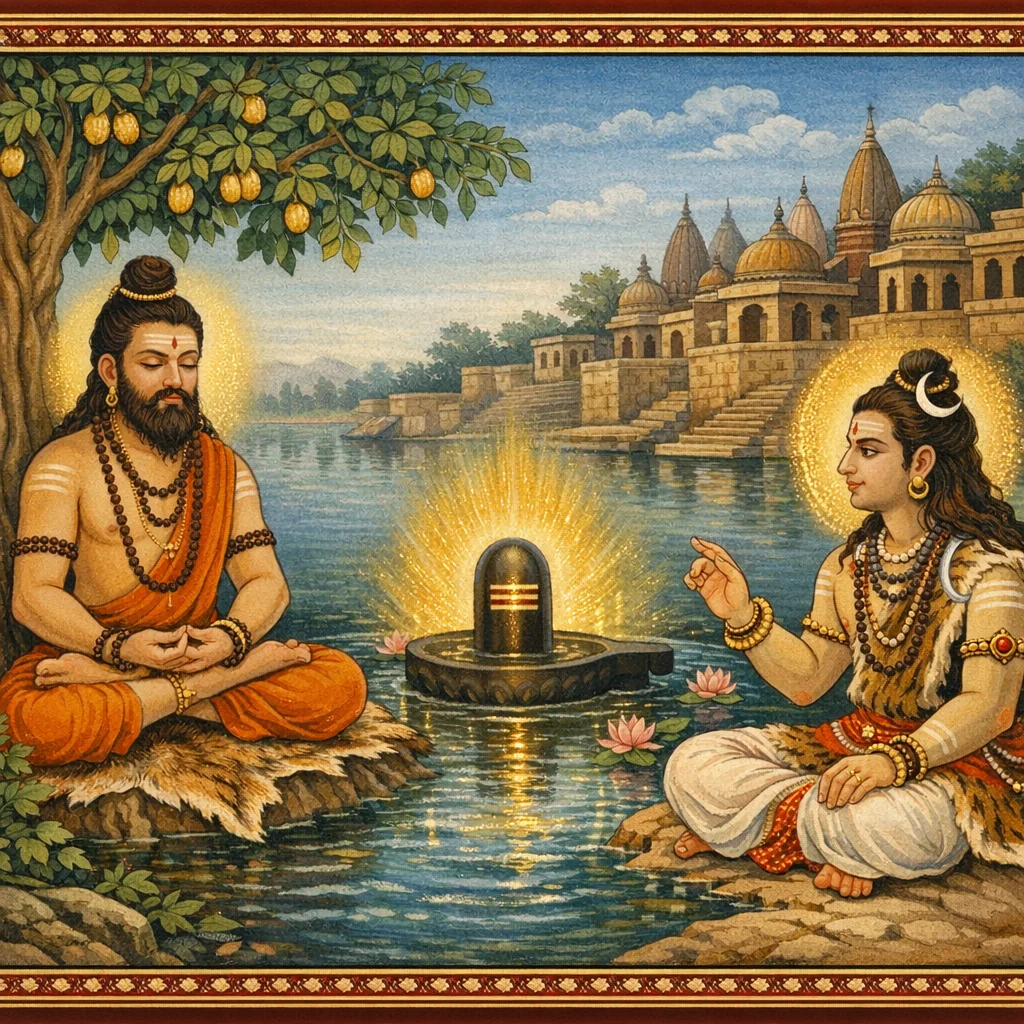
Adhyaya 40
Arjuna asks Nārada who Mahākāla is and how He may be attained at a certain tīrtha. Nārada recounts the origin: in Vārāṇasī the ascetic Māṇḍi performs prolonged Rudra-japa to obtain a son, and Śiva grants a mighty child. The child remains in the womb for years, fearing the “kāla-mārga” (the karmic course) as opposed to the “arcis” path linked with liberation; by Śiva’s grace and the personified vibhūtis (virtues/powers), he is born and named Kālabhīti. As an accomplished Pāśupata devotee, Kālabhīti undertakes tīrtha-yātrā and intense mantra-japa beneath a bilva tree, entering profound bliss and discerning the site’s exceptional purity. During a century-long vow, a mysterious man offers him water; they debate purity, knowledge of lineage, and the ethics of accepting gifts, until a miracle proves the point—a pit fills and becomes a lake. The man vanishes, a colossal liṅga self-manifests amid celestial celebration, and Kālabhīti offers a many-faced Śiva-stotra. Śiva appears, praises his dharma, and grants boons: perpetual presence at the svayaṃbhū liṅga, imperishable fruit for worship and gifts there, and the merit of all tīrthas for bathing and ancestral tarpaṇa in the adjacent well, with special calendrical observances. Later King Karaṅdhama asks how water-offerings reach the ancestors and how śrāddha works. Mahākāla explains subtle reception through tattva and sensory essences, the necessity of mantra-mediated offering, the protective purpose of darbha/tila/akṣata against disruptive forces, and the four yugas with their dominant dharmas—Satya: dhyāna, Tretā: yajña, Dvāpara: observance/vrata, Kali: dāna—along with a sketch of Kali-yuga conditions and future restoration themes.
Shlokas
Verse 1
अर्जुन उवाच । महाकालस्त्वसौ कश्च कथं सिद्धिमुपागतः । अस्मिंस्तीर्थे मुनिश्रेष्ठ महदाश्चर्य मत्र मे
Arjuna said: “Who indeed is this Mahākāla, and how did he attain perfection? O best of sages, at this sacred ford my wonder is great.”
Verse 2
सर्वमेतत्समाख्याहि श्रद्दधानाय पृच्छते
“Explain all this fully to me, for I ask with faith.”
Verse 3
नारद उवाच । नमस्कृत्य महाकालं वरदं स्थाणुमव्ययम् । शक्तितश्चरितं तस्य वक्ष्ये पांडुकुलोद्वह
Nārada said: “Having bowed to Mahākāla—the boon-giver, the steadfast Lord, the imperishable—I shall recount his deeds as best as my ability allows, O foremost of the Pāṇḍu line.”
Verse 4
वाराणस्यां पुरि पुरा बभूव जपतां वरः । रुद्रजापी महाभागो मांटिर्नाम महायशाः
Formerly, in the city of Vārāṇasī, there lived a most excellent chanter—fortunate and renowned—named Māṃṭi, devoted to the japa of Rudra.
Verse 5
तस्यापुत्रस्य पुत्रार्थे रुद्रान्संजपतः किल । गतं वर्षशतं तुष्टस्ततस्तं प्राह शंकरः
He, being without a son, is said to have intensely chanted Rudra for the sake of obtaining a child. When a hundred years had passed, Śaṅkara, pleased, spoke to him.
Verse 6
मांटे तव सुतो धीमान्मत्प्रभावपराक्रमः । वंशस्य तव सर्वस्य समुद्धर्ता भविष्यति
O Māṃṭi, you shall have a wise son, valorous through my own power; he will become the deliverer and upholder of your entire lineage.
Verse 7
इति श्रुत्वा रुद्रवचो मांटिर्हर्षं परं गतः । ततः काले कियन्मात्रे पत्नी मांटेर्महात्मनः
Hearing these words of Rudra, Māṃṭi was filled with supreme joy. Then, after some time had passed, the wife of that great-souled Māṃṭi…
Verse 8
दधार गर्भं चटिका तपोमूर्तिधरा यथा । तस्य गर्भस्य वर्षाणि चत्वारि किल संययुः
Caṭikā conceived, as though she bore an embodied form of austerity itself. It is said that four years passed for that pregnancy.
Verse 9
न पुनर्मातुरुदरंत्यक्त्वा निर्गच्छते बहिः । ततो मांटिरुपामंत्र्य सामभिस्तमवोचत
But even after leaving the mother’s womb, he did not come forth outside. Then Māṃṭi, approaching and formally addressing him with Sāman-chants, spoke to him.
Verse 10
वत्स सामान्यपुत्रोऽपि पित्रोः सुखकरः सदा । शुद्धायां मातरी भवोमत्तः किं पीडयस्यलम्
O dear child, even an ordinary son is always a source of joy to his parents. When the mother is pure, what is the need for you to torment her so much from within?
Verse 11
वत्स मानुष्यवासस्य स्पृहा तुभ्यं कथं न हि । यत्र धर्मार्थकामानां मोक्षस्यापि च संततिः
O child, how could you not yearn for life among humans—where dharma, artha, and kāma may be continually attained, and even mokṣa is possible?
Verse 12
कदामनुष्या जायेम पूजा यत्र महाफला । पितॄणां देवतानां च नानाधर्माश्च यत्र हि
When shall we be born as humans, where worship bears great fruit—where offerings to the ancestors (pitṛ) and to the gods, and many forms of dharma, are truly possible?
Verse 13
इति भूतानि शोचंति नानायोनिगतान्यपि । तत्त्वं मानुष्यमतुलं स्पृहणीयं दिवौकसाम् । अनादृत्य कथं ब्रूहि स्थितश्चोदर एव च
Thus do beings, though born in many kinds of wombs, lament: “In truth, human life is incomparable, desired even by the gods. Yet you disregard it—tell me, how can you remain only within the belly?”
Verse 14
गर्भ उवाच । तात जानाम्यहं सर्वमेतत्परम दुर्लभम् । किं तु बिभेमि चातिमात्रं कालमार्गस्य नित्यशः
The embryo said: “Father, I know all this—that it is exceedingly rare. Yet I constantly fear, to an extreme degree, the path of Kāla, of Time.”
Verse 15
द्वौ मार्गौ किल वेदेषु प्रोक्तौ कालोऽर्चिरेव च । अर्चिषा मोक्षमायांति कालमार्गेण कर्मणि
Indeed, the Vedas speak of two paths: the path of Time (Kāla) and the path of Light. By the path of Light they attain mokṣa; by the path of Time they return to karma, to action.
Verse 16
स्वर्गे वा नरके वापि कालमार्गगतो ह्ययम् । न शर्म लभते क्वापि व्याधविद्धमृगो यथा
Whether in heaven or in hell, one who has entered the path of Time finds peace nowhere—like a deer pierced by a hunter’s arrow.
Verse 17
तस्यैव हेतोः प्रयतेत्कोविदो यन्न दुःखवित् । कालेन घोररुपेण गंभीरेण समाहितः
For that very reason, a wise person—one who would not be a knower of suffering—should strive earnestly, being fully mindful of Time in its dreadful and unfathomable form.
Verse 18
तच्चेन्मम मनस्तात नानादोषैर्न मोह्यते । ततोऽहं दुर्लभं जन्म मानुष्यं शीघ्रमाप्नुयाम्
If my mind, O father, is not deluded by various faults, then may I swiftly obtain the rare birth as a human.
Verse 19
ततस्तस्य पिता पार्थ कांदिशीको महेश्वरम् । जगाम शरणं देवं त्राहित्राहि महेश्वर
Then his father, O descendant of Pṛthā, Kāṃdiśīka, went for refuge to Maheśvara, the God, crying, ‘Save (us), save (us), O Maheśvara!’
Verse 20
त्वां विना कोऽपरो देव पुत्रस्याभीष्टदोऽस्ति मे । त्वयैव दत्तस्त्वं चामुं जन्म प्रापय मे सुतम्
O God, apart from you who else can grant my son what is desired? He was given by you alone—therefore, you yourself should bring my son safely into birth in this world.
Verse 21
ततस्तस्यातिभक्त्यासौ प्राह तुष्टो महेश्वरः । विभूतीः स्वाधर्मज्ञानवैराग्यैश्वर्यमेव च
Then Maheśvara, pleased by his intense devotion, spoke and bestowed the Vibhūtis—divine powers—together with knowledge of one’s own dharma, dispassion (vairāgya), and true lordly prosperity.
Verse 22
विपरीतश्च शीघ्रं भो मांटिपुत्रः प्रबोध्यताम् । ततस्ता द्योतयंत्यश्च विभूत्यो गर्भमूचिंरे
“Let Māṃṭi’s son be awakened quickly, O Lord, and let the adverse condition be reversed!” Then the radiant Vibhūtis, shining forth, addressed the womb.
Verse 23
महामते मांडिपुत्र न धार्यं ते भयं हृदि । चत्वारस्त्वां हि धर्माद्या मनस्त्यक्ष्यामहे न ते
“O noble-minded son of Māṃḍi, do not hold fear in your heart. For we four—beginning with Dharma—will not abandon your mind and inner resolve.”
Verse 24
ततोऽपरास्त्वधर्माद्याः प्रोचुर्नैव तथा वयम् । भविष्यामो मनस्तुभ्यमस्मत्तव भयं न हि
Then others—beginning with Adharma—said, “Not so; we too will cling to your mind. From us, surely, fear will arise for you.”
Verse 25
इत्युक्ते स विभूतीभिः शीघ्रमेव कुमारकः । निःससार बहिर्जातश्चकंपेतिरुरोद च
When this was spoken by the Vibhūtis, the boy quickly came forth—born into the outer world—and, trembling, he cried.
Verse 26
ततो विभूतयः प्राहुर्मांटे तव सुतस्त्वसौ । अद्यापि कालमार्गस्य भीतः कम्पति रोदिति
Then the Vibhūtis said, “O Māṃṭi, this indeed is your son. Even now he fears the path of Time (Death); therefore he trembles and weeps.”
Verse 27
कालभीतिरिति ख्यातस्तस्मादेष भविष्यति । इति दत्त्वा वरं ताश्च महादेवांतिकं ययुः
Therefore he will become renowned by the name “Kālabhīti” (Fear of Time/Death). Having thus granted the boon, they went into the presence of Mahādeva.
Verse 28
सोऽपि बालः प्रववृधे शुक्लपक्ष इवोडुपः । संस्कृतः स च संस्कारैर्धीमान्पशुपतिव्रती
That child too grew, like the moon in the bright fortnight. He was duly refined by the sacraments (saṃskāras), intelligent, and a keeper of the vow of Paśupati (Śiva).
Verse 29
पंचमंत्राञ्जपञ्छुद्धस्तीर्थयात्रापरोऽभवत् । रुद्रक्षेत्रेषु सस्नौ स जपन्मन्त्रांश्च भारत
Purified by repeating the five mantras, he became devoted to pilgrimage. O Bhārata, he bathed in Rudra’s sacred regions while continually reciting mantras.
Verse 30
कालभीतिगुप्तक्षेत्रगुणाञ्छ्रुत्वाभ्युपाययौ । स्नात्वा ततो महीतोये जप्त्वा मन्त्रांश्च कोटिशः
Having heard the excellences of the sacred, hidden kṣetra, Kālabhīti approached it. Then, bathing there in the earth-born waters (a natural holy pool), he chanted mantras countless times—by the koṭi.
Verse 31
निवृत्तो नातिदूरेथ बिल्ववृक्षं ददर्श सः । दृष्ट्वा तं तस्य चाधस्तल्लक्षमेकं जजाप सः
Turning back, not far from there he saw a bilva tree. Seeing it, and beneath it, he repeated his japa to the count of one lakṣa (one hundred thousand).
Verse 32
जपतस्तस्य विप्रस्य इंद्रियाणि लयं ययुः । केवलं परमानंदस्वरूपोऽसावभूत्क्षणात्
As that brāhmaṇa continued his japa, his senses dissolved into stillness; in an instant he became nothing but the very form of supreme bliss.
Verse 33
तस्यानंदस्य नौपम्यं स्वर्गादीनां भवेत्क्वचित् । गंगोदकस्येव मानं केवलं सोऽप्यसावपि
That bliss has no true comparison with heaven and the like. Its “measure” can only be known by itself—just as the real measure of Gaṅgā-water is grasped only by Gaṅgā-water itself.
Verse 34
तत्र लीनो मुहुर्तेन पुनश्चाभूद्यथा पुरा । ततो विसिष्मिये पार्थ कालभीतिरुवाच ह
Absorbed there for a short while, he again became as before. Then, astonished, Kālabhīti spoke—O Pārtha.
Verse 35
नायं मम महानन्दो वाराणस्यां न नमिषे । न प्रभासे न केदारे न चाप्यमरकण्टके
This great bliss of mine is not found in Vārāṇasī, nor at Naimiṣa; not at Prabhāsa, not at Kedāra, nor even at Amarakaṇṭaka.
Verse 36
श्रीपर्वते न चान्यत्र यादृशोद्यप्रवर्त्तते । निर्विकाराणि स्वच्छानि गंगांबांसीवखानि मे
Not on Śrīparvata, nor anywhere else, has there arisen in me today a state like this. My inner faculties have become unchanging and crystal-clear—like channels filled with Gaṅgā-water.
Verse 37
भूतेषु परमा प्रीतिस्त्रिजगद्द्योतते स्फुटम् । धर्ममेकं परं मह्यं चेतश्चाप्यवगच्छति
A supreme love for all beings has arisen; the three worlds shine forth clearly to me. And my mind understands one highest dharma as truly paramount.
Verse 38
अहो स्थानप्रभावोऽयं स्फुटं चाप्यत्र प्रोच्यते । निर्दोषं यच्छुचि स्तान सर्वोपद्रववर्जितम्
Ah—this is the manifest power of the place, clearly proclaimed here. It is a spotless, pure sanctuary, free from every affliction and disturbance.
Verse 39
तत्र स्थितस्य धर्मार्थस्तद्वद्भूयात्सहस्रधा । तदस्माच्च प्रभावाद्धि जानामीतः स्वचेतसि
For one who abides there, dharma and artha increase a thousandfold accordingly. And by that very power, I know this directly within my own heart.
Verse 40
विशिष्टं काशिमुख्येभ्यस्तीर्थेभ्यः स्थानकं त्विदम् । तस्मादत्रैव संस्थोहं तपस्तप्स्यामि पुष्कलम्
This sacred spot is distinguished even among the foremost pilgrimage places, beginning with Kāśī. Therefore, remaining right here, I shall undertake abundant austerity.
Verse 41
इदं चेदं तीर्थमिति सदा यस्तृषितश्चरेत् । न स सिद्धिमवाप्नोति क्लेशेनैव म्रियेत सः
One who, driven by craving, keeps roaming—ever saying, “This is the tīrtha, that is the tīrtha”—does not attain spiritual success; he would die only in hardship.
Verse 42
इति संचिंत्य बिल्वस्य वृक्षस्याधो व्यवस्थितः । जजाप मन्त्रान्रुद्रस्य अंगुष्ठाग्रेण धिष्ठितः
Having reflected thus, he stationed himself beneath a bilva tree and began to recite Rudra’s mantras in japa, seated in steady concentration with the thumb-tip as his support (in a fixed yogic posture).
Verse 43
गृहीत्वा नियमं तोयबिंदुं वर्षशतेऽग्निवत् । ततो वर्षशते याते जपतस्तस्य भारत
Observing a strict vow—taking only a drop of water—he endured like fire for a hundred years. And when that hundred years had passed as he continued his japa, O Bhārata, …
Verse 44
कश्चित्तो यभृतं कुम्भं गृहीत्वा नर आव्रजत् । सतं प्रणम्य प्राहेदं कालभीतिं प्रहर्षतः
Then a certain man came, carrying a pot filled with water. Bowing to that saintly ascetic, he joyfully spoke these words to Kālabhīti.
Verse 45
अद्य ते नियमः पूर्णस्तोयमेतन्महामते । गृहाण सफलं मह्यं श्रमं कर्तुमिहार्हसि
Today your vow is fulfilled, O great-minded one; here is this water. Please accept it, so that my effort here may become fruitful.
Verse 46
कालभीतिरुवाच । को भवान्वर्णतो ब्रूहि किमाचारश्च तत्त्वतः । जन्माचारौ विदित्वा ते ग्रहीष्याम्यन्यथा न हि
Kālabhīti said: “Who are you? Tell me your varṇa. And in truth, what is your conduct? Only after knowing your birth and your way of life will I accept it from you—otherwise, never.”
Verse 47
नर उवाच । न जाने पितरौ स्वीयौ नष्टौ वा सर्वथा न हि । एवमेवापि पश्यामि सर्वदाऽहं स एव च
The man said: “I do not know my own parents, nor do I know whether they are utterly lost. I see only this: I am always the same, and so too is my condition.”
Verse 48
आचारैश्चापि धर्मैश्च न कार्यं मम किंचन । तस्माद्वक्ष्यामि नाप्येतन्न चाप्यस्मि समाचरे
“As for customary conduct and the duties of dharma, I have nothing to do with them. Therefore I speak plainly: I possess none of these qualifications, nor do I practice proper conduct.”
Verse 49
कालभीतिरुवाच । यद्येवं नोदकं तुभ्यं ग्रहीष्याम्यस्मि कर्हिचित् । श्रृणुष्वात्र वचो यन्मे गुरुराह श्रुतीरितम्
Kālabhīti said: “If that is so, I will never accept water from you. Hear now the words my guru taught me, as proclaimed in the Śruti.”
Verse 50
न ज्ञायते कुलं यस्य बीजशुद्धिं विना ततः । तस्य खादन्पिबन्वापि साधुः सीदति तत्क्षणात्
If a person’s lineage cannot be ascertained without first verifying the purity of his origin (bīja-śuddhi), then even a righteous man who eats or drinks what belongs to him falls into misfortune at once.
Verse 51
यश्च रुद्रं न जानाति रुद्रभक्तश्च यो नहि । अन्नोदकं तस्य भुञ्जन्पातकी स्यान्न संशयः
Whoever does not know Rudra and is not a devotee of Rudra—by consuming that person’s food and water one becomes sinful, without doubt.
Verse 52
अज्ञात्वा यः शिवं भुक्ते कथ्यते सोऽत्र ब्रह्महा । मार्ष्टि च ब्रह्महान्नादे तस्मात्तस्य न भक्षयेत्
He who partakes (of food) without recognizing Śiva (present therein) is here declared a ‘slayer of Brahman.’ Moreover, the eater of a Brahma-slayer’s food becomes tainted; therefore one should not eat that.
Verse 53
गंगोदकुम्भः स्याद्यद्वत्तन्मध्ये मद्य बिंदुना । अशिवज्ञस्य यो भुंक्ते शिवज्ञोऽपि तथैव सः
Just as a pot of Gaṅgā-water is spoiled by a single drop of liquor mixed within it, so too one who eats the food of a person ignorant of Śiva becomes the same—even if he is a knower of Śiva.
Verse 54
हीनवर्णश्च यः स्याद्धि शिवभक्तोऽपि नैव सः । प्रतिगृह्यौ गुणौ तस्माद्विलोक्यौ द्वौ प्रतिग्रहे
Indeed, one of inferior conduct or status is not truly a devotee of Śiva, even if he claims devotion. Therefore, when accepting gifts or hospitality, two qualities must be examined.
Verse 55
नर उवाच । एतेन तव वाक्येन हास्यं संजायते मम । अहो मुग्धोऽसि मिथ्या त्वमपस्मारी जडोऽपि च
Nara said: “By these words of yours, laughter arises in me. Alas, you are deluded; you speak falsely—you are epileptic and dull as well.”
Verse 56
सदा सर्वेषु भूतेषु शिवो वसति नित्यशः । साध्वसाधु ततो वाक्यं नैव निन्दा शिवस्य सा
Śiva ever dwells, unceasingly, in all beings. Therefore speech of what is good or not good is, in truth, no condemnation of Śiva.
Verse 57
आत्मनश्च परस्यापि यः करोत्यंतरो हरम् । तस्य भिन्नदृशो मृत्युर्विदधे भयमुल्बणम्
Whoever makes a division concerning Hara—between himself and another—Death, for that one of split vision, brings about dreadful fear.
Verse 58
अथवा का हि पानीये भवेदशुचिता वद । मृत्तिकोद्भवकुम्भोऽयं पावकेनापि पाचितः
Or else, tell me: how could there be impurity in water? This pot is born of clay and has been baked by fire as well.
Verse 59
पूर्णश्च पयसा कस्मिन्नेषामसुचिता कुतः
And when it is filled with milk, in what way—how at all—could there be impurity in these things?
Verse 60
अथ चेन्मम संसर्गादशुचित्वं च मीयते । तदस्यां संस्थितः पृथ्व्यामहंत्वं च कुतो वद
If impurity is thought to arise from contact with me, then tell me: for one established in this very Earth, from where could any ‘I-ness’—egohood—arise?
Verse 61
कुतः पृथिव्यां चरसि खे त्वं नैव चरस्युत । एवं विचार्यमाणे ते भाषितं मुग्धवद्भवेत्
How is it that you move upon the earth, yet do not move in the sky? When examined thus, your words would seem like the talk of one bewildered.
Verse 62
कालभीतिरुवाच । सर्वभूतेषु चेदेवं शिव एवेति चोच्यते । नास्तिकां मृत्तिका कस्माद्भक्षयंति नभस्यके
Kālabhīti said: If it is proclaimed that in all beings there is only Śiva, then why does clay in the month of Nabhasya (Bhādrapada) ‘consume’—that is, afflict—the unbeliever?
Verse 63
शुद्ध्यर्थं तेन विश्वस्य स्थापिता संस्थितिर्यथा । फलेन पालिता सा च नान्यथा तां श्रृणुष्व च
For the sake of purification, he established the ordered maintenance of the universe; and it is upheld by its own ‘fruit’—its results—not otherwise. Listen to this.
Verse 64
ससर्जेति पुरा धाता रूपात्मकमिदं जगत् । तच्च नामप्रपञ्चेन बद्धं दाम्ना च गौर्यथा
Long ago the Creator (Dhātā) brought forth this world as a realm of forms; and that world is bound by the proliferation of names, like a cow bound by a rope.
Verse 65
स च नामप्रपञ्चस्तु चतुर्द्धा भिद्यते किल । ध्वनिर्वर्णाः पदं वाक्यमित्यास्पदचतुष्टयम्
And that proliferation of names is indeed divided fourfold: sound (dhvani), letters/phonemes (varṇa), word (pada), and sentence (vākya)—these are the four bases.
Verse 66
तत्र ध्वनिर्नादमयो वर्णाश्चाकारपूर्वकाः । पदं शा वमि ति प्रोक्तं वाक्यं चेति शिवं भजेत्
There, sound (dhvani) is of the nature of resonance (nāda), and the letters begin with the vowel “a”. The word is taught as “śā–va–mi”, and the sentence likewise—thus, through this understanding of sacred speech, one should worship Śiva.
Verse 67
तच्चापि वाक्यं त्रिविधं भवेदिति श्रुतेर्मतम् । प्रभुसम्मतमेकं च सुहृत्संमतमेव च
And that sentence (vākya) too, according to the teaching of the Śruti, is said to be threefold: one approved by the Lord/master (prabhu), and one approved by a true friend (su-hṛt) as well.
Verse 68
कांतासंमतमेवापि वाक्यं हि त्रिविधं विदुः । प्रभुः स्वामी यथा भृत्यमादिशत्येतदाचर
And speech approved by the beloved (kāntā) is also included—thus they know utterance to be threefold. As a lord commands a servant, “Do this,” so is the speech approved by the master.
Verse 69
तथा श्रुतिस्मृती चोभे प्राहतुः प्रभुसंमतम् । इतिहासपुराणादि सुहृत्संमतमुच्यते
Likewise, both Śruti and Smṛti proclaim what is “approved by the Lord/master”; and the Itihāsas, Purāṇas, and the like are called what is “approved by a friend”.
Verse 70
सुहृद्वत्प्रतिबोध्यैनं प्रवर्तयति तत्त्वतः । काव्यालापादिकं यच्च कांतासंमतमुच्यते
One should instruct him like a true well-wisher, as a friend (su-hṛt), and set him firmly upon the path of reality. And whatever consists of poetic speech, refined talk, and the like—when approved by the beloved (kāntā), that is, by the noble and discerning—is said to be acceptable.
Verse 71
प्रभुवाक्यं स्मृतं यच्च सबाह्याभ्यंतरं शुचि । सुहृद्वाक्यं तथा शौचं पालयेत्स्वर्गकांक्षया
Remember the words of one’s master and keep purity, outward and inward. Likewise, heed the counsel of a true friend and preserve cleanliness, if one longs for heaven (the higher worlds).
Verse 72
तदेतत्पालनीयं स्याद्भूमिजानां श्रुतिर्वदेत् । त्वया नास्तिक्यवाक्येन चेदेतदभिधीयते
This indeed should be observed—so declares the teaching handed down among those born on earth. But if you speak it in words of disbelief, it should not be accepted in that spirit.
Verse 73
एतेन श्रुतिशास्त्राणि पुराणं च वृतैव किम् । अग्रे सप्तर्षिपूर्वा ये ब्राह्मणाः क्षत्रिया भवन्
If this is so, then what need is there of the Veda, the śāstras, and even the Purāṇas? In ancient times, Brahmins who were preceded by the Seven Ṛṣis became Kṣatriyas in their function.
Verse 74
मुग्धाः सर्वेऽभवन्दक्षा ये हि वेदं गता ह्यनु । तथा वेदांतवचनं सत्त्वस्था ह्यूर्ध्वगामिनः
All who followed the Veda became capable and refined, though formerly deluded. Likewise the teaching of Vedānta: those established in sattva are indeed those who ascend toward higher states.
Verse 75
तिष्ठंति राजसा मध्ये ह्यधो गच्छंति तामसाः । सत्त्वाहारैः सत्त्ववृत्त्या स्वर्गगामी भवेत्ततः
Those driven by rajas remain in the middle; those ruled by tamas go downward. But through sāttvika food and a sāttvika way of life, one becomes a traveler to heaven (the higher realms).
Verse 76
न चैतदप्य सूयामो यद्भूतेषु शिवो न हि । अस्त्येव सर्वभूतेषु श्रृण्वत्राप्युपमानकम्
Let us not be jealous or resentful of this, for it is not that Śiva is absent from beings. Indeed He abides in all creatures—listen here also to an illustration.
Verse 77
यथा सुवर्णजातानि भूषणानि बहूनि च । कानिचिच्छ्रद्धरूपाणि हीनरूपाणि कानिचित्
Just as many ornaments are made of gold—some of excellent form, and some of inferior form—
Verse 78
स्वर्णं सर्वेषु चास्त्येव तथैव स सदाशिवः । हीनरूपं शोधितं सच्छुद्धिमेति न चैकताम्
Gold is indeed present in all those ornaments; likewise, that Sadāśiva is present in all beings. What is of inferior form, when purified, attains true purity—yet it does not become one single identical form (as the others).
Verse 79
तथेदं शोधितं देहं शुद्धं दिवि व्रजेत्स्फुटम् । तस्मात्सर्वात्मना हीनान्न ग्राह्यं बत धीमता
So too, when this body is purified, it becomes pure and clearly goes to the heavenly realm. Therefore, the wise should never accept what is wholly inferior.
Verse 80
चेदिदं शोधयेद्देहं नैव ग्राह्यं समंततः । सर्वतो यः प्रति ग्राही निहाराहारयोर्न च
Even if this body were to be purified, it should not be accepted as fit in every way; for one who indiscriminately accepts from everyone is not purified, either in conduct or in diet.
Verse 81
शुचिः स्यादल्पदिवसात्पाषाणोऽसौ भवेत्स्फुटम् । तस्मात्सर्वात्मना नैव ग्रहीष्येहं जलं स्फुटम्
Even if he becomes “pure” after a few days, his stone-like nature would plainly remain. Therefore, with my whole resolve, I will certainly not accept this water here.
Verse 82
साधुवाप्यथवाऽसाधु प्रमाणं नः श्रुतिः परा । एवमुक्ते स च नरः प्रहसन्दक्षिणेन च
Whether it seems proper or improper, for us the supreme authority is Śruti, the sacred revelation. When this was said, that man laughed, gesturing with his right hand as well.
Verse 83
अंगुष्ठेन लिखन्भूमिं चक्रे गर्तं महोत्तमम् । तत्र चिक्षेप तत्तोयं तेन गर्तः स्म पूरितः
Scratching the ground with his thumb, he made an excellent pit. He cast that water into it, and thus the pit became filled.
Verse 84
अत्यरिच्यत तोयं च चक्रे पादेन संलिखन् । चक्रे सरः पूरितं चाप्यतिरिक्तजलेन तत्
And the water overflowed; then, scraping with his foot, he made a lake. That lake too was filled by the excess water.
Verse 85
तदद्भुतं महद्दृष्ट्वा नैव विप्रो विसिष्मिये । यतो बहुविधं चित्रं भवेद्भूताद्युपासिषु
Seeing that great marvel, the brāhmaṇa was not astonished at all; for among those who worship spirits and the like, many kinds of strange wonders can occur.
Verse 86
तच्चित्रेण न जह्याच्च श्रुतिमार्गं सनातनम्
And because of such strange wonders, one should not abandon the eternal path taught by Śruti.
Verse 87
नर उवाच । अतिमूर्खोसि विप्रत्वं प्रज्ञावादांश्च भाषसे । किं न श्रुतस्त्वया श्लोकः पुराविद्भिरुदीरितः । कूपोन्यस्य घटोऽन्यस्य रज्जुरन्यस्य भारत
The man said: “You are extremely foolish, though you speak learned-sounding words. Have you not heard the verse recited by the wise of old: ‘The well belongs to one, the pot to another, and the rope to yet another, O Bhārata’?”
Verse 88
पायंत्यन्ये पिबंत्यन्ये सर्वे ते समभागिनः । तज्जलं मम कस्मात्त्वं धर्मज्ञो न पिबस्यसि
Some make others drink, some drink themselves—yet all of them are equal sharers. So why do you, who claim to know dharma, not drink this water that is mine?
Verse 89
नारद उवाच । ततो विममृशे श्लोको बहुधा समभागिनाम् । अनिश्चयाद्विचार्यासौ घटाद्यैः समभागिता
Nārada said: Then he reflected in many ways on that verse about “equal sharers”. Being uncertain, he pondered whether equality of share applies through things like the pot and other means.
Verse 90
बहुपोतद्रव्यक्षेपः सर्वैः सा समभागिता । एवं कर्तुः फलैः सर्वैः समं स्याच्च पुनःपुनः
If many people contribute materials in many boatloads, the merit of that work becomes shared equally by all. Thus, again and again, the fruits gained by the principal doer are obtained in equal measure by all the contributors.
Verse 91
यः शुचिश्च शिवं ध्यायन्प्रासादकूपकर्तरि । जलप्रतिग्रहाभावात्पिबतोऽस्य समं फलम्
Any person of pure mind who, meditating on Śiva, drinks the water from the well made by the builder of the temple and the well—since there is no ‘acceptance of a gift’ of water—gains merit equal to that builder.
Verse 92
इति निश्चित्य प्रोवाच कालभीतिर्नरं च तम् । सत्यमेत्किं तु कुंभपयसा गर्तपूरणे
Having thus resolved, Kālabhīti said to that man: “It is true; but with only a potful of water, how can one fill up a pit?”
Verse 93
दृष्ट्वा प्रत्यक्षतो मादृक्कथं पिबति भो वद । साधु वाप्यथवाऽसाधु न पिबेयं कथंचन
“Tell me—how can someone like me drink while seeing it plainly before my eyes? Whether it be proper or improper, I will not drink in any way.”
Verse 94
एवं विनिश्चयं दृष्ट्वास्य स्थिरं कुरुनंदन । पुरुषोऽसौ प्रहस्यैव क्षणादंतर्दधे ततः
Seeing his resolve thus firm, O joy of the Kurus, that man merely laughed—and in an instant vanished from there.
Verse 95
कालभीतिश्च परमं विस्मयं समुपागतः । वृत्तांतः कोयमित्येव चिंतयामास भूयसा
Kālabhīti was seized by profound amazement and pondered deeply: “What is this—what has happened here?”
Verse 96
ततश्चिंतयतस्तस्य बिल्वाधस्तात्सुशोभनम् । उच्छ्रितं सुमहालिंगं पृथिव्या द्योतयद्दिशः
Then, as he was reflecting, beneath the bilva tree there appeared a splendid, lofty Great Liṅga, illuminating the directions upon the earth.
Verse 97
प्रादुर्भावे ततस्तस्य महालिंगस्य भारत । ननर्त खेप्सरोवृंदं गधर्वा ललितं जगुः
At the manifestation of that Great Liṅga, O Bhārata, hosts of apsarases danced in the sky, and gandharvas sang sweetly.
Verse 98
पारिजातमयीं पुष्पवृष्टिमिंद्रो मुमोच ह । जयेति देवा मुनयस्तुष्टुवुर्विविधैः स्तवैः
Indra released a shower of pārijāta blossoms; the gods and sages cried “Victory!” and praised (the Lord) with many hymns.
Verse 99
तस्मिन्महति कौरव्य वर्तमाने महोत्सवे । कालभीतिः प्रमुदितः प्रणम्य स्तोत्रमैरयत्
While that great festival was taking place, O Kauravya, Kālabhīti, filled with joy, bowed down and began to utter a hymn of praise.
Verse 100
पापस्य कालं भवपंककालं कलाकलं कालमार्गस्य कालम् । देवं महाकालमहं प्रपद्ये श्रीकालकंठं भवकालरूपम्
I take refuge in Mahākāla, the Lord who is the death of sin, the destroyer of the mire of worldly becoming, the very Time that governs the path of Time—Śrī Kālakaṇṭha, whose own form is Time that ends the cycle of existence.
Verse 101
ईशानवक्त्रं प्रणमामि त्वाहं स्तौति श्रुतिः सर्वविद्येश्वरस्त्वम् । भूतेश्वरस्त्वं प्रपितामहस्त्वं तस्मै नमस्तेस्तु महेश्वराय
I bow to Your Īśāna face. The Vedas themselves praise You—you are the Lord of all knowledges, the Lord of beings, the primordial Grandsire. Therefore, obeisance to You, O Maheśvara.
Verse 102
यं स्तौति वेदस्तमहं प्रपद्ये तत्पुरुषसंज्ञं शरणं द्वितीयम् । त्वां विद्महे तच् नस्त्वं प्रदेहि श्रीरुद्र देवेश नमोनमस्ते
I take refuge in Him whom the Veda praises—the second refuge, known as Tatpuruṣa. We know You; grant that very grace to us. O Śrī Rudra, Lord of gods, again and again obeisance to You.
Verse 103
अघोरवक्त्रं त्रितयं प्रपद्ये अथर्वजुष्टं तव रूपकाणि । अघोरघोराणि च घोरघोराण्यहं सदानौमि भूतानि तुभ्यम्
I take refuge in Your Aghora face—the third. Your forms are cherished in the Atharva tradition. Whether gentle or terrifying, I ever bow to all the beings that belong to You and move under Your lordship.
Verse 104
चतुर्थवक्त्रं च सदा प्रपद्ये सद्योभिजाताय नमोनमस्ते । भवेभवेनादिभवो भवस्व भवोद्भवो मां शिव तत्रतत्र
I ever take refuge in Your fourth face, Sadyojāta—obeisance, again and again. In every birth, be my primal origin; O Śiva, born beyond becoming, protect and guide me there and there, wherever I may be.
Verse 105
नमोस्तु ते वामदेवाय ज्येष्ठरुद्राय कालाय कलाविकारिणे । बलंकरायापि बलप्रमाथिने भूतानि हंत्रे च मनोन्मनाय
Salutations to You as Vāmadeva, as Jyeṣṭha-Rudra; to You as Time, who transforms the measures of time; to the giver of strength and the subduer of all strength; to the slayer of hostile beings; and to Manonmanā, the One beyond the mind.
Verse 106
त्रियंबकं त्वां च यजामहे वयं सुपुण्यगंधैः शिवपुष्टिवर्धनम् । उर्वारुकं पक्वमिवोग्रबंधनाद्रक्षस्व मां त्र्यंबक मृत्युमार्गात्
We worship You, O Tryambaka, Three-eyed Lord, with most holy fragrances—You who increase auspicious well-being. As a ripe cucumber is freed from a harsh bond, so deliver and protect me, O Tryambaka, from the path of death.
Verse 107
षडक्षरं मंत्रवरं तवेश जपंति ये मुनयो वीतरागाः । तेषां प्रसन्नोऽसि जपामहेतं त्वोंकारपूर्वं च नमः शिवाय
O Lord Īśa, the passionless sages chant in japa Your supreme six-syllabled mantra; to them You are gracious. We too chant that mantra, preceded by Oṃ: “Namaḥ Śivāya.”
Verse 108
एवं स्तुतो महादेवो लिंगान्निःसृत्य भारत । त्रिजगद्द्योतयन्मभासा प्रत्यक्षः प्राह च द्विजम्
Thus praised, O Bhārata, Mahādeva emerged forth from the Liṅga. Radiating a great splendor that illumined the three worlds, He became visible and spoke to the twice-born.
Verse 109
यत्त्वयात्र महातीर्थे भृशमाराधितो द्विज । तेनाति तुष्टस्ते वत्स नेशः कालः कथंचन
Because here, at this great sacred ford, you have worshiped Me with deep intensity, O twice-born—thereby I am exceedingly pleased with you, dear child; never again shall Time (Kāla) have mastery over you in any way.
Verse 110
अहं च नररूपी यो दृष्ट्वा ते धर्मसंस्थितिम् । धन्यस्तद्धर्ममार्गोऽयं पाल्यते यद्भवद्विधैः
“Even I—though in human form—having seen your steadfast establishment in Dharma, declare: blessed indeed is this path of righteousness, for it is protected and upheld by the noble like you.”
Verse 111
सर्वतीर्थोदकैर्गरतः पूरितो मे सरस्तथा । जलमेतन्महापुण्यं त्वदर्थं मे समाहृतम्
My reservoir too has been filled with waters brought from all sacred tīrthas. This water is of supreme merit; I have gathered it for your sake.
Verse 112
सप्तमंत्ररहस्यं च यत्कृतं स्तवनं मम । अनेन पठ्यमानेन सप्तमंत्रफलं भवेत्
The secret of the seven mantras has been embodied in this hymn of mine. When it is recited, it yields the very fruit of the seven-mantra practice.
Verse 113
अभीष्टं च वरं मत्तो वृणीष्व मनसेप्सितम् । त्वयातितोषितो ह्यस्मिनादेयं विद्यते तव
Choose from me any boon you desire—whatever your heart longs for. For you have greatly pleased me; here there is nothing that should be withheld from you.
Verse 114
कालभीतिरुवाच । धन्योऽस्म्यनुगृहीतोऽस्मि यत्त्वं तुष्टोऽसि शंकर । त्वत्तोषात्सफला धर्माः श्रमायैवान्यतामताः
Kālabhīti said: “Blessed am I; I am truly graced, since you are pleased, O Śaṅkara. When you are satisfied, all dharmic acts bear fruit; otherwise they are deemed mere toil.”
Verse 115
यदि तुष्टोऽसि सांनिद्यं लिंगेऽत्र क्रियतां सदा । अक्षयं तत्कृतं चास्तु यल्लिंगे क्रियतेऽत्र च
If you are pleased, then may your abiding presence be established forever in this liṅga. And may whatever is done here for this liṅga become imperishable, of unfailing merit.
Verse 116
जपतो यत्फलं देवपंचमंत्रायुतेन च । तत्फलं जायतां नणामस्य लिंगस्य दर्शने
Whatever fruit arises from japa of the divine five-syllabled mantra repeated ten thousand times—may that very fruit arise merely by the darśana (sacred sight) and reverent salutation of this liṅga.
Verse 117
कालमार्गादहं यस्मान्मोचितोऽहं महेश्वर । महाकालमिति ख्यातं लिंगं तस्माद्भवत्विदम्
Since I have been released from the path of Time (death), O Maheśvara, therefore let this liṅga become renowned by the name “Mahākāla”.
Verse 118
अस्मिंश्च कूपे यो मर्त्यः स्नात्वा तर्पयते पितॄन् । सर्वतीर्थफलं चास्तु पितॄणामक्षया गतिः
And whoever among mortals bathes in this well and offers tarpaṇa to the Pitṛs—may he obtain the fruit of all tīrthas, and may the Pitṛs attain an imperishable blessed state.
Verse 119
इति तस्यवचः श्रुत्वा प्रीतस्तं शंकरोऽब्रवीत् । स्वायंभुवं यत्र लिंगं तत्र नित्यं वसाम्यहम्
Hearing his words, Śaṅkara—pleased—said to him: “Wherever there is a self-manifest (svāyaṃbhuva) liṅga, there I dwell eternally.”
Verse 120
स्वयंभुबाणरत्नोत्थदातुपाषाणलोहजम् । लिंगं क्रमेण फलदमंत्यात्पूर्वं दशोत्तरम्
The Liṅga—whether self-manifest, fashioned from an arrow, born of a jewel, made of mineral, stone, or metal—bestows its fruits in due order; and the earlier ones are said to grant tenfold more than the later.
Verse 121
आकाशे तारकालिंगं पाताले हाटकेश्वरम् । स्वायंभुवं धारपृष्ठे तदेतत्त्रितयं समम्
In the heavens stands the Tārakā-liṅga; in the netherworld stands Hāṭakeśvara; and upon Dhārā’s surface stands the self-manifest Liṅga. This triad is equal in sanctity and in power.
Verse 122
विशेषात्प्रार्थितं यच्च तच्च भविष्यति । अत्र पुष्पं फलं पूजा नैवेद्यं स्तवनक्रिया
Whatever is prayed for here with special earnestness shall surely come to pass. Here, offerings of flowers and fruits, pūjā, naivedya (food oblations), and acts of praise are all especially efficacious.
Verse 123
दानं वान्यश्च यत्किंचिदक्षयं तद्भविष्यति । माघासितचतुर्दश्यां शिवयोगे च पुत्रक
Charity (dāna)—or any other pious act whatsoever—becomes inexhaustible in merit, especially on the fourteenth day of Māgha’s dark fortnight, when the auspicious Śiva-yoga prevails, my child.
Verse 124
लिंगाच्च पूर्वतः कूपेस्नात्वा यस्तर्पयेत्पितॄन् । सर्वतीर्थफलावाप्तिः पितॄणां चाक्षया गतिः
After bathing in the well to the east of the Liṅga, whoever offers tarpaṇa—libations to the ancestors—attains the fruits of all tīrthas; and for the Pitṛs there arises an imperishable onward state.
Verse 125
तस्यां रात्रौ महाकालं यामेयामे प्रपूजयेत् । यः क्षिपेत्सर्वलिंगेषु स जागरफलं लभेत्
On that night, one should worship Mahākāla in every watch of the night. Whoever makes offerings at all the Liṅgas attains the full fruit of keeping vigil (jāgaraṇa).
Verse 126
जितेंद्रियश्च यो नित्यं मां लिंगेत्र प्रपूजयेत् । भुक्तिमुक्ती न दूरस्थे तस्य नित्यं द्विजोत्तम
O best of the twice-born, for the devotee who has mastered his senses and worships Me daily in this Liṅga-kṣetra, worldly enjoyment and liberation are never far away—they remain ever near to him.
Verse 127
माघे चतुर्दश्यष्टम्यां सोमवारे च पर्वणि । स्नात्वा सरसि योऽभ्यर्च्य लिंगमेतच्छिवं व्रजेत्
In Māgha—on the fourteenth or the eighth lunar day, and also on a Monday that falls on a festival—whoever bathes in the lake and worships this Liṅga goes to Śiva, attaining Śiva’s state.
Verse 128
दानं तपो रुद्रजापः सर्वमक्षयमेव च । त्वं च नन्दी द्वितीयो मे प्रतीहारो भविष्यसि
Charity, austerity, and the repetition of Rudra’s name—all of it becomes truly inexhaustible. And you, Nandī, shall become my second gatekeeper.
Verse 129
कालमार्गजयाद्वत्स महाकाला भिधश्चिरम् । करंधमोऽत्र राजर्षिरचिरादागमिष्यति
O dear one, because he conquered the path of Time, he has long been renowned as ‘Mahākāla’. And here the royal sage Karaṃdhama will arrive before long.
Verse 130
तस्य प्रोच्य भवान्धर्मांस्ततो मल्लोकमाव्रज । इत्युक्त्वा भगवान्रुद्रो लिंगमध्ये न्यलीयत
After teaching him the sacred duties, the Blessed Rudra said, “Then come to My world.” Having spoken thus, Lord Rudra merged back into the very heart of the Liṅga.
Verse 131
महाकालोऽपि मुदितस्तत्र तेपे महत्तपः
Mahākāla too, delighted, performed intense austerities there.
Verse 132
इति महाकालप्रादुर्भावः । नारद उवाच । अथ केनापि कालेन पार्थ राजा करंधमः । विशेषमिच्छुर्धर्मेषु श्रुत्वा तीर्थमहागुणान्
Thus is the manifestation of Mahākāla. Nārada said: At a certain time, the Pārtha king Karaṁdhama—desiring excellence in dharma—heard of the great virtues of the holy tīrthas.
Verse 133
महाकालचरित्रं च तत्रैव समुपाययौ । महीसागर तोयेऽसौ स्नात्वा लिंगान्यथार्चयत्
He reached that very place famed for Mahākāla’s deeds. Bathing in the waters of the earth-ocean, he then worshipped the Liṅgas in due order.
Verse 134
महाकालमनुप्राप्य परमां प्रीतिमागतः । स पश्यन्सुमहालिंगं नातृप्यत जनेस्वरः
Having attained Mahākāla, the lord of men was filled with supreme joy. Gazing upon that exceedingly great Liṅga, he could not be satisfied.
Verse 135
यथा दरिद्रः कृपणो निधिकुम्भमवाप्य च । सफलं जीवितं मेने महाकालं निरीक्ष्य सः
Just as a poor and miserly man, upon obtaining a pot of treasure, deems his life fruitful—so too, on beholding Mahākāla, he considered his life fulfilled.
Verse 136
पंचमंत्रायुतजपफलं यस्येह दर्शनात् । ततः सपर्ययाक्ष्यर्च्य महत्यासौ प्रणम्य च
By mere darśana here one gains the fruit of chanting the five-mantra ten thousand times; then he worshipped with fitting offerings, performed reverent arcana, and bowed down with great devotion.
Verse 137
श्रुत्वा च लिंगप्रवरं महाकालमुपासदत् । ततो रुद्रवचः स्मृत्वा महाकालः स्मयन्निव
Having heard that Mahākāla is foremost among the Liṅgas, he approached to worship. Then, recalling Rudra’s words, Mahākāla seemed, as it were, to smile.
Verse 138
प्रत्युद्गम्य नृपं पूजामर्घं च प्रत्यपादयत् । ततः कुशलप्रश्रादि कृत्वा शांतमुखं नृपः
Going forth to greet the king, he offered him worship and the arghya-offering. Then, after exchanging inquiries of well-being and other courtesies, the king’s face became calm and composed.
Verse 139
महाकालमुपामंत्र्य कथांते वाक्यमब्रवीत् । भगवन्संशयो मह्यं सदाऽयं परिवर्तते
Addressing Mahākāla at the close of their discourse, he said: “O Lord, this doubt within me keeps turning again and again, ever returning.”
Verse 140
यदिदं तर्पणंनाम पितॄणां क्रियते नृभिः । जलमध्ये जलं याति कथं तृप्यंति पूर्वजाः
When men perform what is called tarpaṇa for the Pitṛs, the offered water merely merges into water itself—how, then, are the ancestors truly satisfied?
Verse 141
एवं पिंडादिपूजा च सर्वमत्रैव दृश्यते । कथमेवं स्म मन्यामः पित्राद्यैरुपभुज्यते
Likewise, the worship with piṇḍas and the rest is all seen to remain right here—how then are we to understand that it is truly enjoyed by the Pitṛs and others?
Verse 142
न चैतदस्ति यत्तेषां नोपतिष्ठति किंचन । स्वप्ने यथाक्रम्य नरं दृश्यंते याचकाश्च ते
Nor is it that nothing at all reaches them; for they are even seen in dreams—approaching a man in due order—like supplicants seeking what has been offered.
Verse 143
देवानां चापि दृश्यंते प्रत्यक्षाः प्रत्ययाः सदा । तत्कथं प्रतिगृह्णन्ति मनो मेऽत्र प्रमुह्यति
Even for the gods, tangible signs and proofs are always seen; so how do they ‘accept’ these offerings? My mind is bewildered about this.
Verse 144
महाकाल उवाच । योनिरेवंविदा तेषां पितॄणां च दिवौकसाम् । दूरोक्तं दूरपूजा च दूरस्तुतिरथापि यत्
Mahākāla said: Such indeed is the mode of existence of the Pitṛs and the dwellers in heaven; even words spoken from afar, worship performed from afar, and praise offered from afar reach them.
Verse 145
भव्यं भूतं भविष्यच्च सर्वं जानंति यांति च । पंचतन्मात्ररूपं च मनोबुद्धिरहंजडाः
They know all—what has been, what is, and what will be—and they also move freely. Their form pertains to the five subtle elements, together with mind, intellect, and the ego-principle (ahaṃkāra).
Verse 146
नवतत्तवमयं देहं दशमः पुरुषो मतः । तस्माद्गंधेन तृप्यंति रसतत्त्वेन ते तथा
The body is held to be made of nine tattvas, and the Puruṣa is regarded as the tenth. Therefore they are satisfied through the principle of smell, and likewise through the tattva of taste, its subtle essence.
Verse 147
शब्दतत्त्वेन तुष्यंति स्पर्शतत्त्वं च गृह्णते । शुचि दृष्ट्वा त तुष्यंति नात्र राजन्भवेन्मृषा
They are pleased through the tattva of sound, and they also take in the tattva of touch. Seeing purity, they are satisfied—O King, there is no falsehood in this.
Verse 148
यता तृणं पशूनां च नराणामन्नमुच्यते । एवं दैवतयोनीनामन्नसारस्य भोजनम्
Just as grass is called the food of animals, and grain or meal is called the food of human beings, so for those born in divine modes, the essence of food is their nourishment.
Verse 149
शक्तयः सर्वभावानामचिंत्या ज्ञानगोचराः । तस्मात्तत्त्वं प्रगृह्णन्ति शेषमत्रैवदृश्यते
The powers (Śakti) within all beings are inconceivable, though knowable through inner insight; therefore they take up the essential principle, while the remainder is seen to stay here alone.
Verse 150
करंधम उवाच । पितृभ्यो दीयते श्राद्धं स्वकर्मवशगाश्च ते । स्वर्गस्था नरकस्था वा कथं तैरुपभुज्यते
Karaṃdhama said: “Śrāddha is offered to the Pitṛs, yet they are bound by their own karma. Whether they abide in heaven or in hell—how can they partake of what is offered by us?”
Verse 151
अथ स्वर्गेऽथ नरेक स्थिताः कर्माभियंत्रिताः । शक्नुवंति वरानेतान्दातुं ते चेश्वराः कथम्
And if they abide in heaven or in hell, constrained by karma—how can they, though called “lords,” be able to bestow such boons?
Verse 152
आयुः प्रजां धनं विद्यां स्वर्गं मोक्षं सुकानि च । प्रयच्छन्तु तथा राज्यं प्रीता नॄणां पितामहाः
May the Pitṛs, the forefathers of men, when pleased, grant long life, offspring, wealth, learning, heaven, liberation (mokṣa), and joys—and also sovereignty.
Verse 153
महाकाल उवाच । सत्यमेततस्वकर्मस्थाः पितरो यन्नृपोत्तम । किं तु देवासुराणां च यक्षादीनाममूर्तकाः
Mahākāla said: “This is true, O best of kings: the Pitṛs abide in states determined by their own karma. Yet there are also subtle, incorporeal beings—among gods, demons (asuras), Yakṣas, and others.”
Verse 154
मूर्ताश्चतुर्णां वर्णानां पितरः सप्तधा स्मृताः । ते हि सर्वे प्रयच्छंति दातुं सर्वं यतोप्सितम्
For the four varṇas, the Pitṛs are remembered as embodied and sevenfold in division. Indeed, all of them can grant whatever is desired.
Verse 155
एकत्रिंशद्गणा येषां पितॄणां प्रबला नृप । कृतं च तदिदं श्राद्धं तर्पयेत्तान्परान्पितॄन्
O king, the Pitṛs whose companies are thirty-one in number are mighty. This Śrāddha, when performed, should satiate and please those supreme ancestors.
Verse 156
ते तृप्तास्तर्पयन्त्यस्य पूर्वजान्यत्र संस्थितान् । एवं स्वानां चोपतिष्ठेच्छ्राद्धं यच्छंति ते वरान्
When they are satisfied, they in turn satiate his forefathers, each abiding in his own realm. Therefore one should duly perform Śrāddha for one’s own lineage; then they bestow boons.
Verse 157
राजोवाच । भूतादिभ्यो यथा विप्र नाम्ना वोद्दिश्य दीयते । सुरादीनां कथं चैव संक्षेपेण न दीयते
The king said: “O brāhmaṇa, just as offerings are given to beings such as bhūtas by specifying their names, why are offerings not likewise given—briefly—to the gods and others?”
Verse 158
इदं पितृभ्यो देवेभ्यो द्विजेभ्यः पावकाय च । एवं कस्माद्विस्तराः स्युर्मनः कायादिकष्टदाः
“‘This is for the Pitṛs, this for the gods, this for the twice-born, and this for Fire’—if it can be said so, then why are there elaborate procedures that strain mind and body?”
Verse 159
महाकाल उवाच । उचिता प्रतिपत्तिश्च कार्या सर्वेषु नित्यशः । प्रतिपत्तिं चोचितां ते विना गृह्णन्ति नैव च
Mahākāla said: “In all matters, at all times, the proper procedure must be followed. Without the appropriate observance, they do not accept the offering at all.”
Verse 160
यथा श्वा गृहद्वारस्थोबलिं गृह्णाति किं तथा । प्रधानपुरुषो राजन्गृह्णाति च शुना समः
Just as a dog standing at a house-door snatches the bali offering placed there, so too, O King, the “chief person” who accepts improper gifts becomes no better than a dog.
Verse 161
एवं ते भूतवद्देवा न हि गृह्णन्ति कर्हिचित् । शुचि कामं जुषंते न हविरश्रद्दधानतः
Thus the gods do not accept such offerings at any time, as though they were meant only for spirits. Even when the oblation is pure, they do not partake of the havis when it is offered without faith (śraddhā).
Verse 162
विना मंत्रैश्च यद्दत्तं न तद्गृह्णन्ति तेऽमलाः । श्रुतिरप्यत्र प्राहेदं मंत्राणां विषये नृप
And whatever is given without mantras, those stainless ones do not accept. Even Śruti, the Vedic revelation, declares this here, O King, concerning the domain of mantras.
Verse 163
मंत्रा दैवता यद्यद्विद्वान्मन्त्रवत्करोति देवताभिरेव तत्करोति यद्ददानि देवतभिरेव तद्ददाति यत्प्रतिगृह्णाति देवताभिरेव तत्प्रतिगृह्णाति तस्मान्नामन्त्रवत्प्रतिगृह्णीयात् नामन्त्रवत्प्रतिपद्यते इति
“Mantras are the very deities. Whatever a learned person performs with mantra, he performs it through the deities themselves. Whatever he gives, he gives through the deities; whatever he receives, he receives through the deities. Therefore one should not accept without mantra; one should not proceed in ritual action without mantra”—so it is declared.
Verse 164
तस्मान्मंत्रैः सदा देयं पौराणैर्वैदिकैरपि । अन्यथा ते न गृह्णन्ति भूतानामुपतिष्ठति
Therefore gifts should always be given with mantras—whether Purāṇic or Vedic. Otherwise they do not accept them, and the offering ends up going to the host of spirits (bhūtas).
Verse 165
राजोवाच । दर्भांस्तिलानक्षतांश्च तोयं चैतैः सुसंयुतम् । कस्मात्प्रदीयते दानं ज्ञातुमिच्छामि कारणम्
The King said: “Why is charity given together with darbha-grass, sesame, akṣata (unbroken grains), and water, all properly combined? I wish to know the reason.”
Verse 166
महाकाल उवाच । पुरा किल प्रदत्तानि भूमेर्दानानि भूरिशः । प्रत्यगृह्णन्त दैत्याश्च प्रविश्याभ्यंतरं बलात्
Mahākāla said: “In ancient times, O mighty king, the gifts of land that had been bestowed were seized back by the Daityas, who forced their way into the sacred sphere of the rite.”
Verse 167
ततो देवाश्च पितरः प्रत्यूचुः पद्मसंभवम्
Then the gods and the Pitṛs replied, addressing Padma-saṃbhava (Brahmā).
Verse 168
स्वामिन्नः पश्यतामेव सर्वं दैत्यैः प्रगृह्यते । विधेहि रक्षां तेषां त्वं न नष्टः स्मो यथा वयम्
“O Lord! Even as we look on, everything is being seized by the Daityas. Establish a protection against them, so that we may not be ruined.”
Verse 169
ततो विमृश्यैव विधी रक्षो पायमचीकरत् । तिलैर्युक्तं पितॄणां च देवानामक्षतैः सह
Then, after due reflection, Vidhī (Brahmā) devised a protective means: for the Pitṛs, the rite joined with sesame; and for the gods, together with akṣata—unbroken grains.
Verse 170
तोयं दर्भांश्च सर्वत्र एवं गृह्णन्ति नासुराः । एतान्विना प्रदत्तं यत्फलं दैत्यैः प्रगृह्यते
Water and darbha-grass are accepted everywhere in this manner—never by the asuras. But whatever fruit of merit is offered without these, that merit is seized away by the Daityas.
Verse 171
निःश्वस्य पितरो देवा यांति दातुः फलं न हि । तस्माद्युगेषु सर्वेषु दानमेव प्रदीयते
Sighing, the Pitṛs and the Devas depart—for the fruit intended by the giver does not arise. Therefore, in all the yugas, charity (dāna) alone should be duly offered, in the proper way.
Verse 172
करंधम उवाच । चतुर्युगव्यवस्थानं श्रोतुमिच्छमि तत्त्वतः । महतीयं विवित्सा मे सदैव परिवर्तते
Karaṃdhama said: “I wish to hear, in truth, the full arrangement of the four yugas. A great desire to understand this keeps continually arising within me.”
Verse 173
महाकाल उवाच । आद्यं कृतयुगं विद्धिततस्त्रेतायुगं स्मृतम् । द्वापरं च कलिश्चेति चत्वारश्च समासतः
Mahākāla said: “Know that the first is the Kṛta Yuga; after it is remembered the Tretā Yuga; then Dvāpara and Kali—these four, in brief.”
Verse 174
सत्त्वं कृतं रजस्त्रेता द्वापरं च रजस्तमः । कलिस्तमस्तु विज्ञेयं युगवृत्तं युगेषु च
Kṛta is of sattva; Tretā is of rajas; Dvāpara is a blend of rajas and tamas; but Kali should be known as tamas. Such is the character of conduct in the yugas.
Verse 175
ध्यानं परं कृकयुगे त्रेतायां यज्ञ उच्यते । वृत्तं च द्वापरे सत्यं दानमेव कलौ युगे
In the Kṛta Yuga, supreme meditation (dhyāna) is declared the highest path. In Tretā, sacrifice (yajña) is taught. In Dvāpara, truthful conduct is the hallmark. But in the Kali Yuga, charity (dāna) alone is the foremost practice.
Verse 176
कृते तु मानसी सृष्टिर्वृत्तिः साक्षाद्रसोल्लसा । तेजोमय्यः प्रजास्तृप्ताः सदानंदाश्च भोगिनः
In the Kṛta Yuga, creation was as if mind-born, and livelihood shone forth directly, rich with essential savor. Beings were radiant by nature, content, ever-blissful, and able to enjoy without lack.
Verse 177
अधमोत्तमो न तासां ता निर्विशेषाः प्रजाः शुभाः । तुल्यमायुः सुखं रूपं तासां तस्मिन्कृते युगे
Among them there was no ‘lowest’ or ‘highest’; those blessed beings were without distinction. Their lifespan, happiness, and appearance were equal for all in that Kṛta Yuga.
Verse 178
न चाप्रीतिर्न च द्वंद्वो न द्वेषो नापि च क्लमः । पर्वतोदधिवासिन्यो ह्यनुक्रोशप्रियास्तु ताः
There was neither displeasure nor conflict, neither hatred nor weariness. Dwelling among mountains and by the oceans, they were indeed lovers of compassion.
Verse 179
वर्णाश्रमव्यवस्था च तदासीन्न हि संकरः । एकमन्यं न ध्यायंति परमं ते सदा शिवम्
The order of varṇas and āśramas existed then, and there was no confusion of duties. They did not meditate on anything else—those people ever contemplated the Supreme Śiva alone.
Verse 180
चतुर्थे च ततः पादे नष्ट साऽभूद्रसोल्लसा । प्रादुरासंस्ततस्तासां वृक्षाश्वगृहसंज्ञिताः
Then, in the fourth quarter of time, that former delight, rich with savor, vanished. Thereupon, for those beings, there appeared things known as “trees,” “horses,” and “houses.”
Verse 181
वस्त्राणि च प्रसूयंते फलान्याभरणानि च । तेष्वेव जायते तासां गंधवर्णरसान्वितम्
Garments came forth, and fruits as well, and ornaments too. And within those very things, for them, there arose what was endowed with fragrance, color, and taste.
Verse 182
सुमाक्षिकं महावीर्यं पुटके पुटके मधु । तेन ता वर्तयंति स्म कृतस्यांते प्रजास्तदा
Pot by pot there was honey—excellent, bee-made, and of great potency. By that, the beings then sustained themselves at the close of the Kṛta age.
Verse 183
हृष्टपुष्टास्तथा वृद्धाः प्रजा वै विगतज्वराः । ततः कालेन केनापि तासां वृद्धे रसेंद्रिये
The people were joyful, well-nourished, and long-lived—indeed free from fever. Then, after some passage of time, their sense for taste increased.
Verse 184
युगभावात्तथा ध्याने स्वल्पीभूते शिवस्य च । वृक्षांस्तान्पर्यगृह्णंत मधु वा माक्षिकं बलात्
Owing to the very nature of the yuga, and as Śiva’s contemplative presence became diminished, they forcibly seized those trees—taking away the honey, the bee-made sweetness.
Verse 185
तासां तेनोपचारेण लोभदोषकृतेन वै । प्रनष्टा मधुना सार्धं कल्पवृक्षाः क्वचित्क्वचित्
Because of that behavior—born of the fault of greed—here and there the wish-fulfilling trees disappeared, along with their honey.
Verse 186
तस्यां चाप्यल्पशिष्टायां द्वंद्वान्यभ्युत्थितानि वै । शीतातपैर्मनोदुःखैस्ततस्ता दुःखिता भृशम्
And when only a little of that abundance remained, the pairs of opposites arose. Troubled by cold and heat and by sorrows of the mind, they became greatly distressed.
Verse 187
चक्रुरावरणार्थं हि केतनानि ततस्ततः । ततः प्रदुर्बभौ तासां सिद्धिस्त्रेतायुगे पुनः
To ward themselves, they built dwellings here and there. Then, in the Tretā Yuga, their new means of livelihood and accomplishment manifested again.
Verse 188
वृष्ट्या बभूवुरौषध्यो ग्राम्यारण्याश्चतुर्दश । अकृष्टपच्यानूप्तास्तोयभूमिसमागमात्
By rainfall there arose medicinal plants—fourteen kinds, both village-grown and forest-born—ripening without ploughing and without sowing, through the meeting of water and earth.
Verse 189
ऋतु पुष्पफलैश्चैव वृक्षगुल्माश्च जज्ञिरे । तैश्च वृत्तिरभूत्तासां धान्यैः पुष्पैः फलैस्तथा
Seasonal flowers and fruits appeared, and trees and shrubs were born. By these their livelihood was sustained—by grains, and likewise by flowers and fruits.
Verse 190
ततः पुनरभूत्तासां रागो लोभश्च सर्वतः । कालवीर्येण वा गृह्य नदीक्षेत्राणि पर्वतान्
Then again, everywhere among them arose passion and greed; and, empowered by the force of Time, they seized rivers, sacred regions, and mountains.
Verse 191
वृक्षगुल्मौषधीश्चैव प्रसह्याशु यथाबलम् । विपर्ययेण चौषध्यः प्रनष्टाश्च चतुर्दश
Trees, shrubs, and medicinal herbs were swiftly overpowered, each according to its strength; and by a perverse reversal, fourteen kinds of herbs were destroyed.
Verse 192
नत्वा धरां प्रविष्टास्ता ओषध्यः पीडिताः प्रजाः । दुदोह गां पृथुर्वैन्यः सर्वभूतहिताय वै
Bowing to the Earth, those medicinal herbs entered into her; the people were afflicted. Then Pṛthu Vainya ‘milked’ the Earth, truly for the welfare of all beings.
Verse 193
तदाप्रभृति चौषध्यः फालकृष्टाः प्रजास्ततः । वार्त्तया वर्तयंति स्म पाल्यमानाश्च क्षत्रियैः
From that time onward, herbs and crops were produced by plough-cultivation; thereafter the people lived by agriculture and trade, being protected by the Kṣatriyas.
Verse 194
वर्णाश्रमप्रतिष्ठा च यज्ञस्त्रेतासु चोच्यते । सदाशिवध्यानमयं त्यक्त्वा मोक्षमचेतनाः
For the Tretā age are spoken the establishment of varṇa and āśrama and the performance of sacrifice; abandoning absorption in meditation on Sadāśiva, the undiscerning seek liberation by other means.
Verse 195
पुष्पितां वाचमाश्रित्य रागात्स्वर्गमसाधयन् । द्वापरे च प्रवर्तंते मतिभेदास्ततो नृणाम्
Relying on flowery speech and, out of attachment, pursuing heaven rather than true attainment, in the Dvāpara age differences of opinion then arise among men.
Verse 196
मनसा कर्मणा वाचा कृच्छ्राद्वार्ता प्रसिध्यति । लोभोऽधृतिः शिवं त्यक्त्वा धर्माणां संकरस्तथा
By mind, by deed, and by speech, one’s livelihood is attained only with hardship. Greed and lack of steadfastness—forsaking Śiva—also bring about confusion and a mingling of dharmas.
Verse 197
वर्णाश्रमपरिध्वंसाः प्रवर्तंते च द्वापरे । तदा व्यासैश्चतुर्द्धा च व्यस्यते द्वापरात्ततः
In the Dvāpara age, the ruin of the varṇa-and-āśrama order begins. Then the Vyāsas arrange the single Veda into four parts—thus it is from Dvāpara onward.
Verse 198
एको वेदश्चतुष्पादैः क्रियते द्विजहेतवे । इतिहासपुराणानि भिद्यंते लोकगौरवात्
The one Veda is made fourfold for the sake of the dvijas (twice-born); and the Itihāsas and Purāṇas too are set apart, for the world’s honor and guidance.
Verse 199
ब्राह्मं पाद्मं वैष्णवं च शैवं भागवतं तथा । तथान्यन्नारदीय च मार्कंडेयं च सप्तमम
They are named: the Brāhma, the Pādma, the Vaiṣṇava, the Śaiva, and likewise the Bhāgavata; also another—the Nāradīya—and the Mārkaṇḍeya as the seventh.
Verse 200
आग्नेयमष्टमं प्रोक्तं भविष्यं नवमं स्मृतम् । दशमं ब्रह्मवैवर्तं लैंगमेकादशं तथा
The Āgneya is declared as the eighth; the Bhaviṣya is remembered as the ninth. The Brahmavaivarta is the tenth, and likewise the Liṅga is the eleventh.