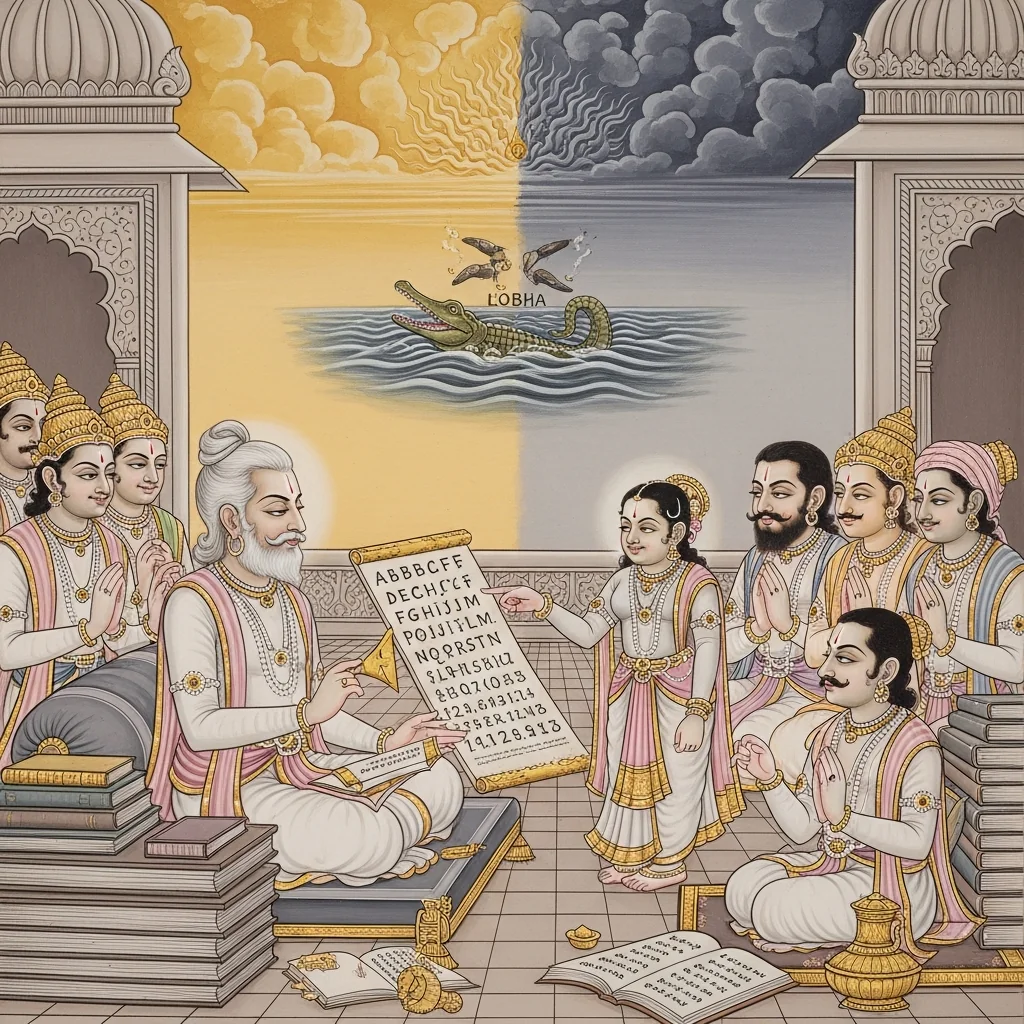
Adhyaya 5
The chapter begins with Nārada setting out toward Mount Raivata, resolved to act “for the sake of brāhmaṇas,” and thus frames an ethical inquiry into dāna (giving) and the fitness of recipients (pātratā). Didactic verses condemn gifts made to the unworthy and warn that an undisciplined or unlearned brāhmaṇa cannot “carry others across,” like a rudderless boat. Proper giving is then defined by right place, time, means, substance, and faith, with pātratā grounded in learning joined to conduct. Nārada poses twelve testing questions and travels to Kalāpagrāma, a great settlement filled with āśramas and śruti-trained brāhmaṇas engaged in debate. Though they deem the questions easy, a child named Sutanu answers them systematically. Sutanu lists the mātṛkā (phonemic set) including oṃkāra, interprets oṃ as A–U–M with the transcendent half-mātrā as Sadāśiva, explains the “five-times-five wondrous house” as a tattva-schema culminating in Sadāśiva, identifies the “many-formed woman” as buddhi, and the “great sea-creature” as lobha (greed) with its moral consequences. He further sets out an eightfold hierarchy of brāhmaṇas by learning and discipline and names calendrical junctures (yugādis, manvantarādis) linked to imperishable merit. The chapter closes by urging life-planning through reflective action, recalling the two paths (arcis and dhūma) from Vedānta, and rejecting ways that deny devas and dharma against śruti-smṛti norms.
Shlokas
Verse 1
नारद उवाच । ततोऽहं धर्मवर्माणं प्रोच्य तिष्ठेद्धनं त्वयि । कृत्यकाले ग्रहीष्यामीत्यागमं रैवतं गिरिम्
Nārada said: “Then, having instructed Dharmavarmā, I told him, ‘Let the wealth remain with you; I shall take it at the proper time of need.’ Saying so, I went to Mount Raivata.”
Verse 2
आसं प्रमुदितश्चाहं पश्यंस्तं गिरिसत्तमम् । आह्वयानं नरान्साधून्भूमेर्भुजमिवोच्छ्रितम्
I was filled with joy as I gazed upon that best of mountains—rising like the uplifted arm of the earth, as though calling noble people toward it.
Verse 3
यस्मिन्नानाविधा वृक्षाः प्रकाशंते समंततः । साधुं गृहपतिं प्राप्य पुत्रभार्यादयो यथा
Upon it, trees of many kinds flourish and shine on every side—just as sons, wives, and other dependents thrive when they attain a virtuous householder.
Verse 4
मुदिता यत्र संतृप्ता वाशंते कोकिलादयः । सद्गुरोर्ज्ञानसंपन्ना यथा शिष्यगणा भुवि
There, delighted and satisfied, cuckoos and other birds sing—like groups of disciples on earth, enriched with knowledge through a true guru.
Verse 5
यत्र तप्त्वा तपो मर्त्या यथेप्सितमवाप्नुयुः । श्रीमहादेवमासाद्य भक्तो यद्वन्मनोरथम्
There, mortals who perform austerities obtain whatever they desire—just as a devotee, approaching Śrī Mahādeva, attains the cherished aim of the heart.
Verse 6
तस्याहं च गिरेः पार्थ समासाद्य महाशिलाम् । शीतसौरभ्यमंदेन प्रीणीतोऽचिंतयं हृदि
Then, O son of Pṛthā, I reached a great rocky slab of that mountain. Refreshed by its cool, gently fragrant breeze, I pondered within my heart.
Verse 7
तावन्मया स्थानमाप्तं यदतीव सुदुर्लभम् । इदानीं ब्राह्मणार्थेऽहं कुर्वे तावदुपक्रमम्
Thus I attained a station exceedingly hard to obtain. Now, for the sake of the brāhmaṇas, I shall begin the necessary undertaking.
Verse 8
ब्राह्मणाश्च विलोक्य मे ये हि पात्रतमा मताः । तथा हि चात्र श्रूयंते वचांसि श्रुतिवादिनाम्
Having observed, I considered those brāhmaṇas to be the most worthy recipients. Indeed, in this matter the sayings of the teachers of the Veda are also heard.
Verse 9
न जलोत्तरणे शक्ता यद्वन्नौः कर्णवर्जिता । तद्वच्छ्रेष्ठोऽप्यनाचारो विप्रो नोद्धरणक्षमः
Just as a boat without a rudder cannot cross water, so too—even if eminent—a brāhmaṇa devoid of right conduct is not capable of delivering others.
Verse 10
ब्राह्मणो ह्यनधीयानस्तृणाग्निरिव शाम्यति । तस्मै हव्यं न दातव्यं न हि भस्मनि हूयते
A brāhmaṇa who does not study the Veda dies down like a grass-fire. To such a one, offerings meant for sacrifice should not be given—for oblations are not poured into ashes.
Verse 11
दानपात्रमतिक्रम्य यदपात्रे प्रदीयते । तद्दत्तं गामतिक्रम्य गर्दभस्य गवाह्निकम्
Whatever is given to an unworthy recipient, bypassing the proper vessel of charity, is like feeding a donkey while neglecting the cow that yields milk.
Verse 12
ऊषरे वापितं बीजं भिन्नभांडे च गोदुहम् । भस्मनीव हुतं हव्यं मूर्खे दानमशाश्वतम्
Like seed sown in barren ground, like cow’s milk poured into a broken vessel, and like oblations (havis) offered into ashes—so is charity given to a fool: it bears no lasting fruit.
Verse 13
विधिहीने तथाऽपात्रे यो ददाति प्रतिग्रहम् । न केवलं हि तद्याति शेषं पुण्यं प्रणश्यति
Whoever gives a gift to one lacking proper observance (vidhi) and unworthy (apātra) not only loses the merit of that gift—his remaining store of merit also perishes.
Verse 14
भूराप्ता गौस्तथा भोगाः सुवर्णं देहमेव च । अश्वश्चक्षुस्तथा वासो घृतं तेजस्तिलाः प्रजाः
Land and water, cows and enjoyments; gold, even one’s very body; horses, eyesight and clothing; ghee (ghṛta), radiance (tejas), sesame, and offspring—all these can be harmed through improper receiving and giving.
Verse 15
घ्नंति तस्मादविद्वांस्तु बिभियाच्च प्रतिग्रहात् । स्वल्पक केनाप्यविद्वांस्तु पंके गौरिव सीदति
Therefore an unlearned man should fear accepting gifts, for they can destroy him. Even by a small gift, the ignorant sinks—like a cow sinking in mud.
Verse 16
तस्माद्ये गूढतपसो गूढस्वाध्यायसाधकाः । स्वदारनिरताः शांतास्तेषु दत्तं सदाऽक्षयम्
Therefore, whatever is given to those who practice hidden austerity and quiet self-study (svādhyāya)—content with their own lawful spouse and tranquil in mind—becomes an imperishable gift (akṣaya), whose merit never wanes.
Verse 17
देशे काल उपायेन द्रव्यं श्रद्धासमन्वितम् । पात्रे प्रदीयते यत्तत्सकलं धर्मलक्षणम्
Whatever is given as a gift—at the proper place and time, in the right manner, with faith, and to a worthy recipient—fully bears the mark of Dharma.
Verse 18
न विद्यया केवलया तपसा वापि पात्रता । यत्र वृत्तिमिमे चोभे तद्वि पात्रं प्रचक्षते
Worthiness to receive gifts arises neither from learning alone nor from austerity alone. A true recipient is said to be one in whom both are found together: right conduct and these qualities.
Verse 19
तेषां त्रयाणां मध्ये च विद्या मुख्यो महागुणः । विद्यां विनांधवद्विप्राश्चक्षुष्मंतो हि ते मताः
Among these three, learning (vidyā) is the foremost great virtue. Without learning, even brāhmaṇas are regarded as blind—though in name they may be deemed ‘possessed of eyes’.
Verse 20
तस्माच्चक्षुष्मतो विद्वान्देशे देशे परीक्षयेत् । प्रश्रान्ये मम वक्ष्यंति तेभ्यो दास्याम्यहं ततः
Therefore, a learned man with true discernment should examine (recipients) from place to place. Those who answer my questions—only to them will I give thereafter.
Verse 21
इति संचिंत्य मनसा तस्माद्देशात्समुत्थितः । आश्रमेषु महर्षीणां विचराम्यस्मि फाल्गुन
Having thus reflected in his mind, he rose from that place. In the month of Phālguna, he wandered through the hermitages of the great sages.
Verse 22
इमाञ्छ्लोकान्गायमानः प्रश्ररूपाञ्छृणुष्व तान् । मातृकां को विजानाति कतिधा कीदृशाक्षराम्
Listen to these verses that I sing as questions: who truly knows the Mātṛkā, the sacred alphabet—how many it is, and what kind of letters it contains?
Verse 23
पंचपंचाद्भुतं गेहं को विजानाति वा द्विजः । बहुरूपां स्त्रियं कर्तुमेकरूपां च वत्ति कः
Which twice-born truly knows the wondrous “house” of five-and-five? And who knows how to make a woman of many forms become of one form—steady and singular?
Verse 24
को वा चित्रकथाबंधं वेत्ति संसारगोचरः । को वार्णवमहाग्राहं वेत्ति विद्यापरायणः
Who, moving within the range of saṃsāra, understands the intricate weaving of narratives? And who, devoted to learning, knows the mighty “seizer” within the ocean?
Verse 25
को वाष्टविधं ब्राह्मण्यं वेत्ति ब्राह्मणसत्तमः । युगानां च चतुर्णां वा को मूलदिवसान्वदेत्
Which best of brāhmaṇas knows the eightfold nature of brāhmaṇahood? And who can state the foundational days—the root measure—of the four yugas?
Verse 26
चतुर्दशमनूनां वा मूलवासरं वेत्ति कः । कस्मिंश्चैव दिने प्राप पूर्वं वा भास्करो रथम्
Who can truly know the primal day of the fourteen Manus? Or on which day did the Sun first obtain his chariot?
Verse 27
उद्वेजयति भूतानि कृष्णाहिरिववेत्ति कः । को वास्मिन्घोरसंसारे दक्षदक्षतमो भवेत्
Who can know what terrifies beings—like a black serpent? And who, in this dreadful cycle of saṃsāra, could be the most supremely capable?
Verse 28
पंथानावपि द्वौ कश्चिद्वेत्ति वक्ति च ब्राह्मणः । इति मे द्वादश प्रश्रान्ये विदुर्ब्राह्मणोत्तमाः
Even of the two paths, some Brahmin may know and explain them. These—my twelve questions—are understood by the best of Brahmins.
Verse 29
ते मे पूज्यतमास्तेषामहामाराधकश्चिरम् । इत्यहं गायमानो वै भ्रमितः सकलां महीम्
They are the most worthy of my worship; for long I have been their devoted worshipper. Saying this and singing it, I wandered over the whole earth.
Verse 30
ते चाहुर्दुःखदाः ख्याताः प्रश्रास्ते कुर्महे नमः । इत्यहं सकलां पृथ्वीं विचिंत्यालब्धब्राह्मणः
And they said: ‘These questions are famed as givers of sorrow; to those questions we bow.’ Thus, after reflecting upon the whole earth, I found no such Brahmin (who could answer).
Verse 31
हिमाद्रिशिखरासीनो भूयश्चिंतामवाप्तवान् । सर्वे विलोकिता विप्राः किमतः कर्तुमुत्सहे
Seated upon the summit of the Himālaya, I again fell into anxiety: ‘I have looked upon all the Brahmins—what, now, can I even attempt to do?’
Verse 32
ततो मे चिंतयानस्य पुनर्जातामतिस्त्वियम् । अद्यापि न गतश्चाहं कलापग्राममुत्तमम्
Then, as I pondered, this thought arose anew within me: “Even now I have not gone to the excellent village called Kalāpa.”
Verse 33
यस्मिन्विप्राः संवसंति मूर्तानीव तपांसि च । चतुराशीतिसाहस्राः श्रुताध्ययनशालिनः
In that place dwell Brahmins—asceticism itself as though embodied—eighty-four thousand of them, rich in Śruti and devoted to Vedic recitation and study.
Verse 34
स्थाने तस्मिन्गमिष्यामीत्युक्त्वाहं चलितस्तदा । खेचरो हिममाक्रम्य परं पारं गतस्ततः
Saying, “I shall go to that place,” I set out then; moving through the sky, I crossed the snowy ranges and reached the far shore beyond.
Verse 35
अद्राक्षं पुण्यभूमिस्थं ग्रामरत्नमहं महत् । शतयोजनविस्तीर्णं नानावृक्षसमाकुलम्
I beheld, set upon holy ground, a great jewel among villages—spreading across a hundred yojanas, thick with many kinds of trees.
Verse 36
यत्र पुण्यवतां संति शतशः प्रवराश्रमाः । सर्वेषामपि जीवानां यत्रान्योन्यं न दुष्टता
Where there are hundreds of excellent hermitages belonging to the meritorious, and where—among all living beings—there is no mutual malice at all.
Verse 37
यज्ञभाजां मुनीनां यदुपकारकरं सदा । सतां धर्मवतां यद्वदुपकारो न शाम्यति
That which is ever beneficial to the sages who partake of the sacrifice; so too the aid of the righteous, established in dharma, never wanes.
Verse 38
मुनीनां यत्र परमं स्थानं चाप्यविनाशकृत् । स्वाहास्वधावषट्कारहन्तकारो न नश्यति
Where lies the sages’ supreme abode, a place that wards off ruin; where the sacred utterances—svāhā, svadhā, and vaṣaṭ—together with the destroyer of obstacles, never perish.
Verse 39
यत्र कृतयुगस्तार्थं बीजं पार्थावशिष्यते । सूर्यस्य सोमवंशस्य ब्राह्मणानां तथैव च
Where on earth the seed of the Kṛta-yuga’s true purpose yet remains; so too remain the seeds of the Solar line, the Lunar line, and of the Brāhmaṇas as well.
Verse 40
स्थानकं तत्समासाद्य प्रविष्टोऽहं द्विजाश्रमान् । तत्र ते विविधान्वादान्विवदंते द्विजोत्तमाः
Having reached that holy spot, I entered the hermitages of the twice-born; there the foremost Brāhmaṇas were engaged in debate on many doctrines.
Verse 41
परस्परं चिंतयाना वेदा मूर्तिधरा यथा । तत्र मेधाविनः केचिदर्थमन्यैः प्रपूरितम्
They reflected together, as though the Vedas themselves had taken embodied form; and there, some brilliant minds supplied the meaning that others had left incomplete.
Verse 42
विचिक्षिपुर्महात्मानो नभोगतमिवामिषम् । तत्रा हं करमुद्यम्य प्रावोचं पूर्यतां द्विजाः
Those great souls flung their arguments about like meat cast into the sky. Then I raised my hand and said, “Let it be settled, O twice-born!”
Verse 43
काकारावैः किमतैर्वो यद्यस्ति ज्ञानशालिता । व्याकुरुध्वं ततः प्रश्रान्मम दुर्विषहान्बहून्
What use are these crow-like cries and quarrels, if there is any true learning among you? Therefore, explain my many questions—hard to endure though they are.
Verse 44
ब्राह्मणा ऊचुः । वद ब्राह्मण प्रश्रान्स्वाञ्छ्रुत्वाऽधास्यामहे वयम् । परमो ह्येष नो लाभः प्रक्षान्पृच्छति यद्भवान्
The Brāhmaṇas said: “Speak, O Brāhmaṇa, your questions; having heard them, we shall answer. This indeed is our highest gain—that you are asking questions.”
Verse 45
अहं पूर्विकया ते वै न्यषेधंत परस्परम् । अहं पूर्वमहं पूर्वमिति वीरा यथा रणे
Then, out of “I-first” pride, they checked one another—each saying, “I shall speak first, I first!” like heroes on a battlefield.
Verse 46
ततस्तान्ब्रवं प्रश्रानहं द्वादश पूर्वकान् । श्रुत्वा ते मामवो चंत लीलायंतो मुनीश्वराः
Then I addressed those twelve elders with my questions. Hearing me, the best of sages answered—almost playfully, as though it were a light matter to them.
Verse 47
किं ते द्विज बालप्रश्नैरमीभिः स्वल्पकैरपि । अस्माकं यन्निहीनं त्वं मन्यसे स ब्रवीत्वमून्
O brāhmaṇa, what use are these childish questions, even if they seem small? If you think there is any deficiency in us, then tell us plainly what it is.
Verse 48
ततोति विस्मितश्चाहं मन्यमानः कृतार्थताम् । तेषां निहीनं संचिंत्य प्रावोचं प्रब्रवीत्वयम्
Then I was astonished, thinking my purpose had been fulfilled. Reflecting on what might be lacking in them, I spoke out and stated my view.
Verse 49
ततः सुतनुनामा स बालोऽबालोऽभ्युवाच माम् । मम मंदायते वाणी प्रश्नैः स्वल्पैस्तव द्विज । तथापि वच्मि मां यस्मान्निहीनं मन्यते भवान्
Then the boy named Sutanū spoke to me—though young, he was no mere child: “O brāhmaṇa, your small questions make my speech falter. Even so, I shall speak, since you consider me deficient.”
Verse 50
सुतनुरुवाच । अक्षरास्तु द्विपं चाशन्मातृकायाः प्रकीर्तिताः
Sutanū said: “The letters of the Mātr̥kā are declared to be fifty-two in number.”
Verse 51
ओंकारः प्रथमस्तत्र चतुर्दश स्वरास्तथा । स्पर्शाश्चैव त्रयस्त्रिं शदनुस्वारस्तथैव च
“There, Oṃkāra is first; then come the fourteen vowels; and the consonants of the ‘sparśa’ class are thirty-three—along with the anusvāra as well.”
Verse 52
विसर्ज्जनीयश्च परो जिह्वामूलीय एव च । उपध्मानीय एवापि द्विपंचाशदमी स्मृताः
And the visarga, the “para” sound, the jihvāmūlīya, and the upadhmānīya—thus they are remembered, completing the count of fifty-two.
Verse 53
इति ते कथिता संख्या अर्थं चैषां श्रृणु द्विज । अस्मिन्नर्थे चेति हासं तव वक्ष्यामि यः पुरा
Thus I have told you their number; now hear their meaning, O brāhmaṇa. And concerning this very sense, I shall relate an ancient, instructive tale that once stirred laughter.
Verse 54
मिथिलायां प्रवृत्तोऽभूद्ब्राह्मणस्य निवेशने । मिथिलायां पुरा पुर्यां ब्राह्मणः कौथुमाभिधः
Long ago, in the city of Mithilā, there lived a brāhmaṇa named Kauthuma, settled in his own dwelling.
Verse 55
येन विद्याः प्रपठिता वर्तंते भुवि या द्विज । एकत्रिंशत्सहस्राणि वर्षाणां स कृतादरः
O brāhmaṇa, he thoroughly studied the sciences that are current in the world. With devoted care he pursued them for thirty-one thousand years.
Verse 56
क्षणमप्यनवच्छिन्नं पठित्वा गेहवानभूत् । ततः केनापि कालेन कौथुमस्याभवत्सुतः
Having studied without interruption even for a moment, he became a householder (gṛhastha); and then, after some time, a son was born to Kauthuma.
Verse 57
जडवद्वर्त्तमानः स मातृकां प्रत्यपद्यत । पठित्वा मातृकामन्यन्नाध्येति स कथंचन
Living like a dull-witted man, he took up only the learning of the alphabet; and even after mastering the letters, he could not, in any way, proceed to further study.
Verse 58
ततः पिता खिन्नरूपी जडं तं समभाषत । अधीष्व पुत्रकाधीष्व तव दास्यामि मोदकान्
Then the father, distressed in appearance, spoke to that dull son: “Study, dear boy—study! I will give you sweet modakas.”
Verse 59
अथान्यस्मै प्रदास्यामि कर्णावुत्पाटयामि ते
“Otherwise, I will give them to someone else—and I will tear out your ears!”
Verse 60
पुत्र उवाच । तात किं मोदकार्थाय पठ्यते लोभहेतवे । पठनंनाम यत्पुंसां परामार्थं हि तत्स्मृतम्
The son said: “Father, is study done for the sake of modakas—out of greed? For the act of studying, for people, is remembered as being for the highest purpose.”
Verse 61
कौथुम उवाच । एवं ते वदमानस्य आयुर्भवतु ब्रह्मणः । साध्वी बुद्धिरियं तेऽस्तु कुतो नाध्येष्यतः परम्
Kauthuma said: “As you speak thus, may you have the lifespan of Brahmā. Let this noble understanding be yours—how indeed would you not go on to higher study?”
Verse 62
पुत्र उवाच । तात सर्वं परिज्ञेयं ज्ञानमत्रैव वै यतः । ततः परं कंठशोषः किमर्थं क्रियते वद
The son said: “Father, if all knowable knowledge is right here, why then continue recitation until the throat is parched? Tell me—what purpose does it serve?”
Verse 63
पितोवाच । विचित्रं भाषसे बाल ज्ञातोऽत्रार्थश्च कस्त्वया । ब्रूहि ब्रूहि पुनर्वत्स श्रोतुमिच्छामि ते गिरम्
The father said: “Child, you speak most remarkably. What meaning have you understood here? Speak—speak again, dear one; I wish to hear your words.”
Verse 64
पुत्र उवाच । एकत्रिंशत्सहस्राणि पठित्वापि त्वया पितः । नानातर्कान्भ्रांतिरेव संधिता मनसिस्वके
The son said: “Father, even after you have studied thirty-one thousand, through many kinds of arguments you have only stitched confusion together in your own mind.”
Verse 65
अयमयं चायमिति धर्मो यो दर्शनोदितः । तेषु वातायते चेतस्तव तन्नाशयामि ते
“This one, that one, and that one”—the ‘dharma’ proclaimed by competing philosophies: among them your mind blows about like wind. That I shall destroy for you.
Verse 66
उपदेशं पठस्येव नैवार्थज्ञोऽसि तत्त्वतः । पाठमात्रा हि ये विप्रा द्विपदाः पशवो हि ते
You merely recite the instruction, but in truth you do not know its meaning. For those Brahmins who possess only rote reading are indeed but two-footed beasts.
Verse 67
तत्ते ब्रवीमि तद्वाक्यं मोहमार्तंडमद्भुतम्
Therefore I shall tell you that utterance—marvelous like the sun that destroys delusion.
Verse 68
अकारः कथितो ब्रह्मा उकारो विष्णुरुच्यते । मकारश्च स्मृतो रुद्रस्त्रयश्चैते गुणाः स्मृताः
The sound ‘A’ is declared to be Brahmā; the sound ‘U’ is said to be Viṣṇu; the sound ‘M’ is remembered as Rudra. These three are also remembered as the three guṇas.
Verse 69
अर्धमात्रा च या मूर्ध्नि परमः स सदाशिवः । एवमोंकारमाहात्म्यं श्रुतिरेषा सनातनी
And the half-syllable (ardhamātrā) that rests at the crown is the Supreme—Sadāśiva. Thus is the greatness of Oṃkāra: this is the eternal teaching of Śruti.
Verse 70
ओंकारस्य च माहात्म्यं याथात्म्येन न शक्यते । वर्षाणामयुतेनापि ग्रंथकोटिभिरेव वा
The greatness of Oṃkāra cannot be fully expressed as it truly is—even with ten thousand years, or even with ten million books.
Verse 71
पुनर्यत्सारसर्वस्वं प्रोक्तं तच्छ्रूयतां परम् । अःकारांता अकाराद्या मनवस्ते चतुर्दश
Now hear further the supreme essence of what has been taught. The fourteen Manus—beginning with ‘A’ and ending with ‘Aḥ’—are these.
Verse 72
स्वायंभुवश्च स्वारोचिरौत्तमो रैवतस्तथा । तामसश्चाक्षुषः षष्ठस्तथा वैवस्वतोऽधुना
Svāyaṃbhuva, Svārociṣa, Uttama, and likewise Raivata; then Tāmasa and Cākṣuṣa as the sixth; and now Vaivasvata.
Verse 73
सावर्णिर्ब्रह्मसावर्णी रुद्रसावर्णिरेव च । दक्षसावर्णिरेवापि धर्मसावर्णिरेव च
Sāvarṇi, Brahma-sāvarṇi, and Rudra-sāvarṇi; also Dakṣa-sāvarṇi, and likewise Dharma-sāvarṇi.
Verse 74
रौच्यो भौत्यस्तथा चापि मनवोऽमी चतुर्दश । श्वेतः पांडुस्तथा रक्तस्ताम्रः पीतश्च कापिलः
Raucya and Bhautyā as well—these are the fourteen Manus. (They are) White, Pale, Red, Coppery, Yellow, and Tawny.
Verse 75
कृष्णः श्यामस्तथा धूम्रः सुपिशंगः पिशंगकः । त्रिवर्णः शबलो वर्णैः कर्कंधुर इति क्रमात्
(Then come) Black, Dark-hued, Smoky, Bright-tawny, Tawny; then Tri-colored, and Variegated in hues—thus in due order, (ending with) Karkaṃdhura.
Verse 76
वैवस्वतः क्षकारश्च तात कृष्णः प्रदृश्यते । ककाराद्य हकारांतास्त्रयस्त्रिंशच्च देवताः
‘Vaivasvata’ is indicated by the syllable kṣa; and, dear one, Kṛṣṇa is seen (signified) as well. From ka as the first up to ha as the last are understood the thirty-three deities.
Verse 77
ककाराद्याष्ठकारांता आदित्या द्वादश स्मृताः । धाता मित्रोऽर्यमा शक्रो वरुणाश्चांशुरेव च
From “ka” as the first up to “ṭha” as the last are remembered the twelve Ādityas: Dhātā, Mitra, Aryamā, Śakra, Varuṇa, and also Aṃśu.
Verse 78
भगो विवस्वान्पूषा च सविता दशमस्तथा । एकादशस्तथा त्वष्टा विष्णुर्द्वादश उच्यते
Bhaga, Vivasvān, and Pūṣan, and Savitṛ as the tenth; Tvaṣṭṛ as the eleventh; and Viṣṇu is declared the twelfth among the Ādityas.
Verse 79
जघन्यजः स सर्वेषामादित्यानां गुणाधिकः । डकाराद्या बकारांता रुद्राश्चैकादशैव तु
That last-born one is superior in qualities among all the Ādityas. From “ḍa” as the first up to “ba” as the last are indeed the eleven Rudras.
Verse 80
कपाली पिंगलो भीमो विरुपाक्षो विलोहितः । अजकः शासनः शास्ता शंभुश्चण्डो भवस्तथा
Kapālī, Piṅgala, Bhīma, Virūpākṣa, Vilohita, Ajaka, Śāsana, Śāstā, Śambhu, Caṇḍa, and likewise Bhava—these are the Rudras.
Verse 81
भकाराद्याः षकारांता अष्टौ हि वसवो मताः । ध्रुवो घोरश्च सोमश्च आपश्चैव नलोऽनिलः
From “bha” as the first up to “ṣa” as the last are considered the eight Vasus: Dhruva, Ghora, Soma, Āpa, Nala, and Anila.
Verse 82
प्रत्यूषश्च प्रभासश्च अष्टौ ते वसवः स्मृताः । सौ हश्चेत्यश्विनौ ख्यातौ त्रयस्त्रिंशदिमे स्मृताः
Pratyūṣa and Prabhāsa—thus these eight are remembered as the Vasus. ‘Sau’ and ‘Ha’ are renowned as the two Aśvins. In this manner, these are remembered as the thirty-three deities.
Verse 83
अनुस्वारो विसर्गश्च जिह्वामूलीय एव च । उपध्मानीय इत्येते जरायुजास्तथांडजाः
Anusvāra, Visarga, Jihvāmūlīya, and Upadhmānīya—these are the signs spoken of; and here they correspond to beings born from a womb and those born from an egg.
Verse 84
स्वेदजाश्चोद्भिजाश्चेति तत जीवाः प्रकीर्तिताः । भावार्थः कथितश्चायं तत्त्वार्थं श्रृणु सांप्रतम्
And those born from sweat and those sprouting from the earth—thus living beings are proclaimed. This is the stated outer sense; now hear the deeper truth-meaning.
Verse 85
ये पुमांसस्त्वमून्देवान्समाश्रित्य क्रियापराः । अर्धमात्रात्मके नित्ये पदे लीनास्त एव हि
Those persons who, taking refuge in these deities and devoted to sacred action, become absorbed into the eternal state whose essence is the ‘half-mātrā’—they alone truly merge in that supreme abode.
Verse 86
चतुर्णां जीवयोनीनां तदैव परिमुच्यते । यदाभून्मनसा वाचा कर्मणा च यजेत्सुरान्
One is immediately released from the bondage of the four modes of living beings, when one worships the gods with mind, speech, and righteous action—being fully engaged in devotion.
Verse 87
यस्मिञ्छास्त्रे त्वमी देवा मानिता नैव पापिभिः । तच्छास्त्रं हि न मंतव्यं यदि ब्रह्मा स्वयं वदेत्
Any teaching in which these gods are not honored, and which is upheld by the sinful, should not be accepted as śāstra—even if Brahmā himself were to proclaim it.
Verse 88
अमी च देवाः सर्वत्र श्रौते मार्गे प्रतिष्ठिताः । पाषण्डशास्त्रे सर्वत्र निषिद्धाः पापकर्मभिः
These gods are established everywhere in the Vedic śrauta path; but in heretical doctrines they are everywhere rejected through sinful practices.
Verse 89
तदमून्ये व्यतिक्रम्य तपो दानमथो जपम् । प्रकुर्वंति दुरात्मानो वेपते मरुतः पथि
Those wicked-minded people, transgressing proper reverence toward those deities, perform austerity, charity, and japa; yet the very path of the Wind—the cosmic order—trembles because of them.
Verse 90
अहो मोहस्य माहात्म्यं पश्यताविजितात्मनाम् । पठंति मातृकां पापा मन्यंते न सुरानिह
Behold the power of delusion in those who have not conquered themselves: sinful people recite the mātṛkā (letters/mantras), yet here they do not acknowledge the gods at all.
Verse 91
सुतनुरुवाच । इति तस्य वचः श्रुत्वा पिताभूदतिविस्मितः । पप्रच्छ च बहून्प्रश्रान्सोप्य वादीत्तथातथा
Sutanu said: Hearing his words, the father became greatly astonished. He asked many questions, and the other replied to each of them accordingly.
Verse 92
मयापि तव प्रोक्तोऽयं मातृकाप्रश्र उत्तमः । द्वितीयं श्रृणु तं प्रश्नं पंचपंचाद्भुतं गृहम्
I too have explained to you this excellent question concerning the mātṛkā. Now hear the second question—about the wondrous “house” formed of five and five.
Verse 93
पंचभूतानि पञ्चैव कर्मज्ञानेंद्रियाणि च । पंच पंचापि विषया मनोबुद्ध्यहमेव च
There are the five elements; and also the five organs of action and the five organs of knowledge; likewise the five objects of the senses, along with mind, intellect (buddhi), and ego (ahaṃkāra).
Verse 94
प्रकृतिः पुरुषश्चैव पञ्चविंशः सदाशिवः । पञ्चपञ्चभिरेततैस्तु निष्पन्नं गृहमुच्यते
Prakṛti and Puruṣa—and as the twenty-fifth, Sadāśiva—by these sets of five-and-five the “house” (the embodied structure) is said to be produced.
Verse 95
देहमेतदिदं वेद तत्त्वतो यात्यसौ शिवम् । बहुरूपां स्त्रियं प्राहुर्बुद्धिं वेदांतवादिनः
He who knows this body in truth proceeds to Śiva. The Vedānta teachers call the intellect (buddhi) a many-formed “woman,” ever assuming varied appearances.
Verse 96
सा हि नानार्थभजनान्नानारूपं प्रपद्यते । धर्मस्यैकस्य संयोगाद्बहुधाप्येकिकैव सा
Though it is resorted to for many different aims, it assumes many outward forms; yet by its connection with the one Dharma, it remains essentially one—even when appearing in many ways.
Verse 97
इति यो वेदे तत्त्वार्थं नासौ नरकमाप्नुयात् । मुनिभिर्यश्च न प्रोक्तं यन्न मन्येत दैवतान्
Whoever understands this true purport does not fall into hell. And one should not regard as divine that which has not been declared by the sages.
Verse 98
वचनं तद्बुधाः प्रहुर्बंधं चित्रकथं त्विति । यच्च कामान्वितं वाक्यं पंचमं वाप्यतः श्रुणु
The wise call such speech a bondage—mere colorful storytelling. And now hear also the fifth kind of statement: the utterance that is driven by desire.
Verse 99
एको लोभो महान्ग्राहो लोभात्पापं प्रवर्तते । लोभात्क्रोधः प्रभवति लोभात्कामः प्रवर्तते
Greed alone is a mighty predator. From greed, sin springs forth; from greed arises anger; from greed desire keeps multiplying.
Verse 100
लोभान्मोहश्च माया च मानः स्तम्भः परेष्सुता । अविद्याऽप्रज्ञता चैव सर्वं लोभात्प्रवर्तते
From greed come delusion and deceit, pride and stubborn arrogance, hostility toward others; ignorance and lack of discernment—indeed all of this proceeds from greed.
Verse 101
हरणं परवित्तानां परदाराभिमर्शनम् । साहसानां च सर्वेषामकार्याणआं क्रियास्तथा
Stealing the wealth of others, violating another’s spouse, and every kind of violent wrongdoing—such forbidden actions likewise arise from that vice.
Verse 102
स लोभः सह मोहेन विजेतव्यो जितात्मना । दम्भो द्रोहश्च निंदा च पैशुन्यं मत्सरस्तथा
That greed—together with delusion—must be conquered by one who has mastered oneself. From it arise hypocrisy, treachery, slander, backbiting, and envy as well.
Verse 103
भवन्त्येतानि सर्वाणि लुब्धानामकृतात्मनाम् । सुमहां त्यपि सास्त्राणि धारयंति बहुश्रुताः
All these faults arise in the greedy who are not self-refined. Even those who have heard much and can retain vast scriptures still fall into them.
Verse 104
छेत्तारः संशयानां च लोभग्रस्ता व्रजंत्यधः । लोभक्रोधप्रसक्ताश्च शिष्टाचारबहिष्कृताः
Even those who cut through doubts fall downward when seized by greed. Addicted to greed and anger, they are cast out from the conduct of the refined.
Verse 105
अन्तःक्षुरा वाङ्मधुराः कूपाश्धन्नास्तृणौरिव । कुर्वते ये बहून्मार्गांस्तांस्तान्हेतुबलन्विताः
Within they are like razors, but their speech is sweet; like wells covered over with grass. Those who create many (deceptive) paths do so, each in turn, armed with arguments and force.
Verse 106
सर्वमार्गं विलुंमपंति लोभाज्जातिषु निष्ठुराः । धर्मावतंसकाः क्षुद्रा मुष्णंति ध्वजिनो जगत्
Driven by greed, the hard-hearted—appearing among various social groups—plunder every path. Petty men, wearing ‘dharma’ as an ornament, rob the world while parading under banners.
Verse 107
एतेऽतिपापिनो ज्ञेया नित्यं लोभसमन्विताः । जनको युवनाश्वश्च वृषादर्भिः प्रसेनजित्
These are to be known as exceedingly sinful, ever bound to greed—Janaka, Yuvanāśva, Vṛṣādarbhi, and Prasenajit.
Verse 108
लोभक्षयाद्दिवं प्राप्तास्तथैवान्ये जनाधिपाः । तस्मात्त्यजंति ये लोभं तेऽतिक्रामंति सागरम्
By the destruction of greed, kings have attained heaven—and so too others. Therefore, those who abandon greed cross over the ocean (of worldly existence).
Verse 109
संसाराख्यमतोऽनये ये ग्राहग्रस्ता न संशयः । अथ ब्राह्मणभेदांस्त्वमष्टो विप्रावधारय
Therefore, those who are seized by this thing called ‘saṃsāra’ are, without doubt, like victims caught by a crocodile. Now, O brāhmaṇa, understand from me the eight classifications of brāhmaṇas.
Verse 110
मात्रश्च ब्राह्मणश्चैव श्रोत्रियश्च ततः परम् । अनूचानस्तथा भ्रूण ऋषिकल्प ऋषिर्मुनिः
They are: the ‘mere-born’ (mātra), the brāhmaṇa, the śrotriya, then the anūcāna; likewise the bhrūṇa, the ṛṣikalpa, the ṛṣi, and the muni.
Verse 111
एते ह्यष्टौ समुद्दिष्टा ब्राह्मणाः प्रथमं श्रुतौ । तेषां परः परः श्रेष्ठो विद्यावृत्तविशेषतः
These eight kinds of brāhmaṇas are indeed first declared in the tradition. Among them, each succeeding one is superior to the former, due to distinctions of knowledge and conduct.
Verse 112
ब्राह्मणानां कुले जातो जातिमात्रो यदा भवेत् । अनुपेतः क्रियाहीनो मात्र इत्यभिधीयते
When one is born in a brāhmaṇa family yet is brāhmaṇa only by birth—uninitiated by upanayana and devoid of the prescribed duties—he is called “mātra”, a mere-born.
Verse 113
एकोद्देश्यमतिक्रम्य वेदस्याचारवानृजुः । स ब्राह्मण इति प्रोक्तो निभृतः सत्यवाग्घृणी
He who has gone beyond a mere single lesson of the Veda, who is disciplined in conduct and straightforward—quiet in demeanor, truthful in speech, and compassionate—is declared to be a brāhmaṇa.
Verse 114
एकां शाखां सकल्पां च षड्भिरंगैरधीत्य च । षट्कर्मनिरतो विप्रः श्रोत्रियोनाम धर्मवित्
A vipra who has studied one Vedic śākhā along with its Kalpa and the six Vedāṅgas, and who is devoted to the six duties, is called a śrotriya, a knower of dharma.
Verse 115
वेदवेदांगतत्त्वज्ञः शुद्धात्मा पापवर्जितः । श्रेष्ठः श्रोत्रियवान्प्राज्ञः सोऽनूचान इति स्मृतः
One who knows the true purport of the Veda and the Vedāṅgas, whose inner self is pure and free from sin—excellent, possessed of śrotriya learning, and wise—is remembered as an anūcāna.
Verse 116
अनूचानगुणोपेतो यज्ञस्वाध्याययंत्रितः । भ्रूण इत्युच्यते शिष्टैः शेषभोजी जितेंद्रियः
Endowed with the virtues of disciplined learning, restrained by sacrifice and Vedic self-study (svādhyāya), eating only what remains after offerings, and master of the senses—such a man is called by the learned a “bhrūṇa”, a refined and well-formed brāhmaṇa.
Verse 117
वैदिकं लौकिकं चैव सर्वज्ञानमवाप्य यः । आश्रमस्थो वशी नित्यमृषिकल्प इति स्मृतः
He who has attained all knowledge—Vedic and worldly alike—and who abides in his own āśrama with constant self-mastery, is remembered as “ṛṣi-like” (ṛṣikalpa).
Verse 118
ऊर्ध्वरेता भवत्यग्र्यो नियताशी नसंश यी । शापानुग्रहयोः शक्तः सत्यसंधो भवेदृषिः
He becomes foremost—sublimating his vital energy, eating with restraint, free from doubt; empowered to curse or to bless, and firmly vowed to truth—such a one becomes a ṛṣi (seer).
Verse 119
निवृत्तः सर्वतत्त्वज्ञः कामक्रोधविवर्जितः । ध्यानस्थानिष्क्रियो दांतस्तुल्यमृत्कांचनो मुनिः
Withdrawn from worldly pursuits, knowing the truth of all principles, free from desire and anger; abiding in meditation, actionless, disciplined—seeing clay and gold as equal—such a one is a muni (silent sage).
Verse 120
एवमन्वयविद्याभ्यां वृत्तेन च समुच्छ्रिताः । त्रिशुक्लानाम विप्रेंद्राः पूज्यन्ते सवनादिषु
Thus elevated by noble lineage and learning, and by exemplary conduct, the foremost Brāhmaṇas of the Triśukla class are honored in rites such as the savanas (sacrificial services).
Verse 121
इत्येवंविधविप्रत्वमुक्तं श्रृणु युगादयः । नवमी कार्तिके शुक्ला कृतादिः परिकीर्तिता
Thus the nature of such Brāhmaṇa excellence has been described. Now hear about the Yugādi (epoch-beginnings): the bright ninth day in Kārttika is proclaimed as the beginning of the Kṛta Yuga.
Verse 122
वैशाखस्य तृतीया या शुक्ला त्रेतादिरुच्यते । माघे पञ्चदशीनाम द्वापरादिः स्मृता बुधैः
The bright third tithi of Vaiśākha is called the beginning of the Tretā Yuga; and the wise remember the full-moon day of Māgha as the beginning of the Dvāpara Yuga.
Verse 123
त्रयोदशी नभस्ये च कृष्णा सा हि कलेः स्मृता । युगादयः स्मृता ह्येता दत्तस्याक्षयकारकाः
The dark thirteenth tithi in the month of Nabhasya is remembered as the beginning of Kali. These are indeed known as Yugādis, and they make gifts (dāna) inexhaustibly fruitful.
Verse 124
एताश्चतस्रस्तिथयो युगाद्या दत्तं हुतं चाक्षयमाशु विद्यात् । युगेयुगे वर्षशतेन दानं युगादिकाले दिवसेन तत्फलम्
Know swiftly that these four tithis are Yugādis: whatever is given in charity or offered in fire-sacrifice (huta) on them soon becomes inexhaustible. A gift made over a hundred years in each yuga yields the same fruit when done on a single day at Yugādi time.
Verse 125
युगाद्याः कथिता ह्येता मन्वाद्याः श्रृणु सांप्रतम् । अश्वयुक्छुक्लनवमी द्वादशी कार्तिके तथा
These Yugādis have been described; now hear of the Manvādis: the bright ninth tithi of Aśvayuj, and likewise the twelfth tithi in Kārttika.
Verse 126
तृतीया चैत्रमासस्य तथा भाद्रपदस्य च । फाल्गुनस्य त्वमावास्या पौषस्यैकादशी तथा
The third tithi of the month of Caitra, and also the third of Bhādrapada; the Amāvāsyā (new-moon day) of Phālguna; and likewise the Ekādaśī of Pauṣa—these sacred tithis are especially praised for dharmic giving.
Verse 127
आषाढस्यापि दशमी माघमासस्य सप्तमी । श्रावणस्याष्टमी कृष्णा तथाषाढी च पूर्णिमा
Also praised are the tenth day of Āṣāḍha, the seventh day of the month of Māgha, the eighth day of the dark fortnight of Śrāvaṇa, and likewise the full-moon of Āṣāḍha—powerful occasions for dharmic merit, especially through giving (dāna).
Verse 128
कार्तिकी फाल्गुनी चैत्री ज्येष्ठे पञ्चदशी सिता । मन्वंतरादयश्चैता दत्तस्याक्षयकारकाः
The full-moons of Kārttika, Phālguna, and Caitra; and in Jyeṣṭha the fifteenth day of the bright fortnight (the full-moon); and the Manvantara-days and the like—these are declared to make the fruit of gifts inexhaustible.
Verse 129
यस्यां तिथौ रथं पूर्वं प्राप देवो दिवाकरः । सा तिथिः कथिता विप्रैर्माघे या रथसप्तमी
That lunar day on which, in ancient times, the god Divākara (the Sun) obtained his chariot—Brahmins declare that very day in the month of Māgha to be Ratha-saptamī.
Verse 130
तस्यां दत्तं हुतं चेष्टं सर्वमेवाक्षयं मतम् । सर्वदारिद्र्यशमनं भास्करप्रीतये मतम्
On that day, whatever is given, offered into the sacred fire (homa), or undertaken as a religious observance is regarded as inexhaustible in its result. It is held to quell every form of poverty, being done for the pleasure of Bhāskara (the Sun).
Verse 131
नित्योद्वेजकमाहुर्यं बुधास्तं श्रृणु तत्त्वतः । यश्च याचनिको नित्यं न स स्वर्गस्य भाजनम्
The wise call him a “constant disturber”—hear this truth as it is: one who is perpetually a beggar, ever importuning others, is not fit to partake of heaven.
Verse 132
उद्वेजयति भूतानि यथा चौरास्तथैव सः । नरकं याति पापात्मा नित्योद्वेगकरस्त्वसौ
He terrifies living beings just as thieves do; therefore that sinful-souled person—the constant maker of distress—goes to hell.
Verse 133
इहोपपत्तिर्मम केन कर्मणा क्व च प्रयातव्यमितो मयेति । विचार्य चैवं प्रतिकारकारी बुधैः स चोक्तो द्विज दक्षदक्षः
“By what karma have I obtained this present condition, and where must I go from here?”—one who reflects in this way and undertakes remedial action is, by the wise, called a truly capable twice-born, skilled in what ought to be done.
Verse 134
मासैरष्टभिरह्ना च पूर्वेण वयसायुषा । तत्कर्म पुरुषः कुर्याद्येनांते सुखमेधते
With the earlier portion of one’s lifespan—even by months, by days, and by the first stage of youth—one should perform that kind of action by which, at life’s end, happiness increases.
Verse 135
अर्चिर्धूमश्च मार्गौ द्वावाहुर्वेदांतवादिनः । अर्चिषा याति मोक्षं च धूमेनावर्तते पुनः
Vedānta-teachers speak of two paths: the path of light (arci) and the path of smoke (dhūma). By the path of light one goes to liberation; by the path of smoke one returns again (to rebirth).
Verse 136
यज्ञैरासाद्यते धूमो नैष्कर्म्येणार्चिराप्यते । एतयोरपरो मार्गः पाखंड इति कीर्त्यते
By sacrificial rites one reaches only “smoke,” while by actionless (disinterested) discipline one attains the “flame.” Any path other than these two is proclaimed to be pākhaṇḍa (deviant, heretical).
Verse 137
यो देवान्मन्यते नैव धर्मांश्च मनुसूचितान् । नैतौ स याति पंथानौ तत्त्वार्थोऽयं निरूपितः
Whoever does not acknowledge the gods, nor the dharmas taught by Manu, proceeds on neither of those two paths. This is the truth of the matter, clearly determined.
Verse 138
इते ते कीर्तिताः प्रश्राः शक्त्या ब्राह्मणसत्तम । साधु वाऽसाधु वा ब्रूही ख्यापयात्मानमेव च
Thus, O best of brāhmaṇas, I have stated these questions to you to the best of my ability. Tell me whether it is proper or improper, and also reveal your own identity.