Adhyaya 22
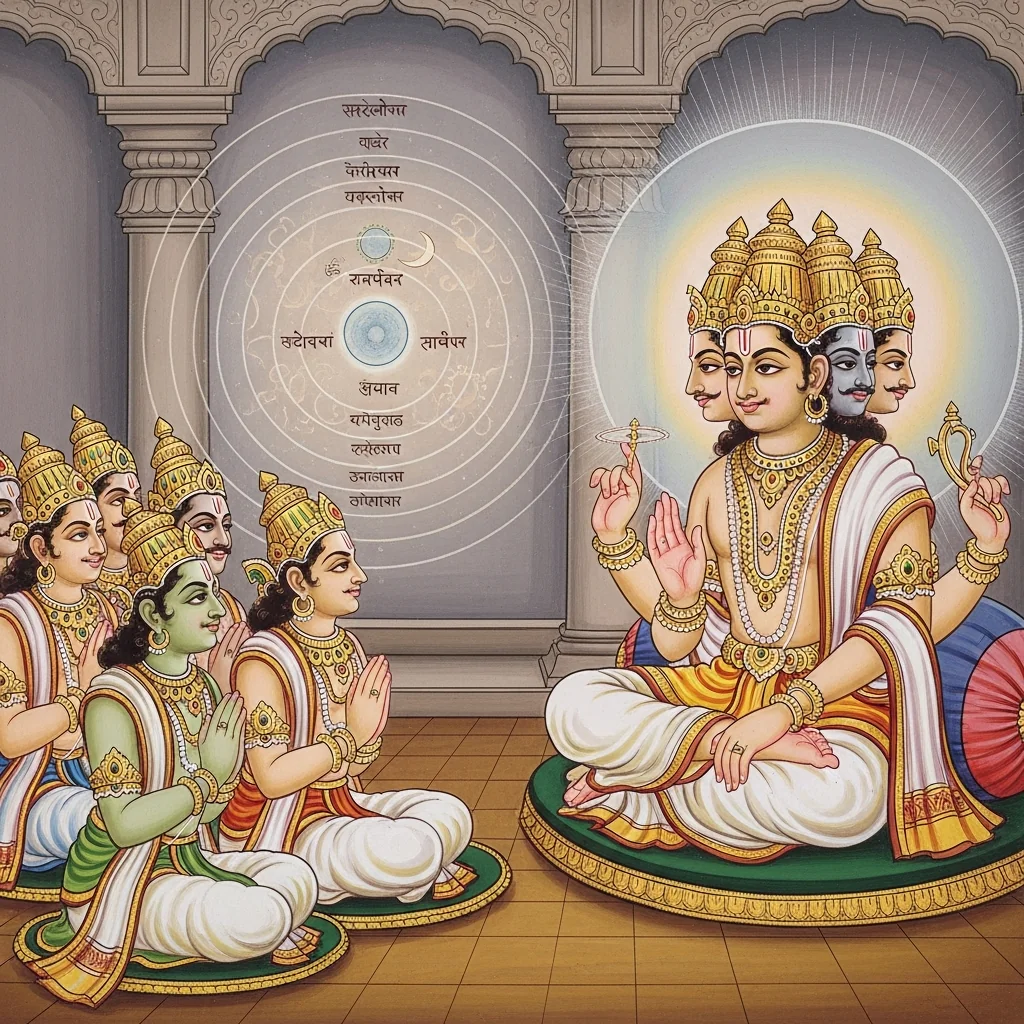
Chapter 22 presents a theological movement from crisis to remedy. Nārada relates that the Devas, oppressed by Tāraka’s ascendancy, approach Svayambhū (Brahmā) while concealed in a transformed guise. Brahmā reassures them and receives their hymn, which delineates the Virāṭ (cosmic) form: netherworlds and heavens are mapped onto divine limbs, and the sun, moon, directions, and vital apertures are gathered into a single cosmological anatomy. The Devas then report Tāraka’s outrages—his devastation of a sacred shore/tīrtha, his seizure of divine powers, and the overturning of cosmic allegiance. Brahmā explains the binding force of boons that render Tāraka nearly invulnerable, and he sets forth a lawful dharmic solution: a seven-day-old divine child will be his slayer; the Goddess (once Satī) will be reborn as Himācala’s daughter to reunite with Śaṅkara; and tapas is affirmed as the indispensable means to siddhi. Brahmā commissions Rātri (Vibhāvarī) to enter Menā’s womb and darken the Goddess’s complexion, foreshadowing Kālī/Cāmuṇḍā forms and future demon-slaying. The chapter concludes with an auspicious birth: cosmic harmony is restored, dispositions turn again toward dharma, nature becomes abundant, and gods, sages, mountains, rivers, and oceans join in celebration.
Shlokas
Verse 1
नारद उवाच । एवं विप्रकृता देवा महेंद्रसहितास्तदा । ययुः स्वायंभुवं दाम मर्करूपमुपाश्रिताः
Nārada said: Thus afflicted and brought low, the Devas—together with Mahendra (Indra)—then went to the abode of the Self-born Lord, assuming a disguised form.
Verse 2
ततश्च विस्मितो ब्रह्मा प्राह तान्सुरपुंगवान् । स्वरूपेणेह तिष्ठध्वं नात्र वस्तारकाद्भयम्
Then Brahmā, astonished, spoke to those foremost among the gods: “Remain here in your own true forms; in this place there is no fear from Tāraka.”
Verse 3
ततो देवाः स्वरूपस्थाः प्रम्लानवदनांबुजाः । तुष्टुवुः प्रणताः सर्वे पितरं पुत्रका यथा
Then the gods, established in their own forms, their lotus-faces no longer withered, all bowed down and praised him—like children praising their father.
Verse 4
नमो जगत्प्रसूत्यै ते हेतवे पालकाय च । संहर्त्रे च नमस्तुभ्यं तिस्रोऽवस्थास्तव प्रभो
Salutations to you, the cause of the world’s arising, and to you as its protector; salutations also to you as its withdrawer. O Lord, these three states belong to you.
Verse 5
त्वमपः प्रथमं सृष्ट्वा तासु वीर्यमवासृजः । तदण्डमभवद्धैमं यस्मिल्लोकाश्चराचराः
You first created the waters and then released your potency into them. From that arose the golden cosmic egg, within which exist the worlds of moving and unmoving beings.
Verse 6
वेदेष्वाहुर्विराड्रूपं त्वामेकरूपमीदृशम् । पातालं पादमूलं च पार्ष्णिपादे रसातलम्
In the Vedas they proclaim You as Virāṭ—the single cosmic Form of such a kind: Pātāla is the sole of Your foot, and Rasātala abides at Your heel and foot.
Verse 7
महातलं चास्य गुल्फौ जंघे चापि तलातलम् । सुतलं जानुनी चास्य ऊरू च वितलातले
Mahātala is said to be at His ankles; Talātala at His shanks; Sutala at His knees; and Vitala at His thighs.
Verse 8
महीतलं च जघनं नाभिश्चास्य नभस्तलम् । ज्योतिः पदमुरः स्थानं स्वर्लोको बाहुरुच्यते
The earth-plane (Mahī-tala) is His hips; His navel is the sky-region. His chest is the station of light, and Svarga-loka is said to be His arm.
Verse 9
ग्रीवा महश्चवदनं जनलोकः प्रकीर्त्यते । ललाटं च तपोलोकः शीर्ष सत्यमुदाहृतम्
His neck is Maharloka; His face is proclaimed as Janaloka. His forehead is Tapoloka, and His head is declared to be Satyaloka.
Verse 10
चन्द्रसूर्यौ च नयने दिशः श्रोत्रे नासिकाश्विनौ । आत्मानं ब्रह्मरंध्रस्थमाहुस्त्वां वेदवादिनः
The Moon and the Sun are said to be Your two eyes; the directions are Your ears; the Aśvins are Your nostrils. The knowers of the Veda declare You to be the Self (Ātman) abiding in the brahma-randhra, the crown aperture.
Verse 11
एवं ये ते विराड्रूपं संस्मरंत उपासते । जन्मबन्धविनिर्मुक्ता यांति त्वां परमं पदम्
Thus, those who remember and worship Your Virāṭ (cosmic) form are freed from the bondage of repeated birth and attain You—Your supreme abode.
Verse 12
एवं स्थूलं प्राणिमध्यं च शूक्ष्मं भावेभावे भावितं त्वां गृणंति । सर्वत्रस्थं त्वामतः प्राहुर्वेदास्तस्मै तुभ्यं पदम्ज इद्विधेम
Thus they hymn You—contemplating You as the gross, as the indwelling presence within beings, and as the subtle, meditated upon in every state of experience. Therefore the Vedas proclaim You as present everywhere; to You—born of the Lotus-seat—we offer this reverent act of praise.
Verse 13
एवं स्तुतो विरंचिस्तु कृपयाभिपरिप्लुतः । जानन्नपि तदा प्राह तेषामाश्वासहेतवे
Thus praised, Virañci (Brahmā), overflowing with compassion, then spoke—though he already knew—so as to reassure them.
Verse 14
सर्वे भवन्तो दुःखार्ताः परिम्लानमुखांबुजाः । भ्रष्टायुदास्तथाऽकस्माद्भ्रष्टा भरणवाससः
All of you are afflicted with sorrow—your lotus-faces have withered. Your weapons have slipped away, and suddenly your ornaments and garments have fallen from you.
Verse 15
ममैवयं कृतिर्देवा भवतां यद्वडम्बना । यद्वैराजशरीरे मे भवन्तो बाहुसंज्ञकाः
O Devas, this humiliation of yours is indeed my doing—for within my cosmic (Vairāja) body you are known as my ‘arms’.
Verse 16
यद्यद्विभूतिमत्सत्त्वं धार्मिकं चोर्जितं महत् । तत्रासीद्बाहुनाशो मे बाहुस्थाने च ते मम
Wherever there was a being endowed with power and prosperity—righteous, mighty, and great—there my arms were destroyed; and you too, who stand in the place of my arms, were struck down.
Verse 17
तन्नूनं मम भग्नौ च बाहू तेन दुरात्मना । येन चोपहृतं देवास्तन्ममाख्यातु मर्हथ
Surely my two arms have been broken by that wicked one, and the Devas have been oppressed by him. Tell me of this—who did it—you ought to declare it to me.
Verse 18
देवा ऊचुः । योऽसौ वज्रांगतनयस्त्वया दत्तवरः प्रभो । भृशं विप्रकृतास्तेन तत्त्वं जानासि तत्त्वतः
The Devas said: “It is that son of Vajrāṅga—he to whom you granted a boon, O Lord. By him we have been grievously wronged; yet you know the reality fully.”
Verse 19
यत्तन्महीसमुद्रस्य तटं शार्विकतीर्थकम् । तदाक्रम्य कृतं तेन मरुभूमिसमं प्रभोः
That shore of the great ocean—the Śārvika Tīrtha—he has trampled upon and turned into a land like a desert, O Lord.
Verse 20
ऋद्धयः सर्वदेवानां गृहीतास्तेन सर्वतः । महाभूतस्वरूपेण स एव च जगत्पतिः
He has seized the powers and prosperities of all the gods on every side; assuming the very form of the great elements, he alone has come to stand as the lord over the world.
Verse 21
चंद्रसूर्यौ ग्रहास्तारा यच्चान्यद्देवपक्षतः । तच्च सर्वं निराकृत्य स्थापितो दैत्यपक्षकः
Even the Moon and the Sun, the planets and the stars—and whatever else belonged to the side of the Devas—he cast it all aside and drove it away, establishing instead the dominion of the Daitya host.
Verse 22
वयं च विधृता स्तेन बहूपहसितास्तथा । प्रसादान्मुक्ताश्च कथंचिदिव कष्टतः
We too were seized by that thief and mocked again and again; only by your grace were we somehow set free—barely, and with grievous hardship.
Verse 23
तद्वयं शरणं प्राप्ताः पीडिताः क्षुत्तृषार्दिताः । धर्मरक्षा कराश्चेति संचिंत्य त्रातुमर्हसि
Therefore we have come to you for refuge—afflicted, tormented by hunger and thirst. Since you are the protector of dharma, it is fitting that you save us.
Verse 24
इत्युक्तः स्वात्मभूर्देवः सुरैर्दैत्यविचेष्टितम् । सुरानुवाच भगवानतः संचिंत्य तत्त्वतः
Thus addressed by the gods concerning the demons’ outrages, the Blessed Self-born Lord (Brahmā), having pondered the truth of the matter, spoke to the Devas.
Verse 25
अवध्यस्तारको दैत्यः सर्वैरपि सुरासुरैः । यस्य वध्यश्च नाद्यापि स जातो भगवान्पुनः
Tāraka the Daitya is invulnerable to all—whether Devas or Asuras. Yet now the Lord has been born again: he who is destined to slay Tāraka, though that slaying has not come to pass even to this day.
Verse 26
मया च वरदानेन च्छन्दयित्वा निवारितः
And by me—through the granting of a boon—he was appeased and held in restraint.
Verse 27
तपसा स हिदीप्तोऽभूत्त्रैलोक्यदहनात्मकः । स च वव्रे वधं दैत्यः शिशतः सप्तवासरात्
Indeed, by austerity he blazed forth, endowed with the power to burn the three worlds. And that demon sought as his destined death: that it should come from a mere child of seven days.
Verse 28
स च सप्तदिनो बालः शंकराद्यो भविष्यति । तारकस्य च वीरस्य वधकर्ता भविष्यति
And that seven-day-old child will arise as the foremost born of Śaṅkara; he will become the slayer of the heroic Tāraka.
Verse 29
सतीनामा तु या देवी विनष्टा दक्षहेलया । सा भविष्यति कल्याणी हिमाचलशरीरजा
And the Goddess named Satī, who perished because of Dakṣa’s insult, will be born again as auspicious Kalyāṇī, daughter of Himācala.
Verse 30
शंकरस्य च तस्याश्च यत्नः कार्यः समागमे । अहमप्यस्य कार्यस्य शेषं कर्ता न संशयः
For the union of Śaṅkara and of Her, effort must indeed be made. And I too shall accomplish the remaining part of this undertaking—of this there is no doubt.
Verse 31
इत्युक्तास्त्रिदशास्तेन साक्षात्कलयोनिना । जग्मुर्मेरुं प्रणम्येशं मर्करूपेण संवृताः
Thus instructed by him—Brahmā, the very source of the ages—the gods set out for Meru. Having bowed to the Lord, they went, concealed in the form of monkeys.
Verse 32
ततो गतेषु देवेषु ब्रह्मा लोकपितामहः । निशां सस्मार भगवान्स्वां तनुं पूर्वसंभवाम्
When the gods had departed, Brahmā—the grandsire of the worlds—remembered Night, his own form that had arisen in former times.
Verse 33
ततो भगवती रात्रिरुपतस्थे पितामहम् । तां विविक्ते समालोक्य तथोवाच विभावरीम्
Then the blessed Goddess Night approached the Grandsire. Seeing her in a secluded place, he spoke thus to Vibhāvarī (Night).
Verse 34
विभावरि महाकार्यं विबुधानामुपस्थितम् । तत्कर्तव्यं त्वया देवि श्रृणु कार्यस्य निश्चयम्
O Vibhāvarī, a great matter concerning the gods has arisen. It must be carried out by you, O Goddess—hear now the resolve of this undertaking.
Verse 35
तारकोनाम दैत्येंद्रः सुरकेतुरनिर्ज्जितः । तस्याभावाय भगवाञ्जनयिष्यति यं शिवः
There is a lord of demons named Tāraka, the banner of the gods’ foes, unconquered. For his destruction, the Blessed Śiva will beget one (a son).
Verse 36
सुतः स भविता तस्य तारकस्यांतकारकः । अहं त्वादौ यदा जातस्तदापश्यं पुरःस्थितम्
That son shall become the bringer of Tāraka’s end. And when I myself was first born, I beheld the Lord standing before me.
Verse 37
अर्धनारीश्वरं देवं व्याप्य विश्वमवस्थितम् । दृष्ट्वा तमब्रुवं देवं भजस्वेति च भक्तितः
I beheld the God Ardhanārīśvara, pervading the universe and abiding within it. Seeing that Lord, I said in devotion: “Worship Him.”
Verse 38
ततो नारी पृथग्जाता पुरुषश्च तथा पृथक् । तस्याश्चैवांशजाः सर्वाः स्त्रियस्त्रिभुवने स्मृताः
Then the Woman was born separately, and likewise the Man separately. And all women in the three worlds are remembered as arising from Her portion.
Verse 39
एकादश च रुद्राश्च पुरुषास्तस्य चांशजाः । तां नारीमहामालोक्य पुत्रं दक्षमथा ब्रवम्
And the eleven Rudras, as well as other male beings, are born from His portion. Then, beholding that great Woman, I spoke to my son Dakṣa.
Verse 40
भजस्व पुत्रीं जगती ममापि च तवापि च । पुंदुःखनकात्त्रात्री पुत्री ते भाविनी त्वियम्
“O Lord of the world, honor and cherish this daughter—for she belongs to me as well as to you. She will become your daughter, and she will be the savior who delivers beings from the sufferings of embodied existence.”
Verse 41
एवमुक्तो मया दक्षः पुत्रीत्वे परि कल्पिताम् । रुद्राय दत्तवान्भक्त्या नाम दत्त्वा सतीति यत्
Thus addressed by me, Dakṣa—having accepted her as his daughter—devoutly gave her to Rudra and bestowed upon her the name “Satī.”
Verse 42
ततः काले चं कस्मिंश्चिदवमेने च तां पिता । मुमूर्षुः पापसंकल्पो दुरात्मा कुलकज्जलः
Then, at some later time, her father insulted her. Wishing harm and harboring sinful intentions—evil-minded, a stain upon his lineage—he acted with contempt.
Verse 43
ये रुद्रं नैव मन्यंते ते स्फुटं कुलकज्जलाः । पिशाचास्ते दुरात्मानो भवंति ब्रह्मराक्षसाः
Those who do not acknowledge Rudra are plainly a stain upon their lineage. Such evil-minded ones become piśācas, becoming brahma-rākṣasas.
Verse 44
अवमानेन तस्यापि यथा देवी जहौ तनुम् । यथा यज्ञः स च ध्वस्तो भवेन विदितं हि ते
Because of his insult, the Goddess abandoned her body; and that sacrifice too was destroyed by Bhava (Śiva)—as is well known to you.
Verse 45
अधुना हिमशैलस्य भवित्री दुहिता च सा । महेश्वरं पतिं सा च पुनः प्राप्स्यति निश्चितम्
Now she will become the daughter of Himālaya; and she will certainly attain Maheśvara again as her husband.
Verse 46
तदिदं च त्वया कार्यं मेनागर्भे प्रविश्य च । तस्याश्छविं कुरु कृष्णां यथा काली भवेत्तु सा
Therefore you must do this: enter the womb of Menā and darken her complexion, so that she may indeed become Kālī.
Verse 47
यदा रुद्रोपहसिता तपस्तप्स्यति सा महत् । समाप्तनियमा देवी यदा चोग्रा भविष्यति
When, mocked in connection with Rudra, she undertakes great austerity—when the Goddess completes her observances and becomes fierce in resolve…
Verse 48
स्वयमेव यदा रूपं सुगौरं प्रतिपत्स्यते । विरहेण हरश्चास्या मत्वा शून्यं जगत्त्रयम्
When she herself regains a most fair and radiant form, then Hara too—through separation from her—will regard the three worlds as empty.
Verse 49
तस्यैव हिमशैलस्य कंदरे सिद्धसेविते । प्रतीक्षमाणस्तां देवीमुग्रं संतप्स्यते तपः
In a cave of that very Himālaya—frequented by Siddhas—waiting for the Goddess, he will practice fierce austerity.
Verse 50
तयोः सुतप्ततपसोर्भविता यो महान्सुतः । भविष्यति स दैत्यस्य तारकस्य निवारकः
From those two, engaged in intensely austere tapas, a great son will be born; he shall become the restrainer and destroyer of the demon Tāraka.
Verse 51
तपसो हि विना नास्ति सिद्धिः कुत्रापि शोभने । सर्वासां कर्मसिद्धीनां मूलं हि तप उच्यते
O auspicious one, without tapas there is no attainment anywhere; indeed, tapas is declared to be the very root of success in all actions.
Verse 52
त्वयापि दानवो देवि देहनिर्गतया तदा । चंडमुंडपुरोगाश्च हंतव्या लोकदुर्जयाः
And you too, O Goddess—having then emerged forth from the body—must slay the demons, led by Caṇḍa and Muṇḍa, who are unconquerable by the worlds.
Verse 53
यस्माच्चंडं च मुंडं च त्वं देवि निहनिष्यसि । चामुंडेति ततो लोके ख्याता देवि भविष्यसि
Because you, O Goddess, will slay both Caṇḍa and Muṇḍa, therefore in the world you shall become famed, O Goddess, by the name ‘Cāmuṇḍā’.
Verse 54
ततस्त्वां वरदे देवी लोकः संपूजयिष्यति । भेदेर्बहुविधाकारैः सर्वगां कामसाधनीम्
Thereafter, O boon-giving Goddess, the world will worship you fully—in many differentiated forms—present everywhere, and capable of fulfilling desires.
Verse 55
ओंकारवक्त्रां गायत्रीं त्वामर्चंति द्विजोत्तमाः । ऊर्जितां बलदां पापि राजानः सुमहाबलाः
The best of the twice-born worship you as Gāyatrī, whose face is Oṃkāra; and mighty kings worship you as the powerful one, the giver of strength, O sin-destroying Lady.
Verse 56
वैश्याश्च भूतिमित्येव शिवां शूद्रास्तथा शुभे । क्षांतिर्मुनीनामक्षोभ्या दया नियमिनामपि
O auspicious One, the Vaiśyas worship you as “Bhūti” (prosperity), and the Śūdras as “Śivā”; you are the unshakable forbearance of sages, and also the compassion of the self-restrained.
Verse 57
त्वं महोपाय सन्दोहा नीतिर्नयविसर्पिणाम् । परिस्थितिस्त्वमर्थानां त्वमहो प्राणिका मता
You are the great treasury of effective means, the guiding nīti of those skilled in strategy; you are the right settlement of affairs—and indeed you are regarded as the very life-force among living beings.
Verse 58
त्वं युक्तिः सर्वभूतानां त्वं गतिः सर्वदेहिनाम् । रतिस्त्वं रतिचित्तानां प्रीतिस्त्वं हृद्यदर्शिनाम्
You are the discerning wisdom of all beings, and the refuge-goal of all embodied creatures; you are delight for those whose minds seek delight, and you are loving joy for those who behold what is dear.
Verse 59
त्वं कांतिः शुभरूपाणां त्वं शांति शुभकर्मिणाम् । त्वं भ्रांतिर्मूढचित्तानां त्वं फलं क्रतुयाजिनाम्
You are the radiance of those of auspicious form; you are the peace of those who perform auspicious deeds. You are even the delusion of the dull-minded, and you are the fruit attained by those who worship through sacrifices.
Verse 60
जलधीनां महावेला त्वं च लीला विलासिनाम् । संभूतिस्त्वं पदार्थानां स्थितिस्त्वं लोकपालिनी
You are the mighty shoreline of the oceans, and you are the līlā—sportive delight of divine play—for those who revel in it. You are the arising of all things, and their abiding stability—O guardian of the worlds.
Verse 61
त्वं कालरात्रिर्निःशेष भुवनावलिनाशिनी । प्रियकंठग्रहानन्ददायिनी त्वं विभावरी
You are Kālārātri, the power that dissolves the entire succession of worlds. You bestow bliss through the beloved’s embrace—O Vibhāvarī, radiant Night.
Verse 62
प्रसीद प्रणतानस्मान्सौम्यदृष्ट्या विलोकय
Be gracious; look upon us who bow before you with a gentle, auspicious gaze.
Verse 63
इति स्तुवंतो ये देवि पूजयिष्यंति त्वां शुभे । ते सर्वकामानाप्स्यंति नियता नात्र संशयः
O Goddess, O auspicious one—those who thus praise you and worship you will surely obtain all their desired aims; of this there is no doubt.
Verse 64
इत्युक्ता तु निशादेवी तथेत्युक्त्वा कृताञ्जलिः । जगाम त्वरिता पूर्वं गृहं हिमगिरेर्महत्
Thus addressed, Niśādevī replied, “So be it,” and with folded hands she hastened first to the great abode of Himagiri.
Verse 65
तत्राऽसीनां महाहर्म्ये रत्नभित्तिसमाश्रये । ददर्श मेनामापांडुच्छविवक्त्रसरोरुहाम्
There she saw Menā seated in a grand palace, resting against jewel-studded walls—her lotus-face shining with a pale, luminous radiance.
Verse 66
किंचिच्छयाममुखोदग्रस्तनभागावनामिताम् । महौषधिगणबद्धमंत्रराजनिषेविताम्
Her face was slightly shadowed, and she bent a little beneath the fullness of her breasts—attended by great healing herbs and served with potent royal mantras.
Verse 67
ततः किंचित्प्रमिलिते मेनानेत्रांबुजद्वये । आविवेशमुखं रात्रिर्ब्रह्मणो वचनात्तदा
Then, when Menā’s two lotus-eyes had slightly closed, Night entered her mouth at that time, in accordance with Brahmā’s command.
Verse 68
जन्मदाया जगन्मातुः क्रमेण जठरांतरम् । अरंजयच्छविं देव्या गुहमातुर्विभावरी
As the giver of birth to the Mother of the world, Vibhāvarī gradually entered the womb, and she enhanced the splendour of that Goddess—the future mother of Guha.
Verse 69
ततो जगन्मं गलदा मेना हिमगिरेः प्रिया । ब्राह्मे मुहूर्ते सुभगे प्रासूयत शुभाननाम्
Then Menā, beloved of Himagiri—bringing auspiciousness to the world—gave birth at the blessed Brāhma-muhūrta to a child of beautiful face.
Verse 70
तस्यां तु जायमानायां जंतवः स्थाणुजंगमाः । अभवन्सुखिनः सर्वे सर्वलोकनिवासिनः
When she was giving birth, all beings—both immobile and moving—became happy; indeed, all who dwelt in every world were filled with well-being.
Verse 71
अभवत्क्रूरसत्त्वानां चेतः शांतं च देहिनाम् । ज्योतिषामपि तेजस्त्वमभवत्सुतरां तदा
Then even the minds of fierce creatures grew calm, and embodied beings became peaceful; even the luminaries shone with far greater splendor at that time.
Verse 72
वनाश्रिताश्चौषधयः स्वादवंति फलानि च । गंधवंति च माल्यानि विमलं च नभोऽभवत्
Forest herbs became potent, fruits grew sweeter, garlands more fragrant, and the sky itself turned clear and spotless.
Verse 73
मारुतश्च सुखस्पर्शो दिशश्च सुमनोहराः । विस्मृता नि च शास्त्राणि प्रादुर्भावं प्रपेदिरे
The breeze became pleasantly soothing, the directions appeared exceedingly delightful, and even teachings that had been forgotten came forth again into manifestation.
Verse 74
प्रभावस्तीर्थमुख्यानां तदा पुण्यतमोऽभवत् । सत्ये धर्मे चाध्ययने यज्ञे दाने तपस्यपि
Then the power of the foremost sacred places became supremely meritorious; likewise in truthfulness, in dharma, in study, in sacrifice, in charity, and even in austerity, merit increased greatly.
Verse 75
सर्वेषामभवच्छ्रद्धा जन्मकाले गुहारणेः । अंतरिक्षेमराश्चापि प्रहर्षोत्फुल्ललोचनाः
At the time of Guha’s birth, faith arose in everyone; and the celestial beings in the mid-sky too had eyes blossoming with joy and exhilaration.
Verse 76
हरिब्रह्ममहेंद्रार्कवायुवह्निपुरोगमाः । पुष्पवृष्टिं प्रमुमुचुस्तस्मिन्मेनागृहे शुभे
Led by Hari, Brahmā, Mahendra, the Sun, the Wind, and Fire, they poured forth a rain of flowers upon Menā’s auspicious house.
Verse 77
मेरुप्रभृतयश्चापि मूर्तिमंतो महानगाः । तस्मिन्महोत्सवे प्राप्ता वीरकांस्योपशोभिताः
Meru and the other mighty mountains too, as though embodied, arrived for that great festival, shining with heroic ornaments of bronze-like splendor.
Verse 78
सागराः सरितश्चैव समाजग्मुश्च सर्वशः
The oceans and the rivers too gathered together from every direction.
Verse 79
हिमशैलोऽभवल्लोके तदा सर्वैश्चराचरैः । सेव्यश्चाप्यभिगम्यश्च पूजनीयश्च भारत
O Bhārata, then in the world the Himālaya became—unto all beings, moving and unmoving—one to be served, approached, and worshipped.
Verse 80
अनुभूयोत्सवं ते च जग्मुः स्वानालयांस्तदा
After experiencing that sacred festivity, they then departed to their own abodes.