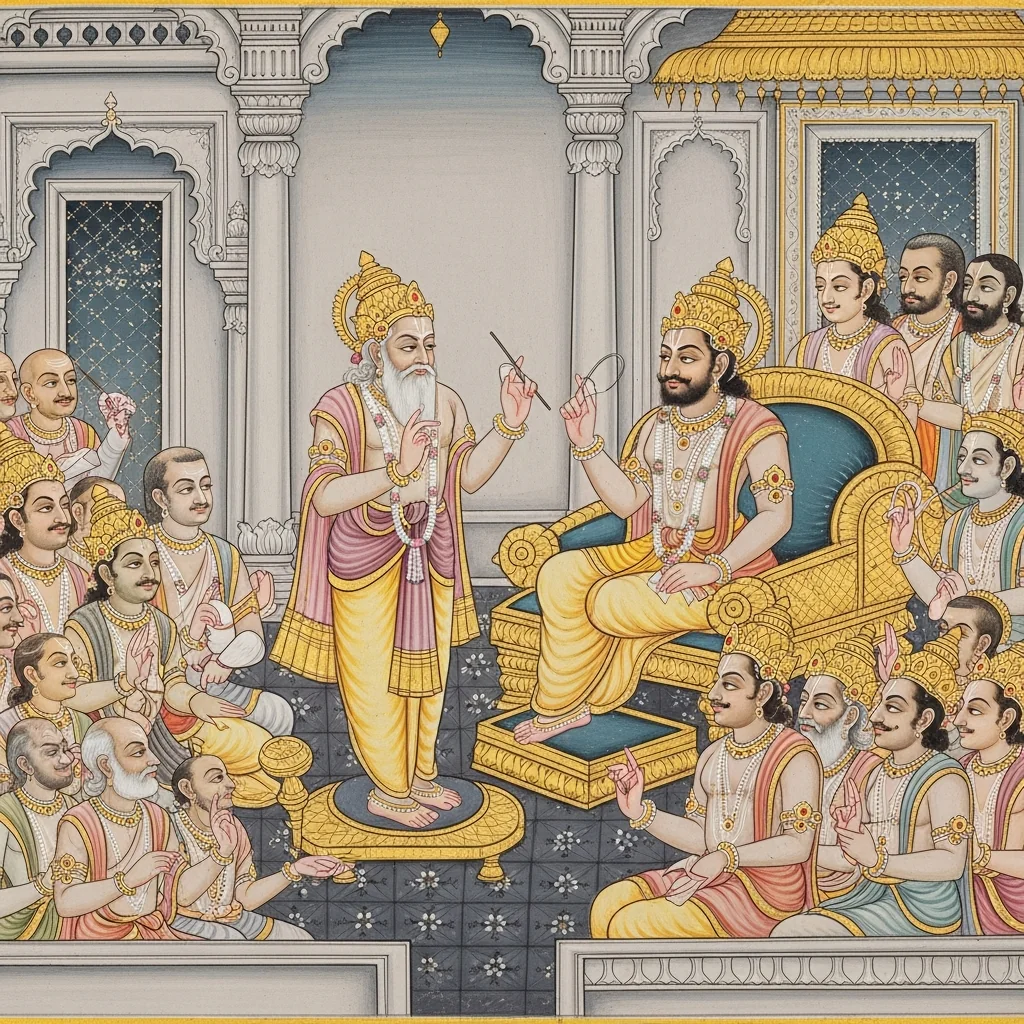
Adhyaya 16
This adhyāya portrays a two-sided escalation before the great deva–asura clash. Tāraka first laments human moral decline, calling sovereignty bubble-like and impermanent, and warning that intoxication with pleasures—women, dice, and drink—destroys “pauruṣa,” the steadfast power to act. He then commands swift war preparations to seize the gods’ tri-worldly prosperity, specifying a grand chariot and ornate insignia. Nārada reports the asura response: the commander Grāsana musters the host, gathering chariots, mounts, and many leaders, each distinguished by fearsome banners (ketu/dhvaja) bearing animal, rākṣasa, and piśāca motifs. The text lingers over numbers, formations, vehicles, and heraldry, presenting a catalog of martial splendor meant to intimidate. The narrative turns to the devas when Vāyu brings Indra news of the asura force. Indra consults Bṛhaspati, who teaches classical nīti through four means—sāma, dāna, bheda, and daṇḍa—and insists that with morally incorrigible foes, conciliation fails and daṇḍa, coercive force, becomes the effective remedy. Indra accepts, orders mobilization, honors the weapons, appoints Yama as senāpati, and a vast muster of devas and allied beings (gandharvas, yakṣas, rākṣasas, piśācas, kinnaras) is described with their banners and vehicles. The chapter closes with Indra’s majestic appearance upon Airāvata, framing the coming war as the dharmic defense of cosmic order guided by ethical strategy.
Shlokas
Verse 1
तारक उवाच । राज्येन बुद्बुदाभेन स्त्रीभिरक्षैश्च पानकैः । मोहितो जन्म लब्ध्वात्र त्यजते पौरुषं नरः
Tāraka said: ‘Intoxicated by a kingdom—bubble-like and fleeting—by women, by gambling, and by drink, a man, though having gained birth in this world, abandons true manly virtue.’
Verse 2
जन्म तस्य वृथा सर्वमाकल्पांतं न संशयः
His entire life is wasted—until the end of the aeon (kalpa)—of this there is no doubt.
Verse 3
मातापितृभ्यां न करोति कामान्बन्धूनशोकान्न करोति यो वा । कीर्तिं हि वा नार्जयते न मानं नरः स जातोऽपि मृतोऽत्र लोके
He who does not fulfil the rightful wishes of his mother and father, who does not keep his kin free from sorrow, and who gains neither fame nor honour—such a man, though born, is as good as dead in this world.
Verse 4
तस्माज्जयायामरपुंगवानां त्रैलोक्यलक्ष्मीहरणाय शीघ्रम् । संयोज्यतां मे रथमष्टचक्रं बलं च मे दुर्जयदैत्यचक्रम्
Therefore, for victory over the foremost of the gods, and to swiftly seize the fortune of the three worlds, let my eight-wheeled chariot be yoked—and let my army, the invincible wheel of Daityas, be assembled.
Verse 5
ध्वजं च मे कांचनपट्टबन्धं छत्रं च मे मौक्तिकजालबद्धम् । अद्याहमासां सुरकामिनीनां धम्मील्लकांश्चाग्रथितान्करिष्ये
Let my banner be fastened with golden bands, and my parasol be tied with a net of pearls. Today I shall braid together the hair-knots (dhammīllaka) of those heavenly maidens—the beloved women of the gods.
Verse 6
यथा पुरा मर्कटको जनन्यास्तस्याश्च सत्येन तु तारकः स्याम्
“Just as in former times the monkey was protected by the truthfulness of his mother, so too may I become a ‘tāraka’—a deliverer—by the power of that very truth.”
Verse 7
नारद उवाच । तारकस्य वचः श्रुत्वा ग्रसनोनाम दानवः । सेनानीर्दैत्यराजस्य तथा चक्रेऽविलंबितम्
Nārada said: Hearing Tāraka’s words, the Dānava named Grasana—the commander of the Daitya-king—at once set about carrying out the order, without delay.
Verse 8
आहत्य भेरीं गम्भीरां दैत्यानाहूय सत्वरः । सज्जं चक्रे रथं दैत्यो दैत्यराजस्य धीमतः
Striking the deep-resounding war-drum and swiftly summoning the Daityas, that Dānava made ready the chariot of the wise Daitya-king.
Verse 9
गरुडानां सहस्रेण गरुडोपमितत्विषा । ते हि पुत्राः सुपर्णस्य संस्थिता मेरुकन्दरे
With a thousand Garuḍas, shining with a splendor comparable to Garuḍa himself—indeed, they were the sons of Suparṇa—stationed in the caverns of Mount Meru.
Verse 10
विजित्य दैत्यराजेन वाहनत्वे प्रकल्पिताः । अष्टाष्टचक्रः सरथश्चतुर्योजनविस्तृतः
Having been subdued by the Daitya-king, they were appointed as his conveyance; and the chariot, with eight-and-eight wheels, spread across four yojanas in breadth.
Verse 11
नानाक्रीडागृहयुतो गीतवाद्यमनोहरः । गंधर्वनगराकारः संयुक्तः प्रत्यदृस्यत
Adorned with many pleasure-pavilions and enchanting with song and music, it appeared fully furnished, shaped like a city of Gandharvas.
Verse 12
आजग्मुस्तत्र दैत्याश्च दशा चंडपराक्रमाः । कोटिकोटिपरिवारा अन्ये च बहवो रणे
There came the Daityas—ten of them, fierce in valor—and many others besides, each surrounded by crores upon crores of followers, ready for battle.
Verse 13
तेषामग्रेसरो जम्भः कुजम्भोनंतरस्तथा । महिषः कुञ्जरो मेषः कालनेमिर्निमिस्तथा
At their forefront was Jambha; next came Kujambha; also Mahiṣa, Kuñjara, Meṣa, and likewise Kālanemi and Nimi.
Verse 14
मथनो जंभकः शुम्भो दैत्येंद्रा दश नायकाः । दैत्येंद्रा गिरिवर्ष्माणः संति चंडपराक्रमाः
Mathana, Jaṃbhaka, and Śumbha—ten leaders, lords among the Daityas—were there, mountain-bodied and of fierce prowess.
Verse 15
नानाविधप्रहरणा नानाशस्त्रास्त्रपारगाः । तारकस्याभवत्केतुर्बहूरूपो महाभयः
Armed with many kinds of weapons, skilled in diverse arms and missiles, there arose Tāraka’s banner (ketu), manifold in form and greatly terrifying.
Verse 16
क्वचिच्च राक्षसो घोरः पिशाचध्वांक्षगृध्रकः । एवं बहुविधाकारः स केतुः प्रत्यदृश्यत
At one moment the banner appeared as a fearsome rākṣasa; in another, as a piśāca, a crow, or a vulture. Thus that standard (ketu), assuming many different forms, was seen again and again.
Verse 17
केतुना मकरेणापि सेनानीर्ग्रसनो बभौ । पैशाचं यत्र वदनं जंभस्यासीदयस्मयम्
With the makara as his banner, the commander Grāsana shone forth; and Jambha’s face there was piśāca-like, hard as iron.
Verse 18
खरो विधुतलांगूलः कुजम्भस्याभवद्ध्वजे । महिषस्य च गोमायुः कांतो हैमस्तथां बभौ
On Kujambha’s banner there was a donkey, its tail lashing about; and for Mahiṣa there appeared a shining golden jackal as his emblem.
Verse 19
गृध्रो वै कुंजरस्यासीन्मेषस्याभूच्च राक्षसः । कालनेमेर्महाकालो निमेरासीन्महातिमिः
For Kuñjara, indeed, the emblem was a vulture; for Meṣa, a rākṣasa. For Kālanemi it was Mahākāla, and for Nimi it was a great darkness (mahātimi).
Verse 20
राक्षसी मथनस्यापि ध्वांक्षोऽभूज्जंभकस्य च । महावृकश्च शुम्भस्य ध्वजा एवंविधा बभुः
Mathana’s banner bore a rākṣasī; Jambhaka’s bore a crow; and Śumbha’s bore a great wolf. Such were the standards they displayed.
Verse 21
अनेकाकारविन्यासादन्येषां च ध्वजा भवन् । शतेन शीघ्रवेगानां व्याघ्राणां हेममालिनाम्
By arranging many different forms, the banners of the others too came forth—(drawn onward) by a hundred swift tigers adorned with golden garlands.
Verse 22
ग्रसनस्य रथो युक्तो महामेघरवो बभौ । शतेन चापि सिंहानां रथो जंभस्य योजितः
Grāsana’s chariot was harnessed and thundered like a mighty cloud; and Jambha’s chariot too was yoked, drawn by a hundred lions.
Verse 23
कुजंभस्य रथो युक्तः पिशाचवदनैः खरैः । तावद्भिर्महिषस्योष्टैर्गजस्य च हयैर्युतः
Kujambha’s chariot was harnessed with donkeys whose faces were like piśācas. Likewise, Mahiṣa’s chariot was joined with camels, and Gaja’s with horses in the same number.
Verse 24
मेषस्य द्वीपिभिर्भीमैः कुञ्जरैः कालनेमिनः । पर्वतं वै समारूढो निश्चित्य विधृतं गजैः
Meṣa’s chariot was drawn by dreadful leopards; Kālanemi’s by elephants. Having resolved, he mounted a mountain, made firm and held steady by elephants.
Verse 25
चतुर्दंष्ट्रैर्गंधवद्भिश्चर्भिर्मेघसन्निभैः । शतहस्तायते कृष्णे तुरंगे हेमभूषणे
With fragrant creatures bearing four tusks, like rain-clouds, (he rode) a black steed a hundred hands in length, adorned with golden ornaments.
Verse 26
सितचामरजालेन शोभिते पुष्पदामनि । मथनोनाम दैत्येन्द्रः पाशहस्तो व्यराजत
Adorned with a net of white chāmara fans and radiant with garlands of flowers, the Daitya lord named Mathana shone forth, holding the pāśa, the noose, in his hand.
Verse 27
किंकिणीमालिनं चोष्ट्रमारूढोऽभूच्च जंभकः । कालमुंचं महामेघमारूढः शुम्भदानवः
Jambhaka too appeared, mounted upon a camel hung with tinkling bells; and the Dānava Śumbha, riding a mighty cloud that seemed to pour forth Kāla—doom itself—advanced.
Verse 28
अन्ये च दानवा वीरा नानावाहनहेतयः । प्रचण्डचित्रवर्माणः कुण्डलोष्णीषभूषिताः
Many other heroic Dānavas also came, equipped with diverse mounts and weapons—fierce, clad in variegated armor, adorned with earrings and crested head-gear.
Verse 29
नानाविधोत्तरासंगा नानामाल्यविभूषणाः । नानासुगंधगंधाढ्या नानाबंधिशतस्तुताः
They wore many kinds of cloaks and attachments, were adorned with diverse garlands and ornaments, were rich with manifold sweet fragrances, and were praised in countless ways by their own bards.
Verse 30
नानावाद्यपरिस्यंदसाग्रेसरमहारथाः । नानाशौर्यकथासक्तास्तस्मिन्सैन्ये महारथाः
In that army were great chariot-warriors who led the vanguard amid the streaming sounds of many instruments; and those mighty fighters were absorbed in recounting diverse tales of valor.
Verse 31
तद्बलं दैत्यसिंहस्य भीमरूपं व्यदृश्यत । भूमिरेणुसमालिंगत्तुरंगरथपत्तिकम्
Then the force of that lion among the Daityas appeared in a terrifying form; the earth was as though embraced by dust raised by horses, chariots, and foot-soldiers.
Verse 32
स च दैत्येश्वरः क्रुद्धः समारूढो महारथम् । दशभिः शुशुबे दैत्यैर्दशबाहुरिवेश्वरः । जगद्धंतुं प्रवृत्तो वा प्रतस्थेऽसौ सुरान्प्रति
Then the lord of the Daityas, wrathful, mounted a mighty chariot. Encircled by ten Daityas, he shone like a ten-armed lord; as though bent on destroying the world, he set forth against the Devas.
Verse 33
एतस्मिन्नंतरे वायुर्देवदूतः सुरालयम् । दृष्ट्वा तद्दानव बलं जगामेंद्रस्य शंसितुम्
Meanwhile Vāyu, the gods’ messenger, went to the abode of the Devas; having seen that Dānava host, he went to report it to Indra.
Verse 34
स गत्वा तु सभां दिव्यां महेंद्रस्य महात्मनः । शशंस मध्ये देवानामिदं कार्यमुपस्थितम्
Having gone to the divine assembly hall of great-souled Mahendra, he proclaimed in the midst of the gods: “This urgent matter has arisen.”
Verse 35
तच्छ्रुत्वा देवराजः स निमीलितविलोचनः । बृहस्पतिमुवाचेदं वाक्यं काले महामतिः
Hearing this, the king of the gods sat with eyes closed in contemplation; then the wise one, timely in counsel, spoke these words to Bṛhaspati.
Verse 36
इन्द्र उवाच । संप्राप्तोऽतिविमर्दोऽयं देवानां दानवैः सह । कार्यं किमत्र तद्ब्रुहि नीत्युपायोपबृंहितम्
Indra said: “A fierce clash has now arisen between the Devas and the Dānavas. Tell me what should be done here—fortified with proper statecraft and prudent strategy.”
Verse 37
एतच्छ्रुत्वा च वचनं महेंद्रस्य गिरांपतिः । प्रत्युवाच महाभागो बॉहस्पति रुदारधीः
Having heard the words of great Indra, Bṛhaspati—the Lord of Speech, most fortunate, with firm and discerning intellect—replied in return.
Verse 38
बृहस्पतिरुवाच । सामपूर्वं स्मृता नीतिश्चतुरंगामनीकिनीम् । जिगीषतां सुरश्रेष्ठ स्थितिरेषा सनातनी
Bṛhaspati said: “O best of the gods, the policy for one who seeks victory is remembered as beginning with sāma—conciliation—applied to the fourfold army. This is the eternal, time-honored method for those who would conquer.”
Verse 39
साम दानं च भेदश्च चतुर्थो दंड एव च । नीतौ क्रमात्प्रयोज्याश्च देशकालविशेषतः
“Conciliation (sāma), gifts (dāna), division (bheda), and fourthly punishment/force (daṇḍa)—these are to be employed in policy in due sequence, according to the particular place and time.”
Verse 40
तत्र साम प्रयोक्तव्यमार्येषु गुणवत्सु च । दानं लुब्धेषु भेदश्च शंकितोष्वितो निश्चयः
“In this matter, conciliation should be used with the noble and the virtuous; gifts are effective with the greedy; and sowing division is the sure recourse with those who are suspicious and wavering.”
Verse 41
दण्डश्चापि प्रयोक्तव्यो नित्यकालं दुरात्मसु । साम दैत्येषु नैवास्ति निर्गुणत्वाद्दुरात्मसु
“Punishment/force (daṇḍa) too should be employed continually against the wicked. With the Daityas there is no place for conciliation, for being without virtue, they are evil-minded.”
Verse 42
श्रिया तेषां च किं कार्यं समृद्धानां तथापि यत् । जातिधर्मेण चाभेद्या विधातुरपि ते मताः
What need have they of gifts of wealth, since they are already prosperous? By their very nature and the dharma of their clan, they are held to be unchangeable—even by the Ordainer himself.
Verse 43
एको ह्युपायो दंडोऽत्र भवतां यदि रोचते । दुर्जनः सुजनत्वाय कल्पते न कदाचन
Here there is but one expedient—daṇḍa, punishment or force—if it pleases you. A wicked person never becomes fit for the state of a good person.
Verse 44
लालितः पालितो वापि स्वस्वभावं न मुंचति । एवं मे मन्यते बुद्धिर्भवंतो यद्व्यवस्यताम्
Even if indulged or carefully protected, one does not abandon one’s own nature. Such is my considered understanding; decide, all of you, accordingly.
Verse 45
एवमुक्तः सहस्राक्ष एवमेवेत्युवाच ह । कर्तव्यतां च संचिंत्य प्रोवाचामरसंसदि
Thus addressed, Indra of the thousand eyes replied, “So be it, so be it.” Reflecting on what must be done, he then spoke in the assembly of the immortals.
Verse 46
बहुमानेन मे वाचं श्रृणुध्वं नाकवासिनः
O dwellers of heaven, hear my words with due respect and attentive honor.
Verse 47
भवंतो यज्ञभोक्तारः सतामिष्टाश्च सात्त्विकाः । स्वेस्वे पदे स्थिता नित्यं जगतः पालने रताः
You are the enjoyers of the sacrifices (yajña), beloved of the righteous, and established in sattvic purity. Steadfast in your own stations, you are ever devoted to the protection of the world.
Verse 48
भवतां च निमित्तेन बाधंते दानवेश्वराः । तेषां समादि नैवास्ति दंड एव विधीयताम्
Because of you, the lords of the Dānavas are causing affliction. For them there is no conciliation at all—let punishment alone be ordained.
Verse 49
क्रियतां समरे बुद्धिः सैन्यं संयोज्यतामिति । आवाद्यंतां च शस्त्राणि पूज्यं तां शस्त्रदेवताः
‘Let resolve be made for battle; let the army be assembled. Let the weapons be sounded and readied, and let the deities of the weapons be duly worshiped.’
Verse 50
इत्युक्ताः समनह्यंत देवानां ये प्रधानतः । वाजिनामयुतेनाजौ हेमपट्टपरिष्कृताः
Thus instructed, those foremost among the gods armed themselves. On the battlefield they were adorned with golden trappings, with ten thousand horses at their side.
Verse 51
वाहनानि विमानानि योजयंतु ममामराः । यमं सेनापतिं कृत्वा शीघ्रं निर्यात देवताः
Let my immortals harness the mounts and the vimānas, the celestial chariots. Appoint Yama as commander of the army, and swiftly march forth, O gods.
Verse 52
नानाश्चर्यगुणोपेता दुर्जया देवदानवैः । रथो मातलिना युक्तो महेंद्रस्याप्यदृश्यत
Then was seen Mahendra’s chariot, yoked by Mātali—endowed with many wondrous powers and hard to conquer even for the gods and the Dānavas.
Verse 53
यमो महिषमास्थाय सेनाग्रे समवर्तत । चंडकिंकिणिवृंदेन सर्वतः परिवारितः
Yama, mounted upon a buffalo, took his place at the head of the army, surrounded on all sides by a fierce multitude of ringing bells.
Verse 54
कल्पकालोज्जवालापूरितांबरगोचरः । हुताश उरणारूढः शक्तिहस्तो व्यवस्थितः
Agni (Hutāśa), blazing like the fire at the end of an age and filling the skies with radiance, stood ready—mounted upon a ram and holding a spear in his hand.
Verse 55
पवनोंऽकुशपाणिस्तु विस्तारितमहाजवः । महाऋक्षं समारूढं सेनाग्रे समदृश्यत
Pavana (Vāyu), holding a goad in his hand and displaying tremendous speed, was seen at the head of the army, mounted upon a great bear.
Verse 56
भुजगेन्द्रं समारूढो जलेशो भगवान्स्वयम् । महापाशधरो वीरः सेनायां समवर्तत
The Lord of the waters himself, the divine Varuṇa, mounted upon the king of serpents, stood arrayed within the army—heroic, bearing the mighty noose.
Verse 57
नरयुक्ते रथे दिव्ये धनाध्यक्षो व्यचीचरत् । महासिंहरवो युद्धे गदाहस्तो व्यवस्थितः
On a heavenly chariot drawn by men, Kubera, lord of riches, moved forth—roaring like a great lion in battle, standing ready with mace in hand.
Verse 58
राक्षसेशोऽथ निरृती रथे रक्षोमुखैर्हयैः । धन्वी रक्षोगणवृतो महारावो व्यदृश्यत
Then Nirṛti, lord among the Rākṣasas, was seen upon a chariot drawn by horses with rākṣasa-faces—an archer, surrounded by rākṣasa hosts, thundering with a terrible roar.
Verse 59
चंद्रादित्यावश्विनौ च वसवः साध्यदेवताः । विश्वेदेवाश्च रुद्राश्च सन्नद्धास्तस्थुराहवे
Candra and Āditya, the Aśvins, the Vasus, the Sādhyas, the Viśvedevas, and the Rudras—fully armed—stood firm for battle.
Verse 60
हेमपीठत्तरासंगाश्चित्रवर्मायुधध्वजाः । गंधर्वाः प्रत्यदृश्यन्त कृत्वा विश्वावसुं मुखे
Gandharvas appeared, adorned with golden upper garments, bearing splendid armor, weapons, and banners—having placed Viśvāvasu at their forefront.
Verse 61
तथा रक्तोत्तरासंगा निर्मलायोविभूषणाः । गृध्रध्वजा अदृश्यंत राक्षसा रक्तमूर्धजाः
Likewise there appeared Rākṣasas—wearing red upper garments, adorned with polished iron ornaments, bearing vulture-banners, and with blood-red hair.
Verse 62
तथा भीमाशनिकराः कृष्णवस्त्रा महारथाः । यक्षास्तत्र व्यदृश्यंत मणिभद्रादिकोटिशः
There too were seen the Yakṣas—mighty wielders of dreadful thunderbolts, clad in black garments, great chariot-warriors—numbering in crores, beginning with Maṇibhadra.
Verse 63
ताम्रोलूकध्वजा रौद्रा द्वीपिचर्मांबरास्तथा । पिशाचास्तत्र राजंते महावेगपुरःसराः
There also shone the Piśācas—fierce, bearing banners marked with copper-colored owls, clad in leopard-skin garments—rushing forward with great speed.
Verse 64
तथैव श्वेतवसनाः सितपट्टपताकिनः । मत्तेभवाहनप्रायाः किंनरास्तस्थुराहवे
So too the Kiṃnaras stood in battle—clad in white garments, bearing bright silken pennants, and for the most part mounted on rutting elephants.
Verse 65
मुक्ताजाल पिरष्कारो हंसो हारसमप्रभः । केतुर्जलधिनाथस्य सौम्यरूपो व्यराजत
The banner of the lord of the ocean shone with a gentle form—a swan, adorned as though with a net of pearls, radiant like a necklace.
Verse 66
पंचरागमहारत्नविटंको धनदस्य च । ध्वजः समुत्थितो भाति यातुकाम इवांबरम्
And Kubera’s banner—adorned with the great jewel called Pañcarāga—rose up and shone, as though it were a wish to soar into the sky itself.
Verse 67
कार्ष्णलोहमयो ध्वांक्षो यमस्याभून्महाध्वजः । राक्षसेशस्य वदनं प्रेतस्य ध्वज आबभौ
Yama’s great banner bore a crow fashioned of black iron; and for the lord of the rākṣasas, a banner displaying the face of a preta appeared.
Verse 68
हेमसिंहध्वजौ देवौ चन्द्रार्कवमितद्युति । कुंभेन चित्रवर्णेन केतुराश्विनयोरभूत्
Two gods bore banners marked with golden lions, radiant as the moon and the sun; and for the Aśvin twins, their standard was a many-colored pitcher (kumbha).
Verse 69
मातंगो हेमरचितश्चित्ररत्नपरिष्कृतः । ध्वजः शतक्रतोरासीत्सितचा मरसंस्थितः
For Śatakratu (Indra), the banner bore an elephant, crafted of gold and embellished with wondrous gems, accompanied by a white yak-tail fan (cāmara).
Verse 70
अन्येषां च ध्वजास्तत्र नानारूपा बभू रणे । सनागयक्षगंधर्वमहोरगनिशाचरा
And there, in that battle, the others too had banners of many forms—among the nāgas, yakṣas, gandharvas, great serpents, and night-wanderers.
Verse 71
सेना सा देवराजस्य दुर्जया प्रत्यदृश्यत । कोटयस्तास्त्रयस्त्रिंशन्नानादेवकायिनाम्
That army of the king of the gods appeared invincible—thirty-three crores in number, composed of hosts of many divine bodies and kinds.
Verse 72
हैमाचलाभे सितकर्णचामरे सुवर्णपद्मामलसुंदरस्रजि । कृताभिरामोज्ज्वलकुंकुमांकुरे कपोललीताविविमुक्तरावे
He shone with the radiance of a golden mountain, wearing white ear-ornaments and bearing a yak-tail fan, adorned with a spotless, lovely garland of golden lotuses. His cheeks were graced with bright, charming shoots of saffron (kuṅkuma), and he blazed forth as he released a resonant roar.
Verse 73
श्रितस्तदैरावणनामकुंजरे महाबलश्चित्रविशेषितांबरः । विशालवज्रांगवितानभूषितः प्रकीर्णकेयूरभुजाग्रमंडलः
Then the mighty one sat upon the elephant named Airāvata, wearing garments adorned with wondrous designs. He was ornamented with a vast splendor like a canopy of lightning, and with gleaming armlets whose brilliance seemed scattered around the circles of his powerful arms.
Verse 74
सहस्रदृग्बंदिसहस्रसंस्तुतस्त्रिविष्टपेऽशोभत पाकशासनः
In Triviṣṭapa, the heavenly realm, Pākaśāsana (Indra)—the thousand-eyed—praised by thousands of bards, shone forth in splendor.