Adhyaya 15
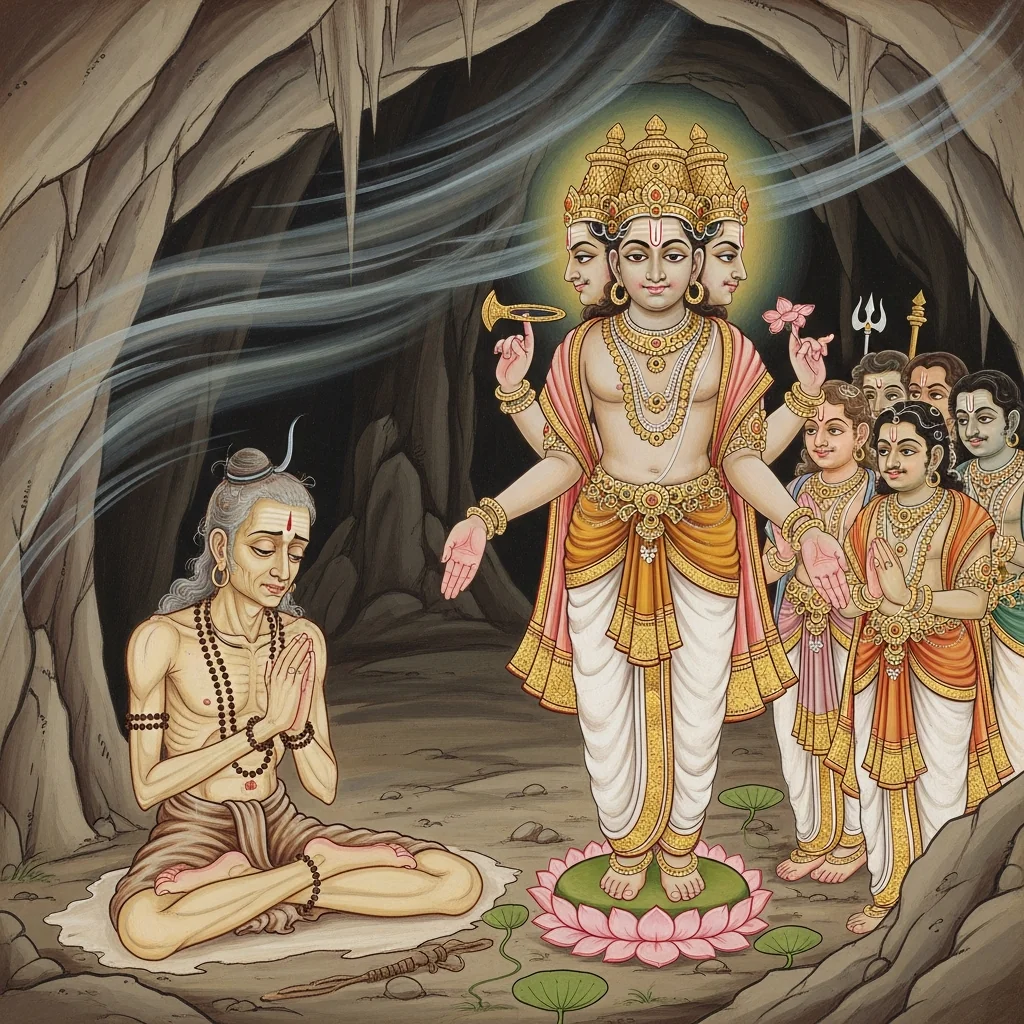
Chapter 15 unfolds a key causal chain in the Kaumāra myth-cycle: suffering gives rise to supplication, supplication awakens dharmic moral reflection, and reflection drives tapas (austerity) that reshapes cosmic power. Varāṅgī laments abandonment and torment, praying for a son who will end her fear and humiliation. The Daitya leader, though cast as asuric, voices a normative defense of marital duty: the wife is honored through dharma-marked roles—jāyā, bhāryā, gṛhiṇī, kalatra—and neglect of an afflicted spouse is declared morally perilous. Brahmā intervenes to temper extreme ascetic resolve and grants assurance of a mighty son named Tāraka. Varāṅgī bears the embryo for a thousand years; Tāraka’s birth is accompanied by cosmic disturbances, signaling world-level consequence. Installed as asura sovereign, Tāraka adopts a strategy: first harsher tapas, then conquest of the devas. At Pāriyātra he receives Pāśupata dīkṣā, repeats five mantras, performs prolonged austerities including self-mutilating oblations, and terrifies the gods by the radiance of his ascetic power. Though pleased, Brahmā—bound by the doctrine of mortality—refuses absolute invulnerability. Tāraka negotiates a conditional boon: he may be slain only by a child older than seven days, a tightly defined vulnerability that foreshadows the Kaumāra resolution. The chapter closes with imagery of Tāraka’s prosperous, courtly rule and the consolidation of his dominion.
Shlokas
Verse 1
वरांग्युवाच । नाशितास्म्यपविद्धास्मि त्रासिता पीडितास्मि च । रौद्रोण देवनाथेन नष्टनाथेन भूरिशः
Varāṅgī said: “I have been ruined and cast aside; I have been terrified and oppressed—again and again—by the fierce lord of the gods, the one who has lost his protector (and thus acts ruthlessly).”
Verse 2
दुःखपारमपश्यंती प्राणांस्त्यक्तुं व्यवस्थिता । पुत्रं मे घोरदुःखस्य तारकं देहि चेत्कृपा
Seeing no far shore to this ocean of sorrow, I am resolved to give up my life. If you have compassion, grant me a son—one who will carry me across this terrible grief.
Verse 3
एवमुक्तस्तु दैत्येंद्रो दुःखितोऽचिंतयद्धृदि । आसुरेष्वपि भावेषु स्पृहा यद्यपि नास्ति मे
Thus addressed, the lord of the Daityas, grieved, reflected within his heart: “Though I have no longing for demonic dispositions and ways….”
Verse 4
तथापि मन्ये शास्त्रैभ्यस्त्वनुकंप्या प्रियेति यत् । सर्वाश्रमानुपादाय स्वाश्रमेण कलत्रवान्
Even so, I understand from the śāstras that the beloved is one who should be met with compassion. Though he has, in principle, embraced all the āśramas, a man established in his own stage of life should still support and maintain his wife.
Verse 5
व्यसनार्णवमत्येति जलयानैरिवार्णवम् । यामाश्रित्येंद्रियारातीन्दुर्जयानितराश्रयैः
Just as one crosses the ocean by means of boats, so too does one pass beyond the sea of calamity by taking refuge in her—she by whom the enemies in the form of the senses, otherwise hard to conquer when one relies elsewhere, are overcome.
Verse 6
गेहिनो हेलया जिग्युर्दस्यून्दूर्ग पतिर्यथा । न केऽपि प्रभवस्तां चाप्यनुकर्तुं गृहेश्वरीम्
Householders conquer troubles with ease, like the lord of a fortress conquers bandits. Yet no one truly has the power to imitate that mistress of the home in her sustaining role.
Verse 7
अथायुषा वा कार्त्स्न्येन धर्मे दित्सुर्यथैव च । यस्यां भवति चात्मैव ततो जाया निगद्यते
And whether through the full span of life, or through complete dedication to dharma, she in whom one finds one’s very self—therefore she is called “jāyā” (wife).
Verse 8
भर्तव्या एव यस्माच्च तस्माद्भार्येति सा स्मृता । सा एव गृहमुक्तं च गृहीणी सा ततः स्मृता
Because she is indeed to be maintained and supported by the husband, she is remembered as “bhāryā” (wife). And since she is the very one who is called the “house” itself, she is therefore remembered as “gṛhiṇī” (lady of the household).
Verse 9
संसारकल्मषात्त्रात्री कलत्रमिति सा ततः । एवंविधां प्रियां को वै नानुकंपितुमर्हति
Because she is a protectress from the stains of worldly existence (saṃsāra), she is therefore called “kalatra” (wife, companion). Who indeed would not be moved to compassion toward such a beloved?
Verse 10
त्रीणि ज्योतींषि पुरुष इति वै देवलोऽब्रवीत् । भार्या कर्म च विद्या च संसाध्यं यत्नतस्त्रयम्
Devala indeed declared: “A man has three lights.” They are: wife, righteous action according to dharma (duty), and knowledge (vidyā)—these three are to be cultivated with careful effort.
Verse 11
तदेनां पीडितां चेद्यः पतिर्भूत्वा न पालये । ततो यास्ये शास्त्रवादान्नरकांतं न संशयः
If, having become her husband, someone does not protect her when she is afflicted, then—according to the teaching of the śāstras—he will go to the very confines of hell; of this there is no doubt.
Verse 12
अह मप्येनमिंद्रं वै शक्तो जेतुं यथाऽनृणाम् । पुनः कामं करिष्येऽस्या दास्ये पुत्रऊं महाबलम्
“I too am surely able to conquer this Indra, as one conquers a man without support. Again I shall fulfill her desire; I shall grant her a son of great strength.”
Verse 13
इति संचिंत्य वज्रांगः कोपव्याकुललोचनः । प्रतिकर्तुं महेंद्राय तपो भूयो व्यवस्यत
Thinking thus, Vajrāṅga—his eyes shaken with anger—resolved to undertake tapas (austerities) once more, in order to retaliate against great Indra.
Verse 14
ज्ञात्वा तु तस्य संकल्पं ब्रह्मा क्रूरतरं पुनः । आजगाम त्वरायुक्तो यत्राऽसौ दितिनंदनः
Knowing his resolve—now even more fierce—Brahmā hastened to the place where that son of Diti was.
Verse 15
उवाचैनं स भगवान्प्रभुर्मधुरया गिरा
That Blessed Lord, the sovereign Brahmā, spoke to him in sweet words.
Verse 16
ब्रह्मोवाच । किमर्थं भूय एव त्वं नियमं क्रूरमिच्छसि । आहाराभिमुखो दैत्य तन्मे ब्रूहि महाव्रतः
Brahmā said: “For what reason do you again desire a harsh discipline? O Daitya, now that you are turned toward taking food—tell me that, O you of great vow.”
Verse 17
यावदब्दसहस्रेण निराहारेण वै फलम् । त्यजता प्राप्तमाहारं लब्धं ते क्षणमात्रतः
“Whatever fruit is gained by fasting without food for a thousand years—by renouncing the food that had come to you, you have obtained that very fruit in just a moment.”
Verse 18
त्यागो ह्यप्राप्तकामानां न तथा च गुरुः स्मृतः । यथा प्राप्तं परित्यज्य कामं कमललोचन । श्रुत्वैतद्ब्रह्मणो वाक्यं दैत्यः प्रांजलिरब्रवीत्
“Renunciation is not so difficult for those who have not obtained their desires, nor is it then regarded as a great virtue. But to abandon desire after it has been attained—O lotus‑eyed one—that is true renunciation.” Having heard these words of Brahmā, the Daitya, with folded hands, spoke.
Verse 19
दैत्य उवाच । पत्न्यर्थेऽहं करिष्यामि तपो घोरं पितामह । पुत्रार्थमुद्यतश्चाहं यः स्याद्गीर्वाणदर्पहा
The Daitya said: “For the sake of a wife, O Grandfather, I shall undertake fierce austerity. And I am resolved to obtain a son—one who will crush the pride of the gods.”
Verse 20
एतच्छ्रुत्वा वचो देवः पद्मगर्भोद्भवस्तदा । उवाच दैत्यराजानं प्रसन्नश्चतुराननः
Hearing these words, the god born from the lotus-womb—four-faced Brahmā—became pleased and then addressed the king of the Daityas.
Verse 21
ब्रह्मोवाच । अलं ते तपसा वत्स मा क्लेशे विस्तरे विश । पुत्रस्ते तारकोनाम भविष्यति महाबलः
Brahmā said: “Enough, dear child, of this austerity—do not plunge into extended hardship. A son of yours, named Tāraka, will be born, mighty in strength.”
Verse 22
देवसीमंतिनीकाम्यधम्मिल्लकविमोक्षणः । इत्युक्तो दैत्यराजस्तु प्रणम्य प्रपितामहम्
Thus addressed—with the boon that fulfills the desire for a divine lady and the loosening of her bound tresses—the king of the Daityas bowed down to the Primeval Grandfather (Brahmā).
Verse 23
विसृज्य गत्वा महिषीं नंदया मास तां मुदा । तौ दंपती कृतार्थौ च जग्मतुश्चाश्रमं तदा
Departing and going to his queen, he delighted her with joy. Then the two spouses, their purpose fulfilled, went to the hermitage.
Verse 24
आहितं च ततो गर्भं वरांगी वरवर्णिनी । पूर्णं वर्षसहस्रं तु दधारोदर एव हि
Then the fair-limbed lady of lovely complexion conceived. Indeed, she bore the embryo within her womb for a full thousand years.
Verse 25
ततो वर्षसहस्रांते वरांगी समसूयत । जायमाने तु दैत्येंद्रे तस्मिंल्लोकभयंकरे
Then, at the end of a thousand years, the fair-limbed lady gave birth. And as that lord of the Daityas—terrifying to the worlds—was being born…
Verse 26
चचाल सकला पृथ्वी प्रोद्धूताश्च महार्णवा । चेलुर्धराधराश्चापि ववुर्वाता विभीषणाः
The entire earth trembled; the great oceans were churned into upheaval. Even the mountains shook, and dreadful winds began to blow.
Verse 27
जेपुर्जप्यं मुनिवरा व्याधविद्धा मृगा इव । जहुः कांतिं च सूर्याद्या नीहाराश्छांदयन्दिशः
The foremost sages hastened their sacred recitations, like deer struck by a hunter. The sun and other luminaries lost their radiance, and banks of mist veiled the directions.
Verse 28
जाते महासुरे तस्मिन्सर्व एव महासुराः । आजग्मुर्हर्षितास्तत्र तथा चासुरयोषितः
When that mighty Asura was born, all the great Asuras—along with the women of the Asuras—came there in delight, rejoicing at the auspicious arrival of their champion.
Verse 29
जगुर्हर्षसमाविष्टा ननृतुश्चासुरांगनाः । ततो महोत्सवे जाते दानवानां पृथासुत
Overcome with joy, they sang, and the Asura maidens danced. Then, when a great festival arose among the Dānavas—O son of Pṛthā—(the narrative continues).
Verse 30
विषण्णमनसो देवाः समहेंद्रास्तदाभवन् । जातामात्रस्तु दैत्येंद्रस्तारकश्चंडविक्रमः
Then the gods—Indra along with them—became heavy-hearted. For Tāraka, fierce in valor, was already, the moment he was born, the lord of the Daityas.
Verse 31
अभिषिक्तोऽसुरो दैत्यैः कुरंगमहिषादिभिः । सर्वासुरमहाराज्ये युतः सर्वैर्महासुरैः
That Asura was consecrated (crowned) by the Daityas—Kuraṅga, Mahiṣa, and others—and was installed as sovereign over the vast dominion of all the Asuras, supported by all the great Asuras.
Verse 32
स तु प्राप्तमहाराज्यस्तारकः पांडुसत्तम । उवाच दानवश्रेष्ठान्युक्तियुक्तमिदं वचः
Having obtained that great sovereignty, Tāraka—O best of the Pāṇḍus—spoke to the foremost Dānavas these words, well-reasoned and strategic.
Verse 33
श्रृणुध्वमसुराः सर्वे वाक्यं मम महाबलाः । श्रुत्वा वः स्थेयसी बुद्धिः क्रियतां वचने मम
“Hear my words, all you Asuras of great strength. Having heard them, let your resolve become firm, and act according to my counsel.”
Verse 34
अस्माकं जातिधर्मेण विरूढं वैरमक्षयम् । करिष्याम्यहं तद्वैरं तेषां च विजयाय च
By the dharma of our own lineage, an undying enmity has taken root. I shall carry that hostility through, so that they may be subdued and victory may be ours.
Verse 35
किं तु तत्तपसा साध्यं मन्येहं सुरसंगमम् । तस्मादादौ करिष्यामि तपो घोरं दनोः सुताः
Yet I deem that access to the gods is attained by tapas, by austerity. Therefore, first of all, I shall undertake severe tapas—O sons of Danu.
Verse 36
ततः सुरान्विजेष्यामो भोक्ष्यामोऽथ जगत्त्रयम् । युक्तोपायोऽहि पुरुषः स्थिरश्रीरेव जायते
Thereafter we shall conquer the gods and then enjoy the three worlds. For the man who employs proper means indeed becomes one whose prosperity is steadfast.
Verse 37
अयुक्तश्चपलः प्राप्तामपि रक्षितुमक्षमः । तच्छ्रुत्वा दानवाः सर्वे वाक्यं तस्यासुरस्य तु
But one who is unsteady and without right judgment is unable to protect even what has been gained. Hearing the words of that Asura, all the Dānavas…
Verse 38
साधुसाध्वित्यथोचुस्ते वचनं तस्य विस्मिताः । सोऽगच्छत्पारियात्रस्य गिरेः कंदरमुत्तमम्
Amazed at his words, they exclaimed, “Well said, well said!” Then he set out for the finest cave of Mount Pāriyātra.
Verse 39
सर्वर्तुकुसुमाकीर्णनानौषधिविदिपितम् । नानाधातुरसस्राविचित्रनानागृहाश्रयम्
It was strewn with flowers of every season and richly filled with many medicinal herbs; it was adorned with wondrous streams of mineral essences and provided shelter in many varied caves and rock-dwellings.
Verse 40
अनेकाकारबहुलं पृथक्पक्षिकुलाकुलम् । नानाप्रस्रवणोपेतं नानाविधजलाशयम्
It abounded in many forms of life and was alive with diverse flocks of birds; it was graced with numerous cascades and many kinds of pools and water-reservoirs.
Verse 41
प्राप्य तत्कंदरं दैत्यश्चकार विपुलं तपः । वहन्पाशुपतीं दीक्षां पंच मंत्राञ्जजाप सः
Having reached that cave, the Daitya undertook immense austerity. Bearing the Pāśupata initiation, he continually recited the five mantras.
Verse 42
निराहारः पंचतपा वर्षायुतमभूत्किल । ततः स्वदेहादुत्कृत्त्य कर्षंकर्षं दिनेदिने
Indeed, he remained without food and practiced the ‘five fires’ austerity for ten thousand years. Then, day after day, he cut away from his own body a portion—one karṣa at a time.
Verse 43
मांसस्याग्नौ जुहावैव ततो निर्मांसतां गतः । ततो निर्मांसदेहः स तपोराशिरजायत
He offered his own flesh into the fire, and thus became fleshless. Then, with a body stripped of flesh, he became a very embodiment—a heap—of austerity.
Verse 44
जज्वलुः सर्वभूतानि तेजसा तस्य सर्वतः । उद्विग्नाश्च सुराः सर्वे तपसा तस्य भीषिताः
By his blazing energy, all beings seemed to burn on every side. All the gods grew anxious, terrified by the force of his austerity.
Verse 45
एतस्मिन्नंतरे ब्रह्मा परमं तोषमागतः । तारकस्य वरं दातुं जगाम शिखरं गिरेः
Meanwhile, Brahmā became exceedingly pleased. To grant Tāraka a boon, he went to the mountain’s peak.
Verse 46
प्राप्य तं शैलराजानं हंसस्यंदनमास्थितः । उवाच तारकं देवो गिरा मधुरया तदा
Reaching that king of mountains, the god (Brahmā), seated upon his swan-chariot, then addressed Tāraka in a sweet voice.
Verse 47
ब्रह्मोवाच । उत्तिष्ठ पुत्र तपसो नास्त्यसाध्यं तवाधुना । वरं वृणीष्वाभिमतं यत्ते मनसि वर्तते
Brahmā said: “Rise, my son. Through your austerity, nothing is impossible for you now. Choose the boon you desire—whatever dwells in your mind.”
Verse 48
इत्युक्तस्तारको दैत्यः प्रांजलिः प्राह तं विभुम्
Thus addressed, the demon Tāraka, with palms joined in reverence, spoke to that all-powerful Lord.
Verse 49
तारक उवाच । वयं प्रभो जातिधर्माः कृतवैराः सहमरैः । तैश्च निःशेषिता दैत्याः कृताः क्रूरैनृशं सवत्
Tāraka said: “O Lord, by our very nature and inherited dharma, we bear enmity toward the gods. By them our Daitya hosts have been utterly destroyed—met with cruel, merciless violence.”
Verse 50
तेषामहं समुद्धर्ता भवेयमिति मे मतिः । अवध्यः सर्वभूतानामस्त्राणां च महौजसाम्
“It is my resolve that I should become their deliverer. Let me be invulnerable to all beings—and even to the weapons of the most mighty.”
Verse 51
स्यामहं चामरैश्चैष वरो मम हृदिस्थितः । एतन्मे देहि देवेश नान्यं वै रोचये वरम्
“May I be thus, unslayable even to the gods—this boon is fixed within my heart. Grant me this, O Lord of gods; I desire no other boon.”
Verse 52
तमुवाच ततो दैत्यं विरंचोऽमरनायकः । न युज्यते विना मृत्युं देहिनो देहधारणम् । जातस्य हि ध्रुवो मृत्युः सत्यमेतच्छ्रुतीरितम्
Then Virañca (Brahmā), leader of the immortals, said to that Daitya: “For an embodied being, sustaining a body without death is not fitting. For one who is born, death is certain—this is truth, as declared by the śruti.”
Verse 53
इति संचिंत्य वरय वरं यस्मान्न शंकसे । ततः संचिंत्य दैत्येंद्रः शिशुतः सप्तवासरात्
“Therefore, reflect and choose a boon about which you have no doubt.” Then the lord of the Daityas pondered and (devised a condition) concerning a child of seven days.
Verse 54
तारक उवाच । वासराणां च सप्तानां वर्जयित्वा तु बालकम् । देवानामप्यवध्योऽहं भूयासं तेन याचितः
Tāraka said: “Except for a child of seven days, may I be unslayable—even by the gods.” Thus he asked for that boon.
Verse 55
वव्रे महासुरो मृत्युं ब्रह्माणं मानमोहितः । ब्रह्मा प्रोचे ततस्तं च तथेति हरवाक्यतः
Deluded by pride, the great Asura sought from Brahmā that condition concerning death. Then Brahmā declared to him, “So be it,” in accordance with Hara’s word.
Verse 56
जगाम त्रिदिवं देवो दैत्योऽपि स्वकमालयम् । उत्तीर्णं तपसस्तं च दैत्यं दैत्येश्वरास्तदा
The god returned to Tridiva, to heaven, and the Daitya too went back to his own abode. Then the Daitya lords gathered around that demon who had successfully completed his austerities.
Verse 57
परिवव्रुः फलाकीर्णं वृक्षं शकुनयो यथा । तस्मिन्महति राज्यस्थे तारके दितिनंदने
They surrounded him as birds encircle a fruit-laden tree—when that great Tāraka, Diti’s descendant, had become firmly established in sovereignty.
Verse 58
ब्रह्मणाभिहि तस्थाने महार्णवतटोत्तरे । तरवो जज्ञिरे पार्थ तत्र सर्वर्तवः शुभाः
At that place—established by Brahmā—on the northern shore of the great ocean, O Pārtha, trees sprang up, and all the seasons there became auspicious.
Verse 59
कांतिर्द्युतिर्धृतिर्मेधा श्रीरखंडा च दानवम् । परिवव्रुर्गुणा कीर्णं निश्छिद्राः सर्व एव हि
Splendour, radiance, steadfastness, intelligence, and unbroken prosperity surrounded that Dānava; indeed, he was filled with virtues, complete in every way, without any flaw.
Verse 60
कालागरुविलिप्तांगं महामुकुटमंडितम् । रुचिरांगदसन्नद्धं महासिंहासने स्थितम्
His body was anointed with dark aloe-wood paste; he was adorned with a great crown, fitted with splendid armlets, and seated upon a lofty throne.
Verse 61
नृत्यंत्यप्सरसः श्रेष्ठा गन्धर्वा गाययंति च । चन्द्रार्कौ दीपमार्गेषु व्यजनेषु च मारुतः । ग्रहा अग्रेसरास्तस्य जीवादेशप्रभाषिणः
The finest Apsarases danced and the Gandharvas sang; the Moon and the Sun served as lights along his pathways, the wind became his fan-bearer, and even the planets went before him, as if proclaiming his very commands.
Verse 62
एवं स्वकाद्बाहुबलात्स दैत्यः संप्राप्य राज्यं परिमोदमानः । कदाचिदाभाष्य जगाद मंत्रिणः प्रोद्धृत्तसर्वांगबलेन दर्पितः
Thus, by the strength of his own arms, that Daitya attained sovereignty and rejoiced. Then, swollen with pride through his heightened power, he addressed his ministers and spoke.