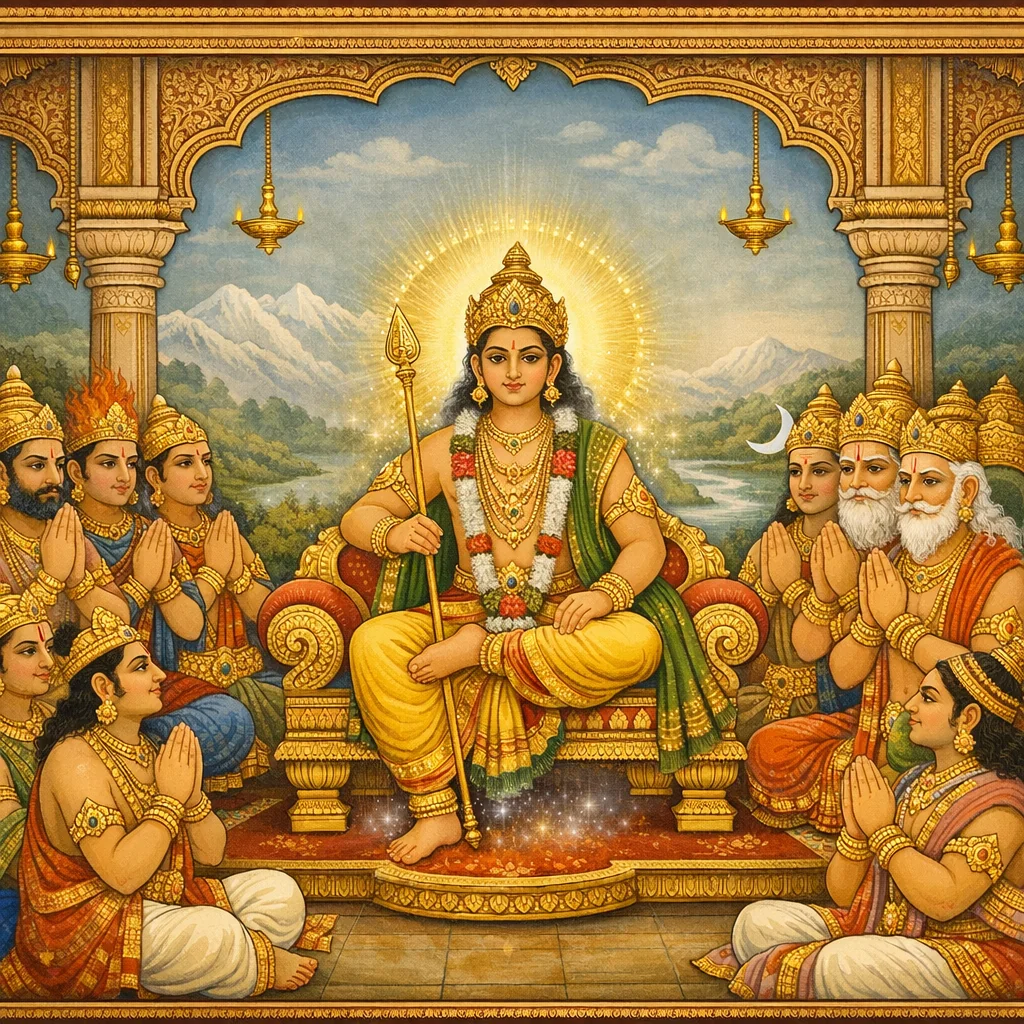
Adhyaya 29
Chapter 29, narrated by Nārada, unfolds as a multi-episode theological account. Girijā (Pārvatī) meets the mountain’s presiding goddess, Kusumāmodinī, and undertakes tapas on a lofty peak, performing seasonal austerities that display her ascetic power. In parallel, the asura Āḍi (connected to Andhaka’s line) gains a conditional boon from Brahmā—death only upon a change of form—and, using māyā, infiltrates Śiva’s vicinity by taking an Umā-like guise to do harm. Śiva detects the imposture through bodily marks and neutralizes it, exemplifying viveka, discerning wisdom against illusion. Misled, Girijā angrily curses her son-like gatekeeper Vīraka; yet the narrative reframes the curse as providential: Vīraka is destined to be born human from stone (śilā) and to serve in time. The chapter explicitly praises Arbuda/Arbudāraṇya and the Acalēśvara-liṅga for their salvific potency. Brahmā grants Girijā a transformation from which Kauśikī, a distinct goddess-form, emerges—appointed as a protector, given a lion as vāhana, and empowered to conquer demonic forces. The account then turns to a Kaumāra cosmogony: Agni’s episode with Svāhā (who assumes the forms of six sages’ wives, excluding Arundhatī) explains the transmission and deposition of Rudra-tejas and the birth and maturation of Skanda/Guha. Viśvāmitra presents a stotra of 108+ names, stressing protective and purifying fruits. Skanda’s early martial display unsettles the devas; Indra’s vajra produces emanations (Śākha, Naigameya) and maternal gaṇa figures, culminating in Skanda’s acceptance of the office of senāpati while reaffirming Indra’s kingship. The chapter closes with celebration on Śveta-parvata and the parents’ reunion with their son, integrating ethics (the cost of anger), ritual theology (stotra, yajña shares), and sacred geography (Arbuda) into a coherent guide for devotion.
Shlokas
Verse 1
। नारद उवाच । व्रजंती गिरिजाऽपश्यत्सखीं मातुर्महाप्रभाम् । कुसुमामोदिनींनाम तस्य शैलस्य देवताम्
Nārada said: As Girijā went on her way, she beheld a radiant friend of her mother—the deity of that mountain—named Kusumāmodinī.
Verse 2
सापि दृष्ट्वा गिरिसुतां स्नेहविक्लवमानसा । क्वपुनर्गच्छसीत्युच्चैरालिंग्योवाच देवता
Seeing the Daughter of the Mountain, the goddess—her heart trembling with affection—embraced her and cried aloud: “Where are you going again?”
Verse 3
सा चास्यै सर्वमाचख्यौ शंकरात्कोपकारणम् । पुनश्चोवाच गिरिजा देवतां मातृसंमताम्
And she told that Goddess everything—the cause of Śaṅkara’s wrath. Then Girijā again spoke to the Goddess who was revered as a mother.
Verse 4
नित्यं शैलाधिराजस्य देवता त्वमनिंदिते । सर्वं च सन्निधानं च मयि चातीव वत्सला
“O blameless one, you are ever the deity of the Lord of Mountains; wholly present at his side, and exceedingly affectionate toward me.”
Verse 5
तदहं संप्रवक्ष्यामि यद्विधेयं तवाधुना । अथान्य स्त्रीप्रवेशे तु समीपे तु पिनाकिनः
“Therefore I shall now tell you what you must do. But as for any other woman entering the vicinity of the Pinākin (Śiva)…”
Verse 6
त्वयाख्येयं मम शुभे युक्तं पश्चात्करोम्यहम् । तथेत्युक्ते तया देव्या ययौ देवी गिरिं प्रति
“Tell me, auspicious one, what is fitting; afterward I shall act accordingly.” When the Goddess replied, “So be it,” the Devī departed toward the mountain.
Verse 7
रम्ये तत्र महाशृंगे नानाश्चर्योपशोभिते । विभूषणादि संन्यस्य वृक्षवल्कलधारिणी
There, upon a lovely great peak adorned with many wonders, she cast aside ornaments and the like, and wore garments of tree-bark.
Verse 8
तपस्तेपे गिरिसुता पुत्रेण परिपालिता । ग्रीष्मे पंचाग्निसंतप्ता वर्षासु च जलोषिता
The Daughter of the Mountain performed tapas, guarded by her son. In summer she endured the scorching of the five fires; and in the rains she remained drenched in water.
Verse 9
स्थंडिलस्था च हेमंते निराहारा तताप सा । एतस्मिन्नंतरे दैत्यो ह्यंधकस्य सुतो बली
In winter she remained upon bare ground and performed austerities without food. Meanwhile, a mighty Daitya—the son of Andhaka—appeared.
Verse 10
ज्ञात्वा गतां गिरिसुतां पितुर्वैरमनुस्मरन् । आडिर्नाम बकभ्राता रहस्यांतरप्रेक्षकः
Learning that the Daughter of the Mountain had gone, and recalling his father’s enmity, there was one named Āḍi—brother of Baka—who spied upon secrets from within.
Verse 11
जिते किलांधके दैत्ये गिरिशेनामरद्विषि । आडिश्चकार विपुलं तपो हरजिगीषया
When Andhaka the Daitya—hater of the gods—had indeed been conquered by Giriśa (Śiva), Āḍi undertook immense austerities, desiring to conquer Hara (Śiva).
Verse 12
तमागत्याब्रवीद्ब्रह्मा तपसा परितोषितः । ब्रूहि किं वासुरश्रेष्ठ तपसा प्राप्तुमिच्छसि
Pleased by his austerities, Brahmā came to him and said: “Speak, O best among the Asuras—what do you wish to obtain through this tapas?”
Verse 13
ब्रह्माणमाह दैत्यस्तु निर्मृत्युत्वमहं वृणे । ब्रह्मोवाच । न कश्चिच्च विना मृत्युं जंतुरासुर विद्यते
The Daitya said to Brahmā, “I choose freedom from death.” Brahmā replied, “O Asura, no embodied being exists without death.”
Verse 14
यतस्ततोऽपि दैत्येंद्र मृत्युः प्राप्यः शरीरिणा । इत्युक्तस्तं तथेत्याह तुष्टः कमलसंभवम्
“In any case, O lord of Daityas, death is inevitable for one who has a body.” Thus addressed, he said to the Lotus-born (Brahmā), “So be it,” satisfied.
Verse 15
रूपस्य परिवर्तो मे यदा स्यात्पद्मसंभव । तदा मृत्युर्मम भवेदन्यथा त्वमरो ह्यहम्
“O Lotus-born, only when my form undergoes a change shall death come to me; otherwise, I am indeed deathless.”
Verse 16
इत्युक्तस्तं तथेत्याह तुष्टः कमलसंभवः । इत्युक्तोऽमरतां मेने दैत्यराज्यस्थितोऽसुरः
Thus spoken to, the Lotus-born (Brahmā), satisfied, replied, “So be it.” Having received this, the Asura—entrenched in the Daitya-kingdom—imagined himself immortal.
Verse 17
आजगाम स च स्थानं तदा त्रिपुरघातिनः । आगतो ददृशे तं च वीरकं द्वार्यवस्थितम्
Then he came to the abode of the Slayer of Tripura (Śiva). On arriving, he saw Vīraka stationed at the gate.
Verse 18
तं चासौ वंचयित्वा च आडिः सर्पशरीरभृत् । अवारितो वीरकेण प्रविवेश हरांतिकम्
Deceiving him, Āḍi—bearing a serpent’s body—entered unrestrained by Vīraka and came into Hara’s presence.
Verse 19
भुजंगरूपं संत्यज्य बभूवाथ महासुरः । उमारूपी छलयितुं गिरिशं मूढचेतनः
Casting off the serpent-form, that great Asura assumed another guise, taking on Umā’s form to deceive Giriśa (Śiva), his mind deluded.
Verse 20
कृत्वोमायास्ततो रूपमप्रतर्क्यमनोहरम् । सर्वावयवसंपूर्णं सर्वाभिज्ञानसंवृतम्
Then, by māyā, he fashioned a form—bewilderingly enchanting—perfect in every limb and clothed with every sign of authenticity.
Verse 21
चक्रे भगांतरे दैत्यो दंतान्वज्रोपमान्दृढान् । तीक्ष्णाग्रान्बुद्धिमोहेन गिरिशं हंतुमुद्यतः
With his intellect clouded, the Daitya fashioned in her private part teeth hard as thunderbolts, sharp-pointed, intent on slaying Giriśa (Śiva).
Verse 22
कृत्वोमारूपमेवं स स्थितो दैत्यो हरांतिके । तां दृष्ट्वा गिरिशस्तुषुटः समालिंग्य महासुरम्
Thus, assuming Umā’s form, the demon stood close to Hara (Śiva). Seeing her, Giriśa was pleased and embraced that great Asura.
Verse 23
मन्यमानो गिरिसुतां सर्वै रवयवांतरैः । अपृच्छत्साधु ते भावो गिरिपुत्री ह्यकृत्रिमा
Taking the figure before him to be Girisutā (Pārvatī) in every limb and feature, he questioned her: “Your disposition is truly fitting—O daughter of the mountain, indeed unfeigned.”
Verse 24
या त्वं मदशयं ज्ञात्वा प्राप्तेह वरवर्णिनि । त्वया विरहितः शून्यं मन्योस्मिन्भुवनत्रये
“Since you, O fair-complexioned lady, have understood my heart and have come here, without you I would deem this entire triple world to be empty.”
Verse 25
प्राप्ता प्रसन्ना या त्वं मां युक्तमेवंविधं त्वयि । इत्युक्ते गूहयंश्चेष्टामुमारूप्यसुरोऽब्रवीत्
When this was said, the asura—having taken on Umā’s form and concealing his real intent—spoke: “Since you have come, gracious and pleased toward me, such conduct is only proper for you.”
Verse 26
यातास्मि तपसश्चर्तुं कालीवाक्यात्तवातुलम् । रतिश्च तत्र मे नाभूत्ततः प्राप्ता तवांतिकम्
“I went to perform incomparable austerity, prompted by Kālī’s words. Yet I found no joy there; therefore I have come back to your presence.”
Verse 27
इत्युक्तः शंकरः शंकां किंचित्प्राप्यवधारयत् । कुपिता मयि तन्वंगी प्रत्यक्षा च दृढव्रता
Hearing this, Śaṅkara grew somewhat suspicious and reflected: “That slender-limbed one is openly angry with me, and she is firm in her vow.”
Verse 28
अप्राप्तकामा संप्राप्ता किमेतत्संशयो मम । रहसीति विचिंत्याथ अभिज्ञानाद्विचारयन्
“She who had not attained her desire has now come—why then do I doubt?” Thinking, “This is a secret matter,” he began to examine the situation through recognition and signs.
Verse 29
नापश्यद्वामपार्श्वे तु तस्यांकं पद्मलक्षणम् । लोम्नामावर्तचरितं ततो देवः पिनाकधृक्
He did not see on her left side the lotus-marked sign upon the thigh, nor the distinctive whorl-pattern of the hairs. Therefore the God, bearer of the Pināka bow, knew the truth.
Verse 30
बुद्धा तां दानवीं मायां किंचित्प्रहसिताननः । मेढ्रे रौद्रास्त्रमाधाय चक्रे दैत्यमनोरथम्
Having understood it to be demonic illusion, he smiled slightly; then, fixing the Raudra weapon upon the daitya’s organ, he brought the demon’s desire to a bitter end.
Verse 31
स रुदन्भैरवाज्रावानवसादं गतोऽसुरः । अबुध्यद्वीरको नैतदसुरेंद्रनिषूदनम्
Crying out with terrifying screams, the asura fell into despair. That Vīraka did not realize that this power was the slayer of the lords of asuras.
Verse 32
हते च मारुतेनाशुगामिना नगदेवता । अपरिच्छिन्नतत्त्वार्था शैलपुत्र्यां न्यवेदयत्
When he had been slain by the swift-moving Wind, the mountain-deity—unable to fathom the true import of what had occurred—reported the matter to Śailaputrī (Pārvatī).
Verse 33
श्रुत्वा वायुमुखाद्देवी क्रोधरक्तातिलोचना । अपस्यद्वीरकं पुत्रं हृदयेन विदूयता
Hearing it from the mouth of Vāyu, the Goddess—her eyes reddened with wrath—beheld her son Vīraka, her heart burning with anguish.
Verse 34
मातरं मां परित्यज्य यस्मात्त्वं स्नेहविह्वलाम् । विहितावसरः स्त्रीणां शंकरस्य रहोविधौ
“Since you have abandoned me—your mother—while I am shaken with affection, and since you have intruded at an improper time into Śaṅkara’s private rite (meant to be observed with due propriety),”
Verse 35
तस्मात्ते परुषा रूक्षा जडा हृदय वर्जिता । गणेशाक्षरसदृशा शिला माता भविष्यति
“Therefore, for you, a mother shall become a stone—harsh, dry, insentient, and devoid of tenderness—like the syllable of Gaṇeśa.”
Verse 36
एवमुत्सृष्टशापाया गिरिपुत्र्यास्त्वनंतरम् । निर्जगाम मुखात्क्रोधः सिंहरूपी महाबलः
Thus, immediately after Giriputrī had cast forth her curse, her very wrath emerged from her mouth—taking the form of a mighty lion.
Verse 37
पश्चात्तापं समश्रित्य तया देव्या विसर्जितः । स तु सिंहः करालास्यो महाकेसरकंधरः
Then, moved by remorse, the Goddess dismissed it; and that lion had a fearsome mouth and a great mane about its neck.
Verse 38
प्रोद्धूतबललांगूलदंष्ट्रोत्कट गुहामुखः । व्यावृतास्यो ललज्जिह्वः क्षामकुक्षिश्चिखादिषुः
Its mighty tail was lifted high; its jaws and fangs were dreadful, like the mouth of a cavern. With gaping mouth and flickering tongue, its belly was lean—ever ravenous for prey.
Verse 39
तस्यास्ये वर्तितुं देवी व्यवस्यत सती तदा । ज्ञात्वा मनोगतं तस्या भगवांश्चतुराननः
At that time the Goddess Satī resolved to enter its mouth. Knowing the intention that had arisen in her mind, the Blessed Four-faced One (Brahmā) …
Verse 40
आजगामाश्रमपंद संपदामाश्रयं ततः । आगम्योवाच तां ब्रह्मा गिरिजां मृष्टया गिरा
Thereupon Brahmā came to that hermitage—an abode of prosperity. Arriving, he addressed Girijā in gentle, well-chosen words.
Verse 41
किं देवी प्राप्तुकामासि किमलभ्यं ददामि ते । तच्छ्रुत्वोवाच गिरिजा गुरुगौरवगर्भितम्
“Goddess, what do you wish to obtain? What is unattainable? I shall grant it to you.” Hearing this, Girijā replied with words filled with weight and solemn dignity.
Verse 42
तपसा दुष्करेणाप्तः पतित्वे शंकरो मया । स मां श्यामलवर्णेति बहुशः प्रोक्तवान्भवः
“By severe and difficult austerities I obtained Śaṅkara as my husband. Yet Bhava repeatedly addressed me as ‘dark-complexioned.’”}]}
Verse 43
स्यामहं कांचनाकारा वाल्लभ्येन च संयुता । भर्तुर्भूतपतेरंगे ह्येकतो निर्विशंकिता
Though I am dark, I bear a golden radiance and am endowed with beloved grace; yet upon the body of my husband, the Lord of beings, I remain set to one side—without confidence.
Verse 44
तस्यास्तद्भाषितं श्रुत्वा प्रोवाच जलजासनः । एवं भवतु भूयस्त्वं भर्तुर्देहार्धधारिणी
Hearing her words, the Lotus-seated one (Brahmā) spoke: “So be it. May you again become the bearer of half of your husband’s body.”
Verse 45
ततस्तस्याः शरीरात्तु स्त्री सुनीलांबुजत्विषा । निर्गता साभवद्भीमा घंटाहस्ता त्रिलोचना
Then from her body there emerged a woman with the sheen of a deep-blue lotus; she appeared formidable—three-eyed, with a bell in her hand.
Verse 46
नानाभरणपूर्णांगी पीतकौशेयवासिनी । तामब्रवीत्ततो ब्रह्मा देवीं नीलांबुजत्विषम्
Adorned with many ornaments and clad in yellow silk, that goddess of blue-lotus radiance was then addressed by Brahmā.
Verse 47
अस्माद्भूधरजा रदेहसंपर्कात्त्वं ममाज्ञया । संप्राप्ता कृतकृत्यत्वमेकानंशा पुराकृतिः
“By my command, through contact with this body born of the mountain, you have attained fulfillment of purpose—an ancient, single portion (of the Goddess) made manifest once more.”
Verse 48
य एष सिंहः प्रोद्भूतो देव्याः क्रोधाद्वरानने । स तेस्तु वाहनो देवी केतौ चास्तु महाबलः
O fair-faced one, this lion that sprang forth from the Goddess’s wrath—let him be your vahana, O Devī, and let him also be your mighty ketu, your emblem and banner.
Verse 49
गच्छ विंध्याचले तत्र सुरकार्यं करिष्यति । अत्र शुंभनिशुंभौ च हत्वा तारकसैन्यपौ
Go to Mount Vindhya; there you will accomplish the work of the gods. Here, after slaying Śumbha and Niśumbha, the commanders of Tāraka’s forces…
Verse 50
पांचालोनाम यक्षोऽयं यक्षलक्षपदानुगः । दत्तस्ते किंकरो देवी महामायाशतैर्युतः
This Yakṣa named Pāñcāla, attended by hundreds of thousands of Yakṣas, is bestowed upon you, O Devī, as a servant—endowed with hundreds of great powers of Mahāmāyā.
Verse 51
इत्युक्ता कौशिकी देवी ततेत्याह पितामहम् । निर्गतायां च कौशिक्यां जाता स्वैराश्रिता गुणैः
Thus addressed, the goddess Kauśikī replied to Pitāmaha (Brahmā), “So be it.” And when Kauśikī had departed, there arose another form, self-directed and established in her own qualities.
Verse 52
सर्वैः पूर्वभवोपात्तैस्तदा स्वयमुपस्तितैः । उमापि प्राप्तसंकल्पा पश्चात्तापपरायणा
Then all the consequences gathered from former births presented themselves of their own accord; and Umā too formed her resolve, wholly absorbed in repentance.
Verse 53
मुहुः स्वं परिनिंदंती जगाम गिरिशांतिकम् । संप्रयांतीं च तां द्वारी अपवार्य समाहितः
Again and again blaming herself, she went into the presence of Girīśa. As she drew near, the vigilant gatekeeper stepped to the threshold and stopped her.
Verse 54
रुरोध वीरको देवीं हेमवेत्रलताधरः । तामुवाच च कोपेन तिष्ठ तिष्ठ क्व यासि च
Vīraka, holding a golden, creeper-like staff, barred the Goddess and angrily said, “Stop, stop! Where are you going?”
Verse 55
प्रयोजनं न तेऽस्तीह गच्छ यावन्न भर्त्स्यसे । देव्या रूपधरो दैत्यो देवं वंचयितुं त्विह
“You have no business here—go, before you are rebuked. For here a demon, taking the form of the Goddess, seeks to deceive the Lord.”
Verse 56
प्रविष्टो न च दृष्टोऽसौ स च देवेन घातितः । घातिते चाहमाक्षिप्तो नीलकण्ठेन धीमता
“He slipped in and was not noticed, and the Lord struck him down. And when he had been slain, I was reproached by the wise Nīlakaṇṭha.”
Verse 57
कापि स्त्री नापि मोक्तव्या त्वया पुत्रेति सादरम् । तस्मात्त्वमत्र द्वारिस्था वर्षपूगान्यनेकशः
“No woman at all is to be let in by you—though addressed affectionately as ‘son.’ Therefore you shall stand here at the gate for many multitudes of years.”
Verse 58
भविष्यसि न चाप्यत्र प्रवेशं लप्स्यसे व्रज । एका मे प्रविशेदत्र माता या स्नेहवत्सला
“So it shall be—and here you shall not be granted entry. Go. Only one may enter here: my mother, who is full of affection.”
Verse 59
नगाधिराजतनया पार्वती रुद्रवल्लभा । इत्युक्ता तु ततो देवी चिंतयामास चेतसा
Thus addressed as “Pārvatī, daughter of the lord of mountains, beloved of Rudra,” the Goddess then reflected within her heart.
Verse 60
न सा नारी तु दैत्योऽसौ वायोर्नैवावबासत । वृथैव वीरकः शप्तो मया क्रोधपरीतया
“She was not a woman—he was a demon; and this did not become clear even to Vāyu. In anger, I cursed Vīraka for nothing.”
Verse 61
अकार्यं क्रियते मूढैः प्रायः क्रोधसमन्वितैः । क्रोधेन नश्यते कीर्तिः क्रोधो हंति स्थिरां श्रियम्
Foolish people, seized by anger, commonly do what ought not to be done. By anger one’s good fame perishes; anger destroys even stable prosperity.
Verse 62
अपरिच्छिन्नसर्वार्था पुत्रं शापितवत्यहम् । विपरीतार्थबोद्धॄणां सुलभा विपदो यतः
O son, since I did not fully understand the truth of all matters, I ended up cursing you. For those who grasp things in a perverse or mistaken way, calamities come easily.
Verse 63
संचिंत्यैवमुवाचेदं वीरकं प्रति शैलजा । अधो लज्जाविकारेण वदनेनांबुजत्विषा
Having thus reflected, Śailajā spoke to Vīraka—her lotus-bright face lowered, transformed by modesty.
Verse 64
अहं वीरक ते माता मा तेऽस्तु मनसो भ्रमः । शंकरस्यास्मि दयिता सुता तु हिमभूभृतः
Vīraka, I am your mother—let there be no confusion in your mind. I am Śaṅkara’s beloved, and the daughter of Himabhūbhṛt, Lord of the snowy mountains.
Verse 65
मम गात्रस्थितिभ्रांत्या मा शंकां पुत्र भावय । तुष्टेन गौरता दत्ता ममेयं पद्मयोनिना
O son, do not entertain doubt because of confusion arising from my bodily condition. This fair radiance of mine was bestowed by Padmayoni (Brahmā) when he was pleased.
Verse 66
मया शप्तोऽस्यविदिते वृत्तांते दैत्यनिर्मिते । ज्ञात्वा नारीप्रवेशं तु शंकरे रहसि स्तिते
I cursed him without knowing the true situation—an episode contrived by a daitya. But after learning of the woman’s entry into the affair, while Śaṅkara stood in secret—
Verse 67
न निवर्तयितुं शक्यः शापः किं तु ब्रवीमि ते । मानुष्यां तु शिलायां त्वं शिलादात्संभविष्यसि
The curse cannot be reversed; yet I tell you this: you will come to be in human form from a stone—born from Śilād (Śilāda).
Verse 68
पुण्ये चाप्यर्बुदारण्ये स्वर्गमोक्षप्रदे नृणाम् । अचलेश्वरलिंगं तु वर्तते यत्र वीरक
In the holy Arbudāraṇya, which grants people heaven and liberation, there stands the liṅga of Acaleśvara, O Vīraka.
Verse 69
वाराणस्यां विश्वनाथसमं तत्फलदं नृणाम् । प्रभासस्य च यात्राभिर्दशभिर्यत्फलं नृणाम्
For people, its fruit equals the worship of Viśvanātha in Vārāṇasī; and it grants the same merit as ten pilgrimages to Prabhāsa.
Verse 70
तदेकयात्रया प्रोक्तमर्बुदस्य महागिरेः । यत्र तप्त्वा तपो मर्त्या देहधातून्विहाय च
That very merit is declared to arise from a single pilgrimage to the great mountain Arbuda—where mortals, having practiced austerity, then cast off the elements of the body.
Verse 71
संसारी न पुनर्भूयान्महेश्वरवचो यथा । अर्बुदो यदि लभ्येत सेवितुं जन्मदुःखितैः
So that one may not become a wanderer in saṃsāra again—just as Maheśvara has spoken—if only Arbuda could be attained and reverently served by those afflicted by the sorrow of repeated birth.
Verse 72
वाराणसीं च केदारं किं स्मरंति वृथैव ते । तत्राराध्य भवं देवं भवान्नन्दीति नामभृत्
Why do they remember Vārāṇasī and Kedāra in vain? There, having worshiped Lord Bhava (Śiva), he became renowned by the name Bhavān-nandī.
Verse 73
शीघ्रमेष्यसि चात्रैव प्रतीहारत्वमाप्स्यसि । एवमुक्ते हृष्टरोमा वीरकः प्रणिपत्य ताम्
“You will return quickly, and right here you will attain the office of chamberlain, the gate-keeper (pratīhāra).” When she spoke thus, Vīraka—his hair standing on end with joy—bowed down to her.
Verse 74
संस्तूय विविधैर्वाक्यैर्मातरं समभाषत । धन्योऽहं देवि यो लप्स्ये मानुष्यमतिदुर्लभम्
Praising the Mother with many words, he addressed her: “Blessed am I, O Goddess, for I shall obtain human birth—so exceedingly hard to attain.”
Verse 75
शापोऽनुग्रहरूपोऽयं विशेषादर्बुदाचले । समीपे यस्य पुण्योऽस्ति महीसागरसंगमः
This “curse” is in truth a form of grace—especially on Mount Arbuda—near which lies the holy confluence of the land and the ocean.
Verse 76
ऊधः पृथिव्या देशोऽयं यो गिरेश्चार्णवांतरे । तत्र गत्वा महत्पुण्यमवाप्य भवभक्तितः
This region is like the “udder of the Earth”, lying between the mountain and the ocean. Going there, one attains great merit through devotion to Bhava (Śiva).
Verse 77
पुनरेष्यामि भो मातरित्युक्त्वाभूच्छिलासुतः । देवी च प्रविवेशाथ भवनं शशिमौलिनः
Saying, “I shall return again, O Mother,” the son of the rock departed. And the Goddess then entered the abode of the moon-crested Lord (Śiva).
Verse 78
इत्यार्बुदाख्यानम् । ततो दृष्ट्वा च तां प्राह धिग्नार्य इति त्र्यंबकः
Thus ends the account of Arbuda. Then, seeing her, Tryambaka (Śiva) said: “Shame upon you, O woman!”
Verse 79
सा च प्रण्म्य तं प्राह सत्यमेतन्न मिथ्यया । जडः प्रकृतिभागोयं नार्यश्चार्हंति निन्दनाम्
She too, bowing to him, said: “This is true, not false. This dullness is a share of Prakṛti; and women indeed deserve censure.”
Verse 80
पुरुषाणां प्रसादेन मुच्यंते भवसागरात् । ततः प्रहृष्टस्तामाह हरो योग्याऽधुना शुभे
By the favor of men they are freed from the ocean of worldly becoming. Then Hara, delighted, said to her: “O auspicious one, you are now worthy.”
Verse 81
पुत्रं दास्यामि येन त्वं ख्यातिमाप्स्यसि शोभने । ततो रेम हि देव्या स नानाश्चर्यालयो हरः
“I shall give you a son, by whom you will attain fame, O lovely one.” Then Hara—an abode of many wonders—indeed delighted with the Goddess.
Verse 82
ततो वर्षसहस्रेषु देवास्त्वरितमानसाः । ज्वलनं नोदयामासुर्ज्ञातुं शंकरचेष्टितम्
Then, after thousands of years had passed, the gods—eager and restless at heart—urged Agni (Jvalana) onward, wishing to learn the mysterious intent and action of Śaṅkara.
Verse 83
द्वारि स्थितं प्रतिहारं वंचयित्वा च पावकः । पारावतस्य रूपेण प्रविवेश हरांतिकम्
Deceiving the doorkeeper stationed at the gate, Pāvaka (Agni) entered Hara’s inner presence, assuming the form of a dove.
Verse 84
ददृशे तं च देवेशो विनतां प्रेक्ष्य पार्वतीम् । ततस्तां ज्वलनं प्राह नैतद्योग्यं त्वया कृतम्
The Lord of the gods saw him, and, seeing Pārvatī bowed down, he then addressed Jvalana (Agni): “This is not a fitting act that you have done.”
Verse 85
यदिदं भुक्षुतं स्थानान्मम तेजो ह्यनुत्तमम् । गृहाण त्वं सुदुर्बुद्धे नो वा धक्ष्यामि त्वां रुषा
“Since you have consumed from this place my unsurpassed divine energy, take it back, O foolish-minded one—otherwise, in wrath, I shall burn you.”
Verse 86
भीतस्ततोऽसौ जग्राह सर्वदेवमुखं च सः । तेन ते वह्निसहिता विह्वलाश्च सुराः कृताः
Then, frightened, he seized the mouths of all the gods; and by that, those deities—together with Agni—were thrown into distress and confusion.
Verse 87
विपाट्य जठराण्येषां वीर्यं माहेश्वरं ततः । निष्क्रांतं तत्सरो जातं पारदं शतयोजनम्
Rending open their bellies, the Māheśvara potency flowed out; from that there arose a lake of mercury (pārada), extending a hundred yojanas.
Verse 88
वह्निश्च व्याकुलीभूतो गंगायां मुमुचे सकृत् । दह्यमाना च सा देवी तरंगैर्वहिरुत्सृजत्
Agni too, thrown into turmoil, released it once into the Gaṅgā. And as that Goddess was scorched, she cast the fire outward through her waves.
Verse 89
जातस्त्रिभुवनक्यातस्तेन च श्वेतपर्वतः । एतस्मिन्नंतरे वह्निराहूतश्च हिमालये
From that arose the famed Śveta-parvata, the White Mountain, renowned in the three worlds. Meanwhile, Agni too was summoned to the Himālaya.
Verse 90
सप्तर्षिभिर्वह्निहोमं कुर्वद्भिर्मंत्रवीर्यतः । आगत्य तत्र जग्राह वह्निर्भागं च तं हुतम्
As the Seven Ṛṣis, empowered by mantra, were performing the homa and offering into the fire, Agni came there and took his share of that oblation.
Verse 91
गतेऽह्न्यत्वस्मिंश्च तत्रस्थः पत्नी स्तेषामपश्यत । सुवर्णकदलीस्तंभनिभास्ताश्चंद्रलेखया
When that day had passed, the wives of those sages who were there saw (them) like golden plantain-stems, marked with a crescent line.
Verse 92
पश्यमानः प्रफुल्लाक्षो वह्निः कामवशं गतः । स भूयश्चिंतयामास न न्याय्यं क्षुभितोऽस्मि यत्
As he looked on, his eyes widened in infatuation, Agni fell under the sway of desire. Then he reflected again and again: “It is not right that I have become so agitated.”
Verse 93
साध्वीः पत्नीर्द्विजेंद्राणामकामाः कामयाम्यहम् । पापमेतत्कर्म चोग्रं नश्यामि तृमवत्स्फुटम्
“I am desiring the chaste wives of the best of the twice-born—women who do not desire me. This deed is sinful and dreadful; I shall be utterly ruined, like a blade of grass.”
Verse 94
कृत्वैतन्नश्यते कीर्तिर्यावदाचंद्रतारकम् । एवं संचिंत्य बहुधा गत्वा चैव वनांतरम्
“If I do this, my good fame—meant to endure as long as the moon and stars—will be destroyed.” Thinking thus again and again, he went into the depths of the forest.
Verse 95
संयन्तुं नाभवच्छक्त उपायैर्बहुभिर्मनः । ततः स कामसंतप्तो मूर्छितः समपद्यत
Yet his mind could not be restrained, even by many methods. Then, scorched by desire, he fell into a swoon.
Verse 96
ततः स्वाहा च भार्यास्य बुबुधे तद्विचेष्टितम् । ज्ञात्वा च चिंतयामास प्रहृष्टा मनसि स्वयम्
Then Svāhā, his wife, understood his behavior. Knowing it, she reflected within herself—secretly delighted in her mind.
Verse 97
स्वां भार्यामथ मां त्यक्त्वा बहुवासादवज्ञया । भार्याः कामयते नूनं सप्तर्षीणां महात्मनाम्
“Having neglected his own wife—me—out of contempt born of long familiarity, he surely desires the wives of the great-minded Seven Sages.”
Verse 98
तदासां रूपमाश्रित्य रमिष्ये तेन चाप्यहम् । ततस्त्वंगिरसो भार्या शिवानामेति शोभना
“Assuming their forms, I too will sport with him.” Then the beautiful wife of Aṅgiras, named Śivā, stepped forward.
Verse 99
तस्या रूपं समाधाय पावकं प्राप्य साब्रवीत् । मामग्ने कामसंतप्तां त्वं कामयितुमर्हसि
Taking on her form, Svāhā approached Pāvaka (Agni) and said: “O Agni, I burn with desire; you should desire me.”
Verse 100
न चेत्करिष्यसे देव मृतां मामुपधारय । अहमंगिरसो भार्या शिवानाम हुताशन
“If you will not do so, O god, then consider me as dead. I am the wife of Aṅgiras, named Śivā, O Hutāśana (Agni).”
Verse 101
सर्वाभिः सहिता प्राप्ता ताश्च यास्यंत्यनुक्रमात् । अस्माकं त्वं प्रियो नित्यं त्वच्चित्ताश्च वयं तथा
“I have come together with them all, and they too will come one after another in due order. You are ever dear to us, and our minds likewise are devoted to you.”
Verse 102
ततः स कामसंतप्तः संबभूव तया सह । प्रीते प्रीता च सा देवी निर्जगाम वनांतरात्
Then he, inflamed by desire, united with her. When he was satisfied, that goddess too—pleased—came forth from the depths of the forest.
Verse 103
चिंतयंती ममेदं चेद्रूपं द्रक्ष्यंति कानने । ते ब्राह्मणीनामनृतं दोषं वक्ष्यंति पावकात्
She thought, “If they behold this form of mine in the forest, they will proclaim that Pāvaka, the Fire-god, has incurred the fault of untruth because of the brāhmaṇas’ wives.”
Verse 104
तस्मादेतद्रक्षमाणा गरुडी संभवाम्यहम् । सुपर्णा सा ततो भूत्वा ददृशे श्वेतपर्वतम्
Therefore, to safeguard this, she resolved, “I shall become a Garuḍī.” Then, having become Suparṇā, the great-winged bird, she beheld the White Mountain (Śvetaparvata).
Verse 105
शरस्तंबैः सुसंपृक्तं रक्षोभिश्च पिशाचकैः । सा तत्र सहसा गत्वा शैलपूष्ठं सुदुर्गमम्
That place was thickly tangled with reeds and haunted by rākṣasas and piśācas. She swiftly went there, to a most inaccessible mountain ridge.
Verse 106
प्राक्षिपत्कांचने कुंडे शुक्रं तद्धारणेऽक्षमा । शिष्टानामपि देवीनां सप्तर्षीणां महात्मनाम्
Unable to bear it, she cast that semen into a golden vessel—a burden that even the noble goddesses and the great-souled Seven Sages could scarcely sustain.
Verse 107
पत्नीसरूपतां कृत्वा कामयामास पावकम् । दिव्यं रूपमरूंधत्याः कर्तुं न शकितं तया
Assuming the likeness of a wife, she sought Pāvaka (Agni) in desire; yet she could not fashion for herself the divine form of Arundhatī.
Verse 108
तस्यास्तपःप्रभावेण भर्तुः शुश्रूषणेन च । षट्कृत्वस्तत्तु निक्षिप्तमग्निरेतः कुरुद्वह
By the power of her austerity and by her devoted service to her husband, the seed of Agni was indeed deposited six times, O bearer of the Kurus.
Verse 109
कुंडेऽस्मिंश्चैत्रबहुले प्रतिपद्येव स्वाहया । ततश्च पावको दुःखाच्छुशोच च मुमोह च
Into this vessel—on Pratipadā, the bright first day of the month of Caitra—by Svāhā. Thereupon Pāvaka, stricken with sorrow, grieved and fell into delusion.
Verse 110
आः पापं कृतमित्येव देहन्यासेऽकरोन्मतिम् । ततस्तं खेचरी वाणी प्राह मा मरणं कुरु
“Alas, I have committed sin!”—thinking thus, he resolved to abandon his body. Then a heavenly voice spoke to him: “Do not commit death.”
Verse 111
भाव्यमेतच्च भाव्यर्थात्को हि पावक मुच्यते । भाव्यर्थेनापि यत्ते च परदारोप सेवनम्
“This was destined, and for the sake of what must come to pass—who, O Pāvaka, can escape destiny? Yet even so, your resorting to another’s wife is a fault.”
Verse 112
कृतं तच्चेतसा तेन त्वामजीर्णं प्रवेक्ष्यति । श्वेतकेतोर्महायज्ञे घृतधाराभितर्पितम्
Because he has resolved it in his mind, he will enter you while you are still undigested—you who were satisfied by streams of ghee in Śvetaketu’s great sacrifice.
Verse 113
शोकं च त्यज नैतास्ताः स्वाहै वेयं तव प्रिया । श्वेतपर्वतकुंडस्थं पुत्रं त्वं द्रष्टुमर्हसि । ततो वह्निस्तत्र गत्वा ददृशे तनयं प्रभुम्
“Cast away your sorrow—these are not your wives; this is Svāhā, your beloved. Go and behold your son who dwells in the pool at Śvetaparvata.” Then Agni went there and beheld his son, the Lord.
Verse 114
अर्जुन उवाच । कस्मात्स्वाहा करोद्रूपं षण्णां तासां महामुने
Arjuna said: “O great sage, for what reason did Svāhā assume the forms of those six (wives)?”
Verse 115
यत्ता भर्तृपराः साध्व्यस्तपस्विन्योग्निसंनिभाः । न बिभेति च किं ताभ्यः षड्भ्यः स्वाहाऽपराधिनी । भर्तृभक्त्या जगद्दग्धुं यतः शक्ताश्च ता मुने
Those women are wholly devoted to their husbands—virtuous ascetics, blazing like fire. O sage, why did the offending Svāhā not fear those six, when by their wifely devotion they are able to burn the world?
Verse 116
नारद उवाच । सत्यमेतत्कुरुश्रेष्ठ श्रृणु तच्चापि कारणम् । येन तासां कृतं रूपं न वा शापं ददुश्च ताः
Nārada said: “It is indeed so, O best of the Kurus. Hear also the reason—why Svāhā assumed their forms, and why those women did not utter a curse.”
Verse 117
यत्र तद्वह्निना क्षिप्तं रुद्रतेजः सकृत्पुरा । गंगायां तत्र सस्नुस्ताः षटत्न्योऽज्ञनाभावतः
Where Agni had once cast the Rudra-splendour (Rudra-tejas), there the six wives bathed in the Gaṅgā, unaware of what had transpired.
Verse 118
ततस्ता विह्वलीभूतास्तेजसा तेन मोहिताः । लज्जया च स्वभर्तॄणां गंगातीरस्थिता रहः
Then they were overwhelmed, deluded by that splendour; and, out of shame before their husbands, they remained secretly on the bank of the Gaṅgā.
Verse 119
एतदंतमालोक्य चिकीर्षंती मनीषितम् । स्वाहा शरीरमाविश्यतासां तेजो जहार तत्
Seeing how matters stood and wishing to accomplish her intention, Svāhā entered their bodies and carried away that splendour (tejas) from them.
Verse 120
चिक्रीड वह्निजायापि यथा ते कथितं मया
Thus even the wife of Agni sported—acting playfully and with strategy—just as I have told you.
Verse 121
उपकारमिमं ताभिः स्मरंतीभिश्च भारत । न शप्ता सा यतः शापो न देयश्चोपकारिणि
O Bhārata, remembering this help rendered to them, they did not curse her; for a curse should not be given to one who has been a benefactor.
Verse 122
ततः सप्तर्षयो ज्ञात्वा ज्ञानेनासुचितां गताः । तत्यजुः षट् तदा पत्नीर्विना देवीमरुंधतीम्
Then the Seven Sages, realizing the truth through their insight, found themselves fallen into impurity; thereupon they abandoned their six wives—except the goddess Arundhatī.
Verse 123
विश्वामित्रस्तु भगवान्कुमारं शरणं गतः । स्तवं दिव्यं संप्रचक्रे महासेनस्य चापि सः
The revered Viśvāmitra took refuge in Kumāra, and he too composed a divine hymn in praise of Mahāsena.
Verse 124
अष्टोत्तरशतं नाम्नां श्रृणु त्वं तानि फाल्गुन । जपेन येषां पापानि यांति ज्ञानमवाप्नुयात्
O Phālguna, listen to those one hundred and eight names; by repeating them in japa, sins depart and spiritual knowledge is attained.
Verse 125
त्वं ब्रह्मवादी त्वं ब्रह्मा ब्राह्मणवत्सलः । ब्रह्मण्यो ब्रह्मदेवश्च ब्रह्मदो ब्रह्मसंग्रहः
You are the proclaimer of Brahman; you are Brahmā; you are tender toward the brāhmaṇas. You uphold the Brahmanic order; you are the divine Lord of Brahman; you bestow Brahmanic wisdom; you are the repository of Brahman.
Verse 126
त्वं परं परमं तेजो मंगलानां च मंगलम् । अप्रमेयगुणश्चैव मंत्राणां मंत्रगो भवान्
You are the supreme, highest splendor, the auspiciousness within all that is auspicious. Your qualities are immeasurable, and you are the indweller and very essence of all mantras.
Verse 127
त्वं सावित्रीमयो देव सर्वत्रैवापराजितः । मंत्र शर्वात्मको देवः षडक्षरवतां वरः
O God, you are formed of the power of Sāvitrī (Gāyatrī) and are everywhere unconquered. O God, you are mantra and the very Self of Śarva (Śiva), the foremost among those endowed with the six-syllabled mantra.
Verse 128
माली मौली पताकी च जटी मुंडी शिखंड्यपि । कुण्डली लांगली बालः कुमारः प्रवरो वरः
You are garlanded, crowned, and banner-bearing; matted-haired, shaven-headed, and also crested. You wear earrings; you bear the plough; you are the Divine Youth—Kumāra—most excellent and supreme.
Verse 129
गवांपुत्रः सुरारिघ्नः संभवो भवभावनः । पिनाकी शत्रुहा श्वेतो गूढः स्कन्दः कराग्रणीः
You are ‘the son of the cows’, the slayer of the enemies of the gods; the self-born, the awakener of becoming. You are the bearer of Pināka, the destroyer of foes; the White One, the Hidden One; Skanda, the leader at the forefront of action.
Verse 130
द्वादशो भूर्भुवो भावी भुवः पुत्रो नमस्कृतः । नागराजः सुधर्मात्मा नाकपृष्ठः सनातनः
You are the Twelvefold One; you are Bhūr and Bhuvaḥ; you are the one who becomes (the future). You are the son of Bhuvaḥ, worthy of reverent salutations. You are the king of nāgas, whose very nature is righteous order; you are established on the heights of heaven, the Eternal.
Verse 131
त्वं भर्ता सर्वभूतात्मा त्वं त्राता त्वं सुखावहः । शरदक्षः शिखी जेता षड्वक्त्रो भयनाशनः
You are the sustainer, the inner Self of all beings; you are the savior, the bringer of happiness. You are keen-eyed like autumn’s clarity; you are crested (peacock-bannered), the conqueror; the Six-Faced One who destroys fear.
Verse 132
हेमगर्भो महागर्भो जयश्च विजयेश्वरः । त्वं कर्ता त्वं विधाता च नित्यो नित्यारिमर्दनः
You are Hemagarbha, the Golden-Embryo; Mahāgarbha, the Great Womb of power; Jaya, the very spirit of victory, and Vijayeśvara, Lord of triumph. You are the doer and the ordainer; eternal indeed, and the perpetual crusher of hostile forces.
Verse 133
महासेनो महातेज वीरसेनश्च भूपतिः । सिद्धासनः सुराध्यक्षो भीमसेनो निरामयः
You are Mahāsena, commander of the great host; Mahātejas, of boundless splendor; Vīrasena, leader of heroes, and Bhūpati, sovereign lord. You are Siddhāsana, enthroned among the perfected; Surādhyakṣa, overseer of the gods; Bhīmasena, of formidable might; and Nirāmaya, remover of affliction.
Verse 134
शौरिर्यदुर्महातेजा वीर्यवान्सत्यविक्रमः । तेजोगर्भोऽसुररिपुः सुरमूर्तिः सुरोर्ज्जितः
You are Śauri and Yadu—noble in lineage and valor—of vast brilliance; mighty in strength, whose prowess is true and unfailing. You are Tejogarbha, womb of splendor; the foe of the asuras; the very embodiment of the gods; and empowered by divine might.
Verse 135
कृतज्ञो वरदः सत्यः शरण्यः साधुवत्सलः । सुव्रतः सूर्यसंकाशो वह्निगर्भः कणो भुवः
You are grateful and mindful of service; the giver of boons; truth itself; the refuge of those who seek shelter; affectionate to the virtuous. You are steadfast in sacred vows, radiant like the sun; fire-born in essence; and present even as the subtle particle that pervades the earth.
Verse 136
पिप्पली शीघ्रगो रौद्री गांगेयो रिपुदारणः । कार्त्तिकेयः प्रभुः क्षंता नीलदंष्ट्रो महामनाः
You are Pippalī; swift-moving; awe-inspiring in power; Gāṅgeya, born of the Gaṅgā; and the splitter of foes. You are Kārttikeya, the Lord—patient and forbearing—blue-tusked, and great-souled.
Verse 137
निग्रहो निग्रहाणां च नेता त्वं सुरनंदनः । प्रग्रहः परमानंदः क्रोधघ्नस्तार उच्छ्रितः
You are the chastiser—and the restraint even of those who restrain; you are the leader, O delight of the gods. You are the guiding rein, supreme bliss itself; the destroyer of anger; a savior-star, exalted on high.
Verse 138
कुक्कुटी बहुली दिव्यः कामदो भूरिवर्धनः । अमोघोऽमृतदो ह्यग्निः शत्रुघ्नः सर्वमोदनः
You are Kukkuṭī and Bahulī; the divine one; the granter of rightful desires; the increaser of abundance. Unfailing, bestower of nectar-like life; fire itself; destroyer of enemies; and the giver of joy to all.
Verse 139
अव्ययो ह्यमरः श्रीमानुन्नतो ह्यग्निसंभवः । पिशाचराजः सूर्याभः शिवात्मा शिवनंदनः
You are imperishable, deathless, and glorious; exalted, and born of fire. You are the king over piśācas; radiant like the sun; of Śiva’s very essence; and the cherished son who brings joy to Śiva.
Verse 140
अपारपारो दुर्ज्ञेयः सर्वभूतहिते रतः । अग्राह्यः कारणं कर्ता परमेष्ठी परं पदम्
You are without far shore or near shore—limitless and hard to comprehend—ever devoted to the welfare of all beings. Unseizable, the very cause and the doer; the supreme ruler, and the highest goal.
Verse 141
अचिंत्यः सर्वभूतात्मा सर्वात्मा त्वं सनातनः । एवं स सर्वभूतानां संस्तुतः परमेश्वरः
You are inconceivable—the inner Self of all beings, the Self of all, the eternal one. Thus is that Supreme Lord praised by all beings.
Verse 142
नाम्नामष्टशतेनायं विश्वामित्रमहर्षिणा । प्रसन्नमूर्तिराहेदं मुनींद्रं व्रियतामिति
Pleased in form, the Lord said: “This hymn of eight hundred names has been composed by the great sage Viśvāmitra. Let this best of sages be accepted and honored.”
Verse 143
मम त्वया द्विजश्रेष्ठ स्तुतिरेषा निरूपिता । भविष्यति मनोऽभीष्टप्राप्तये प्राणिनां भुवि
O best of the twice-born, you have set forth this hymn of mine; upon the earth it shall become a means by which living beings attain the desires of their hearts.
Verse 144
विवर्धते कुले लक्ष्मीस्तस्य यः प्रपठेदिमम् । न राक्षसाः पिशाचा वा न भूतानि न चापदः
For one who recites this, Lakṣmī—prosperity—grows within his family; neither rākṣasas nor piśācas, neither spirits nor calamities can trouble him.
Verse 145
विघ्नकारीणि तद्गेहे यत्रैव संस्तुवंति माम् । दुःस्वप्नं च न पश्येत्स बद्धो मुच्यते बंधनात्
In the house where people praise me, obstacles do not arise; one does not behold evil dreams, and whoever is bound is released from bondage.
Verse 146
स्तवस्यास्य प्रभावेण दिव्यभावः पुमान्भवेत् । त्वं च मां श्रुतिसंस्कारैः सर्वैः संस्कर्तुमर्हसि
By the power of this hymn, a man attains a divine disposition. And you are fit to bestow upon me all the consecrations prescribed by Śruti, the Veda.
Verse 147
संस्काररहितं जन्म यतश्च पशुवत्स्मृतम् । त्वं च मद्वरदानेन ब्रह्मर्षिश्च भविष्यसि
For a birth devoid of consecratory rites is therefore regarded as like that of an animal. But by the boon I grant, you too shall become a Brahmarṣi.
Verse 148
ततो मुनिस्तस्य चक्रे जातकर्मादिकाः क्रियाः । पौरोहित्यं तथा भेजे स्कंदस्यैवाज्ञया प्रभुः
Then the sage performed for him the sacred rites, beginning with the jātakarma, the birth-ceremony. And by Skanda’s own command, that venerable one also undertook the office of priesthood (purohita).
Verse 149
ततस्तं वह्निरभ्यागाद्ददर्श च सुतं गुहम् । षट्छीर्षं द्विगुणश्रोत्रं द्वादशाक्षिभुजक्रमम्
Then Fire drew near and beheld Guha, his son—six-headed, with double ears, and with the ordered array of twelve eyes and twelve arms.
Verse 150
एकग्रीवं चैककायं कुमारं स व्यलोकयत् । कलिलं प्रथमे चाह्नि द्वितीये व्यक्तितां गतम्
He looked upon the Kumāra as having one neck and one body. On the first day he was a formless mass, and on the second day he attained distinct form.
Verse 151
दृतीयायां शिशुर्जातश्चतुर्थ्यां पूर्ण एवच । पंचम्यां संस्कृतः सोऽभूत्पावकं चाप्यपश्यत
On the third day he was born as an infant; on the fourth he became fully formed. On the fifth he received the consecratory rites (saṃskāra), and he also beheld Fire—Agni.
Verse 152
ततस्तं पावकः पार्थ आलिलिंग चुचुंब च । पुत्रेति चोक्त्वा तस्मै स शक्त्यस्त्रम ददात्स्वयम्
Then Pāvaka (Agni) embraced him and kissed him; calling him “my son,” he personally bestowed upon him the missile-weapon called Śakti.
Verse 153
स च शक्तिं समादाय नमस्कृत्य च पावकम् । श्वेतश्रृंगं समारूढो मुखैः पश्यन्दिशो दश
Taking up that Śakti and bowing in reverence to Pāvaka (Agni), he mounted Śvetaśṛṅga; with his many faces he gazed toward the ten directions.
Verse 154
व्यनदद्भैरवं नादं त्रास यन्सासुरं जगत् । ततः श्वेतगिरेः श्रृंगं रक्षः पद्मदशावृतम्
He thundered a fearsome roar like Bhairava, terrifying the world together with the asuras. Then he beheld the peak of Śvetagiri, encircled by ten lotus-like formations, with rākṣasas stationed all around.
Verse 155
बिभेद तरसा शक्त्या शतयोजनविस्तृतम् । तदेकेन प्रहारेण खंडशः पतितं भुवि
With a surge of force he split, by the Śakti, that vast mass spread across a hundred yojanas; by a single blow it fell upon the earth in fragments.
Verse 156
चूर्णीकृता राक्षसास्ते सततं धर्मशत्रवः । ततः प्रव्यथिता भूमिर्व्यशीर्यत समंततः
Those rākṣasas—ever enemies of dharma—were crushed to dust. Then the earth, grievously shaken, began to split apart on every side.
Verse 157
भीताश्च पर्वताः सर्वे चुक्रुशुः प्रलयाद्यथा । भूतानि तत्र सुभृशं त्राहित्राहीति चोज्जगुः
All the mountains, terrified, cried out as though at the time of pralaya. The beings there wailed aloud, “Save us! Save us!”
Verse 158
एवं श्रुत्वा ततो देवा वासवं सह तेऽब्रुवन् । येनैकेन प्रहारेण त्रैलोक्यं व्याकुली कृतम्
Hearing this, the gods then spoke together to Vāsava (Indra): “By whose single blow have the three worlds been cast into turmoil?”
Verse 159
स संक्रुद्धः क्षणाद्विश्वं संहरिष्यति वासव । वयं च पालनार्थाय सृष्टा देवेन वेधसा
“If he becomes enraged, O Vāsava, he will destroy the universe in an instant. And we were created by the god Vedhas (Brahmā) for the very purpose of protecting it.”
Verse 160
तच्च त्राणं सदा कार्यं प्राणैः कंठगतैरपि । अस्माकं पश्यतामेवं यदि संक्षोभ्यते जगत्
“Therefore that act of rescue must always be undertaken—even if life-breath itself rises to the throat. For if, while we look on, the world is thus shaken…”
Verse 161
धिक्ततो जन्म वीराणां श्लाघ्यं हि मरणं क्षणात् । तदस्माभिः सहैनं त्वं क्षतुमर्हसि वासव
“Fie on that life of heroes if it shirks its task; indeed, death in an instant is praiseworthy. Therefore, together with us, you should restrain him, O Vāsava.”
Verse 162
एवमुक्तस्तथेत्युक्त्वा देवैः सार्धं तमभ्ययात् । विधित्सुस्तस्य वीर्यं स शक्रस्तूर्णतरं तदा
Thus addressed, Indra replied, “So be it,” and at once advanced toward him together with the gods—then moving all the more swiftly, intent on testing that hero’s might.
Verse 163
उग्रं तच्च महावेगं देवानीकं दुरासदम् । नर्दमानं गुहऋ प्रेक्ष्य ननाद जलधिर्यथा
Seeing that dreadful, fiercely swift, and unassailable host of the gods roaring, Guha roared in return—like the ocean itself.
Verse 164
तस्य नादेन महता समुद्धूतोदधिप्रभम् । बभ्राम तत्रतत्रैव देव सैन्यमचेतनम्
By that mighty roar, the army of the gods—shaken like an ocean heaved up in turmoil—reeled senselessly, wandering here and there.
Verse 165
जिघांसूनुपसंप्राप्तान्देवान्दृष्ट्वा स पावकिः । विससर्ज्ज मुखात्तत्र प्रवृद्धाः पावकार्चिषः
Seeing the gods approaching with intent to kill, that Pāvaki unleashed from his mouth, on the spot, blazing tongues of fire grown fierce.
Verse 166
अदहद्देवसैन्यानि चेष्ट मानानि भूतले । ते प्रदीप्तशिरोदेहाः प्रदीप्तायुधवाहनाः
He burned the armies of the gods as they struggled upon the ground; their heads and bodies blazed, and their weapons and mounts flamed as well.
Verse 167
प्रच्युताः सहसा भांति दिवस्तारागणा इव । दह्यमानाः प्रपन्नास्ते शरणं पावकात्मजम्
Fallen suddenly, they shone like clusters of stars dropping from the sky; burning, they surrendered and sought refuge in the son of Fire.
Verse 168
देवा वज्रधरं प्रोचुस्त्यज वज्रं शतक्रतो । उक्तो देवैस्तदा शक्रः स्कंदे वज्रवासृजत्
The gods said to the wielder of the vajra, “Cast the vajra, O Śatakratu!” Thus urged by the gods, Indra hurled his thunderbolt at Skanda.
Verse 169
तद्विसृष्टं जघानाशु पार्श्व स्कंदस्य दक्षिणम् । बिभेद च कुरुश्रेष्ठ तदा तस्य महात्मनः
That thunderbolt, once hurled, swiftly struck Skanda’s right side and pierced it—O best of the Kurus—indeed, it rent the side of that great-souled one.
Verse 170
वज्रप्रहारात्स्कंदस्य संजातः पुरुषोऽपरः । युवा कांचनसन्नाहः शक्तिधृग्दिव्य कुंडलः
From the stroke of the thunderbolt upon Skanda, another person sprang forth: a youthful warrior clad in golden armor, bearing a śakti-spear, adorned with divine earrings.
Verse 171
शाख इत्यभिविख्यातः सोपि व्यनददद्भुतम् । ततश्चेंद्रः पुनः क्रुद्धो हृदि स्कंदं व्यदारयत्
Known by the name Śākha, he too sounded a wondrous roar. Then Indra, angered again, struck and tore into Skanda’s chest.
Verse 172
तत्रापि तादृशो जज्ञे नैगमेय इति श्रुतः । ततो विनद्य स्कंदाद्याश्चत्वारस्तं तदाभ्ययुः
There too, one of the same kind was born—known in tradition as Naigameya. Then, raising a great roar, Skanda and the other three leaders rushed toward him at once.
Verse 173
तदेंद्रो वज्रमुत्सृज्य प्रांजलिः शरणं ययौ । तस्याभयं ददौ स्कंदः सहसैन्यस्य सत्तमः
Then Indra, casting aside his vajra, went for refuge with palms joined. Skanda—the best among commanders of armies—granted him abhaya, the assurance of safety and fearlessness.
Verse 174
ततः प्रहृष्टास्त्रभिदशा वादित्राण्यभ्यवादयन् । वज्रप्रहारात्कन्याश्च जज्ञिरेऽस्य महाबलाः
Then the weapon-bearing gods, delighted, caused the musical instruments to resound. And from the blow of the vajra, mighty maidens were also born from him.
Verse 175
या हरं ति शिशूञ्जातान्गर्भस्थांश्चैव दारुणाः । काकी च हिलिमा चैव रुद्रा च वृषभा तथा
They are dreadful beings who seize away infants newly born, and even those still in the womb. Among them are Kākī, Hilimā, Rudrā, and likewise Vṛṣabhā.
Verse 176
आया पलाला मित्रा च सप्तैताः शिशुमातरः । एतासांवीर्यसंपन्नः शिशुश्चाभूत्सुदारुणः
Āyā, Palālā, and Mitrā—these, making seven in all—are called the ‘Mothers of children’. Endowed with their potency, a child too was born—exceedingly fierce.
Verse 177
स्कंदप्रसादजः पुत्रो लोहिताक्षो भयंकरः । एष वीराष्टकः प्रोक्तः स्कंदमातृगणोऽद्भुतः
Born of Skanda’s grace was a son—Lohitākṣa, terrifying in aspect. This is declared to be the ‘eightfold band of heroes’, the wondrous troop of Skanda’s Mothers.
Verse 178
पूजनीयः सदा भक्त्या सर्वापस्मारशांतिदः । उपातिष्ठत्ततः स्कंदं हिरण्यकवचस्रजम्
He should ever be worshipped with devotion, for he grants the pacification of every apasmāra (affliction or seizure). Then he attended upon Skanda, adorned with a golden armor and a golden garland.
Verse 179
लोहितांबरसंवीतं त्रैलोक्यस्यापि सुप्रभम् । युवानं श्रीः स्वयं भेजे तं प्रणम्य शरीरिणी
Clad in red garments and radiant even across the three worlds, that youthful one was chosen by Śrī (Fortune) herself; and she, embodied, bowed to him in reverent homage.
Verse 180
श्रिया जुष्टं च तं प्राहुः सर्वे देवाः प्रणम्य वै । हिरण्यवर्ण्ण भद्रं ते लोकानां शंकरो भव
All the gods, bowing down, addressed him who was favored by Śrī: “O golden-hued one, blessings upon you—be a benefactor and bringer of welfare to the worlds.”
Verse 181
भवानिंद्रोऽस्तु नो नाथ त्रैलोक्यस्य हिताय वै
O Lord, our refuge, may you indeed be our Indra—for the welfare of the three worlds.
Verse 182
स्कंद उवाच । किमिंद्रः सर्वलोकानां करोतीह सुरोत्तमाः । कथं देवगणांश्चैव पाति नित्यं सुरेश्वरः
Skanda said: “O best among the gods, what indeed does Indra accomplish here for all the worlds? And how does the Lord of the Devas continually protect the hosts of gods?”
Verse 183
देवा ऊचुः । इंद्रो दिशति भूतानां बलं तेजः प्रजाः सुखम् । प्रज्ञां प्रयच्छति तथा सर्वान्दायान्सुरेश्वरः
The Devas said: “Indra apportions to beings strength and splendor, progeny and happiness. Likewise, the Lord of the gods bestows understanding and all rightful shares.”
Verse 184
दुर्वृत्तानां स हरति वृत्तस्थानां प्रयच्छति । अनुशास्ति च भूतानि कार्येषु बलवत्तरः
“From the ill-conducted he takes away (their power and fortune), and to those established in right conduct he grants (their due). Stronger than all in action, he also disciplines beings in their duties.”
Verse 185
असूर्ये च भवेत्सूर्यस्तथाऽचंद्रे च चंद्रमाः । भवत्यग्निश्च वायुश्च पृथिव्यां जीवकारणम्
“Where there would be no sun, he becomes the sun; where there would be no moon, he becomes the moon. He becomes fire and wind as well—on earth, the very cause of life.”
Verse 186
एतदिंद्रेण कर्तव्यमिंद्रो हि विपुलं बलम् । त्वं चेंद्रो भव नो वीर तारकं जहि ते नमः
“This is what Indra must do, for Indra is vast power. And you, O hero, become Indra for us—slay Tāraka. Salutations to you!”
Verse 187
इंद्र उवाच । त्वं भवेंद्रो महाबाहो सर्वेषां नः सुखावहः । प्रणम्य प्रार्थये स्कंद तारकं जहि रक्ष नः
Indra said: “O mighty-armed one, be Indra—bringing happiness to us all. Bowing down, I beseech you, Skanda: slay Tāraka and protect us.”
Verse 188
स्कंद उवाच । शाधि त्वमेव त्रैलोक्यं भवानिंद्रोस्तु सर्वदा । करिष्ये चेंद्रकर्माणि न ममेंद्रत्वमीप्सितम्
Skanda said: “You yourself should rule the three worlds; be Indra forever. I shall perform Indra’s duties, but Indra’s sovereignty is not what I seek.”
Verse 189
त्वमेव राजा भद्रं ते त्रैलोक्यस्य ममैव च । करोमि किं च ते शक्रशासनं ब्रूहि तन्मम
“You alone are the king—blessings upon you—of the three worlds, and of me as well. What shall I do? Tell me your command, O Śakra; that I will carry out.”
Verse 190
इंद्र उवाच । यदि सत्यमिदं वाक्यं निश्चयाद्भाषितं त्वया । अभिषिच्छस्व देवानां सैनापत्ये महाबल । अहमिंद्रो भविष्यामि तव वाक्याद्यशोऽस्तु ते
Indra said: “If this word is true and spoken by you with firm resolve, O mighty one, then be consecrated as commander of the gods’ army. By your word I shall remain Indra—may glory be yours.”
Verse 191
स्कंद उवाच । दानवानां विनाशाय देवानामर्थसिद्धये । गोब्राह्मणस्य चार्थाय एवमस्तु वचस्तव
Skanda said: “For the destruction of the Dānavas, for the fulfillment of the gods’ purpose, and for the welfare of cows and Brahmins—so be it, as you have spoken.”
Verse 192
इत्युक्ते सुमहानादः सुराणामभ्यजायत । भूतानां चापि सर्वेषां त्रैलोक्यांकपकारकः
As soon as this was spoken, a tremendous roar arose among the gods—and among all beings as well—echoing through the three worlds and shaking them to their very bounds.
Verse 193
जयेति तुष्टुवुश्चैनं वादित्राण्यभ्यवादयन् । ननृस्तष्टुवुश्चैवं कराघातांश्च चक्रिरे
Crying “Victory!”, they praised him; musical instruments resounded. They danced and sang his glory, and clapped their hands in exultation.
Verse 194
तेन शब्देन महता विस्मिता नगनंदिनी । शंकरं प्राह को देव नादोऽयमतिवर्तते
Amazed by that mighty sound, the Daughter of the Mountain said to Śaṅkara: “O Lord, what is this extraordinary roar that surpasses all?”
Verse 195
रुद्र उवाच । अद्य नुनं प्रहृष्टानां सुराणां विविधा गिरः । श्रूयंते च तथा देवी यथा जातः सुतस्तव
Rudra said: “Today, O Goddess, the many cries of the delighted gods are indeed heard—because your son has been born.”
Verse 196
गवां च ब्राह्मणानां च साध्वीनां च दिवौकसाम् । मार्जयिष्यति चाश्रूणि पुत्रस्ते पुण्यवत्यपि
Your son, O virtuous Lady, will wipe away the tears of cows, of brāhmaṇas, of holy women, and of the dwellers of heaven as well.
Verse 197
एवं वदति सा देवी द्रष्टुं तमुत्सुकाऽभवत् । शंकरश्च महातेजाः पुत्रस्नेहाधिको यतः
As he spoke thus, the Goddess became eager to see him; and Śaṅkara too—though of immense splendor—was all the more moved by affection for his son.
Verse 198
वृषभं तत आरुह्य देव्या सह समुत्सुकः । सगणो भव आगच्छत्पुत्र दर्शनलालसः
Then Bhava, mounting the bull Vṛṣabha with the Goddess at his side, came with his gaṇas—eager, yearning to behold his son.
Verse 199
ततो ब्रह्मा महासेनं प्रजापतिरथाब्रवीत् । अभिगच्छ महादेवं पितरं मातरं प्रभो
Then Brahmā, the Prajāpati, Lord of creatures, said to Mahāsena: “O Mighty One, go to Mahādeva—your father—and to your mother.”
Verse 200
अनयोर्वीर्यसंयोगात्तवोत्पत्तिस्तु प्राथमी । एवमस्त्विति चाप्युक्त्वा महासेनो महेश्वरम्
“Your first arising was from the union of the power of these two.” Saying, “So be it,” Mahāsena then moved to approach Maheśvara.