Adhyaya 7
कालियदमना: यमुनाशुद्धिः, करुणा-निग्रहः, स्तुति-तत्त्वम्
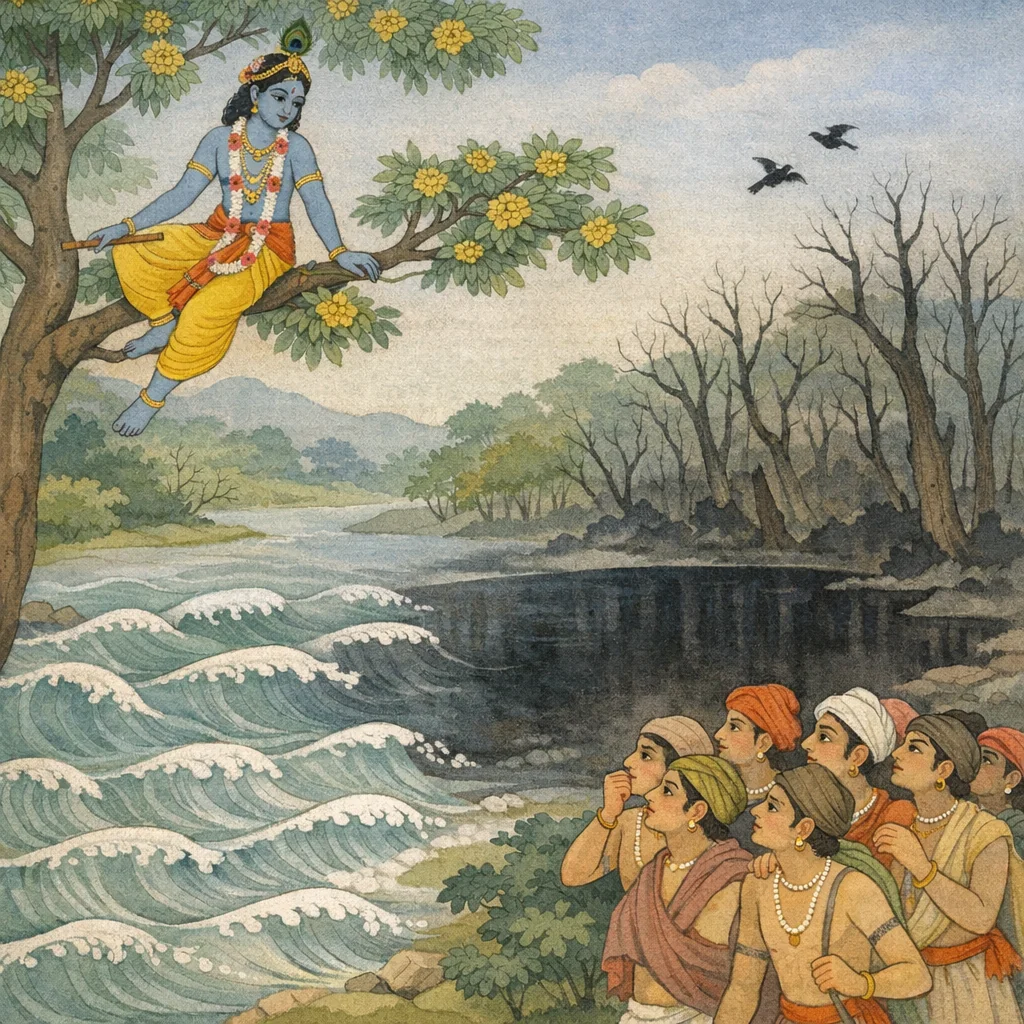
Parāśara tells Maitreya how Śrī Kṛṣṇa, roaming Vṛndāvana without Balarāma, reaches the Yamunā and sees Kāliya’s venom-lake scorching trees and birds. Knowing His avatāra’s purpose is to restrain the wicked for Vraja’s peace, He leaps from a kadamba into the lake; at first He is bound and bitten, and the gopas and gopīs rush in grief as Nanda and Yaśodā stand stunned, lamenting that Vraja’s life depends on Kṛṣṇa. Balarāma arrives, and long stuti arise, proclaiming the Lord’s inconceivable supremacy and cosmic causality. Kṛṣṇa then frees Himself, dances upon Kāliya’s hoods, and subdues him; Kāliya’s wives take refuge and beg mercy. Kāliya surrenders, pleading created nature; Kṛṣṇa commands him to leave the Yamunā for the ocean, protected from Garuḍa by the marks of His feet. The serpent departs, the Yamunā is purified, and Vraja rejoices, praising Govinda.
Shlokas
Verse 1
एकदा तु विना रामं कृष्णो वृन्दावनं ययौ विचचार वृतो गोपैर् वन्यपुष्पस्रगुज्ज्वलः
Once, without Rāma (Balarāma), Śrī Kṛṣṇa went to Vṛndāvana; surrounded by the cowherd boys and radiant with garlands of forest-flowers, he wandered in divine play through the woodland.
Verse 2
स जगामाथ कालिन्दीं लोलकल्लोलशालिनीम् तीरसंलग्नफेनौघैर् हसन्तीम् इव सर्वतः
Then he went to the Kāлиндī (Yamunā), adorned with restless, rolling waves; with masses of foam clinging to her banks, she seemed on every side as though she were smiling.
Verse 3
तस्यां चातिमहाभीमं विषाग्निसृतवारिणम् ह्रदं कालियनागस्य ददृशे ऽतीव भीषणम्
There he beheld the dread lake of the serpent Kāliya—an exceedingly fearsome pool whose waters were tainted by streams of venom, as though fire itself had mingled with them.
Verse 4
विषाग्निना विसरता दग्धतीरमहातरुम् वाताहताम्बुविक्षेपस्पर्शदग्धविहंगमम्
It was as though a spreading fire of poison had swept through: the great trees along the banks were scorched, and birds, struck by wind-driven sprays of water, were burned by that touch alone.
Verse 5
तम् अतीव महारौद्रं मृत्युवक्त्रम् इवापरम् विलोक्य चिन्तयाम् आस भगवान् मधुसूदनः
Beholding that exceedingly dreadful sight—like another very mouth of Death—the Blessed Lord, Madhusūdana, paused and entered into deep contemplation.
Verse 6
अस्मिन् वसति दुष्टात्मा कालियो ऽसौ विषायुधः यो मया निर्जितस् त्यक्त्वा दुष्टो नष्टः पयोनिधिम्
In this very place dwells Kāliya, wicked of soul, whose weapon is poison. Once conquered by me, that evil one abandoned his former haunt and fled away to the ocean.
Verse 7
तेनेयं दूषिता सर्वा यमुना सागराङ्गना न नरैर् गोधनैर् वापि तृषार्तैर् उपभुज्यते
By him this entire Yamunā—she who is the ocean’s bride—has been defiled; therefore she is no longer used for drinking, even by men or by cattle, though they be tormented by thirst.
Verse 8
तद् अस्य नागराजस्य कर्तव्यो निग्रहो मया चिरम् अत्र सुखं येन चरेयुर् व्रजवासिनः
Therefore I must restrain this serpent-king, so that for a long time the people of Vraja may dwell and move about here in peace and happiness.
Verse 9
एतदर्थं नृलोके ऽस्मिन्न् अवतारो मया कृतः यद् एषाम् उत्पथस्थानां कार्या शान्तिर् दुरात्मनाम्
For this very purpose have I assumed an incarnation in the world of men: that the wicked, who have strayed onto the path of error, may be restrained and brought to peace.
Verse 10
तद् एतन् नातिदूरस्थं कदम्बम् उरुशाखिनम् अधिरुह्योत्पतिष्यामि ह्रदे ऽस्मिन्न् अनिलाशिनः
“There—no great distance away—stands that kadamba tree with its wide-spreading branches. Climbing it, I shall leap into this lake, the haunt of the wind-devouring one.”
Verse 11
इत्थं विचिन्त्य बद्ध्वा च गाढं परिकरं ततः निपपात ह्रदे तत्र सर्पराजस्य वेगितः
Thus, having resolved within himself and tightening his girdle firmly, he leapt into that lake—driven by the urgent need to confront the serpent-king there.
Verse 12
तेनापि पतता तत्र क्षोभितः स महाह्रदः अत्यर्थं दूरजातांस् तु तान् असिञ्चन् महीरुहान्
As he fell there, the great lake was violently churned; its waters, flung far and wide, drenched even the trees standing at a great distance.
Verse 13
ते हि दुष्टविषज्वालातप्ताम्बुपवनोक्षिताः जज्वलुः पादपाः सद्यो ज्वालाव्याप्तदिगन्तराः
For those trees, struck by water and wind made scorching by the blaze of deadly poison, flared up at once, until the horizons in every direction were seized by flame.
Verse 14
आस्फोटयाम् आस तदा कृष्णो नागह्रदे भुजम् तच्छब्दश्रवणाच् चाशु नागराजो ऽभ्युपागमत्
Then Kṛṣṇa, by the serpent’s pool, slapped His arm so it rang out like a challenge; hearing that sound, the king of serpents swiftly came forth.
Verse 15
आताम्रनयनः कोपाद् विषज्वालाकुलैः फणैः वृतो महाविषैश् चान्यैर् उरगैर् अनिलाशिभिः
His eyes turned copper-red with wrath. Surrounded by hoods blazing with venom, he was also encircled by other mighty, highly poisonous serpents, as though fed by the wind and sustained by breath.
Verse 16
नागपत्न्यश् च शतशो हारिहारोपशोभिताः प्रकम्पिततनुक्षेपचलत्कुण्डलकान्तयः
The wives of the Nāgas—by the hundreds—were adorned with necklaces and jeweled ornaments; their bodies trembled and swayed, and their moving earrings flashed with shifting radiance.
Verse 17
ततः प्रवेशितः सर्पैः स कृष्णो भोगबन्धनम् ददंशुश् चापि ते कृष्णं विषज्वालाविलैर् मुखैः
Then, hemmed in by the serpents, Śrī Kṛṣṇa was caught in the binding coils of their hoods; and those snakes bit Kṛṣṇa as well, their mouths blazing with the fire of venom.
Verse 18
तं तत्र पतितं दृष्ट्वा सर्पभोगनिपीडितम् गोपा व्रजम् उपागम्य चुक्रुशुः शोकलालसाः
Seeing Him lying there, crushed beneath the serpent’s coils, the cowherds hurried back to Vraja and cried out—hearts seized by grief and frantic longing.
Verse 19
एष मोहं गतः कृष्णो मग्नौ वै कालिये ह्रदे भक्ष्यते सर्पराजेन तद् आगच्छत पश्यत
“Look! Kṛṣṇa has fallen into delusion—he has sunk into Kāliya’s lake. The king of serpents will devour him. Come quickly—see!”
Verse 20
तच् छ्रुत्वा ते तदा गोपा वज्रपातोपमं वचः गोप्यश् च त्वरिता जग्मुर् यशोदाप्रमुखा ह्रदम्
Hearing those words—like a thunderbolt striking down—the cowherds and the cowherd-women, led foremost by Yaśodā, hurried at once to the lake.
Verse 21
हा हा क्वासाव् इति जनो गोपीनाम् अतिविह्वलः यशोदया समं भ्रान्तो द्रुतं प्रस्खलितं ययौ
“Alas, alas—where is He?” cried the people, and the gopīs were utterly overwhelmed. Bewildered, they rushed about with Yaśodā, hurrying so fast that they stumbled as they ran.
Verse 22
नन्दगोपश् च गोपाश् च रामश् चाद्भुतविक्रमः त्वरितं यमुनां जग्मुः कृष्णदर्शनलालसाः
Nanda the cowherd, the cowherd-folk, and Rāma of wondrous prowess all hurried to the Yamunā, yearning for the darśana of Kṛṣṇa.
Verse 23
ददृशुश् चापि ते तत्र सर्पराजवशं गतम् निष्प्रयत्नकृतं कृष्णं सर्पभोगेन वेष्टितम्
There they beheld Kṛṣṇa as though under the dominion of the serpent-king—motionless, as if bereft of effort—tightly encircled by the serpent’s coils.
Verse 24
नन्दगोपश् च निश्चेष्टो न्यस्य पुत्रमुखे दृशम् यशोदा च महाभागा बभूव मुनिसत्तम
O best of sages, Nanda stood motionless, fixing his gaze upon his son’s face; and the noble Yaśodā too became utterly still, stunned by what they beheld.
Verse 25
गोप्यस् त्व् अन्या रुदन्त्यश् च ददृशुः शोककातराः प्रोचुश् च केशवं प्रीत्या भयकातर्यगद्गदम्
But the other gopīs, weeping and shaken with grief, spoke to Keśava with love—yet their voices trembled, broken by fear.
Verse 26
सर्वा यशोदया सार्धं विशामो ऽत्र महाह्रदे नागराजस्य नो गन्तुम् अस्माकं युज्यते व्रजे
All of us, together with Yaśodā, shall enter this great lake here. It is not fitting for us to return to Vraja without the lord of the serpents.
Verse 27
दिवसः को विना सूर्यं विना चन्द्रेण का निशा विना वृषेण का गावो विना कृष्णेन को व्रजः
What is a day without the sun? What is night without the moon? What are cows without a bull? And what is Vraja without Krishna?
Verse 28
विनाकृता न यास्यामः कृष्णेनानेन गोकुलम् अरण्यं नातिसेव्यं च वारिहीनं यथा सरः
Without this Krishna, we will not go to Gokula. A forest is not to be frequented—just as a lake without water is of no use.
Verse 30
उत्फुल्लपङ्कजदलस्पष्टकान्तिविलोचनम् अपश्यन्तो हरिं दीनाः कथं गोष्ठे भविष्यथ
Without beholding Hari—whose eyes shine with the clear radiance of fully blossomed lotus petals—how can you, left wretched by that absence, remain in the cowherd settlement?
Verse 31
अत्यर्थमधुरालापहृताशेषमनोधनम् न विना पुण्डरीकाक्षं यास्यामो नन्दगोकुलम्
His exceedingly sweet words have stolen away the whole treasure of our minds; without Puṇḍarīkākṣa—the Lotus‑eyed Lord—we shall not go to Nanda’s Gokula.
Verse 32
भोगेनावेष्टितस्यापि सर्पराजेन पश्यत स्मितशोभिमुखं गोप्यः कृष्णस्यास्मद्विलोकने
Even as the serpent-king coiled him in mighty folds, the gopīs beheld Kṛṣṇa’s face—radiant with a gentle smile—turned toward them in recognition, as if to soothe them with a single glance.
Verse 33
इति गोपीवचः श्रुत्वा रौहिणेयो महाबलः गोपांश् च त्रासविधुरान् विलोक्य स्तिमितेक्षणः
Hearing the gopīs’ words, the mighty Rauhiṇeya (Balarāma) looked upon the cowherds, shaken and courageless with fear; steady-eyed, he grew still and intent.
Verse 34
नन्दं च दीनम् अत्यर्थं न्यस्तदृष्टिं सुतानने मूर्च्छाकुलां यशोदां च कृष्णमाहात्म्यसंज्ञया
They saw Nanda—utterly dejected, his gaze fixed only on his son’s face—and Yaśodā too, wavering as if in a faint; both were seized by the dawning recognition of Kṛṣṇa’s majesty, that the Supreme had appeared as their child.
Verse 35
किमर्थं देवदेवेश भावो ऽयं मानुषस् त्वया व्यज्यते ऽत्यन्तम् आत्मानं किम् अनन्तं न वेत्सि यत्
Why, O Lord of lords, do You so fully assume and display this human mode of being? Do You not know Yourself as the Infinite—why reveal Yourself so completely in a human guise?
Verse 36
त्वम् अस्य जगतो नाभिर् अराणाम् इव संश्रयः कर्तापहर्ता पाता च त्रैलोक्ये त्वं त्रयीमयः
You are the navel of this universe—the central support on which it rests, as the hub is the refuge of the spokes. You are its maker, its withdrawer, and its protector; throughout the three worlds, You are the very embodiment of the Vedic triad.
Verse 37
सेन्द्ररुद्राश्विवसुभिर् आदित्यैर् मरुदग्निभिः चिन्त्यसे त्वम् अचिन्त्यात्मन् समस्तैश् चैव योगिभिः
With Indra and Rudra—by the Aśvins and the Vasus, by the Ādityas, the Maruts, and the sacred Fires—you are contemplated. O Inconceivable Self, all the yogins too indeed meditate upon You.
Verse 38
जगत्यर्थे जगन्नाथ भारावतरणेच्छया अवतीर्णो ऽत्र मर्त्येषु तवांशश् चाहम् अग्रजः
O Lord of the world, for the sake of the universe—desiring to lighten the earth’s burden—you have descended here among mortals; and I too, as Your portion, have come down as Your elder brother.
Verse 39
मनुष्यलीलां भगवन् भजता भवता सुराः विडम्बयन्तस् त्वल्लीलां सर्व एव सदासते
O Bhagavān, when You choose to enact a human līlā, all the gods, delighting in Your divine sport, ever remain as if imitating and echoing Your līlā.
Verse 40
अवतार्य भवान् पूर्वं गोकुले ऽत्र सुराङ्गनाः क्रीडार्थम् आत्मनः पश्चाद् अवतीर्णो ऽसि शाश्वत
First You brought down the heavenly maidens here to Gokula, that they might be companions in Your divine play; and thereafter You Yourself descended, O Eternal One.
Verse 41
अत्रावतीर्णयोः कृष्ण गोपा एव हि बान्धवाः गोप्यश् च सीदतः कस्मात् त्वं बन्धून् समुपेक्षसे
O Krishna—having descended here, the cowherds are truly Your kin, and the cowherd-women too. When they are sinking in distress, why do You disregard Your own relatives and abandon them to suffering?
Verse 42
दर्शितो मानुषो भावो दर्शितं बालचापलम् तद् अयं दम्यतां कृष्ण दुष्टात्मा दशनायुधः
He has displayed the temper of a mere human; he has shown the restless wilfulness of a child. Therefore, O Kṛṣṇa, let this wicked-souled one—whose weapon is his fangs—be restrained and brought under control.
Verse 43
इति संस्मारितः कृष्णः स्मितभिन्नौष्ठसंपुटः आस्फोट्य मोचयाम् आस स्वदेहं भोगबन्धनात्
Thus reminded, Kṛṣṇa—his lips gently parted by a faint smile—snapped his fingers, and in that very moment released his own body from the bondage of worldly enjoyment and embodied experience.
Verse 44
आनम्य चापि हस्ताभ्याम् उभाभ्यां मध्यमं फणम् आरुह्याभुग्नशिरसि प्रननर्तोरुविक्रमः
Then, with both hands, he bent down the serpent’s central hood; and mounting that bowed head, the mighty-striding Lord began to dance—sportively displaying his sovereign power that subdues even venomous pride.
Verse 45
व्रणाः फणे ऽभवंश् चास्य कृष्णस्याङ्घ्रिनिकुट्टनैः यत्रोन्नतिं च कुरुते ननामास्य ततः शिरः
From the repeated stamping of Krishna’s feet, wounds opened upon the serpent’s hoods; and whenever that (Kāliya) tried to lift himself up, at that very moment his head was forced down again.
Verse 46
मूर्च्छाम् उपाययौ भ्रान्त्या नागः कृष्णस्य रेचकैः दण्डपातनिपातेन ववाम रुधिरं बहु
Staggering in delirium, the serpent was driven toward faintness by Kṛṣṇa’s forceful exhalations; and, struck down by the crashing fall of the staff-like blows, it vomited forth a great quantity of blood.
Verse 47
तं निर्भुग्नशिरोग्रीवम् आस्येभ्यः स्रुतशोणितम् विलोक्य शरणं जग्मुस् तत्पत्न्यो मधुसूदनम्
Seeing him with head and neck crushed and blood streaming from his mouths, his wives—overwhelmed with terror—went for refuge to Madhusudana.
Verse 48
ज्ञातो ऽसि देवदेवेश सर्वेशस् त्वम् अनुत्तमः परं ज्योतिर् अचिन्त्यं यत् तदंशः परमेश्वरः
You are now known—O Lord of the lords of the gods, O Sovereign of all—unsurpassed. That Supreme Light, unthinkable and beyond conception: You are Its very portion, O Supreme Ruler.
Verse 49
न समर्थाः सुराः स्तोतुं यम् अनन्यभवं प्रभुम् स्वरूपवर्णनं तस्य कथं योषित् करिष्यति
He whom even the gods are not capable of praising—That Lord, the sovereign without any other source of being—how could a mere woman undertake to describe His true form and nature?
Verse 50
यस्याखिलं महीव्योमजलाग्निपवनात्मकम् ब्रह्माण्डम् अल्पकांशांशः स्तोष्यामस् तं कथं वयम्
When the entire cosmos—formed of earth, sky, water, fire, and wind—is but the tiniest fraction of a fraction of Him, how indeed can we presume to praise that One?
Verse 51
यतन्तो न विदुर् नित्यं यत्स्वरूपम् अयोगिनः परमार्थम् अणोर् अल्पं स्थूलात् स्थूलं नताः स्म तम्
Though they strive, the non-yogins do not truly know, at any time, the real nature of That. We bow to Him—the Supreme Reality—subtler than the subtlest atom, yet greater than the greatest of the gross.
Verse 52
न यस्य जन्मने धाता यस्य नान्ताय चान्तकः स्थितिकर्ता न चान्यो ऽस्ति यस्य तस्मै नमः सदा
Ever salutations to Him: for whom there is no creator at birth; for whom there is neither “end” nor “ender”; and for whom no other sustainer exists—He alone, the Supreme Vishnu, is the ground of arising, abiding, and cessation.
Verse 53
कोपः स्वल्पो ऽपि ते नास्ति स्थितिपालनम् एव ते कारणं कालियस्यास्य दमने श्रूयताम् अतः
In You there is not even the slightest trace of anger; the cause of Your deed is only the guarding of dharma’s order. Therefore, hear now the reason for the chastening of this Kāliya.
Verse 54
स्त्रियो ऽनुकम्प्याः साधूनां मूढा दीनाश् च जन्तवः यतस् ततो ऽस्य दीनस्य क्षम्यतां क्षमतां वर
The righteous show compassion to women; and so too to all creatures who are deluded and distressed. Therefore—whatever the cause—let this wretched one be forgiven. O noble sir, be pleased to forbear.
Verse 55
समस्तजगदाधारो भवान् अल्पबलः फणी त्वत्पादपीडितो जह्यान् मुहूर्तार्धेन जीवितम्
You are the support of the entire universe; yet, O serpent, your strength is but slight. Crushed beneath His feet, you would abandon your life within half a muhūrta.
Verse 56
क्व पन्नगो ऽल्पवीर्यो ऽयं क्व भवान् भुवनाश्रयः प्रीतिद्वेषौ समोत्कृष्टगोचरौ च यतो ऽव्यय
Where is this serpent of such little power, and where are You, the very support of the worlds? O Imperishable One, for You even affection and aversion—opposed experiences—move within an equal and exalted scope, never binding You, never diminishing You.
Verse 57
ततः कुरु जगत्स्वामिन् प्रसादम् अवसीदतः प्राणांस् त्यजति नागो ऽयं भर्तृभिक्षा प्रदीयताम्
Therefore, O Lord of the universe, be gracious to one who sinks in distress. This serpent is about to relinquish his life-breath; grant him the alms he seeks—his sustenance and protection.
Verse 58
इत्य् उक्ते ताभिर् आश्वस्य क्लान्तदेहो ऽपि पन्नगः प्रसीद देव देवेति प्राह वाक्यं शनैः शनैः
When they had spoken thus, the serpent—though his body was worn with exhaustion—was comforted; and little by little he uttered: “Be gracious, O God of gods.”
Verse 59
तवाष्टगुणम् ऐश्वर्यं नाथ स्वाभाविकं परम् निरस्तातिशयं यस्य तस्य स्तोष्यामि किं न्व् अहम्
O Lord, Your sovereignty—endowed with the eightfold excellences—is supreme and innate to Your very nature. Since Your greatness admits no surpassing measure, how can I praise the Incomparable?
Verse 60
त्वं परस् त्वं परस्याद्यः परं त्वत्तः परात्मकम् परस्मात् परमो यस् त्वं तस्य स्तोष्यामि किं न्व् अहम्
You are the Supreme; You are the primal source even of what is called “the Supreme.” From You arises the highest reality whose very nature is transcendence. Higher than the highest—how can I truly praise You?
Verse 61
यस्माद् ब्रह्मा च रुद्रश् च चन्द्रेन्द्रमरुदश्विनः वसवश् च सहादित्यैस् तस्य स्तोष्यामि किं न्व् अहम्
From Him arise Brahmā and Rudra; the Moon and Indra; the Maruts and the Aśvins; the Vasus together with the Ādityas—how can I, a mere being, praise Him as He deserves?
Verse 62
एकावयवसूक्ष्मांशो यस्यैतद् अखिलं जगत् कल्पनावयवांशस्य तं स्तोष्यामि कथं त्व् अहम्
This entire universe is but a minute portion of a single fragment of Him—indeed, only a subtle part of a part conceived by thought. How could I ever offer fitting praise to that Supreme Viṣṇu?
Verse 63
सदसद्रूपिणो यस्य ब्रह्माद्यास् त्रिदशोत्तमाः परमार्थं न जानन्ति तस्य स्तोष्यामि किं न्व् अहम्
Even Brahmā and the foremost of the gods do not know the highest reality of Him whose nature transcends both the manifest and the unmanifest—so what praise could I possibly offer Him?
Verse 64
ब्रह्माद्यैर् अर्च्यते दिव्यैर् यश् च पुष्पानुलेपनैः नन्दनादिसमुद्भूतैः सो ऽर्च्यते वा कथं मया
He is adored by Brahmā and the other gods with celestial flowers and fragrant unguents born of Nandana and the gardens of heaven—how, then, could one like me truly worship Him?
Verse 65
यस्यावताररूपाणि देवराजः सदार्चति न वेत्ति परमं रूपं सो ऽर्च्यते वा कथं मया
Even Indra, king of the gods, ever worships His incarnate forms, yet does not truly know His supreme form. How could I possibly worship that Lord adequately?
Verse 66
विषयेभ्यः समाहृत्य सर्वाक्षाणि च योगिनः यम् अर्चयन्ति ध्यानेन सो ऽर्च्यते वा कथं मया
Withdrawing all the senses from their objects, the yogins worship Him through meditation. How, then, could I worship that Lord—who is adored in inner contemplation—by outward means?
Verse 67
हृदि संकल्प्य यद् रूपं ध्यानेनार्चन्ति योगिनः भावपुष्पादिभिर् नाथः सो ऽर्च्यते वा कथं मया
O Lord, the form that yogins conceive within the heart and worship through meditation—adorning it with the flowers of inner devotion and other offerings of the mind—how may I, too, worship that very Supreme Master?
Verse 68
सो ऽहं ते देवदेवेश नार्चनादौ स्तुतौ न च सामर्थ्यवान् कृपामात्रमनोवृत्तिः प्रसीद मे
O Lord of lords, God of gods—such as I am, I have no true strength for worship, for offerings, or even for fitting praise. My mind can only turn toward You with the bare impulse of seeking Your mercy; be gracious to me.
Verse 69
सर्पजातिर् इयं क्रूरा यस्यां जातो ऽस्मि केशव तत्स्वभावो ऽयम् अत्रास्ति नापराधो ममाच्युत
“O Keśava, the race of serpents is fierce—into that very kind I have been born. This is the inborn nature that abides here; therefore, O Acyuta, the fault is not mine.”
Verse 70
सृज्यते भवता सर्वं तथा संह्रीयते जगत् जातिरूपस्वभावाश् च सृज्यन्ते सृजता त्वया
By You indeed all this is brought forth, and by You the universe is gathered back in dissolution. Even the very kinds of birth, the forms beings assume, and their inborn dispositions are fashioned—created by You as You create.
Verse 71
यथाहं भवता सृष्टो जात्या रूपेण चेश्वर स्वभावेन च संयुक्तस् तथेदं चेष्टितं मया
O Lord, just as You created me—endowed with a particular birth, a particular form, and joined to a particular innate disposition—so have I acted. My conduct has merely followed the nature You assigned.
Verse 72
यद्य् अन्यथा प्रवर्तेयं देवदेव ततो मयि न्याय्यो दण्डनिपातो वै तवैव वचनं यथा
If I should ever act contrary to what is right, O God of gods, then let punishment fall upon me in true justice—exactly as Your word decrees.
Verse 73
तथापि यज् जगत्स्वामी दण्डं पातितवान् मयि स सोढो ऽयं वरं दण्डस् त्वत्तो नान्यत्र मे वरः
Even so, the punishment the Lord of the worlds has laid upon me—I have borne it. Let that very chastisement be my boon; for apart from You, I seek no other blessing.
Verse 74
हतवीर्यो हतविषो दमितो ऽहं त्वयाच्युत जीवितं दीयताम् एकम् आज्ञापय करोमि किम्
My prowess is broken, my venom is spent, and I have been subdued by You, O Achyuta. Grant me but a single life; command me—what shall I do?
Verse 75
नात्र स्थेयं त्वया सर्प कदाचिद् यमुनाजले सभृत्यपरिवारस् त्वं समुद्रसलिलं व्रज
O serpent, you must never remain here in the waters of the Yamunā. Depart at once—go, together with your attendants and your whole retinue, to the waters of the ocean.
Verse 76
मत्पदानि च ते सर्प दृष्ट्वा मूर्धनि सागरे गरुडः पन्नगरिपुस् त्वयि न प्रहरिष्यति
O serpent, when Garuḍa—the foe of the nāgas—sees upon your head in the ocean the marks of My feet, he will not strike you.
Verse 77
इत्य् उक्त्वा सर्पराजानं मुमोच भगवान् हरिः प्रणम्य सो ऽपि कृष्णाय जगाम पयसां निधिम्
Thus speaking to the serpent-king, Bhagavān Hari released him. And he too, bowing to Kṛṣṇa, departed for the ocean, the great treasury of waters.
Verse 78
पश्यतां सर्वभूतानां सभृत्यापत्यबान्धवः समस्तभार्यासहितः परित्यज्य स्वकं ह्रदम्
While all beings looked on, he—together with his attendants, children, kinsmen, and all his wives—abandoned his own lake and left it behind.
Verse 79
गते सर्पे परिष्वज्य मृतं पुनर् इवागतम् गोपा मूर्धनि गोविन्दं सिषिचुर् नेत्रजैर् जलैः
When the serpent had gone, the cowherds embraced Govinda, returned as though from death itself, and bathed his head with the water born of their eyes—their tears.
Verse 80
कृष्णम् अक्लिष्टकर्माणम् अन्ये विस्मितचेतसः तुष्टुवुर् मुदिता गोपा दृष्ट्वा शिवजलां नदीम्
Beholding the river whose waters had become auspicious and purifying, the cowherds—gladdened and astonished at heart—praised Kṛṣṇa, whose deeds are effortless and untroubled.
Frequently Asked Questions
He states the avatāra purpose: to restrain the wicked (utpatha-sthāna) and secure lasting peace for Vraja; the act is dharma-rakṣaṇa, not reckless impulse.
The text frames nigraha as impersonal protection of cosmic order (sthiti-pālana), aligning divine action with compassion and loka-saṃgraha rather than rāga-dveṣa.
Kṛṣṇa grants him refuge through the visible pāda-cihna on his head; seeing that mark, Garuḍa will not strike—divine protection overrides natural enmity.