Adhyaya 38
अर्जुनस्य अन्त्येष्टि, द्वारकाप्लावनम्, कलिप्रवेशः, कालोपदेशः
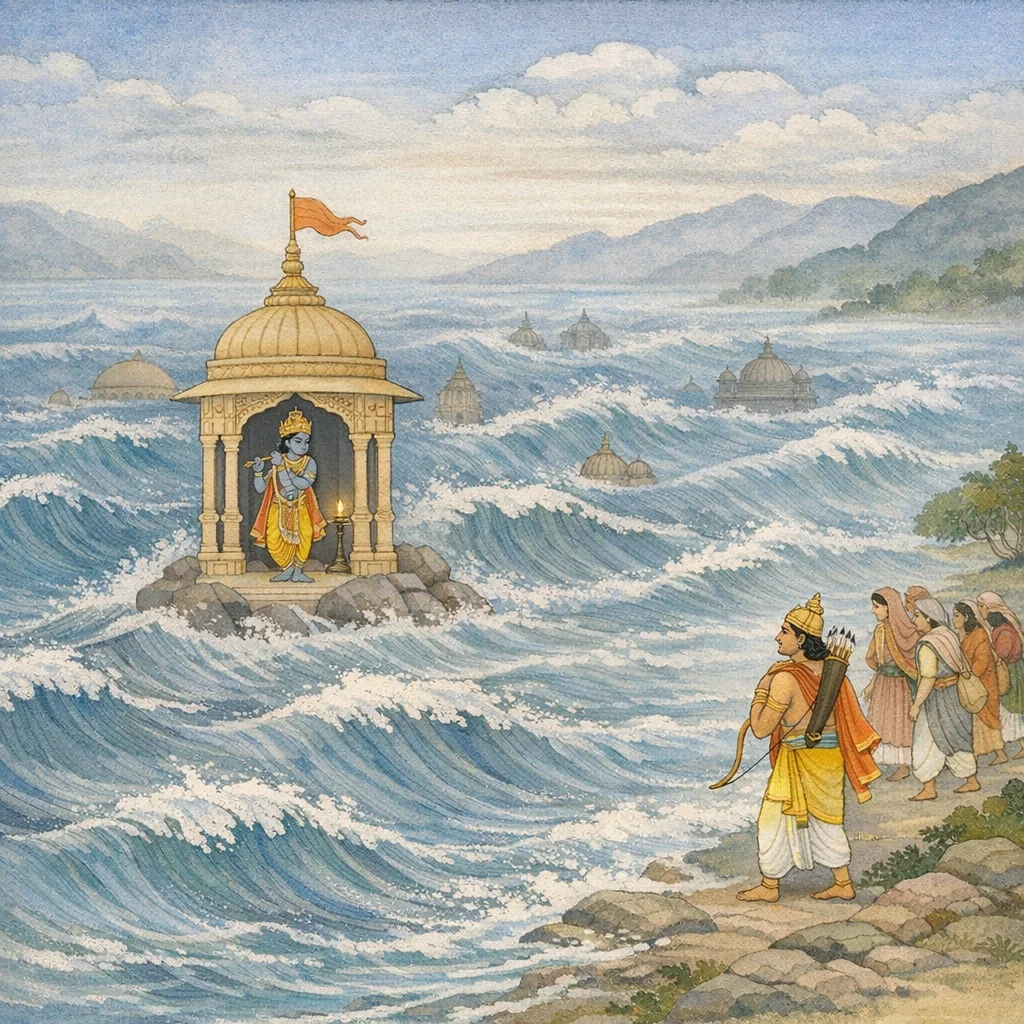
Parāśara tells Maitreya that Arjuna performs the funerary rites for Śrī Kṛṣṇa and Balarāma, and then for the others. Kṛṣṇa’s queens led by Rukmiṇī, and Revatī for Balarāma, enter the sacred fire; Ugrasena, Vasudeva, Devakī, and Rohiṇī also merge into it. Arjuna leads the people out with Vajra, while Sudharmā and the Pārijāta tree return to heaven. On the very day Hari departs, Kali descends; the ocean floods the emptied Dvārakā, sparing only the Lord’s residence, marking its enduring sanctity. After settling the people in Pañcanada, Arjuna faces Ābhīra/dasyu raids; his divine prowess fails—he cannot properly string Gāṇḍīva or recall astras—showing his power depended on Kṛṣṇa’s presence. Women are carried off; Arjuna laments to Vyāsa, who teaches that the calamity is Kāla’s inevitable movement and Hari’s līlā. Parāśara universalizes the lesson: creation and dissolution are time-governed under the Lord; when the avatāra’s purpose is fulfilled, He withdraws śakti. The Pāṇḍavas install Parīkṣit and depart for the forest, closing the dynastic arc by divine ordinance.
Shlokas
Verse 1
अर्जुनो ऽपि तदान्विष्य कृष्णरामकलेवरे संस्कारं लम्भयाम् आस तथान्येषाम् अनुक्रमात्
Then Arjuna too went in search and duly arranged the final rites for the bodies of Śrī Kṛṣṇa and Balarāma; thereafter, in proper order, he performed the rites for the others as well.
Verse 2
अष्टौ महिष्यः कथिता रुक्मिणीप्रमुखास् तु याः उपगुह्य हरेर् देहं विविशुस् ता हुताशनम्
Those eight royal queens—foremost among them Rukmiṇī—embraced Hari’s body and entered the sacred fire, following him beyond the mortal realm.
Verse 3
रेवती चैव रामस्य देहम् आश्लिष्य सत्तम विवेश ज्वलितं वह्निं तत्सङ्गाह्लादशीतलम्
Then Revati too—embracing the body of Balarāma, O best of the virtuous—entered the blazing fire; yet by the blissful touch of her presence, that fire became cool and soothing.
Verse 4
उग्रसेनस् तु तच् छ्रुत्वा तथैवानकदुन्दुभिः देवकी रोहिणी चैव विविशुर् जातवेदसम्
Hearing those words, Ugrasena—and likewise Ānakadundubhi (Vasudeva)—together with Devakī and Rohiṇī, entered Jātavedas, the consecrated fire.
Verse 5
ततो ऽर्जुनः प्रेतकार्यं कृत्वा तेषां यथाविधि निश्चक्राम जनं सर्वं गृहीत्वा वज्रम् एव च
Then Arjuna, having duly performed their funerary rites according to sacred rule, set out—taking with him all the people, and also the Vajra weapon.
Verse 6
द्वारवत्या विनिष्क्रान्ताः कृष्णपत्न्यः सहस्रशः वज्रं जनं च कौन्तेयः पालयञ् छनकैर् ययौ
From Dvāravatī, the wives of Śrī Kṛṣṇa came forth by the thousand; and Kaunteya Arjuna, guarding Vajra and the people, went onward slowly and with care.
Verse 7
सभा सुधर्मा कृष्णेन मर्त्यलोके समुज्झिते स्वर्गं जगाम मैत्रेय पारिजातश् च पादपः
O Maitreya, when Śrī Kṛṣṇa withdrew His presence from the mortal world, the celestial hall Sudharmā returned to heaven—and with it the pārijāta tree as well.
Verse 8
यस्मिन् दिने हरिर् यातो दिवं संत्यज्य मेदिनीम् तस्मिन्न् एवावतीर्णो ऽयं कालकायो बली कलिः
On the very day that Hari departed for heaven, leaving this earth behind, on that same day descended Kali—mighty, embodied as the dark form of Time.
Verse 9
प्लावयाम् आस तां शून्यां द्वारकां च महोदधिः यदुदेवगृहं त्व् एकं नाप्लावयत सागरः
Then the great ocean flooded that emptied Dvārakā; yet the sea did not inundate the one place alone—the dwelling of the Lord of the Yadus.
Verse 10
नातिक्रान्तुम् अलं ब्रह्मंस् तद् अद्यापि महोदधिः नित्यं संनिहितस् तत्र भगवान् केशवो यतः
O Brahman, even to this day that great ocean cannot overstep its bounds, for there the Blessed Lord Keśava ever abides.
Verse 11
तद् अतीव महापुण्यं सर्वपातकनाशनम् विष्णुक्रीडान्वितं स्थानं दृष्ट्वा पापात् प्रमुच्यते
That place is exceedingly holy, the destroyer of every sin; filled with the divine sports of Lord Viṣṇu—by merely beholding it one is freed from the stain of wrongdoing.
Verse 12
पार्थः पञ्चनदे देशे बहुधान्यसमन्विते चकार वासं सर्वस्य जनस्य मुनिसत्तम
O best of sages, Pārtha (Arjuna) dwelt in the grain-abundant land of Pañcanada and established there a settled abode for all the people.
Verse 13
ततो लोभः समभवत् पार्थेनैकेन धन्विना दृष्ट्वा स्त्रियो नीयमाना दस्यूनां निहतेश्वराः
Then greed arose—when Pārtha, the lone archer, beheld women being carried off; the dāsyus, their leaders slain, were left without a lord and fell into grasping desire.
Verse 14
ततस् ते पापकर्माणो लोभोपहतचेतसः आभीरा मन्त्रयाम् आसुः समेत्यात्यन्तदुर्मदाः
Then those Ābhīras—men of sinful conduct, their minds struck down by greed and swollen with insolent pride—gathered together and began to deliberate.
Verse 15
अयम् एको ऽर्जुनो धन्वी स्त्रीजनं निहतेश्वरम् नयत्य् अस्मान् अतिक्रम्य धिग् एतद् भवतां बलम्
“This lone Arjuna, the bowman, has carried off the women‑folk—left lordless after their protector was slain—passing right beyond us. Fie upon this ‘strength’ of yours!”
Verse 16
हत्वा गर्वं समारूढो भीष्मद्रोणजयद्रथान् कर्णादींश् च न जानाति बलं ग्रामनिवासिनाम्
Having slain Bhīṣma, Droṇa, Jayadratha, Karṇa and the rest, he climbed to the summit of pride—yet he does not know the true strength that abides among the village-folk.
Verse 17
हे हे यष्टीर् महायामा गृह्णीतायं सुदुर्मतिः सर्वान् एवावजानाति किं वो बाहुभिर् उन्नतैः
“Ho there—bring the long staffs at once! Seize this wicked-minded man. He holds everyone in contempt—what use are your raised arms against such insolence?”
Verse 18
ततो यष्टिप्रहरणा दस्यवो लोप्त्रहारिणः सहस्रशो ऽभ्यधावन्त तं जनं निहतेश्वरम्
Then, armed with clubs, bandits—plunderers who lived by theft—rushed in by the thousands upon that people, now left without a protector, their lord having been slain.
Verse 19
ततो निवृत्य कौन्तेयः प्राहाभीरान् हसन्न् इव निवर्तध्वम् अधर्मज्ञा यदि न स्थ मुमूर्षवः
Then Kauṇteya (Arjuna), turning back, spoke to the Ābhīras with a faint, almost smiling contempt: “Withdraw! You who know adharma—unless indeed you stand here resolved to die.”
Verse 20
अवज्ञाय वचस् तस्य जगृहुस् ते तदा धनम् स्त्रीजनं चैव मैत्रेय विष्वक्सेनपरिग्रहम्
Disregarding his words, they then seized the wealth—and even the womenfolk, O Maitreya—though all of it was under the protection and rightful guardianship of Viṣvaksena.
Verse 21
ततो ऽर्जुनो धनुर् दिव्यं गाण्डीवम् अजरं युधि आरोपयितुम् आरेभे न शशाक च वीर्यवान्
Then mighty Arjuna began to string and ready for battle his divine, undecaying bow Gāṇḍīva; yet, for all his strength, he could not do so.
Verse 22
चकार सज्जं कृच्छ्राच् च तच् चाभूच् छिथिलं पुनः न सस्मार तथास्त्राणि चिन्तयन्न् अपि पाण्डवः
With great effort the Pāṇḍava made himself ready for action; yet again his resolve slackened. Even while trying to recollect, he could not bring to mind those divine weapons.
Verse 23
शरान् मुमोच चैतेषु पार्थो वैरिष्व् अमर्षितः त्वग्भेदं ते परं चक्रुर् अस्ता गाण्डीवधन्वना
Then Pārtha, inflamed with wrath against those enemies, loosed his arrows upon them. Shot forth from the bow Gāṇḍīva, those shafts tore through their skin and dealt grievous wounds.
Verse 24
वह्निना ये ऽक्षया दत्ताः शरास् ते ऽपि क्षयं ययुः युध्यतः सह गोपालैर् अर्जुनस्य भवक्षये
Even the arrows that Fire had bestowed as “inexhaustible” were spent, when Arjuna fought together with the cowherds; for destiny’s force had turned toward his undoing.
Verse 25
अचिन्तयच् च कौन्तेयः कृष्णस्यैव हि तद् बलम् यन् मया शरसंघातैः सकला भूभृतो जिताः
Kuntī’s son reflected: “Truly, this is Krishna’s own power—that by the volleys of arrows loosed by me, all the mighty kings were conquered.”
Verse 26
मिषतः पाण्डुपुत्रस्य ततस् ताः प्रमदोत्तमाः आभीरैर् अपकृष्यन्त कामाच् चान्याः प्रवव्रजुः
Then, even as the son of Pāṇḍu looked on, those foremost women were dragged away by the Ābhīras; and some others, driven by their own desire, departed of their own accord.
Verse 27
ततः शरेषु क्षीणेषु धनुष्कोट्या धनंजयः जघान दस्यूंस् ते चास्य प्रहाराञ् जहसुर् मुने
Then, when his arrows were spent, Dhanañjaya struck the marauding dasyus with the very tip of his bow; yet, O sage, they laughed at his blows.
Verse 28
प्रेक्षतश् चैव पार्थस्य वृष्ण्यन्धकवरस्त्रियः जग्मुर् आदाय ते म्लेच्छाः समस्ता मुनिसत्तम
O best of sages, even as Pārtha looked on, those mleccha raiders carried away all the noble women of the Vṛṣṇis and the Andhakas.
Verse 29
ततः सुदुःखितो जिष्णुः कष्टं कष्टम् इति ब्रुवन् अहो भगवता तेन मुक्तो ऽस्मीति रुरोद वै
Then Jiṣṇu, overwhelmed with intense sorrow, kept repeating, “Alas, what suffering, what suffering!” Yet, realizing the Lord’s grace, he cried, “Ah! By Him—the Blessed Bhagavān—I have been released,” and he wept indeed.
Verse 30
तद् धनुस् तानि शस्त्राणि स रथस् ते च वाजिनः सर्वम् एकपदे नष्टं दानम् अश्रोत्रिये यथा
That bow, those weapons, that chariot, and those very horses—all were lost in a single instant; just so is a gift, when given to one unworthy of sacred learning, ruined at once.
Verse 31
अहो ऽतिबलवद् दैवं विना तेन महात्मना यद् असामर्थ्ययुक्ते ऽपि नीचवर्गे जयप्रदम्
Ah—how overpowering is destiny (daiva)! Without the support of that great-souled one, even the side of inferior men, though steeped in incapacity, is made the giver of victory.
Verse 32
तौ बाहू स च मे मुष्टिः स्थानं तत् सो ऽस्मि चार्जुनः पुण्येनैव विना तेन गतं सर्वम् असारताम्
These are the very arms, and this is my clenched fist; this is the same seat of power—and I am that very Arjuna. Yet without that former store of merit, everything has slipped into emptiness and lost its essence.
Verse 33
ममार्जुनत्वं भीमस्य भीमत्वं तत् कृतं ध्रुवम् विना तेन यद् आभीरैर् जितो ऽहं कथम् अन्यथा
Surely it was he who made me possess the prowess of Arjuna, and who made Bhīma truly Bhīma. For without him, how could I have been defeated by the Ābhīras—how could it have been otherwise?
Verse 34
इत्थं वदन् ययौ जिष्णुर् मथुराख्यं पुरोत्तमम् चकार तत्र राजानं वज्रं यादवनन्दनम्
Having spoken thus, Jiṣṇu set forth to the supreme city called Mathurā; and there he installed Vajra—scion of the Yādavas—as king.
Verse 35
स ददर्श ततो व्यासं फाल्गुनः काननाश्रयम् तम् उपेत्य महाभागं विनयेनाभ्यवादयत्
Then Phālguna beheld Vyāsa, dwelling in a forest hermitage. Approaching that great-souled sage, he bowed with humility and offered reverent salutations.
Verse 36
तं वन्दमानं चरणाव् अवलोक्य मुनिश् चिरम् उवाच पार्थं विच्छायः कथम् अत्यन्तम् ईदृशः
Seeing him bow and gaze upon his feet in reverence, the sage watched for a long while and then said to the prince: “Why is your radiance so utterly drained—how have you come to be in such a state?”
Verse 37
अवीरजोऽनुगमनं ब्रह्महत्याथवा कृता दृढाशाभङ्गदुःखीव भ्रष्टच्छायो ऽसि साम्प्रतम्
“Either you have followed one unworthy and devoid of true manliness, or else you have committed the sin of brahmin-slaying; for now you stand as though crushed by the shattering of a firm hope—your radiance fallen away, your very shadow dimmed.”
Verse 38
सान्तानिकादयो वा ते याचमाना निराकृताः अगम्यस्त्रीरतिर् वा त्वं तेनासि विगतप्रभः
“Those women, beginning with Sāntānikā and the rest, came to you seeking union, yet you turned them away. Or if your desire runs toward forbidden women, then by that very fault your splendour has faded.”
Verse 39
भुङ्क्ते ऽप्रदाय विप्रेभ्यो एको मिष्टम् अथो भवान् किं वा कृपणवित्तानि हृतानि भवतार्जुन
“Do you eat rich delicacies all by yourself, without first offering anything to the Brahmins? Or, O Arjuna, have you seized the hoarded wealth of the miserly?”
Verse 40
कच्चित् त्वं शूर्पवातस्य गोचरत्वं गतो ऽर्जुन दुष्टचक्षुर्हतो वापि निःश्रीकः कथम् अन्यथा
“Arjuna—have you fallen within the sweep of the ‘winnowing-wind’? Or has some evil-eyed one struck you down? Otherwise, how could you appear so bereft of radiance and fortune?”
Verse 41
स्पृष्टो नखाम्भसा वाथ घटवार्युक्षितो ऽपि वा तेनातीवासि विच्छायो न्यूनैर् वा युधि निर्जितः
Whether you were merely touched by the water clinging to a fingernail, or even sprinkled by water poured from a pot—by that alone you have become utterly without luster; or else, defeated in battle by men fewer than yourself, you stand diminished and shorn of radiance.
Verse 42
ततः पार्थो विनिश्वस्य श्रूयतां भगवन्न् इति प्रोक्तो यथावद् आचष्टे व्यासायात्मपराभवम्
Then Pārtha (Arjuna), drawing a deep breath, spoke with reverence: “Hear me, O Blessed One.” Thus invited, he told Vyāsa exactly as it had happened of the defeat and inner humiliation he had suffered.
Verse 43
यद् बलं यच् च नस् तेजो यद् वीर्यं यः पराक्रमः या श्रीश् छाया च नः सो ऽस्मान् परित्यज्य हरिर् गतः
The strength that was ours, the radiance that was ours; the potency, the heroism, and the power of conquest—along with our Śrī (fortune) and protecting shade—Hari Himself has departed, abandoning us.
Verse 44
इतरेणेव महता स्मितपूर्वाभिभाषिणा हीना वयं मुने तेन जातास् तृणमया इव
Bereft of that noble one—who would address us with a gentle smile before he spoke—we have become, O sage, as though made of mere grass: light and of no account.
Verse 45
अस्त्राणां सायकानां च गाण्डीवस्य तथा मम सारता याभवन् मूर्ता स गतः पुरुषोत्तमः
He who had become embodied as the very excellence of weapons and arrows—who was the living mastery of Gāṇḍīva, and even the strength within me—has departed: that Supreme Person, Puruṣottama.
Verse 46
यस्यावलोकनाद् अस्माञ् श्रीर् जयः संपद् उन्नतिः न तत्याज स गोविन्दस् त्यक्त्वास्मान् भगवान् गतः
By whose mere glance Lakṣmī—together with victory, prosperity, and rising eminence—never forsook us: that very Govinda, the Blessed Lord, has now departed, leaving us behind.
Verse 47
भीष्मद्रोणाङ्गराजाद्यास् तथा दुर्योधनादयः यत्प्रभावेन निर्दग्धाः स कृष्णस् त्यक्तवान् भुवम्
Bhīṣma, Droṇa, the king of Aṅga, and others—Duryodhana and the rest as well—were consumed by the force of his destiny and power; that same Kṛṣṇa has now laid aside the earth and withdrawn from the world.
Verse 48
निर्यौवना हतश्रीका भ्रष्टच्छायेव मे मही विभाति तात नैको ऽहं विरहे तस्य चक्रिणः
“Father, my very earth appears stripped of youth, its splendor slain—like a body whose radiance has fallen away. And I am not the only one: in separation from that Discus-bearing Lord, all things seem diminished.”
Verse 49
यस्यानुभावाद् भीष्माद्यैर् मय्य् अग्नौ शलभायितम् विना तेनाद्य कृष्णेन गोपालैर् अस्मि निर्जितः
By the sheer majesty of Him—through whose power even Bhīṣma and others were reduced to ashes in me, the fire, like moths—today, without that very Kṛṣṇa, I have been overcome by mere cowherd boys.
Verse 50
गाण्डीवं त्रिषु लोकेषु ख्यातिं यदनुभावतः गतं तेन विनाभीरैर् लगुडैस् तन्निराकृतम्
That bow, Gāṇḍīva—whose power had carried its fame through the three worlds—was then, without him, struck down by fearless warriors with clubs, rendered useless, and driven back.
Verse 51
स्त्रीसहस्राण्य् अनेकानि मन्नाथानि महामुने यततो मम नीतानि दस्युभिर् लगुडायुधैः
O great sage, many thousands of women who looked to me as their lord and refuge were carried off by bandits armed with clubs, even as I strove to protect them.
Verse 52
आनीयमानम् आभीरैः कृष्ण कृष्णावरोधनम् हृतं यष्टिप्रहरणैः परिभूय बलं मम
O Kṛṣṇa, O Kṛṣṇa! As the Ābhīras carried me off, men striking with staves seized Kṛṣṇa’s cattle-pen and all that was mine; humiliating me, they robbed me of strength and pride.
Verse 53
निःश्रीकता न मे चित्रं यज् जीवामि तद् अद्भुतम् नीचावमानपङ्काङ्की निर्लज्जो ऽस्मि पितामह
That I have been stripped of fortune does not amaze me; what amazes me is that I still live. Smeared with the mire of low disgrace and humiliation, I remain shamelessly alive—O Grandfather.
Verse 54
अलं ते व्रीडया पार्थ न त्वं शोचितुम् अर्हसि अवेहि सर्वभूतेषु कालस्य गतिर् ईदृशी
Enough of this shame, O son of Pṛthā; you are not fit to grieve. Know well: for all beings, the course of Time is ever thus.
Verse 55
कालो भवाय भूतानाम् अभावाय च पाण्डव कालमूलम् इदं ज्ञात्वा भव स्थैर्यधनो ऽर्जुन
Time brings beings into becoming, and Time also carries them into non-being, O son of Pāṇḍu; knowing that this whole order has Time as its root, O Arjuna, become rich in steadfastness.
Verse 56
नद्यः समुद्रा गिरयः सकला च वसुंधरा देवा मनुष्याः पशवस् तरवः ससरीसृपाः
Rivers and oceans, mountains and the whole earth; gods and human beings; beasts and trees, together with all creeping creatures—each abides within the one all-pervading order of creation, upheld by the Supreme Lord as the Inner Ruler.
Verse 57
सृष्टाः कालेन कालेन पुनर् यास्यन्ति संक्षयम् कालात्मकम् इदं सर्वं ज्ञात्वा शमम् अवाप्नुहि
All beings that arise, time after time, return again to dissolution. Knowing that this whole universe is of the nature of Time itself, attain tranquility and abide in inner peace.
Verse 58
यच् चात्थ कृष्णमाहात्म्यं तत् तथैव धनंजय भारावतारकार्यार्थम् अवतीर्णः स मेदिनीम्
Whatever you have spoken of the greatness of Krishna is indeed so, O Dhanañjaya. To accomplish the work of lightening the Earth’s burden, He descended upon this world.
Verse 59
भाराक्रान्ता धरा याता देवानां समितिं पुरा तदर्थम् अवतीर्णो ऽसौ कालरूपी जनार्दनः
Long ago, when the Earth, crushed beneath her burden, went to the assembly of the gods, for that very purpose Janārdana descended—the Lord who assumes the form of Time itself.
Verse 60
तच् च निष्पादितं कार्यम् अशेषा भूभृतो हताः वृष्ण्यन्धककुलं सर्वं तथा पार्थोपसंहृतम्
Thus the appointed work was fulfilled: the burden of kings upon the earth was wholly cut down; the entire clan of the Vṛṣṇis and Andhakas came to its end; and even the line of the Pārthas was gathered up and withdrawn.
Verse 61
न किंचिद् अन्यत् कर्तव्यम् अस्य भूमितले प्रभोः अतो गतः स भगवान् कृतकृत्यो यथेच्छया
For this Lord, upon the earth, nothing further remained to be done. Therefore that Bhagavān—His work fulfilled—departed by His own will, as He desired.
Verse 62
सृष्टिं सर्गे करोत्य् एष देवदेवः स्थितौ स्थितिम् अन्ते ऽन्ताय समर्थो ऽयं साम्प्रतं वै यथा कृतम्
This God of gods brings forth creation at the time of emanation; in the period of continuance He upholds stability itself; and at the end He is fully able to bring all to dissolution—exactly as has now been described.
Verse 63
तस्मात् पार्थ न संतापस् त्वया कार्यः पराभवात् भवन्ति भवकालेषु पुरुषाणां पराक्रमाः
Therefore, O Pārtha, you should not give way to grief because of defeat; for in the changing turns of time, the valor of men comes to manifestation.
Verse 64
त्वयैकेन हता भीष्मद्रोणकर्णादयो नृपाः तेषाम् अर्जुन कालोत्थः किं न्यूनाभिभवो न सः
By you alone were the kings—Bhīṣma, Droṇa, Karṇa, and the rest—brought down. So then, Arjuna, was not their defeat a conquest born of Time itself, lacking nothing and leaving nothing undone?
Verse 65
विष्णोस् तस्यानुभावेन यथा तेषां पराभवः त्वत्तस् तथैव भवतो दस्युभ्यो ऽन्ते तदुद्भवः
By the sovereign potency of that Lord Viṣṇu, just as those foes met their downfall at your hands, so too—by that same divine ordinance—will your own rise, in the end, arise from among the Dasyus.
Verse 66
स देवो ऽन्यशरीराणि समाविश्य जगत्स्थितिम् करोति सर्वभूतानां नाशं चान्ते जगत्पतिः
That very God—the Lord of the universe—enters into other bodies and thus upholds the world’s continuance; and at the end, He brings about the dissolution of all beings.
Verse 68
कः श्रद्दध्यात् सगाङ्गेयान् हन्यास् त्वं सर्वकौरवान् आभीरेभ्यश् च भवतः कः श्रद्दध्यात् पराभवम्
Who could believe that you would strike down all the Kauravas—Bhīṣma, the son of the Gaṅgā, included? And who could believe that you yourself would be defeated at the hands of the Ābhīras?
Verse 69
पार्थैतत् सर्वभूतस्य हरेर् लीलाविचेष्टितम् त्वया यत् कौरवा ध्वस्ता यद् आभीरैर् भवाञ् जितः
O Pārtha, this is but the līlā of Hari—the indwelling Lord of all beings: through you the Kauravas were destroyed, and you, in turn, were overcome by the Ābhīras; in victory and defeat alike, His play alone unfolds.
Verse 70
गृहीता दस्युभिर् यच् च भवता शोचिताः स्त्रियः तद् अप्य् अहं यथावृत्तं कथयामि तवार्जुन
And as for those women who were seized by bandits—over whom you grieved—of that too, O Arjuna, I shall recount to you exactly what occurred, just as it happened.
Verse 71
अष्टावक्रः पुरा विप्रो जलवासरतो ऽभवत् बहून् वर्षगणान् पार्थ गृणन् ब्रह्म सनातनम्
In ancient times the Brahmin sage Aṣṭāvakra dwelt within the waters; O Pārtha, through many cycles of years, steadfast in austerity and restraint, he ceaselessly sang the praise of the Eternal Brahman.
Verse 72
जितेष्व् असुरसंघेषु मेरुपृष्ठे महोत्सवः बभूव तत्र गच्छन्त्यो ददृशुस् तं सुरस्त्रियः
When the hosts of the Asuras had been subdued, a great festival arose upon the slopes of Meru. As the celestial women went there, they beheld him in that very place.
Verse 73
रम्भातिलोत्तमाद्याश् च शतशो ऽथ सहस्रशः तुष्टुवुस् तं महात्मानं प्रशशंसुश् च पाण्डव
Rambhā, Tilottamā, and the other celestial nymphs—by the hundreds and then by the thousands—sang hymns to that great-souled one and praised him, O Pāṇḍava.
Verse 74
आकण्ठमग्नं सलिले जटाभारधरं मुनिम् विनयावनताश् चैनं प्रणेमुः स्तोत्रतत्पराः
Beholding the sage—submerged in the water up to his throat, bearing the heavy mass of matted locks—they, bowed in humility, prostrated before him, intent on offering hymns of praise.
Verse 75
यथा यथा प्रसन्नो ऽसौ तुष्टुवुस् तं तथा तथा सर्वास् ताः कौरवश्रेष्ठ वरिष्ठं तं द्विजन्मनाम्
And as he grew ever more pleased, so did they praise him all the more. In every way those women extolled him—O best of the Kauravas—as the foremost, the highest among the twice-born.
Verse 76
प्रसन्नो ऽहं महाभागा भवतीनां यद् इष्यते मत्तस् तद् व्रियतां सर्वं प्रदास्याम्य् अतिदुर्लभम्
“I am well-pleased, O most fortunate ones. Whatever you desire from me—choose it freely. Even what is exceedingly rare, I shall grant you in full.”
Verse 77
रम्भातिलोत्तमाद्यास् तं वैदिक्यो ऽप्सरसो ऽब्रुवन् प्रसन्ने त्वय्य् अपर्याप्तं किम् अस्माकम् इति द्विज
Then Rambhā, Tilottamā, and the other Veda-praised Apsarases spoke to that brāhmaṇa: “O twice-born, when you are gracious and pleased, what could ever be lacking for us?”
Verse 78
इतरास् त्व् अब्रुवन् विप्र प्रसन्नो भगवान् यदि तद् इच्छामः पतिं प्राप्तुं विप्रेन्द्र पुरुषोत्तमम्
But the other women said: “O brāhmaṇa, if the Blessed Lord is truly pleased, then we desire to obtain as our husband that Supreme Person—Puruṣottama—O best of the twice-born.”
Verse 79
एवं भविष्यतीत्य् उक्त्वा उत्ततार जलान् मुनिः तम् उत्तीर्णं च ददृशुर् विरूपं वक्रम् अष्टधा
Saying, “So shall it come to pass,” the sage rose up out of the waters; and when he had emerged, those present beheld him transformed—distorted in form, bent awry, and manifested eightfold.
Verse 80
तं दृष्ट्वा गूहमानानां यासां हासः स्फुटो ऽभवत् ताः शशाप मुनिः कोपम् अवाप्य कुरुनन्दन
Seeing him, the women who had been hiding—whose laughter suddenly burst forth—were cursed by the sage, O delight of the Kurus, as wrath rose within him.
Verse 81
यस्माद् विरूपरूपं मां मत्वा हासावमानना भवतीभिः कृता तस्माद् एषं शापं ददामि वः
Because you deemed me misshapen and unseemly, and mocked me with laughter and contempt, therefore I now lay this curse upon you.
Verse 82
मत्प्रसादेन भर्तारं लब्ध्वा तु पुरुषोत्तमम् मच्छापोपहताः सर्वा दस्युहस्तं गमिष्यथ
By my grace you shall obtain Puruṣottama as your husband; yet, struck by my curse, you all shall fall into the hands of robbers.
Verse 83
इत्य् उदीरितम् आकर्ण्य मुनिस् ताभिः प्रसादितः पुनः सुरेन्द्रलोकं वै प्राह भूयो गमिष्यथ
Hearing these words, the sage—appeased by them—spoke again: “Truly, you shall return once more to the world of Indra.”
Verse 84
एवं तस्य मुनेः शापाद् अष्टावक्रस्य केशवम् भर्तारं प्राप्य ता याता दस्युहस्तं वराङ्गनाः
Thus, by the curse of the sage Aṣṭāvakra, those noble women—though they had obtained Keśava as their lord—were driven into the hands of bandits.
Verse 85
तत् त्वया नात्र कर्तव्यः शोको ऽल्पो ऽपि हि पाण्डव तेनैवाखिलनाथेन सर्वं तद् उपसंहृतम्
Therefore, O Pāṇḍava, you should not grieve here—even a little; for that very Lord of all has already gathered all this back and brought it to its ordained conclusion.
Verse 86
भवतां चोपसंहारम् आसन्नं तेन कुर्वता बलं तेजस् तथा वीर्यं माहात्म्यं चोपसंहृतम्
As the time of your withdrawal drew near, he who brought it about gathered back into himself all strength, all splendor, all valor, and all majesty.
Verse 87
जातस्य नियतो मृत्युः पतनं च तथोन्नतेः विप्रयोगावसानश् च संयोगः संचयात् क्षयः
For one who is born, death is certain; for one who rises, a fall is likewise certain. Every union ends in separation, and whatever is amassed inevitably moves toward diminution and loss.
Verse 88
विज्ञाय न बुधाः शोकं न हर्षम् उपयान्ति ये तेषाम् एवेतरे चेष्टां शिक्षन्तः सन्ति तादृशाः
Knowing the truth of things, the wise do not fall into sorrow, nor do they rush into elation; and others of like nature, learning from them, come to adopt that very manner of conduct.
Verse 89
तस्मात् त्वया नरश्रेष्ठ ज्ञात्वैतद् भ्रातृभिः सह परित्यज्याखिलं तन्त्रं गन्तव्यं तपसे वनम्
Therefore, O best of men—having understood this—together with your brothers abandon the whole apparatus of worldly stratagems and arrangements, and depart to the forest to undertake austerity.
Verse 90
तद् गच्छ धर्मराजाय निवेद्यैतद् वचो मम परश्वो भ्रातृभिः सार्धं यथा यासि तथा कुरु
Go, then, to Dharmarāja and report to him these words of mine. And the day after tomorrow, set out together with your brothers—go exactly as you had intended, without deviation.
Verse 91
इत्य् उक्तो ऽभ्येत्य पार्थाभ्यां यमाभ्यां च सहार्जुनः दृष्टं चैवानुभूतं च कथितं तद् विशेषतः
Thus addressed, Arjuna returned and, together with the two sons of Pṛthā and the twin heroes born of Yama, recounted in full detail all that he had seen and all that he had personally undergone.
Verse 92
व्यासवाक्यं च ते सर्वे श्रुत्वार्जुनसमीरितम् राज्ये परीक्षितं कृत्वा ययुः पाण्डुसुता वनम्
Hearing Vyāsa’s counsel as conveyed by Arjuna, all the sons of Pāṇḍu installed Parīkṣit upon the throne—and then departed for the forest.
Verse 93
इत्य् एतत् तव मैत्रेय विस्तरेण मयोदितम् जातस्य यद् यदोर् वंशे वासुदेवस्य चेष्टितम्
Thus, O Maitreya, I have described to you in full the sacred deeds of Vāsudeva—how, having been born in the lineage of Yadu, He enacted His divine exploits.
Frequently Asked Questions
The chapter presents Arjuna’s prowess as contingent upon Hari’s sustaining presence and grace (śakti-anugraha). Once the avatāra-līlā concludes, the Lord ‘gathers back’ tejas and vīrya; thus Arjuna’s inability to string Gāṇḍīva or recall astras illustrates dependence on the Jagat-kāraṇa’s indwelling support.
It marks a cosmological transition: when the direct manifest governance of dharma via avatāra withdraws, Kali’s influence begins. The text frames this not as chaos outside God, but as Kāla-rūpa Janārdana’s ordered cycle—creation, maintenance, and dissolution operating under Viṣṇu.
The narrative supplies a prior karmic/śāpa causality: apsarases receive a boon to obtain Puruṣottama as husband, yet a curse that they will later fall into robbers’ hands. This preserves moral intelligibility (karma/śāpa) while still subordinating outcomes to Hari’s upasaṃhāra and Kāla’s movement.