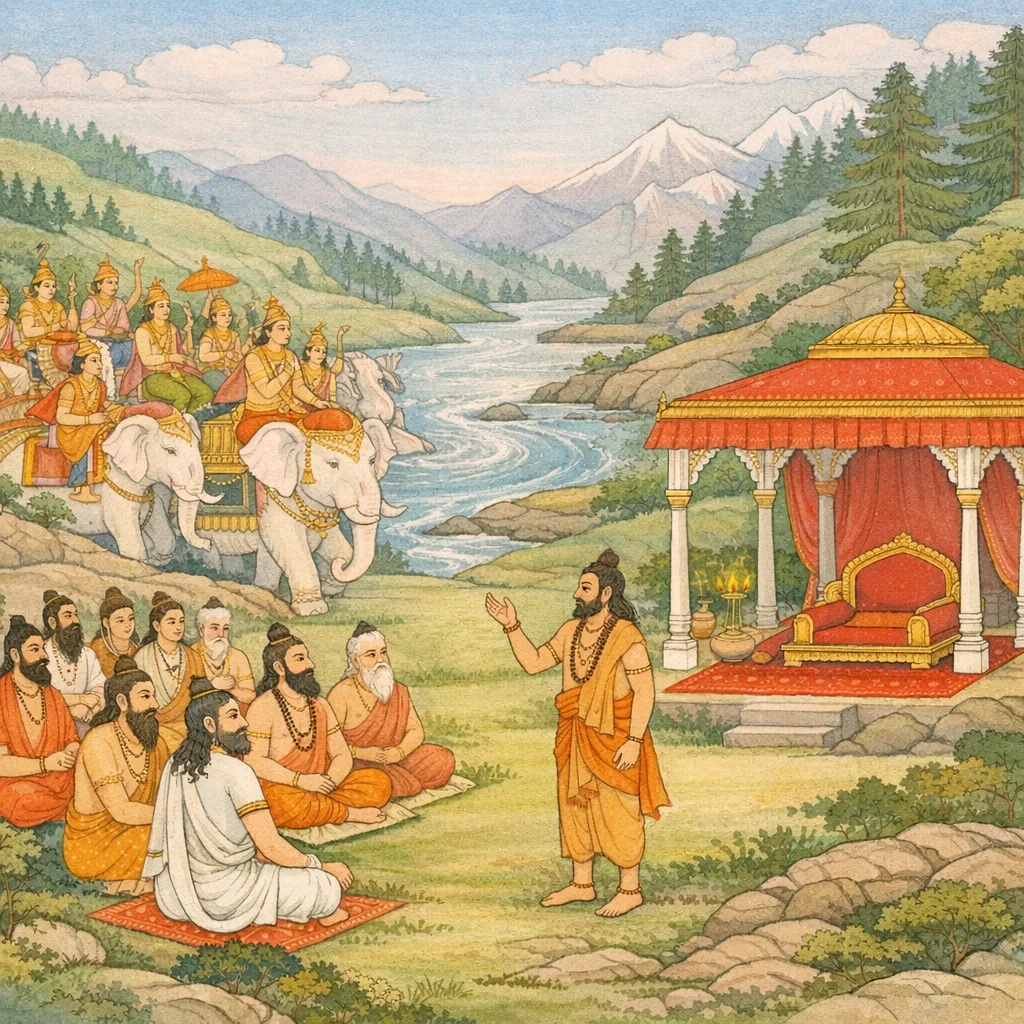
दक्षस्य यज्ञप्रवृत्तिः तथा ईश्वरवर्जितदेवसमागमः (Dakṣa’s Sacrificial Undertaking and the Devas’ Assembly without Īśvara)
Adhyāya 19 begins with the sages asking how Maheśa placed an obstacle (vighna) before Dakṣa, who set out to perform sacrifice in the name of dharma and artha yet is described as durātmā. Vāyu answers by fixing the time and setting: after the divine marriage and the Lord’s long sportive dwelling with the Goddess on Himavat, the Vaivasvata Manvantara arrives. Dakṣa Prācetasa undertakes an aśvamedha, establishing the rite on Himavat’s back at the auspicious Gaṅgādvāra, a haunt of ṛṣis and siddhas. The devas assemble to attend—Indra leading—along with the Ādityas, Vasus, Rudras, Sādhyas, Maruts, recipients of soma/ājya/dhūma, the Aśvins, the Pitṛs, great seers, and Viṣṇu, all as yajña-bhāgins. Seeing the entire divine host gathered without Īśvara, the sage Dadhīci flares in anger and warns Dakṣa that misdirected worship and failure to honor the truly worthy bring great sin. The chapter thus frames the coming conflict as a theological and ritual fault: a sacrifice outwardly complete yet inwardly defective because Śiva is excluded and the hierarchy of honor is distorted.
Shlokas
Verse 1
ऋषय ऊचुः । कथं दक्षस्य धर्मार्थं प्रवृत्तस्य दुरात्मनः । महेशः कृतवान् विघ्नमेतदिच्छाम वेदितुम्
The sages said: “How did Maheśa create an obstacle for the wicked-souled Dakṣa who had set out to perform rites for the sake of dharma and worldly gain? We wish to know this.”
Verse 2
वायुरुवाच । विश्वस्य जगतो मातुरपि देव्यास्तपोबलात् । पितृभावमुपागम्य मुदिते हिमवद्गिरौ
Vāyu said: By the power of the Goddess’s austerities—she who is the very Mother of the whole universe—Śiva assumed the role of a father, and on the delighted Himālaya mountain the divine events unfolded.
Verse 3
देवे ऽपि तत्कृतोद्वाहे हिमवच्छिखरालये । संकीडति तया सार्धं काले बहुतरे गते
Even after the Deva (Śiva) had thus celebrated the marriage, dwelling upon the peak of Himavān (Himālaya), He sported together with Her (Pārvatī) as a very long time passed.
Verse 4
वैवस्वते ऽंतरे प्राप्ते दक्षः प्राचेतसः स्वयम् । अश्वमेधेन यज्ञेन यक्ष्यमाणो ऽन्वपद्यत
When the Vaivasvata Manvantara arrived, Dakṣa, son of Pracetā, himself set about the sacred sacrifice, desiring to perform the Aśvamedha (horse-sacrifice).
Verse 5
ततो हिमवतः पृष्ठे दक्षो वै यज्ञमाहरत् । गंगाद्वारे शुभे देशे ऋषिसिद्धनिषेविते
Thereafter, Dakṣa indeed undertook the sacrifice on the slopes of Himavān, at Gaṅgādvāra—a blessed region frequented by sages and perfected beings.
Verse 6
तस्य तस्मिन्मखेदेवाः सर्वे शक्र पुरोगमाः । गमनाय समागम्य बुद्धिमापेदिरे तदा
At that sacrifice of his, all the gods—led by Śakra (Indra)—assembled there, and at that time they arrived at a resolve to depart.
Verse 7
आदित्या वसवो रुद्रास्साध्यास्सह मरुद्गणैः । ऊष्मपाः सोमपाश्चैव आज्यपा धूमपास्तथा
The Ādityas, the Vasus, the Rudras, and the Sādhyas—together with the hosts of Maruts—along with the Uṣmapas and Somapas, and likewise the Ājyapas and Dhūmapas.
Verse 8
अश्विनौ पितरश्चैव तथा चान्ये महर्षयः । विष्णुना सहिताः सर्वे स्वागता यज्ञभागिनः
The twin Aśvins, the Pitṛs, and the other great sages as well—together with Viṣṇu—had all arrived, welcomed as rightful participants who receive their ordained shares of the sacrifice.
Verse 9
दृष्ट्वा देवकुलं सर्वमीश्वरेण विनागतम् । दधीचो मन्युनाविष्टो दक्षमेवमभाषत
Seeing the entire assembly of gods arrived there without the Lord (Śiva), Dadhīci, seized by indignation, spoke thus to Dakṣa.
Verse 10
दधीच उवाच । अप्रपूज्ये चैव पूजा पूज्यानां चाप्य पूजने । नरः पापमवाप्नोति महद्वै नात्र संशयः
Dadhīci said: “When worship is offered to one who is not worthy of worship, and when those who are truly worthy are not worshipped, a person surely incurs great sin—of this there is no doubt.”
Verse 11
असतां संमतिर्यत्र सतामवमतिस्तथा । दंडो देवकृतस्तत्र सद्यः पतति दारुणः
Where the wicked are applauded and the righteous are treated with contempt, there the terrible punishment fashioned by the Divine falls swiftly.
Verse 12
एवमुक्त्वा तु विप्रर्षिः पुनर्दक्षमभाषत । पूज्यं तु पशुभर्तारं कस्मान्नार्चयसे प्रभुम्
Having spoken thus, the brahmin-sage again addressed Dakṣa: “Why do you not worship the Lord—the Master and Protector of all beings (Paśupati)—who is truly worthy of adoration?”
Verse 13
दक्ष उवाच । संति मे बहवो रुद्राः शूलहस्ताः कपर्दिनः । एकादशावस्थिता ये नान्यं वेद्मि महेश्वरम्
Dakṣa said: “I have many Rudras, bearing tridents and wearing matted hair, established as the Eleven. I acknowledge no other Maheśvara besides them.”
Verse 14
दधीच उवाच । किमेभिरमरैरन्यैः पूजितैरध्वरे फलम् । राजा चेदध्वरस्यास्य न रुद्रः पूज्यते त्वया
Dadhīci said: “What fruit can this sacrifice yield if other gods are worshipped in it? For if you do not worship Rudra as the sovereign of this rite, what true kingship can this sacrifice possess?”
Verse 15
ब्रह्मविष्णुमहेशानां स्रष्टा यः प्रभुरव्ययः । ब्रह्मादयः पिशाचांता यस्य कैंकर्यवादिनः
He is the imperishable Lord, the creator even of Brahmā, Viṣṇu, and Maheśa; and all beings, from Brahmā down to the Piśācas, declare themselves to be His attendants and servants.
Verse 16
प्रकृतीनां परश्चैव पुरुषस्य च यः परः । चिंत्यते योगविद्वद्भि ऋषिभिस्तत्त्वदर्शिभिः
He who is beyond the evolutes of Prakṛti, and transcendent even to the Puruṣa, is contemplated by the knowers of Yoga and by the ṛṣis—seers who truly behold Reality.
Verse 17
अक्षरं परमं ब्रह्म ह्यसच्च सदसच्च यत् । अनादिमध्यनिधनमप्रतर्क्यं सनातनम्
That Imperishable One is the Supreme Brahman—beyond both the unreal and the real (and yet the ground of both). Beginningless, without any middle or end, it is beyond the reach of reasoning and ever-eternal.
Verse 18
यः स्रष्टा चैव संहर्ता भर्ता चैव महेश्वरः । तस्मादन्यं न पश्यामि शंकरात्मानमध्वरे
He who is indeed the Creator, the Dissolver, and the Sustainer—Mahādeva, the Great Lord. Therefore, in this sacred rite I behold none other; I perceive only Śaṅkara as the very Self within the sacrifice.
Verse 19
दक्ष उवाच । एतन्मखेशस्य सुवर्णपात्रे हविः समस्तं विधिमंत्रपूतम् । विष्णोर्नयाम्यप्रतिमस्य भागं प्रभोर्विभज्यावहनीयमद्य
Dakṣa said: “This entire oblation—purified by proper rite and mantra—has been placed in the golden vessel for the Lord of the sacrifice. Today I shall carry the share of the incomparable Viṣṇu, apportioning it for the Lord and duly offering it into the consecrated fire.”
Verse 20
दधीच उवाच । यस्मान्नाराधितो रुद्रस्सर्वदेवेश्वरेश्वरः । तस्माद्दक्ष तवाशेषो यज्ञो ऽयं न भविष्यति
Dadhīci said: “Since Rudra—the supreme Lord over the rulers of all the gods—has not been worshipped, therefore, O Dakṣa, this entire sacrifice of yours will not come to fruition.”
Verse 21
इत्युक्त्वा वचनं क्रुद्धो दधीचो मुनिसत्तमः । निर्गम्य च ततो देशाज्जगाम स्वकमाश्रमम्
Having spoken these words, the foremost of sages, Dadhīci—angered—departed from that place and went to his own hermitage.
Verse 22
निर्गते ऽपि मुनौ तस्मिन्देवा दक्षं न तत्यजुः । अवश्यमनुभावित्वादनर्थस्य तु भाविनः
Even after that sage had departed, the gods did not abandon Dakṣa, for the impending misfortune was fated to be endured and could not be averted.
Verse 23
एतस्मिन्नेव काले तु ज्ञात्वैतत्सर्वमीश्वरात् । दग्धुं दक्षाध्वरं विप्रा देवी देवमचोदयत्
At that very time, having understood everything from the Lord, the Goddess—O sages—urged the Deva (Śiva) to burn Dakṣa’s sacrificial rite.
Verse 24
देव्या संचोदितो देवो दक्षाध्वरजिघांसया । ससर्ज सहसा वीरं वीरभद्रं गणेश्वरम्
Urged by the Goddess, the Lord—intent on destroying Dakṣa’s sacrificial rite—at once manifested the heroic Vīrabhadra, commander and lord of the Gaṇas.
Verse 25
सहस्रवदनं देवं सहस्रकमलेक्षणम् । सहस्रमुद्गरधरं सहस्रशरपाणिकम्
I beheld the Divine Lord with a thousand faces, with lotus-like eyes by the thousand—bearing a thousand maces, and with hands holding a thousand arrows. Thus is Pati (Śiva) praised as the immeasurable, all-pervading saguṇa form, whose powers appear as countless for the uplift of bound souls (paśu).
Verse 26
शूलटंकगदाहस्तं दीप्तकार्मुकधारिणम् । चक्रवज्रधरं घोरं चंद्रार्धकृतशेखरम्
He bore in his hands the trident, the battle-axe, and the mace; he held a blazing bow. He wielded the discus and the thunderbolt—terrific in majesty—and wore the crescent-moon as his crest.
Verse 27
कुलिशोद्योतितकरं तडिज्ज्वलितमूर्धजम् । दंष्ट्राकरालं बिभ्राणं महावक्त्रं महोदरम्
His hand shone as if lit by the thunderbolt; his matted hair blazed like lightning. Bearing fearsome fangs, with a vast mouth and a mighty belly, he appeared in an awe-inspiring form—terrible to bondage, yet a vehicle of the Lord’s grace.
Verse 28
विद्युज्जिह्वं प्रलंबोष्ठं मेघसागरनिःस्वनम् । वसानं चर्म वैयाघ्रं महद्रुधिरनिस्रवम्
“(He is) lightning-tongued, with pendulous lips, resounding like the ocean and thunderclouds; clad in a tiger-skin, and flowing with copious streams of blood.”
Verse 29
गण्डद्वितयसंसृष्टमण्डलीकृतकुण्डलम् । वरामरशिरोमालावलीकलितशेखरम्
His circular earrings rested close against both cheeks, and his crest was adorned with a series of garlands made of the heads of exalted immortals—an awe-inspiring, sovereign ornament befitting the Supreme Lord in manifest (saguṇa) form.
Verse 30
रणन्नूपुरकेयूरमहाकनकभूषितम् । रत्नसंचयसंदीप्तं तारहारावृतोरसम्
Adorned with resounding anklets and armlets, embellished with great golden ornaments, radiant with heaps of gems, and with the chest covered by a necklace of star-like pearls—thus was that divine form seen.
Verse 31
महाशरभशार्दूलसिंहैः सदृशविक्रमम् । प्रशस्तमत्तमातंगसमानगमनालसम्
His prowess was like that of the mighty Śarabha, the tiger, and the lion; and his gait—unhurried and majestic—resembled the measured movement of a renowned royal elephant in rut.
Verse 32
शंखचामरकुंदेन्दुमृणालसदृशप्रभम् । सतुषारमिवाद्रीन्द्रं साक्षाज्जंगमतां गतम्
Radiant like a conch, a yak-tail fan, jasmine, the moon, and a lotus-stalk, that lord of mountains appeared as though covered with frost—indeed, it seemed to have truly taken on motion, as if becoming a living, moving being.
Verse 33
ज्वालामालापरिक्षिप्तं दीप्तमौक्तिकभूषणम् । तेजसा चैव दीव्यंतं युगांत इव पावकम्
Encircled by a garland of flames, adorned with radiant pearl-ornaments, it blazed with such splendor—like the cosmic fire at the end of an age.
Verse 34
स जानुभ्यां महीं गत्वा प्रणतः प्रांजलिस्ततः । पार्श्वतो देवदेवस्य पर्यतिष्ठद्गणेश्वरः
Then Gaṇeśvara went down to the earth upon his knees; bowing in reverence with joined palms, he stood attentively at the side of the Deva-of-devas (Lord Śiva).
Verse 35
मन्युना चासृजद्भद्रां भद्रकालीं महेश्वरीम् । आत्मनः कर्मसाक्षित्वे तेन गंतुं सहैव तु
And from his wrath he manifested the auspicious Goddess—Bhadrakālī, the Great Sovereign Power—so that, as the Witness of his own act (karma), she might accompany him there as well.
Verse 36
तं दृष्ट्वावस्थितं वीरभद्रं कालाग्निसन्निभम् । भद्रया सहितं प्राह भद्रमस्त्विति शंकरः
Seeing Vīrabhadra standing there, blazing like the fire of Time’s dissolution, Śaṅkara—together with Bhadrā—addressed him, saying, “May auspiciousness be yours.”
Verse 37
स च विज्ञापयामास सह देव्या महेश्वरम् । आज्ञापय महादेव किं कार्यं करवाण्यहम्
Then he, together with the Goddess, respectfully addressed Maheśvara: “Command me, O Mahādeva—what task shall I perform?”
Verse 38
ततस्त्रिपुरहा प्राह हैमवत्याः प्रियेच्छया । वीरभद्रं महाबाहुं वाचा विपुलनादया
Then Tripurahā (Lord Śiva, destroyer of Tripura), wishing to fulfill the beloved desire of Haimavatī (Pārvatī), spoke to mighty-armed Vīrabhadra in a voice that resounded powerfully.
Verse 39
देवदेव उवाच । प्राचेतसस्य दक्षस्य यज्ञं सद्यो विनाशय । भद्रकाल्या सहासि त्वमेतत्कृत्यं गणेश्वर
The Lord of gods said: “Destroy at once the sacrifice of Dakṣa, the son of Prācetas. Together with Bhadrakālī, you—O lord of the Gaṇas—must carry out this task.”
Verse 40
अहमप्यनया सार्धं रैभ्याश्रमसपीपतः । स्थित्वा वीक्षे गणेशान विक्रमं तव दुःसहम्
“I too, together with her, have come near the hermitage of Raibhya. Standing there, O Gaṇeśa, I behold your irresistible prowess—so hard to withstand.”
Verse 41
वृक्षा कनखले ये तु गंगाद्वारसमीपगाः । सुवर्णशृंगस्य गिरेर्मेरुमंदरसंनिभाः
The trees in Kanakhala, near Gaṅgādvāra (Haridvāra), are like the slopes of Mount Suvarṇaśṛṅga—resembling Meru and Mandara in majestic grandeur.
Verse 42
तस्मिन्प्रदेशे दक्षस्य युज्ञः संप्रति वर्तते । सहसा तस्य यज्ञस्य विघातं कुरु मा चिरम्
In that very region, Dakṣa’s sacrifice is presently underway. Go at once—without delay—and bring about the obstruction of that sacrifice.
Verse 43
इत्युक्ते सति देवेन देवी हिमगिरीन्द्रजा । भद्रं भद्रं च संप्रेक्ष्य वत्सं धेनुरिवौरसम्
When the Lord had thus spoken, the Goddess—daughter of Himavat—gazed again and again with auspicious tenderness, like a cow looking upon her own calf at her breast.
Verse 44
आलिंग्य च समाघ्राय मूर्ध्नि षड्वदनं यथा । सस्मिता वचनं प्राह मधुरं मधुरं स्वयम्
Embracing him and kissing (inhaling his fragrance) upon the crown of his head—just as one would embrace the Six-faced (Kārttikeya)—she, smiling, spoke of her own accord words that were sweet, sweet indeed.
Verse 45
देव्युवाच । वत्स भद्र महाभाग महाबलपराक्रम । मत्प्रियार्थं त्वमुत्पन्नो मम मन्युं प्रमार्जक
The Goddess said: “Beloved child—noble one, most fortunate, mighty and valorous—you have arisen for what is dear to me; be the one who wipes away my wrath.”
Verse 46
यज्ञेश्वरमनाहूय यज्ञकर्मरतो ऽभवत् । दक्षं वैरेण तं तस्माद्भिंधि यज्ञं गणेश्वर
“Without inviting the Lord of Sacrifice (Śiva), he became absorbed in the rites of the sacrifice. Therefore, O Gaṇeśvara, out of hostility toward that Dakṣa—go and shatter the sacrifice.”
Verse 47
यज्ञलक्ष्मीमलक्ष्मीं त्वं भद्र कृत्वा ममाज्ञया । यजमानं च तं हत्वा वत्स हिंसय भद्रया
“O Bhadra, by my command, turn the prosperity of this sacrifice into misfortune. Then slay that sacrificer (the yajamāna), my child, and with Bhadrā (your fierce power) bring ruin upon him.”
Verse 48
अशेषामिव तामाज्ञां शिवयोश्चित्रकृत्ययोः । मूर्ध्नि कृत्वा नमस्कृत्य भद्रो गंतुं प्रचक्रमे
Receiving the command of the two Śivas—whose wondrous deeds are beyond measure—as though bearing it upon his head, Bhadra bowed in reverence and then set out to depart.
Verse 49
अथैष भगवान्क्रुद्धः प्रेतावासकृतालयः । वीरभद्रो महादेवो देव्या मन्युप्रमार्जकः
Then that blessed Lord, angered—whose abode is amid the haunt of spirits and the departed—appeared as Vīrabhadra, Mahādeva, who wipes away and fulfills the Goddess’s wrath.
Verse 50
ससर्ज रोमकूपेभ्यो रोमजाख्यान्गणेश्वरान् । दक्षिणाद्भुजदेशात्तु शतकोटिगविश्वरान्
From the pores of His body He emanated the troop-lords known as the Romajas; and from the region of His right arm He brought forth a hundred koṭis of mighty leaders of hosts.
Verse 51
पादात्तथोरुदेशाच्च पृष्ठात्पार्श्वान्मुखाद्गलात् । गुह्याद्गुल्फाच्छिरोमध्यात्कंठादास्यात्तथोदरात्
From the feet, from the region of the thighs, from the back and the sides; from the face and the throat; from the secret organ and the ankles; from the middle of the head, from the neck, from the mouth, and likewise from the belly—these are the places spoken of.
Verse 52
तदा गणेश्वरैर्भद्रैर्भद्रतुल्यपराक्रमैः । संछादितमभूत्सर्वं साकाशविवरं जगत्
Then, by the auspicious Gaṇeśvaras—mighty, their valor equal to that of Bhadra—the entire world, along with the open spaces of the sky, became completely covered.
Verse 53
सर्वे सहस्रहस्तास्ते सहस्रायुधपाणयः । रुद्रस्यानुचरास्सर्वे सर्वे रुद्रसमप्रभाः
All of them had a thousand hands, and in their hands were a thousand weapons. All were attendants of Rudra, and all shone with a splendor equal to Rudra’s own.
Verse 54
शूलशक्तिगदाहस्ताष्टंकोपलशिलाधराः । कालाग्निरुद्रसदृशास्त्रिनेत्राश्च जटाधराः
Those fierce attendants of the Lord bore tridents, spears, and maces in their hands, and held aloft mountain-peaks and massive rocks. They appeared like Kālāgnirudra himself—three-eyed and matted-haired—embodying the awe-inspiring, protective power of Śiva’s manifest (saguṇa) might.
Verse 55
निपेतुर्भृशमाकाशे शतशस्सिंहवाहनाः । विनेदुश्च महानादाञ्जलदा इव भद्रजाः
Then, in the sky, hundreds upon hundreds of lion-mounted ones swooped down with great force; and they roared with mighty cries, like auspicious rain-clouds thundering.
Verse 56
तैर्भद्रैर्भगवान्मद्रस्तथा परिवृतो बभौ । कालानलशतैर्युक्तो यथांते कालभैरवः
Thus surrounded by those auspicious attendants, the Blessed Lord—Madra—shone forth, as if Kālabhairava at the end of time, endowed with a hundred fires of Time’s consuming blaze.
Verse 57
तेषां मध्ये समारुह्य वृषेंद्रं वृषभध्वजः । जगाम भगवान्भद्रश्शुभमभ्रं यथा भवः
In their midst, the Bull-bannered Lord—Vṛṣabhadhvaja—mounted the lord of bulls. Auspicious and gracious, the Blessed One moved on, like Bhava (Śiva) passing through a pure, shining cloud.
Verse 58
तस्मिन्वृषभमारूढे भद्रे तु भसितप्रभः । बभार मौक्तिकं छत्रं गृहीतसितचामरः
When the auspicious Lord—radiant with the holy ash (vibhūti)—mounted the bull, he bore a pearl-white royal parasol and held in his hand a white yak-tail fan (cāmara).
Verse 59
स तदा शुशुभे पार्श्वे भद्रस्य भसितप्रभः । भगवानिव शैलेन्द्रः पार्श्वे विश्वजगद्गुरोः
Then he, radiant with the luster of sacred ash, shone gloriously at Bhadra’s side—like a majestic mountain beside the Lord who is the Guru of the entire universe.
Verse 60
सो ऽपि तेन बभौ भद्रः श्वेतचामरपाणिना । बालसोमेन सौम्येन यथा शूलवरायुधः
Adorned by him, the auspicious Bhadra shone brilliantly—holding a white cāmara in his hand, gentle as the tender moon—like the Supreme Lord bearing the excellent weapon, the trident.
Verse 61
दध्मौ शंखं सितं भद्रं भद्रस्य पुरतः शुभम् । भानुकंपो महातेजा हेमरत्नैरलंकृतः
Then Bhānukampa—of great splendor, adorned with gold and jewels—stood reverently before Bhadra and blew a pure white conch, auspicious and excellent.
Verse 62
देवदुंदुभयो नेदुर्दिव्यसंकुलनिःस्वनाः । ववृषुश्शतशो मूर्ध्नि पुष्पवर्षं बलाहकाः
The celestial kettledrums (devadundubhi) resounded with richly blended, divine tones; and the hosts of clouds poured hundreds of showers of flowers upon the revered one’s head as an auspicious offering.
Verse 63
फुल्लानां मधुगर्भाणां पुष्पाणां गंधबंधवः । मार्गानुकूलसंवाहा वबुश्च पथि मारुताः
The fragrance, as though a close companion of the blossomed, nectar-laden flowers, spread forth; and along the pathway, gentle breezes flowed in a manner favorable to the journey.
Verse 64
ततो गणेश्वराः सर्वे मत्ता युद्धबलोद्धताः । ननृतुर्मुमुदुर्१ एदुर्जहसुर्जगदुर्जगुः
Then all those Gaṇa-lords, intoxicated with ardor and made proud by the strength of battle, began to dance; they rejoiced, shouted aloud, laughed, spoke out, and sang—filling the quarters with their exuberance.
Verse 65
तदा भद्रगणांतःस्थो बभौ भद्रः स भद्रया । यथा रुद्रगणांतः स्थस्त्र्यम्बकोंबिकया सह
Then that auspicious one (Bhadra), standing amidst the Bhadragaṇas, shone forth together with Bhadrā—just as Tryambaka (Śiva), standing amid the Rudragaṇas, shines with Ambikā (Pārvatī) by his side.
Verse 66
तत्क्षणादेव दक्षस्य यज्ञवाटं रण्मयम् । प्रविवेश महाबाहुर्वीरभद्रो महानुगः
At that very moment, the mighty-armed Vīrabhadra—followed by his great attendants—entered Dakṣa’s sacrificial enclosure, which had turned into a battlefield.
Verse 67
ततस्तु दक्षप्रतिपादितस्य क्रतुप्रधानस्य गणप्रधानः । प्रयोगभूमिं प्रविवेश भद्रो रुद्रो यथांते भुवनं दिधक्षुः
Then the leader of the gaṇas—Bhadrā Rudra—entered the sacrificial arena of that rite which had been instituted by Dakṣa, as though, at the end of time, Rudra were entering the worlds intent on consuming them in fire.
Frequently Asked Questions
The setup for Dakṣa’s aśvamedha sacrifice at Gaṅgādvāra on Himavat, including the arrival of devas and other beings—conspicuously without Īśvara (Śiva)—which precipitates admonition and impending conflict.
It signals a ritual-theological defect: a yajña that ignores the supreme principle cannot be fully auspicious. The narrative uses this omission to critique mere formalism and to assert Śiva’s indispensability in cosmic and sacrificial hierarchy.
Indra with the devas; Ādityas, Vasus, Rudras, Sādhyas, Maruts; specialized offering-recipients (soma/ājya/dhūma categories); the Aśvins, Pitṛs, other ṛṣis; and Viṣṇu—collectively termed yajña-bhāgins.
Read Shiva Purana in the Vedapath app
Scan the QR code to open this directly in the app, with audio, word-by-word meanings, and more.