Adhyaya 136: Maya’s Nectar-Reservoir in Tripura and the Revival of the Slain in the Tripura War
त्रिपुरयुद्धे मायाकृतामृतवापी तथा दैत्यपुनर्जीवनवर्णनम्
Speaker: Sūta, Maya (Dānava), Vidyunmālī, Śaṅkukarṇa, Tāraka, Mahādeva (Śiva), Brahmā, Janārdana (Viṣṇu/Keśava), Pramathas (Śiva’s hosts)
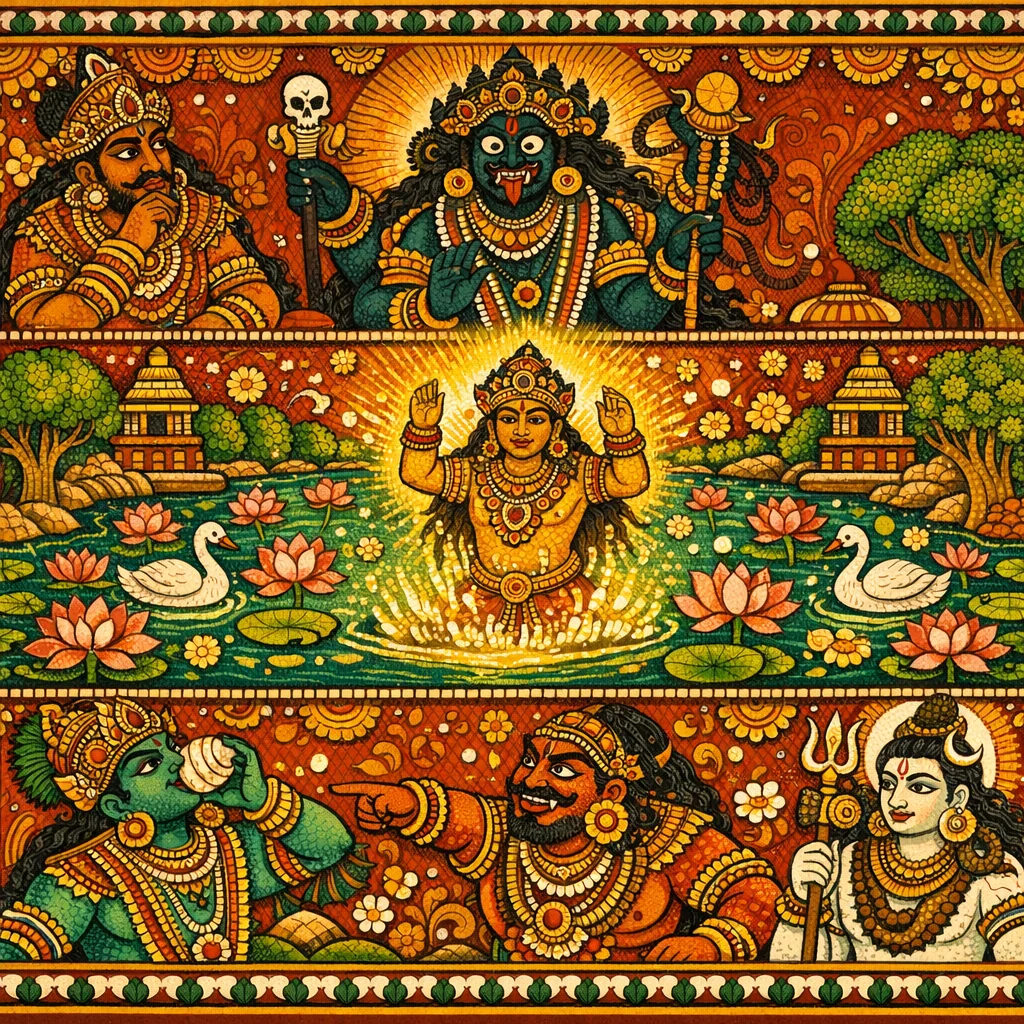
Sūta continues the Tripura episode: after striking his blow, Maya enters Tripura and reflects on Kāla, declaring that fortifications cannot ultimately protect. He affirms Mahādeva’s unsurpassable sovereignty and vows to show the true “fruit” of lordship by creating a vāpī, a nectar-filled reservoir empowered with saṃjīvanī herbs. The vāpī is described in ornate, measured detail; Maya bathes Vidyunmālī in it, and he revives, blazing with renewed vigor. As the war intensifies, slain Daityas are repeatedly hurled into the vāpī and rise again, emboldening the Dānavas and Pramathas. Śaṅkukarṇa reports to Mahēśvara that the Asuras are being restored by this reservoir. Amid portents and fierce clashes (including Tāraka’s assault and the chariot’s instability), Janārdana enters Tripura and drinks the Asuras’ nectar-reservoir dry; they lose their regenerative advantage and retreat, while Gaṇeśvara and the allied divine hosts rejoice.
Key Concepts
Shlokas in Adhyaya 136
Verse 1
*सूत उवाच मयः प्रहारं कृत्वा तु मायावी दानवर्षभः विवेश तूर्णं त्रिपुरम् अभ्रं नीलमिवाम्बरम् //
Sūta said: Then Maya—the crafty bull among the Dānavas—having delivered his blow, swiftly entered Tripura, like a dark-blue cloud entering the sky.
Verse 2
स दीर्घमुष्णं निःश्वस्य दानवान्वीक्ष्य मध्यगान् दध्यौ लोकक्षये प्राप्ते कालं काल इवापरः //
He breathed out a long, hot sigh; and, looking upon the Dānavas who stood in the midst, he reflected—when the destruction of the worlds had drawn near—upon Kāla (Time), as though he himself were another Kāla.
Verse 3
इन्द्रो ऽपि बिभ्यते यस्य स्थितो युद्धेप्सुरग्रतः स चापि निधनं प्राप्तो विद्युन्माली महायशाः //
Even Indra would fear him when he stood at the front, eager for battle; yet that greatly renowned Vidyunmālī too met his end.
Verse 4
दुर्गं वै त्रिपुरस्यास्य न समं विद्यते पुरम् तस्याप्येषो ऽनयः प्राप्तो न दुर्गं कारणं क्वचित् //
Truly, for this Tripura there was no city equal to its fortress; yet even it met with this calamity. A fortification is never, in any case, the real cause of safety.
Verse 5
कालस्यैव वशे सर्वं दुर्गं दुर्गतरं च यत् काले क्रुद्धे कथं कालात् त्राणं नो ऽद्य भविष्यति //
Everything is indeed under the control of Kāla (Time)—even what is fortified, and what is yet more strongly fortified. When Time itself is enraged, how can there be any rescue for us today from Time?
Verse 6
एकेषु त्रिषु यत्किंचिद् बलं वै सर्वजन्तुषु कालस्य तद्वशं सर्वम् इति पैतामहो विधिः //
Whatever strength exists among beings—whether in one, in three, or in any number—everything is under the sway of Time (Kāla). Such is the ancient ordinance taught by the Grandfather, Brahmā.
Verse 7
अस्मिन्कः प्रभवेद्योगो ह्य् असंधार्ये ऽमितात्मनि लङ्घने कः समर्थः स्याद् ऋते देवं महेश्वरम् //
With regard to Him—whose boundless Self is beyond all containment—who could truly accomplish yoga? And who could have the power to surpass or transgress Him, except the divine Mahādeva, Maheśvara alone?
Verse 8
बिभेमि नेन्द्राद्धि यमाद् वरुणान्न च वित्तपात् स्वामी चैषां तु देवानां दुर्जयः स महेश्वरः //
I do not fear Indra, nor Yama, nor Varuṇa, nor even the loss of wealth; for the Lord of these very gods—invincible—is Mahādeva, Maheśvara.
Verse 9
ऐश्वर्यस्य फलं यत्तत् प्रभुत्वस्य च यत्फलम् तदद्य दर्शयिष्यामि यावद्वीराः समन्ततः //
That fruit which comes from sovereignty, and that fruit which comes from lordly authority—today I shall demonstrate it, while the heroes stand gathered on every side.
Verse 10
वापीममृततोयेन पूर्णां स्रक्ष्ये वरौषधीः जीविष्यन्ति तदा दैत्याः संजीवनवरौषधैः //
“I shall prepare a well filled with nectar-like water and bring forth the excellent medicinal herbs; then the Daityas will live again through those life-restoring saṃjīvanī herbs.”
Verse 11
इति संचिन्त्य बलवान् मयो मायाविनां वरः मायया ससृजे वापीं रम्भामिव पितामहः //
Thus having reflected, the mighty Maya—foremost among wielders of illusion—by his own wondrous art created a stepwell/reservoir, as though the Grandsire (Brahmā) had fashioned Rambhā herself.
Verse 12
द्वियोजनायतां दीर्घां पूर्णयोजनविस्तृताम् आरोहसंक्रमवतीं चित्ररूपां कथामिव //
(It was described as) two yojanas in length and a full yojana in breadth, furnished with ascents and connecting passages—variegated in form, like a wondrous tale.
Verse 13
इन्दोः किरणकल्पेन मृष्टेनामृतगन्धिना पूर्णां परमतोयेन गुणपूर्णामिवाङ्गनाम् //
Filled with supremely pure water—polished like the moon’s rays and fragrant like nectar—she appears like a noble woman, complete in every excellence.
Verse 14
उत्पलैः कुमुदैः पद्मैर् वृतां कादम्बकैस्तथा चन्द्रभास्करवर्णाभैर् भीमैर् आवरणैर्वृताम् //
It was surrounded by blue lotuses, white water-lilies, and red lotuses, and also by kādamba trees; and it was enclosed by formidable ramparts whose hues were like the Moon and the Sun.
Verse 15
खगैर् मधुररावैश्च चारुचामीकरप्रभैः कामैषिभिर् इवाकीर्णां जीवानामरणीम् इव //
It was filled with birds of sweet calls and with a lovely, golden radiance—crowded, as it were, with desire-seeking beings—like a forest that serves as a sanctuary for living creatures.
Verse 16
तां वापीं सृज्य स मयो गङ्गामिव महेश्वरः तस्यां प्रक्षालयामास विद्युन्मालिनमादितः //
Having created that stepwell, Maya—like Maheśvara bringing forth the Gaṅgā—first bathed and purified Vidyunmālin in its waters.
Verse 17
स वाप्यां मज्जितो दैत्यो देवशत्रुर्महाबलः उत्तस्थाविन्धनैरिद्धः सद्यो हुत इवानलः //
That mighty Daitya—an enemy of the gods—having been submerged in the pond, rose up at once, blazing like fire newly kindled with fuel and freshly fed by oblations.
Verse 18
मयस्य चाञ्जलिं कृत्वा तारकाख्यो ऽभिवादितः विद्युन्मालीति वचनं मयमुत्थाय चाब्रवीत् //
With palms joined in añjali, the one named Tāraka paid reverence to Maya. Then Vidyunmālī rose and spoke these words to Maya.
Verse 19
क्व नन्दी सह रुद्रेण वृतः प्रमथजम्बुकैः युध्यामो ऽरीन् विनिष्पीड्य दया देहेषु का हि नः //
Where is Nandī—surrounded by Rudra, along with the Pramathas and jackals—so that we may crush our enemies in battle? For what compassion have we at all for bodies?
Verse 20
अन्वास्यैव च रुद्रस्य भवामः प्रभविष्णवः तैर्वा विनिहता युद्धे भविष्यामो यमाशनाः //
Attending upon Rudra alone, we shall become mighty and all-prevailing; or else, if we are struck down by them in battle, we shall become food for Yama—that is, we shall meet death.
Verse 21
विद्युन्मालेर् निशम्यैतन् मयो वचनमूर्जितम् तं परिष्वज्य सार्द्राक्ष इदमाह महासुरः //
Hearing these forceful words spoken by Maya, Vidyunmālī embraced him; with eyes moist with emotion, the great Asura then spoke as follows.
Verse 22
विद्युन्मालिन्न मे राज्यम् अभिप्रेतं न जीवितम् त्वया विना महाबाहो किमन्येन महासुर //
O Vidyunmālī, I desire neither kingdom nor even life itself. Without you, O mighty-armed one—what use is anything else, O great Asura?
Verse 23
महामृतमयी वापी ह्य् एषा मायाभिरीश्वर सृष्टा दानवदैत्यानां हतानां जीववर्धिनी //
O Lord, this well is verily filled with a ‘great death’—created by magical arts; it restores life and strengthens the vitality of the slain Dānavas and Daityas.
Verse 24
दिष्ट्या त्वां दैत्य पश्यामि यमलोकाद् इहागतम् दुर्गतावनयग्रस्तं भोक्ष्यामो ऽद्य महानिधिम् //
By good fortune I see you, O Daitya, returned here from Yama’s world. Crushed by misfortune and fallen into distress, you shall serve today as a great treasure for us to consume and enjoy.
Verse 25
दृष्ट्वा दृष्ट्वा च तां वापीं मायया मयनिर्मिताम् हृष्टाननाक्षा दैत्येन्द्रा इदं वचनमब्रुवन् //
Again and again, seeing that well-tank—fashioned by Mayā and constructed by Maya (the master architect)—the lords of the Daityas, their faces and eyes bright with delight, spoke these words.
Verse 26
दानवा युध्यतेदानीं प्रमथैः सह निर्भयाः मयेन निर्मिता वापी हतान्संजीवयिष्यति //
Now the Dānavas fight fearlessly alongside the Pramathas; for the well (vāpī) constructed by Maya will restore the slain to life.
Verse 27
ततः क्षुब्धाम्बुधिनिभा भेरी सा तु भयंकरी वाद्यमाना ननादोच्चै रौरवी सा पुनः पुनः //
Then that kettledrum—like the surging, churned ocean, terrifying in its power—was beaten and again and again roared aloud with a dreadful, raurava-like sound.
Verse 28
श्रुत्वा भेरीरवं घोरं मेघारम्भितसंनिभम् न्यपतन्नसुरास्तूर्णं त्रिपुराद्युद्धलालसाः //
Hearing the dreadful roar of the war-drums—like the rumbling onset of storm-clouds—the Asuras quickly rushed forth from Tripura, eager for battle.
Verse 29
लोहराजतसौवर्णैः कटकैर्मणिराजितैः आमुक्तैः कुण्डलैर्हारैर् मुकुटैरपि चोत्कटैः //
With bracelets fashioned of iron, silver, and gold, resplendent with gems; with armlets, earrings, necklaces, and also magnificent crowns.
Verse 30
धूमायिता ह्यविरमा ज्वलन्त इव पावकाः आयुधानि समादाय काशिनो दृढविक्रमाः //
Continuously smoking and blazing like fire, the steadfastly valorous men of Kāśī took up their weapons.
Verse 31
नृत्यमाना इव नटा गर्जन्त इव तोयदाः करोच्छ्रया इव गजाः सिंहा इव च निर्भयाः //
They moved as though dancing like actors; they roared like rain-clouds; they stood tall like elephants with raised trunks—and, like lions, they were utterly fearless.
Verse 32
ह्रदा इव च गम्भीराः सूर्या इव प्रतापिताः द्रुमा इव च दैत्येन्द्रास् त्रासयन्तो बलं महत् //
Those Daitya lords were deep like lakes, blazing like the sun, and steadfast like great trees—terrifying others with their immense power.
Verse 33
प्रमथा अपि सोत्साहा गरुडोत्पातपातिनः युयुत्सवो ऽभिधावन्ति दानवान्दानवारयः //
Even the Pramathas, fired with zeal—striking down the ominous assaults of Garuḍa—rushed forward eager for battle, as the Dānava champions charged against the Dānava host.
Verse 34
नन्दीश्वरेण प्रमथास् तारकाख्येन दानवाः चक्रुः संहत्य संग्रामं चोद्यमाना बलेन च //
Led by Nandīśvara, the Pramathas—together with the Dānavas headed by the demon named Tāraka—joined forces and waged battle, driven onward by their might.
Verse 35
ते ऽसिभिश्चन्द्रसंकाशैः शूलैश्चानलपिङ्गलैः बाणैश्च दृढनिर्मुक्तैर् अभिजघ्नुः परस्परम् //
They struck one another in close combat—with swords gleaming like the moon, with spears tawny-red like fire, and with firmly loosed arrows.
Verse 36
शराणां सृज्यमानानाम् असीनां च निपात्यताम् रूपाण्यासन्महोल्कानां पतन्तीनामिवाम्बरात् //
As arrows were loosed and swords were cast down, their shapes appeared like great meteors falling from the sky.
Verse 37
शक्तिभिर्भिन्नहृदया निर्दया इव पातिताः निरयेष्विव निर्मग्नाः कूजन्ते प्रमथासुराः //
With hearts split by spears, as though cast down without mercy, the Pramatha-demons cried out—like beings sunk deep in the hell-realms.
Verse 38
हेमकुण्डलयुक्तानि किरीटोत्कटवन्ति च शिरांस्युर्व्यां पतन्ति स्म गिरिकूटा इवात्यये //
Heads adorned with golden earrings, made formidable by their towering crowns, fell upon the earth—like mountain peaks collapsing at the time of catastrophe.
Verse 39
परश्वधैः पट्टिशैश्च खड्गैश्च परिघैस्तथा छिन्नाः करिवराकारा निपेतुस्ते धरातले //
Cleft by axes, battle-axes, swords, and iron clubs, those mighty ones—shaped like great elephants—fell severed upon the ground.
Verse 40
गर्जन्ति सहसा हृष्टाः प्रमथा भीमगर्जनाः साधयन्त्यपरे सिद्धा युद्धगान्धर्वमद्भुतम् //
Suddenly, the Pramathas—roaring with dreadful thunder—shouted in exhilaration; and other Siddhas performed a wondrous ‘Gāndharva’ art of war: a marvelous battle-music and martial display.
Verse 41
बलवान्भासि प्रमथ दर्पितो भासि दानव इति चोच्चारयन्वाचं वारणा रणधूर्गताः //
In the thick of battle, the war-elephants, thrusting into the foremost ranks, trumpeted aloud: “O Pramatha, you seem mighty! O Dānava, you appear proud and arrogant!”
Verse 42
परिघैराहताः केचिद् दानवैः शंकरानुगाः वमन्ते रुधिरं वक्त्रैः स्वर्णधातुमिवाचलाः //
Struck by iron clubs (parighas) wielded by the Dānavas, some of Śaṅkara’s followers vomited blood from their mouths—like mountains spewing forth streams of molten gold-ore.
Verse 43
प्रमथैरपि नाराचैर् असुराः सुरशत्रवः द्रुमैश्च गिरिशृङ्गैश्च गाढमेवाहवे हताः //
In that fierce and close-pressed battle, the Asuras—enemies of the gods—were slain by the Pramathas as well, struck down with iron arrows, and even with uprooted trees and the very peaks of mountains.
Verse 44
सूदितानथ तान्दैत्यान् अन्ये दानवपुंगवाः उत्क्षिप्य चिक्षिपुर् वाप्यां मयदानवचोदिताः //
Then other foremost Dānava warriors, at the instigation of the Dānava Maya, lifted up those Daityas who had been struck down and hurled them into a reservoir.
Verse 45
ते चापि भास्वरैर्देहैः स्वर्गलोक इवामराः उत्तस्थुर्वापीमासाद्य सद्रूपाभरणाम्बराः //
They too—shining in radiant bodies—rose up like the immortals of Svarga; having reached the sacred tank/stepwell, they stood forth, adorned with auspicious forms, ornaments, and garments.
Verse 46
अथैके दानवाः प्राप्य वापीप्रक्षेपणाद् असून् आस्फोट्य सिंहनादं च कृत्वाधावंस्तथासुराः //
Then certain Dānava-demons, having lost their lives by being hurled into a reservoir (vāpī), snapped their fingers and, making a lion-like roar, rushed forward—those Asuras.
Verse 47
दानवाः प्रमथानेतान् प्रसर्पत किम् आसथ हतानपि हि वो वापी पुनरुज्जीवयिष्यति //
“O Dānavas, press on against these Pramathas—why do you hesitate? For even those who are slain, your well (vāpī) will bring them back to life again.”
Verse 48
एवं श्रुत्वा शङ्कुकर्णो वचो ऽग्रग्रहसंनिभः द्रुतमेवैत्य देवेशम् इदं वचनमब्रवीत् //
Having thus heard those words, Śaṅkukarṇa—terrifying like the foremost of seizers (a fierce graha)—swiftly went to the Lord of gods and spoke this statement.
Verse 49
सूदिताः सूदिता देव प्रमथैरसुरा ह्यमी उत्तिष्ठन्ति पुनर्भीमाः सस्या इव जलोक्षिताः //
“Though struck down—again and again, O Deva—by the Pramathas, these Asuras rise up once more, terrible to behold, like crops that spring back after being sprinkled with water.”
Verse 50
अस्मिन्किल पुरे वापी पूर्णामृतरसाम्भसा निहता निहता यत्र क्षिप्ता जीवन्ति दानवाः //
Indeed, in this very city there is a well filled with water that has the essence of nectar; there, even the Dānavas—though slain again and again—when cast into it, come back to life.
Verse 51
इति विज्ञापयद्देवं शङ्कुकर्णो महेश्वरम् अभवन्दानवबल उत्पाता वै सुदारुणाः //
Thus Śaṅkukarṇa reported the matter to the god Mahēśvara, and went on to say that among the hosts of the Dānavas there truly arose dreadfully fierce portents.
Verse 52
तारकाख्यः सुभीमाक्षो दारितास्यो हरिर्यथा अभ्यधावत्सुसंक्रुद्धो महादेवरथं प्रति //
The one called Tāraka—of exceedingly terrifying eyes and a face as though split open—charged forward in furious wrath, like a lion, straight toward the chariot of Mahādeva (Śiva).
Verse 53
त्रिपुरे तु महान्घोरो भेरीशङ्खरवो बभौ दानवा निःसृता दृष्ट्वा देवदेवरथे सुरम् //
But in Tripura there arose a mighty and terrifying roar of war—kettle-drums and conch-shell blasts. Seeing the god upon the chariot of the Lord of gods, the Dānavas rushed out to confront him.
Verse 54
भूकम्पश्चाभवत्तत्र शताङ्गो भूगतो ऽभवत् दृष्ट्वा क्षोभमगाद्रुद्रः स्वयम्भूश्च पितामहः //
There an earthquake arose, and Śatāṅga sank down into the earth. Seeing that great turmoil, Rudra departed, together with the Self-born Grandfather, Brahmā.
Verse 55
ताभ्यां देववरिष्ठाभ्याम् अन्वितः स रथोत्तमः अनायतनम् आसाद्य सीदते गुणवानिव //
Accompanied by those two foremost of the gods, that excellent chariot, upon reaching an unfit place—ground without proper footing or support—sank down, as though it were a noble steed grown weary.
Verse 56
धातुक्षये देह इव ग्रीष्मे चाल्पमिवोदकम् शैथिल्यं याति स रथः स्नेहो विप्रकृतो यथा //
When its metals are depleted, that chariot becomes loose and unsound—just as a body weakens when its vital constituents waste away, or as a little water dwindles in summer—so too, when the lubrication is spoiled, the chariot slackens.
Verse 57
रथादुत्पत्यात्मभूर् वै सीदन्तं तु रथोत्तमम् उज्जहार महाप्राणो रथं त्रैलोक्यरूपिणम् //
Leaping down from the chariot, the Self-born Lord (Brahmā) lifted up that excellent chariot as it was sinking—Brahmā, of mighty vital power, raising the chariot that embodied the form of the three worlds.
Verse 58
तदा शराद्विनिष्पत्य पीतवासा जनार्दनः वृषरूपं महत्कृत्वा रथं जग्राह दुर्धरम् //
Then Janārdana, clad in yellow garments, sprang forth swiftly; assuming an immense bull-form, he seized the formidable chariot—hard for any to restrain.
Verse 59
स विषाणाभ्यां त्रैलोक्यं रथमेव महारथः प्रगृह्योद्वहते सज्जं कुलं कुलवहो यथा //
Grasping it with his horns, that great chariot-warrior bore the three worlds as though they were a chariot—like a mighty charioteer lifting and carrying a well-yoked car, or like one who upholds a lineage (kula).
Verse 60
तारकाख्यो ऽपि दैत्येन्द्रो गिरीन्द्र इव पक्षवान् अभ्यद्रवत्तदा देवं ब्रह्माणं हतवांश्च सः //
Then Tāraka, the lord of the Daityas—like a winged king of mountains—rushed upon the god Brahmā; and he struck him down as well.
Verse 61
स तारकाख्याभिहतः प्रतोदं न्यस्य कूबरे विजज्वाल मुहुर्ब्रह्मा श्वासं वक्त्रात् समुद्गिरन् //
Struck by the one named Tāraka, he set down the goad upon the yoke; then Brahmā repeatedly blazed with fury, breathing forth hot blasts from his mouth.
Verse 62
तत्र दैत्यैर्महानादो दानवैरपि भैरवः तारकाख्यस्य पूजार्थं कृतो जलधरोपमः //
There, the Daityas raised a mighty roar, and the Dānavas too made a dreadful, thunderous tumult—like a rain-cloud—performed for the sake of worshipping the one called Tāraka.
Verse 63
रथचरणकरो ऽथ महामृधे वृषभवपुर्वृषभेन्द्रपूजितः दितितनयबलं विमर्द्य सर्वं त्रिपुरपुरं प्रविवेश केशवः //
Then, in that great battle, Keśava—whose limbs in action were like a chariot in motion, and who was honored by the bull-like lord (Śiva)—crushed the entire host of Diti’s sons and entered the city of Tripura.
Verse 64
सजलजलदराजितां समस्तां कुमुदवरोत्पलफुल्लपङ्कजाढ्याम् सुरगुरुरपिबत्पयो ऽमृतं तद् रविरिव संचितशार्वरं तमो ऽन्धम् //
Then the preceptor of the gods drank that milk-like nectar, and the entire expanse—shimmering with watery clouds and rich with white kumuda lilies, noble blue utpalas, and fully blossomed lotuses—was cleared of its gathered nocturnal blindness, as the sun dispels the darkness of night.
Verse 65
वापीं पीत्वासुरेन्द्राणां पीतवासा जनार्दनः नर्दमानो महाबाहुः प्रविवेश शरं ततः //
Having drunk up the reservoir of the lords of the Asuras, Janārdana—clad in yellow garments, roaring aloud, and mighty-armed—then entered that śara thicket.
Verse 66
ततो ऽसुरा भीमगणेश्वरैर्हताः प्रहारसंवर्धितशोणितापगाः पराङ्मुखा भीममुखैः कृता रणे यथा नयाभ्युद्यततत्परैर्नरैः //
Then the Asuras, struck down by the dread lords of the hosts, with streams of blood swollen by repeated blows, were turned back and made to flee in battle by the terrible-faced warriors—just as men devoted to policy and vigorous effort put an enemy to flight.
Verse 67
स तारकाख्यस् तडिन्मालिरेव च मयेन सार्धं प्रमथैरभिद्रुताः पुरं परावृत्य नु ते शरार्दिता यथा शरीरं पवनोदये गताः //
Then Tāraka, Taḍinmāli, and Maya—together with the Pramathas—rushed forth; and, turning back from the city, they withdrew, wounded by arrows, just as a body is swept away when the wind rises.
Verse 68
गणेश्वराभ्युद्यतदर्पकाशिनो महेन्द्रनन्दीश्वरषण्मुखा युधि विनेदुरुच्चैर्जहसुश्च दुर्मदा जयेम चन्द्रादिदिगीश्वरैः सह //
In that battle, Gaṇeśvara and the others—Mahendra, Nandīśvara, and Ṣaṇmukha—radiant with uplifted pride, sounded forth loudly and laughed in fierce exhilaration, proclaiming: “May we be victorious, together with the guardians of the directions beginning with Candra (the Moon).”
Frequently Asked Questions
The chapter’s core teaching is the supremacy of Kāla (Time): no strength—individual or collective—and no durga (fortress) can guarantee safety when Time matures. Strategically, it also shows that engineered resources (Maya’s nectar vāpī) can temporarily reverse defeat, but cosmic order reasserts itself when Janārdana removes the Asuras’ source of revival.
This adhyaya is primarily a war-epic/cosmological narrative within the Tripura cycle, emphasizing Kāla (philosophical cosmology) and divine sovereignty (theology). Its Vastu-related relevance appears in the detailed description of a constructed vāpī/stepwell—dimensions, approaches, enclosure, and aesthetic elements—used as a functional, sacred-engineering device. Genealogy is not a focus in this passage.
Maya’s vāpī is described as about two yojanas long and one yojana wide, with ascents and connecting passages, surrounded by lotuses and trees, enclosed by formidable ramparts, filled with supremely pure, fragrant water, and animated by birds—an idealized, almost ‘Vastu-aesthetic’ water architecture.
Maya creates a vāpī filled with nectar-like essence and saṃjīvanī herbs; slain Daityas and Dānavas are thrown into it and rise again with radiant bodies and renewed power, making the Asura host temporarily fearless in battle.
Janārdana drinks the Asuras’ reservoir to neutralize their revival mechanism. Once the vāpī is emptied, the Asuras lose the ability to return to life after being slain, and their forces are driven back, retreating wounded from Tripura.