Adhyaya 50
कृष्णोपदेशः, अर्जुनस्य क्षमा-याचनम्, कर्णवध-अनुज्ञा (Krishna’s Counsel, Arjuna’s Apology, and Authorization for Karṇa’s Slaying)
Upa-parva: Karṇa-vadha-prastāva (Prelude to Karṇa’s Slaying)
Sañjaya reports that Arjuna becomes remorseful after responding sharply to Yudhiṣṭhira, as if having committed a moral fault. Vāsudeva Kṛṣṇa rebukes the notion of harming the dharma-abiding elder brother, warning of grave consequences and urging Arjuna to seek reconciliation. Arjuna, ashamed, falls at Yudhiṣṭhira’s feet and repeatedly asks forgiveness; Yudhiṣṭhira lifts and embraces him, both brothers weeping and then regaining composure. Yudhiṣṭhira recounts the visible damage Karṇa inflicted upon him and declares that his life would be meaningless if Karṇa remains undefeated, pressing the urgency of the task. Arjuna swears by truth and by the goodwill of his brothers that he will slay Karṇa that very day or fall in battle, and he requests Kṛṣṇa’s support. Kṛṣṇa affirms his commitment, instructs Yudhiṣṭhira to console Arjuna and grant permission; Yudhiṣṭhira explicitly authorizes the act and asks Arjuna to abandon resentment. Preparations follow: chariot and horses are readied by Dāruka; Arjuna departs with auspicious rites and blessings, while omens—both favorable and grim—are described as anticipating Karṇa’s fall and enemy losses. As Arjuna experiences anxiety, Kṛṣṇa reassures him of his unmatched prowess yet cautions against underestimating Karṇa, detailing Karṇa’s strengths and positioning him as formidable and nearly invincible except to Arjuna. The chapter thus binds ethical repair (apology and forgiveness) to operational resolve (vow and mobilization), framing the coming engagement as both strategically necessary and morally regularized.
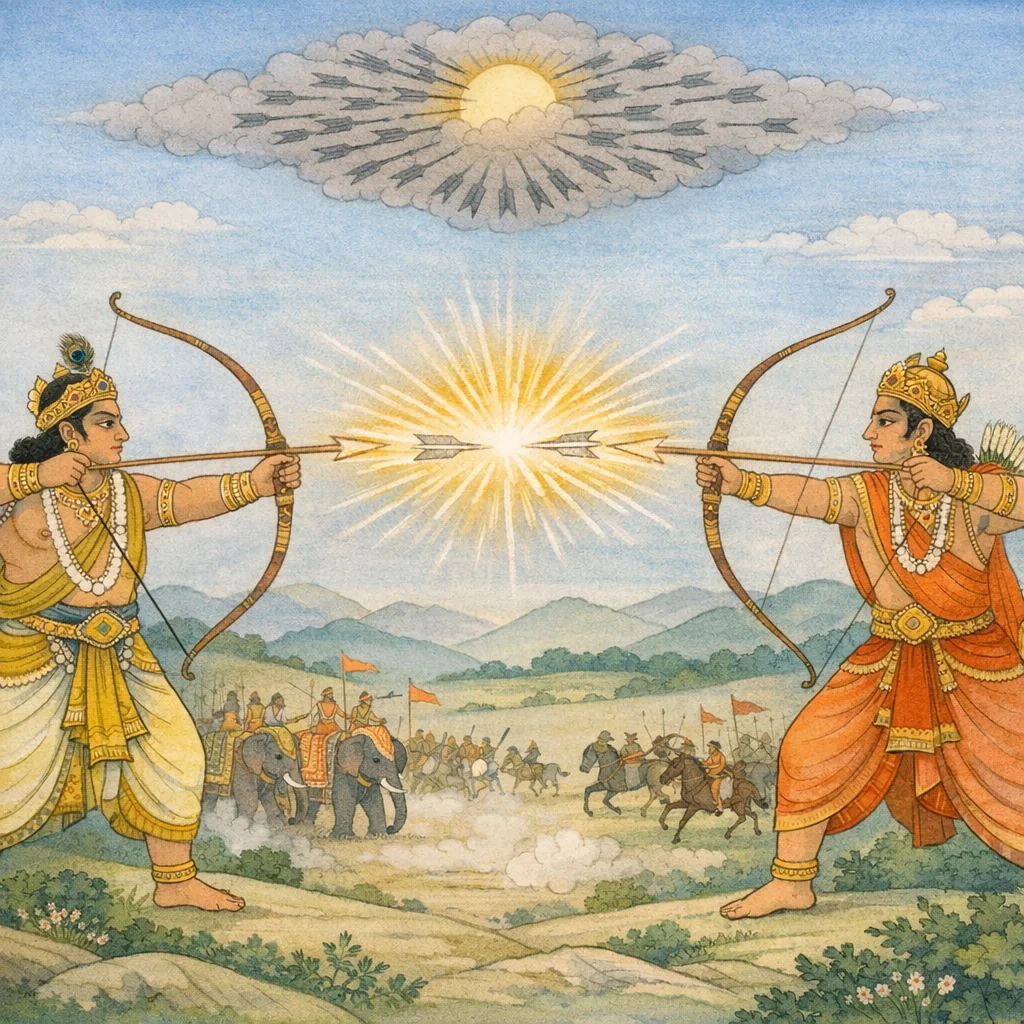
Chapter Arc: सूत संजय धृतराष्ट्र को बताता है कि दुर्योधन बार-बार यही भरोसा दिलाता था—“कर्ण अकेला ही पाण्डवों को सृञ्जयों सहित मार डालेगा”; उसी गर्व और आशा के बीच रणभूमि का दृश्य खुलता है। → परन्तु युद्धस्थल में भीमसेन के हाथों कर्ण को क्षणिक पराजय/पीड़ा का संकेत दिखते ही धृतराष्ट्र-पुत्रों की आशा डगमगाती है; भीम का प्रचण्ड वेग गजसेना, रथसेना और अश्वारोहियों को रौंदता चलता है, और दोनों पक्षों के योद्धा अपनी-अपनी कुल-कीर्ति, कर्म और स्वभाव की विशेषताएँ रण में उद्घोषित करते हुए उन्मत्त हो उठते हैं। → मध्याह्न के तपते समय में भीम और कर्ण का घोर द्वन्द्व भड़क उठता है—दोनों दीप्त बाणों की वर्षा करते हैं; शरसमूहों से सूर्य की किरणें तक फीकी पड़ती प्रतीत होती हैं, और रणभूमि वैसा अद्भुत-भयानक रूप धरती है जैसा न पहले देखा गया, न सुना गया। → दिन के इस खण्ड में भीम का संहार-प्रवाह थमता नहीं—धृतराष्ट्र के छह पुत्र मारे जाते हैं; कर्ण भीम का सामना करने को डटा रहता है, पर दुर्योधन की ‘एकमात्र आशा’ का तेज़ क्षण भर को भीम के प्रहारों से आच्छादित दिखता है, जिससे कौरव-पक्ष की मनःस्थिति टूटती है। → कर्ण का रथ रण में लक्ष्य की खोज में दौड़ता है और वह सारथिरहित रथ को देखकर बाण बरसाता हुआ पीछा करता है—अगला क्षण किस महावीर को संकट में डालेगा, यह अनिश्चित रह जाता है।
Shlokas
Verse 1
अप्-४-कात एकपज्चाशत्तमो< ध्याय: भीमसेनके द्वारा धृतराष्ट्रके छ: पुत्रोंका वध, भीम और कर्णका युद्ध, भीमके द्वारा गजसेना, रथसेना और घुड़सवारोंका संहार तथा उभयपक्षकी सेनाओंका घोर युद्ध धृतराष्ट्र रवाच सुदुष्करमिदं कर्म कृतं भीमेन संजय । येन कर्णो महाबाहू रथोपस्थे निपातितः,धृतराष्ट्र बोले--संजय! भीमसेनने तो यह अत्यन्त दुष्कर कर्म कर डाला कि महाबाहु कर्णको रथकी बैठकमें गिरा दिया
Dhṛtarāṣṭra said: “O Sañjaya, Bhīma has accomplished a deed exceedingly hard to achieve—he has struck down the mighty-armed Karṇa, making him fall upon the seat of his chariot.”
Verse 2
कर्णो होको रणे हन्ता पाण्डवान् सृञ्जयै: सह । इति दुर्योधन: सूत प्राब्रवीन्मां मुहुर्मुहु:,सूत! दुर्योधन मुझसे बारंबार कहा करता था कि “कर्ण अकेला ही रणभूमिमें सृजयोंसहित समस्त पाण्डवोंका वध कर सकता है”
Bhīma said: “O Sūta, Duryodhana used to tell me again and again: ‘Karna alone is capable, in battle, of slaying the Pāṇḍavas together with the Sṛñjayas.’”
Verse 3
पराजित तु राधेयं दृष्टवा भीमेन संयुगे | ततः परं किमकरोतू पुत्रो दुर्योधनो मम,परंतु उस दिन युद्धस्थलमें राधापुत्र कर्णको भीमसेनके द्वारा पराजित हुआ देखकर मेरे पुत्र दुर्योधनने क्या किया?
Bhīma said: “When Duryodhana—my son—saw Radheya (Karna) defeated by Bhīma in the thick of battle, what did he do next? What course did he choose thereafter?”
Verse 4
संजय उवाच विमुखं प्रेक्ष्य राधेयं सूतपुत्रं महाहवे । पुत्रस्तव महाराज सोदर्यान्ू समभाषत,संजयने कहा--महाराज! सूतपुत्र राधाकुमार कर्णको महासमरमें पराडमुख हुआ देख आपका पुत्र अपने भाइयोंसे बोला--
Sañjaya said: O great king, seeing Rādheya—Karna, the charioteer’s son—turn away in the great battle, your son addressed his own brothers. The moment marks a crisis of morale and command: when a foremost warrior seems to withdraw, the burden of sustaining resolve and the righteous purpose of dharma shifts to those who lead and those who stand beside them.
Verse 5
शीघ्र गच्छत भद्ठरं वो राधेयं परिरक्षत । भीमसेनभयागाधे मज्जन्तं व्यसनार्णवे,“तुम्हारा कल्याण हो। तुमलोग शीघ्र जाओ और राधापुत्र कर्णकी रक्षा करो। वह भीमसेनके भयसे भरे हुए संकटके अगाध महासागरमें डूब रहा है”
Sañjaya said: “May welfare attend you. Go quickly and protect Rādheya (Karna). He is sinking in the boundless ocean of calamity, made deep by fear of Bhīmasena.”
Verse 6
ते तु राज्ञा समादिष्टा भीमसेनं जिघांसव: । अभ्यवर्तन्त संक्रुद्धा: पतज्रा: पावकं यथा
Sañjaya said: But those warriors, commanded by the king and intent on killing Bhīmasena, surged forward in fury—like moths rushing into a blazing fire. The verse underscores how blind obedience and wrath can drive men toward self-destructive violence on the battlefield.
Verse 7
राजा दुर्योधनकी आज्ञा पाकर आपके पुत्र अत्यन्त कुपित हो भीमसेनको मार डालनेकी इच्छासे उनके सामने गये, मानो पतंग आगके समीप जा पहुँचे हों ।। श्रुतर्वा दुर्धर: क्राथो विवित्सुर्विकट: सम: । निषज्ी कवची पाशी तथा ननन््दोपनन्दकौ,श्रुतर्वा, दुर्धर, क्राथ (क्रथन), विवित्सु, विकट (विकटानन), सम, निषंगी, कवची, पाशी, नन्द, उपनन्द, दुष्प्रधर्ष, सुबाहु, वातवेग, सुवर्चा, धनुग्राह, दुर्मद, जलसन्ध, शल और सह--ये महाबली और पराक्रमी आपके पुत्रगण, बहुसंख्यक रथोंसे घिरकर भीमसेनके पास जा पहुँचे और उन्हें सब ओरसे घेरकर खड़े हो गये
Sañjaya said: Having received King Duryodhana’s command, your sons—burning with anger—advanced toward Bhīmasena with the intent to kill him, like moths rushing toward a flame. Śrutarvā, Durdhara, Krātha, Vivitsu, Vikaṭa, Sama, Niṣaṅgī, Kavacī, Pāśī, and the two Nanda and Upananda—along with Duṣpradharṣa, Subāhu, Vātavega, Suvarcā, Dhanugrāha, Durmada, Jalasandha, Śala, and Saha—these mighty and valiant sons of yours, surrounded by many chariots, reached Bhīmasena, encircled him on all sides, and stood poised around him.
Verse 8
दुष्प्रधर्ष: सुबाहुश्न वातवेगसुवर्चसौ । धनुग्रहो दुर्मदक्ष जलसंध: शल: सह:,श्रुतर्वा, दुर्धर, क्राथ (क्रथन), विवित्सु, विकट (विकटानन), सम, निषंगी, कवची, पाशी, नन्द, उपनन्द, दुष्प्रधर्ष, सुबाहु, वातवेग, सुवर्चा, धनुग्राह, दुर्मद, जलसन्ध, शल और सह--ये महाबली और पराक्रमी आपके पुत्रगण, बहुसंख्यक रथोंसे घिरकर भीमसेनके पास जा पहुँचे और उन्हें सब ओरसे घेरकर खड़े हो गये
Sañjaya said: Duṣpradharṣa, Subāhu, Vātavega, Suvarchas, Dhanugrāha, Durmada, Jalasandha, Śala, Saha, Śrutārvā, Durdhara, Krātha (Krathana), Vivitsu, Vikaṭa (Vikaṭānana), Sama, Niṣaṅgī, Kavacī, Pāśī, Nanda, and Upananda—these mighty and valiant sons of yours, though surrounded by a great multitude of chariots, advanced to Bhīmasena. Closing in from every side, they stood encircling him, intent on overpowering a single formidable foe through coordinated force in the press of war.
Verse 9
एते रथै: परिवृता वीर्यवन्तो महाबला: । भीमसेनं समासाद्य समन्तात् पर्यवारयन्,श्रुतर्वा, दुर्धर, क्राथ (क्रथन), विवित्सु, विकट (विकटानन), सम, निषंगी, कवची, पाशी, नन्द, उपनन्द, दुष्प्रधर्ष, सुबाहु, वातवेग, सुवर्चा, धनुग्राह, दुर्मद, जलसन्ध, शल और सह--ये महाबली और पराक्रमी आपके पुत्रगण, बहुसंख्यक रथोंसे घिरकर भीमसेनके पास जा पहुँचे और उन्हें सब ओरसे घेरकर खड़े हो गये
Sañjaya said: Ringed about by their chariots, those mighty warriors—brimming with vigor and great strength—closed in upon Bhīmasena and hemmed him in from every side. Śrutarvā, Durdhara, Krātha (Krathana), Vivitsu, Vikaṭa (Vikaṭānana), Sama, Niṣaṅgī, Kavacī, Pāśī, Nanda, Upananda, Duṣpradharṣa, Subāhu, Vātavega, Suvarcā, Dhanugrāha, Durmada, Jalasandha, Śala, and Saha—these powerful and valiant sons of yours, O king, advanced with a great host of chariots to Bhīma and stood encircling him on all sides.
Verse 10
ते व्यमुड्चञ्छरव्रातान् नानालिड्रान् समन्तत: । स तैरभ्यर्ध्यमानस्तु भीमसेनो महाबल:
Sañjaya said: From every side they loosed volleys of arrows of many kinds. Hard pressed by those shafts, the mighty Bhīmasena endured the assault, standing firm amid the encircling attack.
Verse 11
तेषामापततां क्षिप्रं सुतानां ते जनाधिप । रथै: पञ्चाशता सार्थ पज्चाशदहनद् रथान्
Sañjaya said: O king, as those sons charged swiftly, he (Bhīma), together with his company, with fifty chariots struck down fifty chariots.
Verse 12
वे चारों ओरसे नाना प्रकारके चिह्लोंसे युक्त बाण-समूहोंकी वर्षा करने लगे। नरेश्वर! उनसे पीड़ित होकर महाबली भीमसेनने पचास रथोंके साथ आये हुए आपके पुत्रोंके उन पचासों रथियोंको शीघ्र ही नष्ट कर दिया ।। विवित्सोस्तु ततः क्रुद्धो भल्लेनापाहरच्छिर: । भीमसेनो महाराज तत् पपात हतं भुवि
Sañjaya said: Then they began to shower, from every side, clusters of arrows marked in many ways. O king, though pained by them, the mighty Bhīmasena swiftly destroyed those fifty chariot-warriors—fifty chariots—who had come with your sons. Then Vivitsu (Yudhiṣṭhira), enraged, with a sharp bhalla-arrow cut off the head. O king, that head fell to the ground, and Bhīmasena lay slain.
Verse 13
सकुण्डलशिरस्त्राणं पूर्णचन्द्रोपमं तथा । ता ६#क्ा का एच महाराज! तत्पश्चात् कुपित हुए भीमसेनने एक भल्लसे विवित्सुका सिर काट लिया। उसका वह कुण्डल और शिरस्त्राणसहित कटा हुआ मस्तक पूर्ण चन्द्रमाके समान पृथ्वीपर गिर पड़ा || १२६ त॑ दृष्टवा निहतं शूरं भ्रातर: सर्वतः प्रभो
Sañjaya said: “O lord, the hero’s severed head—still adorned with earrings and helmet—fell to the earth, shining like the full moon. Seeing that valiant warrior slain, his brothers gathered around on all sides.”
Verse 14
ततो<पराभ्यां भल्लाभ्यां पुत्रयोस््ते महाहवे
Then, in that great battle, with two sharp bhalla-arrows, he struck your two sons—an act that deepened the tragedy as a father’s love and a king’s duty unraveled beneath the ruthless law of war.
Verse 15
तौ धरामन्वपसद्येतां वातरुग्णाविव द्रुमौ
Sañjaya said: The two of them sank down upon the earth, like two trees shattered by a violent wind—warriors brought low by the irresistible force of battle and fate, where pride and strength collapse in a moment.
Verse 16
ततस्तु त्वरितो भीम: क्राथथं निन््ये यमक्षयम्
Sañjaya said: Then Bhīma, moving with swift resolve, drove Krāthatha down to Yama’s realm—sending him to death in the midst of battle, a stark reminder of how quickly fate turns on the battlefield.
Verse 17
हाहाकारस्ततस्तीव्र: सम्बभूव जनेश्वर
Sañjaya said: Then a fierce cry of lamentation arose—an overwhelming uproar among the people, O lord of men—signaling the battlefield’s sudden surge of fear, grief, and moral shock at what had just occurred.
Verse 18
तेषां सुलुलिते सैन्ये पुनर्भीमो महाबल:
Sañjaya said: When their army had been thrown into confusion and scattered, Bhīma—mighty in strength—once again surged forward, renewing the assault, and in the chaos of war relentless valor reasserted itself, deepening the struggle and its consequences for both sides.
Verse 19
ततस्ते प्राद्रवन् भीता: पुत्रास्ते विहद्दलीकृता:
Sañjaya said: Then, terrified, your sons fled in haste, their battle-formation shattered and broken apart.
Verse 20
पुत्रांस्ते निहतान् दृष्टवा सूतपुत्र: सुदुर्मना:
Sañjaya said: Seeing your sons slain, the charioteer’s son (Karna) became deeply despondent.
Verse 21
हंसवर्णान् हयान् भूय: प्रैषयद् यत्र पाण्डव: । आपके पुत्रोंको मारा गया देख सूतपुत्र कर्णके मनमें बड़ा दुःख हुआ। उसने हंसके समान अपने श्वेत घोड़ोंको पुनः वहीं हँकवाया, जहाँ पाण्डुपुत्र भीमसेन मौजूद थे || २०६ || ते प्रेषिता महाराज मद्रराजेन वाजिन:
Sañjaya said: Seeing your sons slain, Karṇa—the son of a charioteer—was seized by deep grief. He again drove forward his swan-white horses to the very place where the Pāṇḍava Bhīmasena stood. Those steeds, O King, had been urged on by the king of Madra.
Verse 22
स संनिपातस्तुमुलो घोररूपो विशाम्पते
Sañjaya said: “O lord of the people, that massed encounter became a tumultuous and terrifying spectacle.”
Verse 23
दृष्टवा मम महाराज तौ समेतौ महारथौ
Sañjaya said: “O great king, having seen those two great chariot-warriors come together (to engage one another)…”
Verse 24
ततो भीमो रणश्लाघी छादयामास पत्रिभि:
Sanjaya said: Then Bhima, famed for his prowess in battle, covered his foe with a shower of arrows—an image of relentless martial force, where valor is measured by steadfastness and skill amid the demands of righteous war.
Verse 25
ततः कर्णो भृशं क्रुद्धो भीम॑ं नवभिरायसै:
Sañjaya said: Then Karṇa, inflamed with fierce anger, struck Bhīma with nine iron-shafted missiles—an act that intensifies the brutal momentum of battle, where wrath drives warriors to ever harsher measures and tests the boundaries of restraint amid righteous war.
Verse 26
४७०४> «०५७ ७७ पल । नह | न हैँ ण ५ ८ ! ' | ि । आहत: स महाबाहुर्भीमो भीमपराक्रम:
Sañjaya said: That mighty-armed Bhīma—renowned for his fearsome valor—was struck in battle.
Verse 27
ततः कर्णो महाराज आशीविष इव श्वसन्
Then Karṇa, O great king, breathed like a venomous serpent—his harsh, heated breath signaling a surge of wrath and lethal resolve as the battle’s moral and emotional tensions tightened.
Verse 28
भीमो<पि तं शरव्रातैश्छादयित्वा महारथम्
Sañjaya said: Bhīma too, having covered that great chariot-warrior with volleys of arrows, pressed the attack—an image of relentless martial resolve amid the harsh ethics of battlefield duty.
Verse 29
ततः: कर्णो भृशं क्रुद्धों दृढमादाय कार्मुकम्
Sañjaya said: Then Karṇa, inflamed with fierce anger, firmly seized his bow—ready to answer the challenge on the battlefield, where wrath and resolve drive warriors toward decisive, often morally fraught action.
Verse 30
भीम॑ विव्याध दशभि: कड्कपनत्रै: शिलाशितै: । कार्मुकं चास्य चिच्छेद भल्लेन निशितेन च
Sañjaya said: He pierced Bhīma with ten arrows, their feathers like those of a heron and their points honed on stone; and with a keen, razor-edged broad-headed shaft he also cut down Bhīma’s bow. The report underscores the ruthless precision of battlefield skill—where valor is tested not by words but by the capacity to disable an opponent’s power without hesitation.
Verse 31
तब कर्णने अत्यन्त कुपित हो सुदृढ़ धनुष हाथमें लेकर सानपर चढ़ाकर तेज किये हुए कंकपत्रयुक्त दस बाणोंद्वारा भीमसेनको घायल कर दिया। साथ ही एक तीखे भल्लसे उनके धनुषको भी काट डाला ।। ततो भीमो महाबाहुहेमपट्टवि भूषितम् । परिघं घोरमादाय मृत्युदण्डमिवापरम्
Sanjaya said: Then Karna, inflamed with fierce anger, seized his stout bow, set it upon the whetstone and honed it, and with ten sharpened arrows fitted with heron-feathers he wounded Bhimasena. At the same time, with a single keen bhalla-arrow he cut down Bhima’s bow as well. Thereupon the mighty-armed Bhima, adorned with a golden belt, took up a dreadful iron club—like another rod of Death itself—ready to answer violence with overwhelming force in the ruthless ethics of battlefield retaliation.
Verse 32
कर्णस्य निधनाकाडुक्षी चिक्षेपातिबलो नदन् । तब अत्यन्त बलवान् महाबाहु भीमसेनने कर्णके वधकी इच्छासे द्वितीय मृत्युदण्डके समान एक भयंकर स्वर्णपत्रजटित परिघ हाथमें ले उसे गरजकर कर्णपर दे मारा ।। तमापततन्तं परिघं वज़्ाशनिसमस्वनम्
Sanjaya said: Longing for Karna’s death, the exceedingly strong Bhima roared and hurled his weapon. Then the mighty, long-armed Bhimasena—intent on slaying Karna—took in his hand a terrifying iron club inlaid with golden plates, like a second staff of death, and with a thunderous shout struck at Karna. That club, as it came crashing down, resounded like a thunderbolt and lightning—an image of war’s relentless, death-dealing force driven by personal resolve.
Verse 33
चिच्छेद बहुधा कर्ण: शरैराशीविषोपमै: । वज्र और बिजलीके समान गड़गड़ाहट पैदा करनेवाले उस परिघको अपने ऊपर आते देख कर्णने विषधर सर्पके समान भयंकर बाणोंद्वारा उसके बहुत-से टुकड़े कर डाले ।। ३२ हे ततः कार्मुकमादाय भीमो दृढतरं तदा
Sañjaya said: Karṇa, with arrows like venomous serpents, cut that iron club into many pieces. Seeing the mace—thundering like a thunderbolt and lightning—hurtling down upon him, Karṇa shattered it with dreadful, serpent-like shafts. Then Bhīma, taking up his bow, made himself even more resolute for the fight. The passage highlights how, in the fury of war, prowess and presence of mind decide survival, even as the combatants remain bound to their chosen loyalties and vows.
Verse 34
ततो युद्धम भूद् घोरं कर्णपाण्डवयोरमथे
Sañjaya said: Then a dreadful battle arose between Karṇa and the Pāṇḍava—a clash that could not be restrained—an escalation of the Kurukṣetra war where personal rivalry and duty harden into uncompromising violence.
Verse 35
ततः कर्णो महाराज भीमसेने त्रिभि: शरै:
Sañjaya said: Then Karṇa, O great king, struck Bhīmasena with three arrows—an act that continues the relentless exchange of force in the battle, where valor and resolve are tested amid the moral weight of fratricidal war.
Verse 36
सो5तिविद्धो महेष्वास: कर्णेन बलिनां वर:
Sañjaya said: That great archer—foremost among the mighty—was grievously pierced by Karṇa, marking a decisive moment in the battle where prowess and fate press hard upon the warrior’s duty.
Verse 37
तस्य भित्त्वा तनुत्राणं भित्त्वा कायं च सायक:
Sañjaya said: The arrow, having pierced through his armor and then tearing into his very body, struck with lethal force—an image of the battle’s relentless violence, where protection and flesh alike are shattered in the pursuit of victory.
Verse 38
स तेनातिप्रहारेण व्यथितो विह्वलजन्निव
Sañjaya said: Struck by that exceedingly powerful blow, he was shaken with pain and, as if his senses were overwhelmed, became unsteady and confused on the battlefield.
Verse 39
ततः: कर्णो महाराज रोषामर्षसमन्वित:,महाराज! तब रोष और अमर्षमें भरे हुए कर्णने पाण्डुपुत्र भीमसेनपर पचीस नाराचोंका प्रहार किया। साथ ही अन्य बहुत-से बाणोंद्वारा उन्हें घायल कर दिया और एक बाणसे उनकी ध्वजा काट डाली
Sañjaya said: Then Karṇa, O King, filled with wrath and wounded pride, struck Bhīmasena—the son of Pāṇḍu—with twenty-five nārāca arrows. With many other shafts he further wounded him, and with a single arrow he cut down Bhīma’s banner.
Verse 40
पाण्डवं पड्चविंशत्या नाराचानां समार्पयत् । आजजलने बहुभिर्बाणैर्ध्वजमेकेषुणाहनत्,महाराज! तब रोष और अमर्षमें भरे हुए कर्णने पाण्डुपुत्र भीमसेनपर पचीस नाराचोंका प्रहार किया। साथ ही अन्य बहुत-से बाणोंद्वारा उन्हें घायल कर दिया और एक बाणसे उनकी ध्वजा काट डाली
Karṇa struck the Pāṇḍava with twenty-five nārāca arrows; with many other shafts he wounded him further, and with a single arrow he cut down his banner.
Verse 41
सारथिं चास्य भल्लेन प्रेषयामास मृत्यवे । छित्त्वा च कार्मुकं तूर्ण पाण्डवस्याशु पत्रिणा,राजेन्द्र! फिर एक भल्लसे उनके सारथिको यमलोक भेज दिया और तुरंत ही एक बाणसे उनके धनुषको भी काटकर बिना विशेष कष्टके ही मुहूर्तभरमें हँसते हुए-से कर्णने भयंकर पराक्रमी भीमसेनको रथहीन कर दिया
Sañjaya said: With a sharp bhalla-arrow he dispatched that warrior’s charioteer to Death. Then, swiftly severing the Pāṇḍava’s bow with a feathered shaft, O king, Karṇa—almost as if smiling, without exertion and within a brief moment—made the formidable Bhīmasena bereft of his chariot.
Verse 42
ततो मुहूर्ताद् राजेन्द्र नातिकृच्छाद्धसन्निव । विरथं भीमकर्माणं भीम॑ कर्णशक्षकार ह,राजेन्द्र! फिर एक भल्लसे उनके सारथिको यमलोक भेज दिया और तुरंत ही एक बाणसे उनके धनुषको भी काटकर बिना विशेष कष्टके ही मुहूर्तभरमें हँसते हुए-से कर्णने भयंकर पराक्रमी भीमसेनको रथहीन कर दिया
Sañjaya said: Then, O king, within a short while—and with no great exertion, as though smiling—Karna rendered the mighty Bhīma, famed for terrible deeds, without a chariot.
Verse 43
विरथो भरतश्रेष्ठ प्रहसन्ननिलोपम: । गदां गृह महाबाहुरपतत् स्यन्दनोत्तमात्,भरतश्रेष्ठ) रथहीन होनेपर वायुके समान बलशाली महाबाहु भीमसेन गदा हाथमें लेकर हँसते हुए उस उत्तम रथसे कूद पड़े
Sañjaya said: O best of the Bharatas, when he was left without his chariot, the mighty-armed Bhīmasena—laughing, swift and forceful like the wind—grasped his mace and leapt down from that excellent chariot.
Verse 44
अवलप्लुत्य च वेगेन तव सैन्यं विशाम्पते । व्यधमद् गदया भीम: शरन्मेघानिवानिल:ः,प्रजानाथ! जैसे वायु शरत्कालके बादलोंको शीघ्र ही उड़ा देती है, उसी प्रकार भीमसेनने बड़े वेगसे कूदकर अपनी गदाकी चोटसे आपकी सेनाका विध्वंस आरम्भ किया
Sañjaya said: “O lord of the people, Bhīma, leaping forward with great speed into your host, began to shatter your army with blows of his mace—just as the wind swiftly drives away the clouds of the autumn sky.”
Verse 45
नागान् सप्तशतान् राजन्नीषादन्तान् प्रहारिण: । व्यधमत् सहसा भीम: क्रुद्धरूप: परंतप:,शत्रुओंको संताप देनेवाले भीमसेनने क़ुद्ध होकर प्रहार करनेमें कुशल और ईषादण्डके समान दाँतोंवाले सात सौ हाथियोंका सहसा संहार कर डाला
Sañjaya said: “O King, Bhīma—terrible in his wrath and a scorcher of foes—suddenly struck down seven hundred elephants, skilled in assault and bearing tusks like the pole of a chariot.”
Verse 46
दन्तवेष्टेषु नेत्रेषु कुम्भेषु च कटेषु च । मर्मस्वपि च मर्मज्ञस्तान्ू नागानवधीद् बली,मर्मस्थलोंको जाननेवाले बलवान् भीमसेनने उन गजराजोंके मर्मस्थानों, ओठों, नेत्रों, कुम्भस्थलों और कपोलोंपर भी गदासे चोट पहुँचायी
Sañjaya said: “The mighty Bhīmasena, skilled in discerning vital points, struck down those lordly elephants by landing blows with his mace upon their vulnerable spots—at the lips and eyes, upon the temples (kumbha-sthāna), and on the cheeks.”
Verse 47
ततस्ते प्राद्रवन् भीता: प्रतीपं प्रहिता: पुन: । महामात्रैस्तमावत्रुमेंघा इव दिवाकरम्,फिर तो वे हाथी भयभीत होकर भागने लगे। तत्पश्चात् महावतोंने जब उन्हें पीछे लौटाया, तब वे भीमसेनको घेरकर खड़े हो गये, मानो बादलोंने सूर्यदेवको ढक लिया हो
Sañjaya said: “Then those elephants, seized by fear, began to flee. But when the mahouts again drove them back against the foe, they closed in around Bhīmasena, enveloping him—like clouds covering the sun.”
Verse 48
तान् स सप्तशतान् नागान् सारोहायुधकेतनान् | भूमिष्ठो गदया जघ्ने वज्नेणेन्द्र इवाचलान्,जैसे इन्द्र अपने वज्जके द्वारा पर्वतोंपर आघात करते हैं, उसी प्रकार पृथ्वीपर खड़े हुए भीमसेनने सवारों, आयुधों और ध्वजाओंसहित उन सात सौ गजराजोंको गदासे ही मार डाला
Sañjaya said: “Standing firm upon the ground, Bhīmasena struck down those seven hundred lordly elephants—together with their riders, weapons, and banners—just as Indra, with his thunderbolt, smites the mountains.”
Verse 49
ततः सुबलपुत्रस्य नागानतिबलान् पुनः । पोथयामास कौन्तेयो द्विपज्चाशदरिंदम:,तत्पश्चात् शत्रुओंका दमन करनेवाले कुन्तीकुमार भीमने सुबलपुत्र शकुनिके अत्यन्त बलवान् बावन हाथियोंको मार गिराया
Sañjaya said: Then the son of Kuntī—Bhīma, the subduer of foes—again crushed and brought down fifty-two exceedingly powerful elephants belonging to Śakuni, the son of Subala. The scene reveals the brutal arithmetic of war: prowess is displayed through the destruction of formidable war-assets, even as the moral weight of such slaughter hangs over the battlefield.
Verse 50
तथा रथशतं साग्रं पत्ती क्ष शतशो5परान् । न्यहनत् पाण्डवो युद्धे तापयंस्तव वाहिनीम्
Sañjaya said: “In the same manner, the Pāṇḍava struck down in battle a full hundred chariots, and hundreds more of foot-soldiers and elephants, thereby scorching your army with relentless pressure.”
Verse 51
इसी प्रकार उस युद्धस्थलमें आपकी सेनाको संताप देते हुए पाण्डुकुमार भीमसेनने सौसे भी अधिक रथों और दूसरे सैकड़ों पैदल सैनिकोंका संहार कर डाला ।। प्रताप्यमानं सूर्येण भीमेन च महात्मना । तव सैन्यं संचुकोच चर्माग्नावाहितं यथा,ऊपरसे सूर्य तपा रहे थे और नीचे महामनस्वी भीमसेन संतप्त कर रहे थे। उस अवस्थामें आपकी सेना आगपर रखे हुए चमड़ेके समान सिकुड़कर छोटी हो गयी राजन्! तदनन्तर पाण्डव और कौरव महारथी तीखे बाणोंसे प्रहार करते हुए एक- दूसरेको क्षत-विक्षत करने लगे ।। इति श्रीमहाभारते कर्णपर्वणि संकुलयुद्धे एकपञ्चाशत्तमोडध्याय:
Sañjaya said: In that manner, on the battlefield, Bhīmasena—the son of Pāṇḍu—kept scorching your forces and cut down more than a hundred chariots, along with hundreds of foot-soldiers besides. With the sun blazing from above and the great-souled Bhīma burning them from below, your army, O King, shrank like leather held over fire. After this, the Pāṇḍava and Kuru great chariot-warriors, striking with razor-sharp arrows, began to wound and tear one another in close, relentless combat.
Verse 52
ते भीमभयसंत्रस्तास्तावका भरतर्षभ । विहाय समरे भीम॑ दुद्गुव॒ुर्वे दिशो दश,भरतश्रेष्ठ भीमके भयसे डरे हुए आपके समस्त सैनिक समरांगणमें उनका सामना करना छोड़कर दसों दिशाओंमें भागने लगे
Sañjaya said: O bull among the Bharatas, your warriors—shaken with fear of Bhīma—abandoned the attempt to face him on the battlefield and fled in all ten directions. The scene underscores how terror can dissolve discipline and resolve in war, turning an army’s duty into a rout when courage and cohesion fail.
Verse 53
रथा: पञ्चशताश्षान्ये ह्रादिनश्चर्मवर्मिण: । भीममभ्यद्रवन् घ्नन्त: शरपूगै: समन्तत:
Sañjaya said: Five hundred other chariots—resounding and protected by leather-armour—rushed straight at Bhīma, striking him from every side with dense volleys of arrows. The scene underscores the war’s ruthless logic: many unite to overwhelm a single formidable warrior, testing endurance and resolve amid relentless violence.
Verse 54
तदनन्तर चर्ममय आवरणोंसे युक्त पाँच सौ रथ घर्घराहटकी आवाज फैलाते हुए चारों ओरसे भीमसेनपर चढ़ आये और बाणसमूहोंद्वारा उन्हें घायल करने लगे ।। तान् स पञ्चशतान् वीरान् सपताकध्वजायुधान् । पोथयामास गदया भीमो विष्णुरिवासुरान्,जैसे भगवान् विष्णु असुरोंका संहार करते हैं, उसी प्रकार भीमसेनने पताका, ध्वज और आयुधोंसहित उन पाँच सौ रथी वीरोंको गदाके आघातसे चूर-चूर कर डाला
Sañjaya said: Thereafter, five hundred chariots, fitted with hide-and-armor coverings, surged in from every side with a rumbling clatter and began to wound Bhīmasena with volleys of arrows. Bhīma, however, smashed those five hundred heroic chariot-warriors—together with their banners, standards, and weapons—by the blows of his mace, just as Lord Viṣṇu destroys the Asuras.
Verse 55
ततः शकुनिनिर्दिष्टा: सादिन: शूरसम्मता: । त्रिसाहस्राभ्ययुर्भीमं शक््त्यृष्टिप्रासपाणय:,तदनन्तर शकुनिके आदेशसे शूरवीरोंद्वारा सम्मानित तीन हजार घुड़सवारोंने हाथोंमें शक्ति, ऋष्टि और प्रास लेकर भीमसेनपर धावा बोल दिया
Sañjaya said: Then, at Śakuni’s command, three thousand cavalrymen—acknowledged as valiant warriors—charged at Bhīma, weapons in hand: śaktis (javelins), ṛṣṭis (spears), and prāsas (lances).
Verse 56
प्रत्युदुगम्य जवेनाशु साश्वारोहांस्तदारिहा । विविधान् विचरन् मार्गान् गदया समपोथयत्
Sañjaya said: Rushing forward at once with great speed, that foe-slayer met the mounted warriors head-on. Roaming through various lanes of the battlefield, he smashed them down with his mace.
Verse 57
यह देख शत्रुओंका संहार करनेवाले भीमसेनने बड़े वेगसे आगे जाकर भाँति-भाँतिके पैंतरे बदलते हुए अपनी गदासे उन घोड़ों और घुड़सवारोंको मार गिराया ।। तेषामासीन्महाञ्छब्दस्ताडितानां च सर्वशः । अभ्मभिवर्विध्यमानानां नगानामिव भारत,भारत! जैसे वृक्षोंपर पत्थरोंसे चोट की जाय, उसी प्रकार गदासे ताडित होनेवाले उन अश्वारोहियोंके शरीरसे सब ओर महान् शब्द प्रकट होता था
Sañjaya said: Seeing this, Bhimasena—destroyer of enemies—surged forward with great speed. Shifting his stance in many ways, he struck down with his mace both the horses and the mounted warriors. From those men, beaten on every side, there arose a tremendous sound—like the crashing of stones hurled against trees, O Bharata.
Verse 58
एवं सुबलपुत्रस्य त्रिसाहस्रान् हयोत्तमान् | हत्वान्यं रथमास्थाय क्रुद्धो राधेयमभ्ययात्,इस प्रकार शकुनिके तीन हजार घुड़सवारोंको मारकर क्रोधमें भरे हुए भीमसेन दूसरे रथपर आरूढ़ हो राधापुत्र कर्णके सामने आ पहुँचे
Sañjaya said: Having slain three thousand of the finest horsemen belonging to Śakuni, Bhīmasena—still burning with wrath—mounted another chariot and charged straight toward Rādheya (Karna).
Verse 59
कर्णोडपि समरे राजनू् धर्मपुत्रमरिंदमम् | स शरैश्छादयामास सारथिं चाप्यपातयत्,राजन! कर्णने भी समरांगणमें शत्रुओंका दमन करनेवाले धर्मपुत्र युधिष्ठिरको बाणोंसे आच्छादित कर दिया और सारथिको भी मार गिराया
Sañjaya said: O King, Karṇa too, in the thick of battle, covered Dharmaputra Yudhiṣṭhira—the subduer of foes—with a shower of arrows, and he also struck down his charioteer. The scene shows how, in war, even the righteous are pressed by relentless force, and how disabling the chariot’s support becomes a decisive ethical and tactical turning point.
Verse 60
ततः स प्रद्रुतं संख्ये रथं दृष्टवा महारथः । अन्वधावत् किरन् बाणै: कड्कपत्रैरजिद्वागैः,फिर महारथी कर्ण युधिष्ठिरके सारथिरहित रथको रणभूमिमें इधर-उधर घूमते देख कंकपत्रयुक्त सीधे जानेवाले बाणोंकी वर्षा करता हुआ उनके पीछे-पीछे दौड़ने लगा
Sañjaya said: Then the great chariot-warrior, seeing that chariot rushing about on the battlefield, pursued it closely, showering it with arrows—straight-flying, keen, and feathered with heron-plumes. The pursuit shows war’s relentless pressure: a moment of vulnerability (a chariot without its driver) is instantly exploited, and success turns on swift perception and uncompromising aggression rather than mercy.
Verse 61
राजानमभिधावन्तं शरैरावृत्य रोदसी । क्रुद्ध: प्रच्छादयामास शरजालेन मारुति:,कर्णको राजा युधिष्ठिरपर धावा करते देख वायुपुत्र भीमसेन कुपित हो उठे। उन्होंने बाणोंसे कर्णजो ढककर पृथ्वी और आकाशको भी शरसमूहसे आच्छादित कर दिया
Sañjaya said: Seeing the king (Yudhiṣṭhira) rushing forward, Māruti’s son Bhīmasena, inflamed with wrath, covered him with arrows; and with a dense net of shafts he seemed to veil even earth and sky. The scene shows how, in battle’s fury, prowess can eclipse restraint, even when the aim is to protect one’s rightful king.
Verse 62
संनिवृत्तस्ततस्तूर्ण राधेय: शत्रुकर्शन: । भीम॑ प्रच्छादयामास समन्तान्निशितै: शरै:
Sañjaya said: Then Rādheya (Karna), the harrier of foes, swiftly wheeled back and, from every side, covered Bhīma with sharp arrows—showing the battle’s relentless momentum, where prowess and resolve are tested without respite.
Verse 63
तब शत्रुसूदन राधापुत्र कर्णने तुरंत ही लौटकर सब ओरसे पैने बाणोंकी वर्षा करके भीमसेनको ढक दिया ।। भीमसेनरथव्यग्रं कर्ण भारत सात्यकि: । अभ्यर्दयदमेयात्मा पार्ष्णिग्रहणकारणात्
Sañjaya said: Then Karna, the son of Radha and a scourge of foes, swiftly wheeled back and, showering sharp arrows from every side, covered Bhimasena from view. Seeing Bhima’s chariot thrown into turmoil by Karna, Satyaki—O descendant of Bharata—pressed Karna hard, to protect the rear-guard and prevent Bhima from being seized at a disadvantage. The passage highlights battlefield duty: not only personal valor, but timely safeguarding of allies when they are overwhelmed.
Verse 64
भारत! तत्पश्चात् अमेय आत्मबलसे सम्पन्न सात्यकिने भीमसेनके रथसे उलझे हुए कर्णको पीड़ा देना आरम्भ किया, क्योंकि वे भीमसेनके पृष्ठभागकी रक्षा कर रहे थे ।। अभ्यवर्तत कर्णस्तमर्दितो5पि शरैर्भुशम् । तावन्योन्यं समासाद्य वृषभौ सर्वधन्विनाम्
Sañjaya said: “O Bhārata, thereafter Sātyaki—endowed with immeasurable strength of spirit—began to press and torment Karṇa, who had become entangled with Bhīmasena’s chariot, for Sātyaki was guarding Bhīma’s rear. Though sorely struck by many arrows, Karṇa still advanced; and the two, meeting each other head-on, stood like the foremost bulls among all archers—each refusing to yield in the fierce contest of duty and enmity on the battlefield.”
Verse 65
विसृजन्तौ शरान् दीप्तान् व्यभ्राजेतां मनस्विनौ । कर्ण सात्यकिके बाणोंसे अत्यन्त पीड़ित होनेपर भी भीमसेनका सामना करनेके लिये डटा रहा। वे दोनों ही सम्पूर्ण धनुर्धरोंमें श्रेष्ठ एवं मनस्वी वीर थे और एक-दूसरेसे भिड़कर चमकीले बाणोंकी वर्षा करते हुए बड़ी शोभा पा रहे थे ।। ६४ $ ।। ताभ्यां वियति राजेन्द्र विततं भीमदर्शनम्
Sañjaya said: “As those two high-spirited warriors loosed blazing arrows, they shone brilliantly. O king, between them in the open sky there spread a fearsome spectacle—Bhīma and Karṇa (with Sātyaki’s shafts having grievously pained Karṇa, yet he stood firm to face Bhīmasena), both foremost among archers, clashing and raining bright missiles upon one another.”
Verse 66
नैव सूर्यप्रभा राजन् न दिश: प्रदिशस्तथा
Sañjaya said: “O King, neither did the radiance of the sun appear, nor did the directions and intermediate quarters present themselves as before.”
Verse 67
प्राज्ञासिष्म वयं ते वा शरैर्मुक्ते: सहस्रश: । राजन! वहाँ छूटे हुए सहस्रों बाणोंसे न तो सूर्यकी प्रभा दिखायी देती थी, न दिशाएँ और न विदिशाएँ ही दृष्टिगोचर होती थीं। हम या हमारे शत्रु भी पहचाने नहीं जाते थे ।। मध्याह्ले तपतो राजन् भास्करस्य महाप्रभा:
Sañjaya said: “O King, when thousands upon thousands of arrows were released, the field became so choked with shafts that the sun’s radiance could not be seen; neither the directions nor the intermediate quarters were discernible. In that blinding storm of missiles, neither we nor even our enemies could be recognized. Even at midday, O King, when the sun blazes with great brilliance…”
Verse 68
सौबलं कृतवर्माणं द्रौणिमाधिरथ्थिं कृपम्
Sañjaya said: “(He named) Saubala, Kṛtavarmā, Droṇa’s son (Aśvatthāmā), the son of Adhiratha (Karna), and Kṛpa—eminent warriors whose choices and loyalties shape the moral weight of the battle’s unfolding.”
Verse 69
तेषामापततां शब्दस्तीव्र आसीद् विशाम्पते
Sañjaya said: “O lord of the people, as they rushed in, the sound of their onslaught was fierce and overwhelming.”
Verse 70
ते सेने भृशसंसक्ते दृष्टवान्योन्यं महाहवे
Sañjaya said: In that great battle, when the two armies were fiercely locked together, they beheld one another face to face—each side fully engaged in the clash, with no room left for hesitation.
Verse 71
हर्षेण महता युक्ते परिगृह्म परस्परम् । उस महासमरमें एक-दूसरीसे उलझी हुई दोनों सेनाएँ परस्पर दृष्टिपात करके बड़े हर्ष और उत्साहके साथ युद्ध करने लगीं || ७० $ ।। ततः प्रववृते युद्ध मध्यं प्राप्ते दिवाकरे
Sañjaya said: Filled with great exhilaration, the two armies closed upon one another, grappling in close combat. Then, as the sun reached midday, the battle surged forward in full force—each side looking upon the other with heightened ardor and pressing on with renewed intensity.
Verse 72
बलौघस्तु समासाद्य बलौघं सहसा रणे
Sañjaya said: In the thick of battle, one massed host suddenly closed in upon another massed host—an abrupt collision of armies that signals how swiftly war turns into overwhelming, collective violence rather than a contest of individuals.
Verse 73
उपासर्पत वेगेन वार्योचध इव सागरम् | आसीच्निनाद: सुमहान् बाणौघानां परस्परम्
Sañjaya said: They surged forward with speed, like torrents of water rushing into the ocean. Then there arose a very great roar—the crashing, mutual impact of the dense flights of arrows—signaling the battle’s escalation into a relentless exchange where force answered force.
Verse 74
गर्जतां सागरौघाणां यथा स्यान्नि:स्वनो महान् | जैसे जलका प्रवाह वेगके साथ समुद्रमें जाकर मिलता है, उसी प्रकार रणभूमिमें एक सैन्यसमुदाय दूसरे सैन्यसमुदायसे सहसा जा मिला और परस्पर टकरानेवाले बाणसमूहोंका महान् शब्द उसी प्रकार प्रकट होने लगा, जैसे गरजते हुए सागरसमुदायोंका गम्भीर नाद प्रकट हो रहा हो || ७२-७३ ह ।। ते तु सेने समासाद्य वेगवत्यौं परस्परम्
Sañjaya said: As a mighty roar rises when surging masses of the ocean thunder together, so, when the two swift-moving armies suddenly met upon the battlefield, a great and deep din arose—born of their collision and the mutual impact of flights of arrows—like the grave sound of roaring seas.
Verse 75
एकी भावमनुप्राप्ते नद्याविव समागमे । जैसे दो नदियाँ परस्पर संगम होनेपर एक हो जाती हैं, उसी प्रकार वे वेगवती सेनाएँ परस्पर मिलकर एकीभावको प्राप्त हो गयीं ।। ७४ $ ।। ततः प्रववृते युद्ध घोररूपं विशाम्पते
Sañjaya said: When the two forces met, they merged into a single mass, like two rivers becoming one at their confluence. Then, O lord of men, a battle of dreadful aspect burst forth.
Verse 76
कुरूणां पाण्डवानां च लिप्सतां सुमहद् यश: । प्रजानाथ! फिर महान् यश पानेकी इच्छावाले कौरवों और पाण्डवोंमें घोर युद्ध आरम्भ हो गया || ७४ $ ।। शूराणां गर्जतां तत्र ह्विच्छेदकृता गिर:
Sañjaya said: “O lord of the people! Then a dreadful battle began between the Kauravas and the Pandavas—both striving to win exceedingly great fame. There, the roars and cries of the warriors, like words that cut into the heart, rang out on the battlefield.”
Verse 77
यस्य यद्धि रणे व्यडूं पितृतो मातृतोडपि वा
Sañjaya said: “In battle, whatever defect or weakness a man has—whether inherited from his father’s line or from his mother’s line—becomes evident.”
Verse 78
तान् दृष्टवा समरे शूरांस्तर्जमानान् परस्परम्
Sañjaya said: Seeing those heroic warriors on the battlefield, hurling taunts at one another, he observed how the clash was being driven not only by weapons but also by pride, rivalry, and the will to dominate—an escalation that darkens judgment and intensifies the ethical peril of war.
Verse 79
अभवन्मे मती राजन् नैषामस्तीति जीवितम् | राजन! समरांगणमें एक-दूसरेको डाँट बताते हुए उन शूरवीरोंको देखकर मेरे मनमें यह विचार उठता था कि अब इनका जीवन नहीं रहेगा || ७८ ई || तेषां दृष्टवा तु क्रुद्धानां वपूंष्यमिततेजसाम्
Sañjaya said: “O King, it occurred to me that these warriors would not survive. Seeing them on the battlefield, fiercely challenging and rebuking one another, my mind formed the thought: ‘Now their lives will not remain.’ And when I beheld the bodies of those enraged heroes, blazing with immeasurable splendor…”
Verse 80
ततस्ते पाण्डवा राजन् कौरवाश्न महारथा: । ततक्षु: सायकैस्ती&णैर्निघ्नन्तो हि परस्परम्
Sañjaya said: “Then, O King, those Pāṇḍavas and the Kauravas—both mighty chariot-warriors—fell upon one another, striking with sharp arrows, each side intent on cutting down the other in the press of battle.”
Verse 133
अभ्यद्रवन्त समरे भीम॑ भीमपराक्रमम् । प्रभो! उस शूरवीरकों मारा गया देख उसके भाई समरभूमिमें भयंकर पराक्रमी भीमसेनपर सब ओरसे टूट पड़े
Sañjaya said: “In the thick of battle they rushed upon Bhīma—Bhīma of dreadful prowess. O Lord, seeing that heroic warrior slain, his brothers, inflamed by grief and duty, surged from every side on the battlefield against Bhīmasena, whose might was terrifying.”
Verse 146
जहार समरे प्राणान् भीमो भीमपराक्रम: । तब भयानक पराक्रमसे सम्पन्न भीमसेनने उस महायुद्धमें दूसरे दो भल्लोंद्वारा रणभूमिमें आपके दो पुत्रोंके प्राण हर लिये
Sañjaya said: “In the thick of battle, Bhīma—renowned for terrifying valor—took the lives of your sons. With dreadful prowess, Bhīmasena, using two additional sharp arrows, struck them down on the battlefield.”
Verse 156
विकटश्न समश्नोभौ देवपुत्रोपमौ नृप । नरेश्वर! वे दोनों थे विकट (विकटानन) और सम। देवपुत्रोंके समान सुशोभित होनेवाले वे दोनों वीर आँधीके उखाड़े हुए दो वृक्षोंके समान पृथ्वीपर गिर पड़े
Sañjaya said: “O King, those two heroes—Vikaṭa and Sama—radiant like sons of the gods, fell upon the earth like two trees torn up by a violent storm.”
Verse 166
नाराचेन सुतीक्ष्णेन स हतो न्यपतद् भुवि । फिर लगे हाथ भीमसेनने क्राथ (क्रथन)-को भी एक तीखे नाराचसे मारकर यमलोक पहुँचा दिया। वह राजकुमार प्राणशून्य होकर पृथ्वीपर गिर पड़ा
Sañjaya said: Struck by a razor-sharp nārāca arrow, he was slain and fell upon the earth. Then, in the unrelenting surge of battle, Bhīmasena also dispatched Kratha with a keen nārāca, sending him to Yama’s realm; the prince, bereft of life, collapsed to the ground—showing how swiftly war turns valor and lineage into mortality.
Verse 173
वध्यमानेषु वीरेषु तव पुत्रेषु धन्विषु । जनेश्वरर फिर आपके वीर थधनुर्धर पुत्रोंके इस प्रकार वहाँ मारे जानेपर भयंकर हाहाकार मच गया
Sañjaya said: As your heroic, bow-wielding sons were being slain there, O lord of men, a dreadful cry of lamentation arose—an outburst of grief and panic at the ruin of the Kaurava warriors.
Verse 186
नन्दोपनन्दौ समरे प्रैषयद् यमसादनम् । उनकी सेना चंचल हो उठी। फिर महाबली भीमसेनने समरांगणमें नन्द और उपनन्दको भी यमलोक भेज दिया
Sañjaya said: In the thick of battle, Bhīmasena dispatched Nanda and Upananda to the abode of Yama (death). Seeing their fall, their troops wavered and became unsteady—an image of how, in war, the collapse of key warriors can swiftly shake the morale and cohesion of an entire force.
Verse 196
भीमसेनं रणे दृष्टया कालान्तकयमोपमम् | तदनन्तर आपके शेष पुत्र रणभूमिमें काल, अन्तक और यमके समान भयानक भीमसेनको देखकर भयसे व्याकुल हो वहाँसे भाग गये
Sañjaya said: Seeing Bhīmasena in battle—terrible like Kāla, Antaka, and Yama—your remaining sons, shaken by fear, beheld that dreadful Bhīma as death itself upon the battlefield and fled from there.
Verse 216
भीमसेनरथं प्राप्पय समसज्जन्त वेगिता: । महाराज! मद्रराजके हाँके हुए वे घोड़े बड़े वेगसे भीमसेनके रथके पास जाकर उनसे सट गये
Sañjaya said: O King, urged on by the ruler of Madra, the horses, driven at great speed, reached Bhīmasena’s chariot and pressed close against it.
Verse 223
आसीदू रौद्रो महाराज कर्णपाण्डवयोर्मधे । प्रजानाथ! महाराज! युद्धस्थलमें कर्ण और भीमसेनका वह संघर्ष घोर, रौद्र और अत्यन्त भयंकर था
Sañjaya said: O great king, O lord of the people—on the battlefield the clash between Karṇa and Bhīmasena was fierce and wrathful, exceedingly dreadful and terrifying. It showed how the war’s momentum had turned into a brutal test of endurance and resolve, where personal enmity and martial duty converged into a frightening spectacle.
Verse 233
आसीदू् बुद्धि: कथं युद्धमेतदद्य भविष्यति | राजेन्द्र! वे दोनों महारथी जब परस्पर भिड़ गये, उस समय वह देखकर मेरे मनमें यह विचार उठने लगा कि न जाने यह युद्ध कैसा होगा?
Sañjaya said: “A thought arose in my mind: ‘What will this battle be like today?’ O best of kings, when I saw those two great chariot-warriors clash with one another, I was seized by anxious reflection, uncertain of what form this war would take.”
Verse 246
कर्ण रणे महाराज पुत्राणां तव पश्यताम् । महाराज! तदनन्तर युद्धका हौसला रखनेवाले भीमसेनने अपने बाणोंसे आपके पुत्रोंके देखते-देखते कर्णको आच्छादित कर दिया
Sañjaya said: O King, while your sons looked on, Karṇa stood in the thick of battle. Then, O great king, Bhīmasena—undaunted and resolute in war—showered Karṇa with arrows, covering him before the very eyes of your sons. The scene shows how courage and relentless effort can overturn expectations, even under the gaze of powerful witnesses, and how war tests not only strength but steadfastness of will.
Verse 256
विव्याध परमास्त्रज्ञों भल््लै: संनतपर्वभि: | तब उत्तम अस्त्रोंके ज्ञाता कर्णने अत्यन्त कुपित हो लोहेके बने हुए और झुकी हुई गाँठवाले नौ भल्लोंसे भीमसेनको घायल कर दिया
Sañjaya said: Karṇa, the supreme master of weapons, struck with bhalla-arrows whose joints were bent. Then Karṇa, expert in the finest missiles, became exceedingly enraged and wounded Bhīmasena with nine iron-made, knot-jointed, curved bhallas. The verse shows how, in the fury of battle, even the most skilled warriors let anger sharpen their violence, deepening the ethical tragedy of kin-slaying in a dharma-conflicted war.
Verse 266
आकर्णपूर्णविशिखै: कर्ण विव्याध सप्तभि: । उन भल्लोंसे आहत हो भयंकर पराक्रमी महाबाहु भीमसेनने कर्णको भी कानतक खींचकर छोड़े गये सात बाणोंसे पीट दिया
Sañjaya said: Bhīmasena, the mighty-armed warrior of dreadful prowess, struck Karṇa with seven arrows drawn to the ear. Wounded by those sharp shafts, Karṇa was beaten back in the press of battle—an episode that shows how, in war, even the greatest heroes must endure the immediate fruits of opposing strength and resolve.
Verse 273
शरवर्षेण महता छादयामास पाण्डवम् । महाराज! तब विषधर सर्पके समान फुफकारते हुए कर्णने बाणोंकी भारी वर्षा करके पाण्डुपुत्र भीमसेनको आच्छादित कर दिया
Sañjaya said: O King, with a mighty shower of arrows Karṇa covered the Pāṇḍava. Hissing like a venomous serpent, he poured down a heavy rain of shafts and completely enveloped Bhīmasena, the son of Pāṇḍu—an image of relentless martial fury in the midst of war.
Verse 286
पश्यतां कौरवेयाणां विननर्द महाबल: । महाबली भीमसेनने भी कौरववीरोंके देखते-देखते महारथी कर्णको बाणसमूहोंसे आच्छादित करके विकट गर्जना की
Sañjaya said: While the Kauravas looked on, the mighty Bhīmasena—himself of tremendous strength—covered Karṇa with volleys of arrows and let out a fearsome roar. The scene underscores the relentless momentum of battle, where prowess and resolve are displayed openly before both armies, and where reputation and morale are tested as much as bodies.
Verse 336
छादयामास विशिखेी: कर्ण परबलार्दनम् | तत्पश्चात् भीमसेनने अत्यन्त सुदृढ़ धनुष हाथमें लेकर अपने बाणोंद्वारा शत्रुसैन्यसंतापी कर्णको आच्छादित कर दिया
Sanjaya said: With a shower of arrows he covered Karna, the crusher of hostile forces. Thereafter Bhimasena, taking up in his hand an exceedingly strong bow, enveloped Karna—who was tormenting the enemy’s army—with his own shafts, intensifying the fierce contest in which prowess and resolve are tested amid the moral weight of fratricidal war.
Verse 343
हरीन्द्रयोरिव मुहु: परस्परवधैषिणो: । फिर तो एक-दूसरेके वधकी इच्छावाले दो सिंहोंके समान कर्ण और भीमसेनमें वहाँ अत्यन्त भयंकर युद्ध होने लगा
Sañjaya said: Again and again, like two lordly lions each seeking the other’s death, Karṇa and Bhīmasena engaged there in a battle of the most dreadful intensity—driven not by restraint or reconciliation, but by the grim resolve to slay.
Verse 356
आकर्णमूलं विव्याध दृढमायम्य कार्मुकम् । महाराज! उस समय कर्णने अपने सुदृढ़ धनुषको कानके पासतक खींचकर तीन बाणोंसे भीमसेनको क्षत-विक्षत कर दिया
Sañjaya said: Drawing his sturdy bow to the very root of his ear in a full, disciplined pull, Karṇa struck—piercing with force—so that Bhīmasena was torn and wounded. The scene underscores the grim ethic of the battlefield: mastery of weapons and unwavering resolve are turned toward lethal ends, where valor and skill operate within the harsh duties of war.
Verse 363
घोरमादत्त विशिखं कर्णकायावदारणम् | कर्णके द्वारा अत्यन्त घायल होकर बलवानोंमें श्रेष्ठ महाधनुर्थर भीमसेनने एक भयंकर बाण हाथमें लिया, जो कर्णके शरीरको विदीर्ण करनेमें समर्थ था
Sañjaya said: Then Bhīmasena seized a dreadful arrow, capable of rending Karṇa’s body. Though himself grievously wounded, the mighty archer—foremost among the strong—resolved to answer violence with decisive force, pressing the battle toward its fated moral reckoning.
Verse 376
प्राविशद् धरणीं राजन् वल्मीकमिव पन्नग: । राजन! जैसे साँप बाँबीमें घुस जाता है, उसी प्रकार वह बाण कर्णके कवच और शरीरको छेदकर धरतीमें समा गया
Sañjaya said: “O King, the arrow, having pierced Karṇa’s armor and body, sank into the earth—just as a serpent slips into its anthill.” The image underscores the relentless, fated momentum of battle: even the famed protections of a great warrior can be penetrated when the tide of war turns, reminding the listener of the fragility of embodied power amid adharma-driven slaughter.
Verse 383
संचचाल रथे कर्ण: क्षितिकम्पे यथाचल: । उस प्रबल प्रहारसे व्यथित और विह्नलल-सा होकर कर्ण रथपर ही काँपने लगा। ठीक उसी तरह, जैसे भूकम्पके समय पर्वत हिलने लगता है
Sañjaya said: Struck by a mighty blow, Karṇa trembled upon his chariot, shaken and unsteady—like a mountain that quivers when the earth itself convulses. The image underscores how even the most formidable warrior can be momentarily overpowered by the force of battle, revealing the fragility that lies beneath martial pride.
Verse 653
क्रौज्चपृष्ठारुणं रौद्रं बाणजालं व्यदृश्यत । राजेन्द्र! उन दोनोंने आकाशमें बाणोंका भयंकर जाल-सा बिछा दिया, जो क्रौंच पक्षीके पृष्ठभागके समान लाल और भयानक दिखायी देता था
Sanjaya said: O king, there appeared a fierce net of arrows—reddish like the back of a krauñca bird. Those two warriors spread in the sky a dreadful mesh of shafts, so dense and ominous that it seemed to cover the very air, intensifying the terror and momentum of the battle.
Verse 673
ह्ृता: सर्वा: शरौघैस्तै: कर्णपाण्डवयोस्तदा । नरेश्वरर कर्ण और भीमसेनके बाणसमूहोंसे मध्याह्नकालमें तपते हुए सूर्यकी सारी प्रचण्ड किरणें भी फीकी पड़ गयी थीं
Sañjaya said: At that time, in the fierce exchange of arrow-showers between Karṇa and the Pāṇḍava (Bhīmasena), even the blazing rays of the midday sun seemed to lose their brilliance—overpowered by the storm of missiles. The narration underscores how human resolve and martial prowess, when driven by wrath and rivalry, can make the very world appear dim, as if nature itself recoils before the violence of war.
Verse 683
संसक्तान् पाण्डवैर्दष्टवा निवृत्ता: कुरव: पुनः । उस समय शकुनि, कृतवर्मा, अश्वत्थामा, कर्ण और कृपाचार्यको पाण्डवोंके साथ जूझते देख भागे हुए कौरव-सैनिक फिर लौट आये
Sañjaya said: Seeing their leaders locked in close combat with the Pāṇḍavas, the Kauravas who had turned back in flight returned once more. Then, when the Kaurava soldiers beheld Śakuni, Kṛtavarmā, Aśvatthāmā, Karṇa, and the preceptor Kṛpācārya grappling with the Pāṇḍavas, shame and allegiance overcame fear, and they rejoined the battle.
Verse 693
उद्वृत्तानां यथा वृष्टया सागराणां भयावह: । प्रजानाथ! उस समय उनके आनेसे बड़ा भारी कोलाहल होने लगा, मानो वर्षसे बढ़े हुए समुद्रोंकी भयानक गर्जना हो रही हो
Sañjaya said: “O lord of the people, when they arrived a tremendous uproar arose—terrifying like the roar of oceans swollen by the rains.”
Verse 766
श्रूयन्ते विविधा राजन् नामान्युद्धिश्य भारत । भरतवंशी नरेश! उस समय नाम ले-लेकर गरजते हुए शूरवीरोंकी भाँति-भाँतिकी बातें अविच्छिन्न-रूपसे सुनायी पड़ती थीं
Sañjaya said: “O King, O Bharata, many kinds of cries were heard—warriors calling out names as they roared. O ruler of the Bharata line, at that time the battlefield resounded continuously with varied shouts and exchanges, like the thunderous calls of heroes naming one another.”
Verse 773
कर्मत: शीलतो वापि स तच्छावयते युधि । रणभूमिमें जिसकी जो कुछ पिता-माता, कर्म अथवा शील-स्वभावके कारण विशेषता थी, वह युद्धस्थलमें उसको सुनाता था
Sañjaya said: In the midst of battle, he would proclaim it aloud—whether due to deeds or due to character and conduct—whatever distinctive excellence a man had inherited from his father and mother, he would make it known on the battlefield.
Verse 793
अभवन्मे भयं तीव्रं कथमेतद् भविष्यति । क्रोधमें भरे हुए उन अमिततेजस्वी वीरोंके शरीर देखकर मुझे बड़ा भारी भय होता था कि यह युद्ध कैसा होगा?
Sañjaya said: A fierce fear arose in me—how would this turn out? Seeing the bodies of those immeasurably radiant heroes, filled with wrath, I was seized by a heavy dread about what kind of battle this would become.
Verse 7163
तादृशं न कदाचिद्धि दृष्टपूर्व न च श्रुतम् तदनन्तर सूर्यके मध्याह्नकी वेलामें आ जानेपर अत्यन्त घोर युद्ध आरम्भ हुआ। वैसा न तो पहले कभी देखा गया था और न सुननेमें ही आया था
Sañjaya said: “Never before had anything like this been seen or even heard of. Then, as the sun reached the hour of midday, an exceedingly dreadful battle began.”
Frequently Asked Questions
The chapter addresses the dharma-sankat of anger toward a righteous elder: Arjuna’s harsh response to Yudhiṣṭhira raises the question of whether emotional injury and impulsive retaliation can ever be justified within familial and royal duty.
Kṛṣṇa’s counsel teaches that dharma is subtle and easily misunderstood under stress; therefore, corrective humility, reconciliation, and disciplined action are prerequisites for ethically defensible strategy.
No formal phalaśruti is stated; instead, the chapter provides functional meta-commentary by linking moral repair (forgiveness and authorization) with efficacy in action, implying that restored ethical order supports successful undertaking (kārya-siddhi) within the epic’s framework.