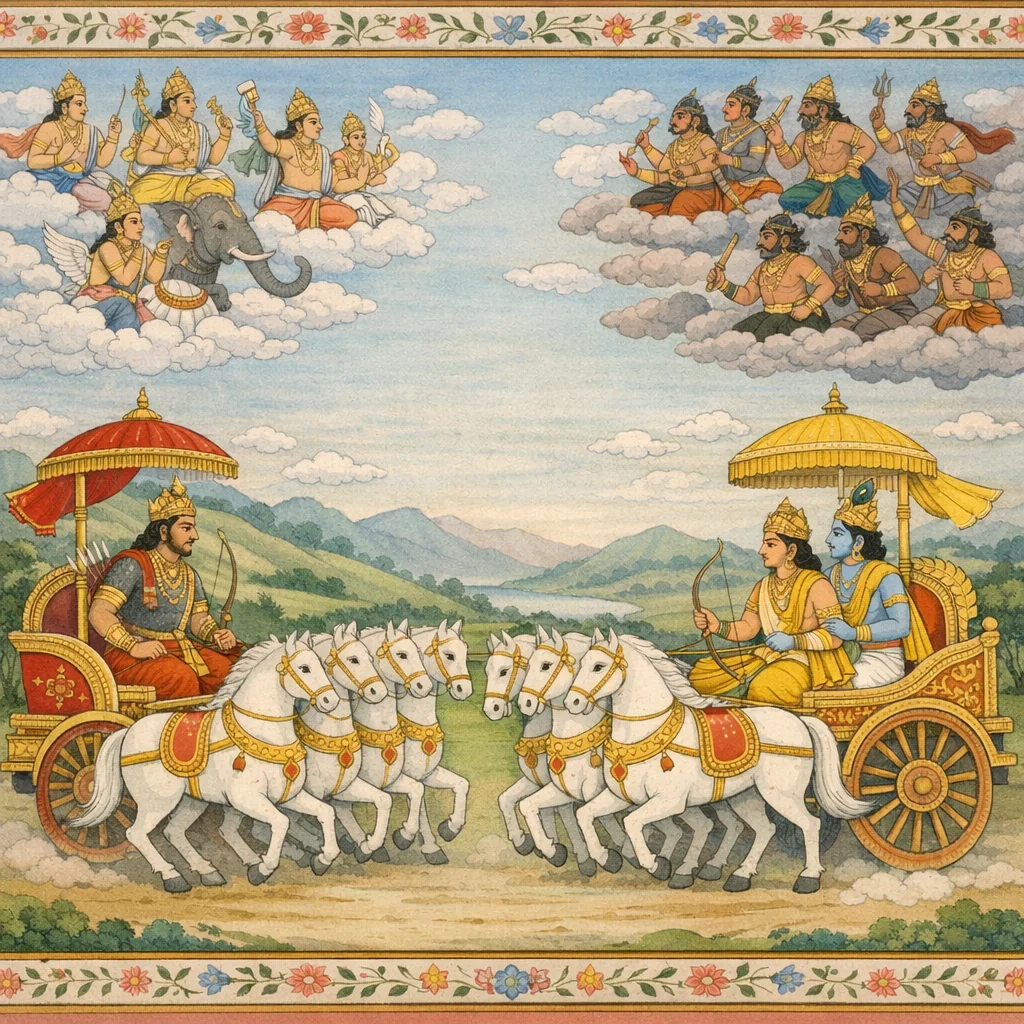
Adhyaya 87
Chapter Arc: संजय धृतराष्ट्र से कहते हैं—वृषसेन के वध का दृश्य देखते ही कर्ण शोक और अमर्ष से भर उठता है; पुत्र-वियोग के आँसू उसके नेत्रों से बहते हैं और वही शोक उसे और भी उग्र प्रतिज्ञा में ढाल देता है। → कर्ण अपने सूर्य-सदृश रथ पर रणभूमि में बढ़ता है; उधर अर्जुन भी अपने दिव्य रथ पर उपस्थित होता है। दोनों रथ ऐसे दीखते हैं मानो आकाश में दो सूर्य एक साथ उदित हो गए हों; श्वेत अश्वों और दिव्य सारथियों के साथ यह सामना देव-दानव-समर की तरह विराट बन जाता है। कौरव-पक्ष कर्ण को घेरकर आगे बढ़ाता है और युद्ध का केंद्र उसी द्वंद्व की ओर खिंच जाता है। → कर्ण और अर्जुन का विवाद इतना प्रचंड प्रतीत होता है कि मानो सूर्य और वासव (इन्द्र) का ही प्रत्यक्ष संघर्ष हो; देवगण अर्जुन की ओर और असुर-भाव कर्ण की ओर खड़े दिखाए जाते हैं। समस्त प्राणी भयभीत होकर इस निर्णायक क्षण की प्रतीक्षा करते हैं—किसका भाग्य विजय लिखेगा? → देवताओं की जिज्ञासा ब्रह्मा/पितामह तक पहुँचती है; स्वयम्भू के वचन से यह निश्चय उद्घोषित होता है कि अर्जुन की विजय अटल है—‘इन दोनों कृष्णों’ (कृष्ण-सारथि और कृष्ण-धनुर्धर अर्जुन) का पक्ष अविजेय ठहरता है। इन्द्र को भी यही आश्वासन मिलता है कि अर्जुन का जय निश्चित है। → रणभूमि में कर्ण का शोक-क्रोध अभी शांत नहीं हुआ है; भविष्यवाणी के बावजूद द्वंद्व का तात्कालिक परिणाम और कर्ण की अगली चाल अगले प्रसंग की ओर धकेलती है।
Shlokas
Verse 2
संजय कहते हैं--महाराज! जब कर्णने वृषसेनको मारा गया देखा, तब वह शोक और अमर्षके वशीभूत हो अपने दोनों नेत्रोंसे पुत्रशोकजनित आँसू बहाने लगा ।। रथेन कर्णस्तेजस्वी जगामाभिमुखो रिपुम् | युद्धायामर्षताम्राक्ष: समाहूय धनंजयम्,फिर तेजस्वी कर्ण क्रोधसे लाल आँखें करके अपने शत्रु धनंजयको युद्धके लिये ललकारता हुआ रथके द्वारा उनके सामने आया
Sañjaya said: “O King! When Karṇa saw Vṛṣasena slain, he was mastered by grief and wounded pride, and tears born of a father’s sorrow streamed from both his eyes. Then the radiant Karṇa, his eyes reddened with wrath, drove his chariot straight toward the foe; calling out Dhanañjaya, he challenged him to battle face to face.”
Verse 3
तौ रथौ सूर्यसंकाशौ वैयाप्रपरिवारितौ । समेतौ ददृशुस्तत्र द्वाविवार्का समुदूगतौ,व्याप्रचर्मसे आच्छादित और सूर्यके समान तेजस्वी वे दोनों रथ जब एकत्र हुए, तब लोगोंने वहाँ उन्हें इस प्रकार देखा, मानो दो सूर्य उदित हुए हों
Sañjaya said: “There the two chariots, radiant like the sun and covered all around with protective armour and hide, came together. When they met, the onlookers beheld them as though two suns had risen at once.”
Verse 4
श्वेताश्लौ पुरुषौ दिव्यावास्थितावरिमर्दनौ | शुशुभाते महात्मानौ चन्द्रादित्यौ यथा दिवि,दोनोंके घोड़े सफेद रंगके थे। दोनों ही दिव्य पुरुष और शत्रुओंका मर्दन करनेमें समर्थ थे। वे दोनों महामनस्वी वीर आकाशमें चन्द्रमा और सूर्यके समान रणभूमिमें शोभा पा रहे थे
Both their horses were white. Both were men of a divine cast, mighty to crush their foes. Those great-souled heroes shone upon the battlefield like the moon and the sun in the sky.
Verse 5
तौ दृष्टवा विस्मयं जग्मु: सर्वसैन्यानि मारिष । त्रैलोक्यविजये यत्ताविन्द्रवरोचनाविव,मान्यवर! तीनों लोकोंपर विजय पानेके लिये प्रयत्नशील हुए इन्द्र और बलिके समान उन दोनों वीरोंको आमने-सामने देखकर समस्त सेनाओंको बड़ा विस्मय हुआ
Sañjaya said: Seeing those two face to face, all the armies were struck with astonishment, O revered one—like Indra and Bali, Varocana’s son, both striving for victory over the three worlds. It seemed a clash of world-conquering powers, and the hosts looked on in awe at the magnitude of the encounter.
Verse 6
रथज्यातलनिद्वदिर्बाणसिंहरवैस्तथा । तौ रथावभिधावन्तौ समालोक्य महीक्षिताम्,रथ, धनुषकी प्रत्यंचा और हथेलीके शब्द, बाणोंकी सनसनाहट तथा सिंहनादके साथ एक-दूसरेके सम्मुख दौड़ते हुए उन दोनों रथोंको देखकर एवं उनकी परस्पर सटी हुई ध्वजाओंका अवलोकन करके वहाँ आये हुए राजाओंको बड़ा विस्मय हुआ। कर्णकी ध्वजामें हाथीके साँकलका चिह्न था और किरीटथधारी अर्जुनकी ध्वजापर मूर्तिमान् वानर बैठा था
Sañjaya said: Amid the twang of bowstrings, the slap of the bow against the palm, the hiss of arrows, and lion-like battle-cries, the two chariots charged straight at one another. Seeing them rush face to face—and their standards pressed close together—the assembled kings were struck with astonishment. Karṇa’s banner bore the emblem of an elephant’s chain, while on the banner of the crown-wearing Arjuna sat the manifest Vānara, Hanumān.
Verse 7
ध्वजौ च दृष्टवा संसक्तौ विस्मय: समपद्यत । हस्तिकक्षं च कर्णस्य वानरं च किरीटिन:,रथ, धनुषकी प्रत्यंचा और हथेलीके शब्द, बाणोंकी सनसनाहट तथा सिंहनादके साथ एक-दूसरेके सम्मुख दौड़ते हुए उन दोनों रथोंको देखकर एवं उनकी परस्पर सटी हुई ध्वजाओंका अवलोकन करके वहाँ आये हुए राजाओंको बड़ा विस्मय हुआ। कर्णकी ध्वजामें हाथीके साँकलका चिह्न था और किरीटथधारी अर्जुनकी ध्वजापर मूर्तिमान् वानर बैठा था
Sañjaya said: Seeing the two standards pressed close together, the assembled kings were struck with wonder. For Karṇa’s banner bore the emblem of an elephant’s chain, while on the banner of the diademed Arjuna sat the monkey made manifest—Hanumān—an awe-inspiring sign as the two champions closed upon each other in battle.
Verse 8
तौ रथौ सम्प्रसक्तौ तु दृष्टवा भारत पार्थिवा: । सिंहनादरवांश्वक्रु: साधुवादां श्व पुष्कलान्
Sañjaya said: Seeing the two chariots locked in close combat, the kings of Bhārata raised lion-like battle-cries and loudly offered abundant acclamations.
Verse 9
भरतनन्दन! उन दोनों रथोंको एक-दूसरेसे सटा देख सब राजा सिंहनाद करने और प्रचुर साधुवाद देने लगे ।। दृष्टवा च द्वैरथं ताभ्यां तत्र योधा: सहस्रश: । चक्रुर्बाहस्वनांश्वैव तथा चैलावधूननम्,उन दोनोंका द्वैरथ युद्ध प्रस्तुत देख वहाँ खड़े हुए सहस्रों योद्धा अपनी भुजाओंपर ताल ठोकने और कपड़े हिलाने लगे
Sañjaya said: “O scion of Bharata, seeing those two chariots pressed close against one another, the kings raised lion-like roars and poured out abundant acclaim. And witnessing the duel between the two, thousands of warriors standing there clapped their arms in loud applause and waved their garments—exulting in the spectacle of single combat amid the larger war.”
Verse 10
आजलसश्नु: कुरवस्तत्र वादित्राणि समन्ततः । कर्ण प्रहर्षयिष्यन्त: शड्खान् दध्मुश्न॒ सर्वश:
Sañjaya said: There the Kauravas, on every side, made the instruments resound; and wishing to gladden Karṇa and lift his spirit, they blew their conches everywhere.
Verse 11
तदनन्तर कर्णका हर्ष बढ़ानेके लिये कौरव-सैनिक वहाँ सब ओर बाजे बजाने और शंखध्वनि करने लगे ।। तथैव पाण्डवा: सर्वे हर्षपन्तो धनंजयम् | तूर्गशड्खनिनादेन दिश: सर्वा व्यनादयन्,इसी प्रकार समस्त पाण्डव भी अर्जुनका हर्ष बढ़ाते हुए वाद्यों और शंखोंकी ध्वनिसे सम्पूर्ण दिशाओंको प्रतिध्वनित करने लगे
Sañjaya said: Thereafter, to heighten Karṇa’s exhilaration, the Kaurava soldiers on every side began to sound their instruments and blow conches. In the same way, all the Pāṇḍavas, seeking to raise Dhanañjaya (Arjuna)’s spirits, made every quarter resound with the blare of trumpets and the roar of conches.
Verse 12
क्ष्वेडितास्फोटितोकत्क्रुष्टैस्तुमुलं सर्वतो5भवत् | बाहुशब्दैश्व शूराणां कर्णार्जुनसमागमे,कर्ण और अर्जुनके उस संघर्षमें शूरवीरोंके सिंहनाद करने, ताली बजाने, गर्जने और भुजाओंपर ताल ठोकनेसे सब ओर भयानक आवाज गूँज उठी
Sañjaya said: In the clash between Karṇa and Arjuna, the battlefield became tumultuous on every side. With warriors roaring like lions, clapping, shouting, and striking their arms in challenge, a dreadful din rose everywhere.
Verse 13
तौ दृष्टवा पुरुषव्याप्रौ रथस्थौ रथिनां वरौ | प्रगृहीतमहाचापौ शरशक्तिध्वजायुतौ,वे दोनों पुरुषसिंह रथपर विराजमान और रथियोंमें श्रेष्ठ थे। दोनोंने विशाल धनुष धारण किये थे। दोनों ही बाण, शक्ति और ध्वजसे सम्पन्न थे। दोनों कवचधारी थे और कमरमें तलवार बाँधे हुए थे। उन दोनोंके घोड़े श्वेत रंगके थे। वे दोनों ही शंखसे सुशोभित, उत्तम तरकससे सम्पन्न और देखनेमें सुन्दर थे। दोनोंके ही अंगोंमें लाल चन्दनका अनुलेप लगा हुआ था। दोनों ही साँड्ोंक॒े समान मदमत्त थे। दोनोंके धनुष और ध्वज विद्युत॒के समान कान्तिमान् थे। दोनों ही शस्त्रसमूहोंद्वारा युद्ध करनेमें कुशल थे। दोनों ही चँवर और व्यजनोंसे युक्त तथा श्वेत छत्रसे सुशोभित थे। एकके सारथि श्रीकृष्ण थे तो दूसरेके शल्य। उन दोनों महारथियोंके रूप एक-से ही थे। उनके कंधे सिंहके समान, भुजाएँ बड़ी-बड़ी और आँखें लाल थीं। दोनोंने सुवर्णकी मालाएँ पहन रखी थीं। दोनों सिंहके समान उन्नत कंधोंसे प्रकाशित होते थे। दोनोंकी छाती चौड़ी थी और दोनों ही महान् बलशाली थे। दोनों एक-दूसरेका वध चाहते और परस्पर विजय पानेकी अभिलाषा रखते थे। गोशालामें लड़नेवाले दो साँड़ोंके समान वे दोनों एक-दूसरेपर धावा करते थे। मद बहानेवाले मदोन्मत्त हाथियोंके समान दोनों ही रोषावेशमें भरे हुए थे। पर्वतके समान अविचल थे। विषधर सर्पोंके शिशुओं-जैसे जान पड़ते थे। यम, काल और अन्तकके समान भयंकर प्रतीत होते थे। इन्द्र और वृत्रासुरके समान वे एक-दूसरेपर कुपित थे। सूर्य और चन्द्रमाके समान अपनी प्रभा बिखेर रहे थे। क्रोधमें भरे हुए दो महान् ग्रहोंके समान प्रलय मचानेके लिये उठ खड़े हुए थे। दोनों ही देवताओंके बालक, देवताओंके समान बली और देवतुल्य रूपवान् थे। दैवेच्छासे भूतलपर उतरे हुए सूर्य और चन्द्रमाके समान शोभा पाते थे। दोनों ही समरांगणमें बलवान् और अभिमानी थे। युद्धके लिये नाना प्रकारके अस्त्र-शस्त्र धारण किये हुए थे। प्रजानाथ! आमने-सामने खड़े हुए दो सिंहोंके समान उन दोनों नरव्याप्र वीरोंको देखकर आपके सैनिकोंको महान् हर्ष हुआ
Sañjaya said: Seeing those two tiger-like heroes—both standing on their chariots, the foremost among chariot-warriors—each gripping a mighty bow, and each equipped with arrows, a spear, and a banner, the armies were filled with exhilaration. The encounter rose as a climactic, almost cosmic duel: two champions alike in aspect, driven by the will to slay and to win.
Verse 14
वर्मिणौ बद्धनिस्त्रिंशौ श्वेताश्लौ शड्खशोभितौ । तूणीरवरसम्पन्नौ द्वावप्येती सुदर्शनी,वे दोनों पुरुषसिंह रथपर विराजमान और रथियोंमें श्रेष्ठ थे। दोनोंने विशाल धनुष धारण किये थे। दोनों ही बाण, शक्ति और ध्वजसे सम्पन्न थे। दोनों कवचधारी थे और कमरमें तलवार बाँधे हुए थे। उन दोनोंके घोड़े श्वेत रंगके थे। वे दोनों ही शंखसे सुशोभित, उत्तम तरकससे सम्पन्न और देखनेमें सुन्दर थे। दोनोंके ही अंगोंमें लाल चन्दनका अनुलेप लगा हुआ था। दोनों ही साँड्ोंक॒े समान मदमत्त थे। दोनोंके धनुष और ध्वज विद्युत॒के समान कान्तिमान् थे। दोनों ही शस्त्रसमूहोंद्वारा युद्ध करनेमें कुशल थे। दोनों ही चँवर और व्यजनोंसे युक्त तथा श्वेत छत्रसे सुशोभित थे। एकके सारथि श्रीकृष्ण थे तो दूसरेके शल्य। उन दोनों महारथियोंके रूप एक-से ही थे। उनके कंधे सिंहके समान, भुजाएँ बड़ी-बड़ी और आँखें लाल थीं। दोनोंने सुवर्णकी मालाएँ पहन रखी थीं। दोनों सिंहके समान उन्नत कंधोंसे प्रकाशित होते थे। दोनोंकी छाती चौड़ी थी और दोनों ही महान् बलशाली थे। दोनों एक-दूसरेका वध चाहते और परस्पर विजय पानेकी अभिलाषा रखते थे। गोशालामें लड़नेवाले दो साँड़ोंके समान वे दोनों एक-दूसरेपर धावा करते थे। मद बहानेवाले मदोन्मत्त हाथियोंके समान दोनों ही रोषावेशमें भरे हुए थे। पर्वतके समान अविचल थे। विषधर सर्पोंके शिशुओं-जैसे जान पड़ते थे। यम, काल और अन्तकके समान भयंकर प्रतीत होते थे। इन्द्र और वृत्रासुरके समान वे एक-दूसरेपर कुपित थे। सूर्य और चन्द्रमाके समान अपनी प्रभा बिखेर रहे थे। क्रोधमें भरे हुए दो महान् ग्रहोंके समान प्रलय मचानेके लिये उठ खड़े हुए थे। दोनों ही देवताओंके बालक, देवताओंके समान बली और देवतुल्य रूपवान् थे। दैवेच्छासे भूतलपर उतरे हुए सूर्य और चन्द्रमाके समान शोभा पाते थे। दोनों ही समरांगणमें बलवान् और अभिमानी थे। युद्धके लिये नाना प्रकारके अस्त्र-शस्त्र धारण किये हुए थे। प्रजानाथ! आमने-सामने खड़े हुए दो सिंहोंके समान उन दोनों नरव्याप्र वीरोंको देखकर आपके सैनिकोंको महान् हर्ष हुआ
Sañjaya said: Both of those splendid warriors were clad in armour and had swords fastened at their waists. Their horses were white, and they were adorned with conches; each was furnished with an excellent quiver. Beautiful to behold, they stood forth as peerless chariot-fighters—equally equipped for battle, yet driven by the will to overcome the other.
Verse 15
रक्तचन्दनदिग्धाड़ौ समदौ गोवृषाविव । चापविद्युद्ध्वजोपेतौ शस्त्रसम्पत्तियोधिनौ,वे दोनों पुरुषसिंह रथपर विराजमान और रथियोंमें श्रेष्ठ थे। दोनोंने विशाल धनुष धारण किये थे। दोनों ही बाण, शक्ति और ध्वजसे सम्पन्न थे। दोनों कवचधारी थे और कमरमें तलवार बाँधे हुए थे। उन दोनोंके घोड़े श्वेत रंगके थे। वे दोनों ही शंखसे सुशोभित, उत्तम तरकससे सम्पन्न और देखनेमें सुन्दर थे। दोनोंके ही अंगोंमें लाल चन्दनका अनुलेप लगा हुआ था। दोनों ही साँड्ोंक॒े समान मदमत्त थे। दोनोंके धनुष और ध्वज विद्युत॒के समान कान्तिमान् थे। दोनों ही शस्त्रसमूहोंद्वारा युद्ध करनेमें कुशल थे। दोनों ही चँवर और व्यजनोंसे युक्त तथा श्वेत छत्रसे सुशोभित थे। एकके सारथि श्रीकृष्ण थे तो दूसरेके शल्य। उन दोनों महारथियोंके रूप एक-से ही थे। उनके कंधे सिंहके समान, भुजाएँ बड़ी-बड़ी और आँखें लाल थीं। दोनोंने सुवर्णकी मालाएँ पहन रखी थीं। दोनों सिंहके समान उन्नत कंधोंसे प्रकाशित होते थे। दोनोंकी छाती चौड़ी थी और दोनों ही महान् बलशाली थे। दोनों एक-दूसरेका वध चाहते और परस्पर विजय पानेकी अभिलाषा रखते थे। गोशालामें लड़नेवाले दो साँड़ोंके समान वे दोनों एक-दूसरेपर धावा करते थे। मद बहानेवाले मदोन्मत्त हाथियोंके समान दोनों ही रोषावेशमें भरे हुए थे। पर्वतके समान अविचल थे। विषधर सर्पोंके शिशुओं-जैसे जान पड़ते थे। यम, काल और अन्तकके समान भयंकर प्रतीत होते थे। इन्द्र और वृत्रासुरके समान वे एक-दूसरेपर कुपित थे। सूर्य और चन्द्रमाके समान अपनी प्रभा बिखेर रहे थे। क्रोधमें भरे हुए दो महान् ग्रहोंके समान प्रलय मचानेके लिये उठ खड़े हुए थे। दोनों ही देवताओंके बालक, देवताओंके समान बली और देवतुल्य रूपवान् थे। दैवेच्छासे भूतलपर उतरे हुए सूर्य और चन्द्रमाके समान शोभा पाते थे। दोनों ही समरांगणमें बलवान् और अभिमानी थे। युद्धके लिये नाना प्रकारके अस्त्र-शस्त्र धारण किये हुए थे। प्रजानाथ! आमने-सामने खड़े हुए दो सिंहोंके समान उन दोनों नरव्याप्र वीरोंको देखकर आपके सैनिकोंको महान् हर्ष हुआ
Sañjaya said: “Both of those lion-like men, their limbs anointed with red sandal paste, stood equally intoxicated with martial ardor like two powerful bulls. Each was equipped with a bow, a banner gleaming like lightning, and the full complement of weapons—warriors complete in every martial resource.”
Verse 16
चामरव्यजनोपेतौ श्वेतच्छत्रोपशोभितौ । कृष्णशल्यरथोपेतौ तुल्यरूपौ महारथौ,वे दोनों पुरुषसिंह रथपर विराजमान और रथियोंमें श्रेष्ठ थे। दोनोंने विशाल धनुष धारण किये थे। दोनों ही बाण, शक्ति और ध्वजसे सम्पन्न थे। दोनों कवचधारी थे और कमरमें तलवार बाँधे हुए थे। उन दोनोंके घोड़े श्वेत रंगके थे। वे दोनों ही शंखसे सुशोभित, उत्तम तरकससे सम्पन्न और देखनेमें सुन्दर थे। दोनोंके ही अंगोंमें लाल चन्दनका अनुलेप लगा हुआ था। दोनों ही साँड्ोंक॒े समान मदमत्त थे। दोनोंके धनुष और ध्वज विद्युत॒के समान कान्तिमान् थे। दोनों ही शस्त्रसमूहोंद्वारा युद्ध करनेमें कुशल थे। दोनों ही चँवर और व्यजनोंसे युक्त तथा श्वेत छत्रसे सुशोभित थे। एकके सारथि श्रीकृष्ण थे तो दूसरेके शल्य। उन दोनों महारथियोंके रूप एक-से ही थे। उनके कंधे सिंहके समान, भुजाएँ बड़ी-बड़ी और आँखें लाल थीं। दोनोंने सुवर्णकी मालाएँ पहन रखी थीं। दोनों सिंहके समान उन्नत कंधोंसे प्रकाशित होते थे। दोनोंकी छाती चौड़ी थी और दोनों ही महान् बलशाली थे। दोनों एक-दूसरेका वध चाहते और परस्पर विजय पानेकी अभिलाषा रखते थे। गोशालामें लड़नेवाले दो साँड़ोंके समान वे दोनों एक-दूसरेपर धावा करते थे। मद बहानेवाले मदोन्मत्त हाथियोंके समान दोनों ही रोषावेशमें भरे हुए थे। पर्वतके समान अविचल थे। विषधर सर्पोंके शिशुओं-जैसे जान पड़ते थे। यम, काल और अन्तकके समान भयंकर प्रतीत होते थे। इन्द्र और वृत्रासुरके समान वे एक-दूसरेपर कुपित थे। सूर्य और चन्द्रमाके समान अपनी प्रभा बिखेर रहे थे। क्रोधमें भरे हुए दो महान् ग्रहोंके समान प्रलय मचानेके लिये उठ खड़े हुए थे। दोनों ही देवताओंके बालक, देवताओंके समान बली और देवतुल्य रूपवान् थे। दैवेच्छासे भूतलपर उतरे हुए सूर्य और चन्द्रमाके समान शोभा पाते थे। दोनों ही समरांगणमें बलवान् और अभिमानी थे। युद्धके लिये नाना प्रकारके अस्त्र-शस्त्र धारण किये हुए थे। प्रजानाथ! आमने-सामने खड़े हुए दो सिंहोंके समान उन दोनों नरव्याप्र वीरोंको देखकर आपके सैनिकोंको महान् हर्ष हुआ
Sañjaya said: “Both of those great chariot-warriors appeared alike in form—adorned with yak-tail fans and fanned with fly-whisks, and beautified by white royal parasols. One rode a chariot driven by Kṛṣṇa, the other a chariot driven by Śalya. Thus matched in splendor and station, they stood as equal rivals, their outward magnificence mirroring the grave moral tension of war: two champions intent on victory, with fate and duty pressing them toward a decisive clash.”
Verse 17
सिंहस्कन्धौ दीर्घभुजौ रक्ताक्षौ हेममालिनौ | सिंहस्कन्धप्रतीकाशौ व्यूढोरस्कौ महाबलौ,वे दोनों पुरुषसिंह रथपर विराजमान और रथियोंमें श्रेष्ठ थे। दोनोंने विशाल धनुष धारण किये थे। दोनों ही बाण, शक्ति और ध्वजसे सम्पन्न थे। दोनों कवचधारी थे और कमरमें तलवार बाँधे हुए थे। उन दोनोंके घोड़े श्वेत रंगके थे। वे दोनों ही शंखसे सुशोभित, उत्तम तरकससे सम्पन्न और देखनेमें सुन्दर थे। दोनोंके ही अंगोंमें लाल चन्दनका अनुलेप लगा हुआ था। दोनों ही साँड्ोंक॒े समान मदमत्त थे। दोनोंके धनुष और ध्वज विद्युत॒के समान कान्तिमान् थे। दोनों ही शस्त्रसमूहोंद्वारा युद्ध करनेमें कुशल थे। दोनों ही चँवर और व्यजनोंसे युक्त तथा श्वेत छत्रसे सुशोभित थे। एकके सारथि श्रीकृष्ण थे तो दूसरेके शल्य। उन दोनों महारथियोंके रूप एक-से ही थे। उनके कंधे सिंहके समान, भुजाएँ बड़ी-बड़ी और आँखें लाल थीं। दोनोंने सुवर्णकी मालाएँ पहन रखी थीं। दोनों सिंहके समान उन्नत कंधोंसे प्रकाशित होते थे। दोनोंकी छाती चौड़ी थी और दोनों ही महान् बलशाली थे। दोनों एक-दूसरेका वध चाहते और परस्पर विजय पानेकी अभिलाषा रखते थे। गोशालामें लड़नेवाले दो साँड़ोंके समान वे दोनों एक-दूसरेपर धावा करते थे। मद बहानेवाले मदोन्मत्त हाथियोंके समान दोनों ही रोषावेशमें भरे हुए थे। पर्वतके समान अविचल थे। विषधर सर्पोंके शिशुओं-जैसे जान पड़ते थे। यम, काल और अन्तकके समान भयंकर प्रतीत होते थे। इन्द्र और वृत्रासुरके समान वे एक-दूसरेपर कुपित थे। सूर्य और चन्द्रमाके समान अपनी प्रभा बिखेर रहे थे। क्रोधमें भरे हुए दो महान् ग्रहोंके समान प्रलय मचानेके लिये उठ खड़े हुए थे। दोनों ही देवताओंके बालक, देवताओंके समान बली और देवतुल्य रूपवान् थे। दैवेच्छासे भूतलपर उतरे हुए सूर्य और चन्द्रमाके समान शोभा पाते थे। दोनों ही समरांगणमें बलवान् और अभिमानी थे। युद्धके लिये नाना प्रकारके अस्त्र-शस्त्र धारण किये हुए थे। प्रजानाथ! आमने-सामने खड़े हुए दो सिंहोंके समान उन दोनों नरव्याप्र वीरोंको देखकर आपके सैनिकोंको महान् हर्ष हुआ
Sañjaya said: “Those two lion-like heroes—broad-shouldered like lions, long-armed, red-eyed, and adorned with golden garlands—shone forth with shoulders raised like a lion’s and with chests expanded, both possessed of immense strength.”
Verse 18
अन्योन्यवधमिच्छन्तावन्योन्यजयकाड्क्षिणौ । अन्योन्यमभिधावन्तौ गोष्ठे गोवृषभाविव । प्रभिन्नाविव मातड़्ौ सुसंरब्धाविवाचलौ,वे दोनों पुरुषसिंह रथपर विराजमान और रथियोंमें श्रेष्ठ थे। दोनोंने विशाल धनुष धारण किये थे। दोनों ही बाण, शक्ति और ध्वजसे सम्पन्न थे। दोनों कवचधारी थे और कमरमें तलवार बाँधे हुए थे। उन दोनोंके घोड़े श्वेत रंगके थे। वे दोनों ही शंखसे सुशोभित, उत्तम तरकससे सम्पन्न और देखनेमें सुन्दर थे। दोनोंके ही अंगोंमें लाल चन्दनका अनुलेप लगा हुआ था। दोनों ही साँड्ोंक॒े समान मदमत्त थे। दोनोंके धनुष और ध्वज विद्युत॒के समान कान्तिमान् थे। दोनों ही शस्त्रसमूहोंद्वारा युद्ध करनेमें कुशल थे। दोनों ही चँवर और व्यजनोंसे युक्त तथा श्वेत छत्रसे सुशोभित थे। एकके सारथि श्रीकृष्ण थे तो दूसरेके शल्य। उन दोनों महारथियोंके रूप एक-से ही थे। उनके कंधे सिंहके समान, भुजाएँ बड़ी-बड़ी और आँखें लाल थीं। दोनोंने सुवर्णकी मालाएँ पहन रखी थीं। दोनों सिंहके समान उन्नत कंधोंसे प्रकाशित होते थे। दोनोंकी छाती चौड़ी थी और दोनों ही महान् बलशाली थे। दोनों एक-दूसरेका वध चाहते और परस्पर विजय पानेकी अभिलाषा रखते थे। गोशालामें लड़नेवाले दो साँड़ोंके समान वे दोनों एक-दूसरेपर धावा करते थे। मद बहानेवाले मदोन्मत्त हाथियोंके समान दोनों ही रोषावेशमें भरे हुए थे। पर्वतके समान अविचल थे। विषधर सर्पोंके शिशुओं-जैसे जान पड़ते थे। यम, काल और अन्तकके समान भयंकर प्रतीत होते थे। इन्द्र और वृत्रासुरके समान वे एक-दूसरेपर कुपित थे। सूर्य और चन्द्रमाके समान अपनी प्रभा बिखेर रहे थे। क्रोधमें भरे हुए दो महान् ग्रहोंके समान प्रलय मचानेके लिये उठ खड़े हुए थे। दोनों ही देवताओंके बालक, देवताओंके समान बली और देवतुल्य रूपवान् थे। दैवेच्छासे भूतलपर उतरे हुए सूर्य और चन्द्रमाके समान शोभा पाते थे। दोनों ही समरांगणमें बलवान् और अभिमानी थे। युद्धके लिये नाना प्रकारके अस्त्र-शस्त्र धारण किये हुए थे। प्रजानाथ! आमने-सामने खड़े हुए दो सिंहोंके समान उन दोनों नरव्याप्र वीरोंको देखकर आपके सैनिकोंको महान् हर्ष हुआ
Sañjaya said: “Longing to slay one another and yearning for victory over the other, the two charged straight at each other—like two bulls clashing in a cattle-pen. Like rut-maddened elephants breaking loose, they were seized by fierce wrath; and like mountains, they stood unshaken.”
Verse 19
आशीविषशिशुप्रख्यौ यमकालान्तकोपमौ । इन्द्रवृत्राविव क्रुद्धौ सूर्याचन्द्रसमप्रभौ,वे दोनों पुरुषसिंह रथपर विराजमान और रथियोंमें श्रेष्ठ थे। दोनोंने विशाल धनुष धारण किये थे। दोनों ही बाण, शक्ति और ध्वजसे सम्पन्न थे। दोनों कवचधारी थे और कमरमें तलवार बाँधे हुए थे। उन दोनोंके घोड़े श्वेत रंगके थे। वे दोनों ही शंखसे सुशोभित, उत्तम तरकससे सम्पन्न और देखनेमें सुन्दर थे। दोनोंके ही अंगोंमें लाल चन्दनका अनुलेप लगा हुआ था। दोनों ही साँड्ोंक॒े समान मदमत्त थे। दोनोंके धनुष और ध्वज विद्युत॒के समान कान्तिमान् थे। दोनों ही शस्त्रसमूहोंद्वारा युद्ध करनेमें कुशल थे। दोनों ही चँवर और व्यजनोंसे युक्त तथा श्वेत छत्रसे सुशोभित थे। एकके सारथि श्रीकृष्ण थे तो दूसरेके शल्य। उन दोनों महारथियोंके रूप एक-से ही थे। उनके कंधे सिंहके समान, भुजाएँ बड़ी-बड़ी और आँखें लाल थीं। दोनोंने सुवर्णकी मालाएँ पहन रखी थीं। दोनों सिंहके समान उन्नत कंधोंसे प्रकाशित होते थे। दोनोंकी छाती चौड़ी थी और दोनों ही महान् बलशाली थे। दोनों एक-दूसरेका वध चाहते और परस्पर विजय पानेकी अभिलाषा रखते थे। गोशालामें लड़नेवाले दो साँड़ोंके समान वे दोनों एक-दूसरेपर धावा करते थे। मद बहानेवाले मदोन्मत्त हाथियोंके समान दोनों ही रोषावेशमें भरे हुए थे। पर्वतके समान अविचल थे। विषधर सर्पोंके शिशुओं-जैसे जान पड़ते थे। यम, काल और अन्तकके समान भयंकर प्रतीत होते थे। इन्द्र और वृत्रासुरके समान वे एक-दूसरेपर कुपित थे। सूर्य और चन्द्रमाके समान अपनी प्रभा बिखेर रहे थे। क्रोधमें भरे हुए दो महान् ग्रहोंके समान प्रलय मचानेके लिये उठ खड़े हुए थे। दोनों ही देवताओंके बालक, देवताओंके समान बली और देवतुल्य रूपवान् थे। दैवेच्छासे भूतलपर उतरे हुए सूर्य और चन्द्रमाके समान शोभा पाते थे। दोनों ही समरांगणमें बलवान् और अभिमानी थे। युद्धके लिये नाना प्रकारके अस्त्र-शस्त्र धारण किये हुए थे। प्रजानाथ! आमने-सामने खड़े हुए दो सिंहोंके समान उन दोनों नरव्याप्र वीरोंको देखकर आपके सैनिकोंको महान् हर्ष हुआ
Sañjaya said: “Those two looked like the young of venomous serpents; they seemed like Yama, Kāla, and Antaka in their dreadfulness. Like Indra and Vṛtra, they were enraged at one another, and they shone with equal radiance like the Sun and the Moon.”
Verse 20
महाग्रहाविव क्रुद्धौ युगान्ताय समुत्थितौ । देवगर्भी देवबलौ देवतुल्यौ च रूपत:,वे दोनों पुरुषसिंह रथपर विराजमान और रथियोंमें श्रेष्ठ थे। दोनोंने विशाल धनुष धारण किये थे। दोनों ही बाण, शक्ति और ध्वजसे सम्पन्न थे। दोनों कवचधारी थे और कमरमें तलवार बाँधे हुए थे। उन दोनोंके घोड़े श्वेत रंगके थे। वे दोनों ही शंखसे सुशोभित, उत्तम तरकससे सम्पन्न और देखनेमें सुन्दर थे। दोनोंके ही अंगोंमें लाल चन्दनका अनुलेप लगा हुआ था। दोनों ही साँड्ोंक॒े समान मदमत्त थे। दोनोंके धनुष और ध्वज विद्युत॒के समान कान्तिमान् थे। दोनों ही शस्त्रसमूहोंद्वारा युद्ध करनेमें कुशल थे। दोनों ही चँवर और व्यजनोंसे युक्त तथा श्वेत छत्रसे सुशोभित थे। एकके सारथि श्रीकृष्ण थे तो दूसरेके शल्य। उन दोनों महारथियोंके रूप एक-से ही थे। उनके कंधे सिंहके समान, भुजाएँ बड़ी-बड़ी और आँखें लाल थीं। दोनोंने सुवर्णकी मालाएँ पहन रखी थीं। दोनों सिंहके समान उन्नत कंधोंसे प्रकाशित होते थे। दोनोंकी छाती चौड़ी थी और दोनों ही महान् बलशाली थे। दोनों एक-दूसरेका वध चाहते और परस्पर विजय पानेकी अभिलाषा रखते थे। गोशालामें लड़नेवाले दो साँड़ोंके समान वे दोनों एक-दूसरेपर धावा करते थे। मद बहानेवाले मदोन्मत्त हाथियोंके समान दोनों ही रोषावेशमें भरे हुए थे। पर्वतके समान अविचल थे। विषधर सर्पोंके शिशुओं-जैसे जान पड़ते थे। यम, काल और अन्तकके समान भयंकर प्रतीत होते थे। इन्द्र और वृत्रासुरके समान वे एक-दूसरेपर कुपित थे। सूर्य और चन्द्रमाके समान अपनी प्रभा बिखेर रहे थे। क्रोधमें भरे हुए दो महान् ग्रहोंके समान प्रलय मचानेके लिये उठ खड़े हुए थे। दोनों ही देवताओंके बालक, देवताओंके समान बली और देवतुल्य रूपवान् थे। दैवेच्छासे भूतलपर उतरे हुए सूर्य और चन्द्रमाके समान शोभा पाते थे। दोनों ही समरांगणमें बलवान् और अभिमानी थे। युद्धके लिये नाना प्रकारके अस्त्र-शस्त्र धारण किये हुए थे। प्रजानाथ! आमने-सामने खड़े हुए दो सिंहोंके समान उन दोनों नरव्याप्र वीरोंको देखकर आपके सैनिकोंको महान् हर्ष हुआ
Sañjaya said: Like two mighty planets, blazing with wrath and risen to bring about the end of an age, those two stood forth—born of the gods, endowed with godlike strength, and equal to the gods in beauty of form. Their very presence on the battlefield foretold a world-shaking clash, driven by mutual resolve for victory and the destruction of the other.
Verse 21
वे दोनों पुरुषसिंह रथपर विराजमान और रथियोंमें श्रेष्ठ थे। दोनोंने विशाल धनुष धारण किये थे। दोनों ही बाण, शक्ति और ध्वजसे सम्पन्न थे। दोनों कवचधारी थे और कमरमें तलवार बाँधे हुए थे। उन दोनोंके घोड़े श्वेत रंगके थे। वे दोनों ही शंखसे सुशोभित, उत्तम तरकससे सम्पन्न और देखनेमें सुन्दर थे। दोनोंके ही अंगोंमें लाल चन्दनका अनुलेप लगा हुआ था। दोनों ही साँड्ोंक॒े समान मदमत्त थे। दोनोंके धनुष और ध्वज विद्युत॒के समान कान्तिमान् थे। दोनों ही शस्त्रसमूहोंद्वारा युद्ध करनेमें कुशल थे। दोनों ही चँवर और व्यजनोंसे युक्त तथा श्वेत छत्रसे सुशोभित थे। एकके सारथि श्रीकृष्ण थे तो दूसरेके शल्य। उन दोनों महारथियोंके रूप एक-से ही थे। उनके कंधे सिंहके समान, भुजाएँ बड़ी-बड़ी और आँखें लाल थीं। दोनोंने सुवर्णकी मालाएँ पहन रखी थीं। दोनों सिंहके समान उन्नत कंधोंसे प्रकाशित होते थे। दोनोंकी छाती चौड़ी थी और दोनों ही महान् बलशाली थे। दोनों एक-दूसरेका वध चाहते और परस्पर विजय पानेकी अभिलाषा रखते थे। गोशालामें लड़नेवाले दो साँड़ोंके समान वे दोनों एक-दूसरेपर धावा करते थे। मद बहानेवाले मदोन्मत्त हाथियोंके समान दोनों ही रोषावेशमें भरे हुए थे। पर्वतके समान अविचल थे। विषधर सर्पोंके शिशुओं-जैसे जान पड़ते थे। यम, काल और अन्तकके समान भयंकर प्रतीत होते थे। इन्द्र और वृत्रासुरके समान वे एक-दूसरेपर कुपित थे। सूर्य और चन्द्रमाके समान अपनी प्रभा बिखेर रहे थे। क्रोधमें भरे हुए दो महान् ग्रहोंके समान प्रलय मचानेके लिये उठ खड़े हुए थे। दोनों ही देवताओंके बालक, देवताओंके समान बली और देवतुल्य रूपवान् थे। दैवेच्छासे भूतलपर उतरे हुए सूर्य और चन्द्रमाके समान शोभा पाते थे। दोनों ही समरांगणमें बलवान् और अभिमानी थे। युद्धके लिये नाना प्रकारके अस्त्र-शस्त्र धारण किये हुए थे। प्रजानाथ! आमने-सामने खड़े हुए दो सिंहोंके समान उन दोनों नरव्याप्र वीरोंको देखकर आपके सैनिकोंको महान् हर्ष हुआ
Sañjaya said: Those two lion-like heroes stood resplendent upon their chariots, foremost among chariot-warriors. Each bore a vast bow; each was furnished with arrows, spear-weapons, and a banner. Armoured, with swords bound at the waist, and drawn by white horses, they appeared handsome—adorned with conches and supplied with excellent quivers. Red sandal paste anointed their limbs; like intoxicated bulls they surged with pride. Their bows and standards flashed like lightning; skilled in fighting with many kinds of weapons, they were attended by fly-whisks and fans and beautified by white parasols. One had Śrī Kṛṣṇa as charioteer, the other Śalya; and the two great chariot-fighters seemed alike in form—lion-shouldered, long-armed, red-eyed, wearing golden garlands, broad-chested, and immensely strong. Each sought the other’s death and longed for victory over his rival. Like two bulls charging in a cowshed, like rut-maddened elephants filled with wrath, they rushed at one another—steady as mountains, dreadful as Yama, Kāla, and Antaka, enraged like Indra and Vṛtrāsura, shining like the sun and moon, as if two great planets risen in anger to bring about destruction. God-born, godlike in strength and beauty, they seemed like the sun and moon descended to earth by divine will. Thus, O lord of men, when your soldiers beheld those two tiger-like warriors facing each other like lions, a great exhilaration arose in the army.
Verse 22
तौ दृष्टवा पुरुषव्याप्रौ शार्ट्लाविव घिष्ठितौ । बभूव परमो हर्षस्तावकानां विशाम्पते,वे दोनों पुरुषसिंह रथपर विराजमान और रथियोंमें श्रेष्ठ थे। दोनोंने विशाल धनुष धारण किये थे। दोनों ही बाण, शक्ति और ध्वजसे सम्पन्न थे। दोनों कवचधारी थे और कमरमें तलवार बाँधे हुए थे। उन दोनोंके घोड़े श्वेत रंगके थे। वे दोनों ही शंखसे सुशोभित, उत्तम तरकससे सम्पन्न और देखनेमें सुन्दर थे। दोनोंके ही अंगोंमें लाल चन्दनका अनुलेप लगा हुआ था। दोनों ही साँड्ोंक॒े समान मदमत्त थे। दोनोंके धनुष और ध्वज विद्युत॒के समान कान्तिमान् थे। दोनों ही शस्त्रसमूहोंद्वारा युद्ध करनेमें कुशल थे। दोनों ही चँवर और व्यजनोंसे युक्त तथा श्वेत छत्रसे सुशोभित थे। एकके सारथि श्रीकृष्ण थे तो दूसरेके शल्य। उन दोनों महारथियोंके रूप एक-से ही थे। उनके कंधे सिंहके समान, भुजाएँ बड़ी-बड़ी और आँखें लाल थीं। दोनोंने सुवर्णकी मालाएँ पहन रखी थीं। दोनों सिंहके समान उन्नत कंधोंसे प्रकाशित होते थे। दोनोंकी छाती चौड़ी थी और दोनों ही महान् बलशाली थे। दोनों एक-दूसरेका वध चाहते और परस्पर विजय पानेकी अभिलाषा रखते थे। गोशालामें लड़नेवाले दो साँड़ोंके समान वे दोनों एक-दूसरेपर धावा करते थे। मद बहानेवाले मदोन्मत्त हाथियोंके समान दोनों ही रोषावेशमें भरे हुए थे। पर्वतके समान अविचल थे। विषधर सर्पोंके शिशुओं-जैसे जान पड़ते थे। यम, काल और अन्तकके समान भयंकर प्रतीत होते थे। इन्द्र और वृत्रासुरके समान वे एक-दूसरेपर कुपित थे। सूर्य और चन्द्रमाके समान अपनी प्रभा बिखेर रहे थे। क्रोधमें भरे हुए दो महान् ग्रहोंके समान प्रलय मचानेके लिये उठ खड़े हुए थे। दोनों ही देवताओंके बालक, देवताओंके समान बली और देवतुल्य रूपवान् थे। दैवेच्छासे भूतलपर उतरे हुए सूर्य और चन्द्रमाके समान शोभा पाते थे। दोनों ही समरांगणमें बलवान् और अभिमानी थे। युद्धके लिये नाना प्रकारके अस्त्र-शस्त्र धारण किये हुए थे। प्रजानाथ! आमने-सामने खड़े हुए दो सिंहोंके समान उन दोनों नरव्याप्र वीरोंको देखकर आपके सैनिकोंको महान् हर्ष हुआ
Sañjaya said: O lord of men, seeing those two tiger-like heroes standing firm like two mighty beasts, a supreme exhilaration arose among your warriors.
Verse 23
संशय: सर्वभूतानां विजये समपद्यत | समेतौ पुरुषव्याघ्रौ प्रेक्ष्य कर्णघधनंजयौ,पुरुषसिंह कर्ण और धनंजयको एकत्र हुआ देखकर समस्त प्राणियोंको किसी एककी विजयमें संदेह होने लगा
Sañjaya said: When all beings saw Karṇa and Dhanañjaya—those tiger-like heroes—come face to face, doubt arose in every heart as to who would win.
Verse 24
उभौ वरायुधधरावुभौ रणकृतश्रमौ । उभौ च बाहुशब्देन नादयन्तौ नभस्तलम्,दोनोंने श्रेष्ठ आयुध धारण कर रखे थे, दोनोंने ही युद्धकी कला सीखनेमें परिश्रम किया था और दोनों अपनी भुजाओंके शब्दसे आकाशको प्रतिध्वनित कर रहे थे
Sañjaya said: Both of them bore excellent weapons; both were seasoned by the exertions of battle. And with the thunder of their arms, both made the vault of the sky resound.
Verse 25
उभौ विश्लुतकर्माणौ पौरुषेण बलेन च | उभौ च सदृशौ युद्धे शम्बरामरराजयो:
Sañjaya said: Both of them, their deeds now unrestrained, matched each other in manly prowess and sheer strength. In battle they appeared alike—like Śambara and the king of the gods (Amara-rāja) confronting one another.
Verse 26
दोनोंके कर्म विख्यात थे। युद्धमें पुरुषार्थ और बलकी दृष्टिसे दोनों ही शम्बरासुर और देवराज इन्द्रके समान थे ।। कार्तवीर्यसमौ चोभौ तथा दाशरथे: समौ । विष्णुवीर्यसमौ चोभौ तथा भवसमौ युधि,दोनों ही युद्धमें कार्तवीर्य अर्जुन, दशरथनन्दन श्रीराम, भगवान् विष्णु और भगवान् शंकरके समान पराक्रमी थे
Sañjaya said: Both were famed for their deeds. In the press of battle, in manly prowess and sheer strength, they were like Śambara the Asura and like Indra, lord of the gods. Indeed, in war both were equal to Kārtavīrya Arjuna, equal to Rāma the son of Daśaratha, equal in valor to Viṣṇu, and equal to Bhava (Śiva) himself—so mighty were they in combat.
Verse 27
उभौ श्वेतहयौ राजन् रथप्रवरवाहिनौ । सारथी प्रवरौ चैव तयोरास्तां महारणे,“राजन! दोनोंके घोड़े सफेद रंगके थे। दोनों ही श्रेष्ठ रथपर सवार थे और उस महासमरमें दोनोंके सारथि श्रेष्ठ पुरुष थे
Sañjaya said: “O King, both had white horses, and both rode in excellent chariots. In that great battle, the charioteers of the two were likewise men of the highest skill.”
Verse 28
ततो दृष्टवा महाराज राजमानौ महारथौ । सिद्धचारणसंघानां विस्मय: समपद्यत,महाराज! वहाँ सुशोभित होनेवाले दोनों महारथियों-को देखकर सिद्धों और चारणोंके समुदायोंको बड़ा आश्वर्य हुआ
Sañjaya said: Then, O great king, on seeing those two splendidly resplendent great chariot-warriors, the assembled hosts of Siddhas and Cāraṇas were seized with wonder.
Verse 29
तव पुत्रास्तत: कर्ण सबला भरतर्षभ । परिवत्रुर्महात्मानं क्षिप्रमाहवशोभिनम्,भरतश्रेष्ठ) तदनन्तर सेनासहित आपके पुत्र युद्धमें शोभा पानेवाले महामनस्वी कर्णको शीघ्र ही सब ओरसे घेरकर खड़े हो गये
Sañjaya said: Then, O bull among the Bharatas, your sons—together with their forces—quickly surrounded Karna on all sides, that great-souled warrior who shone in the battle.
Verse 30
तथैव पाण्डवा हृष्टा धृष्टद्युम्नपुरोगमा: । परिवत्र॒र्महात्मानं पार्थमप्रतिमं युधि,इसी प्रकार हर्षमें भरे हुए धृष्टद्युम्न आदि पाण्डववीर युद्धमें अपना सानी न रखनेवाले महात्मा कुन्तीकुमार अर्जुनको घेरकर खड़े हुए
Sañjaya said: “In the same way, the Pāṇḍavas—exultant and led in the forefront by Dhṛṣṭadyumna—closed in around Pārtha (Arjuna), the great-souled son of Kuntī, who had no equal in battle.”
Verse 31
(यमौ च चेकिताननश्न प्रहृष्टाश्न प्रभद्रका: । नानादेश्याश्न ये शूरा: शिष्टा युद्धाभिनन्दिन: ।। ते सर्वे सहिता हृष्टा: परिवद्रुर्धनंजयम् । रिरक्षिषन्त: शत्रुघ्नं पत्त्यश्चवरथकुञ्जरै: ।। धनंजयस्य विजये धृता: कर्णवधेडपि च । नकुल, सहदेव, चेकितान, हर्षमें भरे हुए प्रभद्रकगण, नाना देशोंके निवासी और युद्धका अभिनन्दन करनेवाले अवशिष्ट शूरवीर--ये सब-के-सब हर्षमें भरकर एक साथ अर्जुनको चारों ओरसे घेरकर खड़े हो गये। वे पैदल, घुड़सवार, रथों और हाथियोंद्वारा शत्रुसूदन अर्जुनकी रक्षा करना चाहते थे। उन्होंने अर्जुनकी विजय और कर्णके वधके लिये दृढ़ निश्चय कर लिया था। तथैव तावका: सर्वे यत्ता: सेनाप्रहारिण: । दुर्योधनमुखा राजन् कर्ण जुगुपुराहवे ।) राजन! इसी प्रकार दुर्योधन आदि आपके सभी पुत्र सावधान एवं शत्रुसेनाओंपर प्रहार करनेके लिये उद्यत हो युद्धस्थलमें कर्णकी रक्षा करने लगे। तावकानां रणे कर्णो ग्लहो ह्यासीद् विशाम्पते । तथैव पाण्डवेयानां ग्लह: पार्थो5भवत् तदा,प्रजानाथ! आपकी ओरसे युद्धरूपी जूएमें कर्णको दाँवपर लगा दिया गया था। इसी प्रकार पाण्डवपक्षकी ओरसे कुन्तीकुमार अर्जुन दाँवपर चढ़ गये थे
Sañjaya said: The twin sons of Mādrī (Nakula and Sahadeva), and Cekitāna, and the Prabhadrakas—exultant—together with other valiant warriors from many lands, disciplined men who delighted in battle, all of them, rejoicing as one, formed a protective ring around Dhanañjaya (Arjuna). With infantry, cavalry, chariots, and elephants they sought to guard the foe-slayer Arjuna, firmly resolved upon his victory and upon the slaying of Karṇa as well. In the same way, O King, all your warriors—led by Duryodhana—stood alert, eager to strike the enemy’s forces, and in the battle they protected Karṇa. In that war, O lord of the people, Karṇa was the stake on your side, and likewise on the Pāṇḍavas’ side Pārtha (Arjuna) became the stake—each army wagering its hope and honor upon its champion.
Verse 32
त एव सभ्यास्तत्रासन् प्रेक्षकाश्नाभवन् सम ते । तत्रैषां ग्लहमानानां ध्रुवी जयपराजयौ,जो पहलेके जूएमें दर्शक थे, वे ही वहाँ भी सभासद् बने हुए थे। वहाँ युद्धरूपी जूआ खेलते हुए इन वीरोंमेंसे एककी जय और दूसरेकी पराजय अवश्यम्भावी थी
Sañjaya said: Those very men who had been spectators at the earlier dice-game were present there again, now seated as members of the assembly. And there, as these heroes ‘played’ the wager of war, victory for one side and defeat for the other were inevitable—fixed as the outcome of that grim game.
Verse 33
ताभ्यां द्यूतं समासक्तं विजयायेतराय च । अस्माकं पाण्डवानां च स्थितानां रणमूर्धनि,उन दोनोंने युद्धके मुहानेपर खड़े हुए हमलोगों तथा पाण्डवोंकी विजय अथवा पराजयके लिये रणद्यूत आरम्भ किया था
Sañjaya said: Those two, standing at the very forefront of the battlefield, began a grim ‘game of war’—a wager whose stake was victory or defeat for us and for the Pāṇḍavas.
Verse 34
तौ तु स्थितौ महाराज समरे युद्धशालिनौ । अन्योन्यं प्रतिसंरब्धावन्योन्यवधकाड्क्षिणौ,महाराज! युद्धमें शोभा पानेवाले वे दोनों वीर परस्पर कुपित हो एक-दूसरेके वधकी इच्छासे संग्रामके लिये खड़े हुए थे
Sañjaya said: O King, those two heroes—resplendent in battle—stood facing each other on the field of war, mutually enraged and intent upon one another’s death.
Verse 35
तावुभौ प्रजिहीर्षस्ताविन्द्रवत्राविव प्रभो । भीमरूपधरावास्तां महाधूमाविव ग्रहौ,प्रभो! इन्द्र और वृत्रासुरके समान वे दोनों एक-दूसरेपर प्रहारकी इच्छा रखते थे। उस समय उन दोनोंने दो महान् केतु-्रहोंके समान अत्यन्त भयंकर रूप धारण कर लिया था
Sañjaya said: O lord, those two, each intent on striking down the other, stood facing one another like Indra and Vṛtra. Assuming forms of dreadful terror, they appeared like two ominous, smoke-dark celestial portents—an image that shows how the fury of battle can eclipse discernment and turn warriors into embodiments of calamity.
Verse 36
ततोडन््तरिक्षे साक्षेपा विवादा भरतर्षभ । मिथो भेदाश्न भूतानामासन् कर्णार्जुनान्तरे,भरतश्रेष्ठ) तदनन्तर अन्तरिक्षमें स्थित हुए समस्त भूतोंमें कर्ण और अर्जुनकी जय- पराजयको लेकर परस्पर आक्षेपयुक्त विवाद और मतभेद पैदा हो गया
Sañjaya said: Thereafter, O bull among the Bharatas, among all the beings stationed in the mid-air there arose contentious, accusatory disputes and mutual differences of opinion concerning the victory and defeat of Karṇa and Arjuna. The very spectators of the battle became divided, revealing how momentous—and morally charged—this duel appeared to the world.
Verse 37
व्यश्रूयन्त मिथो भिन्ना: सर्वलोकास्तु मारिष | देवदानवगन्धर्वा: पिशाचोरगराक्षसा:
Sañjaya said: “O venerable one, from every realm there arose a tumult of divided, conflicting cries. Devas, Dānavas, Gandharvas, Piśācas, Nāgas, and Rākṣasas all seemed to be heard at once—an ominous chorus reflecting the moral and cosmic disturbance unleashed by the war.”
Verse 38
द्यौरासीत् सूतपुत्रस्य पक्षे मातेव धिष्ठिता
Sañjaya said: The very sky seemed to stand on the side of the charioteer’s son (Karna), as though a mother, firmly stationed to protect her child—suggesting that even the elements appeared to favor him in that moment of the war.
Verse 39
गिरय: सागराश्रैव नद्यक्ष सजलास्तथा
Sañjaya said: “Even the mountains, the oceans, and the rivers—still filled with water—(seemed affected and overwhelmed).” The line evokes a cosmic-scale disturbance, suggesting that the violence and intensity of the battle shook not only warriors but the very stability of the natural world, underscoring the moral weight and catastrophic reach of war.
Verse 40
असुरा यातुधानाश्न गुहाकाश्न परंतप
Sañjaya said: “Asuras, Yātudhānas, and the cave-dwelling beings too—O scorcher of foes—(were there, assembled in array).”
Verse 41
मुनयश्लारणा: सिद्धा वैनतेया वयांसि च
Sañjaya said: “Sages, celestial bards (Cāraṇas), perfected beings (Siddhas), and the winged followers of Vainateya (Garuda) as well—were assembled there.”
Verse 42
रत्नानि निधय: सर्वे वेदाक्षाख्यानपञ्चमा: । सोपवेदोपनिषद: सरहस्या: ससंग्रहा:
Sañjaya said: “All treasures and hoards of wealth—together with the Vedas, the traditional narratives that accompany them, and the fivefold body of sacred learning—along with the subsidiary sciences, the Upaniṣads, their inner mysteries, and their collected compendia—were present there then.”
Verse 43
वासुविकश्षित्रसेनश्व॒ तक्षको मणिकस्तथा । सर्पाश्चिव तथा सर्वे काद्रवेयाश्व॒ सान्वया:
Sañjaya said: “Vāsuvika and Kṣitrasena, and also Takṣaka and Maṇika—indeed all the serpents, the Kādraveyas together with their entire lineage, were there.”
Verse 44
विषवन्तो महाराज नागाश्चार्जुनतो5भवन् | ऐरावता: सौरभेया वैशालेयाश्ष भोगिन:
Sañjaya said: “O King, from Arjuna there arose venom-bearing serpents—mighty nāgas, including the Airāvatas, the Saurabheyas, and the Vaiśāleyas—coiling and writhing as formidable ‘bhogins.’”
Verse 45
एते5भवन्नर्जुनतः क्षुद्रसर्पाश्न॒ कर्णत: । महाराज! मुनि, चारण, सिद्ध, गरुड़, पक्षी, रत्न, निधियाँ, उपवेद, उपनिषद्, रहस्य, संग्रह और इतिहास-पुराणसहित सम्पूर्ण वेद, वासुकि, चित्रसेन, तक्षक, मणिक, सम्पूर्ण सर्पगण, अपने वंशजोंसहित कद्रूकी संतानें, विषैले नाग, ऐरावत, सौरभेय और वैशालेय सर्प--ये सब अर्जुनके पक्षमें हो गये। छोटे-छोटे सर्प कर्णका साथ देने लगे || ४१--४४ ई || ईहामृगा व्यालमृगा माड्ल्याश्न मृगद्धिजा:
Sañjaya said: On that occasion, the lesser serpents came over to Arjuna’s side, while others aligned themselves with Karṇa. Thus, even among the nāgas, factions formed—some supporting Arjuna and some supporting Karṇa—mirroring how, in war, alliances shift according to perceived strength, destiny, and prior bonds rather than any single, stable notion of loyalty.
Verse 46
वसवो मरुतः साध्या रुद्रा विश्वेदश्चिनौ तथा,वसु, मरुदगण, साध्य, रुद्र, विश्वेदेव, अश्विनीकुमार, अग्नि, इन्द्र, सोम, पवन और दसों दिशाएँ अर्जुनके पक्षमें हो गये एवं (इन्द्रके सिवा अन्य) आदित्यगण कर्णके पक्षमें हो गये। महाराज! वैश्य, शूद्र, सूत तथा संकर जातिके लोग सब प्रकारसे उस समय राधापुत्र कर्णको ही अपनाने लगे
Sañjaya said: The Vasus, the Maruts, the Sādhyas, the Rudras, the Viśvedevas, and the two Aśvins—along with Agni, Indra, Soma, Vāyu, and the ten directions—took the side of Arjuna; while the Ādityas (except Indra) aligned themselves with Karṇa. O King, at that time people of the Vaiśya and Śūdra orders, the Sūtas, and those of mixed birth, in every way chose to attach themselves to Karṇa, the son of Rādhā. The passage frames the war as not merely human conflict but a cosmic alignment, while also exposing how social groups, moved by loyalty, reputation, or perceived advantage, rally behind a champion—raising questions about dharma, status, and the ethics of allegiance in a fractured polity.
Verse 47
अग्निरिन्द्रश्न सोमश्न॒ पवनो5थ दिशो दश । धनंजयस्य ते पक्षे आदित्या: कर्णतो5भवन्,वसु, मरुदगण, साध्य, रुद्र, विश्वेदेव, अश्विनीकुमार, अग्नि, इन्द्र, सोम, पवन और दसों दिशाएँ अर्जुनके पक्षमें हो गये एवं (इन्द्रके सिवा अन्य) आदित्यगण कर्णके पक्षमें हो गये। महाराज! वैश्य, शूद्र, सूत तथा संकर जातिके लोग सब प्रकारसे उस समय राधापुत्र कर्णको ही अपनाने लगे
Sañjaya said: Agni, Indra, Soma, Vāyu, and the ten directions took their stand on Dhanañjaya Arjuna’s side; the Vasus, hosts of Maruts, Sādhyas, Rudras, the Viśvedevas, and the Aśvin twins likewise aligned with Arjuna. But the Ādityas—except Indra—came over to Karṇa’s side. O King, at that time people of the Vaiśya, Śūdra, Sūta, and mixed communities, in every manner, chose to attach themselves to Rādhā’s son Karṇa alone.
Verse 48
विश: शूद्राश्न सूताश्व ये च संकरजातय: । सर्वशस्ते महाराज राधेयमभजंस्तदा,वसु, मरुदगण, साध्य, रुद्र, विश्वेदेव, अश्विनीकुमार, अग्नि, इन्द्र, सोम, पवन और दसों दिशाएँ अर्जुनके पक्षमें हो गये एवं (इन्द्रके सिवा अन्य) आदित्यगण कर्णके पक्षमें हो गये। महाराज! वैश्य, शूद्र, सूत तथा संकर जातिके लोग सब प्रकारसे उस समय राधापुत्र कर्णको ही अपनाने लगे
Sañjaya said: “O great king, the Vaiśyas, the Śūdras, the Sūtas, and those born of mixed lineages—all of them, in every way, at that time aligned themselves with Rādheya (Karna).” The verse underscores how, amid the moral and social turbulence of war, broad sections of society gravitated toward Karna, suggesting the pull of reputation, patronage, and perceived strength over inherited status alone.
Verse 49
देवास्तु पितृभि: सार्थ सगणा: सपदानुगा: । यमो वैश्रवणश्वैव वरुणश्न यतो<र्जुन:
Sañjaya said: The gods, together with the Pitṛs, attended by their own hosts and followers, and also Yama, Vaiśravaṇa (Kubera), and Varuṇa—all were present there, on the side where Arjuna stood. The scene underscores that righteous resolve and disciplined conduct in battle draw the moral and cosmic order itself to one’s cause.
Verse 50
प्रेताश्नैव पिशाचाश्न क्रव्यादाश्च॒ मृगाण्डजा:
Sañjaya reported that the battlefield had grown so dreadful that even beings who feed upon the dead—ghouls, flesh-eaters, and creatures born from the eggs of wild beasts—were drawn there to consume the fallen.
Verse 51
देवब्रह्मनृपर्षीणां गणा: पाण्डवतो5भवन्,राजन! देवर्षि, ब्रह्मर्षि तथा राजर्षियोंके समुदाय पाण्डुपुत्र अर्जुनके पक्षमें थे। तुम्बुरु आदि गन्धर्व, प्राधा और मुनिसे उत्पन्न हुए गन्धर्व एवं अप्सराओंके समुदाय भी अर्जुनकी ही ओर थे
Sañjaya said: “O King, the hosts of gods, brahmins, kings, and seers stood on the side of the Pāṇḍavas. The gathered companies of divine seers, brahma-seers, and royal seers favored Pāṇḍu’s son Arjuna. Tumburu and other Gandharvas, the Gandharvas born of Prādhā and the sage, and the assemblies of Apsarases too aligned themselves with Arjuna.”
Verse 52
तुम्बुरुप्रमुखा राजन् गन्धर्वाश्व यतोर्डर्जुन: । प्राधेया: सहमौनेया गन्धर्वाप्सरसां गणा:,राजन! देवर्षि, ब्रह्मर्षि तथा राजर्षियोंके समुदाय पाण्डुपुत्र अर्जुनके पक्षमें थे। तुम्बुरु आदि गन्धर्व, प्राधा और मुनिसे उत्पन्न हुए गन्धर्व एवं अप्सराओंके समुदाय भी अर्जुनकी ही ओर थे
Sañjaya said: “O King, the Gandharvas headed by Tumburu, and the hosts of Gandharvas and Apsarases—those known as the Prādeyas and those born of the sage Mauni as well—were aligned with Arjuna.”
Verse 53
(सहाप्सरोभि: शुद्धाभिकवर्देवदूता श्व गुह्दका: । किरीटिनं संश्रिता: सम पुण्यगन्धा मनोरमा: ।। अमनाज्ञाक्ष ये गन्धास्ते सर्वे कर्णमाश्रिता: । शुद्ध अप्सराओंसहित देवदूत, गुह्मक और मनोरम पवित्र सुगन्न्ध--ये सब किरीटधारी अर्जुनके पक्षमें आ गये तथा मनको प्रिय न लगनेवाले जो दुर्गन्धयुक्त पदार्थ थे, उन सबने कर्णका आश्रय लिया था। विपरीतान्यरिष्टानि भवन्ति विनशिष्यताम् ।। ये त्वन्तकाले पुरुषं विपरीतमुपाश्रितम् । प्रविशन्ति नर क्षिप्रं मृत्युकाले5 भ्युपागते ।। ते भावा: सहिता: कर्ण प्रविष्टा: सूतनन्दनम् । विनाशोन्मुख प्राणियोंके समक्ष जो विपरीत अनिष्ट प्रकट होते हैं, अन्तकालमें विपरीतभावका आश्रय लेनेवाले पुरुषमें उसकी मृत्युकी घड़ी आनेपर जो भाव प्रवेश करते हैं, वे सभी भाव और अरिष्ट एक साथ सूतपुत्र कर्णके भीतर प्रविष्ट हुए। ओजस्तेजश्न सिद्धिश्न प्रहर्ष: सत्यविक्रमौ ।। मनस्तुष्टिर्जयश्वापि तथा55नन््दो नृपोत्तम । ईदृशानि नरव्यात्र तस्मिन् संग्रामसागरे ।। निमित्तानि च शुभ्राणि विविशुर्जिष्णुमाहवे । नरव्याप्र! नृपश्रेष्ठट ओज, तेज, सिद्धि, हर्ष, सत्य, पराक्रम, मानसिक संतोष, विजय तथा आनन्द--ऐसे ही भाव और शुभ निमित्त उस युद्धसागरमें विजयशील अर्जुनके भीतर प्रविष्ट हुए थे। ऋषयो ब्राह्मुणै: सार्धमभजन्त किरीटिनम् ।। ततो देवगणै: सार्थ सिद्धाश्ष सह चारणै: । द्विधाभूता महाराज व्याश्रयन्त नरोत्तमौ ।। ब्राह्मगोंसहित ऋषियोंने किरीटधारी अर्जुनका साथ दिया। महाराज! देवसमुदायों और चारणोंके साथ सिद्धगण दो दलोंमें विभक्त होकर उन दोनों नरश्रेष्ठ अर्जुन और कर्णका पक्ष लेने लगे। विमानानि विचित्राणि गुणवन्ति च सर्वशः । समारुह्य समाजममुर्दरथथं कर्णपार्थयो: ।।) वे सब लोग विचित्र एवं गुणवान् विमानोंपर बैठकर कर्ण और अर्जुनका द्वैरथयुद्ध देखनेके लिये आये थे। ईहामृगा: पक्षिगणा द्विपाश्वरथपत्तिभि: | उह्ामानास्तथा मेघैर्वायुना च मनीषिण:
Sañjaya said: Pure apsarases, along with divine messengers and the guhyakas—fragrant with auspicious perfume and delightful to behold—took refuge with the diadem-wearing Arjuna. But all odors that were displeasing and inauspicious clung to Karṇa. For those who are about to perish, contrary and ominous portents arise. And at the final hour, when death draws near, the inner states that belong to a man who has fallen under a contrary destiny swiftly enter him. All those ominous conditions together entered Karṇa, the son of the charioteer. But in that ocean of battle, O best of kings, vigor, radiance, success, exhilaration, true valor, contentment of mind, victory, and joy—such bright dispositions and auspicious signs entered Jishṇu (Arjuna) in the fight. Sages together with brāhmaṇas favored the diadem-wearing Arjuna. Then the hosts of gods, along with siddhas and cāraṇas, divided into two parties, O great king, and took sides with the two foremost men (Arjuna and Karṇa). Mounting wondrous, excellent aerial cars, they came to witness the lofty duel of Karṇa and Pārtha.
Verse 54
देवदानवगन्धर्वा नागयक्षा: पतत्त्रिण:
Sañjaya said: Devas, Dānavas, Gandharvas, Nāgas, Yakṣas, and even the birds—beings of every order—were present.
Verse 55
महर्षयो वेदविद: पितरश्न स्वधाभुज: । तपोविद्यास्तथौषध्यो नानारूपबलान्विता:
Sañjaya said: “There were great seers, masters of the Vedas, and the ancestral Pitṛs who partake of the svadhā-offerings. With them were powers born of austerity and sacred knowledge, and potent herbs as well—endowed with many kinds of strength.”
Verse 56
अन्तरिक्षे महाराज विनदन्तो&वतस्यथिरे । महाराज! देवता, दानव, गन्धर्व, नाग, यक्ष, पक्षी, वेदज्ञ महर्षि, स्वधाभोजी पितर, तप, विद्या तथा नाना प्रकारके रूप और बलसे सम्पन्न ओषधियाँ--ये सब-के-सब कोलाहल मचाते हुए अन्तरिक्षमें खड़े हुए थे ।। ब्रह्मा ब्रह्मर्षिभि: सार्थ प्रजापतिभिरेव च
Sañjaya said: “O King, resounding cries arose in the sky. Deities, Dānavas, Gandharvas, Nāgas, Yakṣas, birds, Veda-knowing great seers, the Pitṛs who partake of the svadhā-offerings, austerity and sacred knowledge themselves, and many kinds of potent herbs endowed with diverse forms and powers—all of them stood in the mid-air, raising a great tumult. Brahmā too was there, accompanied by Brahmarṣis and the Prajāpatis.”
Verse 57
भवश्चैव स्थितो याने दिव्ये तं देशमागमत् । ब्रह्मर्षियों तथा प्रजापतियोंके साथ ब्रह्मा और महादेवजी भी दिव्य विमानपर स्थित हो उस प्रदेशमें आये ।। समेतौ तौ महात्मानौ दृष्टवा कर्णधनंजयौ
Sañjaya said: “Bhava (Śiva), seated in a celestial conveyance, arrived at that region. Brahmā and Mahādeva too—stationed in a divine aerial car—came to that place, accompanied by hosts of Brahmarṣis and the Prajāpatis. Seeing those two great-souled deities assembled there, Karṇa and Dhanañjaya (Arjuna) beheld them.”
Verse 58
जयतामर्जुनं कर्ण इति सूर्योडभ्यभाषत,यह सुनकर सूर्यदेव कहने लगे--“नहीं, कर्ण ही अर्जुनको जीत ले। मेरा पुत्र कर्ण युद्धस्थलमें अर्जुनको मारकर विजय प्राप्त करे।” (इन्द्र बोले--) “नहीं, मेरा पुत्र अर्जुन ही आज कर्णका वध करके विजयश्रीका वरण करे”
Sañjaya said: Hearing this, the Sun-god spoke: “No—let Karṇa defeat Arjuna. Let my son Karṇa win victory by slaying Arjuna on the battlefield.” Indra replied: “No—let my son Arjuna, today, kill Karṇa and choose the glory of victory.”
Verse 59
हत्वार्जुन॑ मम सुत: कर्णो जयतु संयुगे । हत्वा कर्ण जयत्वद्य मम पुत्रो धनंजय:,यह सुनकर सूर्यदेव कहने लगे--“नहीं, कर्ण ही अर्जुनको जीत ले। मेरा पुत्र कर्ण युद्धस्थलमें अर्जुनको मारकर विजय प्राप्त करे।” (इन्द्र बोले--) “नहीं, मेरा पुत्र अर्जुन ही आज कर्णका वध करके विजयश्रीका वरण करे”
Sañjaya said: “Having slain Arjuna, may my son Karṇa be victorious in battle. And having slain Karṇa today, may my son Dhanañjaya (Arjuna) win victory.” Thus, in the divine exchange of wishes—Sūrya for Karṇa and Indra for Arjuna—the tale shows that even gods take sides with their sons, and that victory is imagined through the other’s death, revealing the tragic ethic of fratricidal war, where triumph cannot be separated from destruction.
Verse 60
इति सूर्यस्य चैवासीद् विवादो वासवस्य च । पक्षसंस्थितयोस्तत्र तयोरविबुधसिंहयो: । द्वैपक्ष्यमासीद् देवानामसुराणां च भारत
Sañjaya said: Thus there arose a dispute between Sūrya and Vāsava (Indra). There, with those two lion-like champions standing on opposing sides, the matter became a two-sided contest—drawing in both the gods and the asuras, O Bhārata.
Verse 61
इस प्रकार सूर्य और इन्द्रमें विवाद होने लगा। वे दोनों देवश्रेष्ठ वहाँ एक-एक पक्षमें खड़े थे। भारत! देवताओं और असुरोंमें भी वहाँ दो पक्ष हो गये थे ।। समेतौ तौ महात्मानौ दृष्टवा कर्णधनंजयौ । अकम्पन्त त्रयो लोका: सहदेवर्षिचारणा:,महामना कर्ण और अर्जुनको युद्धके लिये एकत्र हुआ देख देवताओं, ऋषियों तथा चारणोंसहित तीनों लोकके प्राणी काँपने लगे
Sañjaya said: Thus a dispute arose between Sūrya and Indra. Those two foremost of the gods stood there, each taking a side. O Bhārata, even among the gods and the asuras two opposing parties formed. Seeing the two great warriors—Karna and Dhanañjaya (Arjuna)—assembled for battle, the three worlds trembled, together with the divine seers and the Cāraṇas.
Verse 62
सर्वे देवगणाश्वैव सर्वभूतानि यानि च । यतः पार्थस्ततो देवा यतः कर्णस्ततो5सुरा:,सम्पूर्ण देवता तथा समस्त प्राणी भी भयभीत हो उठे थे। जिस ओर अर्जुन थे, उधर देवता और जिस ओर कर्ण था, उधर असुर खड़े थे
Sañjaya said: All the hosts of gods, and indeed all beings whatsoever, rose in fear and tension. On the side where Pārtha (Arjuna) stood, the gods took their station; and on the side where Karṇa stood, the Asuras gathered.
Verse 63
रथयूथपयो: पक्षौ कुरुपाण्डववीरयो: । दृष्टवा प्रजापतिं देवा: स्वयम्भुवमचोदयन्,रथयूथपति कर्ण और अर्जुन कौरव तथा पाण्डव दलके प्रमुख वीर थे। उनके विषयमें दो पक्ष देखकर देवताओं ने प्रजापति स्वयम्भू ब्रह्माजीसे पूछा--
Sañjaya said: Karṇa and Arjuna, the foremost leaders of the chariot-squadrons, stood as the two opposing wings of the Kuru and Pāṇḍava heroes. Seeing these two sides arrayed against each other, the gods approached Prajāpati Svayambhū (Brahmā) and urged him to speak—seeking a higher, cosmic judgment upon a conflict where prowess and righteousness seemed poised in tense balance.
Verse 64
को<नयोर्विजयी देव कुरुपाण्डवयो धयो: । समोअस्तु विजयो देव एतयोर्नरसिंहयो:,“देव! इन कौरव-पाण्डव योद्धाओंमें कौन विजयी होगा? भगवन्! हम चाहते हैं कि इन दोनों पुरुषसिंहोंकी एक-सी ही विजय हो
Sañjaya said: “O Lord, which of these two warriors—the Kuru and the Pāṇḍava—will be victorious? O Divine One, may victory be equal for these two lion-like men.”
Verse 65
कर्णार्जुनविवादेन सर्व संशयितं जगत् | स्वयम्भो ब्रूहि नस्तथ्यमेतयोर्विजयं प्रभो
Sañjaya said: “Because of the contest between Karṇa and Arjuna, the whole world stands in doubt. O Self-born Lord, tell us the truth—who will be victorious between these two?”
Verse 66
तदुपश्रुत्य मघवा प्रणिपत्य पितामहम्
Sañjaya said: “Hearing that, Maghavā (Indra) bowed down in reverence before the Grandsire, acknowledging his superior authority and the weight of what had been spoken.”
Verse 67
व्यज्ञापयत देवेशमिदं मतिमतां वर: । देवताओंकी वह बात सुनकर बुद्धिमानोंमें श्रेष्ठ इन्द्रने देवेश्वर भगवान् ब्रह्माको प्रणाम करके यह निवेदन किया ।। पूर्व भगवता प्रोक्त कृष्णयोविजयो श्रुवः
Sañjaya said: The best among the wise submitted this intention to the Lord of the gods. Hearing the words of the deities, Indra—foremost in understanding—bowed to Brahmā, the divine Lord, and made this respectful petition. For it had already been heard that the Blessed Lord had declared victory for the two Kṛṣṇas—Kṛṣṇa and Arjuna—thus affirming that righteous alignment with divine counsel prevails amid the turmoil of war.
Verse 68
ब्रह्देशानावथो वाक्यमूचतुस्त्रिदशेश्वरम्,स्वर्ग च समनुप्राप्य साहाय्यं शक्र ते कृतम् । तब ब्रह्मा और महादेवजीने देवेश्वर इन्द्रसे कहा--“महात्मा अर्जुनकी विजय तो निश्चित ही है। इन्द्र! इन्हीं सव्यसाची अर्जुनने खाण्डववनमें अग्निदेवको संतुष्ट किया और स्वर्गलोकमें जाकर तुम्हारी भी सहायता की
Sañjaya said: Then Brahmā and Mahādeva addressed the lord of the gods, Indra: “Victory for the great-souled Arjuna is indeed certain. O Śakra, it was this ambidextrous archer Arjuna who once pleased Agni in the Khāṇḍava forest, and who, having reached heaven, also rendered assistance to you.”
Verse 69
विजयो ध्रुवमेवास्य विजयस्य महात्मन: । खाण्डवे येन हुतभुक्तोषित: सव्यसाचिना
Sañjaya said: “Victory is assured for that great-souled one who is himself ‘Victory’—the very man by whom, in the Khāṇḍava forest, Agni, the eater of oblations, was satisfied.”
Verse 70
कर्णश्र दानव: पक्ष अत: कार्य: पराजय:,“कर्ण दानव-पक्षका पुरुष है; अतः उसकी पराजय करनी चाहिये--ऐसा करनेपर निश्चितरूपसे देवताओंका ही कार्य सिद्ध होगा। देवेश्वर! अपना कार्य सभीके लिये गुरुतर होता है
Sañjaya said: “Karna stands on the side of the Dānavas; therefore his defeat must be brought about. If this is done, the gods’ purpose will surely be fulfilled. O Lord of the gods, the duty that is yours—for the welfare of all—outweighs every other consideration.”
Verse 71
एवं कृते भवेत् कार्य देवानामेव निश्चितम् । आत्मकार्य च सर्वेषां गरीयस्त्रिदशेश्वर,“कर्ण दानव-पक्षका पुरुष है; अतः उसकी पराजय करनी चाहिये--ऐसा करनेपर निश्चितरूपसे देवताओंका ही कार्य सिद्ध होगा। देवेश्वर! अपना कार्य सभीके लिये गुरुतर होता है
Sañjaya said: “If this is done, the purpose of the gods will certainly be accomplished. O lord of the Thirty (gods), one’s own appointed task is weightier than all else. Therefore, since Karṇa stands on the side of the daityas, he should be brought down; by doing so, the divine purpose will be decisively fulfilled.”
Verse 72
महात्मा फाल्गुनश्वापि सत्यधर्मरत: सदा । विजयस्तस्य नियतं जायते नात्र संशय:,“महात्मा अर्जुन सदा सत्य और धर्ममें तत्पर रहनेवाले हैं; अतः उनकी विजय अवश्य होगी, इसमें संशय नहीं है
Sañjaya said: “That great-souled Phālguna (Arjuna) is ever devoted to truth and dharma; therefore victory for him is certain—of this there is no doubt.”
Verse 73
तोषितो भगवान् येन महात्मा वृषभध्वज: । कथं वा तस्य न जयो जायते शतलोचन,“शतलोचन! जिन्होंने महात्मा भगवान् वृषभध्वजको संतुष्ट किया है, उनकी विजय कैसे नहीं होगी
Sañjaya said: “O Śatalocana (hundred-eyed one), how could victory fail to arise for the man by whom the blessed Lord—the great-souled Vṛṣabhadhvaja—has been pleased?”
Verse 74
यस्य चक्रे स्वयं विष्णु: सारथ्यं जगतः प्रभु: । मनस्वी बलवान शूर: कृतास्त्रो5थ तपोधन:
Sañjaya said: “For him, Viṣṇu himself—the Lord of the world—took up the role of charioteer. He was high-minded, mighty, and heroic; trained in the use of weapons, and also rich in ascetic merit.”
Verse 75
'साक्षात् जगदीश्वर भगवान् विष्णुने जिनका सारथ्य किया है, जो मनस्वी, बलवान, शूरवीर, अस्त्र-शस्त्रोंके ज्ञाता और तपस्याके धनी हैं, उनकी विजय क्यों न होगी? ।। बिभर्ति च महातेजा भरनुर्वेदमशेषत: । पार्थ: सर्वगुणोपेतो देवकार्यमिदं यतः,'सर्वगुणसम्पन्न महातेजस्वी कुन्तीकुमार अर्जुन सम्पूर्ण धनुर्वेदको धारण करते हैं; अतः उनकी विजय होगी ही; क्योंकि यह देवताओंका ही कार्य है
Sañjaya said: “When the Lord of the universe himself—Bhagavān Viṣṇu—serves as his charioteer, how could victory not belong to him? For that hero is resolute, strong, and fearless, skilled in every weapon and discipline, and rich in austerity. Moreover, Pārtha, the radiant son of Kuntī, fully bears the whole science of archery and is endowed with every excellence; therefore his triumph is assured, since this enterprise is, in truth, the work of the gods.”
Verse 76
क्लिश्यन्ते पाण्डवा नित्यं वनवासादिभिर्भुशम् । सम्पन्नस्तपसा चैव पर्याप्त: पुरुषर्षभ:,“पाण्डव वनवास आदिके द्वारा सदा महान् कष्ट उठाते आये हैं। पुरुषप्रवर अर्जुन तपोबलसे सम्पन्न और पर्याप्त शक्तिशाली हैं
Sañjaya said: “The Pāṇḍavas have continually suffered greatly through exile in the forest and other hardships. Yet that bull among men—Arjuna—has been strengthened by austerity and is fully sufficient in power.”
Verse 77
अतिक्रमेच्च माहात्म्याद् दिष्टमप्यर्थपर्ययम् । अतिक्रान्ते च लोकानामभावो नियतं भवेत्,“ये अपनी महिमासे दैवके भी निश्चित विधानको पलट सकते हैं; यदि ऐसा हुआ तो सम्पूर्ण लोकोंका अवश्य ही अन्त हो जायगा
Sañjaya said: “By sheer greatness one might even overturn what fate has fixed, reversing the ordained course of events. But if such a transgression of the cosmic order were to occur, the inevitable result would be the dissolution of the worlds themselves.”
Verse 78
न विद्यते व्यवस्थान क्रुद्धयो: कृष्णयो: क्वचित् । स्रष्टारी जगतश्वैव सततं पुरुषर्षभी,“श्रीकृष्ण और अर्जुनके कुपित होनेपर यह संसार कहीं टिक नहीं सकता; पुरुषप्रवर श्रीकृष्ण और अर्जुन ही निरन्तर जगत्की सृष्टि करते हैं
Sañjaya said: “When the two Kṛṣṇas—Kṛṣṇa and Arjuna—are enraged, there is nowhere in this world that can remain stable. Those foremost of men, Kṛṣṇa and Arjuna, are ever the very agents through whom the world is brought forth.”
Verse 79
नरनारायणावेतौ पुराणावृषिसत्तमौ । अनियम्यौ नियन्तारावेतौ तस्मात् परंतपौ,'ये ही प्राचीन ऋषिश्रेष्ठ नर और नारायण हैं; इनपर किसीका शासन नहीं चलता। ये ही सबके नियन्ता हैं; अतः ये शत्रुओंको संताप देनेमें समर्थ हैं
Sañjaya said: “These two—Nara and Nārāyaṇa—are the ancient, foremost of sages. They are not subject to anyone’s control; rather, they themselves are the governors of all. Therefore they are fully capable of scorching and subduing their foes.”
Verse 80
नैतयोस्तु समः कश्चिद् दिवि वा मानुषेषु वा । अनुगम्यास्त्रयो लोका: सह देवर्षिचारणै:,देवलोक अथवा मनुष्यलोकमें कोई भी इन दोनोंकी समानता करनेवाला नहीं है। देवता, ऋषि और चारणोंके साथ तीनों लोक, समस्त देवगण और सम्पूर्ण भूत इनके ही नियन्त्रणमें रहनेवाले हैं। इन्हींके प्रभावसे सम्पूर्ण जगत् अपने-अपने कर्माँमें प्रवृत्त होता है
Sañjaya said: “There is none equal to these two—neither in heaven nor among men. The three worlds, together with the gods, the seers, and the celestial bards, follow in their wake and move under their sway.”
Verse 81
सर्वदेवगणाश्चापि सर्वभूतानि यानि च । अनयोस्तु प्रभावेण वर्तते निखिलं जगत्,देवलोक अथवा मनुष्यलोकमें कोई भी इन दोनोंकी समानता करनेवाला नहीं है। देवता, ऋषि और चारणोंके साथ तीनों लोक, समस्त देवगण और सम्पूर्ण भूत इनके ही नियन्त्रणमें रहनेवाले हैं। इन्हींके प्रभावसे सम्पूर्ण जगत् अपने-अपने कर्माँमें प्रवृत्त होता है
Sañjaya said: “All the hosts of gods, and all beings whatsoever—indeed the entire universe—moves under the power of these two. In the world of the gods or among humans, there is none who can truly be compared with them. Together with the gods, the seers, and the celestial bards, the three worlds, all divine companies, and all creatures remain under their governance. By their very influence the whole world is set in motion, each being driven to its own appointed actions.”
Verse 82
कर्णो लोकानयं मुख्यानाप्रोतु पुरुषर्षभ: । कर्णो वैकर्तन: शूरो विजयस्त्वस्तु कृष्णयो:,'शूरवीर पुरुषप्रवर वैकर्तन कर्ण श्रेष्ठ लोक प्राप्त करे; परंतु विजय तो श्रीकृष्ण और अर्जुनकी ही हो
Sañjaya said: “O bull among men, may this heroic Karṇa, Vaikartana, attain the foremost worlds. Yet let victory belong to Kṛṣṇa and Arjuna.”
Verse 83
वसूनां समलोकत्वं मरुतां वा समाप्रुयात् । सहितो द्रोणभीष्माभ्यां नाकलोकमवाप्रुयात्,“कर्ण द्रोणाचार्य और भीष्मजीके साथ वसुओं अथवा मरुद्गणोंके लोकमें जाय अथवा स्वर्गलोक ही प्राप्त करे”
Sañjaya said: “United with Droṇa and Bhīṣma, Karṇa would attain residence in the world of the Vasus or of the Maruts—or else reach the heavenly world itself.”
Verse 84
इत्युक्तो देवदेवा भ्यां सहस्राक्षो5ब्रवीद् वच: । आमन्त्र्य सर्वभूतानि ब्रह्देशानानुशासनम्
Sañjaya said: “Thus addressed by the two divine lords, the thousand‑eyed Indra spoke. Having formally taken leave of all beings, he issued his directive concerning the broad regions.”
Verse 85
देवाधिदेव ब्रह्मा और महादेवजीके ऐसा कहनेपर इन्द्रने सम्पूर्ण प्राणियोंको बुलाकर उन दोनोंकी आज्ञा सुनायी ।। श्रुतं भवद्धिर्यत् प्रोक्ते भगवद्धयां जगद्धितम् | तत्तथा नान्यथा तद्धि तिष्ठध्वं विगतज्वरा:,वे बोले--“हमारे पूज्य प्रभुओंने संसारके हितके लिये जो कुछ कहा है, वह सब तुमलोगोंने सुन ही लिया होगा। वह वैसे ही होगा। उसके विपरीत होना असम्भव है; अतः अब निश्चिन्त हो जाओ!
Sanjaya said: “You have heard what was declared by the two divine Lords for the welfare of the world. It shall be exactly so and not otherwise; it cannot turn out contrary to that. Therefore remain steadfast, free from anxiety.”
Verse 86
इति श्रुत्वेन्द्रवचनं सर्वभूतानि मारिष । विस्मितान्यभवन् राजन् पूजयांचक्रिरे तदा
Sañjaya said: Hearing these words spoken by Indra, all beings, O revered one, were struck with wonder; and then, O King, they offered him honor and worship.
Verse 87
व्यसृजंश्व सुगन्धीनि पुष्पवर्षाणि हर्षिता: । नानारूपाणि विबुधा देवतूर्याण्यवादयन्,इति श्रीमहा भारते कर्णपर्वणि कर्णार्जुनसमागमे द्वैरथे सप्ताशीतितमो<ध्याय: ।। ८७ || इस प्रकार श्रीमह्ाभारत कर्णपर्वमें कर्ण और अजुनिका द्वैरथयुद्धरें समागमविषयक सतासीवाँ अध्याय पूरा हुआ
Sañjaya said: Rejoicing, the celestial beings showered down fragrant rains of flowers of many kinds, and they sounded the divine instruments. Thus, in the Mahābhārata, in the Karṇa Parva, the eighty-seventh chapter on the encounter and chariot-duel of Karṇa and Arjuna comes to its close.
Verse 88
माननीय नरेश! इन्द्रका यह वचन सुनकर समस्त प्राणी विस्मित हो गये और हर्षमें भरकर श्रीकृष्ण और अर्जुनकी प्रशंसा करने लगे। साथ ही उन दोनोंके ऊपर उन्होंने दिव्य सुगन्धित फूलोंकी वर्षा की। देवताओंने नाना प्रकारके दिव्य बाजे बजाने आरम्भ कर दिये ।। दिदृक्षवश्षाप्रतिमं द्वैरथं नरसिंहयो: । देवदानवगन्धर्वा: सर्व एवावतस्थिरे,पुरुषसिंह कर्ण और अर्जुनका अनुपम द्वैरथ युद्ध देखनेकी इच्छासे देवता, दानव और गन्धर्व सभी वहाँ खड़े हो गये
Sanjaya said: “O venerable king, when Indra’s words were heard, all beings were struck with wonder. Filled with joy, they began to praise Śrī Kṛṣṇa and Arjuna, and they showered them with divine, fragrant flowers. The gods then began to sound many kinds of celestial instruments. Eager to behold the curse-like, awe-inspiring chariot-duel of those two lion-like heroes, all the gods, dānavas, and gandharvas stood there as spectators.”
Verse 89
रथौ तयो: श्वेतहयौ दिव्यौ युक्त महात्मनो: । यौ तौ कर्णार्जुनौ राजन प्रह्ृष्ावभ्यतिष्ठताम्,राजन! कर्ण और अर्जुन हर्षमें भरकर जिन रथोंपर बैठे हुए थे, उन महामनस्वी वीरोंके वे दोनों रथ श्वेत घोड़ोंसे युक्त, दिव्य और आवश्यक सामग्रियोंसे सम्पन्न थे
Sañjaya said: O King, the two chariots on which Karṇa and Arjuna stood, filled with exhilaration for battle, were wondrous and celestial, each yoked with white horses and furnished with the requisite equipment—befitting those great-souled warriors.
Verse 90
समागता लोकवीरा: शंखान् दशध्मु: पृथक् पृथक् वासुदेवार्जुनौी वीरौ कर्णशल्यौ च भारत
Sañjaya said: When the heroes famed among the people had assembled, each blew his conch apart from the others. O Bhārata, the two valiant ones—Vāsudeva and Arjuna—did so, and so too did Karṇa and Śalya. Those distinct conch-calls proclaimed the foremost warriors’ readiness and signaled the solemn opening of battle, where fame, duty, and the burden of violence converge.
Verse 91
भरतनन्दन! वहाँ एकत्र हुए सम्पूर्ण जगत्के वीर पृथक्-पृथक् शंखध्वनि करने लगे। वीर श्रीकृष्ण और अर्जुनने तथा शल्य और कर्णने भी अपना-अपना शंख बजाया ।। तद् भीरुसंत्रासकरं युद्ध समभवत्तदा । अन्योन्यस्पर्थिनोरुग्रं शक्रशम्बरयोरिव
Sanjaya said: “O descendant of Bharata, there the heroes assembled from the whole world began sounding their conches, each in his own way. Valiant Krishna and Arjuna, and likewise Shalya and Karna, each blew his own conch. Then the battle arose—terrifying to the timid—fierce with mutual rivalry, like the dreadful combat between Indra and Shambara.”
Verse 92
इन्द्र और शम्बरासुरके समान एक-दूसरेसे डाह रखनेवाले उन दोनों वीरोंमें उस समय घोर युद्ध आरम्भ हुआ, जो कायरोंके हृदयमें भय उत्पन्न करनेवाला था ।। तयोर्ध्वजी वीतमलौ शुशुभाते रथे स्थितौ । राहुकेतू यथा55काशे उदितौ जगत: क्षये,उन दोनोंके रथोंपर निर्मल ध्वजाएँ शोभा पा रही थीं, मानो संसारके प्रलयकालमें आकाशकमें राहु और केतु दोनों ग्रह उदित हुए हों
Sañjaya said: At that time a dreadful battle began between those two heroes, who, like Indra and the demon Śambara, bore mutual rancor—such a combat as would strike fear into the hearts of the cowardly. Upon their chariots their spotless banners shone brilliantly, as though at the world’s dissolution Rahu and Ketu had risen together in the sky.
Verse 93
कर्णस्याशीविषनि भा रत्नसारमयी दृढा । पुरन्दरधनु:प्रख्या हस्तिकक्ष्या व्ययाजत,कर्णके ध्वजकी पताकामें हाथीकी साँकलका चिह्न था, वह साँकल रत्नसारमयी, सुदृढ़ और विषधर सर्पके समान आकारवाली थी। वह आकाशमें इन्द्रधनुषके समान शोभा पाती थी
Sañjaya said: Upon Karṇa’s banner there shone an elephant-girth, a chain-like emblem, fashioned of the essence of jewels, firm and unyielding. Coiled like a venomous serpent and radiant like Indra’s bow in the sky, it proclaimed the splendor and martial pride of Karṇa’s war-ensign amid the righteous yet devastating conflict.
Verse 94
कपिश्रेष्ठस्तु पार्थस्य व्यादितास्य इवान्तक: । दंष्टाभिर्भीषयन् भाभिद्दुर्निरी क्ष्यो रविर्यथा,कुन्तीकुमार अर्जुनके रथपर मुँह बाये हुए यमराजके समान एक श्रेष्ठ वानर बैठा हुआ था, जो अपनी दाढ़ोंसे सबको डराया करता था। वह अपनी प्रभासे सूर्यके समान जान पड़ता था। उसकी ओर देखना कठिन था
Sañjaya said: Upon Pārtha (Arjuna)’s chariot sat the foremost of monkeys, like Death itself with gaping mouth, terrifying all with its bared fangs. By its radiance it appeared like the sun—hard to look upon. The image underscores how righteous strength, when allied with divine protection, becomes an awe-inspiring force in war, restraining the enemy through fear and moral momentum rather than mere violence.
Verse 95
युद्धाभिलाषुको भूत्वा ध्वजो गाण्डीवधन्चन: । कर्णध्वजमुपातिष्ठत् स्वस्थानाद् वेगवान् कपि:
Sañjaya said: Kindled by a longing for battle, the mighty monkey—serving as the banner of the wielder of Gāṇḍīva—swiftly sprang from his own place and took position facing Karṇa’s standard. In that moment resolve rose: the emblem upon Arjuna’s chariot became an active omen of protection and challenge, sharpening the moral and martial confrontation between the two champions.
Verse 96
उत्पपात महावेग: कक्ष्यामभ्याहनत्तदा । नखैश्न दशनैश्वनैव गरुड: पन्नगं यथा
Sañjaya said: Then, with tremendous speed, he sprang up and struck at the waist, tearing with nails and teeth—like Garuḍa seizing and rending a serpent. The image lays bare the war’s ferocity: strength and skill were not turned to restraint or reconciliation, but to overpower an enemy with predatory force.
Verse 97
गाण्डीवधारी अर्जुनका ध्वज मानो युद्धका इच्छुक होकर कर्णके ध्वजपर आक्रमण करने लगा। अर्जुनकी ध्वजाका महान् वेगशाली वानर उस समय अपने स्थानसे उछला और कर्णकी ध्वजाकी साँकलपर चोट करने लगा, जैसे गरुड़ अपने पंजों और चोंचसे सर्पपर प्रहार कर रहे हों ।। सा किड्॒किणीकाभरणा कालपाशोपमा<5<5यसी । अभ्यद्रवत् सुसंरब्धा हस्तिकक्ष्याथ तं कपिम्
Sañjaya said: Arjuna’s standard, of the wielder of Gāṇḍīva, as though eager for war, began to assail Karṇa’s banner. Then the swift, mighty monkey upon Arjuna’s flag leapt from his place and struck at the banner-chain of Karṇa, like Garuḍa rending a serpent with talons and beak. And that chain—hung with tinkling bells, like the very noose of Death—rushed forth in fierce agitation and struck at the monkey, Hanumān.
Verse 98
कर्णके ध्वजपर जो हाथीकी साँकल थी, वह कालपाशके समान जान पड़ती थी। वह लोहनिर्मित हाथीकी साँकल छोटी-छोटी घण्टियोंसे विभूषित थी। उसने अत्यन्त कुपित होकर उस वानरपर धावा किया ।। तयोघोरितरे युद्धे द्वेरथे द्यृूत आहिते । प्रकुर्वाते ध्वजौ युद्ध पूर्व पूर्वतरं तदा,उन दोनोंमें घोरतर द्वैरथ युद्धरूपी जूएका अवसर उपस्थित था, इसीलिये उन दोनोंकी ध्वजाओंने पहले स्वयं ही युद्ध आरम्भ कर दिया
Sañjaya said: Upon Karṇa’s banner hung an iron chain like an elephant’s, seeming like the noose of Death itself, adorned with many small bells. In fierce wrath it rushed upon the monkey. And in that still more dreadful chariot-duel—like a game of dice now set in motion—their very standards began the combat first, as though anticipating the battle to come.
Verse 99
हया हयानभ्यहेषन् स्पर्थमाना: परस्परम् | अविध्यत् पुण्डरीकाक्ष: शल्यं नयनसायकैः,एकके घोड़े दूसरेके घोड़ोंको देखकर परस्पर लाग-डाँट रखते हुए हिनहिनाने लगे। इसी समय कमलनयन भगवान् श्रीकृष्णने शल्यकी ओर त्यौरी चढ़ाकर देखा, मानो वे उसे नेत्ररूपी बाणोंसे बींध रहे हों
Sañjaya said: The horses, seeing the other horses, neighed loudly at one another in mutual rivalry. At that very moment Puṇḍarīkākṣa (Śrī Kṛṣṇa), the lotus-eyed one, fixed his gaze upon Śalya with knitted brows, as though piercing him with arrows made of his eyes—an image of stern resolve and moral censure amid the fury of war.
Verse 100
शल्यश्न पुण्डरीकाक्षं तथैवाभिसमैक्षत | तत्राजयद् वासुदेव: शल्यं नयनसायकै:
Sañjaya said: Śalya, in the same manner, fixed his gaze upon Puṇḍarīkākṣa (Kṛṣṇa). There, Vāsudeva overcame Śalya with arrows aimed at the eyes—showing how, amid the fury of war, mastery and strategy can subdue even a formidable foe, and how the charioteer’s vigilant protection becomes a decisive moral force in safeguarding the righteous cause.
Verse 101
इसी प्रकार शल्यने भी कमलनयन श्रीकृष्णकी ओर दृष्टिपात किया; परंतु वहाँ विजय श्रीकृष्णकी ही हुई। उन्होंने अपने नेत्ररूपी बाणोंसे शल्यको पराजित कर दिया ।। कर्ण चाप्यजयद् दृष्ट्या कुन्तीपुत्रो धनंजय: । अथाब्रवीत् सूतपुत्र: शल्यमाभाष्य सस्मितम्,इसी तरह कुन्तीनन्दन धनंजयने भी अपनी दृष्टिद्वारा कर्णको परास्त कर दिया। तदनन्तर कर्णने शल्यसे मुसकराते हुए कहा--'शल्य! सच बताओ, यदि कदाचित् आज रणभूमिमें कुन्तीपुत्र अर्जुन मुझे यहाँ मार डालें तो तुम इस संग्राममें क्या करोगे?”
Sañjaya said: In the same way, Śalya too cast his glance toward lotus-eyed Śrī Kṛṣṇa; yet victory belonged to Kṛṣṇa alone—he overcame Śalya with the very arrows of his eyes. Likewise, Kuntī’s son Dhanañjaya (Arjuna) defeated Karṇa by his gaze. Then Karṇa, the charioteer’s son, smiling as he addressed Śalya, said: “Śalya, tell me the truth: if today on this battlefield Kuntī’s son Arjuna were to kill me here, what would you do in this war?”
Verse 102
यदि पार्थो रणे हन्यादद्य मामिह कर्हिचित् । कि करिष्यसि संग्रामे शल्य सत्यमथोच्यताम्,इसी तरह कुन्तीनन्दन धनंजयने भी अपनी दृष्टिद्वारा कर्णको परास्त कर दिया। तदनन्तर कर्णने शल्यसे मुसकराते हुए कहा--'शल्य! सच बताओ, यदि कदाचित् आज रणभूमिमें कुन्तीपुत्र अर्जुन मुझे यहाँ मार डालें तो तुम इस संग्राममें क्या करोगे?”
Sanjaya said: “If Partha (Arjuna) were to slay me here today in battle—tell me truly, O Shalya—what would you do in this war?” In the ethical tension of the battlefield, Karna presses Shalya for an honest answer about loyalty and resolve in the face of a possible reversal of fortune.
Verse 103
शल्य उवाच यदि कर्ण रणे हन्यादद्य त्वां श्वेतवाहन: । उभावेकर थेनाहं हन्यां माधवपाण्डवौ,शल्यने कहा--कर्ण! यदि श्वेतवाहन अर्जुन आज युद्धमें तुझे मार डालें तो मैं एकमात्र रथके द्वारा श्रीकृष्ण और अर्जुन दोनोंका वध कर डालूँगा
Śalya said: “Karna, if today in battle Śvetavāhana (Arjuna) were to slay you, then I—standing alone upon a single chariot—would strike down both Mādhava (Kṛṣṇa) and the Pāṇḍava (Arjuna).” In the heat of war, Śalya frames vengeance and loyalty as immediate duty, revealing how martial pride and partisan allegiance can eclipse sober judgment and ethical restraint.
Verse 104
संजय उवाच एवमेव तु गोविन्दमर्जुन: प्रत्यभाषत । त॑ प्रहस्याब्रवीत् कृष्ण: सत्यं पार्थमिदं वच:,संजय कहते हैं--राजन्! इसी प्रकार अर्जुनने भी श्रीकृष्णसे पूछा। तब श्रीकृष्णने हँसकर अर्जुनसे यह सत्य बात कही--
Sanjaya said: “O King, in just this manner Arjuna spoke in reply to Govinda. Then Krishna, smiling, addressed Partha with these truthful words.”
Verse 105
पतेद् दिवाकर: स्थानाच्छुष्येदपि महोदधि: । शैत्यमग्निरियाजन्न त्वां हन्यात् कर्णो धनंजय,“धनंजय! सूर्य अपने स्थानसे गिर जाय, समुद्र सूख जाय और अग्नि सदाके लिये शीतल हो जाय तो भी कर्ण तुम्हें मार नहीं सकता
Sañjaya said: “Even if the Sun were to fall from its station, even if the great ocean were to dry up, and even if fire were to become cold forever—still Karṇa cannot slay you, O Dhanañjaya.”
Verse 106
यदि चैतत् कथज्चित् स्याललोकपर्यासनं भवेत् | हन्यां कर्ण तथा शल्यं बाहुभ्यामेव संयुगे,“यदि किसी तरह ऐसा हो जाय तो संसार उलट जायगा। मैं अपनी दोनों भुजाओंसे ही युद्धभूमिमें कर्ण तथा शल्यको मसल डालूँगा'
Sañjaya said: “If, by any chance, such a thing were to happen, it would overturn the very order of the world. On the battlefield, I would crush Karṇa and Śalya in combat with my own two arms alone.”
Verse 107
इति कृष्णवच: श्र॒ुत्वा प्रहलन् कपिकेतन: । अर्जुन: प्रत्युवाचेदं कृष्णमक्लिष्टकारिणम्,भगवान् श्रीकृष्णका यह वचन सुनकर कपिध्वज अर्जुन हँस पड़े और अनायास ही महान् कर्म करनेवाले भगवान् श्रीकृष्णसे इस प्रकार बोले--
Sañjaya said: Hearing these words of Kṛṣṇa, Arjuna—whose banner bore the emblem of Hanumān—smiled. Then, without agitation, he replied to Kṛṣṇa, the tireless doer of mighty deeds.
Verse 108
मम तावदपर्याप्तौ कर्णशल्यौ जनार्दन । सपताकध्वजं कर्ण सशल्यरथवाजिनम्,'जनार्दन! ये कर्ण और शल्य तो मेरे ही लिये पर्याप्त नहीं हैं। श्रीकृष्ण! आज रणभूमिमें आप देखियेगा, मैं कवच, छत्र, शक्ति, धनुष, बाण, ध्वजा, पताका, रथ, घोड़े तथा राजा शल्यके सहित कर्णको अपने बाणोंसे टुकड़े-टुकड़े कर डालूँगा
Sañjaya said: “O Janārdana, Karṇa and Śalya are, for my purpose, still not enough. Today on the battlefield you shall see: I will shatter Karṇa—together with his banner and pennon, with Śalya, with his chariot and horses—into pieces with my arrows.”
Verse 109
सच्छत्रकवचं चैव सशक्तिशरकार्मुकम् । द्रष्टास्यद्य रणे कृष्ण शरैश्छिन्नमनेकथा,'जनार्दन! ये कर्ण और शल्य तो मेरे ही लिये पर्याप्त नहीं हैं। श्रीकृष्ण! आज रणभूमिमें आप देखियेगा, मैं कवच, छत्र, शक्ति, धनुष, बाण, ध्वजा, पताका, रथ, घोड़े तथा राजा शल्यके सहित कर्णको अपने बाणोंसे टुकड़े-टुकड़े कर डालूँगा
Sañjaya said: “O Kṛṣṇa, today on the battlefield you will see him—together with his umbrella and armor, his spear, arrows, and bow—cut into many pieces by volleys of arrows.”
Verse 110
अद्यैव सरथं साशथ्वं सशक्तिकवचायुधम् । संचूर्णितमिवारण्ये पादपं दन्तिना यथा
Sañjaya said: “Even today, with its chariot and horses, with its armour, weapons, and spear, it has been utterly crushed—like a tree in the forest smashed to pieces by an elephant.”
Verse 111
'जैसे जंगलमें दन्तार हाथी किसी पेड़को टूक-टूक कर देता है, उसी प्रकार आज ही मैं रथ, घोड़े, शक्ति, कवच तथा अस्त्र-शस्त्रोंसहित कर्णको चूर-चूर कर डालूँगा ।। अद्य राधेयभार्याणां वैधव्यं समुपस्थितम् । ध्रुवं स्वप्नेष्वनिष्टानि ताभिवदृष्टानि माधव,“माधव! आज राधापुत्र कर्णकी स्त्रियोंके विधवा होनेका अवसर उपस्थित है। निश्चय ही, उन्होंने स्वप्नमें अनिष्ट वस्तुओंके दर्शन किये हैं
Sañjaya said: “Mādhava, today the hour has come when the wives of Rādheya (Karna) will be made widows. Surely they must have seen ominous and inauspicious visions in their dreams.”
Verse 112
द्रष्टासि ध्रुवमद्यैव विधवा: कर्णयोषित: । न हि मे शाम्यते मन्युर्यदनेन पुरा कृतम्,“आप निश्चय ही, आज कर्णकी स्त्रियोंको विधवा हुई देखेंगे। इस अदूरदर्शी मूर्खने सभामें द्रौपदीको आयी देख बारंबार उसकी तथा हमलोगोंकी हँसी उड़ायी और हम सब लोगोंपर आक्षेप किया। ऐसा करते हुए इस कर्णने पहले जो कुकृत्य किया है, उसे याद करके मेरा क्रोध शान्त नहीं होता है
Sañjaya said: “Surely, this very day you will see Karṇa’s women made widows. My anger does not subside when I recall what this man did earlier—how, in the royal assembly, seeing Draupadī brought there, he repeatedly mocked her and derided us all, casting insults and accusations.”
Verse 113
कृष्णां सभागतां दृष्टवा मूढेनादीर्घदर्शिना । अस्मांस्तथावहसता क्षिपता च पुनः पुन:,“आप निश्चय ही, आज कर्णकी स्त्रियोंको विधवा हुई देखेंगे। इस अदूरदर्शी मूर्खने सभामें द्रौपदीको आयी देख बारंबार उसकी तथा हमलोगोंकी हँसी उड़ायी और हम सब लोगोंपर आक्षेप किया। ऐसा करते हुए इस कर्णने पहले जो कुकृत्य किया है, उसे याद करके मेरा क्रोध शान्त नहीं होता है
Sañjaya said: “When that foolish, short-sighted man saw Kṛṣṇā (Draupadī) brought into the assembly, he repeatedly mocked her and derided us as well, hurling insults again and again. Remembering that earlier wicked deed of Karṇa, my anger does not subside—indeed, today you will surely see Karṇa’s women become widows.”
Verse 114
अद्य द्रष्टासि गोविन्द कर्णमुन्मथितं मया । वारणेनेव मत्तेन पुष्पितं जगतीरुहम्
Sañjaya said: “Today, O Govinda, you will see Karṇa shaken and overpowered by me—like a flowering tree on the earth uprooted and crushed by a maddened elephant.”
Verse 115
“गोविन्द! जैसे मतवाला हाथी फले-फूले वृक्षको तोड़ डालता है, उसी प्रकार आज मैं इस कर्णको मथ डालूँगा। आप यह सब कुछ अपनी आँखों देखेंगे ।। अद्य ता मधुरा वाच: श्रोतासि मधुसूदन । दिष्ट्या जयसि वार्ष्णेय इति कर्णे निपातिते
Sanjaya said: “Govinda! As a maddened elephant snaps a tree heavy with fruit and blossom, so today I shall crush Karna. You will witness it all with your own eyes. Today, O Madhusudana, you will hear those sweet words: ‘By good fortune you are victorious, O Vrishni hero!’—when they are spoken in Karna’s hearing.”
Verse 116
“मधुसूदन! आज कर्णके मारे जानेपर आपको मधुर बातें सुननेको मिलेंगी। हमलोग कहेंगे--“वृष्णिनन्दन! बड़े सौभाग्यकी बात है कि आज आपकी विजय हुई” ।। अद्याभिमन्युजननीं प्रद्ृष्ट: सान्त्वयिष्यसि । कुन्तीं पितृष्वसारं च प्रहृष्ट: सञ्जनार्दन,“जनार्दन! आज आप अत्यन्त प्रसन्न होकर अभिमन्युकी माता सुभद्राको और अपनी बुआ कुन्तीदेवीको सान्त्वना देंगे
Sanjaya said: “O Madhusudana! When Karna is slain today, you will hear sweet words. People will say, ‘O descendant of the Vrishnis, it is a great piece of good fortune that victory is yours today.’ Today, seeing Abhimanyu’s mother, you will console her; and, rejoicing, you will also comfort Kunti—your paternal aunt—O Janardana.”
Verse 117
अद्य बाष्पमुखी कृष्णां सान्त्वयिष्यसि माधव । वाम्भिश्वामृतकल्पाभिर्धर्मराजं च पाण्डवम्,“माधव! आज आप मुखपर आँसुओंकी धारा बहानेवाली द्रुपदकुमारी कृष्णा तथा पाण्डुनन्दन युधिष्ठिरको अमृतके समान मधुर वचनोंद्वारा सान्त्वना प्रदान करेंगे”
Sanjaya said: “Today, O Madhava, you will console Krishna (Draupadi), whose face is wet with tears, and you will also comfort Dharmaraja Yudhishthira, the son of Pandu, with words as sweet and life-giving as nectar.”
Verse 231
यदृच्छया समायातौ सूर्याचन्द्रमसौ यथा । बलिनौ समरे दृप्तौ नानाशस्त्रधरौ युधि
Sanjaya said: “By sheer chance they came together, like the Sun and the Moon meeting in the sky—both mighty, both proud in battle, and on the field of war bearing a variety of weapons.”
Verse 373
प्रतिपक्षग्रहं चक्र: कर्णार्जुनसमागमे । मान्यवर! सब लोग परस्पर भिन्न विचार व्यक्त करते सुनायी देते थे। देवता, दानव, गन्धर्व, पिशाच, नाग और राक्षस--इन सबने कर्ण और अर्जुनके युद्धके विषयमें पक्ष और विपक्ष ग्रहण कर लिया
Sanjaya said: When Karna and Arjuna came face to face, the assembled beings took sides—some for, some against. As differing opinions were heard on every hand, even the gods, Danavas, Gandharvas, Pisacas, Nagas, and Raksasas aligned themselves into opposing camps regarding the outcome and merit of the duel. The scene underscores how a single act of war can polarize the world, drawing every order of being into judgment and partisanship.
Verse 386
भूमिर्धनंजयस्यासीन्मातेव जयकाड्क्षिणी । दयौ (आकाशकी अधिष्ठात्री देवी) माताके समान सूतपुत्र कर्णके पक्षमें खड़ी थी; परंतु भूदेवी माताकी भाँति धनंजयकी विजय चाहती थी
Sañjaya said: The Earth herself stood for Dhanañjaya (Arjuna) like a mother, yearning for his victory. Though Dyauḥ—the presiding goddess of the sky—was stationed on the side of Karṇa, the charioteer’s son, the Earth-Goddess, with a mother’s partiality, desired Dhanañjaya’s triumph. Thus the battle is cast not only as a clash of warriors, but as a moral trial in which cosmic powers seem to incline toward the side aligned with dharma.
Verse 396
वृक्षाश्नौषधयश्चैव व्याश्रयन्त किरीटिनम् | पर्वत, समुद्र, सजल नदियाँ, वृक्ष तथा ओषधियाँ--इन सबने अर्जुनके पक्षका आश्रय ले रखा था
Sañjaya said: Even the trees, the edible plants, and the medicinal herbs took refuge with Kirīṭin (Arjuna). In the epic’s moral vision, nature itself is shown as siding with the righteous, implying that Arjuna’s cause is upheld not only by human allies but by the order of the world.
Verse 403
ते कर्ण समपद्यन्त हृष्टरूपा: समन्ततः । शत्रुओंको तपानेवाले वीर! असुर, यातुधान और गुह्मक--ये सब ओरसे प्रसन्नचित्त हो कर्णके ही पक्षमें आ गये थे
Sañjaya said: Then, from every side, they came over to Karṇa, their faces bright with delight. O hero who scorches the foe! As though bent on burning the enemy, the Asuras, the Yātudhānas, and the Guhyakas—cheerful at heart—gathered on Karṇa’s side alone. The scene shows how, in war’s frenzy, even non-human powers choose their champion, sharpening the tension between sheer might and dharma.
Verse 456
पार्थस्य विजये राजन् सर्व एवाभिसंसृता: । राजन! ईहामृग, व्यालमृग, मंगलसूचक मृग, पशु और पक्षी, सिंह तथा व्याप्र--ये सब- के-सब अर्जुनकी ही विजयका आग्रह रखने लगे
Sañjaya said: “O King, all of them were wholly inclined toward Pārtha’s (Arjuna’s) victory.” In the story, even the omens and the creatures round about are shown as converging in Arjuna’s favor, suggesting a moral momentum behind his cause and foreshadowing the battle’s end.
Verse 496
ब्रद्य क्षत्रं च यज्ञाश्च दक्षिण श्षार्जुनं श्रिता: । अपने गणों और सेवकोंसहित देवता, पितर, यम, कुबेर और वरुण अर्जुनके पक्षमें थे। ब्राह्मण, क्षत्रिय, यज्ञ और दक्षिणा आदिने भी अर्जुनका ही साथ दिया
Sañjaya said: The sanctity of Brahminical virtue, the power of kingship, the sacrifices (yajña), and the sacred gifts (dakṣiṇā)—all stood aligned with Arjuna. Even the gods, the Pitṛs (ancestral spirits), and the guardians of cosmic order—Yama, Kubera, and Varuṇa—together with their hosts and attendants, were on Arjuna’s side. Brahmins, Kṣatriyas, sacrifice, and dakṣiṇā likewise supported him. The tale declares that victory is not merely of arms, but of dharma-backed alignment: righteousness, rightful authority, and rightly offered sacrifice lend their force to the just cause.
Verse 503
राक्षसा: सह यादोभि: श्वसृगालाश्व कर्णत: । प्रेत, पिशाच, मांसभोजी पशु-पक्षी, राक्षस, जल-जन्तु, कुत्ते और सियार--ये कर्णके पक्षमें हो गये
Sañjaya said: Along with the Rākṣasas and the Yādavas, dogs, jackals, and horses—together with pretas and piśācas, flesh-eating creatures, beasts and birds, other rākṣasas, aquatic beings, and scavengers—were seen aligning themselves with Karṇa’s side. The narration casts an ominous moral shadow over Karṇa’s camp, as though inauspicious forces and predatory impulses gather where adharma is felt to be gaining ground in the war.
Verse 536
दिदृक्षव: समाजग्मु: कर्णार्जुनसमागमम् । क्रीड़ामृग, पक्षीसमुदाय तथा हाथी, घोड़े, रथ और पैदलोंसहित दिव्य मनीषी पुरुष वायु तथा बादलोंको वाहन बनाकर कर्ण और अर्जुनका युद्ध देखनेके लिये वहाँ पधारे थे
Sañjaya said: Eager to witness the encounter of Karṇa and Arjuna, many gathered there. Along with herds of sport-animals and flocks of birds, and with elephants, horses, chariots, and foot-soldiers, divine sages and seers arrived—making the wind and the clouds their conveyances—to behold the battle between Karṇa and Arjuna. The scene shows how this duel was regarded as a moment of extraordinary consequence, drawing even celestial attention to its fate-laden moral weight.
Verse 573
अर्जुनो जयतां कर्णमिति शक्रो<ब्रवीत्तदा | उन दोनों महामनस्वी वीर कर्ण और अर्जुनको एकत्र हुआ देख उस समय इन्द्र बोल उठे--'अर्जुन कर्णपर विजय प्राप्त करें"
Sañjaya said: At that moment Śakra (Indra), seeing the two great-souled heroes—Karna and Arjuna—come together to face one another, exclaimed, “May Arjuna gain victory over Karna.” The utterance frames the duel not merely as a clash of arms but as a decisive moral and cosmic turning-point, where divine sympathy aligns with the side believed to uphold the larger order of dharma.
Verse 656
स्वयम्भो ब्रूहि तद्घाक्यं समो5स्तु विजयोडनयो: । 'प्रभो! कर्ण और अर्जुनके विवादसे सारा संसार संशयमें पड़ गया। स्वयम्भू! आप हमें इनके विजयके सम्बन्धमें सच्ची बात बताइये। आप ऐसा वचन बोलिये, जिससे इन दोनोंकी समान विजय सूचित हो”
Sanjaya said: “O Self-born Lord, speak that decisive word. Let the victory be declared equal for them both. Master, because of the dispute between Karna and Arjuna the whole world has fallen into doubt. O Svayambhu, tell us the truth about their victory. Speak in such a way that the triumph of both is shown to be the same.”
Verse 673
तत् तथास्तु नमस्ते<स्तु प्रसीद भगवन् मम । “भगवन्! आपने पहले कहा था कि “इन दोनों कृष्णोंकी विजय अटल है।” आपका वह कथन सत्य हो। आपको नमस्कार है। आप मुझपर प्रसन्न होइये”
Sañjaya said: “So be it; may it be exactly as you have declared. Salutations to you. Be gracious to me, O Blessed Lord.” In ethical and narrative terms, the speaker affirms the truth of a divine assurance and seeks favor through reverent submission, expressing faith that righteous alignment and divine guidance make victory certain.
Verse 693
स्वर्ग च समनुप्राप्य साहाय्यं शक्र ते कृतम् । तब ब्रह्मा और महादेवजीने देवेश्वर इन्द्रसे कहा--“महात्मा अर्जुनकी विजय तो निश्चित ही है। इन्द्र! इन्हीं सव्यसाची अर्जुनने खाण्डववनमें अग्निदेवको संतुष्ट किया और स्वर्गलोकमें जाकर तुम्हारी भी सहायता की
Sanjaya said: “Having reached heaven as well, that aid of yours, O Śakra (Indra), was accomplished. Therefore Brahmā and Mahādeva said to Indra, ‘The victory of the great-souled Arjuna is certainly assured. O Indra! This very ambidextrous Arjuna once satisfied Agni in the Khāṇḍava forest, and, going to heaven, rendered help even to you.’”