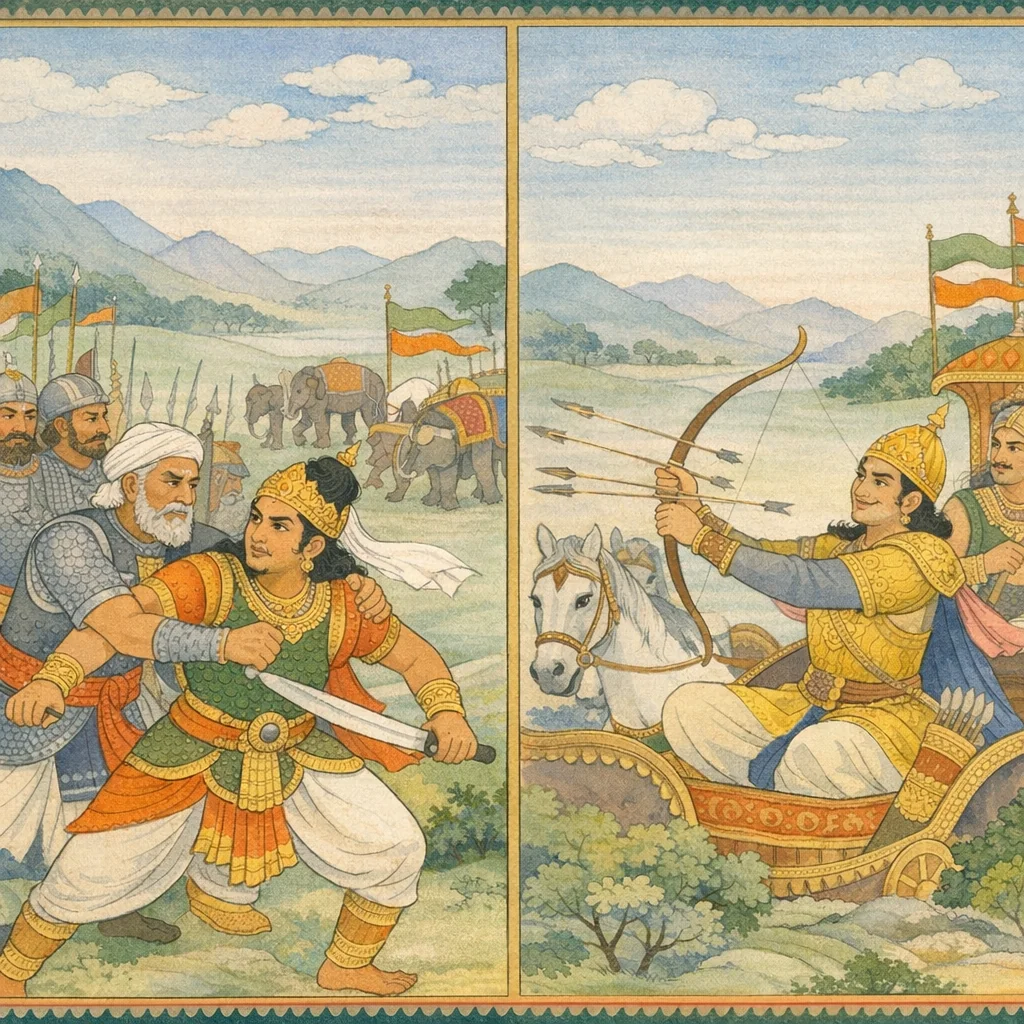
Adhyaya 25
Śalya Appointed as Karṇa’s Sārathi; Discourse on Praise, Blame, and Beneficial Counsel (कर्णस्य शल्यसारथ्यं तथा स्तवनिन्दाविचारः)
Upa-parva: Śalya–Sārathyānuśaṅga (Episode on Śalya’s Charioteership and Counsel)
Chapter 25 presents a compact negotiation over martial logistics and moral-psychological support. Duryodhana cites a precedent of divine hierarchy—Brahmā serving as charioteer where Rudra is the warrior—to argue that a charioteer must be superior in competence to the fighter, and he urges Śalya to control the horses in battle. Sañjaya reports Śalya’s embrace and acceptance, with a pledge to carry Duryodhana’s burdens wherever he is fit for service. Śalya requests tolerance for any counsel he may give to Karṇa, whether pleasing or displeasing, framing it as welfare-oriented. Karṇa reciprocally requests that Śalya align with them in constant benefit, analogizing to Brahmā for Īśāna and Keśava for Pārtha. Śalya then articulates a fourfold pattern—self-blame, self-praise, other-blame, other-praise—as conduct not practiced by the noble, and proceeds to establish his credibility by asserting his competence as charioteer (comparable to Mātali for Indra) through discipline, knowledge, and applied skill. He concludes by assuring Karṇa of steady charioteership during combat with Pārtha, aiming to reduce anxiety and stabilize performance.
Chapter Arc: संजय धृतराष्ट्र को रणभूमि का दृश्य सुनाते हैं: धृष्टद्युम्न का रथ बढ़ता है, पर सामने कृपाचार्य ऐसे अडिग खड़े हैं मानो वन में शरभ सिंह को रोक दे—और समस्त प्राणी उस टकराव को विनाश का संकेत मानते हैं। → कृपाचार्य का ‘अन्तक-प्रतिम’ रूप और उनका वेग धृष्टद्युम्न की गति को काट देता है; वे मर्मस्थलों पर प्रहार कर पार्षत-पुत्र को विचलित करते हैं, और धृष्टद्युम्न का रथ मानो समुद्र-वेग से पीछे मोड़ा जाता है। समानांतर रण में शिखण्डी कृतवर्मा (हार्दिक्य) से भिड़ता है, पर कृतवर्मा मुसकराते हुए बार-बार उसे रोकता है; शिखण्डी के स्वर्ण-पंख वाले तीक्ष्ण बाण भी कृतवर्मा के कवच से फिसल जाते हैं। → कृपाचार्य क्रोध से दीर्घ श्वास लेकर धृष्टद्युम्न पर मर्मभेदी बाण-वर्षा करते हैं—धृष्टद्युम्न का आक्रमण रुकता है और क्षण भर को ऐसा लगता है मानो पार्षत-पुत्र का रथ ही युद्ध से उखड़ जाएगा। उधर कृतवर्मा के शरों से संतप्त शिखण्डी बार-बार नि:श्वास करता है; उसकी प्रतिष्ठा-भरी चुनौती कृतवर्मा की अडिग रक्षा में टूटती दिखती है। → अध्याय का अंत निर्णायक वध पर नहीं, बल्कि दो मोर्चों पर बने दबाव पर टिकता है: कृपाचार्य धृष्टद्युम्न की अग्रगति रोककर कौरव-पक्ष को संबल देते हैं, और कृतवर्मा शिखण्डी को पीछे धकेलकर भीष्म-वधकर्ता की धाक को क्षीण करते हैं। → धृष्टद्युम्न क्या कृपाचार्य की इस ‘अन्तक-छाया’ को चीरकर आगे बढ़ पाएगा, और शिखण्डी क्या कृतवर्मा की मुसकराती रोक को तोड़कर पुनः प्रचण्ड रूप धारण करेगा?
Shlokas
Verse 1
अफड--णरू- षड्विशो<5ध्याय: कृपाचार्यसे धृष्टद्युम्मनका भय तथा कृतवमकि द्वारा शिखण्डीकी पराजय संजय उवाच धृष्टद्युम्न॑ कृपो राजन् वारयामास संयुगे । यथा दृष्टवा वने सिंहं शरभो वारयेद् युधि
Sanjaya said: O King, in the thick of battle Kripa checked Dhrishtadyumna—just as, on seeing a lion in the forest, a śarabha would hold it back in combat.
Verse 2
संजय कहते हैं--राजन्! कृपाचार्यने धृष्टद्युम्मको आक्रमण करते देख युद्धभूमिमें उसी प्रकार उन्हें आगे बढ़नेसे रोका, जैसे वनमें शरभ- सिंहको रोक देता है ।। निरुद्धः पार्षतस्तेन गौतमेन बलीयसा । पदात् पदं विचलितुं नाशकत्तत्र भारत,भारत! अत्यन्त बलवान् गौतमगोत्रीय कृपाचार्यसे अवरुद्ध होकर धृष्टद्युम्मन एक पग भी चलनेमें समर्थ न हो सका
Sanjaya said: O King, seeing Dhrishtadyumna pressing forward to attack, Acharya Kripa checked his advance on the battlefield—just as, in a forest, a śarabha is said to restrain a lion. Thus blocked by the mighty Kripa of the Gautama lineage, the son of Prishata (Dhrishtadyumna) could not move even a single step forward there, O Bharata.
Verse 3
गौतमस्य रथं दृष्टवा धृष्टद्युम्नरथं प्रति । वित्रेसु: सर्वभूतानि क्षयं प्राप्तं च मेनिरे,कृपाचार्यके रथको धृष्टद्युम्नके रथकी ओर जाते देख समस्त प्राणी भयसे थर्रा उठे और धष्टद्युम्नको नष्ट हुआ ही मानने लगे
Sañjaya said: Seeing the chariot of Gautama (Kṛpācārya) advancing toward the chariot of Dhṛṣṭadyumna, all beings trembled in fear and concluded that Dhṛṣṭadyumna had already met his destruction.
Verse 4
तत्रावोचन् विमनसो रथिन: सादिनस्तथा । द्रोणस्य निधनानूनं संक्रुद्धों द्विषदां वर:,वहाँ सभी रथी और घुड़सवार उदास होकर कहने लगे कि निश्चय ही द्रोणाचार्यके मारे जानेसे दिव्यास्त्रोंके ज्ञाता, उदारबुद्धि, महातेजस्वी, नरश्रेष्ठ, शरद्वानके पुत्र कृपाचार्य अत्यन्त कुपित हो उठे होंगे। क्या आज कृपाचार्यसे धृष्टद्युम्न कुशलपूर्वक सुरक्षित रह सकेंगे?
Sañjaya said: There, the chariot-warriors and the horsemen, their hearts cast down, began to speak: “Surely, because Droṇa has been slain, the foremost among our foes has become fiercely enraged.”
Verse 5
शारद्वतो महातेजा दिव्यास्त्रविदुदारधी: । अपि स्वस्ति भवेदद्य धृष्टद्युम्नस्य गौतमात्,वहाँ सभी रथी और घुड़सवार उदास होकर कहने लगे कि निश्चय ही द्रोणाचार्यके मारे जानेसे दिव्यास्त्रोंके ज्ञाता, उदारबुद्धि, महातेजस्वी, नरश्रेष्ठ, शरद्वानके पुत्र कृपाचार्य अत्यन्त कुपित हो उठे होंगे। क्या आज कृपाचार्यसे धृष्टद्युम्न कुशलपूर्वक सुरक्षित रह सकेंगे?
Sañjaya said: “Kṛpa, the son of Śaradvat—radiant with great prowess, broad-minded, and a master of celestial weapons—has surely been inflamed with fury today at the slaying of Droṇa. Will Dhṛṣṭadyumna be able to remain safe and unharmed today from Gautama (Kṛpa)?”
Verse 6
अपीयं वाहिनी कृत्स्ना मुच्येत महतो भयात् | अप्ययं ब्राह्मण: सर्वान् न नो हन्यात् समागतान्,“क्या यह सारी सेना महान् भयसे मुक्त हो सकती है? कहीं ऐसा न हो कि ये ब्राह्मण देवता यहाँ आये हुए हम सब लोगोंका वध कर डालें?
Sañjaya said: “Might this entire host be delivered from this great terror? May it not happen that this brahmin—this formidable divine being—slays all of us who have assembled here.”
Verse 7
यादृशं दृश्यते रूपमन्तकप्रतिमं भूशम् । गमिष्यत्यद्य पदवीं भारद्वाजस्य गौतम:,“इनका यमराजके समान जैसा अत्यन्त भयंकर रूप दिखायी देता है, उससे जान पड़ता है, आज कृपाचार्य भी द्रोणाचार्यके पथपर ही चलेंगे
Sañjaya said: “From the way his form appears—terrifying, like Antaka (Death) himself—it seems that today Gautama (Kṛpācārya) will follow the very path of Bhāradvāja’s son (Droṇa).”
Verse 8
आचार्य: क्षिप्रहस्तश्न विजयी च सदा युधि । अस्त्रवान् वीर्यसम्पन्न: क्रोधेन च समन्वित:,“कृपाचार्य शीघ्रतापूर्वक हाथ चलानेवाले तथा युद्धमें सर्वथा विजय प्राप्त करनेवाले हैं। वे अस्त्रवेत्ता, पराक्रमी और क्रोधसे युक्त हैं
Sañjaya said: “The preceptor Kṛpa is swift of hand and ever victorious in battle. He is a master of weapons, endowed with valor and strength, and he is also stirred by wrath.”
Verse 9
पार्षतश्न महायुद्धे विमुखो5द्याभिलक्ष्यते । इत्येवं विविधा वाचस्तावकानां परै: सह
Sañjaya said: “In this great battle, the son of Pārṣata (Dhṛṣṭadyumna) is seen today turning away (from the fight).” Thus, amid the clash, many such varied remarks were exchanged between your warriors and the enemy.
Verse 10
विनिः:श्वस्य तत: क्रोधात् कृप: शारद्वतो नृप
Sañjaya said: Then, O king, Kṛpa Śāradvata, breathing hard and stirred by anger, prepared to act.
Verse 12
तमब्रवीत्ततो यन्ता कच्चित् क्षेमं तु पार्षत
Sañjaya said: Then the charioteer addressed him, asking, “O son of Pṛṣata, is all well (with you)?”
Verse 13
पार्षतं चार्दयामास निश्रेष्ट सर्वमर्मसु । नरेश्वर! तदनन्तर शरद्वानके पुत्र कृपाचार्यने क्रोधसे लंबी साँस खींचकर निनश्रेष्ट खड़े हुए धृष्टद्युम्नके सम्पूर्ण मर्मस्थानोंमें गहरी चोट पहुँचायी ।। १० ई ।। स हन्यमान: समरे गौतमेन महात्मना,दैवयोगात्तु ते बाणा नापतन् मर्मभेदिन:
Sañjaya said: O king, Kripa—son of Sharadvan—rose up in wrath, drew a long breath, and struck Dhrishtadyumna, the son of Prishata, hard at all his vital points. Yet, though Dhrishtadyumna was being assailed in that battle by the great Gautama (Kripa), by the turn of fate those arrows did not fall as wounders of the vital organs.
Verse 14
व्यावर्तये रथं तूर्ण नदीवेगमिवार्णवात्
Sañjaya said: “I swiftly turned the chariot back, as one would divert a rushing river-current away from the ocean.”
Verse 15
धृष्टद्युम्नस्ततो राजन् शनकैरब्रवीद् वच:,राजन! यह सुनकर धृष्टद्युम्नने धीरेसे कहा--'सारथे! मेरे मनपर मोह छा रहा है और शरीरसे पसीना छूटने लगा है। मेरे सारे अंग काँप रहे हैं और रोमांच हो आया है
Sañjaya said: “O King, then Dhṛṣṭadyumna, speaking slowly, addressed these words. Having heard this, he said in a subdued voice: ‘Charioteer, delusion is overtaking my mind, sweat is breaking out from my body. All my limbs are trembling, and my hair stands on end.’”
Verse 16
मुहाते मे मनस्तात गात्रस्वेदश्व॒ जायते । वेपथुश्न शरीरे मे रोमहर्षश्व सारथे,राजन! यह सुनकर धृष्टद्युम्नने धीरेसे कहा--'सारथे! मेरे मनपर मोह छा रहा है और शरीरसे पसीना छूटने लगा है। मेरे सारे अंग काँप रहे हैं और रोमांच हो आया है
Sañjaya said: “O dear one, my mind is falling into bewilderment; sweat is breaking out on my limbs. My whole body trembles, and my charioteer, I am seized by horripilation.”
Verse 17
वर्जयन ब्राह्मा्ं युद्धे शनैर्याहि यतो<र्जुन: । अर्जुनं भीमसेनं वा समरे प्राप्प सारथे
Sañjaya said: “Avoiding the Brāhmaṇas in battle, advance gradually toward where Arjuna is. And when you come upon Arjuna—or Bhīmasena—in the fight, O charioteer, engage them.”
Verse 18
क्षेममद्य भवेदेवमेषा मे नैप्ठकी मति: । “तुम युद्धस्थलमें ब्राह्मण कृपाचार्यको छोड़ते हुए धीरे-धीरे जहाँ अर्जुन हैं, उसी ओर चल दो। समरांगणमें अर्जुन अथवा भीमसेनके पास पहुँचकर ही आज मैं सकुशल रह सकता हूँ, ऐसा मेरा दृढ़ विचार है” || १७ ई ।। ततः प्रायान्महाराज सारथिस्त्वरयन् हयान्
Sañjaya said: “If things go this way, I shall be safe today—this is my firm and settled resolve. Leaving the Brahmin teacher Kripa behind on the battlefield, drive slowly toward where Arjuna is. Only after reaching Arjuna—or Bhimasena—amid the clash of arms can I hope to remain unharmed today; this is my unwavering conviction.” Then, O King, the charioteer set off, urging the horses on.
Verse 19
प्रद्रुतं च रथ॑ दृष्टवा धृष्टद्युम्नस्य मारिष
Sañjaya said: “O venerable one, seeing Dhṛṣṭadyumna’s chariot rushing forward…”
Verse 20
शड्खं च पूरयामास मुहुर्मुहुररिंदम:
Sañjaya said: The foe-subduer repeatedly blew his conch, sounding it again and again.
Verse 21
शिखण्डिनं तु समरे भीष्ममृत्युं दुरासदम्
Sañjaya said: “But Śikhaṇḍin, on the battlefield, was the hard-to-approach instrument of Bhīṣma’s death.”
Verse 22
शिखण्डी तु समासाद्य हृदिकानां महारथम्
Sañjaya said: Then Śikhaṇḍī, having closed in upon the great chariot-warrior Hṛdika, confronted him in the thick of battle.
Verse 23
कृतवर्मा तु संक्रुद्धों भित्त्वा षष्टया पतत्रिभि:
Sañjaya said: Enraged, Kṛtavarmā broke through with a volley of sixty arrows, pressing the attack forward in the fierce momentum of battle.
Verse 24
अथान्यद् धनुरादाय द्रुपदस्यात्मजो बली
Sañjaya said: Then the mighty son of Drupada took up another bow—signaling steadfast resolve amid the pressures of battle, and the warrior’s duty to continue the fight without yielding to fear or setback.
Verse 25
इस प्रकार श्रीमह्याभारत कर्णपर्वमें सुतमोम और शकुनिका युद्धविषयक पचीसवाँ अध्याय पूरा हुआ,ततो<स्य नवतिं बाणान् रुक्मपुड्खान् सुतेजनान्
Sañjaya reports that, in the Mahābhārata’s Karṇa Parva, the twenty-fifth chapter—concerning the battle involving Suta’s son and Śakuni—concludes here. Thereafter, he discharged ninety arrows, their shafts tipped with gold and sharpened to a keen edge, continuing the relentless momentum of war.
Verse 26
वितथांस्तान् समालक्ष्य पतितांश्व महीतले,इति श्रीमहा भारते कर्णपर्वणि संकुलयुद्धे षड़्विंशो 5ध्याय:
Sañjaya said: Seeing them proved false and fallen upon the ground, thus ends the twenty-sixth chapter of the Karṇa Parva in the Mahābhārata, in the section describing the confused and densely entangled battle. The line underscores the moral collapse of boastful claims when tested in war, where pride is brought down to the earth by the impartial consequences of violence.
Verse 27
क्षुरप्रेण सुतीक्ष्णेन कार्मुक॑ चिच्छिदे भृूशम् । उन्हें व्यर्थ होकर पृथ्वीपर गिरा देख शिखण्डीने तीखे श्षुरप्रसे कृतवर्माके धनुषके टुकड़े-टुकड़े कर डाले ।। अथीैनं छिन्नधन्वानं भग्नशुड्भमिवर्षभम्
Sañjaya said: With a razor-edged, exceedingly sharp arrow, he violently cut the bow. Then, seeing him with his bow severed—like a bull with its horn broken—he pressed the attack. The scene underscores the ruthless efficiency of battlefield skill, where disabling an opponent’s weapon becomes a decisive, ethically charged act: victory is pursued through tactical mastery rather than mere rage, yet it still unfolds within the harsh moral economy of war.
Verse 28
अशीत्या मार्गणै: क्रुद्धो बाह्वोरुरसि चार्पयत् । धनुष कट जानेपर कृतवर्माकी दशा टूटे सींगवाले बैलके समान हो गयी। उस समय शिखण्डीने कुपित होकर उसकी दोनों भुजाओं तथा छातीमें अस्सी बाण मारे ।। कृतवर्मा तु संक्रुद्धो मार्गणै: क्षतविक्षत:
Sañjaya said: Enraged, he drove eighty arrows into the foe’s two arms and chest. Kṛtavarmā, now thoroughly incensed, was wounded and torn by those shafts. The scene underscores how wrath in battle rapidly escalates violence, turning injury into further retaliation rather than restraint.
Verse 29
ववाम रुधिरं गात्रै: कुम्भवक्त्रादिवोदकम् | कृतवर्मा उन बाणोंसे क्षत-विक्षत होकर अत्यन्त कुपित हो उठा और जैसे घड़ेके मुहसे जल गिर रहा हो, उसी प्रकार वह अपने अंगोंसे रक्त वमन करने लगा ।। रुधिरेण परिक्लिन्न: कृतवर्मा त्वराजत
Sañjaya said: Kṛtavarmā, his body torn and wounded by those arrows and inflamed with fury, began to vomit blood from his limbs—like water pouring from the mouth of a jar. Drenched in blood, Kṛtavarmā still shone forth, his warrior-splendor undiminished even amid grievous injury.
Verse 30
अथान्यद् धनुरादाय समार्गणगुणं प्रभु:
Sañjaya said: Then the mighty lord took up another bow, fully fitted with its bowstring and ready for battle—signaling steadfast resolve and the unbroken momentum of duty amid the harsh ethics of war.
Verse 31
स्कन्धदेशस्थितैर्बाणै: शिखण्डी तु व्ययाजत
Sañjaya said: With arrows lodged in the region of his shoulder, Śikhaṇḍī nevertheless held his ground—enduring the wounds and continuing the fight, a stark image of resolve amid the brutal ethics of battlefield duty.
Verse 32
शाखाप्रशाखाविपुल: सुमहान् पादपो यथा । कंधोंमें धँसे हुए उन बाणोंसे शिखण्डी वैसी ही शोभा पाने लगा, जैसे कोई महान् वृक्ष अपनी शाखा-प्रशाखाओंके कारण अधिक विस्तृत दिखायी देता हो ।। तावन्योन्यं भूशं विद्ध्वा रुधिरेण समुक्षितौ,(पोप्लूयमानौ हि यथा महान्तौ शोणितद्वदे ।) वे दोनों महान् वीर एक-दूसरेको अत्यन्त घायल करके खूनसे इस प्रकार नहा गये थे, मानो रक्तके सरोवरमें बारंबार डुबकी लगाकर आये हों
Sanjaya said: As a vast, mighty tree appears even more expansive because of its many branches and sub-branches, so Shikhandi—his shoulders sunk with arrows—seemed adorned by them in that very way. Having grievously pierced one another, the two great heroes were drenched in blood, as though they had repeatedly plunged into a lake of gore and emerged again. The image underscores the war’s grim splendor: valor is displayed, yet it is inseparable from the terrible cost in life and suffering.
Verse 33
अन्योन्यश्ज्राभिहतौ रेजतुर्वषभाविव । उस समय एक-दूसरेके सींगोंसे चोट खाये हुए दो साँड़के समान उन दोनोंकी बड़ी शोभा हो रही थी ।। अन्योन्यस्य वधे यत्नं कुर्वाणाौ तौ महारथौ
Sañjaya said: Struck by each other’s horns, those two shone like battling bulls. Each striving for the other’s death, the two great chariot-warriors pressed the fight with relentless resolve—an image of war’s fierce pride where prowess seeks victory at the cost of life.
Verse 34
रथाभ्यां चेरतुस्तत्र मण्डलानि सहस्रशः । एक-दूसरेके वधके लिये प्रयत्न करते हुए वे दोनों महारथी अपने रथके द्वारा वहाँ सहस्रों बार मण्डलाकार गतिसे विचरते थे ।। ३३ $ ।। कृतवर्मा महाराज पार्षतं निशितै: शरै:
Sañjaya said: There, the two great chariot-warriors drove their chariots in countless circular courses, each striving to bring about the other’s death. Again and again they wheeled in ring-like motion, displaying mastery of war-craft while remaining intent on lethal victory.
Verse 35
रणे विव्याध सप्तत्या स्वर्णपुड्खै: शिलाशितै: । महाराज! कृतवर्माने रणभूमिमें सानपर चढ़ाकर तेज किये हुए सुवर्णमय पंखवाले सत्तर बाणोंसे ट्रुपदपुत्र शिखण्डीको घायल कर दिया || ३४ $ ।। ततो<स्य समरे बाणं भोज: प्रहरतां वर:
Sañjaya said: O King, in that battle he pierced Śikhaṇḍī, the son of Drupada, with seventy arrows—gold-feathered and whetted on stone. Then, in the same combat, the Bhoja hero, foremost among those who strike, launched an arrow against him.
Verse 36
स तेनाभिहतो राजन मूर्च्छामाशु समाविशत्
Sañjaya said: O King, struck by that blow, he was swiftly overcome by a faint.
Verse 37
अपोवाह रणात्तूर्ण सारथी रथिनां वरम्
Sañjaya said: The charioteer swiftly drove the foremost of chariot-warriors away from the battlefield.
Verse 38
पराजिते तत: शूरे ट्रुपदस्यात्मजे प्रभो । व्यद्रवत् पाण्डवी सेना वध्यमाना समन्ततः,प्रभो! शूरवीर ट्रुपदपुत्रके पराजित हो जानेपर सब ओरसे मारी जाती हुई पाण्डव-सेना भागने लगी
Sañjaya said: When that heroic son of Drupada had been defeated, O lord, the Pāṇḍava army—being cut down on every side—broke ranks and fled.
Verse 96
व्यश्रूयन्त महाराज तयोस्तत्र समागमे । “आज इस महायुद्धमें धृष्टद्युम्न विमुख होता दिखायी देता है।” महाराज! इस प्रकार वहाँ धृष्टद्यम्म और कृपाचार्यका समागम होनेपर आपके सैनिकोंकी शत्रुओंके साथ होनेवाली नाना प्रकारकी बातें सुनायी देने लगीं
Sañjaya said: “O King, when those two met there, it was heard among the troops: ‘In this great war, Dhṛṣṭadyumna seems to be turning away—his heart failing, his will recoiling.’ Thus, at the encounter of Dhṛṣṭadyumna and Kṛpācārya, many such reports and battlefield talk about the enemy began to circulate among your soldiers.”
Verse 116
कर्तव्यं न सम जानाति मोहेन महता55वृत: । समरांगणमें महामना कृपाचार्यके द्वारा आहत होनेपर भी धृष्टद्युम्नको कोई कर्तव्य नहीं सूझता था। वे महान् मोहसे आच्छन्न हो गये
Sañjaya said: Overwhelmed by a great delusion, he could not discern what ought to be done. Even after being struck by Kṛpācārya on the battlefield, Dhṛṣṭadyumna found no clear sense of duty; his judgment was veiled by confusion at a critical ethical moment in war.
Verse 123
ईदृशं व्यसन युद्धे न ते दृष्टं मया क्वचित् | तब उनके सारथिने उनसे कहा--'द्रुपदनन्दन! कुशल तो है न? युद्धमें आपपर कभी ऐसा संकट आया हो, यह मैंने नहीं देखा है
Sañjaya said: Then his charioteer said to him: “Son of Drupada, are you well? Never before have I seen such a calamity befall you in battle; a crisis like this, amid the clash of arms, I have not witnessed in your case at any time.”
Verse 133
प्रेषिता द्विजमुख्येन मर्माण्युद्दिश्य सर्वतः । द्विजश्रेष्ठ कृपाचार्यने सब ओरसे आपके मर्मस्थानोंको लक्ष्य करके बाण चलाये थे; परंतु दैवयोगसे ही वे मर्मभेदी बाण आपके मर्मस्थानोंपर नहीं पड़े हैं
Sañjaya said: Discharged by the foremost of the twice-born, those arrows were aimed from every side at your vital points. Yet, by the turn of fate, those life-piercing shafts did not strike your vulnerable spots—showing how, in battle, human skill may be thwarted when destiny does not consent.
Verse 143
अवध्यं ब्राह्मण मन्ये येन ते विक्रमो हतः । 'जैसे कोई शक्तिशाली पुरुष समुद्रसे नदीके वेगको पीछे लौटा दे, उसी प्रकार मैं आपके इस रथको तुरंत लौटा ले चलूँगा। मेरी समझमें ये ब्राह्मण देवता अवध्य हैं, जिनसे आज आपका पराक्रम प्रतिहत हो गया”
Sañjaya said: “I deem that brāhmaṇa to be inviolable—by whom your martial prowess has been checked. Just as a mighty man might turn back the rush of a river from the sea, so will I at once wheel your chariot around and bring it back. In my judgment, brāhmaṇas are divine and cannot be slain; it is by them that your valor has today been thwarted.”
Verse 186
यतो भीमो महेष्वासो युयुधे तव सैनिकै: । महाराज! तब सारथि घोड़ोंको तेजीसे हाँकता हुआ उसी ओर चल दिया जहाँ महाधनुर्धर भीमसेन आपके सैनिकोंके साथ युद्ध कर रहे थे
Sañjaya said: “O King, seeing where Bhīma, the mighty archer, was engaged in combat with your troops, the charioteer at once drove the horses swiftly in that very direction—toward the place where the great bowman Bhīmasena was fighting your soldiers.”
Verse 196
किरन् शतशतान्येव गौतमो5नुययौ तदा । मान्यवर नरेश! धृष्टद्युम्नके रथको वहाँसे भागते देख कृपाचार्यने सैकड़ों बाणोंकी वर्षा करते हुए उनका पीछा किया
Sañjaya said: “O honored king, seeing Dhrishtadyumna’s charioteer fleeing from that place, Gautama (Kripacharya) pursued him at once, showering hundreds upon hundreds of arrows.”
Verse 203
पार्षतं त्रासयामास महेन्द्रो नमुचिं यथा । शत्रुओंका दमन करनेवाले कृपाचार्यने बारंबार शंखध्वनि की और जैसे इन्द्रने नमुचिको डराया था, उसी प्रकार उन्होंने धृष्टद्युम्मको भयभीत कर दिया
Sañjaya said: Kṛpācārya, a subduer of enemies, repeatedly sounded his conch and struck fear into Dhṛṣṭadyumna (the son of Pṛṣata), just as Mahendra (Indra) once terrified Namuci.
Verse 226
पज्चभिरन्निशितैर्भल्लैर्जत्रदेशे समाहनत् । हृदिकवंशी यादवोंके महारथी वीर कृतवर्माको सामने पाकर शिखण्डीने उसके गलेकी हँसलीपर पाँच तीखे भललोंद्वारा प्रहार किया
Sañjaya said: Confronting the heroic Kṛtavarmā—an eminent Yādava chariot-warrior—Śikhaṇḍī struck him in the region of the collarbone with five razor-sharp bhalla arrows.
Verse 236
धनुरेकेन चिच्छेद हसन् राजन् महारथ: । राजन्! तब महारथी कृतवर्माने अत्यन्त कुपित हो साठ बाणोंसे शिखण्डीको घायल करके एकसे हँसते-हँसते उसका धनुष काट डाला
Sañjaya said: O King, the great chariot-warrior, smiling, severed (his opponent’s) bow with a single arrow.
Verse 246
तिष्ठ तिछेति संक्रुद्धो हार्दिक्यं प्रत्यभाषत । तत्पश्चात् द्रपदके बलवान पुत्रने दूसरा धनुष हाथमें लेकर कृतवर्मासे क्रोधपूर्वक कहा --'अरे! खड़ा रह, खड़ा रह”
Sañjaya said: Enraged, he shouted at Hārdikya (Kṛtavarmā), “Stand! Stand!” Then the powerful son of Drupada seized another bow in his hand and, in wrath, challenged Kṛtavarmā to hold his ground.
Verse 296
वर्षेण क्लेदितो राजन् यथा गैरिकपर्वत:ः । राजन! खूनसे लथपथ हुआ कृतवर्मा वर्षासे भीगे हुए गेरूके पहाड़के समान शोभा पा रहा था
Sañjaya said: “O King, Kṛtavarmā—smeared and drenched in blood—appeared like a mountain of red ochre soaked by the rains.”
Verse 303
शिखण्डिनं बाणगणै: स्कन्धदेशे व्यताडयत् । तदनन्तर शक्तिशाली कृतवर्माने बाण और प्रत्यंचा-सहित दूसरा धनुष हाथमें लेकर शिखण्डीके कंधोंपर अपने बाण-समूहोंद्वारा गहरी चोट पहुँचायी
Sañjaya said: He struck Śikhaṇḍin on the shoulder-region with volleys of arrows. Immediately after that, the powerful Kṛtavarmā took up a second bow—equipped with arrows and a taut bowstring—and with dense clusters of shafts inflicted a deep wound upon Śikhaṇḍin’s shoulders.
Verse 353
जीवितान्तकरं घोरं व्यसृजत्त्वरयान्वित: । तत्पश्चात् प्रहार करनेवाले योद्धाओंमें श्रेष्ठ कृतवर्माने उसके ऊपर समरांगणमें बड़ी उतावलीके साथ एक भयंकर प्राणान्तकारी बाण छोड़ा
Sañjaya said: Then, in grim haste, he discharged a dreadful missile that could bring life to its end. After that, Kṛtavarmā—foremost among warriors skilled in striking—hurled upon him in the battlefield, with great urgency, a terrifying, life-ending arrow.
Verse 363
ध्वजयष्टिं च सहसा शिश्रिये कश्मलावृतः । राजन! उस बाणसे आहत हो शिखण्डी तत्काल मूर्च्छिंत हो गया। उसने सहसा मोहाच्छन्न होकर ध्वजदण्डका सहारा ले लिया
Sañjaya said: Overcome by confusion and distress, he suddenly leaned upon the flagstaff for support. Struck by that arrow, Śikhaṇḍī at once fainted, and, his mind clouded by delusion, clutched the standard-pole to steady himself.
Verse 376
हार्दिक्यशरसंतप्तं नि:श्वसन्तं पुन: पुनः । कृतवर्माके बाणोंसे संतप्त हो बारंबार लंबी साँस खींचते हुए रथियोंमें श्रेष्ठ शिखण्डीको उसका सारथि तुरंत रणभूमिसे बाहर हटा ले गया
Sañjaya said: Scorched by the arrows of Hārdikya (Kṛtavarman), and again and again drawing deep breaths in pain, Śikhaṇḍin—foremost among chariot-warriors—was at once withdrawn from the battlefield by his charioteer. The scene shows that amid war’s relentless code, a warrior’s survival and continued duty rest not only on valor, but also on timely protection and disciplined retreat when grievously wounded.
Verse 2136
हार्दिक्यो वारयामास स्मयतन्निव मुहुर्मुहु: । दूसरी ओर समरांगणमें दुर्जय वीर शिखण्डीको, जो भीष्मके लिये मृत्युस्वरूप था, कृतवर्माने बारंबार मुसकराते हुए-से रोका
Sañjaya said: Kṛtavarmā, the son of Hṛdīka, repeatedly checked the advance, seeming to smile again and again. Elsewhere on the battlefield he kept holding back the unconquerable hero Śikhaṇḍī—who for Bhīṣma had become the very embodiment of death—thus sharpening the war’s moral tension, where personal destiny and strategic restraint collide.
Verse 2536
प्रेषषामास राजेन्द्र ते5स्या भ्रश्यन्त वर्मण: । राजेन्द्र! फिर सोनेकी पाँखवाले नब्बे पैने बाण उसने चलाये, परंतु वे कृतवर्माके कवचसे फिसलकर गिर गये
Sañjaya said: O king, he discharged those arrows; yet they slipped off his armour and fell away. In the press of battle, a warrior’s skill meets the protection earned by preparedness and steadfastness—so that even a fierce volley may fail when met by firm defence.
Frequently Asked Questions
The dilemma concerns how a leader should receive counsel: whether to prioritize morale-affirming speech or accept potentially unpleasant advice framed as beneficial (hita), especially when roles require both loyalty and corrective guidance.
Speech is an ethical instrument: credibility and restraint matter, and counsel should aim at welfare rather than ego reinforcement; competence in supportive roles (like the sārathi) is integral to effective action.
No explicit phalaśruti appears in the supplied verses; the chapter functions as practical meta-guidance on conduct—how counsel, praise/blame, and role-competence shape outcomes within the epic’s dharma framework.