Adhyaya 40
कर्णपर्व — अध्याय ४० (Karṇa’s Pressure on the Pāñcālas; Duryodhana Disabled; Arjuna’s Counter-Advance)
Upa-parva: Karṇa–Pāñcāla Saṃgharṣa (Battlefield Engagements with the Pāñcālas)
Sañjaya reports escalating multi-front engagements. Karṇa halts Bhīma with arrows while simultaneously striking Cedi, Kekaya, and Sṛñjaya elites; Bhīma then pivots away from Karṇa to set Kaurava ranks aflame metaphorically, producing broad disruption. Duryodhana engages the Mādrī-putras (Nakula and Sahadeva): he wounds them, severs Sahadeva’s golden banner, and intensifies arrow-pressure that visually ‘covers’ the twins. Dhṛṣṭadyumna intervenes as Pāṇḍava commander, trading volleys with Duryodhana and systematically dismantling his combat platform—cutting bow, killing horses and driver, severing weapons, parasol, and standard—forcing Duryodhana into a vulnerable, chariotless state protected and extracted by his brothers. Karṇa, after overcoming Sātyaki, advances toward Dhṛṣṭadyumna; Śaineya attacks from behind. A large engagement forms between Karṇa and Pāñcāla forces; Karṇa is described as moving fearlessly among them, causing extensive casualties and panic in elephant and chariot units. Karṇa then surges toward Yudhiṣṭhira, prompting Dhṛṣṭadyumna, the Draupadeyas, Śikhaṇḍin, the twins, and other allies to surround and resist him. Parallelly, Arjuna reports to Kṛṣṇa that the Saṃśaptakas are breaking; he requests movement toward Karṇa’s position. Kṛṣṇa drives the chariot into Kaurava formations; Arjuna devastates the Saṃśaptaka wing and kills a prominent Kāmboja leader (Sudakṣiṇa’s younger brother). Droṇa’s son (Drauṇi/Aśvatthāmā) arrives, showers Kṛṣṇa and Arjuna with arrows, briefly immobilizes them, and provokes Kṛṣṇa’s anger; Arjuna counters by cutting Drauṇi’s bow and chariot elements, leading to Drauṇi’s extraction. The chapter closes by summarizing severe mutual attrition and the continuing pressure exerted by Arjuna, Bhīma, and Dhṛṣṭadyumna against the Kaurava forces and Karṇa.
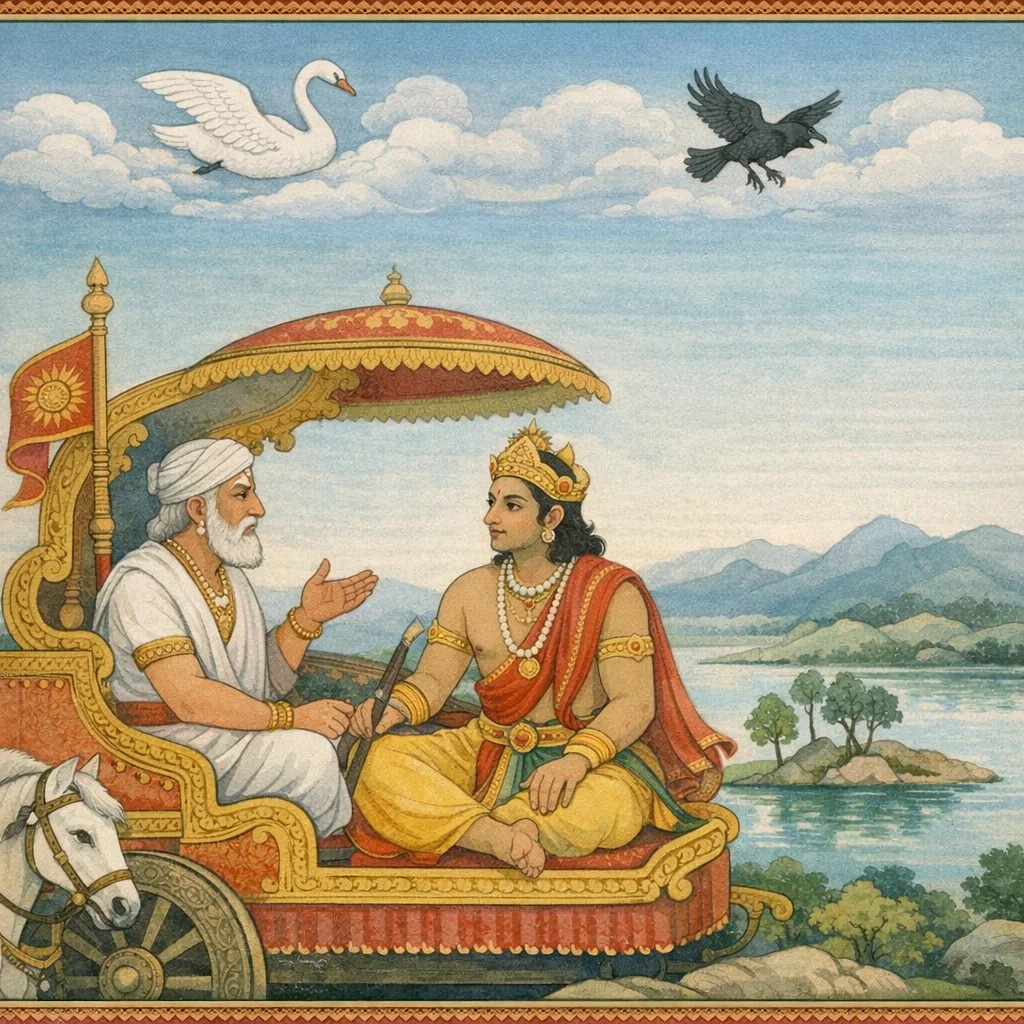
Chapter Arc: कर्ण के रथ पर बैठा शल्य—सारथि होकर भी—वाणी के बाण चलाता है: ‘युद्ध से पीछे न हटना’ पुरूरवा जैसे राजाओं का उत्तम चरित्र है; और आज वही कसौटी कर्ण के सामने है। → शल्य कर्ण की वंश-प्रतिष्ठा और ‘धर्मपरायण’ होने के दावे को सामने रखकर उसे सावधान करता है—कर्ण की दशा उसे मदिरामत्त-सा प्रमादी दिखती है। फिर वह रथी के बलाबल, श्रम, खेद और घोड़ों-रथ की सीमाओं का स्मरण कराकर बताता है कि केवल गर्व नहीं, संयम और विवेक भी रण का कवच है। → उपाख्यान का शिखर: हंस और कौए की कथा में कौआ जूठन खाकर पुष्ट होकर हंस को ललकारता है, ऊँची-ऊँची उड़ानों का प्रदर्शन करता है, पर अंततः थककर द्वीप/वृक्ष का आश्रय न पाकर भयभीत होता है और हंस की शरण में आता है; हंस उसे पराजित कर उसका अहं तोड़ देता है। शल्य इस कथा को कर्ण पर आरोपित करता है—‘जहाँ किरीटधारी अर्जुन ने सबको सिंह की तरह शृगालों-सा तितर-बितर किया, वहाँ तुम्हारा वीर्य कहाँ था?’ → कथा का निष्कर्ष कर्ण के लिए दर्प-शमन है: बल-पराक्रम का मद छोड़कर क्षान्ति, मर्यादा और यथार्थ-बोध अपनाओ; शल्य ‘सुहृत्तया’ (हितैषी भाव) से कहता है कि प्रमाद में पड़े वीर को उपचार चाहिए—और वह उपचार सत्य-वचन है। → शल्य की कटु-हित वाणी के बाद प्रश्न हवा में लटकता है: क्या कर्ण इस अपमान-सी सीख को स्वीकार कर संयमित होगा, या अहं से और भड़ककर अर्जुन-वध के लिए अंधी प्रतिज्ञा में कूद पड़ेगा?
Shlokas
Verse 1
निफमश (0) आज अन न - युद्धसे पीछे न हटना ही राजा पुरूरवाका उत्तम चरित्र है। एकचत्वारिशो< ध्याय: राजा शल्यका कर्णको एक हंस और कौएका उपाख्यान सुनाकर उसे श्रीकृष्ण और अर्जुनकी प्रशंसा करते हुए उनकी शरणमें जानेकी सलाह देना संजय उवाच मारिषाधिरथे: श्रुत्वा वाचो युद्धाभिनन्दिन: । शल्योडब्रवीत् पुन: कर्ण निदर्शनमिदं वच:,संजय कहते हैं--माननीय नरेश! युद्धका अभिनन्दन करनेवाले अधिरथपुत्र कर्णकी पूर्वोक्त बात सुनकर फिर शल्यने उससे यह दृष्टान्तयुक्त बात कही--
Sanjaya said: “O revered king! Having heard the words of Karna, the son of Adhiratha, who delights in war, Shalya again addressed Karna, speaking these words by way of an illustrative example.”
Verse 2
जातो$हं यज्वनां वंशे संग्रामेष्वनिवर्तिनाम् । राज्ञां मूर्थाभिषिक्तानां स्वयं धर्मपरायण:,'सूतपुत्र! मैं युद्धमें पीठ न दिखानेवाले यज्ञपरायण, मूर्धाभिषिक्त नरेशोंके कुलमें उत्पन्न हुआ हूँ और स्वयं भी धर्ममें तत्पर रहता हूँ
Sañjaya said: “I was born in a lineage of sacrificers, of those who never turn back in battle—among kings consecrated by the royal anointing; and I myself am devoted to dharma.”
Verse 3
यथैव मनत्तो मद्येन त्वं तथा लक्ष्यसे वृष | तथाद्य त्वां प्रमाद्यन्तं चिकित्सेयं सुहृत्तया,किंतु वृषभस्वरूप कर्ण! जैसे कोई मदिरासे मतवाला हो गया हो, उसी प्रकार तुम भी उन्मत्त दिखायी दे रहे हो; अतः मैं हितैषी सुहृद् होनेके नाते तुम-जैसे प्रमत्तकी आज चिकित्सा करूँगा
“But, O Karṇa, bull-like in form! Just as a man appears maddened by wine, so you too seem beside yourself; therefore today, as a well-wishing friend, I shall treat you—thus heedless—as one in need of cure.”
Verse 4
इमां काकोपमां कर्ण प्रोच्यमानां निबोध मे । श्र॒ुत्वा यथेष्ट कुर्यास्त्वं निहीन कुलपांसन,ओ नीच कुलांगार कर्ण! मेरे द्वारा बताये जानेवाले कौएके इस दृष्टान्तको सुनो और सुनकर जैसी इच्छा हो वैसा करो
Sañjaya said: “Karna, listen carefully to this parable of the crow that I am about to relate. Having heard it, act thereafter as you please—O disgrace of a low lineage.”
Verse 5
नाहमात्मनि किंचिद् वै किल्बिषं कर्ण संस्मरे | येन मां त्वं महाबाहो हन्तुमिच्छस्यनागसम्,महाबाहु कर्ण! मुझे अपना कोई ऐसा अपराध नहीं याद आता है, जिसके कारण तुम मुझ निरपराधको भी मार डालनेकी इच्छा रखते हो
Sañjaya said: “O Karṇa, I do not recall within myself any fault at all—any wrongdoing—by which you, mighty-armed one, should wish to slay me though I am guiltless.”
Verse 6
अवश्यं तु मया वाच्यं॑ बुद्ध्यता त्वद्धिताहितम् । विशेषतो रथस्थेन राज्ञश्नैव हितैषिणा,मैं राजा दुर्योधनका हितैषी हूँ और विशेषतः रथपर सारथि बनकर बैठा हूँ; इसलिये तुम्हारे हिताहितको जानते हुए मेरा आवश्यक कर्तव्य है कि तुम्हें वह सब बता दूँ
Sañjaya said: “I must speak—using clear discernment—of what is truly for your good and what is not. All the more so because, standing upon the chariot as the king’s charioteer and well-wisher, it is my bounden duty to tell you plainly what serves your welfare and what leads to harm.”
Verse 7
समं च विषम चैव रथिनश्न॒ बलाबलम् | श्रम: खेदश्न॒ सततं हयानां रथिना सह
Sañjaya said: “On ground that is even and on ground that is uneven, the charioteer must constantly judge the strength and weakness of the warrior on the car; and with him he must also continually endure the horses’ fatigue and strain.”
Verse 8
आयुधस्य परिज्ञानं रुतं च मृगपक्षिणाम् | भारश्षाप्यतिभारकश्न शल्यानां च प्रतिक्रिया
Sañjaya said: “(He possessed) expert knowledge of weapons; he could interpret the cries of beasts and birds; he understood the measure of loads—both proper and excessive—and he also knew the remedies and counter-measures for wounds caused by missiles and splinters.”
Verse 9
अस्त्रयोगश्न युद्धे च निमित्तानि तथैव च । सर्वमेतन्मया ज्ञेयं रथस्यास्य कुटुम्बिना
Sañjaya said: “Both the proper application of weapons in battle and the omens that attend it—this entire matter must be understood by me, for I am the charioteer’s attendant of this warrior.”
Verse 10
अतत्त्वां कथये कर्ण निदर्शनमिदं पुनः । सम और विषम अवस्था, रथीकी प्रबलता और निर्बलता, रथीके साथ ही घोड़ोंके सतत परिश्रम और कष्ट, अस्त्र हैं या नहीं, इसकी जानकारी, जय और पराजयकी सूचना देनेवाली पशु-पक्षियोंकी बोली, भार, अतिभार, शल्य-चिकित्सा, अस्त्रप्रयोग, युद्ध और शुभाशुभ निमित्त--इन सारी बातोंका ज्ञान रखना मेरे लिये आवश्यक है; क्योंकि मैं इस रथका एक कुट॒म्बी हूँ। कर्ण! इसीलिये मैं पुनः तुमसे इस दृष्टान्तका वर्णन करता हूँ--- ।। ७ -९३ || वैश्य: किल समुद्रान्ते प्रभूतधनधान्यवान्,राज्ञो धर्मप्रधानस्य राष्ट्रे वसति निर्भय: । कहते हैं समुद्रके तटपर किसी धर्मप्रधान राजाके राज्यमें एक प्रचुर धन-धान्यसे सम्पन्न वैश्य रहता था। वह यज्ञ-यागादि करनेवाला, दानपति, क्षमाशील, अपने वर्णानुकूल कर्ममें तत्पर, पवित्र, बहुत-से पुत्रवाला, संतानप्रेमी और समस्त प्राणियोंपर दया करनेवाला था
Sañjaya said: “Karna, I shall again relate this illustration. For me, as one who belongs to this chariot’s household, it is necessary to know everything that signals success or failure in war: whether the situation is even or uneven, the strength or weakness of the warrior, the ceaseless toil and suffering of the horses alongside the chariot, whether weapons are available or not, the cries of beasts and birds that foretell victory or defeat, the proper load and the overload, the treatment of wounds, the use of weapons, the conduct of battle, and the auspicious and inauspicious omens. Therefore, Karna, I describe this example to you once more. “There was, it is said, a merchant living on the seashore in the kingdom of a dharma-centered king. He was rich in wealth and grain and lived without fear. He performed sacrifices and rites, was a generous giver, patient and forgiving, devoted to the duties proper to his social station, pure in conduct, blessed with many sons, affectionate toward his children, and compassionate toward all living beings.”
Verse 11
यज्वा दानपति: क्षान्त: स्वकर्मस्थो5भवच्छुचि: । बहुपुत्र: प्रियापत्य: सर्वभूतानुकम्पक:
Sañjaya said: “He had performed sacrifices, was a lord of generosity, and was patient. Steadfast in his own prescribed duties, he remained pure in conduct. Blessed with many sons and dear offspring, he was compassionate toward all living beings.”
Verse 12
पुत्राणां तस्य बालानां कुमाराणां यशस्विनाम्
Sañjaya said: He spoke of his sons—still young, mere princes—yet already renowned, whose fame and promise stood in poignant contrast to the ruthless demands of the war.
Verse 13
तस्मै सदा प्रयच्छन्ति वैश्यपुत्रा: कुमारका:
Sañjaya said: “To him, the young boys—sons of Vaiśyas—continually offer gifts.” The line highlights a steady, voluntary support given by ordinary householders, suggesting a social ethic of sustaining one who is regarded as worthy—whether through need, merit, or recognized standing.
Verse 14
मांसौदनं दधि क्षीरं पायसं मधुसर्पिषी । वैश्यके बालक उस कौएको सदा मांस, भात, दही, दूध, खीर, मधु और घी आदि दिया करते थे ।। १३ ह || सचोच्छिष्टभूत: काको वैश्यपुत्रै: कुमारकै:
Sanjaya said: The young sons of a vaiśya would continually feed the crow with meat and cooked rice, curd, milk, sweet rice pudding, honey, and ghee—so that the bird lived as one sustained on their leftovers. The episode underscores how habitual indulgence and easy nourishment can foster dependence and dull natural restraint, a moral contrast often drawn amid the larger war narrative’s reflections on conduct and consequence.
Verse 15
अथ हंसा: समुद्रान्ते कदाचिदतिपातिन:
Sañjaya said: Then, at the ocean’s edge, there were on one occasion swans—swift-flying birds—appearing as an omen-like scene within the unfolding narrative.
Verse 16
कुमारकास्तदा हंसान् दृष्टवा काकमथाब्रुवन्
Sañjaya said: Then the young ones, seeing the swans, spoke to the crow—setting up a contrast between noble conduct and base imitation in the midst of the tale.
Verse 17
प्रतार्यमाणस्तै: सर्वैरल्पबुद्धिभिरण्डज:
Sañjaya said: The egg-born one (a bird) was being harassed and driven about by all those men of little understanding—an image of how the foolish, acting in a crowd, torment the vulnerable without discernment or restraint.
Verse 18
तान् सो$भिपत्य जिज्ञासु: क एषां श्रेष्ठभागिति,तमाद्दयत दुर्बद्धि: पताव इति पक्षिणम् । फिर वह जूठनपर घमंड करनेवाला कौआ इन हंसोंमें सबसे श्रेष्ठ कौन है? यह जाननेकी इच्छासे उड़कर उनके पास गया और दूरतक उड़नेवाले उन बहुसंख्यक हंसोंमेंसे जिस पक्षीको उसने श्रेष्ठ समझा, उसीको उस दुर्बुद्धिने ललकारते हुए कहा--“चलो, हम दोनों उड़ें!
Sañjaya said: Driven by curiosity—“Which among these has the best share, the foremost?”—the foolish crow flew up to them. From among those many far-flying swans, it singled out the bird it judged superior and, challenging it, said: “Come—let the two of us fly (in contest)!”
Verse 19
उच्छिष्टदर्पित: काको बहूनां दूरपातिनाम् । तेषां यं प्रवरं मेने हंसानां दूरपातिनाम्
Sañjaya said: A crow, puffed up with pride after feeding on leftovers, found itself among many birds that could fly far. In that company it presumed itself to be the foremost—thinking itself equal to, or even superior among, the far-flying swans. The verse uses a sharp moral image: petty advantage and borrowed confidence can breed arrogance, but true excellence is measured by inherent capacity and discipline, not by momentary gain.
Verse 20
तच्छुत्वा प्राहसन् हंसा ये तत्रासन् समागता:,बहुत काँव-काँव करनेवाले उस कौएकी वह बात सुनकर वहाँ आये हुए वे पक्षियोंमें श्रेष्ठ आकाशचारी बलवान् चक्रांग हँस पड़े और कौएसे इस प्रकार बोले
Sañjaya said: Hearing that, the swans who had gathered there burst into laughter. Those powerful, sky-ranging birds—foremost among the winged—mocked the crow’s noisy boasting and replied to him accordingly.
Verse 21
भाषतो बहु काकस्य बलिन: पततां वरा: । इदमूचु: सम चक्राड़ा वच: काक॑ं विहड्भमा:,बहुत काँव-काँव करनेवाले उस कौएकी वह बात सुनकर वहाँ आये हुए वे पक्षियोंमें श्रेष्ठ आकाशचारी बलवान् चक्रांग हँस पड़े और कौएसे इस प्रकार बोले
Sañjaya said: Hearing the crow’s loud and incessant cawing, the powerful cakrāṅga-geese—foremost among flying birds—laughed together and addressed the crow with these words. The scene underscores a moral contrast: noisy self-assertion is not the same as true strength or worth, and the wise respond by exposing empty boasting rather than being intimidated by it.
Verse 22
हंया ऊचु: वयं हंसाश्चरामेमां पृथिवीं मानसौकस: । पक्षिणां च वयं नित्यं दूरपातेन पूजिता:,हंसोंने कहा--काक! हम मानसरोवरनिवासी हंस हैं, जो सदा इस पृथ्वीपर विचरते रहते हैं। दूरतक उड़नेके कारण हमलोग सदा सभी पक्षियोंमें सम्मानित होते आये हैं
The swans said: “O crow, we are swans who dwell at Lake Mānasa (Mānasarovara). We roam over this earth, and among birds we have long been held in honor, for we can fly far.”
Verse 23
कथं हंसं नु बलिनं चक्राड़ं दूरपातिनम् । काको भूत्वा निपतने समाह्नयसि दुर्मते
Sañjaya said: “How, O foolish-minded one, do you challenge to a swoop a powerful haṁsa—one that strikes like a discus and can fly far—when you yourself are but a crow?”
Verse 24
अथ हंसवचो मूढ: कुत्सयित्वा पुन: पुनः । प्रजगादोत्तरं काक: कत्थनो जातिलाघवात्,हंसकी बात सुनकर बढ़-बढ़कर बातें बनानेवाले मूर्ख कौएने अपनी जातिगत क्षुद्रताके कारण बारंबार उसकी निन्दा करके उसे इस प्रकार उत्तर दिया
Sañjaya said: Hearing the swan’s words, the foolish crow—given to boastful talk—again and again disparaged him; and, out of the pettiness of his own low nature, spoke back in reply.
Verse 25
काक उवाच शतमेकं च पातानां पतितास्मि न संशय: । शतयोजनमेकैकं विचित्र विविध तथा,कौआ बोला--हंस! मैं एक सौ एक प्रकारकी उड़ानें उड़ सकता हूँ, इसमें संशय नहीं है। उनमेंसे प्रत्येक उड़ान सौ-सौ योजनकी होती है और वे सभी विभिन्न प्रकारकी एवं विचित्र हैं
The crow said: “I can perform a hundred and one kinds of flights—of that there is no doubt. Each of those flights spans a hundred yojanas, and they are all varied and wondrous in their different forms.”
Verse 26
उड्डीनमवडीनं च प्रडीनं डीनमेव च । निडीनमथ संडीनं तिर्यक् डीनगतानि च
Kāka said: “There are those that fly up, those that fly down, those that fly forth, and those that fall utterly; those that settle into a nest, those that gather together, and those that move in a sideways course—these are states and movements of the ‘fallen’.”
Verse 27
विडीनं परिडीनं च पराडीनं सुडीनकम् | अभिडीनं महाडीन॑ निर्डीनमतिडीनकम्
The crow said: “I have become utterly wretched—worn down in every way: fallen into misery, sunk into deeper misery, plunged into misery beyond measure; miserable, more miserable still, greatly miserable; stripped of all strength and reduced to extreme destitution.”
Verse 28
अवडीनं प्रडीनं च संडीनं डीनडीनकम् | संडीनोड्डीनडीनं च पुनर्डीनविडीनकम्
“(It is) fallen, then further fallen; sunk and ever more wretched. Again it is sunk, then flung up and made wretched; and once more it becomes miserable and cast down.”
Verse 29
सम्पातं समुदीषं च ततो<न्यद् व्यतिरिक्तकम् | गतागतप्रतिगतं बह्दीक्ष निकुलीनका:
Kāka said: “There are also other omens beyond these—sudden swoops and agitated movements, repeated comings and goings, and counter-motions. Such signs, observed in many ways, indicate disturbance and foretell adverse outcomes.”
Verse 30
उनमेंसे कुछ उड़ानोंके, नाम इस प्रकार हैं--उड्डीन (ऊँचा उड़ना), अवडीन (नीचा उड़ना), प्रडीन (चारों ओर उड़ना), डीन (साधारण उड़ना), निडीन (धीरे-धीरे उड़ना), संडीन (ललित गतिसे उड़ना), तिर्यग्डीन (तिरछा उड़ना), विडीन (दूसरोंकी चालकी नकल करते हुए उड़ना), परिडीन (सब ओर उड़ना), पराडीन (पीछेकी ओर उड़ना), सुडीन (स्वर्गकी ओर उड़ना), अभिडीन (सामनेकी ओर उड़ना), महाडीन (बहुत वेगसे उड़ना), निर्डीन (परोंको हिलाये बिना ही उड़ना), अतिडीन (प्रचण्डतासे उड़ना), संडीन डीनडीन (सुन्दर गतिसे आरम्भ करके फिर चक्कर काटकर नीचेकी ओर उड़ना), संडीनोड्डीनडीन (सुन्दर गतिसे आरम्भ करके फिर चक्कर काटकर ऊँचा उड़ना), डीनविडीन (एक प्रकारकी उड़ानमें दूसरी उड़ान दिखाना), सम्पात (क्षणभर सुन्दरतासे उड़कर फिर पंख फड़फड़ाना), समुदीष (कभी ऊपरकी ओर और कभी नीचेकी ओर उड़ना) और व्यतिरिक्तक (किसी लक्ष्यका संकल्प करके उड़ना), -ये छब्बीस उड़ानें हैं। इनमेंसे महाडीनके सिवा अन्य सब उड़ानोंके, “गत” (किसी लक्ष्यकी ओर जाना), “आगत' (लक्ष्यतक पहुँचकर लौट आना) और “प्रतिगत” (पलटा खाना)--ये तीन भेद हैं (इस प्रकार कुल छिहत्तर भेद हुए)। इसके सिवा बहुत-से (अर्थात् पचीस) निपात भी हैं।- (ये सब मिलकर एक सौ एक उड़ानें होती हैं) ।। कर्तास्मि मिषतां वोउद्य ततो द्रक्ष्यथ मे बलम् तेषामन्यतमेनाहं पतिष्यामि विहायसम्
Kāka said: “Even as you look on today, I shall act—then you will behold my strength. By means of one among those modes (of flight), I will take to the sky.”
Verse 31
ते वै्रुवं विनिश्चित्य पतथध्वं न मया सह
“Having firmly decided upon that course, go on your way—do not remain with me.”
Verse 32
एवमुक्ते तु काकेन प्रहस्यैको विहंगम:
When the crow had spoken thus, one bird laughed aloud—answering with derision to the crow’s words, as though to expose their folly and to test the moral weight of what had just been said.
Verse 33
हंस उवाच शतमेकं च पातानां त्वं काक पतिता ध्रुवम्,पत त्वमपि ताम्राक्ष येन पातेन मन्यसे । हंस बोला--काग! तू अवश्य एक सौ एक उड़ानोंद्वारा उड़ सकता है। परंतु मैं तो जिस एक उड़ानको सारे पक्षी जानते हैं उसीसे उड़ सकता हूँ, दूसरी किसी उड़ानका मुझे पता नहीं है। लाल नेत्रवाले कौए? तू भी जिस उड़ानसे उचित समझे, उसीसे उड़
The Swan said: “O crow, you are surely capable of a hundred and one kinds of flights. But I can fly only by that single manner of flight which all birds know; I know no other. O copper-eyed crow, you too may fly by whatever flight you deem proper.”
Verse 34
एकमेव तु यं पातं विदु: सर्वे विहंगमा: । तमहं पतिता काक नान्यं जानामि कठ्चन
“All birds know only one true refuge. To that alone I have fallen, O crow; I know no other at all.”
Verse 35
अथ काका: प्रजहसुर्ये तत्रासन् समागता:,हंसस्य पतितं काको बलवानाशुविक्रम: । तब वहाँ आये हुए सारे कौए जोर-जोरसे हँसने लगे और आपसमें बोले--“भला यह हंस एक ही उड़ानसे सौ प्रकारकी उड़ानोंको कैसे जीत सकता है? यह कौआ बलवान् और शीघ्रतापूर्वक उड़नेवाला है; अतः सौमेंसे एक ही उड़ानद्वारा हंसकी उड़ानको पराजित कर देगा'
Then the crows who had gathered there burst into loud laughter and said among themselves: “Look at this swan brought low! How could a swan, in a single flight, surpass a hundred kinds of flights? This crow is strong and swift in its movement; therefore, with just one of those hundred flights he will defeat the swan’s flight.”
Verse 36
कथमेकेन पातेन हंस: पातशतं जयेत् । एकेनैव शतस्यैष पातेनाभिभविष्यति
“How could a swan, with a single stroke, overcome a hundred strokes? Rather, by that one stroke alone, he will be overwhelmed by the hundred.”
Verse 37
प्रपेततु: स्पर्थया च ततस्तौ हंसवायसौ,तदनन्तर हंस और कौआ दोनों होड़ लगाकर उड़े। चक्रांग हंस एक ही गतिसे उड़नेवाला था और कौओआ सौ उड़ानोंसे। इधरसे चक्रांग उड़ा और उधरसे कौआ
Then the swan and the crow flew off in rivalry. The cakrāṅga-swan went with one steady, unbroken motion, while the crow advanced by a hundred separate flappings. Thus the cakrāṅga went one way and the crow another—showing that true strength lies in calm, sustained capability rather than noisy exertion.
Verse 38
एकपाती च चक्राजड़: काक: पातशतेन च । पेतिवानथ चक्राड़: पेतिवानथ वायस:,तदनन्तर हंस और कौआ दोनों होड़ लगाकर उड़े। चक्रांग हंस एक ही गतिसे उड़नेवाला था और कौओआ सौ उड़ानोंसे। इधरसे चक्रांग उड़ा और उधरसे कौआ
Then the swan and the crow set off in rivalry and took flight. The cakrāṅga swan flew with a single, steady course, while the crow attempted the journey through a hundred separate spurts. Thus the cakrāṅga rose from one side and the crow from the other—showing that steadiness and disciplined effort surpass restless, fragmented exertion driven by competition.
Verse 39
विसिस्मापयिषु: पातैराचक्षाणो55त्मन: क्रिया: । अथ काकस्य चित्राणि पतितानि मुहुर्मुहु:
The Swan said: “Wishing to astonish others by his feats, he kept proclaiming his own actions. But then, again and again, the crow’s gaudy ornaments fell off.” The verse contrasts self-advertising pride with the inevitable exposure of borrowed display: true worth needs no show, and pretension collapses under repeated testing.
Verse 40
इस प्रकार श्रीमह्ा भारत कर्णपर्वमें कर्ण और शल्यका संवादविषयक चालीसवाँ अध्याय पूरा हुआ,हंसांक्षावहसन्ति सम प्रावदन्नप्रियाणि च कुर्वाणा विविधान् रावानाशंसन्तो जयं तथा । वे दो-दो घड़ीपर बारंबार उड़-उड़कर कहते--'देखो, कौएकी यह उड़ान, वह उड़ान'। ऐसा कहकर वे हंसोंका उपहास करते और उन्हें कटु वचन सुनाते थे। साथ ही कौएकी विजयके लिये शुभाशंसा करते और भाँति-भाँतिकी बोली बोलते हुए वे कभी वृक्षोंकी शाखाओंसे भूतलपर और कभी भूतलसे वृक्षोंकी शाखाओंपर नीचे-ऊपर उड़ते रहते थे
Mocking the swans, they laughed and repeatedly uttered harsh, unwelcome words. Making many kinds of cries, they kept offering auspicious wishes for the crow’s victory, flitting up and down—now from the branches to the ground, now from the ground back to the branches—while deriding the swans. The scene shows how noisy partisanship and spiteful speech can masquerade as “support” in conflict, revealing a lapse in restraint and right conduct.
Verse 41
उत्पत्योत्पत्य च मुहुर्मुहृ्तमिति चेति च । वृक्षाग्रेभ्य: स्थलेभ्यश्व निपतन्त्युतन्ति च,इति श्रीमहाभारते कर्णपर्वणि कर्णशल्यसंवादे हंसकाकीयोपाख्याने एकचत्वारिंशो5 ध्याय: इस प्रकार श्रीमहाभारत कर्णपर्वमें कर्ण-शल्य-संवादके अन्तर्गत हंसकाकीयोपाख्यान- विषयक इकतालीसवाँ अध्याय पूरा हुआ
The Swan said: “Again and again they spring up, and again and again they cry out ‘alas, alas!’—falling from the tops of trees and from the ground, and then rising again.” The line evokes the restless cycle of fear and agitation born of folly and wrong judgment: lacking steadiness and discernment, one is tossed between sudden leaps and sudden falls, lamenting each time yet repeating the same pattern.
Verse 42
हंसस्तु मृदुनैकेन विक्रान्तुमुपचक्रमे
Then the swan, by a single gentle (yet effective) means, began to act decisively—setting about to overcome the situation not through harshness, but through measured, skillful effort.
Verse 43
प्रत्यहीयत काकाच्च मुहूर्तमिव मारिष । आर्य! हंसने एक ही मृदुल गतिसे उड़ना आरम्भ किया था; अतः दो घड़ीतक वह कौएसे हारता-सा प्रतीत हुआ || ४२ $ ।। अवमन्य च हंसांस्तानिदं वचनमन्रुवन्
The swan seemed to fall behind the crow for a short while, O venerable one. “Noble sir, the swan had only just begun to fly with its gentle, measured pace; therefore, for about two ghaṭīs it appeared as though it were losing to the crow.” Then, slighting those swans, he spoke these words.
Verse 44
अथ हंस: स तच्छुत्वा प्रापतत् पश्चिमां दिशम्
Then the swan, having heard those words, at once flew off toward the western quarter—an immediate, purposeful departure that underscores how counsel, once received, should be acted upon without delay.
Verse 45
ततो भी: प्राविशत् काक॑ तदा तत्र विचेतसम्
Then fear entered the crow; at that moment, in that very place, it became bewildered and lost its composure.
Verse 46
निपतेयं क्व नु श्रान्त इति तस्मिज्जलार्णवे,कौआ सोचने लगा, “मैं थक जानेपर इस जलराशिमें कहाँ उतरूँगा? बहुत-से जल- जन्तुओंका निवासस्थान समुद्र मेरे लिये असहाय है। असंख्य महाप्राणियोंसे उद्धासित होनेवाला यह महासागर तो आकाशसे भी बढ़कर है”
“If I become exhausted, where indeed shall I alight in this ocean?” Thus, in that vast expanse of waters, the crow began to worry: “The sea, a dwelling-place of countless aquatic creatures, offers me no refuge. This great ocean, teeming with innumerable mighty beings, seems vaster even than the sky.”
Verse 47
अविषहा: समुद्रो हि बहुसत्वगणालय: । महासत्त्वशतोद्धासी नभसो5पि विशिष्यते,कौआ सोचने लगा, “मैं थक जानेपर इस जलराशिमें कहाँ उतरूँगा? बहुत-से जल- जन्तुओंका निवासस्थान समुद्र मेरे लिये असहाय है। असंख्य महाप्राणियोंसे उद्धासित होनेवाला यह महासागर तो आकाशसे भी बढ़कर है”
The crow thought to himself: “When weariness overtakes me, where shall I alight upon this vast expanse of water? The ocean, abode of countless creatures of the deep, offers me no refuge. This mighty sea, thronged with innumerable great beings, surpasses even the sky in immensity.”
Verse 48
गाम्भीरयद्धि समुद्रस्य न विशेषं हि सूतज । दिगम्बराम्भस: कर्ण समुद्रस्था विदुर्जना:
The Swan said: “O son of a charioteer, the ocean’s depth bears no outward mark. O Karṇa, people discern those who are truly ‘ocean-deep’ even when they seem bare and unadorned—like the waters that abide within the sea.”
Verse 49
अथ हंसो>प्यतिक्रम्य मुहूर्तमिति चेति च
Then the Swan, too, after letting a brief moment pass, spoke again—words that carried both a measured pause and a renewed resolve to continue.
Verse 50
अतिक्रम्य च चक्राड़: काक॑ तं समुदैक्षत
Having overstepped the wheel’s rim, the crow then looked closely at him, as if to judge what lay beyond the boundary it had just crossed—an act that hints at rash curiosity and the moral risk of transgressing limits.
Verse 51
यावद् गत्वा पतत्येष काको मामिति चिन्तयन् । चक्रांग कौएको लाँधकर आगे बढ़ चुका था तो भी यह सोचकर उसकी प्रतीक्षा करने लगा कि यह कौआ भी उड़कर मेरे पास आ जाय || ५० $ ।। ततः काको भृशं श्रान्तो हंसमभ्यागमत्तदा,तदनन्तर उस समय अत्यन्त थका-मादा कौआ हंसके समीप आया। हंसने देखा, कौएकी दशा बड़ी शोचनीय हो गयी है। अब यह पानीमें डूबनेहीवाला है। तब उसने सत्पुरुषोंके व्रतका स्मरण करके उसके उद्धारकी इच्छा मनमें लेकर इस प्रकार कहा
Thinking, “This crow too will fly and reach me,” the swan, though able to go on ahead, chose to wait. Then the crow, utterly exhausted, finally came near the swan—pitiable and on the verge of sinking. Remembering the vow of the virtuous—to protect and not abandon one who seeks refuge—the swan resolved to save him and spoke accordingly.
Verse 52
तं तथा हीयमानं तु हंसो दृष्टवाब्रवीदिदम् । उज्जिहीर्षुर्निमज्जन्तं स्मरन् सत्पुरुषव्रतम्,तदनन्तर उस समय अत्यन्त थका-मादा कौआ हंसके समीप आया। हंसने देखा, कौएकी दशा बड़ी शोचनीय हो गयी है। अब यह पानीमें डूबनेहीवाला है। तब उसने सत्पुरुषोंके व्रतका स्मरण करके उसके उद्धारकी इच्छा मनमें लेकर इस प्रकार कहा
Seeing the crow thus failing and sinking, the swan spoke. Wishing to lift him up as he was about to drown, and remembering the noble vow of good men—to aid those in distress—he uttered these words, moved by the intent to rescue.
Verse 53
हंस उवाच बहूनि पतितानि त्वमाचक्षाणो मुहुर्मुहु: । पातस्य व्याहरंश्वैंदं न नो गुहां प्रभाषसे,हंस बोला--काग! तू तो बारंबार अपनी बहुत-सी उड़ानोंका बखान कर रहा था; परंतु उन उड़ानोंका वर्णन करते समय उनमेंसे इस गोपनीय रहस्ययुक्त उड़ानकी बात तो तूने नहीं बतायी थी
The Swan said: “Again and again you have been recounting your many flights. Yet, while describing those flights, you did not speak to us of this one—this flight that carries a hidden, confidential significance.”
Verse 54
कि नाम पतितं काक यच्त्वं पतसि साम्प्रतम् जलं स्पृशसि पक्षाभ्यां तुण्डेन च पुन: पुन:,कौए! बता तो सही, तू इस समय जिस उड़ानसे उड़ रहा है, उसका क्या नाम है? इस उड़ानमें तो तू अपने दोनों पंखों और चोंचके द्वारा जलका बार-बार स्पर्श करने लगा है
The Swan said: “O crow, what is the name of this manner of flight by which you are flying just now? In this flight you keep touching the water again and again—both with your wings and with your beak.”
Verse 55
प्रत्रूहि कतमे तत्र पाते वर्तसि वायस । एह्टोहि काक शीचघ्र॑ त्वमेष त्वां प्रतिपालये,वायस! बता, बता। इस समय तू कौन-सी उड़ानमें स्थित है। कौए! आ, शीघ्र आ। मैं अभी तेरी रक्षा करता हूँ
The Swan said: “Tell me—what kind of flight are you engaged in there, O crow? Come here quickly, O crow. I shall protect you at once.”
Verse 56
शल्य उवाच स पक्षाभ्यां स्पृशन्नार्तस्तुण्डेन च जलं तदा । दृष्टो हंसेन दुष्टात्मन्निदं हंसं ततो5ब्रवीत्,शल्य कहते हैं--दुष्टात्मा कर्ण! वह कौआ अत्यन्त पीड़ित हो जब अपनी दोनों पाँखों और चोंचसे जलका स्पर्श करने लगा, उस अवस्थामें हंसने उसे देखा। वह उड़ानके वेगसे थककर शिथिलांग हो गया था और जलका कहीं आर-पार न देखकर नीचे गिरता जा रहा था। उस समय उसने हंससे इस प्रकार कहा--
Shalya said: “Then that crow, in great distress, kept touching the water with its two wings and with its beak. Seeing it, the swan addressed the crow and spoke as follows.”
Verse 57
अपश्यन्नम्भस: पार निपतंश्ष श्रमान्वित: । पातवेगप्रमथितो हंसं काको<ब्रवीदिदम्,शल्य कहते हैं--दुष्टात्मा कर्ण! वह कौआ अत्यन्त पीड़ित हो जब अपनी दोनों पाँखों और चोंचसे जलका स्पर्श करने लगा, उस अवस्थामें हंसने उसे देखा। वह उड़ानके वेगसे थककर शिथिलांग हो गया था और जलका कहीं आर-पार न देखकर नीचे गिरता जा रहा था। उस समय उसने हंससे इस प्रकार कहा--
Śalya said: “Unable to see the far shore of the waters, the crow—exhausted and worn down by the force of its flight—was falling. In that distressed state, it addressed the swan as follows.”
Verse 58
शल्य कर्णको हंस और कौएका उपाख्यान सुनाकर अपमानित कर रहे हैं वयं काका: कुतो नाम चराम: काकवाशिका: । हंस प्राणै: प्रपद्ये त्वामुदकान्तं नयस्व माम्,“भाई हंस! हम तो कौए हैं। व्यर्थ काँव-काँव किया करते हैं। हम उड़ना क्या जानें? मैं अपने इन प्राणोंके साथ तुम्हारी शरणमें आया हूँ। तुम मुझे जलके किनारेतक पहुँचा दो”
Śalya says: “We are only crows—how could we truly move about (with grace or skill)? We merely make the useless cawing of crows. O swan, with my very life-breaths I take refuge in you; please lead me to the water’s edge.”
Verse 59
स पक्षाभ्यां स्पृशन्नार्तस्तुण्डेन च महार्णवे । काको दृढपरिश्रान्त: सहसा निपपात ह,ऐसा कहकर अत्यन्त थका-मादा कौआ दोनों पाँखों और चोंचसे जलका स्पर्श करता हुआ सहसा उस महासागरमें गिर पड़ा। उस समय उसे बड़ी पीड़ा हो रही थी
Śalya said: “Thus, the crow—distressed and utterly exhausted—kept touching the water of the great ocean with its two wings and its beak, and then suddenly fell into it. In that moment it was in severe pain.”
Verse 60
सागराम्भसि तं॑ दृष्टवा पतितं दीनचेतसम् | ग्रियमाणमिदं काक॑ हंसो वाक्यमुवाच ह,समुद्रके जलमें गिरकर अत्यन्त दीनचित्त हो मृत्युके निकट पहुँचे हुए उस कौएसे हंसने इस प्रकार कहा--
Seeing that crow fallen into the waters of the ocean—its mind utterly dejected and its life nearing its end as it was being seized by danger—the swan addressed it with these words.
Verse 61
शतमेकं च पातानां पताम्यहमनुस्मर । श्लाघमानस्त्वमात्मानं काक भाषितवानसि,“काग! तूने अपनी प्रशंसा करते हुए कहा था कि मैं एक सौ एक उड़ानोंद्वारा उड़ सकता हूँ। अब उन्हें याद कर
Śalya said: “O crow, remember it now: ‘I can fly a hundred and one flights.’ You once spoke so, boasting of yourself.”
Verse 62
स त्वमेकशतं पातं पतन्नभ्यधिको मया । कथमेवं परिश्रान्त: पतितो5सि महार्णवे,'सौ उड़ानोंसे उड़नेवाला तू तो मुझसे बहुत बढ़ा-चढ़ा है। फिर इस प्रकार थककर महासागरमें कैसे गिर पड़ा?”
Śalya said: “You, who can keep flying through a hundred descents, are far superior to me in the art of flight. How then did you, so exhausted, fall into the great ocean like this?”
Verse 63
प्रत्युवाच तत: काक: सीदमान इदं वच: । उपरिष्ट तदा हंसमभिवीक्ष्य प्रसादयन्,तब जलमें अत्यन्त कष्ट पाते हुए कौएने जलके ऊपर ठहरे हुए हंसकी ओर देखकर उसे प्रसन्न करनेके लिये कहा
Then the crow, sinking and struggling in the water, spoke these words. Looking up at the swan who remained above the water, the crow tried to appease him with humble speech, seeking rescue as his own strength failed.
Verse 64
काक उवाच उच्छिष्टदर्पितो हंस मन्ये55त्मानं सुपर्णवत् । अवमन्य बहुंश्वाहं काकानन्यांश्व पक्षिण:,कौआ बोला-भाई हंस! मैं जूठन खा-खाकर घमंडमें भर गया था और बहुत-से कौओं तथा दूसरे पक्षियोंका तिरस्कार करके अपने-आपको गरुड़के समान शक्तिशाली समझने लगा था
The crow said: “O swan, puffed up with pride from feeding on leftovers, I imagined myself to be like Suparṇa (Garuḍa). In my arrogance I despised many crows and other birds as well.”
Verse 65
प्राणै्ँस प्रपद्ये त्वां द्वीपान्तं प्रापपस्व माम् । यद्यहं स्वस्तिमान् हंस स्वं देशं प्राप्तुयां प्रभो
The crow said: “With my very life I take refuge in you. Please convey me to the far shore of the island. If, O lordly swan, I may reach my own land in safety…”
Verse 66
तमेवं वादिनं दीनं विलपन्तमचेतनम्
Seeing him thus—speaking in that manner, wretched and broken—lamenting helplessly and as if bereft of sense…
Verse 67
काक काकेति वाशन्तं निमज्जन्तं महार्णवे । कृपया<5<5दाय हंसस्तं जलक्लिन्न सुदुर्दुशम्
The crow cried, “Kāka! Kāka!” as it sank into the vast ocean. Moved by compassion, a swan took pity on that water-soaked, wretched creature and came to its aid—showing that mercy may be extended even to the helpless and distressed, regardless of their nature.
Verse 68
पदभ्यामुत्क्षिप्य वेगेन पृष्ठमारोपयच्छनै: । कर्ण! इस प्रकार कहकर कौआ अचेत-सा होकर दीनभावसे विलाप करने और काँव- काँव करते हुए महासागरके जलमें डूबने लगा। उस समय उसकी ओर देखना कठिन हो रहा था। वह पानीसे भीग गया था। हंसने कृपापूर्वक उसे पंजोंसे उठाकर बड़े वेगसे ऊपरको उछाला और धीरेसे अपनी पीठपर चढ़ा लिया || ६६-६७ $ || आरोप्य पृष्ठ हंसस्तं काक॑ तूर्ण विचेतनम्
Lifting him with his feet and moving swiftly, the swan gently set him upon his back. Addressing Karṇa, the crow—having spoken thus—became as if senseless; wailing in misery and crying “kāṁ-kāṁ,” he began to sink into the waters of the great ocean. It became painful to look at him as he was drenched and going under. Then the swan, moved by compassion, raised the crow with his claws, flung him upward with great speed, and carefully placed him upon his own back. The episode underscores that even when one falls into despair through one’s own folly, compassion and timely aid can restore life and dignity.
Verse 69
आजगाम पुनर्द्धीपं स्पर्धया पेततुर्यत: । अचेत हुए कौएको पीठपर बिठाकर हंस तुरंत ही फिर उसी द्वीपमें आ पहुँचा, जहाँसे होड़ लगाकर दोनों उड़े थे || ६८ ई ।। संस्थाप्य तं चापि पुन: समाश्वास्य च खेचरम्
The swan swiftly returned to the same island from which the two had taken off in rivalry. Seeing the crow rendered senseless, the swan set him upon its back, brought him back, and after placing him safely down, comforted the sky-going bird again. The episode underscores that true excellence is shown not by defeating a weaker rival, but by protecting him when he falls—turning competition into compassion.
Verse 70
गतो यथेप्सितं देशं हंसो मन इवाशुग: । उस कौएको उसके स्थानपर रखकर उसे आश्वासन दे मनके समान शीघ्रगामी हंस पुनः अपने अभीष्ट देशको चला गया ।। ६९ $ ।। एवमुच्छिष्टपुष्ट: स काको हंसपराजित:
Swift as the mind, the swan set the crow back in his place, reassured him, and departed for the land it desired. Thus the crow, sustained only by leftovers, stood defeated by the swan—an ethical reminder that true excellence is not gained by opportunistic feeding on what others leave behind, but by one’s own strength and discipline.
Verse 71
उच्छिष्टभोजन: काको यथा वैश्यकुले पुरा,पूर्वकालमें वह कौआ जैसे वैश्यकुलमें सबकी जूठन खाकर पला था, उसी प्रकार धृतराष्ट्रके पुत्रोंने तुम्हें जूठडन खिला-खिलाकर पाला है, इसमें संशय नहीं है। कर्ण! इसीसे तुम अपने समान तथा अपनेसे श्रेष्ठ पुरुषोंका भी अपमान करते हो
The crow said: “Just as a crow once lived in a merchant’s house by feeding on everyone’s leftovers, so too the sons of Dhṛtarāṣṭra have reared you by repeatedly giving you what is left over—there is no doubt of it. Karṇa, it is for this reason that you insult men who are your equals and even those superior to you.”
Verse 72
एवं त्वमुच्छिष्ट भूतो धार्तराष्ट्रैन संशय: । सदृशान् श्रेयसश्लापि सर्वान् कर्णावमन्यसे,पूर्वकालमें वह कौआ जैसे वैश्यकुलमें सबकी जूठन खाकर पला था, उसी प्रकार धृतराष्ट्रके पुत्रोंने तुम्हें जूठडन खिला-खिलाकर पाला है, इसमें संशय नहीं है। कर्ण! इसीसे तुम अपने समान तथा अपनेसे श्रेष्ठ पुरुषोंका भी अपमान करते हो
It is beyond doubt that you have been raised on the leavings of the sons of Dhṛtarāṣṭra. And for that very reason, O Karṇa, you now show contempt for everyone—those equal to you and even those superior—forgetting what is truly honorable.
Verse 73
द्रोणद्रौणिकृपैर्गुप्तो भीष्मेणान्यैश्व कौरवै: । विराटनगरे पार्थमेक॑ कि नावधीस्तदा,विराटनगरमें तो द्रोणाचार्य, अश्वत्थामा, कृपाचार्य, भीष्म तथा अन्य कौरव वीर भी तुम्हारी रक्षा कर रहे थे। फिर उस समय तुमने अकेले सामने आये हुए अर्जुनका वध क्यों नहीं कर डाला?
In the city of Virāṭa you were protected by Droṇa, Aśvatthāmā, Kṛpa, Bhīṣma, and other Kaurava heroes as well. Why, then, did you not kill Arjuna (Pārtha) when he stood before you alone at that time?
Verse 74
यत्र व्यस्ता: समस्ताश्ष निर्जिता: स्थ किरीटिना । शृगाला इव सिंहेन क्व ते वीर्यम भूत् तदा,वहाँ तो किरीटधारी अर्जुनने अलग-अलग और सब लोगोंसे एक साथ लड़कर भी तुमलोगोंको उसी प्रकार परास्त कर दिया था, जैसे एक ही सिंहने बहुत-से सियारोंको मार भगाया हो। कर्ण! उस समय तुम्हारा पराक्रम कहाँ था?
There, when you were scattered and yet also gathered together, you were nonetheless defeated by the diadem-wearing Arjuna—just as many jackals are routed by a single lion. Karṇa, where was your valor then?
Verse 75
भ्रातरं निहतं दृष्टवा समरे सव्यसाचिना । पश्यतां कुरुवीराणां प्रथमं त्वं पलायित:,सव्यसाची अर्जुनके द्वारा समरांगणमें अपने भाईको मारा गया देखकर कौरव वीरोंके समक्ष सबसे पहले तुम्हीं भागे थे
Seeing your brother slain in battle by Savyasācin (Arjuna), while the Kuru heroes looked on, you were the very first to flee.
Verse 76
तथा द्वैतवने कर्ण गन्धर्वै: समभिद्रुत: । कुरून् समग्रानुत्सज्य प्रथमं त्वं पलायित:,कर्ण! इसी प्रकार जब द्वैतवनमें ग्रन्धवोने आक्रमण किया था, उस समय समस्त कौरवोंको छोड़कर पहले तुमने ही पीठ दिखायी थी
So too, O Karṇa—when, in the Dvaitavana, the Gandharvas launched their assault, you were the first to flee, turning your back and abandoning the entire host of the Kurus.
Verse 77
हत्वा जित्वा च गन्धर्वाश्षित्रसेनमुखान् रणे । कर्ण दुर्योधनं पार्थ: सभार्य सममोक्षयत्
Having slain and routed the Gandharvas—led by Citraratha (Citraseṇa)—in battle, Pārtha (Arjuna) released Karṇa and Duryodhana, along with their wives. The episode upholds a warrior’s dharma: even amid enmity, one preserves honor by rescuing and freeing the vulnerable, refusing to let personal rivalry overrule righteous conduct.
Verse 78
कर्ण! वहाँ कुन्तीकुमार अर्जुनने ही रणभूमिमें चित्रसेन आदि गन्धर्वोकोी मार-पीटकर उनपर विजय पायी थी और स्त्रियोंसहित दुर्योधनको उनकी कैदसे छुड़ाया था ।। पुन: प्रभाव: पार्थस्य पौराण: केशवस्य च । कथित: कर्ण रामेण सभायां राजसंसदि,कर्ण! पुनः तुम्हारे गुरु परशुरामजीने भी उस दिन राजसभामें अर्जुन और श्रीकृष्णके पुरातन प्रभावका वर्णन किया था
“Karna, it was Kunti’s son Arjuna who, on that battlefield, struck down and overcame the Gandharvas led by Chitrasena, and rescued Duryodhana—together with the women—from their captivity. And again, Karna, in the royal assembly your teacher Rama (Parashurama) spoke of the ancient, time-honored might and glory of Partha (Arjuna) and of Keshava (Krishna).”
Verse 79
सततं च त्वमश्रौषीर्वचनं द्रोणभीष्मयो: । अवध्यौ वदत: कृष्णौ संनिधौ च महीक्षिताम्,तुमने समस्त भूपालोंके समीप द्रोणाचार्य और भीष्मकी कही हुई बातें सदा सुनी हैं। वे दोनों श्रीकृष्ण और अर्जुनको अवध्य बताया करते थे
You have continually heard the words spoken by Droṇa and Bhīṣma in the presence of the assembled kings. Again and again they declared that Kṛṣṇa and Arjuna are invincible—beyond being slain—thereby warning the rulers against reckless hostility and reminding them of the extraordinary protection and prowess surrounding those two.
Verse 80
कियत् तत् तत् प्रवक्ष्यामि येन येन धनंजय: । त्वत्तो5तिरिक्तः सर्वेभ्यो भूतेभ्यो ब्राह्मणो यथा,मैं कहाँतक गिन-गिनकर बताऊँ कि किन-किन गुणोंके कारण अर्जुन तुमसे बढ़े-चढ़े हैं। जैसे ब्राह्मण समस्त प्राणियोंसे श्रेष्ठ हैं, उसी प्रकार अर्जुन तुमसे श्रेष्ठ हैं
How far can I go on, counting and recounting the very qualities by which Dhanañjaya (Arjuna) surpasses you? Just as a brāhmaṇa is regarded as foremost among living beings, so is Arjuna superior to you. The speech is meant to humble pride and to assert a hierarchy grounded in recognized excellence rather than mere self-assertion in war.
Verse 81
इदानीमेव द्रष्टासि प्रधाने स्यन्दने स्थितौ । पुत्रं च वसुदेवस्य कुन्तीपुत्रं च पाण्डवम्,तुम इसी समय प्रधान रथपर बैठे हुए वसुदेवनन्दन श्रीकृष्ण तथा कुन्तीकुमार पाण्डुपुत्र अर्जुनको देखोगे
“Even now you will behold them—seated upon the foremost chariot: Vāsudeva’s son, Śrī Kṛṣṇa, and Kuntī’s son, the Pāṇḍava Arjuna.”
Verse 82
यथाश्रयत चक्राड़ूूं वायसो बुद्धिमास्थित: । तथाश्रयस्व वार्ष्णेयं पाण्डवं च धनंजयम्,जैसे कौआ उत्तम बुद्धिका आश्रय लेकर चक्रांगकी शरणमें गया था, उसी प्रकार तुम भी वृष्णिनन्दन श्रीकृष्ण और पाणए्डुपुत्र अर्जुनकी शरण लो
Just as the crow, endowed with sound judgment, sought refuge with Cakrāṅgū (Garuḍa), so too should you take refuge in Vārṣṇeya Śrī Kṛṣṇa and in the Pāṇḍava Dhanañjaya (Arjuna).
Verse 83
यदा त्वं युधि विक्रान्तो वासुदेवधनंजयौ । द्रष्टास्येकरथे कर्ण तदा नैवं वदिष्यसि,कर्ण! जब तुम युद्धस्थलमें पराक्रमी श्रीकृष्ण और अर्जुनको एक रथपर बैठे देखोगे, तब ऐसी बातें नहीं बोल सकोगे
When, in the thick of battle, you behold the valiant Vāsudeva and Dhanañjaya seated together on a single chariot, O Karṇa, then you will no longer be able to speak in this manner.
Verse 84
यदा शरशतै: पार्थो दर्प तव वधिष्यति । तदा त्वमन्तरं द्रष्टा आत्मनश्लार्जुनस्य च,जब अर्जुन अपने सैकड़ों बाणोंद्वारा तुम्हारा घमंड चूर-चूर कर देंगे, तब तुम स्वयं ही देख लोगे कि तुममें और अर्जुनमें कितना अन्तर है?
When Pārtha (Arjuna) strikes down your pride with hundreds of arrows, then you will yourself perceive the true difference between you and Arjuna.
Verse 85
देवासुरमनुष्येषु प्रख्यातौ यौ नरोत्तमौ । तौ मावमंस्था मौख्ख्यात् त्वं खद्योत इव रोचनौ,जैसे जुगनू प्रकाशमान सूर्य और चन्द्रमाका तिरस्कार करे, उसी प्रकार तुम देवताओं, असुरों और मनुष्योंमें भी विख्यात उन दोनों नरश्रेष्ठ वीर श्रीकृष्ण और अर्जुनका मूर्खतावश अपमान न करो
Do not, out of foolishness, disparage those two best of men—renowned among gods, demons, and humans. To slight their radiance is like a firefly scorning the shining sun and moon.
Verse 86
सूर्याचन्द्रमसौ यद्धत् तद्धदर्जुनकेशवौ । प्रकाश्येनाभिविख्यातौ त्वं तु खद्योतवन्नूषु,जैसे सूर्य और चन्द्रमा हैं, वैसे श्रीकृष्ण और अर्जुन हैं। वे दोनों अपने तेजसे सर्वत्र विख्यात हैं; परंतु तुम तो मनुष्योंमें जुगनूके ही समान हो
As the Sun and the Moon are, so are Arjuna and Keśava (Kṛṣṇa). Their radiance is renowned everywhere; but you, among men, are only like a firefly.
Verse 87
एवं विद्वान् मावमंस्था: सूतपुत्राच्युतार्जुनौ । नृसिंहौ तो महात्मानौ जोषमास्स्व विकत्थने,सूतपुत्र! तुम महात्मा पुरुषसिंह श्रीकृष्ण और अर्जुनको ऐसा जानकर उनका अपमान न करो। बढ़-बढ़कर बातें बनाना बंद करके चुपचाप बैठे रहो
Knowing this, do not disparage Acyuta (Kṛṣṇa) and Arjuna, O son of a sūta. Those two great-souled heroes are like lions among men. Cease your boastful talk and sit in silence.
Verse 113
राज्ञो धर्मप्रधानस्य राष्ट्रे वसति निर्भय: । कहते हैं समुद्रके तटपर किसी धर्मप्रधान राजाके राज्यमें एक प्रचुर धन-धान्यसे सम्पन्न वैश्य रहता था। वह यज्ञ-यागादि करनेवाला, दानपति, क्षमाशील, अपने वर्णानुकूल कर्ममें तत्पर, पवित्र, बहुत-से पुत्रवाला, संतानप्रेमी और समस्त प्राणियोंपर दया करनेवाला था
Sanjaya said: In the kingdom of a king for whom dharma was foremost, there lived a man without fear. On the seashore, within the realm of such a righteous ruler, there dwelt a wealthy vaiśya—abundant in grain and riches—devoted to sacrifices and rites, generous, forgiving, diligent in the duties of his own social order, pure in conduct, blessed with many sons, affectionate toward his children, and compassionate toward all living beings.
Verse 126
काको बहूनामभवदुच्छिष्टकृतभोजन: । उसके जो बहुत-से अल्पवयस्क यशस्वी पुत्र थे, उन सबकी जूठन खानेवाला एक कौआ भी वहाँ रहा करता था
Sañjaya said: A crow was there as well—one that lived by eating the leftovers of many. The image underscores a degraded dependence on others’ remnants, suggesting a moral and social fall amid the surrounding turmoil.
Verse 143
सदृशान् पक्षिणो दृप्त: श्रेयसश्नाधिचिक्षिपे | वैश्यके बालकोंद्वारा जूऊन खिला-खिलाकर पाला हुआ वह कौआ बड़े घमंडमें भरकर अपने समान तथा अपनेसे श्रेष्ठ पक्षियोंका भी अपमान करने लगा
Sañjaya said: “That crow, reared in a merchant’s household by children who fed it playfully, grew swollen with pride. In its arrogance it began to insult birds like itself—and even those superior to it.”
Verse 156
गरुडस्य गतौ तुल्याश्षक्राड़ा हृष्टचेतस: । एक दिनकी बात है, उस समुद्रके तटपर गरुड़के समान लंबी उड़ानें भरनेवाले मानसरोवरनिवासी राजहंस आये। उनके अंगोंमें चक्रके चिह्न थे और वे मन-ही-मन बहुत प्रसन्न थे
Sañjaya said: Like Garuḍa in the speed and sweep of their flight, royal swans—marked with wheel-like emblems upon their limbs and inwardly filled with joy—came from their home at Mānasarovara to the shore of the sea, soaring in long, powerful arcs. The scene signals an auspicious, elevated presence entering the narrative, contrasting the purity and serenity associated with such beings against the surrounding atmosphere of conflict.
Verse 166
भवानेव विशिष्टो हि पतत्रिभ्यो विहड़म । (एतेडतिपातिन: पश्य विहड्डान् वियदाश्रितान् | एभिस्त्वमपि शक्तो हि कामान्न पतितं त्वया ।।) उस समय उन हंसोंको देखकर कुमारोंने कौएसे इस प्रकार कहा--'विहंगम! तुम्हीं समस्त पक्षियोंमें श्रेष्ठ हो। देखो, ये आकाशचारी हंस आकाशमें जाकर बड़ी दूरकी उड़ानें भरते हैं। तुम भी इन्हींके समान दूरतक उड़नेमें समर्थ हो। तुमने अपनी इच्छासे ही अबतक वैसी उड़ान नहीं भरी”
Sañjaya said: Seeing those swans, the young princes spoke to the crow in this way: “O bird! You are indeed the finest among all winged creatures. Look—these sky-roaming swans take to the heavens and fly vast distances. You too have the strength to fly as far as they do; it is only by your own choice that you have not yet attempted such a flight.”
Verse 173
तद्धच: सत्यमित्येव मौख्याद् दर्पाच्च मन्यते | उन सारे अल्पबुद्धि बालकोंद्वारा ठगा गया वह पक्षी मूर्खता और अभिमानसे उनकी बातको सत्य मानने लगा
Sañjaya said: Out of sheer foolishness and also from pride, he began to take their words as nothing but truth—deceived by those dull-witted boys, the bird accepted their talk as fact.
Verse 196
तमाद्दयत दुर्बद्धि: पताव इति पक्षिणम् । फिर वह जूठनपर घमंड करनेवाला कौआ इन हंसोंमें सबसे श्रेष्ठ कौन है? यह जाननेकी इच्छासे उड़कर उनके पास गया और दूरतक उड़नेवाले उन बहुसंख्यक हंसोंमेंसे जिस पक्षीको उसने श्रेष्ठ समझा, उसीको उस दुर्बुद्धिने ललकारते हुए कहा--“चलो, हम दोनों उड़ें!
Sañjaya said: The foolish one, having singled out a bird, challenged it with the words, “Let us fly!”—driven by vain pride and the desire to prove superiority.
Verse 236
कथं त्वं पतिता काक सहास्माभिन्रवीहि तत् । ओ खोटी बुद्धिवाले काग! तू कौआ होकर लंबी उड़ान भरनेवाले और अपने अंगोंमें चक्रका चिह्न धारण करनेवाले एक बलवान् हंसको अपने साथ उड़नेके लिये कैसे ललकार रहा है? काग! बता तो सही, तू हमारे साथ किस प्रकार उड़ेगा?
Sanjaya said: “Tell us—how will you, a fallen crow, fly alongside us? O foolish crow! How can you, being a crow, dare to challenge a mighty swan—one that soars far and bears the mark of the discus upon its limbs—to fly together with you? Speak plainly: in what way could you ever keep pace with us?”
Verse 306
प्रदिशध्व॑ यथान्यायं केन हंसा: पताम्यहम् | आज मैं तुमलोगोंके देखते-देखते जब इतनी उड़ानें भरूँगा, उस समय मेरा बल तुम देखोगे। मैं इनमेंसे किसी भी उड़ानसे आकाशमें उड़ सकूँगा। हंसो! तुमलोग यथोचितरूपसे विचार करके बताओ कि “मैं किस उड़ानसे उद्/ूँ?”
The crow said: “Decide, in accordance with what is proper, by which flight I should soar. Today, before your very eyes, I will take to the sky again and again; then you will see my strength. O swans, after due consideration, tell me: ‘With which of these flights should I rise into the heavens?’”
Verse 316
पातैरेभि: खलु खगा: पतितुं खे निराश्रये । अतः पक्षियो! तुम सब लोग दृढ़ निश्चय करके आश्रयरहित आकाशमें इन विभिन्न उड़ानोंद्वारा उड़नेके लिये मेरे साथ चलो न
By these very descents, birds can indeed alight even in the supportless sky. Therefore, O winged ones, all of you—having made a firm resolve—come with me to attempt these various flights and landings in the open, shelterless expanse.
Verse 323
उवाच काकं राधेय वचन तन्निबोध मे । राधापुत्र! कौएके ऐसा कहनेपर एक आकाशचारी हंसने हँसकर उससे जो कुछ कहा, वह मुझसे सुनो
The crow said: “O Radheya, listen carefully to my words. O son of Radha—when the crow spoke thus, a sky-ranging swan laughed aloud and replied to him. Hear from me what that swan said.”
Verse 343
पत त्वमपि ताम्राक्ष येन पातेन मन्यसे । हंस बोला--काग! तू अवश्य एक सौ एक उड़ानोंद्वारा उड़ सकता है। परंतु मैं तो जिस एक उड़ानको सारे पक्षी जानते हैं उसीसे उड़ सकता हूँ, दूसरी किसी उड़ानका मुझे पता नहीं है। लाल नेत्रवाले कौए? तू भी जिस उड़ानसे उचित समझे, उसीसे उड़
The Swan said: “Fly, you too, O red-eyed one, by whatever manner of flight you deem proper.”
Verse 366
हंसस्य पतितं काको बलवानाशुविक्रम: । तब वहाँ आये हुए सारे कौए जोर-जोरसे हँसने लगे और आपसमें बोले--“भला यह हंस एक ही उड़ानसे सौ प्रकारकी उड़ानोंको कैसे जीत सकता है? यह कौआ बलवान् और शीघ्रतापूर्वक उड़नेवाला है; अतः सौमेंसे एक ही उड़ानद्वारा हंसकी उड़ानको पराजित कर देगा'
“A crow has fallen upon the swan—strong and swift in its onset.” Thereupon, the gathered crows burst into loud laughter and said among themselves: “How can this swan, in a single flight, surpass a hundred kinds of flights? This crow is powerful and quick in motion; therefore, with just one out of those hundred flights, it will defeat the swan’s flight.”
Verse 396
दृष्टवा प्रमुदिता: काका विनेदुरधिकै: स्वरै: । कौआ विभिन्न उड़ानोंद्वारा दर्शकोंको आश्चर्य-चकित करनेकी इच्छासे अपने कार्योंका बखान करता जा रहा था। उस समय कौएकी विचित्र उड़ानोंको बारंबार देखकर दूसरे कौए बड़े प्रसन्न हुए और जोर-जोरसे काँव-काँव करने लगे
Seeing this, the crows became delighted and cried out in louder calls. The crow, wishing to astonish the onlookers by various flights, kept boasting of his feats as he went. And as the other crows watched those strange flights again and again, they grew exceedingly pleased and cawed loudly.
Verse 413
कुर्वाणा विविधान् रावानाशंसन्तो जयं तथा । वे दो-दो घड़ीपर बारंबार उड़-उड़कर कहते--'देखो, कौएकी यह उड़ान, वह उड़ान'। ऐसा कहकर वे हंसोंका उपहास करते और उन्हें कटु वचन सुनाते थे। साथ ही कौएकी विजयके लिये शुभाशंसा करते और भाँति-भाँतिकी बोली बोलते हुए वे कभी वृक्षोंकी शाखाओंसे भूतलपर और कभी भूतलसे वृक्षोंकी शाखाओंपर नीचे-ऊपर उड़ते रहते थे
The crows, uttering many kinds of harsh cries, again and again proclaimed victory for their own side. Time after time they flew up and down, jeering, “Look—this crow’s flight, that crow’s flight!” Thus they mocked the swans and assailed them with bitter words. Yet even as they did so, they offered auspicious wishes for the crows’ triumph, chattering in many tones while darting from tree-branches down to the ground and from the ground back up to the branches—restless, noisy, and intent on humiliating the noble.
Verse 433
यो<सावुत्पतितो हंस: सो<सावेवं प्रहीयते । तब कौओंने हंसोंका अपमान करके इस प्रकार कहा--“वह जो हंस उड़ा था, वह तो इस प्रकार कौएसे पिछड़ता जा रहा है!”
Thus the crows, having insulted the swans, spoke in mockery: “That swan which had risen into flight—see how it is now falling behind like this, as though outpaced by a crow!”
Verse 443
उपर्युपरि वेनने सागरं मकरालयम् | उड़नेवाले हंसने कौओंकी वह बात सुनकर बड़े वेगसे मकरालय समुद्रके ऊपर-ऊपर पश्चिम दिशाकी ओर उड़ना आरम्भ किया
Hearing the crows’ words, the flying swan at once gathered great speed and began to fly westward, skimming over the surface of the ocean—the abode of makaras—rising and moving above it again and again.
Verse 486
विदूरपातात् तोयस्य कि पुनः कर्ण वायस: । सूतपुत्र कर्ण! समुद्रमें विचरनेवाले मनुष्य भी उसकी गम्भीरताके कारण दिशाओंद्वारा आवृत उसकी जलराशिकी थाह नहीं जान पाते, फिर वह कौआ कुछ दूरतक उड़ने मात्रसे उस समुद्रके जलसमूहका पार कैसे पा सकता था?
The Swan said: “If even from a great distance one cannot gauge the water’s depth, then what hope is there for a crow, O Karṇa? O Karṇa, son of a charioteer—men who roam upon the ocean still cannot fathom its waters, for its vastness and depth seem to veil it on every side. How then could that crow, merely by flying a little way, ever reach the far shore of such an ocean?”
Verse 493
अवेक्षमाणस्तं काकं॑ नाशकद् व्यपसर्पितुम् । उधर हंस दो घड़ीतक उड़कर इधर-उधर देखता हुआ कौएकी प्रतीक्षामें आगे न जा सका
Watching the crow and waiting for its move, the swan could not withdraw or slip away.
Verse 656
न कंचिदवमन्ये5हमापदो मां समुद्धर । हंस! अब मैं अपने प्राणोंके साथ तुम्हारी शरणमें आया हूँ। तुम मुझे द्वीपके पास पहुँचा दो। शक्तिशाली हंस! यदि मैं कुशलपूर्वक अपने देशमें पहुँच जाऊँ तो अब कभी किसीका अपमान नहीं करूँगा। तुम इस विपत्तिसे मेरा उद्धार करो
The crow said: “I will despise no one again—save me from this calamity. O Swan, I have come to you for refuge with my very life. Take me to the shore near the island. Mighty Swan, if I reach my own land safely, then from this day onward I will never insult anyone. Deliver me from this peril.”
Verse 706
बलवीर्यमद्द कर्ण त्यक्त्वा क्षान्तिमुपागत: । कर्ण! इस प्रकार जूठन खाकर पुष्ट हुआ कौआ उस हंससे पराजित हो अपने महान् बल-पराक्रमका घमंड छोड़कर शान्त हो गया
O Karṇa, the crow, intoxicated with its own strength and prowess, was humbled. Defeated by the swan, it cast off its pride in great power and valor and became calm. Thus, though it had grown stout by eating scraps, when faced with one superior it learned restraint and ceased its arrogance.
Verse 4536
द्वीपद्गुमानपश्यन्तं निपातार्थे श्रमान्वितम् इधर कौआ थक गया था। उसे कहीं आश्रय लेनेके लिये द्वीप या वृक्ष नहीं दिखायी दे रहे थे; अतः उसके मनमें भय समा गया और वह घबराकर अचेत-सा हो उठा
The swan said: “Worn out from exertion and seeking a place to alight, he could see neither an island nor a tree. With no refuge in sight, fear entered his mind, and in his panic he became as if senseless.”
Frequently Asked Questions
The chapter stages a conflict between personal valor and protective duty: commanders must decide whether to pursue high-value targets (e.g., Karṇa driving toward Yudhiṣṭhira) or to stabilize the field by disabling enemy command platforms and extracting vulnerable leaders (e.g., Duryodhana’s rescue after loss of chariot and insignia).
Effectiveness in crisis depends on systems, not only heroism: disabling mobility (horses), command visibility (banner/standard), and operational tools (bow, driver) can neutralize a stronger opponent; simultaneously, disciplined protection and withdrawal preserve leadership continuity.
No formal phalaśruti is presented; however, Sañjaya’s recurring evaluative framing—emphasizing unprecedented valor, mass attrition, and the king’s ‘ill-counsel’ (durmantrita)—functions as a meta-commentary on governance, consequence, and the interpretive lens through which the war is remembered.