Adhyaya 6
कर्णस्य सेनापत्याभिषेकः | Karṇa’s Consecration as Commander-in-Chief
Upa-parva: Karṇa-senāpatyābhiṣeka (Appointment and Consecration of Karṇa as Commander-in-Chief)
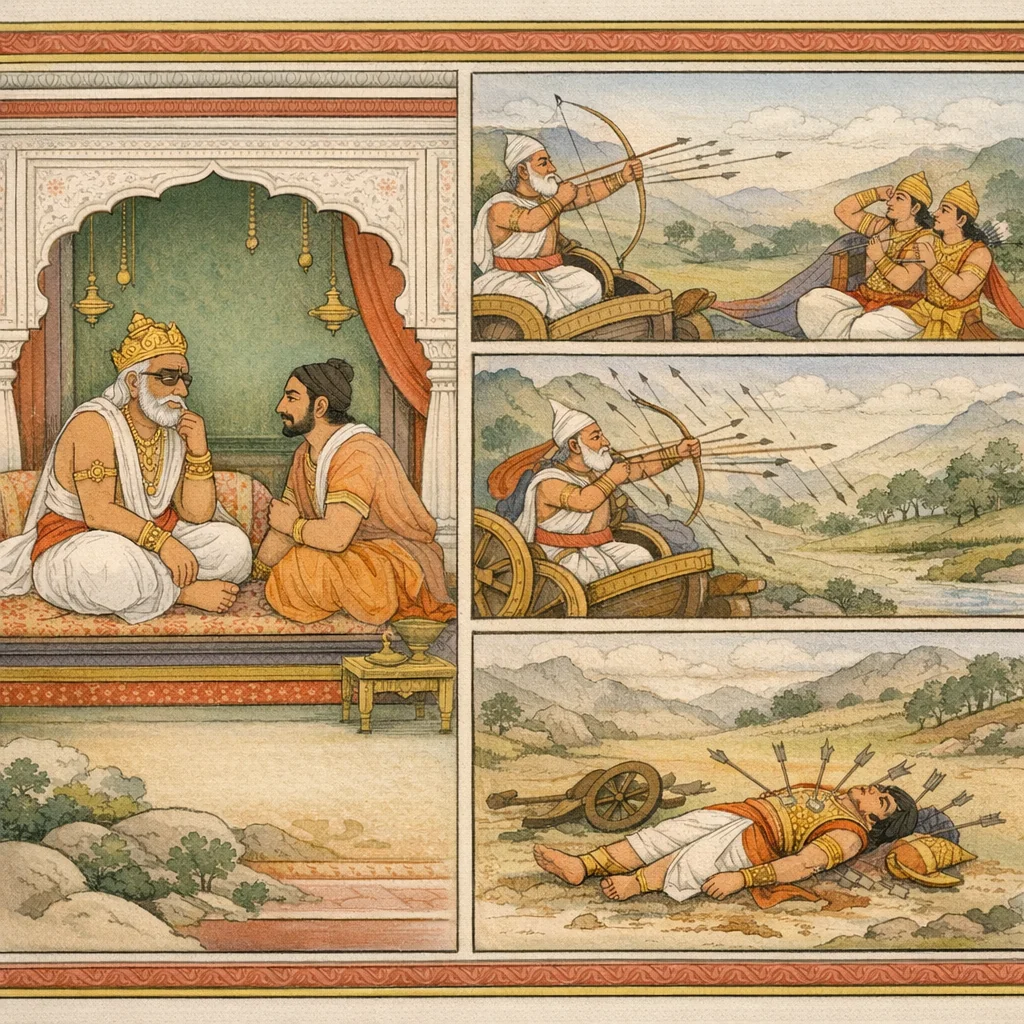
Saṃjaya reports that after Droṇa’s death and the frustration of Aśvatthāman’s immediate aims, Kaurava forces waver while the Pāṇḍavas re-form their array with the brothers. As evening approaches, the Kauravas withdraw to camp and convene in comfort to deliberate on collective advantage. Duryodhana invites rapid counsel; Droṇa’s son articulates a policy frame in which multiple means (rāga, yoga, dākṣya, naya) operate under daiva, discouraging despair and proposing a decisive remedy: appoint Karṇa as senāpati. Duryodhana addresses Karṇa with assurances of trust, recounting how Bhīṣma and Droṇa, due to age and prior regard for Arjuna, had constrained their pressure, and asserts that no equal to Karṇa remains for Kaurava victory. Karṇa accepts, reiterating prior promises to defeat the Pāṇḍavas with Kṛṣṇa. The kings then perform a rapid, rule-governed abhiṣeka with consecrated vessels and auspicious materials, and bards and priests proclaim victory-formulas. The chapter closes with Karṇa radiant in new authority, while Duryodhana considers his objective fulfilled and Karṇa orders preparations oriented to sunrise and renewed operations.
Chapter Arc: धृतराष्ट्र, शोक और जिज्ञासा से काँपते हुए, संजय से पूछते हैं—“मेरे और पाण्डु के कौन-कौन से प्रधान वीर रण में निहत हुए?” और कथा एक शोक-सूची की तरह नहीं, एक धधकते युद्ध-लेख की तरह खुलती है। → संजय क्रमशः उन-उन नामों का उच्चारण करते हैं जिनके साथ किसी कुल, किसी गण, किसी मित्र-मंडली का अंत जुड़ा है—कुन्तीपुत्रों के पक्ष के महाबली, उनके सहायक, अमात्य, और वे सैकड़ों ‘नारायण’ और ‘बलभद्र’ नामधारी शूर, जो भीष्म-भक्ति में पाण्डवों के प्रति अनुराग रखते हुए भी रण में गिर पड़े। हर नाम के साथ धृतराष्ट्र का भय बढ़ता है कि यह विनाश किस ओर झुकेगा। → वर्णन का शिखर उन प्रसंगों में आता है जहाँ एक-एक वीर का अंत किसी बड़े नाम से जुड़कर ‘युद्ध की क्रूर न्याय-प्रणाली’ बन जाता है—दौःशासन द्वारा रथहीन अभिमन्यु का वध; द्रोण द्वारा मित्रवर्मा, सुचित्र और चित्रवर्मा जैसे महारथियों का संहार; और पाण्डव-हित में पराक्रम करने वाले सत्यधृति का यमसादन गमन। यह क्षण धृतराष्ट्र के लिए केवल मृत्यु-सूचना नहीं, धर्म और अधर्म की सीमा-रेखा पर चोट है। → अध्याय का अंत एक व्यापक निष्कर्ष-भाव से होता है—रणभूमि में पराक्रम, कुल-परंपरा, मित्रता, और गुरु-शिष्य संबंध सब एक ही धूल में मिलते हैं; संजय की वाणी धृतराष्ट्र को यह दिखाती है कि युद्ध अब ‘व्यक्तियों’ का नहीं, ‘क्षय’ का नाम हो गया है। → धृतराष्ट्र के मन में अगला प्रश्न उभरता है—इन निहतों के बाद शेष सेनाएँ किसके नेतृत्व में कैसे टिकेंगी, और कौन-सा अधर्म/धर्म आगे निर्णायक बनेगा?
Shlokas
Verse 1
निज जा | पी ॥ #* +<€<< षष्ठो5 ध्याय: कौरवोंद्वारा मारे गये प्रधान-प्रधान पाण्डव-पक्षके वीरोंका परिचय धृतराष्ट्र रवाच आख्याता मामकास्तात निहता युधि पाण्डवै: । हतांश्व पाण्डवेयानां मामकैरब्रहि संजय,धृतराष्ट्रने कहा--तात संजय! तुमने युद्धमें पाण्डवोंद्वारा मारे गये मेरे पक्षके वीरोंके नाम बताये हैं। अब मेरे योद्धाओं द्वारा मारे गये पाण्डव-योद्धाओंका परिचय दो
Dhṛtarāṣṭra said: “Dear Sañjaya, you have already told me the names of my warriors who were slain in battle by the Pāṇḍavas. Now tell me, Sañjaya, which warriors of the Pāṇḍavas were killed by my men.”
Verse 2
संजय उवाच कुन्तयो युधि विक्रान्ता महासत्त्वा महाबला: । सानुबन्धा: सहामात्या गाज़ेयेन निपातिता:,संजयने कहा--राजन्! अत्यन्त धीर, महान् बलवान् और पराक्रमी जो कुन्तिभोजदेशके योद्धा थे, उन्हें गंगानन्दन भीष्मने मन्त्रियों तथा सगे-सम्बन्धियोंसहित मार गिराया
Sanjaya said: O King, the warriors of Kuntibhoja—valiant in battle, of great spirit and great strength—were struck down by Bhishma, the son of the Ganga, together with their attendants, allies, and ministers.
Verse 3
नारायणा बलभद्रा: शूराश्ष शतशो<5परे | अनुरक्ताश्न वीरेण भीष्मेण युधि पातिता:,पाण्डवोंमें अनुराग रखनेवाले जो नारायण और बलभद्र नामवाले सैकड़ों शूरवीर थे, उन्हें भी वीरवर भीष्मने युद्धमें धराशायी कर दिया
Sañjaya said: Hundreds of other heroic warriors named Nārāyaṇa and Balabhadra—devoted in affection to the Pāṇḍavas—were struck down in battle by the mighty Bhīṣma.
Verse 4
सम: किरीटिना संख्ये वीर्येण च बलेन च । सत्यजित् सत्यसंधेन द्रोणेन निहतो युधि,सत्यजित् संग्राममें किरीटधारी अर्जुनके समान बल और पराक्रमसे सम्पन्न था, जिसे युद्धस्थलमें सत्यप्रतिज्ञ द्रोणाचार्यने मार डाला
Sañjaya said: In the thick of battle, Satyajit—equal to the diadem-wearing Arjuna in prowess and in strength—was slain on the field by Droṇa, a man steadfast to his vow.
Verse 5
इस प्रकार श्रीमह्याभारत कर्णपर्वमें संजय-वाक्यविषयक पाँचवाँ अध्याय पूरा हुआ,पज्चालानां महेष्वासा: सर्वे युद्धविशारदा: । द्रोणेन सह संगम्य गता वैवस्वतक्षयम् युद्धकी कलामें कुशल सम्पूर्ण पांचाल महाधनुर्धर द्रोणाचार्यसे टक्कर लेकर यमलोकमें जा पहुँचे हैं
Sañjaya said: All the great bowmen of the Pañcālas, masters of the art of war, having met Droṇa in combat, went to the doom of Vaivasvata (Yama)—they reached the realm of Death.
Verse 6
तथा विराटट्रुपदौ वृद्धौी सहसुतौ नृपौ । पराक्रमन्तौ मित्रार्थे द्रोणेन निहतौ रणे,मित्रके लिये पराक्रम करनेवाले बूढ़े राजा विराट और ट्रुपद अपने पुत्रोंसहित द्रोणाचार्यके द्वारा रणभूमिमें मारे गये हैं इति श्रीमहा भारते कर्णपर्वणि संजयवाक्ये षष्ठोडध्याय:
Sañjaya said: “Thus, the aged kings Virāṭa and Drupada—together with their sons—while exerting their valor for the sake of their allies, were slain in battle by Droṇa.”
Verse 7
यो बाल एव समरे सम्मित: सव्यसाचिना । केशवेन च दुर्धर्षो बलदेवेन वा विभो
Sañjaya said: “He who, while still a mere boy, was already matched in battle by Savyasācin (Arjuna)—and who is hard to withstand even for Keśava (Kṛṣṇa) or for mighty Baladeva—O lord.”
Verse 8
परेषां कदनं कृत्वा महारथविशारद: । परिवार्य महामात्रै: षड़भि: परमकै रथै:
Sañjaya said: Having wrought great slaughter among the enemy, that master of the great chariot-warriors then moved about, surrounded by six eminent commanders in their finest chariots—an image of martial prowess and the grim momentum of war.
Verse 9
अशवनुवद्धिर्बीभत्सुमभिमन्युर्निपातित: । जो बाल्यावस्थामें ही दुर्धर्ष वीर था और सव्यसाची अर्जुन, भगवान् श्रीकृष्ण अथवा बलदेवजीके समान समझा जाता था तथा जो महान् रथयुद्धमें विशेष कुशल था, वह अभिमन्यु शत्रुओंका संहार करके छः: बड़े-बड़े महारथियोंद्वारा, जिनका अर्जुनपर वश नहीं चलता था, चारों ओरसे घेरकर मार डाला गया ।। ७-८ $ ।। कृतं त॑ विरथं वीरें क्षत्रधर्मे व्यवस्थितम्
Sañjaya said: Abhimanyu—whom the warriors compared to the formidable Bībhatsu (Arjuna), to Lord Śrī Kṛṣṇa, or even to Baladeva; who, though still in youth, was an unconquerable hero and exceptionally skilled in great chariot-combat—after cutting down enemies, was surrounded on all sides and slain by six mighty chariot-warriors, men whom Arjuna could not bring under his control. Thus they reduced that valiant fighter to a chariotless state, even as he stood firm in the duty of a kṣatriya.
Verse 10
सपत्नानां निहन्ता च महत्या सेनया वृतः
Sañjaya said: “He was a slayer of rival foes, and he stood surrounded by a vast army.” The line underscores the war-ethic of the epic: prowess is measured not only by personal valor but also by the strategic reality of being supported and enclosed by one’s forces in the unfolding conflict.
Verse 11
अम्बष्ठस्य सुतः श्रीमान् मित्रहेतो: पराक्रमन् । आसाद्य लक्ष्मणं वीर दुर्योधनसुतं रणे
Sañjaya said: The illustrious son of the Ambaṣṭha (caste), fighting for the sake of his ally Mitra, advanced and confronted the heroic Lakṣmaṇa, Duryodhana’s son, in the midst of battle. The episode underscores how, in war, loyalties and alliances drive men into direct conflict, where personal valor is tested against the bonds of friendship and obligation.
Verse 12
सुमहत् कदनं कृत्वा गतो वैवस्वतक्षयम् । शत्रुहन्ता श्रीमान् अम्बष्ठपुत्र अपनी विशाल सेनासे घिरकर मित्रोंके लिये पराक्रम दिखा रहा था। वह शत्रु-सेनाका महान् संहार करके रणभूमिमें दुर्योधनके वीर पुत्र लक्ष्मणसे टक्कर ले यमलोकमें जा पहुँचा ।। बृहन्तः सुमहेष्वास: कृतास्त्रो युद्धदुर्मद:
Sanjaya said: Having wrought a vast slaughter, the illustrious son of the Ambastha—though surrounded by a great host—displayed his valor for the sake of his allies. After inflicting a mighty destruction upon the enemy army, he met in battle on the field Duryodhana’s heroic son Lakshmana and, in the end, reached the realm of Yama. (He was) towering, a great archer, fully trained in weapons, and intoxicated with the fury of war.
Verse 13
मणिमान् दण्डधारश्न राजानौ युद्धदुर्मदौ
Sañjaya said: “Two kings—proud and intoxicated with the fury of battle—advanced: one adorned with jewels, the other bearing a staff-like weapon; the violence of war sharpened their arrogance.”
Verse 14
अंशुमान् भोजराजस्तु सहसैन्यो महारथ:
Sañjaya said: The Bhoja king Aṁśumān, a great chariot-warrior, advanced with a force numbering in the thousands—signaling the swelling momentum of battle, where royal duty and martial resolve drive leaders to commit their troops despite the grave cost.
Verse 15
सामुद्रश्चित्रसेनश्व सह पुत्रेण भारत
Sañjaya said: “O Bhārata, Sāmudra and Citrasena too—along with his son—(were present/advanced in the battle).”
Verse 16
अनूपवासी नीलकश्न व्याप्रदत्तश्न॒ वीर्यवान्
Sañjaya said: Among them was Anūpavāsī, and also Nīlakaśna—along with Vyāpradatta, a man of great valor.
Verse 17
चित्रायुथश्चित्रयोधी कृत्वा च कदनं महत्
Sañjaya said: Citrāyudha, the variegated and formidable warrior, wrought a great slaughter—intensifying the chaos of battle and underscoring how prowess, when yoked to war, multiplies suffering on both sides.
Verse 18
वृकोदरसमो युद्धे वृतः कैकेययोधिभि:
Sañjaya said: In the thick of battle, a warrior equal to Vṛkodara (Bhīma) was surrounded by the fighters of the Kaikeya country—showing how even the mightiest are tested when many close in at once, and how courage and duty under dharma are measured amid overwhelming odds.
Verse 19
जनमेजयो गदायोधी पर्वतीय: प्रतापवान्
Sañjaya said: “Janamejaya was a mighty warrior skilled with the mace—mountain-like in strength and radiant with valor.”
Verse 20
दुर्मुखेन महाराज तव पुत्रेण पातित: । महाराज! प्रतापी पर्वतीय राजा जनमेजय गदायुद्धमें कुशल थे। उन्हें आपके पुत्र दुर्मुखने धराशायी कर दिया ।। रोचमानौ नरव्याप्रौ रोचमानौ ग्रहाविव
Sañjaya said: O great king, that warrior was struck down by your son Durmukha. Those two tiger-like men, radiant in their prowess, had shone like two planets—yet in the harsh moral economy of war, even the illustrious fall when overmatched in the press of battle.
Verse 21
द्रोणेन युगपद् राजन् दिवं सम्प्रापितौ शरै: । राजन्! दो चमकते हुए ग्रहोंके समान नरश्रेष्ठ रोचमान, जो एक ही नामके दो भाई थे, द्रोणाचार्यके द्वारा बाणोंसे एक साथ ही स्वर्गलोक पहुँचा दिये गये ।। नृपाश्च प्रतियुध्यन्त: पराक्रान्ता विशाम्पते
Sañjaya said: O King, by Droṇa’s arrows two warriors were sent to heaven at the very same moment. Shining like a pair of radiant planets, those foremost of men—two brothers bearing the same name—were struck down together by Droṇācārya and attained the heavenly world. And, O lord of the people, other kings too, mighty in valor, continued to fight on in return.
Verse 22
पुरुजित् कुन्तिभोजश्न मातुलौ सव्यसाचिन:
Sañjaya said: Purujit and Kuntibhoja—both maternal uncles of the ambidextrous Arjuna, Savyasācī—were present, marking the kinship ties that bind even as war compels relatives to stand amid opposing duties.
Verse 23
संग्रामनिर्जिताँललोकान् गमितौ द्रोणसायकै: । पुरुजित् और कुन्तिभोज दोनों सव्यसाची अर्जुनके मामा थे। द्रोणाचार्यके सायकोंने उन्हें भी उन लोकोंमें पहुँचा दिया, जो संग्राममें मारे जानेवाले वीरोंको प्राप्त होते हैं || २२ ई || अभिभू: काशिराजश्व काशिकैर्बहुभिवृत:
Sañjaya said: Purujit and Kuntibhoja—both maternal uncles of Arjuna, the ambidextrous archer—were sent by Droṇa’s arrows to those worlds attained by heroes who fall in battle. Likewise Abhibhū, and the king of Kāśī, surrounded by many Kāśika warriors, are named in the continuing account of the slaughter on the field—where valor is honored even as war rends kinship and duty.
Verse 24
अमितौजा युधामन्युरुत्तमौजाश्न वीर्यवान्,निहत्य शतश: शूरानस्मदीयैर्निपातिता: । अमितौजा, युधामन्यु तथा पराक्रमी उत्तमौजा ये सैकड़ों शूरवीरोंका संहार करके हमारे सैनिकोंद्वारा मारे गये
Sañjaya said: The mighty Amitaujā, Yudhāmanyu, and the valiant Uttamaujā—after slaying hundreds of warriors—were themselves struck down by our troops. Thus even great prowess on the battlefield meets its limit amid the relentless reciprocity of war.
Verse 25
मित्रवर्मा च पाउ्चाल्य: क्षत्रधर्मा च भारत
Sañjaya said: “Mitravarmā, and the Pāñcāla warrior, and Kṣatradharmā as well—O Bhārata—(were there).” The line continues the battlefield roll-call, naming kṣatriyas whose identity is bound to martial duty (kṣatra-dharma) in the unfolding war.
Verse 26
शिखण्डितनयो युद्धे क्षत्रदेवो युधां पति:
Sañjaya said: “In the midst of battle, the son of Śikhaṇḍī—like a very god among warriors—stood forth as a lord of combat.”
Verse 27
सुचित्रश्नित्रवर्मा च पितापुत्रो महारथौ
Sañjaya said: “Sucitra and Mitravarmā as well—father and son—both great chariot-warriors (mahārathas).” The line continues the battlefield catalogue, underscoring how entire lineages are drawn into the war, where inherited loyalties and martial duty bind families to the same perilous cause.
Verse 28
वार्द्धक्षेमिर्महाराज समुद्र इव पर्वणि
Sañjaya said: “O great king, Vārddhakṣemi swelled up like the ocean at the time of the full-moon tide,” betokening a surge of power and confidence amid the war’s shifting fortunes.
Verse 29
सेनाविन्दुसुतः श्रेष्ठ: शात्रवान् प्रहरन् युधि
Sañjaya said: In the thick of battle, the excellent son of Senāvindu struck down his foes, pressing the fight with resolute martial vigor—an image of prowess that, in the Mahābhārata’s ethical frame, also shows how valor may be praised even as it serves the grim machinery of fratricidal war.
Verse 30
धृष्टकेतुर्महाराज चेदीनां प्रवरो रथ:
Sañjaya said: “O great king, Dhṛṣṭaketu—the foremost among the Cedi warriors—was a chariot-fighter (ratha) of distinction.”
Verse 31
तथा सत्यधृतिर्वीर: कृत्वा कदनमाहवे
Sañjaya said: “Thus the heroic Satyadhṛti, having wrought great slaughter in the battle, stood forth as a formidable warrior—an image of valor and grim resolve amid the moral weight of war.”
Verse 32
सेनाबिन्दु: कुरुश्रेष्ठ कृत्वा कदनमाहवे,कुरुश्रेष्ठ! सेनाविन्दु भी युद्धमें शत्रुओंका संहार करके कालके गालमें चला गया। शिशुपालका पुत्र राजा सुकेतु भी युद्धमें शत्रुसैनिकोंका वध करके स्वयं भी द्रोणाचार्यके हाथसे मारा गया
Sañjaya said: “O best of the Kurus, Senābindu, after causing great slaughter in the battle, went into the jaws of Time (Kāla). And King Suketu, the son of Śiśupāla, having slain enemy soldiers in the fight, was himself also killed by the hand of Droṇācārya. The passage underscores the grim reciprocity of war: prowess brings destruction, yet even the mighty are finally claimed by inexorable Time.”
Verse 33
पुत्रस्तु शिशुपालस्य सुकेतु: पृथिवीपति: । निहत्य शात्रवान् संख्ये द्रोणेन निहतो युधि,कुरुश्रेष्ठ! सेनाविन्दु भी युद्धमें शत्रुओंका संहार करके कालके गालमें चला गया। शिशुपालका पुत्र राजा सुकेतु भी युद्धमें शत्रुसैनिकोंका वध करके स्वयं भी द्रोणाचार्यके हाथसे मारा गया
Sañjaya said: O best of the Kurus, Śiśupāla’s son—King Suketu—after slaying many foes in the press of battle, was himself struck down in combat by Droṇa. Thus, even a valiant ruler who fulfills the warrior’s duty by fighting fiercely meets the impartial end that war brings, where prowess and fate converge and death comes without regard to lineage.
Verse 34
तथा सत्यधूृतिर्वीरो मदिराश्चश्न वीर्यवान् सूर्यदत्तश्न विक्रान्तो निहतो द्रोणसायकै:,इसी प्रकार वीर सत्यधृति, पराक्रमी मदिराश्व और बल-विक्रमशाली सूर्यदत्त भी द्रोणाचार्यके बाणोंसे मारे गये हैं
Sañjaya said: In the same manner, the heroic Satyadhṛti, the valiant Madirāśva, and the mighty and daring Sūryadatta were slain by the arrows of Droṇa. The narration underscores the grim impartiality of battle: even renowned warriors, despite courage and prowess, fall when confronted by superior skill and fate on the field, reminding the listener of the heavy moral cost of war and the fragility of worldly power.
Verse 35
श्रेणिमांश्न महाराज युध्यमान: पराक्रमी | कृत्वा नसुकरं कर्म गतो वैवस्वतक्षयम्,महाराज! पराक्रमपूर्वक युद्ध करनेवाले श्रेणिमानने युद्धमें दुष्कर कर्म करके यमलोकके मार्गका आश्रय लिया है
Sañjaya said: O great king, the valiant Śreṇimān, fighting with heroic prowess, performed a deed difficult to accomplish in battle and then went to the abode of Vaivasvata (Yama). The report underscores the grim moral economy of war: even courageous achievement on the battlefield culminates in death, reminding the listener that martial glory is inseparable from mortality and the consequences of violent duty.
Verse 36
तथैव युधि विक्रान्तो मागध: परमास्त्रवित् भीष्मेण निहतो राजउ्शेतेड्द्य परवीरहा,राजन! इसी प्रकार शत्रुवीरोंका संहार करनेवाला और उत्तम अस्त्रोंका ज्ञाता पराक्रमी मागध वीर भी भीष्मजीके हाथसे मारा जाकर आज रणभूमिमें सो रहा है
Sañjaya said: “So too, O King, that valiant Magadhan—slayer of enemy heroes and master of the highest weapons—has been struck down by Bhīṣma, and today lies upon the battlefield.”
Verse 37
विराटपुत्र: शड्खस्तु उत्तरश्न महारथ: । कुर्वन्तौ सुमहत् कर्म गतौ वैवस्वतक्षयम्,राजा विराटके पुत्र शंख और महारथी उत्तर ये दोनों युद्धमें महान् कर्म करके यमलोकमें जा पहुँचे हैं
Sañjaya said: Virāṭa’s son Śaṅkha, and Uttara the great chariot-warrior—having performed mighty deeds in battle—went to the abode of Vaivasvata (Yama). The line underscores the Mahābhārata’s sober ethic of war: valor and duty may be fulfilled, yet the battlefield’s outcome is death, and even renowned fighters are carried to Yama’s realm.
Verse 38
वसुदानश्च कदनं कुर्वाणो$तीव संयुगे | भारद्वाजेन विक्रम्य गमितो यमसादनम्,वसुदान भी युद्धस्थलमें बड़ा भारी संहार मचा रहा था। परंतु भरद्वाजनन्दन द्रोणने पराक्रम करके उसे यमलोक पहुँचा दिया
Sañjaya said: Vasudāna, wreaking fierce slaughter in the thick of battle, met the valor of Bhāradvāja’s son (Droṇa); by decisive prowess he was sent to Yama’s abode.
Verse 39
(पाण्ड्यराजश्च विक्रान्तो बलवान् बाहुशालिना | अश्वत्थाम्ना हतस्तत्र गमितो वै यमक्षयम् ।।) अपने बाहुबलसे सुशोभित होनेवाले अश्व॒त्थामाने बलवान् एवं पराक्रमी पाण्ड्यराजको मारकर यमलोक पहुँचा दिया । एते चान्ये च बहव: पाण्डवानां महारथा: । हता द्रोणेन विक्रम्य यन्मां त्वं परिपृच्छसि,ये तथा और भी बहुत-से पाण्डव महारथी, जिनके बारेमें आप मुझसे पूछ रहे थे, द्रोणाचार्यके द्वारा बलपूर्वक मार डाले गये
Sañjaya said: There, the valiant and mighty king of the Pāṇḍyas was slain by Aśvatthāman, famed for the strength of his arms, and sent to Yama’s abode. And many other great chariot-warriors of the Pāṇḍavas—about whom you ask me—were likewise cut down by Droṇa with force in battle.
Verse 96
दौ:शासनिर्महाराज सौभद्रं हतवान् रणे । महाराज! क्षत्रिय-धर्ममें तत्पर रहनेवाला वीर सुभद्राकुमार अभिमन्यु रथहीन कर दिया गया था, उस अवस्थामें दुःशासनके पुत्रने उसे रणभूमिमें मारा था
Sañjaya said: O King, the son of Duhśāsana slew Saubhadra in battle. Though Abhimanyu—the heroic son of Subhadra—was steadfast in kṣatriya-dharma, he had been deprived of his chariot; and in that helpless state, Duhśāsana’s son killed him on the battlefield.
Verse 126
दुःशासनेन विक्रम्य गमितो यमसादनम् | अस्त्र-विद्याके विशेषज्ञ रणदुर्मद महाथनुर्धर बृहन्तको दुःशासनने बलपूर्वक यमलोक पहुँचाया था
Sañjaya said: Having overpowered him with force, Duḥśāsana sent him to Yama’s abode. The mighty archer Bṛhantaka—expert in the science of weapons and fiercely intoxicated by battle—was driven by Duḥśāsana to the world of death.
Verse 133
पराक्रमन्तौ मित्रार्थे द्रोणेन युधि पातितौ । युद्धमें उनन््मत्त होकर जूझनेवाले राजा मणिमान् और दण्डधार मित्रोंके लिये पराक्रम दिखाते थे। उन दोनोंको द्रोणाचार्यने युद्धमें मार गिराया है
Sañjaya said: “Those two, exerting their valor for the sake of their friends, were struck down in battle by Droṇa.” In the fight, King Maṇimān and Daṇḍadhāra, battling as if maddened by war, were felled by Droṇa.
Verse 143
भारद्वाजेन विक्रम्य गमितो यमसादनम् । सेनासहित भोजराज महारथी अंशुमानको भरद्वाजनन्दन द्रोणने पराक्रम करके यमलोक पहुँचाया है
Sañjaya said: Overpowered by the valor of Bhāradvāja’s son (Droṇa), the Bhoja king Aṁśumānaka—an eminent chariot-warrior—was sent to Yama’s abode together with his troops.
Verse 153
समुद्रसेनेन बलाद् गमितो यमसादनम् | भारत! समुद्रतटवर्ती राज्यके अधिपति चित्रसेन अपने पुत्रके साथ युद्धमें आकर समुद्रसेनके द्वारा बलपूर्वक यमलोक भेज दिया गया
Sañjaya said: O Bharata, the coastal king Chitrasena, coming to battle together with his son, was overpowered by Samudrasena and forcibly sent to Yama’s abode.
Verse 163
अश्वत्थाम्ना विकर्णेन गमितो यमसादनम् | समुद्रतटटवासी नील और पराक्रमी व्याप्रदत्त--इन दोनोंको क्रमश: अश्वत्थामा और विकर्णने यमलोक पहुँचा दिया
Sañjaya said: By Aśvatthāmā and by Vikarṇa he was sent to Yama’s abode—slain in battle. Nīla of the seacoast and the valiant Vyāpradatta, those two in turn were dispatched to Yama’s realm by Aśvatthāmā and Vikarṇa.
Verse 173
चित्रमार्गेण विक्रम्य विकर्णेन हतो मृथे । विचित्र युद्ध करनेवाले चित्रायुध समरमें विचित्र रीतिसे पराक्रम करते हुए कौरव- सेनाका महान् संहार करके अन्तमें विकर्णके हाथसे मारे गये
Sañjaya said: Advancing with a striking, unconventional style of combat, he displayed remarkable valor on the battlefield. After causing great destruction among the Kaurava forces through his extraordinary fighting, he was finally slain in the melee by Vikarṇa.
Verse 183
कैकेयेन च विक्रम्य भ्रात्रा भ्राता निपातित: । केकयदेशीय योद्धाओंसे घिरे हुए भीमके समान पराक्रमी केकयराजकुमारको उन्हींके भाई दूसरे केकयराजकुमारने बलपूर्वक मार गिराया
Sañjaya said: Advancing with force, one Kaikeya brother struck down his own brother. Though that Kaikeya prince was a warrior of great prowess—like Bhīma amid surrounding Kekaya fighters—he was felled by the might of his own brother.
Verse 216
कृत्वा नसुकरं कर्म गता वैवस्वतक्षयम् । प्रजानाथ! और भी बहुत-से पराक्रमी नरेश आपकी सेनाका सामना करते हुए दुष्कर पराक्रम करके यमलोकमें जा पहुँचे हैं
Sañjaya said: “Having performed deeds not easy to accomplish, many mighty kings have gone to the abode of Vaivasvata (Yama). O lord of peoples, many other valiant rulers too, while confronting your army, displayed arduous heroism and reached Yama’s realm.”
Verse 236
वसुदानस्य पुत्रेण न्यासितो देहमाहवे । काशिराज अभिभेू बहुतेरे काशीनिवासी योद्धाओंसे घिरे हुए थे। वसुदानके पुत्रने युद्धस्थलमें उनसे उनके शरीरका परित्याग करवा दिया
Sañjaya said: “Surrounded by many warriors from Kāśī and hard-pressed in the press of battle, the king of Kāśī was made to lay down his body on the battlefield by the son of Vasudāna.”
Verse 263
लक्ष्मणेन हतो राजंस्तव पौत्रेण भारत । भरतवंशी नरेश! आपके पौजत्र लक्ष्मणने युद्धमें योद्धाओंके स्वामी क्षत्रदेवको, जो शिखण्डीका पुत्र था, मार डाला
Sañjaya said: “O King, O scion of Bharata, your grandson Lakṣmaṇa has slain the warrior-lord Kṣatradeva in battle—the son of Śikhaṇḍī.”
Verse 286
आयुधक्षयमासाद्य प्रशान्तिं परमां गत: । महाराज! जैसे पूर्णिमाके दिन समुद्र उमड़ पड़ता है, उसी प्रकार वृद्धक्षेमका पुत्र भी युद्धमें उद्धत हो उठा था, परंतु उसके सारे अस्त्र-शस्त्र नष्ट हो गये थे, इसलिये वह प्राणशून्य हो सदाके लिये परम शान्त हो गया
Sañjaya said: “O great king, when he had reached the exhaustion of his weapons, he passed into the highest stillness. Just as the ocean swells on the day of the full moon, so too did the son of Vṛddhakṣema surge up in battle with fierce ardor; but when all his missiles and weapons were destroyed, he became bereft of life and entered lasting, supreme peace.”
Verse 296
बाह्विकेन महाराज कौरवेन्द्रेण पातित: । राजाधिराज! सेनाविन््दुका श्रेष्ठ पुत्र रणभूमिमें शत्रुओंपर प्रहार कर रहा था। उस समय कौरवेन्द्र बाह्नीकने उसे मार गिराया
Sañjaya said: “O King, that warrior—Senāvinduka’s foremost son—was striking down enemies on the battlefield. At that moment, the Kuru lord Bāhlīka brought him down, felling him in combat.”
Verse 306
कृत्वा नसुकरं कर्म गतो वैवस्वतक्षयम् । महाराज! चेदिदेशका श्रेष्ठ रथी धृष्टकेतु भी युद्धमें दुष्कर कर्म करके यमलोकका पथिक हो गया
Sañjaya said: O great king, Dhṛṣṭaketu—an excellent chariot-warrior—having accomplished a deed not easy to perform, and after carrying out a formidable act in battle, went to the abode of Vaivasvata (Yama).
Verse 316
पाण्डवार्थे पराक्रान्तो गमितो यमसादनम् । पाण्डवोंके लिये पराक्रम प्रकट करनेवाले वीर सत्यधृतिने भी रणभूमिमें शत्रुओंका संहार करके यमलोककी राह ली
Sañjaya said: Having exerted his valor for the sake of the Pāṇḍavas, and after slaying enemies on the battlefield, the warrior Satyadhṛti was sent to Yama’s abode, going the way of death.
Verse 2536
द्रोणेन परमेष्वासौ गमितौ यमसादनम् । भारत! पांचालयोद्धा मित्रवर्मा और क्षत्रधर्मा महाधनुर्धर थे। उन्हें भी द्रोणाचार्यने यमलोक पहुँचा दिया
Sañjaya said: O Bhārata, Droṇa—the supreme archer—sent them to the abode of Yama. The Pāñcāla warrior Mitravarmā, steadfast in the kṣatriya code and a mighty wielder of the great bow, was likewise dispatched by Droṇācārya to Yama’s realm.
Verse 2736
प्रचरन्तौ महावीरौ द्रोणेन निहतौ रणे । सुचित्र और चित्रवर्मा ये दो महावीर महारथी परस्पर पिता-पुत्र थे। रणभूमिमें विचरते हुए इन दोनोंको द्रोणाचार्यने मार डाला
Sañjaya said: As those two great heroes ranged across the battlefield, they were slain in combat by Droṇa. Sucitra and Citravarmā—two mighty mahārathas who were father and son—were cut down by Droṇācārya while they moved about the field of war.
Frequently Asked Questions
The dilemma is institutional: how to restore command legitimacy and operational coherence after the death of senior commanders, balancing human strategy (naya/upāya) with the narrative insistence that outcomes remain conditioned by daiva.
The chapter teaches disciplined resolve: despair is rejected, and prudent means—skill, coordination, and policy—should be pursued while recognizing the epic’s larger framework of fate and accumulated consequence.
No explicit phalaśruti appears in this chapter; its meta-function is archival and political, documenting how speech-acts and ritual consecration generate authority within the war narrative.