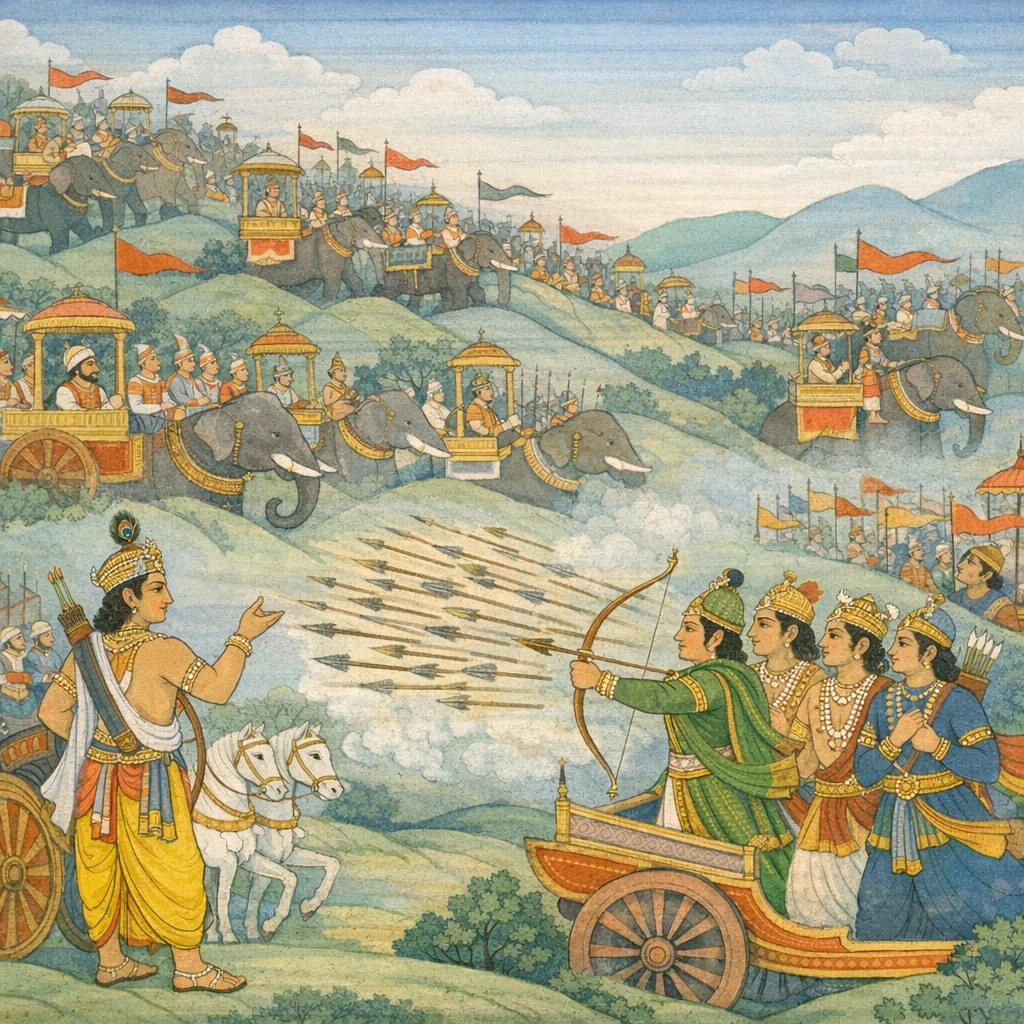
Adhyaya 46
Karṇa-vadha-pratyaya: Yudhiṣṭhira’s Verification of Karṇa’s Fall (कर्णवध-प्रत्ययः)
Upa-parva: Karṇa-nidhana-śravaṇa (Aftermath Report and Yudhiṣṭhira’s Inquiry)
Sañjaya frames the scene as Kṛṣṇa and Arjuna arrive together, prompting the inference that Karṇa has been neutralized. Yudhiṣṭhira receives them with formal welcome and immediate scrutiny: he asks how they returned uninjured after confronting a highly skilled charioteer-warrior described as the Kaurava vanguard, protected by prominent allies, and empowered by prior martial training. The chapter then shifts into a sustained interrogative catalogue (kaccit…): Yudhiṣṭhira repeatedly seeks confirmation that Karṇa lies defeated, dismembered by arrows, and that the psychological pillar supporting Duryodhana has been broken. Interwoven are Yudhiṣṭhira’s disclosures of long-term fear, insomnia, and shame—an archival record of the war’s interior cost—alongside recollections of Karṇa’s earlier public insults and boasts. The thematic center is epistemic closure: the king requires a complete causal account (kārtsnya) of the method and conditions by which Karṇa, portrayed as near-invincible, was overcome, so that personal anguish may be pacified and the polity’s narrative stabilized.
Chapter Arc: धृतराष्ट्र की अतृप्त जिज्ञासा—वे संजय से कहते हैं कि वीरों के रण-विक्रम का विस्तृत वर्णन करो; सुनकर भी मन नहीं भरता। → संजय बताता है कि दुर्योधन की दुरनीति से उत्पन्न संकट को देखकर अर्जुन ने प्रतिशत्रु-बल के सामने व्यूह-प्रतिव्यूह रचा। उधर धृष्टद्युम्न और द्रौपदीपुत्र दिव्य कवच-आयुधों से दीप्त, तारागणों सहित चन्द्रमा-से, युद्ध को उमड़ते हैं। कौरव पक्ष में कर्ण के चारों ओर दुर्योधन की रक्षा-व्यवस्था कसती जाती है; कृप, कृतवर्मा और शकुनि जैसे रथी उग्र होकर प्रहार में लगते हैं। → कर्ण अपनी तीक्ष्ण बाण-वृष्टि से पाण्डव-सेना को सहस्रों की संख्या में विवस्त्र-निरायुध-देहासु (अस्त्र-शस्त्र-विहीन, प्राण-शून्य) कर देता है; बड़े-बड़े रथियों को रज में मिला कर युधिष्ठिर तक को पीड़ित करता है—रण का पलड़ा कौरवों की ओर झुकता दिखता है। → अध्याय का अंत एक निर्णायक वध-समाप्ति पर नहीं, बल्कि ‘धर्म्य, स्वर्ग्य, यशस्कर’ कहे गए संहारक युद्ध के व्यापक चित्र पर टिकता है—जहाँ विभिन्न वर्णों के वीर भी रण-धर्म में प्राण देते हैं और दोनों सेनाएँ उन्मत्त वेग से भिड़ी रहती हैं। → कर्ण द्वारा युधिष्ठिर पर बढ़ते दबाव और कौरव-रक्षा-चक्र के बीच प्रश्न खुला रह जाता है—पाण्डव पक्ष इस प्रचण्ड आघात का प्रत्युत्तर किस प्रकार देगा?
Shlokas
Verse 1
/ (दाक्षिणात्य अधिक पाठके १६ श्लोक मिलाकर कुल १०३ श्लोक हैं) अपन ह< बक। है २ 2 सप्तचत्वारिशो<् ध्याय: कौरवों और पाण्डवोंकी सेनाओंका भयंकर युद्ध तथा अर्जुन और कर्णका पराक्रम धृतराष्ट्र रवाच तथा व्यूढेष्वनीकेषु संसक्तेषु च संजय । संशप्तकान् कथं पार्थो गत: कर्णश्र॒ पाण्डवान्,धृतराष्ट्रने पूछा--संजय! इस प्रकार जब सारी सेनाओंकी व्यूह-रचना हो गयी और दोनों दलोंके योद्धा परस्पर युद्ध करने लगे, तब कुन्तीपुत्र अर्जुनने संशप्तकोंपर और कर्णने पाण्डव-योद्धाओंपर कैसे धावा किया?
Dhṛtarāṣṭra said: “O Sañjaya, when the battle-formations had been fully arrayed and the opposing armies had closed in combat, how did Pārtha (Arjuna) advance against the Saṃśaptakas, and how did Karṇa press his attack upon the Pāṇḍava warriors?”
Verse 2
एतदू विस्तरशो युद्ध प्रब्रूहि कुशलो हासि । न हि तृप्यामि वीराणां शृण्वानो विक्रमान् रणे,सूत! तुम युद्धसम्बन्धी इस समाचारका विस्तार-पूर्वक वर्णन करो, क्योंकि इस कार्यमें कुशल हो। रणभूमिमें वीरोंके पराक्रमका वर्णन सुनकर मुझे तृप्ति नहीं हो रही है
Śalya said: “Tell me this account of the battle in full detail—you are skilled in such narration. For I am not satisfied; as I listen to the heroic feats of warriors on the battlefield, my desire to hear more does not abate, O charioteer.”
Verse 3
संजय उवाच तदास्थितमवज्ञाय प्रत्यमित्रबलं महत् । अव्यूहतार्जुनो व्यूहं पुत्रस्य तव दुर्नये,संजयने कहा--महाराज! आपके पुत्रकी दु्नीतिके कारण शत्रुओंकी उस विशाल सेनाको युद्धमें उपस्थित जानकर अर्जुनने अपनी सेनाका भी व्यूह बनाया
Sañjaya said: Then, seeing the enemy host drawn up in great strength—and not making light of it—Arjuna arrayed his own forces in battle-formation, in response to the misguided policy of your son.
Verse 4
तत् सादिनागकलिलं पदातिरथसंकुलम् | धृष्टद्युम्नमुखं व्यूहमशो भत महद् बलम्,घुड़सवारों, हाथियों, रथों तथा पैदलोंसे भरे हुए उस व्यूहके मुखभागमें धृष्टद्युम्न खड़े थे, जिससे उस विशाल सेनाकी बड़ी शोभा हो रही थी
Sañjaya said: That great army shone splendidly as a battle-formation densely packed with horsemen and elephants, and crowded with infantry and chariots; at the very front of that array stood Dhṛṣṭadyumna, giving it both order and brilliance in the midst of war’s tumult.
Verse 5
पारावतसवर्णाश्विश्रन्द्रादित्यसमद्युति: । पार्षत: प्रबभौ धन््वी कालो विग्रहवानिव
Sañjaya said: With horses the color of doves and a radiance like the Moon and the Sun, the son of Pṛṣata (Dhṛṣṭadyumna), bow in hand, blazed forth—like Time itself embodied, come to take form amid the battle.
Verse 6
कबूतरके समान रंगवाले घोड़ोंसे युक्त और चन्द्रमा तथा सूर्यके समान तेजस्वी धनुर्धर वीर द्रुपदकुमार धृष्टद्युम्न वहाँ मूर्तिमान् कालके समान जान पड़ते थे ।। पार्षतं जुगुपुः सर्वे द्रौपदेया युयुत्सव: । दिव्यवर्मायुधधरा: शार्टूलसमविक्रमा:
Sañjaya said: All the sons of Draupadī, eager for battle, closed in around Dhṛṣṭadyumna, the son of Pṛṣata (Drupada). Clad in celestial armour and bearing splendid weapons, they advanced with tiger-like prowess—forming a protective and formidable ring around their commander.
Verse 7
सानुगा दीप्तवपुषश्चन्द्रं तारागणा इव । दिव्य कवच और आयुध धारण किये, सिंहके समान पराक्रमी सेवकोंसहित समस्त द्रौपदीपुत्र युद्धके लिये उत्सुक हो धृष्टद्युम्नकी रक्षा करने लगे, मानो तेजस्वी शरीरवाले नक्षत्र चन्द्रमाका संरक्षण कर रहे हों ।। अथ व्यूक्ेष्वनीकेषु प्रेक्ष्य संशप्तकान् रणे
Sañjaya said: Accompanied by their attendants, the sons of Draupadī—radiant in form, clad in divine armor and bearing weapons—stood with lion-like valor, eager for battle, and began to guard Dhṛṣṭadyumna. They seemed like bright stars protecting the moon. Then, when the battle-formations had been arrayed, seeing the Samsaptakas in the fight…
Verse 8
क्रुद्धोर्जुनो अभिदुद्राव व्याक्षिपन् गाण्डिवं धनु: । इस प्रकार सेनाओंकी व्यूह-रचना हो जानेपर रणभूमिमें संशप्तकोंकी ओर देखकर क्रोधमें भरे हुए अर्जुनने गाण्डीव धनुषकी टंकार करते हुए उनपर आक्रमण किया ।। ७६ || अथ संशप्तका: पार्थमभ्यधावन् वधैषिण:
Sañjaya said: Enraged, Arjuna rushed forward, brandishing the Gāṇḍīva bow. When the armies had set their battle-formations on the field, he looked toward the Saṃśaptakas and, filled with wrath, made the Gāṇḍīva thunder as he attacked them. Then the Saṃśaptakas—bent on killing—charged straight at Pārtha.
Verse 9
तन्नराश्वौघबहुलं मत्तनागरथाकुलम्
Sañjaya said: “It was a dense, surging mass of men and horses, crowded with chariots and intoxicated elephants—an overwhelming press of war-traffic where force and confusion swelled together.”
Verse 10
स सम्प्रहारस्तुमुलस्तेषामासीत् किरीटिना
Sañjaya said: Between them the clash became fierce and tumultuous, driven on by the Kirīṭin (Arjuna).
Verse 11
रथानश्चान् ध्वजान् नागान् पतीन् रणगतानपि,चिच्छेद द्विषतां पार्थ: शिरांसि च सहस्रश: । तदनन्तर कुन्तीकुमार अर्जुनने रणस्थलमें आये हुए शत्रुपक्षके रथों, घोड़ों, ध्वजों हाथियों और पैदलोंको भी काट डाला, उन्होंने शत्रुओंके धनुष, बाण, खड्ग, चक्र, फरसे, आयुधोंसहित उठी हुई भुजा, नाना प्रकारके अस्त्र-शस्त्र तथा सहस्रों मस्तक काट गिराये
Sañjaya said: Then Pārtha (Arjuna) cut down the enemy’s chariots, horses, banners, elephants, and even the foot-soldiers who had entered the battlefield; and he severed the heads of the hostile warriors by the thousand.
Verse 12
इषून् धनूंषि खड्गांश्व चक्राणि च परश्चधान् | सायुधानुद्यतान् बाहून् विविधान्यायुधानि च
Sañjaya said: “There were arrows, bows, swords, and discus-weapons, and also battle-axes; arms were raised, already armed—bearing weapons of many kinds.”
Verse 13
तस्मिन् सैन्यमहावर्ते पातालतलसंनिभे
Sañjaya said: In that vast, whirling surge of armies—dark and dreadful, like the depths of Pātāla—the battlefield appeared as a churning abyss, drawing countless lives into ruin. The line evokes the moral horror of war: when collective fury and ambition gather, the field itself becomes a hell-like vortex that swallows discernment and compassion.
Verse 14
स पुनस्तानरीन् हत्वा पुनरुत्तरतोडवधीत्
Sañjaya said: Having slain those enemies, he again struck down others who were advancing from the northern side. The verse underscores the relentless momentum of battle—victory here is measured by repeated, forceful action, while the ethical tension of war remains implicit: prowess and duty in combat unfold amid continual taking of life.
Verse 15
दक्षिणेन च पश्चाच्च क्रुद्धो रुद्र: पशूनिव । तत्पश्चात् उन शत्रुओंका वध करके पुनः अर्जुनने कुपित हो उत्तर, दक्षिण और पश्चिमकी ओरसे आपकी सेनाका उसी प्रकार संहार आरम्भ किया, जैसे प्रलयकालमें रुद्रदेव पशुओं (जगतके प्राणियों)-का विनाश करते हैं ।। १४ ई ।। अथ पज्चालचेदीनां सूंजयानां च मारिष
Sañjaya said: Enraged, like Rudra destroying living beings at the time of cosmic dissolution, Arjuna—after slaying his foes—again, in wrath, began to cut down your army from the north, the south, and the west. Then, O revered one, he turned upon the Pāñcālas, the Cedis, and the Sṛñjayas as well.
Verse 16
कृपश्च कृतवर्मा च शकुनिश्चापि सौबल:,शूरसेनै: शूरवरैर्युयुधुर्युद्धदुर्मदा: । रथियोंकी सेनामें प्रहार करनेमें कुशल कृपाचार्य, कृतवर्मा और सुबलपुत्र शकुनि--ये रणदुर्मद वीर अत्यन्त कुपित हो हर्षमें भरी हुई सेना साथ लेकर कोसल काशि, मत्स्य, करूष, केकय तथा शूरसेनदेशीय शूरवीरोंके साथ युद्ध करने लगे
Sañjaya said: Kripa, Kritavarmā, and also Śakuni, the son of Subala—warriors intoxicated with the frenzy of battle—engaged in fierce fighting alongside the foremost heroes of the Śūrasenas. The verse underscores how seasoned leaders, driven by wrath and martial exhilaration, press into combat, illustrating the Mahābhārata’s recurring ethical tension: prowess and loyalty can be harnessed by anger and ambition, intensifying the destruction of war.
Verse 17
हृष्टसेना: सुसंरब्धा रथानीकप्रहारिण: । कोसलै: काश्यमत्स्यैश्ष कारूषै: केकयैरपि
Sañjaya said: The warriors, exultant and fiercely aroused, were striking at the massed chariot-formations. Along with them were the Kosalas, the Kāśyas and Matsyas, the Kārūṣas, and the Kekayas as well—regional contingents drawn into the same violent surge of battle, where collective zeal and anger drive men to assault organized ranks without pause.
Verse 18
तेषामन्तकरं युद्ध देहपाप्मासुनाशनम्
Sañjaya said: “For them, this battle became a bringer of death—yet also a destroyer of the body’s sinful taint and of life itself.”
Verse 19
दुर्योधनो5थ सहितो भ्रातृभिर्भरतर्षभ
Sañjaya said: Then Duryodhana, accompanied by his brothers, advanced/appeared, O bull among the Bharatas.
Verse 20
गुप्त: कुरुप्रवीरैश्व मद्राणां च महारथै: । पाण्डवै: सह पज्चालै क्षेदिभि: सात्यकेन च
Sañjaya said: He was kept under protection—by the heroic Kurus and by the great chariot-warriors of Madra; and likewise by the Pāṇḍavas together with the Pañcālas, the Śaideyas, and Sātyaki.
Verse 21
युध्यमानं रणे कर्ण कुरुवीरो व्यपालयत् । भरतश्रेष्ठ। भाइयोंसहित कुरुवीर दुर्योधन कौरववीरों तथा मद्रदेशीय महारथियोंसे सुरक्षित हो रणभूमिमें पाण्डवों, पांचालों, चेदिदेशके वीरों तथा सात्यकिके साथ जूझते हुए कर्णकी रक्षा करने लगा || १९-२० $ ।। कर्णो5पि निशितैर्बाणैविनिहत्य महाचमूम्
Sañjaya said: O best of the Bharatas, while Karṇa was engaged in fierce combat on the battlefield, the Kuru hero protected him. With his brothers beside him, Duryodhana—surrounded by Kaurava champions and the great chariot-warriors of Madra—entered the fray and, fighting against the Pāṇḍavas, the Pāñcālas, the heroes of Cedi, and Sātyaki, took upon himself the task of guarding Karṇa.
Verse 22
विवस्त्रायुधदेहासून् कृत्वा शत्रूनू सहस्रश:
Sañjaya said: He reduced the enemies by the thousand to a state of utter helplessness—stripped of garments, weapons, bodies, and even life—showing the ruthless momentum of battle.
Verse 23
युक्त्वा स्वर्गयशो भ्यां च स्वेभ्यो मुदमुदावहत् । वह सहसों शत्रुओंको वस्त्र, आयुध शरीर और प्राणोंसे शून्य करके उन्हें स्वर्ग और सुयशसे संयुक्त करता हुआ आत्मीयजनोंको आनन्द प्रदान करने लगा ।। एवं मारिष संग्रामो नरवाजिगजक्षय: । कुरूणां सृज्जयानां च देवासुरसमो5भवत्,मान्यवर! इस प्रकार मनुष्यों, घोड़ों और हाथियोंका विनाश करनेवाला वह कौरवों तथा सूंजयोंका युद्ध देवासुर-संग्रामके समान भयंकर था
Sañjaya said: “Uniting them with heaven and with lasting fame, he brought joy to his own. Swiftly stripping the enemies of garments, weapons, bodies, and even life-breath, he sent them on to heaven and renown, while giving delight to his kinsmen. Thus, O venerable one, that battle—destroying men, horses, and elephants—between the Kurus and the Sṛñjayas became as dreadful as the war of gods and demons.”
Verse 46
इस प्रकार श्रीमह्याभारत कर्णपर्वमें कर्ण और शल्यका संवादविषयक छियालीसवाँ अध्याय पूरा हुआ
Thus ends the forty-sixth chapter of the Karṇa Parva in the revered Mahābhārata, devoted to the dialogue between Karṇa and Śalya.
Verse 47
इति श्रीमहाभारते कर्णपर्वणि संकुलयुद्धे सप्तचत्वारिंशो5ध्याय:
Thus, in the revered Mahābhārata, within the Karṇa Parva, the chapter on the confused and densely entangled battle comes to an end—this being the forty-seventh chapter.
Verse 86
विजये धृतसंकल्पा मृत्युं कृत्वा निवर्तनम् । तब विजयका दृढ़ संकल्प लेकर मृत्युको ही युद्धसे निवृत्त होनेका निमित्त बनाकर अर्जुनके वधकी इच्छावाले संशप्तकोंने भी उनपर धावा बोल दिया
Sañjaya said: Then the Saṁśaptakas—men bound by a fierce vow—fixed their resolve on victory, making death itself the only ground for withdrawal from battle. Driven by the desire to slay Arjuna, they too rushed forward and charged upon them.
Verse 93
पत्तिमच्छूरवीरौघं द्रुतमर्जुनमार्दयत् | संशप्तकोंकी सेनामें पैदल मनुष्यों और घुड़सवारोंकी संख्या बहुत अधिक थी। मतवाले हाथी और रथ भी भरे हुए थे। पैदलोंसहित शूरवीरोंके उस समुदायने तुरंत ही अर्जुनको पीड़ा देना आरम्भ किया
Sañjaya said: A dense host of foot-soldiers and heroic warriors swiftly pressed upon Arjuna and began to harass him. The Saṃśaptakas’ force was vast—packed with infantry and horsemen, and filled as well with maddened elephants and chariots—so that the entire mass of fighters, together with the foot troops, at once set about afflicting Arjuna in battle.
Verse 103
तस्यैव न: श्रुतो यादृड़निवातकवचै: सह । किरीटधारी अर्जुनके साथ संशप्तकोंका वह संग्राम वैसा ही भयानक था, जैसा कि निवातकवच नामक दानवोंके साथ अर्जुनका युद्ध हमने सुन रखा है
Sanjaya said: “That battle of the Saṁsaptakas against Arjuna, the wearer of the diadem, was as terrifying as the famed combat we have heard of—Arjuna’s war with the Nivātakavaca demons. By invoking that earlier, extraordinary struggle, I convey both the ferocity of the present clash and the relentless, vow-driven resolve with which the Saṁsaptakas pressed the fight.”
Verse 126
चिच्छेद द्विषतां पार्थ: शिरांसि च सहस्रश: । तदनन्तर कुन्तीकुमार अर्जुनने रणस्थलमें आये हुए शत्रुपक्षके रथों, घोड़ों, ध्वजों हाथियों और पैदलोंको भी काट डाला, उन्होंने शत्रुओंके धनुष, बाण, खड्ग, चक्र, फरसे, आयुधोंसहित उठी हुई भुजा, नाना प्रकारके अस्त्र-शस्त्र तथा सहस्रों मस्तक काट गिराये
Sañjaya said: “Pārtha (Arjuna) severed the heads of the hostile warriors by the thousand. Thereafter, Kuntī’s son Arjuna cut down the enemy’s chariots, horses, banners, elephants, and foot-soldiers that had come onto the battlefield. He struck down their bows, arrows, swords, discus-weapons, axes and other arms, along with upraised arms bearing weapons, and caused thousands of heads to fall—an image of relentless martial prowess employed in the grim duty of war.”
Verse 133
निमग्नं तं रथं मत्वा नेदु: संशप्तका मुदा । सेनाओंकी उस विशाल भँवरमें जो पातालतलके समान प्रतीत होता था, अर्जुनके उस रथको निमग्न हुआ मानकर संशप्तक सैनिक प्रसन्न हो सिंहनाद करने लगे
Sañjaya said: “Thinking that his chariot had sunk, the Saṃśaptaka warriors cried out in joy. Mistaking Arjuna’s chariot as overwhelmed in the vast, whirlpool-like press of armies—seeming as deep and inescapable as the netherworld—they raised triumphant roars, revealing how quickly battlefield perception turns into moral certainty and celebration, even before the truth is known.”
Verse 153
त्वदीयै: सह संग्राम आसीत् परमदारुण: । माननीय नरेश! फिर आपके सैनिकोंके साथ पाज्चाल, चेदि और सृजयवीरोंका अत्यन्त भयंकर संग्राम होने लगा
Sañjaya said: “O revered king, a battle of utmost ferocity took place. Once again, your troops were drawn into a terribly dreadful clash with the heroes of the Pāñcālas, the Cedis, and the Sṛñjayas.”
Verse 173
शूरसेनै: शूरवरैर्युयुधुर्युद्धदुर्मदा: । रथियोंकी सेनामें प्रहार करनेमें कुशल कृपाचार्य, कृतवर्मा और सुबलपुत्र शकुनि--ये रणदुर्मद वीर अत्यन्त कुपित हो हर्षमें भरी हुई सेना साथ लेकर कोसल काशि, मत्स्य, करूष, केकय तथा शूरसेनदेशीय शूरवीरोंके साथ युद्ध करने लगे
Sañjaya said: “The Śūrasena heroes, maddened by the lust of battle, fought on. In the host of chariot-warriors, Kṛpācārya—skilled at striking the ranks—together with Kṛtavarmā and Śakuni, son of Subala, those battle-maddened champions, grew exceedingly wrathful; and, leading a force brimming with fierce exhilaration, they set upon the warriors of Kosala, Kāśī, Matsya, Karūṣa, Kekaya, and the valiant men of Śūrasena.”
Verse 183
क्षत्रविट्शूद्रवीराणा धर्म्य स्वरग्य यशस्करम् । उनका वह युद्ध क्षत्रिय, वैश्य एवं शूद्रवीरोंक शरीर, पाप और प्राणोंका विनाश करनेवाला, संहारकारी, धर्मसंगत स्वर्गदायक तथा यशकी वृद्धि करनेवाला था
Sañjaya said: That battle, involving the valiant men of the Kṣatriya, Vaiśya, and Śūdra orders, was in accord with dharma; it opened the way to heaven and increased fame. In the epic’s ethical frame, such warfare is presented as a sanctioned arena where duty, renown, and the hope of higher worlds are won through courageous action.
Verse 213
प्रमृद्य च रथश्रेष्ठान् युधिष्ठिरमपीडयत् । कर्ण भी अपने पैने बाणोंसे विशाल पाण्डवसेनाको हताहत करके बड़े-बड़े रथियोंको धूलमें मिलाकर युधिष्ठिरको पीड़ा देने लगा
Sañjaya said: Having crushed the foremost chariot-warriors, Karṇa pressed hard upon Yudhiṣṭhira. With his keen arrows he struck down many in the vast Pāṇḍava host, ground great fighters into the dust, and thus sought to inflict pain and pressure upon the king—an image of war’s ruthless momentum where prowess is used to break both armies and morale.
Frequently Asked Questions
Yudhiṣṭhira balances the need for relief and morale with the dharmic duty to seek accurate causality: he will not treat a decisive outcome as merely emotional news, but as a fact requiring procedural confirmation and ethical accounting.
Leaders should convert intense emotion into disciplined inquiry—welcoming allies, acknowledging psychological burden, and demanding comprehensive explanation (kārtsnya) before forming judgments that affect collective direction.
No explicit phalaśruti is presented here; the chapter’s meta-function is archival—documenting how testimony, fear-memory, and verification practices shape the ethical narration of wartime events within the epic.