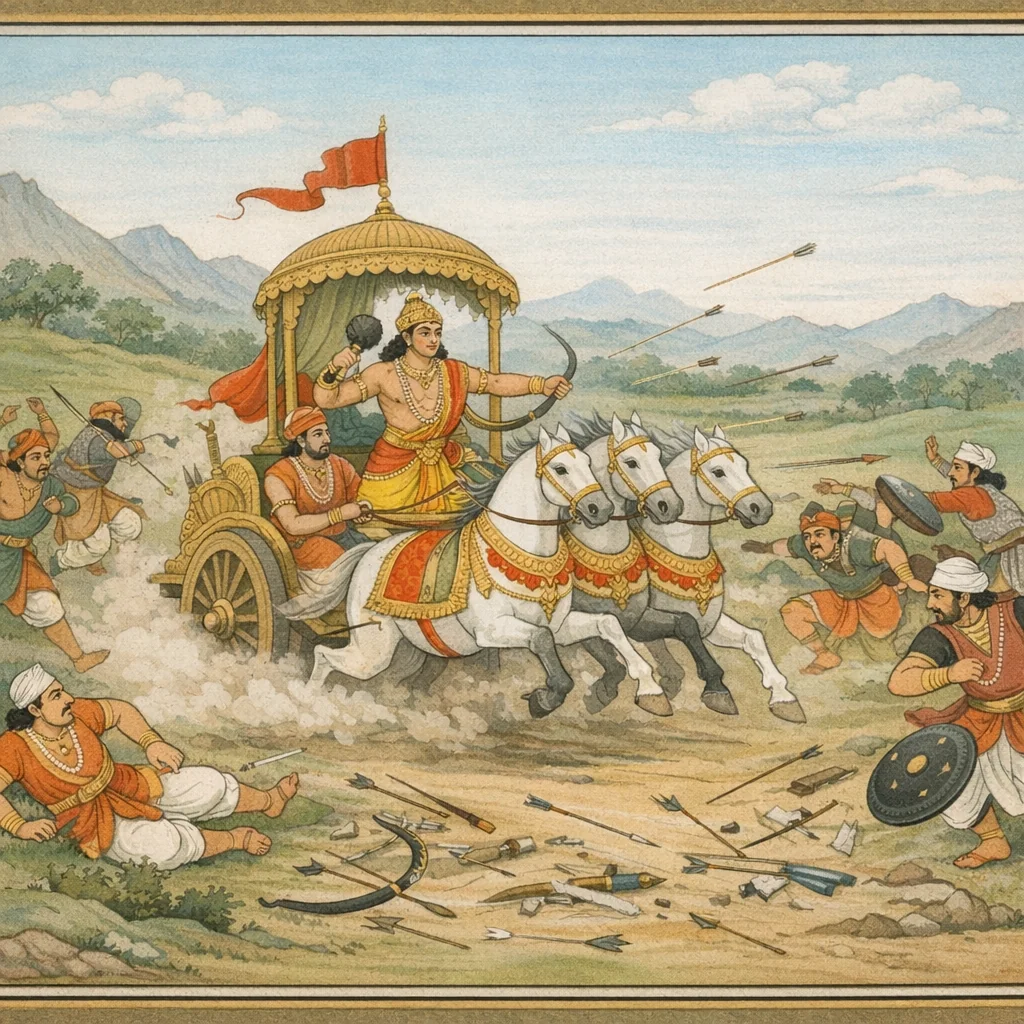
Adhyaya 76
Chapter Arc: तुमुल संग्राम में भीमसेन अपने सारथि विशोक से वेगपूर्वक रथ बढ़ाने का आदेश देता है—धृतराष्ट्र-पुत्रों को यमलोक पहुँचाने का संकल्प रणध्वनि बनकर उठता है। → विशोक, युद्ध-भूमि की समग्र स्थिति जानकर भीम को मार्ग, शत्रु-संघटन और विविध जनपदों की सेनाओं का संकेत देता है; उधर कुरु-योद्धा चारों ओर से रथ, अश्व और पत्तियों सहित भीम के रथ को घेरकर प्रत्युद्यत होते हैं। → भीमसेन की प्रचण्ड गति और बाण-वर्षा से शत्रु-रथ, अश्व और पत्तिगण ऐसे विदीर्ण होकर गिरते हैं जैसे सुपर्ण-वायु से वन उखड़ जाएँ; स्वर्ण-पंख वाले बाण भीम के प्रहार से दो-दो, तीन-तीन खण्डों में कटकर गिरते हैं और पर्वत-वज्राहत-सा घोर निनाद फैल जाता है। → कौरव-सेना भीम के अजेय वेग को रोक नहीं पाती—प्रलयकाल के काल-तुल्य मुख-विस्तार की उपमा के साथ उसका आक्रमण अनिवार्य सिद्ध होता है; भयभीत सेना दिशाओं में बिखरती है। → भीम के वेग से दग्ध-सी कौरव-सेना के पलायन के बाद अगला प्रश्न शेष रहता है—अब कौन-सा महारथी उसके मार्ग में अडिग होकर खड़ा होगा?
Shlokas
Verse 1
अत--#रू- षट्सप्ततितमो< ध्याय: भीमसेनका अपने सारथि विशोकसे संवाद संजय उवाच अथ वि्विदानीं तुमुले विमर्दे द्विषद्धिरेको बहुभि: समावृतः । महारणे सारथिमित्युवाच भीमश्चमूं वाहय धार्तराष्ट्रीम्ू,संजय कहते हैं--राजन्! उस समय उस घमासान युद्धमें बहुत-से शत्रुओंद्वारा अकेले घिरे हुए भीमसेन महासमरमें अपने सारथिसे बोले--'सारथे! अब तुम रथको धृतराष्ट्रपुत्रोंकी सेनाकी ओर ले चलो
Sanjaya said: O King, then, amid that tumultuous and crushing melee, Bhimasena—though alone and surrounded by many foes—spoke to his charioteer on the great battlefield: “Charioteer, drive the chariot toward the army of the sons of Dhritarashtra.”
Verse 2
त्वं सारथे याहि जवेन वाहै- नयाम्येतान् धार्तराष्ट्रानू यमाय । संचोदितो भीमसेनेन चैवं स सारथि: पुत्रबलं त्वदीयम्,'सूत! तुम अपने वाहनोंद्वारा वेगपूर्वक आगे बढ़ो। जिससे इन धुृतराष्ट्रपुत्रोंको मैं यमलोक भेज सकूँ।” भीमसेनके इस प्रकार आदेश देनेपर सारथि तुरंत ही भयंकर वेगसे युक्त हो आपके पुत्रोंकी सेनाकी ओर, जिधर भीमसेन जाना चाहते थे, चल दिया। तब अन्यान्य कौरवोंने हाथी, घोड़े, रथ और पैदलोंकी विशाल सेना साथ ले सब ओरसे उनपर आक्रमण किया
Sanjaya said: “Charioteer, drive on with speed, urge the horses forward, that I may send these sons of Dhritarashtra to Yama.” Thus spurred by Bhimasena, the charioteer at once drove with dreadful swiftness toward your son’s army, in the very direction Bhima desired.
Verse 3
प्रायात् ततः सत्वरमुग्रवेगो यतो भीमस्तद् बल॑ गन्तुमैच्छत् । ततो<परे नागरथाश्रपत्तिभि: प्रत्युद्ययुस्तं कुरव: समन्तात्,'सूत! तुम अपने वाहनोंद्वारा वेगपूर्वक आगे बढ़ो। जिससे इन धुृतराष्ट्रपुत्रोंको मैं यमलोक भेज सकूँ।” भीमसेनके इस प्रकार आदेश देनेपर सारथि तुरंत ही भयंकर वेगसे युक्त हो आपके पुत्रोंकी सेनाकी ओर, जिधर भीमसेन जाना चाहते थे, चल दिया। तब अन्यान्य कौरवोंने हाथी, घोड़े, रथ और पैदलोंकी विशाल सेना साथ ले सब ओरसे उनपर आक्रमण किया
Sañjaya said: Then his charioteer drove on at once with terrible speed, heading toward the force that Bhīma wished to reach. Thereupon the other Kurus, bringing forward elephants, chariots, horses, and infantry, surged out from every side to counterattack him. The scene underscores Bhīma’s fierce resolve to send Dhṛtarāṣṭra’s sons to Yama’s realm, and the Kurus’ collective effort to resist him amid the escalating ethics of battlefield duty and vengeance.
Verse 4
भीमस्य वाहाग्रयमुदारवेगं समनन्ततो बाणगणैर्निजषघ्नु: । तत: शरानापततो महात्मा चिच्छेद बाणैस्तपनीयपुड्खै:,वे भीमसेनके अत्यन्त वेगशाली श्रेष्ठ रथपर चारों ओरसे बाणसमूहोंद्वारा प्रहार करने लगे; परंतु महामनस्वी भीमसेनने अपने ऊपर आते हुए उन बाणोंको सुवर्णमय पंखवाले बाणोंद्वारा काट डाला
Sañjaya said: They struck at Bhīma’s foremost mount—his chariot-team—swift and powerful, assailing it from every side with volleys of arrows. Then the great-souled Bhīmasena, as those shafts rushed upon him, cut them down with his own arrows fitted with golden feathers. In the ethic of the battlefield, the verse highlights disciplined skill and presence of mind: even amid encirclement, Bhīma answers aggression with controlled precision rather than panic.
Verse 5
ते वै निपेतुस्तपनीयपुड्खा द्विधा त्रिधा भीमशरैर्निकृत्ता: । ततो राजन् नागरथाश्चयूनां भीमाहतानां वरराजमध्ये
Sañjaya said: Those arrows, fitted with golden feathers, fell to the ground—cut into two and three pieces by Bhīma’s shafts. Then, O King, in the very midst of the foremost of kings, the chariots and warriors struck down by Bhīma also collapsed, overwhelmed by his force. The scene underscores how prowess in war can swiftly undo pride and momentum, reminding rulers that power is fragile amid adharma-driven conflict.
Verse 6
ते वध्यमानाश्न नरेन्द्रमुख्या निर्भिद्यन्तो भीमशरप्रवेकै:
Sañjaya said: Even as they were being struck down, those foremost of kings were pierced through by Bhīma’s excellent arrows—an image of the battlefield’s relentless justice, where rank and pride offer no refuge from the consequences of war.
Verse 7
ततो5भियाते तव सैन्ये स भीम: प्रादुश्चक्रे वेगमनन्तवेग:
Sañjaya said: When your army advanced to attack, Bhīma—whose momentum is boundless—revealed his full speed and power, surging forth with irresistible force. The verse underscores how, in the crucible of war, a warrior’s resolve and capacity become manifest when confronted by aggression.
Verse 8
यथान्तकाले क्षपयन् दिधक्षु- भूतान्तकृत् काल इवात्तदण्ड: | आपकी सेनाके आक्रमण करनेपर अनन्त वेगशाली भीमसेनने अपना महान् वेग प्रकट किया। ठीक उसी तरह, जैसे प्रलयकालमें समस्त प्राणियोंका संहार करनेवाला काल हाथमें दण्ड लिये सबको नष्ट और दग्ध करनेकी इच्छासे असीम वेग प्रकट करता है ।। तस्यातिवेगस्य रणे5तिवेगं नाशवनुवन् वारयितुं त्वदीया:
Sañjaya said: When your army surged forward, Bhīmasena revealed a tremendous, boundless speed. He was like Time itself at the end of the age—death-dealing, staff in hand—rushing with the will to destroy and burn all beings. Yet in that battle your warriors, unable to match or check his overwhelming momentum, could not restrain him.
Verse 9
ततो बल॑ भारत भारतानां प्रदह्ममानं समरे महात्मना
Sañjaya said: Then, O Bhārata, in the midst of the battle, the might of the Bhāratas began to be consumed—as though set ablaze—by that great-souled warrior.
Verse 10
ततो धीमान् सारथिमब्रवीद् बली स भीमसेन: पुनरेव हृष्ट:,तत्पश्चात् बलवान् और बुद्धिमान भीमसेन हर्षसे उललसित हो अपने सारथिसे पुन: इस प्रकार बोले--'सूत! ये जो बहुत-से रथ और ध्वज एक साथ इधर बढ़े आ रहे हैं, उन्हें पहचानो तो सही! ये अपने पक्षके हैं या शत्रुपक्षके? क्योंकि युद्ध करते समय मुझे अपने- परायेका ज्ञान नहीं रहता, कहीं ऐसा न हो कि अपनी ही सेनाको बाणोंसे आच्छादित कर डालूँ
Sañjaya said: Then the strong and clear-minded Bhīmasena, once again exhilarated, addressed his charioteer. “Charioteer! Look carefully and identify those many chariots and banners advancing together from this side. Are they of our own side or the enemy’s? For when I am engaged in battle, my sense of ‘ours’ and ‘theirs’ does not remain steady—let it not happen that I cover our own army with arrows.”
Verse 11
सूताभिजानीहि स्वकान् परान् वा रथान् ध्वजांश्वञापतत: समेतान् । युद्धवन् हाहं नाभिजानामि किंचि- न्मा सैन्यं स्वं छादयिष्ये पृषत्कै:,तत्पश्चात् बलवान् और बुद्धिमान भीमसेन हर्षसे उललसित हो अपने सारथिसे पुन: इस प्रकार बोले--'सूत! ये जो बहुत-से रथ और ध्वज एक साथ इधर बढ़े आ रहे हैं, उन्हें पहचानो तो सही! ये अपने पक्षके हैं या शत्रुपक्षके? क्योंकि युद्ध करते समय मुझे अपने- परायेका ज्ञान नहीं रहता, कहीं ऐसा न हो कि अपनी ही सेनाको बाणोंसे आच्छादित कर डालूँ
Sañjaya said: “O charioteer, identify them—whether they are our own or the enemy—those chariots and banners rushing together toward us. For in the heat of battle I recognize nothing as ‘mine’ or ‘theirs’; let it not happen that I cover our own army with my arrows.”
Verse 12
अरीन् विशोकाभिनिरीक्ष्य सर्वतो मनस्तु चिन्ता प्रदुनोति मे भृशम् । राजा55तुरो नागमद् यत् किरीटी बहूनि दुःखान्यभियातो5स्मि सूत,“विशोक! सम्पूर्ण दिशाओंमें शत्रुओंको देखकर उठी हुई चिन्ता मेरे हृदयको अत्यन्त संतप्त कर रही है; क्योंकि राजा युधिष्ठिर बाणोंके आघातसे पीड़ित हैं और किरीटधारी अर्जुन अभीतक उनका समाचार लेकर लौटे नहीं। सूत! इन सब कारणोंसे मुझे बहुत दुःख हो रहा है
Sañjaya said: “O Sūta, as I look in every direction and behold the foes, a grief-free gaze is impossible—anxious thought scorches my mind intensely. King Yudhiṣṭhira is wounded by the blows of arrows, and the diademed Arjuna has not yet returned with news of him. For all these reasons, I am overwhelmed by many sorrows.”
Verse 13
एतद् दुःखं सारथे धर्मराजो यन्मां हित्वा यातवान् शत्रुमध्ये । नैनं जीवं नाद्य जानाम्यजीवं बीभत्सुं वा तन्ममाद्यातिदुः:खम्
Sañjaya said: “O charioteer, this is the grief that weighs upon Dharmarāja: that, abandoning me, he went into the midst of the enemy. Even now I do not know whether Bībhatsu is alive or not alive—this, today, is my overwhelming sorrow.”
Verse 14
'सारथे! पहले तो इस बातका दु:ख हो रहा है कि धर्मराज मुझे छोड़कर स्वयं ही शत्रुओंके बीचमें चले गये। पता नहीं, वे अबतक जीवित हैं या नहीं? अर्जुनका भी कोई समाचार नहीं मिला; इससे आज मुझे अधिक दु:ख है ।। सो हं द्विषत्सैन्यमुदग्रकल्पं विनाशयिष्ये परमप्रतीत: । एततन्निहत्याजिमध्ये समेतं प्रीतो भविष्यामि सह त्वयाद्य,“अच्छा, अब मैं अत्यन्त विश्वस्त होकर शत्रुओंकी प्रचण्ड सेनाका विनाश करूँगा। यहाँ एकत्र हुई इस सेनाको युद्धस्थलमें नष्ट करके मैं तुम्हारे साथ ही आज प्रसन्नताका अनुभव करूँगा
Sañjaya said: “Charioteer! First, I am pained that King Dharmarāja left me behind and went alone into the midst of the enemy. I do not know whether he is still alive. Nor has any news of Arjuna been obtained; that makes my grief even greater today. Therefore, with firm confidence, I shall destroy the enemy host, fierce as a storm. Having slain this assembled army in the very center of battle, I shall feel relief and satisfaction today—together with you.”
Verse 15
सर्वास्तृूणान् सायकानामवेक्ष्य किं शिष्ट स्थात् सायकानां रथे मे । का वा जाति: किं प्रमाणं च तेषां ज्ञात्वा व्यक्त तत् समाचक्ष्व सूत,(कति वा सहस्राणि कति वा शतानि ह्याचक्ष्व मे सारथे क्षिप्रमेव ।। 'सूत! तुम मेरे रथपर रखे हुए बाणोंके सारे तरकसोंकी देख-भाल करके ठीक-ठीक समझकर मुझे स्पष्टरूपसे बताओ कि अब उनमें कितने बाण अवशिष्ट रह गये हैं? किस- किस जातिके बाण बचे हैं और उनकी संख्या कितनी है? सारथे! शीघ्र बताओ, कौन बाण कितने हजार और कितने सौ शेष हैं?”
Sañjaya said: “O charioteer, inspect all the quivers of arrows on my chariot and, having ascertained it precisely, tell me clearly what remains of the arrows. What kinds are left, and in what measure? Tell me at once—how many thousands and how many hundreds still remain, O driver.”
Verse 16
विशोक उवाच सर्व विदित्वैवमहं वदामि तवार्थसिद्धिप्रदमद्य वीर ।। कैकेयकाम्बोजसुराष्ट्रबाह्लिका म्लेच्छाश्व सुह्या: परतड्रणाश्न । मद्राश्न वड़ा मगधा: कुलिन्दा आनर्तकावर्तका: पर्वतीया: ।। सर्वे गृहीतप्रवरायुधास्त्वां संख्ये समावेष्ट्य ततो विनेदु: ।।) विशोकने कहा--वीर! मैं आज सब कुछ पता लगाकर आपके मनोरथकी सिद्धि करनेवाली बात बता रहा हूँ, कैकेय, काम्बोज, सौराष्ट्र, बाह्लिक, म्लेच्छ, सुह्य, परतंगण, मद्र, वंग, मगध, कुलिन्द, आनर्त, आवर्त और पर्वतीय सभी योद्धा हाथोंमें श्रेष्ठ आयुध लिये आपको चारों ओरसे घेरकर युद्धस्थलमें शत्रुओंका सामना करनेके लिये गरज रहे हैं। षण्मार्गणानामयुतानि वीर क्षुराश्न भल्लाश्न तथायुताख्या: । नाराचानां द्वे सहस्ने च वीर त्रीण्येव च प्रदराणां सम पार्थ,वीरवर! अभी अपने पास साठ हजार मार्गण हैं, दस-दस हजार क्षुर और भल्ल हैं, दो हजार नाराच शेष हैं तथा पार्थ! तीन हजार प्रदर बाकी रह गये हैं
Viśoka said: “Having ascertained everything, O hero, I will tell you today what will bring about the fulfillment of your purpose. The warriors of Kaikeya, Kāmboja, Saurāṣṭra, Bāhlīka, the Mlecchas, the Suhyas, the Parataṅgaṇas, the Madras, the Vaṅgas, the Magadhas, the Kulindas, the Ānartas, the Āvartakas, and the mountain-dwellers—each bearing excellent weapons—have surrounded you on the battlefield and are roaring, eager to face the enemy. And, O valiant Pārtha, you still have sixty thousand arrows; ten thousand razor-headed shafts and ten thousand bhallas; two thousand nārācas; and three thousand pradaras remaining.”
Verse 17
अस्त्यायुधं पाण्डवेयावशिष्टं न यद् वहेच्छकटं षड्गवीयम् । एतद् विद्वन् मुज्च सहस्रशो 5पि गदासिबाहुद्रविणं च ते5स्ति,पाण्डुनन्दन! अभी इतने आयुध शेष हैं कि छ: बैलोंसे जुता हुआ छकड़ा भी उन्हें नहीं खींच सकता। विद्वन! इन सहस्रों अस्त्रोंका आप प्रयोग कीजिये। अभी तो आपके पास बहुत-सी गदाएँ, तलवारें और बाहुबलकी सम्पत्ति हैं। इसी प्रकार बहुतेरे प्रास, मुद्गर, शक्ति और तोमर बाकी बचे हैं। आप इन आयुधोंके समाप्त हो जानेके डरमें न रहिये
Viśoka said: “O son of Pāṇḍu, you still have weapons left in such abundance that even a cart yoked to six oxen could not carry them. Therefore, O wise one, employ them—even by the thousand. You still possess stores of strength: maces and swords, and the wealth of your own arms. Do not be anxious that your weapons will run out.”
Verse 18
प्रासाश्न मुद्गरा: शक्तयस्तोमराश्न मा भैषीस्त्वं सड़क्षयादायुधानाम्,पाण्डुनन्दन! अभी इतने आयुध शेष हैं कि छ: बैलोंसे जुता हुआ छकड़ा भी उन्हें नहीं खींच सकता। विद्वन! इन सहस्रों अस्त्रोंका आप प्रयोग कीजिये। अभी तो आपके पास बहुत-सी गदाएँ, तलवारें और बाहुबलकी सम्पत्ति हैं। इसी प्रकार बहुतेरे प्रास, मुद्गर, शक्ति और तोमर बाकी बचे हैं। आप इन आयुधोंके समाप्त हो जानेके डरमें न रहिये
Viśoka said: “Spears, maces, javelins, and lances still remain—do not fear the exhaustion of your weapons, O son of Pāṇḍu. Even now you have so many arms left that not even a cart yoked to six bulls could carry them. O wise one, make use of these thousands of missiles. You still possess many clubs and swords, and the wealth of your own arm-strength. Likewise, many spears, maces, javelins, and lances are still in reserve. Therefore do not stand in anxiety that your weapons will run out.”
Verse 19
भीमसेन उवाच सूताद्यैनं पश्य भीमप्रयुक्ति: संछिन्दद्धि: पार्थिवानां सुवेगै: । छन्न॑ बाणैराहवं घोररूपं नष्टादित्यं मृत्युलोकेन तुल्यम्,भीमसेन बोले--सूत! आज इस युद्धस्थलकी ओर दृष्टिपात करो। भीमसेनके छोड़े हुए अत्यन्त वेगशाली बाणोंने राजाओंका विनाश करते हुए सारे रणक्षेत्रको आच्छादित कर दिया है, जिससे सूर्य भी अदृश्य हो गये हैं और यह भूमि यमलोकके समान भयंकर प्रतीत होती है
Bhīmasena said: “O Sūta, look now upon this battlefield. The arrows released by Bhīma—driven with tremendous speed—are cutting down the kings and have blanketed the entire combat-ground. The sun itself is hidden from sight, and the earth appears dreadful, like the realm of Death.”
Verse 20
अद्यैतद् वै विदितं पार्थिवानां भविष्यति हाकुमारं च सूत । निमग्नो वा समरे भीमसेन एक: कुरून् वा समरे व्यजैषीत्,सूत! आज बच्चोंसे लेकर बूढ़ोंतक समस्त भूपालोंको यह विदित हो जायगा कि भीमसेन समरसागरमें डूब गये अथवा उन्होंने अकेले ही समस्त कौरवोंको युद्धमें जीत लिया
“O Sūta, today all the kings—from children to the aged—will know for certain: whether Bhīmasena has sunk into the sea of battle, or whether he alone has conquered all the Kauravas in war.”
Verse 21
सर्वे संख्ये कुरवो निष्पतन्तु मां वा लोका: कीर्तयन्त्वाकुमारम् । सवनिकस्तानहं पातयिष्ये ते वा सर्वे भीमसेनं तुदन्तु,आज युद्धसस््थलमें समस्त कौरव धराशायी हो जायँ अथवा बालकोंसे लेकर वृद्धोंतक सब लोग मुझ भीमसेनको ही रणभूमिमें गिरा हुआ बतावें! मैं अकेला ही उन समस्त कौरवोंको मार गिराऊँगा अथवा वे ही सब लोग मुझ भीमसेनको पीड़ित करें
Bhīmasena said: “Let all the Kauravas fall headlong in this battle—or else let the people, from children up to the aged, proclaim that it was I, Bhīmasena, who fell on the field. Alone I shall strike down all those Kauravas; or let them all together assail and torment me, Bhīmasena. Today the issue will be decided on the battlefield.”
Verse 22
आशास्तार: कर्म चाप्युत्तमं ये तन्मे देवा: केवल साधयन्तु | आयालि्विहद्यार्जुन: शत्रुधाती शक्रस्तूर्ण यज्ञ इवोपहूत:,जो उत्तम कर्मोका उपदेश देनेवाले हैं, वे देवता-लोग मेरा केवल एक कार्य सिद्ध कर दें। जैसे यज्ञमें आवाहन करनेपर इन्द्रदेव तुरंत पदार्पण करते हैं, उसी प्रकार शत्रुघाती अर्जुन यहाँ शीघ्र ही आ पहुँचे
Bhīmasena said: “May the gods—those who commend noble action and uphold the highest deeds—grant me just this one fulfillment: let Arjuna, the slayer of foes, come here at once. As Indra hastens to a sacrifice when duly invoked, so may Arjuna swiftly arrive.”
Verse 23
(पश्यस्व पश्यस्व विशोक मे त्व॑ बल॑ परेषामभिघातभिन्नम् । नानास्वरान् पश्य विमुच्य सर्वे तथा द्रवन्ते बलिनो धार्तराष्ट्रा: ।।) विशोक! देखो, देखो, मेरा बल। मेरे आघातोंसे शत्रुओंकी सेना विदीर्ण हो उठी है। देखो, धृतराष्ट्रके सभी बलवान पुत्र नाना प्रकारके आर्तनाद करते हुए भागने लगे हैं। ईक्षस्वैतां भारतीं दीर्यमाणा- मेते कस्माद् विद्रवन्ते नरेन्द्रा: । व्यक्त धीमान् सव्यसाची नराग्रय: सैन्यं होतच्छादयत्याशु बाणै:,सारथे! इस कौरव-सेनापर तो दृष्टिपात करो। इसमें भी दरार पड़ती जा रही है। ये राजालोग क्यों भाग रहे हैं? इससे तो स्पष्ट जान पड़ता है कि बुद्धिमान् नरश्रेष्ठ अर्जुन आ गये। वे ही अपने बाणोंद्वारा शीघ्रता-पूर्वक इस सेनाको आच्छादित कर रहे हैं
Bhīma said: “Look, Viśoka—look at my strength. The enemy host has been shattered by my blows. See how all the mighty sons of Dhṛtarāṣṭra, crying out in many different tones, are fleeing. Cast your eyes upon this Kaurava army: it is splitting apart even now. Why are these kings running? It is clear that the wise, foremost of men—Arjuna, the ambidextrous archer—has arrived; he is swiftly covering the battlefield with his arrows.”
Verse 24
पश्य ध्वजांक्ष द्रवतो विशोक नागान् हयान् पत्तिसंघांश्व संख्ये रथान् विकीर्णान् शरशक्तिताडितान् पश्यस्वैतान् रथिनश्वैव सूत,विशोक! युद्धस्थलमें भागते हुए रथोंकी ध्वजाओं, हाथियों, घोड़ों और पैदलसमूहोंको देखो। सूत! बाणों और शक्तियोंसे प्रताड़ित होकर बिखरे पड़े हुए इन रथों और रथियोंपर भी दृष्टिपात करो
Bhīmasena said: “Look, Viśoka—see in this battle the standards of fleeing chariots, the elephants, the horses, and the masses of foot-soldiers. O charioteer, look also at these chariots and chariot-warriors lying scattered, struck and battered by arrows and spears.”
Verse 25
आपूर्यते कौरवी चाप्यभीक्षणं सेना हासौ सुभृशं हन्यमाना । धनंजयस्याशनितुल्यवेगै- ग्रेस््ता शरै: काउचनबर्हिबाजै:,अर्जुनके बाण वज्रके समान वेगशाली हैं। उनमें सोने और मयूरपिच्छके पंख लगे हैं। उन बाणोंद्वारा आक्रान्त हुई यह कौरव-सेना अत्यन्त मार पड़नेके कारण बारंबार आर्तनाद कर रही है
Bhīmasena said: “Again and again the Kaurava host is being overwhelmed; struck down with relentless severity, it raises loud cries of anguish. For Dhanañjaya’s foremost arrows—moving with the speed of a thunderbolt, adorned with gold and peacock-feathered fletching—are crushing it.”
Verse 26
एते द्रवन्ति सम रथाश्वनागा: पदातिसड्घानतिमर्दयन्त: | सम्मुहमाना: कौरवा: सर्व एव द्रवन्ति नागा इव दाहभीता:,ये रथ, घोड़े और हाथी पैदलसमूहोंको कुचलते हुए भागे जा रहे हैं। प्रायः सभी कौरव अचेत-से होकर दावानलके दाहसे डरे हुए हाथियोंके समान पलायन कर रहे हैं
Bhīma said: “Look—those troops are fleeing, crushing the masses of foot-soldiers as they run, with chariots, horses, and elephants all in confusion. Indeed, the Kauravas, every one of them, are retreating in a daze—like elephants terrified by the blaze of a forest fire.”
Verse 27
हाहाकृताश्वैव रणे विशोक मुज्चन्ति नादान् विपुलान् गजेन्द्रा:,विशोक! रणभूमिमें सब ओर हाहाकार मचा हुआ है। बहुसंख्यक गजराज बड़े जोर- जोरसे चीत्कार कर रहे हैं
Bhīmasena said: “O Viśoka, the battlefield is filled on every side with cries of alarm. Great lordly elephants, in vast numbers, are bellowing loudly—an ominous sign of the war’s crushing violence and the panic spreading through the ranks.”
Verse 28
विशोक उवाच कि भीम नैनं त्वमिहाशूणोषि विस्फारितं गाण्डिवस्यातिघोरम् । क्रुद्धेन पार्थेन विकृष्पतो$द्य कच्चिन्नेमौ तव कर्णों विनष्टी,विशोकने कहा--भीमसेन! क्रोधमें भरे हुए अर्जुनके द्वारा खींचे जाते हुए गाण्डीव धनुषकी यह अत्यन्त भयंकर टंकार क्या आज आपको सुनायी नहीं दे रही है? आपके ये दोनों कान बहरे तो नहीं हो गये हैं?
Viśoka said: “Bhīma, do you not hear here this exceedingly dreadful reverberation of the Gāṇḍīva as it is drawn and loosed today by the wrathful Pārtha (Arjuna)? Surely your two ears have not failed you?”
Verse 29
सर्वे कामा: पाण्डव ते समृद्धा: कपिहसौ दृश्यते हस्तिसैन्ये । नीलाद घनाद् विद्युतमुच्चरन्तीं तथा पश्य विस्फुरन्तीं धनुज्याम्
Viśoka said: “All your wishes, O Pāṇḍava, are prospering. In the midst of the elephant-corps the banner marked with Hanumān is seen. Look also at the bowstring flashing—like lightning leaping from a dark-blue cloud—vibrating and sparkling as it is drawn.”
Verse 30
पाण्डुनन्दन! आपकी सारी कामनाएँ सफल हुईं। हाथियोंकी सेनामें अर्जुनके रथकी ध्वजाका वह वानर दिखायी दे रहा है। काले मेघसे प्रकट होनेवाली बिजलीके समान चमकती हुई गाण्डीव धनुषकी प्रत्यंचाको देखिये ।। कपिहसौ वीक्षते सर्वतो वै ध्वजाग्रमारुह् धनंजयस्य । वित्रासयन् रिपुसंघान् विमर्दे बिभेम्यस्मादात्मनैवाभिवीक्ष्य,अर्जुनकी ध्वजाके अग्रभागपर आरूढ़ हो वह वानर सब ओर देखता और युद्धस्थलमें शत्रुसमूहोंको भयभीत करता है। मैं स्वयं भी देखकर उससे डर रहा हूँ
“O son of Pāṇḍu, all your hopes have borne fruit. In the midst of the elephant-corps, the monkey upon the crest of Arjuna’s chariot-banner is clearly visible. Behold the bowstring of Gāṇḍīva flashing like lightning emerging from a dark cloud. Perched atop Dhanañjaya’s banner, that mighty monkey scans all directions; in the clash of battle he terrifies the enemy hosts. Even I, seeing him with my own eyes, am struck with fear.”
Verse 31
विभ्राजते चातिमात्र किरीटं विचित्रमेतच्च धनंजयस्य । दिवाकराभो मणिरेष दिव्यो विभ्राजते चैव किरीटसंस्थ:,धनंजयका यह विचित्र मुकुट अत्यन्त प्रकाशित हो रहा है। इस मुकुटमें लगी हुई यह दिव्य मणि दिवाकरके समान देदीप्यमान होती है
Viśoka said: “Dhanañjaya’s wondrous crown shines with extraordinary brilliance. And this divine jewel set upon the crown blazes like the sun.”
Verse 32
पाश्वें भीम॑ पाण्डुरा भ्रप्रकाशं पश्यस्व शड्खं देवदत्तं सुधोषम् | अभीषुहस्तस्य जनार्दनस्य विगाहमानस्य चमूं परेषाम्,वीर! अर्जुनके पार्श्वभागमें श्वेत बादलके समान प्रकाशित होनेवाला और गम्भीर घोष करनेवाला देवदत्त नामक भयानक शंख रखा हुआ है, उसपर दृष्टिपात कीजिये। साथ ही हाथोंमें घोड़ोंकी बागडोर लिये शत्रुओंकी सेनामें घुसे जाते हुए भगवान् श्रीकृष्णकी बगलमें सूर्यके समान प्रकाशमान चक्र विद्यमान है, जिसकी नाभिमें वज्र और किनारेके भागोंमें छुरे लगे हुए हैं। भगवान् केशवका वह चक्र उनका यश बढ़ानेवाला है। सम्पूर्ण यदुवंशी सदा उसकी पूजा करते हैं। आप उस चक्रको भी देखिये
Viśoka said: “O mighty Bhīma, look there beside Arjuna: the conch named Devadatta, shining like a white cloud and sounding with a deep, auspicious roar. And see Janārdana (Kṛṣṇa) as he drives with the reins in hand, plunging into the enemy host—near him is the discus blazing like the sun, a weapon that magnifies Keśava’s fame and is revered by the entire Yadu line.”
Verse 33
रविप्रभं वज्नाभ क्षुरान्तं पाश्वें स्थितं पश्य जनार्दनस्य । चक्र यशोवर्धनं केशवस्य सदार्चितं यदुभि: पश्य वीर,वीर! अर्जुनके पार्श्वभागमें श्वेत बादलके समान प्रकाशित होनेवाला और गम्भीर घोष करनेवाला देवदत्त नामक भयानक शंख रखा हुआ है, उसपर दृष्टिपात कीजिये। साथ ही हाथोंमें घोड़ोंकी बागडोर लिये शत्रुओंकी सेनामें घुसे जाते हुए भगवान् श्रीकृष्णकी बगलमें सूर्यके समान प्रकाशमान चक्र विद्यमान है, जिसकी नाभिमें वज्र और किनारेके भागोंमें छुरे लगे हुए हैं। भगवान् केशवका वह चक्र उनका यश बढ़ानेवाला है। सम्पूर्ण यदुवंशी सदा उसकी पूजा करते हैं। आप उस चक्रको भी देखिये
Look, O hero, at Janārdana’s discus stationed at his side—radiant like the sun, with a thunderbolt-like hub and a razor-edged rim. Behold that wheel-weapon of Keśava, the increaser of his fame, ever worshipped by the Yādavas; look upon that discus as well.
Verse 34
महाद्विपानां सरलद्रुमोपमा: करा निकृत्ता: प्रपतन्त्यमी क्षुरै: । किरीटिना तेन पुन: ससादिन: शरैनिकृत्ता: कुलिशैरिवाद्रय:,अर्जुनके छुरनामक बाणोंसे कटे हुए ये बड़े-बड़े हाथियोंके शुण्डदण्ड देवदारुके समान गिर रहे हैं। फिर उन्हीं किरीटीके बाणोंसे छिन्न-भिन्न हो वज्रके मारे हुए पर्वतोंके समान वे हाथी सवारोंसहित धराशायी हो रहे हैं
The great elephants’ trunk-like limbs, likened to tall pine trees, are being severed by those razor-edged shafts and fall to the ground. Then, struck again by Kirīṭin’s arrows, the elephants collapse with their riders, shattered like mountains split by a thunderbolt.
Verse 35
तथैव कृष्णस्य च पाउ्चजन्यं महाहमेतं द्विजराजवर्णम् । कौन्तेय पश्योरसि कौस्तुभं च जाज्वल्यमानं विजयां स्रजं च,कुन्तीनन्दन! भगवान् श्रीकृष्णके इस बहुमूल्य पांचजन्य शंखको जो चन्द्रमाके समान श्वेतवर्ण है, देखिये। साथ ही उनके वक्ष:स्थलपर अपनी प्रभासे प्रज्वलित होनेवाली कौस्तुभमणि तथा वैजयन्ती मालापर भी दृष्टिपात कीजिये
Behold likewise Kṛṣṇa’s Pāñcajanya conch—mighty, and white as the moon. O son of Kuntī, look also upon the Kaustubha jewel upon his chest, blazing with its own radiance, and upon the Vaijayantī garland of victory.
Verse 36
ध्रुवं रथाग्रय: समुपैति पार्थों विद्रावयन् सैन्यमिदं परेषाम् । सिता भ्रवर्णरसितप्रयुक्ति- हयैर्महाहैं रथिनां वरिष्ठ:,निश्चय ही रथियोंमें श्रेष्ठ कुन्तीनन्दन अर्जुन शत्रुओंकी सेनाको खदेड़ते हुए इधर ही आ रहे हैं। सफेद बादलोंके समान श्वेत कान्तिवाले उनके महामूल्यवान् अश्व श्यामसुन्दर श्रीकृष्णद्वारा संचालित हो रहे हैं
Surely Pārtha (Arjuna), the foremost of charioteers, is coming this way, driving the enemy host into flight. His splendid, high-bred horses—white and radiant like pale clouds—are being expertly urged on by Śrī Kṛṣṇa, Shyāmasundara.
Verse 37
रथान् हयान् पत्तिगणांश्व सायकै- विंदारितान् पश्य पतन्त्यमी यथा । तवानुजेनामरराजतेजसा महावनानीव सुपर्णवायुना,देखिये, जैसे गरुड़के पंखसे उठी हुई वायुके द्वारा बड़े-बड़े जंगल धराशायी हो जाते हैं, उसी प्रकार देवराज इन्द्रके तुल्य तेजस्वी आपके छोटे भाई अर्जुन बाणोंद्वारा शत्रुओंके रथों, घोड़ों और पैदलसमूहोंको विदीर्ण कर रहे हैं और वे सब-के-सब पृथ्वीपर गिरते जा रहे हैं
Look—how these chariots, horses, and masses of foot-soldiers, torn apart by arrows, are falling to the ground. Just as mighty forests are laid low by the wind stirred up by Suparṇa (Garuḍa) with his wings, so too your younger brother Arjuna—radiant like Indra, king of the gods—shatters the enemy’s forces with his shafts.
Verse 38
चतुः:शतान् पश्य रथानिमान् हतान् सवाजिसूतान् समरे किरीटिना । महेषुभि: सप्तशतानि दन्तिनां पदातिसादींश्व॒ रथाननेकश:
Behold these four hundred chariots lying destroyed—together with their horses and charioteers—slain in battle by the Kirīṭin (Arjuna). And with his mighty arrows he has also brought down seven hundred elephants, along with masses of infantry, and many chariots besides.
Verse 39
वह देखिये, किरीटधारी अर्जुनने समरांगणमें सारथि और घोड़ोंसहित इन चार सौ रथियोंको मार डाला तथा अपने विशाल बाणोंद्वारा सात सौ हाथियों, बहुत-से पैदलों, घुड़सवारों और अनेकानेक रथोंका संहार कर डाला ।। अयं समभ्येति तवान्तिकं बली निघ्नन् कुरूंश्रित्र इव ग्रहो<र्जुन: । समृद्धकामो5सि हतास्तवाहिता बल॑ तवायुश्न चिराय वर्धताम्,विचित्र ग्रहके समान ये बलवान् अर्जुन कौरवोंका संहार करते हुए आपके निकट आ रहे हैं। अब आपकी कामना सफल हुई। आपके शत्रु मारे गये। इस समय चिरकालके लिये आपका बल और आयु बढ़े
Behold: the mighty Arjuna, the diadem-bearer (Kirīṭin), has slain these four hundred chariot-warriors on the battlefield, together with their charioteers and horses; and with his great arrows he has destroyed seven hundred elephants, many foot-soldiers, cavalry, and countless chariots. Now that powerful Arjuna, like a wondrous planet upon its course, draws near to you, cutting down the Kurus as he comes. Your desire has been fulfilled—your enemies have been slain. May your strength and your lifespan increase for a long time.
Verse 40
भीमसेन उवाच ददानि ते ग्रामवरांक्षतुर्दश प्रियाख्याने सारथे सुप्रसन्न: । दासीशतं चापि रथांश्व विंशतिं यदर्जुनं वेदयसे विशोक,भीमसेनने कहा--विशोक! तुम अर्जुनके आनेका समाचार सुना रहे हो। सारथे! इस प्रिय संवादसे मुझे बड़ी प्रसन्नता हुई है; अतः मैं तुम्हें चौदह बड़े-बड़े गाँवकी जागीर देता हूँ। साथ ही सौ दासियाँ तथा बीस रथ तुम्हें पारितोषिक रूपमें प्राप्त होंगे
Bhīmasena said: “O charioteer, bearer of welcome tidings—your report has delighted me. Since you have informed me, O Viśoka, that Arjuna has arrived, I grant you fourteen excellent villages. Along with them, accept a hundred maidservants and twenty chariots as your reward.”
Verse 53
घोरो निनादः प्रबभौ नरेन्द्र वज्ाहतानामिव पर्वतानाम् | वे सोनेकी पाँखवाले बाण भीमसेनके बाणोंसे दो-दो तीन-तीन टुकड़ोंमें कटकर गिर गये। राजन! नरेन्द्र! तत्पश्चात् श्रेष्ठ रजाओंकी मण्डलीमें भीमसेनके द्वारा मारे गये हाथियों, रथों, घोड़ों और पैदल युवकोंका भयंकर आर्तनाद प्रकट होने लगा, मानो वच्रके मारे हुए पहाड़ फट पड़े हों
Sañjaya said: O king, a dreadful roar arose—like the mountains splitting apart when struck by a thunderbolt. In that royal assembly of warriors, as Bhīmasena’s shafts cut down elephants, chariots, horses, and foot-soldiers, a terrifying cry of anguish spread through the ranks, echoing the ruin brought by irresistible force.
Verse 66
भीम॑ समनन््तात् समरे5 भ्यरोहन् वृक्ष शकुन्ता इव जातपक्षा: | जैसे जिनके पंख निकल आये हैं, वे पक्षी सब ओरसे उड़कर किसी वृक्षपर चढ़ बैठते हैं, उसी प्रकार भीमसेनके उत्तम बाणोंसे आहत और विदीर्ण होनेवाले प्रधान-प्रधान नरेश समरांगणमें सब ओरसे भीमसेनपर ही चढ़ आये
Sañjaya said: As newly fledged birds, their wings having grown, fly in from every side and alight upon a tree, so in that battlefield the foremost kings—wounded and torn by Bhīmasena’s excellent arrows—closed in upon Bhīma from all directions, seeking to overwhelm him together.
Verse 76
इति श्रीमहाभारते कर्णपर्वणि भीमसेनविशोकसंवादे षट्सप्ततितमो<ध्याय: ।। ७६ || इस प्रकार श्रीमह्ााभारत कर्णपर्वमें भीमसेन और विशोकका संवादविषयक छिह्त्तरवाँ अध्याय पूरा हुआ
Thus, in the Śrī Mahābhārata, within the Karṇa Parvan, the seventy-sixth chapter—whose subject is the dialogue between Bhīmasena and Viśoka—comes to an end. (This is the colophon marking the completion of the chapter.)
Verse 86
व्यात्ताननस्यापततो यथैव कालस्य काले हरत: प्रजा वै । अत्यन्त वेगशाली भीमसेनके महान् वेगको आपके सैनिक रणभूमिमें रोक न सके। जैसे प्रलयकालमें मुँह बाकर आक्रमण करनेवाले प्रजासंहारकारी कालके वेगको कोई नहीं रोक सकता
Sañjaya said: Your soldiers could not check the tremendous onrush of Bhīmasena on the battlefield—just as none can restrain the force of Time when, at the hour of dissolution, it advances with gaping mouth to carry off creatures.
Verse 96
भीत॑ं दिशो5कीर्यत भीमनुन्नं महानिलेना भ्रगणा यथैव । भारत! तदनन्तर समरांगणमें महामना भीमसेनके द्वारा दग्ध होती हुई कौरव-सेना भयभीत हो सम्पूर्ण दिशाओंमें बिखर गयी। जैसे आँधी बादलोंको छिन्न-भिन्न कर देती है, उसी प्रकार भीमसेनने आपके सैनिकोंको मार भगाया था
Sañjaya said: Struck by Bhīma, your troops—terrified and as if scorched by his onslaught—scattered in all directions across the battlefield, O Bhārata. Just as a mighty gale tears apart masses of clouds, so did Bhīmasena break and drive your soldiers into flight.