Adhyaya 52
कर्णवधार्थं धनञ्जयस्य प्रतिज्ञा — Arjuna’s resolve for Karṇa’s defeat
Upa-parva: Karna-vadha-pratijñā (Arjuna’s resolve before the Karṇa engagement)
Sañjaya reports that Arjuna, after hearing Keśava’s words, becomes free from grief and immediately energized (1). He prepares for action by tending the bowstring and raising the Gāṇḍīva, explicitly orienting his readiness toward Karṇa’s neutralization while addressing Kṛṣṇa (2). Arjuna attributes assured victory to Kṛṣṇa’s support, describing Kṛṣṇa as lord of past and future, and asserts that with such aid even cosmic opposition would be surmountable—therefore Karṇa in battle is not insurmountable (3–4). He observes the battlefield: the Pāñcāla forces in motion, Karṇa moving fearlessly, and the circulation of Bhārgava weaponry likened to Indra’s thunderbolt (5–6). Arjuna frames the encounter as historically memorable (7) and predicts that his arrows will carry Karṇa toward death (8). He anticipates cascading political-psychological effects: Dhṛtarāṣṭra’s regret, Duryodhana’s despair, and the Kauravas’ fear and dispersal upon Karṇa’s fall (9–11, 20–22). He links the act to moral accounting—repayment for past suffering and for Karṇa’s earlier harsh words toward Draupadī and the Pāṇḍavas—while reaffirming his own martial preeminence in archery and valor (12–19, 23–33). The chapter thus fuses tactical readiness, ethical memory, and self-characterization into a single pre-engagement declaration.
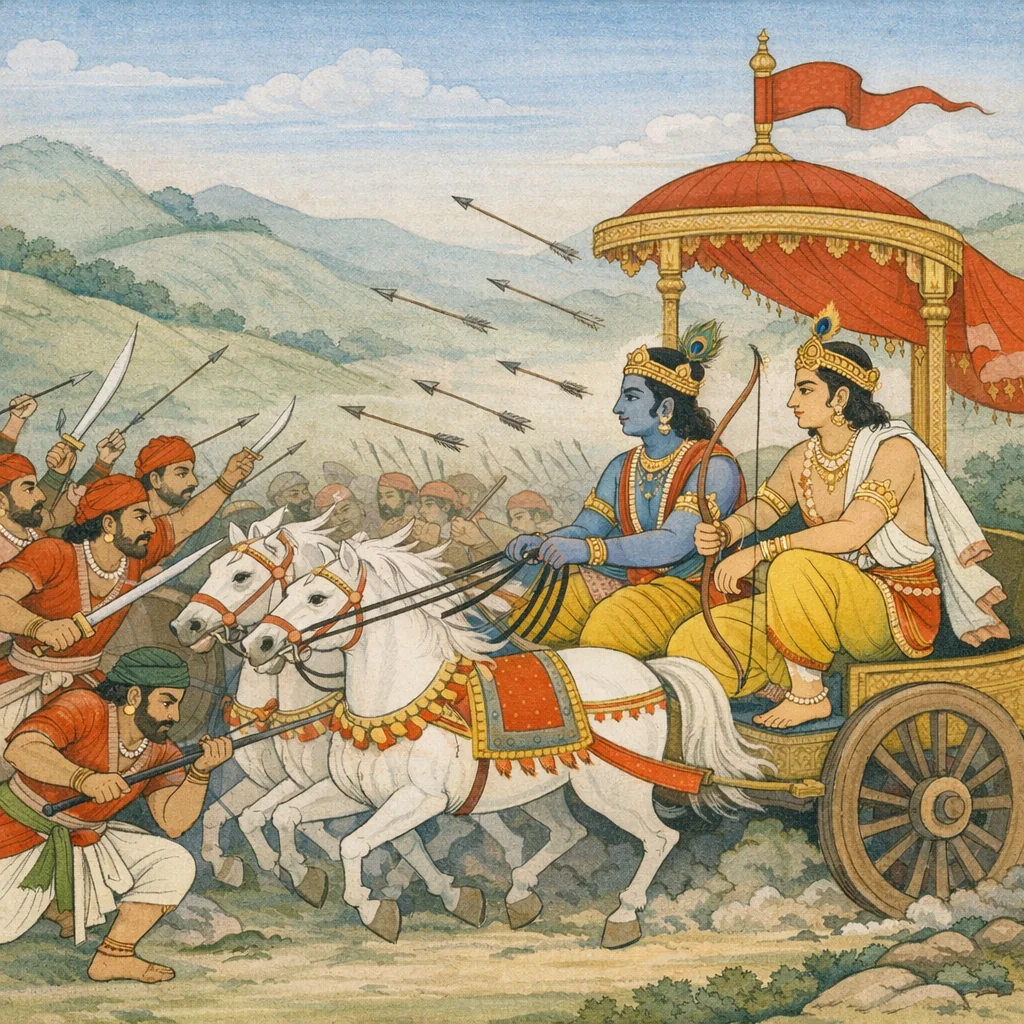
Chapter Arc: संजय धृतराष्ट्र से वर्तमान युद्ध का वृत्तांत कहते हैं—जहाँ पाण्डुनन्दन अर्जुन ने संशप्तकों, कोसल-योद्धाओं और नारायणी-सेना के अंशों पर प्रलय-सा प्रहार आरम्भ किया। → विजय-लालसा से उन्मत्त, प्रतिज्ञाबद्ध संशप्तक चारों ओर से शर-वृष्टि करते हैं; बाण-संघ और शस्त्र-संघ अर्जुन के रथ पर टूट पड़ते हैं। घोर आघात से अर्जुन क्षणभर व्यथित होकर रथ के पृष्ठभाग में बैठ जाते हैं; रण में वाद्यों का कोलाहल और सिंहनाद तनाव को और तीक्ष्ण कर देता है। → भीड़ के उफान में कुछ योद्धा रथ तक आ पहुँचते हैं—कई श्रीकृष्ण की विशाल भुजाएँ पकड़ने का दुस्साहस करते हैं और अन्य रथस्थ अर्जुन को घेरते हैं; उसी समय सुशर्मा झुकी गाँठवाले बाण से अर्जुन के हृदय/वक्ष पर प्रहार कर अन्य तीन बाणों से पुनः वेधता है, और समर का क्षण चरम पर पहुँच जाता है। → अर्जुन पुनः स्थिर होकर प्रतिकार करते हैं; संशप्तकों की सेना क्षीण, निश्चेष्ट-सी और भयाक्रान्त होती जाती है, फिर भी वे ‘मरेंगे या जीतेंगे, लौटेंगे नहीं’ का निश्चय दोहराकर अंतिम उन्माद में लड़ते रहते हैं। शेष गणना तक आ जाती है—पैदल, रथ और हाथियों की संख्या घटकर सीमित रह जाती है। → संशप्तक पुनः प्रतिज्ञा बाँधकर अंतिम धावे को तैयार हैं—अगले क्षण यह तय होना है कि उनकी अडिग प्रतिज्ञा उन्हें कीर्ति देगी या पूर्ण विनाश।
Shlokas
Verse 1
/ अपन क्राा बा अर: त्रिपञज्चाशत्तमो<्ध्याय: अर्जुनद्वारा दस हजार संशप्तक योद्धाओं और उनकी सेनाका संहार संजय उवाच वर्तमाने तथा युद्धे क्षत्रियाणां निमज्जने । गाण्डीवस्य महाघोष: श्रूयते युधि मारिष,संजय कहते हैं--आर्य! जब क्षत्रियोंका संहार करनेवाला वह भयानक युद्ध चल रहा था, उसी समय दूसरी ओर बड़े जोर-जोरसे गाण्डीव धनुषकी टंकार सुनायी देती थी
Sañjaya said: “O noble one, while that dreadful battle—an engulfing destruction of the kṣatriyas—was raging on, there was heard on the field the mighty, resounding twang of Gāṇḍīva.”
Verse 2
संशप्तकानां कदनमकरोद् यत्र पाण्डव: | कोसलानां तथा राजन् नारायणबलस्य च,राजन! वहाँ पाण्डुनन्दन अर्जुन संशप्तकोंका, कोसलदेशीय योद्धाओंका तथा नारायणी-सेनाका संहार कर रहे थे
Sañjaya said: “O King, there—on that part of the battlefield—the son of Pāṇḍu (Arjuna) was carrying out a fierce slaughter of the Saṁśaptakas, as well as of the warriors of Kosala and of the Nārāyaṇī host.”
Verse 3
संशप्तकास्तु समरे शरवृष्टी: समन्ततः । अपातयन् पार्थमूर्थश्नि जयगृद्धा: प्रमन््यव:,समरांगणमें विजयकी इच्छा रखनेवाले संशप्तकोंने अत्यन्त कुपित होकर अर्जुनके मस्तकपर चारों ओरसे बाणोंकी वर्षा आरम्भ कर दी
Sañjaya said: In the thick of battle, the Saṁśaptakas—burning with fierce wrath and hungry for victory—began to shower Arjuna from every side with a rain of arrows, striking upward toward his head.
Verse 4
ता वृष्टी: सहसा राजंस्तरसा धारयनू् प्रभु: । व्यगाहत रणे पार्थो विनिघ्नन् रथिनां वरान्,राजन्! उस बाण-वर्षाको सहसा वेगपूर्वक सहते और श्रेष्ठ रथियोंका संहार करते हुए शक्तिशाली अर्जुन रणभूमिमें विचरने लगे
Sañjaya said: “O King, powerfully enduring that sudden shower of arrows with swift resolve, Pārtha (Arjuna) plunged into the thick of battle, cutting down the foremost chariot-warriors.”
Verse 5
विगाहा[ तद् रथानीकं॑ कड्कपत्रै: शिलाशितै: । आससाद ततः पार्थ: सुशर्माणं वरायुधम्,सानपर चढ़ाकर तेज किये हुए कंकपत्रयुक्त बाणोंद्वारा प्रहार करते हुए कुन्तीपुत्र अर्जुन रथियोंकी सेनामें घुसकर श्रेष्ठ आयुध धारण करनेवाले सुशमके पास जा पहुँचे
Sañjaya said: Having plunged into that massed formation of chariot-warriors, Arjuna—the son of Kuntī—struck with keen, stone-whetted arrows fitted with heron-feathers, and then closed in upon Suśarmā, the wielder of excellent weapons.
Verse 6
स तस्य शरवर्षाणि ववर्ष रथिनां वर: | तथा संशप्तकाश्रैव पार्थ बाणै: समार्पयन्
Sañjaya said: The foremost of chariot-warriors showered him with torrents of arrows; and at the same time he also struck the Saṃśaptakas with Pārtha’s shafts, pressing the battle on all sides with relentless skill.
Verse 7
रथियोंमें श्रेष्ठ सुशर्मा उनके ऊपर बाणोंकी वर्षा करने लगा तथा अन्य संशप्तकोंने भी अर्जुनको अनेक बाण मारे ।। सुशर्मा तु ततः पार्थ विद्ध्वा दशभिराशुगै: । जनार्दनं त्रिभिर्बाणैरहनद् दक्षिणे भुजे,सुशर्माने दस बाणोंसे अर्जुनको घायल करके श्रीकृष्णकी दाहिनी भुजापर तीन बाण मारे
Sañjaya said: Then Suśarmā, foremost among the chariot-warriors, struck Pārtha (Arjuna) with ten swift arrows; and with three arrows he also wounded Janārdana (Kṛṣṇa) on his right arm.
Verse 8
ततो<5परेण भल्लेन केतुं विव्याध मारिष । स वानरवरो राजन् विश्वकर्मकृतो महान्
Sañjaya said: Then, with another broad-headed arrow, he pierced the banner. O revered one, that foremost monkey-emblem—great and fashioned by Viśvakarman—stood as a mighty sign of royal valor even amid the violence of war.
Verse 9
कपेस्तु निनदं श्रुत्वा संत्रस्स्ता तव वाहिनी
Sañjaya said: Hearing the thunderous roar of Hanumān, your army was seized by fear—an omen of shaken morale amid the righteous fury of battle.
Verse 10
भयं विपुलमाधाय निश्चेष्ठा समपद्यत । वानरकी वह गर्जना सुनकर आपकी सेना संत्रस्त हो उठी और मनमें महान् भय लेकर निश्चेष्ट हो गयी ।। ततः सा शुशुभे सेना निश्चेष्ठावस्थिता नूप
Sañjaya said: Hearing the thunderous, monkey-like roar, your army was shaken and, seized by overwhelming fear, became motionless. Then that host—standing still in helplessness—appeared conspicuous, its very stillness revealing how fear can paralyze even a mighty force in the midst of war.
Verse 11
प्रतिलभ्य तत: संज्ञां योधास्ते कुरुसत्तम
Sañjaya said: Then, regaining consciousness, those warriors—O best of the Kurus—returned to awareness amid the turmoil of battle.
Verse 12
परिवद्रुस्तत: सर्वे पाण्डवस्य महारथम्
Sañjaya said: Then all of them moved about restlessly, circling around the Pāṇḍava’s great chariot-warrior—an image of the battlefield’s tense momentum, where collective pressure and strategic motion converge upon a single formidable champion.
Verse 13
ते हयान् रथचक्रे च रथेषां चापि मारिष
Sañjaya said: “And those horses, the chariot-wheels, and even the chariots themselves, O venerable one—” (he continues to describe the battlefield’s matériel and its condition, stressing that the very instruments of war—meant to uphold a king’s dharma in battle—are being shattered in the relentless clash).
Verse 14
निग्रहीतुमुपाक्रामन् क्रोधाविष्टा: समन्तत: । माननीय नरेश! क्रोधमें भरे हुए संशप्तकोंने सब ओरसे आक्रमण करके अर्जुनके रथके घोड़ों, दोनों पहियों तथा ईषादण्डको भी पकड़ना आरम्भ किया ।। निगृहा तं रथं तस्य योधास्ते तु सहस्रश:
Sañjaya said: Enraged, they surged in from every side to seize him. Those warriors, in their thousands, closed upon his chariot, trying to restrain it—grappling at its movement and control—so that Arjuna’s advance might be checked by sheer force and fury.
Verse 15
निगृहा बलवत् सर्वे सिंहनादमथानदन् । इस प्रकार वे सब हजारों योद्धा रथको जबरदस्ती पकड़कर सिंहनाद करने लगे || १४ हे || अपरे जगहुश्वैव केशवस्य महाभुजी
Sañjaya said: Then all of them, forcefully restraining, raised a lion-like roar. Others, too, shouted aloud in praise of mighty-armed Keśava, so that the battlefield resounded with triumphant cries and the fierce resolve to press the fight without yielding.
Verse 16
केशवस्तु ततो बाहू विधुन्चन् रणमूर्थनि
Sañjaya said: Then Keśava, standing at the very forefront of the battle, shook his arms—an emphatic gesture of readiness and resolve, signaling steadfast support for the righteous cause amid the strain of war.
Verse 17
ततः क्रुद्धों रणे पार्थ: संवृतस्तैर्महारथै:
Sañjaya said: Then, in the midst of battle, Pārtha (Arjuna), angered, found himself hemmed in on all sides by those great chariot-warriors—an image of the righteous fighter pressed by formidable force, where resolve and restraint are tested amid the violence of war.
Verse 18
रथारूढांस्तु सुबहून् पदातींश्वाप्पपातयत्,उन्होंने अपने रथपर चढ़े हुए बहुत-से पैदल सैनिकोंको धक्के देकर नीचे गिरा दिया और आस-पास खड़े हुए संशप्तक-योद्धाओंको निकटसे युद्ध करनेमें उपयोगी बाणोंद्वारा ढक दिया एवं समरांगणमें भगवान् श्रीकृष्णसे इस प्रकार कहा--
Then he shoved down many foot-soldiers who had climbed onto the chariot, casting them to the ground; and he blanketed the nearby Saṁśaptaka warriors with arrows fit for close combat. Thereupon, on the battlefield, he addressed Keśava (Śrī Kṛṣṇa) in these words—
Verse 19
आनमन्नांश्व तथा योधान् शरैरासन्नयोधिभि: । छादयामास समरे केशवं चेदमब्रवीत्,उन्होंने अपने रथपर चढ़े हुए बहुत-से पैदल सैनिकोंको धक्के देकर नीचे गिरा दिया और आस-पास खड़े हुए संशप्तक-योद्धाओंको निकटसे युद्ध करनेमें उपयोगी बाणोंद्वारा ढक दिया एवं समरांगणमें भगवान् श्रीकृष्णसे इस प्रकार कहा--
Sañjaya said: In the thick of battle, with arrows suited for close combat he brought down horses and warriors, making them collapse; and he showered the fighters nearby with a hail of shafts. Then, on the battlefield, he spoke to Keśava (Śrī Kṛṣṇa) in these words—
Verse 20
पश्य कृष्ण महाबाहो संशप्तकगणान् बहून् । कुर्वाणान् दारुणं कर्म वध्यमानान् सहस्रश:,“महाबाहु श्रीकृष्ण! देखिये, ये क्रूरतापूर्ण कर्म करनेवाले बहुसंख्यक संशप्तक योद्धा किस प्रकार सहस्रोंकी संख्यामें मारे जा रहे हैं
Sañjaya said: “Behold, O Kṛṣṇa, mighty-armed one—those numerous bands of the Saṁśaptakas. Though they persist in grim and ruthless deeds, they are being cut down in their thousands.”
Verse 21
रथबन्धमिमं घोर पृथिव्यां नास्ति कश्नन । यः सहेत पुमॉल्लोके मदन्यो यदुपुजड्गव,“यदुपुंगव! जगत्में इस भूतलपर मेरे सिवा दूसरा कोई ऐसा पुरुष नहीं है, जो इस भयानक रथबन्ध (रथकी पकड़ अथवा रथोंके घेरे)-का सामना कर सके”
Sañjaya said: “O best of the Yadus, on this earth there is no man who could withstand this dreadful ‘ratha-bandha’—this tight grasp and encirclement of chariots—other than me.”
Verse 22
इत्येवमुक्त्वा बीभत्सुर्देवदत्तमथाधमत् | पाज्चजन्यं च कृष्णो5पि पूरयजन्निव रोदसी,ऐसा कहकर अर्जुनने देवदत्त नामक शंख बजाया। फिर भगवान् श्रीकृष्णने भी पृथ्वी और आकाशको गुँजाते हुए-से पांचजन्य नामक शंखकी ध्वनि फैलायी
Sañjaya said: Having spoken thus, Arjuna (Bībhatsu) blew his conch named Devadatta. Then Kṛṣṇa too sounded his conch Pāñcajanya, as though filling earth and sky with its reverberation.
Verse 23
तं तु शड्खस्वनं श्रुत्वा संशप्तकवरूथिनी । संचचाल महाराज वित्रस्ता चाद्रवद् भूशम्,महाराज! उस शंखनादको सुनकर संशप्तकोंकी सेना काँप उठी और भयभीत होकर जोर-जोरसे भागने लगी
Sañjaya said: Hearing that blare of the conch, O King, the battle-array of the Saṃśaptakas was shaken; seized by fear, they broke formation and fled in great haste.
Verse 24
पादबन्धं ततश्षक्रे पाण्डव: परवीरहा । नागमस्त्रं महाराज सम्प्रकीर्य मुहुर्मुहु:,नरेश्वर! तदनन्तर शत्रुवीरोंका संहार करनेवाले पाण्डुनन्दन अर्जुनने बारंबार नागास्त्रका प्रयोग करके उन सबके पैर बाँध लिये
Sañjaya said: Then the Pāṇḍava, a slayer of enemy-heroes, bound their feet—O King—by repeatedly discharging the Nāga-weapon.
Verse 25
ते बद्धा: पादबन्धेन पाण्डवेन महात्मना । निश्चेणठ क्षाभवन् राजन्नश्मसारमया इव,राजन! उन महात्मा पाण्डुपुत्र अर्जुनके द्वारा पैर बाँध दिये जानेके कारण वे संशप्तक योद्धा लोहेके बने हुए पुतलोंके समान निश्चेष्ट हो गये
Sañjaya said: O King, those warriors, their feet bound by the great-souled Pāṇḍava, became utterly motionless—like figures fashioned of stone and iron.
Verse 26
निश्रैष्टांस्तु ततो योधानवधीत् पाण्डुनन्दन: । यथेन्द्र: समरे दैत्यांस्तारकस्य वधे पुरा,फिर पूर्वकालमें इन्द्रने तारकासुरके वधके समय समरांगणमें जिस प्रकार दैत्योंका वध किया था, उसी प्रकार पाण्डुनन्दन अर्जुनने निश्रेष्ट हुए संशप्तक योद्धाओंका संहार आरम्भ किया
Sañjaya said: Then the son of Pāṇḍu began to slay those warriors who had been rendered helpless, even as Indra in battle long ago struck down the asuras when he slew Tāraka.
Verse 27
ते वध्यमाना: समरे मुमुचुस्तं रथोत्तमम् । आयुधानि च सर्वाणि विस्रष्टमुपचक्रमु:,समरांगणमें बाणोंकी मार पड़नेपर उन्होंने अर्जुनके उस उत्तम रथको छोड़ दिया और उनके ऊपर अपने समस्त अस्त्र-शस्त्रोंको छोड़नेका प्रयास किया
Sañjaya said: Struck in the press of battle, they abandoned that excellent chariot and then attempted to hurl and discharge all their weapons against Arjuna.
Verse 28
ते बद्धा: पादबन्धेन न शेकुश्रेष्टितुं नृप । ततस्तानवधीत् पार्थ: शरै: संनतपर्वभि:,नरेश्वर! उस समय पैर बँधे होनेके कारण वे हिल भी न सके। तब अर्जुन झुकी हुई गाँठवाले बाणोंद्वारा उनका वध करने लगे
Sañjaya said: “O King, with their feet bound fast, they could not even move. Then Pārtha (Arjuna) began to slay them with arrows whose joints were bent downward.”
Verse 29
सर्वयोधा हि समरे भुजगैर्वेष्टिताभवन् । यानुद्दिश्य रणे पार्थ: पादबन्धं चकार ह,रणभूमिमें कुन्तीकुमार अर्जुनने जिन-जिन योद्धाओंको लक्ष्य करके पादबन्धास्त्रका प्रयोग किया, वे समस्त योद्धा समरांगणमें नागोंद्वारा जकड़ लिये गये थे
Sañjaya said: “In that battle, all those warriors at whom Pārtha (Arjuna), the son of Kuntī, aimed and employed the Pādabandha weapon were found bound fast upon the field—like men constricted by coiling serpents.”
Verse 30
तत:ः सुशर्मा राजेन्द्र गृहीतां वीक्ष्य वाहिनीम् । सौपर्णमस्त्रं त्वरित: प्रादुश्चक्रे महारथ:,राजेन्द्र! महारथी सुशर्माने अपनी सेनाको नागोंद्वारा बँधी हुई देख तुरंत ही गारुडास्त्र प्रकट किया
Sañjaya said: “Then, O king, Suśarmā, the great car-warrior, seeing his army seized and bound as if by serpents, swiftly brought forth the Sauparṇa (Garuḍa) weapon.”
Verse 31
ततः सुपर्णा: सम्पेतुर्भक्षयन्तो भुजड़मान् । ते वै विदुद्रुवुर्नागा दृष्टयवा तान् खचरान् नृूप,फिर तो गरुड पक्षी प्रकट होकर उन नागोंपर टूट पड़े और उन्हें खाने लगे। नरेश्वर! उन पक्षियोंको प्रकट हुआ देख वे सारे नाग भाग चले
Sañjaya said: “Then the Suparṇas (Garuḍa-birds) swooped down, devouring the serpents. Seeing those birds of the sky, the nāgas fled in panic, O king.”
Verse 32
बभौ बल तद्विमुक्तं पादबन्धाद विशाम्पते । मेघवृन्दाद् यथा मुक्तो भास्करस्तापयन् प्रजा:,प्रजानाथ! जैसे सूर्यदेव मेघोंकी घटासे मुक्त होकर सारी प्रजाको ताप देते हुए प्रकाशित हो उठते हैं, उसी प्रकार पैरोंके बन्धनसे छुटकारा पाकर वह सारी सेना बड़ी शोभा पाने लगी
Sañjaya said: “O lord of the people, that host, released from the fetter upon their feet, shone forth in splendor—like the sun freed from a mass of clouds, blazing as it warms the world.”
Verse 33
विप्रमुक्तास्तु ते योधा: फाल्गुनस्य रथं प्रति । ससृजुर्बाणसंघांश्व॒ शस्त्रसंघांश्व॒ मारिष
Sañjaya said: Those warriors, now free to act, hurled dense volleys of arrows and masses of weapons toward the chariot of Phālguna (Arjuna), pressing the battle with relentless force.
Verse 34
तां महास्त्रमयीं वृष्टिं संछिद्य शरवृष्टिभि:
Sañjaya said: Cutting through that downpour wrought of mighty celestial weapons, he countered it with a rain of arrows.
Verse 35
सुशर्मा तु ततो राजन् बाणेनानतपर्वणा
Sañjaya said: Then, O King, Suśarmā struck with an arrow whose joints were unbroken.
Verse 36
स गाढविद्धो व्यथितो रथोपस्थ उपाविशत्,नानावादित्रनिनदा: सिंहनादाश्न जज्ञिरे उन बाणोंकी गहरी चोट खाकर अर्जुन व्यथित हो रथके पिछले भागमें बैठ गये। फिर तो सब लोग जोर-जोरसे चिल्लाकर कहने लगे कि “अर्जुन मारे गये!! उस समय शंख बजने लगे, भेरियोंकी गम्भीर ध्वनि फैलने लगी तथा नाना प्रकारके वाद्योंकी ध्वनिके साथ ही योद्धाओंकी सिंहगर्जना भी होने लगी
Sañjaya said: Struck deeply by those arrows and shaken with pain, Arjuna sat down on the rear part of his chariot. Then a great uproar arose—people cried out loudly, “Arjuna has been slain!” Conches were blown, the heavy boom of war-drums spread, and amid the clamor of many instruments the warriors’ lion-like roars resounded.
Verse 37
तत उच्चुक्रुशु: सर्वे हत: पार्थ इति सम ह । ततः शड्खनिनादाश्न भेरीशब्दाश्न पुष्कला:
Sañjaya said: Then all of them cried out together, “Pārtha has been slain!” After that, loud blasts of conches and abundant rolls of war-drums resounded.
Verse 38
प्रतिलभ्य तत: संज्ञां श्वेताश्वः कृष्णसारथि:
Sañjaya said: Then, regaining consciousness, Kṛṣṇa the charioteer—he of the white horses—returned to awareness and steadied himself amid the turmoil of battle. That moment revealed resilience and composure in crisis, virtues befitting one who guides others in war.
Verse 39
ततो बाणसहस्राणि समुत्पन्नानि मारिष
Sañjaya said: “Then, O venerable one, thousands of arrows suddenly arose—an overwhelming storm of missiles in the midst of battle.”
Verse 40
सर्वदिक्षु व्यदृश्यन्त निध्नन्ति तव वाहिनीम् । मान्यवर! उससे सम्पूर्ण दिशाओंमें सहस्नों बाण प्रकट हो-होकर आपकी सेनाका संहार करते दिखायी दिये ।। हयान् रथांश्व समरे शस्त्र: शतसहस्रश:,समरांगणमें शस्त्रोंद्वारा सैकड़ों और हजारों घोड़े तथा रथ मारे जाने लगे। भारत! इस प्रकार जब सेनाका संहार होने लगा, तब संशप्तकगणों और नारायणी सेनाके ग्वालोंको बड़ा भय हुआ
Sañjaya said: “In every direction there appeared, again and again, thousands of arrows, as though they were visibly rising up to destroy your army. On the battlefield, by weapons in the hundreds and thousands, horses and chariots were being struck down. O descendant of Bharata, as the slaughter of the host thus spread, great fear seized the Saṃśaptakas and the cowherd-guards of the Nārāyaṇī army.”
Verse 41
वध्यमाने ततः सैन्ये भयं सुमहदाविशत् । संशप्तकगणानां च गोपालानां च भारत,समरांगणमें शस्त्रोंद्वारा सैकड़ों और हजारों घोड़े तथा रथ मारे जाने लगे। भारत! इस प्रकार जब सेनाका संहार होने लगा, तब संशप्तकगणों और नारायणी सेनाके ग्वालोंको बड़ा भय हुआ
Sañjaya said: As the army was being cut down, a very great fear seized them. O Bhārata, terror arose among the Saṃśaptaka bands as well as among the cowherd-troops of the Nārāyaṇī army, seeing the slaughter on the battlefield.
Verse 42
न हि तत्र पुमान् कश्चनिद् योअर्जुनं प्रत्यविध्यत । पश्यतां तत्र वीराणामहन्यत बल॑ तव,उस समय वहाँ कोई भी ऐसा पुरुष नहीं था, जो अर्जुनपर चोट कर सके। वहाँ सब वीरोंके देखते-देखते आपकी सेनाका वध होने लगा
Sañjaya said: “Indeed, there was no man there who could strike Arjuna in return. Even as those heroes looked on, your army was being cut down.”
Verse 43
हन्यमानमपशथ्यंश्न निश्चेष्टं सम पराक्रमे | अयुतं तत्र योधानां हत्वा पाण्डुसुतो रणे
Sañjaya said: Seeing him struck down—left motionless though equal in valor—the son of Pāṇḍu, in that battle, slew there a full ten thousand warriors.
Verse 44
चतुर्दश सहस्राणि यानि शिष्टानि भारत
Sañjaya said: “O Bhārata, the fourteen thousand that still remained…”
Verse 45
ततः संशप्तका भूय: परिवद्रर्थनंजयम्
Sañjaya said: Then the Saṁśaptakas once again surrounded Arjuna, pressing him hard on every side—renewing their fierce vow to engage him in battle and keep him from his larger purpose.
Verse 46
तत्र युद्ध महच्चासीत् तावकानां विशाम्पते । शूरेण बलिना सार्ध पाण्डवेन किरीटिना,(जित्वा तान् न्यहनत् पार्थ: शत्रूज्शक्र इवासुरान् ।।) प्रजानाथ! फिर तो वहाँ किरीटधारी बलवान शूरवीर पाण्डुपुत्र अर्जुनके साथ आपके सैनिकोंका बड़ा भारी युद्ध हुआ। उसमें कुन्तीपुत्र अर्जुनने उन शत्रुओंको जीतकर उनका उसी प्रकार संहार कर डाला, जैसे देवराज इन्द्रने असुरोंका किया था
Sañjaya said: O lord of the people, there a mighty battle took place for your forces against the heroic, powerful Pāṇḍava—Arjuna, the wearer of the diadem. Having overcome those enemies, Pārtha struck them down, just as Śakra (Indra) once destroyed the Asuras.
Verse 52
इस प्रकार श्रीमह्ाभारत कर्णपर्वनें संकुलयुद्धविषयक बावनवाँ अध्याय पूरा हुआ
Thus ends the fifty-second chapter of the Karṇa Parva of the Śrī Mahābhārata, dealing with the confused and densely entangled fighting of the great war, as reported by Sañjaya.
Verse 53
इति श्रीमहाभारते कर्णपर्वणि संकुलयुद्धे त्रिपठ्चाशत्तमो5ध्याय:
Thus ends the fifty-third chapter in the Karṇa Parva of the Śrī Mahābhārata, within the section describing the confused and densely entangled battle. The narration marks a formal closure, underscoring the relentless complexity of war and the moral weight carried through its unfolding events.
Verse 83
ननाद सुमहानादं भीषयाणो जगर्ज च । मान्यवर! तदनन्तर दूसरे भललसे उनकी ध्वजाको बींध डाला। राजन! उस समय विश्वकर्माका बनाया हुआ वह महान् वानर सबको भयभीत करता हुआ बड़े जोर-जोरसे गर्जना करने लगा
Sanjaya said: He let out a tremendously loud roar, and, terrifying all around, he thundered again and again. Thereafter, with another sharp arrow, his banner was pierced; and at that moment the great monkey-emblem—fashioned by Viśvakarman—struck fear into everyone as it roared mightily.
Verse 106
नानापुष्पसमाकीर्ण यथा चैत्ररथं वनम् । नरेश्वर! फिर वहाँ निश्वेष्ट खड़ी हुई आपकी वह सेना भाँति-भाँतिके पुष्पोंसे भरे हुए चैत्ररथ नामक वनके समान शोभा पाने लगी
Sañjaya said: O king, then your army, standing there motionless, appeared like the Caitraratha grove in spring—strewn with many kinds of flowers. The simile underscores the tragic irony of war: what looks like beauty is in fact the stillness of exhausted or fallen warriors, a moment where splendor and destruction stand side by side.
Verse 113
अर्जुन सिषिचुर्बाणै: पर्वत॑ं जलदा इव । कुरुश्रेष्ठ! तदनन्तर होशमें आकर आपके योद्धा अर्जुनपर उसी प्रकार बाणोंकी बौछार करने लगे, जैसे बादल पर्वतपर जलकी वर्षा करते हैं
Sanjaya said: Arjuna drenched the foe with arrows, as rain-clouds drench a mountain. O best of the Kurus, thereafter your warriors, recovering their composure, began to shower Arjuna with volleys of arrows in the same way—like clouds pouring rain upon a mountain. The verse underscores the relentless reciprocity of battle: courage falters and returns, and the conflict escalates through disciplined, collective resolve rather than mere rage.
Verse 126
निगृह्ा त॑ प्रचुक्कुशुर्वध्यमाना: शितै: शरै: । उन सबने मिलकर पाण्डुपुत्र अर्जुनके उस विशाल रथको घेर लिया। यद्यपि उनपर तीखे बाणोंकी मार पड़ रही थी, तो भी वे उस रथको पकड़कर जोर-जोरसे चिल्लाने लगे
Sañjaya said: Though they were being struck by sharp arrows, they seized hold of him and cried out loudly. United together, they surrounded that vast chariot of Arjuna, the son of Pāṇḍu; even under the cutting rain of shafts, they clung to the chariot and shouted with force—an image of desperate valor that, in the ethics of battle, shows how fear and resolve can drive warriors to collective action even when the cost is immediate suffering.
Verse 156
पार्थमन्ये महाराज रथस्थं जगृहुर्मुदा । महाराज! कई योद्धाओंने भगवान् श्रीकृष्णकी दोनों विशाल भुजाएँ पकड़ लीं। दूसरोंने रथपर बैठे हुए अर्जुनको भी प्रसन्नतापूर्वक पकड़ लिया
Sañjaya said: “O King, some warriors, delighted, seized Pārtha (Arjuna) as he stood upon the chariot. O Mahārāja, many fighters even caught hold of the two mighty arms of Bhagavān Śrī Kṛṣṇa; others, with evident joy, also laid hold of Arjuna seated on the chariot.”
Verse 163
पातयामास तानू् सर्वान् दुष्टहस्तीव हस्तिपान् । तब जैसे दुष्ट हाथी महावतोंको नीचे गिरा देता है, उसी प्रकार भगवान् श्रीकृष्णने अपनी दोनों बाँहें झटककर उन सब लोगोंको युद्धके मुहानेपर नीचे गिरा दिया
Sañjaya said: “He cast them all down—just as a vicious elephant throws its keepers to the ground. In the same way, Śrī Kṛṣṇa, with a forceful shake of both arms, hurled those men down at the very mouth of battle.”
Verse 176
निगृहीतं रथं दृष्टवा केशवं चाप्यभिद्रुतम् । फिर उन महारथियोंसे घिरे हुए अर्जुन अपने रथको पकड़ा गया और श्रीकृष्णपर भी आक्रमण हुआ देख रणभूमिमें कुपित हो उठे
Sañjaya said: “Seeing Arjuna’s chariot seized and Keśava (Kṛṣṇa) also rushed at and assailed, Arjuna—hemmed in by those great chariot-warriors—flared up in wrath on the battlefield.”
Verse 336
विविधानि च श्त्राणि प्रत्यविध्यन्त सर्वश: । आर्य! बन्धनमुक्त होनेपर संशप्तक योद्धा अर्जुनके रथको लक्ष्य करके बाणों तथा शस्त्रसमूहोंकी वर्षा करने लगे तथा उनके नाना प्रकारके अस्त्र-शस्त्रोंकी सब ओरसे काटने लगे
Sañjaya said: “Weapons of many kinds were countered and struck down on every side. O noble one, once freed from their bonds, the Saṁśaptaka warriors fixed Arjuna’s chariot as their target and poured down a storm of arrows and masses of weapons; and they kept cutting down, from all directions, the diverse missiles and arms that came against them.”
Verse 343
न्यवधीच्च ततो योधान् वासवि: परवीरहा । तदनन्तर शत्रुवीरोंका संहार करनेवाले इन्द्रपुत्र अर्जुनने अपने बाणोंकी वर्षसे उनकी भारी अस्त्र-वृष्टिका निवारण करके उन योद्धाओंका संहार आरम्भ कर दिया
Sañjaya said: “Then Arjuna—Indra’s son and slayer of enemy champions—struck down the warriors. Thereafter, he checked their fierce shower of missiles with a counter-rain of arrows, and began the slaughter of those fighters.”
Verse 353
अर्जुन हृदये विद्ध्वा विव्याधान्यैस्त्रिभि: शरै: । राजन! इसी समय सुशर्माने झुकी हुई गाँठवाले बाणसे अर्जुनकी छातीमें चोट पहुँचाकर अन्य तीन बाणोंद्वारा भी उन्हें घायल कर दिया
Sañjaya said: O King, having struck Arjuna in the region of the heart, Suśarmā at once wounded him further—first with arrows whose knots were bent and then again with three more shafts—pressing the violence of battle without pause.
Verse 376
नानावादित्रनिनदा: सिंहनादाश्न जज्ञिरे उन बाणोंकी गहरी चोट खाकर अर्जुन व्यथित हो रथके पिछले भागमें बैठ गये। फिर तो सब लोग जोर-जोरसे चिल्लाकर कहने लगे कि “अर्जुन मारे गये!! उस समय शंख बजने लगे, भेरियोंकी गम्भीर ध्वनि फैलने लगी तथा नाना प्रकारके वाद्योंकी ध्वनिके साथ ही योद्धाओंकी सिंहगर्जना भी होने लगी
Sañjaya said: A tumult of many instruments arose, along with lion-like roars. Struck by the deep, piercing impact of those arrows, Arjuna was shaken and sat down toward the rear of his chariot. Then people began shouting loudly, “Arjuna has been slain!” At that moment conches were blown, the heavy sound of kettle-drums spread, and amid the din of varied music the warriors’ lion-roars also resounded.
Verse 386
ऐन्द्रमस्त्रममेयात्मा प्रादुश्चक्रे त्वरान्वित: । तदनन्तर भगवान् श्रीकृष्ण जिनके सारथि हैं, उन अमेय आत्मबलसे सम्पन्न श्वेतवाहन अर्जुनने होशमें आकर बड़ी उतावलीके साथ ऐन्द्रास्त्रका प्रयोग किया
Sañjaya said: Endowed with immeasurable inner power, Arjuna—whose charioteer is the Blessed Śrī Kṛṣṇa—regained composure and, with urgent resolve, brought forth and deployed the Indra-weapon.
Verse 436
व्यभ्राजत महाराज विधूमोडग्निरिव ज्वलन् । सारी सेना स्वयं निश्चेष्ट हो गयी थी। उससे पराक्रम करते नहीं बनता था और उस अवस्थामें वह मारी जा रही थी। मैंने यह सब अपनी आँखों देखा था। महाराज! पाण्डुपुत्र अर्जुन रणभूमिमें वहाँ दस हजार योद्धाओंका संहार करके धूमरहित अग्निके समान प्रकाशित हो रहे थे
Sañjaya said: O King, he shone like a smokeless fire blazing. The whole army had become inert of itself; it could not display valor, and in that condition it was being cut down. I saw all this with my own eyes. O King, there on the battlefield the son of Pandu, Arjuna—having slain ten thousand warriors—was radiant like a fire without smoke.
Verse 443
रथानामयुतं चैव त्रिसाहस्राश्न दन्तिन: । भारत! उस समय संशप्तकोंके चौदह हजार पैदल, दस हजार रथ और तीन हजार हाथी शेष रह गये थे
Sañjaya said: “O Bhārata, at that time among the Saṃśaptakas there remained fourteen thousand infantry, ten thousand chariots, and three thousand elephants.”
Verse 4536
मर्तव्यमिति निश्चित्य जयं वाप्यनिवर्तनम् | संशप्तकोंने पुनः यह निश्चय करके कि “मर जायूँगे अथवा विजय प्राप्त करेंगे, किंतु युद्धसे पीछे नहीं हटेंगे” अर्जुनको चारों ओरसे घेर लिया
Sañjaya said: Having resolved, “We must die, or else win—yet we shall not turn back from battle,” the Saṃśaptakas, firm in that vow, once again surrounded Arjuna on every side.
Frequently Asked Questions
The chapter presents the tension between righteous rectification and martial pride: Arjuna frames the confrontation as repayment for prior harms and insults, while simultaneously asserting personal superiority—raising the question of how duty and ego coexist in kṣatra action.
Clarity after guidance is decisive: counsel can restore equanimity, and disciplined resolve aligned with duty and awareness converts anxiety into purposeful action, while reminding that present outcomes are inseparable from earlier ethical causes.
No explicit phalaśruti formula appears here; the chapter’s meta-layer is implicit, presenting the episode as a remembered exemplar of resolve and consequence within the epic’s broader moral-historical frame.