Adhyaya 89
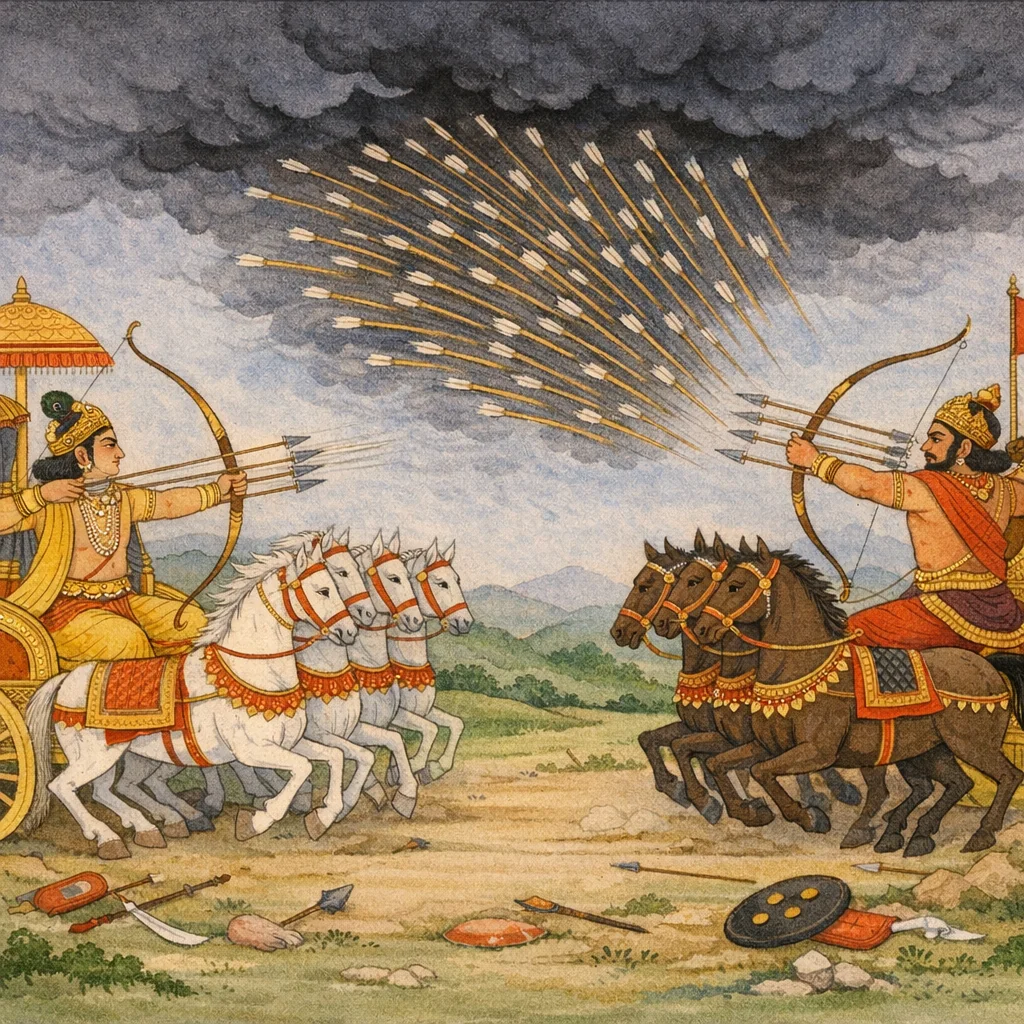
Chapter Arc: संजय धृतराष्ट्र से कहता है कि आपकी कुमन्त्रणाओं के फलस्वरूप रणभूमि में शंख-भेरी की गम्भीर ध्वनि उठी—और श्वेत अश्वों वाले दो नरश्रेष्ठ, अर्जुन और कर्ण, आमने-सामने आ खड़े हुए। → दोनों वीर वैर को विषधर सर्पों की तरह फुफकारते, अग्नि की तरह दहकते हुए धनुष-डोरियों की टंकार और बाण-वर्षा से एक-दूसरे पर टूट पड़ते हैं—मानो मेघ-से-मेघ भिड़ रहे हों। बीच-बीच में पाञ्चालों के वध का कटु स्मरण अर्जुन के पक्ष में क्रोध और प्रतिशोध को और तीखा करता है; भीम भी सत्यसंध अर्जुन को उकसाता है कि कर्ण के प्रहारों का उत्तर निर्णायक अस्त्रों से दे। → अस्त्रों की पराकाष्ठा पर अर्जुन दिशाओं-प्रदिशाओं को बाणों से ढक देता है; दिव्यास्त्रों से आकाश में घोर अन्धकार छा जाता है, पक्षी तक मार्ग नहीं पाते। इसी उन्मत्त क्षण में अर्जुन कर्ण-शल्य और कुरु-सेना पर तीव्र प्रहार करता है, और कर्ण भी प्रत्युत्तर में अर्जुन को तथा उसके रथ-परिसर को बाणों से छलनी करता है—रण का केंद्र एक ही द्वंद्व में सिमट जाता है। → अध्याय का अंत किसी एक के निर्णायक पतन पर नहीं, बल्कि दोनों के असाधारण शौर्य, अस्त्र-प्रतिअस्त्र की काट, और युद्ध-क्षेत्र में बढ़ती हुई अराजकता/अन्धकार के साथ होता है—जहाँ अर्जुन का प्रचण्ड प्रहार क्षणिक बढ़त देता है, पर कर्ण की प्रतिरोध-शक्ति युद्ध को फिर बराबरी पर खींच लाती है। → दिव्यास्त्रों से छाए अन्धकार और निरन्तर बाण-वर्षा के बीच यह प्रश्न लटकता रह जाता है कि अगला निर्णायक प्रहार किसका होगा—अर्जुन का या कर्ण का।
Shlokas
Verse 1
संजय कहते हैं--राजन्! तदनन्तर आपकी कुमन्त्रणाके फलस्वरूप जब वहाँ शंख और भेरियोंकी गम्भीर ध्वनि होने लगी, उस समय वहाँ श्वेत घोड़ोंवाले दोनों नरश्रेष्ठ वैकर्तन कर्ण और अर्जुन युद्धके लिये एक-दूसरेकी ओर बढ़े
Sanjaya said: O King, thereafter—as a consequence of your misguided counsel—when the deep, resounding calls of conches and kettle-drums arose on that field, the two foremost of men, Vaikartana Karna and Arjuna, both mounted on white horses, advanced toward one another for battle.
Verse 2
(आशीविषावग्निमिवापधूमं वैरं मुखाभ्यामभिनि:श्वसन्तौ । यशस्विनौ जज्वलतुर्मधे तदा घृतावसिक्ताविव हव्यवाहौ ।।) वे दोनों यशस्वी वीर उस समय दो विषधर सर्पोके समान लंबी साँस खींचकर मानो अपने मुखोंसे धूमरहित अग्निके सदृश वैरभाव प्रकट कर रहे थे। वे घीकी आहुतिसे प्रज्वलित हुई दो अग्नियोंकी भाँति युद्धभूमिमें देदीप्यमान होने लगे। यथा गजौ हैमवतोौ प्रभिन्नौ प्रवृद्धदन्ताविव वासितार्थ । तथा समाजम्मतुरुग्रवीर्यो धनंजयश्चाधिरथिक्ष वीरौ,जैसे मदकी धारा बहानेवाले हिमाचलप्रदेशके बड़े-बड़े दाँतोंवाले दो हाथी किसी हथिनीके लिये लड़ रहे हों, उसी प्रकार भयंकर पराक्रमी वीर अर्जुन और कर्ण युद्धके लिये एक-दूसरेके सामने आये
Sañjaya said: Then those two illustrious warriors, breathing hard, seemed to exhale from their mouths a smoke-less fire of enmity—like venomous serpents. In the midst of the battlefield they blazed forth like two sacrificial fires kindled by offerings of ghee. And as two great tusked elephants of the Himavat, streaming with rut, fight for a cow-elephant, so did Arjuna and Karna, terrible in prowess, come to face one another for war.
Verse 3
बलाहकेनेव महाबलाहको यदृच्छया वा गिरिणा यथा गिरि: । तथा धनुर्ज्यातलनेमिनिस्वनै: समीयतुस्ताविषुवर्षवर्षिणौ,जैसे महान् मेघ किसी दूसरे मेघके साथ अथवा दैवेच्छासे एक पर्वत दूसरे पर्वतके साथ टक्कर लेनेके लिये उद्यत हो, उसी प्रकार धनुषकी प्रत्यंचा, हथेली तथा रथके पहियोंकी गम्भीर ध्वनिके साथ बाणोंकी वर्षा करते हुए वे दोनों वीर एक-दूसरेके सामने आये
Sañjaya said: As a mighty cloud meets another cloud, or as one mountain, by the turn of fate, rushes to collide with another, so those two heroes—pouring down showers of arrows—advanced to face each other amid the deep sounds of bowstrings, palms striking, and chariot-wheels.
Verse 4
प्रवृद्धशुद्रद्रमवीरुदोष धी प्रवृद्धनानाविधनिर्सरौकसौ । यथाचलौ वा चलितौ महाबलौ तथा महास्त्रैरितरेतरं हत:,जिनके शिखर, वृक्ष, लता-गुल्म और ओषधि सभी विशाल एवं बढ़े हुए हों तथा जो नाना प्रकारके बड़े-बड़े झरनोंके उद्गमस्थान हों, ऐसे दो पर्वतके समान वे महाबली कर्ण और अर्जुन आगे बढ़कर अपने महान् अस्त्रोंद्वारा एक-दूसरेपर आघात करने लगे
Sañjaya said: Like two mighty mountains—whose peaks, trees, creepers, shrubs, and medicinal plants have grown vast, and which contain the sources of many great waterfalls—so did the immensely powerful Karṇa and Arjuna advance and strike one another with their supreme weapons.
Verse 5
स संनिपातस्तु तयोर्महान भूत् सुरेशवैरोचनयोर्यथा पुरा । शरैविंनुन्नाड्शनियन्तृवाहयो: सुदुःसहो<न्यै: कठुशोणितोदक:,उन दोनोंका वह संग्राम वैसा ही महान् था, जैसा कि पूर्वकालमें इन्द्र और बलिका युद्ध हुआ था। बाणोंके आघातसे उन दोनोंके शरीर, सारथि और घोड़े क्षत-विक्षत हो गये थे और वहाँ कटु रक्तरूपी जलका प्रवाह बह रहा था। वह युद्ध दूसरोंके लिये अत्यन्त दुःसह था
Sañjaya said: The clash between those two became immense, like the ancient battle of Indra, lord of the gods, with Virocana’s son Bali. Struck and torn by volleys of arrows, their bodies—along with charioteers and horses—were mangled, and a harsh stream of blood flowed there like water. That combat was unbearable for all others to endure or even witness.
Verse 6
प्रभूतपद्मोत्पलमत्स्यकच्छपौ महाह्दौ पक्षिगणैरिवावृतौ । सुसंनिकृष्टावनिलोद्धतौ यथा तथा रथौ तौ ध्वजिनौ समीयतु:,जैसे प्रचुर पद्म, उत्पल, मत्स्य और कच्छपोंसे युक्त तथा पक्षिसमूहोंसे आवृत दो अत्यन्त निकटवर्ती विशाल सरोवर वायुसे संचालित हो परस्पर मिल जाये, उसी प्रकार ध्वजोंसे सुशोभित उनके वे दोनों रथ एक-दूसरेसे भिड़ गये थे
Sañjaya said: Like two vast lakes lying close together—abounding in lotuses and water-lilies, filled with fish and turtles, and covered as if by flocks of birds—when stirred by the wind they surge and meet, so too those two bannered chariots, splendid with their standards, were driven into one another in the press of battle. The image underscores how the clash of warriors, though propelled by human will, also moves with the irresistible momentum of forces set in motion by war and fate.
Verse 7
उभौ महेन्द्रस्य समानविक्रमा- वुभौ महेन्द्रप्रतिमौ महारथौ । महेन्द्रवज्प्रतिमै श्व॒ सायकै- महेन्द्रवृत्राविव सम्प्रजघ्नतु:,वे दोनों वीर इन्द्रके समान पराक्रमी और उन्हींके सदृश महारथी थे। इन्द्रके वज्रतुल्य बाणोंसे इन्द्र और वृत्रासुरके समान वे एक-दूसरेको चोट पहुँचाने लगे
Sañjaya said: Both warriors were equal in prowess to Mahendra (Indra), both great chariot-fighters resembling Indra himself. With arrows like Indra’s thunderbolt, they struck at one another, like Indra and Vṛtra locked in combat—each meeting the other’s might without yielding.
Verse 8
सनागप्त्त्यश्वरथे उभे बले विचित्रवर्माभरणाम्बरायुधे । चकम्पतुर्विस्मयनीयरूपे वियद्गताश्चार्जुनकर्णसंयुगे,विचित्र कवच, आभूषण, वस्त्र और आयुध धारण करनेवाली, हाथी, घोड़े, रथ और पैदलोंसहित उभय पक्षकी चतुरंगिणी सेनाएँ अर्जुन और कर्णके उस युद्धमें भयके कारण आश्चवर्यजनकरूपसे काँपने लगीं तथा आकाशवर्ती प्राणी भी भयसे थर्रा उठे
Sañjaya said: Both armies—complete with elephants, horses, chariots, and infantry—adorned with variegated armor, ornaments, garments, and weapons, began to tremble in astonishment and fear at the duel between Arjuna and Karṇa. Even beings moving in the sky were shaken, as the clash of those two heroes made the battlefield itself seem to quiver.
Verse 9
भुजा: सवस्त्राडगुलय: समुच्छिता: ससिंहनादैर्हषितैर्दिदृक्षुभि: । यदर्जुनो मत्त इव द्विपो द्विपं समभ्ययादाधिरथिं जिघांसया,जैसे मतवाला हाथी किसी हाथीपर आक्रमण करता है, उसी प्रकार अर्जुन जब कर्णके वधकी इच्छासे उसपर धावा करने लगे, उस समय दर्शकोंने आनन्दित हो सिंहनाद करते हुए अपने हाथ ऊपर उठा दिये और अंगुलियोंमें वस्त्र लेकर उन्हें हिलाना आरम्भ किया
Sañjaya said: When Arjuna, intent on killing Ādhiratha (Karna), charged at him like a maddened elephant rushing upon another elephant, the onlookers—eager to witness the clash—were thrilled. With lion-like shouts they raised their arms aloft and began waving cloths held in their fingers, exulting at the impending encounter.
Verse 10
(ततः कुरूणामथ सोमकानां शब्दो महान् प्रादुरभूत् समन्तात् | यदार्जुनं सूतपुत्रो5पराह्ने महाहवे शैलमिवाम्बुदो<र्छत् ।। तदैव चासीद् रथयो: समागमो महारणे शोणितमांसकर्दमे ।।) जब महासमरमें अपराह्नके समय पर्वतपर जानेवाले मेघके समान सूतपुत्र कर्णने अर्जुनपर आक्रमण किया, उस समय कौरवों और सोमकोंका महान् कोलाहल सब ओर प्रकट होने लगा। उसी समय उन दोनों रथोंका संघर्ष आरम्भ हुआ। उस महायुद्धमें रक्त और मांसकी कीच जम गयी थी। उदक्रोशन् सोमकास्तत्र पार्थ पुर:सराशक्षार्जुन भिन्धि कर्णम् । छिन्ध्यस्य मूर्धानमलं चिरेण श्रद्धां च राज्याद् धृतराष्ट्रसूनो:,उस समय सोमकोंने आगे बढ़कर वहाँ कुन्तीकुमारसे पुकार-पुकारकर कहा--'अर्जुन! तुम कर्णको मार डालो। अब देर करनेकी आवश्यकता नहीं है। कर्णके मस्तक और दुर्योधनकी राज्य-प्राप्तिकी आशा दोनोंको एक साथ ही काट डालो”
Sañjaya said: Then, on every side, a great roar arose among the Kurus and the Somakas, when the charioteer’s son Karṇa, in the late afternoon of that mighty battle, rushed upon Arjuna like a rain-cloud surging toward a mountain. At that very moment the clash of the two chariots began in the great fight, in a field turned to mire with blood and flesh. There the Somakas, pressing forward, cried out to Pārtha again and again: “Arjuna, strike down Karṇa at once. Enough of delay—sever his head, and cut off, together with it, the son of Dhṛtarāṣṭra’s hope of gaining the kingdom.”
Verse 11
तथास्माकं बहवस्तत्र योधा: कर्ण तथा याहि याहीत्यवोचन् । जहार्जुनं कर्ण शरै: सुती3्ष: पुनर्वनं यान्तु चिराय पार्था:,इसी प्रकार हमारे पक्षके बहुत-से योद्धा कर्णको प्रेरित करते हुए बोले--“कर्ण! आगे बढ़ो, आगे बढ़ो। अपने पैने बाणोंसे अर्जुनको मार डालो, जिससे कुन्तीके सभी पुत्र पुनः दीर्घकालके लिये वनमें चले जायेँ”
Sañjaya said: “Even so, many of our warriors there urged Karṇa, crying, ‘Karṇa, advance—advance!’ ‘With your razor-sharp arrows, strike down Arjuna, so that the sons of Kuntī may once again be driven to the forest for a long time.’”
Verse 12
ततः कर्ण: प्रथम तत्र पार्थ महेषुभिवर्दशभि: प्रत्यविध्यत् । तं॑ चार्जुन: प्रत्यविद्धयच्छिताग्रै: कक्षान्तरे दशभि: सम्प्रहस्य
Sañjaya said: Then Karṇa, striking first in that encounter, pierced Pārtha (Arjuna) with ten mighty arrows. Arjuna, laughing in return, counter-pierced him with ten sharp-pointed shafts, driving them into the region of his armpit.
Verse 13
तदनन्तर वहाँ कर्णने पहले दस विशाल बाणोंद्वारा अर्जुनको बींध डाला, तब अर्जुनने भी हँसकर तीखी धारवाले दस बाणोंसे कर्णकी काँखमें प्रहार किया ।। परस्पर तौ विशिखेै: सुपुड्खै- स्ततक्षतु: सूतपुत्रोर्डर्जुनश्व । परस्परं तौ बिभिदुर्विमर्दे सुभीममभ्यापततुश्च हृष्टी,सूतपुत्र कर्ण और अर्जुन दोनों उस युद्धमें अत्यन्त हर्षमें भरकर सुन्दर पंखवाले बाणोंद्वारा एक-दूसरेको क्षत-विक्षत करने लगे। वे परस्पर क्षति पहुँचाते और भयानक आक्रमण करते थे
Then Karṇa first pierced Arjuna with ten massive arrows. Arjuna, smiling in return, struck Karṇa in the armpit with ten keen-edged shafts. In that fierce clash, Karṇa the charioteer’s son and Arjuna, exultant, wounded each other again and again with well-feathered arrows—each dealing injury and launching dreadful assaults.
Verse 14
ततोअर्जुन: प्रासृजदुग्रधन्वा भुजावुभौ गाण्डिवं चानुमृज्य । नाराचनालीकवराहकर्णान् क्षुरांस्तथा साउ्जलिकार्धथचन्द्रान्,तत्पश्चात् भयंकर धनुषवाले अर्जुनने अपनी दोनों भुजाओं तथा गाण्डीव धनुषको पोंछकर नाराच, नालीक, वराहकर्ण, क्षुर, अंजलिक तथा अर्धचन्द्र आदि बाणोंका प्रहार आरम्भ किया
Sañjaya said: Then Arjuna, the fierce archer, wiped both his arms and his Gāṇḍīva bow, and began a dreadful discharge of arrows—nārācas, nālīkas, varāhakarṇas, kṣuras, añjalikas, and half-moon shafts.
Verse 15
ते सर्वतः समकीर्यन्त राजन् पार्थेषव: कर्णरथं विशन्त: । अवाडूमुखा: पक्षिगणा दिनान्ते विशन्ति केतार्थमिवाशु वृक्षम्,राजन! वे अर्जुनके बाण कर्णके रथमें घुसकर सब ओर बिखर जाते थे। ठीक उसी तरह, जैसे संध्याके समय पक्षियोंके झुंड बसेरा लेनेके लिये नीचे मुख किये शीघ्र ही किसी वृक्षपर जा बैठते हैं
Sañjaya said: O King, Arjuna’s arrows, entering Karṇa’s chariot from every side, were scattering and lodging all around it. It was like flocks of birds at day’s end, beaks lowered, swiftly settling into a tree to find their roost.
Verse 16
यानर्जुन: सभ्रुकुटीकटाक्षं कर्णाय राजन्नसृजज्जितारि: । तान् सायकैग्र॑सते सूतपुत्र: क्षिप्तान् क्षिप्तान् पाण्डवस्याशु संघान्
Sañjaya said: O King, the volleys of arrows that Arjuna—brow knit and glance fierce—shot toward Karṇa, the conqueror of foes, were swiftly swallowed up by Karṇa, the charioteer’s son, with his own shafts, again and again, as the Pāṇḍava hurled them forth in clusters.
Verse 17
नरेश्वर! शत्रुविजयी अर्जुन भौंहें टेढ़ी करके कटाक्षपूर्वक देखते हुए कर्णपर जिन-जिन बाणोंका प्रहार करते थे, पाण्डुपुत्र अर्जुनके चलाये हुए उन सभी बाणसमूहोंको सूतपुत्र कर्ण शीघ्र ही नष्ट कर देता था ।। ततोअस्त्रमाग्नेयममित्रसा धनं मुमोच कर्णाय महेन्द्रसूनु: । भूम्यन्तरिक्षे च दिशो<र्कमार्ग प्रावृत्य देहो5स्य बभूव दीप्त:,तब इन्द्रकुमार अर्जुनने कर्णपर शत्रुनाशक आग्नेयास्त्रका प्रयोग किया। उस आगेनेयास्त्रका स्वरूप पृथ्वी, आकाश, दिशा तथा सूर्यके मार्गको व्याप्त करके वहाँ प्रज्वलित हो उठा
Sañjaya said: O king, Arjuna—the conqueror of foes—frowning and casting sharp, sidelong glances, kept striking Karṇa with volleys of arrows; yet Karṇa, the charioteer’s son, swiftly destroyed every cluster of arrows released by Pāṇḍu’s son. Then Indra’s son Arjuna discharged against Karṇa the enemy-crushing Agneya weapon. Spreading over the earth and the mid-sky, covering the directions and even the path of the sun, its blazing form flared up in fierce radiance.
Verse 18
योधाश्व सर्वे ज्वलिताम्बरा भूृशं प्रदुद्रवुस्तत्र विदग्धवस्त्रा: । शब्दश्न घोरोडतिबभूव तत्र यथा वने वेणुवनस्य दहुत:
Sañjaya said: There, all the warriors and horses, their garments blazing and their clothes scorched, fled in wild confusion. A dreadful uproar arose in that place, like the roaring sound in a forest when a bamboo-grove is burning.
Verse 19
इससे वहाँ समस्त योद्धाओंके वस्त्र जलने लगे। कपड़े जल जानेसे वे सब-के-सब वहाँसे भाग चले। जैसे जंगलके बीच बाँसके वनमें आग लगनेपर जोर-जोरसे चटकनेकी आवाज होती है, उसी प्रकार आगकी लपटमें झुलसते हुए सैनिकोंका अत्यन्त भयंकर आर्तनाद होने लगा ।। तद् वीक्ष्य कर्णो ज्वलनास्त्रमुद्यतं स वारुणं तत्प्रशमार्थमाहवे । समुत्सूजन् सूतसुतः प्रतापवान् स तेन वल्लिं शमयाम्बभूव
Sañjaya said: Thus the garments of all the warriors there began to burn; their clothes consumed, they fled the place. And as in a forest, when a bamboo-grove catches fire, loud crackling is heard, so too arose the most dreadful cries of soldiers scorched by the flames. Seeing the blazing fire-weapon unleashed, Karṇa—the valiant charioteer’s son—released in that battle the Vāruṇa weapon to quell it, and by that counter-weapon subdued the spreading blaze.
Verse 20
प्रतापी सूतपुत्र कर्णने उस आग्नेयास्त्रको उद्दीप्त हुआ देखकर रणक्षेत्रमें उसकी शान्तिके लिये वारुणास्त्रका प्रयोग किया और उसके द्वारा उस आगको बुझा दिया ।। बलाहकौघश्न दिशस्तरस्वी चकार सर्वास्तिमिरेण संवृता: । ततो धरित्रीधरतुल्यरोधस: समनततो वै परिवार्य वारिणा,फिर तो बड़े वेगसे मेघोंकी घटा घिर आयी और उसने सम्पूर्ण दिशाओंको अन्धकारसे आच्छादित कर दिया। दिशाओंका अन्तिम भाग काले पर्वतके समान दिखायी देने लगा। मेघोंकी घटाओंने वहाँका सारा प्रदेश जलसे आप्लावित कर दिया था
Sañjaya said: Seeing the blazing Agneya weapon on the battlefield, the valiant Karṇa, son of a charioteer, employed the Varuṇa weapon to pacify it and thereby quenched that fire. Then, with great force, masses of clouds gathered and covered all directions in darkness; the horizons looked like black mountains, and the region all around was flooded with torrents of water.
Verse 21
उन मेघोंने वहाँ पूर्वोक्तरूपसे बढ़ी हुई अति प्रचण्ड आगको बड़े वेगसे बुझा दिया। फिर समस्त दिशाओं और आकाशकमें वे ही छा गये
Sañjaya said: Those clouds swiftly quenched the exceedingly fierce fire that had flared up in the manner described earlier. Thereafter, they alone spread out, covering all directions and the sky.
Verse 22
तथा च सर्वास्तिमिरेण वै दिशो मेघैर्व॒ता न प्रदृश्येत किंचित् । अथापोवाह्या भ्रसंघान् समस्तान् वायव्यास्त्रेणापतत: स कर्णात्,मेघोंसे घिरकर सारी दिशाएँ अन्धकाराच्छन्न हो गयीं; अतः कोई भी वस्तु दिखायी नहीं देती थी। तदनन्तर कर्णकी ओरसे आये हुए सम्पूर्ण मेघ-समूहोंको वायव्यास्त्रसे छिन्न-भिन्न करके शत्रुओंके लिये अजेय अर्जुनने गाण्डीव धनुष, उसकी प्रत्यंचा तथा बाणोंको अभिमन्त्रित करके अत्यन्त प्रभावशाली वच्ञास्त्रको प्रकट किया, जो देवराज इन्द्रका प्रिय अस्त्र है
Sañjaya said: Then, as masses of clouds swept in, all the directions were covered in darkness, so that nothing at all could be seen. Thereupon, the entire host of clouds that had rushed forth from Karṇa was torn apart by the Wind-weapon (Vāyavya-astra), restoring the field of vision.
Verse 23
ततोअप्यस्त्रं दयितं देवराज्ञ: प्रादुश्षक्रे वज्मतिप्रभावम् । गाण्डीवं ज्यां विशिखांश्चानुमन्त्रय धनंजय: शत्रुभिरप्रधृष्य:,मेघोंसे घिरकर सारी दिशाएँ अन्धकाराच्छन्न हो गयीं; अतः कोई भी वस्तु दिखायी नहीं देती थी। तदनन्तर कर्णकी ओरसे आये हुए सम्पूर्ण मेघ-समूहोंको वायव्यास्त्रसे छिन्न-भिन्न करके शत्रुओंके लिये अजेय अर्जुनने गाण्डीव धनुष, उसकी प्रत्यंचा तथा बाणोंको अभिमन्त्रित करके अत्यन्त प्रभावशाली वच्ञास्त्रको प्रकट किया, जो देवराज इन्द्रका प्रिय अस्त्र है
Sañjaya said: Even then, Dhanañjaya—unassailable by his foes—invoked the beloved weapon of the Lord of the gods, a missile of thunderbolt-like, overwhelming power. After consecrating the Gāṇḍīva bow, its bowstring, and his arrows with mantras, he manifested that mighty divine weapon, dear to Indra.
Verse 24
तत: क्षुरप्राञ्जलिकार्धचन्द्रा नालीकनाराचवराहकर्णा: । गाण्डीवत: प्रादुरासन् सुतीक्ष्णा: सहस्रशो वज़्ञसमानवेगा:,उस गाण्डीव धनुषसे क्षुरप्र, अंजलिक, अर्धचन्द्र, नालीक, नाराच और वराहकर्ण आदि तीखे अस्त्र हजारोंकी संख्यामें छूटने लगे। वे सभी अस्त्र वज्धके समान वेगशाली थे
Sañjaya said: Then, from the Gāṇḍīva bow there burst forth—by the thousand—razor-edged shafts: kṣura arrows, prāñjalika, half-moon (ardhacandra) missiles, nālīka and nārāca arrows, and the boar-eared (varāhakarṇa) type. All of them were keenly sharpened and rushed with a speed like Indra’s thunderbolt.
Verse 25
ते कर्णमासाद्य महाप्रभावा: सुतेजना गार्ध्रपत्रा: सुवेगा: । गात्रेषु सर्वेषु हयेषु चापि शरासने युगचक्रे ध्वजे च,वे महाप्रभावशाली गीधके पंखोंसे युक्त, तेज धारवाले और अतिशय वेगवान् अस्त्र कर्णके पास पहुँचकर उसके समस्त अंगोंमें, घोड़ोंपर, धनुषमें तथा रथके जूओं, पहियों और ध्वजोंमें जा लगे
Sañjaya said: Those arrows—mighty in effect, keen-edged, fletched with vulture-feathers, and exceedingly swift—reached Karṇa and struck him everywhere: in his limbs, in his horses as well, and in his bow; they also lodged in the yoke, the wheels, and the banner of his chariot.
Verse 26
निर्भिद्य तूर्ण विविशु: सुतीक्षणा- स्ताक्ष्यत्रस्ता भूमिमिवोरगास्ते । शराचिताड़ो रुधिरारद्रगात्र: कर्णस्तदा रोषविवृत्तनेत्र:
Sañjaya said: Having pierced through, those razor-sharp arrows swiftly entered him—like serpents, frightened by Garuḍa, slipping into the earth. Karṇa then stood with his body bristling with arrows, his limbs wet with blood, and his eyes widened in wrath.
Verse 27
जैसे गरुड़से डरे हुए सर्प धरती छेदकर उसके भीतर घुस जाते हैं, उसी प्रकार वे तीखे अस्त्र उपर्युक्त वस्तुओंको विदीर्ण कर शीघ्र ही उनके भीतर धँस गये। कर्णके सारे अंग बाणोंसे भर गये। सम्पूर्ण शरीर रक्तसे नहा उठा। इससे उसके नेत्र उस समय क्रोधसे घूमने लगे ।। दृढ्ज्यमानाम्य समुद्रघोषं प्रादुश्षक्रे भार्गवास्त्रं महात्मा । महेन्द्रशस्त्राभिमुखान् विमुक्तां- श्छित्त्वा कर्ण: पाण्डवस्येषुसंघान्,उस महामनस्वी वीरने अपने धनुषको जिसकी प्रत्यंचा सुदृढ़ थी, झुकाकर समुद्रके समान गम्भीर गर्जना करनेवाले भार्गवास्त्रको प्रकट किया और अर्जुनके महेन्द्रास्त्रसे प्रकट हुए बाणसमूहोंके टुकड़े-टुकड़े करके अपने अस्त्रसे उनके अस्त्रको दबाकर युद्धस्थलमें रथों, हाथियों और पैदलसैनिकोंका संहार कर डाला। अमर्षशील कर्ण उस महासमरमें भार्गवास्त्रके प्रतापसे देवराज इन्द्रके समान पराक्रम प्रकट कर रहा था
Sañjaya said: As serpents, terrified of Garuḍa, split the earth and vanish into its depths, so those keen missiles tore through the defenses described earlier and quickly sank in. Karṇa’s limbs were riddled with arrows; his whole body was bathed in blood, and his eyes rolled with wrath. Then that great warrior, bracing his firmly strung bow and letting out a roar deep as the ocean, manifested the Bhārgava weapon. Cutting to pieces the volleys released against him from Arjuna’s Mahendra-weapon, Karṇa suppressed the enemy missiles with his own and, on the battlefield, wrought slaughter among chariots, elephants, and foot-soldiers. In that vast clash, the unyielding Karṇa displayed prowess like Indra himself through the might of the Bhārgava weapon.
Verse 28
तस्यास्त्रमस्त्रेण निहत्य सो5थ जघान संख्ये रथनागपत्तीन् | अमृष्यमाणश्न महेन्द्रकर्मा महारणे भार्गवास्त्रप्रतापात्,उस महामनस्वी वीरने अपने धनुषको जिसकी प्रत्यंचा सुदृढ़ थी, झुकाकर समुद्रके समान गम्भीर गर्जना करनेवाले भार्गवास्त्रको प्रकट किया और अर्जुनके महेन्द्रास्त्रसे प्रकट हुए बाणसमूहोंके टुकड़े-टुकड़े करके अपने अस्त्रसे उनके अस्त्रको दबाकर युद्धस्थलमें रथों, हाथियों और पैदलसैनिकोंका संहार कर डाला। अमर्षशील कर्ण उस महासमरमें भार्गवास्त्रके प्रतापसे देवराज इन्द्रके समान पराक्रम प्रकट कर रहा था
Sañjaya said: Having struck down his opponent’s weapon with his own, he then, in the thick of battle, began to fell chariot-warriors, elephants, and foot-soldiers. Unable to endure resistance and fired by wrath, Karṇa—empowered by the might of the Bhārgava weapon—displayed deeds like those of Indra in that great combat.
Verse 29
पज्चालानां प्रवरांश्षापि योधान् क्रोधाविष्ट: सूतपुत्रस्तरस्वी । बाणैरविव्याधाहवे सुप्रमुक्ति: शिलाशितै रुक्मपुड्खै: प्रसहा,क्रोधमें भरे हुए वेगशाली सूतपुत्र कर्णने अच्छी तरह छोड़े गये और शिलापर तेज किये हुए सुवर्णमय पंखवाले बाणोंद्वारा युद्धस्थलमें हठपूर्वक मुख्य-मुख्य पांचालयोद्धाओंको घायल कर दिया
Sañjaya said: Inflamed with wrath, the swift and powerful Karṇa—the son of a charioteer—forcefully pierced the foremost warriors of the Pāñcālas on the battlefield with well-released arrows, their points honed on stone and their shafts adorned with golden fletching.
Verse 30
तत्पञ्चाला: सोमकाश्चापि राजन् कर्णेनाजौ पीड्यमाना: शरौचै: । क्रोधाविष्टा विव्यधुस्तं समन्तात् तीक्षणैर्बाणै: सूतपुत्र॑ं समेता:
Sañjaya said: O King, the Pañcālas and the Somakas, hard-pressed in the battle by Karṇa’s volleys of arrows, were seized by anger. Gathering together, they struck the charioteer’s son from all sides with sharp shafts.
Verse 31
राजन! समरांगणमें कर्णके बाणसमूहोंसे पीड़ित होते हुए पांचाल और सोमक योद्धा भी क्रोधपूर्वक एकत्र हो अपने पैने बाणोंसे सूतपुत्र कर्णको बींधने लगे ।। तान् सूतपुत्रो निजघान बाणै: पज्चालानां रथनागाश्चसंघान् | अभ्यर्दयद् बाणगणै: प्रसहा विद्ध्वा हर्षात् सड़रे सूतपुत्र:,किंतु उस रणक्षेत्रमें सूतपुत्र कर्णने बाणसमूहोंद्वारा हर्ष और उत्साहके साथ पांचालोंके रथियों, हाथीसवारों और घुड़सवारोंको घायल करके बड़ी पीड़ा दी और उन्हें बाणोंसे मार डाला
Sañjaya said: “O King, though tormented on the battlefield by Karṇa’s volleys, the Pāñcāla and Somaka warriors, inflamed with anger, gathered together and began to pierce Karṇa, the son of a charioteer, with their sharp arrows. But Karṇa struck them down in return: with dense showers of arrows he forcefully harried the Pāñcālas’ companies of chariot-fighters, elephant-riders, and horsemen. Wounding them with exultant ardor amid the clash of war, the sūtaputra inflicted grievous pain and slew many with his shafts.”
Verse 32
ते भिन्नदेहा व्यसवो निपेतु: कर्णेषुभिर्भूमितले स्वनन्त: । क्रुद्धेन सिंहेन यथेभयूथा महावने भीमबलेन तद्वत्
Sañjaya said: Their bodies shattered and life-breath gone, they fell upon the ground, their ear-ornaments clinking as they struck the earth—just as herds of elephants in a vast forest are brought down by an enraged lion of terrible strength.
Verse 33
कर्णके बाणोंसे उनके शरीरोंके टुकड़े-टुकड़े हो गये और वे प्राणशून्य होकर कराहते हुए पृथ्वीपर गिर पड़े। जैसे विशाल वनमें भयानक बलशाली और क्रोधमें भरे हुए सिंहसे विदीर्ण किये गये हाथियोंके झुंड धराशायी हो जाते हैं, वैसी ही दशा उन पांचालयोद्धाओंकी भी हुई ।। पज्चालानां प्रवरान् संनिहत्य प्रसह्य योधानखिलानदीन: । ततः स राजन् विरराज कर्णो यथाम्बरे भास्कर उग्ररश्मि:,राजन! पांचालोंके समस्त श्रेष्ठ योद्धाओंका बलपूर्वक वध करके उदार वीर कर्ण आकाशकमें प्रचण्ड किरणोंवाले सूर्यके समान प्रकाशित होने लगा
Sañjaya said: “Struck by Karṇa’s arrows, their bodies were cut into pieces; bereft of life, they fell to the earth, groaning. As in a vast forest a dreadful, mighty lion—swollen with rage—tears apart a herd of elephants so that they collapse to the ground, so too was the fate of those Pāñcāla warriors. Having forcibly slain all the foremost fighters of the Pāñcālas, the undaunted Karṇa then shone forth, O King, like the sun in the sky with fierce rays.”
Verse 34
कर्णस्य मत्वा तु जयं त्वदीया: परां मुदं सिंहनादांश्व चक्कुः । सर्वे हामन्यन्त भूशाहतौ च कर्णेन कृष्णाविति कौरवेन्द्र,उस समय आपके सैनिक कर्णकी विजय समझकर बड़े प्रसन्न हुए और सिंहनाद करने लगे। कौरवेन्द्र! उन सबने यही समझा कि कर्णने श्रीकृष्ण और अर्जुनको बहुत घायल कर दिया है
Sañjaya said: Believing that Karṇa had won, your warriors were filled with supreme joy and raised lion-like shouts. O lord of the Kurus, they all concluded that Karṇa had grievously wounded Kṛṣṇa and Arjuna.
Verse 35
तत् तादृशं प्रेक्ष्य महारथस्य कर्णस्य वीर्य च परैरसहाम् । दृष्टवा च कर्णेन धनंजयस्य तथा5डजिमध्ये निहतं तदस्त्रम्,महारथी कर्णका वह शत्रुओंके लिये असहा वैसा पराक्रम दृष्टिपथमें लाकर तथा रणभूमिमें कर्णद्वारा अर्जुनके उस अस्त्रको नष्ट हुआ देखकर अमर्षशील वायुपुत्र भीमसेन हाथ-से-हाथ मलने लगे। उनके नेत्र क्रोधसे प्रज्वलित हो उठे। हृदयमें अमर्ष और क्रोधका प्रादुर्भाव हो गया; अतः वे सत्यप्रतिज्ञ अर्जुनसे इस प्रकार बोले--
Sañjaya said: Seeing such prowess of the great chariot-warrior Karṇa—an energy intolerable to his foes—and also seeing that, in the midst of battle, Karṇa had neutralized that weapon of Dhanañjaya (Arjuna), the wind-born Bhīmasena, unable to bear it, began to chafe in anger. His eyes flared with wrath; resentment and fury surged within him, and he spoke thus to Arjuna, the steadfast keeper of his vows.
Verse 36
ततस्त्वमर्षी क्रोधसंदीप्तनेत्रो वातात्मज: पाणिना पाणिमार्च्छत् । भीमोअब्रवीदर्जुनं सत्यसंध- ममर्षितो नि:श्वसज्जातमन्यु:,महारथी कर्णका वह शत्रुओंके लिये असहा वैसा पराक्रम दृष्टिपथमें लाकर तथा रणभूमिमें कर्णद्वारा अर्जुनके उस अस्त्रको नष्ट हुआ देखकर अमर्षशील वायुपुत्र भीमसेन हाथ-से-हाथ मलने लगे। उनके नेत्र क्रोधसे प्रज्वलित हो उठे। हृदयमें अमर्ष और क्रोधका प्रादुर्भाव हो गया; अतः वे सत्यप्रतिज्ञ अर्जुनसे इस प्रकार बोले--
Sañjaya said: Then Bhīma, the son of Vāyu—unable to bear the affront—his eyes blazing with anger, rubbed his hands together. Seething with indignation and breathing hard as wrath rose within him, he addressed Arjuna, the steadfast keeper of his vow. The moment frames the ethical tension of war: when a comrade’s prowess is checked and one’s side suffers a setback, righteous resolve must be guarded from collapsing into uncontrolled rage.
Verse 37
कथं नु पापोदयमपेतध धर्म: सूतात्मज: समरेउद्य प्रसहा । पज्चालानां योधमुख्याननेकान् निजघ्निवांस्तव जिष्णो समक्षम्
Sañjaya said: “How is it that the son of a charioteer—one in whom sin has risen and who has fallen away from dharma—has today, in the battle, with reckless force, slain many foremost warriors of the Pāñcālas right before Jiṣṇu (Arjuna), your son’s opponent? The scene shows the grim moral inversion of war: prowess and fury appear to triumph even when righteousness is eclipsed.”
Verse 38
“विजयी अर्जुन आज समरांगणमें धर्मसे दूर रहनेवाले इस पापी सूतपुत्र कर्णने तुम्हारी आँखोंके सामने अनेक प्रमुख पांचालयोद्धाओंका वध कैसे कर डाला? ।। पूर्व देवेरजितं कालकेयै: साक्षात् स्थाणोर्बाहुसंस्पर्शमेत्य । कथं नु त्वां सूतपुत्र: किरीटि- न्नथेषुभिर्दशभि: प्रागविद्धयत्,“किरीटधारी अर्जुन! तुम्हें तो पूर्वकालमें देवता भी नहीं जीत सके थे। कालकेय दानव भी नहीं परास्त कर सके थे। तुम साक्षात् भगवान् शंकरकी भुजाओंसे टक्कर ले चुके हो तो भी इस सूतपुत्रने तुम्हें पहले ही दस बाण मारकर कैसे बींध डाला?
Sañjaya said: “Arjuna, the ever-victorious, how is it that today on the battlefield this sinful Karṇa—son of a charioteer, one who stands far from dharma—has, before your very eyes, slain many of the foremost warriors of Pāñcāla? In former times you were unconquered even by the gods; the Kālakeya demons could not defeat you. You have even come into direct contact with the arms of Sthāṇu (Śiva) himself. How then did this sūta’s son, O diadem-wearing one, manage to pierce you first with ten arrows?”
Verse 39
त्वया क्षिप्तांश्षाग्रसद् बाणसंघा- नाश्चर्यमेतत् प्रतिभाति मेडद्य । कृष्णापरिक्लेशमनुस्मर त्वं यथाब्रवीत् षण्ढतिलान् सम वाच:,“तुम्हारे चलाये हुए बाणसमूहोंको इसने नष्ट कर दिया, यह तो आज मुझे बड़े आश्चर्यकी बात जान पड़ती है। सव्यसाची अर्जुन! कौरव-सभामें द्रौपदीको दिये गये उन क्लेशोंको तो याद करो। इस पापबुद्धि दुरात्मा सूतपुत्रने जो निर्भय होकर हमलोगोंको थोथे तिलोंके समान नपुंसक बताया था और बहुत-सी अत्यन्त तीखी एवं रूखी बातें सुनायी थीं, उन सबको यहाँ याद करके तुम पापी कर्णको शीघ्र ही युद्धमें मार डालो
Sañjaya said: “That he has destroyed the dense volleys of arrows you discharged—this appears truly astonishing to me today. Remember, O Savyasācin Arjuna, the sufferings inflicted upon Kṛṣṇā (Draupadī) in the Kaurava assembly. Recall how this sinful-minded, wicked son of a charioteer spoke fearlessly, calling us ‘impotent like empty sesame seeds,’ and hurled many harsh and cutting words. Keeping all that in mind, swiftly slay the sinner Karṇa in battle.”
Verse 40
रूक्षा: सुतीक्ष्णाश्न हि पापबुद्धिः सूतात्मजो<यं गतभीर्दुरात्मा । संस्मृत्य सर्व तदिहाद्य पापं जह्याशु कर्ण युधि सव्यसाचिन्,“तुम्हारे चलाये हुए बाणसमूहोंको इसने नष्ट कर दिया, यह तो आज मुझे बड़े आश्चर्यकी बात जान पड़ती है। सव्यसाची अर्जुन! कौरव-सभामें द्रौपदीको दिये गये उन क्लेशोंको तो याद करो। इस पापबुद्धि दुरात्मा सूतपुत्रने जो निर्भय होकर हमलोगोंको थोथे तिलोंके समान नपुंसक बताया था और बहुत-सी अत्यन्त तीखी एवं रूखी बातें सुनायी थीं, उन सबको यहाँ याद करके तुम पापी कर्णको शीघ्र ही युद्धमें मार डालो
Sanjaya said: “This charioteer’s son, wicked in intent and vile in nature, has spoken harsh and razor-sharp words, and now, having cast off fear, he stands before you. Recall today, here and now, all that wrongdoing—especially the humiliations inflicted upon Draupadī in the Kaurava court. Remember how this sinful Karṇa, boldly deriding us, called us impotent like empty sesame husks and hurled many cruel insults. Keeping all that in mind, O Savyasācin, swiftly slay Karṇa in battle.”
Verse 41
कस्मादुपेक्षां कुरुषे किरीटि- नुपेक्षितुं नायमिहाद्य काल: । यया धृत्या सर्वभूतान्यजैषी- ग्रांसं ददत् खाण्डवे पावकाय
Sanjaya said: “Why, O Kirīṭin (Arjuna), do you show indifference? Today is no time for indifference. With that same steadfast resolve by which you once conquered all beings—when, in the Khāṇḍava forest, you fed the Fire-god his due—now is the moment to act with unwavering courage.”
Verse 42
अथाब्रवीद् वासुदेवो5पि पार्थ दृष्टवा रथेषून् प्रतिहन्यमानान्,तदनन्तर वसुदेवनन्दन भगवान् श्रीकृष्णने भी अर्जुनके रथसम्बन्धी बाणोंको कर्णके द्वारा नष्ट होते देख उनसे इस प्रकार कहा “किरीटधारी अर्जुन! यह क्या बात है? तुमने अबतक जितने बार प्रहार किये हैं, उन सबमें कर्णने तुम्हारे अस्त्रको अपने अस्त्रोंद्वारा नष्ट कर दिया है। वीर! आज तुमपर कैसा मोह छा रहा है? तुम सावधान क्यों नहीं होते? देखो, ये तुम्हारे शत्रु कौरव अत्यन्त हर्षमें भरकर सिंहनाद कर रहे हैं!
Sanjaya said: Then Vasudeva (Krishna) too spoke to Partha (Arjuna). Seeing the chariot-aimed arrows repeatedly struck down, the blessed Krishna, son of Vasudeva, observing Karna destroying Arjuna’s shafts directed at the chariot, addressed him: “O diadem-wearing Arjuna—what is this? Each time you have launched your attacks, Karna has met and nullified your weapons with his own. O hero, what delusion has come over you today? Why are you not fully alert? Look—your enemies, the Kauravas, are roaring like lions in exultation.”
Verse 43
अमीमृदत् सर्वपातेडद्य कर्णो हास्त्रैरस्त्र किमिदं भो किरीटिन् | स वीर कि मुहा[सि नावधत्से नदन्त्येते कुरव: सम्प्रहृष्टा:,तदनन्तर वसुदेवनन्दन भगवान् श्रीकृष्णने भी अर्जुनके रथसम्बन्धी बाणोंको कर्णके द्वारा नष्ट होते देख उनसे इस प्रकार कहा “किरीटधारी अर्जुन! यह क्या बात है? तुमने अबतक जितने बार प्रहार किये हैं, उन सबमें कर्णने तुम्हारे अस्त्रको अपने अस्त्रोंद्वारा नष्ट कर दिया है। वीर! आज तुमपर कैसा मोह छा रहा है? तुम सावधान क्यों नहीं होते? देखो, ये तुम्हारे शत्रु कौरव अत्यन्त हर्षमें भरकर सिंहनाद कर रहे हैं!
Sanjaya said: “Today Karna has shattered every one of your volleys with his own weapons. What is this, O Kirīṭin (Arjuna)? O hero, what delusion has come over you that you do not stay alert? Look—these Kurus, your enemies, are roaring in triumph, exultant at what they see.”
Verse 44
कर्ण पुरस्कृत्य विदुर्हि सर्वे तवास्त्रमस्त्रैविनिपात्यमानम् । यया धृत्या निहतं तामसास्त्र युगे युगे राक्षसाश्चापि घोरा:
Sanjaya said: “All of them know well that, with Karṇa placed at the fore, your missile is being struck down by counter-missiles. By that same steadfast resolve, the dark and delusive Tāmasa weapon was once destroyed—and, age after age, even the dreadful Rākṣasas as well.”
Verse 45
अनेन चास्य क्षुरनेमिनाद्य संछिन्धि मूर्धानमरे: प्रसहा
Sanjaya said: “With this razor-edged weapon, cut down at once the head of this enemy—overpower him and do it without hesitation.”
Verse 46
किरातरूपी भगवान् सुधृत्या त्वया महात्मा परितोषितो5भूत्
Sañjaya said: By your steadfast resolve and disciplined endurance, the Blessed Lord—who had assumed the form of a Kirāta, a mountain-hunter—the great-souled One, was wholly pleased with you. It declares that divine favor is won not by mere might, but by unwavering intent aligned with one’s dharma.
Verse 47
ततो महीं सागरमेखलां त्वं सपत्तनां ग्रामवर्ती समृद्धाम्
Then you would possess the earth—girdled by the ocean—prosperous with its cities and villages and rich in abundance, even though rival claimants still remain. It evokes the ideal of sovereign responsibility: rule is measured not merely by conquest, but by the power to sustain a flourishing realm amid contested authority.
Verse 48
प्रयच्छ राज्ञे निहतारिसंघां यशश्च पार्थातुलमाप्त॒हि त्वम् । 'पार्थ! तत्पश्चात् समुद्रसे घिरी हुई नगरों और गाँवोंसे युक्त तथा शत्रुसमुदायसे शून्य यह समृद्धिशालिनी पृथ्वी राजा युधिष्ठिरको दे दो और अनुपम यश प्राप्त करो” ।। स एवमुक्तो5तिबलो महात्मा चकार बुद्धिं हि वधाय सौते:,भीमसेन और श्रीकृष्णके इस प्रकार प्रेरणा देने और कहनेपर अत्यन्त बलशाली महात्मा अर्जुनने सूतपुत्रके वधका विचार किया। उन्होंने अपने स्वरूपका स्मरण करके सब बातोंपर दृष्टिपात किया और इस युद्धभूमिमें अपने आगमनके प्रयोजनको समझकर श्रीकृष्णसे इस प्रकार कहा--
Sañjaya said: “O Partha, having destroyed the host of enemies, hand over this prosperous earth—filled with cities and villages, bounded by the ocean and mountains, and now free of hostile forces—to King Yudhishthira, and thereby attain incomparable fame.” Thus addressed, the exceedingly mighty, great-souled Arjuna resolved upon the slaying of the Sūta’s son (Karna). Recollecting his true nature and surveying the whole situation, he understood the purpose of his coming to the battlefield and then spoke to Krishna accordingly.
Verse 49
स चोदितो भीमजनार्दनाभ्यां स्मृत्वा तथा55त्मानमवेक्ष्य सर्वम् । इहात्मनश्नलागमने विदित्वा प्रयोजन केशवमित्युवाच,भीमसेन और श्रीकृष्णके इस प्रकार प्रेरणा देने और कहनेपर अत्यन्त बलशाली महात्मा अर्जुनने सूतपुत्रके वधका विचार किया। उन्होंने अपने स्वरूपका स्मरण करके सब बातोंपर दृष्टिपात किया और इस युद्धभूमिमें अपने आगमनके प्रयोजनको समझकर श्रीकृष्णसे इस प्रकार कहा--
Sañjaya said: Thus urged by Bhīma and Janārdana (Krishna), the mighty Arjuna recalled his true resolve and surveyed the whole situation. Realizing the purpose for which he had come to this battlefield—and that it was not for him to withdraw—he addressed Keśava (Krishna) accordingly.
Verse 50
प्रादुष्करोम्येष महास्त्रमुग्रं शिवाय लोकस्य वधाय सौते: । तन्मे5नुजानातु भवान् सुराश्च ब्रह्मा भवो वेदविदश्न सर्वे,'प्रभो! मैं जगत्के कल्याण और सूतपुत्रके वधके लिये अब एक महान् एवं भयंकर अस्त्र प्रकट कर रहा हूँ। इसके लिये आप, ब्रह्माजी, शंकरजी, समस्त देवता तथा सम्पूर्ण ब्रह्मवेत्ता मुझे आज्ञा दें!
Sañjaya said: “I now bring forth this mighty and terrible weapon—intended for the welfare of the world and for the slaying of the Sūta’s son (Karna). Let you, and Brahmā, and Bhava (Śiva), and all the gods, and all who know the Veda, grant me permission.”
Verse 51
इत्युच्य देव॑ स तु सव्यसाची नमस्कृत्वा ब्रह्मणे सोडमितात्मा । तदुत्तमं ब्राह्ममसहामस्त्र प्रादुक्षक्रे मनसा यद् विधेयम्,भगवान् श्रीकृष्णसे ऐसा कहकर अमितात्मा सव्यसाची अर्जुनने ब्रह्माजीको नमस्कार करके जिसका मनसे ही प्रयोग किया जाता है, उस असहा एवं उत्तम ब्रह्मास्त्रको प्रकट किया
Sañjaya said: Having spoken thus, the ambidextrous archer Arjuna—of boundless spirit—bowed in reverence to Brahmā. Then he manifested that supreme and irresistible Brahmā-weapon, the Brahmāstra, which is to be employed by the mind alone. The moment underscores that even in war, the gravest powers are invoked with restraint, reverence, and inner discipline, not mere rage.
Verse 52
तदस्य हत्वा विरराज कर्णो मुक्त्वा शरान् मेघ इवाम्बुधारा: । समीक्ष्य कर्णेन किरीटिनस्तु तथा55जिमध्ये निहतं तदस्त्रम्
Sañjaya said: Having struck down that (weapon/measure) of his, Karṇa shone forth, releasing arrows like a cloud pouring down sheets of rain. Seeing that his own missile had thus been destroyed by Karṇa in the midst of battle, the diademed Arjuna stood confronted with Karṇa’s prowess. The scene underscores how martial brilliance and resolve can overturn even formidable stratagems, while the warriors remain bound to their chosen duties amid the moral weight of fratricidal war.
Verse 53
ननु त्वाहुर्वेदितारं महास्त्रं ब्राह्मं विधेयं परमं जनास्तत्
Sañjaya said: “Surely people declare that the supreme Brahmā-weapon—the great celestial missile—should be employed only by one who truly knows it.” The line underscores a moral restraint in warfare: the right to wield the highest, most destructive power is inseparable from disciplined knowledge and responsible intent, not mere possession or ambition.
Verse 54
तस्मादन्यद् योजय सव्यसाचि- ज्लिति स्मोक्तोड्योजयत् सव्यसाची । ततो दिश: प्रदिशश्चापि सर्वा: समावृणोत् सायकैर्भूरितेजा:
Sañjaya said: “Therefore, O Savyasācin, yoke another (weapon/means)!” Thus urged, Savyasācin set another in action. Then that mighty, blazing warrior covered all the directions and intermediate quarters with a dense shower of arrows—an escalation of force meant to meet force in the grim ethics of battlefield necessity.
Verse 55
गाण्डीवमुक्तैर्भुजगैरिवो ग्रै- दिवाकरांशुप्रतिमैज्वलद्धि: | “सव्यसाचिन्! सब लोग कहते हैं कि तुम परम उत्तम एवं मनके द्वारा प्रयोग करनेयोग्य महान ब्रह्मास्त्रके ज्ञाता हो; इसलिये तुम दूसरे किसी श्रेष्ठ अस्त्रका प्रयोग करो।” उनके ऐसा कहनेपर सव्यसाची अर्जुनने दूसरे दिव्यास्त्रका प्रयोग किया। इससे महातेजस्वी अर्जुनने अपने गाण्डीव धनुषसे छूटे हुए सर्पोके समान भयंकर और सूर्य-किरणोंके तुल्य तेजस्वी बाणोंद्वारा सम्पूर्ण दिशाओंको आच्छादित कर दिया, कोना-कोना ढक दिया || ५३-५४ || सृष्टास्तु बाणा भरतर्षभेण शतं शतानीव सुवर्णपुड्खा:
Sañjaya said: From the Gāṇḍīva, Arjuna released arrows that were like fierce serpents—blazing and radiant like the sun’s rays—so that the directions seemed covered on every side. Then, O bull among the Bharatas, the arrows he discharged came in hundreds upon hundreds, each fitted with golden feathers. The scene underscores how mastery of divine weapons, though awe-inspiring, intensifies the moral weight of their use in war: skill and power must still answer to restraint and right purpose.
Verse 56
प्राच्छादयन् कर्णरथं क्षणेन युगान्तवहन्यर्ककरप्रकाशा: । भरतश्रेष्ठ अर्जुनके छोड़े हुए प्रलयकालीन सूर्य और अग्निकी किरणोंके समान प्रकाशित होनेवाले दस हजार बाणोंने क्षणभरमें कर्णके रथको आच्छादित कर दिया ।। ततश्न शूलानि परश्चधानि चक्राणि नाराचशतानि चैव
In an instant, ten thousand arrows—shot by Arjuna, foremost of the Bharatas—shining like the sun’s and fire’s rays at the end of an age, covered Karṇa’s chariot completely. Then there appeared spears, axes, discus-blades, and hundreds of nārāca arrows as well.
Verse 57
निश्चक्रमुर्घोरतराणि योधा- स्ततो हााहन्यन्त समन्ततो<डपि । उस दिव्यास्त्रसे शूल, फरसे, चक्र और सैकड़ों नाराच आदि घोरतर अस्त्र-शस्त्र प्रकट होने लगे, जिनसे सब ओरके योद्धाओंका विनाश होने लगा ।। छिन्नं शिर: कस्यचिदाजिम ध्ये पपात योधस्य परस्य कायात्,उस युद्धस्थलमें किसी शरत्रुपक्षीय योद्धाका सिर धड़से कटकर धरतीपर गिर पड़ा। उसे देखकर दूसरा भी भयके मारे धराशायी हो गया। उसको गिरा हुआ देख तीसरा योद्धा वहाँसे भाग खड़ा हुआ। किसी दूसरे योद्धाकी हाथीकी सुँड़ेके समान मोटी दाहिनी बाँह तलवारसहित कटकर गिर पड़ी
Sañjaya said: Then the warriors unleashed weapons of ever more dreadful power, and on every side cries of anguish arose as men were struck down. From that divine missile there appeared spears, axes, discus-blades, and hundreds of iron nārāca arrows, bringing destruction to fighters in all directions. In the midst of the battle, the severed head of a warrior of the opposing host fell to the earth, cut from his body; seeing it, another collapsed in terror, and seeing him fallen, a third fled from that place. Elsewhere, a warrior’s thick right arm—like an elephant’s trunk—was hewn off, sword in hand, and dropped to the ground.
Verse 58
भयेन सो<प्याशु पपात भूमा- वन्य: प्रणष्ट: पतितं विलोक्य । अन्यस्य सासिर्निपपात कृत्तो योधस्य बाहु: करिहस्ततुल्य:,उस युद्धस्थलमें किसी शरत्रुपक्षीय योद्धाका सिर धड़से कटकर धरतीपर गिर पड़ा। उसे देखकर दूसरा भी भयके मारे धराशायी हो गया। उसको गिरा हुआ देख तीसरा योद्धा वहाँसे भाग खड़ा हुआ। किसी दूसरे योद्धाकी हाथीकी सुँड़ेके समान मोटी दाहिनी बाँह तलवारसहित कटकर गिर पड़ी
Sañjaya said: Struck by fear, that warrior too quickly fell to the ground. Another, seeing him fallen, lost heart and fled. And for yet another fighter, his arm—thick like an elephant’s trunk—was severed and dropped to the earth along with his sword. Thus terror spread across the battlefield.
Verse 59
अन्यस्य सव्य: सह वर्मणा च क्षुरप्रकृत्त: पतितो धरण्याम् | एवं समस्तानपि योधमुख्यान् विध्वंसयामास किरीटमाली
Sañjaya said: Another warrior’s left arm, together with its armour, was shorn off by a razor-edged shaft and fell upon the earth. In this very manner the diadem-wearing hero (Kiritamālī) went on destroying even all the foremost leaders among the fighters.
Verse 60
दूसरेकी बायीं भुजा क्षुरोंद्वारा कवचके साथ कटकर भूमिपर गिर गयी। इस प्रकार किरीटधारी अर्जुनने शत्रुपक्षके सभी मुख्य-मुख्य योद्धाओंका संहार कर डाला ।। शरै: शरीरान्तकरै: सुघोरै- दौर्योधनं सैन्यमशेषमेव । वैकर्तनेनापि तथा55जिमध्ये सहस््रशो बाणगणा विसृष्टा:,उन्होंने शरीरका अन्त कर देनेवाले घोर बाणोंद्वारा दुर्योधनकी सारी सेनाका विध्वंस कर दिया। इसी प्रकार वैकर्तन कर्णने भी समरांगणमें सहस्रों बाणसमूहोंकी वर्षा की
Sañjaya said: With a razor-edged shaft, a warrior’s left arm was severed along with its armour and fell to the earth. Thus the diademed Arjuna cut down the foremost champions of the enemy host. With exceedingly dreadful arrows that bring life to its end, he shattered Duryodhana’s army without remainder; and in the same way Karṇa, Vaikartana, in the midst of battle loosed volleys of arrows by the thousand.
Verse 61
ते घोषिण: पाण्डवमभ्युपेयु: पर्जन्यमुक्ता इव वारिधारा: । ततः स कृष्णं च किरीटिनं च वृकोदरं चाप्रतिमप्रभाव:
Sañjaya said: With a thunderous roar they surged toward the son of Pāṇḍu, like torrents of rain released from a rain-cloud. Then that warrior of incomparable might advanced against Kṛṣṇa, the diadem-crowned Arjuna, and Vṛkodara (Bhīma), driving the battle onward with relentless assault, where valor and resolve are tested beneath the moral weight of fratricidal war.
Verse 62
त्रिभिस्त्रिभिर्भीमबलो निहत्य ननाद घोरं महता स्वरेण । वे बाण मेघोंकी बरसायी हुई जलधाराओंके समान शब्द करते हुए पाण्डुपुत्र अर्जुनको जा लगे। तत्पश्चात् अप्रतिम प्रभावशाली और भयंकर बलवान् कर्णने तीन-तीन बाणोंसे श्रीकृष्ण, अर्जुन और भीमसेनको घायल करके बड़े जोरसे भयानक गर्जना की || ६१ ई ।। स कर्णबाणाभिहत: किरीटी भीम तथा प्रेक्ष्य जनार्दनं॑ च
Sañjaya said: Having struck down his foes in sets of three, the mighty Bhīma roared terribly in a great voice. Then Arjuna, the diadem-wearing hero, and Bhīma—both wounded by Karṇa’s arrows—looked toward Janārdana (Kṛṣṇa). In the thick of battle, the cries and volleys proclaim not only bodily dominance but also the moral strain of a war where even the righteous must endure injury and uncertainty, relying on steadfast guidance.
Verse 63
अमृष्यमाण: पुनरेव पार्थ: शरान् दशाष्टौ च समुद्धबर्ह । कर्णके बाणोंसे घायल हुए किरीटधारी कुन्तीकुमार अर्जुन भीमसेन तथा भगवान् श्रीकृष्णको भी उसी प्रकार क्षत-विक्षत देखकर सहन न कर सके; अतः उन्होंने अपने तरकससे पुन: अठारह बाण निकाले ।। ६२ $ ।। स केतुमेकेन शरेण विद्ध्वा शल्यं चतुर्भिस्त्रिभिरेव कर्णम्
Sañjaya said: Unable to endure the sight, Pārtha (Arjuna)—the diadem-wearing son of Kuntī—though wounded by Karṇa’s arrows, saw Bhīmasena and even Lord Śrī Kṛṣṇa likewise cut and torn. He could not bear it. Therefore, drawing again from his quiver, he took up eighteen arrows. Then, with a single shaft he struck down the banner, with four he pierced Śalya, and with three he wounded Karṇa.
Verse 64
ततः स मुक्तिर्दशभिर्जघान सभापति काज्चनवर्मनद्धम् । एक बाणसे कर्णकी ध्वजाको बींधकर अर्जुनने चार बाणोंसे शल्यको और तीनसे कर्णको घायल कर दिया। तत्पश्चात् उन्होंने दस बाण छोड़कर सुवर्णमय कवच धारण करनेवाले सभापति नामक राजकुमारको मार डाला ।। स राजपुत्रो विशिरा विबाहु- विवाजिसूतो विधनुर्विकेतु:
Sañjaya said: Then Arjuna struck down the prince named Sabhāpati with ten arrows, though he was clad in golden armor. With a single arrow he pierced the emblem on Karṇa’s banner; with four arrows he wounded Śalya; and with three he wounded Karṇa. Thereafter that royal son fell—his head and arms severed, his charioteer and horses slain, his bow broken, and his standard destroyed—revealing the relentless, escalating violence of the battlefield.
Verse 65
पुनश्च कर्ण त्रिभिरष्टभिश्न द्वाभ्यां चतुर्भिर्देशभिश्व विद्ध्वा
Sañjaya said: And again, O Karṇa—having struck him in three places, in eight places, with two, with four, and in various other vital points—he continued to wound him repeatedly. The narration underscores the relentless, methodical violence of the battlefield, where skill in arms is turned toward sustained injury rather than restraint.
Verse 66
सहस्रशो<श्चांक्ष पुन: स सादी- नष्ट सहस््राणि च पत्तिवीरान्
Sañjaya said: Again and again he struck down horses by the thousand, along with their riders, and he also destroyed thousands of foot-soldiers. The narration underscores the terrifying scale of slaughter in war—where prowess, when unrestrained by compassion, turns the battlefield into a scene of mass destruction.
Verse 67
कर्ण ससूतं सरथं सकेतु- मदृश्यमण्जोगतिभश्ि: प्रचक्रे । तदनन्तर सवारोंसहित हजारों घोड़ों और सहस््रों पैदल वीरोंको मारकर रथ, सारथि और ध्वजसहित कर्णको भी शीघ्रगामी बाणोंद्वारा ढककर अदृश्य कर दिया ।। अथाक्रोशन् कुरवो वध्यमाना धनंजयेनाधिरथिं समन्तात्
Sañjaya said: Arjuna so covered Karṇa—together with his charioteer, chariot, and banner—with swift-flying arrows that he made him vanish from sight. Before that, he struck down thousands of horsemen with their mounts and thousands of foot-soldiers. As Karṇa’s forces were being cut down on every side by Dhanañjaya, the Kauravas cried out in distress. The scene underscores the grim ethics of battlefield duty: prowess is exercised without hesitation, yet the suffering of the many becomes the immediate moral weight of war.
Verse 68
स चोदित: सर्वयत्नेन कर्णो मुमोच बाणान् सुबहूनभीक्षणम्
Sañjaya said: Thus urged on, Karṇa, exerting himself with every effort, repeatedly loosed a great multitude of arrows—pressing the attack without pause in the heat of battle.
Verse 69
ते पाण्डुपज्चालगणान् निजघ्नु- मर्मच्छिद: शोणितपांसुदिग्धा: । इस प्रकार प्रेरणा मिलनेपर कर्णने सारी शक्ति लगाकर बारंबार बहुत-से बाण छोड़े। रक्त और धूलमें सने हुए वे मर्मभेदी बाण पाण्डव और पांचालोंका विनाश करने लगे ।। तावुत्तमौ सर्वधनुर्धराणां महाबलौ सर्वसपत्नसाहौ
Sañjaya said: Spurred on, Karṇa exerted his full strength and again and again released many arrows. Those vital-piercing shafts, smeared with blood and dust, began to cut down the bands of the Pāṇḍavas and the Pañcālas. In the midst of that carnage, two foremost among all bowmen—mighty in power and able to withstand every rival—stood out (as the battle pressed on).
Verse 70
अथोपयातत्त्वरितो दिदृक्षु- मन्त्रौषधीभिर्निरुजो विशल्य:
Sañjaya said: Then he hurried forward, eager to see him—now free from pain and with the arrow extracted, restored by mantras and healing herbs. The line underscores how, even amid war’s brutality, care, knowledge, and timely aid can momentarily reclaim a wounded warrior from suffering.
Verse 71
तथोपयातं युधि धर्मराजं दृष्टवा मुदा सर्वभूतान्यनन्दन्
Sañjaya said: Seeing the righteous king Yudhiṣṭhira arrive there in the midst of battle, all beings rejoiced with gladness—an auspicious response to the presence of a dharma-guided ruler even amid the violence of war.
Verse 72
राहोर्विमुक्तं विमल॑ समग्रं चन्द्र यथैवा भ्युदितं तथैव । धर्मराजको युद्धस्थलमें आया हुआ देख समस्त प्राणी बड़ी प्रसन्नताके साथ उनका अभिनन्दन करने लगे। ठीक उसी तरह, जैसे राहुके ग्रहणसे छूटे हुए निर्मल एवं सम्पूर्ण चन्द्रमाको उदित देख सब लोग बड़े प्रसन्न होते हैं ।। दृष्टवा तु मुख्यावथ युध्यमानौ दिदृक्षव: शूरवरावरिघ्नौ
Sañjaya said: “Just as the spotless, full moon, released from Rahu’s eclipse, rises again in its complete radiance, so too, when the righteous king (Yudhiṣṭhira) was seen arriving on the battlefield, all beings rejoiced and greeted him with glad acclaim. And seeing those two foremost heroes engaged in combat—destroyers of enemy champions—people, eager to witness, gathered their attention upon them.”
Verse 73
स कार्मुकज्यातलसंनिपात: सुमुक्तबाणस्तुमुलो बभूव
Sañjaya said: The clash of the bowstring against the bow’s surface, together with the well-released arrows, rose into a tremendous, tumultuous din—an ominous soundscape of battle where skill and violence converge.
Verse 74
घ्नतोस्तथान्योन्यमिषुप्रवेकै- रधनंजयस्याधिरयथेश्ष तत्र । उस समय वहाँ अर्जुन और कर्ण उत्तम बाणोंद्वारा एक-दूसरेको चोट पहुँचा रहे थे। उनके धनुष, प्रत्यंचा और हथेलीका संघर्ष बड़ा भयंकर होता जा रहा था और उससे उत्तमोत्तम बाण छूट रहे थे || ७३ $ ।। ततो धनुर्ज्या सहसातिकृष्टा सुघोषमच्छिद्यत पाण्डवस्य
Sañjaya said: There, Dhananjaya (Arjuna) and Adhiratha’s son (Karna) struck one another with superb, piercing arrows. Their contest—bow against bow, bowstring against bowstring, and hand against hand—grew ever more dreadful, and from it flew volleys of the finest shafts. Then, as the Pandava drew his bowstring with sudden force, it snapped with a sharp, resounding twang—showing how, in war, even mastery and valor are tested by strain, chance, and the relentless consequences of chosen enmity.
Verse 75
निर्मुक्तसर्पप्रतिमैरभी क्षणं तैलप्रधौतै: खगपत्रवाजै:
Sañjaya said: Again and again, he was struck by arrows—gleaming like snakes that have just shed their skins, and polished as if washed in oil—swift as birds’ wings. The image underscores the relentless, impersonal force of battle, where skill and fury turn weapons into a continuous, almost natural onslaught, testing endurance and resolve amid the collapse of ordinary moral order.
Verse 76
पूषात्मजो मर्मसु निर्बिभेद मरुत्सुतं चायुतश: शराग्रयै:
Sañjaya said: The son of Pūṣan struck the son of the Wind again and again in his vital points with countless arrow-tips, pressing the battle with relentless force and intent to disable his foe in the midst of the war’s harsh demands.
Verse 77
प्राच्छादयंस्ते विशिखै: पृषत्कै- जीमूतसंघा नभसीव सूर्यम्
Sañjaya said: With their sharp arrows and darts they so completely covered him, as masses of clouds in the sky cover the sun—an image of the battlefield’s moral darkness, where valor is tested amid overwhelming force and the light of life is momentarily obscured.
Verse 78
आगच्छतस्तान् विशिखैरनेकै- व्यष्टम्भयत् सूतपुत्र: कृतास्त्र: । तब जैसे मेघोंके समूह आकाशमें सूर्यको ढक लेते हैं, उसी प्रकार सोमकोंने अपने बाणोंद्वारा कर्णको आच्छादित कर दिया; परंतु सूतपुत्र अस्त्रविद्याका महान् पण्डित था, उसने अनेक बाणोंद्वारा अपने ऊपर आक्रमण करते हुए सोमकोंको जहाँ-के-तहाँ रोक दिया ।। तैरस्तमस्त्र विनिहत्य सर्व जघान तेषां रथवाजिनागान्
Sanjaya said: As the Somakas advanced, the son of the charioteer—fully trained in weapons—checked them with countless arrows. Just as masses of clouds in the sky veil the sun, so the Somakas covered Karna with their shafts. Yet Karna, a master of the science of arms, held those attackers in their very places with a storm of arrows; and after neutralizing all their missiles, he struck down their chariots, horses, and elephants. The passage highlights the grim ethic of battlefield skill: prowess becomes a shield against overwhelming force, even as the war’s momentum turns living beings and war-animals into instruments and casualties.
Verse 79
ते भिन्नदेहा व्यसवो निपेतु: कर्णेषुभिर्भूमितले स्वनन्त:
Sanjaya said: Their bodies, torn apart, fell lifeless to the ground, while the arrows lodged in their ears rang out upon the earth—an image of war’s ruthless momentum, where valor and life are severed in an instant.
Verse 80
सिंहेन क्रुद्धेन यथा श्वयूथ्या महाबला भीमबलेन तद्वत् । उन सबके शरीर कर्णके बाणोंसे विदीर्ण हो गये और वे आर्तनाद करते हुए प्राणशून्य हो पृथ्वीपर गिर पड़े। जैसे क्रोधमें भरे हुए भयंकर बलशाली सिंहने कुत्तोंक महाबली समुदायको मार गिराया हो, वही दशा सोमकोंकी हुई ।। पुनश्चन पाउ्चालवरास्तथान्ये तदन्तरे कर्णधनंजया भ्याम्
Sañjaya said: As a furious lion of dreadful might strikes down a pack of dogs, so did the mighty Bhīma. Their bodies were torn open by Karṇa’s arrows; crying out in agony, they fell to the earth bereft of life. Such was the fate of the Somakas. And again, in the midst of that turmoil, other foremost Pāñcālas too were struck down by Karṇa and Dhanañjaya (Arjuna).
Verse 81
जयं मत्वा विपुलं वै त्वदीया- स्तलान् निजष्नु: सिंहनादांश्व नेदु:
Sañjaya said: Thinking a great victory was assured, your warriors beat their war-drums and roared lion-like battle-cries. Drunk on the triumph they expected, they proclaimed confidence rather than restraint—an omen of how pride can surge amid the moral uncertainty of war.
Verse 82
ततो धनुज्यामवनाम्य शीघ्र शरानस्तानाधिरथेर्विंधम्य
Sañjaya said: Then, swiftly bending down the bowstring, he set the arrows and aimed them at the chariot-warrior—an urgent act of battle-craft, showing how, in the press of war, skill and speed are turned toward the grim work of striking down an opponent.
Verse 83
सुसंरब्ध: कर्णशरक्षताड़े रणे पार्थ: कौरवानू प्रत्यगृह्नात् । तब कर्णके बाणोंसे जिनका अंग-अंग क्षत-विक्षत हो गया था, उन कुन्तीकुमार अर्जुनने रणभूमिमें अत्यन्त कुपित हो शीघ्र ही धनुषकी प्रत्यंचाको झुकाकर चढ़ा दिया और कर्णके चलाये हुए बाणोंको छिन्न-भिन्न करके कौरवोंको आगे बढ़नेसे रोक दिया ।। ज्यां चानुमृज्या भ्यहनत् ततनत्रे बाणान्धकारं सहसा च चक्रे
Sañjaya said: In the battle, Arjuna—his body struck and torn by Karṇa’s arrows—flared up in fierce resolve. Swiftly bending and stringing his bow, he shattered the shafts launched by Karṇa and checked the Kauravas from pressing forward. Wiping the bowstring, he struck again and again upon the stretched bow, and in an instant he created a darkness of arrows—an overwhelming counter-volley that turned back the enemy’s advance.
Verse 84
न पक्षिणो बश्रमुरन्तरिक्षे तदा महास्त्रेण कृतेडन्धकारे
Sañjaya said: When that mighty weapon was unleashed and darkness spread across the sky, even the birds could not move about in the mid-air—such was the blinding, ominous obscuration produced by the use of great astral power in war.
Verse 85
शल्यं च पार्थों दशश्ि: पृषत्कै- भुशं तनुत्रे प्रहसन्नविध्यत्
Sañjaya said: Then Pārtha (Arjuna), smiling with confident composure, struck Śalya powerfully with ten sharp arrows, piercing him through his armour—an act that underscores both the relentless duty of the warrior in battle and the grim precision demanded by righteous warfare.
Verse 86
स पार्थबाणासनवेगमुक्ति- दृढाहतः पत्रिभिरुग्रवेगै:,अर्जुनके धनुषसे वेगपूर्वक छूटे हुए भयंकर वेगशाली बाणोंद्वारा गहरी चोट खाकर कर्णके सारे अंग विदीर्ण हो गये। वह खूनसे नहा उठा और रौद्र मुहूर्तमें श्मशानके भीतर क्रीड़ा करते हुए, बाणोंसे व्याप्त एवं रक्तसे भीगे शरीरवाले रुद्रदेवके समान प्रतीत होने लगा
Sañjaya said: Struck hard by the fierce, swift arrows released from Arjuna’s bow with irresistible force, Karṇa’s limbs were torn and split. Bathed in blood, he appeared—at that dreadful moment—like Rudra himself sporting in a cremation-ground: his body bristling with arrows and drenched in gore. The passage heightens the moral gravity of the war by portraying heroic endurance amid devastation, while invoking Rudra to mark the scene as both terrifying and awe-inspiring rather than merely triumphant.
Verse 87
विभिन्नगात्र: क्षतजोक्षिताड़: कर्णो बभौ रुद्र इवाततेषु: । प्रक्रीडमानो5थ श्मशानमध्ये रौद्रे मुहुर्ते रुधिरा्द्रगात्र:,अर्जुनके धनुषसे वेगपूर्वक छूटे हुए भयंकर वेगशाली बाणोंद्वारा गहरी चोट खाकर कर्णके सारे अंग विदीर्ण हो गये। वह खूनसे नहा उठा और रौद्र मुहूर्तमें श्मशानके भीतर क्रीड़ा करते हुए, बाणोंसे व्याप्त एवं रक्तसे भीगे शरीरवाले रुद्रदेवके समान प्रतीत होने लगा
Sañjaya said: Karṇa, his limbs torn asunder and his body drenched with blood from his wounds, shone forth like Rudra amid the tumult of battle. Sporting, as it were, in the midst of a cremation-ground at the dread ‘Raudra’ moment, his body soaked in gore and surrounded by arrows, he appeared like the fierce Lord himself—an image of terrifying valor under the crushing force of Arjuna’s shafts.
Verse 88
ततस्त्रिभिस्तं त्रिदशाधिपोपमं शरैरबिभिदाधिरथिर्धनंजयम् । शरांश्व पञ्च ज्वलितानिवोरगान् प्रवेशयामास जिघांसयाच्युतम्,तदनन्तर अधिरथपुत्र कर्णने देवराज इन्द्रके समान पराक्रमी अर्जुनको तीन बाणोंसे बींध डाला और श्रीकृष्णको मार डालनेकी इच्छासे उनके शरीरमें प्रजजलित सर्पोके समान पाँच बाण घुसा दिये
Sanjaya said: Then Karna, the son of Adhiratha, pierced Dhananjaya (Arjuna)—who was like the lord of the gods—with three arrows. And, desiring to slay Achyuta (Krishna), he drove five more arrows into him, like blazing serpents. The verse underscores the war’s ruthless intensity: even Krishna, the charioteer and moral anchor of the Pandavas, becomes a direct target, revealing how vengeance and the thirst for victory can eclipse restraint on the battlefield.
Verse 89
ते वर्म भित्त्वा पुरुषोत्तमस्य सुवर्णचित्रा न्यपतन् सुमुक्ता: | वेगेन गामाविविशु: सुवेगा: सस््नात्वा च कर्णाभिमुखा: प्रतीयु:,अच्छी तरह छोड़े हुए वे सुवर्णजटित वेगशाली बाण पुरुषोत्तम श्रीकृष्णके कवचको विदीर्ण करके बड़े वेगसे धरतीमें समा गये और पातालगंगामें नहाकर पुनः कर्णकी ओर जाने लगे इति श्रीमहाभारते कर्णपर्वणि कर्णार्जुनद्वैरथे एकोननवतितमो<ध्याय:
Sañjaya said: Those well-released, swift arrows, inlaid with gold, pierced the armor of Puruṣottama (Śrī Kṛṣṇa) and, with tremendous force, sank into the earth. As though they had bathed in the subterranean Gaṅgā, they then seemed to turn back again, facing Karṇa. The passage heightens the moral tension of the war: even the Lord’s charioteer is not beyond the reach of violence, and yet the narrative frames the event with a sense of cosmic order and inevitability, where weapons move as if guided by fate and the momentum of adharma-driven conflict.
Verse 90
तान् पञ्च भल्लैर्दशभि: सुमुक्ति- स्त्रिधा त्रिधैकेकमथोच्चकर्त । धनंजयास्त्रैन्यपतन् पृथिव्यां महाहयस्तक्षकपुत्रपक्षा:
Sañjaya said: With five sharp bhalla arrows—well released—he cut them down, splitting them again and again, and then severed one more. Struck by Arjuna’s missiles, the great horses—swift as the offspring of Takṣaka—fell upon the earth. The verse underscores the grim precision of martial skill: in war, mastery of weapons becomes decisive, yet its fruits are the immediate suffering and collapse of living beings on the battlefield.
Verse 91
वे बाण नहीं, तक्षकपुत्र अश्वसेनके पक्षपाती पाँच विशाल सर्प थे। अर्जुनने सावधानीसे छोड़े गये दस भल्लोंद्वारा उनमेंसे प्रत्येकके तीन-तीन टुकड़े कर डाले। अर्जुनके बाणोंसे मारे जाकर वे पृथ्वीपर गिर पड़े ।। ततः प्रजज्वाल किरीटमाली क्रोधेन कक्ष प्रदहन्निवाग्नि: । तथा विनुन्नाड्भमवेक्ष्य कृष्णं सर्वेषुभि: कर्णभुजप्रसृष्टे:,कर्णके हाथोंसे छूटे हुए उन सभी बाणोंद्वारा श्रीकृष्णके श्रीअंगोंको घायल हुआ देख किरीटधारी अर्जुन सूखे काठ या घास-फूसके ढेरको जलानेवाली आगके समान क्रोधसे प्रज्वलित हो उठे
Sañjaya said: Those were no ordinary arrows, but five mighty serpents—Aśvasena, son of Takṣaka—fighting with partisan intent. Arjuna, acting with care, loosed ten bhalla shafts and cut each of them into three pieces; struck down by Arjuna’s arrows, they fell upon the earth. Then Arjuna, the diademed warrior, blazed with wrath like a fire that consumes a heap of dry wood or grass. Seeing Kṛṣṇa’s body wounded by all those arrows released from Karṇa’s mighty arms, Arjuna’s anger flared—an ethical surge of protective resolve toward his charioteer and guide amid the brutal demands of war.
Verse 92
स कर्णमाकर्णविकृष्टसूष्टै: शरै: शरीरान्तकरैज्वलडद्धि: | मर्मस्वविध्यत् स चचाल दुःखाद् दैवादवातिष्ठत धैर्यबुद्धिः,उन्होंने कानतक खींचकर छोड़े गये शरीरनाशक प्रज्वलित बाणोंद्वारा कर्णके मर्मस्थानोंमें गहरी चोट पहुँचायी। कर्ण दुःखसे विचलित हो उठा; परन्तु किसी तरह मनमें धैर्य धारण करके दैवयोगसे रणभूमिमें डटा रहा
Sañjaya said: With blazing arrows drawn back to the ear and released with full force—arrows capable of ending a body’s life—he struck Karṇa in his vital points, dealing deep wounds. Karṇa reeled in pain; yet, gathering steadiness of mind and held by the turn of fate, he remained standing on the battlefield.
Verse 93
ततः शरौघै: प्रदिशो दिशश्न रवे: प्रभा कर्णरथश्न राजन् | अदृश्यमासीत् कुपिते धनंजये तुषारनीहारखूतं यथा नभ:,राजन! तत्पश्चात् क्रोधमें भरे हुए अर्जुनने बाणसमूहोंका ऐसा जाल फैलाया कि दिशाएँ, विदिशाएँ, सूर्यकी प्रभा और कर्णका रथ सब कुछ कुहासेसे ढके हुए आकाशकी भाँति अदृश्य हो गया
Sañjaya said: Then, O King, by torrents of arrows the directions and intermediate quarters, the radiance of the sun, and even Karṇa’s chariot became invisible—just as the sky is obscured when covered by frost and thick mist—when Dhanañjaya (Arjuna) rose in wrath.
Verse 94
स चक्ररक्षानथ पादरक्षान् पुर:सरान् पृष्ठगोपांश्व॒ सर्वान् दुर्योधनेनानुमतानरिध्न: समुद्यतान् स रथान् सारभूतान्,नरेश्वर! कुरुकुलके श्रेष्ठ पुरुष अद्वितीय वीर शत्रुनाशक सव्यसाची अर्जुनने कर्णके चक्ररक्षक, पादरक्षक, अग्रगामी और पृष्ठरक्षक सभी कौरवदलके सारभूत प्रमुख वीरोंको, जो दुर्योधनकी आज्ञाके अनुसार चलनेवाले युद्धके लिये सदा उद्यत रहनेवाले थे तथा जिनकी संख्या दो हजार थी, एक ही क्षणमें रथ, घोड़ों और सारथियोंसहित कालके गालमें भेज दिया
Sañjaya said: Then Arjuna—the peerless hero and destroyer of foes—cut down in an instant all those foremost Kaurava warriors who served as Karṇa’s wheel-guards, foot-guards, vanguard, and rear-guard. Approved and directed by Duryodhana, ever ready for battle and forming the very core of the Kaurava host, they were sent to death together with their chariots, horses, and charioteers.
Verse 95
द्विसाहस्रान् समरे सव्यसाची कुरुप्रवीरानृषभ: कुरूणाम् | क्षणेन सर्वान् सरथाश्वसूतान् निनाय राजन् क्षयमेकवीर:,नरेश्वर! कुरुकुलके श्रेष्ठ पुरुष अद्वितीय वीर शत्रुनाशक सव्यसाची अर्जुनने कर्णके चक्ररक्षक, पादरक्षक, अग्रगामी और पृष्ठरक्षक सभी कौरवदलके सारभूत प्रमुख वीरोंको, जो दुर्योधनकी आज्ञाके अनुसार चलनेवाले युद्धके लिये सदा उद्यत रहनेवाले थे तथा जिनकी संख्या दो हजार थी, एक ही क्षणमें रथ, घोड़ों और सारथियोंसहित कालके गालमें भेज दिया
Sañjaya said: O King, Arjuna—Savyasācī, the unrivalled hero and foremost bull among the Kurus—drove to destruction in a single moment two thousand eminent Kuru warriors on the battlefield, sending them, together with their chariots, horses, and charioteers, to their end.
Verse 96
ततो5पलायन्त विहाय कर्ण तवात्मजा: कुरवो ये5वशिष्टा: । हतानपाकीर्य शरक्षतांश्न लालप्यमानांस्तनयान् पितृश्च
Sañjaya said: Then the remaining Kurus—your sons—fled, abandoning Karṇa. Leaving the slain scattered behind them, and themselves wounded by arrows, they ran on, crying out in anguish for their sons and for their fathers.
Verse 97
तदनन्तर जो मरनेसे बच गये थे, वे आपके पुत्र और कौरव-सैनिक कर्णको छोड़कर तथा मारे गये और बाणोंसे घायल हो सगे-सम्बन्धियोंको पुकारनेवाले अपने पुत्रों एवं पिताओंकी भी उपेक्षा करके वहाँसे भाग गये ।। (सर्वे प्रणेशु: कुरवो विभिन्ना: पार्थेषुभि: सम्परिकम्पमाना: । सुयोधनेनाथ पुनर्वरिष्ठा: प्रचोदिता: कर्णरथानुयाने ।। अर्जुनके बाणोंसे संतप्त और क्षत-विक्षत हो समस्त कौरवयोद्धा जब वहाँसे भाग खड़े हुए, तब दुर्योधनने उनमेंसे श्रेष्ठ वीरोंको पुन: कर्णके रथके पीछे जानेके लिये आज्ञा दी। दुर्योधन उवाच भो क्षत्रिया: शूरतमास्तु सर्वे क्षात्रे च धर्मे निरता: स्थ यूयम् । न युक्तरूपं भवतां समीपात् पलायन कर्णमिह प्रहाय ।। दुर्योधन बोला--क्षत्रियो! तुम सब लोग शूरवीर हो, क्षत्रियधर्ममें तत्पर रहते हो। यहाँ कर्णको छोड़कर उसके निकटसे भाग जाना तुम्हारे लिये कदापि उचित नहीं है। संजय उवाच तवात्मजेनापि तथोच्यमाना: पार्थेषुभि: सम्परितप्यमाना: । नैवावतिष्ठन्त भयाद् विवर्णा: क्षणेन नष्टा: प्रदिशो दिशश्ष ।।) संजय कहते हैं--राजन्! आपके पुत्रके इस प्रकार कहनेपर भी वे योद्धा वहाँ खड़े न हो सके। अर्जुनके बाणोंसे उन्हें बड़ी पीड़ा हो रही थी। भयसे उनकी कान्ति फीकी पड़ गयी थी; इसलिये वे क्षणभरमें दिशाओं और उनके कोनोंमें जाकर छिप गये। स सर्वतः प्रेक्ष्य दिशो विशून्या भयावदीर्ण: कुरुभिविहीन: । न विव्यथे भारत तत्र कर्ण: प्रह्दष्ट एवार्जुनम भ्यधावत्,भारत! भयसे भागे हुए कौरवयोद्धाओंसे परित्यक्त हो सम्पूर्ण दिशाओंको सूनी देखकर भी वहाँ कर्ण अपने मनमें तनिक भी व्यथित नहीं हुआ। उसने पूरे हर्ष और उत्साहके साथ ही अर्जुनपर धावा किया
Sañjaya said: Even though your son spoke to them in that manner, those warriors—scorched and tormented by the sons of Pṛthā—could not stand their ground. Their color drained away from fear, and in a moment they vanished, scattering into the directions and the intermediate quarters. Then Karṇa, looking all around and seeing the quarters empty—abandoned by the Kurus who had fled in panic—did not waver in the least, O Bhārata. Rather, exultant and resolute, he charged straight at Arjuna.
Verse 231
तैश्वातिवेगात् स तथाविधो5पि नीत: शमं वल्लिरतिप्रचण्ड: । बलाहकैरेव दिगन्तराणि व्याप्तानि सर्वाणि यथा नभशक्ष
Sañjaya said: Driven by their overwhelming force, even he—though of such formidable kind—was brought to a halt, like a violently raging creeper suddenly stilled. It was as though the quarters of the sky had been wholly covered by storm-clouds, leaving no direction unfilled.
Verse 416
तया धृत्या सूतपुत्रं जहि त्व- महं चैनं गदया पोथयिष्ये । “किरीटथधारी पार्थ! तुम क्यों इसकी उपेक्षा करते हो? आज यहाँ यह उपेक्षा करनेका समय नहीं है। तुमने जिस धैर्यसे खाण्डववनमें अग्निदेवको ग्रास समर्पित करते हुए समस्त प्राणियोंपर विजय पायी थी, उसी धीर्यके द्वारा सूतपुत्रको मार डालो। फिर मैं भी इसे अपनी गदासे कुचल डालूँगा'
Sañjaya said: “With that same steadfast resolve, strike down the charioteer’s son. As for me, I shall crush him with my mace.”
Verse 443
दम्भोद्धवाश्वासुराश्चाहवेषु तया धृत्या जहि कर्ण त्वमद्य | “कर्णको आगे करके सब लोग यही समझ रहे हैं कि तुम्हारा अस्त्र उसके अस्त्रोंद्वारा नष्ट होता जा रहा है। तुमने जिस धैर्यसे प्रत्येक युगमें घोर राक्षस्ोंका, उनके मायामय तामस अस्त्रका तथा दम्भोद्धव नामवाले असुरोंका युद्धस्थलोंमें विनाश किया है, उसी धैर्यसे आज तुम कर्णको भी मार डालो
Sañjaya said: “With that same steadfast courage by which you once destroyed, on many battlefields, the Dambhoddhava and Aśva Asuras and other fierce foes, strike down Karṇa today.”
Verse 456
मया विसृष्टेन सुदर्शनेन वज्नेण शक्रो नमुचेरिवारे: । “तुम मेरे दिये हुए इस सुदर्शनचक्रके द्वारा जिसके नेमिभागमें (किनारे) क्षुर लगे हुए हैं, आज बलपूर्वक शत्रुका मस्तक काट डालो। जैसे इन्द्रने वज्ञके द्वारा अपने शत्रु नमुचिका सिर काट दिया था
Sañjaya said: “With the Sudarśana discus that I have hurled—keen-edged along its rim—strike down the enemy by force and sever his head today, just as Indra (Śakra) once cut off the head of his foe Namuci with the thunderbolt (vajra).”
Verse 466
तां त्वं पुनर्वीर धृतिं गृहीत्वा सहानुबन्धं जहि सूतपुत्रम् “वीर! तुमने अपने जिस उत्तम धैर्यके द्वारा किरातरूपधारी महात्मा भगवान् शंकरको संतुष्ट किया था, उसी धैर्यको पुनः अपनाकर सगे-सम्बन्धियोंसहित सूतपुत्रका वध कर डालो
Sañjaya said: “O hero, take up once again that steadfast resolve; and, together with his followers and close associates, strike down the charioteer’s son.”
Verse 526
ततोअमर्षी बलवान् क्रोधदीप्तो भीमोडब्रवीदर्जुनं सत्यसंधम् । परंतु जैसे मेघ जलकी धारा गिराता है, उसी प्रकार बाणोंकी बौछारसे कर्ण उस अस्त्रको नष्ट करके बड़ी शोभा पाने लगा। रणभूमिमें किरीटधारी अर्जुनके उस अस्त्रको कर्णद्वारा नष्ट हुआ देख अमर्षशील बलवान् भीमसेन पुन: क्रोधसे जल उठे और सत्यप्रतिज्ञ अर्जुनसे इस प्रकार बोले--
Sañjaya said: Then Bhīma—fierce in spirit, powerful, and blazing with anger—addressed Arjuna, steadfast in truth. For just as a cloud pours down streams of water, so Karṇa, by a shower of arrows, destroyed that weapon and gained great splendor. Seeing on the battlefield that Arjuna’s missile—Arjuna of the diadem—had been nullified by Karṇa, the strong Bhīmasena, intolerant of affront, flared up again in wrath and spoke thus to Arjuna, whose vow was truth—
Verse 643
हतो रथाग्रादपतत् स रुग्ण: परश्वधै: शाल इवावकृत्त: | वह राजकुमार मस्तक, भुजा, घोड़े, सारथि, धनुष और ध्वजसे रहित हो मरकर रथके अग्रभागसे नीचे गिर पड़ा, मानो फरसोंसे काटा गया शालवृक्ष टूटकर धराशायी हो गया हो
Sañjaya said: Struck down, he fell from the forepart of his chariot—broken and helpless—like a śāla tree hewn through by axes, crashing to the earth.
Verse 656
चतुः:शतान् द्विरदान् सायुधान् वै हत्वा रथानष्टशताञ्जघान । इसके बाद अर्जुनने पुनः तीन, आठ, दो, चार और दस बाणोंद्वारा कर्णको बारंबार घायल करके अस्त्र-शस्त्रधारी सवारोंसहित चार सौ हाथियोंको मारकर आठ सौ रथोंको नष्ट कर दिया
Sañjaya said: Having slain four hundred armed elephants, he then destroyed eight hundred chariots.
Verse 673
मुज्चाभिविद्धयर्जुनमाशु कर्ण बाणै: पुरा हन्ति कुरून् समग्रान् । अर्जुनकी मार खाते हुए कौरव-सैनिक चारों ओरसे कर्णको पुकारने लगे--'कर्ण! शीघ्र बाण छोड़ो और अर्जुनको घायल कर डालो। कहीं ऐसा न हो कि ये पहले ही समस्त कौरवोंका वध कर डालें”
Sañjaya said: As they were being cut down by Arjuna, the Kaurava soldiers cried out to Karṇa from all sides: “Karṇa, quickly let fly your arrows and wound Arjuna! Otherwise he may first slaughter all the Kauravas.” The scene lays bare the panic of a collapsing host and their urgent reliance on a single champion to check Arjuna’s devastating momentum.
Verse 693
निजघ्नतुश्चाहितसैन्यमुग्र- मन्योन्यमप्यस्त्रविदौ महास्त्रै: वे दोनों सम्पूर्ण धनुर्धरोंमें श्रेष्ठ महाबली, सारे शत्रुओंका सामना करनेमें समर्थ और अस्त्रविद्याके विद्वान् थे; अतः भयंकर शत्रुसेनाको तथा आपसमें भी एक-दूसरेको महान् अस्त्रोंद्वारा घायल करने लगे
Sañjaya said: Those two mighty heroes—foremost among all archers, capable of facing every foe, and masters of weapon-lore—began to strike down the fierce hostile host; and they also wounded one another with great celestial missiles. The scene shows how, in war, skill and valor can intensify destruction, turning even peerless prowess into mutual harm when dharma is eclipsed by the compulsion to win.
Verse 706
कृत: सुहद्धिर्भिषजां वरिष्ठै- युधिष्ठिरस्तत्र सुवर्णवर्मा । तत्पश्चात् शिविरमें हितैषी वैद्यशिरोमणियोंने मन्त्र और ओषधियोंद्वारा राजा युधिष्ठिरके शरीरसे बाण निकालकर उन्हें रोगरहित (स्वस्थ) कर दिया; इसलिये वे बड़ी उतावलीके साथ सुवर्णमय कवच धारण करके वहाँ युद्ध देखनेके लिये आये
Sañjaya said: The best of physicians there rendered friendly service to Yudhiṣṭhira, who was clad in golden armour. Thereafter, out of goodwill, those foremost healers, by means of mantras and medicinal herbs, drew the arrows from King Yudhiṣṭhira’s body and restored him to health. Therefore, eager and intent, he donned a golden cuirass and came there to witness the battle.
Verse 723
कर्ण च पार्थ च विलोकयन्तः खस्था महीस्थाश्न जनावतस्थु: । परस्पर जूझते हुए उन दोनों शत्रुनाशक एवं प्रधान शूरवीर कर्ण और अर्जुनको देखकर उन्हींकी ओर दृष्टि लगाये आकाश और भूतलमें ठहरे हुए सभी दर्शक अपनी-अपनी जगह स्थिरभावसे खड़े रहे
Sañjaya said: As they watched Karṇa and Pārtha (Arjuna) locked in combat, all the onlookers—those stationed in the sky and those on the earth—fixed their gaze upon those two foremost, enemy-destroying heroes. Overwhelmed by the gravity of the duel, each remained motionless in his own place, as if the world itself paused to witness the clash of prowess and fate.
Verse 743
तस्मिन् क्षणे पाण्डवं सूतपुत्र: समाचिनोत् क्षुद्रकाणां शतेन । इसी समय पाण्डुपुत्र अर्जुनके धनुषकी डोरी अधिक खींची जानेके कारण सहसा भारी आवाजके साथ टूट गयी। उस अवसरपर सूतपुत्र कर्णने पाण्डुकुमार अर्जुनको सौ बाण मोर
Sañjaya said: At that very moment, the son of a charioteer (Karna) struck the Pāṇḍava (Arjuna) with a hundred small, swift arrows. In the fierce press of battle, even as Arjuna’s bowstring snapped with a loud report from being overdrawn, Karna seized the opening and rained missiles—showing how, in war, vigilance and composure are tested when one’s equipment and fortune suddenly fail.
Verse 753
षष्ट्या बिभेदाशु च वासुदेव- मनन्तरं फाल्गुमष्टभि श्व । फिर तेलके धोये और पक्षियोंके पंख लगाये गये, केंचुल छोड़कर निकले हुए सर्पोंके समान भयंकर साठ बाणोंद्वारा वसुदेवनन्दन श्रीकृष्णको भी तुरंत ही क्षत-विक्षत कर दिया। इसके बाद पुनः अर्जुनको आठ बाण मारे
Sañjaya said: With sixty arrows he swiftly pierced Vāsudeva’s son, Kṛṣṇa, grievously wounding him; thereafter he struck Phālguna (Arjuna) with eight more shafts. The report underscores the ferocity of the battle, where even the charioteer—revered as a guide in dharma—endures bodily harm, while the warrior’s resolve is tested amid relentless violence.
Verse 763
कृष्णं च पार्थ च तथा ध्वजं च पार्थनुजान् सोमकान् पातयंश्र । तदनन्तर सूर्यकुमार कर्णने दस हजार उत्तम बाणोंद्वारा वायुपुत्र भीमसेनके मर्मस्थानोंपर गहरा आघात किया। साथ ही, श्रीकृष्ण, अर्जुन और उनके रथकी ध्वजाको, उनके छोटे भाइयोंको तथा सोमकोंको भी उसने मार गिरानेका प्रयत्न किया
Sañjaya said: As he rained down shafts, Karṇa sought to strike down Kṛṣṇa, Arjuna, the chariot’s standard, Arjuna’s younger brothers, and the Somakas as well. Then the son of the Sun, Karṇa, with ten thousand excellent arrows, dealt a deep, targeted blow to Bhīmasena—the son of the Wind—hitting him in his vital points. At the same time, he pressed the attack with the intent to bring down Kṛṣṇa, Arjuna, their chariot-flag, the younger Pāṇḍavas, and the Somakas—showing how, in the fury of war, the aim shifts from mere combat to the ruthless pursuit of decisive annihilation.
Verse 786
तथा तु सैन्यप्रवरांश्व राज- न्नभ्यर्दयन्मार्गणै: सूतपुत्र: । राजन! उनके चलाये हुए सम्पूर्ण अस्त्र-शस्त्रोंका नाश करके सूतपुत्रने उनके बहुत-से रथों, घोड़ों और हाथियोंका भी संहार कर डाला और अपने बाणोंद्वारा शत्रुपक्षके प्रधान- प्रधान योद्धाओंको पीड़ा देना प्रारम्भ किया
Sañjaya said: Then, O King, the son of the charioteer pressed hard upon the foremost warriors of the army with volleys of arrows. Having shattered all the weapons and missiles they launched, he destroyed many of their chariots, horses, and elephants, and began to torment the leading champions of the enemy host with his shafts. The passage underscores the ruthless momentum of battle, where martial excellence becomes a force that both protects one side and inflicts grievous suffering on the other.
Verse 803
प्रस्कन्दन्तो बलिना साधुमुक्ति: कर्णेन बाणैर्निहता: प्रसहय । पांचालोंके प्रधान-प्रधान सैनिक तथा दूसरे योद्धा पुनः कर्ण और अर्जुनके बीचमें आ पहुँचे; परंतु बलवान् कर्णने अच्छी तरह छोड़े हुए बाणोंद्वारा उन सबको हठपूर्वक मार गिराया
Sañjaya said: As the foremost Pāñcāla soldiers and other warriors surged forward again and came between Karṇa and Arjuna, Karṇa—mighty and unyielding—cut them down by force with well-aimed arrows loosed in perfect measure. The scene underscores the grim ethic of the battlefield: valor and skill, once unleashed, become an inexorable instrument of destruction, regardless of the individual worth of those who stand in the way.
Verse 816
सर्वे ह्मन्यन्त वशे कृतौ तौ कर्णेन कृष्णाविति ते विमर्दे फिर तो आपके सैनिक कर्णकी बड़ी भारी विजय मानकर ताली पीटने और सिंहनाद करने लगे। उन सबने यह समझ लिया कि “इस युद्धमें श्रीकृष्ण और अर्जुन कर्णके वशमें हो गये”
Sañjaya said: In that fierce clash, all the warriors came to believe that Kṛṣṇa and Arjuna had been brought under Karṇa’s control. Taking Karṇa’s momentary advantage as a great victory, the troops applauded, beat their hands, and raised lion-like shouts—revealing how quickly the mind in war mistakes a passing turn of battle for final triumph.
Verse 833
कर्ण च शल्यं च कुरूंश्व॒ सर्वान् बाणैरविध्यत् प्रसभं किरीटी | तत्पश्चात् किरीटधारी अर्जुनने धनुषकी प्रत्यंचाको हाथसे रगड़कर कर्णके दस्तानेपर आघात किया और सहसा बाणोंका जाल फैलाकर वहाँ अन्धकार कर दिया। फिर कर्ण, शल्य और समस्त कौरवोंको अपने बाणोंद्वारा बलपूर्वक घायल किया
Sañjaya said: Arjuna, the diadem-crowned warrior, forcefully pierced Karna, Shalya, and all the Kurus with his arrows. Then the crown-bearing Arjuna, rubbing the bowstring against his hand, struck at Karna’s hand-guard and, in an instant, spread a net of arrows that darkened the field. Thereafter he wounded Karna, Shalya, and the entire Kaurava host with irresistible volleys.
Verse 853
ततः कर्ण द्वादशश्रि: सुमुक्तै- विंद्ध्वा पुन: सप्तभिरभ्यविद्धयत् | इसी समय कुन्तीकुमार अर्जुनने हँसते-हँसते दस बाणोंसे शल्यको गहरी चोट पहुँचायी और उनके कवचको कछिज्न-भिन्न कर डाला। फिर अच्छी तरह छोड़े हुए बारह बाणोंसे कर्णको घायल करके पुन: उसे सात बाणोंसे बींध डाला
Sañjaya said: Then Arjuna, the son of Kuntī, smiling as he fought, struck Śalya with ten arrows, dealing a deep wound and tearing his armour. Thereafter, with twelve well-released shafts he wounded Karṇa, and again pierced him with seven more.
Verse 8436
वायुर्वियत्स्थैरीरितो भूतसंघै- रुवाह दिव्य: सुरभिस्तदानीम् | अर्जुनके महान् अस्त्रोंद्रारा आकाशमें घोर अन्धकार फैल जानेसे उस समय वहाँ पक्षी भी नहीं उड़ पाते थे। तब अन्तरिक्षमें खड़े हुए प्राणिसमूहोंसे प्रेरित होकर तत्काल वहाँ दिव्य सुगन्धित वायु चलने लगी
At that time, urged on by the hosts of beings poised in the sky, a divine, fragrant wind began to blow at once. For when Arjuna’s mighty weapons spread a dreadful darkness across the heavens—so that even birds could not fly—then, in that very moment, that celestial scented breeze arose there.