Adhyaya 61
दुःशासनवधः (Duḥśāsana-vadha) — Bhīma’s vow-fulfillment in combat
Upa-parva: Bhīma–Duḥśāsana-vadha Upa-Parva (Duḥśāsana’s fall and oath-fulfillment episode)
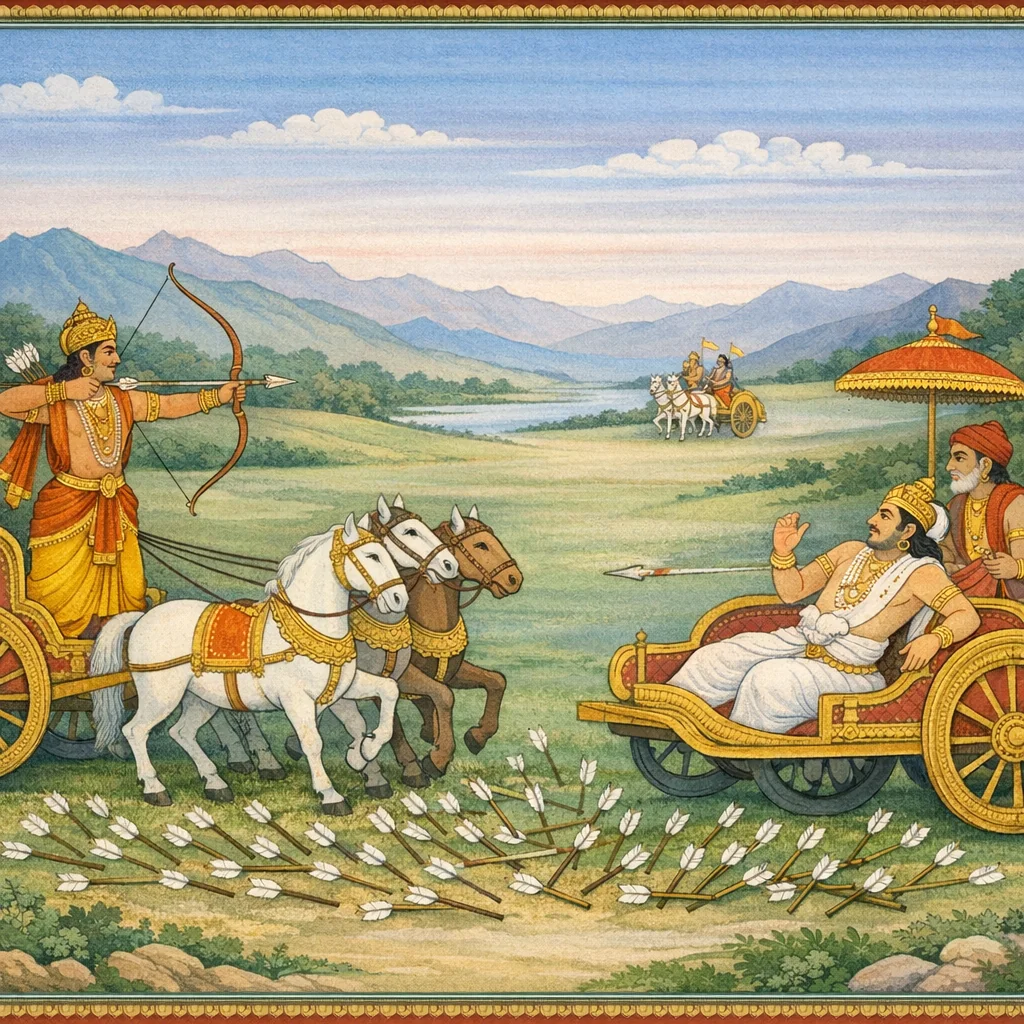
Saṃjaya reports a fierce engagement where Duḥśāsana initially performs a notable tactical act by severing Bhīma’s bow and striking the charioteer with multiple arrows. The exchange rapidly escalates as Bhīma counters by hurling a mace with force, disabling Duḥśāsana’s chariot: the horses and driver are killed, the vehicle is shattered, and Duḥśāsana falls wounded and disarmed. Bhīma, recalling prior hostility and his own sworn intent, descends from his chariot, draws a sharp sword, and executes a close-quarters finishing act. The narration then records Bhīma’s public declaration, including a direct address to Duḥśāsana and a broader statement of accumulated suffering attributed to Dhṛtarāṣṭra’s polity. The surrounding combatants react with fear and retreat, interpreting Bhīma’s conduct as beyond ordinary human comportment. The chapter closes with Bhīma’s proclamation that a further vow remains—directed toward Duryodhana—thereby linking this episode to subsequent war objectives.
Chapter Arc: संजय धृतराष्ट्र से कहता है—कृष्ण की सावधानी से संचालित, शत-घोड़ों वाले रथ पर आरूढ़ अर्जुन रणभूमि में आ पहुँचे; उसी क्षण कौरव-सेना का उन्मत्त वेग पाण्डवों पर टूट पड़ता है। → अर्जुन के क्षणिक असावधान होने पर दुर्योधन क्रोध में सहसा धावा करता है, और उधर राधेय कर्ण अपने अद्भुत शरवर्ष से पाण्डव धनुर्धरों को रोककर युद्ध की दिशा कौरवों के पक्ष में मोड़ने लगता है; युधिष्ठिर भी कर्ण पर तीखे स्वर्णपुङ्ख बाणों से प्रत्युत्तर देते हैं, पर कर्ण हँसते-हँसते अधिक कठोर प्रहार करता जाता है। → युधिष्ठिर और कर्ण का संघर्ष चरम पर पहुँचता है—युधिष्ठिर पचास पैने बाणों से कर्ण को आच्छादित करते हैं, किन्तु कर्ण प्रत्याघात में धर्मराज को उरःस्थल में भल्लों से बेधकर ऐसा आहत करता है कि युधिष्ठिर रथ के पृष्ठभाग में बैठ जाते हैं। → अत्यन्त पीड़ा से व्याकुल धर्मराज अपने सारथि को पीछे हटने/रथ चलाने का आदेश देते हैं; कर्ण का शौर्य और कौरव-आक्रमण उस क्षण पाण्डव-पक्ष को दबाव में ले आता है। → युधिष्ठिर के हटते ही प्रश्न हवा में लटकता है—क्या अर्जुन-कृष्ण समय पर मोर्चा सँभालकर कर्ण के बढ़ते पराक्रम को रोक पाएँगे, या पाण्डव-सेना का मनोबल टूटेगा?
Shlokas
Verse 1
(दाक्षिणात्य अधिक पाठके ई श्लोक मिलाकर कुल ७४ ६ “लोक हैं) न२्ंप्स््स्लििसस ह्य ४2:---&«आ द्विषष्टितमो<5 ध्याय: युधिष्ठिरपर कौरव-सैनिकोंका आक्रमण संजय उवाच ततः श्वेताश्वसंयुक्ते नारायणसमाहिते । तिष्ठन् रथवरे श्रीमानर्जुन: समपद्यत
Sañjaya said: Then Arjuna, the illustrious one, took his stand upon that excellent chariot yoked with white horses, with Nārāyaṇa (Kṛṣṇa) fully composed and intent.
Verse 2
संजय कहते हैं--राजन्! तदनन्तर भगवान् श्रीकृष्णद्वारा सावधानीसे संचालित और शत घोड़ोंसे युक्त उत्तम रथपर खड़े हुए श्रीमान् अर्जुन वहाँ आ पहुँचे ।। तद् बल॑ नृपतिश्रेष्ठ तावकं विजयो रणे । व्यक्षो भयदुदीर्णाश्वं महोदधिमिवानिल:,नृपश्रेष्ठ! जैसे प्रचण्ड वायु महासागरको विद्षुब्ध कर देती है, उसी प्रकार रणभूमिमें स्थित प्रचण्ड अश्वोंसे युक्त आपकी सेनामें अर्जुनने हलचल मचा दी
Sanjaya said: O King, thereafter the illustrious Arjuna arrived there, standing upon an excellent chariot drawn by a hundred horses and carefully guided by the Blessed Lord Śrī Kṛṣṇa. O best of kings, in the battle Arjuna—called Vijaya—threw your army into agitation, its powerful horses surging in tumult, just as a fierce wind churns and disturbs the great ocean.
Verse 3
दुर्योधनस्तव सुतः प्रमत्ते श्वेतवाहने । अभ्येत्य सहसा क्रुद्धः सैन्यार्थधेनाभिसंवृत:,जब श्वेतवाहन अर्जुन असावधान थे, उसी समय क्रोधमें भरे हुए दुर्योधनने सहसा आधी सेनाके साथ आकर अपनी ओर आते हुए अमर्षशील पाण्डुपुत्र युधिष्ठिरको चारों ओरसे घेर लिया। साथ ही तिहत्तर क्षुरप्रोंद्वारा उन्हें घायल कर दिया
Sañjaya said: Your son Duryodhana, seeing the wielder of the white steeds (Arjuna) off his guard, rushed forward in sudden wrath. Surrounded by half the army, he advanced impetuously—an act driven more by anger and opportunism than by measured judgment, intensifying the moral turbulence of the battlefield.
Verse 4
पर्यवारयदायान्तं युधिष्ठटिरममर्षणम् । क्षुरप्राणां त्रिसप्तत्या ततोडविध्यत पाण्डवम्,जब श्वेतवाहन अर्जुन असावधान थे, उसी समय क्रोधमें भरे हुए दुर्योधनने सहसा आधी सेनाके साथ आकर अपनी ओर आते हुए अमर्षशील पाण्डुपुत्र युधिष्ठिरको चारों ओरसे घेर लिया। साथ ही तिहत्तर क्षुरप्रोंद्वारा उन्हें घायल कर दिया
Sañjaya said: Duryodhana swiftly surrounded the approaching Yudhiṣṭhira—unyielding in spirit—and then struck that Pāṇḍava with seventy-three razor-headed arrows. The scene underscores how, in the press of war, tactical advantage and sudden aggression are used to check even a steadfast opponent, intensifying the moral strain of battle where courage and restraint are continually tested.
Verse 5
अक्रुध्यत भृशं तत्र कुन्तीपुत्रो युधिष्ठिर: । स भल्लांस्त्रिंशतस्तूर्ण तव पुत्रे न्यवेशयत्,तब वहाँ कुन्तीपुत्र युधिष्ठिर अत्यन्त कुपित हो उठे। उन्होंने आपके पुत्रपर तीन भल््लोंका प्रहार किया
Sañjaya said: There, Kuntī’s son Yudhiṣṭhira flared up in intense anger. Swiftly, he drove thirty sharp bhalla-arrows into your son—an eruption of wrath within the grim discipline of battle, where even the dharma-minded king is momentarily overtaken by the heat of war.
Verse 6
ततो<5धावन्त कौरव्या जिधघृक्षन्तो युधिष्ठिरम् । वुष्टभावान् पराउज्ञात्वा समवेता महारथा:
Sañjaya said: Then the Kaurava warriors rushed forward, intent on seizing Yudhiṣṭhira. Recognizing that his spirit had been shaken and that he was in a state of discomposure, the assembled great chariot-fighters pressed in upon him.
Verse 7
आजशममुस्तं परीप्सन्त: कुन्तीपुत्र युधिष्ठिरम् । तदनन्तर कौरव-सैनिक युधिष्ठिरको पकड़नेके लिये दौड़े। शत्रुओंकी यह दुर्भावना जानकर एकत्र हुए पाण्डवमहारथी कुन्तीपुत्र युधिष्ठिरकी रक्षाके लिये वहाँ आ पहुँचे || ६३ || नकुल: सहदेवश्व धृष्टद्युम्नश्व॒ पार्षत:
Sanjaya said: Seeking to seize Yudhiṣṭhira, the son of Kuntī, foremost among men, the Kaurava soldiers rushed forward to capture him. Realizing this hostile intent of the enemy, the assembled great chariot-warriors of the Pāṇḍavas arrived there to protect Kuntī’s son Yudhiṣṭhira—namely Nakula, Sahadeva, and Dhṛṣṭadyumna, the son of Pārṣata (Drupada).
Verse 8
भीमसेनश्व समरे मृद्नंस्तव महारथान्
Sanjaya said: “And Bhimasena, in the thick of battle, was crushing your great chariot-warriors.”
Verse 9
तांस्तु सर्वान् महेष्वासान् कर्णो वैकर्तनो नृप
Sanjaya said: O King, Karna—known as Vaikartana—then addressed all those mighty bowmen.
Verse 10
शरवर्षेण महता प्रत्यवारयदागतान् | नरेश्वर! वैकर्तन कर्णने वहाँ आये हुए सम्पूर्ण महाधनुर्धरोंको अपने बाणोंकी भारी वर्षासे रोक दिया ।। शरौघान् विसृजन्तस्ते प्रेरयन्तश्न॒ तोमरान्
Sanjaya said: O king, with a tremendous shower of arrows, Vaikartana Karna checked the oncoming warriors—those great bowmen who had advanced against him. As they kept releasing volleys of shafts and hurling spears, Karna’s counter-fire held them back, turning their assault into a stalled advance amid the storm of weapons.
Verse 11
न शेकुर्यन्तवन्तो5पि राधेयं प्रतिवीक्षितुम् । वे सब महारथी प्रयत्नपूर्वक बाणसमूहोंकी वर्षा और तोमरोंका प्रहार करते हुए भी राधापुत्रको देख न सके ।। तांश्व सर्वान् महेष्वासान् सर्वशस्त्रास्त्रपारग:
Sanjaya said: Even though they were fully armed and prepared, they could not so much as look upon Radheya (Karna). All those great chariot-warriors, despite striving with utmost effort—showering volleys of arrows and striking with tomaras—still could not perceive the son of Radha. And he, the master of bow and weaponry, fully versed in every weapon and missile, faced them all.
Verse 12
महता शरवर्षेण राधेय: प्रत्यवारयत् । सम्पूर्ण अस्त्र-शस्त्रोंके पारंगत विद्वान् राधापुत्र कर्णने बड़ी भारी बाण-वर्षा करके उन समस्त धनुर्धरोंको आगे बढ़नेसे रोक दिया ।। ११ $ ।। दुर्योधनं च विंशत्या शीघ्रमस्त्रमुदीरयन्
Sanjaya said: With a mighty shower of arrows, Radheya (Karna) checked the opposing bowmen and prevented them from advancing. Then, swiftly loosing his missiles, he struck Duryodhana as well with twenty arrows—showing the battle’s chaotic, morally fraught confusion, where even allies may be endangered amid relentless martial display.
Verse 13
स विद्ध: सहदेवेन रराजाचलसंनिभ:
Sanjaya said: Struck by Sahadeva, he still shone forth—steadfast and unshaken—like a mountain. Even when wounded in battle, the warrior’s bearing remains a measure of resolve and martial duty amid the harsh ethics of war.
Verse 14
दृष्टवा तव सुतं तत्र गाढविद्धं सुतेजनै:
Sanjaya said: Seeing your son there, pierced deeply by the sharp shafts, he beheld the grim consequence of battle—how even the mighty are brought low when the war’s fury finds its mark.
Verse 15
अभ्यधावदू दृढं क्रुद्धों राधेयो रथिनां वर: । रथियोंमें श्रेष्ठ राधापुत्र कर्ण आपके पुत्रको तेज बाणोंसे अत्यन्त घायल हुआ देख कुपित होकर दौड़ा ।। दुर्योधनं तथा दृष्टवा शीघ्रमस्त्रमुदैरयत्
Sanjaya said: Rādheya (Karna), the foremost among chariot-warriors, fiercely charged forward in anger. Seeing Duryodhana in that plight, he quickly raised and discharged a weapon—moved by loyalty to his ally and the urgent ethics of battlefield protection.
Verse 16
ततो यौधिष्ठिरं सैन्यं वध्यमानं महात्मना
Then the army of Yudhiṣṭhira, being cut down by that great-souled warrior, began to suffer grievously—an image of war’s relentless momentum, where even a righteous cause must endure the harsh consequences of violence on the battlefield.
Verse 17
सहसा प्राद्रवद् राजन् सूतपुत्रशरार्दितम् | राजन! महामना सूतपुत्र कर्णकी मार खाकर उसके बाणोंसे पीड़ित हो युधिष्ठिरकी सेना सहसा भाग चली ।। विविधा विशिखास्तत्र सम्पतन्त: परस्परम्
Sañjaya said: O King, the army—pierced and harried by the arrows of Karṇa, the son of a charioteer—suddenly broke and fled. There, countless kinds of shafts flew in, striking and crossing one another, as the battle’s violence surged beyond restraint.
Verse 18
अन्तरिक्षे शरौघाणां पततां च परस्परम्
Sañjaya said: In the open sky, dense torrents of arrows were falling and striking one another, meeting head-on in midair.
Verse 19
ततो दश दिश: कर्ण: शलभैरिव यायिभि:
Sañjaya said: Thereafter, Karṇa’s movements spread in all ten directions, like swarms of flying moths—restless, swift, and everywhere at once—signaling the overwhelming surge of battle where force and momentum begin to eclipse restraint.
Verse 20
रक्तचन्दनसंदिग्धौ मणिहेमविभूषितौ
Sañjaya said: “Smeared with red sandalwood paste and adorned with jewels and gold…” The line evokes the striking, almost ceremonial splendor of warriors and their gear amid the battlefield.
Verse 21
ततः सर्वा दिशो राजन् सायकैर्विप्रमोहयन्
Sañjaya said: Then, O King, bewildering all the directions with a storm of arrows, he filled the battlefield with confusion.
Verse 22
ततः क्रुद्धो महाराज धर्मपुत्रो युधिछ्ठिर:
Sañjaya said: Then, O King, Dharmaputra Yudhiṣṭhira became enraged—signaling a decisive shift in his inner restraint as the pressures of war and duty tightened around him.
Verse 23
बाणान्धकारमभवत्तद् युद्ध घोरदर्शनम्,उस समय भयंकर दिखायी देनेवाला वह युद्ध बाणोंके अन्धकारसे व्याप्त हो गया। माननीय प्रजानाथ! जब धर्मपुत्र युधिष्ठिर कौरव-सेनाका वध करने लगे, उस समय आपके योद्धाओंका महान् हाहाकार सब ओर गूँज उठा
Sanjaya said: That battle, dreadful to behold, became shrouded in a darkness made of arrows. O revered lord of the people! When Dharmaputra Yudhishthira began to strike down the Kaurava host, a great cry of distress rose up on all sides among your warriors.
Verse 24
हाहाकारो महानासीक्तावकानां विशाम्पते । वध्यमाने तदा सैन्ये धर्मपुत्रेण मारिष,उस समय भयंकर दिखायी देनेवाला वह युद्ध बाणोंके अन्धकारसे व्याप्त हो गया। माननीय प्रजानाथ! जब धर्मपुत्र युधिष्ठिर कौरव-सेनाका वध करने लगे, उस समय आपके योद्धाओंका महान् हाहाकार सब ओर गूँज उठा
O lord of the people! As your army was being slain by Dharmaputra Yudhiṣṭhira, a great cry of anguish arose among your warriors.
Verse 25
सायकैर्विविधैस्तीक्ष्णै: कडकपत्रै: शिलाशितै: । भल्लैरनेकैर्विविधै: शक््त्यृष्टिमुसलिरपि,भरतश्रेष्ठ! धर्मात्मा युधिष्ठिर शिलापर तेज किये हुए कंकपत्रयुक्त एवं नाना प्रकारके पैने बाणों, भाँति-भाँतिके बहुसंख्यक भल्लों तथा शक्ति, ऋष्टि एवं मूसलोंद्वारा प्रहार करते हुए जहाँ-जहाँ क्रोधरूपी दोषसे पूर्ण दृष्टि डालते थे, वहीं-वहीं आपके सैनिक छित्न-भिन्न होकर बिखर जाते थे
Sañjaya said: O best of the Bharatas, the righteous-souled Yudhiṣṭhira, striking with many kinds of keen arrows—some with hard, razor-like edges and some sharpened like stone—along with countless diverse bhallas, and also with spears, lances, and clubs, would cast his gaze wherever anger had filled his sight; and in every such place your troops were cut to pieces and scattered in disarray.
Verse 26
यत्र यत्र स धर्मात्मा दुष्टां दृष्टिं व्यसर्जयत् । तत्र तत्र व्यशीर्यन्त तावका भरतर्षभ,भरतश्रेष्ठ! धर्मात्मा युधिष्ठिर शिलापर तेज किये हुए कंकपत्रयुक्त एवं नाना प्रकारके पैने बाणों, भाँति-भाँतिके बहुसंख्यक भल्लों तथा शक्ति, ऋष्टि एवं मूसलोंद्वारा प्रहार करते हुए जहाँ-जहाँ क्रोधरूपी दोषसे पूर्ण दृष्टि डालते थे, वहीं-वहीं आपके सैनिक छित्न-भिन्न होकर बिखर जाते थे
Sañjaya said: Wherever that righteous-souled king cast his fierce, fault-laden glance, there and then your warriors, O bull among the Bharatas, were shattered and scattered. Thus, even amid the violence of battle, Yudhiṣṭhira’s presence—marked by moral stature yet momentarily inflamed by wrath—became a decisive force that broke the enemy’s ranks.
Verse 27
कर्णोडपि भृशसंक्रुद्धो धर्मराजं युधिष्ठिरम् । नाराचैरर्थचन्द्रेश्न वत्सदन्तैश्व संयुगे,कर्ण भी अत्यन्त क्रोधमें भरा हुआ था। वह अमर्षशील और क्रोधी तो था ही, रोषसे उसका मुख फड़क रहा था। अप्रमेय आत्मबलसे सम्पन्न उस वीरने युद्धस्थलमें नाराचों, अर्धचन्द्रों तथा वत्सदन्तोंद्वारा धर्मराज युधिष्ठिरपर धावा किया
Sañjaya said: Karṇa too, inflamed with fierce anger, charged at Dharmarāja Yudhiṣṭhira in the thick of battle, assailing him with nārāca arrows, crescent-headed shafts, and calf-tooth–shaped missiles. The scene shows how wrath, even in a heroic warrior, drives the combat toward relentless escalation, placing royal duty and personal restraint under severe strain.
Verse 28
अमर्षी क्रोधनश्वैव रोषप्रस्फुरितानन: । सायकैरप्रमेयात्मा युधिष्ठिरमभिद्रवत्,कर्ण भी अत्यन्त क्रोधमें भरा हुआ था। वह अमर्षशील और क्रोधी तो था ही, रोषसे उसका मुख फड़क रहा था। अप्रमेय आत्मबलसे सम्पन्न उस वीरने युद्धस्थलमें नाराचों, अर्धचन्द्रों तथा वत्सदन्तोंद्वारा धर्मराज युधिष्ठिरपर धावा किया
Sañjaya said: Burning with intolerance and anger, his face twitching with rage, Karṇa—whose inner strength was beyond measure—charged straight at King Yudhiṣṭhira, assailing him with a storm of arrows.
Verse 29
युधिष्ठिरश्चापि स त॑ स्वर्णपुड्खै: शितै: शरै: । प्रहसन्निव तं कर्ण: कड़कपत्रै: शिलाशितै:
Sañjaya said: Yudhiṣṭhira too struck him with sharp arrows fitted with golden feathers. Karṇa, as though laughing, answered him with arrows whose wings were of hard metal and whose points were whetted like stone—meeting force with force in the fierce ethic of battle.
Verse 30
स पीडितो भृशं तेन धर्मराजो युधिछ्िर:
Sañjaya said: Deeply afflicted by that blow, King Yudhiṣṭhira—steadfast in dharma—was shaken with intense pain, revealing how even the righteous are tested amid the harsh necessities of war.
Verse 31
अक्रोशन्त तत: सर्वे धार्तराष्ट्रा: सराजका:
Sañjaya said: Then all the sons of Dhṛtarāṣṭra—together with their king—began to cry out in anger and reproach. The line captures the moral collapse that often follows pride and fear in war: when events turn adverse, harsh speech and blame arise instead of restraint and discernment.
Verse 32
गृह्नी ध्वमिति राजानमभ्यधावन्त सर्वश: । उस समय राजा दुर्योधनसहित आपके सभी पुत्र इस प्रकार कोलाहल करने लगे --'राजा युधिष्ठिरको पकड़ लो” ऐसा कहकर वे सभी ओरसे उनकी ओर दौड़ पड़े ।। ततः शता: सप्तदश केकयानां प्रहारिणाम्
Sañjaya said: “Seize the king!”—crying thus, they rushed at him from every side. Then seventeen hundred Kekaya warriors, fierce in assault, advanced into the fray.
Verse 33
पज्चालै: सहिता राजन् धार्तराष्ट्रान न्यवारयन् । राजन! तब प्रहारकुशल सत्रह सौ केकय योद्धा पांचालोंक साथ आकर आपके पुत्रोंको रोकने लगे ।। तस्मिन् सुतुमुले युद्धे वर्तमाने जनक्षये,जिस समय वह जनसंहारकारी भयंकर युद्ध चल रहा था, उस समय महाबली दुर्योधन और भीमसेन एक-दूसरेसे जूझने लगे
Sañjaya said: O King, accompanied by the Pāñcālas, they checked the sons of Dhṛtarāṣṭra. While that exceedingly tumultuous battle—bringing great loss of life—was in progress, the mighty Duryodhana and Bhīmasena (Vṛkodara) closed upon one another to grapple in direct combat.
Verse 34
दुर्योधनश्व॒ भीमश्न समेयातां महाबलौ,जिस समय वह जनसंहारकारी भयंकर युद्ध चल रहा था, उस समय महाबली दुर्योधन और भीमसेन एक-दूसरेसे जूझने लगे
Sañjaya said: When that dreadful, slaughter-bringing battle was raging, the mighty Duryodhana and Bhīmasena closed with one another and began to fight, each seeking to overpower the other amid the ruin of war.
Verse 61
इस प्रकार श्रीमह्याभारत कर्णपर्वनें संकुलयुद्धविषयक इकसठवाँ अध्याय पूरा हुआ
Sañjaya said: Thus ends the sixty-first chapter of the Karṇa Parva of the sacred Mahābhārata, dealing with the confused and densely entangled battle.
Verse 62
इति श्रीमहाभारते कर्णपर्वणि संकुलयुद्धे द्विषष्टितमो5ध्याय:
Thus, in the Śrī Mahābhārata, within the Karṇa Parva, in the section describing the confused and densely entangled battle, ends the sixty-second chapter.
Verse 73
अक्षौहिण्या परिवृतास्तेडध्यधावन् युधिष्ठिरम् । नकुल, सहदेव और द्रुपदकुमार धृष्टद्युम्न--ये एक अक्षौहिणी सेना साथ लेकर युधिष्ठिरके पास दौड़े आये
Sañjaya said: Ringed about by an akṣauhiṇī, they rushed toward Yudhiṣṭhira. Nakula and Sahadeva, with Drupada’s son Dhṛṣṭadyumna, came swiftly to Yudhiṣṭhira, bringing a full akṣauhiṇī of troops—an urgent advance of loyal allies to shield and reinforce the righteous king amid the crush of war.
Verse 86
अभ्यधावदभिप्रेप्सू राजानं शत्रुभिवृतम् | भीमसेन भी शत्रुओंसे घिरे हुए राजा युधिष्ठिरको बचानेके लिये समरांगणमें आपके महारथियोंको रौंदते हुए उनके पास दौड़े आये
Sañjaya said: Eager to reach him, Bhīmasena rushed toward the king who was surrounded by enemies. Crushing through your great chariot-warriors on the battlefield, he ran to protect Yudhiṣṭhira—an act driven by loyalty and the warrior’s duty to safeguard his lord amid peril.
Verse 126
अविध्यत् तूर्णमभ्येत्य सहदेव: प्रतापवान् | इसी समय प्रतापी सहदेवने आकर शीघ्रतापूर्वक अस्त्र चलाते हुए तुरंत ही बीस बाणोंसे दुर्योधनको बींध डाला
Sañjaya said: The valiant Sahadeva swiftly advanced and, without delay, struck Duryodhana—piercing him with twenty arrows. In the relentless code of the battlefield, this moment shows disciplined speed and precision against a formidable foe, where personal valor yields to the grim demands of war.
Verse 136
प्रभिन्न इव मातड़्रो रुधिरेण परिप्लुत: । सहदेवके बाणोंसे विद्ध होकर दुर्योधन अनेक शिखरोंवाले पर्वतके समान सुशोभित हुआ। खूनसे लथपथ होकर वह मदकी धारा बहानेवाले मदमत्त हाथीके समान जान पड़ता था
Sañjaya said: Pierced by Sahadeva’s arrows, Duryodhana—soaked in blood—looked like a wounded elephant. Though struck and drenched, he still stood out on the battlefield, like a many-peaked mountain in grim splendor; and the blood streaming from his body made him seem like a maddened tusker letting its musth flow—an image of war’s ferocity and resolve hardened through pain.
Verse 156
तेन यौधिष्ठिरं सैन्यमवधीत् पार्षतं तथा । दुर्योधनकी वैसी अवस्था देख उसने शीघ्र अपना अस्त्र प्रकट किया और उसीके द्वारा युधिष्ठटिरकी सेना एवं ट्रुपदपुत्रको घायल कर दिया
Sañjaya said: With that weapon he struck the forces of Yudhiṣṭhira, and likewise wounded the son of Pārṣata (Dhṛṣṭadyumna). Seeing Duryodhana brought to such peril, he swiftly revealed his missile and used it to harm Yudhiṣṭhira’s army and the Pāñcāla commander—an act driven by battlefield urgency rather than restraint.
Verse 173
फलै: पुड्खान् समाजम्मु: सूतपुत्रधनुश्चयुता: । सूतपुत्र कर्णके धनुषसे छूटकर परस्पर गिरते हुए नाना प्रकारके बाण अपने फलोंद्वारा पहलेके गिरे हुए बाणोंके पंखोंमें जुड़ जाते थे
Sanjaya said: From Karna’s bow, arrows of many kinds were loosed in rapid succession, and with their iron heads they struck and fastened into the feathered ends of arrows that had already fallen—so dense was the exchange that shaft seemed to link to shaft. The scene reveals the relentless, impersonal momentum of battle, where skill and fury multiply harm even as each warrior follows the duty he has chosen upon the field.
Verse 183
संघर्षेण महाराज पावक: समजायत | महाराज! आकाशमें परस्पर टकराते हुए बाणसमूहोंकी रगड़से आग प्रकट हो जाती थी
Sanjaya said: O great king, from the sheer friction of the clash, fire itself was born. Indeed, O Mahārāja, as masses of arrows collided with one another in the sky, their grinding contact made flames appear—so fierce had the battle become that even the elements seemed to answer its violence.
Verse 193
अभ्यहंस्तरसा राज5शरै: परशरीरगै: । राजन्! तदनन्तर कर्णने पतंगोंकी तरह चलकर शत्रुओंके शरीरोंमें घुस जानेवाले बाणोंद्वारा वेगपूर्वक दसों दिशाओंमें प्रहार आरम्भ किया
Sanjaya said: O King, then with great speed he struck with arrows that penetrated into the bodies of others. After that, Karna began a fierce assault in all ten directions, his shafts moving like moths and entering the bodies of the enemy—an image of war’s relentless momentum, where prowess is displayed through deadly efficiency rather than restraint.
Verse 206
बाहू व्यत्यक्षिपत् कर्ण: परमास्त्रं विदर्शयन् । दिव्यास्त्रोंका प्रदर्शन करता हुआ कर्ण मणि एवं सुवर्णके आभूषणोंसे विभूषित तथा लाल चन्दनसे चर्चित दोनों भुजाओंको बारंबार हिला रहा था
Sañjaya said: Karṇa, displaying his supreme celestial weapon, repeatedly swung and flourished his arms—adorned with gems and gold ornaments and anointed with red sandalwood—projecting confidence and martial prowess amid the escalating violence of the battle.
Verse 216
अपीडयद्ू भृशं कर्णो धर्मराजं युधिष्ठिरम् । राजन! तत्पश्चात् अपने बाणोंसे सम्पूर्ण दिशाओंको मोहित करते हुए कर्णने धर्मराज युधिष्ठिरको अत्यन्त पीड़ित कर दिया
Sanjaya said: Karna grievously pressed and tormented Dharmaraja Yudhishthira. O King, thereafter, dazzling all directions with his arrows, Karna caused the righteous king Yudhishthira intense suffering—an image of martial brilliance set against the ethical weight of striking the very embodiment of dharma on the battlefield.
Verse 226
निशितैरिषुभि: कर्ण पञ्चाशद्धिः समार्पयत् महाराज! इससे कुपित हुए धर्मपुत्र युधिष्ठिरने कर्णपर पचास पैने बाणोंका प्रहार किया
Sañjaya said: O King, he struck Karṇa with fifty sharp arrows. Enraged by this, Dharmaputra Yudhiṣṭhira retaliated against Karṇa, showering him with fifty keen shafts. The exchange reflects the war’s grim reciprocity: anger answers injury, and even the righteous are drawn into measured violence amid the demands of battle.
Verse 296
उरस्यविध्यद् राजान त्रिभिर्भल्लैश्व पाण्डवम् | इसी प्रकार युधिष्ठिरने भी कर्णको सोनेकी पाँखवाले पैने बाणोंद्वारा घायल कर दिया। तब कर्णने हँसते हुए-से शिलापर तेज किये गये कंकपत्रयुक्त तीन भललोंद्वारा पाण्डुपुत्र राजा युधिष्ठिरकी छातीमें गहरी चोट पहुँचायी
O King, he pierced the Pāṇḍava’s chest with three bhalla arrows. In the same manner, Yudhiṣṭhira wounded Karṇa with keen shafts winged with gold. Then Karṇa, as though smiling, struck the breast of King Yudhiṣṭhira, son of Pāṇḍu, with three bhallas—kanka-feathered and whetted upon stone—dealing a deep wound.
Verse 303
उपविश्य रथोपस्थे सूतं याहीत्यचोदयत् । उस प्रहारसे अत्यन्त पीड़ित हो धर्मराज युधिष्ठिर रथके पिछले भागमें बैठ गये और सारथिको आदेश देते हुए बोले--“यहाँसे अन्यत्र रथ ले चलो'
Sañjaya said: Stricken and overwhelmed by the blow, Dharmarāja Yudhiṣṭhira sat down on the rear part of the chariot-seat and urged his charioteer, saying, “Drive the chariot away from here to another place.”
Frequently Asked Questions
The chapter juxtaposes vow-fulfillment against norms of restraint: Bhīma’s pledged retribution is portrayed as psychologically and ethically binding, while observers register the act as an extreme boundary of conduct.
Actions and oaths formed in earlier moments of injustice persist as causal commitments; the epic frames war conduct as shaped not only by strategy but also by long-duration moral memory.
No formal phalaśruti is stated here; the meta-function is narrative: the episode serves as an oath-completion marker and as a thematic reinforcement of karma and public legitimacy within the war account.