Adhyaya 41
Adhyāya 41 — Kṛṣṇa’s Battlefield Briefing and the Renewal of the Great Engagement
Upa-parva: Karna Parva — Battlefield Reversals and Renewed Engagement (Contextual Upa-Parva Unit for Adhyāya 41)
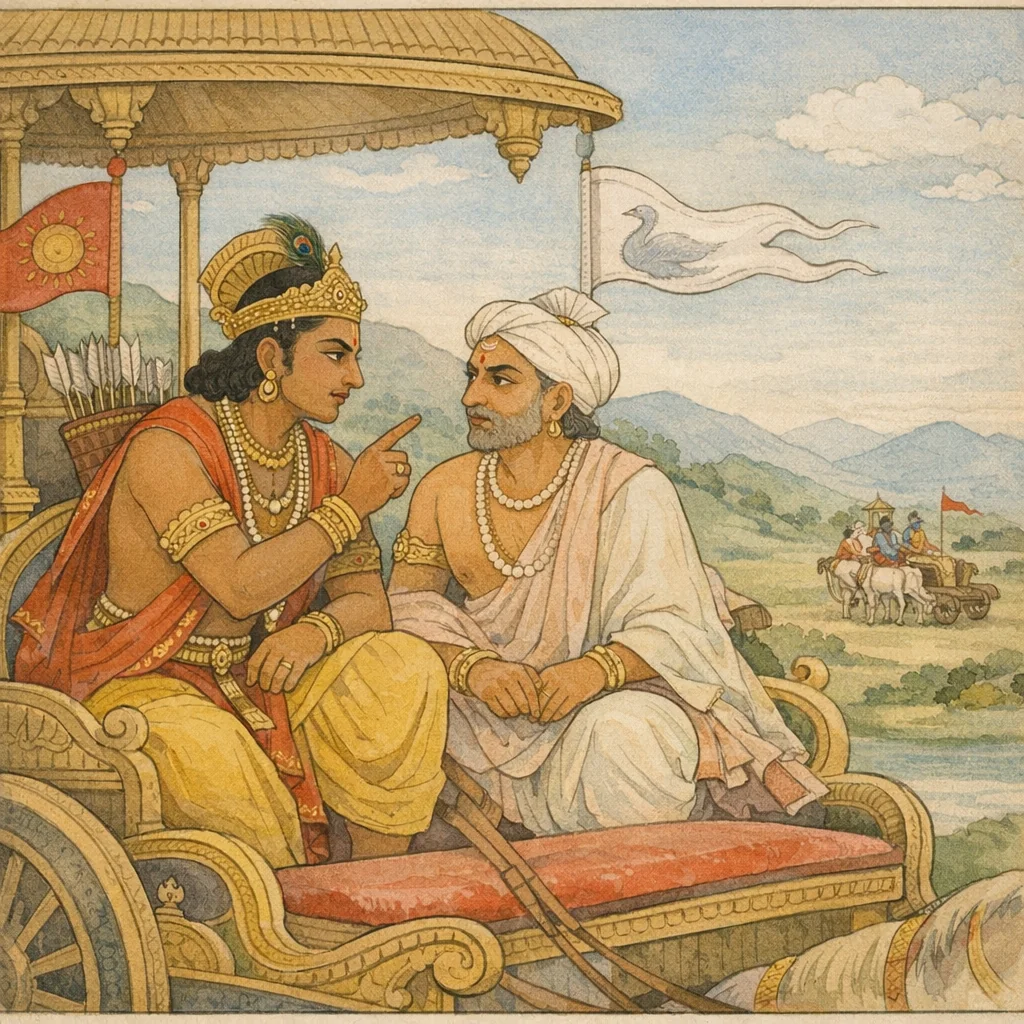
Saṃjaya reports that Kṛṣṇa, moving with urgency, speaks quietly to Arjuna and directs his attention to the battlefield’s shifting alignment: the Kaurava king is observed, and the Pāṇḍava forces are described as having moved away and then turned back. Kṛṣṇa highlights Karṇa on the main field, likened to a blazing fire, and notes Bhīma’s reorientation toward renewed combat. Dhṛṣṭadyumna leads allied formations (Pāñcālas, Sṛñjayas, and Pāṇḍavas) back into the fray, and the enemy’s large force is described as broken in the wake of this return. Karṇa is portrayed as the stabilizing agent who holds the retreating Kauravas, with speed and prowess compared to formidable standards. The movement of Droṇa’s son (Drauṇi/Aśvatthāman) and Dhṛṣṭadyumna’s pursuit is noted, after which Kṛṣṇa continues to explain the situation to Arjuna. The chapter closes with the emergence of a highly intense, large-scale engagement marked by lion-roars and the grim resolve of both armies, framed as a return to combat with death as an accepted horizon.
Chapter Arc: कर्ण शल्य से कहता है कि अर्जुन के रथ-सारथि कृष्ण की सामर्थ्य और पाण्डवों के दिव्यास्त्र-बल को वह भली-भाँति जानता है—फिर भी आज वही युद्ध का निर्णायक दिन बनेगा। → कर्ण अपनी प्रतिज्ञा को कठोर करता है: वह ‘दोनों कृष्ण’ (कृष्ण और अर्जुन) को रण में संतप्त करेगा, भीम और धनंजय को मृत्यु के मुख तक ले जाने का संकल्प दोहराता है। इसी के साथ वह अपने जीवन के एक प्रसंग/शाप-प्रसंग का स्मरण कराता है—ब्राह्मण-संबंधी अपराध, दान/प्रायश्चित्त (हजारों गौएँ) और मित्र-धर्म के टूटने की टीस—जो उसके भाग्य पर छाया बनकर मंडराती है। → कर्ण शल्य के सामने अपने अस्त्र-वैभव और उग्र-पराक्रम का उद्घोष करता है—‘मत्त हाथी से मत्त हाथी’ की तरह वह पाण्डव-वासुदेव से यत्नपूर्वक भिड़ने की घोषणा करता है; साथ ही शाप/अपराध की स्मृति उसके आत्मविश्वास में एक अदृश्य दरार भी डालती है। → अध्याय का अंत कर्ण के दृढ़ निश्चय पर टिकता है: दुर्योधन-हित, यश-प्राप्ति और रण-विजय के लिए वह समस्त दिव्यास्त्रों का प्रयोग करेगा—और शल्य को अपने रथ पर साक्षी बनाकर आगामी महासंघर्ष की भूमिका बाँध देता है। → कर्ण का यह संकल्प अगले क्षण वास्तविक रण में कैसे फलेगा—और शाप-स्मृति उसकी निर्णायक घड़ी में कैसे बाधा बनेगी—यह प्रश्न अध्याय को अगले अध्याय की ओर धकेल देता है।
Shlokas
Verse 1
(दाक्षिणात्य अधिक पाठका १ श्लोक मिलाकर कुल ८८ श्लोक हैं) ता निज: - महाडीनके सिवा, जो अन्य पचीस उड़ानें कही गयी हैं, उन सबका पृथक्-पृथक् एक-एक संपात (पंख फड़फड़ानेकी क्रिया) भी है, ये पचीस संपात जोड़नेसे एक सौ एक संख्याकी पूर्ति होती है। द्विचत्वारिशोड ध्याय: कर्णका श्रीकृष्ण और अर्जुनके प्रभावको स्वीकार करते हुए अभिमानपूर्वक शल्यको फटकारना और उनसे अपनेको परशुरामजीद्वारा और ब्राह्माणद्वारा प्राप्त हुए शापोंकी कथा सुनाना संजय उवाच मद्राधिपस्याधिरथिममहात्मा वचो निशम्याप्रियमप्रतीत: । उवाच शल्यं विदितं ममैतद् यथाविधावर्जुनवासुदेवौ,संजय कहते हैं--राजन्! मद्रराज शल्यकी ये अप्रिय बातें सुनकर महामनस्वी अधिरथपुत्र कर्णने असंतुष्ट होकर उनसे कहा--'शल्य! अर्जुन और श्रीकृष्ण कैसे हैं, यह बात मुझे अच्छी तरह ज्ञात है
Sanjaya said: O King, hearing the unwelcome words spoken by Shalya, the lord of Madra, the high-souled Karna—son of Adhiratha—became displeased. He addressed Shalya: “This much is already well known to me, in full measure—what Arjuna and Vasudeva (Krishna) are like.”
Verse 2
शौरे रथं वाहयतोअर्जुनस्य बल॑ महास्त्राणि च पाण्डवस्य । अहं विजानामि यथावदद्य परोक्षभूतं तव तत् तु शल्य,“मद्रराज! अर्जुनका रथ हाँकनेवाले श्रीकृष्णके बल और पाण्डुपुत्र अर्जुनके महान् दिव्यास्त्रोंकी इस समय मैं भलीभाँति जानता हूँ। तुम स्वयं उनसे अपरिचित हो
“O King of Madra, I know well at this moment the strength of Shauri (Krishna) who drives Arjuna’s chariot, and the great divine weapons of Arjuna, son of Pandu. But you, Shalya, are not truly acquainted with them.”
Verse 3
तौ चाप्यहं शस्त्रभृतां वरिष्ठौ व्यपेतभीर्योधयिष्यामि कृष्णौ । संतापयत्यभ्यधिकं नु रामा- च्छापोउ्द्य मां ब्राह्मणसत्तमाच्च,वे दोनों कृष्ण शस्त्रधारियोंमें श्रेष्ठ हैं तो भी मैं उनके साथ निर्भय होकर युद्ध करूँगा। परंतु परशुरामजीसे तथा एक ब्राह्मणशिरोमणिसे मुझे जो शाप प्राप्त हुआ है, वह आज मुझे अधिक संताप दे रहा है
Sañjaya said: “Though those two Kṛṣṇas are foremost among weapon-bearers, I shall still fight them without fear. Yet today the curse I received from Rāma (Paraśurāma) and from a most eminent brāhmaṇa torments me all the more.”
Verse 4
अवसं वै ब्राह्मणच्छगनाहं रामे पुरा दिव्यमस्त्रं चिकीर्षु: तत्रापि मे देवराजेन विध्नो हितार्थिना फाल्गुनस्यैव शल्य,'पूर्वकालकी बात है, मैं दिव्य अस्त्रोंको प्राप्त करनेकी इच्छासे ब्राह्मणका वेष बनाकर परशुरामजीके पास रहता था। शल्य! वहाँ भी अर्जुनका ही हित चाहनेवाले देवराज इन्द्रने मेरे कार्यमें विघ्न उपस्थित कर दिया था। एक दिन गुरुदेव मेरी जाँघपर अपना मस्तक रखकर सो गये थे। उस समय इन्द्रने एक कीडेके भयंकर शरीरमें प्रवेश करके मेरी जाँघके पास आकर उसे काट लिया, काटकर उसमें भारी घाव कर दिया और इस कार्यके द्वारा इन्होंने मेरे मनोरथमें विध्न डाल दिया
Sanjaya said: Long ago, desiring to obtain divine weapons, I lived with Rama (Parashurama) in the guise of a Brahmin. Even there, O Shalya, Indra—the king of the gods—who sought only the welfare of Phalguna (Arjuna), placed an obstacle in my undertaking. (Thus, the gods themselves intervened to protect Arjuna’s destined advantage, frustrating my pursuit through deception.)
Verse 5
कृतो विभेदेन ममोरुमेत्य प्रविश्य कीटस्य तनुं विरूपाम् । ममोसमेत्य प्रबिभेद कीट: सुप्ते गुरौ तत्र शिरो निधाय,'पूर्वकालकी बात है, मैं दिव्य अस्त्रोंको प्राप्त करनेकी इच्छासे ब्राह्मणका वेष बनाकर परशुरामजीके पास रहता था। शल्य! वहाँ भी अर्जुनका ही हित चाहनेवाले देवराज इन्द्रने मेरे कार्यमें विघ्न उपस्थित कर दिया था। एक दिन गुरुदेव मेरी जाँघपर अपना मस्तक रखकर सो गये थे। उस समय इन्द्रने एक कीडेके भयंकर शरीरमें प्रवेश करके मेरी जाँघके पास आकर उसे काट लिया, काटकर उसमें भारी घाव कर दिया और इस कार्यके द्वारा इन्होंने मेरे मनोरथमें विध्न डाल दिया
Sañjaya said: “Having assumed a hideous worm’s body by a contrivance, it came to my thigh and entered it. Approaching me, the worm bored into my flesh while my teacher slept with his head resting there. Thus an obstacle was laid in my endeavor—an act of covert interference meant to thwart my pursuit of divine weapons.”
Verse 6
ऊरुप्रभेदाच्च महान् बभूव शरीरतो मे घनशोणितौघ: । गुरोर्भयाच्चापि न चेलिवानहं ततो विबुद्धों ददृशे स विप्र:,'जाँघमें घाव हो जानेके कारण मेरे शरीरसे गाढ़े रक्तका महान् प्रवाह बह चला; परंतु गुरुके जागनेके भयसे मैं तनिक भी विचलित नहीं हुआ। तत्पश्चात् जब गुरुजी जागे, तब उन्होंने यह सब कुछ देखा
Because my thigh was pierced, a great, thick torrent of blood began to flow from my body. Yet, out of fear that my teacher might awaken, I did not stir even slightly. Then, when the teacher did wake, that brahmin saw what had happened.
Verse 7
स धैर्ययुक्त प्रसमीक्ष्य मां वै नत्वं विप्र: कोडसि सत्यं वदेति । तस्मै तदा55त्मानमहं यथाव- दाख्यातवान् सूत इत्येव शल्य,“शल्य! उन्होंने मुझे ऐसे धैर्यसे युक्त देखकर पूछा--“अरे! तू ब्राह्मण तो है नहीं; फिर कौन है? सच-सच बता दे।” तब मैंने उनसे अपना यथार्थ परिचय देते हुए इस प्रकार कहा --'भगवन! मैं सूत हूँ!
Sañjaya said: Seeing me steady and composed, he questioned me: “You are not a brāhmaṇa—who are you? Speak the truth.” Then, to him, I disclosed my identity exactly as it was, saying, “O Śalya, I am a sūta.”
Verse 8
स मां निशम्याथ महातपस्वी संशप्तवान् रोषपरीतचेता: । सूतोपधावाप्तमिदं तवास्त्र न कर्मकाले प्रतिभास्यति त्वाम्,“तदनन्तर मेरा वृत्तान्त सुनकर महातपस्वी परशुरामजीके मनमें मेरे प्रति अत्यन्त रोष भर गया और उन्होंने मुझे शाप देते हुए कहा--'सूत! तूने छल करके यह ब्रह्मास्त्र प्राप्त किया है। इसलिये काम पड़नेपर तेरा यह अस्त्र तुझे याद न आयेगा
Sañjaya said: Hearing my account, the great ascetic Paraśurāma, his mind overwhelmed with wrath, pronounced a curse: “O sūta! By deceit you obtained this weapon. Therefore, when the hour of action comes, this weapon will not come to your recollection.”
Verse 9
अन्यत्र तस्मात् तव मृत्युकाला- दब्राद्माणे ब्रह्म न हि ध्रुवं स्यात् । तदद्य पर्याप्तमतीव चास्त्र- मस्मिन् संग्रामे तुमुलेडतीव भीमे,“तेरी मृत्युके समयको छोड़कर अन्य अवसरोंपर ही यह अस्त्र तेरे काम आ सकता है; क्योंकि ब्राह्मणेतर मनुष्यमें यह ब्रह्मास्त्र सदा स्थिर नहीं रह सकता।” वह अस्त्र आज इस अत्यन्त भयंकर तुमुल संग्राममें पर्याप्त काम दे सकता है
Sañjaya said: “Except at the time appointed for your death, this weapon may serve you on other occasions; for in one who is not a brāhmaṇa, the Brahmāstra does not remain firmly established. Yet today, in this exceedingly dreadful and tumultuous battle, that weapon can prove more than sufficient.”
Verse 10
योडयं शल्य भरतेषूपपन्न: प्रकर्षण: सर्वहरो5तिभीम: । सो5भिमन्ये क्षत्रियाणां प्रवीरान् प्रतापिता बलवान वै विमर्द:,“शल्य! वीरोंको आकृष्ट करनेवाला, सर्वसंहारक और अत्यन्त भयंकर जो यह प्रबल संग्राम भरतवंशी क्षत्रियोंपर आ पड़ा है, वह क्षत्रिय-जातिके प्रधान-प्रधान वीरोंको निश्चय ही संतप्त करेगा, ऐसा मेरा विश्वास है
Sañjaya said: “O Śalya, this mighty clash that has fallen upon the Bharata warriors—drawing heroes into its grip, stripping all away, and terrifying beyond measure—will, I believe, surely scorch the foremost champions among the kṣatriyas.”
Verse 11
शल्योग्रधन्वानमहं वरिष्ठ तरस्विनं भीममसहांवीर्यम् । सत्यप्रतिज्ञं युधि पाण्डवेयं धनंजयं मृत्युमुखं नयिष्ये,'शल्य! आज मैं युद्धमें भयंकर धनुष धारण करनेवाले सर्वश्रेष्ठ, वेगवान, भयंकर, असहापराक्रमी और सत्यप्रतिज्ञ पाण्डुपुत्र अर्जुनको मौतके मुखमें भेज दूँगा
“O Śalya, today in battle I shall send Dhanañjaya Arjuna, the son of Pāṇḍu—supreme among warriors, swift, bearing a dreadful bow, of irresistible prowess, and true to his vow—into the very mouth of death.”
Verse 12
अस्त्र॑ ततो<न्यत् प्रतिपन्नमद्य येन क्षेप्स्थे समरे शत्रुपूगान् । प्रतापिनं बलवन्तं कृतास्त्रं तमुग्रधन्चानममितौजसं च
Sañjaya said: “Now you have taken up another weapon—by which you intend, in the press of battle, to strike down the enemy ranks. That warrior is mighty and powerful, fully trained in the use of arms, a fierce archer, and of immeasurable energy.”
Verse 13
अपां पतिर्वेगवानप्रमेयो निमज्जयिष्यन् बहुला: प्रजाश्न
Sañjaya said: “The Lord of the waters—swift and beyond measure—seemed intent on submerging multitudes of people.”
Verse 14
प्रमुड्चन्तं बाणसंघानमेयान् मर्मच्छिदो वीरहण: सुपत्रान्
Sañjaya said: “He was releasing immeasurable volleys of arrows—well-feathered shafts that pierced vital points, slaying heroes—so that the battle’s violence intensified with deadly precision.”
Verse 15
कुन्तीपुत्रं यत्र योत्स्यामि युद्धे ज्यां कर्षतामुत्तममद्य लोके । “उसी प्रकार मैं भी मर्मस्थलको विदीर्ण कर देनेवाले, सुन्दर पंखोंसे युक्त, असंख्य, वीरविनाशक बाण-समूहोंका प्रयोग करनेवाले उन कुन्तीकुमार अर्जुनके साथ रणभूमिमें युद्ध करूँगा, जो इस जगतके भीतर प्रत्यंचा खींचनेवाले वीरोंमें सबसे उत्तम हैं ।। १४ ई ।। एवं बलेनातिबल महास्त्र समुद्रकल्पं सुदुरापमुग्रम्
Sañjaya said: “There, on the battlefield, I shall fight with Kunti’s son Arjuna—who is, in this world, the foremost among those heroes that draw the bowstring—meeting him in war as he unleashes countless beautiful, feathered arrows that pierce vital points and bring down even the bravest.”
Verse 16
अद्याहवे यस्य न तुल्यमन्यं मन्ये मनुष्यं धनुराददानम्
Sañjaya said: “Today, on the battlefield, I deem there to be no other man equal to him as he takes up his bow.”
Verse 17
अतीव मानी पाण्डवो युद्धकामो हामानुषैरेष्यति मे महास्त्रै:
Sañjaya said: “That Pāṇḍava, exceedingly proud and eager for battle, will come against me with great weapons of superhuman power.”
Verse 18
सहस्ररश्मिप्रतिमं ज्वलन्तं दिशश्च सर्वा: प्रतपन्तमुग्रम्
Sañjaya said: “Blazing like the sun with a thousand rays, fierce and scorching, it seemed to burn in every direction.”
Verse 19
तमोनुद मेघ इवातिमात्रं धनंजयं छादयिष्यामि बाणै: | '“सहस्रों किरणोंवाले सूर्यके सदृश प्रकाशित हो सम्पूर्ण दिशाओंको ताप देते हुए भयंकर वीर अर्जुनको मैं अपने बाणोंद्वारा उसी प्रकार अत्यन्त आच्छादित कर दूँगा, जैसे मेघ अन्धकारनाशक सूर्यदेवको ढक देता है ।। वैश्वानरं धूमशिखं ज्वलन्तं तेजस्विनं लोकमिदं दहन्तम्
Sañjaya said: “I shall smother Dhanañjaya with an overwhelming shower of arrows, just as a cloud veils the sun that dispels darkness. Though Arjuna blazes like the thousand-rayed sun, scorching all directions with his radiance, I will still cover that fearsome hero with my shafts.”
Verse 20
आशीदविपष॑ दुर्धरमप्रमेयं सुतीक्षणदंष्टं ज्वलनप्रभावम्
Sañjaya said: “It was like a serpent—hard to withstand, beyond measure—its fangs exceedingly sharp, its very nature blazing like fire.”
Verse 21
प्रमाथिनं बलवन्तं प्रहारिणं प्रभञ्जनं मातरिश्वानमुग्रम्
Sañjaya said: “(He was) a crushing force—mighty, a relentless striker—like the tempest, like fierce Mātariśvan (the Wind).”
Verse 22
विशारदं रथमार्गेषु शक्तं धुर्य नित्यं समरेषु प्रवीरम्
Sañjaya said: “He was expertly skilled in the courses of chariots, capable and dependable as a foremost leader, ever steadfast in battles, and a proven hero.”
Verse 23
अद्याहवे यस्य न तुल्यमन्यं मन्ये मनुष्यं धनुराददानम्
Sañjaya said: “Today, on this battlefield, I deem that there is no other man equal to him—when he takes up his bow.”
Verse 24
यः सर्वभूतानि सदैवतानि प्रस्थेडघजयत् खाण्डवे सव्यसाची
Sañjaya said: “He who, in the Khāṇḍava forest, overcame all beings—together with their divine protectors—was that ambidextrous master-archer Arjuna.”
Verse 25
मानी कृतास्त्र: कृतहस्तयोगो दिव्यास्त्रविच्छुवेतहय: प्रमाथी
Sañjaya said: Proud and confident, fully trained in the use of weapons and skilled in hand-to-hand combat, he was a fierce warrior—one who knew the divine missiles, swift as a well-driven horse, and capable of crushing opponents in battle.
Verse 26
योत्स्याम्येनं शल्य धनंजयं वै मृत्युं पुरस्कृत्य रणे जयं वा
Sañjaya said: “I shall fight him—Dhanañjaya—O Śalya, in battle, placing death before me; or else I shall win victory.”
Verse 27
तस्याहवे पौरुषं पाण्डवस्य ब्रूयां हृष्ट: समितौ क्षत्रियाणाम्
Sañjaya said: “In this battle, I shall gladly recount the valor of that Pāṇḍava, displayed in the assembly of warriors.”
Verse 28
अप्रियो य: पुरुषो निष्ठुरो हि क्षुद्र: क्षेप्ता क्षमिणश्नाक्षमावान्
Sañjaya said: “That man who is disagreeable—truly harsh and petty—who habitually hurls insults, though he may seem ‘forbearing’, is in fact unforgiving.”
Verse 29
अवोचचस्त्वं पाण्डवार्थेडप्रियाणि प्रधर्षयन् मां मूढवत् पापकर्मन्
Sañjaya said: “But you, driven by hostility to the Pāṇḍavas’ cause, spoke unwelcome words—insulting me like a fool, O doer of sinful deeds.”
Verse 30
कालस्त्वयं प्रत्युययाति दारुणो दुर्योधनो युद्धमुपागमद् यत्
Sañjaya said: “This grim and relentless Time is turning back upon us; for Duryodhana has advanced into battle.”
Verse 31
मित्र मिन्देर्नन्दते: प्रीयतेर्वा संत्रायतेर्मिनुतेमोदतेर्वा
Sañjaya said: “A friend is one by whom one rejoices, or feels affection; or by whom one is protected; or with whom one takes delight.”
Verse 32
शत्रु: शदे: शासतेर्वा श्यतेर्वा शणातेर्वा श्वसते: सीदते्वा
Sañjaya said: “The word ‘enemy’ (śatru) is understood in several senses—one who harms, one who rules or chastises, one who pierces or strikes, one who destroys, one who breathes out (as if to consume), or one who causes another to sink into distress.”
Verse 33
दुर्योधनार्थे तव च प्रियार्थ यशोडर्थमात्मार्थमपीश्वरार्थम्
Sañjaya said: “For Duryodhana’s cause, and for your own dear purpose; for the sake of fame, for one’s own interest, and even for the sake of the Lord—(this deed is undertaken).”
Verse 34
अस्त्राणि पश्याद्य ममोत्तमानि ब्राह्माणि दिव्यान्यथ मानुषाणि
Sañjaya said: “Behold today my finest weapons—those sacred Brahma-born missiles, divine in power, and also those that are human in origin.”
Verse 35
अस्त्रं ब्राह्म॑ं मनसा युध्यजेयं क्षेप्स्ये पार्थायाप्रमेयं जयाय । तेनापि मे नैव मुच्येत युद्धे न चेत् पतेद् विषमे मे5द्य चक्रम्,“मैं युद्धमें अजेय तथा असीम शक्तिशाली ब्रह्मास्त्रका मन-ही-मन स्मरण करके अपनी विजयके लिये अर्जुनपर प्रहार करूँगा। यदि मेरे रथका पहिया किसी विषम स्थानमें न फँस जाय तो उस अस्त्रसे अर्जुन रणभूमिमें जीवित नहीं छूट सकते
Sañjaya said: “I shall, by mental invocation, employ the immeasurable Brahmā-weapon and hurl it at Pārtha for the sake of victory. Even by that weapon he would not escape alive from the battle—if only my chariot-wheel today does not sink into uneven ground.”
Verse 36
वैवस्वताद् दण्डहस्ताद्वरुणाद् वापि पाशिन: । सगदाद् वा धनपते: सवज़ाद् वापि वासवात्,सह युद्ध हि मे ताभ्यां साम्पराये भविष्यति । “शल्य! मैं दण्डधारी सूर्यपुत्र यमराजसे, पाशधारी वरुणसे, गदा हाथमें लिये हुए कुबेरसे, वज्रधारी इन्द्रसे अथवा दूसरे किसी आततायी शत्रुसे भी कभी नहीं डरता। इस बातको तुम अच्छी तरह समझ लो। इसीलिये मुझे अर्जुन और श्रीकृष्णसे भी कोई भय नहीं है। उन दोनोंके साथ रणक्षेत्रमें मेरा युद्ध अवश्य होगा
Sañjaya said: "I do not fear Yama, the son of Vivasvat, bearing his staff; nor Varuṇa with his noose; nor Kubera, lord of wealth, wielding a mace; nor Vāsava (Indra) with his thunderbolt—nor any other violent foe. Know this well: therefore I have no fear even of Arjuna and Śrī Kṛṣṇa. In the final encounter, my battle with those two will surely take place."
Verse 37
अन्यस्मादपि कस्माच्चिदमित्रादाततायिन: । इति शल्य विजानीहि यथा नाहं बिभेम्यत: ।। तस्मान्न मे भयं पार्थान्नापि चैव जनार्दनात्,सह युद्ध हि मे ताभ्यां साम्पराये भविष्यति । “शल्य! मैं दण्डधारी सूर्यपुत्र यमराजसे, पाशधारी वरुणसे, गदा हाथमें लिये हुए कुबेरसे, वज्रधारी इन्द्रसे अथवा दूसरे किसी आततायी शत्रुसे भी कभी नहीं डरता। इस बातको तुम अच्छी तरह समझ लो। इसीलिये मुझे अर्जुन और श्रीकृष्णसे भी कोई भय नहीं है। उन दोनोंके साथ रणक्षेत्रमें मेरा युद्ध अवश्य होगा
Sañjaya said: “O Śalya, understand this well: I do not fear any enemy whatsoever, even an assailant who strikes treacherously. Therefore I have no fear of Pārtha (Arjuna) nor of Janārdana (Kṛṣṇa). For in the final issue of battle, my fight with those two will surely come to pass.”
Verse 38
।। कदाचित् विजयस्याहमस्त्रहेतोरटन्नूप,“नरेश्वरर एक समयकी बात है, मैं शस्त्रोंके अभ्यासके लिये विजय नामक एक ब्राह्मणगके आश्रमके आसपास विचरण कर रहा था। उस समय घोर एवं भयंकर बाण चलाते हुए मैंने अनजानमें ही असावधानीके कारण उस ब्राह्मणकी होमधेनुके बछड़ेको एक बाणसे मार डाला
Sanjaya said: “Once, O king, while I was roaming near the hermitage of a Brahmin named Vijaya for the sake of practicing weapons, I was shooting fierce and dreadful arrows. In my ignorance, through sheer carelessness, I struck and killed with a single arrow the calf of that Brahmin’s sacrificial cow (homadhenu).”
Verse 39
अज्ञानद्धि क्षिपन् बाणान् घोररूपान् भयानकान् | होमधेन्वा वत्समस्य प्रमत्त इषुणाहनम्,“नरेश्वरर एक समयकी बात है, मैं शस्त्रोंके अभ्यासके लिये विजय नामक एक ब्राह्मणगके आश्रमके आसपास विचरण कर रहा था। उस समय घोर एवं भयंकर बाण चलाते हुए मैंने अनजानमें ही असावधानीके कारण उस ब्राह्मणकी होमधेनुके बछड़ेको एक बाणसे मार डाला
Sanjaya said: “In ignorance, while shooting dreadful, terrifying arrows, I carelessly struck down with a single shaft the calf belonging to that Brahmin’s sacrificial cow (homadhenu).”
Verse 40
चरन्तं विजने शल्य ततो<नुव्याजहार माम् । यस्मात् त्वया प्रमत्तेन होमधेन्वा हत: सुतः
Sanjaya said: “While I was moving about in a lonely place, Śalya then addressed me, saying: ‘Because of you—careless as you were—my son has been slain: the calf of Homadhenu.’”
Verse 41
श्वश्रे ते पततां चक्रमिति मां ब्राह्मणो<ब्रवीत् । युध्यमानस्य संग्रामे प्राप्तस्यैकायनं भयम्
Sanjaya said: “A Brahmin spoke to me, saying, ‘May your wheel fall, O son-in-law!’—at a time when I was fighting in the thick of battle, having reached that one-pointed, inescapable fear.”
Verse 42
“शल्य! तब उस ब्राह्मणने एकान्तमें घूमते हुए मुझसे आकर कहा--*तुमने प्रमादवश मेरी होमधेनुके बछड़ेको मार डाला है। इसलिये तुम जिस समय रणक्षेत्रमें युद्ध करते-करते अत्यन्त भयको प्राप्त होओ उसी समय तुम्हारे रथका पहिया गड्ढेमें गिर जाय” ।। तस्माद् बिभेमि बलवद् ब्राह्मणव्याह्रतादहम् । एते हि सोमराजान ईश्वरा: सुखदुःखयो:,इति श्रीमहाभारते कर्णपर्वणि कर्णशल्यसंवादे द्विचत्वारिंशो5ध्याय:
Sanjaya said: “O Shalya, then that Brahmin, wandering alone in a secluded place, came up to me and said: ‘Through heedlessness you have killed the calf of my sacrificial cow (homadhenu). Therefore, at the very moment when, fighting on the battlefield, you are seized by extreme fear, your chariot-wheel shall sink into a pit.’ Hence I greatly fear the Brahmin’s uttered words; for such pronouncements are sovereign over joy and sorrow.”
Verse 43
77५ बह: * ८/5३१४ ४४.” 'ब्राह्मणके उस शापसे मुझे अधिक भय हो रहा है। ये ब्राह्मण, जिनके राजा चन्द्रमा हैं, अपने शाप या वरदानद्वारा दूसरोंको दुःख एवं सुख देनेमें समर्थ हैं ।। अदां तस्मै गोसहस्रं बलीवर्दाश्व षघट्शतान् । प्रसाद॑ न लभे शल्य ब्राह्मुणान्मद्रकेश्वर,“मद्रराज शल्य! मैं ब्राह्मणको एक हजार गौएँ और छ: सौ बैल दे रहा था; परंतु उससे उसका कृपाप्रसाद न प्राप्त कर सका
Sañjaya said: “The curse of that brāhmaṇa fills me with even greater fear. These brāhmaṇas—whose sovereign is the Moon—have the power, by curse or by boon, to bestow suffering or happiness upon others. O Śalya, lord of Madra! I offered him a thousand cows and six hundred bulls and horses, yet I could not obtain his gracious favor.”
Verse 44
ईषादन्तान् सप्तशतान् दासीदासशतानि च । ददतो द्विजमुख्यो मे प्रसादं न चकार स:,“हलदण्डके समान दाँतोंवाले सात सौ हाथी और सैकड़ों दास-दासियोंके देनेपर भी उस श्रेष्ठ ब्राह्मणने मुझपर कृपा नहीं की
Sañjaya said: “Even when I offered seven hundred elephants with teeth like a ploughshare, along with hundreds of male and female servants, that foremost of Brahmins still did not extend his favor to me.”
Verse 45
कृष्णानां श्वेतवत्सानां सहस्राणि चतुर्दश । आहरं न लभे तस्मात् प्रसादं द्विजसत्तमात्,'श्वेत बछड़ेवाली चौदह हजार काली गौएँ मैं उसे देनेके लिये ले आया तो भी उस श्रेष्ठ ब्राह्मणसे अनुग्रह न पा सका
Sañjaya said: “Even after I brought fourteen thousand black cows, each with a white calf, I still could not obtain the favor of that foremost of Brahmins.”
Verse 46
ऋद्ध गृहं सर्वकामैर्यच्च मे वसु किंचन । तत् सर्वमस्मै सत्कृत्य प्रयच्छामि न चेच्छति,“मैं सम्पूर्ण भोगोंसे सम्पन्न समृद्धिशाली घर और जो कुछ भी धन मेरे पास था, वह सब उस ब्राह्मणको सत्कारपूर्वक देने लगा; परंतु उसने कुछ भी लेनेकी इच्छा नहीं की
Sañjaya said: “I offered that Brahmin, with due honor, my prosperous house filled with every comfort, and whatever wealth I possessed. Yet he showed no desire to accept anything.”
Verse 47
ततोअब्रवीन्मां याचन्तमपराध॑ प्रयत्नत: । व्याहृतं यन्मया सूत तत् तथा न तदन्यथा,“उस समय मैं प्रयत्नपूर्वक अपने अपराधके लिये क्षमायाचना करने लगा। तब ब्राह्मणने कहा--'सूत! मैंने जो कह दिया, वह वैसा ही होकर रहेगा। वह पलट नहीं सकता
Then, as I earnestly begged forgiveness for my offence, the brāhmaṇa said to me: “Sūta, the word I have uttered will come to pass exactly so; it cannot be otherwise.”
Verse 48
अनुतोक्तं प्रजां हन्यात् तत: पापमवाप्नुयाम् तस्माद् धर्माभिरक्षार्थ नानृतं वक्तुमुत्सहे,“असत्य भाषण प्रजाका नाश कर देता है, अतः मैं झूठ बोलनेसे पापका भागी होऊँगा; इसीलिये धर्मकी रक्षाके उद्देश्यसे मैं मिथ्या भाषण नहीं कर सकता
Sañjaya said: “If I were to speak what ought not to be spoken, it could bring ruin upon the people, and I would incur sin thereby. Therefore, for the sake of safeguarding dharma, I do not have the heart to utter falsehood.”
Verse 49
मा त्वं ब्रह्मग॒तिं हिंस्या: प्रायश्षित्तं कृतं त्वया । मद्वाक्यं नानृतं लोके कश्ित् कुर्यात् समाप्लुहि,“तुम (लोभ देकर) ब्राह्मणकी उत्तम गतिका विनाश न करो। तुमने पश्चात्ताप और दानद्वारा उस वत्सवथका प्रायश्चित्त कर लिया। जगतमें कोई भी मेरे कहे हुए वचनको मिथ्या नहीं कर सकता; इसलिये मेरा शाप तुझे प्राप्त होगा ही'
Sañjaya said: “Do not, by offering greed, bring about the ruin of a brāhmaṇa’s highest destiny. You have already made expiation for that deed through repentance and gifts. In this world no one can render my spoken word untrue; therefore my curse will surely come upon you.”
Verse 50
इत्येतत्ते मया प्रोक्तं क्षिप्तेनापि सुद्तत्तया । जानामि व्वां विक्षिपन्तं जोषमास्स्वोत्तरं शूणु,“मद्रराज! यद्यपि तुमने मुझपर आशक्षेप किये हैं, तथापि सुहृद् होनेके नाते मैंने तुमसे ये सारी बातें कह दी हैं। मैं जानता हूँ, तुम अब भी निन््दा करनेसे बाज न आओगे, तो भी कहता हूँ कि चुप होकर बैठो और अबसे जो कुछ कहूँ, उसे सुनो”
Sanjaya said: “Thus much I have told you, even though you spoke with hostility; yet, out of goodwill, I have spoken plainly. I know you will still persist in fault-finding; nevertheless, restrain yourself, sit in silence, and now listen to what I shall say next.”
Verse 123
क्रूरं शूरं रौद्रममित्रसाहं धनंजयं संयुगे5हं हनिष्ये । “उस ब्रह्मास्त्रसे भिन्न एक दूसरा अस्त्र भी मुझे प्राप्त है, जिससे आज समरांगणनमें मैं शत्रुसमूहोंको मार भगाऊँगा तथा उन भयंकर धनुर्धर, अमिततेजस्वी, प्रतापी, बलवान्, अस्त्रवेत्ता, क्रूर, शूर, रौद्ररूपधारी तथा शत्रुओंका वेग सहन करनेमें समर्थ अर्जुनको भी युद्धमें मार डालूँगा
Sañjaya said: “In the thick of battle I shall slay Dhanañjaya (Arjuna)—that fierce and heroic warrior, terrible in aspect, one who can withstand the onrush of enemies.”
Verse 133
महावेगं संकुरुते समुद्रो वेला चैनं धारयत्यप्रमेयम् । “जलका स्वामी, वेगवान् और अप्रमेय समुद्र बहुत लोगोंको निमग्न कर देनेके लिये अपना महान् वेग प्रकट करता है; परंतु तटकी भूमि उस अनन्त महासागरको भी रोक लेती है
Sañjaya said: “The ocean, swift and immeasurable, gathers and unleashes a mighty surge, capable of drowning many; yet the shoreline—its boundary—holds back even that vast sea.”
Verse 153
शरौघधिणं पार्थिवान् मज्जयन्तं वेलेव पार्थमिषुभि: संसहिष्ये । “कुन्तीकुमार अर्जुन अत्यन्त बलशाली, महान् अस्त्रधारी, समुद्रके समान दुर्लड्घ्य, भयंकर, बाणसमूहोंकी धारा बहानेवाले और बहुसंख्यक भूपालोंको डुबो देनेवाले हैं; तथापि मैं समुद्रको रोकनेवाली तटभूमिके समान अपने बाणोंद्वारा अर्जुनको बलपूर्वक रोकूँगा और उनका वेग सहन करूँगा
Sañjaya said: “I shall endure the onrush of Pārtha’s arrows. Like the seashore that holds back the ocean, I will withstand him as he pours forth a torrent of shafts that can drown multitudes of kings. Kuntī’s son Arjuna is exceedingly powerful, a master of great weapons—terrible, hard to cross like the sea, and a relentless showerer of arrows. Yet I will forcibly check Arjuna with my own arrows and bear his momentum.”
Verse 166
सुरासुरान् युधि वै यो जयेत तेनाद्य मे पश्य युद्ध सुघोरम् । “आज मैं युद्धमें जिनके समान इस समय किसी दूसरे मनुष्यको नहीं मानता, जो हाथमें धनुष लेकर रणभूमिमें देवताओं और असुरोंको भी परास्त कर सकते हैं, उन्हीं वीर अर्जुनके साथ आज मेरा अत्यन्त घोर युद्ध होगा; उसे तुम देखना
Sañjaya said: “Today, behold my most dreadful battle. Today I shall fight a fiercely grim war with the hero Arjuna—one whom, at this hour, I deem no other man to equal; one who, bow in hand upon the field, could vanquish even gods and asuras. Watch this combat.”
Verse 176
तस्यास्त्रमस्त्रै: प्रतिहत्य संख्ये बाणोत्तमै: पातयिष्यामि पार्थम् | “अत्यन्त मानी पाण्डुपुत्र अर्जुन युद्धकी इच्छासे महान दिव्यास्त्रोंद्वारा मेरे सामने आयेंगे। उस समय मैं अपने अस्त्रोंद्वारा उनके अस्त्रका निवारण करके युद्धस्थलमें उत्तम बाणोंसे कुन्तीकुमार अर्जुनको मार गिराऊँगा
Sañjaya said: “In the thick of battle I shall counter his weapon with my own weapons, and then, with my finest arrows, I will strike down Pārtha (Arjuna).”
Verse 193
पर्जन्य भूत: शरवर्षर्य था्ग्निं तथा पार्थ शमयिष्यामि युद्धे । “जैसे प्रलयकालका मेघ इस जगत्को दग्ध करनेवाले तेजस्वी एवं प्रज्वलित धूममयी शिखावाले संवर्तक अग्निको बुझा देता है, उसी प्रकार मैं मेघ बनकर बाणोंकी वर्षद्वारा युद्धमें अग्निरूपी अर्जुनको शान्त कर दूँगा
Sañjaya said: “As the cloud of the world’s dissolution quenches the Saṃvartaka fire—blazing, radiant, wreathed in smoky tongues that would burn the earth—so will I become a cloud, and with a rain of arrows in battle I shall calm Arjuna, who is like fire.”
Verse 203
क्रोधप्रदीप्तं त्वहितं महान्तं कुन्तीपुत्रं शमयिष्यामि भल्लै: । “तीखे दाढ़ोंवाले विषधर सर्पके समान दुर्धर्ष, अप्रमेय, अग्निके समान प्रभावशाली तथा क्रोधसे प्रज्वलित अपने महान् शत्रु कुन्तीपुत्र अर्जुनको मैं भल्लोंद्वारा शान्न्त कर दूँगा
Sañjaya said: “That mighty son of Kuntī—my formidable foe—blazing with anger, indomitable as a venomous serpent with sharp fangs, immeasurable and fierce as fire, I shall quell with keen bhalla-arrows.”
Verse 226
लोके वरं सर्वधनुर्धराणां धनंजयं संयुगे संसहिष्ये । 'रथके मार्गोपर विचरनेमें कुशल, शक्तिशाली, समरांगणमें सदा महान् भार वहन करनेवाले, संसारके समस्त धनुर्धरोंमें श्रेष्ठ, प्रमुख वीर अर्जुनका आज युद्धस्थलमें मैं डटकर सामना करूँगा
Sañjaya said: “In this world, among all archers, Dhanañjaya is the foremost. Yet in battle I shall endure him and stand against him. Skilled in guiding his chariot along the paths, powerful, ever able to bear great burdens on the field of war—Arjuna, the chief hero and best of all bowmen—today I will confront him firmly on the battlefield.”
Verse 236
सर्वामिमां यः पृथिवीं विजिग्ये तेन प्रयोद्धास्मि समेत्य संख्ये | 'युद्धमें जिनके समान धनुर्धर मैं दूसरे किसी मनुष्यको नहीं मानता, जिन्होंने इस सारी पृथ्वीपप विजय पायी है, आज समरांगणमें उन्हींसे भिड़कर मैं बलपूर्वक युद्ध करूँगा
Sañjaya said: “I shall meet in battle and fight with him who has conquered this entire earth—him whom, in the matter of archery, I regard as unequalled among men. Today, on the field of war, I will engage him with all my strength.”
Verse 243
को जीवितं रक्षमाणो हि तेन युयुत्सेद् वै मानुषो मामृतेडन्य: । “जिन सव्यसाची अर्जुनने खाण्डववनमें देवताओं-सहित समस्त प्राणियोंको जीत लिया था, उनके साथ मेरे सिवा दूसरा कौन मनुष्य, जो अपने जीवनकी रक्षा करना चाहता हो, युद्धकी इच्छा करेगा
Sañjaya said: “What man, intent on preserving his own life, would wish to fight with him? Apart from me, who else would choose battle against that Savyasācī Arjuna who once conquered all beings—together with the gods—in the Khāṇḍava forest?”
Verse 256
तस्याहमद्यातिरथस्य काया- च्छिरो हरिष्यामि शितै: पृषत्कै: । 'श्वेतवाहन अर्जुन मानी, अस्त्रवेत्ता, सिद्धहस्त, दिव्यास्त्रोंके ज्ञाता और शत्रुओंको मथ डालनेवाले हैं। आज मैं अपने पैने बाणोंद्वारा उन्हीं अतिरथी वीर अर्जुनका मस्तक धड़से काट लूँगा
Sañjaya said: “Today I shall sever the head of that mighty atiratha from his body with my sharp arrows.”
Verse 266
अन्यो हि न होकरथेन मर्त्यों युध्येत य: पाण्डवमिन्द्रकल्पम् । “शल्य! मैं रणभूमिमें मृत्यु अथवा विजयको सामने रखकर इन धनंजयके साथ युद्ध करूँगा। मेरे सिवा दूसरा कोई मनुष्य ऐसा नहीं है जो इन्द्रके समान पराक्रमी पाण्डुपुत्र अर्जुनके साथ एकमात्र रथके द्वारा युद्ध कर सके
Sañjaya said: “No other mortal could fight, with a single chariot, that son of Pāṇḍu who is like Indra in prowess.”
Verse 273
कि त्वं मूर्ख: प्रसभं मूढचेता ममावोच: पौरुष॑ फाल्गुनस्य । “मैं इस युद्धस्थलमें क्षत्रियोंके समाजमें बड़े हर्ष और उल्लासके साथ पाए्दुपुत्र अर्जुनके उत्साहका वर्णन कर सकता हूँ। तुम्हारे मनमें तो मूढ़ता भरी हुई है। तुम मूर्ख हो। फिर तुमने मुझसे अर्जुनके पुरुषार्थका हठपूर्वक वर्णन क्यों किया है?
Sañjaya said: “Why, being a fool and of deluded mind, did you forcefully ask me to speak of Arjuna’s prowess? Here on this battlefield, amid the assembly of kṣatriyas, I can with great joy and exhilaration describe the ardor and heroic energy of Arjuna, Pāṇḍu’s son; yet your mind is filled with folly—so why did you stubbornly demand from me an account of Arjuna’s manliness?”
Verse 283
हन्यामहं तादृशानां शतानि क्षमाम्यहं क्षमया कालयोगात् | “जो अप्रिय, निष्ठुर, क्षुद्र हृदय और क्षमाशून्य मनुष्य क्षमाशील पुरुषोंकी निन््दा करता है; ऐसे सौ-सौ मनुष्योंका मैं वध कर सकता हूँ; परंतु कालयोगसे क्षमाभावद्वारा मैं यह सब कुछ सह लेता हूँ
Sañjaya said: “I could slay hundreds of men of that sort; yet, by the discipline of forbearance—and because time and circumstance (kāla-yoga) so ordain—I endure it all. When harsh, petty-hearted, and unforgiving people revile those who are patient, the patient may have the power to retaliate, but chooses restraint, recognizing the larger order that governs events.”
Verse 296
मय्यार्जवे जिद्यमतिर्हतस्त्व॑ मित्रद्रोही साप्तपद हि मैत्रम् । '“ओ पापी! मूर्खके समान तुमने पाण्डुपुत्र अर्जुनके लिये मेरा तिरस्कार करते हुए मेरे प्रति अप्रिय वचन सुनाये हैं। मेरे प्रति सरलताका व्यवहार करना तुम्हारे लिये उचित था; परंतु तुम्हारी बुद्धिमें कुटिलता भरी हुई है, अतः तुम मित्रद्रोही होनेके कारण अपने पापसे ही मारे गये। किसीके साथ सात पग चल देने मात्रसे ही मैत्री सम्पन्न हो जाती है (किंतु तुम्हारे मनमें उस मैत्रीका उदय नहीं हुआ)
Sañjaya said: “You should have dealt with me in straightforwardness; instead your mind was bent on deceit. Therefore, as a betrayer of friendship, you have been slain by your own sin. For friendship is said to be sealed by walking seven steps together—yet in you that friendship never truly arose.”
Verse 303
अस्यार्थसिद्धि त्वभिकाड्क्षमाण- स्तन्मन्यसे यत्र नैकान्त्यमस्ति । “यह बड़ा भयंकर समय सामने आ रहा है। राजा दुर्योधन रणभूमिमें आ पहुँचा है। मैं उसके मनोरथकी सिद्धि चाहता हूँ; किंतु तुम्हारा मन उधर लगा हुआ है, जिससे उसके कार्यकी सिद्धि होनेकी कोई सम्भावना नहीं है
Sañjaya said: “A most dreadful hour is drawing near. King Duryodhana has arrived upon the battlefield. I desire the fulfillment of his purpose; yet your mind is fixed elsewhere, upon a course in which there is no certainty that his undertaking can succeed.”
Verse 313
ब्रवीमि ते सर्वमिदं ममास्ति तच्चापि सर्व मम वेत्ति राजा | “मिद, नन्द, प्री, त्रा, मि अथवा मुदरः धातुओंसे निपातनद्वारा मित्र शब्दकी सिद्धि होती है। मैं तुमसे सत्य कहता हँ--इन सभी धातुओंका पूरा-पूरा अर्थ मुझमें मौजूद है। राजा दुर्योधन इन सब बातोंको अच्छी तरह जानते हैं
Sañjaya said: “I will tell you all of it: the word ‘mitra’ (friend) is said to be formed, by the grammatical derivation called nipātana, from the roots mid, nand, prī, trā, mi, or mudara. I speak truth to you—within me the full import of those roots is present. King Duryodhana knows all these matters well.”
Verse 323
उपसर्गाद् बहुधा सूदतेश्व प्रायेण सर्व त्वयि तच्च महाम् । “शद् शास, शो, शू, श्वस् अथवा षद् तथा नाना प्रकारके उपसर्गोंसे युक्त सूद* धातुसे भी शत्रु शब्दकी सिद्धि होती है। मेरे प्रति इन सभी धातुओंका सारा तात्पर्य तुममें संघटित होता है
Sañjaya said: “By the force of prefixes, in many ways, the sense of ‘enemy’ is commonly derived—even from the verbal root sūd when joined with various preverbs. Yet, O great one, all those shades of meaning, taken together, seem to converge upon you in relation to me: whatever the word ‘enemy’ can imply through such derivations, its full import is, as it were, embodied in you.”
Verse 333
तस्मादहं पाण्डववासुदेवौ योत्स्ये यत्नात् कर्म तत् पश्य मेउद्य । “अतः मैं दुर्योधनका हित, तुम्हारा प्रिय, अपने लिये यश और प्रसन्नताकी प्राप्ति तथा परमेश्वरकी प्रीतिका सम्पादन करनेके लिये पाण्डुपुत्र अर्जुन और श्रीकृष्णके साथ प्रयत्नपूर्वक युद्ध करुँगा। आज मेरे इस कर्मको तुम देखो
Sañjaya said: “Therefore, I shall strive and fight today against the Pāṇḍava (Arjuna) and Vāsudeva (Kṛṣṇa). Behold my deed—undertaken with deliberate effort.”
Verse 343
आसादयिष्याम्यहमुग्रवीर्य द्विपो द्विपं मत्तमिवातिमत्त: । “आज मेरे उत्तम ब्रह्मास्त्र, दिव्यास्त्र और मानुषास्त्रोंकी देखो। मैं इनके द्वारा भयंकर पराक्रमी अर्जुनके साथ उसी प्रकार युद्ध करूँगा, जैसे कोई अत्यन्त मतवाला हाथी दूसरे मतवाले हाथीके साथ भिड़ जाता है
“Today behold my finest Brahmāstra, my divine weapons, and my human arms. With these I shall fight Arjuna, terrible in might, just as a maddened elephant clashes with another maddened elephant.”
Verse 2136
युद्धे सहिष्पे हिमवानिवाचलो धनंजयं क्रुद्धममृष्यमाणम् । 'वृक्षोंकी तोड़-उखाड़ देनेवाली प्रचण्ड वायुके समान प्रमथनशील, बलवान, प्रहारकुशल, तोड़-फोड़ करनेवाले तथा अमर्षशील क़ुद्ध अर्जुनका वेग आज मैं युद्धस्थलमें हिमालय पर्वतके समान अचल रहकर सहन करूँगा
Sañjaya said: “In this battle I shall endure the onrush of Dhanañjaya—Arjuna—who is enraged and intolerant of insult. Like a fierce gale that snaps and uproots trees, he is crushing in assault, powerful, skilled in striking, and destructive. Yet today, on the field of war, I will bear his force by standing unmoved, like the Himalaya itself.”
Frequently Asked Questions
The implicit tension is between tactical necessity and ethical burden: leaders must re-initiate engagement to protect allies and fulfill role-duty, while recognizing that renewed escalation increases collective risk and irreversible loss.
Clear perception and timely counsel are presented as stabilizing virtues: disciplined observation, accurate naming of battlefield realities, and coordinated return to duty function as practical ethics under uncertainty.
No explicit phalaśruti appears in these verses; the meta-level significance is structural—this chapter operates as a transition marker that re-frames the field, identifies key agents, and signals escalation into a major engagement within the parva’s late-war arc.