Adhyaya 5
कर्णनिधनश्रवणम् — Hearing of Karṇa’s Fall and Dhṛtarāṣṭra’s Lament
Upa-parva: Karṇa-nidhana-śravaṇa (Dhṛtarāṣṭra-śoka-prasaṅga)
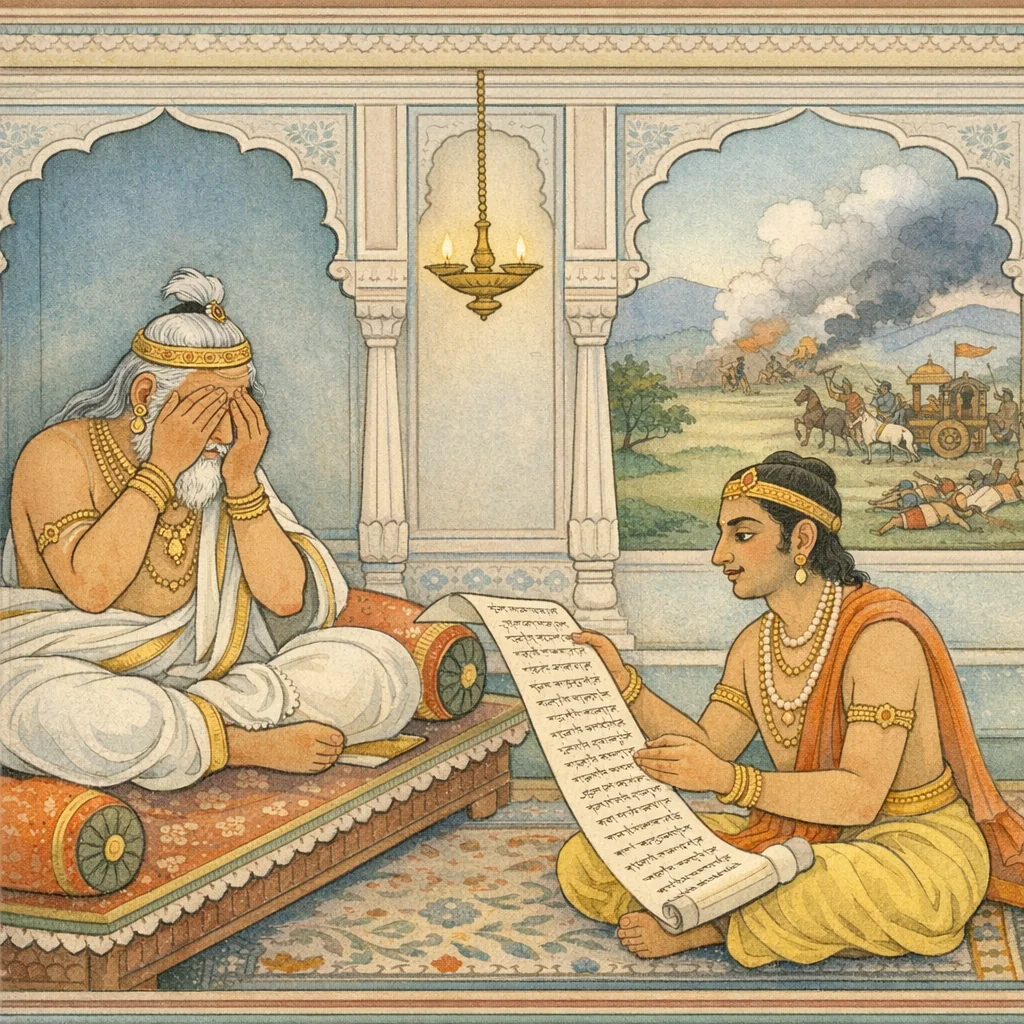
The chapter opens with Janamejaya’s inquiry about Dhṛtarāṣṭra’s words after hearing of Karṇa’s death and his sons’ retreat. Vaiśaṃpāyana describes the news as psychologically implausible—likened to cosmic inversions—and narrates Dhṛtarāṣṭra’s shock, grief, and disbelief. Dhṛtarāṣṭra addresses Saṃjaya with an extended encomium of Karṇa’s martial stature and prior conquests, presenting Karṇa as the primary pillar of Kaurava security. Saṃjaya attempts measured consolation by appealing to Dhṛtarāṣṭra’s stature and self-control. Dhṛtarāṣṭra then pivots to a fatalistic doctrine: daiva supersedes human effort, since even Karṇa fell. He recounts Karṇa’s battlefield prowess and earlier decisive actions (including the use of Indra’s śakti against Ghaṭotkaca), and questions how such a warrior could be slain unless extraordinary disruption occurred (weapon failure, chariot impediment, or loss of astras). The lament expands into retrospective causality: Duryodhana’s refusal of restraint, the earlier counsel attributed to Bhīṣma, and the compounding losses of Bhīṣma and Droṇa. The chapter culminates in Dhṛtarāṣṭra’s interrogatives about the reactions and statements of Duryodhana and other leaders (Śakuni, Kṛtavarman, Aśvatthāman, Kṛpa, Śalya, and allied kings), and requests a detailed account of the formations and circumstances around Karṇa’s death.
Chapter Arc: धृतराष्ट्र कर्ण के वध का समाचार सुनकर अपने ही पुत्र-दुर्योधन की दुष्प्रणीत नीति को कारण मानते हुए शोक से टूट पड़ता है और संजय से पूछता है—कुरुओं और सृञ्जयों में कौन जीवित हैं, कौन मारे गए। → संजय धृतराष्ट्र के प्रश्न का उत्तर ‘गणना’ के रूप में देता है—कौरव-पक्ष के प्रमुख वीरों, सहायकों, गणों और विविध जनपदों के योद्धाओं के नाम-परिचय और उनके मारे जाने का क्रम; यह सूची युद्ध की व्यापकता और कौरव-क्षय की अपरिहार्यता को तीव्र करती जाती है। → कर्ण-संग्राम की छाया में संजय यह स्थापित करता है कि कर्ण के समान पराक्रमी वृषसेन सहित अनेक नामी योद्धा यमलोक को प्राप्त हुए; धृतराष्ट्र के लिए यह बोध चरम पर पहुँचता है कि यह संहार किसी एक द्वंद्व का नहीं, समूचे पक्ष का विघटन है। → संजय निष्कर्ष रूप में धृतराष्ट्र को कठोर सत्य सुनाता है—पाण्डवों का अहित करने की दीर्घ नीति का फल अब सामने है; कर्ण-अर्जुन संग्राम के परिणामस्वरूप भारी संहार हो चुका है और कौरव-बल का आधार टूट चुका है। → कर्ण-अर्जुन युद्ध के बाद की स्थिति और आगे के निर्णायक प्रसंगों की ओर संकेत रह जाता है—अब शेष बचे योद्धाओं के साथ युद्ध किस दिशा में मुड़ेगा।
Shlokas
Verse 1
/ अपन क्ात बछ। अकाल पञठ्चमो<ध्याय: संजयका धृतराष्ट्रको कौरवपक्षके मारे गये प्रमुख वीरोंका परिचय देना वैशम्पायन उवाच इति श्रुत्वा महाराज धृतराष्ट्रोडम्बिकासुत: । अब्रवीत् संजयं सूतं शोकसंविग्नमानस:,वैशम्पायनजी कहते हैं--महाराज! उपर्युक्त समाचार सुनकर अम्बिकानन्दन धृतराष्ट्रका हृदय शोकसे व्याकुल हो गया। वे अपने सारथि संजयसे इस प्रकार बोले --
Vaiśampāyana said: O King, having heard that report, Dhṛtarāṣṭra, the son of Ambikā, his mind shaken by grief, addressed Sañjaya the charioteer in these words. The scene shows how war’s calamities return first as inward suffering—grief and moral disquiet—before they become counsel or action.
Verse 2
दुष्प्रणीतेन मे तात पुत्रस्यादीर्घजीविन: । हतं वैकर्तनं श्रुव्वा शोको मर्माणि कृन्तति,“तात अपने अल्पायु पुत्रके अन्यायसे वैकर्तन कर्णके मारे जानेका समाचार सुनकर जो शोक उमड़ आया है, वह मेरे मर्मस्थानोंको छेदे डालता है
Vaiśampāyana said: “O dear one, because of my son’s misguided conduct—he who was not destined for long life—when I heard that Vaikartana (Karna) had been slain, a surge of grief arose and it cuts into my very vital parts.”
Verse 3
तस्य मे संशयं छिन्धि दुःखपारं तितीर्षत: । कुरूणां सृञ्जयानां च के च जीवन्ति के मृता:,“मैं इस अपार दुःखसे पार पाना चाहता हूँ। तुम मेरे इस संदेहका निवारण करो कि कौरवों तथा सूंजयोंमेंसे कौन-कौन जीवित हैं और कौन-कौन मर गये हैं?”
Vaiśampāyana said: “I wish to cross beyond this boundless sea of sorrow. Cut through my doubt and tell me clearly—among the Kurus and the Sṛñjayas, who still live and who have fallen?”
Verse 4
इस प्रकार श्रीमह्याभारत कर्णपर्वमें धृतराष्रका शोक नामक चौथा अध्याय पूरा हुआ,संजय उवाच हतः शान्तनवो राजन दुराधर्ष: प्रतापवान् । हत्वा पाण्डवयोधानामर्बुदं दशभिर्दिनै: संजयने कहा--राजन्! दुर्जय एवं प्रतापी वीर शान्तनुनन्दन भीष्म दस दिनोंमें पाण्डवदलके दस करोड़ योद्धाओंका संहार करके मारे गये हैं
Sañjaya said: O King, the son of Śantanu—Bhīṣma—invincible and mighty in prowess, has been slain, after killing an arbuda (a vast host) of the Pāṇḍavas’ warriors within ten days. The report lays bare the terrible cost of war: even the greatest champions fall, and victory is measured in grievous destruction rather than in true righteousness.
Verse 5
तथा द्रोणो महेष्वास: पञ्चालानां रथव्रजान् | निहत्य युधि दुर्धर्ष: पश्चाद् रुक्मरथो हत:,इसी प्रकार सुवर्णमय रथवाले दुर्धर्ष वीर महाधनुर्धर द्रोणाचार्य भी पांचालरथियोंके समुदायोंका संहार करके मारे गये हैं इति श्रीमहाभारते कर्णपर्वणि संजयवाक्ये पठचमो<ध्याय:
So too Droṇa, the great bowman, hard to withstand in battle: having slain the companies of Pañcāla charioteers in the fight, he was afterward himself slain; and then the warrior of the golden chariot (Rukmaratha) also fell.
Verse 6
हतशेषस्य भीष्मेण द्रोणेन च महात्मना । अर्ध निहत्य सैन्यस्य कर्णो वैकर्तनो हतः:,भीष्म और महात्मा द्रोणके मारनेसे जो पाण्डव-सेना बच गयी थी, उसके आधे भागका विनाश करके वैकर्तन कर्ण मारा गया है
Sañjaya said: After Bhīṣma and the great-souled Droṇa had cut down the army so that only a remnant remained, Vaikartana Karṇa destroyed half of that remnant—and then was himself slain.
Verse 7
विविंशतिर्महाराज राजपुत्रो महाबल: । आनर्तयोधान् शतशो निहत्य निहतो रणे,महाराज! महाबली राजकुमार विविंशति रणभूमिमें सैकड़ों आनर्तदेशीय योद्धाओंको मारकर मरा है
Sañjaya said: O King, the mighty prince Viviṁśati, after slaying hundreds of warriors of Ānarta, was himself slain in battle.
Verse 8
तथा पुत्रो विकर्णस्ते क्षत्रव्रतमनुस्मरन् । क्षीणवाहायुध: शूर: स्थितोडभिमुखत: परान्,इसी प्रकार आपका शूरवीर पुत्र विकर्ण क्षत्रियोचित व्रतका स्मरण करके वाहनों और आयुधोंके नष्ट हो जानेपर भी शत्रुओंके सामने डटा हुआ था, परंतु दुर्योधनके दिये हुए बहुत-से भयंकर क्लेशों और अपनी प्रतिज्ञाको याद करके भीमसेनने उसे मार गिराया
Sañjaya said: “So too your son Vikarṇa, the hero—remembering the vow proper to a kṣatriya—stood firm facing the foe. Though his mount and weapons were spent or destroyed, he did not turn from battle; yet Bhīmasena, recalling his own vow and the many dreadful hardships wrought by Duryodhana, struck him down.”
Verse 9
घोररूपान् परिक्लेशान् दुर्योधनकृतान् बहून् । प्रतिज्ञां स्मरता चैव भीमसेनेन पातित:,इसी प्रकार आपका शूरवीर पुत्र विकर्ण क्षत्रियोचित व्रतका स्मरण करके वाहनों और आयुधोंके नष्ट हो जानेपर भी शत्रुओंके सामने डटा हुआ था, परंतु दुर्योधनके दिये हुए बहुत-से भयंकर क्लेशों और अपनी प्रतिज्ञाको याद करके भीमसेनने उसे मार गिराया
Sañjaya said: Remembering his vow—and the many dreadful hardships inflicted by Duryodhana—Bhīmasena struck him down.
Verse 10
विन्दानुविन्दावावन्त्यौ राजपुत्रौ महारथौ । कृत्वा त्वसुकरं कर्म गतौ वैवस्वतक्षयम्,अवन्तीदेशके महारथी राजकुमार विन्द और अनुविन्द भी दुष्कर कर्म करके यमलोकको चले गये
Sañjaya said: Vindā and Anuvindā, the two princes of Avanti, great chariot-warriors, having accomplished a deed exceedingly hard to achieve, went to the abode of Vaivasvata (Yama). Thus the grim moral cost of war is shown: even renowned kṣatriya heroes, after fulfilling their perilous martial duty, meet death and pass into Yama’s realm.
Verse 11
सिंधुराष्ट्रमुखानीह दश राष्ट्राणि यानि ह । वशे तिष्ठन्ति वीरस्य य: स्थितस्तव शासने,राजन! जिस वीरके शासनमें सिन्धु, सौबीर आदि दस राष्ट्र थे जो सदा आपकी आज्ञाके अधीन रहा करता था, उस महापराक्रमी जयद्रथको अर्जुनने आपकी ग्यारह अक्षौहिणी सेनाओंको हराकर तीखे बाणोंसे मार डाला
Sañjaya said: “O King, here were ten realms—Sindhurāṣṭra and others—which stood under the control of that hero who remained established in your command.”
Verse 12
अक्षौहिणीर्दशैकां च विनिर्जित्य शितै: शरै: । अर्जुनेन हतो राजन् महावीरयों जयद्रथ:,राजन! जिस वीरके शासनमें सिन्धु, सौबीर आदि दस राष्ट्र थे जो सदा आपकी आज्ञाके अधीन रहा करता था, उस महापराक्रमी जयद्रथको अर्जुनने आपकी ग्यारह अक्षौहिणी सेनाओंको हराकर तीखे बाणोंसे मार डाला
Sañjaya said: O King, after overcoming your eleven akṣauhiṇīs with razor-sharp arrows, Arjuna slew the mighty warrior Jayadratha. Thus fell the ruler under whose command Sindhu, Saubīra, and other realms had long remained obedient to your authority—showing how, in war, power and protection collapse when adharma-driven alliances meet resolute, vow-bound valor.
Verse 13
तथा दुर्योधनसुतस्तरस्वी युद्धदुर्मदः । वर्तमान: पितु: शास्त्रे सौभद्रेण निपातित:,दुर्योधनके रणदुर्मद वेगशाली पुत्र लक्ष्मणको, जो सदा पिताकी आज्ञाके अधीन रहता था, सुभद्राकुमारने मार गिराया
Sañjaya said: Likewise, Duryodhana’s son—impetuous and intoxicated with the arrogance of battle—though ever acting under his father’s command, was struck down by Saubhadra. The verse shows how filial obedience and martial pride, when yoked to an unrighteous cause, culminate in ruin on the battlefield.
Verse 14
तथा दौ:शासनि: शूरो बाहुशाली रणोत्कट: । द्रौपदेयेन सड़म्य गमितो यमसादनम्,अपने बाहुबलसे सुशोभित होनेवाला रणोन्मत्त शूर दुःशासनकुमार द्रौपदीके पुत्रसे टक्कर लेकर यमलोकमें जा पहुँचा
Sañjaya said: Likewise, the heroic Dauḥśāsani—mighty-armed and fierce in battle—having met in combat with a son of Draupadī, was sent to the abode of Yama. The verse underscores the moral gravity of war: prowess and lineage do not shield one from the consequences of one’s side’s adharma, and death comes as the impartial settling of fate on the battlefield.
Verse 15
किरातानामधिपति: सागरानूपवासिनाम् | देवराजस्य धर्मात्मा प्रियो बहुमत: सखा
Sañjaya said: “He was the lord of the Kirātas who dwell along the seacoast and marshlands—a righteous-souled man, dear to Indra, king of the gods, and a trusted, highly esteemed friend.”
Verse 16
भगदत्तो महीपाल: क्षत्रधर्मरत: सदा । धनंजयेन विक्रम्य गमितो यमसादनम्
Sañjaya said: King Bhagadatta, ever devoted to the kṣatriya code, was overpowered by Dhanañjaya (Arjuna) and sent to the abode of Yama.
Verse 17
जो सागर-तटवर्ती किरातोंके स्वामी तथा देवराज इन्द्रके अत्यन्त आदरणीय प्रिय सखा थे, सदा क्षत्रिय-धर्ममें तत्पर रहनेवाले वे धर्मात्मा राजा भगदत्त भी अर्जुनके साथ पराक्रम दिखाकर यमराजके लोकमें चले गये ।। तथा कौरवदायादो न्यस्तशस्त्रो महायशा: । हतो भूरिश्रवा राजन् शूर: सात्यकिना युधि,राजन्! कौरववंशी महायशस्वी शूरवीर भूरिश्रवा, जो अपने अस्त्र-शस्त्रोंका परित्याग कर चुके थे, युद्धस्थलमें सात्यकिके हाथसे मारे गये
Sañjaya said: “That righteous king Bhagadatta—lord of the Kirātas who dwell along the seacoast, and a dearly loved, highly honored friend of Indra, king of the gods—ever devoted to the kṣatriya code, displayed his valor in combat with Arjuna and then departed to the realm of Yama. Likewise, O King, the renowned Kuru scion, the heroic Bhūriśravā—having laid aside his weapons—was slain on the battlefield by Sātyaki.”
Verse 18
श्रुतायुरपि चाम्बष्ठ: क्षत्रियाणां धुरंधर: । चरन्नभीतवत् संख्ये निहत: सव्यसाचिना,अम्बष्ठदेशके राजा क्षत्रिय-धुरंधर श्रुतायु भी, जो समरांगणमें निर्भय-से विचरते थे, सव्यसाची अर्जुनके हाथसे मारे गये
Sañjaya said: Even Śrutāyu, the king of the Ambaṣṭha country—a foremost bearer of the Kṣatriyas’ burden—who moved about the battlefield as if fearless, was slain by Savyasācin (Arjuna).
Verse 19
तव पुत्र: सदामर्षी कृतास्त्रो युद्धदुर्मदः । दुःशासनो महाराज भीमसेनेन पातितः,महाराज! जो अस्त्र-विद्याका विद्वान् तथा युद्धमें उन््मत्त होकर लड़नेवाला था, सदा अमर्षमें भरे रहनेवाले आपके उस पुत्र दुःशासनको भीमसेनने मार गिराया
Sañjaya said: O King, your son Duḥśāsana—ever resentful, trained in weapons, and maddened by the pride of battle—has been struck down by Bhīmasena.
Verse 20
यस्य राजन् गजानीकं ६:20 प् । सुदक्षिण: स संग्रामे निहतः अजय जा नो,राजन्! जिसके अधिकारमें कई हजार हाथियोंकी अद्भुत सेना थी, वह सुदक्षिण भी संग्राममें सव्यसाची अर्जुनके बाणोंका निशाना बन गया
Sañjaya said: O King, Sudakṣiṇa—who commanded a wondrous host of elephants numbering in the thousands—was struck down in battle, becoming the target of the unfailing arrows of Savyasācin Arjuna.
Verse 21
कोसलानामधिपतिर्धहत्वा बहुमतान् परान् | सौभद्रेण हि विक्रम्य गमितो यमसादनम्,कोशलनरेश शत्रुपक्षके अत्यन्त सम्मानित वीरोंका वध करके सुभद्राकुमार अभिमन्युके साथ पराक्रम दिखाते हुए यमलोकके पथिक बन गये
Sañjaya said: The lord of the Kośalas, after slaying many highly esteemed warriors of the opposing side, displayed his valor against Saubhadra (Abhimanyu) and was sent to the abode of Yama.
Verse 22
बहुशो योधयित्वा तु भीमसेनं महारथम् । मद्रराजात्मज: शूर: परेषां भयवर्धन: । असिचर्मधर: श्रीमान् सौभद्रेण निपातितः,जो महारथी भीमसेनके साथ भी कई बार युद्ध कर चुका था, ढाल और तलवार लेकर शत्रुओंका भय बढ़ानेवाला वह मद्रराजका शूरवीर तेजस्वी पुत्र सुभद्राकुमार अभिमन्युके द्वारा मार डाला गया
Sañjaya said: Having fought many times with Bhīmasena, that great chariot-warrior—the valiant, illustrious son of the king of Madra, who increased the fear of his foes—bearing sword and shield, was struck down by Saubhadra (Abhimanyu).
Verse 23
सम: कर्णस्य समरे य: स कर्णस्य पश्यत: । वृषसेनो महातेजा: शीघ्रास्त्रो दृढविक्रम:,जो समरभूमिमें कर्णके समान ही पराक्रमी था, शीघ्रतापूर्वक अस्त्र चलानेवाला, सुदृढ़ बल-विक्रमसे सम्पन्न और महान् तेजस्वी था, वह कर्णपुत्र वृषसेन अभिमन्युका वध सुनकर की हुई अपनी प्रतिज्ञाको याद रखनेवाले अर्जुनके साथ भिड़कर कर्णके देखते-देखते उनके द्वारा यमलोक पहुँचा दिया गया
Sañjaya said: Vṛṣasena—Karna’s son—was in battle the equal of Karna himself: a man of great radiance, swift in the use of weapons, and firm in valor. Yet, as Karna looked on, Vṛṣasena confronted Arjuna, mindful of his vow after Abhimanyu’s slaying; and Arjuna sent him to the realm of Yama.
Verse 24
अभिमन्योर्व॑ं श्रुत्वा प्रतिज्ञामपि चात्मन: । धनंजयेन विक्रम्प गमितो यमसादनम्,जो समरभूमिमें कर्णके समान ही पराक्रमी था, शीघ्रतापूर्वक अस्त्र चलानेवाला, सुदृढ़ बल-विक्रमसे सम्पन्न और महान् तेजस्वी था, वह कर्णपुत्र वृषसेन अभिमन्युका वध सुनकर की हुई अपनी प्रतिज्ञाको याद रखनेवाले अर्जुनके साथ भिड़कर कर्णके देखते-देखते उनके द्वारा यमलोक पहुँचा दिया गया
Sañjaya said: Hearing of Abhimanyu’s slaying and recalling his own vow, that warrior—equal to Karṇa in prowess on the battlefield, swift in the discharge of weapons, endowed with firm strength and valor, and radiant with great splendor—engaged Dhanañjaya (Arjuna). Before Karṇa’s very eyes, he was struck down by Arjuna and sent to the abode of Yama.
Verse 25
नित्यं प्रसक्तवैरो यः पाण्डवै: पृथिवीपति: । विश्राव्य वैरं पार्थेन श्रुतायु: स निपातित:,जो पाण्डवोंके साथ सदा वैर बाँधे रखता था, उस राजा श्रुतायुको कुन्तीकुमार अर्जुनने उसकी शत्रुताका स्मरण कराकर मार डाला
Sañjaya said: The king Śrutāyu, who had long maintained a fixed enmity toward the Pāṇḍavas, was brought down by Pārtha (Arjuna) after Arjuna called his hostility to mind and made it manifest—thus meeting him in battle with the consequences of his chosen feud.
Verse 26
शल्यपुत्रस्तु विक्रान्त: सहदेवेन मारिष । हतो रुक्मरथो राजन् भ्राता मातुलजो युधि,माननीय नरेश! शल्यका पराक्रमी पुत्र रुक्मरथ, जो सहदेवका ममेरा भाई था, युद्धमें सहदेवके ही हाथसे मारा गया
Sañjaya said: O venerable one, Śalya’s valiant son Rukmaratha—who was Sahadeva’s maternal cousin—was slain in battle by Sahadeva himself. The report underscores how the war’s duty-bound violence cuts through even bonds of kinship, as warriors meet one another as opponents on the field.
Verse 27
राजा भगीर थो वृद्धो बृहत्क्षत्रश्न केकय: । पराक्रमन्तौ विक्रान्ती निहतौ वीर्यवत्तरो,बूढ़े राजा भगीरथ और केकयनरेश बृहत्क्षत्र--ये दोनों अत्यन्त बलवान् और पराक्रमी वीर थे, जो युद्धमें पराक्रम दिखाते हुए मारे गये
Sañjaya said: The aged king Bhāgīratha and Bṛhatkṣatra, the ruler of the Kekayas—both exceedingly mighty and valiant—were slain while displaying their prowess in battle. The verse underscores the impartial devastation of war: even renowned, powerful elders fall when dharma is eclipsed by the fury of combat.
Verse 28
भगदत्तसुतो राजन् कृतप्रज्ञो महाबल: । श्येनवच्चरता संख्ये नकुलेन निपातित:
Sañjaya said: O King, the son of Bhagadatta—steady-minded and of great strength—who moved through the battle like a hawk, was struck down by Nakula. The report underscores how even formidable warriors, despite skill and composure, fall under the inexorable law of war and fate, reminding the listener of the grave cost of adharma-driven conflict.
Verse 29
राजन्! भगदत्तके विद्वान् और महाबली पुत्रको युद्धमें बाजकी तरह झपटनेवाले नकुलने मार गिराया ।। पितामहस्तव तथा बाह्लीक: सह बाह्लिकै: । निहतो भीमसेनेन महाबलपराक्रम:,आपके पितामह बाह्नलीक भी महान् बल-पराक्रमसे सम्पन्न थे। वे भीमसेनके हाथसे बाह्लीक योद्धाओंसहित मारे गये
Sanjaya said: O King, Nakula—swift in battle like a swooping hawk—struck down the learned and mighty son of Bhagadatta. And your grandsire Bahlika too, though endowed with great strength and valor, was slain by Bhimasena along with the Bahlika warriors. Thus, in the relentless course of war, even renowned elders and powerful champions fall when fate and force converge on the battlefield.
Verse 30
जयत्सेनस्तथा राजज्जारासंधिमहाबल: । मागधो निहत: संख्ये सौभद्रेण महात्मना
Sañjaya said: O King, Jayatsena and the mighty Jārāsaṃdhi—both warriors of Magadha—were slain in the press of battle by the noble Saubhadra.
Verse 31
राजन्! जरासंधके महाबलवान् पुत्र मगधवासी जयत्सेनको महामना सुभद्राकुमारने युद्धमें मार डाला ।। पुत्रस्ते दुर्मुखो राजन दुःसहश्न महारथ: । गदया भीमसेनेन निहतौ शूरमानिनौ,नरेश्वर! आपके पुत्र दुर्मुख और महारथी दुः:सह--ये दोनों अपनेको शूरवीर माननेवाले योद्धा थे, जो भीमसेनकी गदासे मारे गये
Sañjaya said: O King, the high-souled Jayatsena, a mighty son of Jarasandha and a man of Magadha, was slain in battle by Abhimanyu, the son of Subhadra. And, O ruler of men, your sons Durmukha and the great chariot-warrior Duhsaha—both proud of their heroism—were struck down by Bhimasena with his mace.
Verse 32
दुर्मर्षणो दुर्विषहो दुर्जयश्व महारथ: । कृत्वा त्वसुकरं कर्म गता वैवस्वतक्षयम्,इसी प्रकार दुर्मर्षण, दुर्विषह और महारथी दुर्जय दुष्कर कर्म करके यमराजके लोकमें जा पहुँचे हैं
Sañjaya said: “Durmarṣaṇa, Durviṣaha, and the great chariot-warrior Durjaya—having performed a deed hard to accomplish—have gone to the abode of Vaivasvata (Yama), the realm of death.”
Verse 33
उभौ कलिड्गवृषकौ भ्रातरौ युद्धदुर्मदौ । कृत्वा चासुकरं कर्म गतौ वैवस्वतक्षयम्
Sañjaya said: Both brothers, Kaliṅga and Vṛṣaka—made arrogant by the frenzy of battle—performed a deed hard to accomplish, and then went to the abode of Vaivasvata (Yama), that is, met their death.
Verse 34
युद्धदुर्मद कलिंग और वृषक ये दोनों भाई भी दुष्कर पराक्रम प्रकट करके यमलोकके अतिथि हो चुके हैं ।। सचिवो वृषवर्मा ते शूर: परमवीर्यवान् | भीमसेनेन विक्रम्प गमितो यमसादनम्,आपके मन्त्री परम पराक्रमी शूरवीर वृषवर्मा भीमसेनके द्वारा बलपूर्वक यमलोक पहुँचा दिये गये
Sañjaya said: Kaliṅga and Vṛṣaka, the two brothers made arrogant by the madness of war, displayed a difficult valor and have become guests in Yama’s world. And Vṛṣavarmā, your minister, a hero of supreme might, was likewise driven by Bhimasena’s force to Yama’s abode.
Verse 35
तथैव पौरवो राजा नागायुतबलो महान् । समरे पाण्डुपुत्रेण निहत: सव्यसाचिना,इसी प्रकार दस हजार हाथियोंके समान बलशाली महान् राजा पौरवको समरांगणमें पाण्डुकुमार सव्यसाची अर्जुनने मार डाला
Sañjaya said: In the same manner, the great king Paurava—mighty with the strength of ten thousand elephants—was slain on the battlefield by the Pāṇḍu prince Arjuna, famed as Savyasācin.
Verse 36
वसातयो महाराज द्विसाहस्तरा: प्रहारिण: । शूरसेनाश्न विक्रान्ता: सर्वे युधि निपातिता:
Sañjaya said: O King, the Vasātayas—fighters who struck with two-thousand-strong force—and the valiant Śūrasenas, all of them, were felled in the battle.
Verse 37
महाराज! प्रहारकुशल दो हजार वसातिलोग और पराक्रमी शूरसेन--ये सब-के-सब युद्धमें मार डाले गये हैं ।। अभीषाहा: कवचिन: प्रहरन्तो रणोत्कटा: । शिबयश्न रथोदारा: कालिड्रसहिता हता:,रणमें उन्मत्त होकर प्रहार करनेवाले कवचधारी अभीषाह और उदार रथी शिबि--ये सब कलिंगराजसहित मारे गये हैं
O King! The two thousand Vasātayas, skilled in striking, and the valiant Śūrasenas—all of them were slain in the battle. And the armored Abhīṣāhas, who smote in battle-mad fury, and the noble chariot-warriors of the Śibis—these too were killed, together with the king of Kaliṅga.
Verse 38
गोकुले नित्यसंवृद्धा युद्धे परमकोपना: । ते&पावृत्तकवीराश्व निहता: सव्यसाचिना,जो सदा गोकुलमें पले हैं, युद्धमें अत्यन्त कुपित होकर लड़ते हैं और जिन्होंने कभी युद्धमें पीठ दिखाना नहीं सीखा है, वे गोपाल भी अर्जुनके हाथसे मारे जा चुके हैं
Sañjaya said: “Those cowherds, reared continually in the cattle-settlement, fought in the battle with extreme fury. Though they were men who had never learned to turn their backs in war, they too have been slain by Arjuna, the ambidextrous archer.”
Verse 39
श्रेणयो बहुसाहस्रा: संशप्तकगणाश्च ये । ते सर्वे पार्थमासाद्य गता वैवस्वतक्षयम्,संशप्तकगणोंकी कई हजार श्रेणियाँ थीं। वे सभी अर्जुनका सामना करके यमराजके लोकमें चले गये
Sañjaya said: Many thousands of battle-formations—the bands of the Saṁśaptakas—advanced to confront Arjuna. Having met him in combat, they all went to the abode of Vaivasvata (Yama).
Verse 40
स्यथालौ तव महाराज राजानौ वृषकाचलौ । त्वदर्थमतिविक्रान्ती निहतौ सव्यसाचिना,महाराज! आपके दोनों साले राजा वृषक और अचल, जो आपके लिये अत्यन्त पराक्रम प्रकट करते थे, अर्जुनके द्वारा मार डाले गये
Sañjaya said: “O great king, your two royal brothers-in-law, Vṛṣa and Acala—who, for your sake, displayed extraordinary valor—have been slain by Arjuna (Savyasācin).”
Verse 41
उग्रकर्मा महेष्वासो नामत: कर्मतस्तथा । शाल्वराजो महाबाहुर्भीमसेनेन पातित:,जो महान धनुर्धर तथा नाम और कर्मसे भी उमग्रकर्मा थे, उन महाबाहु शाल्वराजको भीमसेनने मार गिराया
Sañjaya said: “The mighty-armed king of Śālva—an excellent archer, renowned as ‘Ugrakarmā’ both by name and by deeds—was struck down by Bhīmasena.”
Verse 42
ओधघवांश्व महाराज बृहन्त: सहितौ रणे । पराक्रमन्तौ मित्रार्थे गतो वैवस्वतक्षयम्,महाराज! मित्रके लिये रणभूमिमें पराक्रम प्रकट करनेवाले ओघवान् और बृहन्त--ये दोनों एक साथ यमलोकको प्रस्थान कर चुके हैं
Sañjaya said: “O King, Oghavānśva and Bṛhanta—both together on the battlefield—displayed valor for the sake of their ally. Having fought with such devoted courage, they have gone to the realm of Vaivasvata (Yama).”
Verse 43
तथैव रथिनां श्रेष्ठ: क्षेमधूर्तिविशाम्पते । निहतो गदया राजन् भीमसेनेन संयुगे,प्रजानाथ! नरेश्वर! इसी प्रकार रथियोंमें श्रेष्ठ क्षेमधूर्तिको भी युद्धस्थलमें भीमसेनने अपनी गदासे मार डाला
Sañjaya said: “In the same way, O lord of the people, the foremost among chariot-warriors—Kṣemadhūrti—was struck down in battle by Bhīmasena with his mace, O king, O protector of subjects.”
Verse 44
तथा राजन् महेष्वासो जलसंधो महाबल: । सुमहत् कदनं कृत्वा हत: सात्यकिना रणे,राजन! महाधनुर्धर महाबली जलसंध रणभूमिमें शत्रु-सेनाका महान् संहार करके अन्तमें सात्यकिके हाथसे मारे गये
Sañjaya said: “So too, O King, the mighty archer Jalasaṃdha—possessed of great strength—after causing a vast slaughter among the enemy forces on the battlefield, was at last slain in combat by Sātyaki.”
Verse 45
अलनम्बुषो राक्षसेन्द्र: खरबन्धुरयानवान् । घटोत्कचेन विक्रम्य गमितो यमसादनम्,घटोत्कचने पराक्रम करके गर्दभयुक्त सुन्दर रथवाले राक्षसराज अलम्बुषको यमलोक पहुँचा दिया है
Sañjaya said: The rākṣasa-king Alambuṣa, mounted on a splendid chariot drawn by asses, was overpowered by the valour of Ghaṭotkaca and sent to the abode of Yama. In the grim ethic of war, this is the swift, fated end of a fierce combatant through superior might on the battlefield.
Verse 46
राधेय: सूतपुत्रश्न भ्रातरश्न महारथा: । केकया: सर्वशश्चापि निहता: सव्यसाचिना,सूतपुत्र राधानन्दन कर्ण, उसके महारथी भाई तथा समस्त केकय भी सव्यसाची अर्जुनके हाथसे मारे गये
Sañjaya said: Rādheya (Karna), the charioteer’s son, along with his brothers—mighty warriors—and indeed all the Kekayas as well, were slain by Savyasācin (Arjuna). The verse underscores the grim moral weight of war: even renowned heroes and entire allied contingents fall when dharma has already been ruptured and the conflict has become inexorable.
Verse 47
मालवा मद्रकाश्रैव द्राविडाश्नोग्रकर्मिण: । यौधेयाश्व ललित्थाशक्ष क्षुद्रका श्चाप्पुशीनरा:,मालव, मद्रक, भयंकर कर्म करनेवाले द्राविड, यौधेय, ललित्थ, क्षुद्रक, उशीनर, मावेल्लक, तुण्डिकेर, सावित्रीपुत्र, प्राच्य, उदीच्य, प्रतीच्य और दाक्षिणात्य, पैदलसमूह, दस लाख घोड़े, रथोंके समूह और बड़े-बड़े गजराज अर्जुनके हाथसे मारे गये हैं
Sañjaya said: The Mālavas and Madrakas, and the Drāviḍas of fierce deeds; the Yaudheyas and Lalitthas, the Kṣudrakas and the Uśīnaras—these and other regional forces were cut down in the press of battle. The report underscores the vast, multi-kingdom scale of the war and the terrible cost of martial ambition, where entire peoples are swept into destruction by the prowess of a single champion.
Verse 48
मावेल्लकास्तुण्डिकेरा: सावित्रीपुत्रकाश्च ये । प्राच्योदीच्या: प्रतीच्याश्न दाक्षिणात्याशक्ष मारिष
Sañjaya said: “Not only the Vellakas and the Tuṇḍikeras, and those who are called the sons of Sāvitrī, but also the peoples of the East, the North, the West, and the South—indeed, all quarters—are present/are drawn in, O revered one.”
Verse 49
पत्तीनां निहता: संघा हयानां प्रयुतानि च । रथव्रजाश्न निहता हताश्न वरवारणा:
Sañjaya said: Whole companies of foot-soldiers were slain; tens of thousands of horses too were killed. Troops of chariots were destroyed, and noble elephants likewise lay dead—marking the relentless, ruinous tide of battle and the grave human cost of martial ambition.
Verse 50
सध्वजा: सायुधा: शूरा: सवर्माम्बरभूषणा: । कालेन महता यत्ता: कुशलैयें च वर्धिता:
Sañjaya said: “They were warriors furnished with banners and weapons, adorned with armor and fine garments. Disciplined over a long span of time and strengthened by skilled training, they stood prepared—an army shaped by patience, order, and practiced competence as the war’s moral weight drew near.”
Verse 51
ते हता: समरे राजन् पार्थनाक्लिष्टकर्मणा । राजन! पालननिपुण पुरुषोंने जिनका दीर्घकालसे पालन-पोषण किया था, जो युद्धमें सदा सावधान रहनेवाले शूरवीर थे, वे सभी अनायास ही महान् कर्म करनेवाले अर्जुनके हाथसे ध्वज, आयुध, कवच, वस्त्र और आभूषणोंसहित समरांगणमें मारे गये || ५० है ।। अन्ये तथामितबला: परस्परवधैषिण:,महाराज! एक-दूसरेके वधकी इच्छा रखनेवाले असीम बलशाली अन्यान्य योद्धा भी मौतके घाट उतर चुके हैं। राजन! ये तथा और भी बहुत-से नरेश रणभूमिमें अपने दलबलके साथ सहस्रोंकी संख्यामें मारे गये हैं। आप मुझसे जो कुछ पूछ रहे थे, वह सब मैंने बता दिया
Sanjaya said: O King, in the press of battle they were slain—cut down by Arjuna, whose mighty deeds never falter. Those men whom you had long maintained and nurtured, skilled in protection and ever vigilant as warriors, fell on the field together with their standards, weapons, armor, garments, and ornaments. Thus the war’s moral weight is sharpened: royal patronage and long service do not shield one from the impartial consequences of combat when dharma and prowess collide.
Verse 52
एते चान्ये च बहवो राजान: सगणा रणे । हता: सहस््रशो राजन् यन्मां त्वं परिपृच्छसि,महाराज! एक-दूसरेके वधकी इच्छा रखनेवाले असीम बलशाली अन्यान्य योद्धा भी मौतके घाट उतर चुके हैं। राजन! ये तथा और भी बहुत-से नरेश रणभूमिमें अपने दलबलके साथ सहस्रोंकी संख्यामें मारे गये हैं। आप मुझसे जो कुछ पूछ रहे थे, वह सब मैंने बता दिया
Sañjaya said: “These, and many other kings besides, together with their retinues, have been slain on the battlefield—by the thousands, O King. What you have asked me, I have told: countless mighty warriors, driven by the desire to kill one another, have already gone to death.”
Verse 53
एवमेष क्षयो वृत्त: कर्णार्जुनसमागमे । महेन्द्रेण यथा वृत्रो यथा रामेण रावण:,सामात्यबान्धवो राजन् कर्ण: प्रहरतां वर: । राजन! इस प्रकार कर्ण और अर्जुनके संग्राममें यह भारी संहार हुआ है। जैसे देवराज इन्द्रने वृत्रासुरको, श्रीरामचन्द्रजीने रावणको, नरकशत्रु श्रीकृष्णने नरक और मुरुको तथा भृगुवंशी परशुरामने तीनों लोकोंको मोहित करनेवाला अत्यन्त घोर युद्ध करके समरांगणमें रणदुर्मद शूरवीर कृतवीर्यकुमार अर्जुनको उसके भाई-बन्धुओंसहित मार डाला था, जैसे स्कन्दने महिषासुरका और रुद्रने अन्धकासुरका संहार किया था, उसी प्रकार अर्जुनने योद्धाओंमें श्रेष्ठ युद्धदुर्मद कर्णको द्वैरथयुद्धमें उसके मन्त्री और बन्धुओंसहित मार डाला
Sanjaya said: “O King, thus did this destruction come to pass in the encounter between Karna and Arjuna—just as Vṛtra fell to great Indra, and Rāvaṇa to Rāma. So too did Karna, foremost among those who strike in battle, perish together with his ministers and kinsmen.”
Verse 54
यथा कृष्णेन नरको मुरुश्न नरकारिणा । कार्तवीर्यश्ष॒ रामेण भार्गवेण यथा हत:
Sañjaya said: “Just as Naraka was slain by Kṛṣṇa—the destroyer of Naraka—and just as Kārtavīrya was slain by Rāma Bhārgava (Paraśurāma), so too (in this manner) was he brought down.”
Verse 55
सज्ञातिबान्धव: शूर: समरे युद्धदुर्मदः । रणे कृत्वा महद् युद्ध घोरं त्रैलोक्यमोहनम्
Sañjaya said: He was a heroic man, devoted to his kinsmen and allies, and in battle he grew fiercely intoxicated with the ardor of war. Having waged a great and dreadful fight on the field—one that seemed to bewilder the three worlds—he stood forth as a figure of overwhelming martial power, where loyalty to one’s own and the terrible momentum of violence move side by side.
Verse 56
यथा स्कन्देन महिषो यथा रुद्रेण चान्धक: । तथार्जुनेन स हतो द्वैरथे युद्धदुर्मद:
Sañjaya said: “Just as the buffalo-demon was slain by Skanda, and as Andhaka was slain by Rudra, so too was that warrior—maddened by the arrogance of battle—cut down by Arjuna in the duel of chariots. The comparison underscores that pride and unrighteous fury in war meet an inevitable, divinely patterned end when confronted by superior valor aligned with rightful purpose.”
Verse 57
जयाशा धार्तराष्ट्राणां वैरस्य च मुखं यत:
Sañjaya said: “From this arose the Dhārtarāṣṭras’ hope of victory, and from this too the very opening (cause) of renewed enmity.”
Verse 58
तीर्णस्तत् पाण्डवो राजन् यत् पुरा नावबुध्यसे । उच्यमानो महाराज बन्धुभिह्ितकाडुक्षिभि:
Sañjaya said: “O King, the Pāṇḍava has now crossed beyond that very danger which you formerly failed to recognize. Even when he was being warned, O great king, by his kinsmen who sought his welfare, you did not understand.”
Verse 59
तदिदं समनुप्राप्तं व्यसनं सुमहात्ययम् । जिससे आपके पुत्रोंने विजयकी आशा लगा रखी थी, जो वैरका मुख बना हुआ था, उससे पाण्डुपुत्र अर्जुन पार हो गये। महाराज! पहले आपने हितैषी बन्धुओंके कहनेपर भी जिसकी ओर ध्यान नहीं दिया, वही यह महान् विनाशकारी संकट प्राप्त हुआ है ।। ५७-५८ ई | पुत्राणां राज्यकामानां त्वया राजन् हितैषिणा,राजन्! आपने राज्यकी कामना रखनेवाले अपने पुत्रोंक हितकी इच्छा रखते हुए सदा उन पाण्डवोंके अहित ही किये हैं; आपके उन्हीं कर्मोका यह फल प्राप्त हुआ है
Sañjaya said: This terrible and hard-to-surmount calamity has now come upon you. That very obstacle on which your sons had staked their hope of victory—indeed, the very ‘gateway’ of enmity—has been crossed by Arjuna, the son of Pandu. O King, the great, ruinous crisis you face today is precisely what you once refused to heed, even when well-wishing kinsmen spoke for your good. And, O King, though you claimed to seek the welfare of your sons who longed for the kingdom, you repeatedly acted only to harm the Pandavas; this disaster is the fruit of those deeds.
Verse 60
अहितान्येव चीर्णानि तेषां तत् फलमागतम्,राजन्! आपने राज्यकी कामना रखनेवाले अपने पुत्रोंक हितकी इच्छा रखते हुए सदा उन पाण्डवोंके अहित ही किये हैं; आपके उन्हीं कर्मोका यह फल प्राप्त हुआ है
Sanjaya said: “O King, they practiced only harmful deeds, and now their fruit has arrived. Though you sought your sons’ welfare and longed for the kingdom, you repeatedly acted against the Pandavas; this present outcome is the ripened result of those very actions.”
Verse 459
मालव, मद्रक, भयंकर कर्म करनेवाले द्राविड, यौधेय, ललित्थ, क्षुद्रक, उशीनर, मावेल्लक, तुण्डिकेर, सावित्रीपुत्र, प्राच्य, उदीच्य, प्रतीच्य और दाक्षिणात्य, पैदलसमूह, दस लाख घोड़े, रथोंके समूह और बड़े-बड़े गजराज अर्जुनके हाथसे मारे गये हैं
Sañjaya said: The Mālavas, Madrakas, the Drāviḍas of dreadful deeds, the Yaudheyas, Lalitthas, Kṣudrakas, Uśīnaras, Māvellakas, Tuṇḍikeras, the sons of Sāvitrī, and the peoples of the East, North, West, and South—along with masses of infantry, ten lakhs of horses, companies of chariots, and great lordly elephants—were slain by Arjuna’s hand.
Verse 563
सामात्यबान्धवो राजन् कर्ण: प्रहरतां वर: । राजन! इस प्रकार कर्ण और अर्जुनके संग्राममें यह भारी संहार हुआ है। जैसे देवराज इन्द्रने वृत्रासुरको, श्रीरामचन्द्रजीने रावणको, नरकशत्रु श्रीकृष्णने नरक और मुरुको तथा भृगुवंशी परशुरामने तीनों लोकोंको मोहित करनेवाला अत्यन्त घोर युद्ध करके समरांगणमें रणदुर्मद शूरवीर कृतवीर्यकुमार अर्जुनको उसके भाई-बन्धुओंसहित मार डाला था, जैसे स्कन्दने महिषासुरका और रुद्रने अन्धकासुरका संहार किया था, उसी प्रकार अर्जुनने योद्धाओंमें श्रेष्ठ युद्धदुर्मद कर्णको द्वैरथयुद्धमें उसके मन्त्री और बन्धुओंसहित मार डाला
Sañjaya said: O King, Karṇa—foremost among those who strike—stood together with his ministers and kinsmen. Thus, in the battle between Karṇa and Arjuna, a tremendous slaughter occurred. Just as Indra slew Vṛtra, Rāma slew Rāvaṇa, Kṛṣṇa (the foe of Naraka) slew Naraka and Mura, and Paraśurāma of the Bhṛgu line, after a most dreadful war that bewildered the three worlds, killed the battle-maddened hero Arjuna, son of Kṛtavīrya, along with his brothers and allies; just as Skanda destroyed Mahiṣāsura and Rudra destroyed Andhaka—so too did Arjuna, in a chariot-duel, slay Karṇa, the best of warriors, intoxicated with battle, together with his ministers and kinsmen.
Frequently Asked Questions
The chapter stages a dilemma of interpretation and responsibility: Dhṛtarāṣṭra oscillates between attributing outcomes to daiva (thereby reducing personal accountability) and recognizing that prior choices—especially the rejection of restraint and counsel—generated the conditions for catastrophe. The ethical tension lies in whether grief should yield fatalism or sober acknowledgement of causality and duty.
Power and security grounded in singular heroism are structurally unstable; outcomes depend on an interaction of capability, circumstance, and accumulated consequences. The narrative also implies that counsel aligned with restraint and reconciliation, when ignored, returns later as unavoidable consequence, demonstrating the epic’s causal ethics rather than simple determinism.
No formal phalaśruti is stated here. The chapter functions instead as interpretive scaffolding: it frames Karṇa’s fall as a lens for examining war-reporting, grief rhetoric, and the epic’s recurring concern with how agents explain disaster—through fate, error, or moral causality.