Adhyaya 45
अस्त्रयुद्धे द्रौणिपार्थसंघर्षः — Karṇa’s Bhārgavāstra and the Search for Yudhiṣṭhira (Chapter 45)
Upa-parva: Astrayuddha-saṅgrāma (Drauṇi–Pārtha-pratiyuddha and Karṇa’s Bhārgavāstra Deployment)
Saṃjaya reports an intense astrayuddha: Drauṇi (Aśvatthāmā), heavily supported by chariot forces, suddenly assaults the sector where Arjuna and Kṛṣṇa are positioned. Arjuna checks the assault, but Drauṇi blankets both ‘Kṛṣṇas’ (Arjuna and Kṛṣṇa) with arrows; Arjuna’s counter-weapons are repeatedly neutralized, and Drauṇi is portrayed as deathlike in ferocity. Drauṇi wounds Kṛṣṇa’s right arm and continues multi-directional arrow coverage; Arjuna retaliates by killing Drauṇi’s horses and disrupting his chariot team, while Drauṇi demonstrates rapid recovery by managing his team and continuing pressure. As the broader Kaurava host wavers under Pandava pressure, Duryodhana addresses Karṇa, urging decisive action to halt the flight. Karṇa vows to destroy the Pāñcālas with the Pandavas and deploys the Bhārgavāstra, releasing an overwhelming volume of blazing missiles; the Pāñcāla–Sṛñjaya forces suffer disarray and panic, calling repeatedly for Arjuna and Kṛṣṇa. Observing the weapon’s severity, Arjuna acknowledges the difficulty of countering it directly and, with Kṛṣṇa, moves to locate the wounded Yudhiṣṭhira. Arjuna consults Bhīma regarding the king’s whereabouts; Bhīma reports Yudhiṣṭhira has withdrawn to camp, badly injured by Karṇa’s arrows. Arjuna requests verification but notes he cannot disengage until the Saṃśaptakas are addressed; Bhīma undertakes to hold them, enabling Arjuna and Kṛṣṇa to proceed. They reach Yudhiṣṭhira lying down, offer formal respect, and the king—believing Karṇa slain—greets them with relief.
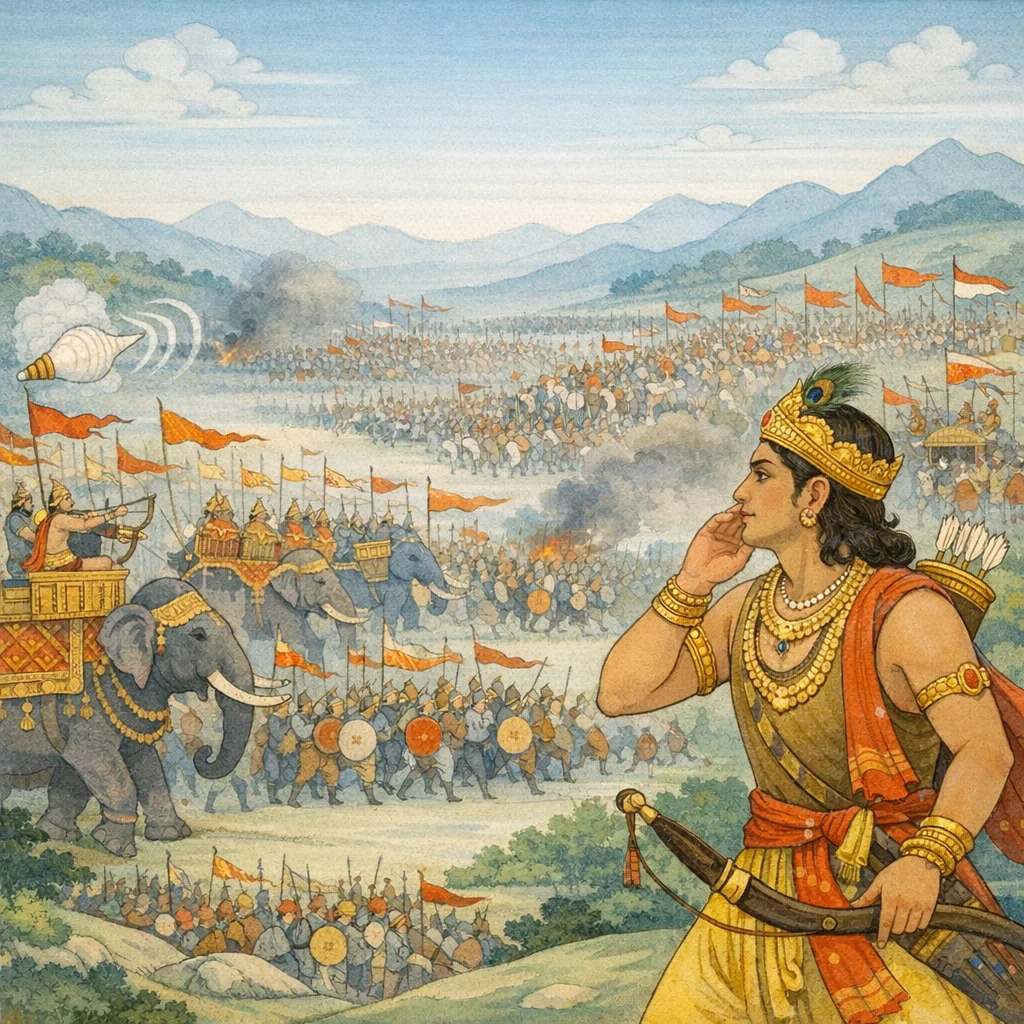
Chapter Arc: रणभूमि पर शंख-नाद और रथों की गर्जना से धरती काँप उठती है; कौरव-सेना अपनी व्यूह-रचना में सघन, चमकती और भय-उत्पादक दिखाई देती है। → कौरवों की ओर से विविध जातियों-गणों के सैनिक, पदाति-नाग-रथ, पट्टिश-खड्गधारी सहस्रों अविचल योद्धा, और वाद्यों का कोलाहल—सब मिलकर एक विराट युद्ध-चित्र रचते हैं। उधर प्रतिव्यूह रचने को महातेजस्वी योद्धा क्रोध से काँपते-से आगे बढ़ते हैं; ध्वजाओं, पताकाओं और कवचों की स्वर्ण-रजत आभा युद्ध को उत्सव-सा और मृत्यु को निकट-सा बनाती है। → कर्ण के सम्मुख दोनों पक्षों की सेनाएँ अपने-अपने ध्वज, रथ-शोभा, प्रत्यंचा-शब्द, बाणों की सनसनाहट, मनुष्य-घोड़े-रथ के कोलाहल के साथ एक साथ उफनती हैं—ऐसा क्षण जब व्यूह-रचना और ध्वज-वैभव स्वयं युद्ध की घोषणा बन जाते हैं। → अध्याय का अंत वास्तविक द्वंद्व-परिणाम से अधिक ‘युद्ध के आरम्भ-क्षण’ की स्थापनाओं में होता है—सेनाएँ सज्ज, व्यूह स्थिर, और कर्ण के लिए संकेत स्पष्ट कि अब निर्णायक टक्कर निकट है। → कर्ण के सामने उठती ध्वज-पंक्तियाँ और प्रत्यंचा-नाद अगले अध्याय में सीधे प्रहार और प्रमुख मुठभेड़ों का द्वार खोलते हैं।
Shlokas
Verse 1
अपन क्ाता बछ। अर: - विभिन्न जातियोंके कर्मको अपनानेके कारण वह उन जातियोंके नामसे निर्दिष्ट होने लगता है। षट्चत्वारिशो5 ध्याय: कौरव-सेनाकी व्यूह-रचना, युधिष्ठिरके आदेशसे 3 ४8% का आक्रमण, शल्यके द्वारा पाण्डव-सेनाके प्रमुख वीरों वर्णन तथा अर्जुनकी प्रशंसा संजय उवाच तत: परानीकसहं व्यूहमप्रतिमं कृतम् । समीक्ष्य कर्ण: पार्थानां धृष्टद्युम्नाभिरक्षितम्
Sanjaya said: Thereafter, having surveyed the peerless battle-formation arrayed against the opposing host, Karna beheld the sons of Pāṇḍu protected by Dhṛṣṭadyumna.
Verse 2
प्रययौ रथघोषेण सिंहनादरवेण च । वादित्राणां च निनदैः कम्पयज्निव मेदिनीम्
Sanjaya said: He advanced, his chariot’s thunder and lion-like battle-cry resounding; and with the clamour of the war-instruments he seemed to make the very earth tremble.
Verse 3
वेपमान इव क्रोधाद् युद्धशौण्ड: परंतप: । प्रतिव्यूह्ा महातेजा यथावद् भरतर्षभ
Sanjaya said: Shaking, as it were, with wrath, that mighty warrior—scorcher of foes and master of battle—formed the counter-array in proper order, O bull among the Bharatas.
Verse 4
व्यधमत् पाण्डवीं सेनामासुरीं मघवानिव । युधिष्ठिरं चाभ्यहनदपसव्यं चकार ह
Sanjaya said: Like Maghavān (Indra) routing the hosts of the Asuras, he shattered the Pāṇḍava army. He also struck Yudhiṣṭhira and forced him into an inauspicious, leftward turn.
Verse 5
संजय कहते हैं--भरतश्रेष्ठल तदनन्तर यह देखकर कि कुन्तीकुमारोंकी सेनाका अनुपम व्यूह बनाया गया है, जो शत्रुदलके आक्रमणको सह सकनेमें समर्थ और धृष्टद्युम्नद्वारा सुरक्षित है, शत्रुओंको संताप देनेवाला युद्धकुशल कर्ण रथकी घर्घराहट, सिंहकी-सी गर्जना तथा वाद्योंकी गम्भीर ध्वनिसे पृथ्वीको कँपाता और स्वयं भी क्रोधसे काँपता हुआ-सा आगे बढ़ा। उस महातेजस्वी वीरने शत्रुओंके मुकाबलेमें अपनी सेनाकी यथोचित व्यूह-रचना करके, जैसे इन्द्र आसुरी सेनाका संहार करते हैं, उसी प्रकार पाण्डव- सेनाका विनाश आरम्भ कर दिया और युधिष्ठिरको भी घायल करके दाहिने कर दिया ।। १ न-डें || (तानि सर्वाणि सैन्यानि कर्ण दृष्टवा विशाम्पते | बभूवु: सम्प्रहृष्टानि तावकानि युयुत्सया ।। अश्रूयन्त ततो वाचस्तावकानां विशाम्पते | प्रजानाथ! (उस समय) आपके सभी सैनिक कर्णको देखकर युद्धकी इच्छासे हर्ष और उत्साहमें भर गये। राजन! उस समय आपके योद्धाओंकी कही हुई ये बातें सुनायी देने लगीं। सैनिका ऊचु: कर्णार्जुनमहायुद्धमेतदद्य भविष्यति । अद्य दुर्योधनो राजा हतामित्रो भविष्यति ।। सैनिक बोले--आज यह कर्ण और अर्जुनका महान् युद्ध होगा। आज राजा दुर्योधनके सारे शत्रु मार डाले जायूँगे। अद्य कर्ण रणे दृष्टवा फाल्गुनो विद्रविष्यति । अद्य तावद् वयं युद्धे कर्णस्यैवानुगामिन: ।। कर्णबाणमयं भीम॑ युद्ध द्रक्ष्याम संयुगे । आज अर्जुन रणभूमिमें कर्णको देखते ही भाग खड़े होंगे। आज युद्धमें हमलोग कर्णके ही अनुगामी होकर समरांगणमें कर्णके बाणोंसे भरा हुआ भीषण संग्राम देखेंगे। चिरकालागतमिदमसद्येदानीं भविष्यति ।। अद्य द्रक्ष्याम संग्रामं घोरं देवासुरोपमम् । दीर्घकालसे जिसकी सम्भावना की जाती थी, वह आज इसी समय उपस्थित होगा। आज हमलोग देवासुर-संग्रामके समान भयंकर युद्ध देखेंगे। अद्येदानीं महद् युद्ध भविष्पति भयानकम् ।। अद्येदानीं जयो नित्यमेकस्यैकस्य वा रणे । आज अभी बड़ा भयानक युद्ध छिड़नेवाला है। आज रणभूमिमें इन दोनोंमेंसे एक-न- एककी विजय अवश्य होगी। अर्जुनं किल राधेयो वधिष्यति महारणे ।। अथवा कं नरं लोके न स्पृशन्ति मनोरथा: । निश्चय ही राधापुत्र कर्ण इस महायुद्धमें अर्जुनका वध कर डालेगा अथवा इस जगत्में किस मनुष्यके अंदर बड़े-बड़े मनसूबे नहीं उठते हैं। संजय उवाच इत्युक्त्वा विविधा वाच: कुरव: कुरुनन्दन । आजपघ्नुः पटहांश्वैव तूर्याश्रैव सहस्रश: ।। संजय कहते हैं--कुरुनन्दन! इस तरह नाना प्रकारकी बातें कहकर कौरवोंने सहस्रों नगाड़े पीटे और दूसरे-दूसरे बाजे भी बजवाये। भेरीनादांश्व विविधान् सिंहनादांश्व पुष्कलान् | मुरजानां महाशब्दानानकानां महारवान् ।। भाँति-भाँतिकी भेरी-ध्वनि हुई और बारंबार सैनिकोंद्वारा सिंहनाद किये गये। गम्भीर ध्वनि करनेवाले ढोल और मृदंगके महान् शब्द वहाँ सब ओर गूँजने लगे। नृत्यमानाश्न बहवस्तर्जमानाश्न मारिष । अन्योन्यमभ्ययुर्युद्धे युद्धरज्रगता नरा: ।। मान्यवर नरेश! युद्धके रंगभूमिमें उतरे हुए बहुसंख्यक मनुष्य नृत्य तथा गर्जन-तर्जन करते हुए एक-दूसरेका सामना करनेके लिये आगे बढ़े। तेषां पदाता नागानां पादरक्षा: समन्तत: । पट्टिशासिधरा: शूराश्चापबाण भुशुण्डिन: ।। भिन्दिपालधराश्चैव शूलहस्ता: सुचक्रिण: । तेषां समागमो घोरो देवासुररणोपम: ।।) उनमें शूरवीर पैदल सैनिक चारों ओरसे पट्टिश, खड्ग, धनुष-बाण, भुशुण्डी, भिन्दिपाल, त्रिशूल और चक्र हाथमें लेकर हाथियोंके पैरोंकी रक्षा कर रहे थे। उनमें देवासुर-संग्रामके समान भयंकर युद्ध छिड़ गया। धृतराष्ट्र रवाच कथं संजय राधेय: प्रत्यव्यूहत पाण्डवान् | धृष्टद्युम्नमुखान् सर्वान् भीमसेनाभिरक्षितान्,धृतराष्ट्रने पूछा--संजय! राधापुत्र कर्णने देवताओंके लिये भी अजेय तथा भीमसेनद्वारा सुरक्षित धृष्टद्युम्म आदि सम्पूर्ण महाधनुर्धर पाण्डव-वीरोंके जवाबमें किस प्रकार व्यूहका निर्माण किया? संजय! मेरी सेनाके दोनों पक्ष और प्रपक्षके रूपमें कौन- कौनसे वीर थे?
Sanjaya said: “O joy of the Kurus, after speaking in many different ways, the Kauravas beat thousands of kettledrums and sounded countless trumpets and other instruments.”
Verse 6
सर्वनिव महेष्वासानजय्यानमरैरपि । के च प्रपक्षौ पक्षौ वा मम सैन्यस्थ संजय,धृतराष्ट्रने पूछा--संजय! राधापुत्र कर्णने देवताओंके लिये भी अजेय तथा भीमसेनद्वारा सुरक्षित धृष्टद्युम्म आदि सम्पूर्ण महाधनुर्धर पाण्डव-वीरोंके जवाबमें किस प्रकार व्यूहका निर्माण किया? संजय! मेरी सेनाके दोनों पक्ष और प्रपक्षके रूपमें कौन- कौनसे वीर थे?
Sañjaya said: Dhritarashtra asked, “Sañjaya, how did Karṇa—the son of Rādhā, unconquerable even by the gods—form his battle-array in response to the Pāṇḍava champions such as Dhrishtadyumna, all great bowmen and protected by Bhīmasena? And, Sañjaya, who among my forces stood as the two wings and the supporting wings of the formation?”
Verse 7
प्रविभज्य यथान्यायं कथं वा समवस्थिता: । कथं पाण्डुसुताश्चापि प्रत्यव्यूहन्त मामकान्,वे किस प्रकार यथोचित रूपसे योद्धाओंका विभाजन करके खड़े हुए थे? पाण्डवोंने भी मेरे पुत्रोंके मुकाबलेमें कैसे व्यूहका निर्माण किया था?
Sañjaya said: “Having apportioned the warriors in a manner befitting rule and propriety, how indeed were they arrayed in position? And how did the sons of Pāṇḍu, in response to my side, form their counter-battle formation against the Kauravas?”
Verse 8
कथं चैव महद् युद्ध प्रावर्तत सुदारुणम् । क्व च बीभत्सुरभवद् यत् कर्णोड्याद् युधिष्ठिरम्,यह अत्यन्त भयंकर महायुद्ध किस प्रकार आरम्भ हुआ? अर्जुन कहाँ थे कि कर्णने युधिष्ठिरपर आक्रमण कर दिया?
Sañjaya said: “How did that great and exceedingly dreadful battle come to be set in motion? And where was Arjuna (Bībhatsu) that Karṇa was able to assail Yudhiṣṭhira?”
Verse 9
को हार्जुनस्य सान्निध्ये शक्तो5भ्येतुं युधिष्ठिरम् । सर्वभूतानि यो होक: खाण्डवे जितवान् पुरा । कस्तमन्यस्तु राधेयात् प्रतियुद्ध्येज्जिजीविषु:,जिन्होंने पूर्वकालमें अकेले ही खाण्डववनमें समस्त प्राणियोंको परास्त कर दिया था, उन अर्जुनके समीप रहते हुए युधिष्ठिरपर कौन आक्रमण कर सकता था? राधापुत्र कर्णके सिवा दूसरा कौन है जो जीवित रहनेकी इच्छा रखते हुए भी अर्जुनके सामने युद्ध कर सके
Sañjaya said: Who, with Arjuna standing close by, could possibly advance to attack Yudhiṣṭhira? For he once, in former days, conquered all beings in the Khāṇḍava forest. Who else but Rādheya Karṇa would dare to fight in Arjuna’s presence, even while still wishing to live?
Verse 10
संजय उवाच शृणु व्यूहस्य रचनामर्जुनश्ष यथा गत: । परिवार्य नृपं स्वं स्व॑ संग्रामश्चाभवद् यथा,संजय कहते हैं--राजन्! व्यूहकी रचना किस प्रकार हुई थी, अर्जुन कैसे और कहाँ चले गये थे और अपने-अपने राजाको सब ओरसे घेरकर दोनों दलोंके योद्धाओंने किस प्रकार संग्राम किया था? यह सब बताता हूँ, सुनिये
Sañjaya said: “O King, listen. I shall describe how the battle-formation was arranged, how and where Arjuna proceeded, and how the warriors of both armies, each surrounding his own sovereign on every side, engaged in combat.”
Verse 11
कृप: शारद्वतो राजन् मागधाश्व तरस्विन: । सात्वत: कृतवर्मा च दक्षिणं पक्षमाश्रिता:,नरेश्वर! शरद्वानके पुत्र कृपाचार्य, वेगशाली मागध वीर और सात्वतवंशी कृतवर्मा--ये व्यूहके दाहिने पक्षका आश्रय लेकर खड़े थे। महारथी शकुनि और उलूक चमचमाते हुए प्रासोंसे सुशोभित घुड़सवारोंके साथ उनके प्रपक्षमें स्थित हो आपके व्यूहकी रक्षा कर रहे थे
Sañjaya said: O King, Kṛpa Śāradvata, the swift Magadhan horsemen, and Sātvata Kṛtavarmā took position on the right wing of the battle-array.
Verse 12
तेषां प्रपक्षे शकुनिरुलूकश्च महारथ: । सादिभिर्विमलप्रासैस्तवानीकमरक्षताम्,नरेश्वर! शरद्वानके पुत्र कृपाचार्य, वेगशाली मागध वीर और सात्वतवंशी कृतवर्मा--ये व्यूहके दाहिने पक्षका आश्रय लेकर खड़े थे। महारथी शकुनि और उलूक चमचमाते हुए प्रासोंसे सुशोभित घुड़सवारोंके साथ उनके प्रपक्षमें स्थित हो आपके व्यूहकी रक्षा कर रहे थे
Sañjaya said: On their forward wing stood the great chariot-warriors Shakuni and Uluka. With horsemen bearing spotless, gleaming lances, they guarded your army, O king.
Verse 13
गान्धारिभिरसम्भ्रान्तै: पर्वतीयैश्न दुर्जयै: शलभानामिव व्रातैः पिशाचैरिव दुर्दशै:,उनके साथ कभी घबराहटमें न पड़नेवाले गान्धारदेशीय सैनिक और दुर्जय पर्वतीय वीर भी थे। पिशाचोंके समान उन योद्धाओंकी ओर देखना कठिन हो रहा था और वे टिड्डीदलोंके समान यूथ बनाकर चलते थे
With them were Gandhāran soldiers who never fell into panic, and mountain heroes hard to overcome. They moved in swarms like locust-hosts, and to look upon them was dreadful, as though they were piśācas.
Verse 14
चतुस्त्रिंशत्सहस्रनाणि रथानामनिवर्तिनाम् | संशप्तका युद्धशौण्डा वाम॑ पार्श्वरपालयन्
Sañjaya said: Thirty-four thousand chariots of unretreating warriors—the Saṁśaptakas, fierce and battle-proud—were guarding the left flank.
Verse 15
तेषां प्रपक्षा: काम्बोजा: शकाश्ष यवनै: सह,उनके प्रपक्षस्थानमें सूतपुत्रकी आज्ञासे रथों, घुड़सवारों और पैदलोंसहित काम्बोज, शक तथा यवन महाबली श्रीकृष्ण और अर्जुनको ललकारते हुए खड़े थे
Sañjaya said: On their flank stood the Kāmbojas, the Śakas, and the Yavanas together—arrayed by the command of the charioteer’s son (Karna). With chariots, cavalry, and infantry, they challenged the mighty Kṛṣṇa and Arjuna.
Verse 16
निदेशात् सूतपुत्रस्य सरथा: साश्वपत्तय: । आह्वयन्तोअ्र्जुनं तस्थु: केशवं च महाबलम्,उनके प्रपक्षस्थानमें सूतपुत्रकी आज्ञासे रथों, घुड़सवारों और पैदलोंसहित काम्बोज, शक तथा यवन महाबली श्रीकृष्ण और अर्जुनको ललकारते हुए खड़े थे
Sañjaya said: At the command of the charioteer’s son (Karna), the Kāmbojas, Śakas, and Yavanas—arrayed with chariots, cavalry, and infantry—stood firm in their own battle-position, loudly challenging Arjuna and the mighty Keśava (Kṛṣṇa).
Verse 17
मध्ये सेनामुखे कर्णो5प्यवातिष्ठत दंशित: । चित्रवर्माड्भद: स्रग्वी पालयन् वाहिनीमुखम्,कर्ण भी विचित्र कवच, अंगद और हार धारण करके सेनाके मुखभागकी रक्षा करता हुआ व्यूहके मुहानेपर ठीक बीचो-बीचमें खड़ा था
Sañjaya said: In the very midst of the army’s front, Karṇa too stood firm, fully armed and resolute. Wearing wondrous, variegated armour and a garland, he guarded the mouth of the battle-array, holding the vanguard steady.
Verse 18
रक्षमाणै: सुसंरब्धै: पुत्रै: शस्त्रभृतां वर: । वाहिनीं प्रमुखे वीर: सम्प्रकर्षज्रशो भत
Sañjaya said: Guarded by his sons, fiercely aroused and intent on protection, that foremost of weapon-bearers—the heroic warrior—drew the army forward at the very front, pressing into the battle-line with impetuous force.
Verse 19
महाद्विपस्कन्धगत: पिड्जाक्ष: प्रियदर्शन:
Sañjaya said: Stationed upon the back of a mighty elephant, the one with distinctive eyes—pleasing to behold—appeared with striking martial presence amid the battle narrative.
Verse 20
तमन्वयान्महाराज स्वयं दुर्योधनो नूप:,अशोभत महाराज देवैरिव शतक्रतुः । महाराज! विचित्र अस्त्र और कवच धारण करनेवाले सहोदर भाइयों तथा एक साथ आये हुए मद्र और केकयदेशके महापराक्रमी योद्धाओंद्वारा सुरक्षित साक्षात् राजा दुर्योधन दुःशासनके पीछे-पीछे चल रहा था। महाराज! उस समय देवताओंसे घिरे हुए देवराज इन्द्रके समान उसकी शोभा हो रही थी
Sañjaya said: O great king, Duryodhana himself, the ruler, followed behind. Surrounded and protected by mighty warriors—his own brothers bearing varied weapons and armor, along with the valiant fighters of Madra and Kekaya who had come together—he shone then, O king, like Indra (Śatakratu) encircled by the gods.
Verse 21
चित्रास्त्रैश्वित्रसंनाहै: सोदर्यरभिरक्षित: । रक्ष्यमाणो महावीर्य: सहितैर्मद्रकेकयै:
Sañjaya said: Guarded by his own brothers, equipped with varied weapons and splendid armor, that mighty hero advanced under protection, accompanied by the assembled warriors of Madra and Kekaya.
Verse 22
अश्वत्थामा कुरूणां च ये प्रवीरा महारथा:,अश्वत्थामा, कौरवपक्षके प्रमुख महारथी वीर, शौर्यसम्पन्न म्लेच्छ सैनिकोंसे युक्त नित्य मतवाले हाथी वर्षा करनेवाले मेघोंके समान मदकी धारा बहाते हुए उस रथसेनाके पीछे- पीछे चल रहे थे
Sañjaya said: Aśvatthāmā, along with those foremost heroes of the Kurus—great chariot-warriors—followed behind that chariot-host. On the Kaurava side he moved as a leading mahāratha, accompanied by fierce, valorous foreign troops and by elephants perpetually in rut, streaming their intoxicating ichor like rain-clouds in the monsoon.
Verse 23
नित्यमत्ताश्न मातड्ा: शूरैम्लेच्छै: समन्विता: । अन्वयुस्तद् रथानीकं क्षरन्त इव तोयदा:,अश्वत्थामा, कौरवपक्षके प्रमुख महारथी वीर, शौर्यसम्पन्न म्लेच्छ सैनिकोंसे युक्त नित्य मतवाले हाथी वर्षा करनेवाले मेघोंके समान मदकी धारा बहाते हुए उस रथसेनाके पीछे- पीछे चल रहे थे
Those elephants, ever in rut and accompanied by brave mleccha warriors, followed that chariot-host, pouring forth their intoxicating ichor like rain-bearing clouds.
Verse 24
ते ध्वजैर्वैजयन्तीभिज्वलद्धि: परमायुधै: । सादिभ्षिश्षास्थिता रेजुर्द्रमवन््त इवाचला:,वे हाथी ध्वजों, वैजयन्ती पताकाओं, प्रकाशमान अस्त्र-शस्त्रों तथा सवारोंसे सुशोभित हो वृक्षसमूहोंसे युक्त पर्वतोंके समान शोभा पा रहे थे
Sañjaya said: Adorned with lofty banners and vaijayantī pennants, blazing with superb weapons, and filled with mounted warriors and armed men, those war-elephants shone forth like mountains clothed with groves of trees.
Verse 25
तेषां पदातिनागानां पादरक्षा: सहस्रश: । पट्टिशासिधरा: शूरा बभूवुरनिवर्तिन:,पट्टिश और खड्ग धारण किये तथा युद्धसे कभी पीछे न हटनेवाले सहस्रों शूर सैनिक उन पैदलों एवं हाथियोंके पादरक्षक थे
Sañjaya said: For those infantrymen and elephants, there were thousands upon thousands of foot-guards—valiant warriors bearing spears (paṭṭiśa) and swords—men who would not turn back from battle.
Verse 26
सादिशि: स्यन्दनैनगिरधिकं समलड्कृतै: । स व्यूहराजो विबभौ देवासुरचमूपम:,अधिकाधिक सुसज्जित हाथियों, रथों और घुड़सवारोंसे सम्पन्न वह व्यूहराज देवताओं और असुरोंकी सेनाके समान सुशोभित हो रहा था
Sañjaya said: Adorned with ever more splendid chariots, elephants, and cavalry, that “king of battle-formations” shone forth—resembling the assembled hosts of gods and asuras.
Verse 27
बा्स्पत्य: सुविहितो नायकेन विपश्चिता । नृत्यतीव महाव्यूह: परेषां भयमादधत्,विद्वान् सेनापति कर्णके द्वारा बृहस्पतिकी बतायी हुई रीतिके अनुसार भलीभाँति रचा गया वह महान् व्यूह शत्रुओंके मनमें भय उत्पन्न करता हुआ नृत्य-सा कर रहा था
Sañjaya said: The vast battle-formation—arranged with great precision by the wise commander according to the tactical system taught by Bṛhaspati—seemed to move like a dance, even as it cast fear into the hearts of the opposing forces.
Verse 28
तस्य पक्षप्रपक्षेभ्यो निष्पतन्ति युयुत्सव: । पत्त्यश्चरथमातज्जा: प्रावषीव बलाहका:,उसके पक्ष और प्रपक्षोंसे युद्धके इच्छुक पैदल, घुड़सवार, रथी और गजारोही योद्धा उसी प्रकार निकल पड़ते थे, जैसे वर्षाकालमें मेघ प्रकट होते हैं
Sañjaya said: From his wings and counter-wings, warriors eager for battle surged forth—infantry, horsemen, charioteers, and elephant-riders—appearing in mass like rain-clouds rising in the monsoon.
Verse 29
तत: सेनामुखे कर्ण दृष्टवा राजा युधिष्छिर: । धनंजयममित्रघ्नमेकवीरमुवाच ह,तदनन्तर सेनाके मुहानेपर कर्णको खड़ा देख राजा युधिष्ठिरने शत्रुओंका संहार करनेवाले अद्वितीय वीर धनंजयसे इस प्रकार कहा--
Sañjaya said: Then, seeing Karṇa standing at the very front of the army, King Yudhiṣṭhira addressed Dhanañjaya (Arjuna)—the foe-slayer, the peerless lone hero.
Verse 30
पश्यार्जुन महाव्यूहं कर्णेन विहितं रणे । युक्त पक्षै: प्रपक्षेश्ष परानीकं प्रकाशते,“अर्जुन! रणभूमिमें कर्णद्वारा रचित उस महाव्यूहको देखो। पक्षों और प्रपक्षोंसे युक्त शत्रुकी वह व्यूहबद्ध सेना कैसी प्रकाशित हो रही है!
Sañjaya said: “Behold, O Arjuna, the vast battle-formation arranged by Karṇa upon the field of war. The enemy host, set in ordered wings and counter-wings, stands forth in formidable array.”
Verse 31
तदेतद् वै समालोक्य प्रत्यमित्रं महद् बलम् । यथा नाभिभवत्यस्मांस्तथा नीतिर्विधीयताम्,“अत: इस विशाल शत्रुसेनाकी ओर देखकर तुम ऐसी नीतिका निर्माण करो, जिससे वह हमें परास्त न कर सके”
Sañjaya said: “Having carefully surveyed this great hostile force drawn up against us, let a strategy be devised in such a way that it cannot overpower us.”
Verse 32
एवमुक्तो<र्जुनो राज्ञा प्राउ्जलिन॒पमब्रवीत् । यथा भवानाह तथा तत् सर्व न तदन्यथा,राजा युधिष्ठिरके ऐसा कहनेपर अर्जुन हाथ जोड़कर उनसे बोले--“भारत! आप जैसा कहते हैं वह सब वैसा ही है। उसमें थोड़ा-सा भी अन्तर नहीं है
Sañjaya said: Thus addressed by the king, Arjuna, with hands joined in reverence, replied: “O Bharata, everything is exactly as you say; it is not otherwise in the least.”
Verse 33
यस्त्वस्य विहितो घातस्तं करिष्यामि भारत । प्रधानवध एवास्य विनाशस्तं करोम्यहम्,'युद्धशास्त्रमें इस व्यूहके विनाशके लिये जो उपाय बताया गया है, उसीका सम्पादन करूँगा। प्रधान सेनापतिका वध होनेपर ही इसका विनाश हो सकता है; अतः मैं वही करूँगा”
Sañjaya said: “O Bhārata, I shall carry out the very means of slaying that has been prescribed for this formation. Its destruction is possible only when its chief commander is killed; therefore I will do exactly that.”
Verse 34
युधिष्ठिर उदाच तस्मात् त्वमेव राधेयं भीमसेन: सुयोधनम् । वृषसेनं च नकुल: सहदेवो5पि सौबलम्
Yudhiṣṭhira said: “Therefore, you alone should face Rādheya (Karna); Bhīmasena should engage Suyodhana (Duryodhana). Nakula should confront Vṛṣasena, and Sahadeva too should take on Saubala (Śakuni).”
Verse 35
दुःशासनं शतानीको हार्दिक्यं शिनिपुड्रव:ः । धृष्टय्युम्नो द्रोणसुतं स्वयं योत्स्याम्यहं कृपम्
Sañjaya said: “Duḥśāsana will engage Śatānīka; Hārdikya will engage that bull among the Śinis; and I myself, Dhṛṣṭadyumna, will fight Kṛpa, while others will take on Droṇa’s son.”
Verse 36
युधिष्ठिर बोले--अर्जुन! तब तुम्हीं राधापुत्र कर्णके साथ भिड़ जाओ! भीमसेन दुर्योधनसे, नकुल वृषसेनसे, सहदेव शकुनिसे, शतानीक दुःशासनसे, सात्यकि कृतवर्मासे और धृष्टद्युम्न अश्वत्थामासे युद्ध करे तथा स्वयं मैं कृपाचार्यके साथ युद्ध करूँगा ।। द्रौपदेया धार्तराष्ट्रानू शिष्टानू सह शिखण्डिना । ते ते च तांस्तानहितानस्माकं घ्नन्तु मामका:,द्रौपदीके पुत्र शिखण्डीके साथ रहकर धुृतराष्ट्रके शेष बचे हुए पुत्रोंपर धावा करें। इसी प्रकार हमारे विभिन्न सैनिक हमलोगोंके उन-उन शत्रुओंका विनाश करें
Sañjaya said: Yudhiṣṭhira said—“Arjuna, you must close with Rādheya Karṇa and fight him. Let Bhīmasena engage Duryodhana; Nakula, Vṛṣasena; Sahadeva, Śakuni; Śatānīka, Duḥśāsana; Sātyaki, Kṛtavarman; and Dhṛṣṭadyumna, Aśvatthāman. I myself will fight with Kṛpācārya. Let the sons of Draupadī, with Śikhaṇḍin at their side, charge the remaining sons of Dhṛtarāṣṭra; and let our warriors, each in his place, strike down those enemies assigned to him.”
Verse 37
संजय उवाच इत्युक्तो धर्मराजेन तथेत्युक्त्वा धनंजय: । व्यादिदेश स्वसैन्यानि स्वयं चागाच्चमूमुखम्,संजय कहते हैं--धर्मराजके ऐसा कहनेपर अर्जुनने “तथास्तु/ कहकर अपनी सेनाओंको युद्धके लिये आदेश दे दिया और स्वयं वे सेनाके मुहानेपर जा पहुँचे
Sañjaya said: Thus addressed by Dharmarāja, Dhanañjaya replied, “So be it.” He then issued commands to his own troops to prepare for battle, and he himself advanced to the very front of the army—accepting the king’s directive as a matter of duty and moving decisively into the field of action.
Verse 38
(धनंजयो महाराज दक्षिणं पक्षमास्थित: । भीमसेनो महाबाहुर्वामं पक्षमुपाश्रित: ।। सात्यकिद्रौपदेयाश्ष स्वयं राजा च पाण्डव: । व्यूहस्य प्रमुखे तस्थु: स्वेनानीकेन संवृता: ।। स्वबलेनारिसैन्यं तत् प्रत्यवस्थाप्य पाण्डव: । प्रत्यव्यूहत् पुरस्कृत्य धृष्टद्युम्म शिखण्डिनौ ।। तत् सादिनागकलिलं पदातिरथसंकुलम् | धृष्टद्युम्नमुखं व्यूहमशो भत महाबलम् ।।) महाराज! अर्जुन दाहिने पक्षमें खड़े हुए और महाबाहु भीमसेनने बायें पक्षका आश्रय लिया। सात्यकि, द्रौपदीके पुत्र तथा स्वयं राजा युधिष्ठिर अपनी सेनासे घिरकर व्यूहके मुहानेपर खड़े हुए। युधिष्ठिरने अपनी सेना द्वारा प्रतिरोध करके शत्रुकी उस सेनाको ठहर जानेके लिये विवश कर दिया और धृष्टद्युम्मन तथा शिखण्डीको आगे करके उसके मुकाबलेमें अपनी सेनाका व्यूह बनाया। घुड़सवारों, हाथियों, पैदलों और रथोंसे भरा हुआ वह प्रबल व्यूह, जिसके प्रमुख भागमें धृष्टद्युम्न थे, बड़ी शोभा पा रहा था। अनिनिर्वेश्ानर: पूर्वो ब्रह्मेद्ध: सप्तितां गत: । तस्माद् यः प्रथमं जातस्तं देवा ब्राह्मणं विदु:,वेद-मन्त्रोंद्वारा प्रचलित और सबसे पहले प्रकट हुए सम्पूर्ण विश्वके नेता अग्निदेव, जो ब्रह्माजीके मुखसे सर्वप्रथम उत्पन्न हैं और इसी कारण देवता जिन्हें ब्राह्मण मानते हैं, अर्जुनके उस दिव्य रथके अश्व बने हुए थे
Sañjaya said: “O King, Dhanañjaya (Arjuna) took position on the right wing, and mighty-armed Bhīmasena held the left. Sātyaki, the sons of Draupadī, and King Yudhiṣṭhira himself stood at the very front of the formation, surrounded by their own divisions. Then the Pāṇḍava, using his own troops, checked the enemy host and compelled it to halt; and placing Dhṛṣṭadyumna and Śikhaṇḍin in the van, he arrayed a counter-formation against it. That powerful battle-array—thick with horsemen and elephants, crowded with foot-soldiers and chariots, and led in its foremost part by Dhṛṣṭadyumna—shone with great splendor. And the Fire-god—ancient, the leader of the universe, kindled by Brahmā and first-born from Brahmā’s mouth, therefore regarded by the gods as a ‘brāhmaṇa’—had become the horses of Arjuna’s divine chariot, invoked and sustained by Vedic mantras.”
Verse 39
ब्रह्मेशानेन्द्रवरुणान् क्रमशो यो5वहत् पुरा । तमाद्यं रथमास्थाय प्रयातौ केशवार्जुनौ
Sañjaya said: “That foremost chariot which in former times had successively borne Brahmā, Īśāna (Śiva), Indra, and Varuṇa—mounting that prime car today, Keśava and Arjuna set forth.”
Verse 40
जो प्राचीन कालमें क्रमशः ब्रह्मा, रुद्र, इन्द्र और वरुणकी सवारीमें आ चुका था, उसी आदि रथपर बैठकर श्रीकृष्ण और अर्जुन शत्रुओंकी ओर बढ़े चले जा रहे थे ।। अथ तं रथमायान्तं दृष्ट्वात्यद्भुतदर्शनम् । उवाचाधिरथिं शल्य: पुनस्तं युद्धदुर्मदम्,अत्यन्त अद्भुत दिखायी देनेवाले उस रथको आते देख शल्यने रणदुर्मद सूतपुत्र कर्णसे पुन: इस प्रकार कहा--
Sañjaya said: That primeval chariot—once, in ancient times, borne in succession by Brahmā, Rudra, Indra, and Varuṇa—now carried Śrī Kṛṣṇa and Arjuna as they advanced toward the enemy. Seeing that chariot approaching, wondrous to behold, Śalya again addressed Karṇa, the charioteer’s son, intoxicated with the fury of battle.
Verse 41
अयं सरथ आयात: श्वैताश्वः कृष्णसारथि: । दुर्वार: सर्वसैन्यानां विपाक: कर्मणामिव
Sañjaya said: “Here comes that chariot—drawn by white horses, with Kṛṣṇa as its charioteer. It is irresistible to all armies, like the inevitable ripening of deeds.”
Verse 42
श्रूयते तुमुल: शब्दो यथा मेघस्वनो महान्
Sañjaya said: “A tremendous roar is heard—vast and rolling, like the deep thunder of clouds.”
Verse 43
एष रेणु: समुद्धूतो दिवमावृत्य तिष्ठति
Sañjaya said: “Behold—this dust, violently stirred up, has risen and now hangs in the air, veiling the sky.”
Verse 44
प्रवात्येष महावायुरभितस्तव वाहिनीम्
Sañjaya said: “A mighty wind is now blowing all around your army.”
Verse 45
इस प्रकार श्रीमह़्ा भारत कर्णपर्वमें कर्ण और शल्यका संवादविषयक पैतालीसवाँ अध्याय पूरा हुआ,पश्य कर्ण महाघोरं भयदं लोमहर्षणम्
Sañjaya said: “Thus ends the forty-fifth chapter of the Karna Parva in the Śrī Mahābhārata, dealing with the dialogue between Karṇa and Śalya. (He continues:) ‘Behold, O Karṇa—something exceedingly dreadful, fear-inducing, and hair-raising.’”
Verse 46
पश्य यूथैर्बहुविधैर्मुगाणां सर्वतोदिशम्,इति श्रीमहाभारते कर्णपर्वणि कर्णशल्यसंवादे षट्चत्वारिंशोडध्याय:
Sanjaya said: “Behold—on every side, in all directions, there are many kinds of herds of bewildered creatures.” Thus ends the forty-sixth chapter in the Karna Parva of the Mahabharata, in the dialogue between Karna and Shalya—an observation that underscores how war and delusion spread confusion everywhere, reducing beings to helpless, herd-like motion rather than clear moral choice.
Verse 47
पश्य कड्कांश्व गृध्रांश्ष समवेतान् सहस्रश:
Sañjaya said: “Behold—kites and vultures, gathered together in their thousands.” The line underscores the grim certainty of slaughter on the battlefield: even before the outcome is spoken, the presence of carrion-birds signals the ethical weight of war and the inevitability of death that follows violence.
Verse 48
स्थितानभिमुखान् घोरानन्योन्यमभिभाषत: । “देखो, सहस्रों घोर कंक और गीध एकत्र होकर सामने खड़े हैं और आपसमें कुछ बोल भी रहे हैं ।। र|ज्जिताश्चामरा युक्तास्तव कर्ण महारथे,प्रवरा: प्रज्वलन्त्येते ध्वजश्नैव प्रकम्पते । “कर्ण! तुम्हारे विशाल रथमें बँधे हुए ये रंगीन और श्रेष्ठ चँवर सहसा प्रज्वलित हो उठे हैं और तुम्हारी ध्वजा भी जोर-जोरसे हिलने लगी है
Sañjaya said: “Look—terrible herons and vultures, in their thousands, have gathered and stand facing us, calling out to one another. And, O Karṇa, on your great chariot the splendid, brightly colored yak-tail fans seem to flare up as if ablaze, while your banner trembles violently.” In the moral atmosphere of the Mahābhārata’s war, such portents are not mere spectacle: they signal a disruption of auspicious order and warn that pride and aggression are drawing the combatants toward ruin, urging discernment where ambition refuses restraint.
Verse 49
।। सवेपथून् हयान् पश्य महाकायान् महाजवान्
Sañjaya said: “Behold those horses—trembling, yet of massive build and great speed.”
Verse 50
ध्रुवमेषु निमित्तेषु भूमिमाश्रित्य पार्थिवा:
Sañjaya said: “When the omens are fixed and unmistakable, the kings, taking their stand upon the earth (i.e., grounding themselves in what is certain and visible), act with resolve.”
Verse 51
शड्खानां तुमुल: शब्द: श्रूयते लोमहर्षण:
Sañjaya said: “A tumultuous, hair-raising roar of six conch-shells is heard.”
Verse 52
बाणशब्दान् बहुविधान् नराश्वरथनिस्वनान्
Sañjaya said: “There arose many kinds of sounds of arrows, along with the resounding din of men, horses, and chariots.”
Verse 53
हेमरूप्यप्रसृष्टानां वाससां शिल्पिनिर्मिता:
Sañjaya said: “Garments, fashioned by skilled artisans, were being distributed—some adorned with gold and silver.”
Verse 54
सहेमचन्द्रतारार्का: पताका: किड्किणीयुता:
Sañjaya said: “The banners—adorned with gold, and bearing the emblems of the moon, stars, and sun—were fitted with tinkling bells.”
Verse 55
पश्य कर्णार्जुनस्यैता: सौदामन्य इवाम्बुदे । “कर्ण! देखो, अर्जुनके रथकी इन पताकाओंमें सुवर्णमय चन्द्रमा, सूर्य और तारोंके चिह्न बने हुए हैं और छोटी-छोटी घंटियाँ लगी हुई हैं। रथपर फहराती हुई ये पताकाएँ मेघोंकी घटामें बिजलीके समान प्रकाशित हो रही हैं ।। ५४ $ ।। ध्वजा: कणकणायन्ते वातेनाभिसमीरिता:
Sañjaya said: “Look, O Karna—these standards on Arjuna’s chariot shine like lightning amid a rain-cloud. Stirred and driven by the wind, the banners tremble and ring with a tinkling sound.”
Verse 56
सपताका रथाश्रैते पञज्चालानां महात्मनाम्,'ये महामनस्वी पांचाल वीरोंके रथ हैं, जिनपर पताकाएँ फहरा रही हैं। यह देखो, श्रेष्ठ वानरयुक्त ध्वजावाले अपराजित वीर कुन्तीकुमार अर्जुन आक्रमण करनेके लिये इधर ही आ रहे हैं
Sañjaya said: “These are the chariots of the great-souled Pāñcālas, bearing fluttering banners. Behold—Arjuna, the unconquered hero, Kuntī’s son, whose standard bears the noble monkey-emblem, is advancing here to launch his assault.”
Verse 57
पश्य कुन्तीसुतं वीर॑ बीभत्सुपराजितम् । प्रधर्षयितुमायान्तं कपिप्रवरकेतनम्,'ये महामनस्वी पांचाल वीरोंके रथ हैं, जिनपर पताकाएँ फहरा रही हैं। यह देखो, श्रेष्ठ वानरयुक्त ध्वजावाले अपराजित वीर कुन्तीकुमार अर्जुन आक्रमण करनेके लिये इधर ही आ रहे हैं
Sañjaya said: “Behold, O hero, Kuntī’s son—Arjuna, the formidable one—unconquered, advancing here to assail the foe, bearing the banner marked with the foremost of monkeys. His approach proclaims the resolve of a dharma-bound warrior: entering battle without hesitation, intent on checking adharma through righteous force.”
Verse 58
एष ध्वजाग्रे पार्थस्य प्रेक्षणीय: समनन््तत: । दृश्यते वानरो भीमो द्विषतामघवर्धन:,'अर्जुनके ध्वजके अग्रभागपर यह सब ओरसे देखनेयोग्य भयंकर वानर दृष्टिगोचर होता है, जो शत्रुओंका दुःख बढ़ानेवाला है
Sañjaya said: “Behold—at the very front of Pārtha’s banner there appears a fearsome monkey, worthy of being looked at from every side, a sight that augments the distress of his foes.”
Verse 59
एतच्चक्रं गदा शार्ज शड्ख: कृष्णस्य धीमत: । अत्यर्थ भ्राजते कृष्णे कौस्तुभस्तु मणिस्तत:,'ये बुद्धिमान् श्रीकृष्णके शंख, चक्र, गदा, शार्ज्-धनुष अत्यन्त शोभा पा रहे हैं। उनके वक्ष:स्थलपर कौस्तुभमणि सबसे अधिक प्रकाशित हो रही है
Sañjaya said: “This discus, the mace, the Śārṅga bow, and the conch of the wise Kṛṣṇa are shining with extraordinary splendor upon him; and upon his chest the Kaustubha jewel, above all, blazes forth most brilliantly.”
Verse 60
एष शड्खगदापाणिवरवसुदेवो5$तिवीर्यवान् | वाहयन्नेति तुरगान् पाण्डुरान् वातरंहस:
Sañjaya said: “Behold that supremely valiant Vāsudeva, holding conch and mace in his hands. He comes on, driving the pale (white) horses—swift as the wind.”
Verse 61
'हाथोंमें शंख और गदा धारण करनेवाले ये अत्यन्त पराक्रमी वसुदेवनन्दन श्रीकृष्ण वायुके समान वेगशाली श्वेत घोड़ोंको हाँकते हुए इधर ही आ रहे हैं ।। एतत् कूजति गाण्डीवं विकृष्टं सव्यसाचिना । एते हस्तवता मुक्ता घ्नन्त्यमित्राञ्शिता: शरा:,“सव्यसाची अर्जुनके हाथसे खींचे गये गाण्डीव धनुषकी यह टंकार होने लगी। उनके कुशल हाथोंसे छोड़े गये ये पैने बाण शत्रुओंके प्राण ले रहे हैं
Sañjaya said: “This is the resonant twang of the Gāṇḍīva bow, drawn back by Arjuna, the ambidextrous master of archery. And these keen arrows, released by his skilled hands, are striking down the foes.”
Verse 62
विशालायतताम्राक्षै: पूर्णचन्द्रनिभाननै: । एषा भू: कीर्यते राज्ञां शिरोभिरपलायिनाम्,'युद्ध छोड़कर पीछे न हटनेवाले राजाओंके मस्तकोंसे रणभूमि पटती जा रही है। वे मस्तक पूर्ण चन्द्रमाके समान मनोहर मुख और लाल-लाल विशाल नेत्रोंसे सुशोभित हैं
Sañjaya said: “This earth is being strewn over with the severed heads of kings who do not flee—men who do not turn their backs on battle. Those heads still bear broad, reddish eyes and faces lovely as the full moon, underscoring the grim cost of steadfast valor in war.”
Verse 63
एते सुपरिघाकारा: पुण्यगन्धानुलेपना: । उद्यतायुधशौण्डानां पात्यन्ते सायुधा भुजा:,“अस्त्र उठाये हुए युद्ध-कुशल वीरोंकी ये परिघ-जैसी मोटी और पवित्र सुगन्धयुक्त चन्दनसे चर्चित भुजाएँ आयुधोंसहित काटकर गिरायी जाने लगी हैं
Sañjaya said: “These arms—thick like iron clubs, anointed with sacred, fragrant sandal-paste—of warriors skilled in battle with weapons raised, are being hewn down and made to fall, still clutching their weapons.”
Verse 64
निरस्तनेत्रजिल्लान्त्रा वाजिन: सह सादिभि: । पतिताः: पात्यमानाश्ष क्षितौ क्षीणाश्ष शेरते,“जिनके नेत्र, जीभ और आँतें बाहर निकल आयी हैं, वे गिरे और गिराये जाते हुए घुड़सवारोंसहित घोड़े क्षत-विक्षत होकर पृथ्वीपर सो रहे हैं
Sañjaya said: “Horses, their eyes, tongues, and entrails spilled out, lie on the earth—some already fallen, others collapsing as they are struck down—mangled and exhausted, with their riders beside them.”
Verse 65
एते पर्वतशुड्भराणां तुल्यरूपा हता द्विपा: । संछिन्नभिन्ना: पार्थेन प्रपतन्त्यद्रयो यथा,'ये पर्ववशिखरोंके समान विशालकाय हाथी अर्जुनके द्वारा मारे जाकर छिन्न-भिन्न हो पर्वतोंके समान धराशायी हो रहे हैं
Sañjaya said: “Those elephants—huge and towering like mountain-peaks—have been slain by Partha. Cut and shattered into pieces by his arrows, they collapse to the ground like crags falling from a mountain.”
Verse 66
गन्धर्वनगराकारा रथा हतनरेश्वरा: । विमानानीव पुण्यानि स्वर्गिणां निपतन्त्यमी,“जिनके नरेश मारे गये हैं, वे गन्धर्वनगरके समान विशाल रथ स्वर्गवासियोंके पुण्यमय विमानोंके समान नीचे गिर रहे हैं
Sañjaya said: Those great chariots—shaped like the splendid cities of the Gandharvas—now bereft of their kings who have been slain, are plunging down, like the meritorious aerial cars of the righteous in heaven when their merit is exhausted.
Verse 67
व्याकुलीकृतमत्यर्थ पश्य सैन्यं किरीटिना । नानामृगसहस्राणां यूथं केसरिणा यथा,“देखो, किरीटधारी अर्जुनने कौरव-सेनाको उसी प्रकार अत्यन्त व्याकुल कर दिया है, जैसे सिंह नाना जातिके सहस्रों मृगोंको भयभीत कर देता है
Sañjaya said: “Behold how the army has been thrown into extreme confusion by the diadem-wearing Arjuna—just as a lion terrifies and scatters a herd made up of thousands of deer of many kinds.”
Verse 68
घ्नन्त्येते पार्थिवान् वीरा: पाण्डवा: समभिद्रुता: । नागाश्वरथपत्त्योघांस्तावकान् समभिघ्नत:,“तुम्हारे सैनिकोंके आक्रमण करनेपर ये वीर पाण्डवयोद्धा अपने ऊपर प्रहार करनेवाले राजाओं तथा हाथी, घोड़े, रथ और पैदलसमूहोंको मार रहे हैं
Sañjaya said: When your troops press their attack, these valiant Pāṇḍava warriors, being assailed, strike back—slaying the kings who rush upon them, and cutting down your masses of elephants, horses, chariots, and infantry.
Verse 69
एष सूर्य इवाम्भोदैश्छन्न: पार्थो न दृश्यते । ध्वजाग्रं दृश्यते त्वस्य ज्याशब्दश्नापि श्रूयते,'जैसे सूर्य बादलोंसे ढक जाते हैं, उसी प्रकार आड़में पड़ जानेके कारण ये अर्जुन नहीं दिखायी देते हैं; परंतु इनके ध्वजका अग्रभाग दीख रहा है और प्रत्यंचाकी टंकार भी सुनायी पड़ती है
Sañjaya said: “Like the sun veiled by clouds, Pārtha (Arjuna) is not visible now, hidden by the intervening screen of battle. Yet the tip of his banner can be seen, and the resonant twang of his bowstring is also heard.”
Verse 70
अद्य द्रक्ष्यसि त॑ वीर श्वेताश्व॑ं कृष्णसारथिम् | निध्नन्तं शात्रवान् संख्ये यं कर्ण परिपृच्छसि,“कर्ण! तुम जिन्हें पूछ रहे थे, युद्धस्थलमें शत्रुओंका संहार करते हुए उन कृष्णसारथि ब्ैतवाहन वीर अर्जुनको अभी देखोगे
Sañjaya said: “Today, O hero, you shall see that warrior Arjuna—he whose horses are white and whose charioteer is Kṛṣṇa—cutting down the enemy hosts in the thick of battle, the very one about whom you, Karṇa, have been asking.”
Verse 71
अद्य तौ पुरुषव्यात्रौ लोहिताक्षौ परंतपौ | वासुदेवार्जुनौ कर्ण द्रष्टास्येकरथे स्थितो
Sañjaya said: “Today, O Karna, you will behold those two tiger-like heroes—red-eyed, scorching their foes—Vasudeva (Krishna) and Arjuna, standing together upon a single chariot.”
Verse 72
“कर्ण! लाल नेत्रोंवाले उन शत्रुसंतापी पुरुषसिंह श्रीकृष्ण और अर्जुनको आज तुम एक रथपर बैठे हुए देखोगे ।। सारथिर्यस्य वार्ष्णेयो गाण्डीवं यस्य कार्मुकम् । त॑ चेद्धन्तासि राधेय त्वं नो राजा भविष्यसि,'राधापुत्र! श्रीकृष्ण जिनके सारथि हैं और गाण्डीव जिनका धनुष है, उन अर्जुनको यदि तुमने मार लिया तो तुम हमारे राजा हो जाओगे
Sañjaya said: “Karna, today you will see Śrī Kṛṣṇa and Arjuna—those lion-like men who scorch their enemies—seated together on a single chariot. He whose charioteer is the Vārṣṇeya (Kṛṣṇa) and whose bow is Gāṇḍīva—if you can slay that Arjuna, O son of Rādhā, then you shall become our king.”
Verse 73
एष संशप्तकाहूतस्तानेवाभिमुखो गत: । करोति कदन चैषां संग्रामे द्विषतां बली,“यह देखो, संशप्तकोंकी ललकार सुनकर महाबली अर्जुन उन्हींकी ओर चल पड़े और अब संग्राममें उन शत्रुओंका संहार कर रहे हैं!
Sañjaya said: “Behold—summoned by the challenge of the Saṁśaptakas, the mighty Arjuna has turned straight toward them. In the thick of battle he is now cutting down those hostile foes.”
Verse 74
इति ब्रुवाणं मद्रेशं कर्ण: प्राह्ातिमन्युना । पश्य संशप्तकै: क्रुद्धैः सर्वतः समभिद्रुत:
Sañjaya said: As the lord of Madra was speaking thus, Karṇa replied with overbearing pride: “Look—on every side you are being rushed upon by the enraged Saṁśaptakas.”
Verse 75
ऐसी बातें कहते हुए मद्रराज शल्यसे कर्णने अत्यन्त क्रोधपूर्वक कहा--'तुम्हीं देखो न, रोषमें भरे हुए संशप्तकोंने उनपर चारों ओरसे आक्रमण कर दिया है ।। एष सूर्य इवाम्भोदैश्छन्न: पार्थो न दृश्यते । एतदन्तो<र्जुन: शल्य निमग्नो योधसागरे,“यह लो, बादलोंसे ढके हुए सूर्यके समान अर्जुन अब नहीं दिखायी देते हैं। शल्य! अब अर्जुनका यहीं अन्त हुआ समझो। वे योद्धाओंके समुद्रमें डूब गये”
Sañjaya said: Speaking thus, Karṇa addressed Madra’s king Śalya with intense anger: “Look—those Saṁśaptakas, inflamed with fury, have attacked him from every side. Like the sun veiled by clouds, Pārtha (Arjuna) can no longer be seen. Śalya, take this as Arjuna’s end—he has sunk into an ocean of warriors.”
Verse 76
शल्य उवाच वरुणं को<म्भसा हन्यादिन्धनेन च पावकम् | को वानिलं निगृह्नीयात् पिबेद् वा को महार्णवम्,शल्यने कहा--कर्ण! कौन ऐसा वीर है जो जलसे वरुणको और ईंधनसे अग्निको मार सके? वायुको कौन कैद कर सकता है अथवा महासागरको कौन पी सकता है?
Śalya said: “Who could strike down Varuṇa with water, or extinguish Fire with fuel? Who could restrain the Wind, or who could drink up the great ocean?”
Verse 77
ईदगूपमहं मन्ये पार्थस्य युधि विग्रहम् । न हि शक्योडर्जुनो जेतु युधि सेन््द्रे: सुरासुरै:,मैं युद्धमें अर्जुनके स्वरूपको ऐसा ही समझता हूँ। संग्रामभूमिमें इन्द्रसहित सम्पूर्ण देवताओं तथा असुरोंके द्वारा भी अर्जुन नहीं जीते जा सकते
Śalya said: “Such, indeed, is the form of Pārtha’s might that I discern in battle. In the field of war, Arjuna cannot be conquered—even by the gods and the asuras together, with Indra himself at their head.”
Verse 78
अथवा परितोषस्ते वाचोक््त्वा सुमना भव | न स शक्यो युधा जेतुमन्यं कुरु मनोरथम्,अथवा यदि तुम्हें इसीसे संतोष होता है तो वाणीमात्रसे अर्जुनके वधकी चर्चा करके मन-ही-मन प्रसन्न हो लो। परंतु वास्तवमें युद्धके द्वारा कोई भी अर्जुनको जीत नहीं सकता। अत: अब तुम कोई और ही मनसूबा बाँधो
Śalya said: “If it pleases you, then merely speak of killing Arjuna and make your mind cheerful. But in truth, no one can defeat Arjuna in battle. Therefore, form some other resolve.”
Verse 79
बाहुभ्यामुद्धरेद् भूमिं दहेत् क्रुद्ध इमा: प्रजा: । पातयेत् त्रिदिवाद देवान् योडर्जुनं समरे जयेत्,जो समरांगणमें अर्जुनको जीत ले, वह मानो अपनी दोनों भुजाओंसे पृथ्वीको उठा सकता है, कुपित होनेपर इस सारी प्रजाको दग्ध कर सकता है तथा देवताओंको भी स्वर्गसे नीचे गिरा सकता है
Śalya said: “He who can defeat Arjuna in battle could, as it were, lift up the earth with his two arms; if enraged, he could burn these peoples, and he could even cast the gods down from heaven.”
Verse 80
पश्य कुन्तीसुतं वीर॑ं भीममक्लिष्टकारिणम् । प्रभासन्तं महाबाहुं स्थितं मेरूमिवापरम्
Śalya said: “Behold Bhima, the heroic son of Kunti—untiring in action. Radiant and mighty-armed, he stands firm like another Mount Meru.”
Verse 81
लो देख लो, अनायास ही महान् कर्म करनेवाले भयंकर वीर महाबाहु कुन्तीकुमार अर्जुन दूसरे मेरुपर्वतके समान अविचल भावसे खड़े हुए प्रकाशित हो रहे हैं ।। अमर्षी नित्यसंरब्धश्निरं वैरमनुस्मरन् । एष भीमो जयप्रेप्सुर्युधि तिषतति वीर्यवान्,सदा क्रोधमें भरे रहकर दीर्घकालतक वैरको याद रखनेवाले ये अमर्षशील पराक्रमी भीमसेन विजयकी अभिलाषा लेकर युद्धके लिये खड़े हैं
Śalya said: “Behold—mighty Bhīma stands here upon the battlefield: quick to take offence, ever bristling with wrath, and long mindful of enmity. Seeking victory, the valiant warrior remains poised for war.”
Verse 82
एष धर्मभृतां श्रेष्ठो धर्मराजो युधिष्ठिर: । तिष्ठत्यसुकर: संख्ये परै: परपुरञ्जय:,शत्रुनगरीपर विजय पानेवाले, ये धर्मात्माओंमें श्रेष्ठ धर्मराज युधिष्ठिर भी युद्धभूमिमें खड़े हैं। शत्रुओंके लिये इन्हें पराजित करना आसान नहीं है
Śalya said: “Here stands Yudhiṣṭhira, the Dharma-king, foremost among the upholders of righteousness. On the battlefield he remains firm—one whom the enemy cannot easily overcome—a conqueror of hostile cities.”
Verse 83
एतौ च पुरुषव्याप्रावश्विनाविव सोदरौ । नकुल: सहदेवश्व तिष्ठतो युधि दुर्जयौ,ये अश्विनीकुमारोंके समान सुन्दर दोनों भाई पुरुषप्रवर नकुल और सहदेव भी युद्धस्थलमें खड़े हैं। इन्हें पराजित करना अत्यन्त कठिन है
Śalya said: “And these two, the foremost of men—brothers like the twin Aśvins—Nakula and Sahadeva, stand firm on the battlefield, hard to overcome.”
Verse 84
अमी स्थिता द्रौपदेया: पजच पठ्चाचला इव । व्यवस्थिता योद्धुकामा: सर्वेडर्जुनसमा युधि,ये द्रौपदीके पाँचों पुत्र पाँच पर्वतोंके समान अविचल भावसे युद्धके लिये खड़े हैं। रणभूमिमें ये सब-के-सब अर्जुनके समान पराक्रमी हैं
Śalya said: “There stand the five sons of Draupadī, firm like mountain-peaks, arrayed with the will to fight. On the battlefield, every one of them is a warrior equal to Arjuna in prowess.”
Verse 85
एते द्रुपदपुत्राश्न धृष्टद्युम्नपुरोगमा: । स्फीता: सत्यजितो वीरास्तिष्ठन्ति परमौजस:
Śalya said: “Here stand the sons of Drupada, led by Dhṛṣṭadyumna—mighty and flourishing heroes, endowed with supreme vigor.”
Verse 86
ये समृद्धिशाली, सत्यविजयी तथा परम बलवान द्रुपदपुत्र धृष्टद्युम्न आदि वीर युद्धके लिये डटे हुए हैं ।। असाविन्द्र इवासहा: सात्यकि: सात्वतां वर: । युयुत्सुरुपयात्यस्मान् क्रुद्धान्तकसम: पुर:,वह सामने सात्वतवंशके श्रेष्ठ वीर सात्यकि, जो शत्रुओंके लिये इन्द्रके समान असहा हैं, क्रोधमें भरे हुए यमराजके समान युद्धकी इच्छा लेकर सामनेसे हमलोगोंकी ओर आ रहे हैं
Śalya said: “Those heroes—prosperous, unfailingly victorious, and supremely strong—such as Dhṛṣṭadyumna, the son of Drupada, stand firm, resolved for battle. And now Sātyaki, the best of the Sātvatas, irresistible like Indra to his foes, advances straight toward us with the will to fight, resembling Death itself when enraged.”
Verse 87
इति संवदतोरेव तयो: पुरुषसिंहयो: । ते सेने समसज्जेतां गज़ायमुनवद् भूशम्,राजन! वे दोनों पुरुषसिंह शल्य और कर्ण इस प्रकार बातें कर ही रहे थे कि कौरव और पाण्डवकी दोनों सेनाएँ गंगा और यमुनाके समान एक-दूसरीसे वेगपूर्वक जा मिलीं
As those two lion-like men—Śalya and Karṇa—were still speaking thus, the two armies, Kaurava and Pāṇḍava, surged into contact. O king, they met with headlong force, like the Gaṅgā and the Yamunā rushing together.
Verse 146
समन्वितास्तव सुतै: कृष्णार्जुनजिघांसव: । श्रीकृष्ण और अर्जुनको मार डालनेकी इच्छावाले युद्ध-निपुण संशप्तक योद्धा युद्धसे कभी पीछे न हटनेवाले रथी वीर थे। उनकी संख्या चौंतीस हजार थी। वे आपके पुत्रोंके साथ रहकर व्यूहके वाम पार्श्वकी रक्षा करते थे
Sañjaya said: United with your sons were the Saṃśaptaka warriors—skilled in battle, sworn to never turn back from the fight, and burning with the resolve to slay Kṛṣṇa and Arjuna. They were mighty chariot-fighters, thirty-four thousand in number. Stationed alongside your sons, they guarded the left flank of the battle formation.
Verse 183
अभ्यवर्तन्महाबाहु: सूर्यवैश्वानरप्रभ: । सूर्य और अग्निके समान तेजस्वी और शस्त्र-धारियोंमें श्रेष्ठ महाबाहु कर्ण रोष और जोशमें भरकर सेनापतिकी रक्षामें तत्पर हुए आपके पुत्रोंके साथ प्रमुख भागमें स्थित हो कौरव-सेनाको अपने साथ खींचता हुआ बड़ी शोभा पा रहा था, वह शत्रुओंके सामने डटा हुआ था
Sañjaya said: Then the mighty-armed Karṇa—radiant like the Sun and the sacred fire—surged forward in wrath and ardour. Taking his stand in the foremost part of the host, intent on guarding the commander and drawing the Kaurava army along with him, he stood firm before the foes, shining in martial splendour.
Verse 196
दुःशासनो वृत: सैन्यै: स्थितो व्यूहस्य पृष्ठत: । व्यूहके पृष्ठभागमें पिंगल नेत्रोंवाला प्रियदर्शन दुःशासन सेनाओंसे घिरा हुआ खड़ा था। वह एक विशाल गजराजकी पीठपर विराजमान था
Sañjaya said: Duhshasana, surrounded by troops, stood at the rear of the battle-formation. Positioned behind the array, he was being protected by his forces, seated upon the back of a great war-elephant.
Verse 216
अशोभत महाराज देवैरिव शतक्रतुः । महाराज! विचित्र अस्त्र और कवच धारण करनेवाले सहोदर भाइयों तथा एक साथ आये हुए मद्र और केकयदेशके महापराक्रमी योद्धाओंद्वारा सुरक्षित साक्षात् राजा दुर्योधन दुःशासनके पीछे-पीछे चल रहा था। महाराज! उस समय देवताओंसे घिरे हुए देवराज इन्द्रके समान उसकी शोभा हो रही थी
Sanjaya said: O King, Duryodhana—guarded by his own full brothers bearing varied weapons and armor, and by the mighty warriors of Madra and Kekaya who had come together—moved close behind Duhshasana. Surrounded by such protectors, he shone like Shatakratu (Indra) encompassed by the gods.
Verse 413
निषघ्नन्नमित्रान् कौन्तेयो यं कर्ण परिपृच्छसि । “कर्ण! तुम जिन्हें बारंबार पूछ रहे थे, वे ही ये कुन्तीकुमार अर्जुन शत्रुओंका संहार करते हुए रथके साथ आ पहुँचे। उनके घोड़े श्वेत रंगके हैं, श्रीकृष्ण उनके सारथि हैं और वे कर्मोंके फलकी भाँति तुम्हारी सम्पूर्ण सेनाओंके लिये दुर्निवार्य हैं
Sanjaya said: “Karna, the very one about whom you have been repeatedly asking—Kunti’s son Arjuna—has now arrived with his chariot, cutting down the foes. His horses are white, Śrī Kṛṣṇa is his charioteer, and like the inevitable fruit of deeds he is irresistible to all your armies.”
Verse 426
ध्रुवमेती महात्मानौ वासुदेवधनंजयौ । “उनके रथका भयंकर शब्द ऐसा सुनायी दे रहा है, मानो महान् मेघकी गर्जना हो रही हो। निश्चय ही वे महात्मा श्रीकृष्ण और अर्जुन ही आ रहे हैं
Sañjaya said: “Surely those two great-souled ones—Vāsudeva and Dhanañjaya—are approaching.”
Verse 436
चक्रनेमिप्रणुन्नेव कम्पते कर्ण मेदिनी । “कर्ण! यह ऊपर उठी हुई धूल आकाशको आच्छादित करके स्थित हो रही है और यह पृथ्वी अर्जुनके रथके पहियोंद्वारा संचालित-सी होकर काँपने लगी है
Sañjaya said: “O Karṇa, the earth is trembling as though driven by the rims of Arjuna’s chariot-wheels. The dust raised high has spread out and now stands like a veil covering the sky.”
Verse 443
क्रव्यादा व्याहरन्त्येते मृगा: क्रन्दन्ति भैरवम् । “तुम्हारी सेनाके सब ओर यह प्रचण्ड वायु बह रही है, ये मांसभक्षी पशु-पक्षी बोल रहे हैं और मृगगण भयंकर क्रन्दन कर रहे हैं
Sañjaya said: “A fierce wind is blowing all around your army. Flesh-eating beasts and birds are crying out, and the deer are raising a dreadful wail.”
Verse 453
कबन्ध॑ मेघसंकाशं भानुमावृत्य संस्थितम् | “कर्ण! वह देखो, रोंगटे खड़े कर देनेवाला भयदायक मेघसदृश महाघोर कबन्धाकार केतु नामक ग्रह सूर्यमण्डलको घेरकर खड़ा है
Sañjaya said: “A terrifying portent has appeared—like a headless trunk, dark as a storm-cloud—standing as though it has covered the Sun. Such a sign is meant to chill the heart, warning of impending calamity amid the war.”
Verse 466
बलिभिर्दप्तशार्टूलैरादित्यो $भिनिरी क्ष्यते । “देखो, चारों दिशाओंमें नाना प्रकारके पशुसमुदाय तथा बलवान् एवं स्वाभिमानी सिंह सूर्यकी ओर देख रहे हैं
Sañjaya said: “Behold—on every side, various herds of beasts, and powerful, proud lions, are gazing toward the Sun.” The image suggests an ominous, nature-filled portent: even the strong and self-assured turn their eyes to the cosmic witness, as if anticipating a decisive turn in the war’s moral and fated course.
Verse 496
प्लवमानान् दर्शनीयानाकाशे गरुडानिव । “देखो, ये तुम्हारे विशालकाय, महान् वेगशाली, दर्शनीय तथा आकाशमें गरुडके समान उड़नेवाले घोड़े थरथर काँप रहे हैं
Sañjaya said: “Behold—those splendid horses of yours, seeming to float through the sky like Garuḍas, are now trembling.” The line underscores an ominous shift in the battle’s moral and psychological atmosphere: even the mighty instruments of war show fear, hinting at impending reversal and the fragility of pride amid adharma-driven conflict.
Verse 503
स्वप्स्यन्ति निहता: कर्ण शतशो5थ सहस््रश: । “कर्ण! जब ऐसे अपशकुन प्रकट हो रहे हैं तो निश्चय ही आज सैकड़ों और हजारों नरेश मारे जाकर रणभूमिमें शयन करेंगे
Sañjaya said: “O Karṇa, when such ominous portents are manifest, it is certain that today hundreds and even thousands of kings, struck down in battle, will lie asleep upon the field of war.”
Verse 516
आनकानां च राधेय मृदड़ानां च सर्वशः । “राधानन्दन! सब ओर शंखों, ढोलों और मृदंगोंकी रोमांचकारी तुमुल ध्वनि सुनायी दे रही है
Sañjaya said: “O Rādheya (son of Rādhā), on every side the stirring, tumultuous sound of war-instruments is being heard—kettledrums and mṛdaṅgas—signaling the armies’ rising fervor and the imminent clash.”
Verse 526
ज्यातलनत्रेषुशब्दांश्न शृणु कर्ण महात्मनाम् | “कर्ण! बाणोंके भाँति-भाँतिके शब्द, मनुष्यों, घोड़ों और रथोंके कोलाहल तथा महामनस्वी वीरोंकी प्रत्यंचा और दस्तानोंके शब्द सुनो
Sanjaya said: “Listen, Karna, to the sounds raised by the great-souled warriors—the twang of bowstrings and the crack of protective gear; the many kinds of whistle and thud of arrows; and the tumult of men, horses, and chariots. Hear how the battlefield itself proclaims the resolve and prowess of those who have entered this grim duty of war.”
Verse 533
नानावर्णा रथे भान्ति श्व॒सनेन प्रकम्पिता: । रथोंकी ध्वजाओंपर सोने और चाँदीके तारोंसे खचित वस्त्रोंकी बनी हुई शिल्पियोंद्वारा निर्मित बहुरंगी पताकाएँ हवाके झोंकेसे हिलती हुई कैसी शोभा पा रही हैं
Sañjaya said: On the chariots, multicoloured banners shine forth; shaken by gusting wind, the many-hued pennants—crafted by skilled artisans and set with threads of gold and silver—sway and appear splendid. The verse heightens the war-scene’s grandeur, showing how human artistry and royal display accompany the violent duty of battle, where outward splendour stands beside inner peril and moral strain.
Verse 553
विभ्राजन्ति रथे कर्ण विमाने दैवते यथा । “कर्ण! देवताओंके विमान-जैसे रथपर ये ध्वज हवाके झोंके खा-खाकर कड़कड़ शब्द करते हुए शोभा पा रहे हैं
Sañjaya said: “O Karṇa, upon your chariot the banners gleam splendidly, as if upon a divine aerial car. Struck again and again by gusts of wind, they crackle with sharp sounds and thereby heighten the chariot’s majesty—an omen-like display of martial splendor amid the unfolding war.”
Frequently Asked Questions
Arjuna confronts a prioritization dilemma: whether to remain engaged against immediate elite threats (Drauṇi and Karṇa’s escalation) or to shift focus to protect and verify the condition of the injured sovereign (Yudhiṣṭhira), balancing tactical necessity with political-ethical duty.
The chapter emphasizes that effective dharma in crisis is often procedural—maintaining cohesion, choosing priorities, and accepting delegated responsibility—rather than merely displaying individual prowess; restraint and redistribution of tasks can be ethically superior to maximal force.
No explicit phalaśruti appears in this passage; its meta-significance lies in illustrating how narrative causality (vows, command roles, and prior injuries) constrains choices and how dharma is enacted through strategic sequencing rather than isolated heroics.