Adhyaya 14
कर्णपर्व — चतुर्दशोऽध्यायः (Arjuna’s Suppression of the Saṃśaptakas; Kṛṣṇa’s Strategic Admonition; Battlefield Inventory)
Upa-parva: Saṃśaptaka-vadha and Battlefield Survey (Arjuna–Kṛṣṇa Episode)
Sañjaya reports that Arjuna, returning to the engagement, strikes down many Saṃśaptaka combatants with rapid, technically varied archery—severing weapons, arms, and heads, disabling chariots and mounts, and dispersing converging units. The narrative emphasizes the density of incoming attacks and Arjuna’s countering of missiles with missiles, producing a swift collapse of enemy mobility and cohesion. Kṛṣṇa addresses Arjuna directly, questioning the delay and instructing him to crush the Saṃśaptakas and hasten toward the objective of Karṇa’s confrontation. As they move, Kṛṣṇa draws Arjuna’s attention to the battlefield’s accumulated remains: discarded bows and quivers, broken armor, diverse weapons, fallen standards, and the bodies of men, horses, and elephants. This descriptive survey functions as a documentary register of war’s material culture and as a moral-phenomenological frame, highlighting the scale of loss, the transformation of royal splendor into wreckage, and the strategic urgency continuing within a landscape of devastation.
Chapter Arc: संजय धृतराष्ट्र को सुनाते हैं कि रणभूमि में द्रोणपुत्र अश्वत्थामा ने भीमसेन को लक्ष्य कर मर्मज्ञ की भाँति तीक्ष्ण बाणों की वर्षा आरम्भ की—और युद्ध का रंग एकाएक ‘अद्भुत’ हो उठा। → अश्वत्थामा नव्वे-नव्वे तीखे शरों से भीम को बार-बार आघात करता है; भीम भी प्रत्युत्तर में ऐसे बाण छोड़ता है कि दिशाएँ प्रकाशित-सी होने लगती हैं। अस्त्र-प्रतिअस्त्र का घोर प्रवाह बढ़ता जाता है; आकाश उल्कापात-सा, और शर-संघर्ष से चिनगारियों व ज्वालाओं का दृश्य दोनों सेनाओं पर भय का आवरण डाल देता है। → दोनों महाबली एक-दूसरे पर प्रचण्ड अस्त्रयुद्ध चलाते हुए सीमा पर पहुँचते हैं—देव, सिद्ध और महर्षि तक ‘साधु द्रौणे, साधु भीमे’ कहकर प्रशंसा करते हैं; अंततः घोर प्रहारों के बीच दोनों योद्धा मूर्च्छित हो जाते हैं और रणभूमि क्षण भर के लिए स्तब्ध-सी पड़ जाती है। → अश्वत्थामा को अचेत देखकर उसका सारथि समस्त सेना के देखते-देखते उसे रण से हटा ले जाता है; भीम भी बाण-वर्षा के बाद थकान/आघात के प्रभाव से संभलता है—पर युद्ध का उन्माद थमता नहीं, केवल अगले प्रहार के लिए साँस भरता है। → मूर्च्छा और उद्धार के बाद भी प्रश्न खुला रह जाता है—अगला आवेग किस ओर झुकेगा: भीम की प्रतिशोधाग्नि या द्रोणपुत्र की क्रोध-प्रतिज्ञा?
Shlokas
Verse 1
््ज-्अ ्ःः बछ। जज :अ पजञ्चदशो<् ध्याय: अश्वत्थामा और भीमसेनका अदभुत युद्ध तथा दोनोंका मूर्च्छित हो जाना संजय उवाच भीमसेनं ततो द्रौणी राजन् विव्याध पत्रिणा । परया त्वरया युक्तो दर्शयन्नस्त्रलाघवम्,संजय कहते हैं--राजन्! तदनन्तर द्रोणकुमार अश्वत्थामाने बड़ी उतावलीके साथ अस्त्र चलानेमें अपनी फुर्ती दिखाते हुए एक बाणसे भीमसेनको बींध डाला
Sañjaya said: O King, thereafter Droṇa’s son Aśvatthāmā, driven by fierce haste and displaying swift mastery of weapons, pierced Bhīmasena with a single arrow.
Verse 2
अथीैनं पुनराजघ्ने नवत्या निशितै: शरै: । सर्वमर्माणि सम्प्रेक्ष्य मर्मज्ञो लघुहस्तवत्,फिर शीघ्रतापूर्वक हाथ चलानेवाले कुशल योद्धाके समान मर्मज्ञ अश्वत्थामाने भीमसेनके सारे मर्मस्थानोंको लक्ष्य करके पुनः उनपर नब्बे तीखों बाणोंका प्रहार किया
Sañjaya said: Then again he struck him with ninety razor-sharp arrows. Aiming at every vital point, Aśvatthāmā—knower of vulnerable spots and swift of hand like a seasoned warrior—assailed Bhīmasena with precise, lethal intent.
Verse 3
भीमसेन: समाकीर्णो द्रौणिना निशितै: शरै: । रराज समरे राजन् रश्मिवानिव भास्कर:,राजन! अभश्व॒त्थामाके तीखे बाणोंसे समरांगणमें आच्छादित हुए भीमसेन किरणोंवाले सूर्यके समान सुशोभित होने लगे
Sañjaya said: O King, Bhīmasena, covered on the battlefield by the sharp arrows of Drauṇi (Aśvatthāmā), shone in the fight like the radiant, ray-bearing sun.
Verse 4
तत:ः शरसहस्रेण सुप्रयुक्तेन पाण्डव: । द्रोणपुत्रमवच्छाद्य सिंहनादममुज्चत,तदनन्तर पाण्डुपुत्र भीमने अच्छी तरह चलाये हुए एक हजार बाणोंसे द्रोणपुत्रको आच्छादित करके घोर सिंहनाद किया
Sañjaya said: Then the Pāṇḍava (Bhīma), with a thousand well-aimed arrows, completely covered Droṇa’s son (Aśvatthāmā) and let out a fierce lion-roar.
Verse 5
शरै: शरांस्ततो द्रौणि: संवार्य युधि पाण्डवम् । ललाटे< भ्याहनद् राजन् नाराचेन स्मयन्निव
Sañjaya said: Then Droṇa’s son, checking the Pāṇḍava in battle with a shower of arrows, struck him on the forehead with a nārāca shaft, as if smiling in contempt.
Verse 6
राजन! अश्वत्थामाने अपने बाणोंसे भीमसेनके बाणोंका निवारण करके युद्धस्थलमें उन पाण्डुपुत्रके ललाटमें मुसकराते हुए-से एक नाराचका प्रहार किया ।। ललाटस्थं ततो बाणं धारयामास पाण्डव: | यथा शड्ूं वने दृप्त: खड्गो धारयते नूप,नरेश्वर! जैसे वनमें बलोन्मत्त गेंड़ा सींग धारण करता है, उसी प्रकार पाण्डुपुत्र भीमने अपने ललाठमें धँसे हुए उस बाणको धारण कर रखा था
Sañjaya said: “O King, Aśvatthāmā, parrying Bhīmasena’s arrows with his own, struck that son of Pāṇḍu on the battlefield with a nārāca, as though smiling, and it lodged in his forehead. Then the Pāṇḍava bore that arrow fixed in his brow—just as, O ruler of men, a proud rhinoceros in the forest bears its horn.”
Verse 7
ततो द्रौणिं रणे भीमो यतमानं पराक्रमी । त्रिभिविंव्याध नाराचैर्ललाटे विस्मयन्निव,तत्पश्चात् पराक्रमी भीमसेनने रणभूमिमें विजयके लिये प्रयत्नशील अश्व॒त्थामाके ललाटमें भी मुसकराते हुए-से तीन नाराचोंका प्रहार किया
Sañjaya said: “Then, in the thick of battle, the mighty Bhīma struck Droṇa’s son Aśvatthāman—who was striving fiercely for victory—with three nārāca arrows on the forehead, as though with a grim, astonished smile.”
Verse 8
ललाटस्थैस्ततो बाणै्राह्रिणोडसौ व्यशोभत । प्रावषीव यथा सिक्तस्त्रिशुद्भ: पर्वतोत्तम:,ललाटमें धँँसे हुए उन तीनों बाणोंद्वारा वह ब्राह्मण वर्षाकालमें भीगे हुए तीन शिखरोंवाले उत्तम पर्वतके समान अद्भुत शोभा पाने लगा
Sañjaya said: “Then, with those three arrows lodged in his forehead, that man shone with a strange, striking splendor—like a lofty mountain with three peaks, drenched in the rains of the monsoon.”
Verse 9
ततः शरशतैद्रौणिर्दयामास पाण्डवम् | न चैनं कम्पयामास मातरिश्वेव पर्वतम्,तब अअश्वत्थामाने सैकड़ों बाणोंसे पाण्डुपुत्र भीमसेनको पीड़ित किया; परंतु जैसे हवा पर्वतको नहीं हिला सकती, उसी प्रकार वह उन्हें कम्पित न कर सका
Sañjaya said: “Then Drauṇi (Aśvatthāman) assailed the Pāṇḍava with hundreds of arrows, causing him pain; yet he could not shake him in the least—just as the wind cannot move a mountain.”
Verse 10
तथैव पाण्डवो युद्धे द्रौर्णि शरशतै: शितै: । नाकम्पयत संहृष्टो वार्योच इव पर्वतम्,इसी प्रकार हर्ष और उत्साहमें भरे हुए पाण्डुपुत्र भीमसेन भी युद्धमें सैकड़ों तीखे बाणोंका प्रहार करके द्रोणपुत्र अश्वत्थामाको विचलित न कर सके। ठीक उसी तरह, जैसे जलका महान् प्रवाह किसी पर्वतको हिला-डुला नहीं सकता
Sañjaya said: “Even so, the Pāṇḍava in the battle—exultant and full of ardor—could not shake Droṇa’s son Aśvatthāman, though he struck him with hundreds of keen arrows; just as a mighty rush of water cannot make a mountain tremble.”
Verse 11
तावन्योन्यं शरैघोरिश्छादयानौ महारथौ । रथवर्यगतौ वीरौ शुशुभाते बलोत्कटौ,वे दोनों बलोन्मत्त महारथी वीर श्रेष्ठ रथोंपर बैठकर एक-दूसरेको भयंकर बाणोंद्वारा आच्छादित करते हुए बड़ी शोभा पा रहे थे
Sañjaya said: Those two mighty chariot-warriors, each showering the other with dreadful arrows, stood upon their excellent chariots and shone forth—heroic and overpowering in strength—amid the fierce exchange of battle.
Verse 12
आदित्याविव संदीप्तौ लोकक्षयकरावुभौ । स्वरश्मिभिरिवान्योन्यं तापयन्तौ शरोत्तमै:,जैसे सम्पूर्ण लोकोंका विनाश करनेके लिये उगे हुए दो तेजस्वी सूर्य अपनी किरणोंद्वारा परस्पर ताप दे रहे हों, उसी प्रकार वे दोनों वीर अपने उत्तम बाणोंद्वारा एक- दूसरेको संतप्त कर रहे थे
Both blazed like two kindled suns, as though risen to bring destruction upon the worlds; and with their finest arrows those heroes scorched one another, as two suns might sear each other with their rays.
Verse 13
ततः प्रतिकृते यत्नं कुर्वाणी तो महारणे । कृतप्रतिकृते यत्तो शरसड्घैरभीतवत्
Sañjaya said: Then, in that great battle, striving to retaliate for what had been done, and intent on answering blow for blow, he pressed the counter-attack with volleys of arrows, fearlessly.
Verse 14
इस प्रकार श्रीमह्याभारत कर्णपर्वमें चित्रसेन और चित्रका वधविषयक चौदहवाँ अध्याय पूरा हुआ,उस महासमरमें बदला लेनेका यत्न करते हुए वे दोनों योद्धा निर्भय-से होकर अपने बाणसमूहोंद्वारा परस्पर अस्त्रोंके घात-प्रतिघातके लिये प्रयत्नशील थे ।। व्याप्राविव च संग्रामे चेरतुस्तौ नरोत्तमौ | शरदंष्टौ दुराधर्षा चापवक्क्त्रौ भयंकरौ वे दोनों नरश्रेष्ठ संग्रामभूमिमें दो व्याप्रोंके समान विचर रहे थे, धनुष ही उन व्याप्रोंके मुख और बाण ही उनकी दाढ़ें थीं। वे दोनों ही दुर्धर्ष एवं भयंकर प्रतीत होते थे
Sañjaya said: In that battlefield the two foremost warriors ranged about like a pair of tigers. Their bows were as their gaping mouths, and their arrows as their fangs. Hard to assail and terrifying to behold, they strove against one another in relentless exchange—each seeking to strike and counterstrike with weapons, driven by the urge for vengeance amid the great slaughter.
Verse 15
अभूतां तावदृश्यौ च शरजालै: समन्तत: । मेघजालैरिव च्छन्नौ गगने चन्द्रभास्करी,आकाशमें मेघोंकी घटासे आच्छादित हुए चन्द्रमा और सूर्यके समान वे दोनों वीर सब ओरसे बाणसमूहोंद्वारा ठककर अदृश्य हो गये थे इति श्रीमहाभारते कर्णपर्वणि अश्वत्थामभीमसेनयोर्युद्धे पजचदशो<5ध्याय:
Sañjaya said: For a time, those two heroes vanished from sight, hemmed in on every side by a dense net of arrows—like the moon and the sun in the sky when they are covered over by masses of cloud.
Verse 16
चकाशेते मुहूर्तेन ततस्तावप्यरिंदमौ । विमुक्तावभ्रजालेन अज्भञारकबुधाविव,फिर दो ही घड़ीमें मेघोंके आवरणसे मुक्त हुए मंगल और बुध नामक ग्रहोंके समान वे दोनों शत्रुदमन वीर एक दूसरेके बाणोंको नष्ट करके प्रकाशित होने लगे
Sañjaya said: Then, within a short while, those two subduers of foes shone forth again—like Mars and Mercury released from a net of clouds—having warded off and nullified each other’s arrows.
Verse 17
अथ तन्रैव संग्रामे वर्तमाने सुदारुणे । अपस॒व्य॑ ततश्नक्रे द्रौणिस्तत्र वृकोदरम्,इस प्रकार चलनेवाले उस भयंकर संग्राममें वहीं द्रोणपुत्र अश्वत्थामाने भीमसेनको अपने दाहिने भागमें कर दिया
Sañjaya said: As that exceedingly dreadful battle continued, Drauṇi (Aśvatthāmā), turning to an inauspicious leftward course, maneuvered so that Vṛkodara (Bhīma) came to his right side.
Verse 18
किरन् शरशतैरुग्रैर्धाराभिरिव पर्वतम् । न तु तन्ममृषे भीम: शत्रोर्विजयलक्षणम्
Sañjaya said: Pouring forth hundreds of fierce arrows like torrents of rain upon a mountain, Bhīma still could not endure that sign of the enemy’s triumph.
Verse 19
फिर जैसे मेघ झलकी धाराओंसे पर्वतको ढक-सा देता है, उसी प्रकार भयंकर एवं सैकड़ों बाणोंद्वारा वह भीमसेनको आच्छादित करने लगा; परंतु भीमसेन शत्रुके इस विजयसूचक लक्षणको सहन न कर सके ।। प्रतिचक्रे ततो राजन् पाण्डवो5प्यपसव्यत: । मण्डलानां विभागेषु गतप्रत्यागतेषु च,राजन! पाण्डुपुत्र भीमने भी गत-प्रत्यागत आदि मण्डलभागों (विभिन्न पैंतरों)-में अश्वत्थामाको दाहिने करके बदला चुका लिया
Sañjaya said: As a rain-cloud, flashing with streams of water, seems to veil a mountain, so did he cover Bhimasena on every side with hundreds of dreadful arrows. But Bhimasena could not endure this sign that proclaimed the enemy’s momentary triumph. Then, O King, the Pandava too countered—wheeling left and right through circular maneuvers and advances-and-withdrawals—turning Ashvatthama to his right and repaying him in kind.
Verse 20
बभूव तुमुल॑ युद्ध तयो: पुरुषसिंहयो: । चरित्वा विविधान् मार्गान् मण्डलस्थानमेव च,उन दोनों पुरुषसिंहोंमें मण्डलाकार घूमकर भाँति-भाँतिके पैंतरे दिखाते हुए भयंकर युद्ध होने लगा
Sañjaya said: A fierce and tumultuous battle arose between those two lion-like men. Circling in a ring and shifting through many lines of approach, they displayed varied maneuvers as they fought.
Verse 21
शरै: पूर्णायतोत्सूष्टैरन्योन्यमभिजषध्नतु: । अन्योन्यस्य वधे चैव चक्रतुर्यत्नमुत्तमम्,वे कानतक खींचकर छोड़े हुए बाणोंसे परस्पर चोट पहुँचाने और एक-दूसरेके वधके लिये भारी यत्न करने लगे
Sañjaya said: With arrows drawn to the full and released with force, the two struck one another again and again, each exerting his utmost effort to bring about the other’s death—an intense exchange that lays bare the war’s grim resolve and the ethical tension between martial duty and the drive to destroy.
Verse 22
ईषतुर्विरथं चैव कर्तुमन्योन्यमाहवे । ततो द्रौणिर्महास्त्राणि प्रादुश्चक्रे महारथ:
Sañjaya said: In the thick of battle, each sought to render the other chariotless. Then Droṇa’s son, that great chariot-warrior, brought forth mighty celestial weapons—escalating the contest from mere martial skill to the perilous use of extraordinary force.
Verse 23
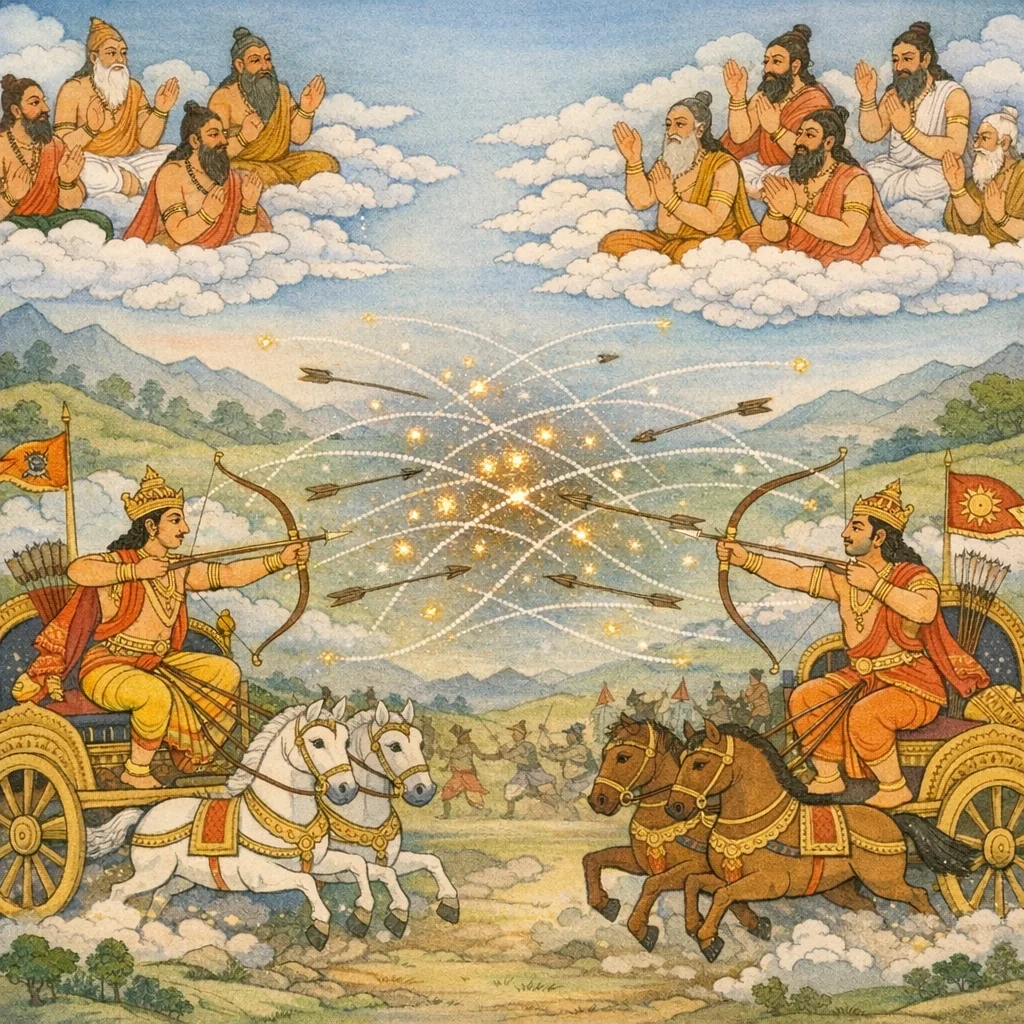
ततो घोरं महाराज अस्त्रयुद्धमवर्तत
Sañjaya said: “Then, O great king, a dreadful battle of weapons broke out.” The line signals an escalation from maneuver and challenge into full, lethal engagement, where the moral weight of war becomes unavoidable and the consequences of choice and duty press upon all combatants.
Verse 24
ते बाणा: समसज्जन्त मुक्तास्ताभ्यां तु भारत
Sañjaya said: O Bhārata, the arrows—well-fitted and readied—were then released by those two, as the battle’s violence tightened into a direct contest of skill and resolve.
Verse 25
बाणसड्घैर्वृतं घोरमाकाशं समपद्यत
Sañjaya said: The sky became a dreadful sight, completely filled and covered by masses of arrows—an image of war’s overwhelming violence, where human resolve turns the very heavens into a field of harm.
Verse 26
बाणाभिघातात् संजज्ञे तत्र भारत पावक:
Sañjaya said: O Bhārata, there, from the impact of the arrows, a blazing fire sprang up. In the moral atmosphere of war, even weapons meant for victory become causes of wider destruction, showing how violence can spill beyond its intended target and consume the innocent along with the guilty.
Verse 27
तत्र सिद्धा महाराज सम्पतन्तो<ब्रुवन् वच:,प्रभो! महाराज! उस समय वहाँ उड़कर आते हुए सिद्ध परस्पर इस प्रकार कहने लगे --“यह युद्ध तो सभी युद्धोंसे बढ़कर हो रहा है, अन्य सब युद्ध तो इसकी सोलहवीं कलाके भी बराबर नहीं थे
Sañjaya said: There, O great king, the Siddhas—descending through the sky—spoke these words to one another: “O lord, O great king! This battle now unfolding surpasses all other battles; all former wars were not even equal to a sixteenth part of its measure.”
Verse 28
युद्धानामति सर्वेषां युद्धमेतदिति प्रभो । सर्वयुद्धानि चैतस्य कलां नाहन्ति षोडशीम्,प्रभो! महाराज! उस समय वहाँ उड़कर आते हुए सिद्ध परस्पर इस प्रकार कहने लगे --“यह युद्ध तो सभी युद्धोंसे बढ़कर हो रहा है, अन्य सब युद्ध तो इसकी सोलहवीं कलाके भी बराबर नहीं थे
“O lord, this war surpasses all wars; and all wars do not reach even a sixteenth part of it.”
Verse 29
नेदृशं च पुनर्युद्धे भविष्पति कदाचन । अहो ज्ञानेन सम्पन्नावुभौ ब्राह्मणक्षत्रियौं,'ऐसा युद्ध फिर कभी नहीं होगा। ये ब्राह्मण और क्षत्रिय दोनों ही अद्भुत ज्ञानसे सम्पन्न हैं
Sañjaya said: “Never again, at any time, will there be a battle like this. Alas—both of these warriors, bearing the qualities of brāhmaṇa and kṣatriya alike, are endowed with extraordinary discernment; thus this war becomes not merely a clash of arms, but a rare meeting of knowledge and valor.”
Verse 30
अहो शौर्येण सम्पन्नावुभौ चोग्रपराक्रमौ । अहो भीमबलो भीम एतस्य च कृतास्त्रता,“भयंकर पराक्रम दिखानेवाले ये दोनों योद्धा अद्भुत शौर्यशाली हैं। अहो! भीमसेनका बल भयंकर है। इनका अस्त्रज्ञान अद्भुत है!
Sañjaya said: “Ah, how wondrous—both these warriors are endowed with heroism and possess fierce, terrifying prowess. Ah! Bhīma’s strength is truly formidable, and this one’s mastery of weapons is remarkable.” In the moral atmosphere of the war, the line underscores how extraordinary martial excellence can inspire awe even amid destruction, while also hinting at the tragic irony that such virtues are being spent in fratricidal conflict.
Verse 31
अहो वीर्यस्य सारत्वमहो सौषछ्वमेतयो: । स्थितावेती हि समरे कालान्तकयमोपमौ,“अहो! इनके वीर्यकी सारता विलक्षण है। इन दोनोंका युद्धसौन्दर्य आश्चर्यजनक है। ये दोनों समरांगणमें कालान्तक एवं यमके समान जान पड़ते हैं
Sanjaya said: “Ah! How remarkable is the concentrated essence of their valor, and how astonishing the beauty and excellence of their martial display. Standing face to face in battle, these two appear like Kālāntaka (the Ender of Time) and Yama (Death) themselves.”
Verse 32
रुद्रौ द्वाविव सम्भूतौ यथा द्वाविव भास्करौ । यमौ वा पुरुषव्याप्रौ घोररूपावुभौ रणे,“ये भयंकर रूपधारी दोनों पुरुषसिंह रणभूमिमें दो रुद्र, दो सूर्य अथवा दो यमराजके समान प्रकट हुए हैं!
Sañjaya said: “Those two lion-like heroes appeared on the battlefield in terrifying form—like two Rudras, like two suns, or like the twin Yamas—portents of overwhelming destruction in the clash.”
Verse 33
इति वाच: सम श्रूयन्ते सिद्धानां वै मुहुर्मुहु: । सिंहनादश्न संजज्ञे समेतानां दिवौकसाम्,इस प्रकार सिद्धोंकी बातें वहाँ बारंबार सुनायी देती थीं। आकाशमें एकत्र हुए देवताओंका सिंहनाद भी प्रकट हो रहा था
Sañjaya said: “Thus, the utterances of the Siddhas were heard there again and again; and among the assembled gods in the sky, a lion-like roar also arose.”
Verse 34
अद्भुतं चाप्यचिन्त्यं च दृष्टवा कर्म तयो रणे । सिद्धचारणसंघानां विस्मय: समपद्यत,रणभूमिमें उन दोनोंके अद्भुत एवं अचिन्त्य कर्मको देखकर सिद्धों और चारणोंके समूहोंको बड़ा विस्मय हो रहा था
Sañjaya said: “Seeing the wondrous and almost inconceivable feats performed by those two in the battle, the assembled hosts of Siddhas and Cāraṇas were seized with astonishment. The scene on the battlefield made even the celestial witnesses marvel at the extraordinary power and resolve on display.”
Verse 35
प्रशंसन्ति तदा देवा: सिद्धाक्ष परमर्षय: । साधु द्रौणे महाबाहो साधु भीमेति चाब्रुवन्,उस समय देवता, सिद्ध और महर्षिगण उन दोनोंकी प्रशंसा करते हुए कहने लगे --“महाबाहु द्रोणकुमार! तुम्हें साधुवाद! भीमसेन! तुम्हारे लिये भी साधुवाद”
Sañjaya said: Then the gods, the Siddhas, and the supreme seers praised them, exclaiming, “Well done, O mighty-armed son of Droṇa! Well done, Bhīma!”—publicly affirming valor and prowess displayed in the midst of war.
Verse 36
तौ शूरौ समरे राजन् परस्परकृतागसौ । परस्परमुदीक्षेतां क्रोधादुद्वृत्य चक्षुषी,राजन! परस्पर अपराध करनेवाले वे दोनों शूरवीर समरांगणमें क्रोधसे आँखें फाड़- फाड़कर एक-दूसरेकी ओर देख रहे थे
Sañjaya said: O King, those two heroic warriors—each having wronged the other—stood on the battlefield glaring at one another. In anger they strained their eyes wide, fixing their gaze on the other, as hostility ripened into open combat.
Verse 37
क्रोधरक्तेक्षणौ तौ तु क्रोधात् प्रस्फुरिताधरौ । क्रोधात् संदष्टदशनौ तथैव दशनच्छदौ,क्रोधसे उन दोनोंकी आँखें लाल हो गयी थीं। क्रोधसे उनके ओठ फड़क रहे थे और क्रोधसे ही वे ओठ चबाते एवं दाँत पीसते थे
Sañjaya said: Both of them, their eyes reddened with anger, had their lips twitching from rage; in that same fury they clenched their teeth and ground them, biting at their own lips—an outward sign of wrath overtaking restraint amid the battle’s tension.
Verse 38
अन्योन्यं छादयन्तौ सम शरवृष्ट्या महारथौ । शराम्बुधारौ समरे शस्त्रविद्युत्प्रकाशिनौ,वे दोनों महारथी धनुषरूपी विद्युतसे प्रकाशित होनेवाले मेघके समान हो बाणरूपी जल धारण करते थे और समरांगणमें बाण-वर्षा करके एक-दूसरेको ढके देते थे
Sanjaya said: The two great chariot-warriors, showering equal volleys of arrows, covered one another over. In that battle they appeared like rain-bearing clouds—holding torrents of arrows—lit up by the lightning of their weapons, as each sought to outmatch the other in martial skill.
Verse 39
तावन्योन्यं ध्वजं विद्ध्वा सारथिं च महारणे | अन्योन्यस्य हयान् विद्ध्वा बिभिदाते परस्परम्,वे उस महासमरमें परस्परके ध्वज, सारथि और घोड़ोंको बींधकर एक-दूसरेको क्षत- विक्षत कर रहे थे
Sanjaya said: In that great battle, having pierced each other’s standards and charioteers, and striking down one another’s horses, the two warriors tore at each other relentlessly—each intent on crippling the other’s means of fighting rather than yielding an inch.
Verse 40
ततः क्रुद्धो महाराज बाणौ गृह महाहवे । उभौ चितक्षिपतुस्तूर्णमन्योन्यस्य वधैषिणौ,महाराज! तदनन्तर उस महासमरमें कुपित हो उन दोनोंने एक-दूसरेके वधकी इच्छासे तुरंत दो बाण लेकर चलाये
Sañjaya said: Then, O great king, in that mighty battle, the two—angered—took up their arrows and swiftly hurled them at one another, each intent on the other’s death.
Verse 41
तौ सायकौ महाराज द्योतमानौ चमूमुखे । आजलश्नतुः समासाद्य वज़वेगौ दुरासदौ,राजेन्द्र! वे दोनों बाण सेनाके मुहानेपर चमक उठे। उन दोनोंका वेग वज़्के समान था। उन दुर्जय बाणोंने दोनोंके पास पहुँचकर उन्हें घायल कर दिया
Sañjaya said: O King, those two arrows blazed at the very front of the army. Swift as a thunderbolt and hard to withstand, they reached their targets and struck them, wounding them in the press of battle.
Verse 42
तौ परस्परवेगाच्च शराभ्यां च भूशाहतौ | निपेततुर्महावीर्य रथोपस्थे तयोस्तदा,परस्परके वेगसे छूटे हुए उन बाणोंद्वारा अत्यन्त घायल हो वे महापराक्रमी वीर अपने- अपने रथकी बैठकमें तत्काल गिर पड़े
Sañjaya said: Struck down by arrows released with mutual force, and grievously wounded, those two heroes of great prowess at once collapsed into the seats of their respective chariots.
Verse 43
ततस्तु सारथिर्ञात्वा द्रोणपुत्रमचेतनम् । अपोवाह रणाद्ू राजन् सर्वसैन्यस्य पश्यत:,राजन! तत्पश्चात् सारथि द्रोणपुत्रको अचेत जानकर सारी सेनाके देखते-देखते उसे रणक्षेत्रसे बाहर हटा ले गया
Sañjaya said: Then the charioteer, realizing that Droṇa’s son had fallen unconscious, drew him away from the battlefield, O King, while the entire army looked on.
Verse 44
तथैव पाण्डवं राजन् विह्नलन्तं मुहुर्मुहुः । अपोवाह रथेनाजौ सारथि: शत्रुतापनम्,महाराज! इसी प्रकार बारंबार विह्नल होते हुए शत्रुतापन पाण्डुपुत्र भीमसेनको भी रथद्वारा उनका सारथि विशोक युद्धस्थलसे अन्यत्र हटा ले गया
Sañjaya said: In the same way, O King, when the Pāṇḍava—Bhīmasena, the scorcher of foes—was repeatedly becoming dazed on the battlefield, his charioteer drew him away from the fight by means of the chariot.
Verse 223
तान्यस्त्रैरेव समरे प्रतिजघ्नेडथ पाण्डव: । दोनों ही युद्धस्थलमें एक-दूसरेको रथहीन कर देनेकी इच्छा करने लगे। तदनन्तर महारथी अभ्वत्थामाने बड़े-बड़े अस्त्र प्रकट किये; परन्तु पाण्डुपुत्र भीमसेनने समरांगणमें अपने अस्त्रोंद्वारा ही उन सबको नष्ट कर दिया
In the battle, the Pāṇḍava countered those weapons with his own and destroyed them. Both warriors longed to strip the other of his chariot. Then the great chariot-fighter Aśvatthāmā unleashed mighty missiles; but Bhīmasena, Pāṇḍu’s son, shattered them all in the field with his own arms.
Verse 233
ग्रहयुद्ध यथा घोरं प्रजासंहरणे हाभूत् । महाराज! फिर तो जैसे प्रजाके संहारकालमें ग्रहोंका घोर युद्ध होने लगता है, उसी प्रकार उन दोनोंमें भयंकर अस्त्रयुद्ध छिड़ गया
Sañjaya said: O King, just as at the time of a people’s destruction a dreadful war arises among the planets, so between those two a terrifying battle of missiles broke out once more.
Verse 243
द्योतयन्तो दिश: सर्वास्तव सैन्यं समनन््ततः । भारत! उन दोनोंके छोड़े हुए वे बाण सम्पूर्ण दिशाओंको प्रकाशित करते हुए आपकी सेनाके चारों ओर गिरने लगे
Sañjaya said: “O Bhārata, the arrows released by those two blazed so fiercely that they lit up every direction. Falling all around, they began to rain down, encircling your army.”
Verse 2536
उल्कापातावृतं युद्ध प्रजानां संक्षये नूप । नरेश्वरर उस समय बाणसमूहोंसे व्याप्त हुआ आकाश बड़ा भयंकर प्रतीत होने लगा; ठीक उस तरह जैसे प्रजाके संहारकालमें होनेवाला युद्ध उल्कापातसे व्याप्त होनेके कारण अत्यन्त भयानक दिखायी देता है
Sañjaya said: O King, at that time the sky, filled with dense flights of arrows, appeared exceedingly dreadful—like a battle at the hour of a people’s destruction, when it is shrouded by falling meteors and thus looks terrifying.
Verse 2636
सविस्फुलिड्ो दीप्तार्चियों<दहद् वाहिनीद्वयम् । भरतनन्दन! वहाँ बाणोंके परस्पर टकरानेसे चिनगारियों तथा प्रज्वलित लपटोंके साथ आग प्रकट हो गयी, जो दोनों सेनाओंको दग्ध किये देती थी
Sañjaya said: O joy of the Bharatas, there the clash of arrows against one another brought forth fire—alive with sparks and blazing tongues of flame—so that it seemed to scorch both armies.
Frequently Asked Questions
The implied tension is between tactical absorption in immediate combat and the obligation to pursue the strategically decisive objective; Kṛṣṇa frames delay itself as ethically relevant when it prolongs broader harm and obstructs mission-level responsibility.
Competence must be governed by discernment: excellence in action is not merely intensity but alignment—choosing the action that best serves the larger purpose under time pressure and moral constraint.
No explicit phalaśruti is presented in the supplied passage; instead, the extended battlefield survey operates as an implicit meta-commentary, guiding the listener toward reflective awareness of impermanence, cost, and the ethical weight of collective decisions.