Adhyaya 63
कर्णार्जुनसमागमः — The Karṇa–Arjuna Confrontation (Cosmic Spectatorship and Vows)
Upa-parva: Karṇa–Arjuna Dvairatha (Duel) Preparations and Cosmic Witnessing Episode
Sañjaya reports that, on seeing Vṛṣasena slain, Karṇa is overtaken by grief and indignation and advances by chariot to face the enemy, explicitly summoning Dhanaṃjaya (Arjuna). The two radiant chariots, with distinctive standards—Karṇa’s serpent-like emblematic harness and Arjuna’s formidable monkey-banner—are depicted as a near-cosmic convergence, eliciting astonishment among kings and beings. Both armies gather, sounding conches and instruments; the duel is framed as a decisive ‘wager’ with victory and defeat as fixed stakes. The narrative then expands into a symbolic cosmology in which diverse classes of beings and natural entities are described as taking sides, intensifying the sense that the encounter has world-order implications. Divine deliberation follows: Brahmā and Īśāna address Indra, articulating that victory is assured for ‘Vijaya’ (Arjuna) and ‘Vijayasya’ (Kṛṣṇa), while Karṇa is granted exalted posthumous attainments—an interpretive move that balances martial outcome with moral-theological recompense. The chapter returns to immediate battlefield psychology: standards clash symbolically, Kṛṣṇa and Śalya exchange pointed looks, and a sequence of confident assertions occurs—Kṛṣṇa’s categorical reassurance that Karṇa cannot slay Arjuna, and Arjuna’s vow to defeat Karṇa, tied to unresolved hostility regarding Draupadī’s earlier humiliation and the need to console the bereaved after Abhimanyu’s death.
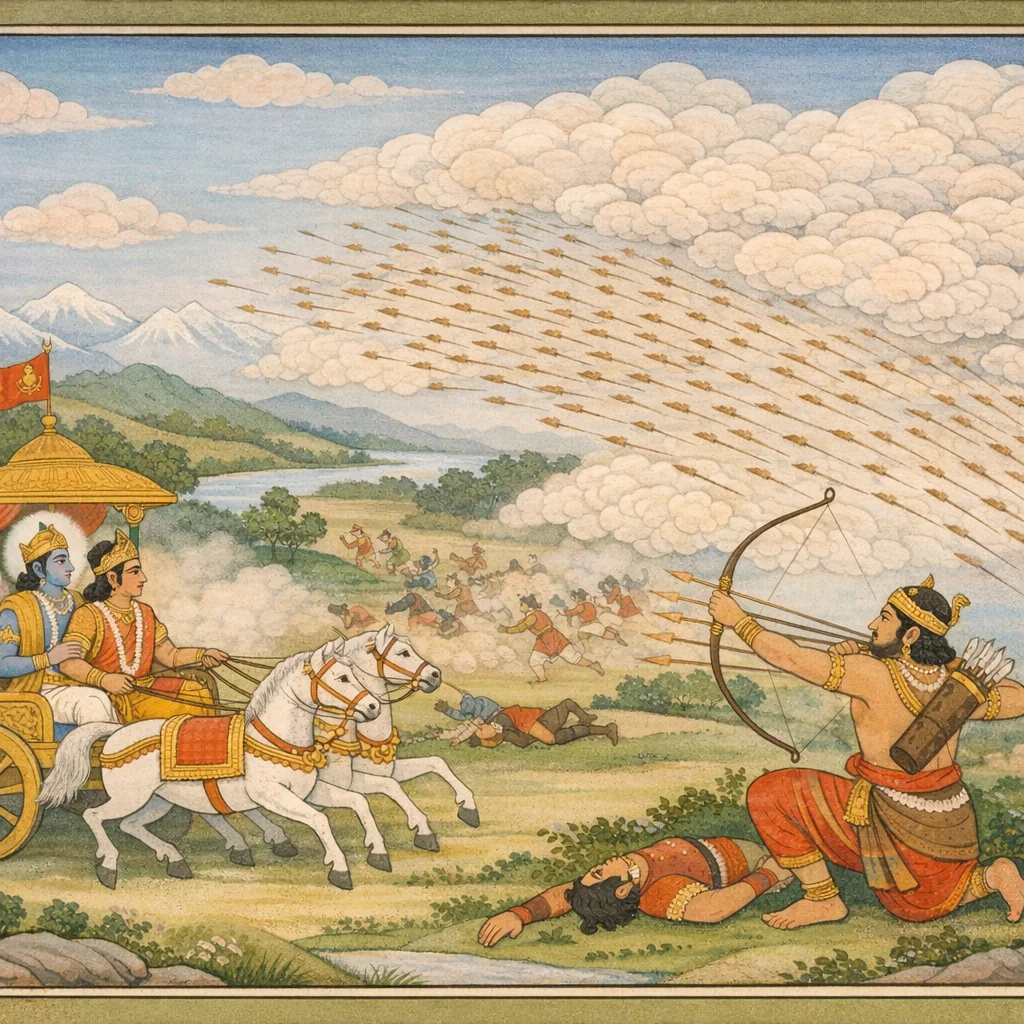
Chapter Arc: कौरव-सेना के बीच द्रोणपुत्र अश्वत्थामा क्रोधाग्नि बनकर उठता है; सामने अर्जुन है—और रथ पर श्रीकृष्ण, मानो समुद्र-तट पर उठती प्रलय-लहर को रोकने वाला धैर्य। → अश्वत्थामा दिशाओं-प्रदिशाओं को बाणों से ढँक देता है, वासुदेव के दाहिने भुज पर भी बाण लगाता है, और अर्जुन पर ऐन्द्रास्त्र जैसी मायावी-वर्षा आरम्भ करता है। बाणों की जाल-रचना से रणभूमि भ्रम, धूल और भय में डूबती है; कौरव-पंक्तियाँ डगमगाती हैं, सैनिक इधर-उधर भागते हैं, और ‘तिष्ठ-तिष्ठ’ की पुकारें भी उन्हें रोक नहीं पातीं। → द्रोणकुमार का तीक्ष्ण प्रहार अर्जुन के वक्ष पर निर्दयता से पड़ता है; क्षण भर को लगता है कि रथ-ध्वज के नीचे धर्म-धनुष भी झुक जाएगा। उसी क्षण अर्जुन, कृष्ण-सहाय होकर, मायावी जाल को पहचानकर प्रत्युत्तर देता है—और अश्वत्थामा की उग्रता को पराजय की ओर मोड़ देता है। → अर्जुन की प्रतिकार-धारा से अश्वत्थामा का आक्रमण शिथिल पड़ता है; कौरव-सेना में फैली व्याकुलता और पलायन और बढ़ते हैं, जबकि पाण्डव-पक्ष में उत्साह का उच्छ्वास उठता है। रणभूमि पर यह स्पष्ट हो जाता है कि केवल क्रोध और अस्त्र-वर्षा से विजय नहीं—कृष्ण-नीति और अर्जुन-स्थैर्य निर्णायक हैं। → भागती कौरव-सेना और अस्त्रों की गूँज के बीच संकेत मिलता है कि आगे और भी भयंकर दिव्यास्त्र (भार्गवास्त्र आदि) का भय मंडरा रहा है—और युद्ध की धारा किसी नए, अधिक क्रूर मोड़ पर जा सकती है।
Shlokas
Verse 1
(दाक्षिणात्य अधिक पाठके २३ “लोक मिलाकर कुल ४०३ श्लोक हैं।) ऑपन-साज बछ। अफि्-"ऋाज चतु:षष्टितमो<5 ध्याय: अर्जुनद्वारा अश्वत्थामाकी पराजय, कौरव-सेनामें भगदड़ एवं दुर्योधनसे प्रेरित कर्णद्वारा भार्गवास्त्रसे पांचालोंका सहार संजय उवाच द्रौणिस्तु रथवंशेन महता परिवारित: । अपतत् सहसा राजन यत्र पार्थो व्यवस्थित:,संजय कहते हैं--राजन! द्रोणपुत्र अश्वत्थामा विशाल रथसेनासे घिरा सहसा वहाँ आ पहुँचा, जहाँ अर्जुन खड़े थे
Sañjaya said: O King, Droṇa’s son Aśvatthāmā—surrounded by a great mass of chariots—suddenly rushed to the spot where Pārtha (Arjuna) stood in battle formation.
Verse 2
तमापतन्तं सहसा शूर: शौरिसहायवान् । दधार सहसा पार्थो वेलेव मकरालयम्,भगवान् श्रीकृष्ण जिनके सहायक थे, उन शूरवीर कुन्तीकुमार अर्जुनने सहसा अपनी ओर आते हुए अभश्व॒त्थामाको तत्काल उसी तरह रोक दिया, जैसे तटभूमि समुद्रको आगे बढ़नेसे रोकती है
Sañjaya said: At that very moment, Pārtha (Arjuna)—a hero with Śauri (Śrī Kṛṣṇa) as his ally—suddenly checked the onrushing attacker, just as the shoreline holds back the sea, the abode of makaras.
Verse 3
ततः क्रुद्धो महाराज द्रोणपुत्र: प्रतापवान् । अर्जुन वासुदेवं च छादयामास सायकै:,महाराज! तब क्रोधमें भरे हुए प्रतापी द्रोणपुत्रने अर्जुन और श्रीकृष्णको अपने बाणोंसे ढक दिया
Sañjaya said: Then, O King, the valiant son of Droṇa, inflamed with anger, showered his arrows so thickly that he seemed to cover both Arjuna and Vāsudeva (Kṛṣṇa).
Verse 4
अवच्छन्नौ ततः कृष्णौ दृष्टवा तत्र महारथा: । विस्मयं परम॑ गत्वा प्रैक्षन्त कुरवस्तदा,उस समय उन दोनोंको बाणोंद्वारा आच्छादित हुआ देख समस्त कौरव महारथी महान् आश्चर्यमें पड़कर उधर ही देखने लगे
Sañjaya said: Then, seeing those two Kṛṣṇas there covered over by volleys of arrows, the Kuru great chariot-warriors were struck with the utmost astonishment and stood staring in that direction.
Verse 5
अर्जुनस्तु ततो दिव्यमस्त्रं चक्रे हसन्निव । तदस्त्रं वारयामास ब्राह्मणो युधि भारत,भारत! तब अर्जुनने हँसते हुए-से दिव्यास्त्र प्रकट किया; परंतु ब्राह्मण अभश्वत्थामाने युद्धस्थलमें उनके उस दिव्यास्त्रका निवारण कर दिया
Sañjaya said: Then Arjuna, as though smiling, brought forth a celestial weapon. Yet the Brahmin warrior on the battlefield—Aśvatthāmā—checked and neutralized that divine missile.
Verse 6
यद् यद्धि व्याक्षिपद् युद्धे पाण्डवो<5स्त्रजिघांसया । तत् तदस्त्रं महेष्वासो द्रोणपुत्रो व्यशातयत्,रणभूमिमें पाण्डुकुमार अर्जुन अश्वत्थामाके अस्त्रोंको नष्ट करनेके लिये जो-जो अस्त्र चलाते थे, महाधनुर्धर द्रोणपुत्र अश्वत्थामा उनके उस-उस अस्त्रको काट गिराता था
Sañjaya said: In the battle, whatever missile the Pāṇḍava (Arjuna) hurled with the intent to destroy his foe’s weapons, that very weapon the great archer Droṇa’s son (Aśvatthāmā) repeatedly cut down, neutralizing it on the field.
Verse 7
अस्त्रयुद्धे ततो राजन् वर्तमाने महा भये । अपश्याम रणे द्रौणिं व्यात्तानममिवान्तकम्,राजन्! इस प्रकार महाभयंकर अस्त्र-युद्ध आरम्भ होनेपर हमलोगोंने रणक्षेत्रमें द्रोणपुत्र अश्वत्थामाको मुँह बाये हुए यमराजके समान देखा था
Sañjaya said: O King, when that most dreadful battle of missiles was underway, we saw on the battlefield Droṇa’s son Aśvatthāmā, his mouth agape, like Yama—the very End—come to claim lives.
Verse 8
स दिश: प्रदिशश्वैव च्छादयित्वा हाुजिदह्ागै: । वासुदेवं त्रिभिर्बाणैरविध्यद् दक्षिणे भुजे,उसने सीधे जानेवाले बाणोंके द्वारा सम्पूर्ण दिशाओं और कोणोंको आच्छादित करके श्रीकृष्णकी दाहिनी भुजामें तीन बाण मारे
Sañjaya said: Covering the quarters and the intermediate directions with his swift, straight-flying arrows, he struck Vāsudeva (Kṛṣṇa) with three shafts on the right arm—an act that heightens the battle’s ferocity and shows that even Arjuna’s charioteer faced peril under the relentless code of war.
Verse 9
ततोडअर्जुनो हयान् हत्वा सर्वास्तस्य महात्मन: । चकार समरे भूमिं शोणितौघतरज्ञषिणीम्
Sañjaya said: Then Arjuna, having slain all the horses of that great warrior, turned the battlefield ground into a torrent-swept expanse of blood. The narration underscores the grim ethical weight of war: even when fought as a duty, its immediate fruit is devastation, and prowess is measured in terrible, irreversible costs.
Verse 10
तब अर्जुनने उस महामनस्वी वीरके समस्त घोड़ोंको मारकर समरभूमिमें खूनकी नदी- सी बहा दी ।। सर्वलोकवहां रौद्रां परलोकवहां नदीम् । सरथान् रथिन: सर्वान् पार्थचापच्युतै: शरै:
Sañjaya said: With arrows released from Pārtha’s bow, Arjuna struck down all the chariot-warriors together with their chariots, and on that battlefield he made a dreadful river of blood—one that carried men away from this world and bore them toward the next. The verse underscores the terrifying moral weight of war: prowess and duty are enacted through violence whose consequence is death and passage beyond life.
Verse 11
द्रौणेरपहतान् संख्ये ददृशु: स च तां तथा । प्रावर्तयन्महाघोरां नदीं परवहां तदा
Sañjaya said: They beheld those struck down in the press of battle by Droṇa’s son; and he too, seeing them thus, then set in motion a most dreadful river—one that swept away the enemy. The scene underscores how a warrior’s prowess, when driven by wrath and vengeance, can turn the battlefield into a relentless current of destruction, carrying off lives without pause.
Verse 12
वह रक्तमयी भयंकर सरिता परलोकवाहिनी थी और सब लोगोंको अपने प्रवाहमें बहाये लिये जाती थी। वहाँ खड़े हुए सब लोगोंने देखा कि अश्वत्थामाके सारे रथी अर्जुनके धनुषसे छूटे हुए बाणोंद्वारा युद्धभूमिमें मारे गये। स्वयं अश्वत्थामाने भी उनकी वह अवस्था देखी। उस समय उसने भी महाभयंकर परलोकवाहिनी नदी बहा दी ।। तयोस्तु व्याकुले युद्धे द्रौणे: पार्थस्य दारुणे । अमर्यादं योधयन्त: पर्यधावन्त पृष्ठत:,अश्वत्थामा और अर्जुनके उस भयंकर एवं घमासान युद्धमें सब योद्धा मर्यादारहित होकर युद्ध करते हुए आगे-पीछे सब ओर भागने लगे
Sañjaya said: A dreadful, blood-filled river—bearing men toward the world beyond—seemed to flow, sweeping everyone along in its current. Those standing there saw that all of Ashvatthama’s chariot-warriors had been slain on the battlefield by arrows released from Arjuna’s bow; Ashvatthama himself also beheld their condition. At that moment, he too unleashed a terrifying ‘river’ that carried men toward death. In that tumultuous and brutal duel between Drona’s son and Partha, the warriors, casting aside all restraint and order, fought without bounds and ran in every direction—forward and back.
Verse 13
रथैर्तताश्वसूतैश्व हतारोहैश्वन वाजिभि: । द्विरदैश्व॒ हतारोहैर्महामात्रैरहतद्विपै:,रथोंके घोड़े और सारथि मार दिये गये। घोड़ोंके सवार नष्ट हो गये। गजारोही मार डाले गये और हाथी बचे रहे एवं कहीं हाथी ही मार डाले गये तथा महावत बचे रहे। राजन! इस प्रकार समरांगणमें अर्जुनने घोर जनसंहार मचा दिया। उनके धनुषसे छूटे हुए बाणोंद्वारा मारे जाकर बहुत-से रथी धराशायी हो गये
Sañjaya said: “On the battlefield, O King, Arjuna’s shafts brought about a dreadful slaughter. Some chariots were left with their horses and charioteers slain; elsewhere the horsemen were cut down. In some places the elephant-riders were killed while the great mahouts survived with their elephants; in other places the elephants themselves were felled while the mahouts remained. Thus, by the arrows released from his bow, many chariot-warriors were struck down and fell to the earth.”
Verse 14
पार्थेन समरे राजन् कृतो घोरो जनक्षय: । विहता रथिन: पेतु: पार्थचापच्युतै: शरै:,रथोंके घोड़े और सारथि मार दिये गये। घोड़ोंके सवार नष्ट हो गये। गजारोही मार डाले गये और हाथी बचे रहे एवं कहीं हाथी ही मार डाले गये तथा महावत बचे रहे। राजन! इस प्रकार समरांगणमें अर्जुनने घोर जनसंहार मचा दिया। उनके धनुषसे छूटे हुए बाणोंद्वारा मारे जाकर बहुत-से रथी धराशायी हो गये
Sañjaya said: O King, in the battle Pārtha (Arjuna) wrought a dreadful destruction of men. Struck down by the arrows released from Pārtha’s bow, many chariot-warriors fell to the ground. The scene underscores the grim ethical cost of war: even when fought for a cause, the battlefield becomes a place where human life is rapidly and relentlessly extinguished.
Verse 15
हयाश्व पर्यधावन्त मुक्तयोक््त्रास्ततस्तत: । तद् दृष्टवा कर्म पार्थस्य द्रौणिराहवशोभिन:,अवाकिरुत्ततो द्रौणि: समन्तान्निशितै: शरै: । घोड़ोंके बन्धन खुल गये और वे चारों ओर दौड़ लगाने लगे। युद्धमें शोभा पानेवाले अर्जुनका वह पराक्रम देखकर पराक्रमी द्रोणकुमार अश्वत्थामा तुरंत उनके पास आ गया और अपने सुवर्ण-भूषित विशाल धनुषको हिलाते हुए उसने विजयी वीरोंमें श्रेष्ठ अर्जुनको पैने बाणोंद्वारा सब ओरसे ढक दिया
Sañjaya said: The horses, their yokes and harness loosened, began to run about in all directions. Seeing that deed of Pārtha (Arjuna)—so splendid in the press of battle—Drauṇi (Aśvatthāmā), the son of Droṇa, swiftly came up and, from every side, showered Arjuna with sharp arrows, seeking to check his prowess amid the righteous yet devastating demands of war.
Verse 16
अर्जुनं जयतां श्रेष्ठ त्वरितो5भ्येत्य वीर्यवान् | विधुन्वानो महच्चापं कार्तस्वरविभूषितम्
Sañjaya said: “O best of victors, the mighty warrior hurried forward toward Arjuna, shaking his great bow, adorned with gleaming gold.”
Verse 17
भूयो<र्जुनं महाराज द्रौणिरायम्य पत्रिणा
Sañjaya said: “Again, O great king, Droṇa’s son (Aśvatthāmā), drawing his feathered missile, took aim at Arjuna.”
Verse 18
सो35तिविद्धो रणे तेन द्रोणपुत्रेण भारत,भारत! रणभूमिमें द्रोणपुत्रके द्वारा अत्यन्त घायल किये गये उदारबुद्धि गाण्डीवधारी अर्जुनने समरांगणमें बलपूर्वक बाणोंकी वर्षा करके अश्वत्थामाको ढक दिया और उसके धनुषको भी काट डाला
Sañjaya said: O Bhārata, though grievously pierced in battle by Droṇa’s son, the noble-minded Arjuna, bearer of the Gāṇḍīva, forcefully poured forth a rain of arrows on the battlefield, covering Aśvatthāmā from view, and he even cut down his bow.
Verse 19
गाण्डीवधन्वा प्रसभं शरवर्षैरुदारधी: । संछाद्य समरे द्रौणिं चिच्छेदास्प च कार्मुकम्,भारत! रणभूमिमें द्रोणपुत्रके द्वारा अत्यन्त घायल किये गये उदारबुद्धि गाण्डीवधारी अर्जुनने समरांगणमें बलपूर्वक बाणोंकी वर्षा करके अश्वत्थामाको ढक दिया और उसके धनुषको भी काट डाला
Sañjaya said: On the battlefield, the noble-minded Arjuna, wielder of the Gāṇḍīva, forcefully covered Droṇa’s son Aśvatthāman with a storm of arrows and cut down his bow as well.
Verse 20
स छिन्नथन्वा परिघं वज्रस्पर्शसमं युधि । आदाय चिक्षेप तदा द्रोणपुत्र: किरीटिने,धनुष कट जानेपर द्रोणपुत्रने युद्धस्थलमें एक ऐसा परिघ हाथमें लिया, जिसका स्पर्श वज्रके समान कठोर था। उसने उस परिघको तत्काल ही किरीटधारी अर्जुनपर दे मारा
Sañjaya said: Having had his bow cut, Droṇa’s son seized a mace-like iron club in the midst of battle—hard to the touch like a thunderbolt—and at once hurled it at the diadem-wearing Arjuna.
Verse 21
तमापततन्तं परिघं जाम्बूनदपरिष्कृतम् । चिच्छेद सहसा राजन् प्रहसन्निव पाण्डव:,राजन! उस सुवर्णभूषित परिघको सहसा अपने ऊपर आते देख पाण्डुपुत्र अर्जुनने हँसते हुए-से उसके टुकड़े-टुकड़े कर दिये
Sañjaya said: O King, as that mace—adorned with Jāmbūnada gold—came hurtling down upon him, the Pāṇḍava (Arjuna), as though smiling, swiftly cut it into pieces.
Verse 22
स पपात तदा भूमौ निकृत्त: पार्थसायकै: । विकीर्ण: पर्वतो राजन् यथा वज्नेण ताडित:,नरेश्वर! जैसे वज्गका मारा हुआ पर्वत टूट-फूटकर सब ओर बिखर जाता है, उसी प्रकार अर्जुनके बाणोंसे कटा हुआ वह परिघ उस समय पृथ्वीपर गिर पड़ा
Sañjaya said: Then, O King, that iron club (parigha), hewn apart by Arjuna’s arrows, fell to the ground. Shattered and scattered, it lay like a mountain struck by Indra’s thunderbolt.
Verse 23
ततः क्रुद्धो महाराज द्रोणपुत्रो महारथ: । ऐन्द्रेण चास्त्रवेगेन बी भत्सुं समवाकिरत्
Sañjaya said: Then, O King, Droṇa’s son—the mighty chariot-warrior—enraged, showered Arjuna (Bībhatsu) with a fierce onslaught of the Indra-weapon.
Verse 24
महाराज! तब महारथी द्रोणपुत्रने कुपित होकर अर्जुनपर ऐन्द्रास्त्रद्वारा वेगपूर्वक बाणोंकी वर्षा आरम्भ कर दी ।। तस्येन्द्रजालावततं समीक्ष्य पार्थो राजन् गाण्डिवमाददे सः । ऐन्द्रं जाल॑ प्रत्यहरत् तरस्वी वरास्त्रमादाय महेन्द्रसृष्टम्ू,राजन! अर्जुनने अश्वत्थामाद्वारा किये हुए इन्द्रजालका विस्तार देखकर बड़े वेगसे गाण्डीव धनुष हाथमें लिया और महेन्द्रद्वारा निर्मित उत्तम अस्त्रका आश्रय लेकर उस इन्द्रजालका संहार कर दिया
Sañjaya said: O King, then Aśvatthāman, Droṇa’s son, enraged, began a swift and forceful shower of arrows against Arjuna by means of Indra’s weapon. Seeing that vast spread of “Indra’s net,” Pārtha seized the Gāṇḍīva bow and, drawing upon an excellent missile fashioned by great Indra, countered and destroyed that Indra-born illusion.
Verse 25
विदार्य तज्जालमथेन्द्रमुक्तं पार्थस्ततो द्रौणिरथं क्षणेन । प्रच्छादयामास ततो<भ्युपेत्य द्रौणिस्तदा पार्थशराभिभूत:,इस प्रकार इन्द्रास्त्रद्वारा छोड़े गये उस बाण-जालको विदीर्ण करके अर्जुनने निकटवर्ती होकर क्षणभरमें अश्वत्थामाके रथको ढक दिया। उस समय अअभश्रत्थामा अर्जुनके बाणोंसे अभिभूत हो गया था
Sañjaya said: Having torn apart that net of arrows released by the Indra-weapon, Pārtha at once closed in and, in an instant, covered Aśvatthāmā’s chariot with his own shafts. Then Droṇa’s son was overwhelmed beneath Arjuna’s arrows.
Verse 26
विगाह्[ तां पाण्डवबाणवदवृुष्टिं शरै: परं नाम ततः प्रकाश्य । शतेन कृष्णं सहसाभ्यविद्ध्यत् त्रिभि: शतैरजुन क्षुद्रकाणाम्
Sañjaya said: Plunging into the storm of arrows loosed by the Pāṇḍavas, he proclaimed his supreme name and, in a sudden assault, struck Kṛṣṇa with a hundred shafts and Arjuna with three hundred small, piercing arrows.
Verse 27
तदनन्तर अभश्व॒त्थामाने अपने बाणोंद्वारा अर्जुनकी उस बाण-वर्षाका निवारण करके अपना नाम प्रकाशित करते हुए सहसा सौ बाणोंसे श्रीकृष्णको घायल कर दिया और अर्जुनपर भी तीन सौ बाणोंका प्रहार किया ।। ततोडर्जुन: सायकानां शतेन गुरो: सुतं मर्मसु निर्बिभेद । अश्वांश्व सूतं॑ च तथा धनुर्ज्या- मवाकिरतू् पश्यतां तावकानाम्,इसके बाद अर्जुनने सौ बाणोंसे गुरुपुत्रके मर्मस्थानोंको विदीर्ण कर दिया तथा आपके पुत्रोंके देखते-देखते उसके घोड़ों, सारथि, धनुष और प्रत्यंचापर बाणोंकी झड़ी लगा दी
Sañjaya said: Thereafter Aśvatthāmā checked Arjuna’s shower of arrows with his own shafts and, proclaiming his name to display his prowess, suddenly struck Śrī Kṛṣṇa with a hundred arrows and rained three hundred upon Arjuna. Then Arjuna, with a hundred keen missiles, pierced the son of the Guru in his vital points; and, before the eyes of your warriors, he covered Aśvatthāmā’s horses, charioteer, bow, and bowstring with a dense volley.
Verse 28
स विद्ध्वा मर्मसु द्रौर्णि पाण्डव: परवीरहा । सारथिं चास्य भल्लेन रथनीडादपातयत्,शत्रुवीरोंका संहार करनेवाले पाण्डुपुत्र अर्जुनने अश्वत्थामाके मर्मस्थानोंमें चोट पहुँचाकर एक भल्लसे उसके सारथिको रथकी बैठकसे नीचे गिरा दिया
Sañjaya said: Arjuna, the Pāṇḍava—slayer of enemy champions—struck Aśvatthāmā, Droṇa’s son, in his vital points. Then, with a sharp arrow, he felled Aśvatthāmā’s charioteer from the chariot-seat.
Verse 29
स संगृहा स्वयं वाहान् कृष्णौ प्राच्छादयच्छरै: | तत्राद्भुतमपश्याम द्रौणेराशु पराक्रमम्
Sañjaya said: Taking charge of the horses himself, he swiftly covered the two Kṛṣṇas with a shower of arrows. There we witnessed something astonishing—the rapid and formidable prowess of Droṇa’s son in the midst of battle.
Verse 30
प्रायच्छत्तुरगान् यच्च फाल्गुनं चाप्ययोधयत् | यदस्य समरे राजन् सर्वे योधा अपूजयन्
Sañjaya said: He bestowed horses, and he also engaged Phālguna (Arjuna) in battle. And, O King, in that encounter all the warriors honored him—acknowledging his prowess and the martial code that esteems valor even in an enemy.
Verse 31
तब उसने स्वयं ही घोड़ोंकी बागडोर हाथमें लेकर श्रीकृष्ण और अर्जुनको बाणोंसे ढक दिया। वहाँ हमने द्रोणपुत्रका शीघ्र प्रकट होनेवाला वह अद्भुत पराक्रम देखा कि वह घोड़ोंको भी काबूमें रखता था और अर्जुनके साथ युद्ध भी करता था। राजन! समरांगणमें सभी योद्धाओंने उसके इस कार्यकी भूरि-भूरि प्रशंसा की ।। ततः प्रहस्य बीभत्सुद्रोणपुत्रस्य संयुगे । क्षिप्रं रश्मीनथाश्चानां क्षुरप्रैश्विच्छिदेि जय:,तदनन्तर विजयी अर्जुनने हँसकर युद्धस्थलमें द्रोणपुत्रके घोड़ोंकी बागडोरोंको क्षुपप्रोंद्वारा शीघ्रतापूर्वक काट दिया
Sañjaya said: Then Arjuna, terrible in battle and ever-victorious, laughed and, in the midst of the fight with Droṇa’s son, swiftly severed the reins of his horses with razor-edged arrows.
Verse 32
प्राद्रवंस्तुरगास्ते तु शरवेगप्रपीडिता: । ततो<भूजन्निनदो घोरस्तव सैन्यस्य भारत,भारत! इसके बाद बाणोंके वेगसे अत्यन्त पीड़ित हुए उसके घोड़े वहाँसे भाग चले। उस समय वहाँ आपकी सेनामें भयंकर कोलाहल मच गया
Sañjaya said: Struck and tormented by the swift force of the arrows, those horses bolted away. Then, O Bhārata, a dreadful uproar arose within your army.
Verse 33
पाण्डवास्तु जयं लब्ध्वा तव सैन्यं समाद्रवन् । समन्तान्निशितान् बाणान् विमुज्चन्तो जयैषिण:,पाण्डव विजय पाकर आपकी सेनापर टूट पड़े और पुनः विजयकी अभिलाषा ले चारों ओरेसे पैने बाणोंका प्रहार करने लगे
Sañjaya said: Having gained the advantage of victory, the Pāṇḍavas surged upon your army. Eager for triumph once more, they loosed sharp arrows in every direction, pressing the battle with relentless resolve.
Verse 34
पाण्डवैस्तु महाराज धार्तराष्ट्री महाचमू: । पुन: पुनरथो वीरैरभज्जि जितकाशिभि:,महाराज! विजयसे उल्लसित होनेवाले पाण्डवोंने दुर्योधनकी विशाल सेनामें बारंबार भगदड़ मचा दी
Sañjaya said: O King, the mighty host of the Dhārtarāṣṭras was again and again shattered by the Pāṇḍavas—those heroes whose ardor for victory was aflame—so that repeated rout and confusion spread through Duryodhana’s vast army.
Verse 35
पश्यतां ते महाराज पुत्राणां चित्रयोधिनाम् | शकुने: सौबलेयस्य कर्णस्य च विशाम्पते,नरेश्वर! प्रजानाथ! विचित्र युद्ध करनेवाले आपके पुत्रोंके, सुबलपुत्र शकुनिके तथा कर्णके देखते-देखते यह सब हो रहा था
Sañjaya said: “O great king—lord of the people, ruler of men—this was all taking place before the very eyes of your sons, those fighters of varied prowess, and also before Śakuni the son of Subala and Karṇa. Even as they watched, the dreadful course of events unfolded.”
Verse 36
वार्यमाणा महासेना पुत्रैस्तव जनेश्वर । न चातिष्ठत संग्रामे पीड्यमाना समन्तत:ः,जनेश्वर! सब ओरसे पीड़ित हुई आपकी विशाल सेना आपके पुत्रोंके बहुत रोकनेपर भी युद्धभूमिमें खड़ी न रह सकी
Sañjaya said: O lord of men, though restrained again and again by your sons, your vast army—harried and pressed from every side—could not hold its ground upon the battlefield.
Verse 37
ततो योधैर्महाराज पलायद्धिः समन्ततः । अभवद् व्याकुलं भीतं पुत्राणां ते महद् बलम्
Sañjaya said: “Then, O great king, as the warriors fled in all directions, the great force of your sons became shaken—confused and afraid.”
Verse 38
महाराज! सब ओर भागनेवाले योद्धाओंके कारण आपके पुत्रोंकी वह विशाल सेना भयभीत और व्याकुल हो उठी ।। तिष्ठ तिषछ्ठेति च ततः सूतपुत्रस्य जल्पत: । नावतिष्ठति सा सेना वध्यमाना महात्मभि:,सूतपुत्र कर्ण “ठहरो, ठहरो” की पुकार करता ही रह गया; परंतु महामनस्वी पाण्डवोंकी मार खाती हुई वह सेना किसी तरह ठहर न सकी
Sanjaya said: Then, even as Karna—the son of the charioteer—kept crying, “Stand! Stand!”, that army did not halt at all, for it was being cut down by the great-souled Pandavas. With warriors fleeing on every side, the vast host of your sons became frightened and shaken, unable to steady itself amid the slaughter.
Verse 39
अथोत्क्रुष्ट महाराज पाण्डवैर्जितकाशिभि: । धार्रराष्ट्रबलं दृष्टवा विद्रुतं वै समन््ततः,महाराज! दुर्योधनकी सेनाको सब ओर भागती देख विजयसे उल्लसित होनेवाले पाण्डव जोर-जोरसे सिंहनाद करने लगे
Sanjaya said: “O King, when the Pandavas—exultant with victory—saw the Dhartarashtra host fleeing in all directions, they raised loud triumphant cries, roaring like lions.”
Verse 40
ततो दुर्योधन: कर्णमब्रवीत् प्रणयादिव । पश्य कर्ण महासेना पज्चालैरदिता भूशम्,उस समय दुर्योधनने कर्णसे प्रेमपूर्वक कहा--“कर्ण! देखो, पांचालोंने मेरी इस विशाल सेनाको अत्यन्त पीड़ित कर दिया है
Sanjaya said: Then Duryodhana spoke to Karna, as if with affectionate familiarity: “Look, Karna—this vast army has been grievously harried by the Panchalas.”
Verse 41
त्वयि तिष्ठति संत्रासात् पलायनपरायणा । एतज्ज्ञात्वा महाबाहो कुरु प्राप्तमरिंदम,“शत्रुदमन महाबाहु वीर! तुम्हारे रहते हुए भयके कारण मेरी सेना भाग रही है; यह जानकर इस समय जो कर्तव्य प्राप्त हो उसे करो
Sanjaya said: “Even while you still stand firm, my troops—overcome by terror—are bent on flight. Knowing this, O mighty-armed one, O crusher of foes, do now the duty that has come upon you in this moment.”
Verse 42
सहस्राणि च योधानां त्वामेव पुरुषोत्तम | क्रोशन्ति समरे वीर द्राव्यमाणानि पाण्डवै:
Sanjaya said: “O Purushottama, in this battle thousands of warriors—driven into flight by the Pandavas—are crying out, calling upon you alone. O hero, amid the terror of rout they seek refuge in your strength.”
Verse 43
“पुरुषोत्तम! वीर! पाण्डवोंद्वारा खदेड़े जानेवाले सहस्रों कौरव-सैनिक समरांगणमें तुम्हें ही पुकार रहे हैं! ।। एतच्छुत्वापि राधेयो दुर्योधनवचो महान् । मद्रराजमिदं वाक्यमब्रवीत् प्रहसन्निव
Sañjaya said: “O best of men, O hero! Thousands of Kaurava soldiers, driven back by the Pāṇḍavas, are calling out to you alone on the battlefield.” Even after hearing Duryodhana’s words, the great Rādheya spoke to the king of Madra, as if with a smile—steadfast in confidence amid the crisis.
Verse 44
महावीर राधापुत्र कर्णने दुर्योधनकी यह बात सुनकर मद्रराज शल्यसे हँसते हुए-से इस प्रकार कहा-- ।। पश्य मे भुजयोरवीर्यमस्त्राणां च जनेश्वर । अद्य हन्मि रणे सर्वान् पञज्चालान् पाण्डुभि: सह
Sañjaya said: Hearing Duryodhana’s remark about the mighty hero Karṇa, son of Rādhā, the king of Madra—Śalya—spoke with a smile, as if in derision: “O lord of men, behold the strength of my arms and my mastery of weapons. Today, in battle, I shall slay all the Pāñcālas together with the sons of Pāṇḍu.”
Verse 45
वाहयाश्वान् नरव्याप्र भद्रेणेव न संशय: । “नरेश्वरर आज तुम मेरी दोनों भुजाओं और अस्त्रोंका बल देखो। मैं रणभूमिमें पाण्डवोंसहित समस्त पांचालोंका वध किये देता हूँ, इसमें संशय नहीं है। पुरुषसिंह! आप कल्याणचिन्तनपूर्वक ही इन घोड़ोंको आगे बढ़ाइये” ।। एवमुक््त्वा महाराज सूतपुत्र: प्रतापवान्
“Drive the horses forward, tiger among men—surely, without doubt. O king, today behold the strength of my two arms and of my weapons. On the battlefield I shall slay all the Pāñcālas together with the Pāṇḍavas; of this there is no doubt. O lion among men, with auspicious intent, urge these horses onward.” Sañjaya said: Having spoken thus, the valiant son of a charioteer (Karṇa)…
Verse 46
प्रगृह् विजयं वीरो धनु: श्रेष्ठ पुरातनम् । सज्यं कृत्वा महाराज संगृहा[ च पुनः पुन:
Sañjaya said: Taking up the famed bow Vijaya—an ancient and excellent weapon—the heroic warrior, O King, repeatedly strung it and grasped it firmly again and again.
Verse 47
संनिवार्य च योधान् स सत्येन शपथेन च । प्रायोजयदमेयात्मा भार्गवास्त्र महाबल:
Sañjaya said: Having restrained the warriors, he—of immeasurable spirit and great might in the Bhārgava weapon—set them to their task, binding them by truth and by solemn oath.
Verse 48
महाराज! ऐसा कहकर प्रतापी वीर सूतपुत्र कर्णने अपने विजय नामक श्रेष्ठ एवं पुरातन धनुषको लेकर उसपर प्रत्यंचा चढ़ायी; फिर उसे बारंबार हाथमें लेकर सत्यकी शपथ दिलाते हुए समस्त योद्धाओंको रोका। इसके बाद अमेय आत्मबलसे सम्पन्न उस महाबली वीरने भार्गवास्त्रका प्रयोग किया ।। ततो राजन् सहस्राणि प्रयुतान्यर्बुदानि च । कोटिश श्व शरास्तीक्ष्णा निरगच्छन् महामृथे
Sañjaya said: Then, O King, in that great battle, sharp arrows streamed forth in countless multitudes—by the thousands, tens of thousands, and even in crores—unleashed with overwhelming force. The scene conveys not only the scale of Karṇa’s martial prowess but also the grim ethical weight of war, where extraordinary skill becomes an instrument of mass destruction and the battlefield is flooded by the consequences of wrath and resolve.
Verse 49
राजन्! फिर तो उस महासमरमें सहस्रों, लाखों, करोड़ों और अरबों तीखे बाण उस अस्त्रसे प्रकट होने लगे ।। ज्वलितैस्तै: शरैघोरै: कड्कबर्हिणवाजितै: । संछन्ना पाण्डवी सेना न प्राज्ञायत किज्चन,कंक और मोरकी पाँखवाले उन प्रज्वलित एवं भयंकर बाणोंद्वारा पाण्डव-सेना आच्छादित हो गयी। कुछ भी सूझ नहीं पड़ता था
Sañjaya said: O King, then in that great battle, from that weapon there burst forth sharp arrows by the thousand, the hundred-thousand, the million, and beyond. With those blazing, dreadful shafts—fletched with vulture-feathers and peacock-plumes—the army of the Pāṇḍavas was completely covered over, so that nothing could be clearly made out. The scene underscores how the unchecked escalation of martial power turns the field into blindness and confusion, where discernment and humane restraint are overwhelmed by sheer force.
Verse 50
हाहाकारो महानासीत् पज्चालानां विशाम्पते । पीडितानां बलवता भार्गवास्त्रेण संयुगे
Sañjaya said: “O lord of men, a great cry of anguish arose among the Pāñcālas, as they were grievously oppressed in the battle by the mighty Bhārgava weapon.”
Verse 51
प्रजानाथ! प्रबल भार्गवास्त्रसे समरांगणमें पीड़ित होनेवाले पांचालोंका महान् हाहाकार सब ओर गूँजने लगा ।। निपतद्धिर्गजै राजन्नश्वैश्षञापि सहस्रश: | रथैश्नापि नरव्याप्र नरैश्नैव समन्तत:
Sañjaya said: O lord of men, as the mighty Bhārgava weapon raged on the battlefield, the Pañcālas—tormented by its force—raised a great, all-pervading cry that echoed in every direction. O king, elephants and horses fell by the thousands; chariots too were shattered, and men—O tiger among men—were strewn everywhere on all sides. The verse underscores the moral weight of warfare: when irresistible weapons are unleashed, the suffering of entire peoples overwhelms distinctions of rank and valor.
Verse 52
प्राकम्पत मही राजन् निहतैस्तै: समन्ततः । व्याकुलं सर्वमभवत् पाण्डवानां महद् बलम्
Sañjaya said: “O King, the earth trembled as those warriors were slain on every side. The great host of the Pāṇḍavas became wholly disturbed and thrown into confusion.”
Verse 53
राजन! गिरते हुए हाथियों, सहस्रों घोड़ों, रथों और मारे गये पैदल मनुष्योंके गिरनेसे सारी पृथ्वी सब ओर कम्पित होने लगी। पाण्डवोंकी सारी विशाल सेना व्याकुल हो गयी ।। कर्णस्त्वेको युधां श्रेष्ठो विधूम इव पावक: । दहन् शत्रून् नरव्याप्र शुशुभे स परंतप:,नरव्याप्र! शत्रुओंको तपानेवाला योद्धाओंमें श्रेष्ठ एकमात्र कर्ण ही धूमरहित अग्निके समान शत्रुओंको दग्ध करता हुआ शोभा पा रहा था
Sanjaya said: “O King, as elephants toppled, thousands of horses and chariots crashed down, and slain foot-soldiers fell in heaps, the whole earth began to tremble on every side. The vast army of the Pandavas grew distressed and disordered. Yet Karna alone—foremost among warriors—shone like smokeless fire, burning down his foes; O tiger among men, that scorcher of enemies blazed in splendor.”
Verse 54
ते वध्यमाना: कर्णेन पञज्चालाश्रेदिभि: सह । तत्र तत्र व्यमुहान्त वनदाहे यथा द्विपा:,जैसे वनमें आग लगनेपर उसमें रहनेवाले हाथी जहाँ-तहाँ दग्ध होकर मूर्च्छित हो जाते हैं, उसी प्रकार कर्णके द्वारा मारे जानेवाले पांचाल और चेदि योद्धा यत्र-तत्र मूर्च्छित होकर पड़े थे
Slain by Karna, the warriors of the Panchalas and the Cedis lay fainted and fallen here and there—like elephants in a forest when a wildfire breaks out, scorched and collapsing in scattered places.
Verse 55
चुक्ुशुश्व नरव्याप्र यथा व्याप्रा नरोत्तमा: । तेषां तु क्रोशतामासीद् भीतानां रणमूर्थनि,पुरुषसिंह! वे श्रेष्ठ योद्धा व्याप्रोंके समान चीत्कार करते थे। राजन! युद्धके मुहानेपर भयभीत हो चिल्लाते और डरकर सब ओर भागते हुए उन सैनिकोंका महान् आर्तनाद प्रलयकालमें समस्त प्राणियोंके चीत्कारके समान जान पड़ता था
Sanjaya said: “O tiger among men, the foremost warriors raised cries like roaring tigers. But the terrified soldiers, at the very front of the battle, wailed and screamed; their great lament, as they fled in fear, seemed like the universal outcry of all creatures at the time of dissolution.”
Verse 56
धावतां च ततो राजंस्त्रस्तानां च समन््तत:ः । आर्तनादो महांस्तत्र भूतानामिव सम्प्लवे,पुरुषसिंह! वे श्रेष्ठ योद्धा व्याप्रोंके समान चीत्कार करते थे। राजन! युद्धके मुहानेपर भयभीत हो चिल्लाते और डरकर सब ओर भागते हुए उन सैनिकोंका महान् आर्तनाद प्रलयकालमें समस्त प्राणियोंके चीत्कारके समान जान पड़ता था
Sanjaya said: “O King, as they fled and, terrified, scattered in every direction, a great cry of anguish arose there—like the wailing of all creatures at the time of cosmic dissolution. O lion among men, the battlefield’s very mouth seemed filled with panic as the soldiers, overcome by fear, shouted and ran.”
Verse 57
वध्यमानांस्तु तान् दृष्टवा सूतपुत्रेण मारिष । वित्रेसु: सर्वभूतानि तिर्यग्योनिगतान्यपि,आर्य! सूतपुत्रके द्वारा मारे जाते हुए उन योद्धाओंको देखकर समस्त प्राणी पशु-पक्षी भी भयसे थर्रा उठे
Sanjaya said: “O noble one, seeing those warriors being slain by the Sūta’s son, all creatures were struck with terror—even beings of the animal and bird realms. The violence on the battlefield had become so overwhelming that fear spread beyond the combatants, shaking the entire living world.”
Verse 58
ते वध्यमाना: समरे सूतपुत्रेण सृज्जया: । अर्जुन वासुदेव॑ च क्रोशन्ति च मुहुर्मुहु:
Sañjaya said: As the Sṛñjayas were being cut down in the battle by the charioteer’s son (Karna), they repeatedly cried out again and again for Arjuna and for Vāsudeva (Kṛṣṇa)—calling upon their protectors in the midst of slaughter, where courage and duty are tested under the crushing weight of war.
Verse 59
श्रुत्वा तु निनदं तेषां वध्यतां कर्णमायकै:
Sañjaya said: Hearing the tumultuous roar of those who were being struck down by Karṇa’s iron-tipped missiles, the battlefield’s din swelled—signaling the relentless momentum of war and the grave moral weight of lives being cut short.
Verse 60
अथाब्रवीद् वासुदेवं कुन्तीपुत्रो धनंजय: । भार्गवास्त्रं महाघोरं दृष्टवा तत्र समीरितम्
Sañjaya said: Then Kuntī’s son Dhanañjaya (Arjuna), seeing the exceedingly dreadful Bhārgava weapon being set in motion there, spoke to Vāsudeva (Kṛṣṇa). The moment marks Arjuna’s alert recognition of a catastrophic escalation in warfare, prompting counsel with his charioteer-guide to meet force with discernment rather than panic.
Verse 61
पश्य कृष्ण महाबाहो भार्गवास्त्रस्य विक्रमम् नैतदस्त्रं हि समरे शक््यं हन्तुं कथठ्चन,“महाबाहु श्रीकृष्ण! यह भार्गवास्त्रका पराक्रम देखिये। समरांगणमें किसी तरह इस अस्त्रको नष्ट नहीं किया जा सकता
Sañjaya said: “O Krishna, mighty-armed one, behold the overwhelming force of the Bhārgava weapon. In the press of battle, this missile cannot be neutralized by any ordinary means.”
Verse 62
सूतपुत्रं च संरब्धं पश्य कृष्ण महारणे । अन्तकप्रतिमं वीर्ये कुर्वाणं कर्म दारुणम्,“श्रीकृष्ण! देखिये, क्रोधमें भरा हुआ सूतपुत्र, जो पराक्रममें यमराजके समान है, महासमरमें कैसा दारुण कर्म कर रहा है
Sañjaya said: “O Kṛṣṇa, look in this great battle—see the charioteer’s son, inflamed with wrath, whose prowess is like Antaka (Death) himself, performing a dreadful deed.”
Verse 63
इस प्रकार श्रीमह्याभारत कर्णपर्वमें युधिष्िरिका पलायनविषयक तिरसठवाँ अध्याय पूरा हुआ,अभीद्ष्णं चोदयजच्नश्वान् प्रेक्षते मां मुहुर्मुहुः । न च पश्यामि समरे कर्ण प्रति पलायितुम् “वह निरन्तर घोड़ोंको हाँकता हुआ बारंबार मेरी ही ओर देख रहा है। समरभूमिमें कर्णके सामनेसे पलायन करना मैं उचित नहीं समझता
“And he, driving on with great urgency, keeps looking toward me again and again. In the midst of battle, I do not see it as right to flee before Karṇa.”
Verse 64
जीवन प्राप्नोति पुरुष: संख्ये जयपराजयौ । मृतस्य तु हृषीकेश भड़ एव कुतो जय:,“मनुष्य जीवित रहे तो वह युद्धमें विजय और पराजय दोनों पाता है। हृषीकेश! मरे हुए मनुष्यका तो नाश ही हो जाता है; फिर उसकी विजय कहाँसे हो सकती है” इति श्रीमहा भारते कर्णपर्वणि धर्मराजशोधने चतु:षष्टितमो 5 ध्याय: इस प्रकार श्रीमह्माभारत कर्णपर्वमें युधिष्टिरकी खोजविषयक चौंसठवाँ अध्याय पूरा हुआ
Sañjaya said: “So long as a man lives, he may meet with both victory and defeat in battle. But for one who is dead, O Hṛṣīkeśa, there is only destruction—how could victory belong to him at all?”
Verse 65
एवमुक्तस्तु पार्थेन कृष्णो मतिमतां वरम् । धनंजयमुवाचेदं प्राप्तकालमरिंदमम्,अर्जुनके ऐसा कहनेपर श्रीकृष्णने बुद्धिमानोंमें श्रेष्ठ शत्रुदमन अर्जुनसे यह समयोचित बात कही--
Thus addressed by Pārtha (Arjuna), Kṛṣṇa—foremost among the wise—spoke these timely words to Dhanañjaya, the subduer of foes.
Verse 66
कर्णेन हि दृढं राजा कुन्तीपुत्र: परिक्षित: । त॑ दृष्टवा55श्वास्प च पुन: कर्ण पार्थ वधिष्यसि,'पार्थ! कर्णने राजा युधिष्ठिरको अत्यन्त क्षत-विक्षत कर दिया है। उनसे मिलकर उन्हें धीरज बँधाकर फिर तुम कर्णका वध करना”
Sañjaya said: “The king, Kunti’s son (Yudhiṣṭhira), has been grievously struck by Karṇa. Having gone to him, seen him, and consoled him, you must then return and slay Karṇa, O Pārtha.”
Verse 67
एवमुक्त्वा पुन: प्रायाद् द्रष्टमिच्छन् युधिष्ठिरम् । श्रमेण ग्राहयिष्यंश्व युद्धे कर्ण विशाम्पते,प्रजानाथ! ऐसा कहकर वे पुनः युधिष्ठिरसे मिलनेकी इच्छासे तथा कर्णको युद्धमें अधिक थकावट प्राप्त करानेके लिये वहाँसे चल दिये
Sañjaya said: Having spoken thus, he set out again, wishing to see Yudhiṣṭhira; and with the intent of making Karṇa grow more weary in the fighting, O lord of the people, he departed from that place.
Verse 68
ततो धनंजयो द्रष्ट राजानं बाणपीडितम् । रथेन प्रययौ क्षिप्रं संग्रामात् केशवाज्ञया,तत्पश्चात् अर्जुन श्रीकृष्णकी आज्ञासे बाणपीड़ित राजा युधिष्ठिरको देखनेके लिये रथके द्वारा युद्धस्थलसे शीघ्रतापूर्वक गये
Sañjaya said: Then Dhanañjaya (Arjuna), seeing the king (Yudhiṣṭhira) tormented by arrows, swiftly drove his chariot away from the battlefield, acting under Keśava’s command.
Verse 69
गच्छन्नेव तु कौन्तेयो धर्मराजदिदृक्षया । सैन्यमालोकयामास नापश्यत् तत्र चाग्रजम्,भारत! कुन्तीकुमार अर्जुनने द्रोणपुत्रके साथ युद्ध करके रणभूमिमें वज्रधारी इन्द्रके लिये भी दुःसह उस गुरुपुत्रको पराजित करनेके पश्चात् जाते समय धर्मराजको देखनेकी इच्छासे सारी सेनापर दृष्टिपात किया। परंतु वहाँ कहीं भी अपने बड़े भाईको नहीं देखा
Sañjaya said: As the son of Kuntī was departing, eager to see King Dharma (Yudhiṣṭhira), he cast his gaze over the army; but there, O Bhārata, he did not see his elder brother.
Verse 70
युद्ध कृत्वा तु कौन्तेयो द्रोणपुत्रेण भारत । दुःसहं वज्िणा संख्ये पराजित्य गुरो: सुतम्,भारत! कुन्तीकुमार अर्जुनने द्रोणपुत्रके साथ युद्ध करके रणभूमिमें वज्रधारी इन्द्रके लिये भी दुःसह उस गुरुपुत्रको पराजित करनेके पश्चात् जाते समय धर्मराजको देखनेकी इच्छासे सारी सेनापर दृष्टिपात किया। परंतु वहाँ कहीं भी अपने बड़े भाईको नहीं देखा
Sañjaya said: O Bhārata, after the son of Kuntī (Arjuna) had fought with Droṇa’s son and overcome that preceptor’s son in battle—one so formidable that even Vajrin (Indra) would find him hard to face—he cast his gaze over the entire army as he was departing, wishing to see Dharmarāja. Yet he did not see his elder brother anywhere there.
Verse 163
अवाकिरुत्ततो द्रौणि: समन्तान्निशितै: शरै: । घोड़ोंके बन्धन खुल गये और वे चारों ओर दौड़ लगाने लगे। युद्धमें शोभा पानेवाले अर्जुनका वह पराक्रम देखकर पराक्रमी द्रोणकुमार अश्वत्थामा तुरंत उनके पास आ गया और अपने सुवर्ण-भूषित विशाल धनुषको हिलाते हुए उसने विजयी वीरोंमें श्रेष्ठ अर्जुनको पैने बाणोंद्वारा सब ओरसे ढक दिया
Sanjaya said: Then Drona’s son, Aśvatthāmā, showered Arjuna from every side with razor-sharp arrows. As the horses’ harnesses came loose and they began to bolt in all directions, Aśvatthāmā—seeing Arjuna’s battle-splendor and prowess—rushed toward him, shaking his great, gold-adorned bow, and enveloped that foremost of victorious heroes with keen shafts on all sides.
Verse 173
वक्षोदेशे भृशं पार्थ ताडयामास निर्दयम् | महाराज! तदनन्तर द्रोणकुमारने धनुष खींचकर छोड़े हुए पंखयुक्त बाणसे कुन्तीकुमार अर्जुनकी छातीपर पुनः बड़े जोरसे निर्दयतापूर्वक प्रहार किया
Sanjaya said: O Partha, he struck your chest-region with great force, mercilessly.
Verse 583
प्रेतराजपुरे यद्धत् प्रेतराजं विचेतस: । सूतपुत्रद्वारा समरांगणमें मारे जाते हुए सूंजय बारंबार अर्जुन और श्रीकृष्णको पुकारते थे। ठीक उसी तरह, जैसे प्रेतराजके नगरमें क्लेशसे अचेत हुए प्राणी प्रेतराजको ही पुकारते हैं
Sañjaya said: As helpless beings, faint with torment in the city of Yama, cry out only to the Lord of the Dead, so too—when the son of a charioteer was being slain on the battlefield—Sañjaya repeatedly called upon Arjuna and Śrī Kṛṣṇa.
Verse 5959
कर्णके बाणोंद्वारा मारे जाते हुए उन सैनिकोंका आर्तनाद सुनकर तथा वहाँ महाभयंकर भार्गवास्त्रका प्रयोग हुआ देखकर कुन्तीपुत्र अर्जुनने भगवान् श्रीकृष्णसे कहा -ए
Sañjaya said: Hearing the anguished cries of the soldiers being cut down by Karṇa’s arrows, and seeing that the dread Bhārgava weapon had been unleashed there, Kuntī’s son Arjuna spoke to Lord Śrī Kṛṣṇa.
Frequently Asked Questions
The chapter foregrounds the tension between personal grief/vengeance and regulated kṣatriya-duty: Karṇa’s rage-driven resolve is publicly valorized, yet the narrative frames outcome through a larger moral-cosmic accounting, raising questions about agency, justice, and recompense.
The cosmic framing suggests that decisive human conflicts are interpreted simultaneously on strategic and metaphysical registers: victory/defeat may be narratively fixed, while moral ‘settlement’ is distributed through posthumous attainments and preservation of world-order.
A formal phalaśruti is not presented; however, the chapter functions as meta-commentary by explicitly stating the duel’s world-order stakes and by reporting divine adjudication that stabilizes interpretive meaning—linking battlefield events to cosmological preservation rather than merely tactical outcome.