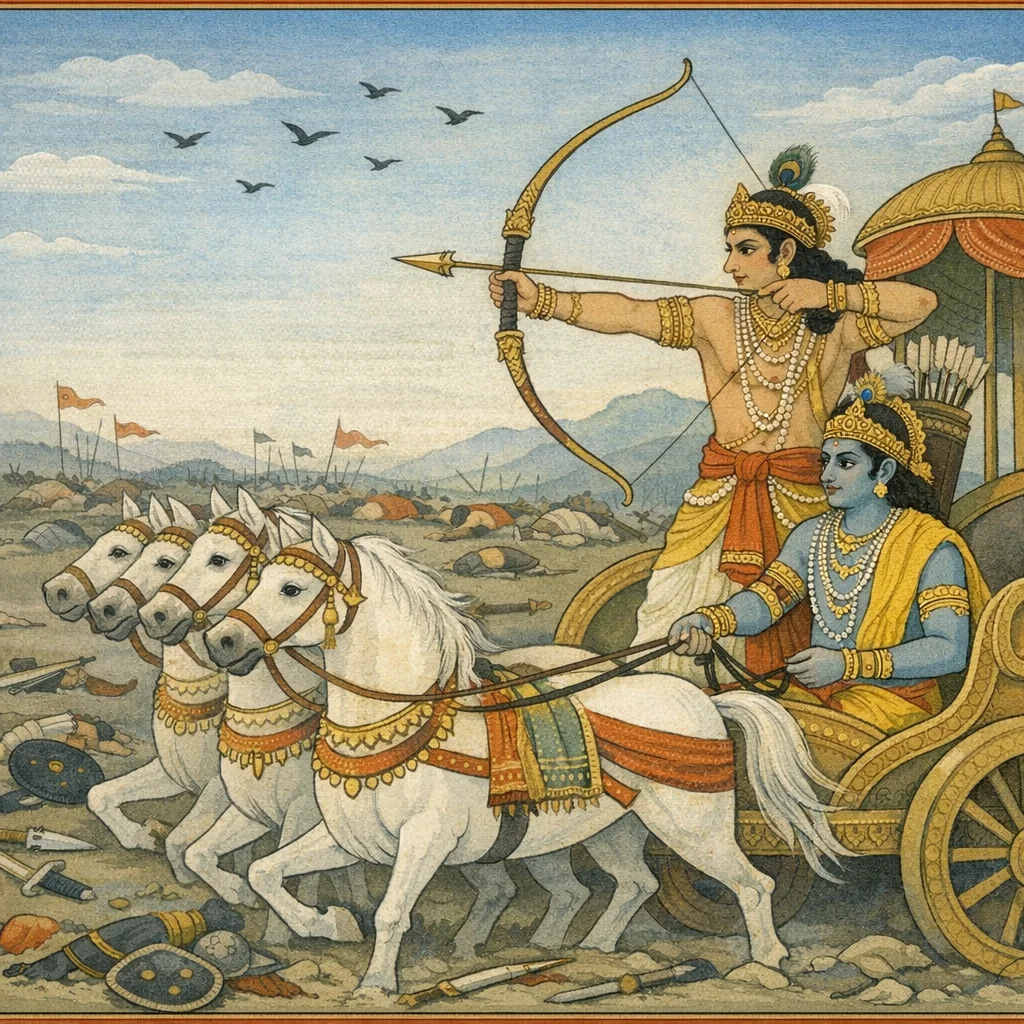
Adhyaya 79
Chapter Arc: रणभूमि रक्त-नदी बन चुकी है—शोणित से भरी पृथ्वी, मांस-मज्जा-अस्थि की कीच, मनुष्य-शीर्षों के पत्थर और हाथी-घोड़ों के शवों से रुकी हुई धारा; उसी भयावह दृश्य के बीच अर्जुन का रथ कर्ण की ओर मुड़ता है और श्रीकृष्ण सारथि बनकर उसे शत्रु-व्यूह के भीतर ले जाते हैं। → अर्जुन क्रोधरक्त नेत्रों से आगे बढ़ता है—युधिष्ठिर के घायल और रथहीन होने का समाचार उसके भीतर प्रतिशोध की ज्वाला बन जाता है। कौरव-पक्ष के रक्षक-वीर (कृप, कृतवर्मा, अश्वत्थामा आदि) कर्ण की सुरक्षा में खड़े हैं और पाण्डव-सेना (शिखण्डी, सात्यकि, नकुल, सहदेव) अर्जुन के सम्मुख शत्रुओं को चीरती हुई आगे आती है। → कृष्ण के रथ पर चक्र, गदा, शंख आदि दिव्य चिह्न चमकते हैं; उसी रथ के वेग से श्रीकृष्ण व्याकुल शत्रुओं को दाहिने कर मार्ग बनाते हैं और अर्जुन एकाकी-रथ होकर भी समस्त पार्थिवों का वध करने को उद्यत दिखता है—कौरव-प्रवीर और सृञ्जय-वीर देवासुर-संग्राम की भाँति आमने-सामने टकराते हैं। → अध्याय का अंत निर्णायक वध पर नहीं, बल्कि युद्ध-प्रवाह के पुनः संगठित होने पर टिकता है—ध्वजों से उठे रथ फिर दौड़ते हैं, पाण्डव-वीर गर्जना करते हुए शत्रु-पंक्तियों में प्रवेश करते हैं और कर्ण तक पहुँचने का मार्ग रक्त और शस्त्रों के बीच खुलता-बंद होता रहता है। → कर्ण की रक्षा-दीवार के सामने अर्जुन का क्रोध अब युद्ध को द्वंद्व की ओर धकेल रहा है—अगला क्षण कर्ण-अर्जुन के निकट-संघर्ष का संकेत देता है।
Shlokas
Verse 1
ऑफ क्रा एकोनाशीतितमो< ध्याय: अर्जुनका कौरव-सेनाको विनाश 848 नदी बहा देना और अपना रथ कर्णके पास ले लिये भगवान् श्रीकृष्णसे कहना तथा श्रीकृष्ण और अर्जुनको आते देख शल्य और कर्णकी बातचीत तथा अर्जुनद्वारा कौरव- सेनाका विध्वंस संजय उवाच अर्जुनस्तु महाराज हत्वा सैन्यं चतुर्विधम् । सूतपुत्रं च संक्रुद्धं दृष्टया चैव महारणे
Sañjaya said: O great king, Arjuna—having slain the fourfold divisions of the army—then, seeing the charioteer’s son (Karna) standing enraged on the great battlefield, turned his attention toward that decisive confrontation.
Verse 2
शोणितोदां महीं कृत्वा मांसमज्जास्थिपड्किलाम् | मनुष्यशीर्षपाषाणां हस्त्यश्वकृतरोधसम्
Sañjaya said: “The battlefield was turned into a land flooded with blood, churned into mire of flesh, marrow, and bones—its channels and obstructions formed by heaps of human heads like stones, and by the bodies of elephants and horses.” The verse underscores the moral horror and dehumanizing cost of war, presenting the carnage as a stark consequence of adharma-driven conflict and unchecked wrath.
Verse 3
शूरास्थिचयसंकीर्णा काकगृध्रानुनादिताम् । छत्रहंसप्लवोपेतां वीरवृक्षापहारिणीम्
Sañjaya said: “The battlefield was strewn with heaps of heroes’ bones, resounding with the cries of crows and vultures; it was marked by fallen parasols, likened to swans and waterfowl, and it carried off the ‘trees’ of warriors—an image of war’s pitiless harvest, where valor ends in ruin and the righteous are reminded of life’s fragility amid slaughter.”
Verse 4
हारपद्माकरवतीमुष्णीषवरफेनिलाम् । धनु:शरध्वजोपेतां नरक्षुद्रकपालिनीम्
Sañjaya said: “(That army/host) appeared like a lake of lotuses and garlands, its splendid turbans foaming like white crests; furnished with bows, arrows, and banners, it seemed to bear the skulls of men—small and crushed—(as if) a grim garland of death.”
Verse 5
चर्मवर्म भ्रमोपेतां रथोडुपसमाकुलाम् । जयैषिणां च सुतरां भीरूणां च सुदुस्तराम्
Sañjaya said: “That battlefield was choked with chariots moving like boats, and filled with the whirling confusion of shields and armor. For those intent on victory it offered a passage—yet for the fearful it was exceedingly hard to cross.”
Verse 6
नदीं प्रवर्तयित्वा च बीभत्सु: परवीरहा । वासुदेवमिदं वाक्यमब्रवीत् पुरुषर्षभ:
Sañjaya said: Having set the river in motion—Arjuna, the slayer of enemy heroes—then addressed Vāsudeva with these words, he who is foremost among men. The moment frames Arjuna’s martial prowess as disciplined action, immediately followed by counsel-seeking speech to Kṛṣṇa, suggesting that power in war is to be guided by right judgment and alignment with dharma.
Verse 7
संजय कहते हैं--महाराज! उस महासमरमें शत्रुवीरोंका संहार करनेवाले अर्जुनने क्रोधमें भरे हुए सूतपुत्रको देखकर कौरवोंकी चतुरंगिणी सेनाका विनाश करके वहाँ रक्तकी नदी बहा दी। जिसमें जलके स्थानमें इस पृथ्वीपर रक्त ही बह रहा था; मांस-मज्जा और हड्डियाँ कीचड़का काम दे रही थीं। मनुष्योंके कटे हुए मस्तक पत्थरोंके टुकड़ोंके समान जान पड़ते थे, हाथी और घोड़ोंकी लाशें कगार बनी हुई थीं, शूरवीरोंकी हड्डियोंके ढेर वहाँ सब ओर बिखरे हुए थे, कौए और गीध वहाँ अपनी बोली बोल रहे थे, छत्र ही हंस और छोटी नौकाका काम देते थे, वीरोंके शरीररूपी वृक्षको वह नदी बहाये लिये जाती थी, उसमें हार ही कमलवन और सफेद पगड़ी ही फेन थी, धनुष और बाण वहाँ मछलीके समान जान पड़ते थे, मनुष्योंकी छोटी-छोटी खोपड़ियाँ वहाँ बिखरी पड़ी थीं, ढाल और कवच ही उसमें भँवरके समान प्रतीत होते थे, रथरूपी छोटी नौकासे व्याप्त वह नदी विजयाभिलाषी वीरोंके लिये सुगमतापूर्वक पार होनेयोग्य और कायरोंके लिये अत्यन्त दुस्तर थी। उस नदीको बहाकर पुरुषप्रवर अर्जुनने वसुदेवनन्दन भगवान् श्रीकृष्णसे इस प्रकार कहा-- ।। अजुन उवाच एष केतू रणे कृष्ण सूतपुत्रस्य दृश्यते । भीमसेनादयश्नैते योधयन्ति महारथम्,अर्जुन बोले--श्रीकृष्ण! रणभूमिमें यह सूतपुत्र कर्णकी ध्वजा दिखायी देती है। ये भीमसेन आदि वीर महारथी कर्णसे युद्ध करते हैं
Arjuna said: “Kṛṣṇa, on this battlefield the banner of Karṇa, the son of a charioteer, is clearly visible. And here Bhīmasena and the other heroes are engaging that great chariot-warrior in combat.”
Verse 8
एते द्रवन्ति पठ्चाला: कर्णत्रस्ता जनार्दन | एष दुर्योधनो राजा श्वेतच्छत्रेण धार्यता
Arjuna said: “O Janārdana, the Pāñcālas are fleeing, terrified of Karṇa. There is King Duryodhana—he is to be marked out by the white royal parasol.”
Verse 9
कर्णेन भग्नान् पञ्चालान् द्रावयन् बहु शोभते । जनार्दन! ये पांचालयोद्धा कर्णसे डरकर भाग रहे हैं, यह राजा दुर्योधन है, जिसके ऊपर श्वेत छत्र तना हुआ है और कर्णने जिनके पाँव उखाड़ दिये हैं उन पांचालोंको खदेड़ता हुआ यह बड़ी शोभा पा रहा है ।। कृपश्च कृतवर्मा च द्रौणिश्वेव महारथ:,कृपाचार्य, कृतवर्मा और महारथी अभश्व॒त्थामा-ये सूतपुत्रसे सुरक्षित हो राजा दुर्योधनकी रक्षा करते हैं। यदि हम इन तीनोंको नहीं मारते हैं तो ये सोमकोंका संहार कर डालेंगे
Arjuna said: “Janārdana, look—Duryodhana is resplendent as he drives the Pāñcālas before him, already broken by Karṇa. Under the white royal parasol, he pursues those Pāñcāla warriors who flee in fear of the Sūta’s son, and he gains great glory by harrying the very men whose footing Karṇa has shattered. And Kṛpa, Kṛtavarmā, and the great chariot-warrior Aśvatthāmā—protected by Karṇa—stand guarding King Duryodhana. If we do not strike down these three, they will bring destruction upon our forces.”
Verse 10
एते रक्षन्ति राजानं सूतपुत्रेण रक्षिता: | अवध्यमानास्ते<स्माभिर्घातयिष्यन्ति सोमकान्,कृपाचार्य, कृतवर्मा और महारथी अभश्व॒त्थामा-ये सूतपुत्रसे सुरक्षित हो राजा दुर्योधनकी रक्षा करते हैं। यदि हम इन तीनोंको नहीं मारते हैं तो ये सोमकोंका संहार कर डालेंगे
Arjuna said: “These warriors, protected by the charioteer’s son (Karna), are guarding the king (Duryodhana). If we do not strike them down, they—remaining unassailed by us—will slaughter the Somakas. Therefore, they must be confronted and slain for the protection of our allies and the course of the battle.”
Verse 11
एष शल्यो रथोपस्थे रश्मिसंचारकोविद: । सूतपुत्ररर्ं कृष्ण वाहयन् बहु शोभते,श्रीकृष्ण! घोड़ोंकी बागडोरका संचालन करनेकी कलामें कुशल ये राजा शल्य रथके निचले भागमें बैठकर सूतपुत्रका रथ हाँकते हुए बड़ी शोभा पाते हैं
Arjuna said: “Behold King Śalya—skilled in handling the reins—seated on the lower part of the chariot. As he drives the chariot of the charioteer’s son (Karna), he appears greatly resplendent, O Kṛṣṇa.”
Verse 12
तत्र मे बुद्धिरुत्पन्ना वाहयात्र महारथम् | नाहत्वा समरे कर्ण निवर्तिष्ये कथठ्चन,जनार्दन! यहाँ मेरा ऐसा विचार हो रहा है कि आप मेरे इस विशाल रथको वहीं हाँक ले चलें (जहाँ कर्ण खड़ा है)। मैं समरांगणमें कर्णका वध किये बिना किसी प्रकार पीछे नहीं लौटूँगा। अन्यथा राधापुत्र हमारे देखते-देखते पाण्डव तथा सूंजय महारथियोंको समरभूमिमें निःशेष कर देगा--किसीको जीवित नहीं छोड़ेगा
Arjuna said: “In this moment a resolve has arisen in me: drive this great chariot there, to where Karṇa stands. O Janārdana, I will not turn back from the battlefield in any way without slaying Karṇa. Otherwise the son of Rādhā, before our very eyes, will utterly destroy the Pāṇḍavas and the mighty warriors of Sūñjaya’s line on the field of war—leaving none alive.”
Verse 13
राधेयो ह्ान्यथा पार्थान् सृञ्जयांश्व महारथान् । निःशेषान् समरे कुर्यात् पश्यतां नो जनार्दन,जनार्दन! यहाँ मेरा ऐसा विचार हो रहा है कि आप मेरे इस विशाल रथको वहीं हाँक ले चलें (जहाँ कर्ण खड़ा है)। मैं समरांगणमें कर्णका वध किये बिना किसी प्रकार पीछे नहीं लौटूँगा। अन्यथा राधापुत्र हमारे देखते-देखते पाण्डव तथा सूंजय महारथियोंको समरभूमिमें निःशेष कर देगा--किसीको जीवित नहीं छोड़ेगा
Arjuna said: “O Janārdana, if it be otherwise—if we do not act as required—Rādheya (Karna) will, before our very eyes, annihilate the Pārthas and the Sṛñjayas, those great chariot-warriors, leaving none alive on the battlefield.”
Verse 14
ततः प्रायाद् रथेनाशु केशवस्तव वाहिनीम् । कर्ण प्रति महेष्वासं द्वैरथे सव्यसाचिना,तदनन्तर भगवान् श्रीकृष्ण रथके द्वारा शीघ्र ही सव्यसाची अर्जुनके साथ कर्णका द्वैरथ-युद्ध करानेके लिये आपकी सेनामें महाधनुर्धर कर्णकी ओर चले
Then Keśava swiftly drove the chariot into your army, moving toward the great bowman Karṇa so that Savyasācin (Arjuna) might engage him in a direct chariot-to-chariot duel.
Verse 15
प्रयातश्न॒ महाबाहु: पाण्डवानुज्ञया हरि: । आश्वासयन् रथेनैव पाण्डुसैन्यानि सर्वश:,अर्जुनकी अनुमतिसे महाबाहु श्रीकृष्ण रथके द्वारा ही पाण्डव-सेनाओंको सब ओरसे आश्वासन देते हुए आगे बढ़े
With the Pandavas’ permission, Hari—mighty-armed—set forth. Even from the chariot itself he moved ahead, offering reassurance to the armies of the sons of Pandu on every side, steadying their resolve amid the strain of war.
Verse 16
रथघोष: स संग्रामे पाण्डवेयस्य सम्बभौ । वासवाशनितुल्यस्य मेघौघस्येव मारिष,मान्यवर नरेश! संग्राममें पाण्डुपुत्र अर्जुनके रथका वह यर्घरघोष इन्द्रके वज्ञकी गड़गड़ाहट तथा मेघसमूहोंकी गर्जनाके समान प्रतीत होता था
In the thick of battle, the rumbling sound of the Pāṇḍava’s chariot arose—like the thunderbolt of Vāsava (Indra), like the roaring mass of storm-clouds.
Verse 17
महता रथघोषेण पाण्डव: सत्यविक्रम: । अभ्ययादप्रमेयात्मा निर्जयंस्तव वाहिनीम्,सत्यपराक्रमी पाण्डव अर्जुन अप्रमेय आत्मबलसे सम्पन्न थे। वे महान् रथघोषके द्वारा आपकी सेनाको परास्त करते हुए आगे बढ़े
With the thunderous roar of his chariot, Arjuna—the Pāṇḍava of unfailing valor—advanced. Possessed of immeasurable spirit and strength, he pressed on, overcoming your army; amid the stern demands of dharma-yuddha, his prowess proved true to his word and purpose.
Verse 18
तमायान्तं समीक्ष्यैव श्वेताश्वंं कृष्णसारथिम् । मद्रराजोब्रवीत् कर्ण केतुं दृष्टवा महात्मन:,श्रीकृष्ण जिनके सारथि हैं, उन श्वेतवाहन अर्जुनको आते देख और उन महात्माकी ध्वजापर दृष्टिपात करके मद्रराज शल्यने कर्णसे कहा--
Seeing Arjuna approaching—upon a chariot drawn by white horses, with Krishna as his charioteer—and casting his gaze upon the great warrior’s banner, Shalya, king of Madra, spoke to Karna. The sight showed how a hero’s standard, and the presence of a righteous guide like Krishna, can sway morale and judgment on the battlefield.
Verse 19
अयं स रथ आयाति श्वेताश्वः कृष्णसारथि: । निषघ्नन्नमित्रान् समरे यं कर्ण परिपृच्छसि,“कर्ण! तुम जिसके विषयमें पूछ रहे थे, वही यह श्वेत घोड़ोंवाला रथ, जिसके सारथि श्रीकृष्ण हैं, समरांगणमें शत्रुओंका संहार करता हुआ इधर ही आ रहा है
“O Karna, that very chariot is approaching—the one drawn by white horses and driven by Krishna. It is the same chariot you asked of: it comes through the battlefield, cutting down foes in the clash of war, and now turns this way.”
Verse 20
एष तिष्ठति कौन्तेय: संस्पृशन् गाण्डिवं धनु: । त॑ हनिष्यसि चेदद्य तन्न: श्रेयो भविष्यति,'ये कुन्तीकुमार अर्जुन हाथमें गाण्डीव धनुष लिये हुए खड़े हैं। यदि तुम आज उनको मार डालोगे तो वह हमलोगोंके लिये श्रेयस्कर होगा
“O son of Kuntī, here stands Arjuna, his hand upon the Gāṇḍīva bow. If you can slay him today, it will be for our highest good.”
Verse 21
धनुर्ज्या चन्द्रताराड़का पताकाकिड्किणीयुता । पश्य कर्णार्जुनस्यैषा सौदामन्यम्बरे यथा,“कर्ण! देखो, अर्जुनके धनुषकी यह प्रत्यंचा तथा चन्द्रमा और तारोंसे चिह्नित यह रथकी पताका है, जिसमें छोटी-छोटी घंटियाँ लगी हैं, वह आकाशमें बिजलीके समान चमक रही है
“O Karṇa, look—this bowstring and this chariot-banner marked with the moon and stars, adorned with tiny bells, flashes in the sky like lightning.”
Verse 22
एष ध्वजाग्रे पार्थस्य प्रेक्षमाण: समन्ततः । दृश्यते वानरो भीमो वीराणां भयवर्धन:,“कुन्तीकुमार अर्जुनकी ध्वजाके अग्रभागमें एक भयंकर वानर दिखायी देता है, जो सब ओर देखता हुआ कौरववीरोंका भय बढ़ा रहा है
Behold—upon the very front of Pārtha’s banner there is seen a formidable monkey, scanning all directions. He heightens the fear of the Kaurava warriors.
Verse 23
एतच्चक्रं गदा शड्ख: शार्ड्र कृष्णस्य च प्रभो । दृश्यते पाण्डवरथे वाहयानस्य वाजिन:,'पाण्डुपुत्रके रथपर बैठकर घोड़े हाँकते हुए भगवान् श्रीकृष्णके ये चक्र, गदा, शंख तथा शार््रधनुष दृष्टिगोचर हो रहे हैं
O lord, as Kṛṣṇa drives the horses while seated on the Pāṇḍava chariot, his divine emblems—the discus, the mace, the conch, and the Śārṅga bow—are clearly visible. Their very sight proclaims his sovereign power and the righteous resolve guiding our cause amid this war.
Verse 24
एतत् कूजति गाण्डीवं विसृष्टं सव्यसाचिना । एते हस्तवता मुक्ता घ्नन्त्यमित्रान् शिता: शरा:,“यह सव्यसाचीके द्वारा खींचा गया गाण्डीव धनुष टंकार रहा है, सिद्धहस्त अर्जुनके छोड़े हुए ये पैने बाण शत्रुओंका विनाश कर रहे हैं
This Gāṇḍīva bow, released and set in motion by the ambidextrous archer, is resounding. And these keen arrows—loosed by the master of the hand—are striking down the foes.
Verse 25
विशालायतताम्राक्षै: पूर्णचन्द्रनिभाननै: । एषा भू: कीर्यते राज्ञां शिरोभिरपलायिनाम्,'जो युद्धसे कभी पीछे नहीं हटते, उन राजाओंके कटे हुए मस्तकोंसे यह रणभूमि पटी जा रही है। उन मस्तकोंके नेत्र बड़े-बड़े और लाल हैं तथा मुख पूर्ण चन्द्रमाके समान मनोहर है
This battlefield is being strewn with the severed heads of kings who did not flee from combat. Their eyes are large and reddish, and their faces are lovely like the full moon—yet they now lie scattered, a stark witness to the terrible cost of unwavering valor in war.
Verse 26
एते परिघसंकाशा: पुण्यगन्धानुलेपना: । उद्धता रणशूराणां पात्यन्ते सायुधा भुजा:,“रणवीरोंकी ये अस्त्र-शस्त्रोंसहित उठी हुई भुजाएँ, जो परिघोंके समान मोटी तथा पवित्र सुगन्धयुक्त चन्दनसे चर्चित हैं, काटकर गिरायी जा रही हैं
These arms of heroic warriors—raised high in battle, thick like iron clubs, and anointed with sandal-paste of sacred fragrance—are being hewn down and made to fall, still bearing their weapons.
Verse 27
निरस्तजिद्दानेत्रान्ता वाजिन: सह सादिभि: | पतिता: पात्यमानाश्ष क्षितौ क्षीणा विशेरते,'ये कौरवपक्षके सवारोंसहित घोड़े क्षत-विक्षत हो, अर्जुनके द्वारा गिराये जा रहे हैं। इनकी जीभें और आँखें बाहर निकल आयी हैं। ये गिरकर पृथ्वीपर सो रहे हैं
Arjuna said: “The horses, along with their riders, have been struck down—tongues lolling and the corners of their eyes protruding. Cast to the ground and still being felled, they lie exhausted upon the earth.”
Verse 28
एते पर्वतशृज्ञाणां तुल्या हैमवता गजा: । संछिन्नकुम्भा: पार्थेन प्रपतन्त्यद्रयो यथा,'ये हिमाचलप्रदेशके हाथी, जो पर्वत-शिखरोंके समान जान पड़ते हैं, पर्वतोंक समान धराशायी हो रहे हैं। अर्जुनने इनके कुम्भस्थल काट डाले हैं
Arjuna said: “These elephants of the Himālaya region, towering like mountain-peaks, are now collapsing like crags falling from a mountain—Arjuna (Pārtha) has severed their frontal globes.”
Verse 29
गन्धर्वनगराकारा रथा वा ते नरेश्वरा: । विमानादिदव पुण्यान्ते स्वर्गिणो निपतन्त्यमी,'ये गन्धर्व-नगरके समान विशाल रथ हैं, जिनसे ये मारे गये राजालोग उसी प्रकार नीचे गिर रहे हैं, जैसे पुण्य समाप्त होनेपर स्वर्गवासी प्राणी विमानसे नीचे गिर जाते हैं
Arjuna said: “O kings, those chariots of yours—vast and wondrous like the cities of the Gandharvas—are now the very cause of your fall. See how these slain rulers are dropping down, just as dwellers in heaven, when their merit is exhausted, fall from their celestial cars.”
Verse 30
व्याकुलीकृतमत्यर्थ परसैन्यं किरीटिना । नानामृगसहस््राणां यूथं केसरिणां यथा,“किरीटथधारी अर्जुनने शत्रुसेनाको उसी प्रकार अत्यन्त व्याकुल कर दिया है, जैसे सिंह नाना जातिके सहसौरों मृगोंके झुंडको व्याकुल कर देता है
Arjuna, the diademed warrior, has thrown the enemy host into extreme confusion—just as a lion throws into panic a herd of thousands of deer of many kinds.
Verse 31
त्वामभिप्रेप्सुरायाति कर्ण निध्नन् वरान् रथान् | असहामानो राधेय तं याहि प्रति भारत,'राधापुत्र कर्ण! अर्जुन बड़े-बड़े रथियोंका संहार करते हुए तुम्हें ही प्राप्त करनेके लिये इधर आ रहे हैं। ये शत्रुओंके लिये असहा हैं। तुम इन भरतवंशी वीरका सामना करनेके लिये आगे बढ़ो
Arjuna said: “Karna, Arjuna is advancing here with the sole aim of reaching you, after cutting down many foremost chariot-warriors. He is unbearable to his foes. O son of Radha, go forth to meet that Bharata hero.”
Verse 32
(घृणां त्यक्त्वा प्रमादं च भूगोरस्त्रं च संस्मर | दृष्टिं मुष्टिं च संधानं स्मृत्वा रामोपदेशजम् । धनंजयं जयप्रेप्सु: प्रत्युदूग॒च्छ महारथम् ।।) “कर्ण! तुम दया और प्रमाद छोड़कर भृगुवंशी परशुरामजीके दिये हुए अस्त्रका स्मरण करो, उनके उपदेशके अनुसार लक्ष्यकी ओर दृष्टि रखना, धनुषको अपनी मुटद्ठीसे दृढ़तापूर्वक पकड़े रहना और बाणोंका संधान करना आदि बातें याद करके मनमें विजय पानेकी इच्छा लिये महारथी अर्जुनका सामना करनेके लिये आगे बढ़ो। एषा विदीर्यते सेना धार्तराष्ट्री समन्ततः । अर्जुनस्य भयात् तूर्ण निध्नतः शात्रवान् बहूनू,“अर्जुन थोड़ी ही देरमें बहुत-से शत्रुओंका संहार कर डालते हैं, इसलिये उनके भयसे दुर्योधनकी यह सेना चारों ओरसे छिन्न-भिन्न होकर भागी जा रही है
Arjuna said: “Cast aside misplaced pity and negligence; recall the weapon taught by Bhṛgu’s descendant (Paraśurāma). Remember, as Rāma instructed you, to keep your gaze fixed on the mark, to hold the bow-grip firmly, and to set the arrow with steady aim. Desiring victory, advance to meet Dhanañjaya, the great chariot-warrior. For the Dhārtarāṣṭra host is being torn apart on every side—out of fear of Arjuna, who swiftly strikes down many foes.”
Verse 33
वर्जयन् सर्वसैन्यानि त्वरते हि धनंजय: । त्वदर्थमिति मन्ये5हं यथास्योदीर्यते वपु:,“इस समय अर्जुनका शरीर जैसा उत्तेजित हो रहा है उससे मैं समझता हूँ कि वे सारी सेनाओंको छोड़कर तुम्हारे पास पहुँचनेके लिये जल्दी कर रहे हैं
“Dhanañjaya (Arjuna), passing by all the armies, is indeed hurrying on. From the way his body is surging with excitement, I understand that he is rushing to reach you—only for your sake.”
Verse 34
न हावस्थास्यते पार्थो युयुत्सु: केनचित् सह । त्वामृते क्रोधदीप्तो हि पीड्यमाने वृकोदरे,'भीमसेनके पीड़ित होनेसे अर्जुन क्रोधसे तमतमा उठे हैं, इसलिये आज तुम्हारे सिवा और किसीसे युद्ध करनेके लिये वे नहीं रुक सकेंगे
Arjuna said: “Pārtha will not hold back to fight anyone else. For, as Vṛkodara is being tormented, his wrath has been kindled into blazing fire; therefore today, except for you, he cannot be restrained from engaging in battle with any other.”
Verse 35
विरथं धर्मराजं तु दृष्टवा सुदृढविक्षतम् | शिखण्डिनं सात्यकिं च धृष्टद्युम्नं च पार्षतम्,“तुमने धर्मराज युधिष्ठिरको अत्यन्त घायल करके रथहीन कर दिया है। शिखण्डी, द्रपदकुमार धृष्टद्युम्न, सात्यकि, द्रौपदीके पुत्रों, उत्तमौजा, युधामन्यु तथा दोनों भाई नकुल- सहदेवको भी तुम्हारे हाथों बहुत चोट पहुँची है। यह सब देखकर शत्रुओंको संताप देनेवाले कुन्तीकुमार अर्जुन अत्यन्त कुपित हो उठे हैं। उनके नेत्र रोषसे रक्तवर्ण हो गये हैं, अतः वे समस्त राजाओंका संहार करनेकी इच्छासे एकमात्र रथके साथ सहसा तुम्हारे ऊपर चढ़े आ रहे हैं
Arjuna said: “Seeing King Dharmarāja (Yudhiṣṭhira) deprived of his chariot and grievously wounded—and also beholding Śikhaṇḍin, Sātyaki, and Dhṛṣṭadyumna, the son of Pṛṣata, struck down—my wrath has been kindled. Such sights cannot be endured; the humiliation and injury of the righteous king and his allies demand an answer in battle.”
Verse 36
द्रौपदेयान् युधामन्युमुत्तमौजसमेव च । नकुलं सहदेवं च भ्रातरौ द्वौ समीक्ष्य च,“तुमने धर्मराज युधिष्ठिरको अत्यन्त घायल करके रथहीन कर दिया है। शिखण्डी, द्रपदकुमार धृष्टद्युम्न, सात्यकि, द्रौपदीके पुत्रों, उत्तमौजा, युधामन्यु तथा दोनों भाई नकुल- सहदेवको भी तुम्हारे हाथों बहुत चोट पहुँची है। यह सब देखकर शत्रुओंको संताप देनेवाले कुन्तीकुमार अर्जुन अत्यन्त कुपित हो उठे हैं। उनके नेत्र रोषसे रक्तवर्ण हो गये हैं, अतः वे समस्त राजाओंका संहार करनेकी इच्छासे एकमात्र रथके साथ सहसा तुम्हारे ऊपर चढ़े आ रहे हैं
Arjuna said: “Seeing the sons of Draupadī, and Yudhāmanyu, and Uttamaujas, and also the two brothers Nakula and Sahadeva—(all struck down and afflicted in battle)—…”
Verse 37
सहसैकरथ: पार्थस्त्वामभ्येति परंतप: । क्रोधरक्तेक्षण: क्रुद्धों जिघांसु: सर्वपार्थिवान्,“तुमने धर्मराज युधिष्ठिरको अत्यन्त घायल करके रथहीन कर दिया है। शिखण्डी, द्रपदकुमार धृष्टद्युम्न, सात्यकि, द्रौपदीके पुत्रों, उत्तमौजा, युधामन्यु तथा दोनों भाई नकुल- सहदेवको भी तुम्हारे हाथों बहुत चोट पहुँची है। यह सब देखकर शत्रुओंको संताप देनेवाले कुन्तीकुमार अर्जुन अत्यन्त कुपित हो उठे हैं। उनके नेत्र रोषसे रक्तवर्ण हो गये हैं, अतः वे समस्त राजाओंका संहार करनेकी इच्छासे एकमात्र रथके साथ सहसा तुम्हारे ऊपर चढ़े आ रहे हैं
Arjuna said: “Pārtha, the scorcher of foes, is rushing straight at you with a single chariot, in sudden fury. His eyes are reddened with wrath; enraged, he longs to slay all the kings.”
Verse 38
त्वरितो$भिपतत्यस्मांस्त्यक्त्वा सैन्यान्यसंशयम् | त्वं कर्ण प्रतियाहोनं नास्त्यन्यो हि धनुर्धर:,“इसमें संदेह नहीं कि वे सारी सेनाओंको छोड़कर बड़ी उतावलीके साथ हमलोगोंपर टूट पड़े हैं; अत: कर्ण! अब तुम भी इनका सामना करनेके लिये आगे बढ़ो, क्योंकि तुम्हारे सिवा दूसरा कोई धनुर्धर ऐसा करनेमें समर्थ नहीं है
Arjuna said: “Without doubt, he has abandoned the other divisions of the army and is rushing straight upon us in great haste. Therefore, O Karṇa, advance to meet him in battle—there is no other archer capable of facing him as you are.”
Verse 39
न तं पश्यामि लोके<स्मिंस्त्वत्तो हान्यं धनुर्धरम् । अर्जुन समरे क़रुद्धं यो वेलामिव धारयेत्,“इस संसारमें मैं तुम्हारे सिवा दूसरे किसी धनुर्धरको ऐसा नहीं देखता जो समुद्रमें उठे हुए ज्वारके समान समरांगणमें कुपित हुए अर्जुनको रोक सके
Arjuna said: “In this world I see no other bowman besides you who could withstand and hold back Arjuna when he is enraged on the battlefield—like a shoreline holding back the surging sea.”
Verse 40
न चास्य रक्षां पश्यामि पार्श्वतो न च पृष्ठत: । एक एवाभियाति त्वां पश्य साफल्यमात्मन:,“मैं देखता हूँ कि अगल-बगलसे या पीछेकी ओरसे उनकी रक्षाका कोई प्रबन्ध नहीं किया गया है। वे अकेले ही तुमपर चढ़ाई कर रहे हैं; अतः देखो, तुम्हें अपनी सफलताके लिये कैसा सुन्दर अवसर हाथ लगा है
“And I see no guard for him, neither at his sides nor at his back. Alone he advances against you; therefore see—what a splendid chance has come into your hands for your own success.”
Verse 41
त्वं हि कृष्णौ रणे सक्त: संसाधयितुमाहवे । तवैव भारो राधेय प्रत्युद्याहि धनंजयम्,'राधापुत्र! रणभूमिमें तुम्हीं श्रीकृष्ण और अर्जुनको परास्त करनेकी शक्ति रखते हो, तुम्हारे ऊपर ही यह भार रखा गया है; इसलिये तुम अर्जुनको रोकनेके लिये आगे बढ़ो
“You alone are truly engaged in this battle and capable of accomplishing the task in the fight—of overcoming Kṛṣṇa and Arjuna. The burden rests on you, O son of Rādhā; therefore advance and confront Dhanañjaya (Arjuna).”
Verse 42
समानो हासि भीष्मेण द्रोणद्रौणिकृपेण च । सव्यसाचिनमायान्तं निवारय महारणे,“तुम भीष्म, द्रोण, अश्वत्थामा तथा कृपाचार्यके समान पराक्रमी हो, अतः इस महासमरमें आक्रमण करते हुए सव्यसाची अर्जुनको रोको
Arjuna said: “You are equal in prowess to Bhīṣma, Droṇa, Droṇa’s son (Aśvatthāmā), and Kṛpa. Therefore, in this great battle, restrain Savyasācī Arjuna as he advances to attack.”
Verse 43
लेलिहानं यथा सर्प गर्जन्तमृषभं यथा । वनस्थितं यथा व्याप्रं जहि कर्ण धनंजयम्,“कर्ण! जीभ लपलपाते हुए सर्प, गर्जते हुए साँड़ और वनवासी व्याप्रके समान भयंकर अर्जुनका तुम वध करो
Arjuna said: “Slay Karṇa, O Dhanañjaya—he is fearsome like a tongue-flicking serpent, like a bellowing bull, and like a tiger lurking in the forest.”
Verse 44
एते द्रवन्ति समरे धार्तराष्ट्रा महारथा: । अर्जुनस्य भयात् तूर्ण निरपेक्षा जनाधिपा:,“देखो! समरभूमिमें दुर्योधनकी सेनाके ये महारथी नरेश अर्जुनके भयसे आत्मीयजनोंकी भी अपेक्षा न रखकर बड़ी उतावलीके साथ भागे जा रहे हैं
Arjuna said: “Look! In this battle the great chariot-warriors of Dhṛtarāṣṭra’s party—those kingly lords—are fleeing in haste out of fear of me, casting aside even regard for their own kinsmen.”
Verse 45
द्रवतामथ तेषां तु नान्यो5स्ति युधि मानव: । भयहा यो भवेद् वीरस्त्वामृते सूतनन्दन,'सूतनन्दन! इस युद्धस्थलमें तुम्हारे सिवा ऐसा कोई भी वीर पुरुष नहीं है, जो उन भागते हुए नरेशोंका भय दूर कर सके
Arjuna said: “As those kings flee, there is no other man on this battlefield—except you, O son of the charioteer—who is a hero capable of dispelling their fear.”
Verse 46
एते त्वां कुरव: सर्वे द्वीपमासाद्य संयुगे । धिषछिता: पुरुषव्यात्र त्वत्त: शरणकाड्क्षिण:,'पुरुषसिंह! इस समुद्र-जैसे युद्धस्थलमें तुम द्वीपके समान हो। ये समस्त कौरव तुमसे शरण पानेकी आशा रखकर, तुम्हारे ही आश्रयमें आकर खड़े हुए हैं
Arjuna said: “O tiger among men, in this ocean-like battlefield you are like an island. All these Kurus, seeking refuge from you, have come and stand here depending upon you alone.”
Verse 47
वैदेहाम्बष्ठकाम्बोजास्तथा नग्नजितस्त्वया । गान्धाराश्च यया धृत्या जिता: संख्ये सुदुर्जया: । तां धृतिं कुरु राधेय ततः प्रत्येहि पाण्डवम्,'राधानन्दन! तुमने जिस धैर्यसे पहले अत्यन्त दुर्जय विदेह, अम्बष्ठ, काम्बोज, नग्नजित् तथा गान्धार-गणोंको युद्धमें पराजित किया था, उसीको पुनः: अपनाओ और पाण्डुपुत्र अर्जुनका सामना करनेके लिये आगे बढ़ो
“O Rādheya (son of Rādhā), with the very steadfast courage by which you once defeated in battle the hard-to-conquer Vaidehas, Ambaṣṭhas, Kāmbojas, Nagnajit, and the Gandhāras—summon that same resolve again. Take it up now, and advance to face the Pāṇḍava (Arjuna).”
Verse 48
वासुदेवं च वार्ष्णेयं प्रीयमाणं किरीटिना । प्रत्युद्याहि महाबाहो पौरुषे महति स्थित:,“महाबाहो! तुम महान् पुरुषार्थमें स्थित होकर अर्जुनसे सतत प्रसन्न रहनेवाले वृष्णिवंशी, वसुदेवनन्दन श्रीकृष्णका भी सामना करो
Arjuna said: “O mighty-armed one, stand firm in great manly valor and go forth to confront Vāsudeva—Kṛṣṇa of the Vṛṣṇis—who is ever well-disposed toward me, the diadem-wearing Arjuna. Face him as well.”
Verse 49
(यथैकेन त्वया पूर्व कृतो दिग्विजय: पुरा । मरुत्सूनोर्यथा सूनुर्घातित: शक्रदत्तया ।। तदेतत् सर्वमालम्ब्य जहि पार्थ धनंजयम् ।) 'जैसे पूर्वकालमें तुमने अकेले ही सम्पूर्ण दिशाओंपर विजय पायी थी, इन्द्रकी दी हुई शक्तिसे भीमपुत्र घटोत्कचका वध किया था, उसी तरह इस सारे बल-पराक्रमका आश्रय ले कुन्तीपुत्र अर्जुनको मार डालो'। कर्ण उवाच प्रकृतिस्थो5सि मे शल्य इदानीं सम्मतस्तथा । प्रतिभासि महाबाहो मा भैषीस्त्वं धनंजयात्,कर्णने कहा--शल्य! इस समय तुम अपने स्वरूपमें प्रतिष्ठित हो और मुझसे सहमत जान पड़ते हो। महाबाहो! तुम अर्जुनसे डरो मत
Karna said: “Just as earlier you once achieved conquest of all directions single-handed, and just as the son of Bhima—Ghaṭotkaca—was slain by the divine missile granted by Indra, so now, relying on that same totality of strength and prowess, strike down Pārtha Dhanañjaya (Arjuna).” Then Karna added: “Śalya, now you seem settled in your true disposition and in agreement with me. Mighty-armed one, do not fear Dhanañjaya.”
Verse 50
पश्य बाह्लोर्बलं मेउद्य शिक्षितस्य च पश्य मे । एकोडद्य निहनिष्यामि पाण्डवानां महाचमूम्,आज मेरी इन दोनों भुजाओंका बल देखो और मेरी शिक्षाकी शक्तिपर भी दृष्टिपात करो। आज मैं अकेला ही पाण्डवोंकी विशाल सेनाका संहार कर डालूँगा
Karna said: “Look today upon the strength of my arms, and look also upon the power born of my training. Today, single-handed, I shall strike down the vast host of the Pandavas.”
Verse 51
कृष्णौ च पुरुषव्यात्र ततः सत्यं ब्रवीमि ते । नाहत्वा युधि तौ वीरौ व्यपयास्थे कथंचन,पुरुषसिंह! मैं तुमसे सच्ची बात कहता हूँ कि युद्धस्थलमें उन दोनों वीर श्रीकृष्ण और अर्जुनका वध किये बिना मैं किसी तरह पीछे नहीं हटूँगा
Karna said: “O tiger among men, I now speak to you the truth. Unless I slay those two heroes—Kṛṣṇa and Arjuna—on the battlefield, I will not withdraw in any way.”
Verse 52
स्वप्स्थे वा निहतस्ताभ्यामनित्यो हि रणे जय: । कृतार्थोड्द्य भविष्यामि हत्वा वाप्यथवा हत:,अथवा उन्हीं दोनोंके हाथों मारा जाकर सदाके लिये सो जाऊँगा, क्योंकि रणमें विजय अनिश्चित होती है। आज मैं उन दोनोंको मारकर अथवा मारा जाकर सर्वथा कृतार्थ हो जाऊँगा
Karna said: “Either I shall fall by the hands of those two and sleep forever, for victory in battle is uncertain; or, having slain them—or being slain by them—I shall today become wholly fulfilled.”
Verse 53
शल्य उवाच अजय्यमेनं प्रवदन्ति युद्धे महारथा: कर्ण रथप्रवीरम् । एकाकिनं किमु कृष्णाभिगुप्तं विजेतुमेनं क इहोत्सहेत,शल्यने कहा--कर्ण! रथियोंमें प्रमुख वीर अर्जुन अकेले भी हों तो महारथी योद्धा उन्हें युद्धमोें अजेय बताते हैं, फिर इस समय तो वे श्रीकृष्णसे सुरक्षित हैं; ऐसी दशामें कौन इन्हें जीतनेका साहस कर सकता है?
Śalya said: “O Karṇa, the great chariot-warriors declare this foremost hero of the chariot to be unconquerable in battle. If even when he stands alone he is deemed invincible, then how much more so now, when he is protected by Kṛṣṇa! In such a situation, who here could even dare to overcome him?”
Verse 54
कर्ण उवाच नैतादृशो जातु बभूव लोके रथोत्तमो यावदुपश्रुतं न: । तमीदृशं प्रतियोत्स्यामि पार्थ महाहवे पश्य च पौरुषं मे,कर्ण बोला--शल्य! मैंने जहाँतक सुना है, वहाँतक संसारमें ऐसा श्रेष्ठ महारथी वीर कभी नहीं उत्पन्न हुआ, ऐसे कुन्तीकुमार अर्जुनके साथ मैं महासमरमें युद्ध करूँगा, मेरा पुरुषार्थ देखो
Karna said: “Never has there been in this world—so far as we have heard—such a supreme chariot-warrior as this. Yet I shall face such a Partha (Arjuna) in the great battle. Behold my manly valor.”
Verse 55
रणे चरत्येष रथप्रवीर: सितै्हयै: कौरवराजपुत्र: । स वाद्य मां नेष्यति कृच्छुमेतत् कर्णस्यान्तादेतदन्तास्तु सर्वे,ये रथियोंमें प्रधान वीर कौरवराजकुमार अर्जुन अपने श्वेत अभश्रोंद्वारा रणभूमिमें विचर रहे हैं। ये आज मुझे मृत्युके संकटमें डाल देंगे और मुझ कर्णका अन्त होनेपर कौरवदलके अन्य समस्त योद्धाओंका विनाश भी निश्चित ही है
Karna said: “There moves upon the battlefield that foremost of chariot-warriors—the Kuru prince Arjuna—driving his sharp, white steeds. Today he will surely press me into the hard extremity of death; and when I, Karna, meet my end, the destruction of all the remaining Kaurava warriors will also be certain.”
Verse 56
अस्वेदिनौ राजपुत्रस्य हस्ता- ववेषमानौ जातकिणोौ बूृहन्तौ । दृढायुध: कृतिमान् क्षिप्रहस्तो न पाण्डवेयेन समो5स्ति योध:,राजकुमार अर्जुनके दोनों विशाल हाथोंमें कभी पसीना नहीं होता, उनमें धनुषकी प्रत्यंचाके चिह्न बन गये हैं और वे दोनों हाथ कभी काँपते नहीं हैं। उनके अस्त्र-शस्त्र भी सुदृढ़ हैं। वे विद्वान् एवं शीघ्रतापूर्वक हाथ चलानेवाले हैं। पाण्डुपुत्र अर्जुनके समान दूसरा कोई योद्धा नहीं है
Karna said: “The prince’s hands do not sweat; they never tremble. Great and powerful, they bear the hardened marks made by the bowstring. His weapons are firm and dependable; he is skilled and quick in action. Among warriors, there is none equal to the Pandava Arjuna.”
Verse 57
गृह्नात्यनेकानपि कड्कपत्रा- नेक॑ यथा तान् प्रतियोज्य चाशु । ते क्रोशमात्रे निपतन्त्यमोघा: कस्तेन योधो5स्ति सम: पृथिव्याम्,वे कंकपत्रयुक्त अनेक बाणोंको इस प्रकार हाथमें लेते हैं, मानो एक ही बाण हो और उन सबको शीघ्रतापूर्वक धनुषपर रखकर चला देते हैं। वे अभमोघ बाण एक कोस दूर जाकर गिरते हैं; अतः इस पृथ्वीपर उनके समान दूसरा योद्धा कौन है?
Karna said: “He takes many arrows, even those feathered with heron-plumes, as though they were a single shaft; and swiftly he fits them to the bow and lets them fly. Those unfailing arrows fall only after a full krośa’s distance. Who on this earth is a warrior equal to him?”
Verse 58
अतोषयत् खाण्डवे यो हुताशं कृष्णद्वितीयो5तिरथस्तरस्वी । लेभे चक्र यत्र कृष्णो महात्मा धनुर्गाण्डीवं पाण्डव: सव्यसाची,उन वेगशाली और अतिरथी वीर अर्जुनने अपने दूसरे साथी श्रीकृष्णके साथ जाकर खाण्डववनमें अग्निदेवको तृप्त किया था, जहाँ महात्मा श्रीकृष्णको तो चक्र मिला और पाण्डुपुत्र सव्यसाची अर्जुनने गाण्डीव धनुष प्राप्त किया
Karna said: “That swift and foremost chariot-warrior Arjuna—accompanied by Krishna as his second—once satisfied Agni in the Khāṇḍava forest. There, the great-souled Krishna obtained the discus, and the Pāṇḍava Arjuna, famed as Savyasācī, received the bow Gāṇḍīva.”
Verse 59
श्वैताश्वयुक्त च सुघोषमुग्रं रथं महाबाहुरदीनसत्त्व: । महेषुधी चाक्षये दिव्यरूपे शस्त्राणि दिव्यानि च हव्यवाहात्,उदार अन्तःकरणवाले महाबाहु अर्जुनने अग्निदेवसे श्वेत घोड़ोंसे जुता हुआ गम्भीर घोष करनेवाला एक भयंकर रथ, दो दिव्य विशाल और अक्षय तरकस तथा अलौकिक अस्त्र-शस्त्र प्राप्त किये
Karna said: “That great-armed, undaunted Arjuna received from Agni (the Fire-god) a formidable chariot yoked with white horses and resounding with a deep, awe-inspiring roar; he also obtained two vast, divine, inexhaustible quivers, and celestial weapons.”
Verse 60
तथेन्द्रलोके निजघान दैत्या- नसंख्येयान् कालकेयांश्व सर्वान् । लेभे शड्खं देवदत्तं सम तत्र को नाम तेनाभ्यधिक: पृथिव्याम्
Karna said: “So too, in Indra’s own world, he slew countless Daityas—all the Kālakeyas as well. There he obtained the conch named Devadatta. Who on earth could be superior to him?”
Verse 61
उन्होंने इन्द्रलोकमें जाकर असंख्य कालकेय नामक सम्पूर्ण दैत्योंका संहार किया और वहाँ देवदत्त नामक शंख प्राप्त किया; अत: इस पृथ्वीपर उनसे अधिक कौन है? ।। महादेव तोषयामास योउउस्त्रै: साक्षात् सुयुद्धेन महानुभाव: । लेभे ततः पाशुपतं सुघोरं त्रैलोक्यसंहारकरं महास्त्रम्,जिन महानुभावने अस्त्रोंद्वारा उत्तम युद्ध करके साक्षात् महादेवजीको संतुष्ट किया और उनसे त्रिलोकीका संहार करनेमें समर्थ अत्यन्त भयंकर पाशुपतनामक महान् अस्त्र प्राप्त कर लिया
Karna said: “He went to Indra’s world and slaughtered the countless Daityas known as the Kāleyas; there he obtained the conch called Devadatta. Therefore, on this earth, who could be greater than he? That great-souled one, by direct and excellent combat employing celestial weapons, pleased Mahādeva himself and from him received the dread Pāśupata— a supreme missile capable of destroying the three worlds.”
Verse 62
पृथक् पृथग्लोकपाला: समेता ददुर्महास्त्राण्यप्रमेयाणि संख्ये । यैस्ताञ्जघानाशु रणे नृसिंह: सकालकेयानसुरान् समेतान्,भिन्न-भिन्न लोकपालोंने आकर उन्हें ऐसे महान् अस्त्र प्रदान किये जो युद्धस्थलमें अपना सानी नहीं रखते। उन पुरुषसिंहने रणभूमिमें उन्हीं अस्त्रोंद्वारा संगठित होकर आये हुए कालकेय नामक असुरोंका शीघ्र ही संहार कर डाला
Karna said: “The guardians of the worlds, assembling each in turn, bestowed incomparable great weapons for battle. With those very weapons, the lion among men swiftly slew in the field of war the assembled Kālakeya demons who had come together in force.”
Verse 63
तथा विराटस्य पुरे समेतान् सर्वानस्मानेकरथेन जित्वा । जहार तद् गोधनमाजिम ध्ये वस्त्राणि चादत्त महारथेभ्य:,इसी प्रकार विराटनगरमें एकत्र हुए हम सब लोगोंको एकमात्र रथके द्वारा युद्धमें जीतकर अर्जुनने उस विराटका गोधन लौटा लिया और महारथियोंके शरीरोंसे वस्त्र भी उतार लिये
Karna said: “In the same way, in the city of Virāṭa, Arjuna—alone on a single chariot—defeated all of us who had assembled there in battle. In the midst of the fight he carried off that cattle-wealth, and he even stripped the great chariot-warriors of their garments.”
Verse 64
तमीदृशं वीर्यगुणोपपन्नं कृष्णद्वितीयं परमं नृपाणाम् । तमाह्नयन् साहसमुतन्तमं वै जाने स्वयं सर्वलोकस्य शल्य,शल्य! इस प्रकार जो पराक्रमसम्बन्धी गुणोंसे सम्पन्न, श्रीकृष्णकी सहायतासे युक्त और क्षत्रियोंमें सर्वश्रेष्ठ हैं, उन्हें युद्धके लिये ललकारना सम्पूर्ण जगत्के लिये बहुत बड़े साहसका काम है; इस बातको मैं स्वयं भी जानता हूँ
Karna said: “To challenge for battle such a man—endowed with heroic power and virtues, attended by Krishna as his second, and foremost among kings—is indeed the highest act of daring. O Shalya, I myself know that this is a feat of extraordinary audacity in the eyes of the whole world.”
Verse 65
अनन्तवीर्येण च केशवेन नारायणेनाप्रतिमेन गुप्त: । वर्षायुतैर्यस्थ गुणा न शक््या वक्तुं समेतैरपि सर्वलोकै:
Karna said: “He is protected by Keśava—Nārāyaṇa of infinite might, incomparable in power. Even if all the worlds were to assemble together, they could not fully describe his virtues, not even over tens of thousands of years.”
Verse 66
भयं मे वै जायते साधथ्वसं च दृष्टवा कृष्णावेकरथे समेती
Karna said: “A true fear rises in me when I behold Kṛṣṇa and Arjuna coming together in a single chariot.”
Verse 67
अतीव पार्थो युधि कार्मुकिभ्यो नारायणश्षाप्रति चक्रयुद्धे । एवंविधौ पाण्डववासुदेवौ चलेत् स्वदेशाद्धिमवान् न कृष्णौ
Karna said: “In battle, Pārtha (Arjuna) is exceedingly superior to all archers, and Nārāyaṇa (Kṛṣṇa) is unmatched in combat with the discus. Such are the Pāṇḍava and Vāsudeva: just as the Himālaya does not shift from its own land, so these two do not waver.”
Verse 68
श्रीकृष्ण और अर्जुनको एक रथपर मिले हुए देखकर मुझे बड़ा भय लगता है, मेरा हृदय घबरा उठता है। अर्जुन युद्धमें समस्त धनुर्धरोंसे बढ़कर हैं और नारायणस्वरूप भगवान् श्रीकृष्ण भी चक्र-युद्धमें अपना सानी नहीं रखते। पाण्डुपुत्र अर्जुन और वसुदेवनन्दन श्रीकृष्ण दोनों ऐसे ही पराक्रमी हैं। हिमालय भले ही अपने स्थानसे हट जाय; किंतु दोनों कृष्ण अपनी मर्यादासे विचलित नहीं हो सकते ।। उभौ हि शूरौ बलिनौ दृढायुधौ महारथौ संहननोपपन्नौ । एतादृशौ फाल्गुनवासुदेवौ कोडन्य: प्रतीयान्मदृते तौ तु शल्य,वे दोनों ही शौर्यसम्पन्न, बलवान, सुदृढ़ आयुधोंवाले और महारथी हैं, उनके शरीर सुगठित एवं शक्तिशाली हैं। शल्य! ऐसे अर्जुन और श्रीकृष्णका सामना करनेके लिये मेरे सिवा दूसरा कौन जा सकता है?
Karna said: “O Śalya, seeing Kṛṣṇa and Arjuna united on a single chariot fills me with dread; my heart trembles. Arjuna surpasses all bowmen in battle, and Nārāyaṇa himself—Śrī Kṛṣṇa—has no equal in the warfare of the discus. Both the son of Pāṇḍu and the son of Vasudeva are of such invincible prowess. The Himālaya might shift from its place, but these two Kṛṣṇas cannot be shaken from their ordained limits. For they are both heroic and mighty, firm in their weapons, great chariot-warriors, and endowed with powerful frames. Who besides me could even think of facing such Phālguna and Vāsudeva?”
Verse 69
मनोरथो यस्तु ममाद्य तस्य मद्रेश युद्ध प्रति पाण्डवस्य । नैतच्चिरादाशु भविष्यतीद- मत्यद्भुतं चित्रमतुल्यरूपम्
Karna said: “O king of Madra, the desire I cherish today—concerning battle against that Pāṇḍava—will not remain unfulfilled for long. Very soon this will come to pass: a deed astonishing and unprecedented, wondrous to behold and unequalled in its form.”
Verse 70
एतौ च हत्वा युधि पातयिष्ये मां वापि कृष्णौ निहनिष्यतोड्द्य । मद्रराज! अर्जुनके साथ युद्धके विषयमें जो आज मेरा मनोरथ है, वह अविलम्ब और शीघ्र सफल होगा। यह युद्ध अत्यन्त अद्भुत, विचित्र और अनुपम होगा। मैं युद्धस्थलमें इन दोनोंको मार गिराऊँगा अथवा वे दोनों ही कृष्ण मुझे मार डालेंगे ।। ६९ $ ।। इति ब्रुवन् शल्यममित्रहन्ता कर्णो रणे मेघ इवोन्ननाद,यथा भवद्धिर्भुशविक्षितावु भौ सुखेन हन्यामहमद्य भूमिपा: । राजन! शत्रुहन्ता कर्ण शल्यसे ऐसा कहकर रणभूमिमें मेघके समान उच्चस्वरसे गर्जना करने लगा। उस समय आपके पुत्र दुर्योधनने निकट आकर उसका अभिनन्दन किया। उससे मिलकर कर्णने कुरुकुलके उस प्रमुख वीरसे, महाबाहु कृपाचार्य और कृतवमसि, भाइयोंसहित गान्धारराज शकुनिसे, गुरुपुत्र अश्वत्थामासे, अपने छोटे भाईसे तथा पैदल और गजारोही सैनिकोंसे इस प्रकार कहा--“वीरो! श्रीकृष्ण और अर्जुनपर धावा करो, उन्हें आगे बढ़नेसे रोको तथा शीघ्र ही सब प्रकारसे प्रयत्न करके उन्हें परिश्रमसे थका दो। भूमिपालो! ऐसा करो, जिससे तुम्हारेद्वारा अत्यन्त क्षत-विक्षत हुए उन दोनों कृष्णोंको आज मैं सुखपूर्वक मार सकूँ”
Karna said: “In this battle I shall strike down these two; or else those two—Kṛṣṇa and Arjuna—will kill me today.” Saying this to Śalya, Karna, famed as a slayer of foes, roared on the battlefield like a thundercloud. Then he urged the kings and warriors around him: “Heroes, charge at Kṛṣṇa and Arjuna; block their advance and quickly exhaust them by every effort, so that, when you have grievously wounded and battered those two Kṛṣṇas, I may kill them with ease today.”
Verse 71
अभ्येत्य पुत्रेण तवाभिनन्दित: समेत्य चोवाच कुरुप्रवीरम् । कृपं च भोजं च महाभुजावुभौ तथैव गान्धारपतिं सहानुजम्
Having approached and been welcomed by your son, he then came forward and addressed the heroic Kuru warrior. He also spoke to Kṛpa and to Bhoja—both mighty-armed—and likewise to the king of Gāndhāra together with his younger brother.
Verse 72
गुरो: सुतं चावरजं तथा55त्मन: पदातिनो<5थ द्विपसादिनश्च तान् निरुध्यताभिद्रवताच्युतार्जुनौ श्रमेण संयोजयताशु सर्वश:
Karna said: “Restrain the younger son of our teacher, and likewise my own troops—both the foot-soldiers and those mounted on elephants. Then rush forward and, on every side, quickly engage Acyuta (Krishna) and Arjuna in exhausting combat.”
Verse 73
तथेति चोकक्त्वा त्वरिता: सम तेअ<र्जुनं जिघांसवो वीरतरा: समभ्ययु:,शरैश्न॒ जध्नुर्युधि तं महारथा धनंजयं कर्णनिदेशकारिण: । तब “बहुत अच्छा” कहकर वे अत्यन्त वीर सैनिक बड़ी उतावलीके साथ अर्जुनको मार डालनेके लिये एक साथ आगे बढ़े। कर्णकी आज्ञाका पालन करनेवाले वे महारथी योद्धा युद्धस्थलमें बाणोंद्वारा अर्जुनको चोट पहुँचाने लगे
Saying, “So be it,” those exceedingly valiant warriors, eager and hurrying, surged forward together to slay Arjuna. Obeying Karṇa’s command, the great chariot-fighters struck Dhanañjaya on the battlefield with volleys of arrows—an image of disciplined loyalty turned into relentless violence amid the moral pressure of war.
Verse 74
।। नदीनदं भूरिजलो महार्णवो यथा तथा तान् समरे<र्जुनो5ग्रसत्,परंतु जैसे प्रचुर जलसे भरा हुआ महासागर नदियों और नदोंके जलको आत्मसात् कर लेता है, उसी प्रकार अर्जुनने समरांगणमें उन सब वीरोंको ग्रस लिया। वे कब धनुषपर उत्तम बाणोंका संधान करते और कब उन्हें छोड़ते हैं, यह शत्रुओंको नहीं दिखायी देता था; किंतु अर्जुनके बाणोंसे विदीर्ण हुए हाथी, घोड़े और मनुष्य प्राणशून्य हो धड़ाधड़ गिरते जा रहे थे
Karna said: “Just as the vast ocean, swollen with abundant waters, absorbs the streams and rivers that flow into it, so in that battle Arjuna seemed to swallow up those warriors. His enemies could not even perceive when he fixed excellent arrows to his bow or when he released them; yet elephants, horses, and men, pierced by Arjuna’s shafts, kept collapsing one after another, lifeless.”
Verse 75
न संदधानो न तथा शरोत्तमान् प्रमुडचमानो रिपुभि: प्रदृश्यते । धनंजयास्तैस्तु शरैरविंदारिता हता निपेतुर्नरवाजिकुञ्जरा:,परंतु जैसे प्रचुर जलसे भरा हुआ महासागर नदियों और नदोंके जलको आत्मसात् कर लेता है, उसी प्रकार अर्जुनने समरांगणमें उन सब वीरोंको ग्रस लिया। वे कब धनुषपर उत्तम बाणोंका संधान करते और कब उन्हें छोड़ते हैं, यह शत्रुओंको नहीं दिखायी देता था; किंतु अर्जुनके बाणोंसे विदीर्ण हुए हाथी, घोड़े और मनुष्य प्राणशून्य हो धड़ाधड़ गिरते जा रहे थे
Karna said: “The foes could not perceive him either as he set the finest arrows to the bow or as he released them. Yet, torn open by Dhanañjaya’s shafts, men, horses, and elephants—struck down and bereft of life—kept collapsing in heaps. Thus, in the moral chaos of battle, Arjuna’s mastery becomes an overwhelming force: swift, unseen in its mechanics, but unmistakable in its consequences.”
Verse 76
शरार्चिषं गाण्डिवचारुमण्डलं युगान्तसूर्यप्रतिमानतेजसम् । न कौरवा: शेकुरुदीक्षितुं जयं यथा रविं व्याधितचक्षुषो जना:,उस समय अर्जुन प्रलयकालके सूर्यकी भाँति तेजस्वी जान पड़ते थे। उनके बाण किरण-समूहोंके समान सब ओर छिटक रहे थे। खींचा हुआ गाण्डीव धनुष सूर्यके मनोहर मण्डल-सा प्रतीत होता था। जैसे रोगी नेत्रोंवाले मनुष्य सूर्यकी ओर नहीं देख सकते, उसी प्रकार कौरव अर्जुनकी ओर देखनेमें असमर्थ हो गये थे
Karna said: “Arjuna appeared blazing like the sun at the end of an age. His arrows flashed forth like streams of rays in every direction, and his drawn Gāṇḍīva looked like the sun’s lovely disc. Just as people with diseased eyes cannot gaze upon the sun, so the Kauravas were unable to look toward Arjuna—overwhelmed by the radiance of his prowess and the certainty of his victory.”
Verse 77
शरोत्तमान् सम्प्रहितान् महारथै- श्रिच्छेद पार्थ: प्रहसन् शरौचै: । भूयश्व तानहनद् बाणसड्घान् गाण्डीवधन्वायतपूर्णमण्डल:,कौरवमहारथियोंके चलाये हुए उत्तम बाणोंको कुन्तीकुमारने अपने शरसमूहोंद्वारा हँसते-हँसते काट दिया। उनका गाण्डीव धनुष खींचा जाकर पूरा मण्डलाकार बन गया था और उसके द्वारा वे उन शत्रु-सैनिकोंपर बारंबार बाणसमूहोंका प्रहार करते थे
Karna said: “The finest arrows launched by the great chariot-warriors were cut down by Partha (Arjuna), smiling as he met them with torrents of his own shafts. Again and again he shattered those masses of arrows; with the Gāṇḍīva drawn to its full, circle-like arc, he repeatedly rained volleys upon the hostile Kaurava forces.”
Verse 78
यथोग्ररश्मि: शुचिशुक्रम ध्यग: सुखं विवस्वान् हरते जलौघान् | तथार्जुनो बाणगणान् निरस्य ददाह सेनां तव पार्थिवेन्द्र,राजेन्द्र! जैसे ज्येष्ठ और आषाढ़के मध्यवर्ती प्रचण्ड किरणोंवाले सूर्यदेव धरतीके जलसमूहोंको अनायास ही सोख लेते हैं, उसी प्रकार अर्जुन अपने बाणसमूहोंका प्रहार करके आपकी सेनाको भस्म करने लगे
Karna said: “Just as the Sun, blazing with fierce rays in the bright mid-season, effortlessly draws up the gathered waters of the earth, so Arjuna—hurling volleys of arrows—began to burn your army to ashes, O lord of kings.”
Verse 79
तमभ्यधावद् विसृजन् कृप: शरां- स्तथैव भोजस्तव चात्मज: स्वयम् | महारथो द्रोणसुतश्च॒ सायकै- रवाकिरंस्तोयधरा यथाचलम्,उस समय कृपाचार्य उनपर बाणसमूहोंकी वर्षा करते हुए उनकी ओर दौड़े। इसी प्रकार कृतवर्मा, आपके पुत्र स्वयं राजा दुर्योधन और महारथी अभश्व॒त्थामा भी पर्वतपर वर्षा करनेवाले बादलोंके समान अर्जुनपर बाणोंकी वृष्टि करने लगे इति श्रीमहा भारते कर्णपर्वणि संकुलयुद्धे एकोनाशीतितमो<ध्याय:
Kṛpa charged toward him, releasing volleys of arrows. Likewise Kṛtavarmā of the Bhoja line, your son King Duryodhana himself, and the great chariot-warrior Aśvatthāmā, son of Droṇa, showered Arjuna with missiles—like rain-bearing clouds drenching a mountain.
Verse 80
जिघांसुभिस्तान् कुशल: शरोत्तमान् महाहवे सम्प्रहितान् प्रयत्नतः । शरै: प्रचिच्छेद स पाण्डवस्त्वरन् पराभिनद् वक्षसि चेषुभिस्त्रिभि:,वधकी इच्छासे आक्रमण करनेवाले उन सब योद्धाओंद्वारा प्रयत्नपूर्वक चलाये गये उन उत्तम बाणोंको महासमरमें युद्धकुशल पाण्डुपुत्र अर्जुनने तुरंत ही अपने बाणोंद्वारा काट डाला और उन सबकी छातीमें तीन-तीन बाण मारे
Karna said: In that great battle, the Pandava Arjuna—skilled in warfare—swiftly cut down with his own arrows those excellent shafts that had been launched with determined effort by warriors intent on killing. Then, pressing the attack, he struck each of them in the chest with three arrows.
Verse 81
स गाण्डिवव्यायतपूर्णमण्डल- स्तपन् रिपूनर्जुनभास्करो बभौ । शरोग्ररश्मि: शुचिशुक्रमध्यगो यथैव सूर्य: परिवेषवांस्तथा,खींचे हुए गाण्डीव धनुषरूपी पूर्ण मण्डलसे युक्त अर्जुनरूपी सूर्य अपनी बाणरूपी प्रचण्ड किरणोंसे प्रकाशित हो शत्रुओंको संताप देते हुए ज्येष्ठ और आषाढ़के मध्यवर्ती उस सूर्यके समान सुशोभित हो रहे थे, जिसपर घेरा पड़ा हुआ हो
Karna said: “Arjuna—like the sun—shone forth, his drawn Gāṇḍīva forming a perfect circle. With fierce rays in the form of arrow-points he scorched the enemy host, appearing like the sun in the bright mid-season between Jyeṣṭha and Āṣāḍha, encircled by a halo.”
Verse 82
अथाग्रयबाणैर्दशभिर्धनंजयं पराभिनद् द्रोणसुतो<च्युतं त्रिभि: | चतुर्भिरश्वां श्षतुरः कपिं ततः शरैश्व॒ नाराचवरैरवाकिरत्,तदनन्तर द्रोणपुत्र अश्वत्थामाने दस बाणोंसे अर्जुनको, तीनसे भगवान् श्रीकृष्णको और चारसे उनके चारों घोड़ोंको घायल कर दिया। तत्पश्चात् वह ध्वजापर बैठे हुए वानरके ऊपर बाणों तथा उत्तम नाराचोंकी वर्षा करने लगा
Then Droṇa’s son (Aśvatthāman) struck Dhanañjaya (Arjuna) with ten razor-pointed arrows, and Acyuta (Kṛṣṇa) with three. With four more he wounded the four horses, and thereafter he showered the banner-top monkey (Hanumān on Arjuna’s standard) with volleys of arrows and choice nārācas. The scene underscores the war’s escalating ferocity: even the charioteer and the very emblems of protection and righteousness are targeted, revealing how wrath and vengeance can drive combatants beyond ordinary restraints.
Verse 83
तथापि त॑ प्रस्फुरदात्तकार्मुकं त्रिभि: शरैर्यन्तृशिर: क्षुरेण । हयांश्वतुर्भिश्व पुनस्त्रिभिर्ध्वजं धनंजयो द्रौणिरथादपातयत्,तब अर्जुनने तीन बाणोंसे चमकते हुए उसके धनुषको, एक छुरके द्वारा सारथिके मस्तकको, चार बाणोंसे उसके चारों घोड़ोंको तथा तीनसे उसके ध्वजको भी अभश्वत्थामाके रथसे नीचे गिरा दिया
Even so, Dhanañjaya (Arjuna) struck down from Aśvatthāman’s chariot: with three arrows his gleaming, upraised bow; with a razor-headed shaft the charioteer’s head; with four arrows the four horses; and again with three arrows the banner. The scene underscores the ruthless precision of battlefield skill—where mastery of arms, not mercy, governs the immediate outcome, even as the larger war continues to test the bounds of dharma.
Verse 84
स रोषपूर्णो मणिवज्रहाटकै- रलड्कृतं तक्षकभोगवर्चसम् | महाधन कार्मुकमन्यदाददे यथा महाहिप्रवरं गिरेस्तटात्,फिर अभ्वत्थामाने रोषमें भरकर मणि, हीरा और सुवर्णसे अलंकृत तथा तक्षकके शरीरकी भाँति अरुण कान्तिवाले दूसरे बहुमूल्य धनुषको हाथमें लिया, मानो पर्वतके किनारेसे विशाल अजगरको उठा लिया हो
Filled with wrath, Karṇa seized another exceedingly precious bow, adorned with gems, diamonds, and gold, glowing with a ruddy sheen like the coils of Takṣaka. It was as though he had lifted a mighty, foremost serpent from the ledge of a mountain—an image that heightens the scene’s fierce momentum and the perilous, ethically charged escalation of battle.
Verse 85
स्वमायुथं चोपनिकीर्य भूतले धनुश्न कृत्वा सगुणं गुणाधिक: । समार्दयत्तावजितौ नरोत्तमौ शरोत्तमैद्रौणिरविध्यदन्तिकात्,अपने टूटे हुए धनुषको पृथ्वीपर फेंककर अधिक गुणशाली अश्वत्थामाने उस धनुषपर प्रत्यंचा चढ़ायी और किसीसे पराजित न होनेवाले उन दोनों नरश्रेष्ठ श्रीकृष्ण और अर्जुनको उत्तम बाणोंद्वारा निकटसे पीड़ित एवं घायल करना आरम्भ किया
Casting his own weapon down upon the ground, the son of Droṇa—surpassing others in skill—strung his bow with its bowstring. Then, from close range, he began to press hard and wound with excellent arrows those two unconquered best of men, Kṛṣṇa and Arjuna. The scene underscores how, in the fury of war, prowess and relentless effort are turned toward injury even against the most protected and righteous champions, revealing the grim ethical cost of martial glory.
Verse 86
कृपश्च भोजश्नच तवात्मजश्न ते शरैरनेकैर्युधि पाण्डवर्षभम् । महारथा: संयुगमूर्थनि स्थिता- स्तमोनुदं वारिधरा इवापतन्,युद्धके मुहानेपर खड़े हुए कृपाचार्य, कृतवर्मा और आपके पुत्र दुर्योधन--ये तीन महारथी युद्धस्थलमें अनेक बाणोंद्वारा पाण्डवप्रवर अर्जुनको चोट पहुँचाने लगे, मानो बहुत-से मेघ सूर्यदेवपर टूट पड़े हों
Karna said: “Kṛpa, Bhoja (Kṛtavarmā), and your own son—those three great chariot-warriors, standing at the very forefront of the clash, struck the bull among the Pāṇḍavas (Arjuna) in battle with many arrows, as if masses of rain-bearing clouds were crashing down upon the dispeller of darkness, the Sun.”
Verse 87
कृपस्य पार्थ: सशरं शरासनं हयान् ध्वजान् सारथिमेव पत्रिभि: | समार्पयद् बाहुसहस्रविक्रम- स्तथा यथा वज्रधर: पुरा बले:,सहस्र भुजाओंवाले कार्तवीर्य अर्जुनके समान पराक्रमी कुन्तीकुमार अर्जुनने अपने बाणोंद्वारा कृपाचार्यके बाणसहित धनुष, घोड़े, ध्वज और सारथिको भी उसी प्रकार बींध डाला, जैसे पूर्वकालमें वज्रधारी इन्द्रने राजा बलिके धनुष आदिको क्षतिग्रस्त कर दिया था
Karna said: Arjuna, son of Pṛthā—whose prowess was like that of the thousand-armed hero—shot feathered arrows and struck down Kṛpa’s bow together with its arrows, and also his horses, banner, and even the charioteer. He did so just as Indra, wielder of the thunderbolt, once shattered the weapons and equipment of King Bali in ancient times.
Verse 88
स पार्थबाणैरविनिपातितायुधो ध्वजावमर्दे च कृते महाहवे । कृत: कृपो बाणसहस्रयन्त्रितो यथा55पगेय: प्रथमं किरीटिना,उस महासमरमें अर्जुनके बाणोंद्वारा जब कृपाचार्यके आयुध नीचे गिरा दिये गये और ध्वज खण्डित कर दिया गया, उस समय किरीटधारी अर्जुनने जैसे पहले भीष्मजीको सहस्रों बाणोंसे आवेष्टित कर दिया था, उसी प्रकार कृपाचार्यको हजारों बाणोंसे बाँध-सा लिया
Karna said: In that great battle, when Kṛpa’s weapons were struck down by Arjuna’s arrows and his banner was shattered, the diademed Arjuna bound Kripacharya fast with thousands of shafts—just as he had earlier pinned down Bhishma with a dense net of arrows.
Verse 89
शरै: प्रचिच्छेद तवात्मजस्य ध्वजं धनुश्न प्रचकर्त नर्दतः । जघान चाश्वान् कृतवर्मण: शुभान् ध्वजं च चिच्छेद तत: प्रतापवान्,तत्पश्चात् प्रतापी अर्जुनने गर्जना करनेवाले आपके पुत्र दुर्योधनके ध्वज और धनुषको अपने बाणोंद्वारा काट दिया। फिर कृतवर्माके सुन्दर घोड़ोंको मार डाला और उसकी ध्वजाके भी टुकड़े-टुकड़े कर डाले
Karna said: With his arrows the mighty warrior cut down the banner and shattered the bow of your son, who was roaring in battle. Then he struck down the fine horses of Kṛtavarman and also hewed his banner into pieces.
Verse 90
सवाजिसूतेष्वसनान् सकेतनान् जघान नागाश्चरथांस्त्वरंक्ष सः । ततः प्रकीर्ण सुमहद् बल॑ तव प्रदारित: सेतुरिवाम्भसा यथा
Karna said: Swiftly he struck down the seats with their horses and charioteers, along with their banners, and he also destroyed the elephant-corps and the chariots. Then your vast army was scattered and torn apart—like a dam broken by rushing waters.
Verse 91
इसके बाद अर्जुनने बड़ी उतावलीके साथ घोड़े, सारथि, धनुष और ध्वजाओंसहित रथों, हाथियों और अश्वोंकी भी मारना आरम्भ किया। फिर तो पानीसे टूटे हुए पुलके समान आपकी वह विशाल सेना सब ओर बिखर गयी ।। ततोअर्जुनस्याशु रथेन केशव- श्षकार शत्रूनपसव्यमातुरान् | ततः प्रयात॑ त्वरितं धनंजयं शतक्रतुं वृत्रनिजघ्नुषं यथा
Then Keśava, swiftly driving Arjuna’s chariot, wheeled the enemy forces to the left in confusion and distress. Thereafter Dhanaṃjaya surged forward at speed—like Śatakratu (Indra) advancing to strike down Vṛtra—so that the opposing host, shaken and scattered, began to break apart on every side.
Verse 92
अथाभिसृत्य प्रतिवार्य तानरीन् धनंजयस्याभिमुखं महारथा:
Then, having advanced and checked those enemies, the great chariot-warriors turned themselves to face Dhanañjaya (Arjuna).
Verse 93
ततो5भिजचघ्नु: कुपिता: परस्परं शरैस्तदाञउ्जोगतिभि: सुतेजनै:
Then, inflamed with anger, they struck one another again and again with arrows—swift in their flight and keen-edged—each seeking to overpower the other in the relentless code of battle.
Verse 94
जयेप्सव: स्वर्गमनाय चोत्सुका: पतन्ति नागाश्वरथा: परंतप
Karna said: “Eager for victory and longing to attain heaven, these warriors—mounted on elephants, horses, and chariots—are falling in battle, O scorcher of foes.”
Verse 95
जगर्जुरुच्चैर्बलवच्च विव्यधु: शरै: सुमुक्तिरितरेतरं पृथक् । शत्रुओंको तपानेवाले नरेश! हाथीसवार, घुड़सवार तथा रथी योद्धा विजय चाहते हुए स्वर्गलोकमें जानेके लिये उत्सुक हो शत्रुओंपर टूट पड़ते, उच्च स्वरसे गर्जते और अच्छी तरह छोड़े हुए बाणोंद्वारा एक-दूसरेको पृथक्-पृथक् गहरी चोट पहुँचाते थे || ९४ इ ।। शरान्धकारे तु महात्मभि: कृते महामृधे योधवरै: परस्परम् | चतुर्दिशो वै विदिशश्व पार्थिव प्रभा च सूर्यस्थ तमोवृताभवत्,महाराज! उस महासमरमें महामनस्वी श्रेष्ठ योद्धाओंने परस्पर छोड़े हुए बाणोंद्वारा घोर अन्धकार फैला दिया। चारों दिशाएँ, विदिशाएँ तथा सूर्यकी प्रभा भी उस अन्धकारसे आच्छादित हो गयीं
Karna said: “They roared aloud and, with great force, struck one another separately with well-released arrows. In that vast and terrible battle, the foremost warriors—high-souled men—created a darkness of arrows as they shot at each other. O king, the four quarters and the intermediate directions, even the radiance of the sun itself, became veiled by that gloom.”
Verse 653
महात्मन: शड्खचक्रासिपाणे- विंष्णोर्जिष्णोर्वसुदेवात्मजस्य । अर्जुन उन अनन्त पराक्रमी, उपमारहित, नारायणावतार, हाथोंमें शंख, चक्र और खड्ग धारण करनेवाले, विष्णुस्वरूप, विजयशील, वसुदेवपुत्र महात्मा भगवान् श्रीकृष्णसे सुरक्षित हैं; जिनके गुणोंका वर्णन सम्पूर्ण जगत्के लोग मिलकर दस हजार वर्षोमें भी नहीं कर सकते
Karna said: Arjuna is protected by the great-souled Lord Śrī Kṛṣṇa—Vasudeva’s son, the victorious one, Viṣṇu Himself, the Nārāyaṇa-incarnation—who bears conch, discus, and sword in his hands. His might is endless and without equal; and even if all the people of the world were to unite, they could not finish describing His virtues even in ten thousand years.
Verse 723
यथा भवद्धिर्भुशविक्षितावु भौ सुखेन हन्यामहमद्य भूमिपा: । राजन! शत्रुहन्ता कर्ण शल्यसे ऐसा कहकर रणभूमिमें मेघके समान उच्चस्वरसे गर्जना करने लगा। उस समय आपके पुत्र दुर्योधनने निकट आकर उसका अभिनन्दन किया। उससे मिलकर कर्णने कुरुकुलके उस प्रमुख वीरसे, महाबाहु कृपाचार्य और कृतवमसि, भाइयोंसहित गान्धारराज शकुनिसे, गुरुपुत्र अश्वत्थामासे, अपने छोटे भाईसे तथा पैदल और गजारोही सैनिकोंसे इस प्रकार कहा--“वीरो! श्रीकृष्ण और अर्जुनपर धावा करो, उन्हें आगे बढ़नेसे रोको तथा शीघ्र ही सब प्रकारसे प्रयत्न करके उन्हें परिश्रमसे थका दो। भूमिपालो! ऐसा करो, जिससे तुम्हारेद्वारा अत्यन्त क्षत-विक्षत हुए उन दोनों कृष्णोंको आज मैं सुखपूर्वक मार सकूँ”
Karna said: “So that, when you have grievously wounded and mangled those two, I may today slay them with ease, O kings.” Having spoken thus, Karna roared on the battlefield like a thundercloud. Then Duryodhana approached and greeted him. After meeting him, Karna addressed the foremost warriors of the Kuru host—Kṛpācārya, Kṛtavarmā, Śakuni the king of Gandhāra (with his brothers), Aśvatthāmā the son of the preceptor, his own younger brother, and the foot-soldiers and elephant-riders—saying: “Heroes, charge at Kṛṣṇa and Arjuna; prevent their advance; and quickly, by every effort, wear them down with exertion. Do so, O rulers, that once you have severely battered those two Kṛṣṇas, I may kill them today without difficulty.” Ethically, the passage highlights Karna’s reliance on coordinated force and attrition against a pair of opponents, framing victory as a product of collective strategy rather than single combat alone, while intensifying the moral tension of targeting Kṛṣṇa (the charioteer) alongside Arjuna in the chaos of war.
Verse 916
समन्वधावन् पुनरुत्थितैर्ध्वजै रथै: सुयुक्तैरपरे युयुत्सव: । तदनन्तर श्रीकृष्णने व्याकुल हुए समस्त शत्रुओंको अपने रथके द्वारा शीघ्र ही दाहिने कर दिया। फिर वृत्रासुरको मारनेकी इच्छासे आगे बढ़नेवाले इन्द्रके समान वेगपूर्वक आगे जाते हुए धनंजयपर दूसरे योद्धाओंने ऊँचे किये ध्वजवाले सुसज्जित रथोंद्वारा पुनः: धावा किया
Other warriors, eager to fight, charged again in well-yoked chariots with banners raised anew. Then Śrī Kṛṣṇa, swiftly maneuvering his chariot, threw the entire host of enemies into confusion and drove them quickly to the right. After that, as Indra advances with force when intent on slaying Vṛtrāsura, so too did Dhanañjaya surge forward with speed; and against him the opposing fighters once more rushed in with lofty-bannered, fully equipped chariots.
Verse 923
शिखण्डिशैनेययमा: शितै: शरै- विंदारयन्तो व्यनदन् सुभैरवम् । अर्जुनके सम्मुख जाते हुए उन शत्रुओंके सामने पहुँचकर महारथी शिखण्डी, सात्यकि, नकुल और सहदेवने उन्हें रोका और पैने बाणोंद्वारा उन सबको विदीर्ण करते हुए भयंकर गर्जना की
Karna said: “Śikhaṇḍī, Śaineya (Sātyaki), and the twin sons of Mādrī (Nakula and Sahadeva) advanced to face the foes who had come before Arjuna. Halting them there, those great chariot-warriors tore into the enemy ranks with keen arrows and raised a dreadful battle-roar.”
Verse 933
कुरुप्रवीरा: सह सृञ्जयैर्य था- सुरा: पुरा देवगणैस्तथा55हवे । तत्पश्चात् सूंजयोंके साथ भिड़े हुए कौरव वीर कुपित हो शीघ्रगामी और तेज बाणोंद्वारा एक-दूसरेपर उसी प्रकार चोट करने लगे, जैसे पूर्वकालमें देवताओंके साथ युद्ध करनेवाले असुरोंने संग्राममें परस्पर प्रहार किया था
Karna said: Then the Kuru champions, locked in combat with the Sṛñjayas, struck one another in fury with swift and keen arrows—just as, in ancient times, the Asuras battling the hosts of gods dealt mutual blows in the thick of war. The scene underscores how wrath and rivalry can make even great warriors mirror the primordial, destructive pattern of divine–demonic conflict.