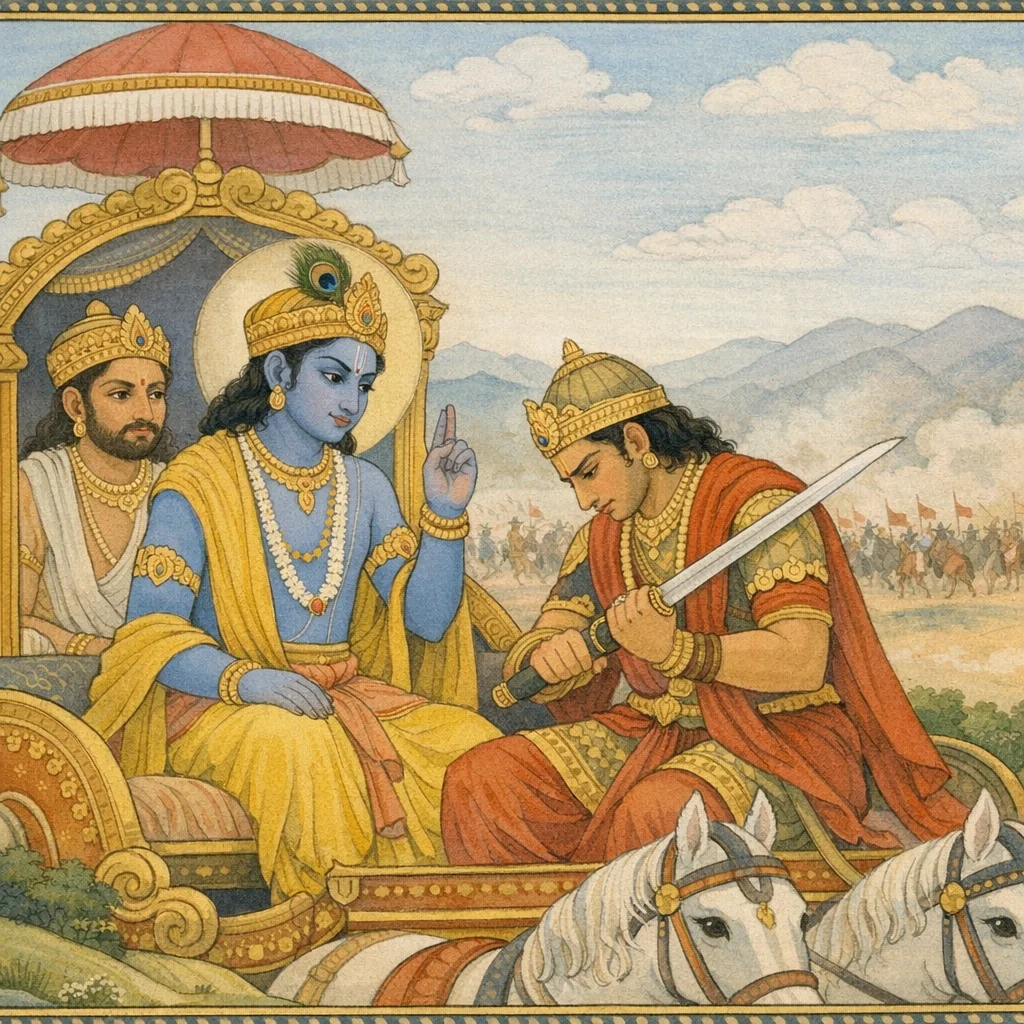
Adhyaya 69
कर्णनिधनवृत्तान्तनिवेदनम् | Reporting Karṇa’s Fall to Yudhiṣṭhira
Upa-parva: Karṇa-vadha-anunaya (Report and reception of Karṇa’s fall)
Sañjaya narrates that after Karṇa is brought down and the Kaurava host disperses, Kṛṣṇa (Dāśārha) embraces Arjuna and praises the feat by analogizing it to Indra’s slaying of Vṛtra, predicting that people will recount the paired exempla (Vṛtra and Karṇa). Kṛṣṇa proposes that the victory be reported to Dharmarāja Yudhiṣṭhira so Arjuna may be freed from the long-standing obligation of confronting Karṇa. Kṛṣṇa turns the chariot and instructs key allies (Dhṛṣṭadyumna, Yudhāmanyu, the Mādrī twins, Bhīma, Sātyaki) to remain facing the opponent until the news is delivered. Reaching Yudhiṣṭhira, Kṛṣṇa and Arjuna take his feet; observing their joy and the extraordinary nature of the blows, Yudhiṣṭhira infers Karṇa’s death and rises. Kṛṣṇa recounts the events and offers a controlled congratulation, emphasizing survival after severe attrition and urging prompt attention to subsequent duties. Yudhiṣṭhira praises Kṛṣṇa and Arjuna, articulates the Nara–Nārāyaṇa identification as earlier taught by Nārada and Vyāsa, and attributes assured victory to Kṛṣṇa’s charioteership. He then goes to view Karṇa’s body on the battlefield and publicly commends the victors; the allies celebrate and return to camp. The frame then shifts: Vaiśaṃpāyana reports that hearing this unwelcome news, Dhṛtarāṣṭra collapses, Gāndhārī is also overcome, and Vidura and Sañjaya console and support them, marking the psychological cost of battlefield intelligence within the epic’s courtly frame.
Chapter Arc: रणभूमि में अर्जुन क्रोध से खड्ग उठा लेता है—मानो अपने ही पक्ष के धर्मराज युधिष्ठिर पर प्रहार करने को उद्यत हो। संजय धृतराष्ट्र से कहता है: अब धर्म का सूक्ष्म तत्त्व कथा-उदाहरणों से समझाया जाएगा। → केशव अर्जुन के मन का वेग पहचानकर पूछते हैं—“पार्थ, यह खड्ग क्यों?” और बताते हैं कि भीमसेन ने धृतराष्ट्र-पुत्रों को दबा रखा है; अभी अर्जुन के लिए बाह्य शत्रु से अधिक बड़ा संकट भीतर का आवेश है। युधिष्ठिर की ओर देखते हुए अर्जुन का द्वंद्व बढ़ता है—प्रतिज्ञा, अपमान, और भ्रातृ-धर्म आमने-सामने खड़े हैं। → कृष्ण धर्म के सूक्ष्म मार्ग को दो दृष्टान्तों से उघाड़ते हैं—बलाक-व्याध (जो अहिंसा-आडम्बर वाले कौशिक को धर्म का मर्म समझाता है) और कौशिक मुनि (जिसकी ‘सत्य’ वाणी डाकुओं के हाथ निर्दोषों की मृत्यु का कारण बनती है)। निष्कर्ष तीखा है: ‘अविचारित सत्य’ भी अधर्म बन सकता है; जहाँ प्राण-रक्षा हो वहाँ असत्य भी श्रेयस्कर है। → अर्जुन को यह बोध कराया जाता है कि धर्म का निर्णय केवल शब्द-पालन से नहीं, परिणाम और करुणा से होता है—“प्राणिनामवधः… न तु हिंस्यात् कथंचन।” क्रोध शान्त होता है; भ्रातृ-वध का पाप टलता है। अर्जुन कृष्ण को परम आश्रय मानकर उनके निर्णय को स्वीकार करता है। → युद्ध का कोलाहल पृष्ठभूमि में बना रहता है—धर्म-निर्णय की यह शिक्षा अगले क्षण फिर रण-नीति और प्रतिज्ञाओं की अग्नि में परखी जाने वाली है।
Shlokas
Verse 1
अफ्-#-#कत एकोनसप्ततितमो<ध्याय: वध करनेके लिये उद्यत हुए भगवान् बलाकव्याध और कौशिक पनिकी कण सुनाते हुए धर्मका तत्त्व बताकर समझाना संजय उवाच युधिष्ठिरेणैवमुक्त: कौन्तेय: श्वेतवाहन: । असिं जग्राह संक्रुद्धों जिघांसुर्भरतर्षभम्,संजय कहते हैं--राजन्! युधिष्ठिरके ऐसा कहनेपर श्वेतवाहन कुन्तीकुमार अर्जुनको बड़ा क्रोध हुआ। उन्होंने भरतश्रेष्ठ युधिष्ठिरको मार डालनेकी इच्छासे तलवार उठा ली
Sanjaya said: O King, when Yudhishthira spoke thus, Arjuna—the son of Kunti, famed as the rider of the white-steeded chariot—was seized by intense anger. Intent on killing Yudhishthira, the bull among the Bharatas, he drew his sword.
Verse 2
तस्य कोपं समुद्वीक्ष्य चित्तज्ञ: केशवस्तदा । उवाच किमिदं पार्थ गृहीतः खड्ग इत्युत,उस समय उनका क्रोध देखकर सबके मनकी बात जाननेवाले भगवान् श्रीकृष्णने पूछा --'पार्थ! यह क्या? तुमने तलवार कैसे उठा ली?
Seeing his anger rise, Keśava—who knows the movements of every mind—spoke at once: “Pārtha, what is this? Why have you taken up the sword?” The question underscores a moral check on impulsive wrath in the midst of war, reminding the warrior that even justified battle must remain governed by self-control and right purpose.
Verse 3
न हि पश्यामि योद्धव्यं त्वया किज्चिद् धनंजय । ते ग्रस्ता धार्तराष्ट्रा हि भीमसेनेन धीमता,“धनंजय! यहाँ तुम्हें किसीके साथ युद्ध करना हो, ऐसा तो नहीं दिखायी देता; क्योंकि धृतराष्ट्रके पुत्रोंकोी बुद्धिमान भीमसेनने कालका ग्रास बना रखा है
Sañjaya said: “Dhanañjaya, I do not see that there remains anything for you to fight here. For the sons of Dhṛtarāṣṭra have already been swallowed up—as if by Death itself—by the wise and mighty Bhīmasena.”
Verse 4
अपयातोड<सि कौन्तेय राजा द्रष्टव्य इत्यपि । स राजा भवता दृष्ट: कुशली च युधिषछिर:,“कुन्तीनन्दन! तुम तो यह सोचकर युद्धसे हट आये थे कि राजा युधिष्ठिरका दर्शन कर लूँ। सो तुमने राजाका दर्शन कर लिया। राजा युधिष्ठिर सब प्रकारसे सकुशल हैं
Sañjaya said: “O son of Kuntī, you had withdrawn from the battle thinking, ‘I must see the king.’ Now you have indeed seen that king; and Yudhiṣṭhira is safe and well.”
Verse 5
स दृष्टवा नृपशार्दूलं शार्टूल्समविक्रमम् । हर्षकाले च सम्प्राप्ते किमिदे मोहकारितम्,“सिंहके समान पराक्रमी नृपश्रेष्ठ युधिष्ठिरको स्वस्थ देखकर जब तुम्हारे लिये हर्षका अवसर आया है, ऐसे समयमें यह मोहकारित कौन-सा कृत्य होने जा रहा है?
Sañjaya said: “Seeing King Yudhiṣṭhira—the tiger among men—safe and possessed of tiger-like valor, when the moment calls for joy, what is this delusion-driven course of action that is about to be undertaken?”
Verse 6
न तं पश्यामि कौन्तेय यस्ते वध्यो भविष्यति । प्रहर्तुमिच्छसे कस्मात् कि वा ते चित्तविभ्रम:,“कुन्तीनन्दन! मैं किसी ऐसे मनुष्यको भी यहाँ नहीं देखता, जो तुम्हारे द्वारा वध करनेके योग्य हो। फिर तुम प्रहार क्यों करना चाहते हो? तुम्हारे चित्तमें भ्रम तो नहीं हो गया है?
Sañjaya said: “O son of Kuntī, I do not see anyone here who is fit to be slain by you. Why then do you wish to strike? Has your mind fallen into confusion?”
Verse 7
कस्माद् भवान् महाखडूगं परिगृह्नाति सत्वर: । तत् त्वां पृच्छामि कौन्तेय किमिदं ते चिकीर्षितम्
Sañjaya said: “Why are you so quickly taking up that great sword? I ask you this, O son of Kuntī—what is it that you intend to do?”
Verse 8
एवमुक्तस्तु कृष्णेन प्रेक्षमाणो युधिष्ठिरम्
Sañjaya said: Thus addressed by Kṛṣṇa, he kept his gaze fixed upon Yudhiṣṭhira—attentive, weighing the counsel amid the moral strain of war.
Verse 9
अन्यस्मै देहि गाण्डीवमिति मां योडभिचोदयेत्,“जो मुझसे यह कह दे कि तुम अपना गाण्डीव धनुष दूसरेको दे दो, उसका मैं सिर काट लूँगा।' मैंने मन-ही-मन यह प्रतिज्ञा कर रखी है। अनन्त पराक्रमी गोविन्द! आपके सामने ही इन महाराजने मुझसे वह बात कही है, अतः मैं इन्हें क्षमा नहीं कर सकता; इन धर्मभीरु नरेशका वध करूँगा
Sañjaya said: “Whoever urges me, ‘Give the Gāṇḍīva to another,’—I have vowed in my heart that I will cut off his head. O Govinda of boundless prowess, this great king spoke those very words to me in your presence; therefore I cannot forgive him. I will slay this king, though he is one who fears to transgress dharma.”
Verse 10
भिन्द्यामहं तस्य शिर इत्युपांशुब्रतं मम । तदुक्त मम चानेन राज्ञामितपराक्रम,“जो मुझसे यह कह दे कि तुम अपना गाण्डीव धनुष दूसरेको दे दो, उसका मैं सिर काट लूँगा।' मैंने मन-ही-मन यह प्रतिज्ञा कर रखी है। अनन्त पराक्रमी गोविन्द! आपके सामने ही इन महाराजने मुझसे वह बात कही है, अतः मैं इन्हें क्षमा नहीं कर सकता; इन धर्मभीरु नरेशका वध करूँगा
Sañjaya said: “I have taken a secret vow within myself: ‘I will split the head of the man who tells me, “Give your Gāṇḍīva bow to someone else.”’ That very statement has now been spoken to me by this king, O Govinda of boundless prowess, and it was spoken in your very presence. Therefore I cannot forgive him. Though he is a king who fears dharma, I will kill him.”
Verse 11
समक्ष तव गोविन्द न तत् क्षन्तुमिहोत्सहे | तस्मादेनं वधिष्यामि राजानं धर्मभीरुकम्,“जो मुझसे यह कह दे कि तुम अपना गाण्डीव धनुष दूसरेको दे दो, उसका मैं सिर काट लूँगा।' मैंने मन-ही-मन यह प्रतिज्ञा कर रखी है। अनन्त पराक्रमी गोविन्द! आपके सामने ही इन महाराजने मुझसे वह बात कही है, अतः मैं इन्हें क्षमा नहीं कर सकता; इन धर्मभीरु नरेशका वध करूँगा
Sañjaya said: “O Govinda, right before you I cannot bring myself to forgive that here. Therefore I shall kill this king, timid in the name of dharma.”
Verse 12
प्रतिज्ञां पालयिष्यामि हत्वैनं नरसत्तमम् | एतदर्थ मया खड्गो गृहीतो यदुनन्दन,“यदुनन्दन! इन नरश्रेष्ठका वध करके मैं अपनी प्रतिज्ञाका पालन करूँगा; इसीलिये मैंने यह खड्ग हाथमें लिया है
Sañjaya said: “I shall keep my vow by slaying this foremost of men. It is for this very purpose, O delight of the Yadus, that I have taken up the sword.”
Verse 13
सो<हं युधिष्ठिरं हत्वा सत्यस्यानृण्यतां गत: । विशोको विज्वरश्नापि भविष्यामि जनार्दन,'जनार्दन! मैं युधिष्ठिरका वध करके उस सच्ची प्रतिज्ञाके भारसे उक्रणप हो शोक और चिन्तासे मुक्त हो जाऊँगा
“Having slain Yudhiṣṭhira, I shall be freed from the debt of my pledged word. Then, O Janārdana, I will become free from grief and feverish anxiety.”
Verse 14
किं वा त्वं मन्यसे प्राप्तमस्मिन् काल उपस्थिते । त्वमस्य जगतस्तात वेत्थ सर्व गतागतम्
Sanjaya said: “What, then, do you think has come to pass, now that this critical moment has arrived? You, dear one, know the whole course of this world—everything that comes and goes.”
Verse 15
संजय उवाच धिग् धिगित्येव गोविन्द: पार्थमुक्त्वाब्रवीत् पुन:,संजय कहते हैं--राजन्! यह सुनकर भगवान् श्रीकृष्ण अर्जुनसे 'धिक्कार है! धिककार है!!' ऐसा कहकर पुनः इस प्रकार बोले
Sañjaya said: O King, hearing this, Govinda (Śrī Kṛṣṇa) rebuked Arjuna—crying, “Shame! Shame!”—and then spoke to him again.
Verse 16
श्रीकृष्ण उवाच इदानीं पार्थ जानामि न वृद्धा: सेवितास्त्वया । काले न पुरुषव्याप्र संरम्भं॑ यद् भवानगात्
Śrī Kṛṣṇa said: “Now, O Pārtha, I understand that you have not served (or heeded) the elders. For at the proper time, O man of action, you did not rise with the necessary resolve.”
Verse 17
श्रीकृष्णने कहा--पार्थ! इस समय मैं समझता हूँ कि तुमने वृद्ध पुरुषोंकी सेवा नहीं की है। पुरुषसिंह! इसीलिये तुम्हें बिना अवसरके ही क्रोध आ गया है ।। न हि धर्मविभागज्ञ: कुयदिवं धनंजय । यथा त्वं पाण्डवाद्येह धर्मभीरुरपण्डित:,पाण्डुपुत्र धनंजय! जो धर्मके विभागको जाननेवाला है, वह कभी ऐसा नहीं कर सकता, जैसा कि यहाँ आज तुम करना चाहते हो। वास्तवमें तुम धर्मभीरु होनेके साथ ही बुद्धिहीन भी हो
Śrī Kṛṣṇa said: “Pārtha, at this moment I think you have not served and learned from the elders. O lion among men, that is why anger has seized you without proper occasion. One who truly understands the distinctions within dharma would never act in the way you now intend to act here today, Dhanañjaya. Pāṇḍu’s son, you are fearful about dharma, yet you are acting without discernment.”
Verse 18
अकार्याणां क्रियाणां च संयोगं य: करोति वै । कार्याणामक्रियाणां च स पार्थ पुरुषाधम:,पार्थ! जो करनेयोग्य होनेपर भी असाध्य हों तथा जो साध्य होनेपर भी निषिद्ध हों ऐसे कर्मोसे जो सम्बन्ध जोड़ता है, वह पुरुषोंमें अधम माना गया है
Śrī Kṛṣṇa said: “O Pārtha, the lowest among men is he who forges an alliance with what ought not to be done, and with actions that should not be undertaken; and who likewise turns away from what ought to be done, failing to act where duty calls. Such a person confuses the boundaries of right and wrong and thereby falls from dharma.”
Verse 19
अनुसृत्य तु ये धर्म कथयेयुरुपस्थिता: । समासविस्तरदविदां न तेषां वेत्सि निश्चयम्,जो स्वयं धर्मका अनुसरण एवं आचरण करके शिष्योंद्वारा उपासित होकर उन्हें धर्मका उपदेश देते हैं; धर्मके संक्षेप एवं विस्तारको जाननेवाले उन गुरुजनोंका इस विषयमें क्या निर्णय है, इसे तुम नहीं जानते
But you do not know the settled judgment of those teachers who themselves follow and practice dharma, who are approached and honored by disciples, and who then teach dharma—those who understand both its concise principles and its detailed applications.
Verse 20
अनिन्चयज्ञो हि नर: कार्याकार्यविनिश्चये । अवशो मुहाते पार्थ यथा त्वं मूढ एव तु,पार्थ! उस निर्णयको न जाननेवाला मनुष्य कर्तव्य और अकर्तव्यके निश्चयमें तुम्हारे ही समान असमर्थ, विवेकशून्य एवं मोहित हो जाता है
A man who lacks the capacity for decisive understanding becomes helplessly deluded when it comes to determining what ought to be done and what ought not to be done. O Partha, he falls into confusion—just as you, too, are now bewildered.
Verse 21
न हि कार्यमकार्य वा सुखं ज्ञातुं कथंचन । श्रुतेन ज्ञायते सर्व तच्च त्वं नावबुध्यसे,कर्तव्य और अकर्तव्यका ज्ञान किसी तरह भी अनायास ही नहीं हो जाता है। वह सब शास्त्रसे जाना जाता है और शास्त्रका तुम्हें पता ही नहीं है
Kṛṣṇa said: “One cannot, by any easy means, discern what ought to be done and what ought not to be done. All this is known through śruti—authoritative sacred teaching—and yet you do not comprehend it.”
Verse 22
अविज्ञानाद् भवान् यच्च धर्म रक्षति धर्मवित् | प्राणिनां त्वं वध पार्थ धार्मिको नावबुध्यसे,कुन्तीनन्दन! तुम अज्ञानवश अपनेको धर्मज्ञ मानकर जो धर्मकी रक्षा करने चले हो, उसमें प्राणिहिंसाका पाप है, यह बात तुम्हारे-जैसे धार्मिककी समझमें नहीं आती है
Śrī Kṛṣṇa said: “Out of ignorance, you set out to ‘protect dharma,’ thinking yourself a knower of dharma. Yet you do not grasp that in this course there is the sin of violence against living beings. O Pārtha, O son of Kuntī—this is what even you, who consider yourself righteous, fail to understand.”
Verse 23
प्राणिनामवधस्तात सर्वज्यायान् मतो मम । अनृतां वा वदेद् वाचं न तु हिंस्थात् कथंचन,तात! मेरे विचारसे प्राणियोंकी हिंसा न करना ही सबसे श्रेष्ठ धर्म है। किसीकी प्राणरक्षाके लिये झूठ बोलना पड़े तो बोल दे, किंतु उसकी हिंसा किसी तरह न होने दे
Krishna said: “Dear one, in my judgment the highest course of all is this: do not kill living beings. Even if one must speak an untruth to save a life, let one speak it—but in no way should one commit violence against that being.”
Verse 24
स कथं भ्रातरं ज्येष्ठं राजानं धर्मकोविदम् | हन्याद् भवान् नरश्रेष्ठ प्राकृतो5न्य: पुमानिव,नरश्रेष्ठ) तुम दूसरे गवाँर मनुष्यके समान अपने बड़े भाई धर्मज्ञ नरेशका वध कैसे करोगे?
How could you, O best of men, kill your elder brother—the king who is skilled in dharma—like some other ordinary, uncultured man?
Verse 25
अयुध्यमानस्य वधस्तथाशत्रोश्व मानद | पराड्मुखस्य द्रवत: शरणं चापि गच्छत:,मानद! जो युद्ध न करता हो, शत्रुता न रखता हो, संग्रामसे विमुख होकर भागा जा रहा हो, शरणमें आता हो, हाथ जोड़कर आश्रयमें आ पड़ा हो तथा असावधान हो, ऐसे मनुष्यका वध करना श्रेष्ठ पुरुष अच्छा नहीं समझते हैं। तुम्हारे बड़े भाईमें उपर्युक्त सभी बातें हैं
Śrī Kṛṣṇa said: “O noble one, the killing of a man who is not fighting, who bears no enmity, who has turned away from battle and is fleeing, or who is going for refuge—indeed, one who comes seeking protection—is not approved by the best of men. All these conditions apply to your elder brother.”
Verse 26
कृताञ्जले: प्रपन्नस्य प्रमत्तस्य तथैव च | न वध: पूज्यते सद्धिस्तच्च सर्व गुरौ तव,मानद! जो युद्ध न करता हो, शत्रुता न रखता हो, संग्रामसे विमुख होकर भागा जा रहा हो, शरणमें आता हो, हाथ जोड़कर आश्रयमें आ पड़ा हो तथा असावधान हो, ऐसे मनुष्यका वध करना श्रेष्ठ पुरुष अच्छा नहीं समझते हैं। तुम्हारे बड़े भाईमें उपर्युक्त सभी बातें हैं
Śrī Kṛṣṇa said: “The good do not approve the killing of one who has come seeking refuge, one who stands with joined palms in supplication, or one who is heedless and unprepared. Such a slaying is not honored among the righteous. And, O bestower of honor, all these conditions apply to your elder brother.”
Verse 27
त्वया चैवं व्रतं पार्थ बालेनेव कृत॑ पुरा । तस्मादधर्मसंयुक्त मौख्यात् कर्म व्यवस्यसि,पार्थ! तुमने नासमझ बालकके समान पहले कोई प्रतिज्ञा कर ली थी, इसीलिये तुम मूर्खतावश अधर्मयुक्त कार्य करनेको तैयार हो गये हो
O Partha, you once made such a vow in the manner of an unthinking child. Therefore, out of foolishness, you are now resolved to undertake an act bound up with adharma.
Verse 28
स गुरु पार्थ कस्मात् त्वं हन्तुकामोडभिधावसि । असम्प्रधार्य धर्माणां गतिं सूक्ष्मां दुरत्ययाम्
Śrī Kṛṣṇa said: “O Pārtha, he is your revered elder and teacher—why do you rush forward with the intent to kill him, without first reflecting on the subtle, difficult-to-cross course of dharma? In such a moment, action must be weighed against duty, gratitude, and the hidden consequences that follow from violating moral order.”
Verse 29
कुन्तीकुमार! बताओ तो तुम धर्मके सूक्ष्म एवं दुर्बोध स्वरूपका अच्छी तरह विचार किये बिना ही अपने ज्येष्ठ भ्राताका वध करनेके लिये कैसे दौड़ पड़े? ।। इदं धर्मरहस्यं च तव वक्ष्यामि पाण्डव । यद् ब्रूयात् तव भीष्मो हि पाण्डवो वा युधिषछिर:,पाण्डुनन्दन! मैं तुम्हें यह धर्मका रहस्य बता रहा हूँ। धनंजय! पितामह भीष्म, पाण्डुपुत्र युधिष्ठिर विदुरजी अथवा यशस्विनी कुन्तीदेवी--ये लोग तुम्हें धर्मके जिस तत्त्वका उपदेश कर सकते हैं, उसीको मैं ठीक-ठीक बता रहा हूँ। इसे ध्यान देकर सुनो
Krishna said: “Son of Kunti, tell me—how have you rushed to kill your eldest brother without first reflecting well on the subtle and hard-to-grasp nature of dharma? I will explain to you this secret of dharma, O Pandava. Whatever teaching on this principle Bhishma, or Yudhishthira the Pandava, or Vidura, or the illustrious Lady Kunti could give you—exactly that I shall state to you correctly. Listen to it with a collected mind, O Dhananjaya.”
Verse 30
विदुरो वा तथा क्षत्ता कुन्ती वापि यशस्विनी । तत् ते वक्ष्यामि तत्त्वेन निबोधैतद् धनंजय,पाण्डुनन्दन! मैं तुम्हें यह धर्मका रहस्य बता रहा हूँ। धनंजय! पितामह भीष्म, पाण्डुपुत्र युधिष्ठिर विदुरजी अथवा यशस्विनी कुन्तीदेवी--ये लोग तुम्हें धर्मके जिस तत्त्वका उपदेश कर सकते हैं, उसीको मैं ठीक-ठीक बता रहा हूँ। इसे ध्यान देकर सुनो
Śrī Kṛṣṇa said: “Whether it be Vidura, the chamberlain (Kṣattā), or the illustrious Kuntī—whatever principle of dharma they could teach you, I shall now declare to you in its true essence. Attend carefully to this, O Dhanañjaya, son of Pāṇḍu.”
Verse 31
सत्यस्य वचन साधु न सत्याद् विद्यते परम् तत्त्वेनैव सुदुर्ज्ञेयं पश्य सत्यमनुछितम्,सत्य बोलना उत्तम है। सत्यसे बढ़कर दूसरा कुछ नहीं है; परंतु यह समझ लो कि सत्पुरुषोंद्वारा आचरणमें लाये हुए सत्यके यथार्थ स्वरूपका ज्ञान अत्यन्त कठिन होता है
“Speaking the truth is noble; nothing stands higher than truth. Yet understand this: the real nature of truth—truth as it is rightly lived and embodied by the good—is exceedingly difficult to discern. See how subtle and context-bound truth can be.”
Verse 32
भवेत् सत्यमवक्तव्यं वक्तव्यमनृतं भवेत् । यत्रानृतं भवेत् सत्यं सत्यं चाप्यनृतं भवेत्,जहाँ मिथ्या बोलनेका परिणाम सत्य बोलनेके समान मंगलकारक हो अथवा जहाँ सत्य बोलनेका परिणाम असत्यभाषणके समान अनिष्टकारी हो, वहाँ सत्य नहीं बोलना चाहिये। वहाँ असत्य बोलना ही उचित होगा
“There are times when truth should not be spoken, and times when untruth should be spoken. Where an untruth brings about auspicious good as though it were truth, or where speaking truth brings harm as though it were falsehood—there one should not speak the truth; there, speaking untruth is the proper course.”
Verse 33
विवाहकाले रतिसम्प्रयोगे प्राणात्यये सर्वधनापहारे । विप्रस्य चार्थे हानृतं वदेत पज्चानृतान्याहुरपातकानि,विवाहकालमें, स्त्रीप्रसंगके समय, किसीके प्राणोंपर संकट आनेपर, सर्वस्वका अपहरण होते समय तथा ब्राह्मणकी भलाईके लिये आवश्यकता हो तो असत्य बोल दे; इन पाँच अवसरोंपर झूठ बोलनेसे पाप नहीं होता
Śrī Kṛṣṇa said: “At the time of marriage, in the context of sexual union, when life is in danger, when one’s entire wealth is being carried off, and when it is necessary for the welfare of a brāhmaṇa—one may speak an untruth. Untruths spoken on these five occasions are declared to be non-sinful.”
Verse 34
सर्वस्वस्यापहारे तु वक्तव्यमनृतं भवेत् । तत्रानृतं भवेत् सत्यं सत्यं चाप्यनृतं भवेत्
Śrī Kṛṣṇa said: “When one’s entire livelihood and possessions are being seized, speaking what is untrue may become a duty. In such a crisis, what is ‘untrue’ can function as truth, and what is ‘true’ can, in effect, become untrue—because the ethical weight lies in protecting life and rightful welfare rather than in bare literal accuracy.”
Verse 35
भवेत् सत्यमवक्तव्यं न वक्तव्यमनुछितम् । सत्यानृते विनिश्चित्य ततो भवति धर्मवित्,केवल अनुष्ठानमें लाया गया असत्यरूप सत्य बोलनेयोग्य नहीं होता, अतः वैसा सत्य न बोले। पहले सत्य और असत्यका अच्छी तरह निर्णय करके जो परिणाममें सत्य हो उसका पालन करे। जो ऐसा करता है, वही धर्मका ज्ञाता है
Śrī Kṛṣṇa said: “There are times when something may be factually true, yet it ought not be spoken; and what is improper should not be uttered. One should first discern carefully between truth and untruth, and then follow that course which, in its outcome, upholds truth. The one who acts with such discrimination is the true knower of dharma.”
Verse 36
किमाश्चर्य कृतप्रज्ञ: पुरुषोडपि सुदारुण: । सुमहत् प्राप्तुयात् पुण्यं बलाको5न्धवधादिव
Śrī Kṛṣṇa said: “What is so surprising in this? Even a man of firm resolve, though exceedingly cruel, may obtain very great merit—just as Balāka did through the slaying of the blind.”
Verse 37
जिसकी बुद्धि शुद्ध (निष्काम) है, वह पुरुष यदि अत्यन्त कठोर होकर भी, जैसे अंधे पशुको मार देनेसे बलाक नामक व्याध पुण्यका भागी हुआ था, उसी प्रकार महान् पुण्य प्राप्त कर ले तो कया आश्चर्य है? ।। किमाश्चर्य पुनर्मूढो धर्मकामो हापण्डित: । सुमहत् प्राप्तुयात् पापमापगास्विव कौशिक:,इसी तरह जो धर्मकी इच्छा तो रखता है, पर है मूर्ख और अज्ञानी, वह नदियोंके संगमपर बसे हुए कौशिक मुनिकी भाँति यदि अज्ञानपूर्वक धर्म करके भी महान् पापका भागी हो जाय तो क्या आश्चर्य है?
Śrī Kṛṣṇa said: “What wonder is it, then, if a man who is deluded—though he desires righteousness, yet lacks true discernment—should incur a very great sin, just as the sage Kauśika, dwelling at the confluence of rivers, became implicated in grave wrongdoing through an act performed in ignorance under the guise of dharma? By contrast, when one’s intellect is purified and free from selfish motive, even a deed that appears harsh may yield great merit—like the hunter Bālaka, who gained religious merit by killing a blind beast.”
Verse 38
अजुन उवाच आचक्ष्व भगवन्नेतद् यथा विन्दाम्यहं तथा । बलाकस्यानुसम्बन्धं नदीनां कौशिकस्य च
Arjuna said: “O revered one, explain this to me so that I may truly understand—how the heron Balāka is connected with the rivers, and how it is connected with Kauśika as well.”
Verse 39
अर्जुन बोले--भगवन्! बलाक नामक व्याध और नदियोंके संगमपर रहनेवाले कौशिक मुनिकी कथा कहिये, जिससे मैं इस विषयको अच्छी तरह समझ सकूँ ।। वायुदेव उवाच पुरा व्याधो5भवत् कश्चिद् बलाको नाम भारत । यात्रार्थ पुत्रदारस्य मृगान् हन्ति न कामतः,भगवान् श्रीकृष्णने कहा--भारत! प्राचीनकालमें बलाक नामसे प्रसिद्ध एक व्याध रहता था, जो अपनी स्त्री और पुत्रोंकी जीवनरक्षाके लिये ही हिंसक पशुओंको मारा करता था, कामनावश नहीं
Arjuna said: “O Blessed One, please tell me the story of the hunter named Balāka and of the sage Kauśika who lived at the confluence of rivers, so that I may understand this matter clearly.” Vāyu said: “In ancient times, O Bhārata, there was a hunter known as Balāka. To sustain and protect his wife and children, he killed wild animals—not out of desire or cruelty.”
Verse 40
वृद्धी च मातापितरी बिभर्त्यन्यांश्व॒ संश्रितान् स्वधर्मनिरतो नित्यं सत्यवागनसूयक:
He supports the aged and maintains his mother and father; he also sustains others who have taken refuge with him. Ever devoted to his own dharma, he speaks truthfully and is free from malice or fault-finding.
Verse 41
वह बूढ़े माता-पिता तथा अन्य आश्रित जनोंका पालन-पोषण किया करता था। सदा अपने धर्ममें लगा रहता, सत्य बोलता और किसीकी निन्दा नहीं करता था ।। स कदाचिन्मृगं लिप्सुर्नाभ्यविन्दन्मृगं क्वचित् । अप: पिबन्तं ददशे श्वापदं प्राणचक्षुषम्,एक दिन वह पशुको मार लानेके लिये वनमें गया; किंतु कहीं किसी हिंसक पशुको न पा सका। इतनेहीमें उसे एक पानी पीता हुआ हिंसक जानवर दिखायी दिया, जो अंधा था, नाकसे सूँघकर ही आँखका काम निकाला करता था
He cared for his aged parents and other dependents, ever devoted to his dharma, speaking truth and slandering none. Once, seeking game, he went into the forest but found no quarry anywhere. Then he saw a fierce beast drinking water—blind, using its breath and sense of smell as its ‘eyes’.
Verse 42
अदृष्टपूर्वमपि तत् सत्त्वं तेन हतं तदा । अन्धे हते ततो व्योम्न: पुष्पवर्ष पपात च,यद्यपि वैसे जानवरको व्याधने पहले कभी नहीं देखा था, तो भी उस समय उसने मार डाला। उस अंधे पशुके मारे जाते ही आकाशसे व्याधपर फूलोंकी वर्षा होने लगी
Though he had never seen that creature before, he killed it then and there. And when that blind beast was slain, a shower of flowers fell from the sky upon the hunter.
Verse 43
अप्सरोगीतवादिन्रै्नादितं च मनोरमम् | विमानमगमत् स्वर्गान्मृगव्याधनिनीषया
Vāyu said: “That delightful celestial chariot, resonant with the songs of the Apsarās and the sound of their instruments, set out from heaven—moved by the intention to raise the hunter to a higher state.”
Verse 44
साथ ही उस हिंसक पशुओंको मारनेवाले व्याधको ले जानेके लिये स्वर्गसे एक सुन्दर विमान उतर आया, जो अप्सराओंके गीतों और वाद्योंकी मधुर ध्वनिसे मुखरित होनेके कारण बड़ा मनोरम जान पड़ता था ।। तद् भूत॑ सर्वभूतानामभावाय किलार्जुन । तपस्तप्त्वा वरं प्राप्त कृतमन्ध॑ स्वयम्भुवा,अर्जुन! लोग कहते हैं कि उस जन्तुने पूर्वजन्ममें तप करके सम्पूर्ण प्राणियोंका संहार कर डालनेके लिये वर प्राप्त किया था; इसीलिये ब्रह्माजीने उसे अन्धा बना दिया था
Vāyu said: “O Arjuna, people say that this creature, in a former birth, performed austerities and obtained a boon aimed at the destruction of all living beings. Therefore Svayambhū (Brahmā), to restrain that perilous power, made it blind.”
Verse 45
तद्धत्वा सर्वभूतानामभावकृतनिश्चयम् । ततो बलाक: स्वरगादेवं धर्म: सुदुर्विद:,इस प्रकार समस्त प्राणियोंका अन्त कर देनेके निश्चयसे युता उस जन्तुको मारकर बलाक स्वर्गलोकमें चला गया; अतः धर्मका स्वरूप अत्यन्त दुर्ज्य है
Having slain that creature, firmly resolved upon bringing about the destruction of all living beings, Balāka then went to heaven. Thus, the true nature of dharma is exceedingly difficult to discern.
Verse 46
कौशिकोडप्यभवद् विप्रस्तपस्वी नो बहुश्रुतः । नदीनां संगमे ग्रामाददूरात्ू स किलावसत्,इसी तरह कौशिक नामका एक तपस्वी ब्राह्मण था, जो बहुत पढ़ा-लिखा या शास्त्रज्ञ नहीं था। वह गाँवके पास ही नदियोंके संगमपर निवास करता था
Vāyu said: “There was also a brāhmaṇa named Kauśika—an ascetic, though not widely learned in the scriptures. He lived not far from a village, at the confluence of rivers.”
Verse 47
सत्यं मया सदा वाच्यमिति तस्याभवद् व्रतम् । सत्यवादीति विख्यात: स तदा55सीद्ू धनंजय,धनंजय! उसने यह नियम ले लिया था कि मैं सदा सत्य ही बोलूँगा। इसलिये उन दिनों वह सत्यवादीके नामसे विख्यात हो गया था
He adopted a vow: “I must always speak the truth.” Because of that resolve, O Dhanaṃjaya, he became renowned in those days by the name “truth-speaker.”
Verse 48
अथ दस्युभयात् केचित् तदा तद् वनमाविशन् | तत्रापि दस्यव: क्रुद्धास्तानमार्गन्त यत्नतः,एक दिनकी बात है, कुछ लोग लुटेरोंके भयसे छिपनेके लिये उस वनमें घुस गये; परंतु वे लुटेरे कुपित हो वहाँ भी उन लोगोंका यत्नपूर्वक अनुसंधान करने लगे
Then, fearing the bandits, some people entered that forest to hide. Yet even there the bandits, enraged, diligently searched for them—showing how fear can drive the innocent into peril, while anger and greed make the violent relentless in their pursuit.
Verse 49
अथ कौशिकमभ्येत्य प्राहुस्ते सत्यवादिनम् । कतमेन पथा याता भगवन् बहवो जना:
Then, approaching the sage Kauśika—renowned as a speaker of truth—they addressed him: “O venerable one, by which path have many people gone?” The question frames a moral test: how a commitment to truth should be exercised when one’s words may affect the welfare of others.
Verse 50
स पृष्ट: कौशिक: सत्यं वचनं तानुवाच ह
When questioned, Kauśika spoke to them a truthful statement—upholding the ethic of truthfulness even under pressure, and setting the stage for the moral tension between speaking truth and preventing harm.
Verse 51
बहुवृक्षलतागुल्ममेतद् वनमुपाश्रिता: । इति तान् ख्यापयामास तेभ्यस्तत्त्वंस कौशिक:
“This forest, thick with many trees, creepers, and shrubs, has been taken as a refuge.” Thus did Kauśika make this known to them, clearly explaining the true situation. In the narrative frame, the line underscores how a guide or knower of dharma must speak plainly about circumstances—especially when others have sought shelter—so that right action can be chosen with full awareness rather than confusion or concealment.
Verse 52
उनके इस प्रकार पूछनेपर कौशिक मुनिने उन्हें सच्ची बात बता दी--“इस वनमें जहाँ बहुत-से वृक्ष, लताएँ और झाड़ियाँ हैं, वहीं वे गये हैं।! इस प्रकार कौशिकने उन दस्युओंको यथार्थ बात बता दी ।। ततस्ते तान् समासाद्य क्रूरा जघ्नुरिति श्रुति: । तेनाधर्मेण महता वाग्दुरुक्तेन कौशिक:
When they asked in this way, the sage Kauśika told them the truth: “In this forest—where there are many trees, creepers, and shrubs—there they have gone.” Thus Kauśika disclosed the plain facts to those bandits. Then those men, having caught up with them, cruelly killed them—so the tradition reports. By that great act of unrighteousness, brought about through harsh and ill-used speech, the sage Kauśika became implicated in grave moral fault.
Verse 53
यथा चाल्पश्रुतो मूढो धर्माणामविभागवित्
Just as a foolish man of scant learning, unable to discern the proper distinctions among the duties of dharma,
Verse 54
वृद्धानपृष्टवा संदेहं महच्छवभ्रमिवाहति । जिसे शास्त्रोंका बहुत थोड़ा ज्ञान है, जो विवेकशून्य होनेके कारण धर्मोके विभागको ठीक-ठीक नहीं जानता, वह मनुष्य यदि वृद्ध पुरुषोंसे अपने संदेह नहीं पूछता तो अनुचित कर्म कर बैठनेके कारण वह महान् नरकके सदृश कष्ट भोगनेके योग्य हो जाता है ।। ५३ ३ || तत्र ते लक्षणोद्ेश: कश्षिदेवं भविष्यति,धर्माधर्मके निर्णयके लिये तुम्हें संक्षेपसे कोई संकेत बताना पड़ेगा, जो इस प्रकार होगा। कुछ लोग परम ज्ञानरूप दुष्कर धर्मको तर्कके द्वारा जाननेका प्रयत्न करते हैं; परंतु एक श्रेणीके बहुसंख्यक मनुष्य ऐसा कहते हैं कि धर्मका ज्ञान वेदोंसे होता है
Vāyu said: “One who does not ask the elders to resolve his doubts is carried, as it were, into a great abyss. A person who has only a little learning in the śāstras and, being devoid of discernment, does not properly understand the divisions of dharma—if he fails to question venerable men about his uncertainties, he ends up committing improper acts and becomes fit to suffer grievous torments, like those of a great hell.”
Verse 55
दुष्करं परम॑ ज्ञानं तर्केणानुव्यवस्यति । श्रुतेर्थर्म इति होके वदन्ति बहवो जना:,धर्माधर्मके निर्णयके लिये तुम्हें संक्षेपसे कोई संकेत बताना पड़ेगा, जो इस प्रकार होगा। कुछ लोग परम ज्ञानरूप दुष्कर धर्मको तर्कके द्वारा जाननेका प्रयत्न करते हैं; परंतु एक श्रेणीके बहुसंख्यक मनुष्य ऐसा कहते हैं कि धर्मका ज्ञान वेदोंसे होता है
Vāyu said: “The highest knowledge—hard to attain—is pursued by some through reasoning and debate. Yet many people in the world maintain that the meaning of dharma is known from the Vedas (revealed scripture).”
Verse 56
तत् ते न प्रत्यसूयामि न च सर्व विधीयते । प्रभवार्थाय भूतानां धर्मप्रवचनं कृतम्,किंतु मैं तुम्हारे निकट इन दोनों मतोंके ऊपर कोई दोषारोपण नहीं करता; परंतु केवल वेदोंके द्वारा सभी धर्म-कर्मोंका विधान नहीं होता; इसीलिये धर्मज्ञ महर्षियोंने समस्त प्राणियोंके अभ्युदय और नि:श्रेयसके लिये उत्तम धर्मका प्रतिपादन किया है
Vāyu said: “I do not censure you for holding those views. Yet it is not the case that every rule of dharma and action is laid down solely by the Vedas. Therefore, the dharma-knowing great seers have articulated and taught excellent dharma for the welfare, uplift, and highest good of all living beings.”
Verse 57
यत् स्यादहिंसासंयुक्त स धर्म इति निश्चय: । अहिंसार्थाय भूतानां धर्मप्रवचनं कृतम्,सिद्धान्त यह है कि जिस कार्यमें हिंसा न हो, वही धर्म है। महर्षियोंने प्राणियोंकी हिंसा नहोने देनेके लिये ही उत्तम धर्मका प्रवचन किया है
Vāyu-deva said: “This is the settled conclusion: that which is joined with non-violence is Dharma. The sages taught the highest doctrine of Dharma precisely so that living beings might be protected through non-violence.”
Verse 58
धारणाद् धर्ममित्याहुर्धर्मों धारयते प्रजा: । यत् स्यथाद् धारणसंयुक्त स धर्म इति निश्चय:,धर्म ही प्रजाको धारण करता है और धारण करनेके कारण ही उसे धर्म कहते हैं। इसलिये जो धारण--प्राण-रक्षासे युक्त हो--जिसमें किसी भी जीवकी हिंसा न की जाती हो, वही धर्म है। ऐसा ही धर्म-शास्त्रोंका सिद्धान्त है
They say it is called dharma because it upholds. Dharma upholds the people. Therefore, whatever is joined with “upholding”—that is, whatever sustains life and protects living beings—is certainly dharma. This is the settled conclusion of the dharma-śāstras.
Verse 59
येउन्यायेन जिहीर्षन्तो धर्ममिच्छन्ति कहिचित् । अकूजनेन मोक्ष वा नानुकूजेत् कथंचन
Some people, while seeking to take away what is not rightfully theirs, still claim to desire dharma. But whether one seeks liberation or any other end, one should never lend approval—by silent acquiescence—to what is improper.
Verse 60
जो लोग अन्यायपूर्वक दूसरोंके धन आदिका अपहरण कर लेना चाहते हैं, वे कभी अपने स्वार्थकी सिद्धिके लिये दूसरोंसे सत्यभाषणरूप धर्मका पालन कराना चाहते हों तो वहाँ उनके समक्ष मौन रहकर उनसे पिण्ड छुड़ानेकी चेष्टा करे, किसी तरह कुछ बोले ही नहीं ।। अवश्यं कूजितव्ये वा शड्केरन्नप्पकूजत: । श्रेयस्तत्रानृतं वक्तुं तत् सत्यमविचारितम्,किंतु यदि बोलना अनिवार्य हो जाय अथवा न बोलनेसे लुटेरोंको संदेह होने लगे तो वहाँ असत्य बोलना ही ठीक है। ऐसे अवसरपर उस असत्यको ही बिना विचारे सत्य समझो
Vāyu-deva said: If one is compelled to speak, or if remaining silent would make the robbers suspicious, then in that situation it is better to speak an untruth. In such an emergency, that untruth should be accepted—without over-deliberation—as the “truth” to be spoken, because it serves the higher aim of escaping harm and protecting oneself from unjust aggressors.
Verse 61
यः कार्येभ्यो व्रतं कृत्वा तस्य नानोपपादयेत् । न तत्कलमवाप्रोति एवमाहुर्मनीषिण:
Vāyu said: “Whoever undertakes a vow with a view to accomplishing certain duties, but then fails to carry it through in the proper manner, does not attain the intended result. Thus have the wise declared.”
Verse 62
जो मनुष्य किसी कार्यके लिये प्रतिज्ञा करके उसका प्रकारान्तरसे उपपादन करता है, वह दम्भी होनेके कारण उसका फल नहीं पाता, ऐसा मनीषी पुरुषोंका कथन है ।। प्राणात्यये विवाहे वा सर्वज्ञातिवधात्यये । नर्मण्यभिप्रवृत्ते वा न च प्रोक्ते मृषा भवेत्
Vāyu said: “A man who makes a vow for some undertaking and then tries to ‘fulfil’ it by a different contrivance does not obtain its fruit, for such conduct is mere show; so declare the wise. However, a falsehood does not become blameworthy when life is at stake, or at a marriage, or when the slaughter of one’s entire kin is imminent, or in playful jest—provided it is not actually uttered.”
Verse 63
अधर्म नात्र पश्यन्ति धर्मतत्त्वार्थदर्शिन: । प्राणसंकटकालमें, विवाहमें, समस्त कुटुम्बियोंके प्राणान््तका समय उपस्थित होनेपर तथा हँसी-परिहास आरम्भ होनेपर यदि असत्य बोला गया हो तो वह असत्य नहीं माना जाता। धर्मके तत्त्वको जाननेवाले विद्वान् उक्त अवसरोंपर मिथ्या बोलनेमें पाप नहीं समझते ।। यः स्तेनैः सह सम्बन्धान्मुच्यते शपथैरपि
Vāyu said: Those who truly discern the meaning and principles of dharma do not see adharma in this. If an untrue word is spoken to save life in a time of peril, at the time of marriage, when the lives of an entire family are at stake, or when jest and playful banter has begun, it is not regarded as falsehood in the moral sense. The wise who know dharma’s essence do not deem it sinful to speak such untruth on these occasions. Moreover, one who is freed from association with thieves—even by means of an oath—is not blamed.
Verse 64
न च तेभ्यो धनं देयं शक्ये सति कथंचन
And no wealth should be given to them—when it lies within one’s power to decide otherwise—under any circumstances.
Verse 65
पापेभ्यो हि धनं दत्तं दातारमपि पीडयेत् । जहाँतक वश चले, किसी तरह उन लुटेरोंको धन नहीं देना चाहिये; क्योंकि पापियोंको दिया हुआ धन दाताको भी दुःख देता है ।। ६४ $ ।। तस्माद् धर्मार्थमनृतमुक्त्वा नानृतभाग् भवेत्,एतच्छुत्वा ब्रूहि पार्थ यदि वध्यो युधिष्ठिर: । अतः धर्मके लिये झूठ बोलनेपर मनुष्य असत्यभाषणके दोषका भागी नहीं होता। अर्जुन! मैं तुम्हारा हित चाहता हूँ, इसलिये आज मैंने अपनी बुद्धि और धर्मके अनुसार संक्षेपसे तुम्हारे लिये यह विधिपूर्वक धर्माधर्मके निर्णयका संकेत बताया है। यह सुनकर अब तुम्हीं बताओ, क्या अब भी राजा युधिष्ठिर तुम्हारे वध्य हैं
Vāyu said: “Wealth given to the wicked ends up tormenting even the giver. Therefore, as far as one has any control, one should not give money to such plunderers, for what is given to sinners returns as suffering to the donor. Hence, when a falsehood is spoken for the sake of dharma, a person does not incur the share of the fault of untruth. Having heard this, tell me, O Pārtha: is Yudhiṣṭhira still to be slain?”
Verse 66
एष ते लक्षणोद्ेशो मयोद्दिष्टो यथाविधि । यथाथधर्म यथाबुद्धि मयाद्य वै हितार्थिना
“This delineation of the signs has been set forth for you by me, in the proper manner. Today I have explained it to you—true to its meaning and to dharma, and according to right understanding—seeking only your welfare.”
Verse 67
अर्जुन उवाच यथा ब्रूयान्महाप्राज्ञो यथा ब्रूयान्महामति:
Arjuna said: “May the supremely wise speak as he ought; may the great-minded one speak as he ought.”
Verse 68
हितं चैव यथास्माकं तथैतद् वचनं तव । अर्जुन बोले--प्रभो! कोई बहुत बड़ा विद्वान् और परम बुद्धिमान् मनुष्य जैसा उपदेश दे सकता है तथा जिसके अनुसार आचरण करनेसे हमलोगोंका हित हो सकता है, वैसा ही आपका यह भाषण हुआ है ।। भवान् मातृसमो<स्माकं तथा पितृसमो5पि च
Arjuna said: “Your words are truly for our welfare. This speech of yours is like the counsel that a great scholar and supremely wise person would give—guidance by which, if we live accordingly, our good is secured. Indeed, to us you are like a mother, and also like a father.”
Verse 69
नहितेत्रिषु लोकेषु विद्यतेडविदितं क्वचित्,इति श्रीमहाभारते कर्णपर्वणि कृष्णार्जुनसंवादे एकोनसप्ततितमो<5ध्याय:
Arjuna said: “Indeed, in the three worlds there is nothing anywhere that is unknown to you.”
Verse 70
तस्माद् भवान् परं धर्म वेद सर्व यथातथम् । तीनों लोकोंमें कहीं कोई भी ऐसी बात नहीं है जो आपको विदित न हो; अत: आप ही परम धर्मको सम्पूर्ण और यथार्थरूपसे जानते हैं ।। ६९ $ ।। अवध्यं पाण्डवं मन्ये धर्मराजं युधिष्ठिरम्,अब मैं पाण्डुनन्दन धर्मराज युधिष्ठिरको वधके योग्य नहीं मानता। मेरी इस मानसिक प्रतिज्ञेक विषयमें आप ही कोई अनुग्रह (भाईका वध किये बिना ही प्रतिज्ञाकी रक्षाका उपाय) बताइये। मेरे मनमें जो यहाँ कहनेयोग्य उत्तम बात है, इसे पुनः सुन लीजिये
Arjuna said: “Therefore you know the supreme Dharma—everything exactly as it truly is. I regard the Pāṇḍava, King Yudhiṣṭhira, as not to be slain. Hence, please show me a gracious way by which my vow may be upheld without committing the sin of killing my own brother.”
Verse 71
अस्मिंस्तु मम संकल्पे ब्रूहि किंचिदनुग्रहम् । इदं वा परमनत्रैव शृणु हृत्स्थं विवक्षितम्,अब मैं पाण्डुनन्दन धर्मराज युधिष्ठिरको वधके योग्य नहीं मानता। मेरी इस मानसिक प्रतिज्ञेक विषयमें आप ही कोई अनुग्रह (भाईका वध किये बिना ही प्रतिज्ञाकी रक्षाका उपाय) बताइये। मेरे मनमें जो यहाँ कहनेयोग्य उत्तम बात है, इसे पुनः सुन लीजिये
Arjuna said: “In this resolve of mine, tell me some act of grace—some way by which my vow may be upheld without requiring the killing of my own brother. Or else, hear again this highest matter that lies in my heart and that I wish to speak here.”
Verse 72
जानासि दाशार्ह मम व्रतं त्वं यो मां ब्रूयात् कश्नन मानुषेषु । अन्यस्मै त्वं गाण्डिवं देहि पार्थ त्वत्तोउस्त्रैर्वा वीर्यतो वा विशिष्ट:,दशाईकुलनन्दन! आप तो यह जानते ही हैं कि मेरा व्रत क्या है? मनुष्योंमेंसे जो कोई भी मुझसे यह कह दे कि 'पार्थ! तुम अपना गाण्डीव धनुष किसी दूसरे ऐसे पुरुषको दे दो जो अस्त्रोंके ज्ञान अथवा बलमें तुमसे बढ़कर हो; तो केशव! मैं उसे बलपूर्वक मार डालूँ।' इसी प्रकार भीमसेनको कोई “मूँछ-दाढ़ीरहित” कह दे तो वे उसे मार डालेंगे, वृष्णिवीर! राजा युधिष्ठिरने आपके सामने ही बारंबार मुझसे कहा है कि “तुम अपना धनुष दूसरेको दे दो'
Arjuna said: “O Dāśārha, you know my vow. If any man among men were to say to me, ‘Pārtha, give your Gāṇḍīva bow to another—someone superior to you either in mastery of weapons or in strength,’ then, O Keśava, I would slay that person by force. Yet King Yudhiṣṭhira, in your very presence, has repeatedly told me, ‘Give your bow to another.’”
Verse 73
हन्यामहं केशव तं प्रसहा भीमो हन्यात् तूबरकेति चोक्त: । तन्मे राजा प्रोक्तवांस्ते समक्ष॑ धनुर्देहीत्यसकृद् वृष्णिवीर,दशाईकुलनन्दन! आप तो यह जानते ही हैं कि मेरा व्रत क्या है? मनुष्योंमेंसे जो कोई भी मुझसे यह कह दे कि 'पार्थ! तुम अपना गाण्डीव धनुष किसी दूसरे ऐसे पुरुषको दे दो जो अस्त्रोंके ज्ञान अथवा बलमें तुमसे बढ़कर हो; तो केशव! मैं उसे बलपूर्वक मार डालूँ।' इसी प्रकार भीमसेनको कोई “मूँछ-दाढ़ीरहित” कह दे तो वे उसे मार डालेंगे, वृष्णिवीर! राजा युधिष्ठिरने आपके सामने ही बारंबार मुझसे कहा है कि “तुम अपना धनुष दूसरेको दे दो'
Arjuna said: “Keśava, I would strike down by force the man who says such a thing to me; and Bhīma too would kill anyone who calls him ‘tūbaraka’ (beardless). For the king has repeatedly said to me—right in your presence, O hero of the Vṛṣṇis—‘Give your bow away.’”
Verse 74
त॑ हन्यां चेत् केशव जीवलोके स्थाता नाहं कालमप्यल्पमात्रम् । ध्यात्वा नूनं होनसा चापि मुक्तो वध राज्ञो भ्रष्टवीर्यो विचेता:,केशव! यदि मैं युधिष्ठिरको मार डालूँ तो इस जीव-जगतमे थोड़ी देर भी मैं जीवित नहीं रह सकता। यदि किसी तरह पापसे छूट जाऊँ तो भी राजा युधिष्ठिरके वधका चिन्तन करके जी नहीं सकता। निश्चय ही इस समय मैं किंकर्तव्यविमूढ़ होकर पराक्रमशून्य और अचेत- सा हो गया हूँ
Arjuna said: “O Keśava, if I were to kill him, I could not remain alive in this world even for a moment. Even if I were somehow freed from the sin, I still could not go on living after having contemplated the killing of the king. Surely, at this time I have become bewildered about what must be done—stripped of valor and almost senseless.”
Verse 75
यथा प्रतिज्ञा मम लोकबुद्धौ भवेत् सत्या धर्मभृतां वरिष्ठ । यथा जीवेत् पाण्डवो<हं च कृष्ण तथा बुद्धि दातुमप्यर्हसि त्वम्,धर्मात्माओंमें श्रेष्ठ श्रीकृष्ण! संसारके लोगोंकी समझमें जिस प्रकार मेरी प्रतिज्ञा सच्ची हो जाय और जिस प्रकार पाण्डुपुत्र राजा युधिष्ठिर और मैं दोनों जीवित रह सकें, वैसी कोई सलाह आप मुझे देनेकी कृपा करें
Arjuna said: “O Kṛṣṇa, best among the upholders of dharma, grant me such counsel that, in the understanding of the world, my vow may be seen as true—and that both the Pāṇḍava (Yudhiṣṭhira) and I may remain alive. Show me a way in which truthfulness to my pledge and the preservation of our lives can stand together.”
Verse 76
परामृशसि यत् क्रुद्ध: खड्गमद्भुतविक्रम । 'पार्थ! तुम क्यों इतने उतावले होकर विशाल खड्ग हाथमें ले रहे हो। अद्भुत पराक्रमी वीर! मैं तुमसे पूछता हूँ, बताओ, इस समय तुम्हें यह क्या करनेकी इच्छा हुई है, जिससे कुपित होकर तलवार उठा रहे हो?”,वायुदेव उवाच राजा श्रान्तो विक्षतो दुःखितश्व कर्णेन संख्ये निशितैर्बाणसंघै: । यश्चानिशं सूतपुत्रेण वीर शरैर्भुश॑ ताडितो<युध्यमान: श्रीकृष्णने कहा--वीर! राजा युधिष्ठिर थक गये हैं। कर्णने युद्धस्थलमें अपने तीखे बाणसमूहोंद्वारा इन्हें क्षत-विक्षत कर दिया है, इसलिये ये बहुत दु:खी हैं। इतना ही नहीं, जब ये युद्ध नहीं कर रहे थे, उस समय भी सूतपुत्रने इनके ऊपर लगातार बाणोंकी वर्षा करके इन्हें अत्यन्त घायल कर दिया था
Sanjaya said: “Why, in anger, are you reaching for your sword, O warrior of wondrous prowess? Arjuna—why are you so hasty in taking up that great sword in your hand? Hero of extraordinary valor, I ask you: what is it you wish to do at this moment, that you have become enraged and are lifting your blade?” Vayu-deva said: “The king (Yudhishthira) is exhausted, wounded, and distressed. In the battle, Karna has pierced and torn him with volleys of sharp arrows. Moreover, even when the king was not fighting, the son of a charioteer kept striking him relentlessly with arrows, grievously injuring him.”
Verse 77
अतत्त्वमेतेन सरोषमुक्तो दुःखान्वितेनेदमयुक्तरूपम् । अकोपितो होष यदि सम संख्ये कर्ण न हन्यादिति चाब्रवीत् सः,इसीलिये दुःखी होनेके कारण इन्होंने तुम्हारे प्रति रोषपूर्वक ये अनुचित बातें कही हैं। इन्होंने यह भी सोचा है कि यदि अर्जुनको क्रोध न दिलाया गया तो ये युद्धमें कर्णको नहीं मार सकेंगे, इस कारणसे भी वैसी बातें कह दी हैं
Vāyu said: “These improper words have been spoken in anger by one afflicted with grief, and they are not in accord with truth. He also thought: ‘If Arjuna is not provoked to wrath, then in the equal contest of battle he will not be able to slay Karṇa.’ For that reason too, he uttered such words.”
Verse 78
जानाति त॑ पाण्डव एष चापि पापं लोके कर्णमसहामन्यै: । ततस्त्वमुक्तो भृशरोषितेन राज्ञा समक्षं परुषाणि पार्थ,ये पाण्डुनन्दन राजा युधिष्छिर जानते हैं कि संसारमें पापी कर्णका सामना करना तुम्हारे सिवा दूसरोंके लिये असम्भव है। पार्थ! इसीलिये अत्यन्त रोषमें भरे हुए राजाने मेरे सामने तुम्हें कटु वचन सुनाये हैं
O Pandava, he too knows that in this world the sinful Karna is unbearable to face for anyone other than you. Therefore, O Partha, the king—seized by intense anger—has spoken harsh words to you in my very presence.
Verse 79
नित्योद्युक्ते सततं चाप्रसहो कर्णे द्यूतं हाद्य रणे निबद्धम् । तस्मिन् हते कुरवो निर्जिता: स्यु- रेव॑ं बुद्धिः पार्थिवे धर्मपुत्रे
Vāyu said: “Karna is ever active and constantly unyielding; today, in this battle, the decisive ‘game of dice’ has been bound up with him. If he is slain, the Kurus will be defeated. Such is the settled judgment regarding King Dharmaputra.”
Verse 80
कर्ण नित्य-निरन्तर युद्धके लिये उद्यत और शत्रुओंके लिये असह्य है। आज रणभूमिमें हार-जीतका जूआ कर्णपर ही अवलम्बित है। कर्णके मारे जानेपर अन्य कौरव शीघ्र ही परास्त हो सकते हैं। धर्मपुत्र राजा युधिष्ठिरके मनमें ऐसा ही विचार काम कर रहा था ।। ततो वध नाहति धर्मपुत्र- स्त्वया प्रतिज्ञार्जुन पालनीया । जीवन्नयं येन मृतो भवेद्धि तन्मे निबोधेह तवानुरूपम्,अर्जुन! इसलिये धर्मपुत्र युधिष्ठिर वधके योग्य नहीं हैं। इधर तुम्हें अपनी प्रतिज्ञाका पालन भी करना है। अतः जिस उपायसे ये जीवित रहते हुए भी मरेके समान हो जायँ, वही तुम्हारे अनुरूप होगा। उसे बताता हूँ, सुनो
Vāyu said: “Karna is ever-ready for unbroken combat and unbearable to his enemies. Today, the very wager of victory and defeat on the battlefield rests upon Karna alone. If Karna is slain, the other Kauravas may quickly be overcome. Such a thought was working in the mind of Dharmaputra King Yudhiṣṭhira. Therefore, Dharmaputra is not fit to be killed; yet you, Arjuna, must also keep your vow. So understand from me a means by which he may remain alive and yet become as one dead—something suited to you, Arjuna. Listen.”
Verse 81
यदा मान॑ं लभते माननार्ह- स्तदा स वै जीवति जीवलोके । यदावमानं लभते महान्तं तदा जीवन्मृत इत्युच्यते सः,इस जीवजगत्में माननीय पुरुष जबतक सम्मान पाता है, तभीतक वह वास्तवमें जीवित है। जब वह महान् अपमान पाने लगता है, तब वह जीते-जी मरा हुआ कहलाता है
Vāyu said: “So long as a person worthy of honor receives honor, he truly lives in this world of the living. But when he comes to receive great humiliation, he is spoken of as ‘dead while still alive.’”
Verse 82
सम्मानित: पार्थिवो5यं सदैव त्वया च भीमेन तथा यमाभ्याम् | वृद्धैश्व लोके पुरुषैश्न शूरै- स्तस्यापमानं कलया प्रयुड्क्षय,तुमने, भीमसेनने, नकुल-सहदेवने तथा अन्य वृद्ध पुरुषों एवं शूरवीरोंने जगतमें राजा युधिष्ठिरका सदा सम्मान किया है; किंतु इस समय तुम उनका थोड़ा-सा अपमान कर दो
Vāyu-deva said: “This king has always been honored by you, by Bhīma, and by the twin sons of Yama; and likewise by the elders and the heroic men of the world. Yet now, for the sake of what must be done, inflict upon him a slight measure of humiliation.”
Verse 83
अर्जुन: प्राह गोविन्द क्रुद्धः सर्प इव श्वसन् भगवान् श्रीकृष्णके इस प्रकार पूछनेपर अर्जुनने क्रोधमें भरकर फुफकारते हुए सर्पके समान युधिष्ठिरकी ओर देखकर श्रीकृष्णसे कहा--,त्वमित्यत्रभवन्तं हि ब्रूहि पार्थ युधिष्ठिरम् । त्वमित्युक्तो हि निहतो गुरुर्भवीति भारत पार्थ! तुम युधिष्ठिरको सदा आप कहते आये हो, आज उन्हें “तू” कह दो। भारत! यदि किसी गुरुजनको “तू” कह दिया जाय तो यह साधु पुरुषोंकी दृष्टिमें उसका वध ही हो जाता है
Sañjaya said: “O Pārtha, here address Yudhiṣṭhira with the word ‘tvam’—the familiar ‘you’—instead of the respectful ‘bhavān’. For, O Bhārata, when a venerable elder or teacher is spoken to as ‘tvam’, the righteous deem it as though he were struck down.”
Verse 84
एवमाचर कौन्तेय धर्मराजे युधिष्ठिरे । अधर्मयुक्तं संयोगं कुरुष्वैनं कुरूद्गह,कुन्तीनन्दन! तुम धर्मराज युधिष्ठिरके प्रति ऐसा ही बर्ताव करो। कुरुश्रेष्ठ) उनके लिये इस समय अधर्मयुक्त वाक््यका प्रयोग करो
Vāyu said: “So act, O son of Kuntī, toward Yudhiṣṭhira, the Dharma-king. O best of the Kurus, Kuntī’s joy—use, for this moment, a manner of address and engagement joined with adharma against him.”
Verse 85
अथर्वाड़िरसी होषा श्रुतीनामुत्तमा श्रुति: । अविचार्यव कार्यषा श्रेयस्कामैनरै: सदा,जिसके देवता अथर्वा और अंगिरा हैं, ऐसी एक श्रुति है, जो सब श्रुतियोंमें उत्तम है। अपनी भलाई चाहनेवाले मनुष्योंको सदा बिना विचारे ही इस श्रुतिके अनुसार बर्ताव करना चाहिये
Vāyu said: “There is a sacred utterance belonging to Atharvan and Aṅgiras—an instruction counted as the highest among the śrutis. Those who seek their true welfare should always act in accordance with it, without wavering in over-deliberation.”
Verse 86
अवधेन वध: प्रोक्तो यद् गुरुस्त्वमिति प्रभु: । तद् ब्रूहि त्वं यन्मयोक्तं धर्मराजस्य धर्मवित्,उस श्रुतिका भाव यह है--“गुरुको तू कह देना उसे बिना मारे ही मार डालना है।” तुम धर्मज्ञ हो तो भी जैसा मैंने बताया है, उसके अनुसार धर्मराजके लिये “तू” शब्दका प्रयोग करो
Vāyu said: “The purport of that śruti is this: ‘To address one’s teacher as “tvam” is to slay him without slaying.’ Therefore, though you know dharma, do as I have said—use the word ‘tvam’ toward Dharmarāja.”
Verse 87
वर्ध हायं पाण्डव धर्मराज- स्त्वत्तो<्युक्तं वेत्स्यते चैवमेष: | ततो<स्य पादावभिवाद्य पश्चात् सम॑ ब्रूया: सान्त्वयित्वा च पार्थम्,पाण्डुनन्दन! तुम्हारे द्वारा किये गये इस अनुचित शब्दके प्रयोगको सुनकर ये धर्मराज अपना वध हुआ ही समझेंगे। इसके बाद तुम इनके चरणोंमें प्रणाम करके इन्हें सान्त्वना देते हुए क्षमा माँग लेना और इनके प्रति न््यायोचित वचन बोलना
Vāyu said: “O son of Pāṇḍu, if you utter such an improper word, Dharmarāja will take it as though he has already been slain. Therefore, afterward, bow at his feet; then, having soothed him, speak with fairness—ask his forgiveness and address him in words that accord with justice.”
Verse 88
भ्राता प्राज्ञस्तव कोपं न जातु कुर्याद् राजा धर्ममवेक्ष्य चापि । मुक्तोडनृताद् भ्रातृवधाच्च पार्थ हृष्ट: कर्ण त्वं जहि सूतपुत्रम्,कुन्तीनन्दन! तुम्हारे भाई राजा युधिष्ठिर समझदार हैं। ये धर्मका खयाल करके भी तुमपर कभी क्रोध नहीं करेंगे। इस प्रकार तुम मिथ्याभाषण और भ्रातृ-वधके पापसे मुक्त हो बड़े हर्षके साथ सूतपुत्र कर्णका वध करना
Vāyu said: “Your brother, the wise king, will never grow angry with you—especially as he keeps dharma in view. Therefore, O Pārtha, freed from the sin of falsehood and from the guilt of slaying a brother, strike down Karṇa, the charioteer’s son, with a joyful heart.”
Verse 143
तत् तथा प्रकरिष्यामि यथा मां वक्ष्यते भवान् । “तात! आप इस अवसरपर क्या करना उचित समझते हैं? आप ही इस जगतके भूत और भविष्यको जानते हैं, अत: आप मुझे जैसी आज्ञा देंगे, वैसा ही करूँगा”
Sanjaya said: “So shall I act, exactly as you instruct me. Father, what do you judge proper to be done at this moment? You know the past and the future of this world; therefore, whatever command you give me, that I will carry out.”
Verse 343
तादृशं पश्यते बालो यस्य सत्यमनुछितम् | जब किसीका सर्वस्व छीना जा रहा हो तो उसे बचानेके लिये झूठ बोलना कर्तव्य है। वहाँ असत्य ही सत्य और सत्य ही असत्य हो जाता है। जो मूर्ख है, वही यथाकथंचित् व्यवहारमें लाये हुए एक-जैसे सत्यको सर्वत्र आवश्यक समझता है
Only a fool insists on the same kind of “truth” everywhere, even when it is unfit to the occasion. When someone’s all is being seized away, speaking falsehood to save it becomes a duty; there, untruth becomes truth, and truth becomes untruth.
Verse 496
सत्येन पृष्ट: प्रब्रूहि यदि तान् वेत्थ शंस न: । उन्होंने सत्यवादी कौशिक मुनिके पास आकर पूछा--“भगवन्! बहुत-से लोग जो इधर ही आये हैं, किस रास्तेसे गये हैं? मैं सत्यकी साक्षीसे पूछता हूँ। यदि आप उन्हें जानते हों तो बताइये”
Vāyu said: “Since you are questioned in the name of truth, speak out. If you know where those people have gone, tell us. I ask you with Truth as witness—many have come this way; by which path did they depart?”
Verse 523
गत: स कष्ट नरकं सूक्ष्म धर्मेष्वकोविद: । तब उन निर्दयी डाकुओंने उन सबका पता पाकर उन्हें मार डाला, ऐसा सुना गया है। इस तरह वाणीका दुरुपयोग करनेसे कौशिकको महान् पाप लगा, जिससे उसे नरकका कष्ट भोगना पड़ा; क्योंकि वह धर्मके सूक्ष्म स्वरूपको समझनेमें कुशल नहीं था
It is heard that those pitiless robbers, having learned their whereabouts, slew them all. Thus, by the misuse of speech, Kauśika incurred a great sin and had to endure the torment of hell, for he was not skilled in grasping the subtle workings of dharma.
Verse 633
श्रेयस्तत्रानृतं वक्तुं तत् सत्यमविचारितम् | जो झूठी शपथ खानेपर भी लुटेरोंके साथ बन्धनमें पड़नेसे छुटकारा पा सके, उसके लिये वहाँ असत्य बोलना ही ठीक है। उसे बिना विचारे सत्य समझना चाहिये
Vāyu said: “In that situation, it is better to speak an untruth; that very untruth, without further deliberation, should be taken as ‘truth’—for when a false oath can free a person from being bound and ruined in the company of robbers, speaking falsely there is the right course.”
Verse 663
एतच्छुत्वा ब्रूहि पार्थ यदि वध्यो युधिष्ठिर: । अतः धर्मके लिये झूठ बोलनेपर मनुष्य असत्यभाषणके दोषका भागी नहीं होता। अर्जुन! मैं तुम्हारा हित चाहता हूँ, इसलिये आज मैंने अपनी बुद्धि और धर्मके अनुसार संक्षेपसे तुम्हारे लिये यह विधिपूर्वक धर्माधर्मके निर्णयका संकेत बताया है। यह सुनकर अब तुम्हीं बताओ, क्या अब भी राजा युधिष्ठिर तुम्हारे वध्य हैं
Vāyu said: “Having heard this, tell me, O Pārtha: is Yudhiṣṭhira to be slain? For when a falsehood is spoken for the sake of dharma, a person does not incur the fault of untruth. Arjuna, I seek your welfare; therefore today, according to my understanding and in keeping with dharma, I have briefly indicated to you—by proper reasoning—the sign by which to decide what is dharma and what is not. Now, after hearing this, you yourself tell me: is King Yudhiṣṭhira still someone you ought to kill?”
Verse 683
गतिश्न परमा कृष्ण त्वमेव च परायणम् | श्रीकृष्ण! आप हमारे माता-पिताके तुल्य हैं। आप ही परमगति और परम आश्रय हैं
Arjuna said to Krishna: “O Krishna, you are the highest goal and my supreme refuge. To us you are as mother and father; you alone are the final shelter and the loftiest path.”
Frequently Asked Questions
How to integrate a decisive battlefield outcome into lawful kingship and collective duty: the victors must stabilize command, report formally to the sovereign, and convert personal triumph into accountable rāja-nīti without losing moral composure amid mass loss.
Victory is narrated through culturally recognized exempla to align agency with cosmic intelligibility: the Indra–Vṛtra analogy interprets human action within a broader moral-historical template, strengthening resolve while acknowledging the gravity of violence.
Yes: Yudhiṣṭhira explicitly invokes the Nara–Nārāyaṇa identification of Arjuna and Kṛṣṇa as taught by authoritative transmitters (Nārada and Vyāsa), functioning as theological framing and legitimizing the outcome within the epic’s dharma-centered worldview.