Adhyaya 11
Bhīmasena–Drauṇi Mahāyuddha (Chariot Duel and Astra-Exchange)
Upa-parva: Bhīma–Drauṇi Astrayuddha (Tactical Duel Episode)
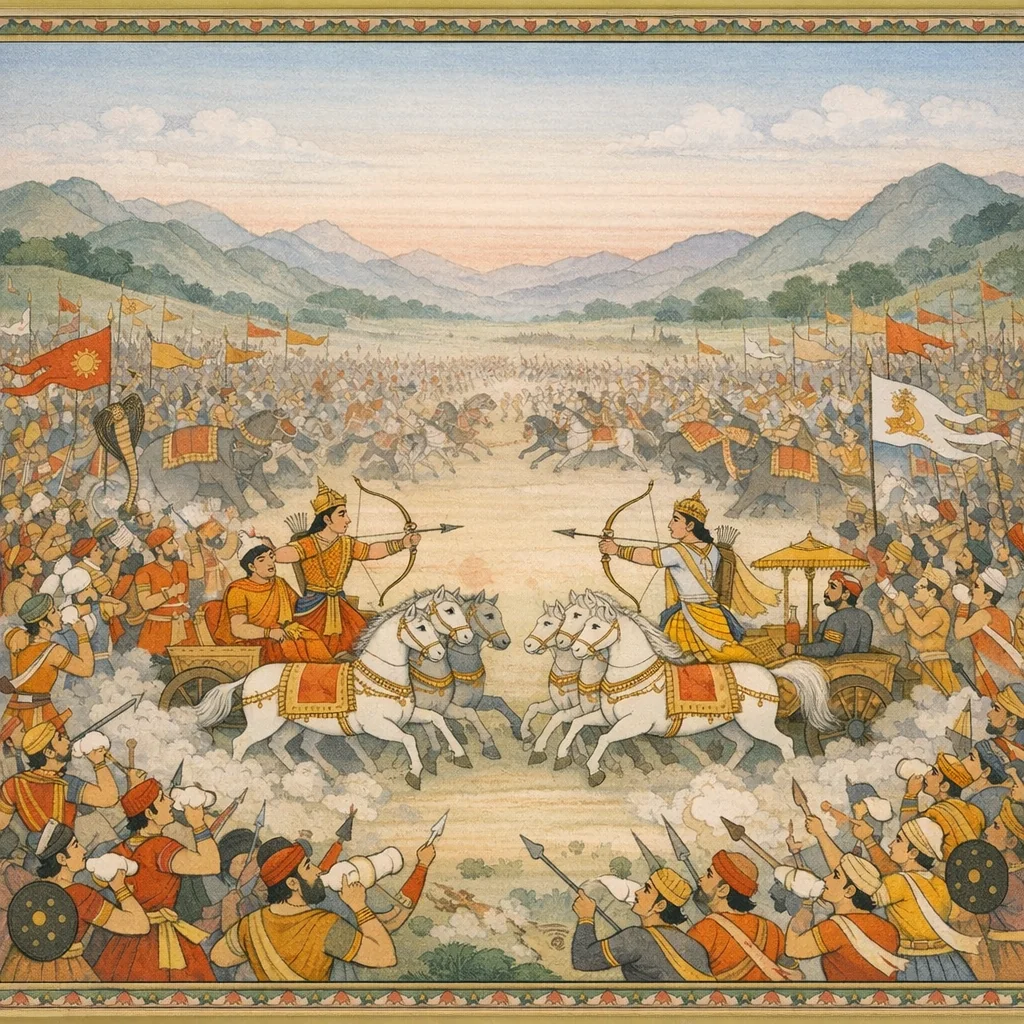
Sañjaya describes a high-density duel between Bhīma and Drauṇi. Drauṇi first wounds Bhīma with a rapid sequence of sharp arrows, exhibiting astralāghava (weapons dexterity) and targeted knowledge of vital points (marma). Bhīma answers by blanketing Drauṇi with a thousand arrows and issuing a siṃhanāda, after which Drauṇi strikes Bhīma’s forehead with an ārāca; Bhīma bears the embedded arrow and returns three nārācas to Drauṇi’s forehead, producing a vivid visual tableau. The fighters exchange hundreds of arrows without “shaking” one another, and the narration emphasizes symmetric endurance. Their ratha-caryā becomes circular (apasavya maneuvers), and the battle expands into an explicit astrayuddha likened to catastrophic cosmic conflict; arrow impacts generate fire that burns through both forces. Siddhas proclaim the encounter incomparable, praising both strength and training. The duel culminates in simultaneous, high-velocity shots that drop both warriors within their chariots; recognizing unconsciousness or disorientation, their charioteers withdraw them from the field in view of the assembled warriors.
Chapter Arc: कर्ण को सेनापति-पद प्राप्त होते ही प्रभात के उदय के साथ युद्ध-योग का आदेश—धृतराष्ट्र की जिज्ञासा कि ‘महाप्राज्ञ कर्ण ने क्या व्यवस्था की?’ → संजय बताता है कि कर्ण के मत को जानकर धृतराष्ट्र-पुत्रों ने तुर्य-नाद के साथ सेना को सजाया; मकरव्यूह की रचना में दायें-बायें पादों पर कृतवर्मा की नारायणी-सेना और गौतम/त्रिगर्त/दाक्षिणात्य धनुर्धरों की तैनाती; भीतर ही भीतर यह स्वीकारोक्ति कि कौरव-सेना के श्रेष्ठ वीर पहले ही कट चुके हैं और शेष ‘फल्गु’ है। → दोनों सेनाओं में शंख-भेरी का महास्वन, सिंहनाद; रणभूमि के मध्य कर्ण और पाण्डव-पक्ष के प्रमुख योद्धा आमने-सामने स्थिर होकर क्रोध-संयम के साथ घूमते हैं—और फिर ‘नृत्यमान’ सेनाएँ टकरा जाती हैं; मनुष्य-हाथी-घोड़े-रथों का सर्वग्रासी संग्राम फूट पड़ता है। → अध्याय का अंत युद्ध के आरम्भिक उन्माद और व्यापक भिड़ंत की स्थापना पर टिकता है—व्यूह, अग्रभाग, और सेनाओं की पहली टक्कर स्पष्ट हो जाती है। → कर्ण और पाण्डव-पक्ष के बीच केंद्र-स्थल पर कौन-सा निर्णायक द्वंद्व पहले फूटेगा, और मकरव्यूह किसे निगलेगा?
Shlokas
Verse 1
(दाक्षिणात्य अधिक पाठके २६३ श्लोक मिलाकर कुल ५८ ३ “लोक हैं।) शस्न्पैमा+ () अिमने एकादशोब< ध्याय: कर्णके सेनापतित्वमें कौरव-सेनाका युद्धके लिये प्रस्थान और मकर व्यूहका निर्माण तथा पाण्डव-सेनाके अर्धचन्द्राकार व्यूहकी रचना और युद्धका आरम्भ धृतराष्ट्र उवाच सैनापत्यं तु सम्प्राप्प कर्णो वैकर्तनस्तदा । तथोक्तश्न स्वयं राज्ञा स्निग्ध॑ भ्रातृसमं वच:,धृतराष्ट्रने पूछा--संजय! सेनापतिका पद पाकर जब परम बुद्धिमान् वैकर्तन कर्ण युद्धके लिये तैयार हुआ और जब स्वयं राजा दुर्योधनने उससे भाईके समान स्नेहपूर्ण वचन कहा, उस समय सूर्योदयकालमें सेनाको युद्धके लिये तैयार होनेकी आज्ञा देकर उसने क्या किया? यह मुझे बताओ
Dhṛtarāṣṭra said: “Sañjaya, when Karṇa Vaikartana, born of the charioteer’s line, had obtained the command of the army, and when King Duryodhana himself addressed him with affectionate words as to a brother—what did Karṇa do after ordering the forces, at sunrise, to make ready for battle? Tell me this.”
Verse 2
योगमाज्ञाप्य सेनानामादित्ये< भ्युदिते तदा । अकरोत् किं महाप्राज्ञस्तन्ममाचक्ष्व संजय,धृतराष्ट्रने पूछा--संजय! सेनापतिका पद पाकर जब परम बुद्धिमान् वैकर्तन कर्ण युद्धके लिये तैयार हुआ और जब स्वयं राजा दुर्योधनने उससे भाईके समान स्नेहपूर्ण वचन कहा, उस समय सूर्योदयकालमें सेनाको युद्धके लिये तैयार होनेकी आज्ञा देकर उसने क्या किया? यह मुझे बताओ
Dhṛtarāṣṭra said: “Sañjaya, when the sun had risen and the army had been ordered into battle-formation, what did that great-minded, highly discerning one do then? Tell me.”
Verse 3
संजय उवाच कर्णस्य मतमाज्ञाय पुत्रास्ते भरतर्षभ । योगमाज्ञापयामासुरनन्दितूर्यपुरःसरम्,संजयने कहा--भरतश्रेष्ठ) कर्णका मत जानकर आपके पुत्रोंने आनन्दमय वाद्योंके साथ सेनाको तैयार होनेका आदेश दिया
Sanjaya said: “O bull among the Bharatas, having understood Karṇa’s intention, your sons ordered the army to make ready for battle, with joyous music of drums and other instruments leading the way.”
Verse 4
महत्यपररात्रे च तव सैन्यस्य मारिष । योगो योगेति सहसा प्रादुरासीन्महास्वन:,माननीय नरेश! अत्यन्त प्रात:कालसे ही आपकी सेनामें सहसा “तैयार हो जाओ, तैयार हो जाओ' का शब्द गूँज उठा
Sañjaya said: “O revered king, in the deep pre-dawn hours within your army, a great roar suddenly arose—‘Form up! Form up!’—as the forces were roused into immediate readiness for battle.”
Verse 5
कल्प्यतां नागमुख्यानां रथानां च वरूथिनाम् | संनहातां नराणां च वाजिनां च विशाम्पते,प्रजानाथ! सजाये जाते हुए बड़े-बड़े गजराजों, आवरणयुक्त रथों, कवच धारण करते हुए मनुष्यों, कसे जाते हुए घोड़ों तथा उतावलीपूर्वक एक-दूसरेको पुकारते हुए योद्धाओंका महान् तुमुल-नाद आकाशमें बहुत ऊँचेतक गूँज रहा था
Sañjaya said: “O lord of the people, preparations were being made—of the foremost elephants, of chariots fitted with protective coverings, of men fully armed in their gear, and of horses being harnessed. The tumult of the army’s readiness and martial calling rose and echoed high into the sky.”
Verse 6
क्रोशतां चैव योधानां त्वरितानां परस्परम् । बभूव तुमुल: शब्दो दिवस्पृक् सुमहांस्तत:,प्रजानाथ! सजाये जाते हुए बड़े-बड़े गजराजों, आवरणयुक्त रथों, कवच धारण करते हुए मनुष्यों, कसे जाते हुए घोड़ों तथा उतावलीपूर्वक एक-दूसरेको पुकारते हुए योद्धाओंका महान् तुमुल-नाद आकाशमें बहुत ऊँचेतक गूँज रहा था
Sañjaya said: As the warriors, rushing about, shouted to one another, there arose a vast and tumultuous roar—so mighty that it seemed to strike the very heavens, O lord of men. The battlefield swelled with urgent calls, the mustering of forces, and the press of impending combat, signaling the moral gravity and irreversible momentum of war.
Verse 7
तत: श्वेतपताकेन बलाकावर्णवाजिना । हेमपृष्ठेन धनुषा नागकक्ष्येण केतुना,तदनन्तर सूतपुत्र कर्ण निर्मल सूर्यके समान तेजस्वी और सब ओरसे पताकाओंद्वारा सुशोभित रथके द्वारा रणयात्राके लिये उद्यत दिखायी दिया। उस रथमें श्वेत पताका फहरा रही थी। बगुलोंके समान सफेद रंगके घोड़े जुते हुए थे। उसपर एक ऐसा धनुष रखा हुआ था, जिसके पृष्ठभागपर सोना मढ़ा गया था। उस रथकी पताकापर हाथीके रस्सेका चिह्न बना हुआ था। उसमें गदाके साथ ही सैकड़ों तरकस रखे गये थे। रथकी रक्षाके लिये ऊपरसे आवरण लगाया गया था। उसमें शतघ्नी, किंकिणी, शक्ति, शूल और तोमर संचित करके रखे गये थे तथा वह रथ अनेक धनुषोंसे सम्पन्न था
Sañjaya said: Then there appeared a chariot prepared for the march into battle—adorned with a white banner, drawn by horses white as herons, bearing a bow whose back was overlaid with gold, and marked by a standard emblazoned with the emblem of an elephant-girth.
Verse 8
तूणीरशतपूर्णेन सगदेन वरूथिना । शतघ्नीकिंकिणीशक्तिशूलतोमरधारिणा,तदनन्तर सूतपुत्र कर्ण निर्मल सूर्यके समान तेजस्वी और सब ओरसे पताकाओंद्वारा सुशोभित रथके द्वारा रणयात्राके लिये उद्यत दिखायी दिया। उस रथमें श्वेत पताका फहरा रही थी। बगुलोंके समान सफेद रंगके घोड़े जुते हुए थे। उसपर एक ऐसा धनुष रखा हुआ था, जिसके पृष्ठभागपर सोना मढ़ा गया था। उस रथकी पताकापर हाथीके रस्सेका चिह्न बना हुआ था। उसमें गदाके साथ ही सैकड़ों तरकस रखे गये थे। रथकी रक्षाके लिये ऊपरसे आवरण लगाया गया था। उसमें शतघ्नी, किंकिणी, शक्ति, शूल और तोमर संचित करके रखे गये थे तथा वह रथ अनेक धनुषोंसे सम्पन्न था
Sañjaya said: Thereafter Karṇa, the charioteer’s son, appeared ready to set out for battle in a spotless, sun-like chariot, radiant and adorned on all sides with banners. A white standard fluttered upon it; horses white as herons were yoked to it. A bow lay there whose back was overlaid with gold, and on the banner was the emblem of an elephant’s tether-rope. The chariot was packed with hundreds of quivers along with a mace; it was covered above with protective armoring, and it carried stores of heavy missiles—śataghnīs, tinkling weapons, spears, tridents, and tomaras—fully equipped with many bows.
Verse 9
कार्मुकैरुपपन्नेन विमलादित्यवर्चसा । रथेनाभिपताकेन सूतपुत्रो5 भ्यदृश्यत,तदनन्तर सूतपुत्र कर्ण निर्मल सूर्यके समान तेजस्वी और सब ओरसे पताकाओंद्वारा सुशोभित रथके द्वारा रणयात्राके लिये उद्यत दिखायी दिया। उस रथमें श्वेत पताका फहरा रही थी। बगुलोंके समान सफेद रंगके घोड़े जुते हुए थे। उसपर एक ऐसा धनुष रखा हुआ था, जिसके पृष्ठभागपर सोना मढ़ा गया था। उस रथकी पताकापर हाथीके रस्सेका चिह्न बना हुआ था। उसमें गदाके साथ ही सैकड़ों तरकस रखे गये थे। रथकी रक्षाके लिये ऊपरसे आवरण लगाया गया था। उसमें शतघ्नी, किंकिणी, शक्ति, शूल और तोमर संचित करके रखे गये थे तथा वह रथ अनेक धनुषोंसे सम्पन्न था
Sañjaya said: Then the charioteer’s son, Karṇa, came into view—mounted on a chariot furnished with bows, radiant like the spotless sun, and splendidly adorned with many banners.
Verse 10
इस प्रकार श्रीमह्याभारत कर्णपर्वमें कर्णका अभिषेकविषयक दसवाँ अध्याय पूरा हुआ,ध्मापयन् वारिजं राजन हेमजालविभूषितम् | विधुन्वानो महच्चापं कार्तस्वरविभूषितम् राजन! कर्ण सोनेकी जालियोंसे विभूषित शंखको बजाता हुआ अपने सुवर्णसज्जित विशाल धनुषकी टंकार कर रहा था
Sanjaya said: “O King, Karna blew the conch adorned with golden latticework, and, shaking his mighty bow embellished with pure gold, he made it resound.” The scene underscores the deliberate display of martial confidence and royal legitimacy—Karna’s consecration and public signals of readiness intensify the moral pressure of the coming battle, where pride, duty, and loyalty collide.
Verse 11
दृष्टवा कर्ण महेष्वासं रथस्थं रथिनां वरम् । भानुमन्तमिवोद्यन्तं तमो घ्नन्तं दुरासदम्,पुरुषसिंह! माननीय नरेश! रथियोंमें श्रेष्ठ महाधनुर्धर दुर्जय वीर कर्ण रथपर बैठकर उदयकालीन सूर्यके समान तम (दुःख या अन्धकार)-का निवारण कर रहा था। उसे देखकर कोई भी कौरव भीष्म, द्रोण तथा दूसरे महारथियोंके मारे जानेके दुःखको कुछ नहीं समझते थे इति श्रीमहाभारते कर्णपर्वणि व्यूहनिर्माणे एकादशोडथ्याय: इस प्रकार श्रीमह्ााभारत कर्णपरववमें व्यूनिर्माणविषयक ग्यारहवाँ अध्याय पूरा हुआ
Sañjaya said: Seeing Karṇa—the mighty archer, standing upon his chariot, foremost among chariot-warriors—like the radiant sun rising, dispelling darkness and hard to assail, the Kauravas took heart. At the sight of him, their grief over the fall of Bhīṣma, Droṇa, and other great champions seemed to lessen, as if eclipsed by the hope his presence inspired amid the moral and emotional darkness of war.
Verse 12
न भीष्मव्यसनं केचिन्नापि द्रोणस्य मारिष | नान्येषां पुरुषव्याप्र मेनिरे तत्र कौरवा:,पुरुषसिंह! माननीय नरेश! रथियोंमें श्रेष्ठ महाधनुर्धर दुर्जय वीर कर्ण रथपर बैठकर उदयकालीन सूर्यके समान तम (दुःख या अन्धकार)-का निवारण कर रहा था। उसे देखकर कोई भी कौरव भीष्म, द्रोण तथा दूसरे महारथियोंके मारे जानेके दुःखको कुछ नहीं समझते थे
Sañjaya said: “O venerable one, there were some among the Kauravas who no longer felt the calamity that had befallen Bhīṣma, nor that of Droṇa, nor even that of the other heroic warriors. In that moment their grief and discouragement were eclipsed—because Karṇa, the foremost of chariot-fighters, had taken his place on the chariot like the rising sun, dispelling the darkness of despair.”
Verse 13
ततस्तु त्वरयन् योधान् शड्खशब्देन मारिष । कर्णो निष्कर्षयामास कौरवाणां महद् बलम्,मान्यवर! तदनन्तर शंखध्वनिके द्वारा योद्धाओंको जल्दी करनेका आदेश देते हुए कर्णने कौरवोंकी विशाल वाहिनीको शिविरोंसे बाहर निकाला
Sañjaya said: Then, urging the warriors to hasten by the blare of conches, Karṇa drew forth the great Kaurava host from the camp.
Verse 14
व्यूहं व्यूह्या महेष्वासो मकरं शत्रुतापन: । प्रत्युद्ययौ तथा कर्ण: पाण्डवान् विजिगीषया,तत्पश्चात् शत्रुओंको संताप देनेवाला महाधनुर्थर कर्ण पाण्डवोंको जीत लेनेकी इच्छासे अपनी सेनाका मकर-व्यूह बनाकर आगे बढ़ा
Sañjaya said: Having arrayed his forces into the Makara (crocodile) battle-formation, Karṇa—the mighty archer and tormentor of foes—advanced to meet the Pāṇḍavas, driven by the resolve to conquer them.
Verse 15
मकरस्य तु तुण्डे वै कर्णो राजन् व्यवस्थित: । नेत्राभ्यां शकुनि: शूर उलूकश्न महारथ:,राजन्! उस मकर-व्यूहके मुखभागमें स्वयं कर्ण खड़ा हुआ, नेत्रोंके स्थानमें शूरवीर शकुनि तथा महारथी उलूक खड़े किये गये
Sañjaya said: “O King, Karṇa took his position at the very mouth of the Makara-formation; and in the places of its eyes were stationed the valiant Śakuni and the great chariot-warrior Ulūka.”
Verse 16
द्रोणपुत्रस्तु शिरसि ग्रीवायां सर्वसोदरा: । मध्ये दुर्योधनो राजा बलेन महता वृतः,शीर्षस्थानमें द्रोणकुमार अश्वत्थामा और ग्रीवा-भागमें दुर्योधनके समस्त भाई स्थित हुए। मध्यस्थान (कटिप्रदेश)-में विशाल सेनासे घिरा हुआ राजा दुर्योधन खड़ा हुआ
Sañjaya said: At the “head” stood Droṇa’s son, Aśvatthāmā, and at the “neck” were stationed all of Duryodhana’s brothers. In the middle King Duryodhana stood, ringed about and guarded by a vast host—like a body-shaped battle array, where power is set in layers of defense, yet driven by the will to dominate rather than by dharma.
Verse 17
वामपादे तु राजेन्द्र कृतवर्मा व्यवस्थित: । नारायणबलैयक्तो गोपालैरयुद्धदुर्मदै:,राजेन्द्र! उस मकरव्यूहके बायें पैरकी जगह नारायणी-सेनाके रणदुर्मद गोपालोंके साथ कृतवर्मा खड़ा किया गया था
Sañjaya said: “O king, on the ‘left foot’ of that formation Kṛtavarmā was stationed, supported by the Nārāyaṇa force—those cowherd-warriors, intoxicated with the pride of battle.” The placement showed how carefully the commanders arrayed their strength, setting a fierce and devoted contingent to guard a crucial flank amid the war’s violence, heavy with moral consequence.
Verse 18
पादे तु दक्षिणे राजन् गौतम: सत्यविक्रम: । त्रिगर्तें: सुमहेष्वासैर्दाक्षिणात्यैश्व संवृत:,राजन! व्यूहके दाहिने पैरके स्थानमें महाधनुर्धर त्रिगर्तों और दाक्षिणात्योंसे घिरे हुए सत्यपराक्रमी कृपाचार्य खड़े थे
Sañjaya said: “O king, on the right foot of the battle-formation stood Gautama—Kṛpācārya—of unfailing valor, surrounded by the Trigartas, mighty archers, and by the warriors of the southern lands.”
Verse 19
अनुपादे तु यो वामस्तत्र शल्यो व्यवस्थित: । महत्या सेनया सार्ध मद्रदेशसमुत्थया,बायें पैरके पिछले भागमें मद्रदेशकी विशाल सेनाके साथ स्वयं राजा शल्य उपस्थित थे
Sañjaya said: On the left flank, in the rear position, King Śalya stood stationed, accompanied by a great host that had arisen from the land of Madra—an arrangement that showed how each side deliberately placed trusted rulers and regional forces to secure the vulnerable points of the battle array.
Verse 20
दक्षिणे तु महाराज सुषेण: सत्यसंगर: । वृतो रथसहस्रेण दन्तिनां च त्रिभि: शतै:,महाराज! दाहिने पैरके पिछले भागमें एक सहख्र रथियों और तीन सौ हाथियोंसे घिरे हुए सत्यप्रतिज्ञ सुषेण खड़े किये गये
Sañjaya said: “On the right flank, O great king, Suṣeṇa—steadfast and true to his battle-vow—was stationed, surrounded by a thousand chariots and three hundred war-elephants.”
Verse 21
पुच्छे हयास्तां महावीर्यों भ्रातरौ पार्थिवौ तदा । चित्रश्न चित्रसेनश्व॒ महत्या सेनया वृती,व्यूहके पुच्छभागमें महापराक्रमी दोनों भाई राजा चित्र और चित्रसेन अपनी विशाल सेनाके साथ उपस्थित हुए
Sañjaya said: Then, at the rear of that formation—where the horses were—there appeared two highly valorous royal brothers, Citra and Citrasena, surrounded by a great army.
Verse 22
तथा प्रयाते राजेन्द्र कर्णे नरवरोत्तमे । धनंजयमभिप्रेक्ष्य धर्मराजो5ब्रवीदिदम्,राजेन्द्र! मनुष्योंमें श्रेष्ठ कर्णके इस प्रकार यात्रा करनेपर धर्मराज युधिष्ठिरने अर्जुनकी ओर देखकर इस प्रकार कहा--
Sañjaya said: O king, when Karṇa—the foremost of men—had set forth in that manner, Dharmarāja Yudhiṣṭhira, looking toward Dhanañjaya (Arjuna), spoke these words.
Verse 23
पश्य पार्थ यथा सेना धार्तराष्ट्रीह संयुगे । कर्णेन विहिता वीर गुप्ता वीरैर्महारथै:,“वीर पार्थ! देखो, इस समय युद्धस्थलमें धृतराष्ट्रपुत्रोंकी सेना कैसी स्थितिमें है? कर्णने वीर महारथियोंद्वारा इसे किस प्रकार सुरक्षित कर दिया है?
Sañjaya said: “Behold, O Pārtha—see how the army of the sons of Dhṛtarāṣṭra stands here in the clash of battle. O hero, observe how Karṇa has arrayed it and how it is guarded by mighty warriors, great chariot-fighters.”
Verse 24
हतवीरतमा होषा धार्तराष्ट्री महाचमू: । फल्गुशेषा महाबाहो तृणैस्तुल्या मता मम,“महाबाहो! कौरवोंकी इस विशाल सेनाके प्रमुख वीर तो मारे जा चुके हैं। अब इसके तुच्छ सैनिक ही शेष रह गये हैं। इस समय तो यह मुझे तिनकोंके समान जान पड़ती है
Sañjaya said: O mighty-armed one, the great army of the Dhārtarāṣṭras has had its foremost heroes slain; only a paltry remnant remains. At this moment it seems to me no more than straw—easily scattered in the storm of war.
Verse 25
एको ह्वात्र महेष्वास: सूतपुत्रो विराजते । सदेवासुरगन्धर्वै: सकिन्नरमहोरगै:,“इस सेनामें एकमात्र महाधनुर्धर सूतपुत्र कर्ण विराजमान है, जो रथियोंमें श्रेष्ठ है तथा जिसे देवता, असुर, गन्धर्व, किन्नर, बड़े-बड़े नाग एवं चराचर प्राणियोंसहित तीनों लोकोंके लोग मिलकर भी नहीं जीत सकते। महाबाहु फाल्गुन! आज उसी कर्णको मारकर तुम्हारी विजय होगी और मेरे हृदयमें बारह वर्षोंसे जो सेल कसक रहा है, वह निकल जायगा। महाबाहो! ऐसा जानकर तुम्हारी जैसी इच्छा हो, वैसे व्यूहकी रचना करो”
Sañjaya said: “Here stands a single great archer—the charioteer’s son, Karṇa—radiant in this host. Even if the gods and demons, the Gandharvas, the Kinnaras, and the mighty serpents were to unite, they could not overcome him.”
Verse 26
चराचरैस्त्रिभिलोेंकैियों $जय्यो रथिनां वर: । तं॑ हत्वाद्य महाबाहो विजयस्तव फाल्गुन,“इस सेनामें एकमात्र महाधनुर्धर सूतपुत्र कर्ण विराजमान है, जो रथियोंमें श्रेष्ठ है तथा जिसे देवता, असुर, गन्धर्व, किन्नर, बड़े-बड़े नाग एवं चराचर प्राणियोंसहित तीनों लोकोंके लोग मिलकर भी नहीं जीत सकते। महाबाहु फाल्गुन! आज उसी कर्णको मारकर तुम्हारी विजय होगी और मेरे हृदयमें बारह वर्षोंसे जो सेल कसक रहा है, वह निकल जायगा। महाबाहो! ऐसा जानकर तुम्हारी जैसी इच्छा हो, वैसे व्यूहकी रचना करो”
Sañjaya said: “Karna, the charioteer’s son, stands here as the lone great bowman of this host—foremost among chariot-warriors—one whom even the three worlds, with all moving and unmoving beings, cannot together overcome. Yet, O mighty-armed Phālguna, by slaying that very Karna today, victory will be yours. Then the long-borne anguish that has pressed upon my heart for twelve years will be lifted. Knowing this, O strong-armed one, arrange the battle-formation as you deem fit.”
Verse 27
उद्धृतश्न भवेच्छल्यो मम द्वादशवार्षिक: । एवं ज्ञात्वा महाबाहो व्यूहं व्यूह यथेच्छसि,“इस सेनामें एकमात्र महाधनुर्धर सूतपुत्र कर्ण विराजमान है, जो रथियोंमें श्रेष्ठ है तथा जिसे देवता, असुर, गन्धर्व, किन्नर, बड़े-बड़े नाग एवं चराचर प्राणियोंसहित तीनों लोकोंके लोग मिलकर भी नहीं जीत सकते। महाबाहु फाल्गुन! आज उसी कर्णको मारकर तुम्हारी विजय होगी और मेरे हृदयमें बारह वर्षोंसे जो सेल कसक रहा है, वह निकल जायगा। महाबाहो! ऐसा जानकर तुम्हारी जैसी इच्छा हो, वैसे व्यूहकी रचना करो”
Sañjaya said: “Then the thorn that has been lodged in my heart for twelve years will be drawn out. Knowing this, O mighty-armed one, arrange the battle-formation as you wish.”
Verse 28
भ्रातुरेतद् वच: श्रुत्वा पाण्डव: श्वेतवाहन: । अर्धचन्द्रेण व्यूहेन प्रत्यव्यूहत तां चमूम्,भाईकी यह बात सुनकर श्वेतवाहन पाण्डुपुत्र अर्जुनने इस कौरव-सेनाके मुकाबलेमें अपनी सेनाके अर्द्धचन्द्राकार व्यूहकी रचना की
Sañjaya said: Hearing these words of his brother, the Pāṇḍava Arjuna—he whose chariot is drawn by white horses—counter-arrayed that host by forming his own troops into a half-moon formation.
Verse 29
वामपाशश्चे तु तस्थाथ भीमसेनो व्यवस्थित: । दक्षिणे च महेष्वासो धृष्टद्युम्नो व्यवस्थित:,उस व्यूहके वाम पार्श्वमें भीमसेन और दाहिने पार्श्वमें महाधनुर्धर धृष्टद्युम्न खड़े हुए। उसके मध्यभागमें राजा युधिष्ठिर और पाण्डुपुत्र धनंजय खड़े थे। धर्मराजके पृष्ठभागमें नकुल और सहदेव थे
Sañjaya said: On the left flank stood Bhīmasena, firmly stationed; on the right flank stood the great archer Dhṛṣṭadyumna, likewise in position. The array is presented as an ordered, disciplined formation—each warrior taking a rightful place to protect the center and uphold the collective duty of the Pāṇḍava host in battle.
Verse 30
मध्ये व्यूहस्य राजा तु पाण्डवश्न धनंजय: । नकुल: सहदेवश्व धर्मराजस्य पृष्ठत:,उस व्यूहके वाम पार्श्वमें भीमसेन और दाहिने पार्श्वमें महाधनुर्धर धृष्टद्युम्न खड़े हुए। उसके मध्यभागमें राजा युधिष्ठिर और पाण्डुपुत्र धनंजय खड़े थे। धर्मराजके पृष्ठभागमें नकुल और सहदेव थे
Sañjaya said: In the very center of the battle-formation stood the king, the Pāṇḍava Yudhiṣṭhira, together with Dhanañjaya (Arjuna). Behind Dharmarāja were Nakula and Sahadeva. The arrangement underscores disciplined protection of the righteous king and coordinated duty among brothers amid the moral strain of war.
Verse 31
चक्ररक्षौ तु पाउ्चाल्यौ युधामन्यूत्तमौजसौ । नार्जुनं जहतुर्युद्धे पाल्यमानौ किरीटिना,पांचाल महारथी युधामन्यु और उत्तमौजा अर्जुनके चक्ररक्षक थे। किरीटधारी अर्जुनसे सुरक्षित होकर उन दोनोंने युद्धमें कभी उनका साथ नहीं छोड़ा
Sañjaya said: The two Pāñcāla heroes, Yudhāmanyu and Uttamaujā, served as Arjuna’s wheel-guards. Protected by the diadem-wearing Arjuna, they did not abandon him in battle, remaining steadfast at his side.
Verse 32
शेषा नृपतयो वीरा: स्थिता व्यूहस्य दंशिता: । यथाभागं यथोत्साहं यथायत्नं च भारत,भारत! शेष वीर नरेश कवच धारण करके व्यूहके विभिन्न भागोंमें अपने उत्साह और प्रयत्नके अनुसार खड़े हुए थे
Sañjaya said: The remaining warrior-kings, clad in armor, took their stations within the battle-formation—each according to his assigned sector, his courage, and his capacity for effort, O Bhārata.
Verse 33
एवमेतन्महाव्यूहं व्यूह्ू भारत पाण्डवा: । तावकाश्न महेष्वासा युद्धायैव मनो वधु:,भरतनन्दन! इस प्रकार इस महाव्यूहकी रचना करके पाण्डवों तथा आपके महाधनुर्धरोंने युद्धमें ही मन लगाया
Sañjaya said: “Thus, O descendant of Bharata, having arrayed this vast and formidable battle-formation, the Pāṇḍavas and your own great bowmen fixed their minds solely upon battle.”
Verse 34
दृष्टवा व्यूढां तव चमूं सूतपुत्रेण संयुगे । निहतान् पाण्डवान् मेने धार्तराष्ट्र: सबान्धव:
Sañjaya said: Seeing your army drawn up in battle-order by the charioteer’s son (Karna) in the midst of the fight, Dhṛtarāṣṭra—together with his kinsmen—concluded that the Pāṇḍavas had been slain.
Verse 35
युद्धस्थलमें सूतपुत्र कर्णके द्वारा व्यूह-रचनापूर्वक खड़ी की गयी आपकी सेनाको देखकर भाइयोंसहित दुर्योधनने यह मान लिया कि “अब तो पाण्डव मारे गये' ।। तथैव पाण्डवीं सेनां व्यूढां दृष्टवा युधिष्ठिर: । धार्तराष्ट्रानू हतान् मेने सकर्णान् वै जनाधिप:,उसी प्रकार पाण्डव-सेनाका व्यूह देखकर राजा युधिष्ठिरने भी कर्णसहित आपके सभी पुत्रोंकोी मारा गया ही समझ लिया
Seeing the Pāṇḍava army drawn up in battle-formation, King Yudhiṣṭhira likewise concluded that the sons of Dhṛtarāṣṭra—Karna included—had surely been slain.
Verse 36
ततः शड्खाश्न भेर्यश्व॒ पणवानकदुन्दुभि: | डिण्डिमाश्षाप्यहन्यन्त झर्झराश्ष समनन्तत:ः,राजन! तदनन्तर दोनों सेनाओंमें चारों ओर महान् शब्द करनेवाले शंख, भेरी, पणव, आनक, दुन्दुभि और झाँझ आदि बाजे बज उठे। नगाड़े पीटे जाने लगे। साथ ही विजयकी अभिलाषा रखनेवाले शूरवीरोंका सिंहनाद भी होने लगा
Sañjaya said: Then conches, kettledrums, tabors, war-drums, and great drums resounded; and everywhere, O King, kettledrums were beaten and cymbals clashed. Immediately after, on all sides in both armies, those instruments that raise a mighty din—conches, drums, tabors, war-drums, great drums, cymbals and the like—burst into sound. The kettledrums were struck, and with them rose the lion-roars of heroic warriors who longed for victory, an outward surge of martial resolve that drives the battle onward.
Verse 37
सेनयोरुभयो राजन प्रावाद्यन्त महास्वना: । सिंहनादश्न संजज्ञे शूराणां जयगृद्धिनाम्,राजन! तदनन्तर दोनों सेनाओंमें चारों ओर महान् शब्द करनेवाले शंख, भेरी, पणव, आनक, दुन्दुभि और झाँझ आदि बाजे बज उठे। नगाड़े पीटे जाने लगे। साथ ही विजयकी अभिलाषा रखनेवाले शूरवीरोंका सिंहनाद भी होने लगा
Sañjaya said: O King, on both sides of the armies, instruments of great volume were sounded all around; and among the warriors—eager for victory—a lion-like roar arose as well.
Verse 38
हयह्लेषितशब्दाश्न वारणानां च बूंहताम् । रथनेमिस्वनाश्षोग्रा: सम्बभूवुर्जनाधिप,जनेश्वर! घोड़ोंके हींसने, हाथियोंके चिग्चाड़ने तथा रथके पहियोंके घरघरानेके भयंकर शब्द प्रकट होने लगे
Sañjaya said: O lord of men, O ruler of the people, there arose fierce sounds on every side—the neighing of horses, the trumpeting of elephants, and the dreadful rumble of chariot-wheels. The battlefield’s tumult swelled, signaling the full onset of war.
Verse 39
न द्रोणव्यसनं ककश्िज्जानीते तत्र भारत । दृष्टवा कर्ण महेष्वासं मुखे व्यूहस्य देशितम्
Sañjaya said: O Bhārata, no one there truly grasped the calamity that had befallen Droṇa. For they saw the great archer Karṇa posted at the very front of the battle-formation—an arrangement that projected strength and confidence, masking the depth of the loss.
Verse 40
भारत! व्यूहके मुख्य द्वारपर कवच धारण किये महाधनुर्धर कर्णको खड़ा देख कोई भी सैनिक द्रोणाचार्यके मारे जानेके दुःखका अनुभव न कर सका ।। उभे सैन्ये महाराज प्रह्ृष्टनरसंकुले । योद्धुकामे स्थिते राजन् हन्तुमन्योन्यमोजसा,महाराज! वे दोनों सेनाएँ हर्षोत्फुल्ल मनुष्योंसे भरी थीं। राजन्! वे बलपूर्वक परस्पर चोट करने और जूझनेकी इच्छासे मैदानमें आकर खड़ी हो गयीं
Sañjaya said: O Bhārata, seeing the great bowman Karṇa, clad in armor, standing at the main gate of the battle-formation, no soldier could feel the full grief of Droṇācārya’s death. O great king, both armies stood facing each other, crowded with men exultant and eager for combat. O ruler, they had taken their positions with the desire to fight, intent on striking one another down by sheer force and martial ardor.
Verse 41
तत्र यत्तौ सुसंरब्धौ दृष्टवान्योन्यं व्यवस्थितौ । अनीकमध्ये राजेन्द्र चेरतु: कर्णपाण्डवौ,राजेन्द्र! वहाँ रोषमें भरकर सावधानीके साथ खड़े हुए कर्ण और पाण्डव अपनी- अपनी सेनामें विचरने लगे
Sañjaya said: Then those two—Karna and the Pāṇḍava—burning with fierce wrath and fixing their gaze upon one another, stood poised in wary readiness. O king, moving within the midst of their respective battle-formations, they began to range about, seeking advantage without letting their vigilance slacken.
Verse 42
नृत्यमाने च ते सेने समेयातां परस्परम् । तयो: पक्षप्रपक्षेभ्यो निर्जग्मुस्ते युयुत्मव:,वे दोनों सेनाएँ परस्पर नृत्य करती हुई-सी भिड़ गयीं। युद्धकी अभिलाषा रखनेवाले वीर उन दोनों व्यूहोंके पक्ष और प्रपक्षसे निकलने लगे
Sañjaya said: As the two armies surged forward as if in a dance, they closed upon one another. Then the warriors, eager for battle, began to stream out from the flanks and counter-flanks of both battle-formations, pressing into the clash.
Verse 43
ततः प्रववृते युद्धं नरवारणवाजिनाम् । रथानां च महाराज अन्योन्यमभिनिधघ्नताम्,महाराज! तदनन्तर एक-दूसरेपर आघात करनेवाले मनुष्य, हाथी, घोड़ों और रथोंका वह महान् युद्ध आरम्भ हो गया
Sañjaya said: Then, O King, the great battle began—men, elephants, horses, and chariots striking one another in mutual assault.
Frequently Asked Questions
The chapter implicitly tests how far escalation should proceed when prowess invites retaliation: both sides pursue decisive advantage, yet the narrative repeatedly signals the ethical and practical risk of uncontrolled intensification (including harm extending to surrounding forces).
Excellence and endurance do not guarantee clear victory; outcomes remain contingent on circumstance, restraint, and support systems (notably the charioteer’s judgment), suggesting that agency operates within constraints of karma, chance, and collective impact.
No formal phalaśruti appears; the closest meta-commentary is the evaluative speech of siddhas and the cosmic similes, which frame the duel as exemplary and cautionary—an index of extraordinary skill and the destabilizing potential of maximal force.