Adhyaya 9
अध्याय ९ — कर्णस्य प्रहारः, योधयुग्मनियोजनम्, शैनेय-कैकेययोर्युद्धविन्यासः
Upa-parva: Karṇa-parva — Yuddha-vyūha and Sātyaki–Kaikeya Engagement Cycle (Chapter Cluster Context)
Saṃjaya reports a rapid escalation of engagements. Karṇa, described as a great archer, strikes the Pāṇḍava host with well-jointed arrows and polished nārācas, causing disorder among elephants and spreading confusion across directions. The Pāṇḍavas respond by attacking the Kaurava force in front of Karṇa. The narration then enumerates concurrent matchups that stabilize the battlefield through paired contests: Nakula advances toward Karṇa; Bhīmasena engages Droṇa’s son (Drauṇi); Sātyaki checks the Kaikeya brothers Vindā and Anuvindā; other named warriors intercept approaching opponents. Focus tightens on Sātyaki’s duel with the Kaikeyas: mutual arrow-covering, repeated bow-cutting, and a shift from missile exchange to close combat with swords and shields. The turning point occurs when Sātyaki, after sustaining wounds, uses a sharp kṣurapra to sever Anuvinda’s head; the surviving brother retaliates with a spear and renewed arrow strikes. Sātyaki counters, transitions again into close-quarters maneuvering, and ultimately cuts down the Kaikeya combatant, after which the Kekaya contingent breaks and disperses, indicating morale-driven rout following the loss of a key champion.
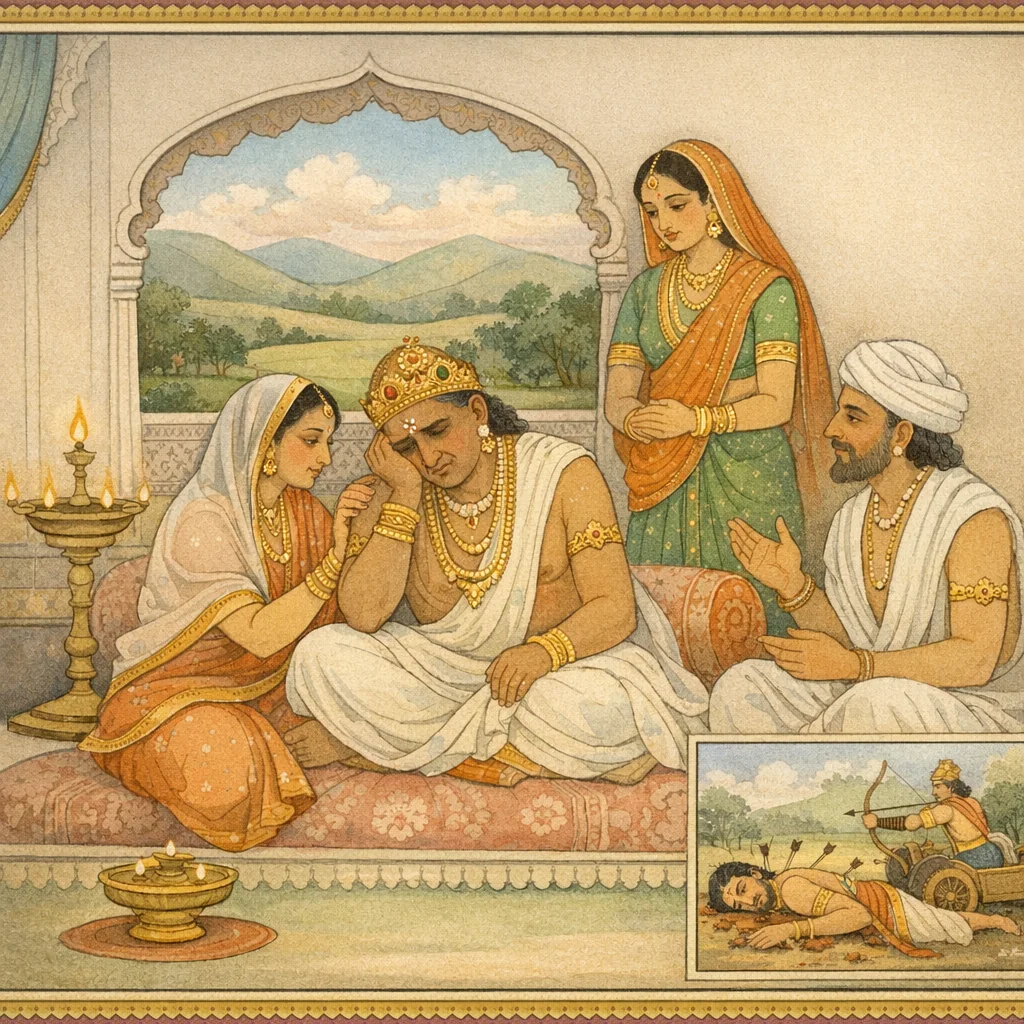
Chapter Arc: संजय कर्णवध का समाचार सुनाते हैं; धृतराष्ट्र शोक में डूबकर संजय से विस्तार माँगते हैं और अपने भाग्य को ही प्रधान मानते हुए पुरुषार्थ को धिक्कारते हैं। → धृतराष्ट्र कर्ण के तेज, अस्त्र-विद्या और महाबल का स्मरण कर-कर प्रश्नों की बौछार करते हैं—जिसने जामदग्न्य परशुराम से घोर ब्राह्मास्त्र सीखा, जो सिंह-वेग से दिव्यास्त्र बरसाता था, वह कैसे मारा गया? कौरव पक्ष के शेष वीरों की प्रतिक्रियाएँ (कृतवर्मा, कृप) भी शोक और अविश्वास को तीखा करती हैं। → ‘वैकर्तन’ कर्ण के हत होने का दृश्य और उसके बाद धृतराष्ट्र का टूट जाना—“उस पुरुषर्षभ के बिना मेरे जीवन का क्या अर्थ?”—यही अध्याय का भाव-शिखर है; साथ ही यह प्रश्न उभरता है कि यदि रथ, धनुष और अस्त्र न टूटे थे तो शत्रु उसे कैसे निहत कर सके। → धृतराष्ट्र अपने राज्य-परिवार के विनाश को द्यूत-कर्म के मूल पाप से जोड़ते हैं—अपने मंत्रियों और पुत्रों के मारे जाने पर स्वयं को ‘कटे पंखों वाले पक्षी’ के समान बताते हैं; शोक अब आत्म-आरोप और नियति-बोध में बदलता है। → कर्ण जैसा अजेय प्रतीत होने वाला महारथी किन परिस्थितियों/विघ्नों से पराजित हुआ—यह जिज्ञासा अगले वर्णन के लिए तीव्र होकर रह जाती है।
Shlokas
Verse 1
(दाक्षिणात्य अधिक पाठके १६३ श्लोक मिलाकर कुल ३२६ “लोक हैं।) #द-2ल्5 >> श््यु # ++/<< नवमो<्ध्याय: धृतराष्ट्रका संजयसे विलाप करते हुए कर्णवधका विस्तारपूर्वक वृत्तान्त पूछना संजय उवाच श्रिया कुलेन यशसा तपसा च श्रुतेन च । त्वामद्य सन््तो मन्यन्ते ययातिमिव नाहुषम्,संजयने कहा--महाराज! साधु पुरुष इस समय आपको धन-सम्पत्ति, कुल-मर्यादा, सुयश, तपस्या और शास्त्रज्ञानमें नहुषनन्दन ययातिके समान मानते हैं
Sanjaya said: “O King, the virtuous now regard you as Yayāti, son of Nāhuṣa—endowed with prosperity, noble lineage, fame, ascetic merit, and sacred learning.”
Verse 2
श्रुते महर्षिप्रतिम: कृतकृत्यो$सि पार्थिव । पर्यवस्थापयात्मानं मा विषादे मन: कृथा:,राजन! वेद-शास्त्रोंके ज्ञानमें आप महर्षियोंके तुल्य हैं। आपने अपने जीवनके सम्पूर्ण कर्तव्योंका पालन कर लिया है; अतः अपने मनको स्थिर कीजिये, उसे विषादमें न डुबाइये
Sañjaya said: “O king, in sacred learning you are comparable to the great seers. You have fulfilled the duties of your life; therefore steady your inner self and do not let your mind sink into grief.”
Verse 3
धृतराष्ट उवाच दैवमेव पर मनन््ये धिक् पौरुषमनर्थकम् | यत्र शालप्रतीकाश: कर्णो5हन्यत संयुगे,धृतराष्ट्रने कहा--मैं तो दैवको ही प्रधान मानता हूँ। पुरुषार्थ व्यर्थ है, उसे धिक्कार है, जिसका आश्रय लेकर शालवृक्षके समान ऊँचे शरीरवाला कर्ण भी युद्धमें मारा गया
Dhṛtarāṣṭra said: “I hold fate alone to be supreme; human striving is futile—cursed be it! For even Karṇa, tall of body like a sāla tree, was slain in battle.”
Verse 4
हत्वा युधिष्ठिरानीक॑ पञ्चालानां रथव्रजान् । प्रताप्प शरवर्षेण दिश: सर्वा महारथ:,युधिष्ठिरकी सेना तथा पांचाल रथियोंके समुदायका संहार करके जिस महारथी वीरने अपने बाणोंकी वर्षसे सम्पूर्ण दिशाओंको संतप्त कर दिया और वज्धारी इन्द्र जैसे असुरोंको अचेत कर देते हैं, उसी प्रकार जिसने रणभूमिमें कुन्तीकुमारोंको मोहमें डाल दिया था, वही किस तरह मारा जाकर आँधीके उखाड़े हुए वृक्षके समान धरतीपर पड़ा है?
Dhṛtarāṣṭra said: After slaughtering Yudhiṣṭhira’s battle-array and the companies of Pañcāla chariot-warriors, that great chariot-fighter scorched all the quarters with a storm of arrows. Like Indra bearing the thunderbolt, who strikes the Asuras senseless, he had thrown Kuntī’s sons into bewilderment on the battlefield. How, then, has that very hero been slain and now lies on the earth like a tree torn up by a violent gale?
Verse 5
मोहयित्वा रणे पार्थान् वजहस्त इवासुरान् । स कथं निहत: शेते वायुरुग्ण इव द्रुम:,युधिष्ठिरकी सेना तथा पांचाल रथियोंके समुदायका संहार करके जिस महारथी वीरने अपने बाणोंकी वर्षसे सम्पूर्ण दिशाओंको संतप्त कर दिया और वज्धारी इन्द्र जैसे असुरोंको अचेत कर देते हैं, उसी प्रकार जिसने रणभूमिमें कुन्तीकुमारोंको मोहमें डाल दिया था, वही किस तरह मारा जाकर आँधीके उखाड़े हुए वृक्षके समान धरतीपर पड़ा है?
Dhṛtarāṣṭra said: “After bewildering the sons of Pṛthā in battle—just as Vajrahasta (Indra), wielder of the thunderbolt, confounds the Asuras—how is it that this hero now lies slain, stretched upon the earth like a tree torn down by a violent wind?”
Verse 6
शोकस्यान्तं न पश्यामि पारं जलनिधेरिव । चिन्ता मे वर्धतेडतीव मुमूर्षा चापि जायते,जैसे समुद्रका पार नहीं दिखायी देता, उसी प्रकार मैं इस शोकका अन्त नहीं देख पाता हूँ। मेरी चिन्ता अधिकाधिक बढ़ती जाती है और मरनेकी इच्छा प्रबल हो उठी है
Dhṛtarāṣṭra said: “I cannot see any end to my grief—just as one cannot see the far shore of the ocean. My anxiety keeps increasing more and more, and even the desire to die has arisen within me.”
Verse 7
कर्णस्य निधन श्रुत्वा विजयं फाल्गुनस्य च । अश्रद्धेयमहं मन्ये वध॑ कर्णस्य संजय,संजय! मैं कर्णकी मृत्यु और अर्जुनकी विजयका समाचार सुनकर भी कर्णके वधको विश्वासके योग्य नहीं मानता
Dhṛtarāṣṭra said: “Even after hearing the report of Karṇa’s death and of Phālguna’s (Arjuna’s) victory, I cannot accept Karṇa’s slaying as something believable, O Sañjaya.”
Verse 8
इस प्रकार श्रीमह्ााभारत कर्णपर्वमें धृतराष्ट्रवाक्यविषयक आठवाँ अध्याय पूरा हुआ,वज्ञसारमयं नूनं हृदयं दुर्भिदं मम । यच्छुत्वा पुरुषव्याप्र॑ हतं कर्ण न दीर्यते निश्चय ही मेरा हृदय वज्रके सारतत्त्वका बना हुआ है, अतः दुर्भद्य है; तभी तो पुरुषसिंह कर्णको मारा गया सुनकर भी यह विदीर्ण नहीं हो रहा है
Vaiśampāyana said: “Surely my heart is made of the very essence of adamant; it is hard to break. For even after hearing that Karṇa—the tiger among men—has been slain, it does not split apart.”
Verse 9
आयुर्नूनं सुदीर्घ मे विहितं दैवतै: पुरा । यत्र कर्ण हत॑ श्रुत्वा जीवामीह सुदु:खित:,अवश्य ही पूर्वकालमें देवताओंने मेरी आयु बहुत बड़ी बना दी थी, जिसके अधीन होनेके कारण मैं कर्ण-वधका समाचार सुनकर अत्यन्त दुःखी होनेपर भी यहाँ जी रहा हूँ इति श्रीमहाभारते कर्णपर्वणि धृतराष्ट्रप्रश्ने नवमो5ध्याय:
Dhṛtarāṣṭra said: “Surely the gods long ago ordained for me an exceedingly long life; for, even after hearing that Karṇa has been slain, I still remain alive here—overwhelmed by unbearable grief.”
Verse 10
धिग्जीवितमिदं चैव सुहृद्धीनश्व॒ संजय । अद्य चाहं दशामेतां गत: संजय गर्हिताम्
Dhṛtarāṣṭra laments: “Fie upon this life of mine, O Sañjaya—bereft of true friends and support. Today I have fallen into this disgraceful condition, O Sañjaya.”
Verse 11
संजय! मेरे इस जीवनको धिक्कार है। आज मैं सुहृदोंसे हीन होकर इस घृणित दशाको पहुँच गया हूँ ।। कृपणं वर्तयिष्यामि शोच्य: सर्वस्य मन्दधी: । अहमेव पुरा भूत्वा सर्वलोकस्य सत्कृत:
Dhṛtarāṣṭra said: “Sañjaya, cursed be this life of mine. Today, bereft of true well-wishers, I have fallen into a loathsome condition. I shall live on in wretchedness—pitied by all, dull of understanding—though once I myself stood honored by the whole world.”
Verse 12
दुःखात् सुदुःखव्यसन प्राप्तवानस्मि संजय
Dhṛtarāṣṭra said: “O Sañjaya, from one sorrow I have fallen into an even graver calamity of suffering.”
Verse 13
नावशेषं प्रपश्यामि सूतपुत्रे हते युधि
Dhṛtarāṣṭra said: “I see no hope left when the charioteer’s son has been slain in battle.”
Verse 14
युद्धे हि निहतः शूरो विसृजन् सायकान् बहून्
Dhṛtarāṣṭra said: “For a hero, to be slain in battle while still releasing many arrows is indeed a noble end—falling in the very act of fighting, without abandoning courage or duty.”
Verse 15
रथादाधिरथिरनूनं न्यपतत् सायकार्दित:
Dhṛtarāṣṭra said: “Struck and torn by arrows, the charioteer—Ādhirathi—fell down from the chariot, seemingly without life.”
Verse 16
पर्वतस्येव शिखरं वज़्पाताद विदारितम् | जैसे वज़्के आघातसे विदीर्ण किया हुआ पर्वतशिखर धराशायी हो जाता है, उसी प्रकार बाणोंसे पीड़ित हुआ अधिरथपुत्र कर्ण निश्चय ही रथसे नीचे गिर पड़ा होगा ।। स शेते पृथिवीं नूनं शोभयन् रुधिरोक्षित:
Dhṛtarāṣṭra said: “Like a mountain-peak split apart by a thunderbolt and brought crashing down, so surely Karṇa, the son of Adhiratha, tormented by arrows, has fallen from his chariot. Now he must be lying upon the earth, making it grimly resplendent, drenched with blood.”
Verse 17
यो बल धार्तराष्ट्राणां पाण्डवानां यतो भयम्
Dhṛtarāṣṭra said: “Who is the source of strength for the sons of Dhṛtarāṣṭra, and from whom do the Pāṇḍavas feel fear?”
Verse 18
स हि वीरो महेष्वासो मित्राणाम भयंकर:
Dhṛtarāṣṭra says: “For he is truly a hero, a mighty archer—one who becomes a source of dread to the enemies of his allies.”
Verse 19
पड़ोरिवाध्वगमनं दरिद्रस्पेव कामितम्
Dhṛtarāṣṭra said: “This onward march is like the trudging of a weary traveler—like the longing of a poor man: compelled, painful, and driven more by necessity than by joy.”
Verse 20
दुर्योधनस्थ चाकूतं तृषितस्येव विप्रुष: । जैसे पंगु मनुष्यके लिये रास्ता चलना कठिन है, दरिद्रका मनोरथ पूर्ण होना असम्भव है तथा जलकी कुछ ही बूँदें जैसे प्यासेकी प्यास बुझानेमें असमर्थ हैं, उसी प्रकार दुर्योधनका अभिप्राय असम्भव अथवा सफलतासे कोसों दूर है ।। अन्यथा चिन्तितं कार्यमन्यथा तत् तु जायते
Dhṛtarāṣṭra said: “Duryodhana’s intention is like a few drops of water to a thirsty man—incapable of quenching thirst. Just as a lame person finds the road hard to traverse, and a poor man’s wish is impossible to fulfill, so too Duryodhana’s design is either unattainable or far from success. For what is planned turns out otherwise; the deed is born in a different way than one imagines.”
Verse 21
पलायमान: कृपणो दीनात्मा दीनपौरुष:,कच्चिन्न निहत:ः शूरो यथान्ये क्षत्रियर्षभा: । सूत! क्या मेरा पुत्र दुःशासन दीनचित्त और पुरुषार्थशून्य होकर कायरके समान भागता हुआ मारा गया। तात! उसने युद्धस्थलमें कोई दीनतापूर्ण बर्ताव तो नहीं किया था। जैसे अन्य क्षत्रियशिरोमणि मारे गये हैं, क्या उसी प्रकार शूरवीर दुःशासन नहीं मारा गया?
Dhṛtarāṣṭra said: “Fleeing in misery, with a broken spirit and weakened manliness—has that hero not been slain, as other foremost bulls among kṣatriyas have been? O Sūta, tell me: was my son Duḥśāsana, faint-hearted and bereft of resolve, killed while running away like a coward? Dear one, he did not display any pitiable conduct on the battlefield, did he? As other eminent kṣatriya champions have fallen, has the brave Duḥśāsana not fallen in the same way?”
Verse 22
कच्चिद् विनिहतः सूत पुत्रो दःशासनो मम । कच्चिन्न दीनाचरितं कृतवांस्तात संयुगे
Dhṛtarāṣṭra said: “Has my son Duḥśāsana—born of the charioteer’s line—been slain? And, dear one, did he at least not behave in a base or cowardly manner on the battlefield?”
Verse 23
युधिष्ठटिरस्य वचन मा युध्यस्वेति सर्वदा
Dhṛtarāṣṭra said: “(I recall) Yudhiṣṭhira’s counsel—‘Do not fight’—repeated again and again.”
Verse 24
शरतल्पे शयानेन भीष्मेण सुमहात्मना,भ्रातृभावेन पृथिवीं भुड़क्ष्व पाण्ड्सुतैः सह । बाण-शय्यापर सोये हुए महात्मा भीष्मने अर्जुनसे पानी माँगा और उन्होंने इसके लिये पृथ्वीको छेद दिया। इस प्रकार पाण्डुपुत्र अर्जुनके द्वारा प्रकट की हुई उस जलधाराको देखकर महाबाहु भीष्मने दुर्योधनसे कहा--“तात! पाण्डवोंके साथ संधि कर लो। संधिसे वैरकी शान्ति हो जायगी, तुमलोगोंका यह युद्ध मेरे जीवनके साथ ही समाप्त हो जाय। तुम पाण्डवोंके साथ भ्रातृभाव बनाये रखकर पृथ्वीका उपभोग करो”
Dhṛtarāṣṭra said: “As the great-souled Bhīṣma lay upon his bed of arrows, he urged: ‘Live upon and govern the earth together with the sons of Pāṇḍu in a spirit of brotherhood. Let hostility be calmed through reconciliation; let this war end with my life. Maintain fraternal feeling with the Pāṇḍavas and enjoy the kingdom in peace.’”
Verse 25
पानीयं याचित:ः पार्थ: सो<विध्यन्मेदिनीतलम् । जलस्य धारां जनितां दृष्टवा पाण्डुसुतेन च
Dhṛtarāṣṭra said: When water was asked for, Pārtha struck and pierced the surface of the earth. And when the son of Pāṇḍu beheld the stream of water thus brought forth, the episode revealed his resourcefulness and resolve amid the harsh demands of war—answering a request without hesitation, by an act that also displayed power over nature on the battlefield.
Verse 26
अब्रवीतू् स महाबाहुस्तात संशाम्य पाण्डवै: । प्रशमाद्धि भवेच्छान्तिर्मदन्तं युद्धमस्तु व:
Dhṛtarāṣṭra said: “Then that mighty-armed one spoke: ‘Dear son, restrain yourself toward the Pāṇḍavas. For from self-control arises peace. Let this war come to an end with me—may it not continue beyond my lifetime for your sake.’”
Verse 27
अकुर्वन् वचन तस्य नूनं शोचति पुत्रक:
Dhṛtarāṣṭra said: “Surely my son now grieves, for he did not carry out that man’s counsel.”
Verse 28
अहं तु निहतामात्यो हतपुत्रश्न संजय
Dhṛtarāṣṭra said: “But I—my ministers slain and my sons killed—O Sañjaya…”
Verse 29
यथा हि शकुनिं गृह छित्त्वा पक्षी च संजय,तथाहमपि सम्प्राप्तो लूनपक्ष इव द्विज: । सूत! जैसे खेलते हुए बालक किसी पक्षीको पकड़कर उसकी दोनों पाँखें काट लेते और प्रसन्नतापूर्वक उसे छोड़ देते हैं। फिर पंख कट जानेके कारण उसका उड़कर कहीं जाना सम्भव नहीं हो पाता। उसी कटे हुए पंखवाले पक्षीके समान मैं भी भारी दुर्दशामें पड़ गया हूँ
Dhṛtarāṣṭra said: “Just as, O Sañjaya, a bird is caught within the house and its wings are cut, so have I come to this state—like a twice-born bird with shorn wings. Deprived of the power to rise and go where it wills, it is left helpless; so too have I fallen into grievous misery, unable to act or to escape the consequences of my own house’s deeds.”
Verse 30
विसर्जयन्ति संहृष्टा: क्रीडमाना: कुमारका: । लूनपक्षतया तस्य गमन॑ नोपपद्यते
Dhṛtarāṣṭra said: “Delighted and playful, little boys let it go free; but since its wings have been cut, it cannot truly go anywhere.”
Verse 31
क्षीण: सर्वार्थहीनश्च निर्ज्ञातिर्बन्धुवर्जित: । कां दिशं प्रतिपत्स्यामि दीन: शत्रुवशं गत:,मैं शरीरसे दुर्बल, सारी धन-सम्पत्तिसे वंचित तथा कुट॒ुम्बीजनों और बन्धु-बान्धवोंसे रहित हो शत्रुके वशमें पड़कर दीनभावसे किस दिशाको जाऊँगा?
Dhṛtarāṣṭra said: “Worn out in body, stripped of all resources, without kinsmen, and bereft of relatives—fallen under the enemy’s control—what direction can I, in my misery, possibly take?”
Verse 32
वैशम्पायन उवाच इत्येवं धृतराष्ट्रो5थ विलप्य बहु दुःखितः । प्रोवाच संजयं भूय: शोकव्याकुलमानस:,वैशम्पायनजी कहते हैं--इस प्रकार विलाप करके अत्यन्त दुःखी और शोकसे व्याकुलचित्त हो धृतराष्ट्रने पुन: संजयसे इस प्रकार कहा
Vaiśampāyana said: Having thus lamented, Dhṛtarāṣṭra—deeply distressed and with a mind overwhelmed by grief—once again addressed Sañjaya.
Verse 33
धृतराष्ट्र रवाच योडजयत् सर्वकाम्बोजानम्बष्ठान् केकयैः सह । गान्धारांश्व विदेहांश्व॒ जित्वा कार्यार्थमाहवे,धृतराष्ट्र बोले--संजय! जिसने हमारे कार्यके लिये युद्धस्थलमें सम्पूर्ण काम्बोज- निवासियों, अम्बष्ठों, केकयों, गान्धारों और विदेहोंपर विजय पायी। इन सबको जीतकर जिसने दुर्योधनकी वृद्धिके लिये समस्त भूमण्डलको जीत लिया था। वही सामर्थ्यशाली कर्ण अपने बाहुबलसे सुशोभित होनेवाले शूरवीर पाण्डवोंद्वारा समरांगणमें परास्त हो गया
Dhṛtarāṣṭra said: “Sañjaya, he who, for the sake of our cause, conquered in battle all the Kāmbojas, the Ambaṣṭhas together with the Kekayas, and also the Gāndhāras and the Videhas—having subdued them to serve our purpose in war—how is it that that mighty Karṇa, once the instrument of Duryodhana’s expansion, has now been overcome on the battlefield by the Pāṇḍava heroes?”
Verse 34
दुर्योधनस्य वृद्धयर्थ योडजयत् पृथिवीं प्रभु: । स जित: पाण्डवै: शूरै:ः समरे बाहुशालिभि:,धृतराष्ट्र बोले--संजय! जिसने हमारे कार्यके लिये युद्धस्थलमें सम्पूर्ण काम्बोज- निवासियों, अम्बष्ठों, केकयों, गान्धारों और विदेहोंपर विजय पायी। इन सबको जीतकर जिसने दुर्योधनकी वृद्धिके लिये समस्त भूमण्डलको जीत लिया था। वही सामर्थ्यशाली कर्ण अपने बाहुबलसे सुशोभित होनेवाले शूरवीर पाण्डवोंद्वारा समरांगणमें परास्त हो गया
Vaiśampāyana said: The mighty warrior who, to increase Duryodhana’s power, had conquered the whole earth—was himself defeated on the battlefield by the heroic Pāṇḍavas, men famed for the strength of their arms. The verse lays bare war’s moral irony: worldly expansion pursued for another’s ambition is unstable, and even the most formidable champion can be brought low when opposed by equally valorous—and, in the epic’s ethical frame, more dharmically aligned—adversaries.
Verse 35
तस्मिन् हते महेष्वासे कर्णे युधि किरीटिना । के वीरा: पर्यतिष्ठन्त तन्ममाचक्ष्व संजय,संजय! युद्धस्थलमें किरीटधारी अर्जुनके द्वारा उस महाधनुर्धर कर्णके मारे जानेपर कौन-कौन-से वीर ठहर सके; यह मुझे बताओ
Vaiśampāyana said: When that great archer Karṇa had been slain in battle by the diadem-wearing Arjuna, tell me, Sañjaya—who among the warriors still held their ground on the field? This I wish to hear.
Verse 36
कच्चिन्नैक: परित्यक्त: पाण्डवैर्निहतो रणे । उक्त त्वया पुरा तात यथा वीरो निपातित:,तात! कहीं ऐसा तो नहीं हुआ कि कर्णको अकेला छोड़ दिया गया हो और समस्त पाण्डवोंने मिलकर उसे मार डाला हो; क्योंकि तुम पहले बता चुके हो कि वीर कर्ण मारा गया
Vaiśampāyana said: “Tell me—did it not happen that Karṇa was left without support and then slain in battle by the Pāṇḍavas together? For earlier, dear one, you had already said that the heroic Karṇa was brought down.”
Verse 37
भीष्ममप्रतियुद्धयन्तं शिखण्डी सायकोत्तमै: । पातयामास समरे सर्वशस्त्रभूृतां वरम्,समस्त शस्त्रधारियोंमें श्रेष्ठ भीष्म जब युद्ध नहीं कर रहे थे, उस दशामें शिखण्डीने अपने उत्तम बाणोंद्वारा उन्हें समरांगणमें मार गिराया
Vaiśampāyana said: When Bhīṣma, the foremost among all bearers of weapons, was not offering resistance in battle, Śikhaṇḍī struck him with excellent arrows and caused him to fall on the battlefield. The episode underscores the moral tension of war: victory is pursued through tactical advantage, even when the opponent’s restraint (here, Bhīṣma’s refusal to fight Śikhaṇḍī) creates an ethically charged asymmetry.
Verse 38
तथा द्रौपदिना द्रोणो न्यस्तसर्वायुधो युधि । युक्तयोगो महेष्वास: शरैरबहुभिराचित:
Vaiśampāyana said: Thus, in the midst of battle, Droṇa—disarmed of all his weapons by the son of Draupada—stood as a great archer, steady in disciplined composure, yet covered with not a few arrows. The scene underscores how even the mightiest warrior, when checked by a worthy opponent, must endure the consequences of war’s relentless momentum, where skill, restraint, and suffering intertwine.
Verse 39
निहत:ः खड्गमुद्यम्य धृष्टद्युम्नेन संजय । अन्तरेण हतावेतौ छलेन च विशेषत:
Vaiśampāyana said: “O Sañjaya, those two were slain by Dhṛṣṭadyumna when he raised his sword—killed in a vulnerable interval, and, above all, by a stratagem.”
Verse 40
इसी प्रकार जब महाधनुर्थर द्रोणाचार्य युद्धस्थलमें अपने सारे अस्त्र-शस्त्रोंको नीचे डालकर ब्रह्मका ध्यान लगाये हुए बैठे थे, उस अवस्थामें ट्रुपद-पुत्र धृष्टद्युम्नने उन्हें बहुसंख्यक बाणोंसे ढक दिया और तलवार उठाकर उनका सिर काट लिया। संजय! इस प्रकार ये दोनों वीर छिद्र मिल जानेसे विशेषत: छलपूर्वक मारे गये ।। अश्रौषमहमेतद् वै भीष्मद्रोणौ निपातितौ । भीष्मद्रोणौ हि समरे न हन्याद् वज़भूत् स्वयम्
Vaiśampāyana said: “I have indeed heard this—that Bhīṣma and Droṇa were brought down. For in open battle Bhīṣma and Droṇa could not have been slain by anyone, even if he were as hard and irresistible as a thunderbolt itself.”
Verse 41
कर्ण त्वस्यन्तमस्त्राणि दिव्यानि च बहूनि च
Vaiśaṃpāyana said: “O Karṇa, your celestial weapons are many indeed—countless in their variety.”
Verse 42
यस्य विद्युत्प्रभां शक्ति दिव्यां कनकभूषणाम्
Vaiśampāyana said: “He whose spear, radiant like lightning, was a divine weapon adorned with gold.”
Verse 43
प्रायच्छद् द्विषतां हन्त्रीं कुण्डलाभ्यां पुरंदर: । यस्य सर्पमुखो दिव्य: शर: काउज्चनभूषण:
Vaiśaṃpāyana said: “Purandara (Indra) bestowed, in exchange for the pair of earrings, that enemy-slaying weapon—an arrow of divine power, serpent-mouthed in form and adorned with gold.”
Verse 44
अशेत निशित: पत्री समरेष्वरिसूदन: । भीष्मद्रोणमुखान् वीरान् योडवमन्ये महारथान्
Vaiśampāyana said: On the battlefield that sharp-feathered arrow lay there—an enemy-slayer—after felling mighty warriors, foremost among them Bhīṣma and Droṇa, and other great chariot-fighters as well.
Verse 45
जामदग्न्यान्महाघोरें ब्राह्ममस्त्रमशिक्षत । यश्च द्रोणमुखान् दृष्टवा विमुखानर्दिताउशरै:
Vaiśampāyana said: He learned the dread Brahmā-weapon from the fierce Jāmadagnya (Paraśurāma). And when he saw warriors turning away in fear at the very sight of Droṇa’s face, he harried them with a shower of arrows.
Verse 46
सौभद्रस्य महाबाहुर्व्यधमत् कार्मुकं शितै: । यश्च नागायुतप्राणं वजरंहसमच्युतम्
Vaiśaṃpāyana said: The mighty-armed warrior shattered Saubhadra’s bow with sharp arrows; and he struck down Acyuta as well—he whose life-force was said to equal that of ten thousand elephants, and whose speed was like a thunderbolt.
Verse 47
विरथं सहसा कृत्वा भीमसेनमथाहसत् । सहदेवं च निर्जित्य शरै: संनतपर्वभि:
Vaiśampāyana said: Having suddenly rendered Bhīmasena chariotless, he then laughed; and after also defeating Sahadeva with arrows whose joints were well-set, he pressed the attack onward.
Verse 48
कृपया विरथं कृत्वा नाहनद् धर्मचिन्तया । यश्न मायासहस््राणि विकुर्वाणं जयैषिणम्
Vaiśampāyana said: Having, out of compassion, rendered him chariotless, he did not strike him—reflecting on dharma. And he refrained even though the other, eager for victory, was deploying thousands of deceptive stratagems.
Verse 49
घटोत्कचं राक्षसेन्द्र शक्रशकत्या निजध्निवान् | एतांश्व दिवसान् यस्य युद्धे भीतो धनंजय:
Vaiśampāyana said: With Indra’s spear, the Śakti, he struck down Ghaṭotkaca, lord of the Rākṣasas. For these very days Dhanaṃjaya (Arjuna) had feared in battle—awaiting the moment when that divine weapon would be spent. The verse lays bare war’s grim calculus: a dreadful deed is told not merely as victory, but as the removal of a looming peril and the exhaustion of a single, fate-turning weapon.
Verse 50
नागमद् द्वैरथं वीर: स कथं निहतो रणे । जिसे देवराज इन्द्रने दो कुण्डलोंके बदलेमें विद्युतके समान प्रकाशित होनेवाली तथा शत्रुओंका नाश करनेमें समर्थ सुवर्णभूषित दिव्य शक्ति प्रदान की थी, जिसके तूणीरमें सर्पके समान मुखवाला दिव्य, सुवर्णभूषित, कंकपत्रयुक्त एवं युद्धमें शत्रुसंहारक तीखा बाण सदा शयन करता था, जो भीष्म-द्रोण आदि महारथी वीरोंकी भी अवहेलना करता था, जिसने जमदग्निनन्दन परशुरामजीसे अत्यन्त घोर ब्रह्मास्त्रकी शिक्षा पायी थी और जिस महाबाहु वीरने सुभद्राकुमारके बाणोंसे पीड़ित हुए द्रोणाचार्य आदिको युद्धसे विमुख हुआ देख अपने तीखे बाणोंसे उसका धनुष काट डाला था, जिसने दस हजार हाथियोंके समान बलशाली, वज्रके समान तीव्र वेगवाले, अपराजित वीर भीमसेनको सहसा रथहीन करके उनकी हँसी उड़ायी थी, जिसने सहदेवको जीतकर झुकी हुई गाँठवाले बाणोंद्वारा उन्हें रथहीन करके भी धर्मके विचारसे दयावश उनके प्राण नहीं लिये; जिसने सहस्रों मायाओंकी सृष्टि करनेवाले विजयाभिलाषी राक्षसराज घटोत्कचको इन्द्रकी दी हुई शक्तिसे मार डाला तथा इतने दिनोंतक अर्जुन जिससे भयभीत होकर उसके साथ द्वैरथ-युद्धमें सम्मिलित नहीं हो सके, वही वीर कर्ण रणभूमिमें मारा कैसे गया? ।। संशप्तकानां योधा ये आह्वयन्त सदान्यत:,स कथं निहतो वीर: पार्थेन परवीरहा । 'संशप्तकोंमेंसे जो योद्धा सदा मुझे दूसरी ओर युद्धके लिये बुलाया करते हैं, इन्हें पहले मारकर पीछे वैकर्तन कर्णका रणभूमिमें वध करूँगा।” ऐसा बहाना बनाकर अर्जुन जिस सूतपुत्रको युद्धस्थलमें छोड़ दिया करते थे, उसी शत्रुवीरोंके संहारक वीरवर कर्णको अर्जुनने किस प्रकार मारा?
Vaiśampāyana said: “That hero, famed for chariot-duels, did not come to a direct duel—how then was he slain in battle? And those warriors called Saṃśaptakas, who continually challenged (Arjuna) elsewhere—how was that hero, the killer of enemy-champions, killed by Pārtha? (The sense is:) Arjuna had often deferred the encounter with Karṇa on the pretext, ‘First I will destroy the Saṃśaptakas, and only then will I kill Vaikartana Karṇa.’ How, then, did Arjuna finally bring down that foremost warrior?”
Verse 51
एतान् हत्वा हनिष्यामि पश्चाद् वैकर्तनं रणे । इति व्यपदिशन् पार्थों वर्जयन् सूतजं रणे
Vaiśampāyana said: “After slaying these men, I shall then kill Vaikartana in battle.” Declaring this as his stated intention, Pārtha (Arjuna) in the fight deliberately set aside the charioteer’s son (Karna), postponing his direct engagement with him.
Verse 52
रथभडज़ो न चेत् तस्य धरनुर्वा न व्यशीर्यत
Vaiśampāyana said: If that were not so, his bow would not have slipped from his grasp, nor would it have been shattered—implying that the extraordinary strain of battle and fate’s pressure were at work, not mere weakness or lack of resolve.
Verse 53
को हि शक्तो रणे कर्ण विधुन्वानं महद् धनुः,सिंहके समान वेगशाली पुरुषसिंह कर्ण जब अपना विशाल धनुष कँपाता हुआ युद्धस्थलमें दिव्यास्त्र तथा भयंकर बाण छोड़ रहा हो, उस समय उसे कौन जीत सकता था?
Vaiśampāyana said: “Who, indeed, could prevail in battle over Karṇa when he was shaking his mighty bow—lion-like in speed and force—and, on the field of war, was releasing celestial missiles and dreadful arrows? At such a moment, who could conquer him?”
Verse 54
विमुज्चन्तं शरान् घोरान् दिव्यान्यस्त्राणि चाहवे । जेतुं पुरुषशार्दूलं शार्टूलमिव वेगिनम्,सिंहके समान वेगशाली पुरुषसिंह कर्ण जब अपना विशाल धनुष कँपाता हुआ युद्धस्थलमें दिव्यास्त्र तथा भयंकर बाण छोड़ रहा हो, उस समय उसे कौन जीत सकता था?
Vaiśampāyana said: When Karṇa—the lion among men, swift as a tiger and forceful as a lion—shook his mighty bow and, on the battlefield, loosed dreadful arrows and unleashed celestial weapons, who could possibly overcome him then?
Verse 55
ध्रुवं तस्य धनुश्छिन्न॑ रथो वापि महीं गत: । अस्त्राणि वा प्रणष्टानि यथा शंससि मे हतम्,निश्चय ही उसका धनुष कट गया होगा या रथ धरतीमें धँस गया होगा अथवा उसके अस्त्र नष्ट हो गये होंगे, तभी जैसा कि तुम मुझे बता रहे हो, वह मारा गया होगा
Vaiśampāyana said: “Surely his bow must have been cut, or his chariot sunk into the earth, or else his weapons were lost. Only under such disabling misfortune, as you report to me, could he have been slain.”
Verse 56
न ह्ान्यदपि पश्यामि कारणं तस्य नाशने । न हन्मि फाल्गुनं यावत् तावत् पादौ न धावये
Vaiśampāyana said: “I see no other cause for his destruction. Until I strike down Phālguna (Arjuna), I will not let my feet run away from the battlefield.”
Verse 57
यस्य भीतो रणे निद्रां धर्मराजो युधिष्ठिर:
Vaiśampāyana said: In battle, King Yudhiṣṭhira—the upholder of dharma—was so afraid of him that sleep itself would not come to him.
Verse 58
त्रयोदश समा नित्यं नाभजत् पुरुषर्षभ: । यस्य वीर्यवतो वीर्यमुपाश्रित्य महात्मन:
Vaiśampāyana said: For thirteen years, that bull among men did not seek his own advantage at all, ever relying instead on the prowess of that great-souled hero whose strength was renowned.
Verse 59
मम पुत्र: सभां भार्या पाण्डूनां नीतवान् बलात् | तत्रापि च सभामध्ये पाण्डवानां च पश्यताम्
Vaiśampāyana said: “My son, by force, brought the wife of the Pāṇḍavas into the assembly—there in the very midst of the court, while the Pāṇḍavas themselves looked on.”
Verse 60
दासभार्येति पाञज्चालीमब्रवीत् कुरुसंनिधौ । न सन्ति पतय: कृष्णे सर्वे षण्ढतिलै: समा:
Vaiśampāyana said: “In the presence of the Kurus, he taunted Pāñcālī with cruel words: ‘You are but a slave’s wife.’ And he declared, ‘Kṛṣṇā has no husbands at all—every one of them is as good as impotent.’”
Verse 61
उपतिष्ठस्व भर्तारिमन्यं वा वरवर्णिनि । इत्येवं यः पुरा वाचो रूक्षाश्नाआरवयद् रुषा
Vaiśampāyana said: “O fair-complexioned lady, attend upon your husband—or upon another, if you choose.” Thus, in former times, he spoke harsh words in anger, wounding her with his rough speech.
Verse 62
सभायां सूतज: कृष्णां स कथं निहतः परै: । रणभूमिमें जिसके भयसे डरे हुए पुरुषशिरोमणि धर्मराज युधिष्ठिरने तेरह वर्षोतक कभी अच्छी तरह नींद नहीं ली, जिस महामनस्वी बलवान सूतपुत्रके बलका भरोसा करके मेरा पुत्र दुर्योधन पाण्डवोंकी पत्नीको बलपूर्वक सभामें घसीट लाया और वहाँ भी भरी सभामें उसने पाण्डवोंके देखते-देखते समस्त कुरुवंशियोंके समीप पांचालराजकुमारीको दासपत्नी बतलाया, साथ ही जिसने उसे सम्बोधित करके कहा--“कृष्णे! तेरे पति अब नहींके बराबर हैं। ये सभी थोथे तिलोंके समान नपुंसक हो गये हैं। सुन्दरि! अब तू दूसरे किसी पतिका आश्रय ले' पूर्वकालमें जिस सूतपुत्रने सभामें रोषपूर्वक द्रौपदीको ये कठोर बातें सुनायी थीं, वह स्वयं शत्रुओंद्वारा कैसे मारा गया? || ५७--६१ ई || यदि भीष्मो रणश्लाघी द्रोणो वा युधि दुर्मद:,जिसने मेरे पुत्रसे कहा था कि दुर्योधन! यदि युद्धकी श्लाघा रखनेवाले भीष्म अथवा रणदुर्मद द्रोणाचार्य पक्षपात करनेके कारण कुन्तीपुत्रोंकोी नहीं मारेंगे तो मैं उन सबको मार डालूँगा। तुम्हारी मानसिक चिन्ता दूर हो जानी चाहिये
Vaiśampāyana said: “How was that charioteer’s son slain by his enemies—the very one who, in the assembly, abused Kṛṣṇā (Draupadī)? It was from fear of him on the battlefield that even the foremost of men trembled, and Dharma-rāja Yudhiṣṭhira, haunted by that dread, did not sleep soundly through the thirteen years. Relying on his strength, my son Duryodhana dragged the Pāṇḍavas’ wife into the hall by force; and there, before the full assembly and in the sight of the Pāṇḍavas, he proclaimed the princess of Pāñcāla to be a slave-wife in the presence of all the Kurus. Addressing her, he spoke cruelly: ‘Kṛṣṇe! Your husbands are as good as dead; all of them have become impotent like empty husks—fair one, seek the shelter of another husband.’ How could that same Sūta’s son—who once, in wrath, hurled such harsh words at Draupadī in the royal court—be brought down by foes? And he had even assured Duryodhana: ‘If Bhīṣma, proud of battle, or Droṇa, fierce in war, will not kill the sons of Kuntī out of partiality, then I myself will slay them all; let your mental anxiety be dispelled.’”
Verse 63
न हनिष्यति कौन्तेयान् पक्षपातात् सुयोधन । सवनिव हनिष्यामि व्येतु ते मानसो ज्वर:,जिसने मेरे पुत्रसे कहा था कि दुर्योधन! यदि युद्धकी श्लाघा रखनेवाले भीष्म अथवा रणदुर्मद द्रोणाचार्य पक्षपात करनेके कारण कुन्तीपुत्रोंकोी नहीं मारेंगे तो मैं उन सबको मार डालूँगा। तुम्हारी मानसिक चिन्ता दूर हो जानी चाहिये
Vaiśampāyana said: “O Suyodhana, (they) will not slay the sons of Kuntī, out of partiality. Therefore I shall slay them all myself—let the fever of anxiety in your mind be dispelled.”
Verse 64
कि करिष्यति गाण्डीवमक्षय्यौ च महेषुधी । स्निग्धचन्दनदिग्धस्य मच्छरस्याभिधावत:
Vaiśampāyana said: “What can the Gāṇḍīva bow and those two inexhaustible great quivers accomplish, when my enemy rushes forward—his body anointed with smooth sandal-paste?”
Verse 65
स नूनमृषभस्कन्धो हार्जुनेन कथं हतः । “गाण्डीव धनुष अथवा दोनों अक्षय तरकस मेरे उस बाणका क्या कर लेंगे, जो चिकने चन्दनसे चर्चित हो शत्रुओंपर बड़े वेगसे धावा करता है” ऐसी बातें कहनेवाला कर्ण, जिसके कंधे बैलोंके समान हृष्टपुष्ट थे, निश्चय ही अर्जुनके हाथसे कैसे मारा गया? ।। ६४ ई ।। यश्न गाण्डीवमुक्तानां स्पर्शमुग्रमचिन्तयन्
Vaiśampāyana said: “How indeed was Karṇa—broad-shouldered like a mighty bull—slain by Arjuna? He was the very man who used to boast, ‘What can Arjuna’s Gāṇḍīva bow, or even his two inexhaustible quivers, do against my arrow—smeared with smooth sandal-paste—that rushes upon enemies with tremendous speed?’ Yet he fell by Arjuna’s hand.”
Verse 66
अपतिहसि कृष्णेति ब्रुवन् पार्थानवैक्षत । यस्य नासीद् भयं पार्थ: सपुत्रै: सजनार्दनै:
Vaiśampāyana said: “Uttering the words, ‘You have been slain, O Kṛṣṇa,’ he looked toward the sons of Pṛthā. Yet Pārtha—together with his sons and with Janārdana at his side—showed no fear.”
Verse 67
स्वबाहुबलमश्रित्य मुहूर्तमपि संजय । तस्य नाहं वध॑ मन्ये देवैरपि सवासवै:
Vaiśampāyana said: “Relying on the strength of his own arms, O Sañjaya, even for a single moment—his destruction, I do not deem possible, not even by the gods together with Indra. Such is the measure of his prowess.”
Verse 68
प्रतीपमभिधावद्धिः कि पुनस्तात पापडवै: | संजय! जिसने गाण्डीव धनुषसे छूटे हुए बाणोंके आघातकी तनिक भी परवा न करके 'कृष्णे! अब तू पतिहीना हो गयी' ऐसा कहते हुए कुन्तीपुत्रोंकी ओर देखा था, जिसे अपने बाहुबलके भरोसे कभी दो घड़ीके लिये भी पुत्रोंसहित पाण्डवों और भगवान् श्रीकृष्णसे भी भय नहीं हुआ। तात! यदि शत्रुपक्षकी ओरसे इन्द्रसहित सम्पूर्ण देवता भी धावा करें तो उनके द्वारा भी कर्णके वध होनेका विश्वास मुझे नहीं हो सकता था, फिर पाण्डवोंकी तो बात ही क्या है? || ६५--६७ $ ।। न हि ज्यां संस्पृशानस्य तलन्रे वापि गृह्नत:,न वध: पुरुषेन्द्रस्यथ संयुगेष्वपलायिन: । जब अधिरथपुत्र कर्ण अपने धनुषकी प्रत्यंचाका स्पर्श कर रहा हो अथवा दस्ताने पहन चुका हो, उस समय कोई पुरुष उसके सामने नहीं ठहर सकता था। सम्भव है यह पृथ्वी चन्द्रमा और सूर्यकी प्रकाशमयी किरणोंसे वंचित हो जाय, परंतु युद्धमें पीठ न दिखानेवाले पुरुषशिरोमणि कर्णके वधकी कदापि सम्भावना नहीं थी
Vaiśampāyana said: “He rushed straight against the foe—how much more, dear one, against the Pāṇḍavas? Sañjaya, he who, caring not in the least for the blows of arrows released from the Gāṇḍīva, looked toward Kuntī’s sons as though declaring, ‘Kṛṣṇa, today you will be without a husband’; and he who, trusting in the strength of his own arms, never for even a brief while feared the Pāṇḍavas together with their sons, nor even Lord Śrī Kṛṣṇa. Dear one, even if all the gods with Indra at their head were to charge from the enemy’s side, I could not bring myself to believe that they could slay Karṇa—what then to say of the Pāṇḍavas? For when that lord among men was touching the bowstring or even taking up his arm-guard, no one could stand before him; the earth might be deprived of the radiant rays of the moon and sun, but the death of Karṇa—the jewel of men who never turned his back in battle—seemed impossible.”
Verse 69
पुमानाधिरयथे: स्थातुं कश्चित् प्रमुखतो $हति । अपि स्यान्मेदिनी हीना सोमसूर्यप्रभांशुभि:
Vaiśaṃpāyana said: “Who among men could stand face to face against the son of Adhiratha, Karṇa? Truly, the earth itself would seem bereft of the radiance of the Moon and the Sun, if such a warrior were left without a worthy foe.”
Verse 70
येन मन्दः सहायेन क्रात्रा दःशासनेन च
Vaiśaṃpāyana said: “By whom—through a dull-witted ally, and through the harsh force of Duḥśāsana as well—was this course brought about.”
Verse 71
वासुदेवस्य दुर्बुद्धि: प्रत्याख्यानमरोचत । स नूनं वृषभस्कन्ध॑ कर्ण दृष्टवा निपातितम्
Vaiśaṃpāyana said: “The ill-conceived thought of rejecting Vāsudeva’s counsel pleased him. Surely, O bull-shouldered one, only after seeing Karṇa struck down did he accept the truth—too late for any remedy.”
Verse 72
दुःशासनं च निहतं मन्ये शोचति पुत्रक: । जिस कर्ण और भाई दुःशासनको अपना सहायक पाकर मूर्ख एवं दुर्बुद्धि दुर्योधनने श्रीकृष्णके प्रस्तावको ठुकरा देना ही उचित समझा था, मैं समझता हूँ, आज बैलोंके समान पुष्ट कंधेवाले कर्णको गिरा हुआ तथा दुःशासनको भी मारा गया देख मेरा वह पुत्र निश्चय ही शोकमें मग्न हो गया होगा || ७०-७१ $ || हत॑ वैकर्तन श्र॒त्वा द्वैरथे सव्यसाचिना
Vaiśaṃpāyana said: “And Duḥśāsana too has been slain; I think my son, Dhṛtarāṣṭra, is grieving. For Duryodhana, in folly, deemed it right to reject Kṛṣṇa’s offer of peace, relying on Karṇa and Duḥśāsana as his supports; now, seeing those very pillars fallen, sorrow must surely overwhelm the old king.”
Verse 73
दुर्मर्षणं हतं दृष्टवा वृषसेनं च संयुगे,विद्रुतान् रथिनो दृष्टवा मन्ये शोचति पुत्रक: । दुर्मैषण और वृषसेन भी युद्धमें मारे गये, महारथी पाण्डवोंकी मार खाकर सेनामें भगदड़ मच गयी, सहायक नरेश युद्धसे विमुख हो पलायन करने लगे और रथियोंने पीठ दिखा दी। यह सब देखकर मेरा बेटा शोक कर रहा होगा; ऐसा मुझे मालूम हो रहा है
Vaiśaṃpāyana said: “Seeing Durmarṣaṇa slain and Vṛṣasena fallen in the battle, and seeing the chariot-warriors fleeing in disorder, I think my son is grieving. The rout of the supporting kings and the turning back of the fighters bespeak a collapse of resolve; such sights, born of war’s harsh moral cost, would pierce a father’s heart with sorrow.”
Verse 74
प्रभग्नं च बल॑ दृष्टवा वध्यमानं महारथै: । पराड्मुखांश्व राज्ञस्तु पलायनपरायणान्
Vaiśampāyana said: Seeing the host shattered and being hewn down by the great chariot-warriors, and seeing the kings with faces turned away—bent only on flight—(he beheld resolve collapsing amid the crush of battle).
Verse 75
अनेयश्नाभिमानी च दुर्बुद्धिरजितेन्द्रियः
Vaiśampāyana said: He was proud of improper, unrestrained eating, of a warped understanding, and of senses left unconquered—marks of moral collapse and unfitness for righteous conduct under the strain of war.
Verse 76
हतोत्साहं बल दृष्टवा किंस्विद् दुर्योधनो<ब्रवीत् | जो किसीकी सीख नहीं मानता है, जिसे अपनी विद्धत्ता और बुद्धिमत्ताका अभिमान है, उस दुर्बुद्धि, अजितेन्द्रिय दुर्योधनने अपने सेनाको हतोत्साह देखकर क्या कहा? ।। ७५ 4 कल || स्वयं वैरं महत् कृत्वा वार्यमाण: सुह्ृदूगणै:
Vaiśampāyana said: Seeing his army’s spirit broken, what indeed did Duryodhana say? Having himself brought about a great enmity, though restrained and advised by well-wishers, the ill-guided Duryodhana—proud of his learning and intellect, refusing all counsel, and with senses unconquered—spoke upon beholding his demoralized host.
Verse 77
प्रधने हतभूयिष्ठै: किंस्विद् दुर्योधनो<ब्रवीत् । हितैषी सुहृदोंके मना करनेपर भी पाण्डवोंके साथ स्वयं बड़ा भारी वैर ठानकर दुर्योधनने, जब संग्राममें उसके अधिकांश सैनिक मार डाले गये, तब क्या कहा? ।। भ्रातरं निहतं दृष्टवा भीमसेनेन संयुगे
Vaiśampāyana said: When most of his warriors had been slain in the battle, what did Duryodhana say? Though Karṇa was a friend and well-wisher, Duryodhana—having himself resolved upon a great enmity with the Pāṇḍavas—what words did he speak then, after seeing his brother killed by Bhīmasena in combat?
Verse 78
सह गान्धारराजेन सभायां यदभाषत
He recounted what was spoken in the royal assembly together with the king of Gandhāra—showing how counsel and words exchanged in court can shape the course of war, and the moral responsibility borne by those who advise and decide.
Verse 79
द्यूतं॑ कृत्वा पुरा हृष्ो वज्चयित्वा च पाण्डवान्
Vaiśaṃpāyana said: Once, in former times, he entered the game of dice and grew exultant—and by deceit he cheated the Pāṇḍavas. This line recalls the moral stain of gambling and fraud that helped set the course toward the later catastrophe of war.
Verse 80
कृतवर्मा महेष्वास: सात्वतानां महारथ:
Vaiśampāyana said: Kṛtavarmā, a mighty archer and a foremost great chariot-warrior among the Sātvatas, is here identified—marking his stature and martial authority amid the unfolding violence of the Karṇa Parva battles.
Verse 81
हतं वैकर्तनं दृष्टवा हार्दिक्य: किमभाषत । वैकर्तन कर्णको मारा गया देख सात्वतवंशके महाधनुर्धर महारथी हृदिकपुत्र कृतवर्माने क्या कहा? ।। ब्राह्मणा: क्षत्रिया वैश्या यस्य शिक्षामुपासते,अश्वत्थामा हते कर्णे किमभाषत संजय । संजय! थरनुर्वेद प्राप्त करनेकी इच्छावाले ब्राह्मण, क्षत्रिय और वैश्य जिस बुद्धिमान् द्रोणपुत्रके पास आकर शिक्षा ग्रहण करते हैं, जो सुन्दर रूपसे सम्पन्न, युवक, दर्शनीय तथा महायशस्वी है, उस अश्वत्थामाने कर्णके मारे जानेपर क्या कहा?
Vaiśaṃpāyana said: “When Vaikartana (Karna) had been slain, what did Hārdikya (Kṛtavarmā) say upon seeing it? And, Sañjaya, what did Aśvatthāmā say when Karna was killed—Aśvatthāmā, to whom Brahmins, Kshatriyas, and Vaishyas resort for instruction in the science of arms?”
Verse 82
धनुर्वेदं चिकीर्षन्तो द्रोणपुत्रस्य धीमत: । युवा रूपेण सम्पन्नो दर्शनीयो महायशा:
Vaiśampāyana said: Wishing to master the science of archery under the wise son of Droṇa, he was endowed with youthful beauty—handsome to behold and of great renown.
Verse 83
आचार्यो यो धरनुर्वेदे गौतमो रथसत्तम:
Vaiśaṃpāyana said: “That teacher—Gautama—who was renowned in the science of archery, O best of charioteers.”
Verse 84
मद्रराजो महेष्वास: शल्य: समितिशोभन:
Vaiśampāyana said: The king of Madra, Śalya—an archer of great prowess, resplendent in the press of battle—stood forth there.
Verse 85
दृष्टवा विनिहतं कर्ण सारथ्ये रथिनां वर: । किमभाषत वीरौ5सौ मद्राणामधिपो बली
Vaiśampāyana said: Seeing Karṇa slain, that mighty hero—the lord of the Madras, famed as the best of charioteers among warriors—spoke out. What did he say at that moment?
Verse 86
युद्धमें शोभा पानेवाले, रथियोंमें श्रेष्ठ, मद्रदेशके अधिपति, बलवान, वीर, महाधनुर्धर मद्रराज शल्यने अपने सारथित्वमें कर्णको मारा गया देखकर क्या कहा? ।। दृष्टवा विनिहतं सर्वे योधा वा रणदुर्जया: । ये च केचन राजान: पृथिव्यां योद्धुमागता: । वैकर्तनं हतं दृष्टवा कान्यभाषन्त संजय,संजय! भूमण्डलके जो कोई भी नरेश युद्धके लिये आये थे, वे समस्त रणदुर्जय योद्धा वैकर्तन कर्णको मारा गया देखकर क्या बातें कर रहे थे?
Vaiśampāyana said: Seeing Vaikarṭana (Karna) slain, all the warriors famed as unconquerable in battle—and whatever kings from across the earth had come to fight—began to speak among themselves. O Sañjaya, what words did they utter on beholding Karna fallen?
Verse 87
द्रोणे तु निहते वीरे रथव्याप्रे नरर्षभे । के वा मुखमनीकानामासन् संजय भागश:,संजय! रथियोंमें सिंह नरश्रेष्ठ वीरवर द्रोणाचार्यके मारे जानेपर कौन-कौनसे वीर सेनाओंके मुख (अग्रभाग) की रक्षा करते रहे?
Vaiśampāyana said: “When the heroic Droṇa—foremost among chariot-warriors and a bull among men—had been slain, who then, O Sañjaya, in their respective divisions, stood at the front of the armies and protected the vanguard?”
Verse 88
मद्रराज: कथं शल्यो नियुक्तो रथिनां वर: । वैकर्तनस्य सारथ्ये तन्ममाचक्ष्व संजय,संजय! रथियोंमें श्रेष्ठ मद्रराज शल्यको कर्णके सारथिके कार्यमें कैसे नियुक्त किया गया? यह मुझे बताओ
Vaiśampāyana said: “O Sañjaya, tell me—how was Śalya, the king of Madra and foremost among chariot-warriors, appointed to serve as the charioteer of Vaikartana (Karna)? Explain this to me, Sañjaya.”
Verse 89
केडरक्षन् दक्षिणं चक्र सूतपुत्रस्य युध्यत: । वाम॑ चक्र ररक्षुर्वा के वा वीरस्य पृष्ठत:,युद्ध करते समय भी वीर सूतपुत्रके दाहिने पहियेकी रक्षा कौन-कौन कर रहे थे? अथवा उसके बायें पहिये या पृष्ठभागकी रक्षामें कौन-कौन वीर नियुक्त थे?
Vaiśampāyana said: “When the heroic son of the charioteer was engaged in battle, who were assigned to guard the right wheel of his chariot? Or who protected the left wheel, and who stood appointed to defend the warrior’s rear?”
Verse 90
के कर्ण न जहु: शूरा: के क्षुद्रा: प्राद्रवंस्तत: । कथ॑ं च व: समेतानां हत: कर्णो महारथ:,किन शूरवीरोंने कर्णका साथ नहीं छोड़ा? और कौन-कौन-से नीच सैनिक वहाँसे भाग गये? तुम सब लोग जब एक साथ होकर लड़ रहे थे, तब महारथी कर्ण कैसे मारा गया?
Vaiśampāyana said: “O Karṇa, which valiant warriors did not abandon you, and which petty men fled from that place? And how was the great chariot-warrior Karṇa slain, even while all of you were gathered together and fighting as one?”
Verse 91
पाण्डवाश्च स्वयं शूराः प्रत्युदीयुर्महारथा: । सृजन्त: शरवर्षाणि वारिधारा इवाम्बुदा:,संजय! जिस समय शूरवीर महारथी पाण्डव पानीकी धारा बरसानेवाले बादलोंके समान स्वयं ही बाणोंकी वृष्टि करते हुए आगे बढ़ने लगे, उस समय महान् बाणोंमें सर्वश्रेष्ठ दिव्य सर्पमुख बाण व्यर्थ कैसे हो गया? यह मुझे बताओ
Vaiśampāyana said: “The Pāṇḍavas—heroes and great chariot-warriors—advanced to meet the attack, pouring forth showers of arrows like rain-laden clouds. Sañjaya, when those valiant Pāṇḍavas themselves surged forward, raining arrows, how did that supreme, divine ‘serpent-faced’ missile—foremost among great shafts—come to be rendered futile? Tell me this.”
Verse 92
स च सर्पमुखो दिव्यो महेषुप्रवरस्तदा । व्यर्थ: कथं समभवत् तन्ममाचक्ष्व संजय,संजय! जिस समय शूरवीर महारथी पाण्डव पानीकी धारा बरसानेवाले बादलोंके समान स्वयं ही बाणोंकी वृष्टि करते हुए आगे बढ़ने लगे, उस समय महान् बाणोंमें सर्वश्रेष्ठ दिव्य सर्पमुख बाण व्यर्थ कैसे हो गया? यह मुझे बताओ
Vaiśampāyana said: “And how did that divine Serpent-faced missile—foremost among the great arrows—come to be rendered futile at that moment? Tell me, Sañjaya. When the heroic Pāṇḍava, a mighty chariot-warrior, advanced while himself pouring forth a rain of arrows like water-laden clouds, by what cause did that supreme weapon fail?”
Verse 93
मामकस्यास्य सैन्यस्य हतोत्सेधस्य संजय । अवशेषं न पश्यामि ककुदे मृदिते सति
Vaiśampāyana said: “O Sañjaya, of this army of mine—its pride and power already crushed—I see no remnant left, once its ‘crest’ has been trampled down.”
Verse 94
संजय! मेरी इस सेनाका उत्कर्ष अथवा उत्साह नष्ट हो गया है। इसके प्रमुख वीर कर्णके मारे जानेपर अब यह बच सकेगी, ऐसा मुझे नहीं दिखायी देता है ।। तौ हि वीरौ महेष्वासौ मदर्थे त्यक्तजीवितौ । भीष्मद्रोणौ हतीौ श्रुत्वा को न्यर्थों जीवितेन मे,मेरे लिये प्राणोंका मोह छोड़ देनेवाले महाधनुर्धर वीर भीष्म और द्रोणाचार्य मारे गये, यह सुनकर मेरे जीवित रहनेका क्या प्रयोजन है?
“Sanjaya, the strength—indeed the very spirit—of this army has collapsed. Now that its foremost hero, Karna, has been slain, I do not see how it can survive. Those two mighty bowmen, Bhishma and Drona, had cast off attachment to life for my sake; hearing that they have been killed, what purpose is there in my continuing to live?”
Verse 95
पुन: पुनर्न मृष्यामि हतं कर्ण च पाण्डवै: । यस्य बाह्ोर्बलं तुल्यं कुज्जराणां शतं शतै:,जिसकी भुजाओंमें दस हजार हाथियोंका बल था, वह कर्ण पाण्डवोंद्वारा मारा गया, यह बारंबार सुनकर मुझसे सहा नहीं जाता
Vaiśampāyana said: “Again and again I cannot bear to hear that Karṇa has been slain by the Pāṇḍavas—Karṇa whose arm-strength was said to equal that of hundreds upon hundreds of elephants. The report of such a fall, repeated, becomes intolerable.”
Verse 96
ढ्रोणे हते च यद् वृत्तं कौरवाणां परै: सह । संग्रामे नरवीराणां तनन््ममाचक्ष्व संजय
Vaiśampāyana said: “Tell me, Sañjaya, what happened after Droṇa was slain—how the Kauravas fared together with their foes, in that battle of heroic men.”
Verse 97
संजय! द्रोणाचार्यके मारे जानेपर संग्राममें नरवीर कौरवोंका शत्रुओंके साथ जैसा बर्ताव हुआ, वह मुझे बताओ ।। यथा कर्णश्न कौन्तेयै:ः सह युद्धमयोजयत् । यथा च द्विषतां हन्ता रणे शान्तस्तदुच्यताम्,शत्रुहन्ता कर्णने कुन्तीपुत्रोंके साथ जिस प्रकार युद्धका आयोजन किया और जिस प्रकार वह रणभूमिमें शान्त हो गया, वह सारा वृत्तान्त मुझे बताओ
Vaiśampāyana said: “Sanjaya, after Droṇācārya had been slain, tell me how the heroic Kurus conducted themselves in the battle against their foes. Tell me in full how Karṇa arranged the fight with the sons of Kuntī, and how that slayer of enemies at last became still upon the field of war.”
Verse 113
परिभूत: कथं सूत परै: शक्ष्यामि जीवितुम् अब मैं मन्दबुद्धि मानव सबके लिये शोचनीय होकर दीन-दुःखी मनुष्योंके समान जीवन बिताऊँगा। सूत! मैं ही पहले सब लोगोंके सम्मानका पात्र था; किंतु अब शत्रुओंसे अपमानित होकर कैसे जीवित रह सकूँगा?
Dhṛtarāṣṭra said: “O Sūta, when I have been humiliated by others, how shall I be able to go on living? Now I, of dull understanding, will have to pass my days as a pitiable, destitute man, suffering like the wretched. O Sūta, I was once the object of everyone’s respect; but now, dishonoured by my enemies, how can I endure life?”
Verse 126
भीष्मद्रोणवधेनैव कर्णस्य च महात्मन: । संजय! भीष्म, द्रोण और महामना कर्णके वधसे मुझपर लगातार एक-से-एक बढ़कर अत्यन्त दुःख तथा संकट आता गया है
Dhṛtarāṣṭra said: “O Sañjaya, ever since Bhīṣma and Droṇa were slain—and now the great-souled Karṇa as well—calamity after calamity has fallen upon me, each more grievous than the last. My sorrow and peril have only continued to intensify.”
Verse 136
स हि पारो महानासीत् पुत्राणां मम संजय । युद्धमें सूतपुत्र कर्णके मारे जानेपर मैं अपने पक्षके किसी भी वीरको ऐसा नहीं देखता, जो जीवित रह सके। संजय! कर्ण ही मेरे पुत्रोंकी पार उतारनेवाला महान् अवलम्ब था
Dhṛtarāṣṭra said: “O Sañjaya, he truly was the great shore of passage for my sons. Now that Karṇa, the charioteer’s son, has been slain in battle, I see no hero left on my side who can survive. Sañjaya, Karṇa alone was the mighty support by which my sons could have been carried across this peril.”
Verse 143
को हि मे जीवितेनार्थस्तमृते पुरुषर्षभम् । शत्रुओंपर असंख्य बाणोंकी वर्षा करनेवाला वह शूरवीर युद्धमें मार डाला गया। उस पुरुषशिरोमणिके बिना मेरे इस जीवनसे क्या प्रयोजन है?
Dhṛtarāṣṭra said: “What purpose does my life serve without that bull among men? That heroic warrior—who used to shower countless arrows upon the enemies—has been slain in battle. Bereft of that foremost of men, what use is this life to me?”
Verse 163
मातड़ इव मनत्तेन ड्विपेन्द्रेण निपातित: । जैसे मतवाले गजराजद्दवारा गिराया हुआ हाथी पड़ा हो, उसी प्रकार कर्ण खूनसे लथपथ होकर अवश्य इस पृथ्वीकी शोभा बढ़ाता हुआ सो रहा है
Dhṛtarāṣṭra said: “Like an elephant struck down by a rut-maddened lord of elephants, so does Karṇa lie—his body smeared with blood—sprawled upon the earth, as though even in death he adds to the battlefield’s grim splendor.”
Verse 176
सोर्डर्जुनेन हत: कर्ण: प्रतिमानं धनुष्मताम् । जो मेरे पुत्रोंका बल था, पाण्डवोंको जिससे सदा भय बना रहता था तथा जो धनुर्धर वीरोंके लिये आदर्श था, वह कर्ण अर्जुनके हाथसे मारा गया
Dhṛtarāṣṭra said: “Karna has been slain by Arjuna—Karna, the very standard among archers, the strength of my sons, and the one whose prowess kept the Pāṇḍavas in constant fear.”
Verse 186
शेते विनिहतो वीरो देवेन्द्रेण इवाचल: । जैसे देवराज इन्द्रके द्वारा वज़से मारा गया पर्वत पृथ्वीपर पड़ा हो, उसी प्रकार मित्रोंकी अभय-दान देनेवाला वह महाथनुर्धर वीर कर्ण अर्जुनके हाथसे मारा जाकर रणभूमिमें सो रहा है
Dhṛtarāṣṭra said: “That hero lies slain, like a mountain felled by Indra. Even so, Karṇa—the great archer who once granted fearlessness to his companions—has been struck down by Arjuna’s hand and now lies upon the battlefield.”
Verse 203
अहो नु बलवद् दैवं कालश्न दुरतिक्रम: । किसी कार्यको अन्य प्रकारसे सोचा जाता है, किंतु वह दैववश और ही प्रकारका हो जाता है। अहो! निश्चय ही दैव प्रबल और काल दुर्लड्घ्य है
Dhṛtarāṣṭra said: “Alas, how powerful is fate, and how impossible it is to overstep Time. One plans an undertaking in one way, yet by the force of destiny it turns out altogether differently. Indeed, fate is mighty, and Time cannot be crossed.”
Verse 223
कच्चिन्न निहत:ः शूरो यथान्ये क्षत्रियर्षभा: । सूत! क्या मेरा पुत्र दुःशासन दीनचित्त और पुरुषार्थशून्य होकर कायरके समान भागता हुआ मारा गया। तात! उसने युद्धस्थलमें कोई दीनतापूर्ण बर्ताव तो नहीं किया था। जैसे अन्य क्षत्रियशिरोमणि मारे गये हैं, क्या उसी प्रकार शूरवीर दुःशासन नहीं मारा गया?
Dhṛtarāṣṭra said: “Sūta, has the brave one been slain, as other bull-like warriors among the kṣatriyas have been? Tell me—was my son Duḥśāsana, his spirit broken and his manly effort spent, killed while fleeing like a coward? Dear one, did he show any ignoble conduct on the battlefield? As other foremost kṣatriyas have fallen, has not the heroic Duḥśāsana likewise been struck down?”
Verse 233
दुर्योधनो नाभ्यगृह्नान्मूढ: पथ्यमिवौषधम् | युधिष्ठिर सदा यही कहते रहे कि “युद्ध न करो।” परंतु मूर्ख दुर्योधनने हितकारक औषधके समान उनके उस वचनको ग्रहण नहीं किया
Dhṛtarāṣṭra said: “The deluded Duryodhana did not accept Yudhiṣṭhira’s wholesome counsel—‘Do not wage war’—just as a foolish man refuses a beneficial medicine.”
Verse 263
भ्रातृभावेन पृथिवीं भुड़क्ष्व पाण्ड्सुतैः सह । बाण-शय्यापर सोये हुए महात्मा भीष्मने अर्जुनसे पानी माँगा और उन्होंने इसके लिये पृथ्वीको छेद दिया। इस प्रकार पाण्डुपुत्र अर्जुनके द्वारा प्रकट की हुई उस जलधाराको देखकर महाबाहु भीष्मने दुर्योधनसे कहा--“तात! पाण्डवोंके साथ संधि कर लो। संधिसे वैरकी शान्ति हो जायगी, तुमलोगोंका यह युद्ध मेरे जीवनके साथ ही समाप्त हो जाय। तुम पाण्डवोंके साथ भ्रातृभाव बनाये रखकर पृथ्वीका उपभोग करो”
Dhṛtarāṣṭra said: “Enjoy and govern the earth together with the sons of Pāṇḍu in a spirit of brotherhood.”
Verse 276
तदिदं समनुप्राप्तं वचन दीर्घदर्शिन: । उनकी इस बातको न माननेके कारण अवश्य ही मेरा पुत्र शोक कर रहा है। दूरदर्शी भीष्मजीकी वह बात आज सफल होकर सामने आयी है
Dhṛtarāṣṭra reflects that the far-sighted counsel once spoken has now come to pass before his eyes. Because his son did not accept that advice, he is now inevitably consumed by grief; the warning of the wise Bhīṣma has proved true in the harsh reality of the war.
Verse 303
तथाहमपि सम्प्राप्तो लूनपक्ष इव द्विज: । सूत! जैसे खेलते हुए बालक किसी पक्षीको पकड़कर उसकी दोनों पाँखें काट लेते और प्रसन्नतापूर्वक उसे छोड़ देते हैं। फिर पंख कट जानेके कारण उसका उड़कर कहीं जाना सम्भव नहीं हो पाता। उसी कटे हुए पंखवाले पक्षीके समान मैं भी भारी दुर्दशामें पड़ गया हूँ
Dhṛtarāṣṭra said: “So I too have come to this state—like a bird whose wings have been cut. O Sūta, just as heedless boys seize a bird at play, clip both its wings, and then release it with delight—yet, with its wings shorn, it can no longer fly away—so have I fallen into a grievous condition, powerless to escape.”
Verse 406
न्यायेन युध्यमानौ हि तद् वै सत्यं ब्रवीमि ते । मैंने यह समाचार भी सुना था कि भीष्म और द्रोणाचार्य मार गिराये गये, परंतु मैं तुमसे यह सच्ची बात कहता हूँ कि ये भीष्म और द्रोण यदि समरभूमिमें न्यायपूर्वक युद्ध करते होते तो इन्हें साक्षात् वज्रधारी इन्द्र भी नहीं मार सकते थे
For if those two were fighting in accordance with justice and the proper rules of battle, then—this I tell you as the plain truth—no one could overcome them. Even Indra himself, the wielder of the thunderbolt, would not be able to slay Bhīṣma and Droṇa were they engaged in righteous combat.
Verse 413
कथमिन्द्रोपमं वीर मृत्युर्युद्धे समस्पृशत् । मैं पूछता हूँ कि युद्धमें बहुत-से दिव्यास्त्रोंकी वर्षा करते हुए इन्द्रके समान पराक्रमी वीर कर्णको मृत्यु कैसे छू सकी?
Vaiśampāyana said: “How could Death, on the battlefield, come to touch that hero—Karna—whose prowess was like Indra’s, even as he rained down a multitude of divine missiles?” The question underscores the moral shock of war: even the mightiest, armed with celestial power, remain subject to fate, time, and the consequences woven by dharma and past deeds.
Verse 513
स कथं निहतो वीर: पार्थेन परवीरहा । 'संशप्तकोंमेंसे जो योद्धा सदा मुझे दूसरी ओर युद्धके लिये बुलाया करते हैं, इन्हें पहले मारकर पीछे वैकर्तन कर्णका रणभूमिमें वध करूँगा।” ऐसा बहाना बनाकर अर्जुन जिस सूतपुत्रको युद्धस्थलमें छोड़ दिया करते थे, उसी शत्रुवीरोंके संहारक वीरवर कर्णको अर्जुनने किस प्रकार मारा?
Vaiśaṃpāyana said: “How was that heroic slayer of enemy-champions—Karna—killed by Pārtha (Arjuna)? For Arjuna had often deferred the direct encounter with the charioteer’s son, saying as a pretext, ‘First I shall destroy the Saṃśaptakas who constantly challenge me to battle; afterward I will kill Vaikartana Karna on the battlefield.’ In what manner, then, did Arjuna finally bring down that foremost warrior, the destroyer of hostile heroes?”
Verse 563
इति यस्य महाघोरं व्रतमासीन्महात्मन: । उसके नष्ट होनेमें और कोई कारण मुझे नहीं दिखायी देता है, जिस महामना वीरका यह भयंकर व्रत था कि “मैं जबतक अर्जुनको मार नहीं लूँगा, तबतक दूसरोंसे अपने पैर नहीं धुलाऊँगा'
Vaiśampāyana said: “Such was the exceedingly dreadful vow of that great-souled hero. I see no other cause for his ruin than this: he had bound himself by a terrible resolve—‘Until I slay Arjuna, I shall not have my feet washed by anyone else.’”
Verse 693
न वध: पुरुषेन्द्रस्यथ संयुगेष्वपलायिन: । जब अधिरथपुत्र कर्ण अपने धनुषकी प्रत्यंचाका स्पर्श कर रहा हो अथवा दस्ताने पहन चुका हो, उस समय कोई पुरुष उसके सामने नहीं ठहर सकता था। सम्भव है यह पृथ्वी चन्द्रमा और सूर्यकी प्रकाशमयी किरणोंसे वंचित हो जाय, परंतु युद्धमें पीठ न दिखानेवाले पुरुषशिरोमणि कर्णके वधकी कदापि सम्भावना नहीं थी
Vaiśampāyana said: There was no possibility of slaying that lord among men—one who never turned away in battle. When Karṇa, the son of Adhiratha, so much as touched the bowstring of his bow or had donned his protective gloves, no man could stand before him. The earth might, perhaps, be deprived of the luminous rays of the moon and the sun; yet the death of Karṇa—crest-jewel of warriors who never showed his back in war—was deemed impossible.
Verse 726
जयत:पाण्डवान् दृष्टवा किंस्विद् दुर्योधनो<ब्रवीत् । द्वैरथयुद्धमें सव्यसाची अर्जुनके हाथसे कर्णको मारा गया सुनकर और पाण्डवोंकी विजय होती देखकर दुर्योधनने क्या कहा था?
Vaiśampāyana said: Seeing the Pāṇḍavas prevailing, what did Duryodhana say? (This question arises in the context of hearing that Karṇa had been slain by the left-handed archer Arjuna in a chariot-duel, and observing the Pāṇḍavas’ victory.)
Verse 743
विद्रुतान् रथिनो दृष्टवा मन्ये शोचति पुत्रक: । दुर्मैषण और वृषसेन भी युद्धमें मारे गये, महारथी पाण्डवोंकी मार खाकर सेनामें भगदड़ मच गयी, सहायक नरेश युद्धसे विमुख हो पलायन करने लगे और रथियोंने पीठ दिखा दी। यह सब देखकर मेरा बेटा शोक कर रहा होगा; ऐसा मुझे मालूम हो रहा है
Vaiśampāyana said: Seeing the chariot-warriors fleeing in disorder, I think my son is grieving. For Durmaiṣaṇa and Vṛṣasena too have been slain in battle; struck down by the mighty Pāṇḍavas, the army has fallen into panic and rout. The allied kings, turning away from the fight, have begun to run, and even the rathins have shown their backs. Witnessing all this, it seems to me that my son is overwhelmed with sorrow—so I judge.
Verse 773
रुधिरे पीयमाने च किंस्विद् दुर्योधनो<ब्रवीत् । युद्धस्थलमें अपने भाई दुःशासनको भीमसेनके द्वारा मारा गया देख जब कि उसका रक्त पीया जा रहा था, दुर्योधनने क्या कहा?
Vaiśampāyana said: As Duḥśāsana lay slain on the battlefield and his blood was being drunk, what did Duryodhana say?
Verse 783
कर्णो<र्जुनं रणे हन्ता हते तस्मिन् किमब्रवीत् | गान्धारराज शकुनिके साथ सभामें दुर्योधनने जो यह कहा था कि “कर्ण अर्जुनको मार डालेगा', उसके विपरीत जब कर्ण स्वयं मारा गया तब उसने क्या कहा?
Vaiśampāyana said: “Karna was proclaimed to be the slayer of Arjuna in battle. But when Karna himself was slain, what did Duryodhana say then—contrary to what he had earlier declared in the assembly to Shakuni, the king of Gandhara, that ‘Karna will kill Arjuna’?”
Verse 793
शकुनि: सीबलस्तात हते कर्णे किमब्रवीत् । तात! पहले द्यूतक्रीड़ाका आयोजन करके पाण्डवोंको ठग लेनेके बाद जिसे बड़ा हर्ष हुआ था, वह सुबल-पुत्र शकुनि कर्णके मारे जानेपर क्या बोला?
Vaiśampāyana said: “Dear one, when Karṇa had been slain, what did Śakuni, the son of Subala, say? He who had once exulted greatly after arranging the gambling match and deceitfully dispossessing the Pāṇḍavas—what words did that Śakuni speak upon Karṇa’s death?”
Verse 826
अश्वत्थामा हते कर्णे किमभाषत संजय । संजय! थरनुर्वेद प्राप्त करनेकी इच्छावाले ब्राह्मण, क्षत्रिय और वैश्य जिस बुद्धिमान् द्रोणपुत्रके पास आकर शिक्षा ग्रहण करते हैं, जो सुन्दर रूपसे सम्पन्न, युवक, दर्शनीय तथा महायशस्वी है, उस अश्वत्थामाने कर्णके मारे जानेपर क्या कहा?
Vaiśampāyana said: “When Karṇa had been slain, what did Aśvatthāmā say, O Sañjaya? Sañjaya—Aśvatthāmā, the wise son of Droṇa, to whom Brahmins, Kṣatriyas, and Vaiśyas who desire to master the science of archery come and receive instruction—handsome in form, youthful, striking to behold, and of great renown—what did he utter upon Karṇa’s death?”
Verse 836
कृप: शारद्वतस्तात हते कर्णे किमब्रवीत् । तात! थधरनुर्वेदके आचार्य एवं रथियोंमें श्रेष्ठ, गौतमवंशी, शरद्वानके पुत्र कृपाचार्यने कर्णके मारे जानेपर क्या कहा?
Vaiśampāyana said: “Dear one, when Karṇa had been slain, what did Kṛpa, the son of Śaradvat, say?”
Verse 2836
द्यूतत: कृच्छुमापन्नो लूनपक्ष इव द्विज: । संजय! मेरे मन्त्री और पुत्र मारे गये। मैं तो पंख कटे हुए पक्षीके समान जूएके कारण भारी संकटमें पड़ गया हूँ
Dhṛtarāṣṭra said: “Because of the gambling, I have fallen into grievous distress—like a bird whose wings have been cut. Sañjaya, my ministers and my sons have been slain. It is the dice that has brought me to this crushing calamity, leaving me powerless and broken.”
Verse 5236
न चेदस्त्राणि निर्णेशु: स कथं निहतः परे: । यदि उसका रथ नहीं टूट गया था, धनुषके टुकड़े-टुकड़े नहीं हो गये थे और अस्त्र नहीं नष्ट हुए थे, तब शत्रुओंने उसे किस प्रकार मार दिया?
Vaiśampāyana said: “If his weapons had not been rendered useless, how could he have been slain by the enemy? If his chariot had not been broken, his bow had not been shattered into pieces, and his missiles had not been destroyed, by what means did the foes manage to kill him?”
Frequently Asked Questions
The chapter frames a pragmatic dharma tension: whether to prioritize collective formation integrity (containing threats through assigned pairings) or pursue decisive individual eliminations that may expose one’s own side to counter-pressure.
Endurance and adaptive method are repeatedly rewarded: when standard exchange (archery) reaches stalemate, disciplined transition of means (bow to sword, defense to decisive strike) becomes the operative lesson in applied duty.
No explicit phalaśruti is present in the supplied passage; the chapter functions as operational narration, with significance derived from its placement in the late-war causal chain rather than from stated salvific or ritual benefits.