Adhyaya 122
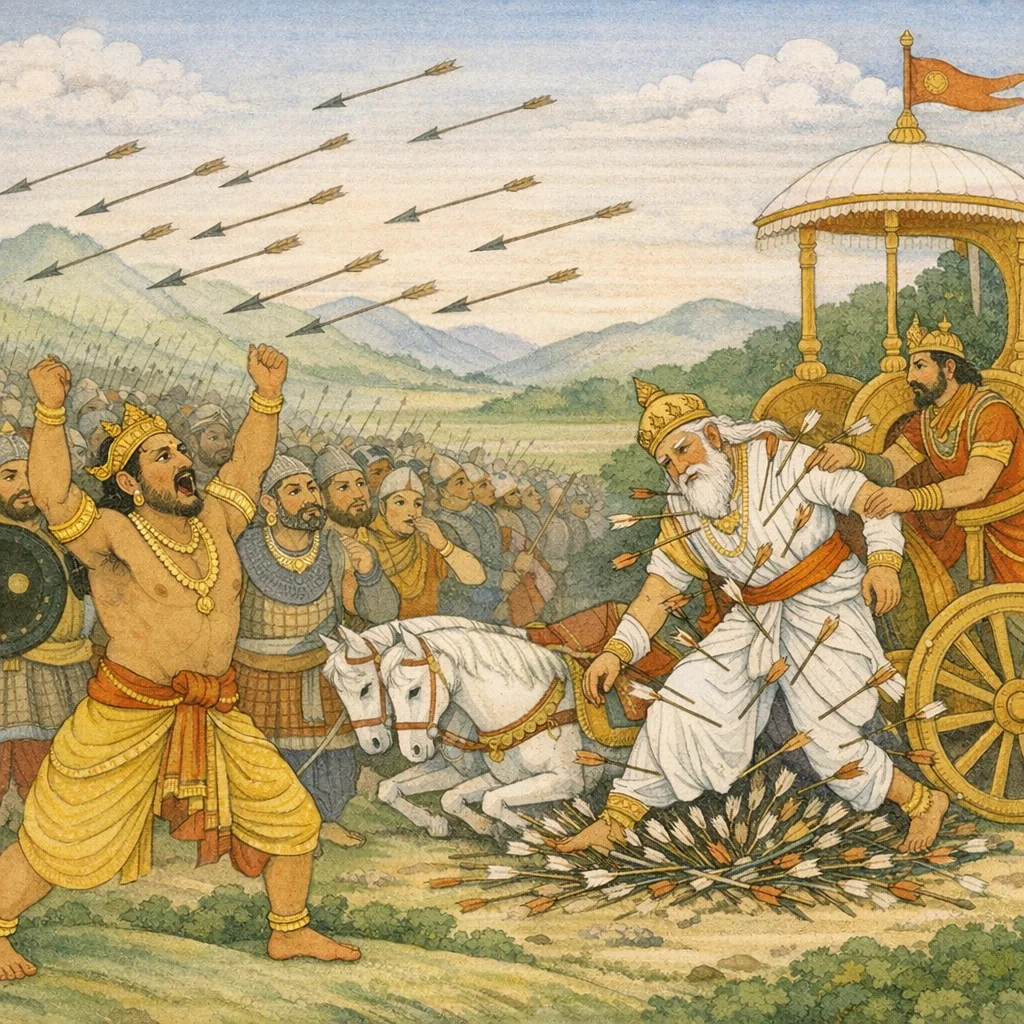
Chapter Arc: संजय धृतराष्ट्र को बताता है कि कौरव-पक्ष के प्रधान महारथियों से घिरे हुए भीष्म पर समस्त सृंजय-वीर एक साथ टूट पड़े—मानो एक ही लक्ष्य पर समूची वज्रवर्षा उतर आई हो। → शतघ्नियों, परिघों, परश्वधों, मुद्गरों, मुसलों, प्रासों और असंख्य क्षेपणीय अस्त्रों के साथ-साथ स्वर्णपुङ्ख बाण, शक्ति-तोमर, नाराच, वत्सदन्त और भुशुण्डियाँ—हर दिशा से भीष्म पर प्रहार होने लगता है; भीष्म का धनुष कटता है, क्रोध बढ़ता है, और वे पर्वत-भेदी शक्ति उठाकर प्रत्युत्तर को उद्यत होते हैं। → भीषण संग्राम देवासुर-युद्ध के समान हो उठता है; अंततः भीष्म के रथ से गिरते ही (उनके साथ) सबके हृदय गिर पड़ते हैं—यह दृश्य युद्धभूमि की धड़कन बदल देता है, और पांडव-पक्ष में विशेषतः भीमसेन के घोष-ताड़न से हर्ष का ज्वार उठता है। → भीष्म अपने वरदान-स्मरण के साथ उत्तरायण की प्रतीक्षा का संकल्प करते हैं—मुमूर्षु होकर भी प्राण धारण करने का निश्चय; गंगा-पुत्र के मनोभाव को जानकर गंगा की करुण उपस्थिति/अनुगमन का संकेत मिलता है, और दोनों सेनाएँ महान योद्धा के पतन से स्तब्ध-सी हो जाती हैं। → भीष्म के पतन के बाद सेनाओं की दिशा क्या होगी—कौरवों का नेतृत्व किसके हाथ में जाएगा और युद्ध का पलड़ा किस ओर झुकेगा?
Shlokas
Verse 1
[दाक्षिणात्य अधिक पाठका १ श्लोक मिलाकर कुल ५५ “लोक हैं।] #स्न्मा+ज () अिमसन- एकोनविशर्त्याधिकशततमो< ध्याय: कौरवपक्षके प्रमुख महारथियोंद्वारा सुरक्षित होनेपर भी अर्जुनका भीष्मको रथसे गिराना, शरशय्यापर स्थित भीष्मके समीप हंसरूपधारी ऋषियोंका आगमन एवं उनके कथनसे भीष्मका उत्तरायणकी प्रतीक्षा करते हुए प्राण धारण करना संजय उवाच एवं ते पाण्डवा: सर्वे पुरस्कृत्य शिखण्डिनम् । विव्यधु: समरे भीष्म परिवार्य समन्ततः,संजय कहते हैं--राजन! इस प्रकार शिखण्डीको आगे करके सभी पाण्डवोंने समरभूमिमें भीष्मको सब ओरसे घेरकर बींधना आरम्भ किया
Sanjaya said: O King, placing Śikhaṇḍin in the forefront, all the Pāṇḍavas surrounded Bhīṣma on every side in the battle and began to pierce him with their arrows. The scene underscores a grim ethical tension of war: the Pāṇḍavas rely on a strategic arrangement—using Śikhaṇḍin as a shield—against a warrior bound by his own vows and codes of conduct.
Verse 2
शतघध्नीभि: सुघोराभि: परिघैश्न परश्वथैः । मुदगरैर्मुसलै: प्रासै: क्षेपणीयैश्व॒ सर्वश:,अताडयन् रणे भीष्मं सहिता: सर्वसृञज्जया: । समस्त सूंजय वीर एक साथ संगठित हो भयंकर शतघ्नी, परिघ, फरसे, मुद्गर, मुसल, प्रास, गोफन, स्वर्णमय पंखवाले बाण, शक्ति, तोमर, कम्पन, नाराच, वत्सदन््त और भुशुण्डी आदि अस्त्र-शस्त्रोंद्वारा रणभूमिमें भीष्मको सब ओरसे पीड़ा देने लगे
Sañjaya said: Then, in the thick of battle, the assembled Sṛñjayas assailed Bhīṣma from every side—striking him with dreadful śataghni missiles, iron clubs and bars, axes, hammers, pestles, spears, and all manner of thrown weapons. The scene underscores the grim ethic of war: even the most venerable warrior becomes a target when duty to one’s side hardens into relentless collective force.
Verse 3
शरै: कनकपुड्खैश्न शक्तितोमरकम्पनै: । नाराचैर्वत्सदन्तैश्व भुशुण्डीभिश्नल सर्वशः,अताडयन् रणे भीष्मं सहिता: सर्वसृञज्जया: । समस्त सूंजय वीर एक साथ संगठित हो भयंकर शतघ्नी, परिघ, फरसे, मुद्गर, मुसल, प्रास, गोफन, स्वर्णमय पंखवाले बाण, शक्ति, तोमर, कम्पन, नाराच, वत्सदन््त और भुशुण्डी आदि अस्त्र-शस्त्रोंद्वारा रणभूमिमें भीष्मको सब ओरसे पीड़ा देने लगे
Sañjaya said: United together, all the Sṛñjayas struck Bhīṣma on the battlefield from every side—assailing him with arrows fitted with golden feathers, with spears and tomaras, with the weapon called kampana, with nārācas and the ‘calf-tooth’ shafts, and with bhuśuṇḍīs. The scene shows the collective resolve of the Pāṇḍava host to check the seemingly invincible elder, even as the war’s harsh necessity presses against the moral weight of attacking a revered patriarch.
Verse 4
स विशीर्णतनुत्राण: पीडितो बहुभिस्तदा,अताडयन् रणे भीष्मं सहिता: सर्वसृञज्जया: । समस्त सूंजय वीर एक साथ संगठित हो भयंकर शतघ्नी, परिघ, फरसे, मुद्गर, मुसल, प्रास, गोफन, स्वर्णमय पंखवाले बाण, शक्ति, तोमर, कम्पन, नाराच, वत्सदन््त और भुशुण्डी आदि अस्त्र-शस्त्रोंद्वारा रणभूमिमें भीष्मको सब ओरसे पीड़ा देने लगे न विव्यथे तदा भीष्मो भिद्यमानेषु मर्मसु । उस समय बहुसंख्यक योद्धाओंके द्वारा अनेक प्रकारके अस्त्रोंसे पीड़ित होनेके कारण भीष्मका कवच छिउत्न-भिन्न हो गया। उनके मर्मस्थान विदीर्ण होने लगे, तो भी उनके मनमें व्यथा नहीं हुई
Sañjaya said: Then Bhīṣma, his armour shattered and his body pressed hard by many warriors, was struck again and again in battle as all the Sṛñjayas, united together, assailed him. Yet even as his vital points were being pierced and torn by the blows, Bhīṣma did not waver in pain—steadfast in his warrior’s resolve amid the crushing violence of war.
Verse 5
।। संदीप्तशरचापाग्निरस्त्रप्रसूतमारुत:,अताडयन् रणे भीष्मं सहिता: सर्वसृञज्जया: । समस्त सूंजय वीर एक साथ संगठित हो भयंकर शतघ्नी, परिघ, फरसे, मुद्गर, मुसल, प्रास, गोफन, स्वर्णमय पंखवाले बाण, शक्ति, तोमर, कम्पन, नाराच, वत्सदन््त और भुशुण्डी आदि अस्त्र-शस्त्रोंद्वारा रणभूमिमें भीष्मको सब ओरसे पीड़ा देने लगे
Sañjaya said: The Sṛñjaya warriors, all acting in close formation, assailed Bhīṣma on the battlefield—like a blazing fire fed by the wind raised from weapons—striking him from every side with volleys of arrows and the force of their arms. The scene underscores the grim ethic of war: even the most venerable elder is relentlessly targeted once he stands as the foremost pillar of the opposing cause.
Verse 6
नेमिनिहादिसंतापो महास्त्रोदयपावक: । चित्रचापमहाज्वालो वीरक्षयमहेन्धन:,अताडयन् रणे भीष्मं सहिता: सर्वसृञज्जया: । समस्त सूंजय वीर एक साथ संगठित हो भयंकर शतघ्नी, परिघ, फरसे, मुद्गर, मुसल, प्रास, गोफन, स्वर्णमय पंखवाले बाण, शक्ति, तोमर, कम्पन, नाराच, वत्सदन््त और भुशुण्डी आदि अस्त्र-शस्त्रोंद्वारा रणभूमिमें भीष्मको सब ओरसे पीड़ा देने लगे
Sañjaya said: “Like a blazing fire kindled by the rising of mighty weapons—its heat fed by the whir of wheels and the clash of arms, its great flames the many-colored bows, and its fuel the destruction of heroes—the assembled Sṛñjayas struck Bhīṣma on the battlefield from every side. In their united assault, they sought to wear down the grandsire through relentless, coordinated violence, showing how war’s momentum can turn even disciplined valor into a consuming conflagration.”
Verse 7
युगान्ताग्निसमप्रख्य: परेषां समपद्यत । वे शत्रुओंके लिये प्रलयकालकी अग्निके समान अदभुत तेजसे प्रज्वलित हो उठे। धनुष और बाण ही धधकती हुई आग थे। अस्त्रोंका प्रसार ही वायुका सहारा था। रथोंके पहियोंकी घरघराहट उस आगकी आँच थी। बड़े-बड़े अस्त्रोंका प्राकट्य अंगारके समान था। विचित्र चाप ही उस आगकी प्रचण्ड ज्वालाओंके समान था। बड़े-बड़े वीर ही ईंधनके समान उसमें गिरकर भस्म हो रहे थे ।। विवृत्य रथसड्घानामन्तरेण विनि:सृत:,अताडयन् रणे भीष्मं सहिता: सर्वसृञज्जया: । समस्त सूंजय वीर एक साथ संगठित हो भयंकर शतघ्नी, परिघ, फरसे, मुद्गर, मुसल, प्रास, गोफन, स्वर्णमय पंखवाले बाण, शक्ति, तोमर, कम्पन, नाराच, वत्सदन््त और भुशुण्डी आदि अस्त्र-शस्त्रोंद्वारा रणभूमिमें भीष्मको सब ओरसे पीड़ा देने लगे
Sañjaya said: He advanced upon the enemy like the fire that blazes at the end of an age. For his foes he flared up with astonishing radiance, like the conflagration of dissolution. His bow and arrows seemed like a roaring flame; the very spread of his missiles was as the wind that feeds that fire; the rumbling of chariot-wheels was its scorching heat. The appearance of mighty weapons was like glowing embers, and his wondrous bows were like fierce tongues of flame. Great warriors themselves, like fuel, fell into it and were consumed. Breaking through the intervals between the masses of chariots, all the Sṛñjayas together struck Bhīṣma in battle, tormenting him from every side with dreadful śataghnīs, iron clubs and bars, axes, maces, pestles, spears, slings, arrows with golden wings, śaktis, tomaras, kampanas, nārācas, vatsadantas, and bhuśuṇḍīs—an image of war’s consuming power where valor becomes both duty and destruction.
Verse 8
दृश्यते सम नरेन्द्राणां पुनर्मध्यगतश्चरन् । पितामह भीष्म एक ही क्षणमें रथकी पंक्ति तोड़कर घेरेसे बाहर निकल आते और पुनः राजाओंकी सेनाके मध्यभागमें प्रवेश करके वहाँ विचरते दिखायी देते थे ।। ततः पज्चालराजं च धृष्टकेतुमचिन्त्य च,अताडयन् रणे भीष्मं सहिता: सर्वसृञज्जया: । समस्त सूंजय वीर एक साथ संगठित हो भयंकर शतघ्नी, परिघ, फरसे, मुद्गर, मुसल, प्रास, गोफन, स्वर्णमय पंखवाले बाण, शक्ति, तोमर, कम्पन, नाराच, वत्सदन््त और भुशुण्डी आदि अस्त्र-शस्त्रोंद्वारा रणभूमिमें भीष्मको सब ओरसे पीड़ा देने लगे
Sañjaya said: Bhīṣma, the grandsire, was seen moving again and again amid the kings. In a single moment he would break through the line of chariots, emerge from the encirclement, and then re-enter the very center of the royal host, ranging there in full view. Then all the Sṛñjayas, acting together, struck at Bhīṣma in battle—along with the king of the Pāñcālas and the formidable Dhṛṣṭaketu—seeking to check the unstoppable elder whose prowess was reshaping the field. The scene underscores the war’s moral tension: disciplined valor and collective duty confronting an aged yet invincible champion bound by his own vows and allegiance.
Verse 9
पाण्डवानीकिनीमध्यमाससाद विशाम्पते । प्रजानाथ! तत्पश्चात् पांचालराज ट्रुपद तथा धृष्टकेतुकी कुछ भी परवा न करके वे पाण्डव-सेनाके भीतर घुस आये ।। ८ ह ।। ततः सात्यकिभीमौ च पाण्डवं च धनंजयम्,अताडयन् रणे भीष्मं सहिता: सर्वसृञज्जया: । समस्त सूंजय वीर एक साथ संगठित हो भयंकर शतघ्नी, परिघ, फरसे, मुद्गर, मुसल, प्रास, गोफन, स्वर्णमय पंखवाले बाण, शक्ति, तोमर, कम्पन, नाराच, वत्सदन््त और भुशुण्डी आदि अस्त्र-शस्त्रोंद्वारा रणभूमिमें भीष्मको सब ओरसे पीड़ा देने लगे षडेतान् निशितैर्भीष्म: प्रविव्याधोत्तमै: शरै: | फिर भयंकर शब्द करनेवाले, महान् वेगशाली, मर्मस्थानों और कवचोंको भी विदीर्ण कर देनेवाले, तीखे एवं उत्तम बाणोंद्वारा उन्होंने सात्यकि, भीमसेन, पाण्डुपुत्र अर्जुन, विराट, टद्रुपद तथा उनके पुत्र धृष्टद्युम्न--इन छ: महाराथियोंको अत्यन्त घायल कर दिया
Sanjaya said: Then Sātyaki and Bhīma, and Pāṇḍava Arjuna (Dhanañjaya) too—together with all the Sṛñjaya warriors—assailed Bhīṣma in the battle. But Bhīṣma, with keen and excellent arrows, pierced and grievously wounded these six foremost fighters. The scene underscores the harsh reciprocity of war: even when many unite to strike down a single elder commander, mastery and resolve can turn the tide, while the ethical tension of fighting revered elders remains implicit beneath the clash of arms.
Verse 10
द्रुपदं च विराट च धृष्टद्युम्नं च पार्षतम् भीमघोषैर्महावेगैर्मर्मावरणभेदिभि:,अताडयन् रणे भीष्मं सहिता: सर्वसृञज्जया: । समस्त सूंजय वीर एक साथ संगठित हो भयंकर शतघ्नी, परिघ, फरसे, मुद्गर, मुसल, प्रास, गोफन, स्वर्णमय पंखवाले बाण, शक्ति, तोमर, कम्पन, नाराच, वत्सदन््त और भुशुण्डी आदि अस्त्र-शस्त्रोंद्वारा रणभूमिमें भीष्मको सब ओरसे पीड़ा देने लगे
Sañjaya said: Drupada and Virāṭa, and Dhṛṣṭadyumna the son of Pṛṣata, together with all the Sṛñjayas, struck Bhīṣma in battle with terrifying roars and tremendous force—blows that pierced even his vital protections. In the clash of arms, the allied warriors pressed him from every side, intent on checking the elder’s overwhelming might, even as the grim demands of war drove them to assail a revered grandsire.
Verse 11
तस्य ते निशितान् बाणान् संनिवार्य महारथा:,अताडयन् रणे भीष्मं सहिता: सर्वसृञज्जया: । समस्त सूंजय वीर एक साथ संगठित हो भयंकर शतघ्नी, परिघ, फरसे, मुद्गर, मुसल, प्रास, गोफन, स्वर्णमय पंखवाले बाण, शक्ति, तोमर, कम्पन, नाराच, वत्सदन््त और भुशुण्डी आदि अस्त्र-शस्त्रोंद्वारा रणभूमिमें भीष्मको सब ओरसे पीड़ा देने लगे
Sañjaya said: Having checked those sharp arrows of his, the great chariot-warriors—all the Sṛñjayas united—assailed Bhīṣma in the battle, striking him from every side. In their coordinated fury they sought to overwhelm the grandsire with a storm of weapons, pressing him relentlessly amid the din of war.
Verse 12
शिखण्डी तु महाबाणान् यान् मुमोच महारथ:,अताडयन् रणे भीष्मं सहिता: सर्वसृञज्जया: । समस्त सूंजय वीर एक साथ संगठित हो भयंकर शतघ्नी, परिघ, फरसे, मुद्गर, मुसल, प्रास, गोफन, स्वर्णमय पंखवाले बाण, शक्ति, तोमर, कम्पन, नाराच, वत्सदन््त और भुशुण्डी आदि अस्त्र-शस्त्रोंद्वारा रणभूमिमें भीष्मको सब ओरसे पीड़ा देने लगे
Sañjaya said: Then Śikhaṇḍī, that great chariot-warrior, loosed mighty arrows; and together all the Sṛñjayas struck Bhīṣma in the battle. United as one, they assailed him from every side, seeking to wear down the grandsire through relentless force—an episode that highlights how, in war, collective strategy and the exploitation of a known vulnerability can overpower even the most righteous and formidable elder.
Verse 13
ततः किरीटी संरब्धो भीष्ममेवाभ्यधावत,अताडयन् रणे भीष्मं सहिता: सर्वसृञज्जया: । समस्त सूंजय वीर एक साथ संगठित हो भयंकर शतघ्नी, परिघ, फरसे, मुद्गर, मुसल, प्रास, गोफन, स्वर्णमय पंखवाले बाण, शक्ति, तोमर, कम्पन, नाराच, वत्सदन््त और भुशुण्डी आदि अस्त्र-शस्त्रोंद्वारा रणभूमिमें भीष्मको सब ओरसे पीड़ा देने लगे
Sañjaya said: Then Arjuna, the diademed hero, inflamed with resolve, rushed straight at Bhīṣma. And all the Sṛñjaya warriors, united together, struck Bhīṣma on the battlefield from every side, seeking to harass and press him hard in the fury of war. The scene underscores the grim ethic of kṣatriya combat: concentrated force is marshalled to check an invincible elder, even as reverence and duty collide amid the necessities of battle.
Verse 14
भीष्मस्य धनुषश्छेदं नामृष्यन्त महारथा:,अताडयन् रणे भीष्मं सहिता: सर्वसृञज्जया: । समस्त सूंजय वीर एक साथ संगठित हो भयंकर शतघ्नी, परिघ, फरसे, मुद्गर, मुसल, प्रास, गोफन, स्वर्णमय पंखवाले बाण, शक्ति, तोमर, कम्पन, नाराच, वत्सदन््त और भुशुण्डी आदि अस्त्र-शस्त्रोंद्वारा रणभूमिमें भीष्मको सब ओरसे पीड़ा देने लगे अभिपेतुर्भुशं क्रुद्धाश्छादयन्तश्न॒ पाण्डवम् | भीष्मके धनुषका काटा जाना कौरव महारथियोंको सहन नहीं हुआ। द्रोण, कृतवर्मा, सिन्धुराज जयद्रथ, भूरिश्रवा, शल, शल्य और भगदत्त--ये सात महारथी अत्यन्त क़ुद्ध हो किरीटधारी अर्जुनकी ओर दौड़े तथा अपने दिव्य अस्त्र-शस्त्रोंका प्रदर्शन करते हुए पाण्डुनन्दन अर्जुनको अत्यन्त क्रोधपूर्वक बाणोंसे आच्छादित करने लगे
Sanjaya said: Unable to endure that Bhishma’s bow had been cut, the great chariot-warriors—joined together with all the Sṛñjayas—assailed Bhishma in the battle. Then, in fierce anger, they rushed forward and, displaying their prowess, showered the Pāṇḍava (Arjuna) with volleys of arrows, seeking to overwhelm him from every side.
Verse 15
द्रोणश्न॒ कृतवर्मा च सैन्धवश्न जयद्रथ: । भूरिश्रवा: शल: शल्यो भगदत्तस्तथैव च,अताडयन् रणे भीष्मं सहिता: सर्वसृञज्जया: । समस्त सूंजय वीर एक साथ संगठित हो भयंकर शतघ्नी, परिघ, फरसे, मुद्गर, मुसल, प्रास, गोफन, स्वर्णमय पंखवाले बाण, शक्ति, तोमर, कम्पन, नाराच, वत्सदन््त और भुशुण्डी आदि अस्त्र-शस्त्रोंद्वारा रणभूमिमें भीष्मको सब ओरसे पीड़ा देने लगे
Sañjaya said: Drona and Kṛtavarmā, the Sindhu prince Jayadratha, Bhūriśravas, Śala, Śalya, and Bhagadatta as well—joining together with all the Sṛñjaya warriors—assailed Bhīṣma in the battle, striking him from every side. The scene underscores the grim ethic of war: even the most venerable and formidable elder on the field becomes the focus of coordinated violence when victory is pursued above reverence.
Verse 16
सप्तैते परमक्रुद्धा: किरीटिनमभिद्रुता: । तत्र शस्त्राणि दिव्यानि दर्शयन्तो महारथा:,अताडयन् रणे भीष्मं सहिता: सर्वसृञज्जया: । समस्त सूंजय वीर एक साथ संगठित हो भयंकर शतघ्नी, परिघ, फरसे, मुद्गर, मुसल, प्रास, गोफन, स्वर्णमय पंखवाले बाण, शक्ति, तोमर, कम्पन, नाराच, वत्सदन््त और भुशुण्डी आदि अस्त्र-शस्त्रोंद्वारा रणभूमिमें भीष्मको सब ओरसे पीड़ा देने लगे
Sañjaya said: Seven of those great chariot-warriors, inflamed with extreme wrath, rushed upon the diademed one (Arjuna). There, displaying their celestial weapons, all the Sṛñjayas together struck Bhīṣma in the battle. In the moral tension of the war, this scene shows how collective fury and martial prowess are turned against a single venerable elder—Bhīṣma—whose very presence embodies duty and the tragic cost of allegiance.
Verse 17
तेषामापततां शब्द: शुश्रुवे फाल्गुनं प्रति,अताडयन् रणे भीष्मं सहिता: सर्वसृञज्जया: । समस्त सूंजय वीर एक साथ संगठित हो भयंकर शतघ्नी, परिघ, फरसे, मुद्गर, मुसल, प्रास, गोफन, स्वर्णमय पंखवाले बाण, शक्ति, तोमर, कम्पन, नाराच, वत्सदन््त और भुशुण्डी आदि अस्त्र-शस्त्रोंद्वारा रणभूमिमें भीष्मको सब ओरसे पीड़ा देने लगे
Sañjaya said: The roar of those warriors rushing forward was heard as it surged toward Phālguna (Arjuna). United together, all the Sṛñjayas struck Bhīṣma in the battle, assailing him from every side with their weapons. The scene underscores the grim ethic of war: even the most venerable elder, once committed to a cause on the battlefield, becomes a lawful target of concentrated force, as duty and allegiance harden into violence.
Verse 18
घ्नतानयत गृह्नीत विद्धय॒ध्वमवर्कर्तत,अताडयन् रणे भीष्मं सहिता: सर्वसृञज्जया: । समस्त सूंजय वीर एक साथ संगठित हो भयंकर शतघ्नी, परिघ, फरसे, मुद्गर, मुसल, प्रास, गोफन, स्वर्णमय पंखवाले बाण, शक्ति, तोमर, कम्पन, नाराच, वत्सदन््त और भुशुण्डी आदि अस्त्र-शस्त्रोंद्वारा रणभूमिमें भीष्मको सब ओरसे पीड़ा देने लगे
Sañjaya said: “Strike, bring them down, seize them, pierce them, and cut them to pieces!” Thus urged on, all the Sṛñjayas, acting in concert, assailed Bhīṣma on the battlefield from every side, seeking to overwhelm him through relentless blows and wounds. The scene underscores the grim ethic of war: collective resolve and martial skill are turned toward the single aim of disabling a formidable elder-warrior, even as the violence intensifies the tragedy of kin-slaying within a dharma-conflicted war.
Verse 19
तं शब्दं तुमुलं श्रुत्वा पाण्डवानां महारथा:,अताडयन् रणे भीष्मं सहिता: सर्वसृञज्जया: । समस्त सूंजय वीर एक साथ संगठित हो भयंकर शतघ्नी, परिघ, फरसे, मुद्गर, मुसल, प्रास, गोफन, स्वर्णमय पंखवाले बाण, शक्ति, तोमर, कम्पन, नाराच, वत्सदन््त और भुशुण्डी आदि अस्त्र-शस्त्रोंद्वारा रणभूमिमें भीष्मको सब ओरसे पीड़ा देने लगे
Sañjaya said: Hearing that tremendous, tumultuous roar raised by the Pāṇḍavas, all the Sṛñjaya great chariot-warriors, acting in close formation, fell upon Bhīṣma in the battle and struck at him from every side. The scene underscores the grim ethic of war: even the most venerable elder is treated as an active combatant once he stands as the opposing commander, and collective duty to one’s cause overrides personal reverence on the battlefield.
Verse 20
सात्यकिर्भीमसेनश्व धृष्टय्युम्नश्व॒ पार्षत:,अताडयन् रणे भीष्मं सहिता: सर्वसृञज्जया: । समस्त सूंजय वीर एक साथ संगठित हो भयंकर शतघ्नी, परिघ, फरसे, मुद्गर, मुसल, प्रास, गोफन, स्वर्णमय पंखवाले बाण, शक्ति, तोमर, कम्पन, नाराच, वत्सदन््त और भुशुण्डी आदि अस्त्र-शस्त्रोंद्वारा रणभूमिमें भीष्मको सब ओरसे पीड़ा देने लगे
Sañjaya said: Sātyaki, Bhīmasena, and Dhr̥ṣṭadyumna the son of Pārṣata—together with all the Sṛñjayas in close formation—assailed Bhīṣma in the thick of battle, striking him from every side. The scene underscores the grim ethic of war: even the most venerable warrior becomes a lawful target once he stands as the pillar of an unjust cause, and collective effort is marshalled to check a single, overwhelming champion.
Verse 21
विराटद्रुपदौ चोभौ राक्षसश्न घटोत्कच: । अभिमन्युश्च संक्रुद्ध: सप्तैते क्रोधमूर्च्छिता:,अताडयन् रणे भीष्मं सहिता: सर्वसृञज्जया: । समस्त सूंजय वीर एक साथ संगठित हो भयंकर शतघ्नी, परिघ, फरसे, मुद्गर, मुसल, प्रास, गोफन, स्वर्णमय पंखवाले बाण, शक्ति, तोमर, कम्पन, नाराच, वत्सदन््त और भुशुण्डी आदि अस्त्र-शस्त्रोंद्वारा रणभूमिमें भीष्मको सब ओरसे पीड़ा देने लगे
Sañjaya said: Virāṭa and Drupada, and the rākṣasa Ghaṭotkaca, and Abhimanyu—enraged—these seven, overcome by a surge of wrath, together with all the Sṛñjayas, struck Bhīṣma in battle. United as one, they assailed him from every side with fearsome weapons, seeking to break the grandsire’s advance and protect their own cause amid the harsh demands of war.
Verse 22
समभ्यधावंस्त्वरिताश्रित्रकार्मुकधारिण: । सात्यकि, भीमसेन, ट्रुपदकुमार धृष्टद्युम्न, विराट, द्रुपद, राक्षस घटोत्कव और अभिमन्यु--ये सात वीर क्रोधसे मूर्च्छित हो तुरंत ही विचित्र धनुष धारण किये वहाँ दौड़े आये || २०-२१ है ।। तेषां समभवद् युद्ध तुमुलं लोमहर्षणम्,अताडयन् रणे भीष्मं सहिता: सर्वसृञज्जया: । समस्त सूंजय वीर एक साथ संगठित हो भयंकर शतघ्नी, परिघ, फरसे, मुद्गर, मुसल, प्रास, गोफन, स्वर्णमय पंखवाले बाण, शक्ति, तोमर, कम्पन, नाराच, वत्सदन््त और भुशुण्डी आदि अस्त्र-शस्त्रोंद्वारा रणभूमिमें भीष्मको सब ओरसे पीड़ा देने लगे
Sañjaya said: Then, bearing their bows and rushing with speed, Sātyaki, Bhīmasena, Drupada’s son Dhṛṣṭadyumna, Virāṭa, Drupada, the rākṣasa Ghaṭotkaca, and Abhimanyu—these heroes, maddened with wrath and wielding wondrous bows—ran straight to that place. From their onset there arose a tumultuous, hair-raising battle. United as the Sṛñjayas, they struck Bhīṣma in the fight from every side, pressing him hard with a coordinated assault—an image of war’s grim ethic: disciplined collective effort set against a single, formidable elder whose duty binds him to the Kuru cause.
Verse 23
शिखण्डी तु रणे श्रेष्ठो रक्ष््माण: किरीटिना,अताडयन् रणे भीष्मं सहिता: सर्वसृञज्जया: । समस्त सूंजय वीर एक साथ संगठित हो भयंकर शतघ्नी, परिघ, फरसे, मुद्गर, मुसल, प्रास, गोफन, स्वर्णमय पंखवाले बाण, शक्ति, तोमर, कम्पन, नाराच, वत्सदन््त और भुशुण्डी आदि अस्त्र-शस्त्रोंद्वारा रणभूमिमें भीष्मको सब ओरसे पीड़ा देने लगे भीष्मजीका धनुष कट गया था। उसी अवस्थामें अर्जुनसे सुरक्षित शिखण्डीने दस बाणोंसे उन्हें और दस बाणोंसे उनके सारथिको भी घायल कर दिया। तत्पश्चात् एक बाणसे ध्वजको काट गिराया। तब शत्रुवीरोंका संहार करनेवाले गंगानन्दन भीष्मने दूसरा अत्यन्त वेगशाली धनुष लेकर तीखे बाणोंसे अर्जुनको घायल करना आरम्भ किया। यह देख अर्जुनने उस धनुषको भी तीन पैने बाणोंद्वारा काट डाला
Sañjaya said: In that battle, Śikhaṇḍī—foremost among fighters—being protected by the diademed Arjuna, struck at Bhīṣma. Along with him, all the Sṛñjaya warriors unitedly assailed Bhīṣma from every side, seeking to overwhelm the grandsire through coordinated force. The scene underscores the grim ethics of war: even the mightiest are brought down not only by personal valor but by strategy, alliances, and the deliberate use of a shielded attacker against one bound by vows and scruples.
Verse 24
अविध्यद् दशभिर्भ॑ष्म॑ छिन्नधन्वानमाहवे । सारथिं दशभिश्चास्य ध्वजं चैकेन चिच्छिदे,अताडयन् रणे भीष्मं सहिता: सर्वसृञज्जया: । समस्त सूंजय वीर एक साथ संगठित हो भयंकर शतघ्नी, परिघ, फरसे, मुद्गर, मुसल, प्रास, गोफन, स्वर्णमय पंखवाले बाण, शक्ति, तोमर, कम्पन, नाराच, वत्सदन््त और भुशुण्डी आदि अस्त्र-शस्त्रोंद्वारा रणभूमिमें भीष्मको सब ओरसे पीड़ा देने लगे भीष्मजीका धनुष कट गया था। उसी अवस्थामें अर्जुनसे सुरक्षित शिखण्डीने दस बाणोंसे उन्हें और दस बाणोंसे उनके सारथिको भी घायल कर दिया। तत्पश्चात् एक बाणसे ध्वजको काट गिराया। तब शत्रुवीरोंका संहार करनेवाले गंगानन्दन भीष्मने दूसरा अत्यन्त वेगशाली धनुष लेकर तीखे बाणोंसे अर्जुनको घायल करना आरम्भ किया। यह देख अर्जुनने उस धनुषको भी तीन पैने बाणोंद्वारा काट डाला
Sañjaya said: In the battle, Śikhaṇḍin struck Bhīṣma—whose bow had been cut—with ten arrows. He also pierced Bhīṣma’s charioteer with ten arrows, and with a single arrow he severed the banner. The scene underscores the ruthless mechanics of war: once a warrior is disarmed, the fight turns into a contest of protection, vulnerability, and tactical advantage, even against a venerable elder like Bhīṣma.
Verse 25
सोअन्यत् कार्मुकमादाय गाड़्ेयो वेगवत्तरम् । (जघान निशितैर्बाणैरर्जुनं परवीरहा ।) तदप्यस्य शितैर्बाणैस्त्रिभिश्चिच्छेद फाल्गुन:,अताडयन् रणे भीष्मं सहिता: सर्वसृञज्जया: । समस्त सूंजय वीर एक साथ संगठित हो भयंकर शतघ्नी, परिघ, फरसे, मुद्गर, मुसल, प्रास, गोफन, स्वर्णमय पंखवाले बाण, शक्ति, तोमर, कम्पन, नाराच, वत्सदन््त और भुशुण्डी आदि अस्त्र-शस्त्रोंद्वारा रणभूमिमें भीष्मको सब ओरसे पीड़ा देने लगे भीष्मजीका धनुष कट गया था। उसी अवस्थामें अर्जुनसे सुरक्षित शिखण्डीने दस बाणोंसे उन्हें और दस बाणोंसे उनके सारथिको भी घायल कर दिया। तत्पश्चात् एक बाणसे ध्वजको काट गिराया। तब शत्रुवीरोंका संहार करनेवाले गंगानन्दन भीष्मने दूसरा अत्यन्त वेगशाली धनुष लेकर तीखे बाणोंसे अर्जुनको घायल करना आरम्भ किया। यह देख अर्जुनने उस धनुषको भी तीन पैने बाणोंद्वारा काट डाला
Sañjaya said: Then Bhīṣma, the son of the Gaṅgā and slayer of enemy heroes, took up another bow, swifter in its force, and struck Arjuna with sharp arrows. But Arjuna (Phālguna) cut that bow as well with three keen shafts. Meanwhile, all the Sṛñjayas, acting in concert, assailed Bhīṣma on the battlefield from every side. The episode underscores a grim battlefield ethic: prowess is met by counter-prowess, and even the mightiest warrior is constrained by circumstance—here, Bhīṣma’s vulnerability is intensified by coordinated pressure and the larger moral tension of fighting while bound by vows and prior commitments.
Verse 26
एवं स पाण्डव: क्रुद्ध आत्तमात्तं पुनः पुनः । धनुश्विच्छेद भीष्मस्य सव्यसाची परंतप:,अताडयन् रणे भीष्मं सहिता: सर्वसृञज्जया: । समस्त सूंजय वीर एक साथ संगठित हो भयंकर शतघ्नी, परिघ, फरसे, मुद्गर, मुसल, प्रास, गोफन, स्वर्णमय पंखवाले बाण, शक्ति, तोमर, कम्पन, नाराच, वत्सदन््त और भुशुण्डी आदि अस्त्र-शस्त्रोंद्वारा रणभूमिमें भीष्मको सब ओरसे पीड़ा देने लगे इस प्रकार क्रोधमें भरे हुए शत्रुसंतापी, सव्यसाची पाण्डुनन्दन अर्जुन जो-जो धनुष भीष्म लेते, उसी-उसीको काट डालते थे
Sanjaya said: Thus the Pandava, inflamed with wrath, again and again cut down Bhishma’s bow as he raised it. That left-handed master archer, Arjuna, scorcher of foes, struck Bhishma in the battle; and all the Sṛñjayas, united together, assailed Bhishma on every side with terrible weapons, seeking to harry and wear him down amid the righteous yet devastating demands of war.
Verse 27
स छिन्नधन्वा संक्रुद्ध: सृक्किणी परिसंलिहन् । शक्ति जग्राह तरसा गिरीणामणि दारणीम,अताडयन् रणे भीष्मं सहिता: सर्वसृञज्जया: । समस्त सूंजय वीर एक साथ संगठित हो भयंकर शतघ्नी, परिघ, फरसे, मुद्गर, मुसल, प्रास, गोफन, स्वर्णमय पंखवाले बाण, शक्ति, तोमर, कम्पन, नाराच, वत्सदन््त और भुशुण्डी आदि अस्त्र-शस्त्रोंद्वारा रणभूमिमें भीष्मको सब ओरसे पीड़ा देने लगे धनुष कट जानेपर क्रोधपूर्वक अपने मुँहके दोनों कोनोंको चाटते हुए भीष्मने बलपूर्वक एक शक्ति हाथमें ली, जो पर्वतोंको भी विदीर्ण करनेवाली थी
Sañjaya said: When his bow had been cut, Bhīṣma—angered—licking the corners of his mouth in fierce resolve, swiftly seized a śakti (a heavy spear), a weapon said to be able to split even the peaks of mountains. The scene underscores the relentless escalation of violence in war: when one means is broken, another, more terrible means is taken up, and wrath becomes the fuel that drives further destruction.
Verse 28
तां च चिक्षेप संक्रुद्ध: फाल्गुनस्य रथं प्रति । तामापतन्तीं सम्प्रेक्ष्य ज्वलन्तीमशनीमिव,अताडयन् रणे भीष्मं सहिता: सर्वसृञज्जया: । समस्त सूंजय वीर एक साथ संगठित हो भयंकर शतघ्नी, परिघ, फरसे, मुद्गर, मुसल, प्रास, गोफन, स्वर्णमय पंखवाले बाण, शक्ति, तोमर, कम्पन, नाराच, वत्सदन््त और भुशुण्डी आदि अस्त्र-शस्त्रोंद्वारा रणभूमिमें भीष्मको सब ओरसे पीड़ा देने लगे संक्रुद्धो भरतश्रेष्ठ भीष्मबाहुप्रवेरिताम् । भरतश्रेष्ठ! फिर उसे क्रोधपूर्वक उन्होंने अर्जुनके रथकी ओर चला दिया। प्रज्वलित वज्रके समान उस शक्तिको आती देख पाण्डवोंको आनन्दित करनेवाले अर्जुनने अपने हाथमें भल्ल नामक पाँच तीखे बाण लिये और कुपित हो उन पाँच बाणोंद्वारा भीष्मकी भुजाओंसे प्रेषित हुई उस शक्तिके पाँच टुकड़े कर दिये
Sañjaya said: Enraged, Bhīṣma hurled that weapon toward the chariot of Phālguna (Arjuna). Seeing it rushing in like a blazing thunderbolt, the Sṛñjayas together pressed Bhīṣma hard in the battle. Then Arjuna—delighting the Pāṇḍavas—took five sharp arrows called bhallas, and in anger cut into five pieces that śakti-weapon which had been launched by Bhīṣma’s arms. The episode highlights disciplined skill and alert protection amid the fury of war: even in righteous combat, restraint and precision are the means by which harm is checked.
Verse 29
समादत्त शितान् भल्लान् पञ्च पाण्डवनन्दन: । तस्य चिच्छेद तां शक्ति पठचधा पडठ्चभि: शरै:,अताडयन् रणे भीष्मं सहिता: सर्वसृञज्जया: । समस्त सूंजय वीर एक साथ संगठित हो भयंकर शतघ्नी, परिघ, फरसे, मुद्गर, मुसल, प्रास, गोफन, स्वर्णमय पंखवाले बाण, शक्ति, तोमर, कम्पन, नाराच, वत्सदन््त और भुशुण्डी आदि अस्त्र-शस्त्रोंद्वारा रणभूमिमें भीष्मको सब ओरसे पीड़ा देने लगे
Sañjaya said: The son of the Pāṇḍavas took up five keen, razor-edged bhalla arrows, and with five shafts he cut that spear-weapon into five pieces. Then, united together, all the Sṛñjayas struck Bhīṣma in the battle, assailing him from every side—seeking to check his overwhelming might by a concerted onslaught of diverse missiles and weapons.
Verse 30
सा पपात तथा छि्छिन्ना संक्रुद्धेन किरीटिना,अताडयन् रणे भीष्मं सहिता: सर्वसृञज्जया: । समस्त सूंजय वीर एक साथ संगठित हो भयंकर शतघ्नी, परिघ, फरसे, मुद्गर, मुसल, प्रास, गोफन, स्वर्णमय पंखवाले बाण, शक्ति, तोमर, कम्पन, नाराच, वत्सदन््त और भुशुण्डी आदि अस्त्र-शस्त्रोंद्वारा रणभूमिमें भीष्मको सब ओरसे पीड़ा देने लगे
Sañjaya said: Thus severed, she fell—cut down by the enraged Kirīṭin (Arjuna). Then, all the Sṛñjayas, acting together, struck Bhīṣma on the battlefield from every side, seeking to harass and wear him down with a concentrated assault. The scene underscores the grim ethics of war: even the most venerable warrior becomes a target when the demands of victory override personal reverence, and collective force is marshalled to check an otherwise unstoppable champion.
Verse 31
मेघवृन्दपरिभ्रष्टा विच्छिन्नेव शतह्नदा । क्रोधमें भरे हुए अर्जुनद्वारा काटी हुई वह शक्ति मेघोंके समूहसे निर्मुक्त होकर गिरी हुई बिजलीके समान पृथ्वीपर गिर पड़ी ।। ३० हू || छिन्नां तां शक्तिमालोक्य भीष्म: क्रोधसमन्वित:,अताडयन् रणे भीष्मं सहिता: सर्वसृञज्जया: । समस्त सूंजय वीर एक साथ संगठित हो भयंकर शतघ्नी, परिघ, फरसे, मुद्गर, मुसल, प्रास, गोफन, स्वर्णमय पंखवाले बाण, शक्ति, तोमर, कम्पन, नाराच, वत्सदन््त और भुशुण्डी आदि अस्त्र-शस्त्रोंद्वारा रणभूमिमें भीष्मको सब ओरसे पीड़ा देने लगे
Sañjaya said: Like a lightning-flash torn from a mass of clouds, the spear-weapon—severed by Arjuna in the heat of wrath—fell to the earth. Seeing that spear cut down, Bhīṣma, filled with anger, was assailed in the battle as all the Sṛñjaya warriors, acting together, pressed him from every side with a storm of weapons—maces, clubs, axes, spears, slings, and many kinds of arrows—seeking to wound and restrain the grandsire amid the fury of war.
Verse 32
अचिन्तयद् रणे वीरो बुद्धया परपुरंजय: । अपनी उस शक्तिको छिजन्न-भिन्न हुई देख भीष्मजी क्रोधमें निमग्न हो गये और शत्रुनगरविजयी उन वीर-शिरोमणिने रणक्षेत्रमें अपनी बुद्धिके द्वारा इस प्रकार विचार किया “३१३ || शक्तो5हं धनुषैकेन निहन्तुं सर्वपाण्डवान्,अताडयन् रणे भीष्मं सहिता: सर्वसृञज्जया: । समस्त सूंजय वीर एक साथ संगठित हो भयंकर शतघ्नी, परिघ, फरसे, मुद्गर, मुसल, प्रास, गोफन, स्वर्णमय पंखवाले बाण, शक्ति, तोमर, कम्पन, नाराच, वत्सदन््त और भुशुण्डी आदि अस्त्र-शस्त्रोंद्वारा रणभूमिमें भीष्मको सब ओरसे पीड़ा देने लगे
Sanjaya said: In the midst of battle, that heroic conqueror of enemy strongholds reflected with clear intelligence. Seeing his own power being worn down and shattered, Bhishma sank into anger; and the foremost of warriors, intent on victory, deliberated on the field—measuring duty, resolve, and the hard limits imposed by the unfolding war.
Verse 33
(अजय्यश्लवैव लोकानां सर्वेषामिति मे मति: ।) कारणद्वयमास्थाय नाहं योत्स्यामि पाण्डवान्,अताडयन् रणे भीष्मं सहिता: सर्वसृञज्जया: । समस्त सूंजय वीर एक साथ संगठित हो भयंकर शतघ्नी, परिघ, फरसे, मुद्गर, मुसल, प्रास, गोफन, स्वर्णमय पंखवाले बाण, शक्ति, तोमर, कम्पन, नाराच, वत्सदन््त और भुशुण्डी आदि अस्त्र-शस्त्रोंद्वारा रणभूमिमें भीष्मको सब ओरसे पीड़ा देने लगे
Sañjaya said: “My conviction is that he is truly unconquerable by all the worlds.” Yet, taking up two considerations, he resolved, “I will not fight the Pāṇḍavas.” Meanwhile, in the battle the assembled Sṛñjaya warriors struck Bhīṣma again and again. United together, they pressed him from every side on the field, tormenting him with dreadful weapons—sataghnīs, iron clubs and bars, axes, maces, pestles, spears, slings, golden‑winged arrows, śaktis, tomaras, kampanas, nārācas, vatsadantas, bhuśuṇḍīs, and other missiles and arms—seeking to overwhelm even the grandsire who stood as the pillar of the Kuru cause.
Verse 34
पित्रा तुष्टेन मे पूर्व यदा कालीमुदावहम्,अताडयन् रणे भीष्मं सहिता: सर्वसृञज्जया: । समस्त सूंजय वीर एक साथ संगठित हो भयंकर शतघ्नी, परिघ, फरसे, मुद्गर, मुसल, प्रास, गोफन, स्वर्णमय पंखवाले बाण, शक्ति, तोमर, कम्पन, नाराच, वत्सदन््त और भुशुण्डी आदि अस्त्र-शस्त्रोंद्वारा रणभूमिमें भीष्मको सब ओरसे पीड़ा देने लगे 'पूर्वकालमें जब मैंने माता सत्यवतीका विवाह पिताजीके साथ कराया था, उस समय मेरे पिताने संतुष्ट होकर मुझे दो वर दिये थे--“जब तुम्हारी इच्छा होगी, तभी तुम मरोगे तथा युद्धमें कोई भी तुम्हें मार न सकेगा।' ऐसी दशामें मुझे स्वेच्छासे ही मृत्यु स्वीकार कर लेनी चाहिये। मैं समझता हूँ कि अब उसका अवसर आ गया है'
Sañjaya said: When, in former times, my father was pleased with me—at the time I brought about Kāli’s marriage—then, on the battlefield, all the Sṛñjayas, united together, began to strike Bhīṣma from every side. With dreadful weapons—śataghni, iron clubs, axes, maces, pestles, spears, slings, golden-feathered arrows, śakti-darts, tomaras, kampanas, nārācas, vatsadantas, and bhuśuṇḍīs—they tormented him on all fronts. (In this context Bhīṣma recalls the boons granted by his father: that he would die only when he wished, and that no one in battle could slay him; therefore, he considers that the time has come to accept death by his own will.)
Verse 35
स्वच्छन्दमरणं दत्तमवध्यत्वं रणे तथा । तस्मान्मृत्युमहं मन्ये प्राप्तकालमिवात्मन:,अताडयन् रणे भीष्मं सहिता: सर्वसृञज्जया: । समस्त सूंजय वीर एक साथ संगठित हो भयंकर शतघ्नी, परिघ, फरसे, मुद्गर, मुसल, प्रास, गोफन, स्वर्णमय पंखवाले बाण, शक्ति, तोमर, कम्पन, नाराच, वत्सदन््त और भुशुण्डी आदि अस्त्र-शस्त्रोंद्वारा रणभूमिमें भीष्मको सब ओरसे पीड़ा देने लगे 'पूर्वकालमें जब मैंने माता सत्यवतीका विवाह पिताजीके साथ कराया था, उस समय मेरे पिताने संतुष्ट होकर मुझे दो वर दिये थे--“जब तुम्हारी इच्छा होगी, तभी तुम मरोगे तथा युद्धमें कोई भी तुम्हें मार न सकेगा।' ऐसी दशामें मुझे स्वेच्छासे ही मृत्यु स्वीकार कर लेनी चाहिये। मैं समझता हूँ कि अब उसका अवसर आ गया है'
Sañjaya said: “To him was granted death at his own will, and also invincibility in battle. Therefore I deem that for him the time of death has now arrived, as it were, for his own self.”
Verse 36
एवं ज्ञात्वा व्यवसितं भीष्मस्यामिततेजस: । ऋषयो वसवश्वैव वियत्स्था भीष्ममत्रुवन्,अताडयन् रणे भीष्मं सहिता: सर्वसृञज्जया: । समस्त सूंजय वीर एक साथ संगठित हो भयंकर शतघ्नी, परिघ, फरसे, मुद्गर, मुसल, प्रास, गोफन, स्वर्णमय पंखवाले बाण, शक्ति, तोमर, कम्पन, नाराच, वत्सदन््त और भुशुण्डी आदि अस्त्र-शस्त्रोंद्वारा रणभूमिमें भीष्मको सब ओरसे पीड़ा देने लगे अमिततेजस्वी भीष्मके इस निश्चयको जानकर आकाशमें खड़े हुए ऋषियों और वसुओंने उनसे इस प्रकार कहा--
Sañjaya said: Having understood the firm resolve of Bhīṣma, whose splendor was immeasurable, the seers and the Vasus—standing in the sky—addressed Bhīṣma. The scene underscores how, even amid the violence of war, the inner determination of a righteous yet duty-bound warrior becomes an object of cosmic attention, inviting counsel from higher beings.
Verse 37
यत् ते व्यवसितं तात तदस्माकमपि प्रियम् । तत् कुरुष्व महाराज युद्ध बुद्धि निवर्तय,“तात! तुमने जो निश्चय किया है, वह हमलोगोंको भी बहुत प्रिय है। महाराज! अब तुम वही करो। युद्धकी ओरसे अपनी चित्तवृत्ति हटा लो"
Sanjaya said: “Dear one, the resolve you have formed is pleasing to us as well. O great king, act accordingly—turn your mind away from the impulse toward war.”
Verse 38
अस्य वाक्यस्य निधने प्रादुरासीच्छिवो 5निल: । अनुलोम: सुगन्धी च पृषतैश्व समन्वित:,यह बात समाप्त होते ही जलकी बूँदोंके साथ सुखद, शीतल, सुगन्धित एवं मनके अनुकूल वायु चलने लगी
Sañjaya said: As soon as those words came to an end, a благотворный wind arose—cool, fragrant, and blowing in a favorable direction—accompanied by fine droplets of water. In the midst of war’s harshness, this auspicious change in the atmosphere signals a moment of divine approval and moral reassurance, as if nature itself responds to righteous speech and solemn resolve.
Verse 39
देवदुन्दुभयश्चैव सम्प्रणेदुर्महास्वना: । पपात पुष्पवृष्टिश्न भीष्मस्योपरि मारिष,आर्य! देवताओंकी दुन्दुभियाँ जोर-जोरसे बज उठीं। भीष्मके ऊपर फूलोंकी वर्षा होने लगी
Sañjaya said: “And the celestial kettledrums resounded loudly; and a shower of flowers fell upon Bhīṣma.” The scene marks divine acknowledgment amid the violence of war—honouring Bhīṣma’s stature and steadfastness even as the battlefield remains morally fraught.
Verse 40
न च तच्छुश्रुवे कश्चित् तेषां संवदतां नृप । ऋते भीष्म महाबाहुं मां चापि मुनितेजसा,राजन! उस समय उपर्युक्त बातें कहनेवाले ऋषियोंका शब्द महाबाहु भीष्म तथा मुझको छोड़कर और कोई नहीं सुन सका। मुझे तो महर्षि व्यासके प्रभावसे ही वह बात सुनायी पड़ी
Sañjaya said: O King, no one heard the words of those sages as they conversed—except mighty-armed Bhīṣma and myself. I was able to hear it only through the spiritual potency of the sage Vyāsa.
Verse 41
सम्भ्रमश्न महानासीत् त्रिदशानां विशाम्पते । पतिष्यति रथाद् भीष्मे सर्वलोकप्रिये तदा,प्रजानाथ! सम्पूर्ण लोकोंके प्रिय भीष्म रथसे गिरना चाहते हैं, यह जानकर उस समय सम्पूर्ण देवताओंको भी महान् आश्चर्य हुआ
Sañjaya said: “O lord of the people, a great agitation arose among the gods. For when they understood that Bhīṣma—beloved of all the worlds—was then about to fall from his chariot, even the celestial beings were struck with astonishment.”
Verse 42
इति देवगणानां च वाक्यं श्रुत्वा महातपा: । ततः शान्तनवो भीष्मो बीभत्सुं नात्यवर्तत
Sañjaya said: Having heard these words of the hosts of gods, the great ascetic Bhīṣma, son of Śāntanu, thereafter did not overstep (or press beyond) Arjuna (Bībhatsu)—acting with restraint and deference in the unfolding of the battle’s ordained course.
Verse 43
शिखण्डी तु महाराज भरतानां पितामहम्
Sañjaya said: “But Śikhaṇḍī, O great king, (advanced against) the grandsire of the Bharatas.” The line signals a decisive tactical and moral turning-point in the war: Śikhaṇḍī is positioned before Bhīṣma, invoking the complex ethics of combat where personal vows, past enmities, and the codes of kṣatriya warfare collide.
Verse 44
आजपघानोरसि क्रुद्धो नवभिर्निशितै: शरै: । महाराज! उस समय शिखण्डीने कुपित होकर भरतवंशियोंके पितामह भीष्मजीकी छातीमें नौ पैने बाण मारे || ४३ ह ।। स तेनाभिहत: संख्ये भीष्म: कुरुपितामह:
Sañjaya said: O King, at that moment Śikhaṇḍī, inflamed with anger, struck the grandsire of the Bharatas—Bhīṣma—on the chest with nine keen arrows. Thus wounded in the thick of battle, Bhīṣma, the revered patriarch of the Kurus, endured the assault. The scene underscores the tragic ethics of war: even the most venerable are not spared when vows, strategy, and destiny converge on the battlefield.
Verse 45
नाकम्पत महाराज क्षितिकम्पे यथाचल: । नरेश्वर! युद्धमें शिखण्डीके द्वारा आहत होकर भी कुरुवंशियोंके पितामह भीष्म उसी प्रकार कम्पित नहीं हुए, जैसे भूकम्प होनेपर भी पर्वत नहीं हिलता || ४४ ह || ततः प्रहस्य बीभत्सुर्व्याक्षिपन् गाण्डिवं धनु:
Sañjaya said: “O great king, even when the earth shook, he did not tremble—like a mountain that remains unmoved in an earthquake. O lord of men, though struck in battle through Śikhaṇḍī, Bhīṣma, the grandsire of the Kuru line, did not waver in the least. Then Arjuna, smiling, swiftly took up the Gāṇḍīva bow.”
Verse 46
पुन: पुनः शतैरेनं त्वरमाणो धनंजय:
Sañjaya said: Again and again, Dhanañjaya (Arjuna), pressing forward in haste, struck at him in hundreds—relentlessly renewing the assault as the battle’s urgency demanded.
Verse 47
एवमन्यैरपि भृशं विद्धयमान: सहस्रश:
Sañjaya said: Thus, being grievously pierced again and again by countless other warriors as well, he was struck from every side in the fury of battle—an image of how, in war, even the mightiest become vulnerable when many act together without restraint.
Verse 48
तैश्व मुक्ताउ्छरान् भीष्मो युधि सत्यपराक्रम:
Sañjaya said: In that battle, Bhīṣma—whose valor never proved false—released those arrows, meeting the moment with unwavering martial resolve and the stern duty of a warrior on the field.
Verse 49
निवारयामास शरै: सम॑ संनतपर्वभि: । सत्यपराक्रमी भीष्म युद्धस्थलमें अन्य सब राजाओं-द्वारा छोड़े हुए बाणोंका झुकी हुई गाँठवाले अपने बाणोंद्वारा तुरंत ही निवारण कर देते थे || ४८ ह ।। शिखण्डी तु रणे बाणान् यान् मुमोच महारथ:
Sanjaya said: With his own arrows—whose joints were bent—Bhishma, steadfast in true valor, at once checked and neutralized the volleys of arrows released by the other kings on the battlefield. Meanwhile, Shikhandi, the great chariot-warrior, loosed the arrows he had discharged in the fight.
Verse 50
ततः किरीटी संक्रुद्धों भीष्ममेवाभ्यवर्तत
Sañjaya said: Then Arjuna, the diadem-crowned warrior, inflamed with righteous anger, turned his assault directly upon Bhīṣma—choosing to confront the formidable elder himself amid the moral strain of war.
Verse 51
शिखण्डिनं पुरस्कृत्य धनुश्वास्य समाच्छिनत् । तत्पश्चात् क्रोधमें भरे हुए अर्जुन शिखण्डीको आगे रखकर पुन: भीष्मकी ही ओर बढ़े। उन्होंने भीष्मजीके धनुषको काट दिया ।। ५० ह ।। अथीैनं नवभिर्विद्ध्वा ध्वजमेकेन चिच्छिदे
Sañjaya said: Placing Śikhaṇḍin in front, Arjuna drew his bow and cut down Bhīṣma’s bow. Then, striking Bhīṣma with nine arrows, he severed his banner with a single shaft—pressing the attack while using Śikhaṇḍin as a shield in accordance with the grim stratagems of war.
Verse 52
सोअन्यत् कार्मुकमादाय गाड़ेयो बलवत्तरम्
Sañjaya said: Taking up another bow—one that was firmer and more powerful—he prepared to continue the fight with renewed force, showing steadfast resolve amid the pressures of battle.
Verse 53
निमेषार्धेन कौन्तेय आत्तमात्तं महारणे
Sañjaya said: “O son of Kuntī, in the great battle, in less than half a blink of an eye, the seized weapon was seized away (in turn).”
Verse 54
ततः: शान्तनवो भीष्मो बीभत्सुं नात्यवर्तत
Sañjaya said: Then Bhīṣma, the son of Śāntanu, did not overstep (or press beyond) Arjuna—holding to restraint even amid the clash of war, and keeping his conduct within the bounds of warriorly propriety.
Verse 55
अथैनं पज्चविंशत्या क्षुद्रकाणां समार्पयत् । तब शान्तनुनन्दन भीष्मने अर्जुनपर हाथ उठाना बंद कर दिया। फिर भी अर्जुनने उन्हें पचीस बाण मारे || ५४ है || सो&5तिविद्धो महेष्वासो दःशासनमभाषत,इस प्रकार अत्यन्त घायल होनेपर महाधनुर्थर भीष्मने दुःशासनसे कहा--*ये पाण्डव महारथी अर्जुन युद्धमें क्रुद्ध होकर अनेक सहस्र बाणोंद्वारा मुझे घायल कर चुके हैं
Then Arjuna struck him with twenty-five small, swift arrows. Even as Bhīṣma, the son of Śāntanu, checked his own raised hand—restraining his impulse to strike—Arjuna continued to press the attack, wounding him with a concentrated volley. The scene underscores the harsh ethics of battlefield duty: restraint may arise in a warrior, yet the opposing side, bound to victory and obligation, does not pause.
Verse 56
एष पार्थो रणे क्रुद्ध: पाण्डवानां महारथ: । शरैरनेकसाहसैमामिेवाभ्यहनद् रणे,इस प्रकार अत्यन्त घायल होनेपर महाधनुर्थर भीष्मने दुःशासनसे कहा--*ये पाण्डव महारथी अर्जुन युद्धमें क्रुद्ध होकर अनेक सहस्र बाणोंद्वारा मुझे घायल कर चुके हैं
Sañjaya said: “This Pārtha—Arjuna, the great chariot-warrior of the Pāṇḍavas—has become wrathful in battle. In the thick of the fight he has struck and wounded me with many thousands of arrows.”
Verse 57
न चैष समरे शक््यो जेतुं वज्ञभूता अपि । न चापि सहिता वीरा देवदानवराक्षसा:
Sañjaya said: “In battle, he cannot be conquered—even by those who are as formidable as the thunderbolt. Nor could the heroic hosts of gods, Dānavas, and Rākṣasas, even if united together, overcome him.”
Verse 58
मां चापि शक्ता निर्जेतुं किमु मर्त्या महारथा: । “इन्हें वज्रधारी इन्द्र भी युद्धमें जीत नहीं सकते। इसी प्रकार समस्त देवता, दानव तथा राक्षम वीर एक साथ आ जायाँ तो मुझे भी वे युद्धमें परास्त नहीं कर सकते; फिर दूसरे मानव महारथियोंकी तो बात ही क्या है?' || ५७ ह || एवं तयो: संवदतो: फाल्गुनो निशितै: शरै:
Sañjaya said: “They are not capable of conquering even me—how much less could mortal warriors, even those famed as great chariot-fighters, do so?” While the two were thus speaking to one another, Phālguna (Arjuna) began to act with keen, razor-sharp arrows—signaling that proud boasts and intimidation must now be answered by disciplined skill in battle.
Verse 59
शिखण्डिनं पुरस्कृत्य भीष्म विव्याध संयुगे | इस प्रकार दुःशासन और भीष्ममें जब बातचीत हो रही थी, उसी समय अर्जुनने अपने तीखे बाणोंद्वारा युद्धस्थलमें शिखण्डीको आगे करके भीष्मको क्षत-विक्षत कर दिया ।। ५८ -॥] ततो दुःशासनं भूय: स्मयमान इवाब्रवीत्
Sañjaya said: Placing Śikhaṇḍin in front, Arjuna pierced Bhīṣma again and again in the battle. Then Duḥśāsana, as if smiling, spoke once more. The episode underscores the grim ethics of war: a formidable elder bound by his vow and code is strategically neutralized through a circumstance he will not counter, while the combatants press advantage within the accepted logic of the battlefield.
Verse 60
अतिविद्धः शितैर्बाणैर्भुशं गाण्डीवधन्चना । वज्जाशनिसमस्पर्शा अर्जुनेन शरा युधि
Sañjaya said: In the thick of battle, Arjuna—the wielder of the Gāṇḍīva bow—pierced him again and again with razor-sharp arrows, whose impact was like a thunderbolt. The verse underscores the relentless force of martial skill when dharma has led the warriors into an unavoidable confrontation, where prowess and resolve become instruments of a larger moral destiny.
Verse 61
मुक्ता: सर्वेडव्यवच्छिन्ना नेमे बाणा: शिखण्डिन: । तब वे पुनः दुःशासनसे मुसकराते हुए-से बोले--“गाण्डीवधारी अर्जुनने युद्धस्थलमें ऐसे बाण छोड़े हैं, जिनका स्पर्श वज्र और विद्युतके समान असहा है। उनके तीखे बाणोंसे मैं अत्यन्त घायल हो गया हूँ। ये अविच्छिन्न रूपसे छूटनेवाले समस्त बाण शिखण्डीके नहीं हो सकते; ।। ५९-६० ह || निकृन्तमाना मर्माणि दृढावरणभेदिन:,"क्योंकि ये मेरे सुदृढ्ढ कवचको छेदकर मर्मस्थानोंमें आघात कर रहे हैं, ये बाण मेरे शरीरपर मुसलके समान चोट करते हैं। इनका स्पर्श वज़् और यमदण्डके समान असहा है। इनका वेग वज्रके समान होनेके कारण निवारण करना कठिन है। ये शिखण्डीके बाण कदापि नहीं
Sanjaya said: “These arrows are being released in an unbroken, continuous stream; they cannot be Shikhandin’s. They are cleaving vital points and piercing even firm armor. Their touch is unbearable—like a thunderbolt or lightning—striking the body like a heavy club. Such force is hard to ward off; these are not Shikhandin’s arrows at all.”
Verse 62
मुसला इव मे घ्नन्ति नेमे बाणा: शिखण्डिन: । वज्रदण्डसमस्पर्शा वज्वेगदुरासदा:,"क्योंकि ये मेरे सुदृढ्ढ कवचको छेदकर मर्मस्थानोंमें आघात कर रहे हैं, ये बाण मेरे शरीरपर मुसलके समान चोट करते हैं। इनका स्पर्श वज़् और यमदण्डके समान असहा है। इनका वेग वज्रके समान होनेके कारण निवारण करना कठिन है। ये शिखण्डीके बाण कदापि नहीं
Sañjaya said: “These arrows of Śikhaṇḍin strike me like heavy clubs. Their touch is like a thunderbolt and the rod of death—unendurable—and their speed is like a thunderbolt, making them exceedingly hard to ward off.”
Verse 63
मम प्राणानारुजन्ति नेमे बाणा: शिखण्डिन: । नाशयन्तीव मे प्राणान् यमदूता इवाहिता:
Sañjaya said: “These arrows of Śikhaṇḍin are tearing at my very life-breath. They seem as though they would destroy my life, like Yama’s messengers set upon me.”
Verse 64
'ये मेरे प्राणोंमें व्यथा उत्पन्न कर देते हैं। अहितकारी यमदूतोंके समान मेरे प्राणोंका विनाश-सा कर रहे हैं। ये शिखण्डीके बाण कदापि नहीं हो सकते ।। गदापरिघसंस्पर्शा नेमे बाणा: शिखण्डिन: । भुजगा इव संक्रुद्धा लेलिहाना विषोल्बणा:,“इनका स्पर्श गदा और परिघकी चोटके समान प्रतीत होता है, ये क्रोधमें भरे हुए प्रचण्ड विषवाले सर्पोंके समान डसे लेते हैं। ये शिखण्डीके बाण नहीं हैं
Sañjaya said: “These arrows do not feel like those of Śikhaṇḍin. Their impact is like the blow of a mace or an iron club; like enraged serpents, terrible with potent venom, they strike as if to consume life itself—causing anguish and seeming to bring ruin to one’s very breath.”
Verse 65
समाविशन्ति मर्माणि नेमे बाणा: शिखण्डिन: । अर्जुनस्य इमे बाणा नेमे बाणा: शिखण्डिन:
Sañjaya said: “These arrows that pierce the vital points are not Śikhaṇḍin’s. These are Arjuna’s arrows; they are not Śikhaṇḍin’s.” In the moral tension of the battle, the line underscores how agency and responsibility in violence are attributed: the visible instrument (Śikhaṇḍin) is distinguished from the true executor (Arjuna), even as the act remains part of the larger, fated conflict.
Verse 66
कृन्तन्ति मम गात्राणि माघमां सेगवा इव । 'ये बाण मेरे मर्मस्थानोंमें प्रवेश कर रहे हैं, अत: शिखण्डीके नहीं हैं। ये अर्जुनके बाण हैं। ये शिखण्डीके बाण नहीं हैं। जैसे केंकड़ीके बच्चे अपनी माताका उदर विदीर्ण करके बाहर निकलते हैं, उसी प्रकार ये बाण मेरे सम्पूर्ण अंगोंको छेदे डालते हैं ।। ६५ ह ।। सर्वे हापि न मे दु:खं कुर्युरन्ये नराधिपा:
Sañjaya said: “They are tearing through my limbs, as if (sharp) segavā thorns were rending flesh. These arrows that strike the vital points are not Śikhaṇḍin’s; they are Arjuna’s. Like young creatures that split open their mother’s belly to emerge, so do these shafts pierce and rip through all my limbs.”
Verse 67
इति ब्रुवज्छान्तनवो दिधक्षुरिव पाण्डवान्,भारत! ऐसा कहते हुए शान्तनुनन्दन भीष्मने पाण्डवोंकी ओर इस प्रकार देखा, मानो उन्हें भस्म कर डालेंगे। फिर उन्होंने अर्जुनपर एक शक्ति चलायी; परंतु अर्जुनने तीन बाणोंद्वारा उनकी उस शक्तिको तीन जगहसे काट गिराया
Sanjaya said: Speaking thus, Bhishma, the son of Shantanu, looked toward the Pandavas as though he would burn them to ashes. Then he hurled a spear-weapon at Arjuna; but Arjuna, with three arrows, cut that weapon into three parts and brought it down. The episode underscores the fierce resolve of the elders in war and the disciplined, measured skill by which Arjuna meets overwhelming force without losing composure.
Verse 68
शक्ति भीष्म: स पार्थाय ततक्रिक्षेप भारत । तामस्य विशिखैश्शकछित्त्वा त्रिधा त्रेभिरपातयत्,भारत! ऐसा कहते हुए शान्तनुनन्दन भीष्मने पाण्डवोंकी ओर इस प्रकार देखा, मानो उन्हें भस्म कर डालेंगे। फिर उन्होंने अर्जुनपर एक शक्ति चलायी; परंतु अर्जुनने तीन बाणोंद्वारा उनकी उस शक्तिको तीन जगहसे काट गिराया
Sanjaya said: O Bharata, Bhishma hurled a mighty spear-weapon at Partha (Arjuna) there. But Arjuna, with three sharp arrows, cut that weapon into three pieces and brought it down. Thus, amid the fury of battle, disciplined skill and presence of mind checked a deadly assault without excess—an image of controlled power within the demands of war.
Verse 69
पश्यतां कुरुवीराणां सर्वेषां तव भारत । चर्माथादत्त गाड़ेयो जातरूपपरिष्कृतम्
Sañjaya said: “O Bhārata, while all the Kuru heroes were watching, a firmly fastened protective covering—well-fitted and refined with gold—was put on.”
Verse 70
खडगं चान्यतरप्रेप्सु्मुत्योरग्रे जयाय वा । भरतनन्दन! समस्त कौरव वीरोंके देखते-देखते गंगानन्दन भीष्मने मृत्यु अथवा विजय इन दोमेंसे किसी एकका वरण करनेके लिये अपने हाथमें सुवर्णभूषित ढाल और तलवार ले ली || ६९ ह || तस्य तच्छतथा चर्म व्यधमत् सायकैस्तथा
Sañjaya said: O descendant of Bharata, before the eyes of all the Kaurava heroes, Bhīṣma, the son of the Gaṅgā, took up in his own hand a sword and a shield adorned with gold—choosing, as it were, one of two outcomes: death in the forefront or victory. Then that very shield of his was struck and battered by arrows as well.
Verse 71
ततो युधिष्िरो राजा स्वान्यनीकान्यचोदयत्
Then King Yudhiṣṭhira urged on his own battle-formations, rallying his troops to advance in the righteous yet grim duty of war as the conflict pressed forward.
Verse 72
अभिद्रवत गाड़ेयं मा वो5स्तु भयमण्वपि | इसी समय राजा युधिष्ठिरने अपने सैनिकोंको आज्ञा दी--“वीरो! गंगानन्दन भीष्मपर आक्रमण करो। उनकी ओरसे तुम्हारे मनमें तनिक भी भय नहीं होना चाहिये” || ७१ है ।। अथ ते तोमरै: प्रासैर्बाणौघैश्ष॒ समनन्तत:,तदनन्तर वे पाण्डव-सैनिक सब ओरसे तोमर, प्रास, बाणसमुदाय, पट्टिश, खड़्ग, तीखे नाराच, वत्सदन्त तथा भल्लोंका प्रहार करते हुए एकमात्र भीष्मकी ओर दौड़े
Sanjaya said: “Charge at Bhishma, the son of the Ganga. Let there not be even the slightest fear in you.” Then, at Yudhishthira’s command, the Pandava soldiers rushed from every side toward Bhishma alone, striking at him with javelins, spears, volleys of arrows, axes, swords, sharp barbed shafts, and broad-headed arrows. The scene underscores a hard ethical tension of war: courage is demanded not for hatred, but for steadfast duty in the face of a formidable elder whose prowess inspires dread.
Verse 73
पट्टिशैश्न सुनिस्त्रिंशैर्नाराचैश्व तथा शितैः । वत्सदन्तैश्न भल्लैश्व तमेकमभिदुद्रुवु:,तदनन्तर वे पाण्डव-सैनिक सब ओरसे तोमर, प्रास, बाणसमुदाय, पट्टिश, खड़्ग, तीखे नाराच, वत्सदन्त तथा भल्लोंका प्रहार करते हुए एकमात्र भीष्मकी ओर दौड़े
Sañjaya said: Then the Pāṇḍava warriors surged forward against Bhīṣma alone, striking at him with spears and lances, with sharp arrows in volleys, with paṭṭiśa weapons and keen swords, and with razor-edged nārācas—also with vatsadanta and bhalla shafts. The scene underscores the grim ethics of war: even a single, formidable elder becomes the focal point of collective assault when the fate of armies and dharma itself seems to hinge on his fall.
Verse 74
सिंहनादस्ततो घोर: पाण्डवानामभूत् तदा । तथैव तव पुत्राश्च नेदुर्भीष्मजयैषिण:,तदनन्तर पाण्डवोंकी सेनामें घोर सिंहनाद हुआ। इसी प्रकार भीष्मकी विजय चाहनेवाले आपके पुत्र भी उस समय गर्जना करने लगे
Sañjaya said: Then a dreadful lion-roar arose from the Pāṇḍavas’ host. In the same manner, your sons too—eager for Bhīṣma’s victory—raised their own battle-cries. The verse underscores how both sides, driven by loyalty and ambition, harden their resolve as the war’s momentum intensifies.
Verse 75
तमेकमभ्यरक्षन्त सिंहनादांश्ष चक्रिरे | तत्रासीत् तुमुल॑ युद्ध तावकानां परैः सह,आपके सैनिक एकमात्र भीष्मकी रक्षा और सिंहनाद करने लगे। वहाँ आपके योद्धाओंका शत्रुओंके साथ भयंकर युद्ध हुआ
Sañjaya said: They guarded that one warrior alone and raised lion-like battle-cries. There, your forces and the enemy met in a tumultuous and dreadful clash—an image of war’s fierce loyalty and its consuming violence.
Verse 76
दशमे<5हनि राजेन्द्र भीष्मार्जुनसमागमे । आसीद् गाज्ज इवावर्तो मुहूर्तमुदधेरिव,राजेन्द्र! दसवें दिन भीष्म और अर्जुनके संघर्षमें दो घड़ीतक ऐसा दृश्य दिखायी दिया, मानो समुद्रमें गंगाजीके गिरते समय उनके जलमें भारी भँवर उठ रही हो
Sañjaya said: “O king, on the tenth day, when Bhīṣma and Arjuna met in combat, for a brief while the scene appeared like a mighty whirlpool rising in the ocean—like the waters churning when the Gaṅgā plunges into the sea.”
Verse 77
सैन्यानां युध्यमानानां निध्नतामितरेतरम् । असौम्यरूपा पृथिवी शोणिताक्ताभवत् तदा,उस समय एक-दूसरेको मारनेवाले युद्धपरायण सैनिकोंके रक्तसे रंजित हो वहाँकी सारी पृथ्वी भयानक हो गयी थी
Sañjaya said: As the armies, intent on battle, struck down one another, the earth at that time—smeared with blood—took on a grim and inauspicious aspect. The scene underscores how mutual slaughter in war, even when pursued as duty, visibly stains the world with the moral weight of violence.
Verse 78
समं च विषमं चैव न प्राज्ञायत किंचन । योधानामयुतं हत्वा तस्मिन् स दशमे5हनि
Sañjaya said: In that tumult, nothing could be discerned as even or uneven—no clear order or distinction was perceptible. Having slain a myriad of warriors, he stood there on that tenth day, the battle’s moral and physical balance alike obscured by the sheer violence of the slaughter.
Verse 79
अतिष्ठदाहवे भीष्मो भिद्यमानेषु मर्मसु । वहाँ ऊँची और नीची भूमिका भी कुछ ज्ञान नहीं हो पाता था, दसवें दिनके उस युद्धमें अपने मर्मस्थानोंके विदीर्ण होते रहनेपर भी भीष्मजी दस हजार योद्धाओंको मारकर वहाँ खड़े हुए थे || ७८ ह ।। ततः सेनामुखे तस्मिन् स्थित: पार्थों धनुर्धर:
Verse 80
(तथा च तव सैन्यानि तापयामासुरोजसा । शरैरशनिसंकाशै: पाण्डवाश्षैतरे नृपा: ।। तत्राद्भुतमपश्याम पाण्डवानां पराक्रमम् । द्रावयामासुरिषुभि: सर्वान् भीष्मपदानुगान् ।।) पाण्डवों तथा अन्य राजाओंने वज्रके समान बाणोंद्वारा आपकी सेनाओंको बलपूर्वक पीड़ित किया। वहाँ हमने पाण्डवोंका यह अद्भुत पराक्रम देखा कि उन्होंने अपने बाणोंकी वर्षासे भीष्मका अनुगमन करनेवाले समस्त योद्धाओंको मार भगाया। वयं श्वेतहयाद् भीता: कुन्तीपुत्रादू धनंजयात्
Sañjaya said: “And so, with sheer force, the Pāṇḍavas and the other kings tormented your armies with arrows like thunderbolts. There we witnessed an astonishing display of the Pāṇḍavas’ valor: by a rain of shafts they drove into flight all the warriors who were following in Bhīṣma’s wake. We were terrified of Dhanañjaya, Kuntī’s son, the one with the white horses.”
Verse 81
सौवीरा: कितवाः प्राच्या: प्रतीच्योदीच्यमालवा:,सौवीर, कितव, प्राच्य, प्रतीच्य, उदीच्य, मालव, अभीषाह, शूरसेन, शिबि, वसाति, शाल्वाश्रय, त्रिगर्त, अम्बष्ठ और केकय--इन सभी देशोंके ये सारे महामनस्वी वीर बाणोंसे घायल और घावोंसे पीड़ित होनेपर भी अर्जुनके साथ युद्ध करनेवाले भीष्मको संग्राम भूमिमें छोड़ न सके
Sanjaya said: The warriors of the Sauvīras, Kitavas, Prācyas, Pratīcyas, Udīcyas, Mālavas, Abhīṣas, Śūrasenas, Śibis, Vasātis, those allied with the Śālvas, the Trigartas, Ambaṣṭhas, and Kekayas—these all, high-souled heroes though they were, even when struck by arrows and tormented by wounds, could not abandon Bhīṣma on the battlefield as he fought on against Arjuna. The scene underscores the grim ethic of war: steadfast loyalty to one’s commander and cause persists even amid suffering, binding men to the field when retreat would mean dishonor and the collapse of their side’s resolve.
Verse 82
अभीषाहा: शूरसेना: शिबयो5थ वसातय: । शाल्वाश्रयास्त्रिगर्ताश्न॒ अम्बष्ठा: केकयै: सह,सौवीर, कितव, प्राच्य, प्रतीच्य, उदीच्य, मालव, अभीषाह, शूरसेन, शिबि, वसाति, शाल्वाश्रय, त्रिगर्त, अम्बष्ठ और केकय--इन सभी देशोंके ये सारे महामनस्वी वीर बाणोंसे घायल और घावोंसे पीड़ित होनेपर भी अर्जुनके साथ युद्ध करनेवाले भीष्मको संग्राम भूमिमें छोड़ न सके
Sañjaya said: The Abhīṣāhas, the Śūrasenas, the Śibis, and the Vasātis; those who had taken refuge with the Śālvas, the Trigartas, and the Ambaṣṭhas together with the Kekayas—all these high-spirited warriors, though pierced by arrows and suffering from wounds, still could not abandon Bhīṣma on the battlefield as he fought Arjuna. The verse underscores a warrior’s code of loyalty and steadfastness amid the brutal demands of war, even when the cost is bodily pain and near-certain peril.
Verse 83
सर्व एते महात्मान: शरार्ता व्रणपीडिता: । संग्रामे न जहुर्भीष्मं युध्यमानं किरीटिना,सौवीर, कितव, प्राच्य, प्रतीच्य, उदीच्य, मालव, अभीषाह, शूरसेन, शिबि, वसाति, शाल्वाश्रय, त्रिगर्त, अम्बष्ठ और केकय--इन सभी देशोंके ये सारे महामनस्वी वीर बाणोंसे घायल और घावोंसे पीड़ित होनेपर भी अर्जुनके साथ युद्ध करनेवाले भीष्मको संग्राम भूमिमें छोड़ न सके
Sañjaya said: All those high-souled warriors, though pierced by arrows and tormented by wounds, still did not abandon Bhīṣma on the battlefield while he was fighting against the diadem-wearing Arjuna. Even in pain and under relentless assault, they remained bound by loyalty to their commander and by the warrior’s code of standing firm in the face of danger.
Verse 84
ततस्तमेकं बहव: परिवार्य समन्तत: । परिकाल्य कुरून् सर्वान् शरवर्षरवाकिरन्,तदनन्तर एकमात्र भीष्मको पाण्डव-पक्षीय बहुत-से योद्धाओंने चारों ओरसे घेर लिया और समस्त कौरवोंको सब ओर खदेड़कर उनके ऊपर बाणोंकी वर्षा आरम्भ कर दी
Sañjaya said: Then many warriors surrounded that lone hero on every side. Driving back all the Kurus in every direction, they began to shower him with a roaring rain of arrows—an image of how, in war, even a single formidable fighter becomes the focus of collective resistance when the balance of the field is threatened.
Verse 85
निपातयत गृह्नीत युध्यध्वमवकृन्तत । इत्यासीत् तुमुलः शब्दो राजन् भीष्मरथं प्रति,राजन्! उस समय भीष्मके रथके समीप “मार गिराओ, पकड़ लो, युद्ध करो, टुकड़े- टुकड़े कर डालो” इत्यादि भयंकर शब्द गूँज रहे थे
Sañjaya said: “Strike him down! Seize him! Fight! Hack him to pieces!”—such tumultuous and terrifying cries resounded, O King, around Bhīṣma’s chariot. The scene conveys the war’s moral collapse into frenzy, where the heat of battle drives men from measured duty into violent clamor directed at a single, formidable elder-warrior.
Verse 86
निहत्य समरे राजन् शतशो5थ सहसत्रश: । न तस्यासीदनिर्भिन्न गात्रे द्वयड्गुलमन्तरम्,महाराज! समरमें भीष्म सैकड़ों और हजारों वीरोंका वध करके स्वयं इस स्थितिमें पहुँच गये थे कि उनके शरीरमें दो अंगुल भी ऐसा स्थान नहीं रह गया था, जो बाणोंसे विद्ध नहुआ हो
Sañjaya said: “O King, having slain hundreds and then thousands in the battle, Bhīṣma reached such a condition that, O great king, on his body there was not even a space of two fingers’ breadth left that was not pierced through by arrows.”
Verse 87
एवंभूतस्तव पिता शरैविशकलीकृत: । शिताग्रै: फाल्गुनेनाजौ प्राकृशिरा: प्रापतद् रथात्
Sañjaya said: “Thus was your father—cut and torn by arrows. Struck on the battlefield by Phālguna’s keen-pointed shafts, he fell headlong from his chariot.”
Verse 88
किंचिच्छेषे दिनकरे पुत्राणां तव पश्यताम् | इस प्रकार आपके ताऊ भीष्म युद्धस्थलमें अर्जुनके तीखे बाणोंसे अत्यन्त विद्ध हो गये थे--उनका शरीर छिदकर छलनी हो रहा था। वे उसी अवस्थामें, जब कि दिन थोड़ा ही शेष था, आपके पुत्रोंके देखते-देखते पूर्व दिशाकी ओर मस्तक किये रथसे नीचे गिर पड़े || ८७ - हाहेति दिवि देवानां पार्थिवानां च भारत,पतमाने रथादू् भीष्मे बभूव सुमहास्वन: । भारत! रथसे भीष्मके गिरते समय आकाशमें खड़े हुए देवताओं तथा भूतलवर्ती राजाओंमें बड़े जोरसे हाहाकार मच गया
Sanjaya said: When only a little of the sun remained, before the very eyes of your sons, Bhishma—pierced again and again by Arjuna’s sharp arrows—fell down from his chariot with his head turned toward the east. O Bharata, as Bhishma was falling from the chariot, a mighty cry of lamentation—“Alas! Alas!”—arose among the gods in the sky and among the kings upon the earth.
Verse 89
सम्पतन्तमभिप्रेक्ष्य महात्मानं पितामहम्
Sañjaya said: Seeing the great-souled Grandsire Bhīṣma as he came rushing down (into the fray), they fixed their gaze upon him—an image of venerable authority descending into the violence of war, where even the most revered must act according to their chosen duty.
Verse 90
स पपात महाबाहुर्वसुधामनुनादयन्,वे महाबाहु भीष्म सम्पूर्ण धनुर्धरोंमें श्रेष्ठ थे। वे कटी हुई इन्द्रकी ध्वजाके समान पृथ्वीको शब्दायमान करते हुए गिर पड़े। उनके सारे अंगोंमें सब ओर बाण बिंधे हुए थे। इसलिये गिरनेपर भी उनका धरतीसे स्पर्श नहीं हुआ
Sañjaya said: The mighty-armed Bhīṣma fell, making the earth resound—like Indra’s banner when it is cut down. Though he was the foremost among complete masters of the bow, his entire body was pierced on every side with arrows; therefore, even as he fell, he did not touch the ground. The scene underscores the terrible cost of war and the austere steadfastness of a warrior who endures suffering without abandoning his chosen duty.
Verse 91
इन्द्रध्वज इवोत्सृष्ट: केतु: सर्वधनुष्मताम् | धरणीं न स पस्पर्श शरसंघै: समावृत:,वे महाबाहु भीष्म सम्पूर्ण धनुर्धरोंमें श्रेष्ठ थे। वे कटी हुई इन्द्रकी ध्वजाके समान पृथ्वीको शब्दायमान करते हुए गिर पड़े। उनके सारे अंगोंमें सब ओर बाण बिंधे हुए थे। इसलिये गिरनेपर भी उनका धरतीसे स्पर्श नहीं हुआ
Sañjaya said: Like Indra’s banner-staff cut down and cast away, that foremost standard among all bowmen fell, making the earth resound. Yet, though he had fallen, he did not touch the ground, for his body was covered on every side by dense clusters of arrows. The scene underscores the terrible cost of war: even the greatest are brought down, and valor itself becomes a spectacle of suffering.
Verse 92
शरतल्पे महेष्वासं शयानं पुरुषर्षभम् | रथात् प्रपतितं चैनं दिव्यो भाव: समाविशत्,रथसे गिरकर बाणशय्यापर सोये हुए पुरुषप्रवर महाधनुर्धर भीष्मके भीतर दिव्यभावका आवेश हुआ
Sañjaya said: As that bull among men—Bhīṣma, the great archer—lay upon the bed of arrows, having fallen from his chariot, a divine exaltation entered into him. In the midst of war’s violence and the body’s collapse, the narrative marks an inner elevation: the warrior’s outward defeat becomes the threshold for a higher, steadier state of being.
Verse 93
अभ्यवर्षच्च पर्जन्य: प्राकम्पत च मेदिनी । पतन् स ददृशे चापि दक्षिणेन दिवाकरम्,आकाशशसे मेघ वर्षा करने लगा, धरती काँपने लगी, गिरते-गिरते उन्होंने देखा, अभी सूर्य दक्षिणायनमें हैं (यह मृत्युके लिये उत्तम समय नहीं है)
Sañjaya said: “The rain-cloud poured down, and the earth trembled. As he was falling, he also saw the Sun to the south—an omen indicating that the season was not considered auspicious for death. In the midst of war’s violence, the narrative marks how even time, weather, and cosmic signs were read as bearing ethical and ritual weight upon a warrior’s end.”
Verse 94
संज्ञां चोपालभद् वीर: कालं॑ संचिन्त्य भारत । अन्तरिक्षे च शुश्राव दिव्या वाच: समन्तत:,भारत! समयका विचार करके वीरवर भीष्मने अपने होश-हवाशको ठीक रखा। उस समय आकाशमें सब ओरसे दिव्य वाणी सुनायी दी
Sañjaya said: O Bhārata, after reflecting on the right moment, the heroic Bhīṣma regained full composure. Then, from the sky, a divine voice was heard resounding from every direction—an omen that the unfolding events were being witnessed and judged by a higher moral order amid the chaos of war.
Verse 95
कथं महात्मा गाजड़ेय: सर्वशस्त्रभृतां वर: । कालकर्ता नरव्याघ्र: सम्प्राप्ते दक्षिणायने,महात्मा गंगानन्दन भीष्म सम्पूर्ण शस्त्रधारियोंमें श्रेष्ठ, मनुष्योंमें सिंहके समान पराक्रमी तथा कालपर भी प्रभुत्व रखनेवाले थे। इन्होंने दक्षिणायनमें मृत्यु क्यों स्वीकार की?
Sañjaya said: “How did the great-souled Bhīṣma, the son of the Gaṅgā—foremost among all who bear weapons, a tiger among men, and one who could determine the very time of his death—come to accept death when the sun had entered the southern course (Dakṣiṇāyana)? Why would such a master of self and destiny choose to depart at that season?”
Verse 96
स्थितो<स्मीति च गाज्लेयस्तच्छुत्वा वाक्यमब्रवीत् । धारयामास च प्राणान् पतितो5पि महीतले
Sañjaya said: Hearing him say, “I am steady,” Gājaleya spoke in reply. And though he had fallen upon the ground, he still held fast to his life-breaths—showing a grim resolve to endure even in collapse amid the violence of battle.
Verse 97
उत्तरायणमन्विच्छन् भीष्म: कुरुपितामह: । तस्य तन्मतमाज्ञाय गंगा हिमवतः सुता
Sañjaya said: Seeking the auspicious northern course of the sun (uttarāyaṇa), Bhīṣma, the grandsire of the Kurus, fixed his mind upon that time. Understanding his intention, Gaṅgā—the daughter of Himavat—responded accordingly (as a mother attentive to her son’s vow and chosen moment).
Verse 98
ततः सम्पातिनो हंसास्त्वरिता मानसौकस:
Then, the swans—swiftly descending in a flock, dwellers of Lake Mānasa—hurried onward. The scene underscores how even nature’s creatures respond in ordered motion amid the vast, fate-driven momentum of the war narrative.
Verse 99
आज म्मुः सहिता द्रष्टू भीष्मं कुरूपितामहम् | यत्र शेते नरश्रेष्ठ. शरतल्पे पितामह:
Sañjaya said: “Today I too shall go, along with the others, to see Bhīṣma—now brought low among the Kurus—there where that best of men, the grandsire, lies upon his bed of arrows.”
Verse 100
वे मानससरोवरमें निवास करनेवाले हंसरूपधारी महर्षि एक साथ उड़ते हुए बड़ी उतावलीके साथ कुरुकुलके वृद्धपितामह भीष्मका दर्शन करनेके लिये उस स्थानपर आये, जहाँ वे नरश्रेष्ठ बाणशय्यापर सो रहे थे ।। ते तु भीष्म॑ं समासाद्य ऋषयो हंसरूपिण: । अपश्यज्छरतल्पस्थं भीष्म कुरुकुलोद्हम्,उन हंसरूपधारी ऋषियोंने वहाँ पहुँचकर कुरुकुल-धुरन्धर वीर भीष्मको बाणशय्यापर सोये हुए देखा
Sanjaya said: Those sages, assuming the form of swans, approached Bhishma and beheld him—Kuru lineage’s foremost bearer—lying upon his bed of arrows. The scene underscores reverence for dharma: even amid the ruin of war, the righteous seek out the venerable elder to honor his life of duty and to receive the wisdom that endures beyond victory and defeat.
Verse 101
ते तं दृष्टवा महात्मानं कृत्वा चापि प्रदक्षिणम् | गाज़ेयं भरतश्रेष्ठ दक्षिणेन च भास्करम्
Sañjaya said: Seeing that great-souled one, they circumambulated him in reverence, keeping Gāṅgeya (Bhīṣma), the best of the Bharatas, and the Sun to their right—an act of honor and auspicious observance amid the war’s solemn duties.
Verse 102
इतरेतरमामन्त्रय प्राहुस्तत्र मनीषिण: । उन भरतश्रेष्ठ महात्मा गंगानन्दन भीष्मका दर्शन करके ऋषियोंने उनकी प्रदक्षिणा की। फिर दक्षिणायन-युक्त सूर्यके सम्बन्धमें परस्पर सलाह करके वे मनीषी मुनि इस प्रकार बोले - || १०१ ह || भीष्म: कथं महात्मा सन् संस्थाता दक्षिणायने,इत्युक्त्वा प्रस्थिता हंसा दक्षिणामभितो दिशम् | 'भीष्मजी महात्मा होकर दक्षिणायनमें कैसे अपनी मृत्यु स्वीकार करेंगे”! ऐसा कहकर वे हंसगण दक्षिणदिशाकी ओर चले गये
Sañjaya said: Having addressed one another, the wise sages there spoke among themselves. “How can Bhīṣma—being a great-souled man—choose to depart (from life) during the sun’s southern course (dakṣiṇāyana)?” Saying this, the swan-like ascetics set out toward the southern direction. The passage underscores reverence for Bhīṣma’s moral stature and the traditional belief that the timing of one’s death should accord with auspicious cosmic order, even amid the harsh necessities of war.
Verse 103
।। सम्प्रेक्ष्य वै महाबुद्धिश्रचिन्तयित्वा च भारत,भारत! हंसोंके जाते समय उन्हें देखकर परम बुद्धिमान् भीष्मने कुछ चिन्तन करके उनसे कहा---मैं सूर्यके दक्षिणायन रहते किसी प्रकार यहाँसे प्रस्थान नहीं करूँगा। यह मेरे मनका निश्चित विचार है
Sañjaya said: O Bhārata! Seeing the swans as the time came for their departure, Bhīṣma—though supremely wise—looked on, reflected for a while, and then spoke to them: “So long as the sun is in its southern course, I will not depart from here in any way. This is my settled resolve.”
Verse 104
तानब्रवीच्छान्तनवो नाहं गनन्ता कथंचन । दक्षिणावर्त आदित्ये एतन्मे मनसि स्थितम्,भारत! हंसोंके जाते समय उन्हें देखकर परम बुद्धिमान् भीष्मने कुछ चिन्तन करके उनसे कहा---मैं सूर्यके दक्षिणायन रहते किसी प्रकार यहाँसे प्रस्थान नहीं करूँगा। यह मेरे मनका निश्चित विचार है
Sañjaya said: Then Śāntanu’s son (Bhīṣma), after reflecting, spoke to them: “So long as the Sun is in its southward course (dakṣiṇāyana), I will not depart from here in any way. This is my settled resolve, O Bhārata.”
Verse 105
गमिष्यामि स्वकं स्थानमासीद्ू यन्मे पुरातनम् | उदगायन आदित्ये हंसा: सत्यं ब्रवीमि व:,/हंसो! सूर्यके उत्तरायण होनेपर ही मैं उस लोककी यात्रा करूँगा, जो मेरा पुरातन स्थान है। यह मैं आपलोगोंसे सच्ची बात कह रहा हूँ
I shall depart for my own abode—the ancient station that has long been mine—only when the Sun has turned to the northern course (uttarāyaṇa). O Haṁsas, I tell you this in truth. (The statement underscores a deliberate, dharma-guided choice of time for departure, valuing auspicious order and steadfast resolve amid the surrounding turmoil of war.)
Verse 106
धारयिष्याम्यहं प्राणानुत्तरायणकाड्क्षया । ऐश्वर्यभूत: प्राणानामुत्सगों हि यतो मम,षडेतान् निशितैर्भीष्म: प्रविव्याधोत्तमै: शरै: | फिर भयंकर शब्द करनेवाले, महान् वेगशाली, मर्मस्थानों और कवचोंको भी विदीर्ण कर देनेवाले, तीखे एवं उत्तम बाणोंद्वारा उन्होंने सात्यकि, भीमसेन, पाण्डुपुत्र अर्जुन, विराट, टद्रुपद तथा उनके पुत्र धृष्टद्युम्न--इन छ: महाराथियोंको अत्यन्त घायल कर दिया “मैं उत्तरायणकी प्रतीक्षामें अपने प्राणोंको धारण किये रहूँगा; क्योंकि मैं जब इच्छा करूँ, तभी अपने प्राणोंको छोड़ूँ, यह शक्ति मुझे प्राप्त है
Sañjaya said: “I shall sustain my life-breaths while awaiting the sun’s northward course (uttarāyaṇa), for I possess the sovereign power that my life may be relinquished only when I so will.” Thereupon Bhīṣma, with razor-sharp and excellent arrows, pierced and grievously wounded these six great warriors—Sātyaki, Bhīmasena, Arjuna the son of Pāṇḍu, Virāṭa, Drupada, and his son Dhṛṣṭadyumna—striking with force that broke through vital points and even armor. The passage juxtaposes Bhīṣma’s disciplined mastery over death (a vow-bound, dharmic self-command) with the relentless ethics of battlefield duty, where even the noblest are compelled to inflict harm in pursuit of their pledged cause.
Verse 107
तस्मात् प्राणान् धारयिष्ये मुमूर्षुरुदगायने । यश्न दत्तो वरो महां पित्रा तेन महात्मना,“अतः उत्तरायणमें मृत्यु प्राप्त करनेकी इच्छासे मैं अपने प्राणोंको धारण करूँगा। मेरे महात्मा पिताने मुझे जो वर दिया था कि तुम्हें अपनी इच्छा होनेपर ही मृत्यु प्राप्त होगी, उनका वह वरदान सफल हो। मैं प्राणत्यागका नियत समय आनेतक अवश्य इन प्राणोंको रोक रखूँगा'
Therefore, though longing to depart, I shall sustain my life until the sun turns to its northward course (uttarāyaṇa). Let the great boon granted to me by my noble father be fulfilled—that I may meet death only when I myself choose. Until the appointed time for relinquishing life arrives, I will surely hold these vital breaths within me.
Verse 108
छन््दतो मृत्युरित्येवं तस्य चास्तु वरस्तथा । धारयिष्ये ततः प्राणानुत्सगें नियते सति,“अतः उत्तरायणमें मृत्यु प्राप्त करनेकी इच्छासे मैं अपने प्राणोंको धारण करूँगा। मेरे महात्मा पिताने मुझे जो वर दिया था कि तुम्हें अपनी इच्छा होनेपर ही मृत्यु प्राप्त होगी, उनका वह वरदान सफल हो। मैं प्राणत्यागका नियत समय आनेतक अवश्य इन प्राणोंको रोक रखूँगा'
Sañjaya said: “Thus resolved—‘let death come only at my chosen time’—may that boon indeed stand fulfilled. Therefore I shall hold back my life-breath until the appointed moment of relinquishing it arrives.”
Verse 109
इत्युक्त्वा तांस्तदा हंसान् स शेते शरतल्पग: । एवं कुरूणां पतिते शृज्गे भीष्मे महौजसि
Sañjaya said: Having spoken thus to those swans, Bhīṣma—lying upon his bed of arrows—then remained at rest. Thus, when the mighty Bhīṣma, the great strength and crowning eminence of the Kurus, had fallen, the Kuru cause was as though its very summit had collapsed, marking a grave moral and strategic turning point in the war.
Verse 110
पाण्डवा: सूंजयाश्रैव सिंहनादं प्रचक्रिरे उस समय उन हंसोंसे ऐसा कहकर वे बाण-शय्यापर पूर्ववत् सोये रहे। इस प्रकार कुरुकुलशिरोमणि महापराक्रमी भीष्मके गिर जानेपर पाण्डव और सूंजय हर्षसे सिंहनाद करने लगे ।। १०९ है ।। तस्मिन् हते महासत्त्वे भरतानां पितामहे
Sañjaya said: The Pāṇḍavas, along with the Sṛñjayas, raised a lion-like roar of exultation. When that mighty-souled grandsire of the Bharatas—Bhīṣma—had been struck down, they proclaimed their triumph aloud, marking a decisive turn in the battle’s moral and strategic landscape.
Verse 111
न किंचित् प्रत्यपद्यन्त पुत्रास्ते भरतर्षभ | भरतश्रेष्ठ! उन महान् शक्तिशाली एवं भरत-वंशियोंके पितामह भीष्मके मारे जानेपर आपके पुत्रोंको कुछ भी सूझ नहीं पड़ता था || ११० ई ।। सम्मोहश्चैव तुमुल: कुरूणामभवत् तदा
Sañjaya said: “O bull among the Bharatas, your sons could not collect themselves at all. O best of the Bharatas, when the mighty Bhīṣma—the grandsire of the Bharata line—was struck down, your sons found no counsel within themselves. At that moment a fierce and overwhelming bewilderment seized the Kurus.”
Verse 112
कृपदुर्योधनमुखा नि: श्व॒स्य रुरुदुस्तत: । उस समय कौरवोंपर बड़ा भयंकर मोह छा गया। कृपाचार्य और दुर्योधन आदि सब लोग सिसक-सिसककर रोने लगे |। १११ ह || विषादाच्च चिरं कालमतिष्ठन् विगतेन्द्रिया:,वे सब लोग विषादके कारण दीर्घकालतक ऐसी अवस्थामें पड़े रहे, मानो उनकी सारी इन्द्रियाँ नष्ट हो गयी हों। महाराज! वे भारी चिन्तामें डूब गये। युद्धमें उनका मन नहीं लगता था। वे पाण्डवोंपर धावा न कर सके, मानो किसी महान ग्राहने उन्हें पकड़ लिया हो
Sañjaya said: Then Kṛpa, Duryodhana, and the others, heaving deep sighs, began to weep. Overcome by grief, they remained for a long time as if their senses had failed them. Sunk in anxious despair, their minds no longer turned toward battle; they could not rush against the Pāṇḍavas, as though seized and held fast by some mighty force.
Verse 113
दध्युश्वैव महाराज न युद्धे दधिरे मन: । ऊरुग्राहगृहीता श्व नाभ्यधावन्त पाण्डवान्,वे सब लोग विषादके कारण दीर्घकालतक ऐसी अवस्थामें पड़े रहे, मानो उनकी सारी इन्द्रियाँ नष्ट हो गयी हों। महाराज! वे भारी चिन्तामें डूब गये। युद्धमें उनका मन नहीं लगता था। वे पाण्डवोंपर धावा न कर सके, मानो किसी महान ग्राहने उन्हें पकड़ लिया हो
Sañjaya said: O King, they were utterly shaken; their minds could not settle on battle. They did not rush against the Pāṇḍavas, as if seized by a mighty crocodile—held fast by despair and heavy anxiety, their powers seemingly drained.
Verse 114
अवध्ये शन्तनो: पुत्रे हते भीष्मे महौजसि । अभाव: सहसा राजन् कुरुराजस्य तर्कित:,राजन! महातेजस्वी शान्तनुपुत्र भीष्म अवध्य थे, तो भी मारे गये। इससे सहसा सब लोगोंने यही अनुमान किया कि कुरुराज दुर्योधनका विनाश भी अवश्यम्भावी है
Sañjaya said: “O King, when Bhīṣma—the mighty son of Śantanu, deemed impossible to slay—was nevertheless struck down, a sudden conclusion arose among all: that the ruin of the Kuru king (Duryodhana) had become inevitable.”
Verse 115
हतप्रवीरास्तु वयं निकृत्ताश्व शितै: शरै: । कर्तव्यं नाभिजानीमो निर्जिता: सव्यसाचिना,सव्यसाची अर्जुनने हम सब लोगोंपर विजय पायी। उनके तीखे बाणोंसे हमलोग क्षत- विक्षत हो रहे थे और हमारे प्रमुख वीर उनके हाथों मारे गये थे। उस अवस्थामें हमें अपना कर्तव्य नहीं सूझता था
Verse 116
दशभिर्दशभिभ्भीष्ममर्दयामासुरोजसा | तब उन महारथी वीरोंने भीष्मके उन तीखे बाणोंका निवारण करके पुनः दस-दस बाणोंद्वारा भीष्मको बलपूर्वक पीड़ित किया,पाण्डवाश्व जयं लब्ध्वा परत्र च परां गतिम् । सर्वे दध्मुर्महाशड्खान् शूरा: परिघबाहव:
Sanjaya said: With ten arrows each, they powerfully harassed Bhishma. Then those heroic great chariot-warriors, having checked Bhishma’s sharp shafts, again tormented him with force by volleys of ten arrows apiece. And the Pandava warriors—having gained victory and (seeking) the highest destiny hereafter—blew their great conches, those heroes whose arms were like iron clubs.
Verse 117
परिघके समान मोटी भुजाओंवाले शूरवीर पाण्डवोंने इहलोकमें विजय पाकर परलोकमें भी उत्तम गति निश्चित कर ली। वे सब-के-सब बड़े-बड़े शंख बजाने लगे ।। सोमकाश्न सपज्चालाः: प्राह्ृष्यन्त जनेश्वर । ततस्तूर्यसहस्रेषु नदत्सु स महाबल:
Sañjaya said: The heroic Pāṇḍavas, whose thick arms were like iron clubs, having won victory in this world, also secured for themselves a sure and exalted destiny in the next. All of them began to sound their great conches. O lord of men, the Somakas along with the Pāñcālas rejoiced; then, amid thousands of blaring war-instruments, that mighty tumult arose.
Verse 119
संन्यस्य वीरा: शस्त्राणि प्राध्यायन्त समन्ततः । शक्तिशाली गंगानन्दन भीष्मके मारे जानेपर सब ओर दोनों सेनाओंके सब वीर अपने अस्त्र-शस्त्र नीचे डालकर भारी चिन्तामें निमग्न हो गये || ११८ है ।। प्राक्रोशन् प्राद्रवंश्वान्ये जग्मुमोहं तथापरे,कुछ फूट-फ़ूटकर रोने-चिल्लाने लगे, कुछ इधर-उधर भागने लगे और कुछ वीर मोहको प्राप्त (मूर्च्छित) हो गये इति श्रीमहा भारते भीष्मपर्वणि भीष्मवधपर्वणि भीष्मनिपातने एकोनविंशत्यधिकशततमो<ध्याय:
Sañjaya said: When the mighty Bhīṣma, the son of Gaṅgā, was struck down, warriors on every side laid aside their weapons and sank into heavy anxiety. Some cried out and wailed aloud, others fled in confusion, and still others were overcome by stupefaction. The fall of the great elder momentarily suspended the very rhythm of battle, revealing how war’s violence shatters resolve and exposes the human cost that even the strongest cannot escape.
Verse 120
क्षत्रं चान्ये5भ्यनिन्दन्त भीष्म चान्ये3भ्यपूजयन् । ऋषय: पितरश्रैव प्रशशंसुर्महाव्रतम्,कुछ लोग क्षात्रधर्मकी निन््दा कर रहे थे और कुछ भीष्मजीकी प्रशंसा कर रहे थे। ऋषियों और पितरोंने महान् व्रतधारी भीष्मकी बड़ी प्रशंसा की
Sañjaya said: Some censured the warrior’s code, while others honored Bhīṣma. The seers and the ancestral Fathers alike extolled Bhīṣma, the great observer of vows—praising the steadfastness of his life-long discipline even amid the moral turmoil of war.
Verse 121
भरतानां च ये पूर्वे ते चैनं प्रशशंसिरे । महोपनिषदं चैव योगमास्थाय वीर्यवान्,भरतवंशके पूर्वजोंने भी भीष्मजीकी बड़ी बड़ाई की। परम पराक्रमी एवं बुद्धिमान् शान्तनुनन्दन भीष्म महान् उपनिषदोंके सारभूत योगका आश्रय ले प्रणवका जप करते हुए उत्तरायणकालकी प्रतीक्षामें बाणशय्यापर सोये रहे
Sañjaya said: The earlier ancestors of the Bharata line also praised him. That mighty hero, having taken refuge in the Yoga that is the essence of the great Upaniṣads, remained steadfast in inner discipline—worthy of veneration for the spiritual resolve that crowns a life of duty even amid the devastation of war.
Verse 122
जपडज्शान्तनवो धीमान् कालाकाडुशक्षी स्थितो5भवत्,भरतवंशके पूर्वजोंने भी भीष्मजीकी बड़ी बड़ाई की। परम पराक्रमी एवं बुद्धिमान् शान्तनुनन्दन भीष्म महान् उपनिषदोंके सारभूत योगका आश्रय ले प्रणवका जप करते हुए उत्तरायणकालकी प्रतीक्षामें बाणशय्यापर सोये रहे
Verse 126
न चक्कुस्ते रुजं तस्य स्वर्णपड्खा: शिलाशिता: । महारथी शिखण्डीने जिन महान् बाणोंका प्रयोग किया था, वे सब सुवर्णमय पंखसे युक्त और शिलापर रगड़कर तेज किये गये थे, तो भी भीष्मजीके शरीरमें घाव या पीड़ा नहीं उत्पन्न कर सके
Sañjaya said: Yet those arrows of his—golden-winged and whetted upon stone—could not produce any wound or pain in Bhīṣma’s body. The narration underscores the extraordinary steadfastness and divinely protected resolve of Bhīṣma amid the violence of war, where mere martial excellence is shown to be insufficient against a life anchored in vow, dharma, and destined time.
Verse 136
शिखण्डिनं पुरस्कृत्य धनुश्वास्य समाच्छिनत् । तब किरीटधारी अर्जुनने कुपित हो शिखण्डीको आगे किये हुए ही भीष्मपर धावा किया और उनके धनुषको काट डाला
Sañjaya said: Placing Śikhaṇḍin in the forefront, Arjuna—wearing his diadem—charged against Bhīṣma in anger and cut down his bow, thereby striking at the very instrument of Bhīṣma’s resistance in the battle.
Verse 166
अभिपेतुर्भुशं क्रुद्धाश्छादयन्तश्न॒ पाण्डवम् | भीष्मके धनुषका काटा जाना कौरव महारथियोंको सहन नहीं हुआ। द्रोण, कृतवर्मा, सिन्धुराज जयद्रथ, भूरिश्रवा, शल, शल्य और भगदत्त--ये सात महारथी अत्यन्त क़ुद्ध हो किरीटधारी अर्जुनकी ओर दौड़े तथा अपने दिव्य अस्त्र-शस्त्रोंका प्रदर्शन करते हुए पाण्डुनन्दन अर्जुनको अत्यन्त क्रोधपूर्वक बाणोंसे आच्छादित करने लगे
Sañjaya said: Enraged beyond measure, they rushed straight at the son of Pāṇḍu and, pressing the attack, began to cover him over with volleys of arrows. In the moral atmosphere of the war, this moment shows how wrath and rivalry drive even great warriors to concentrate their force upon a single foe, turning the battlefield into a test of endurance, resolve, and adherence to one’s chosen duty amid overwhelming violence.
Verse 176
उद्वृत्तानां यथा शब्द: समुद्राणां युगक्षये । अर्जुनके प्रति आक्रमण करते हुए उन वीरोंका सिंहनाद उसी प्रकार सुनायी पड़ा, जैसे प्रलयकालमें अपनी मर्यादा छोड़कर बढ़नेवाले समुद्रोंकी भीषण गर्जना सुनायी पड़ती है
Sañjaya said: As, at the end of an age, the oceans—casting aside their bounds—rise up with a terrifying roar, so too was heard the lion-like battle-cry of those heroes as they surged forward to assail Arjuna. The image underscores the overwhelming, world-shaking force of war when restraint collapses and destruction seems to swell beyond measure.
Verse 186
इत्यासीत् तुमुल: शब्द: फाल्गुनस्य रथं प्रति । अर्जुनके रथके समीप “मार डालो, ले आओ, पकड़ लो, बींध डालो, टुकड़े-टुकड़े कर दो” इस प्रकार भयंकर शब्द गूँजने लगा
Sañjaya said: “Thus there arose a tumultuous roar directed toward Phālguna’s chariot.” Near Arjuna’s chariot the warriors’ cries thundered—“Kill him! Bring him here! Seize him! Pierce him! Cut him to pieces!”—revealing the frenzy and moral collapse that war can unleash when hatred overpowers restraint.
Verse 196
अभ्यधावन् परीप्सन्त: फाल्गुनं भरतर्षभ | भरतश्रेष्ठ] उस भयानक शब्दको सुनकर पाण्डव महारथी अर्जुनकी रक्षाके लिये दौड़े
Sañjaya said: O bull of the Bharatas, hearing that dreadful roar, the Pāṇḍava great chariot-warriors rushed forward, intent on protecting Phālguna (Arjuna). The moment underscores the warrior’s duty of guardianship and solidarity amid the chaos of battle.
Verse 226
संग्रामे भरतश्रेष्ठ देवानां दानवैरिव । भरतभूषण! उनका वह भयंकर युद्ध देवासुरसंग्रामके समान रोंगटे खड़े कर देनेवाला था
Sañjaya said: “O best of the Bharatas, O ornament of the Bharata line! That dreadful battle was like the war between the gods and the demons—so terrifying that it made one’s hair stand on end.”
Verse 296
संक्रुद्धो भरतश्रेष्ठ भीष्मबाहुप्रवेरिताम् । भरतश्रेष्ठ! फिर उसे क्रोधपूर्वक उन्होंने अर्जुनके रथकी ओर चला दिया। प्रज्वलित वज्रके समान उस शक्तिको आती देख पाण्डवोंको आनन्दित करनेवाले अर्जुनने अपने हाथमें भल्ल नामक पाँच तीखे बाण लिये और कुपित हो उन पाँच बाणोंद्वारा भीष्मकी भुजाओंसे प्रेषित हुई उस शक्तिके पाँच टुकड़े कर दिये
Sañjaya said: Enraged, O best of the Bharatas, Bhīṣma hurled a blazing spear, driven by the force of his arms, toward Arjuna’s chariot. Seeing that weapon rushing in like a flaming thunderbolt, Arjuna—delighting the Pāṇḍavas—took five sharp arrows called bhallas in his hand and, in wrath, cut the oncoming spear, sent forth by Bhīṣma’s arms, into five pieces with those five arrows.
Verse 326
यद्येषां न भवेद् गोप्ता विष्वक्सेनो महाबल: । “यदि महाबली भगवान् श्रीकृष्ण उन पाण्डवोंकी रक्षा न करते तो मैं इन सबको केवल एक धनुषके ही द्वारा मार सकता था
Sañjaya said: “If those men had not been protected by the mighty Viśvaksena—Lord Kṛṣṇa—then I could have slain them all with a single bow.” The remark underscores how, amid the fury of war, human prowess is portrayed as limited when opposed by divine guardianship and the moral force aligned with the Pāṇḍavas’ cause.
Verse 333
अवध्यत्वाच्च पाण्डूनां स्त्रीभावाच्च शिखण्डिन: । “भगवान् सम्पूर्ण लोकोंके लिये अजेय हैं; ऐसा मेरा विश्वास है। इस समय मैं दो कारणोंका आश्रय लेकर पाण्डवोंसे युद्ध नहीं करूँगा। एक तो ये पाण्डुकी संतान होनेके कारण मेरे लिये अवध्य हैं और दूसरे मेरे सामने शिखण्डी आ गया है, जो पहले स्त्री था
Sañjaya said: “Because the sons of Pāṇḍu are not to be slain by me, and because Śikhaṇḍin was once a woman, I hold this conviction: the Lord is unconquerable for all the worlds. At this moment, taking refuge in these two reasons, I will not fight the Pāṇḍavas. First, as Pāṇḍu’s descendants they are inviolable to me; and second, Śikhaṇḍin stands before me—one who formerly had a woman’s state.”
Verse 426
भिद्यमान: शितैर्बाणै: सर्वावरणभेदिभि: । देवताओंकी वह बात सुनकर महातपस्वी शान्तनुनन्दन भीष्म समस्त आवरणोंका भेदन करनेवाले तीखे बाणोंद्वारा विदीर्ण होनेपर भी अर्जुनको जीतनेका प्रयत्न न कर सके
Sanjaya said: Though he was being torn by sharp arrows that could pierce every kind of armor, Bhishma—the great ascetic, son of Shantanu—on hearing the words of the gods, did not even then strive to defeat Arjuna. In the midst of battle, he accepted a higher restraint: reverence for divine ordinance and the limits of righteous conduct outweighed the impulse to win at any cost.
Verse 456
गाड़ेयं पञ्चविंशत्या क्षुद्रकाणां समार्पयत् । तदनन्तर अर्जुनने हँसकर गाण्डीव धनुषकी टंकार करते हुए गंगानन्दन भीष्मको पचीस बाण मारे
Sanjaya said: Arjuna, smiling and making the Gandiva bow resound with its twang, then struck Bhishma—the son of the Ganga—with twenty-five arrows. The scene underscores the grim discipline of war: even the most revered elder is met with force when duty and allegiance place him on the opposing side.
Verse 466
सर्वगात्रेषु संक्रुद्ध: सर्वमर्मस्वताडयत् । तत्पश्चात् पुनः उन्होंने अत्यन्त कुपित हो शीघ्रतापूर्वक सौ बाणोंद्वारा भीष्मके सम्पूर्ण अंगों और सभी मर्मस्थानोंमें आघात किया
Sañjaya said: Enraged in every limb, he struck at all the vital points. Then, once again thereafter, he renewed the assault—driven by wrath—aiming to wound decisively rather than restrain, a grim reminder of how anger in war seeks not merely victory but the breaking of the opponent’s very supports of life.
Verse 473
तानप्याशु शरैर्भीष्म: प्रविव्याध महारथ: । इसी प्रकार दूसरे लोगोंने भी सहस्रों बाणोंद्वारा भीष्मजीको घायल किया। तब महारथी भीष्मने भी तुरंत ही अपने बाणोंद्वारा उन सबको बींध डाला
Sañjaya said: Bhīṣma, the great chariot-warrior, swiftly pierced even those opponents with his arrows. Though others too struck Bhīṣma with thousands of shafts, he at once answered by riddling them all in return—an image of relentless martial duty where prowess and endurance, not personal hatred, drive the exchange on the battlefield.
Verse 496
न चक्ुस्ते रुजं तस्य रुक्मपुड्खा: शिलाशिता: । महारथी शिखण्डीने रणक्षेत्रमें जिनका प्रयोग किया था, वे शानपर चढ़ाकर तेज किये हुए सुवर्णमय पंखयुक्त बाण भीष्मजीके शरीरमें कोई घाव या पीड़ा नहीं उत्पन्न कर सके
Sañjaya said: Even the gold-feathered arrows, honed sharp upon a whetstone, did not produce any wound or pain in him. Thus, on the battlefield, Śikhaṇḍin’s volleys failed to harm Bhīṣma—underscoring Bhīṣma’s extraordinary martial invulnerability and the fateful, dharma-laden conditions under which he could be brought down.
Verse 516
सारथिं विशिखैश्लास्य दशभि: समकम्पयत् | तदनन्तर नौ बाणोंसे उन्हें घायल करके एक बाणसे उनके ध्वजको भी काट डाला। फिर दस बाणोंद्वारा उनके सारथिको कम्पित कर दिया
Sañjaya said: With ten sharp arrows he shook the charioteer. Then, immediately after, he wounded them with nine arrows and with a single arrow cut down their banner as well. Again, with ten arrows, he made their charioteer reel—an act that displays the ruthless precision of battlefield skill, where striking the driver and the standard aims to break both control and morale.
Verse 526
तदप्यस्य शितैर्भल्लैस्त्रिधा त्रिभिरघातयत् | तब गंगानन्दन भीष्मने दूसरा अत्यन्त प्रबल धनुष हाथमें लिया; परंतु अर्जुनने तीन तीखे भल््लोंद्वारा मारकर उसे भी तीन जगहसे खण्डित कर दिया
Sañjaya said: Even that bow of his, Arjuna struck with three razor-sharp bhalla arrows, shattering it into three pieces. The episode underscores Arjuna’s disciplined mastery in battle and the relentless momentum of war, where even the mightiest weapons are rendered futile when skill and resolve are unwavering.
Verse 536
एवमस्य धरनूंष्याजी चिच्छेद सुबहून्यथ । उस महायुद्धमें भीष्म जो-जो धनुष हाथमें लेते थे कुन्तीकुमार अर्जुन उसे आधे निमेषमें काट डालते थे। इस प्रकार उन्होंने रणक्षेत्रमें उनके बहुत-से धनुष खण्डित कर दिये
Sañjaya said: Thus, in the thick of battle, Arjuna repeatedly cut down Bhīṣma’s bows—so swiftly that whatever bow Bhīṣma took up in his hand was severed in but a fraction of a moment. In this way, on the battlefield, he shattered many of Bhīṣma’s weapons, displaying unmatched skill while the war’s grim duty pressed on both sides.
Verse 666
वीरं गाण्डीवधन्वानमृते जिष्णुं कपिध्वजम् | “गाण्डीवधारी वीर कपिध्वज अर्जुनको छोड़कर अन्य सभी नरेश अपने प्रहारोंद्वारा मुझे इतनी पीड़ा नहीं दे सकते”
Sanjaya said: Except for the heroic Arjuna—bearer of the Gāṇḍīva bow, the unconquered victor, whose banner bears the emblem of Hanumān—no other king can, by his blows, inflict such pain upon me. In the moral atmosphere of the war, the statement underscores how a single warrior’s disciplined prowess and righteous resolve can outweigh the force of many, making Arjuna the decisive instrument of the Pāṇḍavas’ cause.
Verse 703
रथादनवरूढस्य तदद्भुतमिवाभवत् । परंतु वे अभी अपने रथसे उतर भी नहीं पाये थे कि अर्जुनने अपने बाणोंद्वारा उनकी ढालके सौ टुकड़े कर दिये, वह एक अद्भुत-सी बात हुई
Sañjaya said: While he had not even mounted his chariot, something astonishing occurred—Arjuna, with his arrows, shattered his shield into a hundred pieces. The scene underscores the ruthless speed and precision of battle, where hesitation or delay becomes a moral and strategic vulnerability amid the demands of kṣatriya warfare.
Verse 793
मध्येन कुरुसैन्यानां द्रावयामास वाहिनीम् । उस समय सेनाके अग्रभागमें खड़े हुए धनुर्धर अर्जुनने कौरव-सेनाके भीतर प्रवेश करके आपके सैनिकोंको खदेड़ना आरम्भ किया
Sañjaya said: Arjuna, the bowman stationed at the forefront, forced his way into the Kaurava host and began driving their troops back, cutting through the very middle of the Kuru formations. The verse underscores the momentum of righteous resolve in battle: disciplined prowess, when directed toward a chosen duty, can scatter even a vast army.
Verse 806
पीड्यमाना: शितै: शस्त्रै: प्राद्रवाम रणे तदा । राजन्! उस समय श्वेतवाहन कुन्तीपुत्र धनंजयसे डरकर उनके तीखे अस्त्र-शस्त्रोंसे पीड़ित हो हम सभी लोग रणभूमिसे भागने लगे थे
Sañjaya said: O King, at that time, tormented by their keen weapons in the midst of battle, we all broke and fled from the field. The verse underscores how fear and overwhelming force can shake even seasoned warriors, revealing the moral pressure of war where courage, duty, and survival collide.
Verse 896
सह भीष्मेण सर्वेषां प्रापतन् हृदयानि नः । महाराज! महात्मा पितामह भीष्मको रथसे नीचे गिरते देखकर हम सब लोगोंके हृदय भी उनके साथ ही गिर पड़े
Sañjaya said: “O King, when the great-souled grandsire Bhīṣma fell down from his chariot, it was as though the hearts of all of us fell with him. Seeing that venerable elder brought low in battle, our courage and inner steadiness collapsed, for he stood as the very pillar of our cause and the embodiment of martial duty.”
Verse 1176
आस्फोटयामास भृशं भीमसेनो ननाद च | जनेश्वर! पांचालों और सोमकोंके तो हर्षकी सीमा न रही। सहस्रों रणवाद्य बजने लगे। उस समय महाबली भीमसेन जोर-जोरसे ताल ठोकने और सिंहके समान दहाड़ने लगे
Sanjaya said: Bhimasena clapped his arms with great force and roared aloud. O lord of men, the Panchalas and the Somakas could not contain their joy; thousands of war-instruments resounded. Then the mighty Bhimasena, striking his body in challenge, let out a lion-like roar—an exultant signal of courage that roused his allies and proclaimed readiness for the righteous battle.
Verse 1318
सेनयोरुभयोश्रापि गाड़ेये निहते विभौ
Sañjaya said: When the mighty Gāḍheya had been slain, both armies too were thrown into turmoil—shaken in their ranks and resolve by the fall of a powerful warrior, as often happens when strength is used for destruction rather than restraint.