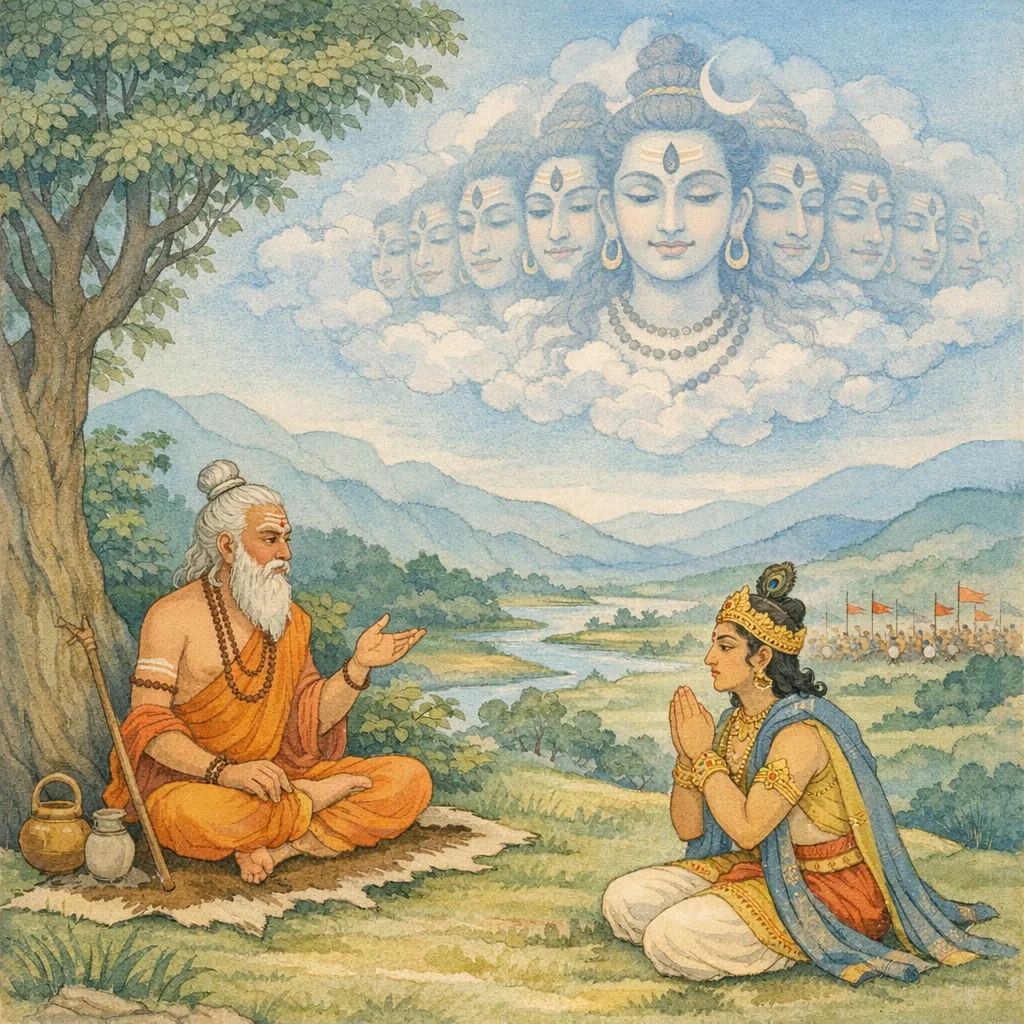
Adhyaya 204
Chapter Arc: संजय धृतराष्ट्र को सुनाते हैं—धृष्टद्युम्न के हाथों अतिरथी द्रोणाचार्य के निहत होते ही कौरव-सेना में भगदड़ मचती है और पाण्डवों में विजय-ध्वनि उठती है। उसी क्षण अर्जुन के मन में एक अद्भुत जिज्ञासा जागती है, क्योंकि युद्ध के बीच व्यास का ‘यदृच्छया’ आगमन होता है। → द्रोण-वध के बाद युद्ध का संतुलन बदल चुका है, पर अर्जुन के भीतर प्रश्न और भी तीव्र हो उठता है—ऐसे महाविनाश के बीच कौन-सा आश्रय, कौन-सी परम सत्ता है जो सबको धारण करती है? वह व्यास से शिव-महिमा पूछता है; व्यास कथा-धारा को युद्ध से उठाकर ब्रह्मा-वचन और देव-स्तुति की विराट ऊँचाई पर ले जाते हैं—महादेव के घोर-दीप्त, बहुरूप, सर्वनेत्र, सर्वव्यापी स्वरूप का वर्णन बढ़ता जाता है। → ब्रह्मा द्वारा शिव की परम-स्तुति—‘त्वं यज्ञः… त्वं गतिः… त्वं परायणम्’—और शिव के विश्वरूप का चरम उद्घोष: सहस्र/दशसहस्र नेत्र, सर्वतोऽक्षिमय, भूत-भव्य-भविष्य का उद्गम, तथा वे ही देने वाले और संहार करने वाले—यही अध्याय का शिखर है, जहाँ युद्ध-धूलि के ऊपर ब्रह्माण्डीय सत्य का प्रकाश फूट पड़ता है। → व्यास अर्जुन को यह बोध कराते हैं कि महादेव ही जगत के आधार, यज्ञ के आत्मा, और फलदाता-फलहरणकर्ता हैं; उनके अनेक पूज्य रूप लोक में प्रतिष्ठित हैं। अर्जुन की जिज्ञासा को दिशा मिलती है—विजय का कारण केवल बाहुबल नहीं, परमेश्वर-आश्रय और धर्म-स्थित प्रार्थना भी है। → अर्जुन के भीतर शिव-शरणागति और आगे के युद्ध-कर्तव्य का संकल्प गहराता है—पर द्रोण के पतन के बाद कौरव-पक्ष किस प्रकार प्रतिशोध और नई व्यूह-रचना करेगा, यह अगले प्रसंग की ओर कथा को धकेल देता है।
Shlokas
Verse 1
(दाक्षिणात्य अधिक पाठके २६ लोक मिलाकर कुल १०२३ श्लोक हैं।) #द-3८5>> | मर । >> द्र्याधिकद्विशततमो< ध्याय: व्यासजीका अर्जुनसे भगवान् शिवकी महिमा बताना तथा द्रोणपर्वके पाठ और श्रवणका फल धृतराष्ट उवाच तस्मिन्नतिरथे द्रोणे निहते पार्षतेन वै मामका: पाण्डवाश्वैव किमकुर्वन्नत: परम्,धृतराष्ट्रने पूछा--संजय! धृष्टद्युम्नके द्वारा अतिरथी वीर द्रोणाचार्यके मारे जानेपर मेरे और पाण्डुके पुत्रोंने आगे कौन-सा कार्य किया?
Dhṛtarāṣṭra said: “When Droṇa—the great chariot-warrior—had been slain by Pārṣata (Dhṛṣṭadyumna), what did my sons and the sons of Pāṇḍu do next?”
Verse 2
संजय उवाच तस्मिन्नतिरथे द्रोणे निहते पार्षतेन वै कौरवेषु च भग्नेषु कुन्तीपुत्रो धनंजय:,संजयने कहा--भरतश्रेष्ठ! धृष्टद्युम्नद्वारा अतिरथी वीर द्रोणाचार्यके मारे जानेपर जब समस्त कौरव भाग खड़े हुए, उस समय अपनेको विजय दिलानेवाली एक अत्यन्त आश्चर्यमयी घटना देखकर दुन्तीपुत्र अर्जुनने अकस्मात् वहाँ आये हुए वेदव्यासजीसे उसके सम्बन्धमें इस प्रकार पूछा
Sañjaya said: When Droṇa—counted among the foremost chariot-warriors—had been slain by the son of Pṛṣata (Dhṛṣṭadyumna), and the Kaurava forces had broken and fled, Kuntī’s son Dhanañjaya (Arjuna), witnessing a victory-bringing yet astonishing turn of events, approached the suddenly arrived sage Vyāsa and questioned him about it.
Verse 3
दृष्टवा सुमहदाश्चर्यमात्मनो विजयावहम् | यदृच्छया55गतं व्यासं पप्रच्छ भरतर्षभ,संजयने कहा--भरतश्रेष्ठ! धृष्टद्युम्नद्वारा अतिरथी वीर द्रोणाचार्यके मारे जानेपर जब समस्त कौरव भाग खड़े हुए, उस समय अपनेको विजय दिलानेवाली एक अत्यन्त आश्चर्यमयी घटना देखकर दुन्तीपुत्र अर्जुनने अकस्मात् वहाँ आये हुए वेदव्यासजीसे उसके सम्बन्धमें इस प्रकार पूछा
Sanjaya said: O bull among the Bharatas, having witnessed a very great and wondrous occurrence that promised victory for his own side, Arjuna questioned Vyasa, who had arrived there by chance, about it. The moment is framed as a moral turning-point in the war: amid the shock of Drona’s fall and the rout of the Kauravas, Arjuna seeks authoritative insight rather than relying on mere battlefield perception.
Verse 4
अजुन उवाच संग्रामे न्यहनं शत्रून् शरौघैर्विमलैरहम् । अग्रतो लक्षये यान्तं पुरुषं पावकप्रभम्,अर्जुन बोले--महर्षे! जब मैं अपने निर्मल बाणोंद्वारा शत्रु-सेनाका संहार कर रहा था, उस समय मुझे दिखायी दिया कि एक अग्निके समान तेजस्वी पुरुष मेरे आगे-आगे चल रहे हैं
Verse 5
ज्वलन्तं शूलमुद्रम्य यां दिशं प्रतिपद्यते । तस्यां दिशि विदीर्यन्ते शत्रवों मे महामुने,महामुने! वे जलता हुआ शूल हाथमें लेकर जिस ओर जाते उसी दिशामें मेरे शत्रु विदीर्ण हो जाते थे
Arjuna said: “O great sage, whenever he lifted up the blazing spear and advanced toward any direction, in that very direction my enemies would be torn apart and shattered. Such was the irresistible force that moved with him, turning the tide of battle and making the unrighteous fall before a power that seemed divinely charged.”
Verse 6
तेन भग्नानरीन् सर्वान् मद्धग्नान् मन््यते जन: । तेन भग्नानि सैन्यानि पृष्ठतो<नुव्रजाम्पयहम्,उन्होंने ही मेरे समस्त शत्रुओंको मार भगाया है, किंतु लोग समझते हैं कि मैंने ही उन्हें मारा और भगाया है। शत्रुओंकी सारी सेनाएँ उन्हींके द्वारा नष्ट की गयीं, मैं तो केवल उनके पीछे-पीछे चलता था
By him all the enemy warriors were routed; yet people think that I myself struck them down. By him the hostile armies were shattered; I merely followed behind in his wake—an ethical reminder that fame often clings to the visible agent, while the true cause remains unseen.
Verse 7
भगवंस्तन्ममाचक्ष्व को वै स पुरुषोत्तम: । शूलपाणिम्मया दृष्टस्तेजसा सूर्यसंनिभ:,भगवन्! मुझे बताइये, वे महापुरुष कौन थे? मैंने उन्हें हाथमें त्रिशूल लिये देखा था। वे सूर्यके समान तेजस्वी थे
Arjuna said: “O Blessed Lord, tell me clearly—who indeed was that supreme person? I saw him bearing a trident in his hand, radiant with a splendor like the sun.”
Verse 8
न पद्भ्यां स्पृशते भूमिं न च शूलं विमुज्चति । शूलाच्छूलसहस्राणि निष्येतुस्तस्य तेजसा,वे अपने पैरोंसे पृथ्वीका स्पर्श नहीं करते थे। त्रिशूल॒को अपने हाथसे अलग कभी नहीं छोड़ते थे। उनके तेजसे उस एक ही त्रिशूलसे सहस्रों नये-नये शूल प्रकट होकर शत्रुओंपर गिरते थे
Verse 9
व्यास उवाच प्रजापतीनां प्रथमं तैजसं पुरुष॑ प्रभुम् । भुवनं भूर्भुव॑ देवं सर्वलोकेश्वरं प्रभुम्,व्यासजीने कहा--अर्जुन! जो प्रजापतियोंमें प्रथम, तेज:स्वरूप, अन्तर्यामी तथा सर्वसमर्थ हैं, भूलोॉक, भुवलोॉक आदि समस्त भुवन जिनके स्वरूप हैं, जो दिव्य विग्रहधारी तथा सम्पूर्ण लोकोंके शासक एवं स्वामी हैं, उन्हीं वरदायक ईश्वर भगवान् शंकरका तुमने दर्शन किया है। वे वरद देवता सम्पूर्ण जगत्के ईश्वर हैं, तुम उन्हींकी शरणमें जाओ
Vyāsa said: “Arjuna, you have beheld Śaṅkara—the boon-giving Lord—who is foremost among the Prajāpatis, the radiant (tejas-born) supreme Person and inner ruler, fully sovereign. The worlds—Bhūḥ, Bhuvaḥ, and all realms—are encompassed in his being; he is the divine Lord, the ruler and master of all worlds. Therefore, take refuge in him, the Lord of the entire universe.”
Verse 10
ईशान वरदं पार्थ दृष्टटानसि शड्करम् | तं॑ गच्छ शरण देव॑ वरद॑ं भुवनेश्चरम्,व्यासजीने कहा--अर्जुन! जो प्रजापतियोंमें प्रथम, तेज:स्वरूप, अन्तर्यामी तथा सर्वसमर्थ हैं, भूलोॉक, भुवलोॉक आदि समस्त भुवन जिनके स्वरूप हैं, जो दिव्य विग्रहधारी तथा सम्पूर्ण लोकोंके शासक एवं स्वामी हैं, उन्हीं वरदायक ईश्वर भगवान् शंकरका तुमने दर्शन किया है। वे वरद देवता सम्पूर्ण जगत्के ईश्वर हैं, तुम उन्हींकी शरणमें जाओ
Vyāsa said: “O Pārtha (Arjuna), you have beheld Śaṅkara—the Lord (Īśāna) who grants boons. Go to Him for refuge: to that divine bestower of grace, the Sovereign of the worlds. In the midst of peril and duty, let your strength be grounded in surrender to the supreme Lord who alone can rightly empower action.”
Verse 11
महादेवं महात्मानमीशानं जटिलं विभुम् । त्र्यक्षं महाभुजं रुद्रे शिखिनं चीरवाससम्,वे महान् देव हैं। उनका हृदय महान् है। वे सबपर शासन करनेवाले, सर्वव्यापी और जटाधारी हैं। उनके तीन नेत्र और विशाल भुजाएँ हैं, रुद्र उनकी संज्ञा है, उनके मस्तकपर शिखा तथा शरीरपर वल्कल वस्त्र शोभा देता है
Vyāsa describes the Supreme Lord Śiva: the Great God, great-souled and sovereign over all, all-pervading and matted-haired. Three-eyed and mighty-armed, known as Rudra, he bears a topknot and is adorned with bark-garments—an ascetic form that embodies power restrained by self-control and devotion.
Verse 12
महादेवं हरं स्थाणुं वरदं भुवनेश्वरम् जगत्प्रधानमजितं जगत्प्रीतिमधी श्वरम्,महादेव, हर और स्थाणु आदि नामोंसे प्रसिद्ध वरदायक भगवान् शिव सम्पूर्ण भुवनोंके स्वामी हैं। वे ही जगत्के कारणभूत अव्यक्त प्रकृति हैं। वे किसीसे भी पराजित नहीं होते हैं। जगतको प्रेम और सुखकी प्राप्ति उन्हींसे होती है। वे ही सबके अध्यक्ष हैं
Vyāsa said: “Mahādeva—known also as Hara and Sthāṇu—is the boon-giving Lord, the sovereign of all worlds. He is the primal ground of the cosmos, unconquered by any. From him the world receives love and well-being, and he presides as the supreme ruler over all.”
Verse 13
जगद्योनिं जगद्वघीजं॑ जयिनं जगतो गतिम् | विश्वात्मानं विश्वसृजं विश्वमूर्ति यशस्विनम्,वे ही जगत्की उत्पत्तिके स्थान, जगत॒के बीज, विजयशील, जगत्के आश्रय, सम्पूर्ण विश्वके आत्मा, विश्वविधाता, विश्वरूप और यशस्वी हैं
Vyāsa said: “He is the womb and source of the universe, the seed from which the world arises; ever-victorious, and the final refuge and course of all beings. He is the Self within all, the maker of the cosmos, the one whose form is the whole universe, and the glorious one.” In the midst of war and moral strain, the verse frames ultimate sovereignty not as mere martial power but as the cosmic ground that sustains order and meaning, inviting reverence and ethical steadiness.
Verse 14
विश्वेश्वरं विश्वनरं कर्मणामीश्ररं प्रभुम् शम्भुं स्वयम्भुं भूतेशं भूतभव्यभवोद्धवम्,वे ही विश्वेश्वर, विश्वनियन्ता, कर्मोंके फलदाता ईश्वर और प्रभावशाली हैं। वे ही सबका कल्याण करनेवाले और स्वयम्भू हैं। सम्पूर्ण भूतोंके स्वामी तथा भूत, भविष्य और वर्तमानके कारण भी वे ही हैं
Vyāsa said: “He is the Lord of the universe, the indwelling presence in all beings, the sovereign over all actions and their fruits, the supreme Master. He is Śambhu, self-born and self-existent, the ruler of all creatures, and the very source from which past, future, and present arise.” In the midst of war and moral strain, the verse frames devotion as recognition of a single, overarching divine governance that upholds order and dispenses the results of deeds.
Verse 15
योगं योगेश्वरं सर्व सर्वलोकेश्वरेश्वरम् । सर्वश्रेष्ठ जगच्छेष्ठं वरिष्ठ परमेछ्ठिनम्,वे ही योग और योगेश्वर हैं, वे ही सर्वस्वरूप और सम्पूर्ण लोकेश्वरोंके भी ईश्वर हैं। सबसे श्रेष्ठ, सम्पूर्ण जगतसे श्रेष्ठ और श्रेष्ठतम परमेष्ठी भी वे ही हैं
Vyāsa said: He is Yoga itself and the Lord of Yoga; he is the All, and the sovereign even over all the rulers of the worlds. He is the best of all, the best of the entire universe, the most excellent—indeed the supreme Ordainer (Parameṣṭhin).
Verse 16
लोकत्रयविधातारमेकं॑ लोकत्रयाश्रयम् । शुद्धात्मानं भवं भीम॑ं शशाडुककृतशेखरम्,तीनों लोकोंके एकमात्र स्रष्टा, त्रिलोकीके आश्रय, शुद्धात्मा, भव, भीम और चन्द्रमाका मुकुट धारण करनेवाले भी वे ही हैं
Vyāsa said: “He alone is the maker of the three worlds and the refuge of the three worlds—pure in essence, the Lord Bhava, awe-inspiring Bhīma, and the One who bears the moon as his crest.” In the midst of war’s turmoil, the verse redirects attention from human power to the supreme ground of order: the divine source and shelter upon whom all worlds depend.
Verse 17
शाश्वतं भूधरं देवं सर्ववागीश्चरेश्वरम् । सुदुर्जयं जगन्नाथं जन्ममृत्युजरातिगम्,वे सनातन देव इस पृथ्वीको धारण करनेवाले तथा सम्पूर्ण वागीश्वरोंके भी ईश्वर हैं। उन्हें जीतना असम्भव है। वे जगदीश्वर जन्म, मृत्यु और जरा आदि विकारोंसे परे हैं
Vyāsa said: “He is the eternal God who upholds the earth, the supreme Lord even of all masters of speech. He is unconquerable, the Lord of the universe, and He transcends birth, death, and the decay of old age.”
Verse 18
ज्ञानात्मानं ज्ञानगम्यं ज्ञानश्रेष्ठं सुदुर्विदम् । दातारं चैव भक्तानां प्रसादविहितान् वरान्,वे ज्ञानस्वरूप, ज्ञानगम्य तथा ज्ञानमें श्रेष्ठ हैं। उनके स्वरूपको समझ लेना अत्यन्त कठिन है। वे अपने भक्तोंको कृपापूर्वक मनोवांछित उत्तम फल देनेवाले हैं
Vyāsa said: He is of the very essence of knowledge, attainable through true knowledge, and supreme among all that is known—yet exceedingly difficult to comprehend. And to His devotees He is the giver, bestowing through grace the excellent boons they desire. The verse frames the divine not as a mere object of speculation, but as a moral and devotional refuge: understanding is hard, yet grace responds to sincere devotion.
Verse 19
तस्य पारिषदा दिव्या रूपैर्नानाविधैरविंभो: । वामना जटिला मुण्डा हस्वग्रीवा महोदरा:,भगवान् शंकरके दिव्य पार्षद नाना प्रकारके रूपोंमें दिखायी देते हैं। उनमेंसे कोई वामन (बौने), कोई जटाधारी, कोई मुण्डित मस्तकवाले और कोई छोटी गर्दनवाले हैं। किन्हींके पेट बड़े हैं तो किन्हींके सारे शरीर ही विशाल हैं। कुछ पार्षदोंके कान बहुत बड़े- बड़े हैं। वे सब बड़े उत्साही होते हैं। कितनोंके मुख विकृत हैं और कितनोंके पैर। अर्जुन! उन सबके वेष भी बड़े विकराल हैं
Vyāsa said: “Around him were the divine attendants, appearing in many different forms—some dwarf-like, some with matted locks, some with shaven heads, some with short necks, and some with great bellies. Their varied and fearsome appearances proclaim the overwhelming, otherworldly power that accompanies Śaṅkara, reminding the onlooker that the divine cannot be confined to a single pleasing form and that awe and restraint are also part of righteous understanding.”
Verse 20
महाकाया महोत्साहा महाकर्णास्तथापरे | आननैविंकृतै: पादै: पार्थ वेषैश्व वैकृतै:,भगवान् शंकरके दिव्य पार्षद नाना प्रकारके रूपोंमें दिखायी देते हैं। उनमेंसे कोई वामन (बौने), कोई जटाधारी, कोई मुण्डित मस्तकवाले और कोई छोटी गर्दनवाले हैं। किन्हींके पेट बड़े हैं तो किन्हींके सारे शरीर ही विशाल हैं। कुछ पार्षदोंके कान बहुत बड़े- बड़े हैं। वे सब बड़े उत्साही होते हैं। कितनोंके मुख विकृत हैं और कितनोंके पैर। अर्जुन! उन सबके वेष भी बड़े विकराल हैं
Vyāsa said: “O Pārtha, some of Śaṅkara’s divine attendants appear with immense bodies and tremendous energy; others have huge ears. Some have distorted faces and misshapen feet, and their very attire too is grotesque and uncanny. Thus, in many strange forms, the Lord’s retinue becomes visible—overwhelming the mind with awe rather than ordinary beauty.”
Verse 21
ईदृशै: स महादेव: पूज्यमानो महेश्वर: । स शिवस्तात तेजस्वी प्रसादाद् याति तेडग्रत:,ऐसे स्वरूपवाले वे सभी पार्षद महान् देवता भगवान् शंकरकी सदा ही पूजा किया करते हैं। तात! उन तेजस्वी पुरुषके रूपमें वे भगवान् शंकर ही कृपा करके तुम्हारे आगे- आगे चलते हैं
Thus worshipped by such attendants, that Great God—Mahādeva, the Supreme Lord—moves before you by his grace. Dear one, it is Śiva himself, radiant in that manly form, who goes ahead of you, guiding and protecting.
Verse 22
तस्मिन् घोरे सदा पार्थ संग्रामे रोमहर्षणे । दौणिकर्णकृपैर्गुप्तां महेष्वासै: प्रहारिभि:,कुन्तीनन्दन! उस रोमांचकारी घोर संग्राममें अश्वत्थामा, कर्ण और कृपाचार्य आदि प्रहारकुशल बड़े-बड़े धनुर्धरोंसे सुरक्षित उस कौरव-सेनाको उस समय बहुरूपधारी महाधनुर्धर भगवान् महेश्वरके सिवा दूसरा कौन मनसे भी नष्ट कर सकता था
Vyāsa said: In that dreadful, ever-thrilling battle, O Pārtha—O son of Kuntī—who other than the many-formed Lord Maheśvara, the supreme archer, could even in thought have destroyed that Kaurava host, guarded by Aśvatthāmā, Karṇa, Kṛpa, and other mighty bowmen skilled in striking? The verse underscores the near-invincibility of the protected army and frames its possible destruction as lying beyond ordinary human agency, pointing to the overwhelming, almost cosmic scale of violence and power at this stage of the war.
Verse 23
कस्तां सेनां तदा पार्थ मनसापि प्रधर्षयेत् । ऋते देवान्महेष्वासाद् बहुरूपान्महेश्वरात्,कुन्तीनन्दन! उस रोमांचकारी घोर संग्राममें अश्वत्थामा, कर्ण और कृपाचार्य आदि प्रहारकुशल बड़े-बड़े धनुर्धरोंसे सुरक्षित उस कौरव-सेनाको उस समय बहुरूपधारी महाधनुर्धर भगवान् महेश्वरके सिवा दूसरा कौन मनसे भी नष्ट कर सकता था
Vyāsa said: “O Pārtha, who at that time could even in thought overpower that army—protected by mighty, strike-skilled bowmen such as Aśvatthāmā, Karṇa, and Kṛpācārya—except the many-formed Lord Maheśvara, the great archer among the gods?” The verse underscores the terrifying strength of the Kaurava host and frames its near-invincibility as something only a divine power could subdue, reminding the listener of the limits of human prowess amid adharma-driven slaughter.
Verse 24
स्थातुमुत्सहते कश्रिन्न तस्मिन्नग्रतः स्थिते । न हि भूतं सम॑ तेन त्रिषु लोकेषु विद्यते,जब वे ही सामने आकर खड़े हो जायाँ तो वहाँ ठहरनेका साहस कोई नहीं कर सकता है? तीनों लोकोंमें कोई भी प्राणी उनकी समानता करनेवाला नहीं है
Vyāsa said: When he stands facing them in the forefront, no one dares to hold their ground. For in the three worlds there exists no being equal to him—none who can match his might and presence.
Verse 25
गन्धेनापि हि संग्रामे तस्य क्रुद्धस्य शत्रव:ः । विसंज्ञा हतभूयिष्ठा वेपन्ति च पतन्ति च,संग्राममें भगवान् शंकरके कुपित होनेपर उनकी गन्धसे भी शत्रु बेहोश होकर काँपने लगते और अधमरे होकर गिर जाते हैं
Vyāsa said: Even in the midst of battle, when that Lord Śaṅkara is enraged, the enemies are overwhelmed merely by his very scent; they lose consciousness, tremble, and collapse, left as though half-dead. The passage underscores the moral asymmetry between human warfare and the terrifying, uncontrollable force of the divine when provoked.
Verse 26
तस्मै नमस्तु कुर्वन्तो देवास्तिष्ठन्ति वै दिवि । ये चान्ये मानवा लोके ते च स्वर्ग जितो नरा:
Paying homage to him, the gods indeed remain established in heaven; and those other human beings in the world as well—those men have won heaven. The verse underscores that reverent recognition of true greatness (worthy of salutations) is itself a dharmic act, bearing exalted spiritual fruit.
Verse 27
उनको नमस्कार करनेवाले देवता सदा स्वर्गलोकमें निवास करते हैं। दूसरे भी जो मानव इस लोकमें उन्हें नमस्कार करते हैं, वे भी स्वर्गलोकपर विजय पाते हैं ।। ये भक्ता वरदं देवं शिवं रुद्रमुमापतिम् । अनन्यभावेन सदा सर्वेशं समुपासते
Vyāsa said: Those devoted worshippers who, with undivided single-mindedness, continually revere the boon-giving Lord—Śiva, Rudra, the consort of Umā, the Lord of all—attain the highest divine favor. Even in the midst of worldly struggle, steadfast devotion and reverence toward the supreme deity are presented as a path to auspicious destiny and heavenly attainment.
Verse 28
नमस्कुरुष्व कौन्तेय तस्मै शान्ताय वै सदा,कुन्तीनन्दन! अतः तुम भी उन शान्तस्वरूप भगवान् शिवको सदा नमस्कार किया करो। जो रुद्र, नीलकण्ठ, कनिष्ठ (सूक्ष्म या दीप्तिमान), उत्तम तेजसे सम्पन्न, जटाजूटधारी, विकरालस्वरूप, पिंगल नेत्रवाले तथा कुबेरको वर देनेवाले हैं, उन भगवान् शिवको नमस्कार है
Vyāsa said: “O son of Kuntī, ever bow in reverence to that eternally tranquil Lord. Therefore, O Kuntī’s son, you too should always offer homage to Lord Śiva, whose very nature is peace. Salutations to that Śiva who is Rudra, the blue-throated one; subtle (or supremely radiant), endowed with the highest splendor; bearing matted locks; awe-inspiring in form; with tawny eyes; and the giver of boons to Kubera.”
Verse 29
रुद्राय शितिकण्ठाय कनिष्ठाय सुवर्चसे । कपर्दिने करालाय हर्यक्षवरदाय च,कुन्तीनन्दन! अतः तुम भी उन शान्तस्वरूप भगवान् शिवको सदा नमस्कार किया करो। जो रुद्र, नीलकण्ठ, कनिष्ठ (सूक्ष्म या दीप्तिमान), उत्तम तेजसे सम्पन्न, जटाजूटधारी, विकरालस्वरूप, पिंगल नेत्रवाले तथा कुबेरको वर देनेवाले हैं, उन भगवान् शिवको नमस्कार है
Vyāsa said: “O son of Kuntī, therefore you too should always bow to that Lord Śiva whose very nature is peace. Salutations to him who is called Rudra, the Blue-throated one; who is subtle (or the youngest) and radiant; endowed with excellent splendor; the wearer of matted locks; awe-inspiring in form; tawny-eyed; and the giver of boons even to Kubera.”
Verse 30
याम्यायाव्यक्तकेशाय सद्वृत्ते शड्कराय च | काम्याय हरिनेत्राय स्थाणवे पुरुषाय च,जो यमके अनुकूल रहनेवाले काल हैं, अव्यक्त स्वरूप आकाश ही जिनका केश है, जो सदाचारसम्पन्न, सबका कल्याण करनेवाले, कमनीय, पिंगलनेत्र, सदा स्थित रहनेवाले और अन्तर्यामी पुरुष हैं, जिनके केश भूरे एवं पिंगलवर्णके हैं, जिनका मस्तक मुण्डित है, जो दुबले-पतले और भवसागरसे पार उतारनेवाले हैं, जो सूर्यस्वरूप, उत्तम तीर्थ और अत्यन्त वेगशाली हैं, उन देवाधिदेव महादेवको नमस्कार है
Vyāsa said: Salutations to that Supreme Lord—Time itself, favorable to Yama; whose ‘hair’ is the unmanifest (the subtle ether-like expanse); who is established in right conduct and is Śaṅkara, the benefactor of all; who is desirable and gracious; whose eyes are tawny; who is the Unmoving (Sthāṇu), the inner Person who abides within all beings. The verse functions as a devotional invocation, grounding the violent events of the war in a higher moral order where even death and time are governed by a cosmic, welfare-bearing principle.
Verse 31
हरिकेशाय मुण्डाय कृशायोत्तारणाय च । भास्कराय सुतीर्थाय देवदेवाय रंहसे,जो यमके अनुकूल रहनेवाले काल हैं, अव्यक्त स्वरूप आकाश ही जिनका केश है, जो सदाचारसम्पन्न, सबका कल्याण करनेवाले, कमनीय, पिंगलनेत्र, सदा स्थित रहनेवाले और अन्तर्यामी पुरुष हैं, जिनके केश भूरे एवं पिंगलवर्णके हैं, जिनका मस्तक मुण्डित है, जो दुबले-पतले और भवसागरसे पार उतारनेवाले हैं, जो सूर्यस्वरूप, उत्तम तीर्थ और अत्यन्त वेगशाली हैं, उन देवाधिदेव महादेवको नमस्कार है
Vyāsa said: Salutations to Mahādeva, the God of gods—whose hair is tawny-brown, whose head is shaven, who is lean, and who carries beings across the ocean of worldly existence; who is sun-like in radiance, a supreme sacred ford for those seeking refuge, and irresistibly swift in power. This hymn frames Śiva as both austere and compassionate: a transcendent inner ruler who, through discipline and grace, becomes the saving passage for those caught in time and suffering.
Verse 32
बहुरूपाय सर्वाय प्रियाय प्रियवाससे । उष्णीषिणे सुवक्त्राय सहस्राक्षाय मीढुषे,जो अनेक रूप धारण करनेवाले, सर्वस्वरूप तथा सबके प्रिय हैं, वलकल आदि वस्त्र जिन्हें प्रिय है, जो मस्तकपर पगड़ी धारण करते हैं, जिनका मुख सुन्दर है, जिनके सहस्रों नेत्र हैं तथा जो वर्षा करनेवाले हैं, उन भगवान् शंकरको नमस्कार है
Vyāsa said: Salutations to Lord Śaṅkara—He who assumes many forms, who is the all-encompassing reality, who is beloved of all; who delights in simple garments such as bark-cloth; who wears a turbaned head-dress; whose face is auspicious and beautiful; who is thousand-eyed in omniscient vision; and who is the beneficent giver of rain and grace. In the midst of war’s turmoil, this hymn frames devotion as a return to the supreme protector and moral refuge beyond fear and faction.
Verse 33
गिरिशाय प्रशान्ताय यतये चीरवाससे । हिरण्यबाहवे राज्ञे उग्राय पतये दिशाम्,जो पर्वतपर शयन करनेवाले, परम शान्त, यतिस्वरूप, चीरवस्त्रधारी, हिरण्यबाहु (सोनेके आभूषणोंसे विभूषित बाँहवाले), राजा (दीप्तिमान), उग्र (भयंकर) तथा दिशाओंके अधिपति हैं, (उन भगवान् शंकरको नमस्कार है)
Vyāsa offers a reverential salutation to Śaṅkara: the mountain-dwelling Lord who rests upon the heights, inwardly tranquil and self-restrained like an ascetic, clad in simple bark-garments, yet radiant as a king with golden-ornamented arms; awe-inspiring in power and the sovereign guardian of all directions. The verse frames devotion as a source of steadiness and moral clarity amid the violence and uncertainty of war.
Verse 34
पर्जन्यपतये चैव भूतानां पतये नम: । वृक्षाणां पतये चैव गवां च पतये नम:,जो मेघोंके अधिपति तथा सम्पूर्ण भूतोंके स्वामी हैं, उन्हें नमस्कार है। वृक्षोंके पालक और गौओंके अधिपतिरूप आपको नमस्कार है
Vyāsa said: Homage to the Lord of rain-clouds, and homage to the Sovereign of all beings. Homage to the Protector of trees, and homage to the Lord of cattle. In this praise, the speaker recognizes a single divine governance that sustains life—through rain, through living creatures, through forests, and through the herds that uphold human livelihood—affirming reverence for the cosmic order that makes dharma and survival possible even amid war.
Verse 35
वृक्षेरावतकायाय सेनान्ये मध्यमाय च । ख्रुवहस्ताय देवाय धन्विने भार्गवाय च,जिनका शरीर वृक्षोंसे आच्छादित है, जो सेनाके अधिपति और शरीरके मध्यवर्ती (अन्तर्यामी) हैं, यजमानरूपसे जो अपने हाथमें ख्रुवा धारण करते हैं, जो दिव्यस्वरूप, धनुर्धर और भृगुवंशी परशुरामस्वरूप हैं, उनको नमस्कार है
Vyāsa said: Salutations to him whose body is veiled by trees, who is the commander of the host and also the indwelling ‘middle’ (the inner regulator within beings); to him who, as the sacrificer, bears the ladle (khruvā) in his hand; to the divine one, the bow-bearing warrior, the Bhārgava—manifest as Paraśurāma. The verse frames martial power within a sacred, ethical horizon: the true leader is not merely a battlefield chief but a divine presence linked to sacrifice, restraint, and righteous force.
Verse 36
बहुरूपाय विश्वस्य पतये मुछजवाससे । सहस्रशिरसे चैव सहस्रनयनाय च
Vyāsa said: “(Salutations) to the Lord of the universe, who assumes many forms; to Him who is clad in muñja-grass (as an ascetic emblem); to the thousand-headed One, and likewise to the thousand-eyed One.”
Verse 37
शरणं गच्छ कौन्तेय वरदं भुवनेश्वरम्
Vyāsa said: “O son of Kuntī, take refuge in the Lord of the worlds, the gracious giver of boons.” In the midst of crisis and moral strain, the counsel redirects the warrior’s mind from mere strategy to surrender—seeking protection and right guidance from the supreme source of order and grace.
Verse 38
उमापतिं विरूपाक्ष॑ दक्षयज्ञनिबर्हणम् । प्रजानां पतिमव्यग्रं भूतानां पतिमव्ययम्
Vyāsa said: “(I beheld/remember) the Lord of Umā—Virūpākṣa—who destroyed Dakṣa’s sacrifice; the unperturbed sovereign of creatures, the imperishable Lord of all beings.” The verse frames Śiva as the supreme protector and moral governor: when sacred rites are corrupted by pride and exclusion, he restores cosmic order, yet remains inwardly steady and beyond decay.
Verse 39
कुन्तीनन्दन! तुम उन्हीं वरदायक भुवनेश्वर, उमा वल्लभ, त्रिनेत्रधारी, दक्षयज्ञविनाशक, प्रजापति, व्यग्रतारहित और अविनाशी भगवान् भूतनाथकी शरणमें जाओ ।। कपर्दिन वृषावर्त वृषनाभं वृषध्वजम् | वृषदर्प वृषपतिं वृषशृड्रं वृषर्षभम्,जो जटाजूटवधारी हैं, जिनका घूमना परम श्रेष्ठ है, जो श्रेष्ठ नाभिसे सुशोभित, ध्वजापर वृषभका चिह्न धारण करनेवाले, वृषदर्प (प्रबल अहंकारवाले), वृषपति (धर्मस्वरूप वृषभके अधिपति), धर्मको ही उच्चतम माननेवाले तथा धर्मसे भी सर्वश्रेष्ठ हैं, जिनके ध्वजमें साँड़का चिह्न अंकित है, जो धर्मात्माओंमें उदार, धर्मस्वरूप, वृषभके समान विशाल नेत्रोंवाले, श्रेष्ठ आयुध और श्रेष्ठ बाणसे युक्त, धर्मविग्रह तथा धर्मके ईश्वर, उन भगवानकी मैं शरण ग्रहण करता हूँ
O son of Kuntī, seek refuge in that imperishable Lord—bestower of boons, sovereign of the worlds, beloved of Umā, the three‑eyed one, destroyer of Dakṣa’s sacrifice, the primal progenitor, free from agitation, the Master of beings. I take shelter in Kapardin, whose matted locks are bound; in him whose course is supremely exalted; whose navel is splendid; whose banner bears the bull; who is mighty in power; the Lord of the Bull (Dharma); bull‑horned and bull‑like in majesty—Śiva, the very embodiment and guardian of dharma, invoked here as the highest refuge amid the calamity of war.
Verse 40
वृषाड्कं वृषभोदारं वृषभं वृषभेक्षणम् | वृषायुधं वृषशरं वृषभूतं वृषेश्चरम्,जो जटाजूटवधारी हैं, जिनका घूमना परम श्रेष्ठ है, जो श्रेष्ठ नाभिसे सुशोभित, ध्वजापर वृषभका चिह्न धारण करनेवाले, वृषदर्प (प्रबल अहंकारवाले), वृषपति (धर्मस्वरूप वृषभके अधिपति), धर्मको ही उच्चतम माननेवाले तथा धर्मसे भी सर्वश्रेष्ठ हैं, जिनके ध्वजमें साँड़का चिह्न अंकित है, जो धर्मात्माओंमें उदार, धर्मस्वरूप, वृषभके समान विशाल नेत्रोंवाले, श्रेष्ठ आयुध और श्रेष्ठ बाणसे युक्त, धर्मविग्रह तथा धर्मके ईश्वर, उन भगवानकी मैं शरण ग्रहण करता हूँ
Vyāsa said: “I take refuge in that Lord who bears the bull as his emblem; who is noble and steadfast like a bull; whose gaze is bull-like—wide and powerful; whose weapons and arrows are righteous; who is himself the very embodiment of Dharma; and who is the sovereign of righteousness.” In the midst of war and moral crisis, the verse frames devotion as a return to the supreme standard of Dharma, portraying the deity as both the symbol and source of ethical order.
Verse 41
महोदरं महाकायं द्वीपिचर्मनिवासिनम् । लोकेशं वरदं मुण्डं ब्रह्मुण्यं ब्राह्मणप्रियम्
Vyāsa said: “(He was) large-bellied and of immense body, clad in a tiger-skin; a lord of the world, a giver of boons, shaven-headed, devoted to Brahmanical sanctity, and beloved of the brāhmaṇas.”
Verse 42
त्रिशूलपार्णिं वरदं खड्गचर्मधरं प्रभुम् । पिनाकिनं खड्गधरं लोकानां पतिमीश्वरम्
Vyāsa said: (He beheld and praised) the mighty Lord who bears the trident, the gracious giver of boons, armed with sword and shield; the wielder of the Pināka bow, sword in hand—Īśvara, the sovereign master of the worlds. The verse frames the deity as both protector and supreme ruler, evoking reverence amid the moral turbulence of war.
Verse 43
प्रपद्ये शरणं देवं शरण्यं चीरवाससम् | कोटि-कोटि ब्रह्माण्डोंको धारण करनेके कारण जिनका उदर और शरीर विशाल है, जो व्याप्रचर्म ओढ़ा करते हैं, जो लोकेश्वर, वरदायक, मुण्डितमस्तक, ब्राह्मणहितैषी तथा ब्राह्मणोंके प्रिय हैं। जिनके हाथमें त्रिशूल, ढाल, तलवार और पिनाक आदि अस्त्र शोभा पाते हैं, जो वरदायक, प्रभु, सुन्दर शरीरधारी, तीनों लोकोंके स्वामी तथा साक्षात् ईश्वर हैं, उन चीरवस्त्रधारी, शरणागतवत्सल भगवान् शिवकी मैं शरण लेता हूँ || ४१-४२ $ ।। नमस्तस्मै सुरेशाय यस्य वैश्रवण: सखा,कुबेर जिनके सखा हैं, उन देवेश्वर शिवको नमस्कार है। प्रभो! आप उत्तम वस्त्र, उत्तम व्रत और उत्तम धनुष धारण करते हैं। आप धनुर्धर देवताको धनुष प्रिय है, आप धन्वी, धन्वन्तर, धनुष और धन्वाचार्य हैं, आपको नमस्कार है। भयंकर आयुध धारण करनेवाले सुरश्रेष्ठ महादेवजीको नमस्कार है
Vyāsa says: “I take refuge in Śiva, the divine protector, the worthy refuge, the ascetic clad in bark-garments. His belly and body are vast, as though bearing countless cosmic eggs; he wears a tiger-skin. He is the Lord of the worlds, the giver of boons, shaven-headed, a well-wisher of Brahmins and dear to them. In his hands shine the trident, shield, sword, and Pināka and other weapons. He is the boon-giver, the sovereign, of beautiful form, master of the three worlds—indeed God himself. In that bark-clad Lord Śiva, tender to those who surrender, I seek shelter. “Salutations to that Lord of the gods whose friend is Vaiśravaṇa (Kubera). O Lord, you bear the finest garments, the finest vows, and the finest bow. To you—bowman, healer (Dhanvantari), bow itself, and teacher of archery—salutation. Salutation to Mahādeva, best of the gods, who bears terrible weapons.”
Verse 44
सुवाससे नमस्तुभ्यं सुव्रताय सुधन्विने । धनुर्धराय देवाय प्रियधन्वाय धन्विने,कुबेर जिनके सखा हैं, उन देवेश्वर शिवको नमस्कार है। प्रभो! आप उत्तम वस्त्र, उत्तम व्रत और उत्तम धनुष धारण करते हैं। आप धनुर्धर देवताको धनुष प्रिय है, आप धन्वी, धन्वन्तर, धनुष और धन्वाचार्य हैं, आपको नमस्कार है। भयंकर आयुध धारण करनेवाले सुरश्रेष्ठ महादेवजीको नमस्कार है
Vyāsa offers reverent salutations to Śiva, praising him as the divine archer: one who is clad in excellent garments, steadfast in noble vows, and bearing an incomparable bow. In the midst of war’s moral strain, the hymn frames true power as disciplined, vow-governed, and worthy of devotion—reminding the listener that victory and protection are sought through righteousness and reverence, not mere force.
Verse 45
धन्वन्तराय धनुषे धन्याचार्याय ते नम: । उग्रायुधाय देवाय नम: सुरवराय च,कुबेर जिनके सखा हैं, उन देवेश्वर शिवको नमस्कार है। प्रभो! आप उत्तम वस्त्र, उत्तम व्रत और उत्तम धनुष धारण करते हैं। आप धनुर्धर देवताको धनुष प्रिय है, आप धन्वी, धन्वन्तर, धनुष और धन्वाचार्य हैं, आपको नमस्कार है। भयंकर आयुध धारण करनेवाले सुरश्रेष्ठ महादेवजीको नमस्कार है
Vyāsa said: Salutations to you—master of the bow, the blessed teacher of archery. Salutations to the divine one who bears terrible weapons, to the best among the gods. In this war-torn setting, the hymn frames strength and weaponry within reverence and restraint: power is acknowledged as sacred and therefore to be approached with humility, not arrogance.
Verse 46
नमोस्तु बहुरूपाय नमोस्तु बहुधन्विने । नमोअस्तु स्थाणवे नित्यं नमस्तस्मै तपस्विने,अनेक रूपधारी शिवको नमस्कार है, बहुत-से धनुष धारण करनेवाले रुद्रदेवको नमस्कार है, आप स्थाणुरूप हैं, आपको नमस्कार है, उन तपस्वी शिवको नित्य नमस्कार है
Vyāsa offers a reverent hymn to Śiva: salutations to the Lord of many forms, salutations to the wielder of many bows, salutations always to the immovable and steadfast One (Sthāṇu), and salutations to that ever-austere ascetic. In the war-torn narrative, this praise frames Śiva as both the supreme yogin and the formidable divine power behind martial might—reminding the listener that strength and victory are ultimately subordinate to disciplined tapas and unwavering steadiness.
Verse 47
नमोस्तु त्रिपुरघ्नाय भगघ्नाय च वै नमः । वनस्पतीनां पतये नराणां पतये नम:,त्रिपुरुनाशक और भभमनेत्रविनाशक भगवान् शिवको बारंबार नमस्कार है। वनस्पतियोंके पति तथा नरपतिरूप महादेवजीको नमस्कार है
Vyāsa said: Salutations again and again to Śiva, the destroyer of Tripura and the slayer of Bhaga. Salutations to him who is the Lord of trees and plants, and salutations to him who is the Lord of men (the supreme ruler). In the midst of war and calamity, the hymn turns the mind toward the higher refuge—acknowledging a power that subdues arrogance and restores moral order.
Verse 48
मातृणां पतये चैव गणानां पतये नमः । गवां च पतये नित्यं यज्ञानां पतये नम:,मातृकाओंके अधिपति और गणोंके पालक शिवको नमस्कार है। गोपति और यज्ञपति शंकरको नित्य नमस्कार है
Vyāsa said: Salutations to Śiva, the lord of the Mothers (the Mātṛkās) and the lord of the Gaṇas. Ever do I bow to Śaṅkara, the protector of cattle and the lord of sacrifices—invoking his guardianship and auspicious order amid the turmoil of war.
Verse 49
अपां च पतये नित्यं देवानां पतये नमः । पूष्णो दन्तविनाशाय त्र्यक्षाय वरदाय च
Vyāsa said: “Ever do I bow to the Lord of the Waters, and to the Lord of the gods. I also bow to Pūṣan, the one who caused the breaking of teeth, and to the Three-eyed Lord, the bestower of boons.” In the midst of grave events, the narration turns to reverent invocation—remembering divine powers that govern cosmic order, chastise wrongdoing, and grant protection—framing the unfolding war within a moral universe overseen by higher law.
Verse 50
कर्माणि यानि दिव्यानि महादेवस्य धीमत:
Vyāsa said: “Those divine deeds of the wise Mahādeva—” (introducing a recounting of Śiva’s extraordinary acts, held up as sacred exemplars and as a reminder that even amid war, higher divine agency and moral order stand above human striving).
Verse 51
तानि ते कीर्तयिष्यामि यथाप्रज्ञं यथाश्रुतम् । अर्जुन! अब मैं परम बुद्धिमान् महादेवजीके जो दिव्य कर्म हैं, उनका अपनी बुद्धिके अनुसार जैसा मैंने सुन रखा है, वैसा ही तुम्हारे समक्ष वर्णन करता हूँ ।। न सुरा नासुरा लोके न गन्धर्वा न राक्षसा:
Vyāsa said: “I shall recount those deeds to you as best as my understanding allows, exactly as I have heard them. Arjuna, I will now describe before you—according to my own capacity—those divine acts of the supremely wise Mahādeva. In this world, neither the gods nor the demons, neither the Gandharvas nor the Rākṣasas…”
Verse 52
सुखमेधन्ति कुपिते तस्मिन्नपि गुहागता: । यदि वे कुपित हो जाये तो देवता, असुर, गन्धर्व और राक्षस इस लोकमें अथवा पातालमें छिप जानेपर भी चैनसे नहीं रहने पाते हैं ।। ५१ $ ।। दक्षस्य यजमानस्य विधिवत् सम्भूतं पुरा,पहलेकी बात है, वे यज्ञपरायण दक्षपर कुपित हो गये थे। उस समय उन्होंने उनके विधिपूर्वक किये जानेवाले यज्ञको नष्ट कर दिया था। उन दिनों वे निर्दय हो गये थे और धनुषद्वारा बाण छोड़कर बड़े जोर-जोरसे गर्जना करने लगे थे
Vyāsa said: Even if they hide away in caves, when he is enraged they cannot remain at ease. The passage underscores how the wrath of a mighty being makes fear inescapable—no refuge, whether in this world or below, grants peace when destructive anger is unleashed.
Verse 53
विव्याध कुपितो यज्ञ निर्दयस्त्वभवत् तदा । धनुषा बाणमुत्सृूज्य सघोषं विननाद च,पहलेकी बात है, वे यज्ञपरायण दक्षपर कुपित हो गये थे। उस समय उन्होंने उनके विधिपूर्वक किये जानेवाले यज्ञको नष्ट कर दिया था। उन दिनों वे निर्दय हो गये थे और धनुषद्वारा बाण छोड़कर बड़े जोर-जोरसे गर्जना करने लगे थे
Vyāsa said: Enraged, he struck at the sacrifice; at that time he became pitiless. Releasing an arrow from his bow, he roared aloud with a resounding clamor. The scene underscores how wrath can eclipse restraint and turn even a sacred rite into a target of violence.
Verse 54
ते न शर्म कुतः शान्तिं लेभिरे सम सुरास्तदा । विद्रुते सहसा यज्ञे कुपिते च महेश्वरे,देवताओंको उस समय कहीं भी सुख और शान्ति नहीं मिली, महेश्वरके कुपित होनेसे सहसा यज्ञमें उपद्रव खड़ा हो गया था
Vyāsa said: At that time the gods found neither comfort nor peace anywhere. For when the sacrifice was suddenly thrown into disorder and Maheśvara became enraged, turmoil arose on all sides—showing how even divine assemblies lose stability when sacred order is violated and wrath is provoked.
Verse 55
तेन ज्यातलघोषेण सर्वे लोका: समाकुला: । बभूवुर्वशगा: पार्थ निपेतुश्च सुरासुरा:,पार्थ! उनके धनुषकी प्रत्यंचाके गम्भीर घोषसे अत्यन्त व्याकुल हो सम्पूर्ण लोक उनके अधीन हो गये। देवता और असुर सभी धरतीपर गिर पड़े
Vyāsa said: By that deep, reverberant roar of the bowstring, all the worlds were thrown into agitation. O Pārtha, they came under his overpowering sway; even gods and asuras alike were struck down, falling to the earth—signaling how sheer martial might can subdue beings across realms and unsettle the moral order of war.
Verse 56
आपक्षुक्षुभिरे सर्वाश्चकम्पे च वसुंधरा । पर्वताश्च व्यशीर्यन्त दिशो नागाश्ष मोहिता:
Vyāsa said: As the winged creatures were thrown into turmoil, the very earth trembled. Mountains began to split and crumble, and the quarters of the sky—along with the great serpents—were struck with bewilderment. The scene signals a cosmic disturbance, as if nature itself recoils at the moral weight and violence of the war’s unfolding events.
Verse 57
समुद्रके जलमें ज्वार आ गया, धरती काँपने लगी, पर्वत टूट-फूटकर बिखरने लगे और दिग्गज मूर्च्छित हो गये ।। अन्धेन तमसा लोका न प्राकाशन्त संवृता: । जध्निवान् सह सूर्येण सर्वेषां ज्योतिषां प्रभा:,घोर अन्धकारसे आच्छादित हो जानेके कारण सम्पूर्ण लोकोंमें कहीं भी प्रकाश नहीं रह गया। भगवान् शिवने सूर्यसहित सम्पूर्ण ज्योतियोंकी प्रभा नष्ट कर दी
Vyāsa said: When the worlds were enveloped by dreadful darkness, no light shone anywhere. Lord Śiva, as if striking down radiance itself, extinguished the brilliance of all luminaries, even that of the sun—an ominous sign that the moral order had been shaken amid the war’s horrors.
Verse 58
चुक्षुभुर्भयभीताश्च शान्तिं चक्रुस्तथैव च । ऋषय: सर्वभूतानामात्मनश्नव सुखैषिण:,महर्षि भी भयभीत एवं क्षुब्ध हो उठे। वे सम्पूर्ण भूतोंक तथा अपने लिये भी सुख चाहते हुए पुण्याहवाचन आदि शान्ति कर्म करने लगे
Vyāsa said: The sages, shaken with fear, were deeply agitated; and just then they undertook rites of pacification. Seeking welfare and happiness for all beings—and for themselves as well—they began the calming acts (such as auspicious invocations) to counter the ominous disturbance that had arisen amid the war’s turmoil.
Verse 59
पूषाणमभ्यद्रवत शड्कर: प्रहसन्निव । पुरोडाशं भक्षयतो दशनान् वै व्यशातयत्,उस समय हँसते हुए-से भगवान् शंकरने पूषापर आक्रमण किया। वे पुरोडाश खा रहे थे। उन्होंने उनके सारे दाँत तोड़ डाले
Vyāsa said: Smiling as though in amusement, Śaṅkara rushed at Pūṣan. As Pūṣan was eating the sacrificial cake (puroḍāśa), Śaṅkara smashed and broke all his teeth. The episode underscores the peril of arrogance and ritual performed without reverence—when sacred order is violated, even the gods face swift consequence.
Verse 60
ततो निश्चक्रमुर्देवा वेपमाना नता: सम ते । पुनश्न संदधे दीप्तान् देवानां निशिताउशरान्,तदनन्तर सारे देवता नतमस्तक हो भयसे थरथर काँपते हुए यज्ञशालासे बाहर निकल गये। तब भगवान् शिवने देवताओंको लक्ष्य करके तीखे और तेजस्वी बाणोंका संधान किया
Then the gods, trembling with fear and bowing low in submission, came out. Immediately thereafter, Śiva fixed upon them sharp, blazing arrows—an image that underscores how even the mighty are held accountable when pride or disorder threatens the moral balance upheld by sacrifice and cosmic law.
Verse 61
सधूमान् सस्फुलिज्ांश्व विद्युत्तोयदर्संनि भान् । त॑ दृष्टवा तु सुरा: सर्वे प्रणिपत्य महेश्वरम्
It appeared wreathed in smoke, throwing off sparks, and resembling lightning, torrents of rain, and the crash of thunder. Seeing that awe-inspiring manifestation, all the gods bowed down in reverence to Maheśvara (Śiva), acknowledging his overwhelming power and sovereignty.
Verse 62
रुद्रस्य यज्ञभागं च विशिष्ट ते त्वकल्पयन् | धूम और चिनगारियोंसहित वे बाण बिजलीसहित मेघोंके समान जान पड़ते थे। तब सम्पूर्ण देवताओंने भगवान् महेश्वरको कुपित देख उनके चरणोंमें प्रणाम किया और रुद्रके लिये उन्होंने विशिष्ट यज्ञभागकी कल्पना की ।। भयेन त्रिदशा राजज्छरणं च प्रपेदिरे,राजन्! सब देवता भयभीत हो भगवान् शंकरकी शरणमें आये। तब क्रोध शान्त होनेपर उन्होंने उस यज्ञको पूर्ण किया। उन दिनों देवता लोग भाग खड़े हुए थे, तभीसे आजतक वे देवता उनसे डरते रहते हैं
Vyāsa narrates that the gods, seeing Lord Maheśvara (Rudra) enraged, fell at his feet in fear and assigned him a distinct share in the sacrificial offering. When his anger subsided, the sacrifice was completed; and from that time onward, the gods have remained wary of Rudra, remembering how they once fled in terror.
Verse 63
तेन चैवातिकोपेन स यज्ञ: संधितस्तदा । भग्नाश्नापि सुरा आसन् भीताश्चाद्यापि त॑ं प्रति,राजन्! सब देवता भयभीत हो भगवान् शंकरकी शरणमें आये। तब क्रोध शान्त होनेपर उन्होंने उस यज्ञको पूर्ण किया। उन दिनों देवता लोग भाग खड़े हुए थे, तभीसे आजतक वे देवता उनसे डरते रहते हैं
Verse 64
असुराणां पुराण्यासंस्त्रीणि वीर्यवर्तां दिवि । आयसं राजतं चैव सौवर्ण परमं महत्,पूर्वकालमें परम पराक्रमी तीन असुरोंके आकाशमें तीन नगर थे। एक लोहेका, दूसरा चाँदीका और तीसरा अत्यन्त विशाल नगर सोनेका बना हुआ था
Vyāsa said: In ancient times, the mighty Asuras possessed three cities in the heavens. One was made of iron, another of silver, and the third—supremely vast—was fashioned of gold. The passage evokes the moral contrast between dazzling power and material splendor on one side, and the inevitable vulnerability of pride and domination on the other, setting the stage for the downfall of fortified arrogance.
Verse 65
सौवर्ण कमलाक्षस्य तारकाक्षस्य राजतम् | तृतीयं तु पुरं तेषां विद्युम्मालिन आयसम्,उनमेंसे सोनेका नगर कमलाक्षके, चाँदीका तारकाक्षके तथा तीसरा लोहेका बना हुआ नगर विद्युन्मालीके अधिकारमें था
Vyāsa said: Of those three strongholds, the golden city belonged to Kamalākṣa, the silver city to Tārakākṣa, and the third—made of iron—was under the lordship of Vidyunmālin. The passage underscores how power and protection can be built upon dazzling material splendor, yet such fortresses remain part of a larger moral order in which pride and domination invite eventual reckoning.
Verse 66
न शक्तस्तानि मघवान् भेत्तुं सर्वायुधैरपि । अथ सर्वे सुरा रुद्रं जग्मु: शरणमर्दिता:,इन्द्र सम्पूर्ण अस्त्र-शस्त्रोंका प्रयोग करके भी उन नगरोंका भेदन न कर सके। तब उनसे पीड़ित हुए सम्पूर्ण देवता भगवान् शंकरकी शरणमें गये
Vyāsa said: Even Maghavān (Indra), though employing every kind of weapon, was unable to break through those (fortified) cities. Then all the gods, afflicted and hard-pressed by them, went to Rudra (Śiva) seeking refuge—signaling that when power and armaments fail, humility and surrender to a higher divine order become the rightful course.
Verse 67
ते तमूचुर्महात्मानं सर्वे देवा: सवासवा: । ब्रह्मदत्तवरा होते घोरास्त्रिपुरवासिन:
Vyāsa said: Then all the gods, together with Indra, addressed that great-souled one: “O priest who has been granted boons by Brahmā, the fearsome inhabitants of Tripura (the three cities)…”
Verse 68
त्वदृते देवदेवेश नान्य: शक्त: कथंचन
Vyāsa said: “Apart from you, O Lord of lords, there is no one at all who is capable—under any circumstance.”
Verse 69
हन्तुं दैत्यान् महादेव जहि तांस्त्वं सुरद्विष: । 'देवदेवेश्वर महादेव! आपके सिवा दूसरा कोई उन दैत्योंका वध करनेमें समर्थ नहीं है; अतः आप उन देवद्रोहियोंको मार डालिये || ६८ $ ।। रुद्र रौद्रा भविष्यन्ति पशव: सर्वकर्मसु
Vyāsa said: “O Mahādeva, slay the Dāityas—strike down those enemies of the gods. Apart from you, none is capable of destroying them; therefore, put an end to these violators of the divine order.”
Verse 70
निपातयिष्यसे चैतानसुरान् भुवनेश्वर । 'भुवनेश्वर! रुद्र! आप जब इन असुरोंका विनाश कर डालेंगे, तबसे सम्पूर्ण यज्ञकर्मोमें जो पशु (यज्ञके साधनभूत उपकरण) होंगे, वे रुद्रके भाग समझे जायूँगे' ।। स तथोक्तस्तथेत्युक्त्वा देवानां हितकाम्यया
Vyāsa said: “O Lord of the worlds! You will strike down these Asuras. And, O Rudra—when you have brought about the destruction of these Asuras, then in all sacrificial rites the animals offered (the sacrificial means and instruments) will be regarded as Rudra’s rightful share.” Thus addressed, he replied, “So be it,” desiring the welfare of the gods.
Verse 71
गन्धमादनविन्ध्यौ च कृत्वा वंशध्वजौ हर: । पृथ्वीं ससागरवनां रथं कृत्वा तु शड्कर:
Vyāsa said: Hara (Śiva) fashioned Gandhamādana and the Vindhya as the two banner-poles of his chariot; and Śaṅkara made the earth—together with its oceans and forests—into his chariot itself. The verse magnifies the Lord’s cosmic sovereignty: all that seems vast and immovable becomes merely an instrument in the hands of the divine, reminding the listener that pride in worldly power is fragile before higher order.
Verse 72
अक्ष॑ कृत्वा तु नागेन्द्रं शेषं नाम त्रिलोचन: । चक्रे कृत्वा तु चन्द्रार्कों देवदेव: पिनाकधृक्
Vyāsa said: The three-eyed Lord (Śiva), bearing the bow Pināka, made the serpent-king named Śeṣa his axle; and he fashioned the Moon and the Sun as the two wheels. The verse evokes Śiva’s cosmic sovereignty: even the mightiest beings and luminaries become instruments in the divine order, reminding the listener that power in war and life is ultimately subordinate to a higher, regulating dharma.
Verse 73
अणी कृत्वैलपत्रं च पुष्पदन्तं च ऋयम्बक: । यूपं कृत्वा तु मलयमवनाहं च तक्षकम्
Vyāsa said: “Ṛyambaka fashioned a sharp point and also a leaf-like blade; he also made Puṣpadanta. And having made a sacrificial post, he further fashioned Malaya, Avanāha, and Takṣaka.” The verse presents a catalogue of crafted forms—suggesting deliberate construction and preparation—often used in the epic to underscore how human (or superhuman) agency shapes the instruments and agents through which larger conflicts and moral consequences unfold.
Verse 74
देवताओंके ऐसा कहनेपर भगवान् शिवने “तथास्तु” कहकर उनके हितकी इच्छासे गन्धमादन और विन्ध्याचल इन दो पर्वतोंको अपने रथके दो पार्श्ववर्ती ध्वज बनाये। फिर समुद्र और पर्वतोंसहित समूची पृथ्वीको रथ बनाकर नागराज शेषको उस रथका धुरा बनाया। तत्पश्चात् त्रिनेत्रधारी पिनाकपाणि देवाधिदेव महादेवने चन्द्रमा और सूर्य दोनोंको रथके दो पहिये बनाये। एलपत्रके पुत्र और पुष्पदनन््तको जूएकी कीलें बनाया। फिर त्यम्बकने मलयाचलको यूप और तक्षक नागको जूआ बाँधनेकी रस्सी बना लिया || ७०-- ७३ || योक्त्राड्ानि च सत्त्वानि कृत्वा शर्व: प्रतापवान् | वेदान् कृत्वाडथ चतुरश्षतुरश्चवान् महेश्वर:,इसी प्रकार प्रतापी भगवान् महेश्वरने अन्य प्राणियोंको जोते और बागडोर आदिके रूपमें रखकर चारों वेद ही रथके चार घोड़े बना लिये
Vyāsa said: When the gods spoke thus, Lord Śiva replied, “So be it,” and, wishing their welfare, fashioned the mountains Gandhamādana and Vindhya as the two side-banners of his chariot. Then, taking the entire earth—together with oceans and mountains—as his chariot, he made the serpent-king Śeṣa its axle. The three-eyed, bow-bearing Mahādeva, lord of the gods, next made the Moon and the Sun the two wheels of that chariot. He appointed Elāpatra’s son and Puṣpadanta as the pegs of the yoke; and Tryambaka made Mount Malaya the sacrificial post and the serpent Takṣaka the rope that binds the yoke. In the same manner, the mighty Śarva arranged other beings as harness and reins, and made the four Vedas themselves the four horses of his chariot—portraying cosmic order as the very power that carries the divine will forward for the good of the gods.
Verse 75
उपवेदान् खलीनांश्व॒ कृत्वा लोकत्रयेश्वर: । गायत्री प्रग्रह कृत्वा सावित्रीं च महेश्वर:,तत्पश्चात् तीनों लोकोंके स्वामी महेश्वरने उपवेदोंको लगाम बनाकर गायत्री और सावित्रीको प्रग्रह बना लिया
Vyāsa said: The great Lord, sovereign of the three worlds, fashioned the subsidiary Vedic disciplines as the bridle for his horses; and making Gāyatrī and Sāvitrī the reins, he brought them under control. The image teaches that sacred knowledge and disciplined recitation are meant to govern power and impulse, so that authority is exercised with restraint and right order.
Verse 76
कृत्वोड्कार प्रतोदं च ब्रह्माणं चैव सारथिम् । गाण्डीवं मन्दरं कृत्वा गुणं कृत्वा तु वासुकिम्,फिर ओंकारको चाबुक, ब्रह्माजीको सारथि, मन्दराचलको गाण्डीव धनुष, वासुकिनागको उसकी प्रत्यंचा, भगवान् विष्णुको उत्तम बाण, अग्निदेवको उस बाणका फल, वायुको उसके पंख और वैवस्वत यमको उसकी पूँछ बनाया
Vyāsa said: “He fashioned the sacred syllable Oṃ as the goad, and Brahmā himself as the charioteer. He made Mandara mountain into the Gāṇḍīva bow, and Vāsuki into its bowstring.” The image presents a cosmic arming: divine powers and primordial beings are re-purposed as instruments of battle, suggesting that when dharma is at stake, the very forces of the universe are marshalled to uphold order—yet the grandeur also underscores the grave ethical weight of war.
Verse 77
विष्णुं शरोत्तमं कृत्वा शल्यमग्निं तथैव च | वायुं कृत्वाथ वाजाभ्यां पुड्खे वैवस्वतं यमम्,फिर ओंकारको चाबुक, ब्रह्माजीको सारथि, मन्दराचलको गाण्डीव धनुष, वासुकिनागको उसकी प्रत्यंचा, भगवान् विष्णुको उत्तम बाण, अग्निदेवको उस बाणका फल, वायुको उसके पंख और वैवस्वत यमको उसकी पूँछ बनाया
Vyāsa said: Fashioning Viṣṇu as the supreme arrow, and making Agni its blazing point, he set Vāyu as its wings; and for its tail-feathers he made Vaivasvata Yama. The passage heightens the moral gravity of the war by portraying the weapon as empowered by cosmic forces—suggesting that the unfolding destruction is not merely human violence but a fateful, dharma-laden reckoning.
Verse 78
विद्युत् कृत्वाथ निश्राणं मेरुं कृत्वाथ वै ध्वजम् | आरुहा स रथं दिव्यं सर्वदेवमयं शिव:,बिजलीको उस बाणकी तीखी धार बनाकर मेरु पर्वतको प्रधान ध्वजके स्थानमें रखा। इस प्रकार सर्वदेवमय दिव्य रथ तैयार करके असुरोंका अन्त करनेवाले, अतुल पराक्रमी, योद्धाओंमें श्रेष्ठ तथा सदा स्थिर रहनेवाले श्रीमान् भगवान् शिव त्रिपुरवधके लिये उसपर आरूढ़ हुए
Vyāsa said: Having fashioned lightning into a keen, cutting edge (for his weapon) and setting Mount Meru in the place of the chief banner, Śiva—whose chariot was divine and composed of the powers of all the gods—mounted that celestial car to set out for the destruction of the Tripuras. The scene underscores a moral order in which overwhelming force is not mere aggression but a divinely sanctioned act to end demonic oppression and restore stability.
Verse 79
त्रिपुरस्यथ वधार्थाय स्थाणु: प्रहरतां वर: । असुराणामन्तकर: श्रीमानतुलविक्रम:,बिजलीको उस बाणकी तीखी धार बनाकर मेरु पर्वतको प्रधान ध्वजके स्थानमें रखा। इस प्रकार सर्वदेवमय दिव्य रथ तैयार करके असुरोंका अन्त करनेवाले, अतुल पराक्रमी, योद्धाओंमें श्रेष्ठ तथा सदा स्थिर रहनेवाले श्रीमान् भगवान् शिव त्रिपुरवधके लिये उसपर आरूढ़ हुए
Then, for the purpose of slaying Tripura, Sthāṇu—foremost among those who strike—glorious and of incomparable prowess, the bringer of death to the Asuras, prepared to deliver the decisive blow. The passage frames Śiva’s action as the restoration of cosmic order: force is employed not for conquest or hatred, but to end destructive powers that threaten the balance upheld by the gods.
Verse 80
स्तूयमान: सुरै: पार्थ ऋषिभिश्न तपोधनै: । स्थान माहेश्वरं कृत्वा दिव्यमप्रतिमं प्रभु:
O Pārtha, praised by the gods and by ascetic seers rich in austerity, the mighty one established a divine, incomparable abode of Maheśvara—an act that underscores how supreme power is affirmed and sanctified through reverence, tapas, and alignment with the Lord’s sacred presence.
Verse 81
यदा त्रीणि समेतानि अन्तरिक्षे पुराणि च
Vyāsa said: “When the three came together in the mid-sky, and the ancient (portents) as well…” (The line signals the convergence of three factors in the heavens—read as an ominous conjunction—invoking the Mahābhārata’s ethical atmosphere where cosmic signs mirror the ripening of human deeds and the impending consequences of war.)
Verse 82
पुराणि न च तं शेकुर्दानिवा: प्रतिवीक्षितुम्
Even the ancient ones could not bring themselves to look upon him directly; so dreadful and overwhelming was the sight. The verse underscores how, in the extremity of war, a person’s condition can become so fearsome that even seasoned elders—those who have witnessed much—are shaken, reminding the listener of the moral and human cost that violence exacts beyond the battlefield’s immediate tactics.
Verse 83
पुराणि दग्धवन्तं तं देवी याता प्रवीक्षितुम्
Vyāsa said: The Goddess went to see him—who had burned up the ancient records—so as to examine the matter for herself. The line underscores that even after a destructive act, a higher authority investigates directly, implying accountability and discernment rather than blind approval.
Verse 84
बालमड्कगतं कृत्वा स्वयं पञ्चशिखं पुन: । जिस समय वे तीनों पुरोंको दग्ध कर रहे थे, उस समय पार्वतीदेवी भी उन्हें देखनेके लिये एक पाँच शिखावाले बालकको गोदमें लेकर वहाँ गयीं ।। ८३ $ ।। उमा जिज्ञासमाना वै को<यमित्यब्रवीत् सुरान्
Vyāsa said: Taking into her lap a five-crested boy, Umā (Pārvatī), curious to know who he was, asked the gods about him. This occurs in the wider scene where the three cities are being burned, and even the divine household is drawn to witness the awe-inspiring act—yet Umā’s question highlights a moral attentiveness: power and spectacle do not eclipse discernment, and even among gods one should inquire into identity and purpose rather than assume.
Verse 85
असूयतश्च शक्रस्य वज्ेण प्रहरिष्यत: । बाहुं सवज्ं तं तस्य क्रुद्धस्यास्तम्भयत् प्रभु:
Vyāsa said: As Śakra (Indra), moved by resentment, was about to strike with his thunderbolt, the mighty Lord checked his enraged arm—thunderbolt in hand—restraining the act before it could be carried out. The passage underscores the ethical necessity of curbing wrath and preventing destructive violence even when power and weapons are at hand.
Verse 86
प्रहस्य भगवांस्तूर्ण सर्वलोकेश्वरो विभु: । पार्वतीदेवीने देवताओंसे पूछा--“पहचानते हो, यह कौन है?” उनके इस प्रश्नसे इन्द्रके हृदयमें असूया और क्रोधकी आग जल उठी, वे उस बालकपर वज्रका प्रहार करना ही चाहते थे कि सर्वलोकेश्वर सर्वव्यापी भगवान् शंकरने हँसकर उनकी वज्रसहित बाँहको स्तम्भित कर दिया || ८४-८५३$ ।। ततः स स्तम्भितभुज: शक्रो देवगणैर्वृत:
Then Śakra (Indra), his arm immobilized, stood surrounded by the hosts of gods. The episode underscores how divine pride and jealousy can flare into violence, and how the supreme Lord restrains such impulses—protecting cosmic order and reminding even the gods that power must submit to dharma and true sovereignty.
Verse 87
जगाम ससुरस्तूर्ण ब्रह्माणं प्रभुमव्ययम् । तदनन्तर स्तम्भित हुई भुजाके साथ ही देवताओंसहित इन्द्र तुरंत ही वहाँसे अविनाशी भगवान् ब्रह्माजीके पास गये ।। ते तं॑ प्रणम्य शिरसा प्रोचु: प्राउचलयस्तदा,देवताओंने मस्तक झुकाकर ब्रह्माजीको प्रणाम किया और हाथ जोड़कर कहा --'ब्रह्मन! पार्ववीजीकी गोदमें बालरूपधारी एक अद्भुत प्राणी था, जिसे देखकर भी हमलोग पहचान नहीं सके हैं
Vyasa said: Then the gods, together with Indra, hastened at once to Brahma, the imperishable Lord. After reaching him, they bowed their heads in reverence and, with hands joined, spoke: “O Brahman, in Parvati’s lap there was a wondrous being bearing the form of a child. Even after seeing him, we were unable to recognize who he truly was.” The passage highlights the ethical humility of the gods: even the powerful must seek higher wisdom when confronted with the mysterious workings of divinity.
Verse 88
किमप्यड्कगतं ब्रह्मन् पार्वत्या भूतमद्भुतम् । बालरूपधरं दृष्टवा नास्माभिरभिलक्षित:,देवताओंने मस्तक झुकाकर ब्रह्माजीको प्रणाम किया और हाथ जोड़कर कहा --'ब्रह्मन! पार्ववीजीकी गोदमें बालरूपधारी एक अद्भुत प्राणी था, जिसे देखकर भी हमलोग पहचान नहीं सके हैं
“O Brahman, there was something wondrous upon Pārvatī’s lap—an extraordinary being. Though we saw it assuming the form of a child, we were unable to recognize who it truly was.”
Verse 89
तस्मात् त्वां प्रष्टमिच्छामो निर्जिता येन वै वयम् । अयुध्यता हि बालेन लीलया सपुरंदरा:,“अत: हमलोग आपसे उसके विषयमें पूछना चाहते हैं, उस बालकने बिना युद्धके ही खेल-खेलमें इन्द्रसहित हम देवताओंको परास्त कर दिया”
Therefore we wish to question you about him—by whom we were indeed subdued. For that mere boy, without even engaging in battle, effortlessly overcame us, the gods, even with Indra among us, as if in play.
Verse 90
तेषां तद् वचन श्रुत्वा ब्रह्मा ब्रह्म॒विदां वर: । ध्यात्वा स शम्भुं भगवान् बालं चामिततेजसम्,उनकी यह बात सुनकर ब्रह्मवेत्ताओंमें श्रेष्ठ भगवान् ब्रह्माने ध्यान करके अमिततेजस्वी बालरूपधारी शंकरको पहचान लिया
Hearing their words, Brahmā—foremost among the knowers of Brahman—entered contemplation. By meditation he recognized Śambhu (Śiva), the Blessed Lord, who had assumed the form of a child blazing with immeasurable splendor. The passage underscores that true discernment arises not from impulse or rumor but from inner clarity and spiritual insight, even amid turbulent events.
Verse 91
उवाच भगवान् ब्रह्मा शक्रादींश्व॒ सुरोत्तमान् । चराचरस्य जगत: प्रभु: स भगवान् हर:,तत्पश्चात् भगवान् ब्रह्माने उन देवश्रेष्ठ इन्द्र आदिसे कहा--'देवताओ! वे चराचर जगतके स्वामी साक्षात् भगवान् शंकर थे। उन महेश्वरसे बढ़कर दूसरी कोई सत्ता नहीं है। तुमलोगोंने पार्ववीजीके साथ जिस अमिततेजस्वी बालकका दर्शन किया है, उसके रूपमें भगवान् शंकर ही थे। उन्होंने पार्वतीजीकी प्रसन्नताके लिये बालरूप धारण कर लिया था; अतः तुमलोग मेरे साथ उन्हींकी शरणमें चलो'
Bhagavān Brahmā addressed Indra and the other foremost gods: “That Bhagavān Hara (Śaṅkara) is the sovereign Lord of the entire moving and unmoving universe. There is no higher power than Mahādeva. The child of immeasurable radiance whom you all beheld together with Pārvatī was none other than Śaṅkara himself, who assumed a child’s form to delight Pārvatī. Therefore, come—let us all take refuge in him.”
Verse 92
तस्मात् परतरं नान्यत् किंचिदस्ति महेश्वरात् । यो दृष्टो हमुमया सार्ध युष्माभिरमितद्युति:,तत्पश्चात् भगवान् ब्रह्माने उन देवश्रेष्ठ इन्द्र आदिसे कहा--'देवताओ! वे चराचर जगतके स्वामी साक्षात् भगवान् शंकर थे। उन महेश्वरसे बढ़कर दूसरी कोई सत्ता नहीं है। तुमलोगोंने पार्ववीजीके साथ जिस अमिततेजस्वी बालकका दर्शन किया है, उसके रूपमें भगवान् शंकर ही थे। उन्होंने पार्वतीजीकी प्रसन्नताके लिये बालरूप धारण कर लिया था; अतः तुमलोग मेरे साथ उन्हींकी शरणमें चलो'
Vyāsa said: “Therefore, there exists nothing whatsoever higher than Maheśvara. The child of immeasurable radiance whom you all beheld together with Umā was none other than Bhagavān Śaṅkara himself. For the delight of Pārvatī, he assumed the form of a child; hence, come—let us take refuge in him.”
Verse 93
स पार्वत्या: कृते शर्व: कृतवान् बालरूपताम् | ते मया सहिता यूय॑ प्रापयध्वं तमेव हि,तत्पश्चात् भगवान् ब्रह्माने उन देवश्रेष्ठ इन्द्र आदिसे कहा--'देवताओ! वे चराचर जगतके स्वामी साक्षात् भगवान् शंकर थे। उन महेश्वरसे बढ़कर दूसरी कोई सत्ता नहीं है। तुमलोगोंने पार्ववीजीके साथ जिस अमिततेजस्वी बालकका दर्शन किया है, उसके रूपमें भगवान् शंकर ही थे। उन्होंने पार्वतीजीकी प्रसन्नताके लिये बालरूप धारण कर लिया था; अतः तुमलोग मेरे साथ उन्हींकी शरणमें चलो'
Vyāsa said: “For Pārvatī’s sake, Śarva (Śiva) assumed the form of a child. Therefore, you all, together with me, should approach and take refuge in Him alone.” In this passage, the gods are reminded that the supreme Lord they encountered as a radiant boy was none other than Śaṅkara himself, who adopted that guise to please Pārvatī—teaching humility before the highest divinity and the ethical priority of seeking the true source of protection rather than relying on one’s own status or power.
Verse 94
स एष भगवान् देव: सर्वलोकेश्वर: प्रभु: । न सम्बुबुधिरे चैनं देवास्तं भुवनेश्वरम्
Vyāsa said: “He indeed is the Blessed Lord, the divine Master—sovereign over all worlds, the supreme ruler. Yet even the gods did not truly recognize Him, that Lord of the universe.”
Verse 95
अथाश्येत्य ततो ब्रह्मा दृष्टवा स च महेश्वरम्
Then Brahmā, having approached and beheld Maheśvara (Śiva), proceeded accordingly—marking a moment where the cosmic order is acknowledged through reverent encounter with the supreme lord.
Verse 96
ब्रह्मोवाच त्वं यज्ञों भुवनस्यास्य त्वं गतिस्त्वं परायणम्,ब्रह्माजी बोले--भगवन्! आप ही यज्ञ, आप ही इस विश्वके सहारे और आप ही सबको शरण देनेवाले हैं, आप ही सबको उत्पन्न करनेवाले भव हैं, आप ही महादेव हैं और आप ही परमधाम एवं परमपद हैं। आपने ही इस सम्पूर्ण चराचर जगत्को व्याप्त कर रखा है
Brahmā said: “You are the sacrifice itself; you are the support of this universe; you are the goal and the final refuge. You are Bhava, the source of all beings; you are Mahādeva, the supreme abode and highest state. By you this entire moving and unmoving world is pervaded on every side.”
Verse 97
त्वं भवस्त्वं महादेवस्त्वं धाम परमं पदम् | त्वया सर्वमिदं व्याप्तं जगत् स्थावरजड्रमम्,ब्रह्माजी बोले--भगवन्! आप ही यज्ञ, आप ही इस विश्वके सहारे और आप ही सबको शरण देनेवाले हैं, आप ही सबको उत्पन्न करनेवाले भव हैं, आप ही महादेव हैं और आप ही परमधाम एवं परमपद हैं। आपने ही इस सम्पूर्ण चराचर जगत्को व्याप्त कर रखा है
Vyāsa said: “You are Bhava; you are Mahādeva; you are the supreme abode and the highest goal. By you this entire universe is pervaded—everything, whether unmoving or inert.” The verse frames Śiva as the all-supporting reality, grounding devotion in the recognition that the divine is not separate from the world but present throughout it.
Verse 98
भगवन् भूतभव्येश लोकनाथ जगत्पते । प्रसादं कुरु शक्रस्य त्वया क्रोधार्दितस्य वै,भूत, वर्तमान और भविष्यके स्वामी भगवन्! लोकनाथ! जगत्पते! ये इन्द्र आपके क्रोधसे पीड़ित हो रहे हैं। आप इनपर कृपा कीजिये
Vyāsa said: “O Blessed Lord, sovereign of past and future, protector of the worlds, Lord of the universe—grant your grace to Śakra (Indra). He is indeed being afflicted by the wrath that has arisen from you; therefore, show him compassion.”
Verse 99
व्यास उवाच पद्मयोनिवच: श्रुत्वा ततः प्रीतो महेश्वर: । प्रसादाभिमुखो भूत्वा अट्टहासमथाकरोत्,व्यासजी कहते हैं--पार्थ! ब्रह्माजीकी बात सुनकर भगवान् महेश्वर प्रसन्न हो गये और कृपाके लिये उद्यत हो ठठाकर हँस पड़े
Vyāsa said: Hearing the words of Padmayoni (Brahmā), Maheśvara became pleased. Turning his attention toward granting grace, he then burst into a loud, resonant laugh—an auspicious sign that the divine response was about to unfold.
Verse 100
ततः प्रसादयामासुरुमां रुद्रं च ते सुरा: । अभवच्च पुनर्बाहुर्यथाप्रकृति वच्धिण:,तब देवताओंने पार्वतीदेवी तथा भगवान् शंकरको प्रसन्न किया। फिर वज्रधारी इन्द्रकी बाँह जैसी पहले थी, वैसी हो गयी
Then the gods sought to appease Umā and Rudra. And the arm of Indra, the wielder of the thunderbolt, became once again as it had been before—restored to its natural state—through that propitiation.
Verse 101
तेषां प्रसन्नो भगवान् सपत्नीको वृषध्वज: । देवानां त्रिदशश्रेष्ठो दक्षयज्ञविनाशन:,दक्षयज्ञका विनाश करनेवाले देवश्रेष्ठ भगवान् वृषध्वज अपनी पत्नी उमाके साथ देवताओंपर प्रसन्न हो गये
Pleased with them, the Blessed Lord Vṛṣadhvaja (Śiva), accompanied by his consort Umā, became gracious toward the gods—the foremost among the Thirty—he who once destroyed Dakṣa’s sacrifice. The verse underscores that divine favor is won through sincere propitiation, and that even the gods depend upon the Lord’s grace when order has been disturbed.
Verse 102
स वै रुद्र: स च शिव: सोडग्नि: सर्वश्न सर्ववित् । स्चेन्द्रश्नेव वायुश्व सो5श्वचिनौ च स विद्युत:,वे ही रुद्र हैं, वे ही शिव हैं, वे ही अग्नि हैं, वे ही सर्वस्वरूप एवं सर्वज्ञ हैं। वे ही इन्द्र और वायु हैं, वे ही दोनों अश्विनीकुमार तथा विद्युत् हैं
Vyāsa declares that the one being praised is not limited to a single form: he is Rudra and also Śiva; he is Agni, the all-pervading essence, and the all-knowing. He is Indra and Vāyu; he is the twin Aśvins and even lightning itself. The verse frames divinity as a unified reality manifesting through many cosmic powers, urging reverence beyond sectarian labels and reminding the listener that the forces shaping war and fate are ultimately expressions of one supreme principle.
Verse 103
स भव: स च पर्जन्यो महादेव: सनातन: । स चन्द्रमा: स चेशान: स सूर्यो वरुणश्व॒ सः,वे ही भव, वे ही मेघ और वे ही सनातन महादेव हैं। चन्द्रमा, ईशान, सूर्य और वरुण भी वे ही हैं
Vyāsa said: He is Bhava; he is also Parjanya (the rain-bearing power); he is the eternal Mahādeva. He is the Moon; he is Īśāna; he is the Sun; and he is Varuṇa as well. Thus the text affirms a single supreme divinity manifesting as many cosmic and moral powers that sustain the world.
Verse 104
स काल: सो&न््तको मृत्यु: स यमो रात्र्यहानि तु । मासार्धमासा ऋतव: संध्ये संवत्सरशक्ष॒ सः,वे ही काल, अनाक, मृत्यु, यम, रात्रि, दिन, मास, पक्ष, ऋतु, संध्या और संवत्सर हैं
Vyāsa said: He is Time; he is Antaka, the Ender; he is Death; he is Yama. He is also night and day, the months and half-months, the seasons, the twilights, and the year. In other words, all measures and movements by which beings are born, sustained, and finally brought to their end are but forms of that one sovereign principle.
Verse 105
धाता च स विधाता च विश्वात्मा विश्वकर्मकृत् | सर्वासां देवतानां च धारयत्यवपुर्वपु:,वे ही धाता, विधाता, विश्वात्मा और विश्वरूपी कार्यके कर्ता हैं। वे शरीररहित होकर भी सम्पूर्ण देवताओंके शरीर धारण करते हैं
Vyāsa said: He is both the Ordainer and the Disposer, the Universal Self and the maker of the universe’s works. Though Himself without a body, He upholds and bears the bodies of all the gods—affirming a supreme, all-supporting reality that stands beyond form yet sustains every divine function.
Verse 106
सर्वदेवै: स्तुतो देव: सैकधा बहुधा च सः । शतधा सहस्रधा चैव भूय: शतसहस्रधा,सम्पूर्ण देवता सदा उनकी स्तुति करते हैं। वे महादेवजी एक होकर भी अनेक हैं। सौ, हजार और लाखों रूपोंमें वे ही विराज रहे हैं
Vyāsa said: Praised by all the gods, that Lord—though one—appears in many ways. He manifests in hundreds, in thousands, and again in hundreds of thousands of forms. The verse underscores a devotional vision in which the supreme divinity is singular in essence yet endlessly expressive in form, inviting reverence beyond sectarian limitation and grounding worship in humility before the immeasurable.
Verse 107
द्वे तनू तस्य देवस्य वेदज्ञा ब्राह्मणा विदु: । घोरा चान्या शिवा चान्या ते तनू बहुधा पुनः,वेदज्ञ ब्राह्मण उनके दो शरीर मानते हैं, एक घोर और दूसरा शिव। ये दोनों पृथक्- पृथक् हैं और उन्हींसे पुनः: बहुसंख्यक शरीर प्रकट हो जाते हैं
Vyāsa said: The Brahmin sages who know the Vedas understand that this deity has two forms: one terrible and one auspicious. Though distinct, from these two forms many further manifestations arise again and again—showing how the same divine power can appear as both fearsome for the destruction of evil and benevolent for the protection and welfare of beings.
Verse 108
घोरा तु या तनुस्तस्य सो<नग्निर्विष्णु: स भास्कर: । सौम्या तु पुनरेवास्य आपो ज्योतींषि चन्द्रमा:,उनका जो घोर शरीर है, वही अग्नि, विष्णु और सूर्य है और उनका सौम्य (शिव) शरीर ही जल, ग्रह, नक्षत्र और चन्द्रमा है
Vyāsa explains that the deity’s terrifying aspect is the very power seen as Fire, Viṣṇu, and the Sun; while that same deity’s gentle, auspicious aspect is manifest as Water, the lights of the heavens—planets and stars—and the Moon. The teaching frames cosmic forces as expressions of one reality, whose fierce and benevolent modes together sustain order in the world.
Verse 109
वेदा: साज्रोपनिषद: पुराणाध्यात्मनिश्चया: । यदत्र परम गुहां स वै देवो महेश्वर:,वेद, वेदांग, उपनिषद् पुराण और अध्यात्मशास्त्रके जो सिद्धान्त हैं तथा उनमें भी जो परम रहस्य है, वह भगवान् महेश्वर ही हैं
Vyāsa said: The Vedas together with their auxiliaries and Upaniṣads, and the settled conclusions of the Purāṇas and the teachings on the Self—indeed, whatever is the supreme secret within all these—this is none other than the divine Lord Maheśvara. The statement places the highest religious knowledge not merely in texts, but in the realization of the supreme deity who is their innermost meaning.
Verse 110
ईदृशश्व महादेवो भूयांश्न भगवानज: । न हि सर्वे मया शक््या वक्तुं भगवतो गुणा:
Vyāsa said: “Such indeed is Mahādeva—ever greater, the Blessed One, the Unborn. For it is not possible for me to fully describe all the qualities of that Lord.”
Verse 111
अपि वर्षसहस्रेण सततं पाण्डुनन्दन । अर्जुन! यह है अजन्मा भगवान् महादेवका महामहिमस्वरूप। मैं सहस्रों वर्षोतक लगातार वर्णन करता रहूँ तो भी भगवानके समस्त गुणोंका पार नहीं पा सकता ।। ११० $ई || सर्वर्गरहैगहीतान् वै सर्वपापसमन्वितान्
Vyāsa said: “O son of Pāṇḍu, Arjuna—this is the unborn Lord, Mahādeva, the very embodiment of supreme majesty. Even if I were to describe Him unceasingly for thousands of years, I still could not reach the far shore of all the Lord’s qualities.”
Verse 112
आयुरारोग्यमैश्चर्य वित्तं कामांश्व पुष्कलान्
Vyāsa said: “(He grants) long life, good health, prosperity, wealth, and abundant enjoyments of desire.” In context, these are presented as worldly boons that may accrue through divine favor or meritorious conduct, yet they also implicitly remind the listener that such gains are transient and must be pursued within the bounds of dharma.
Verse 113
सेन्द्रादिषु च देवेषु तस्य चैश्वर्यमुच्यते,इन्द्र आदि देवताओंमें उन्हींका ऐश्वर्य बताया जाता है, वे ही ईश्वर होनेके कारण लोकमें मनुष्योंके शुभाशुभ कर्मोके फल देनेमें संलग्न रहते हैं। सम्पूर्ण कामनाओंके ईश्वर भी वे ही बताये जाते हैं
Vyāsa said: Even among the gods headed by Indra, it is declared that His sovereignty prevails. Because He is the Lord, He remains engaged in the world in dispensing the fruits of human actions—both auspicious and inauspicious. He alone is also taught to be the Lord who grants the fulfillment of all desires.
Verse 114
स चैव व्यापृतो लोके मनुष्याणां शुभाशुभे । ऐश्वर्याच्चैव कामानामीश्व्रक्ष॒ स उच्यते,इन्द्र आदि देवताओंमें उन्हींका ऐश्वर्य बताया जाता है, वे ही ईश्वर होनेके कारण लोकमें मनुष्योंके शुभाशुभ कर्मोके फल देनेमें संलग्न रहते हैं। सम्पूर्ण कामनाओंके ईश्वर भी वे ही बताये जाते हैं
And he alone is engaged in the world with regard to the auspicious and inauspicious deeds of human beings, dispensing their results. Because sovereignty and the fulfillment of desires depend upon him, he is therefore called the Lord (Īśvara).
Verse 115
महेश्वरश्न महतां भूतानामीश्वरश्च॒ सः । बहुभिरबहुधा रूपैर्विश्वं व्याप्रोति वै जगत्,महाभूतोंके ईश्वर होनेसे वे ही महेश्वर कहलाते हैं। वे नाना प्रकारके बहुसंख्यक रूपोंद्वारा सम्पूर्ण विश्वमें व्याप्त हैं
Vyāsa said: He is Mahādeva, the sovereign Lord of the great beings and the ruler of all elemental existences. Assuming many forms in countless ways, he pervades the entire universe—teaching that the supreme reality is not confined to a single appearance but sustains and indwells all creation.
Verse 116
तस्य देवस्य यद् वक्त्रं समुद्रे तदधिषछ्ठितम् । वडवामुखेति विख्यातं पिबत् तोयमयं हवि:,उन महादेवजीका जो मुख है, वह समुद्रमें स्थित है। वह “वडवामुख” नामसे विख्यात होकर जलमय हविष्यका पान करता है
Vyāsa said: That mouth of the god—established within the ocean—is renowned as the “Vaḍavāmukha.” It continually drinks an oblation made of water. The image conveys a cosmic, restrained power: even what seems like endless consumption is framed as a sacrificial act, suggesting that destructive potential is held within an ordered, dharmic structure rather than unleashed without measure.
Verse 117
एष चैव श्मशानेषु देवो वसति नित्यश: । यजन्त्येनं जनास्तत्र वीरस्थान इतीश्वरम्,ये ही महादेवजी श्मशानभूमि (काशीपुरी)-में नित्य निवास करते हैं। वहाँ मनुष्य “वीरस्थानेश्वर” के नामसे इनकी आराधना करते हैं
Vyāsa said: This very Lord dwells perpetually in the cremation-grounds. There, people worship him as the sovereign called “Vīrasthāneśvara,” the Lord of the heroes’ place—signifying that even amid death and impermanence, the divine is present and worthy of reverent devotion.
Verse 118
अस्य दीप्तानि रूपाणि घोराणि च बहूनि च । लोके यान्यस्य पूज्यन्ते मनुष्या: प्रवदन्ति च,इनके बहुत-से तेजस्वी घोर रूप हैं, जो लोकमें पूजित होते हैं और मनुष्य उनका कीर्तन करते रहते हैं
Vyāsa said: “He has many blazing forms, and many that are terrible as well—forms which, in the world, people worship, and which human beings continually speak of and celebrate.”
Verse 119
नामधेयानि लोकेषु बहुन्यस्य यथार्थवत् । निरुच्यन्ते महत्त्वाच्च विभुत्वात् कर्मणस्तथा,उनकी महत्ता, सर्वव्यापकता तथा कर्मके अनुसार लोकमें इनके बहुत-से यथार्थ नाम बताये जाते हैं
Vyāsa said: In the world, many names are rightly ascribed to him—names that truly fit—because of his greatness, his all-pervading sovereignty, and the nature of his deeds. The teaching implies that divine epithets are not arbitrary labels but arise from recognized qualities and actions, guiding people to remember and judge by true merit rather than mere convention.
Verse 120
वेदे चास्य समाम्नातं शतरुद्रियमुत्तमम् । नाम्ना चानन्तरुद्रेति हुपस्थानं महात्मन:,यजुर्वेदमें भी परमात्मा शिवकी “शतरुद्रिय” नामक उत्तम स्तुति बतायी गयी है। अनन्तरुद्रनामसे इनका उपस्थान बताया गया है
Vyāsa said: “In the Veda, for him (that great Lord) there is also preserved the excellent hymn called the Śatarudrīya. And the mode of worshipful invocation of that Mahātman is taught under the name ‘Anantarudra’.”
Verse 121
स कामानां प्रभुर्देवो ये दिव्या ये च मानुषा: । स विभु: स प्रभुर्देवो विश्व व्याप्रोति वै महत्,जो दिव्य तथा मानव भोग हैं, उन सबके स्वामी ये महादेवजी ही हैं। ये देव इस विशाल विश्वमें व्याप्त हैं; इसलिये विभु और प्रभु कहलाते हैं
Vyāsa said: He is the Lord of all enjoyments and desired objects—whether heavenly or human. That God, all-powerful and sovereign, pervades this vast universe; therefore he is called the All-pervading One and the Supreme Lord.
Verse 122
ज्येष्ठ भूतं वदन्त्येनं ब्राह्मणा मुनयस्तथा । प्रथमो होष देवानां मुखादस्यानलो5भवत्,ब्राह्मण और मुनिजन इन्हें सबसे ज्येष्ठ बताते हैं, ये देवताओंमें सबसे प्रथम हैं; इन्हींके मुखसे अग्निदेवका प्रादुर्भाव हुआ है
Vyāsa said: The Brāhmaṇas and the seers declare him to be the eldest of beings. He is the foremost among the gods; and from his mouth Agni (the Fire-god) came forth. The statement underscores his primordial status and the sacred authority associated with speech and ritual fire.
Verse 123
सर्वथा यत् पशून् पाति तैश्न यद् रमते पुनः । तेषामधिपतिर्यच्च तस्मात् पशुपति: स्मृत:,ये सर्वथा पशुओं (प्राणियों)-का पालन करते और उन्हींके साथ खेला करते हैं तथा उन पशुओंके अधिपति हैं; इसलिये “पशुपति' कहे गये हैं
Vyāsa said: “He is remembered as ‘Paśupati’ because, in every way, he protects living creatures, delights again in their company, and stands as their lord and guardian. The title thus points to a ruler’s duty of care—sovereignty expressed not as domination, but as protection and benevolent oversight.”
Verse 124
दिव्यं च ब्रह्मचर्येण लिड्रमस्य यथा स्थितम् । महयत्येष लोकांश्व महेश्वर इति स्मृत:,इनका दिव्य लिंग ब्रह्मचर्यसे स्थित है। ये सम्पूर्ण लोकोंको महिमान्वित करते हैं; इसलिये महेश्वर कहे गये हैं
Vyāsa said: His liṅga is divine and stands established through perfect brahmacarya (chaste, disciplined spiritual restraint). He magnifies and upholds all the worlds; therefore he is remembered as Maheśvara, the Great Lord. The verse frames ascetic self-mastery as the basis of cosmic beneficence and rightful lordship.
Verse 125
ऋषयश्नैव देवाश्ष गन्धर्वाप्सरसस्तथा । लिज्भमस्यार्चयन्ति सम तच्चाप्यूर्ध्व समास्थितम्,ऋषि, देवता, गन्धर्व और अप्सराएँ इनके ऊर्ध्वलोकस्थित लिंगविग्रह (प्रतीक)-की पूजा करती हैं
Vyāsa said: Sages, gods, Gandharvas, and Apsarases all worship this sacred liṅga—an emblem established in the higher worlds. The passage frames devotion as a universal act that transcends human society, presenting reverence for the divine as upheld even by exalted beings.
Verse 126
पूज्यमाने ततस्तस्मिन् मोदते स महेश्वर: । सुखी प्रीतश्न॒ भवति प्रद्ृष्टश्वेव शड्कर:,उस लिंग अर्थात् प्रतीककी पूजा होनेपर कल्याणकारी भगवान् महेश्वर आनन्दित होते हैं। सुखी, प्रसन्न तथा हर्षोल्लाससे परिपूर्ण होते हैं
When that emblem is worshipped, the auspicious Lord Maheśvara rejoices. Śaṅkara becomes happy and graciously pleased, as though directly seen before one’s eyes—showing how sincere devotion brings the deity’s favor and inner well-being to the worshipper.
Verse 127
यदस्य बहुधा रूप॑ भूतभव्यभवस्थितम् | स्थावरं जज्भमं चैव बहुरूपस्तत: स्मृत:,भूत, भविष्य और वर्तमान--तीनों कालोंमें इनके स्थावर-जंगम बहुत-से रूप स्थित होते हैं; इसलिये इन्हें 'बहुरूप” नाम दिया गया है
Vyāsa said: “Because this being manifests in many forms—spread across the past, the future, and the present—and because within it abide countless forms both immobile and mobile, it is therefore remembered by the name ‘Bahurūpa’ (the Many-Formed).”
Verse 128
एकाक्षो जाज्वतन्नास्ते सर्वतो$क्षिमयो5पि वा । क्रोधाद् यश्चाविशल्लोकांस्तस्मात् सर्व इति स्मृत:,यद्यपि उनके सब ओर नेत्र हैं, तथापि उनका एक विलक्षण अग्निमय नेत्र अलग भी है, जो सदा क्रोधसे प्रज्वलित रहता है; वे सब लोकोंमें समाविष्ट होनेके कारण 'सर्व” कहे गये हैं
Vyāsa said: Though he possesses eyes on every side—indeed, though he is made of eyes—there is also a single, extraordinary, fiery eye that stands apart, ever blazing with wrath. And because he pervades and enters all the worlds, he is remembered by the name “Sarva,” the All.
Verse 129
धूम्ररूपं च यत् तस्य धूर्जटिस्तेन चोच्यते । विश्वेदेवाश्व॒ यत् तस्मिन् विश्वरूपस्तत: स्मृत:,उनका रूप धूम्रवर्णका है; इसलिये वे “धूर्जटे” कहलाते हैं। विश्वेदेव उन्हींमें प्रतिष्ठित हैं, इसलिये उनका एक नाम (विश्वरूप” है
Vyāsa said: Because his form bears a smoky hue, he is therefore called Dhūrjaṭi. And since the Viśvedevas are established within him, he is remembered by the name Viśvarūpa—he in whom the many divine powers find their ground and unity.
Verse 130
तिस्रो देवीर्यदा चैव भजते भुवनेश्वर: । द्यामप: पृथिवीं चैव तःऋरयम्बकश्न ततः स्मृत:,वे भगवान् भुवनेश्वर आकाश, जल और पृथ्वी इन अम्बास्वरूपा तीन देवियोंको अपनाते, उनकी रक्षा करते हैं, इसलिये तयम्बक कहे गये हैं
Vyāsa said: When the Lord of the worlds embraces and sustains the three divine forms—heaven (sky), waters, and earth—protecting them as his own, he is therefore remembered by the name Tryambaka, the one associated with the three mothers (or three-eyed Lord), as the guardian of these three cosmic supports.
Verse 131
समेधयति यत्नित्यं सर्वार्थान् सर्वकर्मसु । शिवमिच्छन् मनुष्याणां तस्मादेष शिव: स्मृत:,ये मनुष्योंका कल्याण चाहते हुए उनके समस्त कर्माँमें सम्पूर्ण अभिलषित पदार्थोंकी समृद्धि (सिद्धि) करते हैं, इसलिये “शिव” कहे गये हैं
Vyāsa said: “He continually brings about the successful fulfillment of all desired aims in every undertaking, seeking the welfare of human beings. Therefore, he is remembered by the name ‘Śiva’—the one who causes auspiciousness.”
Verse 132
सहस्राक्षोड्युताक्षो वा सर्वतो$क्षिमयो5पि वा । यच्च विश्व महत् पाति महादेवस्तत: स्मृत:,उनके सहस्र अथवा दस हजार नेत्र हैं अथवा वे सब ओरसे नेत्रमय ही हैं। भगवान् शिव महान् विश्वका पालन करते हैं; इसलिये “महादेव” कहे गये हैं
Vyāsa said: “He is called ‘the Thousand‑eyed’, or ‘the Ten‑thousand‑eyed’; indeed, he may be understood as being made of eyes on every side—ever‑vigilant in all directions. Because Mahādeva protects and sustains this vast universe, he is remembered by the name ‘Mahādeva’—the Great God.”
Verse 133
महत् पूर्व स्थितो यच्च प्राणोत्पत्तिस्थितश्न यत् । स्थितलिडज्ञश्न यन्नित्यं तस्मात् स्थाणुरिति स्मृत:,वे पूर्वकालसे ही महान् रूपमें स्थित हैं, प्राणोंकी उत्पत्ति और स्थितिके कारण हैं तथा उनका लिंगमय शरीर सदा स्थिर रहता है; इसलिये उन्हें 'स्थाणु' कहते हैं
Verse 134
सूर्याचन्द्रमसोलोंके प्रकाशन्ते रुचश्व॒ या: । ता: केशसंज्ञितास्त्रयक्षे व्योमकेशस्तत: स्मृत:,लोकमें जो सूर्य और चन्द्रमाकी किरणें प्रकाशित होती हैं, वे भगवान् त्रिलोचनके केश कही गयी हैं। वे व्योम (आकाश)-में प्रकाशित होती हैं; इसलिये उनका नाम “व्योमकेश' है
Verse 135
भूतं भव्यं भविष्यं च सर्व जगदशेषत: । भव एव ततो यस्माद् भूतभव्यभवोद्धव:,भूत, वर्तमान और भविष्य सम्पूर्ण जगत् भगवान् शंकरसे ही विस्तारको प्राप्त हुआ है; इसलिये वे 'भूतभव्यभवोद्धव” कहे गये हैं
Vyāsa said: The entire universe in all its aspects—past, present, and future—has arisen and expanded from Bhava (Śiva) alone. Therefore he is praised by the epithet “Bhūta-bhavya-bhavodbhava,” the source from whom the past, the present, and the future come forth.
Verse 136
कपि: श्रेष्ठ इति प्रोक्तो धर्मश्व॒ वृष उच्यते । स देवदेवो भगवान् कीर्त्यतेडतो वृषाकपि:,कपि कहते हैं श्रेष्को और वृष नाम है धर्मका। वृष और कपि दोनों होनेके कारण देवाधिदेव भगवान् शंकर *वृषाकपि” कहलाते हैं
Vyāsa said: “The word ‘kapi’ is declared to mean ‘the excellent (the foremost)’, and ‘vṛṣa’ is said to be a name of Dharma. Therefore that Blessed Lord, the God of gods—Śaṅkara—is celebrated as ‘Vṛṣākapi’, because he is (signified by) both ‘vṛṣa’ and ‘kapi’.”
Verse 137
ब्रह्माणमिन्द्रं वरुणं यमं धनदमेव च । निगृहा हरते यस्मात् तस्माद्धर इति स्मृत:,वे ब्रह्मा, इन्द्र वरुण, यम तथा कुबेरको भी काबूमें करके उनसे उनका एऐश्वर्य हर लेते हैं; इसलिये “हर” कहे गये हैं
Vyāsa said: Because he can restrain even Brahmā, Indra, Varuṇa, Yama, and Kubera (the Lord of wealth), and can take away their lordly powers, he is therefore remembered by the name “Hara”—the one who seizes and removes. The verse underscores Śiva’s supremacy: no authority, even divine, is beyond the reach of higher dharma and cosmic order, and pride in power is ultimately subject to restraint.
Verse 138
निमीलिताभ्यां नेत्राभ्यां बलाद देवो महेश्वर: । ललाटे नेत्रमसृजत् तेन तऋयक्ष: स उच्यते,उन भगवान् महेश्वरने दोनों नेत्रोंकी बंद करके अपने ललाटमें बलपूर्वक तीसरे नेत्रकी सृष्टि की, इसलिये उन्हें त्रिनेत्र कहते हैं
Vyāsa said: The god Maheśvara, forcibly closing both his eyes, brought forth an eye upon his forehead. Therefore he is called ‘Triyakṣa’—the Three-Eyed Lord. In the narrative, this epithet underscores Śiva’s awe-inspiring power of insight and restraint: when ordinary sight is withdrawn, a higher, discerning vision arises, associated with the capacity to check excess and to uphold cosmic order.
Verse 139
विषमस्थ: शरीरेषु समश्न प्राणिनामिह । स वायुर्विषमस्थेषु प्राणोडपान: शरीरिषु,वे प्राणियोंके शरीरोंमें विषम संख्यावाले पाँच प्राणोंके साथ निवास करते हुए सदा समभावसे स्थित रहते हैं। विषम परिस्थितियोंमें पड़े हुए समस्त देहधारियोंके भीतर वे ही प्राणवायु और अपानवायुके रूपमें विराजमान हैं
Vyāsa said: In the bodies of living beings, though situated amid unequal and varied conditions, that vital Wind remains evenly poised. In all embodied creatures who find themselves in adverse or irregular states, it is that same force that shines forth as prāṇa and apāna—sustaining life through balanced inner functioning even when outer circumstances are unbalanced.
Verse 140
पूजयेद विग्रहं यस्तु लिड़ं चापि महात्मन: । लिड्/ं पूजयिता नित्यं महतीं श्रियमश्नुते,जो कोई भी मनुष्य हो, उसे महात्मा शिवके अर्चाविग्रह अथवा लिंग (प्रतीक)-की पूजा करनी चाहिये। लिंग अथवा प्रतिमाकी पूजा करनेवाला पुरुष बड़ी भारी सम्पत्ति प्राप्त कर लेता है
Vyāsa said: Whoever worships the sacred image or the liṅga of the great-souled Lord Śiva should be honored as a devotee. One who regularly worships the liṅga attains great prosperity—teaching that steadfast devotion and reverence toward the divine become a source of auspiciousness and well-being.
Verse 141
ऊरुभ्यामर्धमाग्नेयं सोमर्थध च शिवा तनु: । आत्मनोडर्थ तथा चाग्नि: सोमो<र्थ पुनरुच्यते,दोनों जाँघोंसे नीचे भगवान् शिवका आधा शरीर आग्नेय अथवा घोर है तथा उससे ऊपरका आधा शरीर सोम एवं शिव है। किसी-किसीके मतमें उनके सम्पूर्ण शरीरका आधा भाग “अग्नि” और आधा भाग 'सोम” कहलाता है
Vyāsa said: From the thighs downward, Śiva’s body is described as the Agni-like (fiery, formidable) half; above that, it is the Soma-like (cool, auspicious) half. Some authorities also state that, in another reckoning, one half of his entire body is called “Agni” and the other half “Soma.” The passage frames Śiva as the union of opposing powers—terrible and beneficent—suggesting that cosmic order is sustained by balance rather than by one-sidedness.
Verse 142
तैजसी महती दीप्ता देवेभ्यो5स्य शिवा तनु: । भास्वती मानुषेष्वस्य तनुर्घोराग्निरुच्यते,उनका जो शिव शरीर है, वह तेजोमय और परम कान्तिमान् है। वह देवताओंके उपयोगमें आता है तथा मनुष्यलोकमें उनका प्रकाशमान घोर शरीर “अग्नि' कहलाता है
Vyāsa said: His auspicious form, blazing with immense, fiery splendor, is for the gods. But among human beings, his radiant and terrible form is spoken of as “Agni” (Fire). The passage underscores that the same divine reality appears differently according to the realm and the capacity of those who behold it—beneficent and worship-worthy in one context, awe-inspiring and fearsome in another.
Verse 143
ब्रह्मचर्य चरत्येष शिवा यास्य तनुस्तया । यास्य घोरतरा मूर्ति: सर्वानित्ति तयेश्वर:,उनकी जो शिव मूर्ति है, वह जगत्की रक्षाके लिये ब्रह्मचर्यका पालन करती है और उनकी जो घोरतर मूर्ति है, उसके द्वारा भगवान् शंकर सम्पूर्ण जगत्का संहार करते हैं
Vyāsa said: That auspicious form of Śiva, by which he safeguards the world, abides in brahmacarya (disciplined continence). Yet there is also his more terrible form—through that dread manifestation the Lord Śaṅkara consumes (destroys) the entire world. The verse underscores Śiva’s twofold cosmic function: protection through restraint and dissolution through overwhelming power.
Verse 144
यन्निर्दहति यत् तीक्ष्णो यदुग्रो यत् प्रतापवान् । मांसशोणितमज्जादो यत् ततो रुद्र उच्यते,ये प्रतापी देवता प्रलयकालमें अत्यन्त तीक्ष्ण एवं उग्र रूप धारण करके सबको दग्ध कर डालते हैं और प्राणियोंके रक्त, मांस एवं मज्जाको भी भक्षण करते हैं; अतः रौद्रभावके कारण “रुद्र' कहलाते हैं
That deity who burns all things, who is exceedingly sharp and fierce, and who is mighty in power—who even consumes flesh, blood, and marrow—therefore is called “Rudra,” so named for his terrible, wrathful nature, especially as it manifests at the time of dissolution.
Verse 145
एष देवो महादेवो यो5सौ पार्थ तवाग्रत: । संग्रामे शात्रवान् निष्नंस्त्वया दृष्ट:ः पिनाकधूक्,अर्जुन! संग्रामभूमिमें जो तुम्हारे आगे शत्रुओंका संहार करते हुए दिखायी दिये हैं, वे ये ही पिनाकधारी भगवान् महादेव हैं
Vyāsa said: “O Pārtha, the one you saw before you on the battlefield—cutting down the hostile warriors—was none other than that very God, Mahādeva, the bearer of the bow Pināka. O Arjuna, it was Śiva himself who appeared as the slayer of your foes.”
Verse 146
सिन्धुराजवधार्थाय प्रतिज्ञाते त्वयानघ । कृष्णेन दर्शित: स्वप्रे यस्तु शैलेन्द्रमूर्थनि,निष्पाप अर्जुन! जब तुमने सिंधुराजके वधकी प्रतिज्ञा की थी, उस समय स्वप्में भगवान् श्रीकृष्णने तुम्हें गिरिगजके शिखरपर जिनका दर्शन कराया था, ये वे ही भगवान् शंकर संग्राममें तुम्हारे आगे-आगे चल रहे हैं। उन्होंने ही तुम्हें वे दिव्यास्त्र प्रदान किये थे, जिनके द्वारा तुमने दानवोंका संहार किया है
Vyāsa said: “O blameless one! When you vowed to slay King Sindhu, the very deity whom Lord Kṛṣṇa showed you in a dream upon a mountain peak—He is that same Lord Śaṅkara. Now, in this battle, he is moving before you, leading the way. It was he who granted you those divine weapons by which you have destroyed the Dānavas.”
Verse 147
एष वै भगवान् देव: संग्रामे याति तेडग्रत: । येन दत्तानि ते<स्त्राणि यैस्त्वया दानवा हता:,निष्पाप अर्जुन! जब तुमने सिंधुराजके वधकी प्रतिज्ञा की थी, उस समय स्वप्में भगवान् श्रीकृष्णने तुम्हें गिरिगजके शिखरपर जिनका दर्शन कराया था, ये वे ही भगवान् शंकर संग्राममें तुम्हारे आगे-आगे चल रहे हैं। उन्होंने ही तुम्हें वे दिव्यास्त्र प्रदान किये थे, जिनके द्वारा तुमने दानवोंका संहार किया है
Vyāsa said: “Behold—this very Blessed Lord, the divine one, goes before you in the battle. It is he who granted you those celestial weapons by which you struck down the Dānavas. (Thus your prowess is upheld by divine aid, and your vow is not borne by pride alone but by rightful support.)”
Verse 148
धन्यं यशस्यमायुष्य॑ पुण्य॑ वेदैश्व सम्मितम् । देवदेवस्य ते पार्थ व्याख्यातं शतरुद्रियम्,पार्थ! यह देवाधिदेव भगवान् शिवके “शतरुद्रिय” स्तोत्रकी व्याख्या की गयी है। यह स्तोत्र वेदोंके समान परम पवित्र तथा धन, यश और आयुकी वृद्धि करनेवाला है
Vyāsa said: “O Pārtha, the Śatarudriya—explained here in praise of Śiva, the God of gods—is blessed and fame-bestowing, life-prolonging, supremely meritorious, and in sanctity comparable to the Vedas. It is a sacred hymn whose recitation and understanding are held to increase prosperity, renown, and longevity through devotion to the highest Lord.”
Verse 149
सर्वार्थसाथन पुण्यं सर्वकिल्बिषनाशनम् | सर्वपापप्रशमनं सर्वदुःखभयापहम्,इसके पाठसे सम्पूर्ण मनोरथोंकी सिद्धि होती है। यह पवित्र स्तोत्र सम्पूर्ण किल्बिषोंका नाशक, सब पापोंका निवारक तथा सब प्रकारके दुःख और भयको दूर करनेवाला है
Vyāsa declares that this sacred hymn is a universal means to accomplish one’s rightful aims. By its recitation it destroys all moral taints, pacifies every sin, and removes every kind of sorrow and fear—presenting devotion and purity as a refuge amid the terrors of war and human frailty.
Verse 150
चतुर्विधमिदं स्तोत्र यः शुणोति नर: सदा । विजित्य शत्रून् सर्वान् स रुद्रलोके महीयते,जो मनुष्य भगवान् शंकरके ब्रह्मा, विष्णु महेश और निर्मुण निराकार--इन चतुर्विध स्वरूपका प्रतिपादन करनेवाले इस स्तोत्रको सदा सुनता है, वह सम्पूर्ण शत्रुओंको जीतकर रुद्रलोकमें प्रतिष्ठित होता है
Vyāsa said: Whoever continually listens to this fourfold hymn—proclaiming the Lord Śaṅkara in his manifold aspects—conquers all enemies and, having prevailed, is honored and established in Rudra’s world. The verse frames devotion and right hearing (śravaṇa) as a spiritual discipline that yields both worldly victory over adversaries and a higher posthumous attainment.
Verse 151
चरितं महात्मनो नित्यं सांग्रामिकमिदं स्मृतम् । पठन् वै शतरुद्रीयं शृण्वंश्ष सततोत्थित:,परमात्मा शिवका यह चरित सदा संग्राममें विजय दिलानेवाला है, जो सदा उद्यत रहकर शतरुद्रियको पढ़ता और सुनता है तथा मनुष्योंमें जो कोई भी निरन्तर भगवान् विश्वेश्वरका भक्तिभावसे भजन करता है, वह उन त्रिलोचनके प्रसन्न होनेपर समस्त उत्तम कामनाओंको प्राप्त कर लेता है
Vyāsa said: This is remembered as the ever-relevant, battle-winning account of that great-souled Lord. One who, always alert and prepared, recites and listens to the Śatarudrīya, and any person who continually worships the Lord Viśveśvara with devotion—when the Three-eyed Śiva is pleased, that devotee attains every excellent desire. The passage frames devotion and disciplined remembrance of Śiva as a source of inner steadiness and auspicious success amid the pressures of war.
Verse 152
भक्तो विश्वेश्वरं देव॑ं मानुषेषु च यः सदा । वरान् कामान् स लभते प्रसन्ने उ5यम्बके नर:,परमात्मा शिवका यह चरित सदा संग्राममें विजय दिलानेवाला है, जो सदा उद्यत रहकर शतरुद्रियको पढ़ता और सुनता है तथा मनुष्योंमें जो कोई भी निरन्तर भगवान् विश्वेश्वरका भक्तिभावसे भजन करता है, वह उन त्रिलोचनके प्रसन्न होनेपर समस्त उत्तम कामनाओंको प्राप्त कर लेता है
Vyāsa says: Whoever among men is ever devoted to the divine Lord Viśveśvara, worshipping him with steady faith, attains excellent and desired boons when Tryambaka (Śiva) is pleased. The ethical thrust is that sincere devotion and disciplined recitation/hearing of sacred praise—especially in the strain of conflict—become a source of inner steadiness and, by divine grace, the fulfillment of worthy aims.
Verse 153
गच्छ युद्धयस्व कौन्तेय न तवास्ति पराजय: । यस्य मन्त्री च गोप्ता च पार्श्वस्थो हि जनार्दन:,कुन्तीनन्दन! जाओ, युद्ध करो। तुम्हारी पराजय नहीं हो सकती; क्योंकि तुम्हारे मन्त्री, रक्षक और पार्श्ववर्ती साक्षात् भगवान् श्रीकृष्ण हैं
Vyāsa said: “Go forth, O son of Kuntī, and engage in battle. Defeat cannot be yours, for at your side stands Janārdana—Śrī Kṛṣṇa himself—who is your counsellor, your protector, and your constant companion. When righteous action is undertaken with such guidance and guardianship, fear and despair have no rightful place.”
Verse 154
संजय उवाच एवमुकक््त्वार्जुनं संख्ये पराशरसुतस्तदा । जगाम भरतश्रेष्ठ यथागतमरिंदम,संजय कहते हैं--शत्रुओंका दमन करने-वाले भरतश्रेष्ठ! युद्धस्थलमें अर्जुनसे ऐसा कहकर पराशरनन्दन व्यासजी जैसे आये थे, वैसे चले गये
Sanjaya said: Having thus addressed Arjuna on the battlefield, Parāśara’s son (Vyāsa) then departed, O best of the Bharatas, returning the very way he had come—O subduer of foes. The moment underscores the gravity of counsel given amid war: guidance is offered, and the warrior must now act with discernment and dharma in the face of imminent violence.
Verse 155
युद्ध कृत्वा महद् घोरं पज्चाहानि महाबल: । ब्राह्मणो निहतो राजन् ब्रह्मलोकमवाप्तवान्,राजन! पाँच दिनोंतक अत्यन्त घोर युद्ध करके महाबली ब्राह्मण द्रोणाचार्य मारे गये और ब्रह्मलोकमें चले गये
Sañjaya said: “O King, after waging a great and dreadful battle for five days, the mighty Brāhmaṇa Droṇācārya was slain; having fallen, he attained Brahmaloka.” The line underscores the tragic moral tension of war: even a revered teacher and Brāhmaṇa, drawn into kṣatriya conflict, meets death on the battlefield, yet is remembered as reaching a lofty posthumous state.
Verse 156
स्वधीते यत् फल वेदे तदस्मिन्नपि पर्वणि । क्षत्रियाणामभीरूणां युक्तमत्र महद् यश:,वेदोंके स्वाध्यायसे जो फल मिलता है, वही इस पर्वके पाठ और श्रवणसे भी प्राप्त होता है। इसमें निर्भय होकर युद्ध करनेवाले वीर क्षत्रियोंके महान् यशका वर्णन है
Sañjaya said: “The very merit that is gained from studying the Veda is also obtained by reciting and hearing this section. Here is fittingly celebrated the great fame of fearless kṣatriyas who engage in battle without shrinking—an account meant to uphold courage, duty, and renown in the face of war.”
Verse 157
य इदं पठते पर्व शृणुयाद् वापि नित्यश: । स मुच्यते महापापै: कृतैघोरिश्व॒ कर्मभि:,जो प्रतिदिन इस पर्वको पढ़ता अथवा सुनता है, वह पहलेके किये हुए बड़े-बड़े पापों तथा घोर कर्मोसे मुक्त हो जाता है
Sañjaya said: Whoever regularly recites this section of the epic, or even listens to it daily, is released from great sins and from the dreadful deeds previously committed. The verse underscores the Mahābhārata’s self-understanding as a moral and purificatory scripture: sustained engagement with its narration is presented as a discipline that turns the mind toward dharma and loosens the burden of past wrongdoing.
Verse 158
यज्ञावाप्तिब्रद्विणस्येह नित्यं घोरे युद्धे क्षत्रियाणां यशश्नव । शेषौ वर्णों काममिष्टं लभेते पुत्रान् पौत्रान् नित्यमिष्टांस्तथैव,इसको प्रतिदिन पढ़ने और सुननेसे ब्राह्मणको यज्ञका फल प्राप्त होता है, क्षत्रियोंको घोर युद्धमें सुयशकी प्राप्ति होती है, शेष दो वर्णके लोगोंको भी पुत्र, पौत्र आदि अभीष्ट एवं प्रिय वस्तुएँ उपलब्ध होती हैं
Sañjaya said: By reciting and hearing this regularly in this world, a brāhmaṇa gains the fruit of sacrifice; a kṣatriya, in the midst of dreadful battle, attains renowned glory. The remaining two social orders likewise obtain what they desire—sons and grandsons, and other cherished, wished-for blessings.
Verse 201
इस प्रकार श्रीमहाभारत द्रोणपर्वके अन्तर्गत नारायणास्त्रगोक्षपर्वमें व्यासवाक्य तथा शतरुद्रिय स्घुतिविषयक दो सौ एकवाँ अध्याय पूरा हुआ
Sañjaya said: Thus, in the Śrī Mahābhārata, within the Droṇa Parva—specifically in the section concerning the proclamation of the Nārāyaṇa weapon—the two-hundred-and-first chapter, dealing with Vyāsa’s utterance and the recitation of the Śatarudrīya hymn, is concluded. The closing formula underscores the epic’s framing of warfare within sacred speech and ritual remembrance, suggesting that even amid violence, restraint and reverence for divine order remain ethically significant.
Verse 202
इति श्रीमहाभारते द्रोणपर्वणि नारायणास्त्रमोक्षपर्वणि द्वायधिकद्धिशततमो< ध्याय:,इस प्रकार श्रीमह्ा भारत द्रोणपर्वके अन्तर्गत नारायणास्त्रगोक्षपर्वमें दो सौ दोवाँ अध्याय पूरा हुआ
Sanjaya said: Thus, in the Śrī Mahābhārata, within the Droṇa Parva, in the section concerning the discharge of the Nārāyaṇa weapon, the 202nd chapter is concluded. (This is a colophon marking the end of the chapter and situating the narrative within the larger ethical and martial frame of the war.)
Verse 276
इहलोके सुखं प्राप्य ते यान्ति परमां गतिम् | जो भक्त मनुष्य सदा अनन्यभावसे वरदायक देवता कल्याणस्वरूप, सर्वेश्वर उमानाथ भगवान् रुद्रकी उपासना करते हैं, वे भी इहलोकमें सुख पाकर अन्तमें परमगतिको प्राप्त होते हैं
Vyāsa said: Those who attain happiness in this world go on to the highest state. Devout people who, with undivided faith, worship the boon-giving deity—Rudra, the auspicious Lord of all, Umānātha—enjoy well-being here and, in the end, reach the supreme destination. The teaching underscores that steadfast, exclusive devotion to the highest Lord yields both worldly welfare and ultimate liberation.
Verse 493
नीलकण्ठाय पिज्ञाय स्वर्णकेशाय वै नमः । जलपति तथा देवपतिको नित्य नमस्कार है। पूषाके दाँत तोड़नेवाले, त्रिनेत्रधारी वरदायक शिवको नमस्कार है। नीलकण्ड, पिंगलवर्ण और सुनहरे केशवाले भगवान् शंकरको नमस्कार है
Vyāsa offers a sustained salutation to Śiva: the blue-throated Lord, tawny-hued and golden-haired; the sovereign of the waters and the lord of the gods. He bows to the three-eyed, boon-giving deity who once broke Pūṣan’s teeth—invoking Śiva’s power to restrain arrogance and uphold cosmic order. The hymn frames devotion as a moral refuge amid the violence of war, seeking divine steadiness, protection, and right-guiding strength.
Verse 673
पीडयन्त्यधिकं लोक॑ यस्मात् ते वरदर्पिता: । इन्द्रसहित सम्पूर्ण देवताओंने महात्मा भगवान् शंकरसे कहा--'प्रभो! ब्रह्माजीसे वरदान पाकर ये त्रिपुरनिवासी घोर दैत्य सम्पूर्ण जगत्को अधिकाधिक पीड़ा दे रहे हैं; क्योंकि वरदान प्राप्त होनेसे उनका घमंड बहुत बढ़ गया है
Verse 803
अतिष्ठत् स्थाणुभूत: स सहस्र॑ परिवत्सरान् | पार्थ! उस समय सम्पूर्ण देवता और तपोधन महर्षि भगवान् शंकरकी स्तुति करने लगे। उन भगवानने उस अनुपम एवं दिव्य माहेश्वर स्थान (रथ)-का निर्माण करके उसपर एक हजार वर्षोतक स्थिरभावसे खड़े रहे
Vyāsa said: He stood motionless like a pillar for a thousand years. O Pārtha, at that time all the gods and the ascetic seers began to praise Lord Śaṅkara. That Lord, having fashioned an incomparable and divine Māheśvara station—his chariot—remained there, steadfast and unmoving, for a full thousand years. The passage underscores the ethical force of unwavering tapas and the power of devotion that draws divine presence and aid.
Verse 816
त्रिपर्वणा त्रिशल्येन तदा तानि बिभेद सः । जब वे तीनों पुर आकाशमें एकत्र हुए, तब उन्होंने तीन गाँठ और तीन फलवाले बाणसे उन तीनों पुरोंको विदीर्ण कर डाला
Vyāsa said: When those three aerial cities came together in the sky at the appointed moment, he pierced and shattered them with a single arrow fitted with three joints and three barbs—an act that underscores decisive, disciplined power directed toward the removal of a grave threat.
Verse 823
शरं कालाग्निसंयुक्त विष्णुसोमसमायुतम् । उस समय दानव उन नगरोंकी ओर और कालाग्निसे संयुक्त एवं विष्णु तथा सोमकी शक्तिसे सम्पन्न उस बाणकी ओर भी आँख उठाकर देख न सके
Vyāsa said: A single arrow—charged with the consuming force of Time’s fire and empowered by the might of Viṣṇu and Soma—became so overwhelming that the Dānavas could not even raise their eyes to look toward those cities, nor toward that blazing missile itself. The scene underscores how adharma, when confronted by divinely sanctioned power, collapses not merely in battle but even in courage and perception.
Verse 956
अयं श्रेष्ठ इति ज्ञात्वा ववन्दे तं पितामह: । तदनन्तर ब्रह्माजीने निकट जाकर भगवान् महेश्वरको देखा और ये ही सबसे श्रेष्ठ हैं, ऐसा जानकर उनकी वन्दना की
Recognizing, “This one is the supreme,” the Grandsire bowed to him. Thereafter, drawing near to the Brahmā-skin (the sacred seat/covering associated with Brahmā), he beheld the Blessed Maheśvara (Śiva); and knowing, “He indeed is the highest of all,” he offered his reverent homage. The passage underscores the ethic of humility before true greatness and the devotional recognition of the highest divine principle.
Verse 1116
स मोचयति सुप्रीतः शरण्य: शरणागतान् । जो सब प्रकारकी ग्रहबाधाओंसे पीड़ित हैं और सम्पूर्ण पापोंमें डूबे हुए हैं, वे भी यदि शरणमें आ जायँ तो शरणागतवत्सल भगवान् शिव अत्यन्त प्रसन्न होकर उन्हें पाप-तापसे मुक्त कर देते हैं
Vyāsa said: The Lord who is the refuge of all, being greatly pleased, delivers those who have sought refuge. Even those afflicted by every kind of planetary or demonic oppression and sunk in all sins—if they come seeking shelter—are, by the grace of refuge-loving Lord Śiva, freed from sin and suffering.
Verse 1126
स ददाति मनुष्येभ्य: स चैवाक्षिपते पुन: । वे ही प्रसन्न होनेपर मनुष्योंको आयु, आरोग्य, ऐश्वर्य, धन और प्रचुरमात्रामें मनोवांछित पदार्थ देते हैं तथा वे ही कुपित होनेपर फिर उन सबका संहार कर डालते हैं
Vyāsa said: They bestow upon human beings, and they also take away again. For when they are pleased, they grant people long life, health, sovereignty, wealth, and abundant, heart-desired enjoyments; but when angered, those very powers destroy all of these once more. The passage underscores the moral necessity of humility and right conduct, since worldly prosperity is contingent and can be withdrawn as swiftly as it is given.
Verse 3636
सहस्रबाहवे चैव सहस्रचरणाय च । जिनके बहुत-से रूप हैं, जो इस विश्वके पालक होकर भी मूँजका कौपीन धारण करते हैं, जिनके सहस्रों सिर, सहसरों नेत्र, सहस्रों भुजाएँ और सहस्ौ्रों पैर हैं, उन भगवान् शंकरको नमस्कार है
Vyāsa offers reverent salutation to Lord Śaṅkara, envisioned in a cosmic form with countless arms and countless feet—an all-pervading protector of the world. The praise underscores that true sovereignty is not mere power but the divine capacity to uphold the universe while remaining inwardly detached and austere, symbolized by the ascetic’s simple loincloth.
Verse 9436
सप्रजापतय: सर्वे बालार्कसदृशप्रभम् । उस बालकके रूपमें ये सर्वलोकेश्वर प्रभु भगवान् महादेव ही थे, किंतु प्रजापतियोंसहित सम्पूर्ण देवता बालसूर्यके सदृश कान्तिमान् उन जगदीश्वरको पहचान न सके
Vyāsa said: All the Prajāpatis beheld a radiant being, shining like the newly risen sun. Yet that child-form was none other than Bhagavān Mahādeva himself—the Lord, sovereign of all worlds. Still, even the entire host of gods together with the Prajāpatis could not recognize that luminous Jagadīśvara. The passage underscores how divine reality can remain concealed by appearance, and how pride in status or mere outward perception can obstruct true discernment.