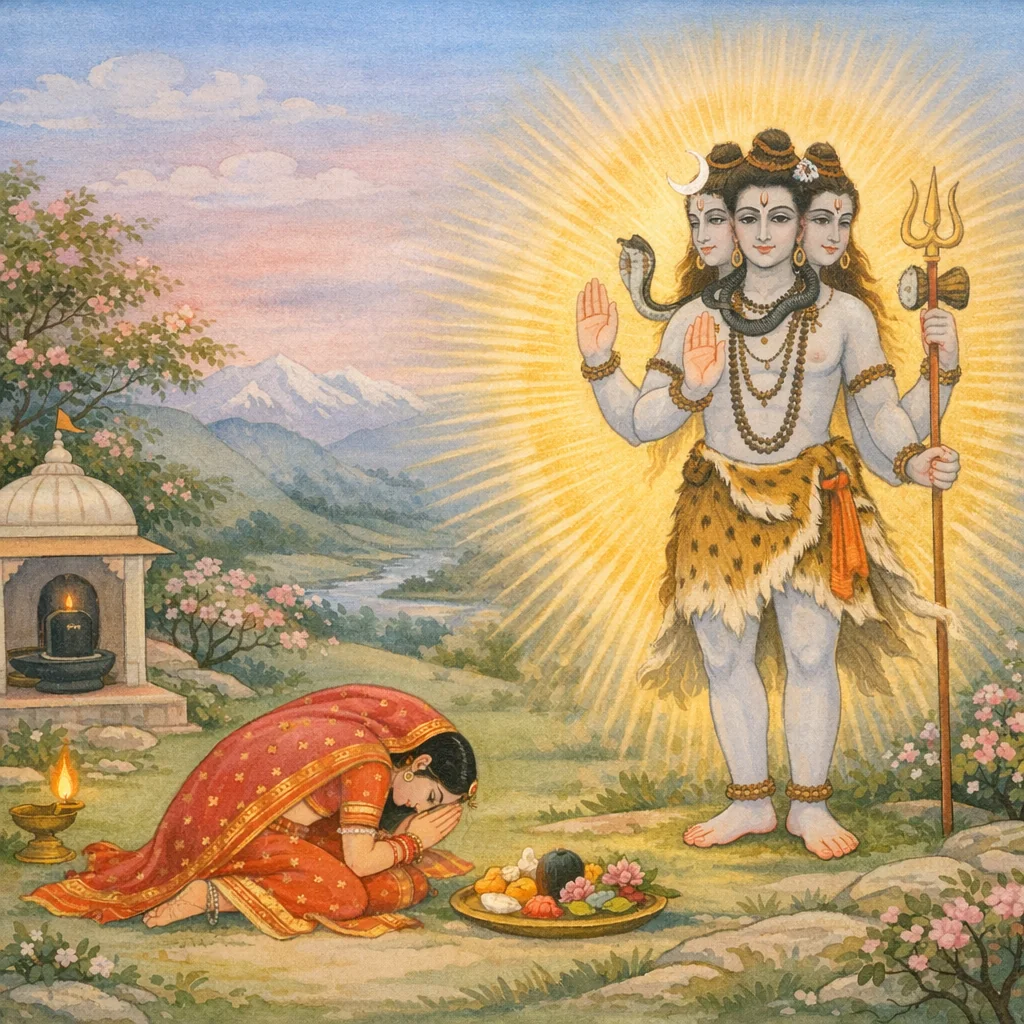
नन्दाव्रत-समाप्तिः तथा शङ्करस्य प्रत्यक्ष-दर्शनम् (Completion of the Nandā-vrata and Śiva’s Direct Appearance)
Adhyāya 17 recounts the completion of Satī’s disciplined vow, here called the Nandā-vrata. After the gods offer praise, Satī fasts and worships on the bright fortnight’s eighth lunar day (śukla-aṣṭamī) in the month of Āśvina, absorbed in meditation. When the vow is fulfilled, Śiva (Hara) manifests directly (pratyakṣa), described with classic Purāṇic iconography: fair and beautiful, five-faced and three-eyed, moon-adorned, radiant with sacred ash, four-armed, holding the trident and showing gestures of protection and boon-giving, with the Gaṅgā upon his head. Satī, modest and reverent, bows at his feet. Śiva addresses her as Dakṣa’s daughter, expresses satisfaction with her vrata, and invites her to choose a boon, though he already knows her inner intention—highlighting divine grace and the instructive role of voiced desire within vow-rituals. Brahmā’s framing narration emphasizes Śiva’s sovereignty and his pedagogical purpose in drawing forth Satī’s request.
Shlokas
Verse 1
ब्रह्मोवाच । इत्युक्त्वा सर्वदेवैश्च कृता शंभोर्नुतिः परा । शिवाच्च सा वरं प्राप्ता शृणु ह्यादरतो मुने
Brahmā said: Having spoken thus, all the gods offered an exalted hymn of praise to Śaṁbhu (Lord Śiva). And from Śiva she obtained a boon. Listen to it attentively, O sage.
Verse 2
अथो सती पुनः शुक्लपक्षेऽष्टम्यामुपोषिता । आश्विने मासि सर्वेशं पूजयामास भक्तितः
Then Satī again observed a fast on the eighth lunar day of the bright fortnight. In the month of Āśvina, she worshipped Sarveśa—Lord Śiva, the Lord of all—with wholehearted devotion.
Verse 3
इति नंदाव्रते पूर्णे नवम्यां दिनभागतः । तस्यास्तु ध्यानमग्नायाः प्रत्यक्षमभवद्धरः
Thus, when the Nandā-vrata was completed, on the ninth lunar day as the day progressed, the Bearer of all (Lord Śiva) became directly manifest before her, for she was absorbed in meditation.
Verse 4
सर्वाङ्गसुन्दरो गौरः पंचवक्त्रस्त्रिलोचनः । चंद्रभालः प्रसन्नात्मा शितिकंठश्चतुर्भुज
Beautiful in every limb, radiant and fair, He is five-faced and three-eyed. His brow is adorned with the moon; His inner being is serene and gracious. Blue-throated and four-armed—thus is the auspicious, manifest (saguṇa) form of Lord Śiva praised.
Verse 5
त्रिशूलब्रह्मकवराभयधृग्भस्मभास्वरः । स्वर्धुन्या विलसच्छीर्षस्सकलाङ्गमनोहरः
Radiant with the sacred ash, He bore the trident, the protection of Brahmā, and the gesture of fearlessness. With the celestial Gaṅgā adorning His head, He was enchanting in the beauty of all His limbs.
Verse 6
महालावण्यधामा च कोटिचन्द्रसमाननः । कोटिस्मरसमाकांतिस्सर्वथा स्त्रीप्रियाकृतिः
He was a radiant abode of great beauty; his face was like ten million moons. His charm equalled that of ten million Kāmas, and in every way his form was delightful and beloved to women.
Verse 7
प्रत्यक्षतो हरं वीक्ष्य सती सेदृविधं प्रभुम् । ववन्दे चरणौ तस्य सुलज्जावनतानना
Seeing Hara directly before her—her own Lord so manifest—Satī, with modesty and her face gently lowered in reverence, bowed down at His feet.
Verse 8
अथ प्राह महादेवस्सतीं सद्व्रतधारिणीम् । तामिच्छन्नपि भार्यार्थं तपश्चर्याफलप्रदः
Then Mahādeva—bestower of the fruit of tapas—spoke to Satī, steadfast in noble vows. Though He desired her as His wife, He addressed her in a way that preserves the sanctity and fulfillment of austerity.
Verse 9
महादेव उवाच । दक्षनंदिनि प्रीतोस्मि व्रतेनानेन सुव्रते । वरं वरय संदास्ये यत्तवाभिमतं भवेत्
Mahādeva said: “O beloved daughter of Dakṣa, O virtuous keeper of this sacred vow, I am pleased with you because of this vrata. Choose a boon; I shall surely grant whatever your heart desires.”
Verse 10
ब्रह्मोवाच । जानन्नपीह तद्भावं महादेवो जगत्पतिः । जगौ वरं वृणीष्वेति तद्वाक्यश्रवणेच्छया
Brahmā said: Though Mahādeva, Lord of the worlds, already knew her inner intention here, He spoke, “Choose a boon,” desiring to hear her own words.
Verse 11
सापि त्रपावशा युक्ता वक्तुं नो हृदि यत्स्थितम् । शशाक सा त्वभीष्टं यत्तल्लज्जाच्छादितं पुनः
Even she, overcome by modesty, could not speak what dwelt in her heart. Though she wished to express it, that cherished intention was again veiled by shyness.
Verse 12
प्रेममग्नाऽभवत्साति श्रुत्वा शिववचः प्रियम् । तज्ज्ञात्वा सुप्रसन्नोभूच्छंकरो भक्तवत्सलः
Hearing the beloved words of Lord Śiva, Satī became wholly immersed in love. Knowing her heart, Śaṅkara—the ever-affectionate to His devotees—became exceedingly pleased.
Verse 13
वरं ब्रूहि वरं ब्रूहि प्राहेति स पुनर्द्रुतम् । सतीभक्तिवशश्शंभुरंतर्यामी सतां गतिः
Again and again, he quickly said, “Speak your boon—speak your boon!” For Śambhu, though the Inner Ruler of all, becomes responsive to Satī’s devotion; he is the refuge and final goal of the righteous.
Verse 14
अथ त्रपां स्वां संधाय यदा प्राह हरं सती । यथेष्टं देहि वरद वरमित्यनिवारकम्
Then Satī, composing her modesty, spoke to Hara (Lord Śiva): “O Bestower of boons, grant me a boon according to Your will—one that none can obstruct or prevent.”
Verse 15
तदा वाक्यस्यावसानमनवेक्ष्य वृषध्वजः । भव त्वं मम भार्येति प्राह तां भक्तवत्सलः
Then Vṛṣadhvaja—Śiva, whose emblem is the bull—without waiting for her words to end, spoke to her with tender love for His devotee: “Become My wife.”
Verse 16
एतच्छ्रुत्वा वचस्तस्य साभीष्टफल भावनम् । तूष्णीं तस्थौ प्रमुदिता वरं प्राप्य मनोगतम्
Hearing his words—words sure to bring the longed-for fruit—she stood in silence, rejoicing, for she had received the boon her heart had cherished.
Verse 17
इति श्रीशैवे महापुराणे द्वितीयायां रुद्रसंहितायां द्वितीये सतीखंडे सतीवरलाभो नाम सप्तदशोऽध्यायः
Thus, in the Śaiva Mahāpurāṇa, in the second book called the Rudra-saṃhitā, within its second section, the Satī-khaṇḍa, ends the seventeenth chapter entitled “Satī’s Attainment of the Boon.”
Verse 18
ततो भावान्समादाय शृंगाराख्यो रसस्तदा । तयोश्चित्ते विवेशाशु कला हावा यथोदितम्
Then, gathering the fitting inner moods, the rasa called Śṛṅgāra—love—arose. As described, its subtle expressions, artful grace and amorous gestures, swiftly entered the hearts of them both.
Verse 19
तत्प्रवेशात्तु देवर्षे लोकलीलानुसारिणोः । काप्यभिख्या तयोरासीच्चित्रा चन्द्रमसोर्यथा
O divine sage, when they entered that place, those two—moving in accord with the world’s sportive līlā—came to bear a distinctive renown, wondrous like the moon’s radiance.
Verse 20
रेजे सती हरं प्राप्य स्निग्धभिन्नांजनप्रभा । चन्द्राभ्याशेऽभ्रलेखेव स्फटिकोज्ज्वलवर्ष्मणः
Having attained Hara (Lord Śiva), Satī shone forth; her complexion was like the lustre of smooth, freshly-ground añjana. She was like a delicate streak of cloud beside the moon, as his crystal-brilliant form blazed with radiance.
Verse 21
अथ सा तमुवाचेदं हरं दाक्षायणी मुहुः । सुप्रसन्ना करौ बद्ध्वा नतका भक्तवत्सलम्
Then Dakṣa’s daughter Dakṣāyaṇī (Satī), greatly pleased, spoke these words to Hara again and again. With hands joined in reverence and bowing down, she addressed the Lord who is ever affectionate to his devotees.
Verse 22
सत्युवाच । देवदेव महादेव विवाह विधिना प्रभौ । पितुर्मे गोचरीकृत्य मां गृहाण जगत्पते
Satī said: “O God of gods, O Mahādeva, O Lord—accept me in marriage according to the proper rite, after bringing my father to consent. O Lord of the universe, receive me.”
Verse 23
ब्रह्मोवाच । एवं सतीवचः श्रुत्वा महेशो भक्तवत्सलः । तथास्त्विति वचः प्राह निरीक्ष्य प्रेमतश्च ताम्
Brahmā said: Hearing Satī’s words, Maheśa—ever tender toward His devotees—looked upon her with love and replied, “So be it.”
Verse 24
दाक्षायण्यपि तं नत्वा शंभुं विज्ञाप्य भक्तितः । प्राप्ताज्ञा मातुरभ्याशमगान्मोहमुदान्विता
Dākṣāyaṇī (Satī) too bowed to Śambhu and, with devotion, reverently informed Him; having obtained His consent, she then, overcome by delusion, went to the presence of her mother.
Verse 25
हरोपि हिमवत्प्रस्थं प्रविश्य च निजाश्रमम् । दाक्षायणीवियोगाद्वै कृच्छ्रध्यानपरोऽभवत्
Hara too entered the Himalayan highlands and returned to His own hermitage; and, because of separation from Dakṣa’s daughter (Satī), He became wholly intent on austere, difficult meditation.
Verse 26
समाधाय मनः शंभुर्लौकिकीं गतिमाश्रितः । चिंतयामास देवर्षे मनसा मां वृषध्वजः
Having steadied His mind, Śambhu—outwardly adopting a worldly manner—began to contemplate me within, O divine sage; the Bull-bannered Lord reflected upon me in His heart.
Verse 27
ततस्संचिंत्यमानोहं महेशेन त्रिशूल्रिना । पुरस्तात्प्राविशं तूर्णं हरसिद्धिप्रचोदितः
Then, as I was being contemplated by Maheśa—the trident-bearing Lord—I swiftly came into His presence, impelled by the unfailing power of Hara.
Verse 28
यत्रासौ हिमवत्प्रस्थे तद्वियोगी हरः स्थितः । सरस्वतीयुतस्तात तत्रैव समुपस्थितः
In that very region on the slopes of Himavān, Hara (Śiva) remained, anguished by separation from her. And there itself, O dear one, Brahmā arrived, accompanied by Sarasvatī.
Verse 29
सरस्वतीयुतं मां च देवर्षे वीक्ष्य स प्रभुः । उत्सुकः प्रेमबद्धश्च सत्या शंभुरुवाच ह
O divine sage, seeing me together with Sarasvatī, that Supreme Lord Śambhu—eager and bound by love—spoke to Satī.
Verse 30
शंभुरुवाच । अहं ब्रह्मन्स्वार्थपरः परिग्रहकृतौ च यत् । तदा स्वत्वमिवस्वार्थे प्रतिभाति ममाधुना
Śambhu said: “O Brahman, when I became intent on self-interest and engaged in the act of taking possession, then even now that self-interest appears to me as though it were ‘mine’—as if it were true ownership.”
Verse 31
अहमाराधितस्सत्याद्दाक्षायण्याथ भक्तितः । तस्यै वरो मया दत्तो नंदाव्रतप्रभावतः
Truly, Satī, the daughter of Dakṣa, worshipped Me with steadfast devotion; therefore, by the power of the Nandā-vrata, I granted her a boon.
Verse 32
भर्ता भवेति च तया मत्तो ब्रह्मन् वरो वृतः । मम भार्या भवेत्युक्तं मया तुष्टेन सर्वथा
O Brahman, she chose from Me the boon, “May he be my husband.” And I—wholly pleased—declared, “May she indeed become My wife.”
Verse 33
अथावदत्तदा मां सा सती दाक्षायणी त्विति । पितुर्मे गोचरीकृत्य मां गृहाण जगत्पते
Then Satī, the daughter of Dakṣa, spoke to Me: “I am Dākṣāyaṇī (Satī). Having brought myself within my father’s sight and concern, O Lord of the worlds, accept me as Your own.”
Verse 34
तदप्यंगीकृतं ब्रह्मन्मया तद्भक्ति तुष्टितः । सा गता भवनं मातुरहमत्रागतो विधे
O Brahman, I too accepted that proposal, being pleased by her devotion. She went to her mother’s house, and I have come here, O Vidhe, the Ordainer.
Verse 35
तस्मात्त्वं गच्छ भवनं दक्षस्य मम शासनात् । तां दक्षोपि यथा कन्यां दद्यान्मेऽरं तथा वद
Therefore, by My command, go to the house of Dakṣa. Speak in such a way that Dakṣa, too, may duly give that maiden to Me in marriage.
Verse 36
सतीवियोगभंगस्स्याद्यथा मे त्वं तथा कुरु । समाश्वासय तं दक्षं सर्वविद्याविशारदः
Act in such a way that My separation from Satī may be brought to an end. As I desire, so do you. O master well-versed in every branch of knowledge, go and console Dakṣa.
Verse 37
ब्रह्मोवाच । इत्युदीर्य महादेवस्सकाशे मे प्रजापतेः । सरस्वतीं विलोक्याशु वियोगवशगोभवत्
Brahmā said: Having spoken thus in the presence of me, the Prajāpati, Mahādeva then looked upon Sarasvatī; and at once he came under the compelling sway of separation, seized by longing.
Verse 38
तेनाहमपि चाज्ञप्तः कृतकृत्यो मुदान्वितः । प्रावोचं चेति जगतां नाथं तं भक्तवत्सलम्
Thus, I too was instructed by him; feeling my duty fulfilled and filled with joy, I spoke out in praise of that Lord of the worlds, the affectionate guardian of His devotees.
Verse 39
ब्रह्मोवाच । यदात्थ भगवञ्शम्भो तद्विचार्य सुनिश्चितम् । देवानां मुख्यस्स्वार्थो हि ममापि वृषभध्वज
Brahmā said: “O Blessed Śambhu, I have reflected well upon what You have spoken and have become firmly convinced. Indeed, the foremost welfare of the gods—and mine as well, O Lord whose banner bears the bull—lies in it.”
Verse 40
दक्षस्तुभ्यं सुतां स्वां च स्वयमेव प्रदास्यति । अहं चापि वदिष्यामि त्वद्वाक्यं तत्समक्षतः
Dakṣa himself will give you his own daughter in marriage. And I too shall speak your very words in his presence, face to face.
Verse 41
ब्रह्मोवाच । इत्युदीर्य्य महादेवमहं सर्वेश्वरं प्रभुम् । अगमं दक्षनिलयं स्यंदनेनातिवेगिना
Brahmā said: “Having thus addressed Mahādeva—the Supreme Lord, the sovereign of all—I then went to Dakṣa’s residence, swiftly, in a chariot of great speed.”
Verse 42
नारद उवाच । विधे प्राज्ञ महाभाग वद नो वदतां वर । सत्यै गृहागतायै स दक्षः किमकरोत्ततः
Narada said: “O Creator (Brahmā), O wise and greatly fortunate one—best among speakers—tell us: when Sati came to her father’s house, what did Daksha do thereafter?”
Verse 43
ब्रह्मोवाच । तपस्तप्त्वा वरं प्राप्य मनोभिलषितं सती । गृहं गत्वा पितुर्मातुः प्रणाममकरोत्तदा
Brahmā said: Having performed austerities and gained the boon her heart desired, Satī returned home and then bowed in reverent homage to her father and mother.
Verse 44
मात्रे पित्रेऽथ तत्सर्वं समाचख्यौ महेश्वरात् । वरप्राप्तिः स्वसख्या वै सत्यास्तुष्टस्तु भक्तितः
Then she related all of that to her mother and father—how, through Maheśvara, the boon had been obtained. Indeed, her companion Satyā was pleased because of devotion.
Verse 45
माता पिता च वृत्तांतं सर्वं श्रुत्वा सखीमुखात् । आनन्दं परमं लेभे चक्रे च परमोत्सवम्
Having heard the entire account from the mouth of her friend, her mother and father attained supreme joy and arranged a most splendid celebration.
Verse 46
द्रव्यं ददौ द्विजातिभ्यो यथाभीष्टमुदारधीः । अन्येभ्यश्चांधदीनेभ्यो वीरिणी च महामनाः
That noble-minded lady, generous in understanding, gave wealth to the twice-born (dvija) as each desired; and she, the great-souled one, also bestowed gifts upon others—upon the blind and the destitute.
Verse 47
वीरिणी तां समालिंग्य स्वसुतां प्रीतिवर्द्धिनीम् । मूर्ध्न्युपाघ्राय मुदिता प्रशशंस मुहुर्मुहुः
Vīriṇī embraced her own daughter, who increased her joy and affection. Delighted, she kissed (smelled) her on the crown of the head and praised her again and again.
Verse 48
अथ दक्षः कियत्काले व्यतीते धर्मवित्तमः । चिंतयामास देयेयं स्वसुता शम्भवे कथम्
Then, after some time had passed, Dakṣa—most learned in dharma—began to reflect: “How indeed can I give my own daughter to Śambhu (Lord Śiva)?”
Verse 49
आगतोपि महादेवः प्रसन्नस्स जगाम ह । पुनरेव कथं सोपि सुतार्थेऽत्रागमिष्यति
Even though Mahādeva had come, He departed again, pleased. How, then, will He return here once more for the sake of a son?
Verse 50
प्रास्थाप्योथ मया कश्चिच्छंभोर्निकटमंजसा । नैतद्योग्यं निगृह्णीयाद्यद्येवं विफलार्दना
Then I shall swiftly send someone near Śambhu. Yet one who is unfit should not take up this task; done in such a way, the effort becomes fruitless and brings affliction.
Verse 51
अथवा पूजयिष्यामि तमेव वृषभध्वजम् । मदीयतनया भक्त्या स्वयमेव यथा भवेत्
Or else I shall worship that very Lord—Śiva, whose banner bears the bull—so that, through the devotion of my own daughter, He may of His own accord become her chosen Lord and husband.
Verse 52
तथैव पूजितस्सोपि वांछत्यार्यप्रयत्नतः । शंभुर्भवतु मद्भर्त्तेत्येवं दत्तवरेणतत्
Thus, duly worshipped, she too—through noble and earnest effort—sought this boon: “May Śambhu become my husband.” In this manner, that boon was granted to her.
Verse 53
इति चिंतयतस्तस्य दक्षस्य पुरतोऽन्वहम् । उपस्थितोहं सहसा सरस्वत्यन्वितस्तदा
While Dakṣa was thus thinking, day after day, I suddenly appeared before him at that time, accompanied by Sarasvatī.
Verse 54
मां दृष्ट्वा पितरं दक्षः प्रणम्यावनतः स्थितः । आसनं च ददौ मह्यं स्वभवाय यथोचितम्
Seeing me, Dakṣa bowed to his father and stood with humility. Then, as was proper to his station and household, he offered me a seat befitting the occasion.
Verse 55
ततो मां सर्वलोकेशं तत्रागमन कारणम् । दक्षः पप्रच्छ स क्षिप्रं चिंताविष्टोपि हर्षितः
Then Dakṣa quickly asked me—Śiva, the Lord of all worlds—the reason for my coming there. Though inwardly troubled with anxious thoughts, he still appeared delighted.
Verse 56
दक्ष उवाच । तवात्रागमने हेतुः कः प्रवेशे स सृष्टिकृत् । ममोपरि सुप्रसादं कृत्वाचक्ष्व जगद्गुरो
Dakṣa said: “What is the reason for your coming here, and who is the creator who has arranged your entry into this assembly? O world-teacher, be gracious to me and tell me.”
Verse 57
पुत्रस्नेहात्कार्यवशादथ वा लोककारक । ममाश्रमं समायातो हृष्टस्य तव दर्शनात्
O benefactor of the worlds, whether out of affection for your son or compelled by some task, you have come to my hermitage; and at the sight of you I am filled with joy.
Verse 58
ब्रह्मोवाच । इति पृष्टस्स्वपुत्रेण दक्षेण मुनिसत्तम । विहसन्नब्रुवं वाक्यं मोदयंस्तं प्रजापतिम्
Brahmā said: O best of sages, when I was thus questioned by my own son Dakṣa, I smiled and spoke words that would gladden that Prajāpati.
Verse 59
ब्रह्मोवाच । शृणु दक्ष यदर्थं त्वत्समीपमहमागतः । त्वत्तोकस्य हितं मेपि भवतोपि तदीप्सितम्
Brahmā said: “Listen, O Dakṣa, for what purpose I have come near you. The welfare of your daughter is desired by me as well, and that very welfare is also what you yourself seek.”
Verse 60
तव पुत्री समाराध्य महादेवं जगत्पतिम् । यो वरः प्रार्थितस्तस्य समयोयमुपागतः
“Your daughter, having duly worshipped Mahādeva—the Lord of the universe—has obtained His grace. The time has now arrived for the boon that was prayed for.”
Verse 61
शंभुना तव पुत्र्यर्थं त्वत्सकाशमहं धुवम् । प्रस्थापितोस्मि यत्कृत्यं श्रेय स्तदवधारय
“For the sake of your daughter, Śambhu has certainly sent me to your presence. Therefore, understand well what must be done now—what will lead to the highest good.”
Verse 62
वरं दत्त्वा गतो रुद्रस्तावत्प्रभृति शंकरः । त्वत्सुताया वियोगेन न शर्म लभतेंजसा
“Having granted the boon, Rudra departed. From that time onward, Śaṅkara, because of separation from your daughter (Satī), could not easily attain peace of heart.”
Verse 63
अलब्धच्छिद्रमदनो जिगाय गिरिशं न यम् । सर्वैः पुष्पमयैर्बाणैर्यत्नं कृत्वापि भूरिशः
“Even Madana (Kāma), though he strove greatly and shot all his flower-made arrows, could not find a single vulnerable opening in Girīśa (Lord Śiva) to conquer Him.”
Verse 64
स कामबाणविद्धोपि परित्यज्यात्म चिंतनम् । सतीं विचिंतयन्नास्ते व्याकुलः प्राकृतो यथा
Though pierced by the arrows of Kāma, he abandoned inner self-contemplation and sat there, anxiously brooding over Satī—like an ordinary worldly man.
Verse 65
विस्मृत्य प्रश्रुतां वाणीं गणाग्रे विप्रयोगतः । क्व सतीत्येवमभितो भाषते निकृतावपि
From the anguish of separation, he forgot the words he had earlier spoken before the gaṇas; and though deceived, he kept calling in every direction, “Where is Satī?”
Verse 66
मया यद्वांछितं पूर्वं त्वया च मदनेन च । मरीच्याद्यैमुनिवरैस्तत्सिद्धमधुना सुत
“My son, what I formerly desired—and what you and Kāma, the god of love, also wished for—has now been accomplished through the great sages beginning with Marīci.”
Verse 67
त्वत्पुत्र्याराधितश्शंभुस्सोपि तस्या विचिंतनात् । अनुशोधयितुं प्रेप्सुर्वर्त्तते हिमवद्गिरौ
Śambhu, whom your daughter has worshipped with devotion, is also—through contemplation of her—now intent on pursuing and ascertaining the matter; therefore He abides upon Mount Himavat.
Verse 68
यथा नानाविधैर्भावैस्सत्त्वात्तेन व्रतेन च । शंभुराराधितस्तेन तथैवाराध्यते सती
Just as he propitiated Śambhu through many devotional moods, through purity of being (sattva), and through that sacred observance (vrata), in the very same way Satī too is to be worshipped and propitiated.
Verse 69
तस्मात्तु दक्षतनयां शंभ्वर्थं परिकल्पिताम् । तस्मै देह्यविलंबेन कृता ते कृतकृत्यता
Therefore, without delay, give him Dakṣa’s daughter—she has been destined for Śambhu’s sake. By granting her to him, your purpose will be fulfilled and your duty will be complete.
Verse 70
अहं तमानयिष्यामि नारदेन त्वदालयम् । तस्मै त्वमेनां संयच्छ तदर्थे परिकल्पिताम्
“I shall bring him to your abode through Nārada. Therefore, you should give this maiden to him, for she has been duly destined for that very purpose.”
Verse 71
ब्रह्मोवाच । श्रुत्वा मम वचश्चेति स मे पुत्रोतिहर्षितः । एवमेवेतिमां दक्ष उवाच परिहर्षितः
Brahmā said: Hearing my words, my son became exceedingly delighted. Then Dakṣa, greatly pleased, replied to me, “So be it—exactly so.”
Verse 72
ततस्सोहं मुने तत्रागममत्यंतहर्षितः । उत्सुको लोकनिरतो गिरिशो यत्र संस्थितः
Then, O sage, I went there, filled with exceeding joy—eager and intent upon beholding the sacred world where Girīśa (Lord Śiva, the Lord of the Mountain) was abiding.
Verse 73
गते नारद दक्षोपि सदार तनयो ह्यपि । अभवत्पूर्णकामस्तु पीयूषैरिव पूरितः
When Nārada had departed, Dakṣa too—together with his wife and son—became fully contented, as though filled with nectar, his desires seemingly satisfied.
Frequently Asked Questions
Satī completes the Nandā-vrata with fasting and worship in Āśvina (śukla-aṣṭamī), enters deep meditation, and Śiva appears directly (pratyakṣa) and invites her to choose a boon.
The chapter models a bhakti-tapas pathway: disciplined observance (vrata + upavāsa) matures into dhyāna, which culminates in darśana—signifying that divine encounter is both grace-given and practice-conditioned.
Śiva’s manifested form is described with key dhyāna markers—pañcavaktra, trilocana, caturbhuja, śitikaṇṭha, ash-brilliance, trident-bearing, and Gaṅgā on the head—linking narrative to iconography and meditation practice.