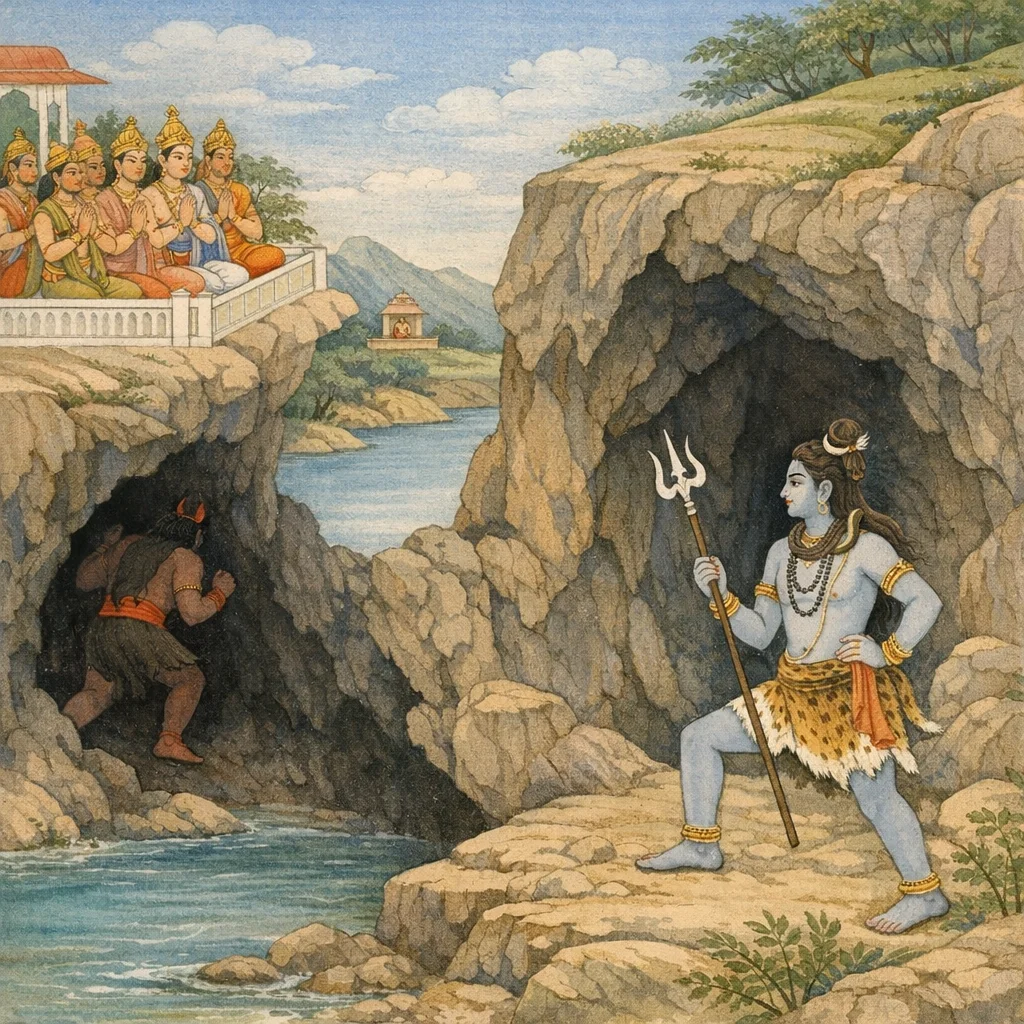
Andhakeśvara-liṅga Māhātmya and Śiva’s Subjugation of Andhaka (अन्धकेश्वरलिङ्गमाहात्म्य तथा अन्धकवध-प्रसङ्ग)
Adhyāya 13 is cast as a Sūta-to-ṛṣi transmission: Sūta invites further questions, and the sages request the māhātmya (sacred greatness) of the Andhakeśvara-liṅga and related liṅga traditions. Andhaka the asura is first placed in a subterranean or oceanic “garta” (pit/abyss), from which he rises to oppress beings and bring the three worlds under his sway. The distressed devas repeatedly appeal to Śiva and report their suffering. Śiva—destroyer of the wicked and refuge of the good—reassures them, instructs the devas to muster their forces, and arrives with his gaṇas. A fierce deva–daitya battle follows; strengthened by Śiva’s favor, the devas prevail. As Andhaka retreats toward the garta, Śiva pierces him with the śūla (trident), restoring cosmic order through a decisive divine act. Within this māhātmya frame, the liṅga linked to the episode is implicitly sanctified as a ritual center where remembrance, worship, and recitation partake of Śiva’s protective power.
Shlokas
Verse 1
सूत उवाच । यथाभवल्लिंगरूपः संपूज्यस्त्रिभवे शिवः । तथोक्तं वा द्विजाः प्रीत्या किमन्यच्छ्रोतुमिच्छथ
Sūta said: “Thus it has been explained how Śiva—manifest as the Liṅga—is to be duly worshipped in the three worlds. O twice-born sages, with affection, what else do you wish to hear?”
Verse 2
ऋषय ऊचुः अन्धकेश्वरलिंगस्य महिमानं वद प्रभो । तथान्यच्छिवलिंगानां प्रीत्या वक्तुमिहार्हसि
The sages said: “O Lord, please proclaim the greatness of the Andhakeśvara Liṅga. And, out of gracious favor, speak here also of the glory of the other Śiva Liṅgas.”
Verse 3
सूत उवाच । पुराब्धिगर्तमाश्रित्य वसन्दैत्योऽन्धकासुरः । स्ववशं कारयामास त्रैलोक्यं सुरसूदनः
Sūta said: “In ancient times, the Daitya Andhakāsura dwelt, taking refuge in a cavern of the primordial ocean; that slayer of the gods brought the three worlds under his own control.”
Verse 4
तस्माद्गर्ताच्च निस्सृत्य पीडयित्वा पुनः प्रजाः । प्राविशच्च तदा दैत्यस्तं गर्तं सुपराक्रमः
Then, emerging from that pit, the mighty demon again oppressed the people; and after doing so, that exceedingly valiant one re-entered the same pit.
Verse 5
देवाश्च दुःखितः सर्वे शिवं प्रार्थ्य पुनःपुनः । सर्वं निवेदयामासुस्स्वदुःखं च मुनीश्वराः
All the Devas, afflicted with sorrow, repeatedly prayed to Lord Śiva; and the great sages, too, fully submitted to Him the entire account of their own distress.
Verse 6
सूत उवाच । तदाकर्ण्य वचस्तेषां देवानां परमेश्वरः । प्रत्युवाच प्रसन्नात्मा दुष्टहंता सतां गतिः
Sūta said: Hearing those words of the gods, the Supreme Lord (Śiva)—serene in heart, the destroyer of the wicked and the refuge of the righteous—replied to them with gracious composure.
Verse 7
शिव उवाच । घातयिष्यामि तं दैत्यमन्धकं सुरसूदनम् । सैन्यं च नीयतान्देवा ह्यायामि च गणैस्सह
Śiva said: “I shall slay that Daitya Andhaka, the slayer of the gods. O Devas, lead forth the army; I too am coming, together with my Gaṇas.”
Verse 8
तस्माद्गर्तादंधके हि देवर्षिद्रुहि भीकरे । निस्सृते च तदा तस्मिन्देवा गर्तमुपाश्रिताः
When Andhaka—terrifying and hostile even to the gods and the devarṣi sages—came forth from that pit, then the Devas, in fear, took refuge in that very pit as their shelter.
Verse 9
दैत्याश्च देवताश्चैव युद्धं चक्रुः सुदारुणम् । शिवानुग्रहतो देवाः प्रबलाश्चाभवंस्तदा
Then the Daityas and the Devas waged a most dreadful battle. Yet, by Lord Śiva’s gracious favor, the Devas became mighty and prevailed at that time.
Verse 10
देवैश्च पीडितः सोपि यावद्गर्तमुपागतः । तावच्छूलेन संप्रोतः शिवेन परमात्मना
Harassed by the gods, he too fled until he reached a pit; but at that very moment Śiva—the Supreme Self (Paramātman)—pierced him through with His trident.
Verse 11
तत्रत्यश्च तदा शंभुं ध्यात्वा संप्रार्थयत्तदा । अन्तकाले च त्वां दृष्ट्वा तादृशो भवति क्षणात्
Then the man of that place meditated on Śambhu and offered earnest prayer. And at the final moment, having beheld You, he becomes like You in an instant.
Verse 12
इत्येवं संस्तुतस्सोपि प्रसन्नः शंकरस्तदा । उवाच वचनं तत्र वरं ब्रूहि ददामि ते
Thus praised in this manner, Śaṅkara became gracious then, and there he spoke these words: “Speak your boon (vara); I shall grant it to you.”
Verse 13
इति श्रीशिवमहापुराणे चतुर्थ्यां कोटिरुद्रसंहितायां वटुकोत्पत्तिवर्णनं नाम त्रयोदशोऽध्यायः
Thus, in the Śrī Śiva Mahāpurāṇa, in the Fourth Book—the Koṭirudrasaṃhitā—ends the thirteenth chapter, entitled “The Description of the Origin/Manifestation of Vaṭuka.”
Verse 14
अन्धक उवाच । यदि प्रसन्नो देवेश स्वभक्तिं देहि मे शुभाम् । कृपां कृत्वा विशेषेण संस्थितो भव चेह वै
Andhaka said: “O Devēśa, Lord of the gods, if You are pleased, grant me Your own auspicious devotion. Showing special compassion, be firmly established here (in my heart and life) indeed.”
Verse 15
सूत उवाच । इत्युक्तस्तेन दैत्यं तं तद्गर्ते चाक्षिपद्धरः । स्वयं तत्र स्थितो लिंगरूपोऽसौ लोककाम्यया
Sūta said: Thus addressed, Dhara the Bear cast that demon into that very pit. Then, for the welfare of the world and the fulfillment of its aspirations, the Lord Himself remained established there in the form of the Liṅga.
Verse 16
अन्धकेशं च तल्लिंगं नित्यं यः पूजयेन्नरः । षण्मासाज्जायते तस्य वांछासिद्धिर्न संशयः
Whoever worships daily that Liṅga known as Andhakeśa—the sacred emblem of Lord Śiva—attains within six months the fulfillment of the heart’s desired aim; of this there is no doubt.
Verse 17
वृत्त्यर्थं पूजयेल्लिंगं लोकस्य हितकारकम् । षण्मासं यो द्विजश्चैव स वै देवलकः स्मृतः
If a twice-born man (dvija) worships the Śiva-liṅga—benefactor of the world—merely as a means of livelihood for six months, he is indeed regarded as a ‘devalaka’ (one who performs worship as a profession).
Verse 18
यथा देवलकश्चैव स भवेदिह वै तदा । देवलकश्च यः प्रोक्तो नाधिकारो द्विजस्य हि
In that case, he indeed becomes, in this very life, a “devalaka.” And one who is declared to be a devalaka—such a person has no rightful eligibility (adhikāra) of a twice-born (dvija) for Vedic duties and sacred observances.
Verse 19
ऋषय ऊचुः । देवलकश्च कः प्रोक्तः किं कार्यं तस्य विद्यते । तत्त्वं वद महाप्राज्ञ लोकानां हितहेतवे
The sages said: “Who is this Devalaka that has been mentioned, and what purpose does he serve? O greatly wise one, tell us the truth of it for the welfare of all beings.”
Verse 20
सूत उवाच । दधीचिर्नाम विप्रो यो धर्मिष्ठो वेदपारगः । शिवभक्तिरतो नित्यं शिवशास्त्रपरायणः
Sūta said: There was a Brahmin named Dadhīci—most righteous, fully versed in the Vedas—ever absorbed in devotion to Śiva and steadfastly devoted to the scriptures that teach Śiva.
Verse 21
तस्य पुत्रस्तथा ह्यासीत्स्मृतो नाम्ना सुदर्शनः । तस्य भार्या दुकूला च नाम्ना दुष्टकुलोद्भवा
He had a son, remembered by the name Sudarśana. Sudarśana’s wife was named Dukūlā, and she was born from an unrighteous lineage.
Verse 22
तद्वशे स च भर्तासीत्तस्य पुत्रचतुष्टयम् । सोऽपि नित्यं शिवस्यैव पूजां च स्म करोत्यसौ
Under her influence he became her husband, and from him she bore four sons. He too, day after day, continually performed worship of Lord Śiva alone.
Verse 23
दधीचेस्तु तदा ह्यासीद्ग्रामान्तरनिवेशनम् । ज्ञातिसंयोगतश्चैव ज्ञातिभिर्न स मोचितः
At that time Dadhīci had his dwelling established in another village; and because of his association with his kinsmen, he was not released by those relatives.
Verse 24
कथयित्वा च पुत्रं स शिवभक्तिरतो भव । इत्युक्त्वा स गतो मुक्तो दाधीचिश्शैवसत्तमः
Having thus instructed his son, he said, “Be devoted to the worship of Lord Śiva.” After speaking these words, that supreme Śaiva—Dadhīci—departed, liberated, having attained mokṣa through steadfast devotion to Śiva.
Verse 25
सुदर्शनस्तत्पुत्रोऽपि शिवपूजां चकार ह । एवं चिरतरः कालो व्यतीयाय मुनीश्वराः
And Sudarśana’s son also performed the worship of Lord Śiva. Thus, O best of sages, a very long time passed in this continued devotion.
Verse 26
एवं च शिवरात्रिश्च समायाता कदाचन । तस्यां चोपोषितास्सर्वे स्वयं संयोगतस्तदा
In this manner, on one occasion the sacred night of Śiva (Śivarātri) arrived. On that very night, all of them—by a providential convergence—undertook the fast (upoṣa) then.
Verse 27
पूजां कृत्वा गतस्सोऽपि सुदर्शन इति स्मृतः । स्त्रीसंगं शिवरात्रौ तुं कृत्वा पुनरिहागतः
Having performed the worship, he too departed and came to be remembered by the name Sudarśana. But after indulging in intercourse with a woman on the night of Śivarātri, he returned again to this worldly state.
Verse 28
न स्नानं तेन च कृतं तद्रात्र्यां शिवपूजनम् । तेन तत्कर्मपाकेन क्रुद्धः प्रोवाच शङ्करः
On that night he performed neither the purifying bath nor the worship of Śiva. When the karmic consequence of that deed ripened, Śaṅkara, angered, spoke—showing that neglect of Śiva’s observance bears inevitable karmic fruit.
Verse 29
महेश्वर उवाच । शिवरात्र्यां त्वया दुष्ट सेवनं च स्त्रियाः कृतम् । अस्नातेन मदीया च कृता पूजाविवेकिना
Maheshvara said: “On the night of Śivarātri you consorted sinfully with a woman; and, without bathing—though claiming discernment—you worshiped Me in an improper way.”
Verse 30
ज्ञात्वा चैवं कृतं यस्मात्तस्मात्त्वं जडतां व्रज । ममास्पृश्यो भव त्वं च दूरतो दर्शनं कुरु
Since you acted thus knowingly, therefore enter a state of dullness and insentience. Become untouchable to Me, and behold Me only from a distance.
Verse 31
सूत उवाच । इति शप्तो महेशेन दाधीचिस्स सुदर्शनः । जडत्वं प्राप्तवान्सद्यश्शिवमायाविमोहितः
Sūta said: Thus Sudarśana, the son of Dadhīci, when cursed by Maheśa, was at once deluded by Śiva’s māyā and immediately fell into a dull, inert stupor.
Verse 32
एतस्मिन्समये विप्रा दधीचिः शैवसत्तमः । ग्रामान्तरात्समायातो वृत्तान्तं श्रुतवांश्च सः
At that time, O Brahmins, Dadhīci—the foremost among Śiva’s devotees—arrived from another village, having also heard the account of what had occurred.
Verse 33
शिवेन भर्त्सितः सोऽपि दुःखितोऽभूदतीव हि । रुरोद हा हतोऽश्मीति दुःखेन सुतकर्मणा
Rebuked by Lord Śiva, he too became exceedingly distressed. Overwhelmed with sorrow for his son’s fate, he wept aloud, crying, “Alas! I am struck down—crushed like a stone!”
Verse 34
पुनःपुनरुवाचेति स दधीचिस्सतां मतः । अनेनेदं कुपुत्रेण हतं मे कुलमुत्तमम्
Again and again, Dadhīci—esteemed among the righteous—spoke: “By this wicked son, my noble lineage has been ruined.”
Verse 35
स पुत्रोऽपि हतो भार्यां पुंश्चलीं कृतवान्द्रुतम् । पश्चात्तापमनुप्राप्य स्वपित्रा परिभर्त्सितः
Even after having slain his own son, he quickly took a wife and made her a wanton. Later, when remorse arose within him, he was rebuked by his own father.
Verse 36
तत्पित्रा गिरिजा तत्र पूजिता विधिभिर्वरैः । सुयत्नतो महाभक्त्या स्वपुत्रसुखहेतवे
There, Girijā (Pārvatī) was worshipped by her father with excellent prescribed rites—carefully and with great devotion—so that his own son might attain happiness and well-being.
Verse 37
सुदर्शनोऽपि गिरिजां पूजयामास च स्वयम् । चण्डीपूजनमार्गेण महाभक्त्या शुभैः स्तवैः
Even Sudarśana himself worshipped Girijā (Pārvatī) personally—following the method of Caṇḍī worship—offering auspicious hymns with great devotion.
Verse 38
एवं तौ पितृपुत्रौ हि नानोपायैः सुभक्तितः । प्रसन्नां चक्रतुर्देवीं गिरिजां भक्तवत्सलाम्
Thus, that father and son—through various means, with sincere devotion—made the Goddess Girijā, ever affectionate to her devotees, gracious and pleased.
Verse 39
तयोः सेवाप्रभावेण प्रसन्ना चण्डिका तदा । सुदर्शनं च पुत्रत्वे चकार गिरिजा मुने
By the power of their devoted service, Caṇḍikā was then pleased; and Girijā (Pārvatī), O sage, accepted Sudarśana as her son.
Verse 40
शिवं प्रसादयामास पुत्रार्थे चण्डिका स्वयम् । क्रुद्धाऽक्रुद्धा पुनश्चण्डी तत्पुत्रस्य प्रसन्नधीः
Seeking a son, Caṇḍikā herself strove to propitiate Lord Śiva. Though she appeared now fierce and now gentle, that same Caṇḍī—her mind made serene—became gracious toward that son.
Verse 41
अथाज्ञाय प्रसन्नं तं महेशं वृषभध्वजम् । नमस्कृत्य स्वयं तस्य ह्युत्संगे तं न्यवेशयत्
Then, understanding that Maheśa—the Bull-bannered Lord—was pleased, he bowed to Him and, with his own hands, placed the child upon the Lord’s lap.
Verse 42
घृतस्नानं ततः कृत्वा पुत्रस्य गिरिजा स्वयम् । त्रिरावृत्तोपवीतं च ग्रन्थिनैकेन संयुतम्
Then Girijā (Pārvatī) herself performed for her son the ceremonial bathing with ghee. She also placed upon him the sacred thread, worn in three folds, joined together with a single knot.
Verse 43
सुदर्शनाय पुत्राय ददौ प्रीत्या तदाम्बिका । उद्दिश्य शिवगायत्रीं षोडशाक्षरसंयुताम्
Then Ambikā, moved by affection, bestowed upon her son Sudarśana the Śiva-Gāyatrī—an invocation directed to Lord Śiva—endowed with the sixteen syllables, for his worship and inner purification.
Verse 44
तदोंनमः शिवायेति श्रीशब्द पूर्वकाय च । वारान्षोडश संकल्पपूजां कुर्यादयं बटुः
Then that young devotee should perform worship with a vowed intention for sixteen occasions, uttering “Oṃ Namaḥ Śivāya,” and also (reciting it) preceded by the auspicious word “Śrī.”
Verse 45
आस्नानादिप्रणामान्तं पूजयन्वृषभध्वजम् । मंत्रवादित्रपूजाभिस्सर्षीणां सन्निधौ तथा
He should worship Lord Shiva—the One whose banner bears the bull—performing the rites from the ceremonial bath onward up to the final prostration, and offering worship accompanied by mantra-recitation and sacred music, in the reverent presence of the sages as well.
Verse 46
नाममंत्राननेकांश्च पाठयामास वै तदा । उवाच सुप्रसन्नात्मा चण्डिका च शिवस्तथा
Then indeed he recited many name-mantras. At that time, with a heart wholly pleased, Caṇḍikā spoke—and Lord Śiva also spoke.
Verse 47
मदर्पितं च यत्किंचिद्धनधान्यादिकन्तथा । तत्सर्वं च त्वया ग्राह्यं न दोषाय भविष्यति
“Whatever wealth, grain, or any other offering is dedicated to Me—take all of it without hesitation; it will not become a fault (sin) for you.”
Verse 48
मम कृत्ये भवान्मुख्यो देवीकृत्ये विशेषतः । घृततैलादिकं सर्वं त्वया ग्राह्यं मदर्पितम्
“In my service you are foremost—especially in the service of the Goddess. All offerings such as ghee, oil, and the rest, which are presented in my name, should be accepted by you.”
Verse 49
प्राजापत्यं भवेद्यर्हिं तर्ह्येको हि भवान्भवेत् । तदा पूजा च सम्पूर्णान्यथा सर्वा च निष्फला
When the Prājāpatya condition (connected with Brahmā) arises, then you should remain alone and self-restrained. Only then does worship become complete; otherwise, all worship becomes fruitless.
Verse 50
तिलकं वर्तुलं कार्यं स्नानं कार्यं सदा त्वया । शिवसन्ध्या च कर्तव्या गायत्री च तदीयिका
You should always apply a round tilaka and always maintain purity through regular bathing. You must also perform the Śiva-sandhyā worship and recite the Gayatrī that belongs to Śiva.
Verse 51
मत्सेवां प्रथमं कृत्वा कार्यमन्यत्कुलोचितम् । एवं कृतेऽखिले भद्रं दोषाः क्षान्ता मया तव
“First perform service and worship to Me; then attend to the other duties that are proper to your lineage. If you do everything in this order, O auspicious one, all your faults are forgiven by Me.”
Verse 52
सूत उवाच । इत्युक्त्वा तस्य पुत्राश्च चत्वारो बटुकास्तदा । अभिषिक्ताश्चतुर्दिक्षु शिवेन परमात्मना
Sūta said: Having spoken thus, his four sons—then appearing as youthful Baṭukas—were consecrated in the four directions by Shiva, the Supreme Self.
Verse 53
चण्डी चैवात्मनिकटे पुत्रं स्थाप्य सुदर्शनम् । तत्पुत्रान्प्रेरयामास वरान्दत्त्वा ह्यनेकशः
Chandī, placing her son Sudarśana close by her side, then urged his sons onward, granting them many boons again and again.
Verse 54
देव्युवाच । उभयोर्युवयोर्मध्ये वटुको यो भवेन्मम । तस्य स्याद्विजयो नित्यं नात्र कार्या विचारणा
The Goddess said: “Between the two of you, whichever one becomes My vaṭuka—My consecrated servant-child—for him victory shall be constant. Of this there is no need for any further deliberation.”
Verse 55
भवांश्च पूजितो येन तेनैवाहं प्रपूजिता । कर्तव्यं हि भवद्भिश्च स्वीयं कर्म सदा सुत
He by whom you have been worshipped has, by that very act, worshipped Me as well. Therefore, you too must always carry out your own ordained duty, O son.
Verse 56
सूत उवाच । एवं तस्मै वरान्दत्तास्सपुत्राय महात्मने । सुदर्शनाय कृपया शिवाभ्यां जगतां कृते
Sūta said: Thus, out of compassion, for the welfare of the worlds, Śiva and Śivā (Pārvatī) granted boons to the great-souled Sudarśana, together with his son.
Verse 57
तथेति नियमश्चासीत्तस्य राज्ञो महामुने । प्राजापत्यं कृतं नित्यं शिवपूजाविधानत
“So be it”—O great sage—thus that discipline became established for the king. Following the prescribed rite of Śiva-worship, he regularly observed the prājāpatya vow as a constant sacred commitment.
Verse 58
शिवयोः कृपया सर्वे विस्तारं बहुधा गताः । तेषां च प्रथमा पूजा महापूजा महात्मनः
By the gracious compassion of Śiva and Gaurī, the Divine Consort, all these sacred manifestations became widely established in many ways. Among them, the foremost worship is the Great Worship (Mahāpūjā) of that great-souled Lord.
Verse 59
तेन यावत्कृता नैव पूजा वै शंकरस्य च । तावत्पूजा न कर्त्तव्या कृता चेन्न शुभापि सा
So long as the worship of Śaṅkara has not been duly performed in that manner, no other worship should be undertaken; and even if it is performed, it does not become auspicious.
Verse 60
शुभं वाप्यशुभं वापि बटुकं न परित्यजेत् । प्राजापत्ये च भोज्ये वै वटुरेको विशिष्यते
Whether the occasion is auspicious or inauspicious, one should not dismiss a baṭuka (a young brahmacārin). Indeed, in the ritual meal offered in the prājāpatya rite, a single baṭuka is regarded as especially eminent.
Verse 61
शिवयोश्च तथा कार्ये विशेषोऽत्र प्रदृश्यते । तदेव शृणु सुप्राज्ञ यथाहं वच्मि तेऽनघ
In the divine activity of Śiva and Gaurī as well, a distinctive principle is clearly seen here. Therefore listen to that very point, O highly wise and sinless one, just as I now explain it to you.
Verse 62
तस्यैव नगरे राज्ञो भद्रस्य नित्यभोजने । प्राजापत्यस्य नियमे ह्यन्धकेशसमीपतः
In that very city, near Andhakeśa, there was King Bhadrā’s daily sacred feeding, performed according to the rule of discipline of the Prajāpatya rite.
Verse 63
यज्जातमद्भुतं वृत्तं शिवानुग्रहकारणात् । श्रूयतां तच्च सुप्रीत्या कथयामि यथाश्रुतम्
That wondrous event which occurred through Śiva’s grace—listen to it with glad devotion. I shall recount it, just as I have heard it.
Verse 64
ध्वज एकश्च तद्राज्ञे दत्तस्तुष्टेन शंभुना । प्रोक्तश्च कृपया राजा देवदेवेन तेन सः
Pleased, Śambhu granted a single sacred banner (dhvaja) to that king; and, out of compassion, that Deva of devas also addressed the king with gracious words.
Verse 65
प्रातश्च वर्ध्यतां राजन्ध्वजो रात्रौ पतिष्यति । मम त्वेवं च सम्पूर्णे प्राजापत्ये तथा पुनः
“O King, let the banner be raised in the morning; by night it will fall. Even so, when my Prajāpatya rite is fully completed, once again (this cycle will repeat).”
Verse 66
अन्यथायं ध्वजो मे हि रात्रावपि स्थिरो भवेत् । इत्युक्त्वान्तर्हितश्शंभू राज्ञे तुष्टः कृपानिधिः
“Otherwise, indeed, this banner of mine would remain steady even through the night.” Having spoken thus, Śambhu—the treasure-house of compassion—being pleased with the king, became invisible (and withdrew).
Verse 68
स्वयं प्रातर्विवर्दे्धेत ध्वजः सायं पतेदिति । यदि कार्यं च सम्पूर्णं जातं चैव भवेदिह
“If, of its own accord, the flag rises and grows in the morning, and in the evening it falls, then know that the undertaking here has indeed been brought to completion.”
Verse 69
एकस्मिन्समये चात्र बटोः कार्यं पुरा ह्यभूत् । ध्वजः स पतितो वै हि ब्रह्मभोजं विनापि हि
Once, at a certain time there, an occasion arose concerning a young student (a brahmacārin). Indeed, the banner fell down—truly—even without any neglect such as omitting a Brahmin-feast offering (brahma-bhoja).
Verse 70
दृष्ट्वा तच्च तदा तत्र पृष्टा राज्ञा च पण्डिताः । भुञ्जते ब्राह्मणा ह्यत्र नोत्थितो वै ध्वजस्त्विति
Seeing that situation there, the king then questioned the learned men. They replied, “The brāhmaṇas are indeed eating here, but the ceremonial flag has not been raised.”
Verse 71
कथं च पतितः सोऽत्र ब्राह्मणा ब्रूत सत्यतः । ते पृष्टाश्च तदा प्रोचुर्ब्राह्मणाः पण्डितोत्तमाः
“And how did he fall into this state here? O Brāhmaṇas, speak the truth.” Thus questioned then, those Brāhmaṇas—foremost among the learned—began to speak.
Verse 72
ब्रह्मभोजे महाराज वटुको भोजितः पुरा । चण्डीपुत्रश्शिवस्तुष्टस्तस्माच्च पतितो ध्वजः
O great king, long ago, at a sacred feeding offered as a ‘Brahma-feast’, a young brahmacārin was duly fed. Śiva—appearing as the son of Caṇḍī—was pleased by that act; and from that very occasion the banner fell down (as a sign).
Verse 73
तच्छ्रुत्वा नृपतिस्सोऽथ जनाश्चान्ये ऽपि सर्वशः । अभवन्विस्मितास्तत्र प्रशंसां चक्रिरे ततः
Hearing that, the king—and all the other people as well—were utterly astonished. Thereupon, on that very spot, they began to offer words of praise.
Verse 74
एवं च महिमा तेषां वर्द्धितः शङ्करेण हि । तस्माच्च वटुकाः श्रेष्ठाः पुरा विद्भिः प्रकीर्तिताः
Thus indeed their glory was increased by Śaṅkara, Lord Śiva. Therefore, in ancient times the wise proclaimed the Vaṭukas as the foremost.
Verse 75
शिवपूजा तु तैः पूर्वमुत्तार्य्या नान्यथा पुनः । अन्येषां नाधिकारोऽस्ति शिवस्य वचनादिह
But the worship of Śiva must first be duly completed by them, and not otherwise. Others have no entitlement here—such is Śiva’s command in this matter.
Verse 76
उत्तारणं च कार्य्यं वै पूजा पूर्णा भवत्विति । एतावदेव तेषां तु शृणु नान्यत्तथैव च
“One should then perform the concluding rite (uttāraṇa), so that the worship becomes complete. This alone is prescribed for them—listen; there is nothing else to be done in that same manner.”
Verse 77
एतत्सर्वं समाख्यातं यत्पृष्टं च मुनीश्वराः । यच्छ्रुत्वा शिवपूजायाः फलं प्राप्नोति वै नरः
O lordly sages, I have thus explained everything that you asked. By hearing this, a person surely attains the fruit of the worship of Lord Śiva.
Frequently Asked Questions
The chapter presents the Andhaka episode within a liṅga-māhātmya frame: Andhaka emerges from a garta, subjugates the three worlds, the devas petition Śiva, and Śiva intervenes with his gaṇas, culminating in Andhaka being pierced by Śiva’s śūla—an argument for Śiva’s ultimate sovereignty and protective function.
The garta signifies a liminal zone of chaos and unchecked power; emergence from it marks disorder entering the manifest world. Śiva’s śūla functions as the instrument of divine discrimination and restraint—piercing not merely a body but the principle of adharmic domination—while the liṅga-māhātmya frame encodes how sacred form becomes a stable access-point to transcendent Śiva.
Śiva is highlighted primarily as Parameśvara, duṣṭa-haṃtā (slayer of the wicked), and satāṃ gatiḥ (refuge/goal of the virtuous), arriving with his gaṇas and wielding the śūla. The chapter’s emphasis is on Śiva’s protective and martial sovereignty rather than a distinct iconographic form of Gaurī.