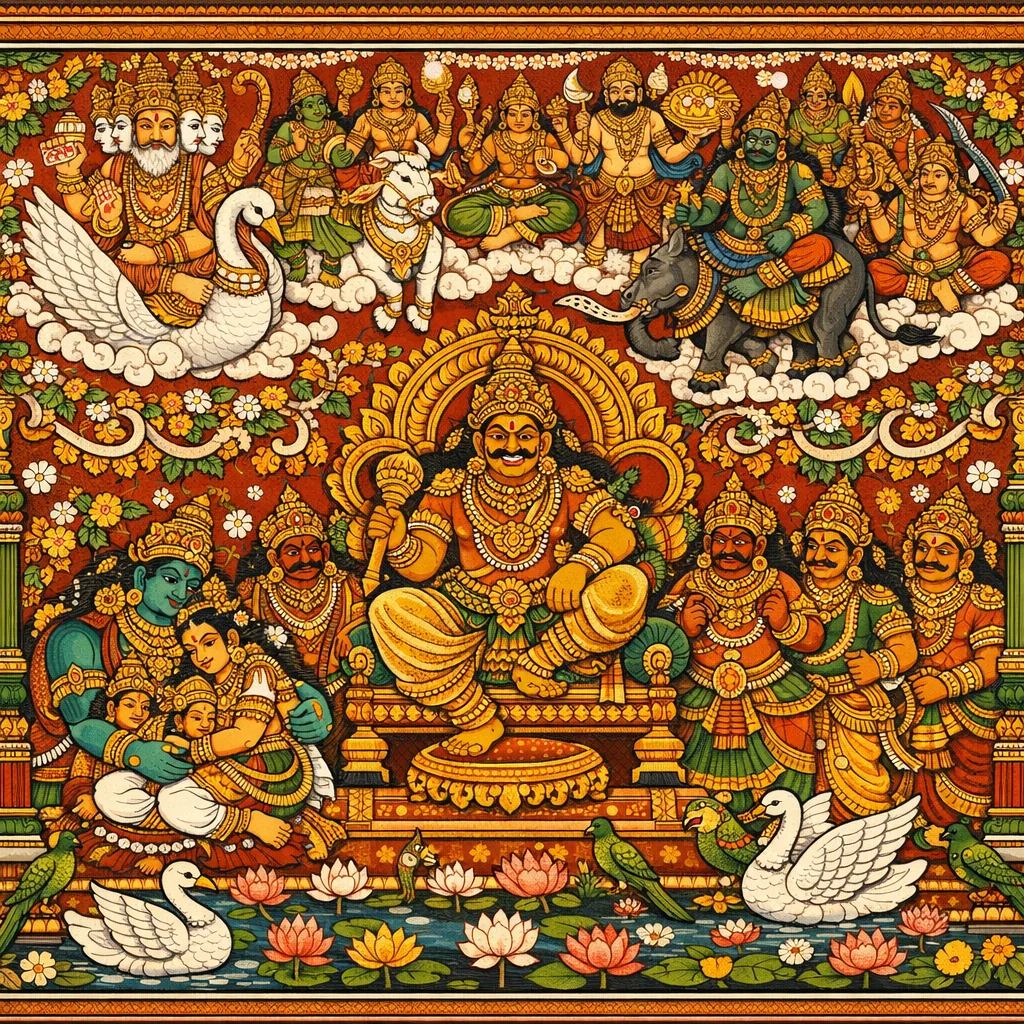
Adhyaya 161: Hiranyakashipu’s Boons, the Gods’ Refuge in Vishnu, and the Splendor of the Daitya Assembly Hall (Prelude to Narasimha)
हिरण्यकशिपोर्वरप्राप्तिः सभावर्णनं च (नरसिंहमाहात्म्यप्रसङ्गः)
Speaker: ऋषयः (Sages), सूत (Sūta), हिरण्यकशिपुः (Hiraṇyakaśipu), ब्रह्मा (Brahmā / Pitāmaha / Prajāpati), देवाः (Gods), विष्णुः (Viṣṇu / Nārāyaṇa / Vāsudeva / Hari)
The sages ask to hear of Hiraṇyakaśipu’s death, Narasiṃha’s greatness, and the power that destroys sin. Sūta recounts Hiraṇyakaśipu’s long tapas, after which Brahmā arrives attended by the gods, the directions, divisions of time, planets, ṛṣis, and celestial beings. The Daitya king petitions for immunity from death by specified agents and conditions, freedom from sages’ curses, and cosmic dominion; Brahmā grants these boons. Alarmed, the gods approach Brahmā, who consoles them that Viṣṇu will slay him when the fruit of his austerity is spent. When Hiraṇyakaśipu oppresses beings and overturns sacrificial order, the gods take refuge in Viṣṇu; Viṣṇu grants fearlessness, bids them reclaim heaven, and resolves upon the Asura’s destruction. The chapter then turns to an extended sabhā-description: a vast, jewel-like aerial assembly hall filled with delights—lakes, tīrthas, birds, perfumed breezes, and long lists of auspicious trees and flowering plants—culminating in the enthroned Daitya king amid attendants and Daitya chiefs.
Key Concepts
Shlokas in Adhyaya 161
Verse 1
*ऋषय ऊचुः इदानीं श्रोतुमिच्छामो हिरण्यकशिपोर्वधम् नरसिंहस्य माहात्म्यं तथा पापविनाशनम् //
The sages said: “Now we wish to hear about the slaying of Hiraṇyakaśipu, the greatness of Narasiṃha, and also that which brings about the destruction of sins.”
Verse 2
*सूत उवाच पुरा कृतयुगे विप्रा हिरण्यकशिपुः प्रभुः दैत्यानामादिपुरुषश् चकार स महत्तपः //
Sūta said: In ancient times, in the Kṛta Yuga, O brāhmaṇas, Hiraṇyakaśipu—the mighty lord, the prime leader among the Daityas—undertook a great austerity.
Verse 3
दश वर्षसहस्राणि दश वर्षशतानि च जलवासी समभवत् स्नानमौनधृतव्रतः //
For ten thousand years, and for a further ten hundred years, he lived dwelling in the waters, observing his vows—maintaining ritual bathing, silence, and steadfast disciplines.
Verse 4
ततः शमदमाभ्यां च ब्रह्मचर्येण चैव हि ब्रह्मा प्रीतो ऽभवत्तस्य तपसा नियमेन च //
Thereafter, through tranquillity and self-restraint, and indeed through the observance of brahmacarya, Brahmā became pleased with him—by his austerity and by his disciplined observances.
Verse 5
ततः स्वयंभूर्भगवान् स्वयमागम्य तत्र ह विमानेनार्कवर्णेन हंसयुक्तेन भास्वता //
Then the Self-born, the Blessed Lord, came there in person—arriving in a brilliant aerial chariot, sun-hued in radiance and drawn by swans.
Verse 6
आदित्यैर्वसुभिः साध्यैर् मरुद्भिर्दैवतैस्तथा रुद्रैर्विश्वसहायैश्च यक्षराक्षसपन्नगैः //
—with the Ādityas, the Vasus, the Sādhyas, the Maruts, and the other divine beings; likewise with the Rudras who aid the worlds, and with the Yakṣas, Rākṣasas, and the serpent-races (Pannagas).
Verse 7
दिग्भिश् चैव विदिग्भिश् च नदीभिः सागरैस्तथा नक्षत्रैश्च मुहूर्तैश्च खेचरैश्च महाग्रहैः //
—with the directions and the intermediate directions; with rivers and likewise with oceans; with the lunar mansions and the divisions of time (muhūrtas); and with the sky-moving bodies and the great planets.
Verse 8
देवैर्ब्रह्मर्षिभिः सार्धं सिद्धैः सप्तर्षिभिस्तथा राजर्षिभिः पुण्यकृद्भिर् गन्धर्वाप्सरसां गणैः //
Together with the gods, with the brahmarṣis, with the siddhas and the seven seers; and likewise with the royal sages—doers of merit—and with the companies of Gandharvas and Apsarases.
Verse 9
चराचरगुरुः श्रीमान् वृतः सर्वैर्दिवौकसैः ब्रह्मा ब्रह्मविदां श्रेष्ठो दैत्यं वचनमब्रवीत् //
Brahmā—the illustrious guru of all moving and unmoving beings, revered by all the gods and foremost among the knowers of Brahman—addressed the Daitya with these words.
Verse 10
प्रीतो ऽस्मि तव भक्तस्य तपसानेन सुव्रत वरं वरय भद्रं ते यथेष्टं काममाप्नुहि //
I am pleased with you—my devotee—by the power of your austerity, O you of noble vows. Choose a boon; blessings to you. Attain whatever desire you wish.
Verse 11
*हिरण्यकशिपुरुवाच न देवासुरगन्धर्वा न यक्षोरगराक्षसाः न मानुषाः पिशाचा वा हन्युर्मां देवसत्तम //
Hiraṇyakaśipu said: “Neither the Devas, nor the Asuras, nor the Gandharvas; neither the Yakṣas, the Nāgas, nor the Rākṣasas; nor even human beings or Piśācas—none of these, O best among the gods, can slay me.”
Verse 12
ऋषयो वा न मां शापैः शपेयुः प्रपितामह यदि मे भगवान्प्रीतो वर एष वृतो मया //
O Great‑Grandfather, if the Blessed Lord is pleased with me, then let this be the boon I have chosen: may the sages not curse me with their imprecations.
Verse 13
न चास्त्रेण न शस्त्रेण गिरिणा पादपेन च न शुष्केण न चार्द्रेण न दिवा न निशाथ वा //
“Neither by a missile nor by a weapon; neither by a mountain nor by a tree; neither by what is dry nor by what is wet; neither by day nor yet by night—(may he be slain) by none of these.”
Verse 14
भवेयमहमेवार्कः सोमो वायुर्हुताशनः सलिलं चान्तरिक्षं च नक्षत्राणि दिशो दश //
“May I alone become the Sun, the Moon, the Wind, and the Fire; the Waters and the Mid-space (atmosphere), the stars, and the ten directions.”
Verse 15
अहं क्रोधश्च कामश्च वरुणो वासवो यमः धनदश्च धनाध्यक्षो यक्षः किंपुरुषाधिपः //
“I am wrath and desire; I am Varuṇa, Vāsava (Indra), and Yama; I am Dhanada (Kubera), the Lord of wealth, the Yakṣa, and the ruler of the Kiṃpuruṣas.”
Verse 16
*ब्रह्मोवाच एते दिव्या वरास्तात मया दत्तास्तवाद्भुताः सर्वान्कामान्सदा वत्स प्राप्स्यसि त्वं न संशयः //
Brahmā said: “O dear one, these wondrous, divine boons have been granted to you by me. You will unfailingly obtain all your desired aims at all times, my child—of this there is no doubt.”
Verse 17
एवमुक्त्वा स भगवाञ् जगामाकाश एव हि वैराजं ब्रह्मसदनं ब्रह्मर्षिगणसेवितम् //
Having spoken thus, the Blessed Lord indeed departed through the sky and went to the Vairāja abode of Brahmā—Brahmā’s celestial hall—attended and served by hosts of Brahmarṣis.
Verse 18
ततो देवाश्च नागाश्च गन्धर्वा ऋषिभिः सह वरप्रदानं श्रुत्वैव पितामहमुपस्थिताः //
Then the gods, the Nāgas, and the Gandharvas—together with the sages—having heard of the granting of the boon, immediately came and presented themselves before Pitāmaha (Brahmā).
Verse 19
वरप्रदानाद्भगवन् वधिष्यति स नो ऽसुरः तत्प्रसीदाशु भगवन् वधो ऽप्यस्य विचिन्त्यताम् //
O Blessed Lord, by the power of the boon that was granted, that asura will slay us. Therefore, be gracious quickly, O Lord—please consider a means for his destruction as well.
Verse 20
भगवन्सर्वभूतानाम् आदिकर्ता स्वयं प्रभुः स्रष्टा त्वं हव्यकव्यानाम् अव्यक्तप्रकृतिर् बुधः //
O Blessed Lord, You alone are the primal maker of all beings, the sovereign by Your own nature. You are the creator even of the offerings—those made into the sacred fire and those presented to the ancestors; the wise know You as the unmanifest primal Nature (the subtle source of creation).
Verse 21
सर्वलोकहितं वाक्यं श्रुत्वा देवः प्रजापतिः आश्वासयामास सुरान् सुशीतैर्वचनाम्बुभिः //
Hearing those words that were for the welfare of all the worlds, the divine Prajāpati comforted the gods, soothing them with the cool waters of his speech.
Verse 22
अवश्यं त्रिदशास्तेन प्राप्तव्यं तपसः फलम् तपसो ऽन्ते ऽस्य भगवान् वधं विष्णुः करिष्यति //
Surely, for this chastiser of the gods, the fruit of his austerities must be attained; yet, at the end of that austerity, the Blessed Lord Vishnu will bring about his death.
Verse 23
तच्छ्रुत्वा विबुधा वाक्यं सर्वे पङ्कजजन्मनः स्वानि स्थानानि दिव्यानि विप्रजग्मुर्मुदान्विताः //
Hearing those words, all the gods—born of the Lotus-born (Brahmā)—joyfully departed to their own divine abodes.
Verse 24
लब्धमात्रे वरे चाथ सर्वाः सो ऽबाधत प्रजाः हिरण्यकशिपुर्दैत्यो वरदानेन दर्पितः //
And as soon as he had obtained the boon, that Daitya Hiraṇyakaśipu—made arrogant by the grant of the boon—began to harass all the creatures (subjects) everywhere.
Verse 25
आश्रमेषु महाभागान् स मुनीञ्छंसितव्रतान् सत्यधर्मपरान्दान्तान् धर्षयामास दानवः //
In the hermitages, that Dānava (demonic being) began to violate and harass the greatly fortunate sages—men of praised vows, devoted to truth and dharma, and self-controlled.
Verse 26
देवांस्त्रिभुवनस्थांश्च पराजित्य महासुरः त्रैलोक्यं वशमानीय स्वर्गे वसति दानवः //
Having defeated the gods who dwelt throughout the three worlds, the mighty Asura brought the entire triad of worlds under his control; the Dānava then took up residence in heaven itself.
Verse 27
यदा वरमदोत्सिक्तश् चोदितः कालधर्मतः यज्ञियानकरोद्दैत्यान् अयज्ञियाश्च देवताः //
When, intoxicated by the pride of a boon, he was driven onward by the law of Time (kāladharma), he made the Daityas fit recipients of sacrifice, and rendered the gods unfit for sacrificial offerings.
Verse 28
तदादित्याश्च साध्याश्च विश्वे च वसवस्तथा सेन्द्रा देवगणा यक्षाः सिद्धद्विजमहर्षयः //
Then (there are) the Ādityas and the Sādhyas; the Viśvedevas and likewise the Vasus; the hosts of gods together with Indra; the Yakṣas; and the Siddhas, the twice-born sages, and the great Ṛṣis.
Verse 29
शरण्यं शरणं विष्णुम् उपतस्थुर्महाबलम् देवदेवं यज्ञमयं वासुदेवं सनातनम् //
Seeking refuge, they approached Vishnu—the mighty one who is the giver of shelter—Vāsudeva, the eternal Lord of lords, whose very essence is sacrifice (Yajña).
Verse 30
*देवा ऊचुः नारायण महाभाग देवास्त्वां शरणं गताः त्रायस्व जहि दैत्येन्द्रं हिरण्यकशिपुं प्रभो //
The gods said: “O Nārāyaṇa, most fortunate Lord! We gods have come to You for refuge. Protect us, O Master—slay Hiraṇyakaśipu, the king of the Daityas.”
Verse 31
त्वं हि नः परमो धाता त्वं हि नः परमो गुरुः त्वं हि नः परमो देवो ब्रह्मादीनां सुरोत्तम //
Indeed, you are our supreme Sustainer; you are our highest Teacher. You are our supreme God—O best among the gods, even above Brahmā and the others.
Verse 32
*विष्णुरुवाच भयं त्यजध्वममरा अभयं वो ददाम्यहम् तथैव त्रिदिवं देवाः प्रतिपद्यत मा चिरम् //
Viṣṇu said: “Cast off your fear, O immortals; I grant you fearlessness. And so, O gods, regain your heaven (the threefold celestial realm) without delay.”
Verse 33
एषो ऽहं सगणं दैत्यं वरदानेन दर्पितम् अवध्यममरेन्द्राणां दानवेन्द्रं निहन्म्यहम् //
“Here am I: I shall slay this Danava-king—this Daitya together with his followers—made arrogant by a boon, and deemed invulnerable even by the lords of the gods.”
Verse 34
एवमुक्त्वा तु भगवान् विसृज्य त्रिदशेश्वरान् वधं संकल्पयामास हिरण्यकशिपोः प्रभुः //
Having spoken thus, the Blessed Lord dismissed the chiefs of the gods, and the Sovereign resolved upon the slaying of Hiraṇyakaśipu.
Verse 35
साहाय्यं च महाबाहुर् ओंकारं गृह्य सत्वरम् अथौंकारसहायस्तु भगवान्विष्णुरव्ययः //
And, O mighty-armed one, swiftly take the syllable Oṃ as your aid; for with Oṃ as his support, the Blessed Lord Viṣṇu—imperishable—(becomes the unfailing helper).
Verse 36
हिरण्यकशिपुस्थानं जगाम हरिरीश्वरः तेजसा भास्कराकारः शशी कान्त्येव चापरः //
Hari, the Supreme Lord, went to the dwelling-place of Hiraṇyakaśipu—radiant like the Sun in his splendor, and like the Moon in his gentle luster as well.
Verse 37
नरस्य कृत्वार्धतनुं सिंहस्यार्धतनुं तथा नारसिंहेन वपुषा पाणिं संस्पृश्य पाणिना //
Fashioning half the body as that of a man and half as that of a lion, (the image) should be made with the Narasiṃha form, with one hand touching (or clasping) the other hand.
Verse 38
ततो ऽपश्यत विस्तीर्णां दिव्यां रम्यां मनोरमाम् सर्वकामयुतां शुभ्रां हिरण्यकशिपोः सभाम् //
Then he beheld the vast assembly-hall of Hiraṇyakaśipu—divine, charming and most delightful, radiant and bright, furnished with every desirable luxury and comfort.
Verse 39
विस्तीर्णां योजनशतं शतमध्यर्धमायताम् वैहायसीं कामगमां पञ्चयोजनविस्तृताम् //
It was spread to a breadth of one hundred yojanas, and its length was a hundred and a half; it was a celestial sky-moving craft, able to go wherever one willed, and had a breadth of five yojanas (in its defined span).
Verse 40
जराशोकक्लमापेतां निष्प्रकम्पां शिवां सुखाम् वेश्महर्म्यवतीं रम्यां ज्वलन्तीमिव तेजसा //
Free from the afflictions of old age, sorrow, and fatigue—steadfast and unshaken—she was auspicious and pleasant, adorned with houses and lofty mansions, delightful to behold, and seeming to blaze with splendor.
Verse 41
अन्तःसलिलसंयुक्तां विहितां विश्वकर्मणा दिव्यरत्नमयैर्वृक्षैः फलपुष्पप्रदैर्युताम् //
Fashioned by Viśvakarman, it was provided with inner water-channels (or pools) and adorned with divine jewel-like trees, bearing and bestowing fruits and blossoms.
Verse 42
नीलपीतसितश्यामैः कृष्णैर्लोहितकैरपि अवतानैस्तथा गुल्मैर् मञ्जरीशतधारिभिः //
With ornaments and arrangements in blue, yellow, white, and dark hues—also in black and red—together with festoons and clustered shrubs, bearing streams of hundreds of flower-bunches.
Verse 43
सिताभ्रघनसंकाशा प्लवन्तीव व्यदृश्यत रश्मिवती भास्वरा च दिव्यगन्धमनोरमा //
She appeared like a dense mass of white clouds, as though floating; radiant with streaming rays, brilliantly luminous, and delightful with a divine fragrance.
Verse 44
सुसुखा न च दुःखा सा न शीता न च घर्मदा न क्षुत्पिपासे ग्लानिं वा प्राप्य तां प्राप्नुवन्ति ते //
That state is wholly blissful and not sorrowful; it brings neither cold nor heat. Having reached it, they experience neither hunger nor thirst, nor any weariness at all.
Verse 45
नानारूपैरुपकृतां विचित्रैरतिभास्वरैः स्तम्भैर्न विभृता सा वै शाश्वती चाक्षपा सदा //
That (structure) is not to be supported by pillars that are made in many different forms—variegated and overly dazzling; for such showy supports do not accord with what is enduring, and they constantly disturb the eye.
Verse 46
अति चन्द्रं च सूर्यं च शिखिनं च स्वयंप्रभा दीप्यते नाकपृष्ठस्था भासयन्तीव भास्करम् //
Abiding on the very surface of heaven, she shines by her own radiance—outshining the moon, the sun, and even fire—seeming, as it were, to illuminate the Sun itself.
Verse 47
सर्वे च कामाः प्रचुरा ये दिव्या ये च मानुषाः रसयुक्तं प्रभूतं च भक्ष्यभोज्यमनन्तकम् //
And there are all desires in abundance—both divine and human; and food and drink of endless variety, rich in taste and plentiful, to be eaten and enjoyed.
Verse 48
पुण्यगन्धस्रजश्चात्र नित्यपुष्पफलद्रुमाः उष्णे शीतानि तोयानि शीते चोष्णानि सन्ति च //
Here there are garlands fragrant with sacred, auspicious perfume, and trees that perpetually bear flowers and fruits. In the hot season the waters are cool, and in the cold season they are warm.
Verse 49
पुष्पिताग्रा महाशाखाः प्रवालाङ्कुरधारिणः लतावितानसंछन्ना नदीषु च सरःसु च //
Great-branched trees, their tips in bloom and bearing reddish tender sprouts, stand covered with vine-canopies—along rivers and around lakes as well.
Verse 50
वृक्षान्बहुविधांस्तत्र मृगेन्द्रो ददृशे प्रभुः गन्धवन्ति च पुष्पाणि रसवन्ति फलानि च //
There the lordly lion among beasts beheld trees of many kinds—flowers rich with fragrance and fruits full of sweet juice.
Verse 51
नातिशीतानि नोष्णानि तत्र तत्र सरांसि च अपश्यत्सर्वतीर्थानि सभायां तस्य स प्रभुः //
There he saw, here and there, lakes whose waters were neither excessively cold nor hot; and that Lord beheld all the sacred fords (tīrthas) while in that assembly hall.
Verse 52
नलिनैः पुण्डरीकैश्च शतपत्त्रैः सुगन्धिभिः रक्तैः कुवलयैर्नीलैः कुमुदैः संवृतानि च //
And they were covered all around with lotuses—nalina and puṇḍarīka—along with fragrant hundred‑petalled blooms, red and blue kuvalayas, and kumuda water‑lilies.
Verse 53
सुकान्तैर्धार्तराष्ट्रैश्च राजहंसैश्च सुप्रियैः कारण्डवैश्चक्रवाकैः सारसैः कुररैरपि //
It is filled with lovely dhārtarāṣṭra geese, with royal swans dear to the eye, and also with kāraṇḍava ducks, cakravāka birds, sārasas (cranes), and kuraras as well.
Verse 54
विमलैः स्फाटिकाभैश्च पाण्डुरच्छदनैर्द्विजैः बहुहंसोपगीतानि सारसाभिरुतानि च //
There, spotless, crystal-bright birds with pale-white plumage are seen; the place resounds with the songs of many swans and with the calls of sarasa-cranes as well.
Verse 55
गन्धवत्यः शुभास्तत्र पुष्टमञ्जरिधारिणीः दृष्टवान्पर्वताग्रेषु नानापुष्पधरा लताः //
There he beheld, upon the mountain-peaks, auspicious creepers rich with fragrance—bearing full, well-nourished clusters of blossoms, and laden with flowers of many kinds.
Verse 56
केतक्यशोकसरलाः पुंनागतिलकार्जुनाः चूता नीपाः प्रस्थपुष्पाः कदम्बा बकुला धवाः //
Ketakī, aśoka, and sarala trees; puṃnāga, tilaka, and arjuna; as well as mango (cūta), nīpa, prastha-puṣpa, kadamba, bakula, and dhava—these are (commended) trees for planting and presence in auspicious sacred and residential precincts.
Verse 57
प्रियङ्गुपाटलावृक्षाः शाल्मल्यः सहरिद्रकाः सालास्तालास्तमालाश्च चम्पकाश्च मनोरमाः //
There were priyaṅgu and pāṭalā trees, śālmali trees along with turmeric-bearing plants; and also sāla, tāla, tamāla, and charming campaka trees—delightful to behold.
Verse 58
तथैवान्ये व्यराजन्त सभायां पुष्पिता द्रुमाः विद्रुमाश्च द्रुमाश्चैव ज्वलिताग्निसमप्रभाः //
Likewise, other trees also shone splendidly within the assembly hall—trees in full blossom, and coral-like trees as well—radiant with a brilliance comparable to blazing fire.
Verse 59
स्कन्धवन्तः सुशाखाश्च बहुतालसमुच्छ्रयाः अञ्जनाशोकवर्णाश्च बहवश्चित्रका द्रुमाः //
There were many trees with massive trunks and fine-spreading branches, rising to the height of many palm-trees, with hues like dark añjana and reddish aśoka—numerous, variegated, and splendid.
Verse 60
वरुणो वत्सनाभश्च पनसाः सह चन्दनैः नीपाः सुमनसश्चैव निम्बा अश्वत्थतिन्दुकाः //
Varuṇa trees, vatsanābha plants, jackfruit trees along with sandalwood, as well as nīpa trees, sumanasa (fragrant flowering trees), neem, the aśvattha (sacred fig), and tinduka are to be included (in the prescribed planting/list of auspicious trees).
Verse 61
पारिजाताश्च लोध्राश्च मल्लिका भद्रदारवः आमलक्यस्तथा जम्बूलकुचाः शैलवालुकाः //
“(These are to be included:) pārijāta and lodhra, mallikā (jasmine) and bhadradāru; likewise āmalakī, and the jambū and lakuca trees, and also the śaila-vālukā variety (a plant/tree associated with rocky or sandy terrain).”
Verse 62
खर्जूर्यो नारिकेलाश्च हरीतकविभीतकाः कालीयका द्रुकालाश्च हिङ्गवः पारियात्रकाः //
Date-palms and coconut trees; harītakī and vibhītaka (the medicinal fruits), kālīyaka (a fragrant wood), drukālā (a kind of tree/wood), asafoetida plants, and the pāriyātraka trees—these are listed (as notable growths/produce).
Verse 63
मन्दारकुन्दलक्ताश्च पतङ्गाः कुटजास्तथा रक्ताः कुरण्टकाश्चैव नीलाश्चागरुभिः सह //
Also (there should be) mandāra, kunda, and laktā plants; likewise pataṅga and kuṭaja; red kuraṇṭaka flowers as well, and blue varieties—together with agaru (aloeswood) trees.
Verse 64
कदम्बाश्चैव भव्याश्च दाडिमा बीजपूरकाः सप्तपर्णाश्च बिल्वाश्च मधुपैरावृतास्तथा //
Kadamba trees, the auspicious bhavya plants, pomegranates, citron trees, saptaparṇa and bilva—these too should be planted, and likewise they should be surrounded with flowering creepers (madhū-latās).
Verse 65
अशोकाश्च तमालाश्च नानागुल्मलतावृताः मधूकाः सप्तपर्णाश्च बहवः क्षीरका द्रुमाः //
There were aśoka trees and tamāla trees, covered all around with many kinds of shrubs and creepers; there were also madhūka and saptaparṇa trees, and many milk-yielding (latex-bearing) trees as well.
Verse 66
लताश्च विविधाकाराः पत्रपुष्पफलोपगाः एते चान्ये च बहवस् तत्र काननजा द्रुमाः //
And there are creepers of many kinds, endowed with leaves, flowers, and fruits; these and many other trees born of the forest are found there in that woodland-grove.
Verse 67
नानापुष्पफलोपेता व्यराजन्त समन्ततः चकोराः शतपत्राश्च मत्तकोकिलसारिकाः //
Abounding in many kinds of flowers and fruits, the whole place shone on every side; there were cakora-birds, lotus-filled waters, and intoxicated (joyful) cuckoos and mynas resounding throughout.
Verse 68
पुष्पिताः पुष्पिताग्रैश्च संपतन्ति महाद्रुमाः रक्तपीतारुणास्तत्र पादपाग्रगताः खगाः //
There the great trees, in full bloom with flower-laden tips, seem to bend down as if descending; and birds—red, yellow, and tawny—perch upon the topmost branches of the trees.
Verse 69
परस्परमवेक्षन्ते प्रहृष्टा जीवजीवकाः तस्यां सभायां दैत्येन्द्रो हिरण्यकशिपुस्तदा //
Delighted, the living beings looked at one another; and at that time, in that assembly-hall, the lord of the Daityas—Hiraṇyakaśipu—was present.
Verse 70
स्त्रीसहस्रैः परिवृतो विचित्राभरणाम्बरः अनर्घ्यमणिवज्रार्चिः शिखाज्वलितकुण्डलः //
Surrounded by a thousand women, he wore wondrous ornaments and garments; he shone with the radiance of priceless jewels and diamonds, and his earrings blazed like a flame at the crest (of his head).
Verse 71
आसीनश्चासने चित्रे दशनल्वप्रमाणतः दिवाकरनिभे दिव्ये दिव्यास्तरणसंस्तृते //
Seated upon a splendidly fashioned throne-seat—measured to the span of ten aṅgulas—radiant like the sun, divine, and spread with heavenly coverings.
Verse 72
दिव्यगन्धवहस्तत्र मारुतः सुसुखो ववौ हिरण्यकशिपुर्दैत्य आस्ते ज्वलितकुण्डलः //
There a gentle, delightful breeze blew, carrying celestial fragrance; and the Daitya Hiraṇyakaśipu sat there, his earrings blazing with splendor.
Verse 73
उपचेरुर्महादैत्यं हिरण्यकशिपुं तदा दिव्यतानेन गीतानि जगुर् गन्धर्वसत्तमाः //
Then the foremost Gandharvas paid court to the great Daitya Hiraṇyakaśipu, singing songs in a celestial melody.
Verse 74
विश्वाची सहजन्या च प्रम्लोचेत्यभिविश्रुता दिव्याथ सौरभेयी च समीची पुञ्जिकस्थली //
Viśvācī, Sahajanyā, and Pramlocā—thus celebrated everywhere—(as well as) Divyā, Saurabheyī, Samīcī, and Puñjikasthalī (are named).
Verse 75
मिश्रकेशी च रम्भा च चित्रलेखा शुचिस्मिता चारुकेशी घृताची च मेनका चोर्वशी तथा //
Miśrakeśī, Rambhā, Citralekhā, Śucismitā, Cārukeśī, Ghṛtācī, Menakā, and likewise Urvaśī—these (celestial nymphs) are named.
Verse 76
एताः सहस्रशश्चान्या नृत्यगीतविशारदाः उपतिष्ठन्ति राजानं हिरण्यकशिपुं प्रभुम् //
And thousands of other women, skilled in dance and song, stand in attendance upon the king—Hiraṇyakaśipu, their lord.
Verse 77
तत्रासीनं महाबाहुं हिरण्यकशिपुं प्रभुम् उपासते दितेः पुत्राः सर्वे लब्धवरास्तथा //
There, seated in state, the mighty-armed lord Hiraṇyakaśipu was attended upon by all the sons of Diti—each of them likewise endowed with boons.
Verse 78
तमप्रतिमकर्माणं शतशो ऽथ सहस्रशः बलिर्विरोचनस्तत्र नरकः पृथिवीसुतः //
There (in that lineage) were Bali, Virocana, and Naraka—the son of the Earth—who performed deeds of like kind, in their hundreds and even thousands.
Verse 79
प्रह्लादो विप्रचित्तिश्च गविष्ठश्च महासुरः सुरहन्ता सुनामा च प्रमतिः सुमतिर्वरः //
Prahlāda, Vipracitti, and Gaviṣṭha—the great Asura—along with Surahantā, Sunāmā, Pramati, and the excellent Sumati: these are (among) the renowned chiefs named in this lineage.
Verse 80
घटोदरो महापार्श्वः क्रथनः पिठरस्तथा विश्वरूपः सुरूपश्च स्वबलश्च महाबलः //
“(He is) Ghaṭodara (the One with a pot-like, capacious belly), Mahāpārśva (of mighty flanks), Krathana (the Crusher), and Piṭhara (the Broad/Expansive); (He is) Viśvarūpa (whose form is the universe), Surūpa (of beautiful form), Svabala (self-powered), and Mahābala (of great strength).”
Verse 81
दशग्रीवश्च वाली च मेघवासा महासुरः घटास्यो ऽकम्पनश्चैव प्रजनश्चेन्द्रतापनः //
Daśagrīva (the Ten-necked one), Vālī, Meghavāsā the great Asura, and also Ghaṭāsya, Akampana, and Prajana—these too were fierce tormentors of Indra.
Verse 82
दैत्यदानवसंघास्ते सर्वे ज्वलितकुण्डलाः स्रग्विणो वाग्मिनः सर्वे सदैव चरितव्रताः //
Those hosts of Daityas and Danavas—all of them—wore blazing earrings; all were garlanded, eloquent in speech, and ever steadfast in the vows and disciplines they had undertaken.
Verse 83
सर्वे लब्धवराः शूराः सर्वे विगतमृत्यवः एते चान्ये च बहवो हिरण्यकशिपुं प्रभुम् //
All were heroes who had obtained boons; all were free from the fear of death. These—and many others besides—(stood aligned with) their lord, Hiraṇyakaśipu.
Verse 84
उपासन्ति महात्मानं सर्वे दिव्यपरिच्छदाः विमानैर्विविधाकारैर् भ्राजमानैरिवाग्निभिः //
All those endowed with divine ornaments and regalia worship that Great Soul, arriving in celestial aerial cars of many forms, blazing like fires.
Verse 85
महेन्द्रवपुषः सर्वे विचित्राङ्गदबाहवः भूषिताङ्गा दितेः पुत्रास् तमुपासन्त सर्वशः //
All the sons of Diti—adorned in their limbs and bearing arms decked with splendid armlets—attended upon him everywhere, taking on the very form and majesty of Mahendra (Indra).
Verse 86
तस्यां सभायां दिव्यायाम् असुराः पर्वतोपमाः हिरण्यवपुषः सर्वे दिवाकरसमप्रभाः //
In that divine assembly-hall, the Asuras—mountain-like in stature—were all golden-bodied, shining with a radiance equal to the sun.
Verse 87
न श्रुतं नैव दृष्टं हि हिरण्यकशिपोर्यथा ऐश्वर्यं दैत्यसिंहस्य यथा तस्य महात्मनः //
Truly, neither has it been heard nor has it been seen—such was the sovereignty of Hiraṇyakaśipu: the lordly power of that “lion among the Daityas,” that great-souled one.
Verse 88
कनकरजतचित्रवेदिकायां परिहृतरत्नविचित्रवीथिकायाम् स ददर्श मृगाधिपः सभायां सुरचितरत्नगवाक्षशोभितायाम् //
In that assembly-hall—whose platforms were adorned with patterns of gold and silver, whose aisles were set apart and richly variegated with gems, and whose windows (gavākṣas) shone with exquisitely inlaid jewels—the lord of beasts (the lion) beheld it all.
Verse 89
कनकविमलहारभूषिताङ्गं दितितनयं स मृगाधिपो ददर्श दिवसकरमहाप्रभाज्वलन्तं दितिजसहस्रशतैर्निषेव्यमाणम् //
The lord of beasts (the lion) beheld a son of Diti—his limbs adorned with a flawless golden garland—blazing with the mighty radiance of the sun, and being attended upon by hundreds of daityas.
Frequently Asked Questions
The chapter teaches that tapas can generate immense worldly power, but that power remains bounded by kāladharma and the preserving intelligence of Viṣṇu. Hiraṇyakaśipu’s boons create an engineered “gap” in ordinary causality, which necessitates an avatāra beyond standard categories. In parallel, the gods’ śaraṇāgati (taking refuge) is shown as the proper dharmic response to cosmic disorder: Viṣṇu, as yajñamaya (the essence of sacrifice and order), restores balance at the destined time.
Dharma is central: the disruption of sacrificial order (daityas becoming yajñiya, devas becoming ayajñiya), tyranny over subjects and sages, and the gods’ appeal to Viṣṇu for protection. Vāstu-related material appears as an extensive architectural-ecological description of the Daitya sabhā: dimensions, comfort-conditions (no hunger/thirst/fatigue), aesthetic cautions (avoid overly dazzling, distracting pillars), water features, tīrtha imagery, and long catalogues of auspicious trees and flowering plants suitable for sacred/residential precincts. Genealogical elements appear in the naming of prominent Daityas/Dānavas and associated figures attending Hiraṇyakaśipu.
While framed as narrative, it contains Vāstu-adjacent guidance through descriptive norms: the sabhā is presented as auspicious, stable, and visually pleasing; it explicitly criticizes excessively variegated, overly dazzling pillar-forms that ‘disturb the eye,’ implying a principle of enduring aesthetics (śāśvata) over showiness. It also provides an unusually rich planting canon—trees and creepers associated with auspicious precincts—useful for reconstructing Purāṇic landscape ideals.
The chapter lists many auspicious trees/plants including ketakī, aśoka, sarala, puṃnāga, tilaka, arjuna, mango (cūta), nīpa, kadamba, bakula, dhava, priyaṅgu, pāṭalā, śālmali, sāla, tāla, tamāla, campaka, varuṇa, jackfruit (panasa), sandalwood, sumanasa, neem (nimba), aśvattha, tinduka, pārijāta, lodhra, mallikā, bhadradāru, āmalakī, jambū, lakuca, kharjūrī (date palm), nārikela (coconut), harītakī, vibhītaka, agaru, bilva, saptaparṇa, dāḍima (pomegranate), and bījapūraka (citron), along with flowering creepers.
Adhyaya 161 functions as the setup: it establishes the boons that make Hiraṇyakaśipu ‘un-killable’ by ordinary agents and times, shows his oppression and inversion of sacrificial order, and records Viṣṇu’s vow to kill him. It also introduces the Narasiṃha form explicitly (half-man, half-lion), preparing the theological logic for how Viṣṇu will bypass the boon-conditions in the forthcoming slaying narrative.