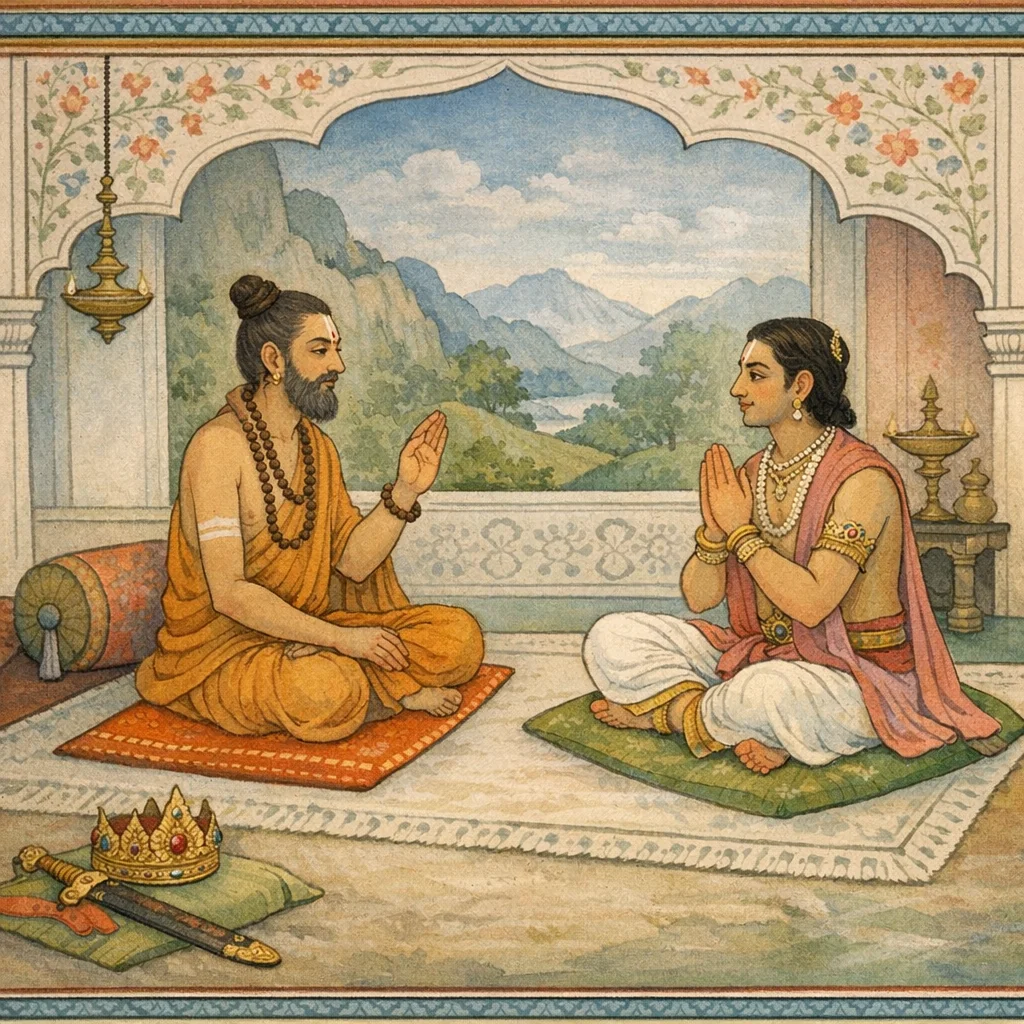
Adhyaya 7
अविद्याबीज-निरूपणं, योगस्वरूप-उपदेशः, मूर्तहरिधारणा-समाधि, जनकवंशीय-राजर्षिसंवादः
Parāśara continues his teaching to Maitreya by citing the rajarṣis of the Janaka/Nimi line, showing the difference between craving for kingship and true vairāgya (dispassion). In the dialogue of Keśidhvaja and Khāṇḍikya, kṣatriya-dharma—protecting the people and fighting righteous war—is affirmed, yet attachment to rule through “mine-ness” (mamatva) is declared a cause of bondage, and dispassion is praised. He then defines the twofold seed of avidyā: taking the non-Self as the Self, and regarding what is not one’s own as “I/mine”; through the body’s relation to the five elements the “I–mine” delusion arises, and is washed away by the warm water of knowledge that cleanses the dust of latent tendencies. Yoga is taught as the means to free the mind: the sequence of yama, niyama, āsana, prāṇāyāma, pratyāhāra, and so on; Brahman is presented as both with form and without form, and dhāraṇā on Hari as the Viśvarūpa is described. Finally, meditation proceeds from the formed image to contemplation without weapons and ornaments, to one-pointedness on the limbs, the marks of dhyāna and samādhi, and—when ignorance is destroyed—the realization of non-difference leading to mokṣa. Khāṇḍikya attains yogic perfection in the forest, while Keśidhvaja gains perfection through desireless action and the prior exhaustion of karma.
Shlokas
Verse 1
न प्रार्थितं त्वया कस्मान् मम राज्यम् अकण्टकम् राज्यलाभाद् विना नान्यत् क्षत्रियाणाम् अतिप्रियम्
Why did you not ask me for my kingdom—whole and untroubled, free from any thorn of opposition? For to kṣatriyas, nothing is so exceedingly dear as the gaining of sovereignty.
Verse 2
केशिध्वज निबोध त्वं मया न प्रार्थितं यतः राज्यम् एतद् अशेषं ते यत्र गृध्नन्त्य् अपण्डिताः
O Keśidhvaja, understand this: I did not seek your kingdom at all—for this entire sovereignty of yours is precisely the thing after which the unwise, driven by craving, greedily run.
Verse 3
क्षत्रियाणाम् अयं धर्मो यत् प्रजापरिपालनम् वधश् च धर्मयुद्धेन स्वराज्यपरिपन्थिनाम्
This is the sacred duty of the Kshatriyas: to protect and rightly govern the people, and—through righteous warfare—to subdue those who obstruct the realm’s lawful sovereignty.
Verse 4
यत्राशक्तस्य मे दोषो नैवास्त्य् अपहृते त्वया बन्धायैव भवत्य् एषा अविद्याप्य् अक्रमोज्झिता
In that matter, I—being powerless—incur no fault, once you have taken it away. Yet this ignorance, though removed in due order, still becomes a cause of bondage alone.
Verse 5
जन्मोपभोगलिप्सार्थम् इयं राज्यस्पृहा मम अन्येषां दोषजा नैव धर्मम् एवानुरुध्यते
This longing of mine for sovereignty arises only from the craving to enjoy the pleasures of embodied life; it is not, like the ambitions of others born of fault, something that follows after dharma.
Verse 7
राज्ये गृध्नन्त्य् अविद्वांसो ममत्वाहृतचेतसः अहंमानमहापानमदमत्ता न मादृशाः
It is the unwise who hunger for dominion—minds stolen away by possessiveness. Drunk on the great draught of ‘I’-ness and pride, they reel in the intoxication of power; but those like me do not become so.
Verse 8
ततः प्रहृष्टः साध्व् इति प्राह केशिध्वजो नृपः खाण्डिक्यजनकं प्रीत्या श्रूयतां वचनं मम
Then King Keśidhvaja, delighted, said, “Well spoken!” And with affection he addressed Khāṇḍikya-Janaka: “Now, please listen to my words.”
Verse 9
अहम् अविद्यया मृत्युं तर्तुकामः करोमि वै राज्यं यागांश् च विविधान् भोगैः पुण्यक्षयं तथा
Blinded by ignorance, I sought to cross over death; and so I pursued kingship, performed many kinds of sacrifices, and indulged in enjoyments—only to bring about the wasting away of my accumulated merit.
Verse 10
तद् इदं ते मनो दिष्ट्या विवेकैश्वर्यतां गतम् श्रूयतां चाप्य् अविद्यायाः स्वरूपं कुलनन्दन
Blessed indeed is this: your mind has, by good fortune, attained the sovereign power of discernment. Now then, O joy of your lineage, listen as well to the true nature of avidyā—ignorance itself.
Verse 11
अनात्मन्य् आत्मबुद्धिर् या अस्वे स्वम् इति या मतिः अविद्यातरुसंभूतिबीजम् एतद् द्विधा स्थितम्
The delusion that sees the Self in what is not the Self, and the notion that claims as “mine” what is not one’s own—this is the seed of the tree of ignorance, abiding in a twofold form.
Verse 12
पञ्चभूतात्मके देहे देही मोहतमोवृतः अहम् एतद् इतीत्य् उच्चैः कुरुते कुमतिर् मतिम्
Shrouded in the thick darkness of delusion, the indwelling self fixes its thought upon the body made of the five elements and loudly declares, “I am this; this is mine,” thus forming a misguided conviction.
Verse 13
आकाशवाय्वग्निजलपृथिवीभ्यः पृथक् स्थिते आत्मन्य् आत्ममयं भावं कः करोति कलेवरे
When the Self stands apart, distinct from ether, wind, fire, water, and earth, who within this body can truly fashion the sense “I am this,” the identification with the corporeal frame?
Verse 14
कलेवरोपभोग्यं हि गृहक्षेत्रादिकं च कः अदेहे ह्य् आत्मनि प्राज्ञो ममेदम् इति मन्यते
House, field, and such possessions are only things to be enjoyed by the body; who, being truly wise, would think of the bodiless Self, “This is mine”?
Verse 15
इत्थं च पुत्रपौत्रेषु तद्देहोत्पादितेषु कः करोति पण्डितः स्वाम्यम् अनात्मनि कलेवरे
Thus, even regarding sons and grandsons—born from this very body—what wise person would claim ownership over this corpse-like frame that is not the Self?
Verse 16
सर्वं देहोपभोगाय कुरुते कर्म मानवः देहश् चान्यो यदा पुंसस् तदा बन्धाय तत्परम्
A man performs every deed for the enjoyment of the body; but when he takes the body itself as “I,” that very pursuit turns wholly toward bondage.
Verse 17
मृण्मयं हि यथा गेहं लिप्यते वै मृदम्भसा पार्थिवो ऽयं तथा देहो मृदम्भोलेपनस्थितिः
As a house of clay is plastered with a mixture of earth and water, so this body, made of earth, stands only by that same coating and support of mud and water.
Verse 18
पञ्चभूतात्मकैर् भोगैः पञ्चभूतात्मकं वपुः आप्यायते यदि ततः पुंसो गर्वो ऽत्र किं कृतः
If, by enjoyments made of the five great elements, a body likewise made of those five is merely nourished and fattened, what is there in this for a man to be proud of?
Verse 19
अनेकजन्मसाहस्रीं संसारपदवीं व्रजन् मोहश्रमं प्रयातो ऽसौ वासनारेणुगुण्ठितः
Wandering the road of saṃsāra through thousands upon thousands of births, he grows weary with the toil of delusion, his being veiled by the dust of latent tendencies (vāsanās).
Verse 20
प्रक्षाल्यते यदा सो ऽस्य रेणुर् ज्ञानोष्णवारिणा तदा संसारपान्थस्य याति मोहश्रमः शमम्
When the dust clinging to him is washed away by the warm water of true knowledge, then the weary toil of delusion borne by the traveller on the road of saṃsāra comes to rest.
Verse 21
मोहश्रमे शमं याते स्वस्थान्तःकरणः पुमान् अनन्यातिशयाबाधं परं निर्वाणम् ऋच्छति
When the weariness born of delusion is stilled, the person whose inner instrument has become steady attains the supreme nirvāṇa—unobstructed, unsurpassed, and untroubled by anything else.
Verse 22
निर्वाणमय एवायम् आत्मा ज्ञानमयो ऽमलः दुःखाज्ञानमला धर्माः प्रकृतेस् ते तु नात्मनः
This Self is truly of the nature of nirvāṇa—made of consciousness, pure and stainless. The states tainted by sorrow and ignorance belong to Prakṛti alone; they are not attributes of the Ātman.
Verse 23
जलस्य नाग्निसंसर्गः स्थालीसङ्गात् तथापि हि शब्दोद्रेकादिकान् धर्मांस् तत् करोति यथा मुने
Water has no direct contact with fire; yet, through association with the pot, it comes to display properties such as an increase of sound and the like—just so, O sage.
Verse 24
तथात्मा प्रकृतेः सङ्गाद् अहंमानादिदूषितः भजते प्राकृतान् धर्मान् अन्यस् तेभ्यो हि सो ऽव्ययः
Thus the embodied self, through association with Prakṛti, becomes tainted by ego-sense and its distortions, and so takes up the qualities and duties of material nature. Yet in truth it is other than these, for that Self is imperishable.
Verse 25
तद् एतत् कथितं बीजम् अविद्याया मया तव क्लेशानां च क्षयकरं योगाद् अन्यन् न विद्यते
Thus have I explained to you that very seed of ignorance; and for the wearing away of the afflictions there is nothing to be known as equal to Yoga—no other means exists apart from it.
Verse 26
तं ब्रवीहि महाभाग योगं योगविदुत्तम विज्ञातयोगशास्त्रार्थस् त्वम् अस्यां निमिसंततौ
O greatly fortunate one, supreme among the knowers of Yoga, declare that Yoga to me. You have truly understood the purport of the Yoga-śāstras, and in this lineage of Nimi you stand as a master of that wisdom.
Verse 27
योगस्वरूपं खाण्डिक्य श्रूयतां गदतो मम यत्र स्थितो न च्यवते प्राप्य ब्रह्मलयं मुनिः
O Khāṇḍikya, hear from me as I speak of the very nature of Yoga—that state in which, once established, the sage does not fall away, having attained absorption into Brahman (brahma-laya).
Verse 28
मन एव मनुष्याणां कारणं बन्धमोक्षयोः बन्धस्य विषयासङ्गि मुक्तेर् निर्विषयं तथा
Mind alone is the cause, for human beings, of both bondage and liberation. When it clings to objects of sense it becomes the maker of bondage; when it is free from objects, that very mind becomes the means of release.
Verse 29
विषयेभ्यः समाहृत्य विज्ञानात्मा मनो मुनिः चिन्तयेन् मुक्तये तेन ब्रह्मभूतं परेश्वरम्
Having withdrawn the mind from all sense-objects, the sage—whose inner nature is true discernment—should contemplate, for the sake of liberation, that Supreme Lord who is realized as Brahman.
Verse 30
आत्मभावं नयत्य् एनं तद् ब्रह्मध्यायिनं मुने विकार्यम् आत्मनः शक्त्या लोहम् आकर्षको यथा
O sage, that Supreme Brahman draws the meditator upon Brahman into Its own state of being—transforming him by Its power—just as a magnet draws iron to itself.
Verse 31
आत्मप्रयत्नसापेक्षा विशिष्टा या मनोगतिः तस्या ब्रह्मणि संयोगो योग इत्य् अभिधीयते
That distinctive movement of the mind, dependent upon one’s own disciplined effort—its joining (saṃyoga) with Brahman—is what is called “Yoga.”
Verse 32
एवम् अत्यन्तवैशिष्ट्ययुक्तधर्मोपलक्षणः यस्य योगः स वै योगी मुमुक्षुर् अभिधीयते
Thus, one whose yoga is marked by dharma, endowed with the most excellent distinguishing signs, is indeed called a yogin—a true mumukṣu, intent on liberation.
Verse 33
योगयुक् प्रथमं योगी युञ्जमानो ऽभिधीयते विनिष्पन्नसमाधिस् तु परब्रह्मोपलब्धिमान्
At first, the yogin is called “yoga-yukta” while he is still applying himself, striving to yoke the mind to discipline. But when his samādhi fully matures and is perfected, he attains direct realization of the Supreme Brahman.
Verse 34
यद्य् अन्तरायदोषेण दूष्यते चास्य मानसम् जन्मान्तरैर् अभ्यसतो मुक्तिः पूर्वस्य जायते
Even if, through the fault of intervening obstacles, a seeker’s mind becomes tainted, liberation still arises from the former practice; for that discipline, cultivated and resumed across successive births, ripens at last into release.
Verse 35
विनिष्पन्नसमाधिस् तु मुक्तिं तत्रैव जन्मनि प्राप्नोति योगी योगाग्निदग्धकर्मचयो ऽचिरात्
But the yogin whose samādhi has fully matured attains liberation in that very same birth; for, with the fire of yoga, the accumulated mass of his past actions is swiftly burned away.
Verse 36
ब्रह्मचर्यम् अहिंसां च सत्यास्तेयापरिग्रहान् सेवेत योगी निष्कामो योग्यतां स्वमनो नयन्
Let the yogin, free from craving, practice brahmacarya, non-violence, truth, non-stealing, and non-possessiveness; thus guiding his own mind toward fitness for Yoga, he becomes ready for inner union.
Verse 37
स्वाध्यायशौचसंतोषतपांसि नियतात्मवान् कुर्वीत ब्रह्मणि तथा परस्मिन् प्रवणं मनः
Let the self-controlled one practice sacred study, purity, contentment, and austerity; and let his mind incline again and again toward Parabrahman, the Supreme Reality.
Verse 38
एते यमाः सनियमाः पञ्च पञ्च प्रकीर्तिताः विशिष्टफलदाः काम्या निष्कामानां विमुक्तिदाः
Thus the five yamas, together with the five niyamas, have been declared. Pursued with desire they grant specific results; but for those who practice without selfish craving, they become givers of liberation.
Verse 39
एकं भद्रासनादीनां समास्थाय गुणैर् युतः यमाख्यैर् नियमाख्यैश् च युञ्जीत नियतो यतिः
Having firmly assumed one posture—such as bhadrāsana and the like—endowed with the virtues called yama and niyama, the disciplined ascetic should apply himself to Yoga with unwavering restraint.
Verse 40
प्राणाख्यम् अनिलं वश्यम् अभ्यासात् कुरुते तु यत् प्राणायामः स विज्ञेयः सबीजो ऽबीज एव च
That discipline by which, through sustained practice, the wind called prāṇa is brought under mastery is known as prāṇāyāma; and it is taught in two modes—“with seed” and “seedless.”
Verse 41
परस्परेणाभिभवं प्राणापानौ यदानिलौ कुरुतः स द्विधानेन तृतीयः संयमात् तयोः
When the two winds, prāṇa and apāna, alternately overpower one another, then by this twofold regulation a third movement arises, born of the restraint (saṃyama) of them both.
Verse 42
तस्य चालम्बनवतः स्थूलरूपं द्विजोत्तम आलम्बनम् अनन्तस्य योगिनो ऽभ्यसतः स्मृतम्
For the yogin who practices meditation with a support, O best of the twice-born, the Lord Ananta’s tangible, manifest form is remembered as that very support for steady contemplation of the Infinite.
Verse 43
शब्दादिष्व् अनुरक्तानि निगृह्याक्षाणि योगवित् कुर्याच् चित्तानुकारीणि प्रत्याहारपरायणः
The knower of Yoga, devoted to pratyāhāra, should restrain the senses that cling to sound and the rest, and make them obedient to the mind, moving only by its inward command.
Verse 44
वश्यता परमा तेन जायते ऽतिचलात्मनाम् इन्द्रियाणाम् अवश्यैस् तैर् न योगी योगसाधकः
From that disciplined practice arises the highest mastery over the senses, whose nature is restless and ever-wandering; but one who is helpless before those ungoverned senses is not a yogin, nor even a true seeker of yoga.
Verse 45
प्राणायामेन पवनैः प्रत्याहारेण चेन्द्रियैः वशीकृतैस् ततः कुर्यात् स्थितं चेतः शुभाश्रये
Having mastered the currents of the life-breath through prāṇāyāma and restrained the senses by pratyāhāra, one should then establish the mind in steady poise, resting it upon the auspicious refuge—the Supreme.
Verse 46
कथ्यतां मे महाभाग चेतसो यः शुभाश्रयः यदाधारम् अशेषं तद् धन्ति दोषसमुद्भवम्
Tell me, O greatly blessed one: what is that auspicious refuge of the mind, upon which—when the whole being is firmly established—the arising of faults and impurities is struck down?
Verse 47
आश्रयश् चेतसो ब्रह्म द्विधा तच् च स्वरूपतः भूप मूर्तम् अमूर्तं च परं चापरम् एव च
Brahman is the very support on which the mind rests; and, O king, in its essential nature it is spoken of as twofold—both with form and without form, both supreme (para) and also the lower, accessible aspect (apara).
Verse 48
त्रिविधा भावना भूप विश्वम् एतन् निबोधताम् ब्रह्माख्या कर्मसंज्ञा च तथा चैवोभयात्मिका
O King, know that this entire universe is upheld through a threefold bhāvanā: one called Brahman, one designated as karma, and a third that partakes of both natures together.
Verse 49
कर्मभावात्मिका ह्य् एका ब्रह्मभावात्मिकापरा उभयात्मिका तथैवान्या त्रिविधा भावभावना
Indeed, this cultivating bhāvanā is threefold: one oriented to the spirit of action (karma-bhāva), another oriented to the spirit of Brahman (brahma-bhāva), and yet another of dual nature, embracing both together.
Verse 50
सनन्दनादयो ब्रह्मभावभावनया युताः कर्मभावनया चान्ये देवाद्याः स्थावराश् चराः
Sanandana and the other mind-born sages are absorbed in the bhāvanā of Brahman; others—beginning with the gods—are shaped by bhāvanā oriented toward action. Thus all beings, immovable and moving, stand differentiated according to the dominant tendency that fashions their nature.
Verse 51
हिरण्यगर्भादिषु च ब्रह्मकर्मात्मिका द्विधा अधिकारबोधयुक्तेषु विद्यते भावभावना
In Hiraṇyagarbha (Brahmā) and the like, there arises a twofold power of contemplation, taking the form of Brahmā’s cosmic activity; in those whose understanding of their rightful sphere is awakened, it fashions and sustains the dispositions and states of being.
Verse 52
अक्षीणेषु समस्तेषु विशेषज्ञानकर्मसु विश्वम् एतत् परं चान्यद् भेदभिन्नदृशां नृप
O King, so long as all particularized knowledges and their corresponding actions remain unexhausted, this entire universe—and even what is called “the beyond”—appears divided and distinct to those whose vision is split by difference.
Verse 53
प्रत्यस्तमितभेदं यत् सत्तामात्रम् अगोचरम् वचसाम् आत्मसंवेद्यं तज् ज्ञानं ब्रह्मसंज्ञितम्
That knowledge in which all distinctions have subsided—pure Being alone, beyond the reach of words, directly realized within the Self—this is what is designated as Brahman.
Verse 54
तच् च विष्णोः परं रूपम् अरूपस्याजम् अक्षरम् विश्वस्वरूपवैरूप्यलक्षणं परमात्मनः
And that indeed is Viṣṇu’s supreme form: for the Formless One it is beyond form—unborn, imperishable; the mark of the Supreme Self is this, that He is characterized as the universe in its manifest appearance and in its transcendent unmanifestness.
Verse 55
न तद् योगयुजा शक्यं नृप चिन्तयितुं यतः ततः स्थूलं हरे रूपं चिन्तयेद् विश्वगोचरम्
O King, since that subtle formless reality cannot be contemplated by one still harnessed to the discipline of yoga, let him instead meditate upon Lord Hari in a tangible, manifest form—accessible to the mind and supporting the whole universe.
Verse 56
हिरण्यगर्भो भगवान् वासवो ऽथ प्रजापतिः मरुतो वसवो रुद्रा भास्करास् तारका ग्रहाः
From Him arise Hiraṇyagarbha, the Blessed Lord, and Vāsava (Indra) and Prajāpati. From Him also proceed the Maruts, the Vasus, the Rudras—the radiant Suns, the stars, and the planets.
Verse 57
गन्धर्वयक्षदैत्याद्याः सकला देवयोनयः मनुष्याः पशवः शैलाः समुद्राः सरितो द्रुमाः
Gandharvas, Yakṣas, Daityas, and all other divine-born orders; humans and animals; mountains, oceans, rivers, and trees—all are encompassed within the manifested world.
Verse 58
भूप भूतान्य् अशेषाणि भूतानां ये च हेतवः प्रधानादिविशेषान्तं चेतनाचेतनात्मकम्
O King, all beings without remainder—and also the causes from which beings arise—extending from Pradhāna to the last particularized forms: all this is of the nature of both the conscious and the non-conscious.
Verse 59
एकपादं द्विपादं च बहुपादम् अपादकम् मूर्तम् एतद् धरे रूपं भावनात्रितयात्मकम्
O Dhara, this is the manifest form: contemplated as one-footed, two-footed, many-footed, and even footless—this embodied appearance is understood through the triad of contemplations.
Verse 60
एतत् सर्वम् इदं विश्वं जगद् एतच् चराचरम् परब्रह्मस्वरूपस्य विष्णोः शक्तिसमन्वितम्
All this—this entire universe, this world of the moving and the unmoving—exists as the śakti-endowed manifestation of Lord Viṣṇu, whose very nature is the Supreme Brahman.
Verse 61
विष्णुशक्तिः परा प्रोक्ता क्षेत्रज्ञाख्या तथापरा अविद्या कर्मसंज्ञान्या तृतीया शक्तिर् इष्यते
The śakti of Viṣṇu is declared supreme; and there is another power called the Kṣetrajña—the indwelling Knower. A third power is acknowledged: avidyā, also named karma, by which bondage and the becoming of saṃsāra are explained.
Verse 62
यया क्षेत्रज्ञशक्तिः सा वेष्टिता नृप सर्वगा संसारतापान् अखिलान् अवाप्नोत्य् अतिसंततान्
O King, when that all-pervading power of the Kṣetrajña is enveloped by coverings, it comes to experience in full all the torments of saṃsāra, endlessly multiplied through the round of transmigration.
Verse 63
तया तिरोहितत्वाच् च शक्तिः क्षेत्रज्ञसंज्ञिता सर्वभूतेषु भूपाल तारतम्येन लक्ष्यते
And because it is veiled by that covering power, the energy known as the Kṣetrajña—the conscious Knower—is perceived in all beings, O King, only in graded degrees.
Verse 64
अप्राणवत्सु स्वल्पाल्पा स्थावरेषु ततो ऽधिका सरीसृपेषु तेभ्यो ऽन्याप्य् अतिशक्त्या पतत्त्रिषु
In those without vital breath the potency is exceedingly slight; in immobile beings it is greater; in creeping creatures greater still; and beyond them, in birds, it manifests with yet more extraordinary power.
Verse 65
पतत्त्रिभ्यो मृगास् तेभ्यस् तच्छक्त्या पशवो ऽधिकाः पशुभ्यो मनुजाश् चापि शक्त्या पुंसः प्रभाविताः
Beyond the birds are the deer; beyond them, by that same measure of potency, are the beasts that surpass them. Beyond the beasts, too, are human beings—made eminent through the power that belongs to the human state.
Verse 66
तेभ्यो ऽपि नागगन्धर्वयक्षाद्या देवता नृप
O King, even above them are the divine classes such as the Nāgas, Gandharvas, Yakṣas, and others.
Verse 67
शक्रः समस्तदेवेभ्यस् ततश् चापि प्रजापतिः हिरण्यगर्भो ऽपि ततः पुंसः शक्त्युपलक्षितः
Śakra (Indra) is foremost among all the gods; beyond him is Prajāpati; and beyond even Prajāpati is Hiraṇyagarbha. Yet all of these are but marks—distinguishing manifestations—of the one Supreme Person, known through His powers.
Verse 68
एतान्य् अशेषरूपाणि तस्य रूपाणि पार्थिव यतस् तच्छक्तियोगेन युक्तानि नभसा यथा
O King, all these—endless in variety—are indeed His forms; for they are joined to Him through the union of His own powers, just as all things are held together and sustained by the sky.
Verse 69
द्वितीयं विष्णुसंज्ञस्य योगिध्येयं महामते अमूर्तं ब्रह्मणो रूपं यत् सद् इत्य् उच्यते बुधैः
O great-minded one, the second aspect of Him who is known as Vishnu—fit to be contemplated by yogins—is the formless reality of Brahman, that which the wise declare to be “Sat,” pure Being.
Verse 70
समस्ताः शक्तयश् चैता नृप यत्र प्रतिष्ठिताः तद् विश्वरूपरूपं वै रूपम् अन्यद् धरेर् महत्
O King, that in which all these powers are firmly established—know that to be the Universal Form itself: another, vast and majestic manifestation of Hari.
Verse 71
समस्तशक्तिरूपाणि तत् करोति जनेश्वर देवतिर्यङ्मनुष्यादिचेष्टावन्ति स्वलीलया
O Lord of beings, He assumes the forms of all powers and, by His own divine līlā, sets the gods, animals, humans, and all others in motion in their respective functions.
Verse 72
जगताम् उपकाराय न सा कर्मनिमित्तजा चेष्टा तस्याप्रमेयस्य व्यापिन्य् अव्याहतात्मिका
For the welfare of all worlds, His activity is not born of karma as a motive; it is the action of the immeasurable Lord—all-pervading, unobstructed, and free by nature.
Verse 73
तद् रूपं विश्वरूपस्य तस्य योगयुजा नृप चिन्त्यम् आत्मविशुद्ध्यर्थं सर्वकिल्बिषनाशनम्
O King, that very form of Him—the Universal Form (Viśvarūpa)—is to be contemplated by the disciplined yogin for inner purification; it destroys every stain of sin.
Verse 74
यथाग्निर् उद्धतशिखः कक्षं दहति सानिलः तथा चित्तस्थितो विष्णुर् योगिनां सर्वकिल्बिषम्
As a fire with leaping flames, fanned by the wind, burns up dry brushwood, so Vishnu—when established within the mind—consumes every taint and sin of the yogins.
Verse 75
तस्मात् समस्तशक्तीनाम् आधारे तत्र चेतसः कुर्वीत संस्थितिं सा तु विज्ञेया शुद्धधारणा
Therefore, fixing the mind steadily upon That which is the support of all powers, one should establish unwavering concentration there; this is to be understood as pure dhāraṇā.
Verse 76
शुभाश्रयः स चित्तस्य सर्वगस्य तथात्मनः त्रिभावभावनातीतो मुक्तये योगिनां नृप
O King, He is the auspicious refuge of the mind—the all-pervading One, the very Self; beyond contemplation of the three states, He is the means of liberation for yogins.
Verse 77
अन्ये तु पुरुषव्याघ्र चेतसो ये व्यपाश्रयाः अशुद्धास् ते समस्तास् तु देवाद्याः कर्मयोनयः
But, O tiger among men, all others who take the mind itself as their refuge remain unpurified; beginning even with the gods, all such beings are births that arise from karma.
Verse 78
मूर्तं भगवतो रूपं सर्वापाश्रयनिःस्पृहम् एषा वै धारणा प्रोक्ता यच् चित्तं तत्र धार्यते
The manifest form of Bhagavān—though the support of all—remains untouched by any dependence. This is declared to be dhāraṇā: that in which the mind is steadily held and fixed.
Verse 79
तच् च मूर्तं हरे रूपं यादृक् चिन्त्यं नराधिप तच् छ्रूयताम् अनाधारे धारणा नोपपद्यते
And now, O lord of men, hear what that embodied form of Hari is—how it is to be contemplated; for without a support, dhāraṇā cannot truly arise.
Verse 80
प्रसन्नचारुवदनं पद्मपत्त्रोपमेक्षणम् सुकपोलं सुविस्तीर्णललाटफलकोज्ज्वलम्
His face was serene and exquisitely beautiful; his eyes were like lotus-petals. His cheeks were comely, and his broad forehead shone with a clear, pure radiance.
Verse 81
समकर्णान्तविन्यस्तचारुकर्णविभूषणम् कम्बुग्रीवं सुविस्तीर्णश्रीवत्साङ्कितवक्षसम्
His lovely ear-ornaments rest evenly to the very ends of His ears; His neck is conch-shaped, and His broad chest bears the mark of Śrīvatsa—revealing the sovereign, auspicious form of the Supreme Lord.
Verse 82
वलीत्रिभङ्गिना मग्ननाभिना चोदरेण वै प्रलम्बाष्टभुजं विष्णुम् अथवापि चतुर्भुजम्
One should contemplate Viṣṇu—slender and gracefully triple-bent, with a deep-set navel and a gently rounded belly—either as the majestic, long-limbed Lord with eight arms, or else as the four-armed Supreme.
Verse 83
समस्थितोरुजङ्घं च सुस्थिताङ्घ्रिकराम्बुजम् चिन्तयेद् ब्रह्मभूतं तं पीतनिर्मलवाससम्
Let the meditator contemplate Him whose thighs and shanks are poised in perfect symmetry; whose lotus-feet are set firm and serene—Him who is Brahman made manifest, clothed in spotless yellow raiment.
Verse 84
किरीटचारुकेयूरकटकादिविभूषितम्
Adorned with a splendid crown, beautiful armlets, bracelets, and other radiant ornaments.
Verse 86
तावद् यावद् दृढीभूता तत्रैव नृप धारणा व्रजतस् तिष्ठतो ऽन्यद् वा स्वेच्छया कर्म कुर्वतः नापयाति यदा चित्तात् सिद्धां मन्येत तां तदा
O King, one should persist in that very practice of concentration (dhāraṇā) until it becomes firm. When, whether walking, standing, or engaging in any other action by one’s own choice, it does not depart from the mind—then it should be regarded as accomplished.
Verse 87
ततः शङ्खगदाचक्रशार्ङ्गादिरहितं बुधः चिन्तयेद् भगवद्रूपं प्रशान्तं साक्षसूत्रकम्
Thereafter, the wise one should contemplate the form of Bhagavān—utterly tranquil—free from conch, mace, discus, and the Śārṅga bow and the like, bearing only the sacred thread as the immediate sign of His serene supremacy.
Verse 88
सा यदा धारणा तद्वद् अवस्थानवती ततः किरीटकेयूरमुखैर् भूषणै रहितं स्मरेत्
When that dhāraṇā becomes steady and abiding, then one should remember Him as free from ornaments—without crown, armlets, and the like—resting in the pure, unadorned reality of the Supreme.
Verse 89
तद् एकावयवं देवं चेतसा हि पुनर् बुधः कुर्यात् ततो ऽवयविनि प्रणिधानपरो भवेत्
Then the wise seeker should again fashion within the mind the Divine as a single limb alone; from that, he becomes wholly intent on steady contemplation of the complete Lord who possesses all limbs.
Verse 90
तद्रूपप्रत्यया चैका संततिश् चान्यनिःस्पृहा तद्ध्यानं प्रथमैर् अङ्गैः षड्भिर् निष्पाद्यते नृप
O King, there is one unbroken current of awareness resting upon His very form, and there is another, free from craving and grasping. That meditation is accomplished through the first six limbs of discipline.
Verse 91
तस्यैव कल्पनाहीनं स्वरूपग्रहणं हि यत् मनसा ध्याननिष्पाद्यं समाधिः सो ऽभिधीयते
When the mind, through meditation, apprehends only His very nature—free from all imaginative construction and mental projection—that state is declared to be samādhi.
Verse 92
विज्ञानं प्रापकं प्राप्ये परे ब्रह्मणि पार्थिव प्रापणीयस् तथैवात्मा प्रक्षीणाशेषभावनः
O king, when the Supreme Brahman is the goal to be attained, vijñāna—discriminative realization—becomes the means that carries one there; and the Self, attainable in that Supreme, is realized only when every residual tendency of imagination and conditioning has been utterly exhausted.
Verse 93
क्षेत्रज्ञः करणी ज्ञानं करणं तेन तस्य तत् निष्पाद्य मुक्तिकार्यं वै कृतकृत्यं निवर्तते
The Kṣetrajña—the inner Knower—makes knowledge itself his sacred work, and knowledge becomes his instrument. By that instrument he accomplishes the work of liberation; having fulfilled the purpose, he withdraws as one whose task is complete.
Verse 94
तद्भावभावम् आपन्नस् ततो ऽसौ परमात्मना भवत्य् अभेदी भेदश् च तस्याज्ञानकृतो भवेत्
Having entered into that state—becoming of that very nature—he becomes non-different from the Supreme Self, Paramātman. Any sense of difference in him arises only from ignorance.
Verse 95
विभेदजनके ऽज्ञाने नाशम् आत्यन्तिकं गते आत्मनो ब्रह्मणो भेदम् असन्तं कः करिष्यति
When ignorance—the very cause of perceived division—has been utterly destroyed, who can then fabricate a difference between the Self and Brahman, a difference that in truth does not exist?
Verse 96
इत्य् उक्तस् ते मया योगः खाण्डिक्य परिपृच्छतः संक्षेपविस्तराभ्यां तु किम् अन्यत् क्रियतां तव
Thus, O Khāṇḍikya, in response to your inquiry, I have taught you Yoga—both in concise outline and in fuller detail. What else, then, would you have me do for you?
Verse 97
कथिते योगसद्भावे सर्वम् एव कृतं मम तवोपदेशेनाशेषो नष्टश् चित्तमलो यतः
Now that you have explained the true nature of Yoga, all has been accomplished for me; for by your instruction the entire impurity of my mind has been destroyed.
Verse 98
ममेति यन् मया चोक्तम् असद् एतन् न चान्यथा नरेन्द्र गदितुं शक्यम् अपि विज्ञेयवेदिभिः
O king, what I have stated as “mine” is not ultimately real—nor can it be otherwise. Even those skilled in discerning what is truly knowable cannot fully express it in words.
Verse 99
अहं ममेत्य् अविद्येयं व्यवहारस् तथानया परमार्थस् त्व् असंलाप्यो गोचरे वचसां न सः
The ordinary traffic of life—“I” and “mine”—is born of ignorance. But the Supreme Truth is beyond all verbal commerce; it does not fall within the range of words.
Verse 100
तद् गच्छ श्रेयसे सर्वं ममैतद् भवता कृतम् यद् विमुक्तिप्रदो योगः प्रोक्तः केशिध्वजाव्ययः
Therefore, go forth to your highest good. All that was to be done for me has been accomplished by you—since the imperishable Keśidhvaja has taught that Yoga which bestows liberation.
Verse 101
यथार्हं पूजया तेन खाण्डिक्येन स पूजितः आजगाम पुरं ब्रह्मंस् ततः केशिध्वजो नृपः
Thus honoured with due and fitting rites by Khāṇḍikya, O Brahmin, King Keśidhvaja thereafter returned to his city.
Verse 102
खाण्डिक्यो ऽपि सुतं कृत्वा राजानं योगसिद्धये वनं जगाम गोविन्दे विनिवेशितमानसः
Khāṇḍikya too, having installed his son as king, went to the forest to attain perfection in yoga—his mind wholly absorbed in Govinda, the Supreme Lord.
Verse 103
तत्रैकान्तरतिर् भूत्वा यमादिगुणशोधितः विष्ण्वाख्ये निर्मले ब्रह्मण्य् अवाप नृपतिर् लयम्
There, absorbed in single-minded inner contemplation and purified by the disciplines beginning with yama, the king attained dissolution—merging into the stainless Brahman known as Viṣṇu.
Verse 104
केशिध्वजो ऽपि मुक्त्यर्थं स्वकर्मक्षपणोन्मुखः बुभुजे विषयान् कर्म चक्रे चानभिसंधितम्
Even Keśidhvaja, intent on liberation and bent on wearing away his own karma, continued to partake of sense-objects; yet he acted without ulterior aim, without clinging to results.
Verse 105
अकल्याणोपभोगैश् च क्षीणपापो ऽमलस् ततः अवाप सिद्धिम् अत्यन्ततापक्षयफलां द्विज
And by undergoing inauspicious and painful experiences, his sins were exhausted; purified, O twice-born one, he attained the siddhi whose fruit is the utter cessation of suffering.
Frequently Asked Questions
Parāśara defines it as twofold: (1) taking the non-self (body, prakṛti) as the Self (anātmani ātmabuddhi), and (2) claiming ownership over what is not one’s own (asve ‘svam/mama’). From these arise egoism, possessiveness, and bondage.
Yoga is described as the distinctive, disciplined movement of the mind (manogati) that depends on personal effort and results in its joining (saṃyoga) with Brahman—culminating in samādhi and realization of the Supreme Brahman.
Because the formless supreme reality is difficult for a beginner (‘yoga-yukta’) to contemplate, Parāśara prescribes mūrta-dhāraṇā—especially viśvarūpa—so the mind has a stable support, enabling purification and eventual rise to subtler meditation and samādhi.
When the chosen divine form does not depart from the mind even while walking, standing, or doing other voluntary actions—then dhāraṇā is considered firm and perfected.