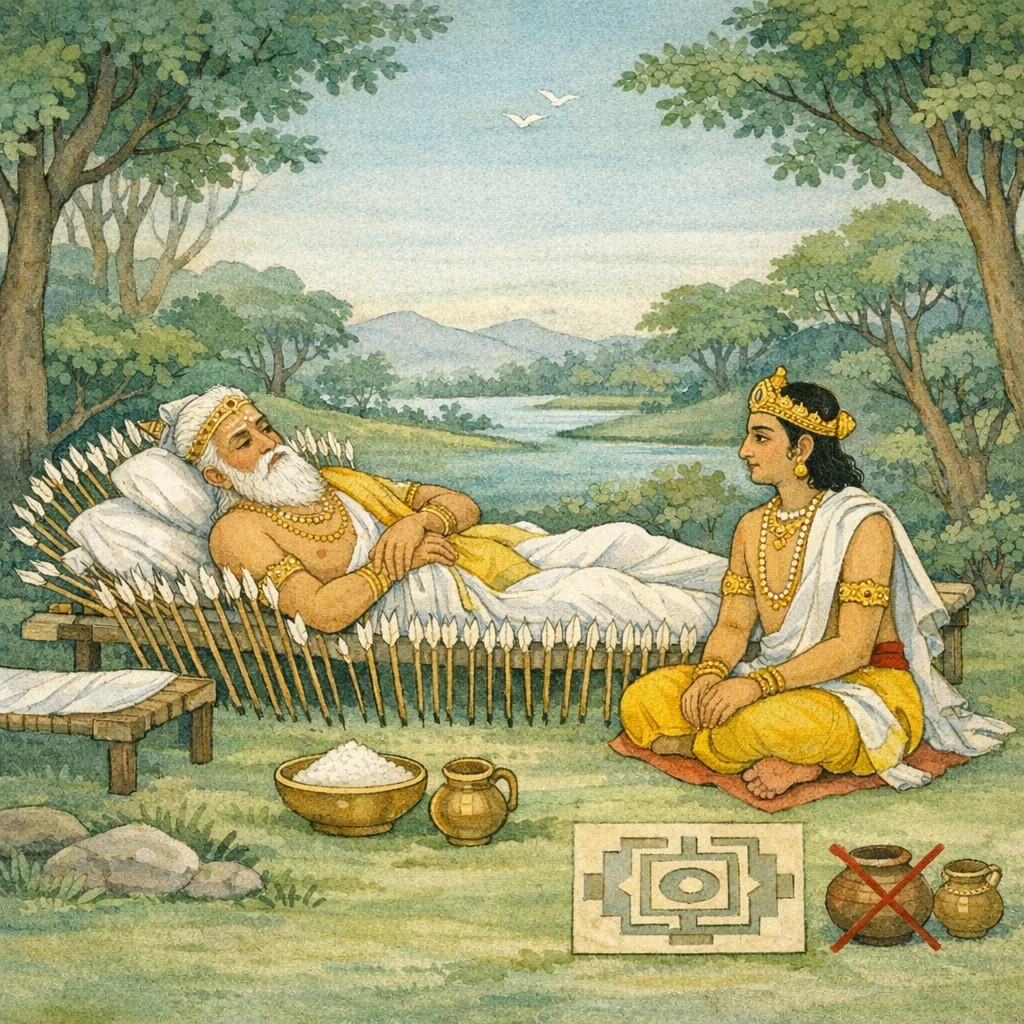
Adhyaya 107
आचारप्रशंसा (Praise of Ācāra as the Basis of Longevity, Fame, and Prosperity)
Upa-parva: Ācāra–Āyuḥ–Kīrti–Śrī Anuśāsana (Conduct and the Causes of Longevity, Fame, and Prosperity)
Yudhiṣṭhira asks Bhīṣma why humans—despite the Vedic ideal of a hundred-year lifespan—often die young, and by what means one gains longevity, fame, and prosperity: through austerity, celibacy, mantra, sacrifice, medicines, birth, or behavior. Bhīṣma responds with a programmatic claim: ācāra (regulated conduct) is the generator of āyus and śrī, and the foundation of kīrti both in this world and beyond. He contrasts durācāra—marked by fear-inducing behavior, impiety, and transgression of guru and śāstra—with the long-lived person characterized by non-anger, truthfulness, non-violence, and absence of envy. The chapter then catalogs practical injunctions spanning daily routine (waking at brāhma-muhūrta, sandhyā observances), cleanliness and waste-disposal norms, etiquette toward elders and teachers, speech ethics (avoiding harsh or humiliating words), dietary and hospitality rules, sexual restraint and prohibited relations, and household/ritual proprieties. The discourse culminates in a summarizing refrain: ācāra produces well-being, increases reputation, supports dharma, and removes inauspiciousness—presented as a compassionate, universal guideline for all social groups.
Chapter Arc: युधिष्ठिर पितामह भीष्म से पूछते हैं—मनुष्य दीर्घायु कैसे होता है, अल्पायु क्यों होता है, कीर्ति और श्री (समृद्धि) किससे मिलती है? (V2) → भीष्म उत्तर को केवल ‘धर्म’ के सिद्धान्तों तक सीमित नहीं रखते; वे जीवन-व्यवहार के सूक्ष्म नियमों—यज्ञ-परम्परा (शम्या फेंककर वेदी-सीमा), तप-ब्रह्मचर्य-जप-होम, मन-वाणी-शरीर की शुद्धि, क्रोध-नियंत्रण, शयन-आहार-वस्त्र-आचरण की मर्यादाएँ—एक-एक कर रखते जाते हैं। (V1, V3, V37, V49, V85, V93, V863) → भीष्म ‘आचरण-धर्म’ को निर्णायक बताते हैं: क्रोध में किसी पर दण्ड न उठाना, केवल पुत्र/शिष्य को भी शिक्षा-हेतु मर्यादित ताड़न की अनुमति (V37); शयन, वस्त्र, स्नानोत्तर लेपन, भोजन-नियम, और ‘दूसरे के वस्त्र’ न पहनने जैसे निषेध (V49, V85, V93, V863)—ये सब दीर्घायु, कीर्ति और श्री के प्रत्यक्ष कारण बनते हैं। → अध्याय का निष्कर्ष यह बनता है कि उन्नति चाहने वाला बुद्धिमान पुरुष हर कार्य का शुभारम्भ ब्राह्मण द्वारा विधिपूर्वक (वास्तुपूजन आदि) कराए और शौच-शुद्धि को भोजन के आदि-अन्त तक हितकर माने। (V1176, V1310) → युधिष्ठिर के प्रश्नों का विस्तार अगले उपदेशों की ओर संकेत करता है—शौच, आहार, गृह-धर्म और सामाजिक मर्यादा के और सूक्ष्म विधान आगे कैसे व्यवस्थित होंगे?
Shlokas
Verse 1
ऑपन-माज बक। अपि्-छऋाज > यज्ञकर्ता पुरुष 'शम्या' नामक एक काठका डंडा खूब जोर लगाकर फेंकता है, वह जितनी दूरपर जाकर गिरता है उतने दूरमें यज्ञकी वेदी बनायी जाती है; उस वेदीपर जो यज्ञ किया जाता है उसे “शम्याक्षेप" अथवा “शम्याप्रास” यज्ञ कहते हैं। चतुरधिकशततमो< ध्याय: हि 388 वृद्धि और क्षय करनेवाले शुभाशुभ कर्मोके गृहस्थाश्रमके कर्तव्योंका विस्तारपूर्वक निरूपण युधिछिर उवाच शतायुरुक्त: पुरुष: शतवीर्यश्व॒ जायते । कस्मान्म्रियन्ते पुरुषा बाला अपि पितामह,युधिष्ठिरने कहा--पितामह! शास्त्रोंमें कहा गया है कि “मनुष्यकी आयु सौ वर्षोकी होती है। वह सैकड़ों प्रकारकी शक्ति लेकर जन्म धारण करता है।” किंतु देखता हूँ कि कितने ही मनुष्य बचपनमें ही मर जाते हैं। ऐसा क्यों होता है?
Yudhiṣṭhira said: “Grandfather, the scriptures declare that a human being is destined for a hundred years of life and is born endowed with a hundredfold vigor. Yet we see that many people die even in childhood. For what reason does this happen?”
Verse 2
आयुष्मान् केन भवति अल्पायुर्वापि मानव: | केन वा लभते कीर्ति केन वा लभते श्रियम्,मनुष्य किस उपायसे दीर्घायु होता है अथवा किस कारणसे उसकी आयु कम हो जाती है? क्या करनेसे वह कीर्ति पाता है या क्या करनेसे उसे सम्पत्तिकी प्राप्ति होती है?
Yudhiṣṭhira said: “By what does a person become long-lived, and by what does a human being become short-lived? By what does one attain fame, and by what does one obtain prosperity?”
Verse 3
तपसा ब्रह्मचर्येण जपहोमैस्तथौषधै: । कर्मणा मनसा वाचा तने ब्रूहि पितामह,पितामह! मनुष्य मन, वाणी अथवा शरीरके द्वारा तप, ब्रह्मचर्य, जप, होम तथा औषध आदिमेंसे किसका आश्रय ले, जिससे वह श्रेयका भागी हो, वह मुझे बताइये
Yudhiṣṭhira said: “By austerity, by celibate discipline, by recitation and sacrificial offerings, and likewise by medicinal means—through action, through the mind, and through speech—tell me, O Grandfather, what a human being should chiefly rely upon so that he may become a sharer in the highest good.”
Verse 4
भीष्म उवाच अत्र तेहहं प्रवक्ष्यामि यन्मां त्वमनुपृच्छसि । अल्पायुर्येन भवति दीर्घायुर्वापि मानव:
Bhishma said: “Here I shall explain to you what you are asking me—by what causes a human being becomes short-lived, and by what causes one becomes long-lived as well.”
Verse 5
येन वा लभते कीर्ति येन वा लभते श्रियम् यथा वर्तयन् पुरुष: श्रेयसा सम्प्रयुज्यते
Bhīṣma said: “By what conduct a man gains lasting fame, and by what he gains prosperity—when he lives in that manner, he becomes united with the higher good (śreyas), attaining true welfare through right practice.”
Verse 6
भीष्मजीने कहा--युधिष्ठिर! तुम मुझसे जो पूछ रहे हो, इसका उत्तर देता हूँ। मनुष्य जिस कारणसे अल्पायु होता है, जिस उपायसे दीर्घायु होता है, जिससे वह कीर्ति और सम्पत्तिका भागी होता है तथा जिस बर्तावसे पुरुषको श्रेयका संयोग प्राप्त होता है, वह सब बताता हूँ, सुनो ।। आचाराल्लभते हायुराचाराल्लभते श्रियम् | आचारात् कीर्तिमाप्रोति पुरुष: प्रेत्य चेह च,सदाचारसे ही मनुष्यको आयुकी प्राप्ति होती है, सदाचारसे ही वह सम्पत्ति पाता है तथा सदाचारसे ही उसे इहलोक और परलोकमें भी कीर्तिकी प्राप्ति होती है
Bhishma said: “Yudhishthira, I will answer what you ask. I shall tell you the causes by which a person becomes short-lived, the means by which one becomes long-lived, how one comes to share in fame and prosperity, and what conduct brings a man into union with the highest good—listen. From right conduct (ācāra) one indeed gains longevity; from right conduct one gains prosperity; and from right conduct a man attains fame, both here in this world and after death.”
Verse 7
दुराचारो हि पुरुषो नेहायुर्विन्दते महत् । त्रसन्ति यस्माद् भूतानि तथा परिभवन्ति च
Bhishma said: “A man of corrupt conduct does not attain a long life in this world. For living beings tremble because of him, and he also comes to be scorned and humiliated in return.”
Verse 8
दुराचारी पुरुष, जिससे समस्त प्राणी डरते और तिरस्कृत होते हैं, इस संसारमें बड़ी आयु नहीं पाता ।। तस्मात् कुर्यादिहाचारं यदीच्छेद् भूतिमात्मन: । अपि पापशरीरस्य आचारो हन्त्यलक्षणम्,अतः यदि मनुष्य अपना कल्याण करना चाहता हो तो उसे इस जगत्में सदाचारका पालन करना चाहिये। जिसका सारा शरीर ही पापमय है, वह भी यदि सदाचारका पालन करे तो वह उसके शरीर और मनके बुरे लक्षणोंको दबा देता है
Bhishma teaches that a man who is wicked in conduct—feared and despised by all beings—does not attain long life in this world. Therefore, if one seeks one’s own welfare and prosperity, one should practice right conduct here. Even for a person whose very body is steeped in sin, disciplined good conduct can destroy inauspicious marks, restraining the evil tendencies of body and mind.
Verse 9
आचारलक्षणो धर्म: संतश्षारित्रलक्षणा: । साधूनां च यथावृत्तमेतदाचारलक्षणम्,सदाचार ही धर्मका लक्षण है। सच्चरित्रता ही श्रेष्ठ पुरुषोंकी पहचान है। श्रेष्ठ पुरुष जैसा बर्ताव करते हैं; वही सदाचारका स्वरूप अथवा लक्षण है
Bhishma said: “Dharma is recognized by right conduct (ācāra). The virtuous are known by their good character. Whatever the good and disciplined actually practice in life—such lived behavior is precisely what is meant by ‘proper conduct’ and serves as the mark of dharma.”
Verse 10
अप्यदृष्टं श्रवादेव पुरुषं धर्मचारिणम् | भूतिकर्माणि कुर्वाणं तं जना: कुर्वते प्रियम्,जो मनुष्य धर्मका आचरण करता और लोक-कल्याणके कार्यमें लगा रहता है, उसका दर्शन न हुआ हो तो भी मनुष्य केवल नाम सुनकर उससे प्रेम करने लगते हैं
Bhīṣma said: “Even if they have never seen him, people come to cherish a man of righteous conduct merely by hearing of him—when he is engaged in deeds that bring welfare and prosperity to others.”
Verse 11
ये नास्तिका निष्क्रियाश्व गुरुशास्त्राभिलड्घिन: । अधर्मज्ञा दुराचारास्ते भवन्ति गतायुष:,जो नास्तिक, क्रियाहीन, गुरु और शास्त्रकी आज्ञाका उल्लंघन करनेवाले, धर्मको न जाननेवाले और दुराचारी हैं, उन मनुष्योंकी आयु क्षीण हो जाती है
Bhīṣma said: Those who deny the sacred order, abandon prescribed duties, and transgress the commands of teachers and the śāstras—who are ignorant of dharma and given to corrupt conduct—such people come to have their lifespan cut short.
Verse 12
विशीला भिजन्नमर्यादा नित्यं संकीर्णमैथुना: । अल्पायुषो भवन्तीह नरा निरयगामिन:,जो मनुष्य शीलहीन, सदा धर्मकी मर्यादा भंग करनेवाले तथा दूसरे वर्णकी स्त्रियोंके साथ सम्पर्क रखनेवाले हैं; वे इस लोकमें अल्पायु होते और मरनेके बाद नरकमें पड़ते हैं
Bhīṣma said: Men who are devoid of good conduct, who continually violate the bounds of dharma, and who habitually engage in illicit sexual relations (mixing across forbidden boundaries) become short-lived in this world; and after death they proceed to hell.
Verse 13
सर्वलक्षणहीनो5पि समुदाचारवान् नर: । श्रद्दधानोडनसूयुश्च॒ शतं वर्षाणि जीवति,सब प्रकारके शुभ लक्षणोंसे हीन होनेपर भी जो मनुष्य सदाचारी, श्रद्धालु और दोषदृष्टिसे रहित होता है, वह सौ वर्षोतक जीवित रहता है
Bhīṣma said: Even if a man lacks all auspicious bodily marks, if he is established in good conduct, endowed with faith, and free from fault-finding or envy, he lives for a hundred years.
Verse 14
अक्रोधन: सत्यवादी भूतानामविहिंसक: । अनसूयुरजिद्दाश्व शतं वर्षाणि जीवति,जो क्रोधहीन, सत्यवादी, किसी भी प्राणीकी हिंसा न करनेवाला, अदोषदर्शी और कपटशून्य है, वह सौ वर्षोतक जीवित रहता है सायंप्रातश्व भूज्जीत नानतराले समाहित: । वालेन तु न भुज्जीत परश्राद्धं तथैव च
Bhīṣma said: He who is free from anger, speaks truth, harms no living being, is without fault-finding, and is devoid of deceit—such a man lives for a hundred years. Let him eat in the evening and in the morning with a collected mind, not in between; and let him not partake of another’s śrāddha offering as well.
Verse 15
लोष्ठमर्दी तृणच्छेदी नखखादी च यो नर: । नित्योच्छिष्ट: संकुसुको नेहायुर्विन्दते महत्,जो ढेले फोड़ता, तिनके तोड़ता, नख चबाता तथा सदा ही उच्छिष्ट (अशुद्ध) एवं चंचल रहता है, ऐसे कुलक्षणयुक्त मनुष्यको दीर्घायु नहीं प्राप्त होती
Bhīṣma said: A man who habitually crushes clods of earth, snaps blades of grass, bites his nails, and remains constantly unclean from eating remnants—restless and fidgety in conduct—does not attain long life in this world.
Verse 16
ब्राह्मे मुहूर्ते बुध्येत धर्मार्थों चानुचिंतयेत् । उत्थायाचम्य तिषछेत पूर्वा संध्यां कृताज्जलि:,प्रतिदिन ब्राह्ममुहूर्तमें (अर्थात् सूर्योदयसे दो घड़ी पहले) जागे तथा धर्म और अर्थके विषयमें विचार करे। फिर शय्यासे उठकर शौच-स्नानके पश्चात् आचमन करके हाथ जोड़े हुए प्रातः:कालकी संध्या करे
Bhīṣma said: “One should awaken in the Brahma-muhūrta and reflect upon dharma and artha. Then, rising from bed and performing ācamana, one should stand with joined palms and carry out the morning (eastern) sandhyā.”
Verse 17
एवमेवापरां संध्यां समुपासीत वाग्यत: । नेक्षेतादित्यमुद्यन्तं नास्तं यान््तं कदाचन,इसी प्रकार सायंकालमें भी मौन रहकर संध्योपासना करे। उदय और अस्तके समय सूर्यकी ओर कदापि न देखे
Bhīṣma said: “In the same manner, one should also perform the evening twilight worship in silence, with speech restrained. One should never look directly at the sun—neither as it rises nor as it sets.”
Verse 18
नोपसूष्टं न वारिस्थं न मध्यं नभसो गतम् | ऋषयो नित्यसंध्यत्वाद् दीर्घमायुरवाप्तुवन्
Bhīṣma said: “The sages did not remain in places that were foul or polluted, nor in waterlogged tracts, nor in the mid-region of the sky. By being ever-constant in the daily twilight rites (sandhyā), they attained long life.”
Verse 19
ये न पूर्वामुपासन्ते द्विजा: संध्यां न पश्चिमाम्
Bhīṣma said: “Those twice-born men who do not perform the morning Sandhyā worship, nor the evening Sandhyā, neglect a foundational daily duty.”
Verse 20
परदारा न गन्तव्या सर्ववर्णेषु कहिचित्,किसी भी वर्णके पुरुषको कभी भी परायी स्त्रियोंसे संसर्ग नहीं करना चाहिये। परस्त्री- सेवनसे मनुष्यकी आयु जल्दी ही समाप्त हो जाती है। संसारमें परस्त्री-समागमके समान पुरुषकी आयुको नष्ट करनेवाला दूसरा कोई कार्य नहीं है
Bhīṣma said: “A man of any varṇa should never go to another’s wife. Consorting with another man’s woman swiftly brings one’s lifespan to an end; in this world there is no deed that destroys a man’s longevity like union with another’s wife.”
Verse 21
न हीदृशमनायुष्यं लोके किंचन विद्यते । यादृशं पुरुषस्येह परदारोपसेवनम्,किसी भी वर्णके पुरुषको कभी भी परायी स्त्रियोंसे संसर्ग नहीं करना चाहिये। परस्त्री- सेवनसे मनुष्यकी आयु जल्दी ही समाप्त हो जाती है। संसारमें परस्त्री-समागमके समान पुरुषकी आयुको नष्ट करनेवाला दूसरा कोई कार्य नहीं है
Bhīṣma said: “In this world there is nothing so destructive of longevity as consorting with another man’s wife. For a man here, no deed shortens life as surely as the pursuit and enjoyment of another’s spouse.”
Verse 22
यावन्तो रोमकूपाः स्युः स्त्रीणां गात्रेषु निर्मिता: । तावद् वर्षसहस्राणि नरकं पर्युपासते,स्त्रियोंके शरीरमें जितने रोमकूप होते हैं, उतने ही हजार वर्षोंतक व्यभिचारी पुरुषोंको नरकमें रहना पड़ता है
Bhīṣma said: “As many hair-follicles as are formed upon the limbs of women, for just so many thousands of years do men who violate sexual fidelity remain in hell.”
Verse 23
प्रसाधनं च केशानामज्जनं दन्तधावनम् | पूर्वाह्न एव कार्याणि देवतानां च पूजनम्,केशोंको सँवारना, आँखोंमें अंजन लगाना, दाँत-मुँह धोना और देवताओंकी पूजा करना--ये सब कार्य दिनके पहले प्रहरमें ही करने चाहिये
Bhīṣma teaches that personal grooming—arranging one’s hair, applying collyrium to the eyes, and cleaning the teeth and mouth—along with worship of the deities, should be performed in the forenoon itself.
Verse 24
पुरीषमूत्रे नोदीक्षेत्राधितिषछ्ठेत् कदाचन । नातिकल्यं नातिसायं न च मध्यन्दिने स्थिते
Bhīṣma said: “One should never take one’s seat or remain in a place soiled with feces or urine. Nor should one do so at an improper time—neither too early in the morning, nor too late in the evening, nor at midday.”
Verse 25
पन्था देयो ब्राह्म॒णाय गोभ्यो राजभ्य एव च
Bhīṣma said: “A clear passage should be granted—to a brāhmaṇa, to cows, and to kings as well.”
Verse 26
प्रदक्षिणं च कुर्वीत परिज्ञातान् वनस्पतीन्
Bhīṣma said: One should also perform pradakṣiṇā—reverent circumambulation—around trees that are well known and rightly understood, treating such familiar plants as worthy of respect and mindful attention.
Verse 27
चतुष्पथान् प्रकुर्वीत सवनिव प्रदक्षिणान् । मार्गमें चलते समय अश्वत्थ आदि परिचित वृक्षों तथा समस्त चौराहोंको दाहिने करके जाना चाहिये ।। मध्यन्दिने निशाकाले अर्धरात्रे च सर्वदा
Bhīṣma said: One should honor crossroads, keeping them to one’s right as one passes, as though performing pradakṣiṇā. Likewise, while travelling, one should pass well-known trees such as the sacred aśvattha and all junctions by keeping them on the right. This rule is to be observed always—at midday, at night, at midnight, and at all times.
Verse 28
चतुष्पथ्थं न सेवेत उभे संध्ये तथैव च । दोपहरमें, रातमें, विशेषत:ः आधी रातके समय और दोनों संध्याओंके समय कभी चौराहोंपर न रहे ।। उपानहौ च वस्त्र च धृतमन्यैर्न धारयेत्,दूसरोंके पहने हुए वस्त्र और जूते न पहने। सदा ब्रह्मचर्यका पालन करे। पैरसे पैरको न दबावे। सभी पक्षोंकी अमावास्या, पौर्णमासी, चतुर्दशी और अष्टमी तिथिको सदा ब्रह्मचारी रहे--स्त्री-समागम न करे। किसीकी निंदा, बदनामी और चुगली न करे
Bhīṣma said: One should not frequent crossroads, especially at the two twilight junctions (dawn and dusk). Nor should one wear footwear or clothing that has been worn by others. These are disciplines of purity and restraint, meant to safeguard conduct and support brahmacarya (self-controlled living).
Verse 29
ब्रह्मचारी च नित्य॑ं स्यात् पादं पादेन नाक्रमेत् अमावास्यां पौर्णमास्यां चतुर्दश्यां च सर्वश:,दूसरोंके पहने हुए वस्त्र और जूते न पहने। सदा ब्रह्मचर्यका पालन करे। पैरसे पैरको न दबावे। सभी पक्षोंकी अमावास्या, पौर्णमासी, चतुर्दशी और अष्टमी तिथिको सदा ब्रह्मचारी रहे--स्त्री-समागम न करे। किसीकी निंदा, बदनामी और चुगली न करे
Bhīṣma said: One should always live as a brahmacārin, maintaining continence and disciplined conduct. One should not carelessly or disrespectfully press one foot with the other. On the new-moon day, the full-moon day, and on the fourteenth lunar day in every fortnight, one should observe strict continence in every way—avoiding sensual indulgence and guarding one’s conduct.
Verse 30
अष्टम्यां सर्वपक्षाणां ब्रह्मचारी सदा भवेत् | आक्रोशं परिवादं च पैशुन्यं च विवर्जयेत्,दूसरोंके पहने हुए वस्त्र और जूते न पहने। सदा ब्रह्मचर्यका पालन करे। पैरसे पैरको न दबावे। सभी पक्षोंकी अमावास्या, पौर्णमासी, चतुर्दशी और अष्टमी तिथिको सदा ब्रह्मचारी रहे--स्त्री-समागम न करे। किसीकी निंदा, बदनामी और चुगली न करे
Bhīṣma said: “On the eighth lunar day (aṣṭamī) in both fortnights, one should invariably observe brahmacarya (sexual restraint). One should also abstain from abusive speech, slander, and tale-bearing.”
Verse 31
नारुन्तुदः स्यान्न नृशंसवादी न हीनत: परमभ्याददीत । ययास्य वाचा पर उद्विजेत नतां वदेद् रुशतीं पापलोक्याम्,दूसरोंके मर्मपर आघात न करे। क्रूरतापूर्ण बात न बोले, औरोंको नीचा न दिखावे। जिसके कहनेसे दूसरोंको उद्वेग होता हो वह रुखाईसे भरी हुई बात पापियोंके लोकमें ले जानेवाली होती है। अत: वैसी बात कभी न बोले
Bhīṣma said: One should not be a wounder of others, nor a speaker of cruel words. One should not seek to surpass another by belittling him. Speech that disturbs others is harsh and leads one toward the realms of the sinful; therefore, such words should never be spoken.
Verse 32
वाक्सायका वदनान्निष्पतन्ति यैराहत: शोचति रात्र्यहानि । परस्य वा मर्मसु ये पतन्ति तान् पण्डितो नावसूजेत् परेषु,वचनरूपी बाण मुँहसे निकलते हैं, जिनसे आहत होकर मनुष्य रात-दिन शोकमें पड़ा रहता है। अतः जो दूसरोंके मर्मस्थानोंपर चोट करते हैं, ऐसे वचन विद्वान् पुरुष दूसरोंके प्रति कभी न कहे
Bhīṣma said: “Words are like arrows that fly forth from the mouth; when struck by them, a person grieves night and day. Therefore, a wise man should never hurl such speech at others—words that pierce another’s vital, sensitive points.”
Verse 33
रोहते सायकैरिंद्ध वनं परशुना हतम् । वाचा दुरुक्तं बीभत्सं न संरोहति वाक्क्षतम्,बाणोंसे बिंधा और फरसेसे कटा हुआ वन पुन: अंकुरित हो जाता है, किंतु दुर्वचनरूपी शस्त्रसे किया हुआ भयंकर घाव कभी नहीं भरता है
Bhishma said: A forest, even when pierced by arrows and felled by the axe, can grow back again; but the dreadful wound inflicted by harsh, ill-spoken words does not heal.
Verse 34
कर्णिनालीकनाराचान् निर्हरन्ति शरीरत: । वाक्शल्यस्तु न निर्हर्तु शक्यो हृदिशयो हि सः,कर्णि, नालीक और नाराच--ये शरीरमें यदि गड़ जायेँ तो चिकित्सक मनुष्य इन्हें शरीरसे निकाल देते हैं, किंतु वचनरूपी बाणको निकालना असंभव होता है; क्योंकि वह हृदयके भीतर चुभा होता है
Bhīṣma said: “Barbed arrows—karṇin, nālīka, and nārāca—when they lodge in the body, physicians can draw them out. But the arrow of harsh speech cannot be extracted, for it lies embedded within the heart.”
Verse 35
हीनांगानतिरिक्तांगान् विद्याहीनान् विगर्हितान् | रूपद्रविणहीनांश्व सत्त्वहीनांश्व नाक्षिपेत्,हीनांग (अंधे-काने आदि), अधिकांग (छांगुर आदि), विद्याहीन, निन्दित, कुरूप, निर्धन और निर्बल मनुष्योंपर आक्षेप करना उचित नहीं है
Bhīṣma said: One should not cast reproach upon people who are physically impaired or deformed, those with extra limbs, those lacking learning, those socially censured, those lacking beauty or wealth, or those lacking strength and courage. Such fault-finding is ethically improper and contrary to dharma.
Verse 36
नास्तिक्यं वेदनिन्दां च देवतानां च कुत्सनम् । देषस्तम्भो5भिमानं च तैक्ष्ण्यं च परिवर्जयेत्,नास्तिकता, वेदोंकी निंदा, देवताओंको कोसना, द्वेष, उद्ण्डता, अभिमान और कठोरता--इन दुर्गुणोंका त्याग कर देना चाहिये
Bhīṣma said: One should renounce irreligious disbelief, contempt for the Vedas, and the disparagement of the gods; likewise one should give up malice, obstinate arrogance, pride, and harshness. These faults corrode dharma and therefore must be abandoned by one who seeks right conduct.
Verse 37
परस्य दण्डं नोद्यच्छेत् क्रुद्धो नैन॑ निपातयेत् । अन्यत्र पुत्राच्छिष्याच्च शिक्षार्थ ताडनं स्मृतम्,क्रोधमें आकर पुत्र या शिष्यके सिवा दूसरे किसीको न तो डंडा मारे, न उसे पृथ्वीपर ही गिरावे। हाँ, शिक्षाके लिये पुत्र या शिष्यको ताड़ना देना उचित माना गया है
Bhīṣma said: In anger one should not raise a staff against another, nor strike him down to the ground. Only in the case of one’s son or disciple is chastisement for the sake of instruction remembered as proper.
Verse 38
न ब्राह्मणान् परिवदेन्नक्षत्राणि न निर्दिशेत् । तिथिं पक्षस्य न ब्रूयात् तथास्यायुर्न रिष्यते,ब्राह्मणोंकी निंदा न करे, घर-घर घूम-घूमकर नक्षत्र और किसी पक्षकी तिथि न बताया करे। ऐसा करनेसे मनुष्यकी आयु क्षीण नहीं होती है
Bhīṣma said: “One should not speak ill of Brāhmaṇas. Nor should one go about pointing out (to people) the lunar mansions (nakṣatras), nor announce the tithi of a fortnight. By refraining from such practices, a person’s lifespan is not diminished.”
Verse 39
(अमावास्यामृते नित्यं दंतधावनमाचरेत् । इतिहासपुराणानि दान वेदं च नित्यश: ।। गायत्रीमनन नित्य॑ कुर्यात् संध्यां समाहित: ।) अमावास्याके सिवा प्रतिदिन दन्तधावन करना चाहिये। इतिहास, पुराणोंका पाठ, वेदोंका स्वाध्याय, दान, एकाग्रचित्त होकर संध्योपासना और गायत्रीमंत्रका जप--ये सब कर्म नित्य करने चाहिये ।। कृत्वा मूत्रपुरीषे तु रथ्यामाक्रम्य वा पुन: । पादप्रक्षालनं कुर्यात् स्वाध्याये भोजने तथा,मल-मूत्र त्यागने और रास्ता चलनेके बाद तथा स्वाध्याय और भोजन करनेके पहले पैर धो लेने चाहिये
Bhīṣma said: Except on the new-moon day, one should regularly cleanse the teeth. One should daily recite the Itihāsas and Purāṇas, give in charity, and study the Veda; with a collected mind one should perform Sandhyā worship and daily reflect upon (and repeat) the Gāyatrī. After passing urine and stool, and again after walking on the road, one should wash the feet; likewise before sacred study and before eating.
Verse 40
त्रीणि देवा: पवित्राणि ब्राह्णानामकल्पयन् । अदृष्टमद्धिर्निर्णिक्ते यच्च वाचा प्रशस्यते
Bhīṣma said: The gods ordained three purifying agencies for Brāhmaṇas: what is unseen (adṛṣṭa—the merit of righteous conduct), water which cleanses by washing, and that which is praised and sanctified by speech—i.e., the purifying power of truthful, laudatory, and sacred utterance.
Verse 41
जिसपर किसीकी दूषित दृष्टि न पड़ी हो, जो जलसे धोया गया हो तथा जिसकी ब्राह्मणलोग वाणीद्वारा प्रशंसा करते हों--ये ही तीन वस्तुएँ देवताओं ने ब्राह्मणोंके उपयोगमें लाने योग्य और पवित्र बतायी हैं ।। संयावं कृसरं मांसं शष्कुलीं पायसं तथा । आत्मार्थ न प्रकर्तव्यं देवार्थ तु प्रकल्पयेत्,जौके आटेका हलवा, खिचड़ी, फलका गूदा, पूड़ी और खीर--ये सब वस्तुएँ अपने लिये नहीं बनानी चाहिये। देवताओंको अर्पण करनेके लिये ही इनको तैयार करना चाहिये
Bhishma said: “Saṃyāva, kṛsara, meat, śaṣkulī-cakes, and pāyasa (rice-milk pudding)—such foods should not be prepared for one’s own indulgence. They should be made with the intention of offering to the gods.” In ethical terms, Bhishma frames cooking and consumption as acts that gain purity and legitimacy when oriented toward worship and self-restraint rather than private pleasure.
Verse 42
नित्यमग्निं परिचरेद् भिक्षां दद्याच्च नित्यदा | वाग्यतो दन्तकाषछं च नित्यमेव समाचरेत्
Bhishma said: “One should regularly tend the sacred fire, and one should always give alms. One should be restrained in speech, and should also daily perform the rite of cleaning the teeth with a tooth-stick—thus maintaining constant discipline in conduct.”
Verse 43
प्रतिदिन अग्निकी सेवा करे, नित्यप्रति भिक्षुको भिक्षा दे और मौन होकर प्रतिदिन दन्तथधावन किया करे ।। (न संध्यायां स्वपेन्नित्यं स््नायाच्छुद्ध: सदा भवेत् ।) न चाभ्युदितशायी स्यात् प्रायश्चित्ती तथा भवेत् । मातापितरमुत्थाय पूर्वमेवाभिवादयेत्
Bhishma said: One should never sleep at the time of twilight; one should bathe and remain ever pure. One should not lie down after sunrise; thus one becomes fit for expiation and self-discipline. Rising up, one should first of all pay respectful salutations to one’s mother and father. The teaching emphasizes daily restraint, ritual cleanliness, and reverence to parents as foundational duties of righteous conduct.
Verse 44
आचार्यमथवाप्यन्यं तथायुर्विन्दते महत् | सायंकालमें न सोये, नित्य स्नान करे और सदा पवित्रतापूर्वक रहे। सूर्योदय होनेतक कभी न सोये। यदि किसी दिन ऐसा हो जाय तो प्रायश्षित्त करे। प्रतिदिन प्रातःकाल सोकर उठनेके बाद पहले माता-पिताको प्रणाम करे। फिर आचार्य तथा अन्य गुरुजनोंका अभिवादन करे। इससे दीर्घायु प्राप्त होती है || ४३ $ ।। वर्जयेद् दन्तकाष्ठानि वर्जनीयानि नित्यश:
Bhīṣma said: By respectfully approaching and honoring one’s teacher—or any other venerable elder—one gains great longevity. One should also, every day, avoid those tooth-sticks (dantakāṣṭhas) that are forbidden to use. The teaching emphasizes disciplined daily conduct, reverence to elders, and careful observance of purity-rules as supports for health, long life, and dharmic living.
Verse 45
उदड़्मुखश्नव सततं शौचं कुर्यात् समाहित:
Bhīṣma said: One should regularly bathe facing north and, with a collected and attentive mind, continually maintain purity—both in conduct and in personal cleanliness.
Verse 46
अकृत्वा देवपूजां च नाभिगच्छेत् कदाचन । अन्यत्र तु गुरुं वृद्ध धार्मिक वा विचक्षणम्,देवपूजा किये बिना गुरु, वृद्ध, धार्मिक तथा विद्वान् पुरुषको छोड़कर दूसरे किसीके पास न जाय
Bhishma said: “One should never go to meet anyone without first performing worship of the gods. The only exception is when one goes to a guru, an elder, or a person who is righteous or discerning.”
Verse 47
अवलोक्यो न चादर्शो मलिनो बुद्धिमत्तरै: । न चाज्ञातां स्त्रियं गच्छेद् गर्भिणीं वा कदाचन,अत्यन्त बुद्धिमान् पुरुषोंको मलिन दर्पणमें कभी अपना मुँह नहीं देखना चाहिये। अपरिचित तथा गर्भिणी स्त्रीके पास भी न जाय
Bhīṣma teaches a rule of prudent conduct: a truly intelligent man should not look at his own face in a dirty mirror, and he should never approach an unknown woman—or a pregnant woman. The counsel emphasizes restraint, cleanliness, and avoidance of situations that invite moral confusion, social suspicion, or harm.
Verse 48
(दारसंग्रहणात् पूर्व नाचरेन्मैथुनं बुध: । अन्यथा त्ववकीर्ण: स्यात् प्रायश्षित्तं समाचरेत् ।। नोदीक्षेत् परदारांश्व रहस्येकासनो भवेत् । इन्द्रियाणि सदा यच्छेत् स्वप्ने शुद्धमना भवेत् ।।) विद्वान् पुरुष विवाहसे पहले मैथुन न करे, अन्यथा वह ब्रह्मचर्य-व्रतको भंग करनेका अपराधी माना जाता है। ऐसी दशामें उसे प्रायश्चित्त करना चाहिये। वह परायी स्त्रीकी ओर न तो देखे और न एकान्तमें उसके साथ एक आसनपर बैठे ही। इन्द्रियोंको सदा अपने वशमें रखे। स्वप्रमें भी शुद्ध मनवाला होकर रहे ।। उदक्शिरा न स्वपेत तथा प्रत्यकुशिरा न च । प्राकृशिरास्तु स्वपेद् विद्वानथवा दक्षिणाशिरा:,उत्तर तथा पश्चिमकी ओर सिर करके न सोये। विद्वान् पुरुषको पूर्व अथवा दक्षिणकी ओर सिर करके ही सोना चाहिये
Bhishma said: “Before taking a wife, a wise man should not engage in sexual intercourse. Otherwise he becomes one who has ‘spilled’ (broken the vow of continence) and should duly perform expiation. He should not even look at another man’s wife, nor sit with her on the same seat in private. He should always restrain his senses and keep his mind pure even in dreams. He should not sleep with his head to the north, nor with his head to the west; a learned man should sleep with his head to the east or to the south.”
Verse 49
न भग्ने नावशीर्णे च शयने प्रस्वपीत च । नान्तर्थाने न संयुक्ते न च तिर्यक् कदाचन,टूटी और ढीली खाटपर नहीं सोना चाहिये। अँधेरेमें पड़ी हुई शय्यापर भी सहसा शयन करना उचित नहीं है (उजाला करके उसे अच्छी तरह देख लेना चाहिये)। किसी दूसरेके साथ एक खाटपर न सोये। इसी तरह पलंगपर कभी तिरछा होकर नहीं, सदा सीधे ही सोना चाहिये
Bhīṣma said: One should not sleep on a bed that is broken or loosened. One should not lie down to sleep on a couch kept in darkness without first examining it (by bringing light). One should not sleep together with another person on the same bed. Likewise, one should never sleep lying crosswise; one should lie straight.
Verse 50
न चापि गच्छेत् कार्येण समयाद् वापि नास्तिकै: । आसन तु पदा55कृष्य न प्रसज्जेत् तथा नर:,नास्तिकोंके साथ काम पड़नेपर भी न जाय। उनके शपथ खाने या प्रतिज्ञा करनेपर भी उनके साथ यात्रा न करे। आसनको पैरसे खींचकर मनुष्य उसपर न बैठे
Bhīṣma said: “Even when compelled by some business, one should not go in the company of unbelievers; nor should one travel with them even if they have made an agreement or sworn an oath. And a man should not become attached in such a way as to sit upon a seat that has been dragged with the foot.”
Verse 51
न नग्न: कर्तहिचित् स्नायान्न निशायां कदाचन । स्नात्वा च नावमृज्येत गात्राणि सुविचक्षण:,विद्वान पुरुष कभी नग्न होकर स्नान न करे। रातमें भी कभी न नहाय। स्नानके पश्चात् अपने अंगोंमें तैल आदिकी मालिश न करावे
Bhīṣma said: A wise man should never bathe while naked, nor should he ever bathe at night. And after bathing, the discerning person should not rub or massage his limbs with oil and the like.
Verse 52
न चानुलिम्पेदस्नात्वा स्नात्वा वासो न निर्धुनेत् । न चैवार्द्राणि वासांसि नित्यं सेवेत मानव:,स्नान किये बिना अपने अंगोंमें चन्दन या अंगराग न लगावे। स्नान कर लेनेपर गीले वस्त्र न झटकारे। मनुष्य भीगे वस्त्र कभी न पहने
Bhīṣma said: One should not anoint the body with sandal paste or other unguents without first bathing. And after bathing, one should not shake out or snap wet garments. Nor should a person habitually wear damp clothes.
Verse 53
स्रजश्न नावकृष्येत न बहिर्धारयीत च । उदक्यया च सम्भाषां न कुर्वीत कदाचन,गलेमें पड़ी हुई मालाको कभी न खींचे। उसे कपड़ेके ऊपर न धारण करे। रजस्वला सत्रीके साथ कभी बातचीत न करे
Bhīṣma said: One should not tug at the garland worn on the neck, nor should one wear it on the outside over one’s clothing. And one should never engage in conversation with a menstruating woman.
Verse 54
नोत्सूजेत पुरीषं च क्षेत्रे ग्रामस्य चान्तिके । उभे मूत्रपुरीषे तु नाप्सु कुर्यात् कदाचन,बोये हुए खेतमें, गाँवके आस-पास तथा पानीमें कभी मल-मूत्रका त्याग न करे
Bhīṣma said: One should not relieve oneself of feces in a sown field or near a village; and one should never, at any time, discharge either urine or feces into water.
Verse 55
(देवालये5थ गोवन्दे चैत्ये सस्येषु विश्रमे । भक्ष्यान् भूक्त्वा क्षुतेअध्वानं गत्वा मूत्रपुरीषयो: ।। द्विराचामेद् यथान्यायं हृदगतं तु पिबन्नपः ।) देवमन्दिर, गौओंके समुदाय, देवसम्बन्धी वृक्ष और विश्रामस्थानके निकट तथा बढ़ी हुई खेतीमें भी मल-मूत्रका त्याग नहीं करना चाहिये। भोजन कर लेनेपर, छींक आनेपर, रास्ता चलनेपर तथा मल-मूत्रका त्याग करनेपर यथोचित शुद्धि करके दो बार आचमन करे। आचमनमें इतना जल पीये कि वह हृदयतक पहुँच जाय ।। अन्न बुभुक्षमाणस्तु त्रिर्मुखेन स्पशेदप: । भुक््त्वा चान्न॑ तथैव त्रिर्द्धि: पुनः परिमार्जयेत्,भोजन करनेकी इच्छावाला पुरुष पहले तीन बार मुखसे झलका स्पर्श (आचमन) करे। फिर भोजनके पश्चात् भी तीन आचमन करे। फिर अंगुष्ठके मूलभागसे दो बार मुँहको पोंछे
Bhīṣma said: One should not void urine or feces near a temple, among cows, at a sacred shrine (caitya), near trees connected with worship, near a resting place, or in flourishing cultivated fields. After eating, after sneezing, after traveling on the road, and after relieving oneself, one should perform the proper purification and then sip water twice in the prescribed manner (ācāmana)—drinking enough that it is felt to reach the heart. A man who is about to eat should perform ācāmana three times; after eating he should again do so three times, and then wipe the mouth twice with the base of the thumb.
Verse 56
प्राडमुखो नित्यमश्रीयाद् वाग्यतो5न्नमकुत्सयन् । प्रस्कन्दयेच्च मनसा भुक्त्वा चाग्निमुपस्पृशेत्,भोजन करनेवाला पुरुष प्रतिदिन पूर्वकी ओर मुँह करके मौन भावसे भोजन करे। भोजन करते समय परोसे हुए अन्नकी निन्दा न करे। किंचिन्मात्र अन्न थालीमें छोड़ दे और भोजन करके मन-ही-मन अग्निका स्मरण करे
Bhishma said: A man who takes his meal should do so every day facing east, in silence and with self-restraint. While eating, he should not disparage the food that has been served. He should leave a small portion uneaten, and after finishing, he should inwardly recollect the sacred fire—maintaining reverence and discipline in the simple act of nourishment.
Verse 57
आयुष्य॑ प्राड्मुखो भुड्क्ते यशस्यं दक्षिणामुख: । धन्य पश्चान्मुखो भुड्क्ते ऋतं भुड्क्ते उदडमुख:
Bhishma said: Facing east one partakes of what promotes longevity; facing south one partakes of fame; facing west one partakes of prosperity and blessedness; and facing north one partakes of truth. Thus, even the simple discipline of orientation while eating is presented as an ethical observance that aligns daily conduct with valued aims of dharma.
Verse 58
जो मनुष्य पूर्व दिशाकी ओर मुँह करके भोजन करता है, उसे दीर्घायु, जो दक्षिणकी ओर मुँह करके भोजन करता है उसे यश, जो पश्चिमकी ओर मुख करके भोजन करता है उसे धन और जो उत्तराभिमुख होकर भोजन करता है उसे सत्यकी प्राप्ति होती है ।। अग्निमालभ्य तोयेन सर्वान् प्राणानुपस्पृशेत् । गात्राणि चैव सर्वाणि नाभिं पाणितले तथा,(मनसे) अग्निका स्पर्श करके जलसे सम्पूर्ण इन्द्रियोंका, सब अंगोंका, नाभिका और दोनों हथेलियोंका स्पर्श करे
Bhishma said: A person who eats facing the east gains long life; one who eats facing the south gains fame; one who eats facing the west gains wealth; and one who eats facing the north attains truthfulness. Having touched fire, one should then, with water, ritually touch (purify) all the vital functions and the whole body—also the navel and the palms—thus observing the proper discipline connected with eating and purity.
Verse 59
नाधितिषछेत् तुषं जातु केशभस्मकपालिका: । अन्यस्य चाप्यवस्नातं दूरत: परिवर्जयेत्,भूसी, भस्म, बाल और मुर्देकी खोपड़ी आदिपर कभी न बैठे। दूसरेके नहाये हुए जलका दूरसे ही त्याग कर दे
Bhishma said: One should never sit upon chaff, nor upon hair, ashes, or a skull. Likewise, one should keep away—indeed, avoid from a distance—the water in which another person has bathed. The teaching underscores rules of purity and disciplined conduct, urging restraint and careful avoidance of impure or contaminating substances as part of righteous living.
Verse 60
शान्तिहोमांश्व॒ कुर्वीत सावित्राणि च धारयेत् । निषण्णश्नापि खादेत न तु गच्छन् कदाचन,शान्ति-होम करे, सावित्रसंज्ञक मन्त्रोंका जप और स्वाध्याय करे। बैठकर ही भोजन करे, चलते-फिरते कदापि भोजन नहीं करना चाहिये
Bhishma said: “Let him perform rites of pacification (śānti-homa) and keep up the Savitrī-prayers (the Gāyatrī and related recitations). Even when eating, he should do so only while seated; he should never eat while walking.” The instruction frames disciplined daily conduct as a form of dharma—purifying one’s life through ritual steadiness and mindful restraint in ordinary acts like taking food.
Verse 61
मूत्रं नोत्तिषठतता कार्य न भस्मनि न गोव्रजे । आर्द्रपादस्तु भुंजीत नार्द्रपादस्तु संविशेत्,खड़ा होकर पेशाब न करे। राखमें और गोशालामें भी मूत्र त्याग न करे, भीगे पैर भोजन तो करे, परंतु शयन न करे
Bhīṣma said: “One should not pass urine while standing; nor should one urinate upon ashes or within a cowshed. If one’s feet are wet, one may still take food, but one should not lie down to sleep with wet feet.” In this teaching on right conduct, Bhīṣma sets forth rules of bodily discipline and cleanliness, treating even ordinary acts as part of dharma and reverence for pure places.
Verse 62
आर्द्रपादस्तु भुंजानो वर्षाणां जीवते शतम् । त्रीणि तेजांसि नोच्छिष्ट आलभेत कदाचन
Bhīṣma said: “One who eats while his feet are wet may live for a hundred years. Yet he should never, at any time, take up or employ the three ‘tejas’—the three fires/energies—while in a state of impurity, that is, without proper cleanliness and discipline.”
Verse 63
त्रीणि तेजांसि नोच्छिष्ट उदीक्षेत्र कदाचन
Bhīṣma said: “O one who is not to be treated as impure (nocchiṣṭa), never look with contempt upon three kinds of tejas—splendour and power.”
Verse 64
ऊर्ध्व प्राणा ह्ुत्क्रामन्ति यून: स्थविर आयति
Bhīṣma said: “In the young, the vital breaths (prāṇa) tend to rise upward and depart; in the aged, they move slowly and come on with difficulty.” In this ethical reflection on the body’s decline, the verse underscores the inevitability of aging and the need for disciplined living and detachment, since life’s powers do not remain steady.
Verse 65
प्रत्युत्थानाभिवादा भ्यां पुनस्तान् प्रतिपद्यते । वृद्ध पुरुषके आनेपर तरुण पुरुषके प्राण ऊपरकी ओर उठने लगते हैं। ऐसी दशामें जब वह खड़ा होकर वृद्ध पुरुषोंका स्वागत और उन्हें प्रणाम करता है, तब वे प्राण पुनः पूर्वावस्थामें आ जाते हैं |। ६४ ई ।। अभिवादयीत वृद्धांश्व॒ दद्याच्चैवासनं स्वयम्
Bhīṣma said: “By rising to greet and by offering respectful salutations, one regains one’s former vitality. Therefore, one should salute the elders and personally offer them a seat. Such conduct preserves life-force, cultivates humility, and upholds dharma through reverence toward age, experience, and virtue.”
Verse 66
कृतांजलिरुपासीत गच्छन्तं पृष्ठतो5न्वियात् । इसलिये जब कोई वृद्ध पुरुष अपने पास आवे, तब उसे प्रणाम करके बैठनेकी आसन दे और स्वयं हाथ जोड़कर उसकी सेवामें उपस्थित रहे। फिर जब वह जाने लगे, तब उसके पीछे-पीछे कुछ दूरतक जाय ।। न चासीतासने भिन्ने भिन्नकांस्यं च वर्जयेत्
Bhīṣma said: One should stand by an elder with folded hands in respectful attendance, and when the elder departs, one should follow behind for some distance. One should not sit on a separate seat set apart from the elder, and one should avoid using separate utensils—thus maintaining humility, reverence, and a spirit of service toward seniors.
Verse 67
स्वप्तव्यं नैव नग्नेन न चोच्छिष्टोडपि संविशेत्
Bhīṣma said: One should not sleep while naked, nor should one lie down to rest while still in a state of impurity after eating (that is, without proper cleansing). This rule teaches bodily discipline and everyday purity as part of dharma, emphasizing that even private habits should be governed by restraint and cleanliness.
Verse 68
उच्छिष्टो न स्पृशेच्छीर्ष सर्वे प्राणास्तदा श्रया: । नंगे होकर न सोये। उच्छिष्ट अवस्थामें भी शयन न करे। जूठे हाथसे मस्तकका स्पर्श न करे; क्योंकि समस्त प्राण मस्तकके ही आश्रित हैं ।। ६७ $ ।। केशग्रहं प्रहारांश्न शिरस्येतान् विवर्जयेत्,सिरके बाल पकड़कर खींचना और मस्तकपर प्रहार करना वर्जित है। दोनों हाथ सटाकर उनसे अपना सिर न खुजलावे। बारंबार मस्तकपर पानी न डाले। इन सब बातोंके पालनसे मनुष्यकी आयु क्षीण नहीं होती है
Bhīṣma said: One should not touch the head with hands that are impure from leftover food, for all the vital energies are said to depend upon the head. Therefore, one should avoid seizing the hair and striking the head. These restraints are taught as rules of disciplined conduct that protect life and well-being.
Verse 69
न संहताभ्यां पाणिभ्यां कण्डूयेदात्मन: शिर: । न चाभीक्ष्णं शिर: स्नायात् तथास्यायुर्न रिष्यते,सिरके बाल पकड़कर खींचना और मस्तकपर प्रहार करना वर्जित है। दोनों हाथ सटाकर उनसे अपना सिर न खुजलावे। बारंबार मस्तकपर पानी न डाले। इन सब बातोंके पालनसे मनुष्यकी आयु क्षीण नहीं होती है
Bhīṣma said: One should not scratch one’s head with both hands held together, nor should one repeatedly bathe or drench the head. By observing such bodily discipline and restraint, a person’s lifespan is not diminished.
Verse 70
शिर:स्नातस्तु तैलैश्व नांगं किंचिदपि स्पृशेत् । तिलसृष्टं न चाश्नीयात् तथास्यायुर्न रिष्यते,सिरपर तेल लगानेके बाद उसी हाथसे दूसरे अंगोंका स्पर्श नहीं करना चाहिये और तिलके बने हुए पदार्थ नहीं खाने चाहिये। ऐसा करनेसे मनुष्यकी आयु क्षीण नहीं होती है
Bhīṣma said: After bathing the head and applying oil, one should not touch any other part of the body with that same hand. Nor should one eat preparations made from sesame. By observing this restraint, a person’s lifespan is not diminished. (The instruction belongs to the broader discipline of bodily purity and regulated conduct taught as part of dharma.)
Verse 71
नाध्यापयेत् तथोच्छिष्टो नाधीयीत कदाचन । वाते च पूतिगन्धे च मनसापि न चिन्तयेत्,जूठे मुँह न पढ़ाये तथा उच्छिष्ट अवस्थामें स्वयं भी कभी स्वाध्याय न करे। यदि दुर्गन्धयुक्त वायु चले, तब तो मनसे स्वाध्यायका चिन्तन भी नहीं करना चाहिये
Bhīṣma said: One who is ritually impure after eating—while remnants still remain in the mouth—should not teach the sacred text, and should never undertake self-recitation (svādhyāya). Even when a foul-smelling wind is blowing, one should not even in the mind contemplate recitation. Thus is reverence for Vedic study and instruction upheld, requiring bodily and environmental cleanliness as part of disciplined dharma.
Verse 72
अत्र गाथा यमोदगीता: कीर्तयन्ति पुराविद: । आयुरस्य निकृन्तामि प्रजास्तस्थाददे तथा,प्राचीन इतिहासके जानकार लोग इस विषयमें यमराजकी गायी हुई गाथा सुनाया करते हैं। (यमराज कहते हैं--) “जो मनुष्य जूठे मुँह उठकर दौड़ता और स्वाध्याय करता है, मैं उसकी आयु नष्ट कर देता हूँ और उसकी संतानोंको भी उससे छीन लेता हूँ। जो द्विज मोहवश अनध्यायके समय भी अध्ययन करता है, उसके वैदिक ज्ञान और आयुका भी नाश हो जाता है।' अतः सावधान पुरुषको निषिद्ध समयमें कभी वेदोंका अध्ययन नहीं करना चाहिये
Bhīṣma said: “On this matter, the learned in ancient lore recite verses once sung by Yama. (Yama declares:) ‘I cut short the lifespan of the man who rises with an unclean mouth and runs about or engages in Vedic self-recitation; and I also deprive him of his progeny. Likewise, if a twice-born man, deluded, studies even during times forbidden for recitation (anadhyāya), his Vedic attainment and his lifespan are both ruined.’ Therefore, a prudent person should never undertake Vedic study at prohibited times.”
Verse 73
उच्छिष्टो यः प्राद्रवति स्वाध्यायं चाधिगच्छति । यश्चानध्यायकाले5पि मोहादभ्यस्यति द्विज:,प्राचीन इतिहासके जानकार लोग इस विषयमें यमराजकी गायी हुई गाथा सुनाया करते हैं। (यमराज कहते हैं--) “जो मनुष्य जूठे मुँह उठकर दौड़ता और स्वाध्याय करता है, मैं उसकी आयु नष्ट कर देता हूँ और उसकी संतानोंको भी उससे छीन लेता हूँ। जो द्विज मोहवश अनध्यायके समय भी अध्ययन करता है, उसके वैदिक ज्ञान और आयुका भी नाश हो जाता है।' अतः सावधान पुरुषको निषिद्ध समयमें कभी वेदोंका अध्ययन नहीं करना चाहिये
Bhīṣma says: “One who, with an impure mouth after eating, hastens about and engages in Vedic recitation and study, and one who—out of delusion—studies even during times prohibited for recitation (anadhyāya): the tradition recalls an ancient account sung by Yama. Yama declares that he cuts short the lifespan of such a person and deprives him of his progeny; and for the twice-born who studies during an anadhyāya period, both Vedic merit/knowledge and longevity are ruined. Therefore, a prudent person should never study the Veda at forbidden times.”
Verse 74
तस्य वेद: प्रणश्येत आयुश्च परिहीयते । तस्माद् युक्तो हानध्याये नाधीयीत कदाचन,प्राचीन इतिहासके जानकार लोग इस विषयमें यमराजकी गायी हुई गाथा सुनाया करते हैं। (यमराज कहते हैं--) “जो मनुष्य जूठे मुँह उठकर दौड़ता और स्वाध्याय करता है, मैं उसकी आयु नष्ट कर देता हूँ और उसकी संतानोंको भी उससे छीन लेता हूँ। जो द्विज मोहवश अनध्यायके समय भी अध्ययन करता है, उसके वैदिक ज्ञान और आयुका भी नाश हो जाता है।' अतः सावधान पुरुषको निषिद्ध समयमें कभी वेदोंका अध्ययन नहीं करना चाहिये
Bhīṣma said: “For such a person, the Veda—its learning and its efficacy—is ruined, and his lifespan diminishes. Therefore, a disciplined man should never study during times prohibited for recitation (anadhyāya).”
Verse 75
प्रत्यादित्य॑ प्रत्यनलं प्रति गां च प्रति द्विजान् ये मेहन्ति च पन्थानं ते भवन्ति गतायुष:,जो सूर्य, अग्नि, गौ तथा ब्राह्मणोंकी ओर मुँह करके पेशाब करते हैं और जो बीच रास्तेमें मूतते हैं, वे सब गतायु हो जाते हैं
Bhīṣma said: Those who urinate facing the Sun, facing fire, toward a cow, or toward Brāhmaṇas—and those who urinate in the middle of the roadway—are said to become “short-lived,” for such acts violate basic standards of purity, reverence, and public propriety taught in dharma.
Verse 76
उभे मूत्रपुरीषे तु दिवा कुर्यादुदड्मुख: । दक्षिणाभिमुखो रात्रौ तथा ह्ायुर्न रिष्यते,मल और मूत्र दोनोंका त्याग दिनमें उत्तराभिमुख होकर करे और रातमें दक्षिणाभिमुख। ऐसा करनेसे आयुका नाश नहीं होता
Bhīṣma said: One should relieve oneself of both urine and feces facing north during the daytime, and facing south at night; by observing this rule of proper conduct, one’s longevity is not diminished.
Verse 77
त्रीन् कृशान् नावजानीयाद् दीर्घमायुर्जिजीविषु: । ब्राह्मण क्षत्रियं सर्प सर्वे ह्याशीविषास्त्रय:
Bhīṣma said: One who wishes to live long should never treat three ‘weak’ beings with contempt: a brāhmaṇa, a kṣatriya, and a serpent. For these three, though they may appear feeble, are all truly like venomous snakes—capable of swift and dangerous retaliation when provoked.
Verse 78
जिसे दीर्घ कालतक जीवित रहनेकी इच्छा हो, वह ब्राह्मण, क्षत्रिय और सर्प--इन तीनोंके दुर्बल होनेपर भी इनको न छेड़े; क्योंकि ये सभी बड़े जहरीले होते हैं ।। दहत्याशीविष: क्रुद्धो यावत् पश्यति चक्षुषा | क्षत्रियोडपि दहेत् क्रुद्धो यावत् स्पृशति तेजसा,क्रोधमें भरा हुआ साँप जहाँतक आँखोंसे देख पाता है, वहाँतक धावा करके काटता है। क्षत्रिय भी कुपित होनेपर अपनी शक्तिभर शत्रुको भस्म करनेकी चेष्टा करता है; परंतु ब्राह्मण जब कुपित होता है, तब वह अपनी दृष्टि और संकल्पसे अपमान करनेवाले पुरुषके सम्पूर्ण कुलको दग्ध कर डालता है; इसलिये समझदार मनुष्यको यत्नपूर्वक इन तीनोंकी सेवा करनी चाहिये
Bhishma said: Whoever wishes to live long should not provoke—even when they seem weak—these three: a Brahmin, a Kshatriya, and a serpent; for all three are intensely venomous in their own way. An enraged snake strikes as far as its eyes can range; an enraged Kshatriya strives to burn down his enemy with the full reach of his martial power. But when a Brahmin is angered, he can, by the force of his gaze and resolve, scorch the entire lineage of the one who dishonors him. Therefore, a wise person should carefully honor and attend to these three.
Verse 79
ब्राह्मणस्तु कुलं हन्याद् ध्यानेनावेक्षितेन च । तस्मादेतत् त्रयं यत्नादुपसेवेत पण्डित:,क्रोधमें भरा हुआ साँप जहाँतक आँखोंसे देख पाता है, वहाँतक धावा करके काटता है। क्षत्रिय भी कुपित होनेपर अपनी शक्तिभर शत्रुको भस्म करनेकी चेष्टा करता है; परंतु ब्राह्मण जब कुपित होता है, तब वह अपनी दृष्टि और संकल्पसे अपमान करनेवाले पुरुषके सम्पूर्ण कुलको दग्ध कर डालता है; इसलिये समझदार मनुष्यको यत्नपूर्वक इन तीनोंकी सेवा करनी चाहिये
Bhishma said: A brāhmaṇa can destroy an entire lineage merely by concentrated thought and a fixed, intent gaze. Therefore, a wise person should diligently cultivate proper regard and careful conduct toward these three.
Verse 80
गुरुणा चैव निर्बन्धो न कर्तव्य: कदाचन । अनुमान्य: प्रसाद्यश्न गुरु: क्रुद्धो युधिष्ठिर
Bhīṣma said: One should never, at any time, enter into stubborn insistence or contention with one’s teacher. Rather, the teacher should be treated with due regard and gently appeased. Even when the teacher is angry, O Yudhiṣṭhira, one should seek reconciliation and maintain respectful conduct.
Verse 81
गुरुके साथ कभी हठ नहीं ठानना चाहिये। युधिष्ठिर! यदि गुरु अप्रसन्न हों तो उन्हें हर तरहसे मान देकर मनाकर प्रसन्न करनेकी चेष्टा करनी चाहिये ।। सम्यड्मिथ्याप्रवृत्तेडपि वर्तितव्यं गुराविह । गुरुनिन्दा दहत्यायुर्मनुष्याणां न संशय:,गुरु प्रतिकूल बर्ताव करते हों तो भी उनके प्रति अच्छा ही बर्ताव करना उचित है; क्योंकि गुरुनिन्दा मनुष्योंकी आयुको दग्ध कर देती है, इसमें संशय नहीं है
Bhishma said: One should never stubbornly oppose one’s teacher. O Yudhishthira, if the teacher becomes displeased, one should strive to honor, appease, and gladden him by every proper means. Even if the teacher’s conduct seems right or wrong, one should still behave appropriately toward him here; for reviling the teacher burns away a person’s lifespan—of this there is no doubt.
Verse 82
दूरादावसथान्मूत्रं दूरात् पादावसेचनम् | उच्छिष्टोत्सर्जनं चैव दूरे कार्य हितैषिणा,अपना हित चाहनेवाला मनुष्य घरसे दूर जाकर पेशाब करे, दूर ही पैर धोवे और दूरपर ही जूठे फेंके
Bhīṣma said: A person who seeks his own welfare should go far from the dwelling to urinate, wash the feet at a distance, and likewise discard leftover or impure remnants away from the home.
Verse 83
रक्तमाल्यं न धार्य स्याच्छुक्लं धार्य तु पण्डितै: । वर्जयित्वा तु कमलं तथा कुवलयं प्रभो,प्रभो! विद्वान् पुरुषको लाल फूलोंकी नहीं, श्वेत पुष्पोंकी माला धारण करनी चाहिये; परंतु कमल और कुवलयको छोड़कर ही यह नियम लागू होता है। अर्थात् कमल और कुवलय लाल हों तो भी उन्हें धारण करनेमें कोई हर्ज नहीं है
Bhīṣma said: “A garland of red flowers should not be worn; rather, the learned should wear a white one. This rule applies only after exempting the lotus and the blue-lotus (kuvalaya), O lord—so even if those are red-hued, there is no fault in wearing them.”
Verse 84
रक्त शिरसि धार्य तु तथा वानेयमित्यपि । कांचनीयापि माला या न सा दुष्यति कहिचित्,लाल रंगके फूल तथा वन्य पुष्पको मस्तकपर धारण करना चाहिये। सोनेकी माला पहननेसे कभी अशुद्ध नहीं होती
Bhīṣma says that one may wear on the head red-colored flowers, even if they are wild forest blossoms. Likewise, a garland made of gold never becomes ritually impure.
Verse 85
स्नातस्य वर्णकं नित्यमार्द्र दद्याद् विशाम्पते | विपर्ययं न कुर्वीत वाससो बुद्धिमान् नर:,प्रजानाथ! स्नानके पश्चात् मनुष्यको अपने ललाटपर गीला चन्दन लगाना चाहिये। बुद्धिमान् पुरुषको कपड़ोंमें कभी उलट-फेर नहीं करना चाहिये अर्थात् उत्तरीय वस्त्रको अधोवस्त्रके स्थानमें और अधोवस्त्रको उत्तरीयके स्थानमें न पहने
Bhishma said: “O lord of the people, after bathing one should regularly apply a moist fragrant paste (such as sandal) to the forehead. A wise man should not wear his garments in a reversed manner—he should not interchange the upper cloth and the lower cloth.”
Verse 86
तथा नान्यधूृतं धार्य न चापदशमेव च । अन्यदेव भवेद् वास: शयनीये नरोत्तम
Bhīṣma said: “So too, one should not keep wearing what has been worn by another; nor should one do so even in times of distress. For a noble man, the garment used for sleeping should be something else, kept separate.”
Verse 87
प्रियंगुचन्दना भ्यां च बिल्वेन तगरेण च
Bhīṣma said: “(One should offer worship) with priyangu and sandalwood, and also with bilva and tagara.”
Verse 88
पृथगेवानुलिम्पेत केसरेण च बुद्धिमान् । बुद्धिमान् पुरुष राई, चन्दन, बिल्व, तगर तथा केसरके द्वारा पृथक्ू-पृथक् अपने शरीरमें उबटन लगावे ।। उपवासं च कुर्वीत स्नात: शुचिरलंकृत:
Bhīṣma said: “A wise man should anoint his body separately with fragrant substances—saffron (kesar), sandalwood, bilva, tagara, and the like—applying each in its proper way. Having bathed, remaining pure and well-adorned, he should also undertake a fast.”
Verse 89
पर्वकालेषु सर्वेषु ब्रहद्मयचारी सदा भवेत् | मनुष्य सभी पर्वोके समय स्नान करके पवित्र हो वस्त्र एवं आभूषणोंसे विभूषित होकर उपवास करे तथा पर्वकालमें सदा ही ब्रह्मचर्यका पालन करे ।। समानमेकपात्रे तु भुउ्जेन्नान्नं जनेश्वर,जनेश्वर! किसीके साथ एक पात्रमें भोजन न करे। जिसे रजस्वला स्त्रीने अपने स्पर्शसे दूषित कर दिया हो, ऐसे अन्नका भोजन न करे एवं जिसमेंसे सार निकाल लिया गया हो ऐसे पदार्थको कदापि भक्षण न करे तथा जो तरसती हुई दृष्टिसे अन्नकी ओर देख रहा हो, उसे दिये बिना भोजन न करे
Bhīṣma said: “At every sacred festival time one should always remain a brahmacārin—after bathing and becoming pure, wearing clean garments and ornaments, and observing a fast. O lord of men, one should not eat food together with another from the same vessel. One should not eat food rendered impure by the touch of a menstruating woman, nor consume items from which the essence has already been extracted. And one should not eat without first giving to a person who looks longingly at the food.”
Verse 90
नालीढया परिहतं भक्षयीत कदाचन । तथा नोद्धृतसाराणि प्रेक्ष्यते नाप्रदाय च,जनेश्वर! किसीके साथ एक पात्रमें भोजन न करे। जिसे रजस्वला स्त्रीने अपने स्पर्शसे दूषित कर दिया हो, ऐसे अन्नका भोजन न करे एवं जिसमेंसे सार निकाल लिया गया हो ऐसे पदार्थको कदापि भक्षण न करे तथा जो तरसती हुई दृष्टिसे अन्नकी ओर देख रहा हो, उसे दिये बिना भोजन न करे
Bhīṣma said: “O lord of men, one should never eat food that has been defiled by the touch of a menstruating woman. Likewise, one should not consume items whose essence has already been extracted. And one should not eat while another looks on with longing at the food, without first giving to that person.”
Verse 91
न संनिकृष्टे मेधावी नाशुचेर्न च सत्सु च | प्रतिषिद्धान् नधर्मेषु भक्ष्यान् भुज्जीत पृष्ठत:,बुद्धिमान् पुरुषको चाहिये कि वह किसी अपवित्र मनुष्यके निकट अथवा सत्पुरुषोंके सामने बैठकर भोजन न करे। धर्मशास्त्रोंमें जिनका निषेध किया गया हो, ऐसे भोजनको पीठ पीछे छिपाकर भी न खाय
Bhishma said: A wise man should not take his meal while sitting too close to an impure person, nor in the presence of the virtuous. Nor should he eat—whether in secret, turning his back—foods that are forbidden by the dharma-texts and belong to unrighteous conduct.
Verse 92
पिप्पलं च वर्ट चैव शणशाकं तथैव च । उदुम्बरं न खादेच्च भवार्थी पुरुषोत्तम:,अपना कल्याण चाहनेवाले श्रेष्ठ पुरुषको पीपल, बड़ और गूलरके फलका तथा सनके सागका सेवन नहीं करना चाहिये
Bhishma said: “O best of men, one who seeks his own welfare and spiritual good should refrain from eating the fruits of the pippala (sacred fig), the vaṭa (banyan), and the udumbara (cluster fig), and likewise should avoid śaṇaśāka (greens of flax/śaṇa).”
Verse 93
न पाणौ लवणं दिद्वान् प्राश्नीयान्न च रात्रिषु दधिसक्तून् न भुज्जीत वृथा मांसं च वर्जयेत्,विद्वान् पुरुष हाथमें नमक लेकर न चाटे। रातमें दही और सत्तू न खाय। मांस अखाद्य वस्तु है, उसका सर्वथा त्याग कर दे
Bhishma said: A wise person should not lick salt placed in the palm of the hand. Nor should he eat curd mixed with roasted flour (sattu) at night. He should also renounce meat altogether, regarding it as improper food and an avoidable indulgence.
Verse 94
प्रतिदिन सबेरे और शामको ही एकाग्रचित्त होकर भोजन करे। बीचमें कुछ भी खाना उचित नहीं है। जिस भोजनमें बाल पड़ गया हो, उसे न खाय तथा शत्रुके श्राद्धमें कभी अन्न न ग्रहण करे
Bhishma said: “Each day one should take one’s meal with a collected mind, only in the morning and in the evening. Eating in between is not proper. One should not eat food into which a hair has fallen, and one should never accept food offered at the śrāddha rites of an enemy.”
Verse 95
वाग्यतो नैकवस्त्रश्ष नासंविष्ट: कदाचन । भूमौ सदैव नाश्नीयान्नानासीनो न शब्दवत्,भोजनके समय मौन रहना चाहिये। एक ही वस्त्र धारण करके अथवा सोये-सोये कदापि भोजन न करे। भोजनके पदार्थको भूमिपर रखकर कदापि न खाय। खड़ा होकर या बातचीत करते हुए कभी भोजन नहीं करना चाहिये
Bhishma said: “At the time of eating, one should restrain speech and maintain silence. One should not eat while wearing only a single garment, nor ever while lying down. One should never eat with the food placed on the bare ground. One should not eat while standing, nor while seated in an improper posture, nor while making noise or talking.”
Verse 96
तोयपूर्व प्रदायान्नमतिथि भ्यो विशाम्पते । पश्चाद् भुञज्जीत मेधावी न चाप्यन्यमना नर:
Bhīṣma said: “O lord of the people, having first offered water and then food to the guests, a wise man should eat only afterward; and even then he should not do so with a distracted mind.”
Verse 97
प्रजानाथ! बुद्धिमान् पुरुष पहले अतिथिको अन्न और जल देकर पीछे स्वयं एकाग्रचित्त हो भोजन करे ।। समानमेकपड्क्त्यां तु भोज्यमन्नं नरेश्वर । विष हालाहलं भुड्क्ते यो5प्रदाय सुहृज्जने,नरेश्वर! एक पंक्तिमें बैठनेपर सबको एक समान भोजन करना चाहिये। जो अपने सुहृदजनोंको न देकर अकेला ही भोजन करता है, वह हालाहल विष ही खाता है
Bhīṣma said: “O lord of the people! A wise man should first offer food and water to a guest, and only afterward eat himself with a collected mind. And, O king, when people sit in a single row to dine, the food should be served equally to all. Whoever eats alone without giving to his well-wishing companions truly consumes the deadly Hālāhala poison.”
Verse 98
पानीयं पायसं सक्तून् दथिसर्पिमि धून्यपि । निरस्य शेषमन्येषां न प्रदेयं तु कस्यचित्,पानी, खीर, सत्तू, दही, घी और मधु--इन सबको छोड़कर अन्य भक्ष्य पदार्थोंका अवशिष्ट भाग दूसरे किसीको नहीं देना चाहिये
Bhishma said: “Water, milk-rice (sweet porridge), parched-flour (sattu), curd, ghee, and honey—these may be set aside and given; but the leftover portion of other foods should not be handed over to anyone.”
Verse 99
भुज्जानो मनुजव्याप्र नैव शंकां समाचरेत् । दधि चाप्यनुपान वै न कर्तव्यं भवार्थिना,पुरुषसिंह! भोजन करते समय भोजनके विषयमें शंका नहीं करनी चाहिये तथा अपना भला चाहनेवाले पुरुषको भोजनके अन्तमें दही नहीं पीना चाहिये
Bhishma said: “O tiger among men, while eating one should not entertain doubts about the food. And, O lion among men, a person who seeks his own welfare should not drink curd as a concluding drink after the meal.”
Verse 100
आचम्य चैकहस्तेन परिप्लाव्यं तथोदकम् । अंगुष्ठं चरणस्याथ दक्षिणस्यावसेचयेत्
Bhīṣma said: “Having sipped water for purification with a single hand, one should likewise rinse and swirl the water. Then one should pour water over the right foot’s big toe.”
Verse 101
भोजन करनेके पश्चात् कुल्ला करके मुँह धो ले और एक हाथसे दाहिने पैरके अँगूठेपर पानी डाले ।। पार्णिं मूर्ध्नि समाधाय स्पृष्टवा चाग्निं समाहित: । ज्ञातिश्रैष्ठयमवाप्रोति प्रयोगकुशलो नर:,फिर प्रयोगकुशल मनुष्य एकाग्रचित्त हो अपने हाथको सिरपर रखे। उसके बाद अग्निका मनसे स्पर्श करे। ऐसा करनेसे वह कुटुम्बीजनोंमें श्रेष्ठता प्राप्त कर लेता है
Bhishma said: After taking food, one should rinse the mouth and wash the face, then with one hand pour water upon the right great toe. Next, placing the palm upon the head and, with a collected mind, mentally touching (that is, reverently acknowledging) the sacred fire, Agni, a man skilled in proper observance attains pre-eminence among his kinsmen. The teaching emphasizes disciplined post-meal purity and mindful reverence as marks of dharma in household life.
Verse 102
अद्विः प्राणान् समालभ्य नाभिं पाणितले तथा | स्पृशंश्वैव प्रतिछ्ेत न चाप्याद्रेण पाणिना,इसके बाद जलसे आँख, नाक आदि इन्द्रियों और नाभिका स्पर्श करके दोनों हाथोंकी हथेलियोंको धो डाले। धोनेके पश्चात् गीले हाथ लेकर ही न बैठ जाय (उन्हें कपड़ोंसे पोंछकर सुखा दे)
Thereafter, touching with water the eyes, the nose, and the other sense-organs, as well as the navel, one should wash both palms. Having washed, one should not sit with wet hands; rather, one should wipe them on one’s cloth and dry them.
Verse 103
इस प्रकार श्रीमहाभारत अनुशासनपर्वके अंतर्गत दानधर्मपर्वमें ब्रह्मा और भगीरथका संवादविषयक एक सौ तीनवाँ अध्याय पूरा हुआ,अंगुष्टस्थान्तराले च ब्राद्मं तीर्थमुदाह्नतम् । कनिष्िकाया: पश्चात् तु देवतीर्थमिहोच्यते अँगूठेका अन्तराल (मूलस्थान) ब्राह्मतीर्थ कहलाता है, कनिष्ठा आदि अँगुलियोंका पश्चादभाग (अग्रभाग) देवतीर्थ कहा जाता है
Bhīṣma said: “The space at the base of the thumb is declared to be the Brāhma-tīrtha (the ‘Brahmin’ sacred point of the hand). The region behind the little finger—toward its upper/back portion—is here called the Deva-tīrtha (the ‘divine’ sacred point).”
Verse 104
अड््गुष्ठस्य च यन्मध्यं प्रदेशिन्याश्व॒ भारत । तेन पित्र्याणि कुर्वीत स्पृष्टवापो न्न्यायत: सदा,भारत! अंगुष्ठ और तर्जनीके मध्यभागको पितृतीर्थ कहते हैं। उसके द्वारा शास्त्रविधिसे जल लेकर सदा पितृकार्य करना चाहिये
Bhishma said: “O Bharata, the space between the thumb and the forefinger is called the pitṛ-tīrtha (the sacred point for the ancestors). Using that—taking water in the prescribed manner—one should always perform the rites for the Pitṛs according to proper rule.”
Verse 105
परापवाद न ब्रूयान्नाप्रियं च कदाचन । न मन्यु: कश्रिदुत्पाद्य: पुरुषेण भवार्थिना,अपनी भलाई चाहनेवाले पुरुषको दूसरोंकी निनन््दा तथा अप्रिय वचन मुँहसे नहीं निकालने चाहिये और किसीको क्रोध भी नहीं दिलाना चाहिये
Bhishma said: A man who seeks his own true welfare should never utter slander against others, nor speak harsh and unwelcome words. Nor should he, by his conduct, provoke anger in anyone.
Verse 106
पतितैस्तु कथां नेच्छेद् दर्शनं च विवर्जयेत् । संसर्ग च न गच्छेत तथा<<युर्विन्दते महत्,पतित मनुष्योंके साथ वार्तालापकी इच्छा न करे। उनका दर्शन भी त्याग दे और उनके सम्पर्कमें कभी न जाय। ऐसा करनेसे मनुष्य बड़ी आयु पाता है
Bhīṣma said: One should not seek conversation with the fallen (morally degraded), should avoid even seeing them, and should not enter into association with them. By such disciplined avoidance, a person is said to attain a long life—because one’s conduct and purity are protected from corrupting influence.
Verse 107
न दिवा मैथुन गच्छेन्न कन्यां न च बन्धकीम् | न चास्नातां स्त्रियं गच्छेत् तथायुर्विन्दते महत्
Bhīṣma said: One should not engage in sexual intercourse during the daytime; nor should one approach a maiden, nor a woman held in bondage. One should also not approach a woman who has not bathed. By observing such restraint and propriety, a person is said to attain great longevity.
Verse 108
दिनमें कभी मैथुन न करे। कुमारी कन्या और कुलटाके साथ कभी समागम न करे। अपनी पत्नी भी जबतक ऋतुस्नाता न हो तबतक उसके साथ समागम न करे। इससे मनुष्यको बड़ी आयु प्राप्त होती है ।। स्वे स्वे तीर्थे समाचम्य कार्ये समुपकल्पिते । त्रिःपीत्वा5<पो द्वि: प्रमूज्य कृतशौचो भवेन्नर:,कार्य उपस्थित होनेपर अपने-अपने तीर्थमें आचमन करके तीन बार जल पीये और दो बार ओठोंको पोंछ ले--ऐसा करनेसे मनुष्य शुद्ध हो जाता है
Bhishma said: One should not engage in sexual intercourse during the daytime. One should never have intercourse with an unmarried maiden, nor with a promiscuous woman. Even with one’s own wife, one should not approach her until she has bathed after the onset of her season. By such restraint a person attains long life. Further, when a duty is at hand, having performed ācamana at one’s proper water-place, one should sip water three times and wipe the lips twice; by this a man becomes ritually purified for the task.
Verse 109
इन्द्रियाणि सकृत्स्पृश्य त्रिरभ्युक्ष्य च मानव: । कुर्वीत पित्र्यं दैवं च वेददृष्टेन कर्मणा,पहले नेत्र आदि इन्द्रियोंका एक बार स्पर्श करके तीन बार अपने ऊपर जल छिड़के इसके बाद वेदोक्त विधिके अनुसार देवयज्ञ और पितृयज्ञ करे
Bhīṣma said: “Having once touched the sense-organs (such as the eyes) and then sprinkling water upon himself three times, a person should thereafter perform the offerings to the gods and to the ancestors, in the manner prescribed by the Vedas.”
Verse 110
कुरुनन्दन! अब ब्राह्मणके लिये भोजनके आदि और अन्तमें जो पवित्र एवं हितकारक शुद्धिका विधान है, उसे बता रहा हूँ, सुनो
Bhishma said: “O joy of the Kuru line, listen. I shall now describe for a Brahmin the pure and beneficial rite of purification to be observed at the beginning and at the end of a meal.”
Verse 111
सर्वशौचेषु ब्राह्ेण तीर्थेन समुपस्पृशेत् । निष्ठीव्य तु तथा क्षुत्त्वा स्पृश्यापो हि शुचिर्भवेत्
Bhīṣma said: “In every circumstance that calls for purification, one should perform ācamana by touching (sipping) water at the ‘Brāhma-tīrtha’, the prescribed manner for a brāhmaṇa. Likewise, after spitting or sneezing, by touching water—performing ācamana—one becomes clean again.”
Verse 112
ब्राह्मणको प्रत्येक शुद्धिके कार्यमें ब्राह्मतीर्थसी आचमन करना चाहिये। थूकने और छींकनेके बाद झलका स्पर्श (आचमन) करनेसे वह शुद्ध होता है ।। वृद्धो ज्ञातिस्तथा मित्र दरिद्रो यो भवेदपि । (कुलीन: पण्डित इति रक्ष्या निःस्वा: स्वशक्तितः ।) गृहे वासयितव्यास्ते धन्यमायुष्यमेव च,बूढ़े कुटुम्बी, दरिद्र मित्र और कुलीन पण्डित यदि निर्धन हों तो उनकी यथाशक्ति रक्षा करनी चाहिये। उन्हें अपने घरपर ठहराना चाहिये। इससे धन और आयुकी वृद्धि होती है
Bhīṣma said: “A brāhmaṇa should perform sipping of water (ācamana) with the ‘brāhma-tīrtha’ in every act of purification. After spitting or sneezing, mere touching of water—i.e., performing ācamana—restores purity. Likewise, an aged kinsman, a poor friend, and even a learned person of good family who has become destitute should be protected according to one’s capacity. Such people should be given lodging in one’s home; doing so brings increase of prosperity and longevity.”
Verse 113
गृहे पारावता धन्या: शुकाश्न सहसारिका: । गृहेष्वेते न पापाय तथा वै तैलपायिका:,(देवता प्रतिमा55दर्शाश्वन्दना: पुष्पवल्लिका: । शुद्ध जल॑ सुवर्ण च रजतं गृहमंगलम् ।।) परेवा, तोता और मैना आदि पक्षियोंका घरमें रहना अभ्युदयकारी एवं मंगलमय है। ये तैलपायिक पक्षियोंकी भाँति अमंगल करनेवाले नहीं होते। देवताकी प्रतिमा, दर्पण, चन्दन, फ़ूलकी लता, शुद्ध जल, सोना और चाँदी--इन सब वस्तुओंका घरमें रहना मंगल-कारक है
Bhishma said: “In a household, doves are auspicious, as are parrots and the myna. Their presence in the home does not bring sin or ill-luck, unlike certain birds called tailapāyikā that are regarded as inauspicious. Likewise, keeping in the house a deity’s image, a mirror, sandalwood, a flowering creeper, pure water, gold, and silver—these are all considered to promote the home’s well-being and auspiciousness.”
Verse 114
उद्दीपकाश्न गृध्राश्ष॒ कपोता भ्रमरास्तथा | निविशेयुर्यदा तत्र शान्तिमेव तदा55चरेत् । अमंगल्यानि चैतानि तथाक्रोशो महात्मनाम्,उद्दीपक, गीध, कपोत (जंगली कबूतर) और भ्रमर नामक पक्षी यदि कभी घरमें आ जायँ तो सदा उसकी शान्ति ही करानी चाहिये; क्योंकि ये अमंगलकारी होते हैं। महात्माओंकी निन््दा भी मनुष्यका अकल्याण करनेवाली है
Bhishma said: “If, at any time, creatures such as the uddīpaka-bird, vultures, wild pigeons, and bees should enter one’s dwelling, one should then perform rites of pacification alone; for these are regarded as inauspicious omens. Likewise, reviling great-souled persons brings misfortune upon a man.”
Verse 115
महात्मनो5तिगुह्यानि न वक्तव्यानि कर्िचित् । अगम्याक्ष न गच्छेत राज्ञ: पत्नी सखीस्तथा,महात्मा पुरुषोंके गुप्त कर्म कहीं किसीपर प्रकट नहीं करने चाहिये। परायी स्त्रियाँ सदा अगम्य होती हैं, उनके साथ कभी समागम न करे। राजाकी पत्नी और सखियोंके पास भी कभी न जाय
Bhishma said: “One should never disclose the deeply secret matters of a noble-minded person. Women who are ‘not to be approached’ must not be approached; likewise, one should not go near the king’s wives or his female companions.”
Verse 116
वैद्यानां बालवृद्धानां भृत्यानां च युधिष्ठिर । बन्धूनां ब्राह्मणानां च तथा शारणिकस्य च
Bhīṣma said: “O Yudhiṣṭhira, one should extend due care and support to physicians, to children and the aged, to dependents and servants, to one’s kinsmen, and to Brāhmaṇas—and likewise to those who seek shelter and protection.”
Verse 117
सम्बन्धिनां च राजेन्द्र तथा<<युर्विन्दते महत् । राजेन्द्र युधिष्ठिर! वैद्यों, बालकों, वृद्धों, भृत्यों, बन्धुओं, ब्राह्मणों, शरणार्थियों तथा सम्बन्धियोंकी स्त्रियोंक पास कभी न जाय। ऐसा करनेसे दीर्घायु प्राप्त होती है ।। ११६३६ || ब्राह्मणस्थपतिभ्यां च निर्मितं यन्निवेशनम्
Bhīṣma said: “O king, by such restraint one gains great longevity. O King Yudhiṣṭhira, one should never approach—out of desire or impropriety—physicians, children, the aged, dependents, kinsmen, brāhmaṇas, those seeking refuge, and the wives of one’s relations. By acting in this way, a person attains long life.”
Verse 118
संध्यायां न स्वपेद् राजन् विद्यां न च समाचरेत्
Bhīṣma said: “O King, one should not sleep at twilight, nor should one engage in the study or practice of learning at that time.”
Verse 183
तस्मात् तिछेत् सदा पूर्वा पश्चिमां चैव वाग्यतः । ग्रहण और मध्याह्नके समय भी सूर्यकी ओर दृष्टिपात न करे तथा जलनमें स्थित सूर्यके प्रतिबिम्बकी ओर भी न देखे। ऋषियोंने प्रतिदिन संध्योपासन करनेसे ही दीर्घ आयु प्राप्त की थी। इसलिये सदा मौन रहकर द्विजमात्रको प्रात:काल और सायंकालकी संध्या अवश्य करनी चाहिये
Bhīṣma said: Therefore one should remain disciplined in speech and conduct, keeping to proper orientation and restraint. At the time of an eclipse and at midday one should not gaze at the sun, nor look at the sun’s reflection when it appears in water. The sages attained long life precisely through daily worship at the twilight junctions (sandhyā). Hence, maintaining silence and self-control, every twice-born should unfailingly perform the morning and evening sandhyā rites.
Verse 196
सर्वास्तान् धार्मिको राजा शूद्रकर्माणि कारयेत् | जो द्विज न तो प्रातःकालकी संध्या करते हैं और न सायंकालकी ही, उन सबसे धार्मिक राजा शूद्रोचित कर्म करावे
Bhishma said: A righteous king should require all such persons to perform the duties proper to a śūdra. Those twice-born men who do not perform the morning Sandhyā worship, nor the evening Sandhyā, should all be made by a dharmic ruler to undertake work befitting the śūdra—thus upholding social and ritual order through accountability.
Verse 246
नाज्ञातैः सह गच्छेत नैको न वृषलै: सह । मल-मूत्रकी ओर न देखे, उसपर कभी पैर न रखे। अत्यन्त सबेरे, अधिक साँझ हो जानेपर और ठीक दोपहरके समय कहीं बाहर न जाय। न तो अपरिचित पुरुषोंके साथ यात्रा करे, न शूद्रोंके साथ और न अकेला ही
Bhishma teaches rules of prudent conduct: one should not travel with unknown people, nor go alone, nor keep company with the socially disreputable. One should avoid looking at or stepping upon impure places associated with excretion. One should also avoid going out at unsafe or inauspicious times—very early dawn, late evening after dusk, and the exact midday hour. In short, a disciplined person protects bodily purity, social propriety, and personal safety by choosing clean places, proper times, and trustworthy companions.
Verse 256
वृद्धाय भारतप्ताय गर्भिण्यै दुर्बलाय च । ब्राह्मण, गाय, राजा, वृद्ध पुरुष, गर्भिणी स्त्री, दुर्बल और भारपीड़ित मनुष्य यदि सामनेसे आते हों तो स्वयं किनारे हटकर उन्हें जानेका मार्ग देना चाहिये
Bhishma teaches that one should practice courtesy as a form of dharma: if an aged person, one afflicted by hardship, a pregnant woman, a weak person, or those worthy of special regard—such as a Brahmin, a cow, or a king—approach from the front, one should step aside and give them the way. The ethic is not merely social politeness but a disciplined recognition of vulnerability, sanctity, and public order, expressed through yielding space and priority to those who deserve protection or honor.
Verse 446
भक्षयेच्छास्त्रदृष्टानि पर्वस्वपि विवर्जयेत् । शास्त्रोंमें जिन काष्ठोंका दाँतन निषिद्ध माना गया है, उन्हें सदा ही त्याग दे--कभी काममें न ले। शास्त्रविहित काष्ठका ही दन््तधावन करे; परंतु पर्वके दिन उसका भी परित्याग कर दे
Bhishma said: One should use only those tooth-cleaning sticks that are approved by the scriptures, and avoid those that the scriptures prohibit. Moreover, on festival or sacred observance days (parva-days), one should refrain even from the otherwise permitted tooth-stick, practicing restraint in keeping with dharma.
Verse 456
अकृत्वा देवपूजां च नाचरेद् दन्तधावनम् | सदा एकाग्रचित्त हो दिनमें उत्तरकी ओर मुँह करके ही मल-मूत्रका त्याग करे। दन्तधावन किये बिना देवताओंकी पूजा न करे
Bhishma teaches rules of daily conduct: one should not proceed with tooth-cleaning without first completing worship of the gods, and one should not worship the gods without having cleaned the teeth. Maintaining steady attention, a person should, in daytime, face north while relieving oneself. The instruction emphasizes bodily cleanliness, mental composure, and directional discipline as parts of dharma in everyday life.
Verse 626
आगननिं गां ब्राह्मणं चैव तथा हायुर्न रिष्यते । भीगे पैर भोजन करनेवाला मनुष्य सौ वर्षोतक जीवन धारण करता है। भोजन करके हाथ-मुँह धोये बिना मनुष्य उच्छिष्ट (अपवित्र) रहता है। ऐसी अवस्थामें उसे अग्नि, गौ तथा ब्राह्मग--इन तीन तेजस्वियोंका स्पर्श नहीं करना चाहिये। इस प्रकार आचरण करनेसे आयुका नाश नहीं होता
Bhishma said: “One’s lifespan is not diminished by observing this rule: after eating, a person remains impure so long as he has not washed his hands and mouth. In that state, he should not touch three radiant and venerable beings—fire, the cow, and the Brahmin. By such disciplined conduct, one’s vitality and longevity are preserved.”
Verse 636
सूर्याचन्द्रमसौ चैव नक्षत्राणि च सर्वश: । उच्छिष्ट मनुष्यको सूर्य, चन्द्रमा और नक्षत्र--इन त्रिविध तेजोंकी ओर कभी दृष्टि नहीं डालनी चाहिये
Bhishma said: “When one is in a state of ritual impurity (such as after eating remnants), one should never cast one’s gaze toward the Sun, the Moon, or the stars in general. These three are sources of sacred radiance; reverence requires restraint and purity in how one approaches them.”
Verse 663
नैकवस्त्रेण भोक्तव्यं न नग्न: स्नातुमर्हति । फटे हुए आसनपर न बैठे। फूटी हुई काँसीकी थालीको काममें न ले। एक ही वस्त्र (केवल धोती) पहनकर भोजन न करे (साथमें गमछा भी लिये रहे)। नग्न होकर स्नान न करे
Bhīṣma said: “One should not eat wearing only a single garment, and one should not bathe while naked. One should not sit on a torn seat, nor use a cracked bronze plate. These are rules of proper conduct meant to preserve modesty, cleanliness, and dignity in daily life—small disciplines that uphold dharma through bodily restraint and respect for social decorum.”
Verse 863
अन्यद् रथ्यासु देवानामर्चायामन्यदेव हि । नरश्रेष्ठ) दूसरेके पहने हुए कपड़े नहीं पहनने चाहिये। जिसकी कोर फट गयी हो, उसको भी नहीं धारण करना चाहिये। सोनेके लिये दूसरा वस्त्र होना चाहिये। सड़कोंपर घूमनेके लिये दूसरा और देवताओंकी पूजाके लिये दूसरा ही वस्त्र रखना चाहिये
Bhishma teaches rules of personal discipline regarding clothing: one should not wear garments worn by another, nor those frayed and torn at the hem. One should keep separate garments for different contexts—one for sleeping, one for moving about in public streets, and another reserved for the worship of the gods. The ethical point is cleanliness, propriety, and reverence: what is used for ordinary public activity should not be used for sacred ritual service.
Verse 1176
तदावसेत् सदा प्राज्ञो भवार्थी मनुजेश्वर । मनुजेश्वर! अपनी उन्नति चाहनेवाले विद्वान् पुरुषको उचित है कि ब्राह्मणके द्वारा वास्तुपूजनपूर्वक आरम्भ कराये और अच्छे कारीगरके द्वारा बनाये हुए घरमें सदा निवास करे
Bhishma said: “O lord of men, a wise person who seeks prosperity should always reside in a well-made house—one whose construction has been duly commenced after Vāstu-worship performed by a brāhmaṇa, and which has been built by skilled craftsmen.”
Verse 1310
ब्राह्म॒णार्थे च यच्छौचं तच्च मे शृूणु कौरव । पवित्र च हितं चैव भोजनाद्यन्तयोस्तथा
Bhīṣma said: “O Kaurava, listen from me to that purity (śauca) which is to be observed for the sake of Brahmins. It is both sanctifying and beneficial—especially with regard to the beginning and the end of eating (i.e., the proper observances surrounding food).”
Frequently Asked Questions
Yudhiṣṭhira seeks a causal account of unequal lifespans—why some die young despite Vedic ideals—and asks which factors (austerity, ritual, medicine, birth, or behavior) truly generate longevity, fame, and prosperity.
Bhīṣma’s core teaching is that ācāra is the decisive instrument: disciplined conduct—truthful, non-violent, restrained, and purity-oriented—produces āyus, śrī, and kīrti more reliably than status claims or isolated techniques.
Yes in functional form: the chapter repeatedly asserts benefit-statements (āyus/śrī/kīrti increase through ācāra; inauspiciousness is removed; misconduct shortens life), framing ethical practice as yielding both social and post-mortem outcomes.