Adhyaya 1
देवकी-विवाहः, आकाशवाणी, भूरभारावतरण-याचना, क्षीराब्धि-स्तुति, केशावतार-नियोजनम्
Maitreya asks Parashara to narrate Vishnu's incarnation. The story begins with Devaki's marriage and the celestial voice predicting Kamsa's death. Oppressed by the earth's burden, the Devas and Brahma praise Vishnu at the Ocean of Milk. Vishnu produces two hairs (white and black) to incarnate, promises to slay Kamsa, and instructs Yoganidra to transfer the seventh embryo (Sankarshana) to Rohini.
Shlokas
Verse 1
नृपाणां कथितः सर्वो भवता वंशविस्तरः वंशानुचरितं चैव यथावद् अनुवर्णितम्
You have recounted in full the extended genealogies of kings, and you have rightly described the successive histories of those royal lines, just as they ought to be told.
Verse 2
अंशावतारो ब्रह्मर्षे यो ऽयं यदुकुलोद्भवः विष्णोस् तं विस्तरेणाहं श्रोतुम् इच्छाम्य् अशेषतः
O Brahmarṣi, this one who has arisen in the Yadu lineage is a partial descent of Lord Viṣṇu. I desire to hear of him in full—expanded in detail, leaving nothing unspoken.
Verse 3
चकार यानि कर्माणि भगवान् पुरुषोत्तमः अंशांशेनावतीर्योर्व्यां तत्र तानि मुने वद
O sage, recount to me those deeds which the Blessed Lord—the Supreme Person—performed after descending into the world in partial manifestations; tell them here, in their proper course.
Verse 4
मैत्रेय श्रूयताम् एतद् यत् पृष्टो ऽहम् इह त्वया विष्णोर् अंशांशसंभूतिचरितं जगतो हितम्
O Maitreya, listen: what you have asked of me here I shall now relate—an account of the deeds of those who arise from Vishnu’s own portions and sub-portions, a sacred narration meant for the welfare of the whole world.
Verse 5
देवकस्य सुतां पूर्वं वसुदेवो महामुने उपयेमे महाभागां देवकीं देवतोपमाम्
O great sage, Vasudeva first took in marriage Devaka’s daughter—Devakī, most fortunate and radiant like a goddess—thus beginning the sacred line through which the Lord would later reveal His divine play.
Verse 6
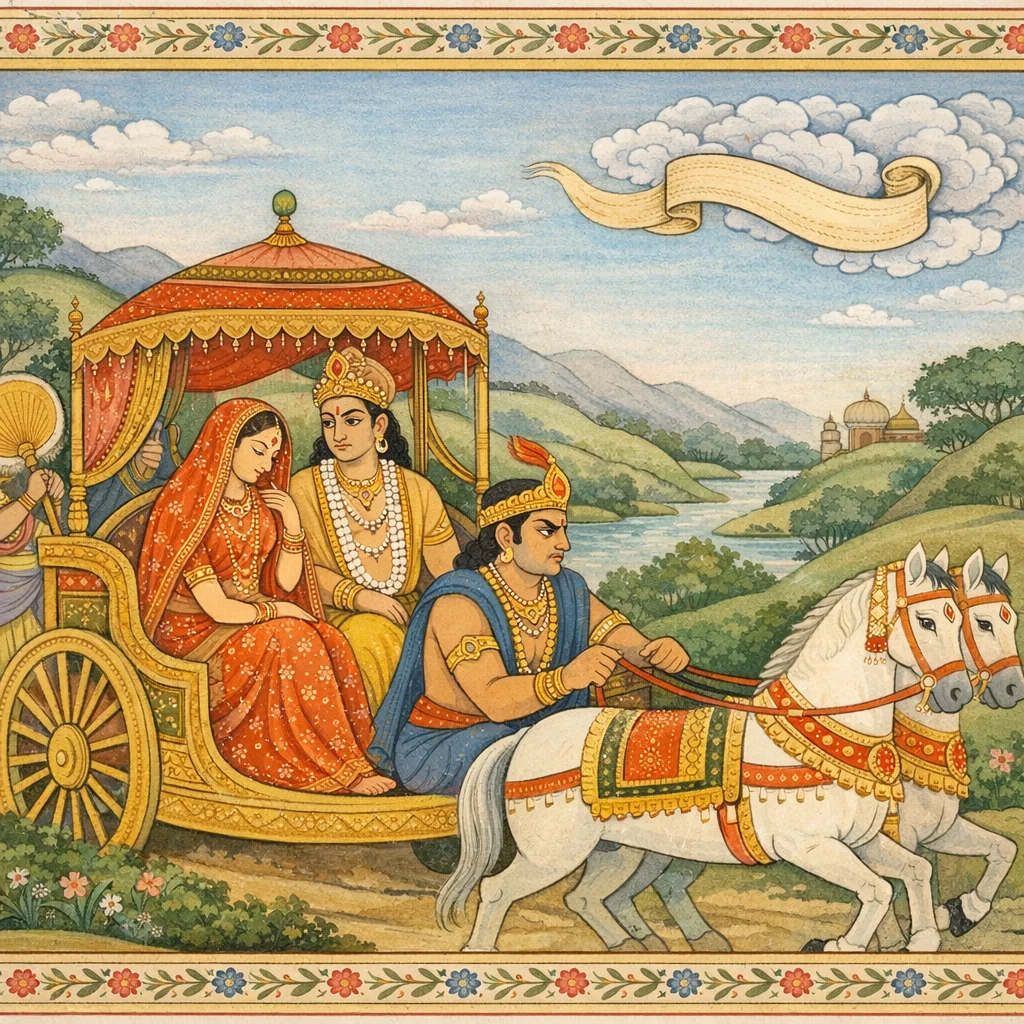
कंसस् तयोर् वररथं चोदयाम् आस सारथिः वसुदेवस्य देवक्याः संयोगे भोजवर्धनः
Then Kaṃsa himself became their charioteer and set that splendid chariot in motion. The increaser of the Bhoja line celebrated the marriage-union of Vasudeva and Devakī, unaware that this very journey was being drawn into the sovereign design of Lord Viṣṇu.
Verse 7
अथान्तरिक्षे वाग् उच्चैः कंसम् आभाष्य सादरम् मेघगम्भीरनिर्घोषं समाभाष्येदम् अब्रवीत्
Then, from the mid-sky, a loud voice—grave as the deep rumble of thunderclouds—addressed Kaṃsa with solemn force and spoke these words.
Verse 8
याम् एनां वहसे मूढ सह भर्त्रा रथे स्थिताम् अस्यास् तवाष्टमो गर्भः प्राणान् अपहरिष्यति
O fool—this very woman whom you are carrying in your chariot, seated there with her husband: her eighth child will tear away your life-breath. In the flow of time, no power, no crown, no tyranny can outrun the decree; when the Lord Viṣṇu’s purpose ripens, it arrives as destiny itself.
Verse 9
इत्य् आकर्ण्य समादाय खड्गं कंसो महाबलः देवकीं हन्तुम् आरब्धो वसुदेवो ऽब्रवीद् इदम्
Hearing this, the mighty Kaṃsa seized his sword and set about to kill Devakī; then Vasudeva spoke these words.
Verse 10
न हन्तव्या महाभाग देवकी भवता तव समर्पयिष्ये सकलान् गर्भान् अस्याउदरोद्भवान्
“O fortunate one, Devakī must not be slain by you. I shall deliver to you every child that is born from her womb.”
Verse 11
तथेत्य् आह च तं कंसो वसुदेवं द्विजोत्तम न घातयाम् आस च तां देवकीं तस्य गौरवात्
“So be it,” Kaṃsa said to Vasudeva, O best of the twice-born. Out of regard for him, he did not slay Devakī; though cruelty had seized his heart, he restrained his hand.
Verse 12
एतस्मिन्न् एव काले तु भूरिभारावपीडिता जगाम धरणी मेरौ समाजे त्रिदिवौकसाम्
At that very time, the Earth, crushed beneath an excessive burden, went to Mount Meru, to the assembled host of the dwellers of heaven, seeking relief.
Verse 13
सब्रह्मकान् सुरान् सर्वान् प्रणिपत्याथ मेदिनी कथयाम् आस तत् सर्वं खेदात् करुणभाषिणी
Then the Earth, her speech gentle with compassion yet heavy with sorrow, bowed down before all the gods, even up to Brahmā, and told them in full the cause of her distress.
Verse 14
अग्निः सुवर्णस्य गुरुर् गवां सूर्यः परो गुरुः ममाप्य् अखिललोकानां गुरुर् नारायणो गुरुः
Fire is the preceptor of gold; for cattle, the Sun is the highest guide. Yet for me—and for all worlds—Nārāyaṇa alone is the Guru, the supreme Teacher.
Verse 15
प्रजापतिपतिर् ब्रह्मा पूर्वेषाम् अपि पूर्वजः कलाकाष्ठानिमेषात्मा कालश् चाव्यक्तमूर्तिमान्
Brahmā—lord of the Prajāpatis and progenitor even of the earliest progenitors—is Time itself: the essence of kalā, kāṣṭhā, and nimeṣa, Time whose form is unmanifest.
Verse 16
तदंशभूतः सर्वेषां समूहो वः सुरोत्तमाः
O best of the gods, this entire host of you is formed from His own portion; each of you stands as a manifestation of that Supreme Reality.
Verse 17
आदित्या मरुतः साध्या रुद्रा वस्वश्विवह्नयः पितरो ये च लोकानां स्रष्टारो ऽत्रिपुरोगमाः
The Ādityas, the Maruts, the Sādhyas, the Rudras, the Vasus, the Aśvins, and the sacred Fires; and the Pitṛs too—progenitors who create and uphold the worlds, led by Atri—are here invoked and remembered in their cosmic order.
Verse 18
एतत् तस्याप्रमेयस्य रूपं विष्णोर् महात्मनः
This indeed is the manifested form of the great-souled Lord Viṣṇu—immeasurable and inconceivable, beyond all limit and measure.
Verse 19
यक्षराक्षसदैतेया पिशाचोरगदानवाः गन्धर्वाप्सरसश् चैव रूपं विष्णोर् महात्मनः
Yakṣas, Rākṣasas, Daityas, Piśācas, serpentine beings, and Dānavas—together with Gandharvas and Apsarās—are all but diverse expressions of the majestic form of the great-souled Lord Viṣṇu.
Verse 20
ग्रहर्क्षतारकाचित्रगगनाग्निजलानिलाः अहं च विषयाश् चैतत् सर्वं विष्णुमयं जगत्
Planets, constellations, and stars; the variegated expanse of the sky; fire, water, and wind—together with myself and all objects of experience: all this indeed is the universe wholly pervaded by Viṣṇu.
Verse 21
तथाप्य् अनेकरूपस्य तस्य रूपाण्य् अहर्निशम् बाध्यबाधकतां यान्ति कल्लोला इव सागरे
Yet, though He is of countless forms, those forms—day and night—ceaselessly become both sublated and sublating, like waves upon the ocean: ever arising, ever dissolving, while the ocean itself is not diminished.
Verse 22
तत्साम्प्रतम् इमे दैत्याः कालनेमिपुरोगमाः मर्त्यलोकं समाक्रम्य बाधन्ते ऽहर्निशं प्रजाः
But now these Daityas—led in the vanguard by Kālanemi—have overrun the world of mortals and torment the people day and night without respite.
Verse 23
कालनेमिर् हतो यो ऽसौ विष्णुना प्रभविष्णुना उग्रसेनसुतः कंसः संभूतः स महासुरः
He who was once Kālanemi—slain by Viṣṇu, the all-prevailing Lord—was born again as Kaṁsa, the son of Ugrasena, that mighty asura.
Verse 24
अरिष्टो धेनुकः केशी प्रलम्बो नरकस् तथा सुन्दो ऽसुरस् तथात्युग्रो बाणश् चापि बलेः सुतः
Ariṣṭa, Dhenuka, Keśin, Pralamba, and Naraka as well; likewise the asura Sunda, the exceedingly fierce one; and also Bāṇa, the son of Bali.
Verse 25
तथान्ये च महावीर्या नृपाणां भवनेषु ये समुत्पन्ना दुरात्मानस् तान् न संख्यातुम् उत्सहे
So too, there were other men of great might—born within the households of kings—yet wicked at heart; to reckon them all in number, I do not presume.
Verse 26
अक्षौहिण्यो ऽत्र बहुला दिव्यमूर्तिधराः सुराः महाबलानां दृप्तानां दैत्येन्द्राणां ममोपरि
Here are many vast armies—hosts of the gods bearing radiant divine forms—yet over me stand those lords of the Daityas, exceedingly mighty, intoxicated with pride, and swollen with power.
Verse 27
तद्भूरिभारपीडार्ता न शक्नोम्य् अमरेश्वराः बिभर्तुम् आत्मानम् अहम् इति विज्ञापयामि वः
Crushed by that immense burden, O lords of the immortals, I can no longer sustain myself; therefore I make this petition known to you.
Verse 28
क्रियतां तन् महाभागा मम भारावतारणम् यथा रसातलं नाहं गच्छेयम् अतिविह्वला
O greatly fortunate ones, do what will bring down my burden, so that I—utterly distressed—do not sink into Rasātala, the nether depths.
Verse 29
इत्य् आकर्ण्य धरावाक्यम् अशेषं त्रिदशैस् ततः भुवो भारावतारार्थं ब्रह्मा प्राह प्रचोदितः
Having fully heard the Earth’s words, Brahmā—urged by all the gods—spoke of the descent (avatāra) meant to remove the burden weighing upon the world.
Verse 30
यथाह वसुधा सर्वं सत्यम् एतद् दिवौकसः अहं भवो भवन्तश् च सर्वं नारायणात्मकम्
O dwellers of heaven, just as the Earth has declared, this is wholly true: I—Bhava—and you as well; indeed all that exists is of the very nature of Nārāyaṇa.
Verse 31
विभूतयस् तु यास् तस्य तासाम् एव परस्परम् आधिक्यन्यूनता बाध्यबाधकत्वेन वर्तते
Yet His many vibhūtis—manifestations of power—are not all of equal rank: among those very vibhūtis arise degrees of greater and lesser, functioning mutually as what is constrained and what constrains.
Verse 32
तद् आगच्छत गच्छामः क्षीराब्धेस् तटम् उत्तरम् तत्राराध्य हरिं तस्मै सर्वं विज्ञापयाम वै
“Come then—let us go to the northern shore of the Ocean of Milk. There, having worshipped Hari, we shall surely lay the whole matter before Him.”
Verse 33
सर्वदैव जगत्य् अर्थे स सर्वात्मा जगन्मयः स्वल्पांशेनावतीर्योर्व्यां धर्मस्य कुरुते स्थितिम्
For the welfare of the world, that Supreme One—Self of all beings and pervader of the universe—again and again descends to earth with but a small portion of His power, and thus establishes the steadfast continuance of Dharma.
Verse 34
इत्य् उक्त्वा प्रययौ तत्र सह देवैः पितामहः समाहितमतिश् चैनं तुष्टाव गरुडध्वजम्
Having spoken thus, Pitāmaha (Brahmā) departed from that place together with the gods; and with his mind steadied in contemplation, he praised the Lord whose banner bears Garuḍa.
Verse 35
द्वे विद्ये त्वम् अनाम्नाय परा चैवापरा तथा त एव भवतो रूपे मूर्तामूर्तात्मिके प्रभो
O Lord, You are declared to be the twofold knowledge—higher and lower; and these very two are also Your forms: the manifest and the unmanifest, O Master.
Verse 36
द्वे ब्रह्मणी त्व् अणीयो ऽतिस्थूलात्मन् सर्वसर्ववित् शब्दब्रह्मपरं चैव ब्रह्म ब्रह्ममयस्य यत्
O Self, subtle yet immense, knower of all in every way—Brahman is indeed spoken of in two modes: the supreme Brahman beyond Śabda-Brahman (the Vedic word), and that Brahman pertaining to the one whose very nature is Brahman.
Verse 37
ऋग्वेदस् त्वं यजुर्वेदः सामवेदस् त्व् अथर्व च शिक्षा कल्पो निरुक्तं च छन्दो ज्योतिषम् एव च
You are the Ṛgveda; You are the Yajurveda; You are the Sāmaveda—and the Atharvaveda as well. You are also Śikṣā, Kalpa, Nirukta, Chandas, and Jyotiṣa: all the limbs of sacred knowledge.
Verse 38
इतिहासपुराणे च तथा व्याकरणं प्रभो मीमांसा न्यायिकं तद्वद् धर्मशास्त्राण्य् अधोक्षज
O Lord, O Adhokṣaja—so too the Itihāsas and Purāṇas, grammar, Mīmāṁsā, Nyāya, and likewise the Dharma-śāstras: all these sacred disciplines are encompassed in relation to You.
Verse 39
आत्मात्मदेहगुणवद्विचाराचारि यद् वचः तद् अप्य् आद्यपते नान्यद् अध्यात्मात्मस्वरूपवत्
Whatever speech moves in reflective inquiry—speaking of the self, the inner self, the body, and the qualities—O Lord of the beginning, that too is not other than You; for it proceeds in accord with the very nature of the supreme Self within.
Verse 40
त्वम् अव्यक्तम् अनिर्देश्यम् अचिन्त्यानामवर्णवत् अपाणिपादरूपं च विष्णुर् नित्यं परात् परम्
You are the Unmanifest—beyond description, beyond the reach of thought, without any defining mark of name or form. Without hands or feet as a limiting shape, You are Vishnu, eternal—Parātpara, higher than the highest.
Verse 41
शृणोष्य् अकर्णः परिपश्यसि त्वम् अचक्षुर् एको बहुरूपरूपः अपादहस्तो जवनो ग्रहीता त्वं वेत्सि सर्वं न च सर्ववेद्यः
Though earless, You hear; though eyeless, You see all around. One alone, You assume forms of countless kinds. Though without feet or hands, You are swift to reach and sure to grasp. You know everything—yet You are not an object fully knowable to all.
Verse 42
अणोर् अणीयांसम् असत्स्वरूपं त्वां पश्यतो ऽज्ञाननिवृत्तिर् अग्र्या धीर् अस्य धीर्यस्य बिभर्ति नान्यद् वरेण्यरूपात् परतः परात्मन्
O Supreme Self beyond even the beyond—subtler than the subtlest—when one truly beholds You, whose reality is not grasped by the ordinary sense of ‘what is,’ the highest removal of ignorance arises. In that awakened steadiness, the mind rests and bears no other support; it clings to nothing apart from Your most excellent form.
Verse 43
त्वं विश्वम् आदिर् भुवनस्य गोप्ता सर्वाणि भूतानि तवान्तराणि यद् भूतभव्यं तद् अणोर् अणीयः पुमांस् त्वम् एकः प्रकृतेः परस्तात्
You are the universe itself—the primal source and the guardian of all worlds. All beings abide within You. Whatever is past and whatever is yet to come is contained in You; subtler than the subtlest atom, You alone are the one Supreme Person, transcending material Nature (prakṛti).
Verse 44
एकश् चतुर्धा भगवान् हुताशो वर्चोविभूतिं जगतो ददाति त्वं विश्वतश् चक्षुर् अनन्तमूर्ते त्रेधा पदं त्वं निदधे विधातः
Though One, the Blessed Lord—manifest as the sacred Fire—becomes fourfold and bestows upon the world its radiance, vitality, and splendor. You are the all-encompassing Eye of the universe, O Infinite-Formed One; and as the Ordainer of all, You set Your station in threefold measure, establishing the very order by which the cosmos is sustained.
Verse 45
यथाग्निर् एको बहुधा समिध्यते विकारभेदैर् अविकाररूपः तथा भवान् सर्वगतैकरूपो रूपाण्य् अनेकान्य् अनुपुष्यतीशः
Just as fire is one, yet is kindled in many ways—appearing as diverse through different conditions, while its own nature remains unchanged—so too are You: the one Lord who pervades all, ever of a single essence, sustaining and animating many forms without ceasing to be the sovereign One.
Verse 46
एकस् त्वम् अग्र्यं परमं पदं यत् पश्यन्ति त्वां सूरयो ज्ञानदृश्यम् त्वत्तो नान्यत् किंचिद् अस्ति स्वरूपं यद् वा भूतं यच् च भव्यं परात्मन्
You alone are the Supreme—the foremost, the highest state—beheld by the seers as the very object of true knowledge. Apart from You there exists nothing whatsoever as an independent reality: whatever has been, and whatever is yet to be, is only Your own essential nature, O Supreme Self.
Verse 47
व्यक्ताव्यक्तस्वरूपस् त्वं समष्टिव्यष्टिरूपवान् सर्वज्ञः सर्वदृक् सर्वशक्तिज्ञानबलर्द्धिमान्
You are of the nature of both the manifest and the unmanifest; You are the One who appears as the totality and as the individual. All-knowing, all-seeing, You possess every power—endowed with knowledge, strength, and sovereign plenitude.
Verse 48
अन्यूनश् चाप्य् अवृद्धिश् च स्वाधीनो ऽनादिमान् वशी क्लमतन्द्रीभयक्रोधकामादिभिर् असंयुतः
He is never diminished, nor does He ever increase. Self-ruled and independent, beginningless, and the sovereign controller, He is untouched by fatigue, sloth, fear, anger, desire, and all such limiting conditions.
Verse 49
निरवद्यः परः शान्तो निरधिष्ठो ऽक्षरः क्रमः सर्वेश्वर पराधार धाम्नां धामात्मको ऽक्षयः
He is flawless, supreme, and tranquil; without any governing superior, the imperishable ground of all orderly succession. The Lord of all, the highest support, He is the very essence of every abode—Himself the ultimate Abode—unchanging and undecaying.
Verse 50
सकलावरणातीत निरालम्बनभावन महाविभूतिसंस्थान नमस् ते पुरुषोत्तम
Salutations to You, O Puruṣottama—beyond every veil and covering, the supportless Support who upholds all; the abiding ground of immeasurable majesty and sovereign power.
Verse 51
नाकारणात् कारणाद् वा कारणाकारणान् न च शरीरग्रहणं व्यापिन् धर्मत्राणाय ते परम्
O all-pervading Lord, Your assuming a body is not driven by causelessness, nor by any cause, nor by a blend of cause and no-cause; it is undertaken solely for the supreme aim of protecting Dharma.
Verse 52
इत्य् एवं संस्तवं श्रुत्वा मनसा भगवान् अजः ब्रह्माणम् आह विश्वात्मा विश्वरूपधरो हरिः
Thus hearing that hymn of praise within His own awareness, the Blessed Lord Hari—unborn, the Self of the universe and bearer of the universe-form—then addressed Brahmā.
Verse 53
भो भो ब्रह्मंस् त्वया मत्तः सह देवैर् यद् इष्यते तद् उच्यताम् अशेषं च सिद्धम् एवावधार्यताम्
“O Brahman—yes, O Brahman—whatever you, together with the gods, desire from Me, speak it. Declare it fully, omitting nothing; and know it as already accomplished.”
Verse 54
ततो ब्रह्मा हरेर् दिव्यं विश्वरूपं समीक्ष्य तत् तुष्टाव भूयो देवेषु साध्वसावनतात्मसु
Then Brahmā, beholding Hari’s divine, all-encompassing cosmic form, praised Him anew; and the hosts of gods stood humbled, their minds bowed in reverent awe.
Verse 55
नमो नमस् ते ऽस्तु सहस्रमूर्ते सहस्रबाहो बहुवक्त्रपाद नमो नमस् ते जगतः प्रवृत्ति विनाशसंस्थानकराप्रमेय
Salutations—again and again—to You of a thousand forms; to You of a thousand arms, with manifold faces and feet. Salutations—again and again—to You, immeasurable One, who impel the universe’s unfolding and who also bring about its dissolution and its ordered continuance.
Verse 56
सूक्ष्मातिसूक्ष्मातिबृहत्प्रमाण गरीयसाम् अप्य् अतिगौरवात्मन् प्रधानबुद्धीन्द्रियवत्प्रधान मूलात् परात्मन् भगवन् प्रसीद
O Bhagavān, whose measure is subtler than the subtlest and vaster than the vast; O innermost Self, weightier in majesty than the most weighty—O Supreme Soul, root of Pradhāna, Buddhi, and the senses, and even of that which transcends Pradhāna: be gracious; be pleased.
Verse 57
एषा मही देव महीप्रसूतैर् महासुरैः पीडितशैलबन्धा परायणं त्वां जगताम् उपैति भारावतारार्थम् अपारपारम्
O Deva, this Earth—bound down by mountains and oppressed by mighty Asuras born of the Earth—now approaches You, the supreme refuge of all worlds, the limitless One beyond all bounds, seeking You to lighten the burden that has grown upon her.
Verse 58
एते वयं वृत्ररिपुस् तथायं नासत्यदस्रौ वरुणस् तथैषः इमे च रुद्रा वसवः ससूर्याः समीरणाग्निप्रमुखास् तथान्ये
“These are we; and this one is Vṛtra’s slayer (Indra). Here too are the Nāsātyas and Dasras (the Aśvins), and this is Varuṇa. These are the Rudras, the Vasus, and the Sun as well; and likewise the others—foremost among them Vāyu and Agni.”
Verse 59
सुराः समस्ताः सुरनाथ कार्यम् एभिर् मया यच् च तद् ईश सर्वम् आज्ञापयाज्ञां परिपालयन्तस् तथैव तिष्ठाम सदास्तदोषाः
“O Lord of the gods, all the Devas together declare: whatever task is to be accomplished by us—indeed, whatever is ours to do—belongs wholly to You, the Supreme Ruler. Command us; and, keeping faithfully to Your command, we shall remain ever as we are—free from fault—established in obedience to Your ordinance.”
Verse 60
एवं संस्तूयमानस् तु भगवान् परमेश्वरः उज्जहारात्मनः केशौ सितकृष्णौ महामुने
Thus praised with hymns, the Blessed Lord—the Supreme Sovereign—drew forth from His own being two hairs, O great sage: one white and one black.
Verse 61
उवाच च सुरान् एतौ मत्केशौ वसुधातले अवतीर्य भुवो भारक्लेशहानिं करिष्यतः
He said to the gods: “These two hairs of Mine shall descend to the earth; taking birth in the world, they will remove the affliction born of the earth’s burden.”
Verse 62
सुराश् च सकलाः स्वांशैर् अवतीर्य महीतले कुर्वन्तु युद्धम् उन्मत्तैः पूर्वोत्पन्नैर् महासुरैः
“Let all the gods, descending to the earth with portions of their own divine power, wage war against those frenzied, mighty Asuras born in former times.”
Verse 63
ततः क्षयम् अशेषास् ते दैतेया धरणीतले प्रयास्यन्ति न संदेहो मद्दृक्पातविचूर्णिताः
Thereafter, upon the earth, all those Daityas will go to utter ruin—of this there is no doubt—for they are crushed to dust by the mere fall of My glance.
Verse 64
वसुदेवस्य या पत्नी देवकी देवतोपमा तस्यायम् अष्टमो गर्भो मत्केशो भविता सुराः
O gods, Devakī—Vasudeva’s wife, radiant like a goddess—will bear an eighth child; that very eighth womb shall become My own manifestation in the form of My hair.
Verse 65
अवतीर्य च तत्रायं कंसं घातयिता भुवि कालनेमिं समुद्भूतम् इत्य् उक्त्वान्तर्दधे हरिः
“Descending there, He will strike down Kaṃsa upon the earth—Kaṃsa, who has arisen from Kālanemi.” Having spoken thus, Hari disappeared from sight.
Verse 66
अदृश्याय ततस् ते ऽपि प्रणिपत्य महात्मने मेरुपृष्ठं सुरा जग्मुर् अवतेरुश् च भूतले
Then they too bowed in reverence to that great-souled One who had become unseen; the gods went to the ridge of Mount Meru, and thereafter descended again to the earth.
Verse 67
कंसाय चाष्टमे गर्भे देवक्यां धरणीधरः भविष्यतीत्य् आचचक्षे भगवान् नारदो मुनिः
And to Kaṁsa the venerable sage Nārada declared: “In Devakī’s eighth pregnancy, the Upholder of the Earth (Lord Viṣṇu) will be born.”
Verse 68
कंसो ऽपि तद् उपश्रुत्य नारदात् कुपितस् ततः देवकीं वसुदेवं च गृहे गुप्ताव् अधारयत्
Hearing this from Nārada, Kaṁsa became enraged; he then kept Devakī and Vasudeva confined within his house, under secret guard.
Verse 69
जातं जातं च कंसाय तेनैवोक्तं यथा पुरा तथैव वसुदेवो ऽपि पुत्रम् अर्पितवान् द्विज
O brāhmaṇa, each time a child was born, just as had been declared earlier, Vasudeva—true to that very word—handed the newborn son over to Kaṁsa.
Verse 70
हिरण्यकशिपोः पुत्राः षड्गर्भा इति विश्रुताः विष्णुप्रयुक्ता तान् निद्रा क्रमाद् गर्भे न्ययोजयत्
Hiraṇyakaśipu’s sons—renowned as the “Six Embryos” (Ṣaḍgarbha)—were, by the will of Lord Viṣṇu, placed again within the womb, one after another, by the goddess Nidrā.
Verse 71
योगनिद्रा महामाया वैष्णवी मोहितं यया अविद्यया जगत् सर्वं ताम् आह भगवान् हरिः
That divine Yogic Slumber—Mahāmāyā, the Vaiṣṇavī power—by which, through ignorance, the whole universe is deluded: her indeed Bhagavān Hari proclaims as His own potency.
Verse 72
निद्रे गच्छ ममादेशात् पातालतलसंश्रयान् एकैकश्येन षड् गर्भान् देवकीजठरं नय
“O Nidrā, go forth at My command. Take, one by one, the six embryos abiding in the nether regions, and place them into the womb of Devakī.”
Verse 73
हतेषु तेषु कंसेन शेषाख्यो ऽंशस् ततो मम अंशांशेनोदरे तस्याः सप्तमः संभविष्यति
When those (earlier children) have been slain by Kaṃsa, then an emanated portion of Mine—known as Śeṣa—will, by a further fractional manifestation, become the seventh conception in her womb.
Verse 74
गोकुले वसुदेवस्य भार्यान्या रोहिणी स्थिता तस्याः स संभूतिसमं देवि नेयस् त्वयोदरम्
In Gokula dwells Rohiṇī, another wife of Vasudeva. O goddess, the one who is to be born as her equal in birth is to be led by you into her womb.
Verse 75
सप्तमो भोजराजस्य भयाद् रोधोपरोधतः देवक्याः पतितो गर्भ इति लोको वदिष्यति
“Through fear of the Bhoja-king, and because of the harsh confinement and obstruction, people will say, ‘Devakī’s seventh pregnancy has fallen’.”}]}
Verse 76
गर्भसंकर्षणात् सो ऽथ लोके संकर्षणेति वै संज्ञाम् अवाप्स्यते वीरः श्वेताद्रिशिखरोपमः
Because he draws forth and gathers the embryo of existence, that heroic one shall indeed gain in the world the name “Saṃkarṣaṇa,” radiant and towering like the peak of the White Mountain.
Verse 77
ततो ऽहं संभविष्यामि देवकीजठरे शुभे गर्भे त्वया यशोदाया गन्तव्यम् अविलम्बितम्
Thereafter I shall manifest within the auspicious womb of Devakī; and you must, without delay, go into the womb of Yaśodā.
Verse 78
प्रावृट्काले च नभसि कृष्णाष्टम्याम् अहं निशि उत्पत्स्यामि नवम्यां च प्रसूतिं त्वम् अवाप्स्यसि
In the rainy season, in the month of Nabhas, on the dark eighth lunar day—at night—I shall take birth; and on the ninth, you shall attain the blessed event of childbirth.
Verse 79
यशोदाशयने मां तु देवक्यास् त्वाम् अनिन्दिते मच्छक्तिप्रेरितमतिर् वसुदेवो नयिष्यति
But you, blameless one—Vasudeva, whose resolve is impelled by My own divine power, will carry Me away to the bedchamber of Yaśodā, and will bring you from Devakī in exchange.
Verse 80
कंसश् च त्वाम् उपादाय देवि शैलशिलातले प्रक्षेप्स्यत्य् अन्तरिक्षे च त्वं स्थानं समवाप्स्यसि
And Kamsa, O Goddess, will seize you and hurl you upon the rocky surface of the mountain; yet even in mid-air you shall attain your destined station.
Verse 81
ततस् त्वां शतदृक् छक्रः प्रणम्य मम गौरवात् प्रणिपातानतशिरा भगिनीत्वे ग्रहीष्यति
Then Shatakratu (Indra), the wielder of the discus, will bow to you out of regard for me; and with his head bent low in full prostration, he will accept you as his sister.
Verse 82
ततः शुम्भनिशुम्भादीन् हत्वा दैत्यान् सहस्रशः स्थानैर् अनेकैः पृथिवीम् अशेषां मण्डयिष्यसि
Then, having slain Shumbha and Nishumbha and countless other Daityas by the thousands, you will adorn the entire earth—without remainder—by establishing many sacred sites.
Verse 83
त्वं भूतिः सन्नतिः कीर्तिः क्षान्तिर् द्यौः पृथिवी धृतिः लज्जा पुष्टिर् उषा या च काचिद् अन्या त्वम् एव सा
You are prosperity; you are reverent humility; you are fame. You are forbearance; you are the heaven and the earth; you are steadfastness. You are modesty; you are nourishment; you are the dawn.
Verse 84
ये त्वाम् आर्येति दुर्गेति वेदगर्भे ऽम्बिकेति च भद्रेति भद्रकालीति क्षेम्या क्षेमकरीति च
Those who praise you by these sacred names—“Arya,” “Durga,” “Vedagarbha,” “Ambika,” “Bhadra,” “Bhadrakali,” “Kshemya,” and “Kshemakari”—invoke your protecting power.
Verse 85
प्रातश् चैवापराह्णे च स्तोष्यन्त्य् आनम्रमूर्तयः तेषां हि प्रार्थितं सर्वं मत्प्रसादाद् भविष्यति
In the morning and again in the afternoon, with forms bowed in reverence, they shall praise you. For whatever they pray for shall come to be through My grace alone.
Verse 86
सुरामांसोपहारैस् तु भक्ष्यभोज्यैश् च पूजिता नॄणाम् अशेषकामांस् त्वं प्रसन्ना संप्रदास्यसि
When you are worshipped with offerings of liquor and meat, and with foods to be eaten and enjoyed, you—being pleased—will bestow upon people the complete fulfilment of their desires.
Verse 87
ते सर्वे सर्वदा भद्रे मत्प्रसादाद् असंशयम् असंदिग्धा भविष्यन्ति गच्छ देवि यथोदितम्
“O auspicious one, by my grace, all of them will, at all times, become free from doubt—certain and unconfused. Go, O goddess, just as has been spoken.”
Frequently Asked Questions
The celestial voice warns Kaṁsa that Devakī’s eighth child will take his life. This prophecy drives Kaṁsa’s imprisonment of Devakī and Vasudeva and sets the stage for Viṣṇu’s avatāra-līlā.
Because Bhūdevī’s burden is presented as a cosmic imbalance requiring divine intervention. Brahmā and the devas worship Hari at Kṣīrābdhi to petition the Supreme Jagat-kāraṇa, who alone can re-establish dharma.
Saṅkarṣaṇa is identified as an aṁśa of Viṣṇu known as Śeṣa, destined to become the ‘seventh’ conception—transferred to Rohiṇī—hence the name Saṅkarṣaṇa (“drawing together/transfer of the embryo”).