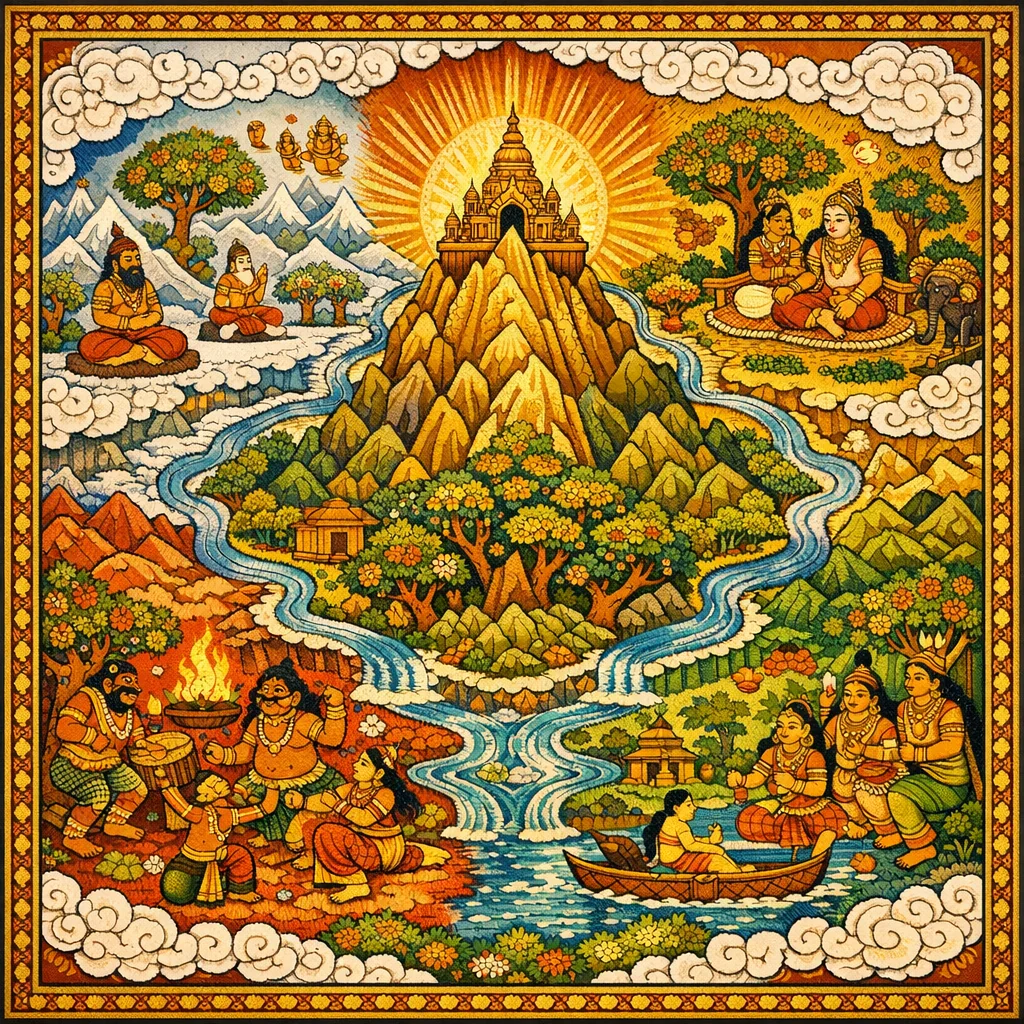
Adhyaya 113: Cosmography of Jambūdvīpa: Varṣas, Mountains, Meru’s Measurements, and Ideal Lands
जम्बूद्वीप-वर्षविभाग-मेर्वादि-प्रमाणवर्णनम्
Speaker: Rishis, Suta
The sages ask Sūta for the complete cosmic arrangement—dvīpas, oceans, mountains, varṣas, and rivers—along with Lokāloka and the motions of the sun and moon. Sūta admits the vastness of the topic, distinguishes measurable, knowable dimensions from what is acintya beyond prakṛti, and then gives an ordered account of Jambūdvīpa: its total extent, the mountains that divide the varṣas, Meru’s location and measurements, and the surrounding lands with their distinctive peoples, lifespans, and sustaining trees. Still inquisitive, the sages request the northern varṣas and mountain-dwellers; Sūta continues with details of Ramaṇaka/Hiraṇvata and Uttara-Kuru-like ideals, concluding that this is the observed natural order for Bhārata’s varṣa-structure in the present age, after which the sages again ask for further recitation.
Key Concepts
Shlokas in Adhyaya 113
Verse 1
*ऋषय ऊचुः कति द्वीपाः समुद्रा वा पर्वता वा कति प्रभो कियन्ति चैव वर्षाणि तेषु नद्यश्च काः स्मृताः //
The sages said: “O Lord, how many continents (dvīpas) are there, and how many oceans and mountains? How many regions (varṣas) are there as well—and which rivers are traditionally remembered within them?”
Verse 2
महाभूमिप्रमाणं च लोकालोकस्तथैव च पर्याप्तिं परिमाणं च गतिश्चन्द्रार्कयोस्तथा //
“(I shall describe) the vast measure of the Earth, and likewise the Lokāloka (mountain boundary); its extent and dimensions, and also the courses (motions) of the Moon and the Sun.”
Verse 3
एतद्ब्रवीहि नः सर्वं विस्तरेण यथार्थवित् त्वदुक्तमेतत्सकलं श्रोतुमिच्छामहे वयम् //
O knower of the truth, tell us all of this in full detail. We wish to hear completely everything that has been spoken by you.
Verse 4
*सूत उवाच द्वीपभेदसहस्राणि सप्त चान्तर्गतानि च न शक्यन्ते क्रमेणेह वक्तुं वै सकलं जगत् //
Sūta said: The thousands of divisions of the continents (dvīpas)—and the seven that are contained within them—cannot be fully spoken here in due sequence; indeed, the whole world cannot be recounted in its entirety.
Verse 5
सप्तैव तु प्रवक्ष्यामि चन्द्रादित्यग्रहैः सह तेषां मनुष्यतर्केण प्रमाणानि प्रचक्षते //
“I shall explain only the seven (planets), together with the Moon and the Sun; and I shall state their measures (and the validating computations) as they are ascertained through human reasoning.”
Verse 6
अचिन्त्याः खलु ये भावास् तांस्तु तर्केण साधयेत् प्रकृतिभ्यः परं यच्च तदचिन्त्यस्य लक्षणम् //
Truly, those realities that are inconceivable (acintya) are not to be established by mere reasoning. Whatever lies beyond all prakṛtis—beyond material nature—that is the defining mark of the Inconceivable.
Verse 7
सप्त वर्षाणि वक्ष्यामि जम्बूद्वीपं यथाविधम् विस्तरं मण्डलं यच्च योजनैस्तान्निबोधत //
I shall now describe, in due order, Jambūdvīpa with its seven regions (varṣas)—its breadth, its circular expanse, and its measurements in yojanas; listen and understand.
Verse 8
योजनानां सहस्राणि शतं द्वीपस्य विस्तरः नानाजनपदाकीर्णं पुरैश्च विविधैः शुभैः //
The expanse of that island-continent is one hundred thousand yojanas; it is filled with many provinces (janapadas) and adorned with various auspicious cities.
Verse 9
सिद्धचारणसंकीर्णं पर्वतैरुपशोभितम् सर्वधातुपिनद्धैस्तैः शिलाजालसमुद्गतैः //
It is thronged with Siddhas and Cāraṇas, and made splendid by mountains—peaks sheathed in every kind of mineral, rising up like lattices and networks of rock.
Verse 10
पर्वतप्रभवाभिश्च नदीभिस्तु समन्ततः प्रागायता महापार्श्वाः षडिमे वर्षपर्वताः //
Encircled on every side by rivers born of the mountains, these six Varṣa-mountains stretch eastward and possess vast flanks.
Verse 11
अवगाह्य ह्युभयतः समुद्रौ पूर्वपश्चिमौ हिमप्रायश्च हिमवान् हेमकूटश्च हेमवान् //
Plunging down on both sides into the eastern and western oceans, there lie the snow-laden Himavān, and also Hemakūṭa, together with Hemavān.
Verse 12
सर्वतः सुमुखश्चापि निषधः पर्वतो महान् चातुर्वर्ण्यस्तु सौवर्णो मेरुश्चोल्बमयः स्मृतः चतुर्विंशत्सहस्राणि विस्तीर्णः स चतुर्दिशम् //
On every side stands the great Niṣadha mountain, fair in aspect. Meru, too, is remembered as golden and of fourfold hue, formed of compact, solid substance; it extends twenty-four thousand yojanas in breadth toward the four directions.
Verse 13
वृत्ताकृतिप्रमाणश्च चतुरस्रः समाहितः नानावर्णैः समः पार्श्वैः प्रजापतिगुणान्वितः //
Its measure is fixed by a circular proportion, yet it is arranged as a well-composed square; its sides are equal, marked with various colors, and it is endowed with the qualities of Prajāpati, the Lord of creation.
Verse 14
नाभीबन्धनसम्भूतो ब्रह्मणो ऽव्यक्तजन्मनः पूर्वतः श्वेतवर्णस्तु ब्राह्मण्यं तस्य तेन वै //
Born from the navel-bond of Brahmā, whose origin is unmanifest, there arose first one of white complexion; and by that very mark his Brahmin status is affirmed.
Verse 15
पीतश्च दक्षिणेनासौ तेन वैश्यत्वमिष्येत भृङ्गिपत्त्रीनभश् चैव पश्चिमेन समन्वितः तेनास्य शूद्रता सिद्धा मेरोर् नामार्थकर्मतः //
If it is yellow on the southern side, then Vaishya-hood is to be understood. And if on the western side it bears the ‘bhṛṅgī-leaf’ mark and a cloud-like hue, then its Shudra-hood is established—according to the name, meaning, and function connected with Meru.
Verse 16
पार्श्वमुत्तरतस्तस्य रक्तवर्णं स्वभावतः तेनास्य क्षत्रभावः स्याद् इति वर्णाः प्रकीर्तिताः //
On his northern side, the flank is naturally red in color; therefore it is said that a Kṣatriya disposition arises in him—thus the varṇas are described.
Verse 17
नीलश्च वैडूर्यमयः श्वेतः पीतो हिरण्मयः मयूरबर्हवर्णश्च शातकौम्भः स शृङ्गवान् //
Blue, made of vaidūrya (cat’s-eye/beryl); white; yellow, made of gold; and peacock-plume-hued—such is that śātakumbha (a superior kind of gold), and it is described as ‘horned’ (i.e., having prominent projections).
Verse 18
एते पर्वतराजानः सिद्धचारणसेविताः तेषामन्तरविष्कम्भो नवसाहस्रमुच्यते //
These royal mountains are attended by Siddhas and Cāraṇas; the breadth of the intervening space between them is said to be nine thousand (yojanas).
Verse 19
मध्ये त्विलावृतं नाम महामेरोः समन्ततः चतुर्विंशत्सहस्राणि विस्तीर्णो योजनैः समः //
In the middle lies the region called Ilāvṛta; encircling the great Mount Meru (Mahāmeru) on every side, it extends evenly for twenty‑four thousand yojanas in breadth.
Verse 20
मध्ये तस्य महामेरुर् विधूम इव पावकः वेद्यर्धं दक्षिणं मेरोर् उत्तरार्धं तथोत्तरम् //
At its center stands the great Mount Meru, like a smokeless fire. Of the Vedi (the cosmic altar‑region), one half lies to the south of Meru, and likewise the other half lies to the north.
Verse 21
वर्षाणि यानि सप्तात्र तेषां वै वर्षपर्वताः द्वे द्वे सहस्रे विस्तीर्णा योजनैर्दक्षिणोत्तरम् //
Here, the regions (varṣas) are said to be seven; and the mountains that bound those varṣas extend two thousand yojanas in breadth, stretching from south to north.
Verse 22
जम्बूद्वीपस्य विस्तारस् तेषामायाम उच्यते नीलश्च निषधश्चैव तेषां हीनाश्च ये परे //
The breadth of Jambūdvīpa and the length of those regions are being described. Among its ranges are the Nīla and Niṣadha mountains, and also those other ranges that are smaller than them.
Verse 23
श्वेतश्च हेमकूटश्च हिमवाञ्छृङ्गवांश्च यः जम्बूद्वीपप्रमाणेण ऋषभः परिकीर्त्यते //
Śveta, Hemakūṭa, Himavān, and Śṛṅgavān—these mountain ranges are described; and, in terms of Jambūdvīpa’s measured extent, Ṛṣabha is also renowned as a defining range.
Verse 24
तस्माद्द्वादशभागेन हेमकूटो ऽपि हीयते हिमवान्विंशभागेन तस्मादेव प्रहीयते अष्टाशीतिसहस्राणि हेमकूटो महागिरिः //
Therefore, Hemakūṭa too is diminished by one-twelfth according to that measure; and Himavān, by that very standard, is diminished by one-twentieth. Hemakūṭa—the great mountain—has an extent of eighty-eight thousand.
Verse 25
अशीतिर्हिमवाञ्छैल आयतः पूर्वपश्चिमे द्वीपस्य मण्डलीभावाद् ध्रासवृद्धी प्रकीर्तिते //
The Himavān mountain-range extends eighty (yojanas) from east to west. And because the continent assumes the form of a circular disc, its decrease and increase (in breadth) are described.
Verse 26
वर्षाणां पर्वतानां च यथाभेदं तथोत्तरम् तेषां मध्ये जनपदास् तानि वर्षाणि सप्त वै //
Now, in due order, I shall describe the distinct divisions of the regions (varṣas) and the mountains; and within those divisions lie the countries (janapadas). Indeed, those regions are seven in number.
Verse 27
प्रपातविषमैस्तैस्तु पर्वतैरावृतानि तु सप्त तानि नदीभेदैर् अगम्यानि परस्परम् //
Those seven (regions) are enclosed by mountains made perilous with steep precipices; and, divided by distinct river-systems, they are mutually difficult to reach from one another.
Verse 28
वसन्ति तेषु सत्त्वानि नानाजातीनि सर्वशः इमं हैमवतं वर्षं भारतं नाम विश्रुतम् //
In these regions dwell living beings of many kinds, in every way and everywhere. This Haimavata land is renowned by the name Bhārata.
Verse 29
हेमकूटं परं तस्मान् नाम्ना किम्पुरुषं स्मृतम् हेमकूटाच्च निषधं हरिवर्षं तदुच्यते //
Beyond that lies Hemakūṭa; the region there is remembered by the name Kimpuruṣa-varṣa. And from Hemakūṭa up to Niṣadha, that tract is called Hari-varṣa.
Verse 30
हरिवर्षात्परं चापि मेरोस्तु तदिलावृतम् इलावृतात्परं नीलं रम्यकं नाम विश्रुतम् //
Beyond Hari-varṣa lies Ilāvṛta, belonging to Mount Meru; and beyond Ilāvṛta is the celebrated region called Ramyaka, by the mountain Nīla.
Verse 31
रम्यकादपरं श्वेतं विश्रुतं तद्धिरण्यकम् हिरण्यकात्परं चैव शृङ्गशाकंकुरं स्मृतम् //
Beyond Ramyaka lies the famed Śveta region, known as Hiraṇyaka; and beyond Hiraṇyaka, the land called Śṛṅgaśākāṅkura is remembered.
Verse 32
धनुःसंस्थे तु विज्ञेये देवर्षे दक्षिणोत्तरे दीर्घाणि तस्य चत्वारि मध्यमं तदिलावृतम् //
O divine seer, know that in the bow-shaped disposition, the axis runs from south to north. Its length is to be taken as four measures; and the middle portion of that arrangement is Ilāvṛta.
Verse 33
पूर्वतो निषधस्येदं वेद्यर्धं दक्षिणं स्मृतम् परं त्विलावृतं पश्चाद् वेद्यर्धं तु तदुत्तरम् //
To the east of Niṣadha lies the southern half of the Vedi (the sacred enclosure), as tradition states; beyond it is Ilāvṛta. To the west, however, is the northern half of that same Vedi.
Verse 34
तयोर्मध्ये तु विज्ञेयो मेरुर्यत्र त्विलावृतम् दक्षिणेन तु नीलस्य निषधस्योत्तरेण तु //
Between those two mountain ranges one should understand Mount Meru to be situated—where the region called Ilāvṛta lies—placed to the south of the Nīla mountain and to the north of the Niṣadha mountain.
Verse 35
उदगायतो महाशैलो माल्यवान्नाम पर्वतः द्वात्रिंशता सहस्रेण प्रतीच्यां सागरानुगः //
To the north rises the great mountain named Mālyavān; it extends for thirty-two thousand (yojanas) and, in the western direction, runs on until it meets the ocean.
Verse 36
माल्यवान्वै सहस्रैक आ नीलनिषधायतः द्वात्रिंशत्त्वेवमप्युक्तः पर्वतो गन्धमादनः //
Mālyavān Mountain extends for a thousand (yojanas) up to the Nīla and Niṣadha ranges; likewise, Gandhamādana Mountain is also described as being thirty-two (yojanas in extent).
Verse 37
परिमण्डलयोर्मध्ये मेरुः कनकपर्वतः चातुर्वर्ण्यसमो वर्णैश् चतुरस्रः समुच्छ्रितः //
Between the two circular regions stands Meru, the golden mountain—lofty and four-sided—its hues corresponding to the four varṇas.
Verse 38
नानावर्णः स पार्श्वेषु पूर्वान्ते श्वेत उच्यते पीतं तु दक्षिणं तस्य भृङ्गिपत्त्रनिभं परम् उत्तरं तस्य रक्तं वै इति वर्णसमन्वितः //
He is described as multicolored on the sides: at the eastern end he is said to be white; on his southern side he is yellow, like the wing of the bhṛṅgi bee; and on his northern side he is indeed red—thus endowed with the prescribed colors.
Verse 39
मेरुस्तु शुशुभे दिव्यो राजवत्स तु वेष्टितः आदित्यतरुणाभासो विधूम इव पावकः //
The divine Mount Meru shone in splendour—encircled like a royal rampart—radiant with the fresh glow of the rising sun, like a smokeless fire.
Verse 40
योजनानां सहस्राणि चतुराशीतिसूच्छ्रितः प्रविष्टः षोडशाधस्ताद् अष्टाविंशतिविस्तृतः //
Its height is described as eighty-four thousand yojanas; it extends sixteen yojanas downward, and its breadth is twenty-eight yojanas.
Verse 41
विस्तराद्द्विगुणश्चास्य परीणाहः समन्ततः स पर्वतो महादिव्यो दिव्यौषधिसमन्वितः //
All around, the mountain’s girth is twice its breadth. That mountain is supremely divine, endowed with celestial herbs.
Verse 42
भुवनैरावृतः सर्वैर् जातरूपपरिष्कृतैः तत्र देवगणाश्चैव गन्धर्वासुरराक्षसाः शैलराजे प्रमोदन्ते सर्वतो ऽप्सरसां गणैः //
Encompassed on every side by resplendent heavenly worlds, adorned with gold, there on the king of mountains the hosts of gods—together with Gandharvas, Asuras, and Rākṣasas—rejoice, surrounded everywhere by companies of Apsarases.
Verse 43
स तु मेरुः परिवृतो भुवनैर्भूतभावनैः यस्येमे चतुरो देशा नानापार्श्वेषु संस्थिताः //
That Mount Meru is encircled by the worlds—those that nurture all beings; and upon its various sides are situated these four regions (quarters).
Verse 44
भद्राश्वं भारतं चैव केतुमालं च पश्चिमे उत्तराश्चैव कुरवः कृतपुण्यप्रतिश्रयाः //
Bhadrāśva and Bhārata, and also Ketumāla in the west; likewise the Northern Kurus—these are dwellings and sacred refuges for those whose merit has already been fulfilled.
Verse 45
विष्कम्भपर्वतास्तद्वन् मन्दरो गन्धमादनः विपुलश्च सुपार्श्वश्च सर्वरत्नविभूषिताः //
Likewise there are the supporting, buttress-like mountains: Mandara, Gandhamādana, Vipula, and Supārśva—each adorned with every kind of precious gem.
Verse 46
अरुणोदं मानसं च सितोदं भद्रसंज्ञितम् तेषामुपरि चत्वारि सरांसि च वनानि च //
There are the lakes Aruṇoda, Mānasā, Sitoda, and the one known as Bhadra; and above them are four more lakes, together with forests.
Verse 47
तथा भद्रकदम्बस्तु पर्वते गन्धमादने जम्बूवृक्षस्तथाश्वत्थो विपुले ऽथ वटः परम् //
Likewise, the auspicious kadamba stands upon Mount Gandhamādana; there too are the jambu tree and the aśvattha (sacred fig); and on the vast Mount Vipula is found the supreme vaṭa (banyan).
Verse 48
गन्धमादनपार्श्वे तु पश्चिमे ऽमरगण्डिकः द्वात्रिंशच्च सहस्राणि योजनैः सर्वतः समः //
To the west, beside Gandhamādana, lies (the mountain or region called) Amaragaṇḍika; it extends uniformly on all sides for thirty-two thousand yojanas.
Verse 49
तत्र ते शुभकर्माणः केतुमालाः परिश्रुताः तत्र कालानलाः सर्वे महासत्त्वा महाबलाः //
There, the people of Ketumāla are famed for their auspicious deeds; and there, all the Kālānalas are mighty beings—great in spirit and great in strength.
Verse 50
स्त्रियश् चोत्पलवर्णाभाः सुन्दर्यः प्रियदर्शनाः तत्र दिव्यो महावृक्षः पनसः पत्त्रभासुरः //
There were women there, lotus-hued in complexion—beautiful and delightful to behold. In that place stood a divine, great tree: a jackfruit tree (panasa), radiant with shining leaves.
Verse 51
तस्य पीत्वा फलरसं संजीवन्ति समायुतम् तस्य माल्यवतः पार्श्वे पूर्वे पूर्वा तु गण्डिका द्वात्रिंशच्च सहस्राणि तत्रापि शतमुच्यते //
Having drunk its fruit-juice, they are restored to life in full vigor. To the east of Mount Mālyavat, further eastward, lies a place (or river) called Gaṇḍikā; its extent is said to be thirty-two thousand, and there too an additional hundred is mentioned.
Verse 52
भद्राश्वस्तत्र विज्ञेयो नित्यं मुदितमानसः भद्रमालवनं तत्र कालाम्रश्च महाद्रुमः //
There, the region known as Bhadrāśva is to be recognized—its inhabitants ever of joyful mind. In that land is the Bhadramāla grove, and also the great tree called Kālāmrā.
Verse 53
तत्र ते पुरुषाः श्वेता महासत्त्वा महाबलाः स्त्रियः कुमुदवर्णाभाः सुन्दर्यः प्रियदर्शनाः //
There, the men are radiant-white, of lofty nature and great strength; and the women, lotus-white in hue, are beautiful and delightful to behold.
Verse 54
चन्द्रप्रभाश् चन्द्रवर्णाः पूर्णचन्द्रनिभाननाः चन्द्रशीतलगात्राश्च स्त्रियो ह्युत्पलगन्धिकाः //
There are women radiant like the moon, moon-hued, with faces like the full moon; their bodies are cool as moonlight, and they are fragrant like blue lotuses (utpala).
Verse 55
दशवर्षसहस्राणि आयुस्तेषामनामयम् कालाम्रस्य रसं पीत्वा ते सर्वे स्थिरयौवनाः //
Their lifespan was ten thousand years, free from disease. Having drunk the juice of the kālāmra (dark mango), they all remained in steady, unfading youth.
Verse 56
*सूत उवाच इत्युक्तवानृषीन्ब्रह्मा वर्षाणि च निसर्गतः पूर्वं ममानुग्रहकृद् भूयः किं वर्णयामि वः //
Sūta said: Thus did Brahmā address the sages, speaking of the years and the natural order from the earliest times. Having shown me his favor, what more shall I describe to you?
Verse 57
एतच्छ्रुत्वा वचस्ते तु ऋषयः संशितव्रताः जातकौतूहलाः सर्वे प्रत्यूचुस्ते मुदान्विताः //
Hearing these words, the sages—firm in their vows—were all stirred with curiosity, and, filled with joy, they replied to him.
Verse 58
*ऋषय ऊचुः पूर्वापरौ समाख्यातौ यौ देशौ तौ त्वया मुने उत्तराणां च वर्षाणां पर्वतानां च सर्वशः //
The sages said: “O sage, you have explained to us the eastern and the western regions. Now, in the same comprehensive way, describe the northern varṣas (territorial divisions) and the mountains as well.”
Verse 59
आख्याहि नो यथातथ्यं ये च पर्वतवासिनः एवमुक्तस्तु ऋषिभिस् तेभ्यस्त्वाख्यातवान्पुनः //
“Tell us truthfully and in full about those who dwell in the mountains.” Thus addressed by the sages, he then narrated it again to them.
Verse 60
*सूत उवाच शृणुध्वं यानि वर्षाणि पूर्वोक्तानि च वै मया दक्षिणेन तु नीलस्य निषधस्योत्तरेण तु //
Sūta said: “Listen to the regions (varṣas) that were previously described by me—those lying to the south of the Nīla mountain and to the north of Niṣadha.”
Verse 61
वर्षं रमणकं नाम जायन्ते यत्र वै प्रजाः रतिप्रधाना विमला जायन्ते यत्र मानवाः शुक्लाभिजनसम्पन्नाः सर्वे ते प्रियदर्शनाः //
There is a region (varṣa) called Ramaṇaka, where people are indeed born. The humans born there are chiefly devoted to love, pure in nature, endowed with noble and bright lineage, and all of them are pleasing to behold.
Verse 62
तत्रापि च महावृक्षो न्यग्रोधो रोहिणो महान् तस्यापि ते फलरसं पिबन्तो वर्तयन्ति हि //
There too stands a great tree—a vast nyagrodha (banyan), the mighty Rohiṇa. They sustain themselves by drinking the juice of its fruits.
Verse 63
दशवर्षसहस्राणि दशवर्षशतानि च जीवन्ति ते महाभागाः सदा हृष्टा नरोत्तमाः //
Those supremely blessed best of men live for ten thousand years and a further one thousand years; ever joyful, they remain continually delighted.
Verse 64
उत्तरेण तु श्वेतस्य पार्श्वे शृङ्गस्य दक्षिणे वर्षं हिरण्वतं नाम यत्र हैरण्वती नदी //
To the north of Mount Śveta, on the southern flank of the Śṛṅga peak, lies the region called Hiraṇvata, where the river Hairaṇvatī flows.
Verse 65
महाबला महासत्त्वा नित्यं मुदितमानसाः शुक्लाभिजनसम्पन्नाः सर्वे च प्रियदर्शनाः //
They are of great strength and lofty virtue, ever cheerful in heart; endowed with a pure and illustrious lineage, and all of them pleasing to behold.
Verse 66
एकादश सहस्राणि वर्षाणां ते नरोत्तमाः आयुष्प्रमाणं जीवन्ति शतानि दश पञ्च च //
Those best of men live according to a lifespan measured as eleven thousand years—(that is,) fifteen hundred years.
Verse 67
तस्मिन्वर्षे महावृक्षो लकुचः पत्त्रसंश्रयः तस्य पीत्वा फलरसं तत्र जीवन्ति मानवाः //
In that Varṣa stands a great tree called Lakuca, whose broad leaves serve as shelter; by drinking the juice of its fruits, the people there sustain their lives.
Verse 68
शृङ्गसाह्वस्य शृङ्गाणि त्रीणि तानि महान्ति वै एकं मणियुतं तत्र एकं तु कनकान्वितम् सर्वरत्नमयं चैकं भुवनैरुपशोभितम् //
Śṛṅgasāhva indeed has three lofty and mighty peaks: one set with gems, one adorned with gold, and one fashioned of every kind of jewel, splendidly beautified like the celestial worlds.
Verse 69
उत्तरे चास्य शृङ्गस्य समुद्रान्ते च दक्षिणे कुरवस्तत्र तद्वर्यं पुण्यं सिद्धनिषेवितम् //
To the north of this peak, and to the south at the ocean’s edge, lie the lands of the Kurus; that foremost region is holy, and is frequented by the perfected beings, the siddhas.
Verse 70
तत्र वृक्षा मधुफला दिव्यामृतमयापगाः वस्त्राणि ते प्रसूयन्ते फलैश्चाभरणानि च //
There, the trees bear honey-sweet fruits, and the rivers flow with divine waters like nectar. Those wish-fulfilling trees produce garments, and from their fruits arise ornaments as well.
Verse 71
सर्वकामप्रदातारः केचिद्वृक्षा मनोरमाः अपरे क्षीरिणो नाम वृक्षास्तत्र मनोरमाः ये रक्षन्ति सदा क्षीरं षड्रसं चामृतोपमम् //
Some delightful trees there bestow every desired object. Others—lovely trees known as the Kṣīriṇs—ever preserve milk and the sixfold flavors, nectar-like in quality.
Verse 72
सर्वा मणिमयी भूमिः सूक्ष्मा काञ्चनवालुका सर्वत्र सुखसंस्पर्शा निःशब्दाः पवनाः शुभाः //
The ground there is entirely gem-like; its sand is fine and golden. Everywhere it is pleasant to the touch, and the auspicious breezes move about noiselessly.
Verse 73
देवलोकच्युतास्तत्र जायन्ते मानवाः शुभाः शुक्लाभिजनसम्पन्नाः सर्वे ते स्थिरयौवनाः //
Having fallen from the realm of the gods, they are born there as auspicious human beings—endowed with a pure and noble lineage; all of them possess steady, enduring youthfulness.
Verse 74
मिथुनानि प्रजायन्ते स्त्रियश्चाप्सरसोपमाः तेषां ते क्षीरिणां क्षीरं पिबन्ति ह्यमृतोपमम् //
There, pairs are born, and the women are like celestial apsarases. Those milk-giving beings drink milk that is like nectar, akin to amṛta.
Verse 75
एकाहाज्जायते युग्मं समं चैव विवर्धते समं रूपं च शीलं च समं चैव म्रियन्ति वै //
A pair (of twins) is born on the very same day and grows in equal measure. Their form and disposition are alike, and indeed they also die at the same time.
Verse 76
एकैकमनुरक्ताश्च चक्रवाकमिव ध्रुवम् अनामया ह्यशोकाश्च नित्यं मुदितमानसाः //
Each remains devoted to the other, steadfast like the cakravāka pair. They are free from illness and sorrow, and their hearts are ever cheerful.
Verse 77
दश वर्षसहस्राणि दश वर्षशतानि च जीवन्ति च महासत्त्वा न चान्या स्त्री प्रवर्तते //
For ten thousand years—and for a further one thousand years—those great beings live; and there no other class of women comes into social practice.
Verse 78
*सूत उवाच एवमेव निसर्गो वै वर्षाणां भारते युगे दृष्टः परमधर्मज्ञाः किं भूयः कथयामि वः //
Sūta said: “Thus indeed, in this age, the natural order of the regions (varṣas) in Bhārata has been observed. O you who are supremely versed in dharma, what more shall I relate to you?”
Verse 79
आख्यातास्त्वेवमृषयः सूतपुत्रेण धीमता उत्तरश्रवणे भूयः पप्रच्छुः सूतनन्दनम् //
Thus, when the wise son of Sūta had related the account, the sages—at the later recitation—once again questioned Sūta’s son.
Frequently Asked Questions
The chapter’s primary instruction is a disciplined cosmographic mapping: Sūta presents a reasoned (tarka-based) description of Jambūdvīpa’s structure—its seven varṣas, the mountains that partition them, and Mount Meru’s measurements—while explicitly warning that certain cosmic realities are acintya (inconceivable) and cannot be proven by reasoning alone. The lesson blends measurement with humility about metaphysical limits.
The chapter is chiefly Sṛṣṭi/Cosmography (Bhuvana-kośa): dvīpa–varṣa divisions, mountain systems, Meru’s dimensions, lakes/forests, and the qualities of inhabitants in regions like Bhārata, Ketumāla, Bhadrāśva, and Uttara-Kuru. It is not a genealogy chapter, and it does not prescribe temple-building rules; however, it supports a Vastu-like worldview by treating space as ordered, measured, and symbolically oriented (center/axis/directions/colors).
Meru is described as 84,000 yojanas in height, extending 16 yojanas downward, with a breadth of 28 (as stated in the chapter). Its form is also portrayed as four-sided and directionally colored, reinforcing its role as the cosmic axis within Ilāvṛta.
The chapter enumerates the varṣa-regions in sequence around Meru: Bhārata (Haimavata), Kimpuruṣa, Hari-varṣa, Ilāvṛta, Ramyaka (Ramaṇaka), Hiraṇyaka/Hiraṇvata, and Śṛṅgaśākāṅkura (with Uttara-Kuru described as a holy ideal land near the oceanic edge).