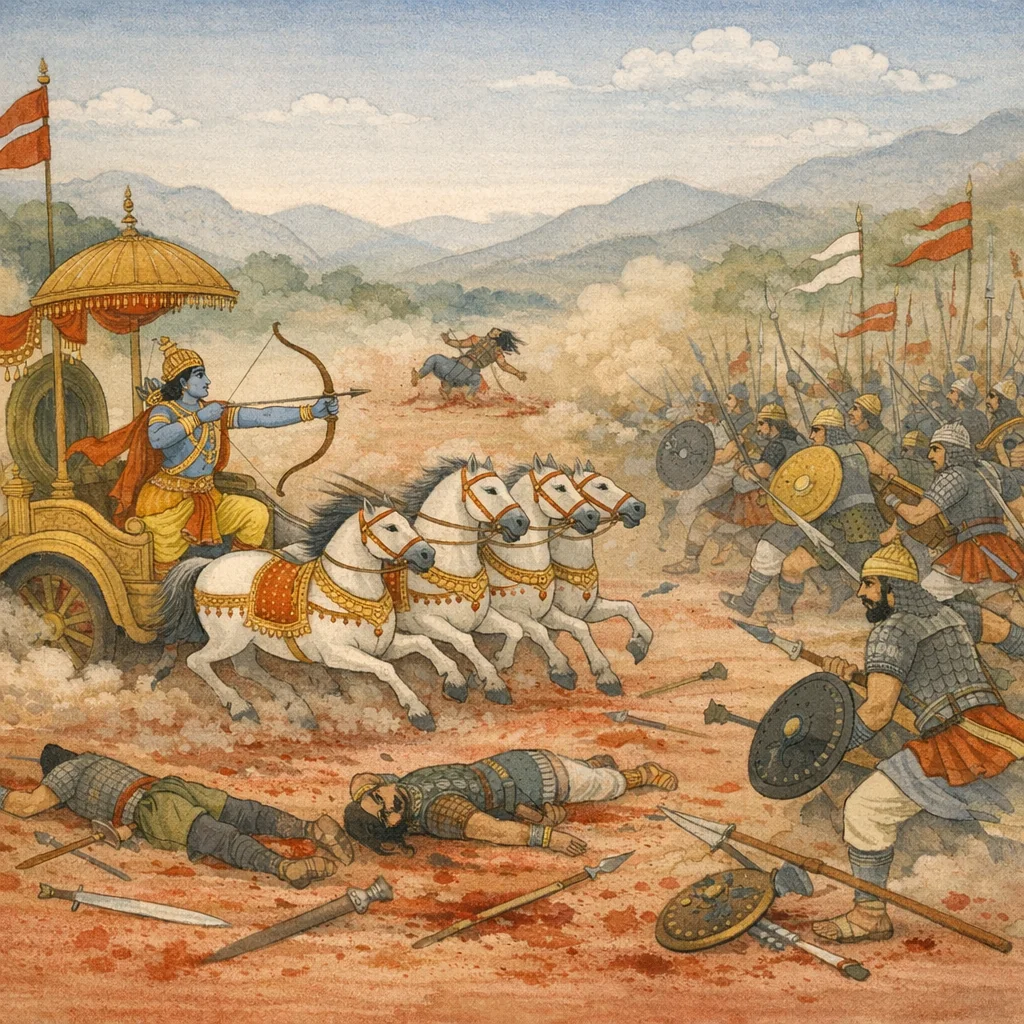
Adhyaya 148
अध्याय १४८ — कर्णप्रभावः, धृष्टद्युम्नस्य विरथता, तथा घटोत्कच-आह्वानम् (Chapter 148: Karṇa’s Pressure, Dhṛṣṭadyumna Unhorsed, and the Summoning of Ghaṭotkaca)
Upa-parva: Niśā-yuddha (Night Engagement) Episode: Karṇa–Ghaṭotkaca Confrontation (contextual unit within Droṇa-parva)
Saṃjaya reports a concentrated engagement in which Karṇa strikes Dhṛṣṭadyumna with penetrating arrows; Dhṛṣṭadyumna replies, but Karṇa disables his chariot-system by wounding the charioteer and horses and cutting the bow, casting him into a vulnerable, chariotless state. Dhṛṣṭadyumna retaliates with a heavy weapon (parigha), while Karṇa’s momentum expands into a broader rout of Pāñcāla forces, depicted through scattered formations, casualties across mounts and vehicles, and a general inability to regroup under sustained arrow-pressure. Observing the destabilization, Yudhiṣṭhira urges Arjuna to address the imminent strategic danger posed by Karṇa. Arjuna consults Kṛṣṇa; Kṛṣṇa assesses Karṇa as exceptionally difficult to counter directly at that moment and proposes Ghaṭotkaca as the most viable responder, particularly in night conditions. Kṛṣṇa summons Ghaṭotkaca, instructing him to employ his astras and rākṣasa māyā to stabilize the Pāṇḍava side by engaging Karṇa; Arjuna assigns Sātyaki as protective support. Ghaṭotkaca accepts the task with maximal resolve, and the chapter closes as the night duel between Karṇa and Ghaṭotkaca commences.
Chapter Arc: संजय धृतराष्ट्र से कहते हैं कि गाण्डीव की विस्पष्ट, गर्जन-सी टंकार सुनते ही कौरव-सेना पर ऐसा भय छा गया मानो युगान्त की आँधी से समुद्र उथल-पुथल हो उठा हो। → अर्जुन रणभूमि में धनंजय-रूप से विचरते हैं—अस्त्रों से अस्त्र काटते, रथों को रथों से, धनुषों को धनुषों से, और पंक्तियों को पंक्तियों से तोड़ते हुए। रक्त से भरी धरती में रथचक्र धँसते हैं; कटे शुण्डदण्डों और शिरों से भूमि विकराल दृश्य रचती है। कौरव-बल त्रस्त, उद्विग्न और श्रान्त होकर बिखरने लगता है, पर जयद्रथ-रक्षा का संकल्प उन्हें फिर-फिर बाँधता है। → अर्जुन रौद्रकर्म में स्थित होकर अपने दिव्यास्त्रों से शत्रु-व्यूह को चीरते हैं और जयद्रथ-वध की प्रतिज्ञा को रण-न्याय में परिणत करते हैं—यही क्षण अध्याय का शिखर है, जहाँ ‘शिरश्छेत्स्यति संक्रुद्धः’ जैसी घोषणा-ध्वनि के साथ संहार का निर्णय स्पष्ट हो जाता है। → जयद्रथ-वध के परिणामस्वरूप कौरव-पक्ष में शोक, भय और अव्यवस्था फैलती है; पाण्डव-पक्ष में प्रतिज्ञा-पूर्ति का तेज और युद्ध-धर्म का कठोर संतोष उतरता है। रणभूमि का दृश्य—रक्त, रथचक्र, कटे अंग—इस विजय की कीमत को भी सामने रख देता है। → जयद्रथ के पतन से कौरव-शिविर में प्रतिशोध की अग्नि भड़कती है—अगले प्रहार में कौन-सा महारथी किस पर टूटेगा, यह अनिश्चितता युद्ध को अगले अध्याय की ओर धकेलती है।
Shlokas
Verse 1
अपन का छा अकाल षट्चत्वारिशर्दाधेकशततमो< ध्याय: अर्जुनका अदभुत पराक्रम और सिन्धुराज जयद्रथका वध संजय उवाच श्रुत्वा निनादं धनुषश्च तस्य विस्पष्टमुत्क़ुष्टमिवान्तकस्य । शक्राशनिस्फोटसमं सुघोरं विकृष्यमाणस्य धनंजयेन,प्रलीनमीनमकरं सागराम्भ इवाभवत् | संजय कहते हैं--राजन्! उस समय अर्जुनके द्वारा खींचे जानेवाले गाण्डीव धनुषकी अत्यन्त भयंकर टंकार यमराजकी सुस्पष्ट गर्जना तथा इन्द्रके वज्रकी गड़गड़ाहटके समान जान पड़ती थी। उसे सुनकर आपकी सेना भयसे उद्विग्न हो बड़ी घबराहटमें पड़ गयी। उस समय उसकी दशा प्रलयकालकी आँधीसे क्षोभको प्राप्त एवं उत्ताल तरंगोंसे परिपूर्ण हुए उस महासागरके जलकी-सी हो गयी, जिसमें मछली और मगर आदि जलजन्तु छिप जाते हैं
Sañjaya said: O King, when Arjuna drew the Gāṇḍīva, the bow’s twang rang out—clear and terrifying—like the loud roar of Death himself, and like the thunderclap of Indra’s thunderbolt. Hearing it, your army became shaken with fear and fell into confusion, like the ocean at the time of dissolution, churned by a tempest and heaving with towering waves, in which fish and crocodiles vanish from sight.
Verse 2
त्रासोद्धिग्नं तथोदश्रान्तं त्वदीयं तद् बल॑ नृप । युगान्तवातसंक्षुब्धं चलद्वीचितरद्धितम्,प्रलीनमीनमकरं सागराम्भ इवाभवत् | संजय कहते हैं--राजन्! उस समय अर्जुनके द्वारा खींचे जानेवाले गाण्डीव धनुषकी अत्यन्त भयंकर टंकार यमराजकी सुस्पष्ट गर्जना तथा इन्द्रके वज्रकी गड़गड़ाहटके समान जान पड़ती थी। उसे सुनकर आपकी सेना भयसे उद्विग्न हो बड़ी घबराहटमें पड़ गयी। उस समय उसकी दशा प्रलयकालकी आँधीसे क्षोभको प्राप्त एवं उत्ताल तरंगोंसे परिपूर्ण हुए उस महासागरके जलकी-सी हो गयी, जिसमें मछली और मगर आदि जलजन्तु छिप जाते हैं
Sañjaya said: O king, your army—terrified, shaken, and utterly exhausted—became like the waters of the ocean when, at the end of an age, a tempest churns it into moving, towering waves, so that fish and crocodiles vanish from sight. Thus, under the pressure of Arjuna’s fearsome display, your forces lost steadiness and sank into panic.
Verse 3
स रणे व्यचरत् पार्थ: प्रेक्षमाणो धनंजय:,प्रलीनमीनमकरं सागराम्भ इवाभवत् | संजय कहते हैं--राजन्! उस समय अर्जुनके द्वारा खींचे जानेवाले गाण्डीव धनुषकी अत्यन्त भयंकर टंकार यमराजकी सुस्पष्ट गर्जना तथा इन्द्रके वज्रकी गड़गड़ाहटके समान जान पड़ती थी। उसे सुनकर आपकी सेना भयसे उद्विग्न हो बड़ी घबराहटमें पड़ गयी। उस समय उसकी दशा प्रलयकालकी आँधीसे क्षोभको प्राप्त एवं उत्ताल तरंगोंसे परिपूर्ण हुए उस महासागरके जलकी-सी हो गयी, जिसमें मछली और मगर आदि जलजन्तु छिप जाते हैं
Sañjaya said: O King, in that battle Pārtha—Arjuna, the son of Pṛthā, called Dhanañjaya—moved about, surveying the field. He was like the ocean’s waters at the time of dissolution, so violently churned that fish and makaras (crocodiles and sea-beasts) sink and vanish from sight.
Verse 4
आददानं महाराज संदधानं च पाण्डवम्,प्रलीनमीनमकरं सागराम्भ इवाभवत् | संजय कहते हैं--राजन्! उस समय अर्जुनके द्वारा खींचे जानेवाले गाण्डीव धनुषकी अत्यन्त भयंकर टंकार यमराजकी सुस्पष्ट गर्जना तथा इन्द्रके वज्रकी गड़गड़ाहटके समान जान पड़ती थी। उसे सुनकर आपकी सेना भयसे उद्विग्न हो बड़ी घबराहटमें पड़ गयी। उस समय उसकी दशा प्रलयकालकी आँधीसे क्षोभको प्राप्त एवं उत्ताल तरंगोंसे परिपूर्ण हुए उस महासागरके जलकी-सी हो गयी, जिसमें मछली और मगर आदि जलजन्तु छिप जाते हैं
Sañjaya said: O King, then the Pāṇḍava (Arjuna) took up his bow and set his arrows. Your army became like the ocean at the time of dissolution—its waters churned by a devastating gale, heaving with towering waves, where fish and makaras hide away in fear.
Verse 5
ततः क्रुद्धो महाबाहुरैन्द्रमस्त्रं दुरासदम्,प्रलीनमीनमकरं सागराम्भ इवाभवत् | संजय कहते हैं--राजन्! उस समय अर्जुनके द्वारा खींचे जानेवाले गाण्डीव धनुषकी अत्यन्त भयंकर टंकार यमराजकी सुस्पष्ट गर्जना तथा इन्द्रके वज्रकी गड़गड़ाहटके समान जान पड़ती थी। उसे सुनकर आपकी सेना भयसे उद्विग्न हो बड़ी घबराहटमें पड़ गयी। उस समय उसकी दशा प्रलयकालकी आँधीसे क्षोभको प्राप्त एवं उत्ताल तरंगोंसे परिपूर्ण हुए उस महासागरके जलकी-सी हो गयी, जिसमें मछली और मगर आदि जलजन्तु छिप जाते हैं
Sañjaya said: Then the mighty-armed warrior, inflamed with wrath, unleashed the hard-to-withstand Aindra-astra, Indra’s weapon. The battlefield became like the ocean’s waters at the time of dissolution—so turbulent that fish and makaras sink away into hiding.
Verse 6
ततः शरा: प्रादुरासन् दिव्यास्त्रप्रतिमन्त्रिता:,प्रलीनमीनमकरं सागराम्भ इवाभवत् | संजय कहते हैं--राजन्! उस समय अर्जुनके द्वारा खींचे जानेवाले गाण्डीव धनुषकी अत्यन्त भयंकर टंकार यमराजकी सुस्पष्ट गर्जना तथा इन्द्रके वज्रकी गड़गड़ाहटके समान जान पड़ती थी। उसे सुनकर आपकी सेना भयसे उद्विग्न हो बड़ी घबराहटमें पड़ गयी। उस समय उसकी दशा प्रलयकालकी आँधीसे क्षोभको प्राप्त एवं उत्ताल तरंगोंसे परिपूर्ण हुए उस महासागरके जलकी-सी हो गयी, जिसमें मछली और मगर आदि जलजन्तु छिप जाते हैं
Sañjaya said: “Then arrows appeared in volleys, made divine by the mantras of celestial weapons, and the battlefield seemed like the ocean’s waters in upheaval, where fish and makaras sink away into hiding. In that moment the dreadful twang of Arjuna’s Gāṇḍīva sounded like Yama’s unmistakable roar and the thunder of Indra’s vajra; hearing it, your army was shaken by fear and fell into panic, like the sea churned by a doomsday gale, heaving with towering waves.”
Verse 7
आकर्णपूर्णनिर्मुक्तिरग्न्यर्काशुनि भै: शरै:,प्रलीनमीनमकरं सागराम्भ इवाभवत् | संजय कहते हैं--राजन्! उस समय अर्जुनके द्वारा खींचे जानेवाले गाण्डीव धनुषकी अत्यन्त भयंकर टंकार यमराजकी सुस्पष्ट गर्जना तथा इन्द्रके वज्रकी गड़गड़ाहटके समान जान पड़ती थी। उसे सुनकर आपकी सेना भयसे उद्विग्न हो बड़ी घबराहटमें पड़ गयी। उस समय उसकी दशा प्रलयकालकी आँधीसे क्षोभको प्राप्त एवं उत्ताल तरंगोंसे परिपूर्ण हुए उस महासागरके जलकी-सी हो गयी, जिसमें मछली और मगर आदि जलजन्तु छिप जाते हैं
Sañjaya said: O King, the arrows Arjuna released at full draw—terrible like fire, the sun, and thunder—made your army like the ocean’s waters where fish and crocodiles vanish from sight: thrown into turmoil, overwhelmed by fear, and seeking concealment.
Verse 8
ततः शस्त्रान्धकारं तत् कौरवै: समुदीरितम्,प्रलीनमीनमकरं सागराम्भ इवाभवत् | संजय कहते हैं--राजन्! उस समय अर्जुनके द्वारा खींचे जानेवाले गाण्डीव धनुषकी अत्यन्त भयंकर टंकार यमराजकी सुस्पष्ट गर्जना तथा इन्द्रके वज्रकी गड़गड़ाहटके समान जान पड़ती थी। उसे सुनकर आपकी सेना भयसे उद्विग्न हो बड़ी घबराहटमें पड़ गयी। उस समय उसकी दशा प्रलयकालकी आँधीसे क्षोभको प्राप्त एवं उत्ताल तरंगोंसे परिपूर्ण हुए उस महासागरके जलकी-सी हो गयी, जिसमें मछली और मगर आदि जलजन्तु छिप जाते हैं नैशं तमों5शुभि: क्षिप्रं दिनादाविव भास्कर: । तदनन्तर कौरवोंने अस्त्र-शस्त्रोंकी इतनी वर्षा की कि वहाँ अँधेरा छा गया। दूसरे कोई योद्धा उस अन्धकारको नष्ट करनेका विचार भी मनमें नहीं ला सकते थे; परंतु पाण्डुपुत्र अर्जुनने बड़ी शीघ्रता-सी करते हुए दिव्यास्त्रसम्बन्धी मन्त्रोंद्वारा अभिमन्त्रित बाणोंसे पराक्रमपूर्वक उसे नष्ट कर दिया। ठीक उसी तरह, जैसे प्रातःकालमें सूर्य अपनी किरणोंद्वारा रात्रिके अन्धकारको शीघ्र नष्ट कर देते हैं
Sañjaya said: Then the darkness made of weapons—raised up by the Kauravas—spread like the waters of the ocean, in which fish and makaras vanish from sight. Yet Arjuna swiftly dispelled that inauspicious gloom with arrows empowered by the mantras of divine weapons, just as the sun at daybreak quickly drives away the night’s darkness.
Verse 9
अशक्यं मनसाप्यन्यै: पाण्डव: सम्भ्रमन्निव | नाशयामास विक्रम्य शरैंदिव्यास्त्रमन्त्रिते:,प्रलीनमीनमकरं सागराम्भ इवाभवत् | संजय कहते हैं--राजन्! उस समय अर्जुनके द्वारा खींचे जानेवाले गाण्डीव धनुषकी अत्यन्त भयंकर टंकार यमराजकी सुस्पष्ट गर्जना तथा इन्द्रके वज्रकी गड़गड़ाहटके समान जान पड़ती थी। उसे सुनकर आपकी सेना भयसे उद्विग्न हो बड़ी घबराहटमें पड़ गयी। उस समय उसकी दशा प्रलयकालकी आँधीसे क्षोभको प्राप्त एवं उत्ताल तरंगोंसे परिपूर्ण हुए उस महासागरके जलकी-सी हो गयी, जिसमें मछली और मगर आदि जलजन्तु छिप जाते हैं
Sañjaya said: O King, the Pāṇḍava (Arjuna), as though moving in swift, urgent resolve, advanced with prowess and destroyed the enemy with arrows empowered by the mantras of divine weapons—something inconceivable even in thought for others. Your army then became like the waters of the ocean at dissolution, where fish and makaras vanish into hiding: shaken, overwhelmed, and driven into fearful confusion by the irresistible force of his celestial assault.
Verse 10
ततस्तु तावकं सैन्यं दीप्तै: शरगभस्तिभि:,प्रलीनमीनमकरं सागराम्भ इवाभवत् | संजय कहते हैं--राजन्! उस समय अर्जुनके द्वारा खींचे जानेवाले गाण्डीव धनुषकी अत्यन्त भयंकर टंकार यमराजकी सुस्पष्ट गर्जना तथा इन्द्रके वज्रकी गड़गड़ाहटके समान जान पड़ती थी। उसे सुनकर आपकी सेना भयसे उद्विग्न हो बड़ी घबराहटमें पड़ गयी। उस समय उसकी दशा प्रलयकालकी आँधीसे क्षोभको प्राप्त एवं उत्ताल तरंगोंसे परिपूर्ण हुए उस महासागरके जलकी-सी हो गयी, जिसमें मछली और मगर आदि जलजन्तु छिप जाते हैं
Sañjaya said: “Then your army, O King, struck by the blazing rays of Arjuna’s arrows, became like the ocean’s waters in turmoil—where fish and makaras vanish and hide—overwhelmed and driven to confusion by fear.”
Verse 11
ततो दिव्यास्त्रविदुषा प्रहिता: सायकांशव:,प्रलीनमीनमकरं सागराम्भ इवाभवत् | संजय कहते हैं--राजन्! उस समय अर्जुनके द्वारा खींचे जानेवाले गाण्डीव धनुषकी अत्यन्त भयंकर टंकार यमराजकी सुस्पष्ट गर्जना तथा इन्द्रके वज्रकी गड़गड़ाहटके समान जान पड़ती थी। उसे सुनकर आपकी सेना भयसे उद्विग्न हो बड़ी घबराहटमें पड़ गयी। उस समय उसकी दशा प्रलयकालकी आँधीसे क्षोभको प्राप्त एवं उत्ताल तरंगोंसे परिपूर्ण हुए उस महासागरके जलकी-सी हो गयी, जिसमें मछली और मगर आदि जलजन्तु छिप जाते हैं
Sañjaya said: Then, the volleys of arrows released by the master of celestial weapons made the battlefield seem like the ocean at the time of dissolution—its waters churning so violently that fish and crocodiles vanish into hiding.
Verse 12
अथापरे समुत्सृष्टा विशिखास्तिग्मतेजस:,प्रलीनमीनमकरं सागराम्भ इवाभवत् | संजय कहते हैं--राजन्! उस समय अर्जुनके द्वारा खींचे जानेवाले गाण्डीव धनुषकी अत्यन्त भयंकर टंकार यमराजकी सुस्पष्ट गर्जना तथा इन्द्रके वज्रकी गड़गड़ाहटके समान जान पड़ती थी। उसे सुनकर आपकी सेना भयसे उद्विग्न हो बड़ी घबराहटमें पड़ गयी। उस समय उसकी दशा प्रलयकालकी आँधीसे क्षोभको प्राप्त एवं उत्ताल तरंगोंसे परिपूर्ण हुए उस महासागरके जलकी-सी हो गयी, जिसमें मछली और मगर आदि जलजन्तु छिप जाते हैं
Sañjaya said: “Then other arrows, blazing with keen brilliance, were released; and the sea-like mass of your host became as though an ocean in which fish and makaras vanish and hide—overwhelmed and swallowed up by the surge.”
Verse 13
य एनमीयु: समरे त्वद्योधा: शूरमानिन:,प्रलीनमीनमकरं सागराम्भ इवाभवत् | संजय कहते हैं--राजन्! उस समय अर्जुनके द्वारा खींचे जानेवाले गाण्डीव धनुषकी अत्यन्त भयंकर टंकार यमराजकी सुस्पष्ट गर्जना तथा इन्द्रके वज्रकी गड़गड़ाहटके समान जान पड़ती थी। उसे सुनकर आपकी सेना भयसे उद्विग्न हो बड़ी घबराहटमें पड़ गयी। उस समय उसकी दशा प्रलयकालकी आँधीसे क्षोभको प्राप्त एवं उत्ताल तरंगोंसे परिपूर्ण हुए उस महासागरके जलकी-सी हो गयी, जिसमें मछली और मगर आदि जलजन्तु छिप जाते हैं
Sañjaya said: O King, when your warriors—proud of their valor—advanced against him in battle, they became like the ocean’s waters at the time of dissolution, where fish and crocodiles hide away. Hearing the dreadful twang of Arjuna’s Gāṇḍīva—like Yama’s clear roar and the thunder of Indra’s thunderbolt—your army was shaken with fear and fell into great confusion.
Verse 14
एवं स मृदनन् शत्रूणां जीवितानि यशांसि च,प्रलीनमीनमकरं सागराम्भ इवाभवत् | संजय कहते हैं--राजन्! उस समय अर्जुनके द्वारा खींचे जानेवाले गाण्डीव धनुषकी अत्यन्त भयंकर टंकार यमराजकी सुस्पष्ट गर्जना तथा इन्द्रके वज्रकी गड़गड़ाहटके समान जान पड़ती थी। उसे सुनकर आपकी सेना भयसे उद्विग्न हो बड़ी घबराहटमें पड़ गयी। उस समय उसकी दशा प्रलयकालकी आँधीसे क्षोभको प्राप्त एवं उत्ताल तरंगोंसे परिपूर्ण हुए उस महासागरके जलकी-सी हो गयी, जिसमें मछली और मगर आदि जलजन्तु छिप जाते हैं
Sañjaya said: “Thus, crushing the enemies’ very lives and their fame, he became like the ocean’s waters at the time of dissolution—where fish and crocodiles vanish into hiding.”
Verse 15
पार्थश्चचार संग्रामे मृत्युर्विग्रहवानिव । इस प्रकार कुन्तीकुमार अर्जुन शत्रुओंके जीवन और यशको धूलमें मिलाते हुए मूर्तिमान् मृत्युके समान संग्रामभूमिमें विचरण करने लगे ।। १४ ई ।। सकिरीटानि वक्त्राणि साड्दान् विपुलान् भुजान्,प्रलीनमीनमकरं सागराम्भ इवाभवत् | संजय कहते हैं--राजन्! उस समय अर्जुनके द्वारा खींचे जानेवाले गाण्डीव धनुषकी अत्यन्त भयंकर टंकार यमराजकी सुस्पष्ट गर्जना तथा इन्द्रके वज्रकी गड़गड़ाहटके समान जान पड़ती थी। उसे सुनकर आपकी सेना भयसे उद्विग्न हो बड़ी घबराहटमें पड़ गयी। उस समय उसकी दशा प्रलयकालकी आँधीसे क्षोभको प्राप्त एवं उत्ताल तरंगोंसे परिपूर्ण हुए उस महासागरके जलकी-सी हो गयी, जिसमें मछली और मगर आदि जलजन्तु छिप जाते हैं
Sañjaya said: O King, Pārtha (Arjuna) moved about the battlefield like Death embodied. As he struck down the foe, helmets and heads, and great arms with their ornaments, disappeared—just as fish and crocodiles vanish into the waters of the ocean when it is churned into turmoil. The scene conveys not mere slaughter but the irresistible momentum of fate in war: when adharma ripens into conflict, even the mighty are swept away, and the field becomes a mirror of mortality.
Verse 16
सकुण्डलयुगान् कर्णान् केषांचिदहरच्छरै: । वे अपने बाणोंसे किन्हीं शत्रुओंके मुकुटमण्डित मस्तकों, किन्हींके बाजूबंदविभूषित विशाल भुजाओं तथा किन्हींके दो कुण्डलोंसे अलंकृत दोनों कानोंको काट गिराते थे ।। १५ हे || सतोमरान् गजस्थानां सप्रासान् हयसादिनाम्,प्रलीनमीनमकरं सागराम्भ इवाभवत् | संजय कहते हैं--राजन्! उस समय अर्जुनके द्वारा खींचे जानेवाले गाण्डीव धनुषकी अत्यन्त भयंकर टंकार यमराजकी सुस्पष्ट गर्जना तथा इन्द्रके वज्रकी गड़गड़ाहटके समान जान पड़ती थी। उसे सुनकर आपकी सेना भयसे उद्विग्न हो बड़ी घबराहटमें पड़ गयी। उस समय उसकी दशा प्रलयकालकी आँधीसे क्षोभको प्राप्त एवं उत्ताल तरंगोंसे परिपूर्ण हुए उस महासागरके जलकी-सी हो गयी, जिसमें मछली और मगर आदि जलजन्तु छिप जाते हैं पाण्डुकुमार अर्जुनने हाथीसवारोंकी तोमरयुक्त, घुड़सवारोंकी प्रासयुक्त, पैदल सिपाहियोंकी ढालयुक्त, रथियोंकी धनुषयुक्त और सारथियोंकी चाबुकसहित भुजाओंको काट डाला
Sañjaya said: With his arrows he sheared off, from some foes, ears adorned with paired earrings. The battlefield then seemed like the sea at the time of dissolution—its waters heaving, while fish and crocodiles vanish into hiding—for he cut down the elephant-riders bearing tomaras and the horsemen armed with lances. The image underscores how, in the frenzy of war, even the proud ornaments and martial insignia of warriors are reduced to fragments, and an army’s confidence can collapse into panic like creatures disappearing in a storm-tossed ocean.
Verse 17
सचर्मण: पदातीनां रथीनां च सधन्वन: । सप्रतोदान् नियन्तृणां बाहुंश्विच्छेद पाण्डव:,प्रलीनमीनमकरं सागराम्भ इवाभवत् | संजय कहते हैं--राजन्! उस समय अर्जुनके द्वारा खींचे जानेवाले गाण्डीव धनुषकी अत्यन्त भयंकर टंकार यमराजकी सुस्पष्ट गर्जना तथा इन्द्रके वज्रकी गड़गड़ाहटके समान जान पड़ती थी। उसे सुनकर आपकी सेना भयसे उद्विग्न हो बड़ी घबराहटमें पड़ गयी। उस समय उसकी दशा प्रलयकालकी आँधीसे क्षोभको प्राप्त एवं उत्ताल तरंगोंसे परिपूर्ण हुए उस महासागरके जलकी-सी हो गयी, जिसमें मछली और मगर आदि जलजन्तु छिप जाते हैं पाण्डुकुमार अर्जुनने हाथीसवारोंकी तोमरयुक्त, घुड़सवारोंकी प्रासयुक्त, पैदल सिपाहियोंकी ढालयुक्त, रथियोंकी धनुषयुक्त और सारथियोंकी चाबुकसहित भुजाओंको काट डाला
Sañjaya said: O King, the Pāṇḍava (Arjuna) hewed off the arms of the foot-soldiers bearing shields, of the chariot-warriors bearing bows, and of the drivers holding goads. Your army then became like the waters of the ocean in which fish and crocodiles lie hidden—turbid and overwhelmed—suggesting how, in war, fear and confusion can swallow up even the mighty when disciplined force is met by superior skill.
Verse 18
प्रदीप्तोग्रशरार्चिष्मान् बभौ तत्र धनंजय: । सविस्फुलिज्ञाग्रशिखो ज्वलन्निव हुताशन:,प्रलीनमीनमकरं सागराम्भ इवाभवत् | संजय कहते हैं--राजन्! उस समय अर्जुनके द्वारा खींचे जानेवाले गाण्डीव धनुषकी अत्यन्त भयंकर टंकार यमराजकी सुस्पष्ट गर्जना तथा इन्द्रके वज्रकी गड़गड़ाहटके समान जान पड़ती थी। उसे सुनकर आपकी सेना भयसे उद्विग्न हो बड़ी घबराहटमें पड़ गयी। उस समय उसकी दशा प्रलयकालकी आँधीसे क्षोभको प्राप्त एवं उत्ताल तरंगोंसे परिपूर्ण हुए उस महासागरके जलकी-सी हो गयी, जिसमें मछली और मगर आदि जलजन्तु छिप जाते हैं उद्दीप्त एवं उग्र बाणरूपी शिखाओंसे युक्त तेजस्वी अर्जुन वहाँ चिनगारियों और लपटोंसे युक्त प्रजजलित अग्निके समान प्रकाशित हो रहे थे
Sañjaya said: O King, there Dhanañjaya (Arjuna) shone forth, blazing with fierce, flame-like arrows—like a fire flaring up with tongues of flame and scattering sparks. And your army became like the ocean’s waters in which fish and crocodiles hide away, as if overwhelmed by a cataclysmic surge—disturbed, terrified, and seeking concealment before the onrushing force of Arjuna’s assault.
Verse 19
त॑ देवराजप्रतिमं सर्वशस्त्रभृतां वरम् । युगपद् दिक्षु सर्वासु रथस्थं पुरुषर्षभम्,प्रलीनमीनमकरं सागराम्भ इवाभवत् | संजय कहते हैं--राजन्! उस समय अर्जुनके द्वारा खींचे जानेवाले गाण्डीव धनुषकी अत्यन्त भयंकर टंकार यमराजकी सुस्पष्ट गर्जना तथा इन्द्रके वज्रकी गड़गड़ाहटके समान जान पड़ती थी। उसे सुनकर आपकी सेना भयसे उद्विग्न हो बड़ी घबराहटमें पड़ गयी। उस समय उसकी दशा प्रलयकालकी आँधीसे क्षोभको प्राप्त एवं उत्ताल तरंगोंसे परिपूर्ण हुए उस महासागरके जलकी-सी हो गयी, जिसमें मछली और मगर आदि जलजन्तु छिप जाते हैं
Sañjaya said: O King, that bull among men—like the lord of the gods, the foremost of all weapon-bearers—standing upon his chariot and appearing at once in every direction, became like the ocean at the time of dissolution, whose waters churn in tempest and in which fish and crocodiles vanish from sight. The image conveys how Arjuna’s overwhelming martial presence and the terror it inspired caused the opposing host to lose composure, as creatures disappear into the depths when the sea is violently agitated.
Verse 20
निक्षिपन्तं महास्त्राणि प्रेक्षणीयं धनंजयम् । नृत्यन्तं रथमार्गेषु धनुज्यातलनादिनम्,प्रलीनमीनमकरं सागराम्भ इवाभवत् | संजय कहते हैं--राजन्! उस समय अर्जुनके द्वारा खींचे जानेवाले गाण्डीव धनुषकी अत्यन्त भयंकर टंकार यमराजकी सुस्पष्ट गर्जना तथा इन्द्रके वज्रकी गड़गड़ाहटके समान जान पड़ती थी। उसे सुनकर आपकी सेना भयसे उद्विग्न हो बड़ी घबराहटमें पड़ गयी। उस समय उसकी दशा प्रलयकालकी आँधीसे क्षोभको प्राप्त एवं उत्ताल तरंगोंसे परिपूर्ण हुए उस महासागरके जलकी-सी हो गयी, जिसमें मछली और मगर आदि जलजन्तु छिप जाते हैं
Sañjaya said: O King, Arjuna—Dhanañjaya—was a spectacle to behold as he kept hurling mighty celestial weapons. Moving as if dancing along the paths of his chariot, with the resounding twang and slap of his bowstring, he made your army like the ocean’s waters in a time of dissolution—tossed into turmoil, where fish and crocodiles vanish into hiding. The image underscores how overwhelming prowess in war can shatter morale, driving even seasoned warriors into fear and disarray.
Verse 21
निरीक्षितुं न शेकुस्ते यत्नवन्तो$पि पार्थिवा: । मध्यंदिनगतं सूर्य प्रतपन््तमिवाम्बरे,प्रलीनमीनमकरं सागराम्भ इवाभवत् | संजय कहते हैं--राजन्! उस समय अर्जुनके द्वारा खींचे जानेवाले गाण्डीव धनुषकी अत्यन्त भयंकर टंकार यमराजकी सुस्पष्ट गर्जना तथा इन्द्रके वज्रकी गड़गड़ाहटके समान जान पड़ती थी। उसे सुनकर आपकी सेना भयसे उद्विग्न हो बड़ी घबराहटमें पड़ गयी। उस समय उसकी दशा प्रलयकालकी आँधीसे क्षोभको प्राप्त एवं उत्ताल तरंगोंसे परिपूर्ण हुए उस महासागरके जलकी-सी हो गयी, जिसमें मछली और मगर आदि जलजन्तु छिप जाते हैं
Sañjaya said: Even though they strove with all their might, those kings could not bear to look on. It was as if the sun, having reached midday, blazed in the sky; and the host became like the ocean’s waters, where fish and crocodiles vanish from sight—overwhelmed and driven to concealment by the scorching force before them. In this war-scene, the verse underscores how overpowering prowess can shatter morale: when fear takes hold, even the mighty lose steadiness and clarity of action.
Verse 22
देवराज इन्द्रके समान रथपर बैठे हुए सम्पूर्ण शस्त्रधारियोंमें श्रेष्ठ नरश्रेष्ठ अर्जुन एक ही साथ सम्पूर्ण दिशाओंमें महान् अस्त्रोंका प्रहार करते हुए सबके लिये दर्शनीय हो रहे थे। वे अपने धनुषकी टंकार करते हुए रथके मार्गोपर नृत्य-सा कर रहे थे। जैसे आकाशगमें तपते हुए दोपहरके सूर्यकी ओर देखना कठिन होता है, उसी प्रकार उनकी ओर राजालोग यत्न करनेपर भी देख नहीं पाते थे ।। दीप्तोग्रसम्भूतशर: किरीटी विरराज ह । वर्षास्विवोदीर्णजल: सेन्द्रधन्वाम्बुदो महान्,प्रलीनमीनमकरं सागराम्भ इवाभवत् | संजय कहते हैं--राजन्! उस समय अर्जुनके द्वारा खींचे जानेवाले गाण्डीव धनुषकी अत्यन्त भयंकर टंकार यमराजकी सुस्पष्ट गर्जना तथा इन्द्रके वज्रकी गड़गड़ाहटके समान जान पड़ती थी। उसे सुनकर आपकी सेना भयसे उद्विग्न हो बड़ी घबराहटमें पड़ गयी। उस समय उसकी दशा प्रलयकालकी आँधीसे क्षोभको प्राप्त एवं उत्ताल तरंगोंसे परिपूर्ण हुए उस महासागरके जलकी-सी हो गयी, जिसमें मछली और मगर आदि जलजन्तु छिप जाते हैं प्रज्वलित एवं भयंकर बाण लिये किरीटधारी अर्जुन वर्षा-ऋतुमें अधिक जलसे भरे हुए इन्द्रधनुषघसहित महामेघके समान सुशोभित हो रहे थे
Sañjaya said: O King, Arjuna—crowned and foremost among all wielders of weapons—shone brilliantly, releasing blazing, fearsome arrows in every direction at once. As he made the Gāṇḍīva resound and drove his chariot as if dancing along its course, he became a spectacle for all. Just as it is hard to gaze at the midday sun blazing in the sky, so too the kings, even striving, could not look upon him. With his terrible bowstring’s thunder—like Yama’s roar and Indra’s thunderbolt—your army was shaken by fear and fell into confusion, like the ocean churned by a doomsday gale, where fish and crocodiles vanish into hiding. Arjuna, aflame with dreadful shafts, appeared like a vast monsoon cloud swollen with rain and adorned with a rainbow.
Verse 23
महास्त्रसम्प्लवे तस्मिन् जिष्णुना सम्प्रवर्तिते । सुदुस्तरे महाघोरे ममज्जुर्यो धपुड़रवा:,प्रलीनमीनमकरं सागराम्भ इवाभवत् | संजय कहते हैं--राजन्! उस समय अर्जुनके द्वारा खींचे जानेवाले गाण्डीव धनुषकी अत्यन्त भयंकर टंकार यमराजकी सुस्पष्ट गर्जना तथा इन्द्रके वज्रकी गड़गड़ाहटके समान जान पड़ती थी। उसे सुनकर आपकी सेना भयसे उद्विग्न हो बड़ी घबराहटमें पड़ गयी। उस समय उसकी दशा प्रलयकालकी आँधीसे क्षोभको प्राप्त एवं उत्ताल तरंगोंसे परिपूर्ण हुए उस महासागरके जलकी-सी हो गयी, जिसमें मछली और मगर आदि जलजन्तु छिप जाते हैं उस युद्धस्थलमें अर्जुनने बड़े-बड़े अस्त्रोंकी ऐसी बाढ़ ला दी थी, जो परम दुस्तर और अत्यन्त भयंकर थी। उसमें कौरवदलके बहुसंख्यक श्रेष्ठ योद्धा डूब गये
Sañjaya said: O King, when that deluge of mighty weapons was set in motion by Jiṣṇu (Arjuna)—a crossing most difficult and exceedingly dreadful—your foremost warriors began to sink in it. The battlefield became like the waters of the ocean in turmoil, where fish and crocodiles hide away, overwhelmed by the storm of destruction. Thus, by Arjuna’s onrush of great astras, many eminent Kaurava fighters were swallowed up, shaken by fear and confusion, as if in a time of cosmic dissolution.
Verse 24
उत्कृत्तवदनैर्देहै: शरीरैः कृत्तबाहुभि: । भुजैश्न पाणिनिर्मुक्त: पाणिभिव्यड्गुलीकृतै:,आक्रीडमिव रुद्रस्य पुराभ्यर्दयत: पशून् । भूपाल! अर्जुनका वह महान् युद्ध मृत्युका क्रीडास्थल बना हुआ था, जो श्त्रोंके आधघातसे ही सुन्दर लगता था। वहाँ बहुत-सी ऐसी लाशें पड़ी थीं, जिनके मस्तक कट गये थे और भुजाएँ काट दी गयी थीं। बहुत-सी ऐसी भुजाएँ दृष्टिगोचर होती थीं, जिनके हाथ नष्ट हो गये थे और बहुत-से हाथ भी अंगुलियोंसे शून्य थे। कितने ही मदोन्मत्त हाथी धराशायी हो गये थे। जिनकी सूँड़के अग्रभाग और दाँत काट डाले गये थे। बहुतेरे घोड़ोंकी गर्दनें उड़ा दी गयी थीं और रथोंके टुकड़े-टुकड़े कर दिये गये थे। किन्हींकी आँतें कट गयी थीं, किन्हींके पाँव काट डाले गये थे तथा कुछ दूसरे लोगोंकी संधियाँ (अंगोंके जोड़) खण्डित हो गयी थीं। कुछ लोग निनश्वेष्ट हो गये थे और कुछ पड़े-पड़े छटपटा रहे थे। इनकी संख्या सैकड़ों तथा सहस्रों थी। हमने देखा कि वह युद्धस्थल कायरोंके लिये भयवर्धक हो रहा है। मानो पूर्व (प्रयल) कालमें पशुओं (जीवों) को पीड़ा देनेवाले रुद्रदेवका क्रीडास्थल हो
Sañjaya said: The battlefield had become strewn with bodies whose faces were hewn off, with trunks whose arms were severed; with arms torn from their hands, and with hands mangled and stripped of fingers. O king, it looked like the very playground of Rudra in ancient times, when he tormented living creatures—an arena of death where the violence of weapons made a dreadful spectacle.
Verse 25
कृत्ताग्रहस्तै: करिभि: कृत्तदन्तैर्मदोत्कटै: । हयैश्न विधुरग्रीवै रथैश्न शकलीकृतै:
Sañjaya said: The battlefield was strewn with elephants whose trunks had been hewn off, their tusks shattered, yet still raging in musth; with horses whose necks were broken; and with chariots smashed into fragments.
Verse 26
निकृत्तान्त्रै: कृत्तपादैस्तथान्यै: कृत्तसंधिभि: । निश्रेष्विस्फुरद्धिश्न शतशो5थ सहस्रश:
Sañjaya said: There were hundreds—indeed thousands—of warriors with their entrails cut away, with their feet severed, and others with their joints hewn apart; sharp weapons still quivered in their bodies.
Verse 27
मृत्योराघातललितं तत्पार्थायोधनं महत् | अपश्याम महीपाल भीरूणां भयवर्धनम्
Sañjaya said: O king, we beheld that great combat between Pārtha and Ayodhana—playful, as it were, with the very blows of Death—an encounter that swelled the terror of the faint-hearted.
Verse 28
गजानां क्षुरनिर्मुक्ता: करैः: सभुजगेव भू:
Sañjaya said: The earth, struck and torn by the elephants’ hands—like a serpent released from a razor’s edge—seemed to writhe in anguish amid the violence of battle, revealing how war makes even the ground itself appear to suffer.
Verse 29
विचित्रोष्णीषमुकुटै: केयूराड्रदकुण्डलै:,विरराज भृशं चित्रा मही नववधूरिव । विचित्र पगड़ी, मुकुट, केयूर, अंगद, कुण्डल, स्वर्णजटित कवच, हाथी-घोड़ोंके आभूषण तथा सैकड़ों किरीटोंसे यत्र-तत्र आच्छादित हुई वह युद्धभूमि नववधूके समान बम. शोभासे सुशोभित हो रही थी
Sañjaya said: Adorned everywhere with variegated turbans and crowns, with armlets, bracelets, and earrings, the many-hued earth—the battlefield—shone exceedingly, like a newly-wedded bride. The verse heightens the tragic irony of war: instruments and ornaments of power create a deceptive beauty that veils the violence and moral cost beneath.
Verse 30
स्वर्णचित्रतनुत्रैश्न भाण्डैश्न गजवाजिनाम् | किरीटशतसंकीर्णा तत्र तत्र समाचिता
Sañjaya said: “There, in many places, the field was heaped with gold-ornamented coats of mail and with the trappings of elephants and horses; it was strewn everywhere with hundreds of fallen helmets.”
Verse 31
जे :कर्दमिनीं शोणितौघतरज्लिणीम्,नदीं प्रवर्तयामास भीरूणां भयवर्धिनीम् | अर्जुनने कायरोंका भय बढ़ानेवाली वैतरणीके समान एक अत्यन्त भयंकर रौद्र और घोर रक्तकी नदी बहा दी, जो प्राणशून्य योद्धाओंके सैकड़ों निश्चेष्ट शरीरोंको बहाये लिये जाती थी। मज्जा और मेद ही उसकी कीचड़ थे। उसमें रक्तका ही प्रवाह था और रक्तकी ही तरंगें उठती थीं। वीरोंके मर्मस्थान एवं हड्डियोंसे व्याप्त हुई वह नदी अगाध जान पड़ती थी। केश ही उस नदीके सेवार और घास थे। योद्धाओंके कटे हुए मस्तक और भुजाएँ ही किनारेके छोटे-छोटे प्रस्तरखण्डोंका काम देती थीं। टूटी हुई छातीकी हड्डियोंसे वह दुर्गम हो रही थी। विचित्र ध्वज और पताकाएँ उसके भीतर पड़ी हुई थीं। छत्र और धनुषरूपी तरंगमालाओंसे वह अलंकृत थी। प्राणशून्य प्राणी ही उसके विशाल शरीरके अवयव थे, हाथियोंकी लाशोंसे वह भरी हुई थी, रथरूपी सैकड़ों नौकाएँ उसपर तैर रही थीं, घोड़ोंके समूह उसके तट थे, रथके पहिये, जूए, ईषादण्ड, धुरी और कूबर आदिके कारण वह नदी अत्यन्त दुर्गग जान पड़ती थी। प्रास, खड्ग, शक्ति, फरसे और बाणरूपी सर्पोसे युक्त होनेके कारण उसके भीतर प्रवेश करना कठिन था। कौए और कंक आदि जनन््तु उसके भीतर निवास करनेवाले बड़े-बड़े नक्र (घड़ियाल) थे। गीदड़रूपी मगरोंके निवाससे उसकी उग्रता और बढ़ गयी थी। गीध ही उसमें प्रचण्ड एवं बड़े-बड़े ग्राह थे। गीदड़ियोंके चीत्कारसे वह नदी बड़ी भयानक प्रतीत होती थी। नाचते हुए प्रेत-पिशाचादि सहस्रों भूतोंसे वह व्याप्त थी
Sañjaya said: Arjuna set in motion a river—muddy and heaving with waves of blood—whose very flow increased the terror of the fearful. In the ethical darkness of battle, the image underscores how violence, once unleashed, becomes a force of its own: it sweeps along the lifeless bodies of warriors and turns the field into a dreadful passage like the Vaitaraṇī, where fear and death seem to rule. The description is not praise of cruelty but a stark portrayal of war’s dehumanizing momentum and the moral cost borne by all who enter it.
Verse 32
मर्मास्थिभिरगाधां च केशशैवलशाद्धलाम् । शिरोबाहूपलतटां रुग्णक्रोडास्थिसंकटाम्
Sañjaya said: “It was like a dreadful river made unfathomable by heaps of vital organs and bones; its surface choked with hair like water-weeds and matted scum. Its banks were strewn with boulders of severed heads and arms, and its bed was cramped and jagged with shattered ribs and bones.”
Verse 33
युगपद् दिक्षु सर्वासु सर्वाण्यस्त्राणि दर्शयन् | उस रणक्षेत्रमें कुन्तीकुमार अर्जुन एक साथ सम्पूर्ण दिशाओंमें देखते और सब प्रकारके अस्त्रोंका कौशल दिखाते हुए विचर रहे थे,चित्रध्वजपताकादूयां छत्रचापोर्मिमालिनीम् | विगतासुमहाकायां गजदेहाभिसंकुलाम्
There on that battlefield, Arjuna, Kuntī’s son, moved about while at once casting his gaze to every quarter and displaying every kind of weapon and the mastery of their use. The ground was thick with banners and pennons; dust rose in clouds; parasols and bows lay interlaced like a garland of waves. And great bodies, their life-breath gone, lay packed together—crowding the field like the fallen bulk of elephants.
Verse 34
रथोडुपशताकीर्णा हयसंघातरोधसम् | रथचक्रयुगेषाक्षकूबरैरतिदुर्गमाम्
Sañjaya said: The field was choked with countless chariots—like boats crowding a waterway—and its passages were blocked by dense masses of horses. With chariot-wheels, yokes, axles, and poles strewn and jammed together, it had become exceedingly hard to traverse—an image of war’s chaos, where human intent and dharma are tested amid crushing congestion and confusion.
Verse 35
प्रासासिशक्तिपरशुविशिखाहिदुरासदाम् । बलकड़्कमहानक्रां गोमायुमकरोत्कटाम्
Sañjaya said: It was a fearsome, almost unapproachable scene—bristling with spears, swords, javelins, axes, arrows, and serpents; crowded with cranes, herons, great crocodiles, jackals, and formidable makaras. The battlefield had become like a dreadful wilderness of death, where violence drew in scavengers and predators, underscoring the grim moral cost of war.
Verse 36
गृध्रोदग्रमहाग्राहां शिवाविरुतभैरवाम् । नृत्यत्प्रेतपिशाचाद्यैर्भूताकीर्णा सहस्रश:
Sañjaya said: “It was a dreadful scene—filled with vultures and fierce beasts of prey, made terrifying by the howling cries of jackals, and crowded in thousands with spirits and goblins, as if the very forces that rejoice in slaughter were dancing upon the battlefield.”
Verse 37
गतासुयोधनिश्लेष्टशरीरशतवाहिनीम् । महाप्रतिभयां रौद्रां घोरां वैतरणीमिव
Sañjaya said: “It was like the Vaitaraṇī—terrible, fierce, and filled with great dread—its current bearing along hundreds of bodies, lifeless and clinging together on the battlefield.”
Verse 38
त॑ दृष्टवा तस्य विक्रान्तमन्तकस्येव रूपिण:
Sañjaya said: Seeing his valour—his very form seeming like that of Antaka (Death) himself—the warriors were struck with awe, as if confronted by inevitable destruction. The scene shows how, in war, extraordinary prowess can appear as a moral and existential force: a reminder of mortality and the fearful consequences of unchecked violence.
Verse 39
तत आदाय वीराणामस्त्रैरस्त्राणि पाण्डव:
Sañjaya said: Then the Pāṇḍavas, taking up the heroes’ weapons, met weapon with weapon—countering each missile with their own—so that the battle became a contest of skill and resolve rather than mere slaughter.
Verse 40
ततो रथवरान् राजन्नत्यतिक्रामदर्जुन:,राजन! तत्पश्चात् अर्जुन बड़े-बड़े रथियोंको लाँचकर आगे बढ़ गये। उस समय आकाशमें तपते हुए दोपहरके सूर्यके समान पाण्डुपुत्र अर्जुनकी ओर सम्पूर्ण प्राणी देख नहीं पाते थे
Sañjaya said: Then, O King, Arjuna surged forward, outstripping the foremost chariot-warriors. After leaping past those great fighters, he pressed on ahead. At that time, blazing in the sky like the scorching midday sun, the son of Pāṇḍu was so radiant that living beings could scarcely look toward him—an image of overwhelming martial energy that momentarily eclipses ordinary perception amid the moral storm of war.
Verse 41
मध्यंदिनगतं सूर्य प्रतपन्तमिवाम्बरे । न शेकुः सर्वभूतानि पाण्डवं प्रतिवीक्षितुम्,राजन! तत्पश्चात् अर्जुन बड़े-बड़े रथियोंको लाँचकर आगे बढ़ गये। उस समय आकाशमें तपते हुए दोपहरके सूर्यके समान पाण्डुपुत्र अर्जुनकी ओर सम्पूर्ण प्राणी देख नहीं पाते थे
Sañjaya said: “O King, all beings were unable to look upon the Pāṇḍava, for he blazed like the midday sun scorching the sky. Thereafter Arjuna pressed forward, driving back the great chariot-warriors; at that moment, like the burning noon-sun, the son of Pāṇḍu was unendurable to behold.”
Verse 42
प्रसृतांस्तस्य गाण्डीवाच्छरव्रातान् महात्मन: । संग्रामे सम्प्रपश्यामो हंसपड्धक्तिमिवाम्बरे,उन महात्माके गाण्डीव धनुषसे छूटकर संग्राममें फैले हुए बाणसमूहोंको हम आकाशमें हंसोंकी पंक्तिके समान देखते थे
Sañjaya said: In that battle we beheld the volleys of arrows released from the great-souled warrior’s Gāṇḍīva bow spreading out through the sky, like a line of swans across the heavens. The image conveys both awe at martial mastery and the sobering beauty with which war can appear even as it brings destruction.
Verse 43
विनिवार्य स वीराणामस्त्रैरस्त्राणि सर्वतः । दर्शयन् रौद्रमात्मानमुग्रे कर्मणि घिष्ठित:,वीरोंके अस्त्र-शस्त्रोंको अस्त्रोंद्वारा सब ओरसे रोककर अपने रौद्रभावका दर्शन कराते हुए वे उग्र कर्ममें संलग्न हो गये
Sañjaya said: He checked the warriors’ missiles on every side with his own weapons; and, displaying his fierce and terrible might, he set himself firmly to the dreadful work of battle.
Verse 44
स तान् रथवरान् राजजन्नत्याक्रामत् तदार्जुन: | मोहयजन्निव नाराचैर्जयद्रथवधेप्सया । विसृजन् दिक्षु सर्वासु शरानसितसारथि:
Sañjaya said: O King, then Arjuna pressed hard upon those foremost chariot-warriors, as though bewildering them with his iron arrows, driven by the resolve to slay Jayadratha. With Kṛṣṇa, the dark-hued charioteer, he kept releasing shafts in every direction.
Verse 45
भ्रमन्त इव शूरस्य शरबत्राता महात्मन:
Sañjaya said: “The great-souled hero’s quiver of arrows seemed to whirl about, as if in restless motion.”
Verse 46
उत्कर्षन्तं सृजन्तं च न सम पश्याम लाघवात् | महाराज! उस समय अर्जुनकी अद्भुत फुर्तीके कारण हमलोग यह नहीं देख पाते थे कि वे कब बाण निकालते हैं, कब उसे धनुषपर रखते हैं, कब धनुषको खींचते हैं और कब बाण छोड़ते हैं,आददानं महेष्वासं संदधानं च सायकम्
Sañjaya said: O great king, because of Arjuna’s astonishing swiftness, we could not clearly perceive the sequence of his actions—when he drew forth an arrow, when he set it upon the bow, when he pulled the bowstring, and when he released the shaft. Such was the mastery of that great archer in taking up and fitting his missiles.
Verse 47
तथा सर्वा दिशो राजन् सर्वाश्व रथिनो रणे
Sañjaya said: “So it was, O King—on every side of the battlefield, horsemen and chariot-warriors were spread out in all directions.”
Verse 48
विव्याध च चतु:षष्ट्या शराणां नतपर्वणाम्,साथ ही उसे झुकी हुई गाँठवाले चौंसठ बाणोंसे क्षत-विक्षत कर दिया। पाण्डुपुत्र अर्जुनको सिंधुराजके सम्मुख जाते देख हमारे पक्षके वीर योद्धा उसके जीवनसे निराश होकर युद्धसे निवृत्त हो गये
Sañjaya said: He pierced him with sixty-four arrows whose joints were bent, grievously wounding and tearing him. Seeing Pāṇḍu’s son Arjuna advancing to confront the king of Sindhu, the heroes on our side, despairing of Arjuna’s death, withdrew from the fight.
Verse 49
सैन्धवाभिमुखं यान्तं योधा: सम्प्रेक्ष्य पाण्डवम् । न्यवर्तन्त रणाद् वीरा निराशास्तस्य जीविते,साथ ही उसे झुकी हुई गाँठवाले चौंसठ बाणोंसे क्षत-विक्षत कर दिया। पाण्डुपुत्र अर्जुनको सिंधुराजके सम्मुख जाते देख हमारे पक्षके वीर योद्धा उसके जीवनसे निराश होकर युद्धसे निवृत्त हो गये
Sañjaya said: Seeing the Pāṇḍava warrior advancing straight toward Saindhava (Jayadratha), the brave fighters on our side withdrew from the battle, having lost hope that he would survive.
Verse 50
यो यो<भ्यधावदाक्रन्दे तावक: पाण्डवं रणे । तस्य तस्यान्तगा बाणा: शरीरे न्यपतन् प्रभो,प्रभो! उस घोर संग्राममें आपके पक्षका जो-जो योद्धा पाण्डुपुत्र अर्जुनकी ओर बढ़ा, उस-उसके शरीरपर प्राणान्तकारी बाण पड़ने लगे
Sañjaya said: In that dreadful tumult of battle, O lord, whichever warrior of your side rushed toward the Pāṇḍava (Arjuna) in the fight—upon each of them fell life-ending arrows, striking their bodies.
Verse 51
कबन्धसंकुलं चक्रे तव सैन्यं महारथ: । अर्जुनो जयतां श्रेष्ठ: शरैरग्न्यंशुसंनिभै:,विजयी वीरोंमें श्रेष्ठ महारथी अर्जुनने अग्निकी ज्वालाके समान तेजस्वी बाणोंद्वारा आपकी सेनाको कबन्धोंसे भर दिया
Sañjaya said: The great chariot-warrior Arjuna—foremost among victors—filled your army with headless trunks, striking it with arrows blazing like tongues of fire.
Verse 52
एवं तत् तव राजेन्द्र चतुरड्गबलं तदा । व्याकुलीकृत्य कौन्तेयो जयद्रथमुपाद्रवत्,राजेन्द्र! उस समय इस प्रकार आपकी उस चतुरंगिणी सेनाको व्याकुल करके कुन्तीकुमार अर्जुन जयद्रथकी ओर बढ़े
Sañjaya said: O king, at that time, having thrown your fourfold army into confusion, Kuntī’s son Arjuna pressed forward to attack Jayadratha.
Verse 53
प्रादुश्षक्रे महाराज त्रासयन् सर्वभारतान् । नरेश्वर! तदनन्तर महाबाहु अर्जुनने कुपित हो कौरव-सेनाके समस्त सैनिकोंको भयभीत करते हुए दुर्धर्ष इन्द्रास्त्रको प्रकट किया,द्रौर्णि पज्चाशताविध्यद् वृषसेन त्रिभि: शरै: । कृपायमाण: कौन्तेय: कृपं॑ नवभिरार्दयत् उन्होंने अश्वत्थामाकों पचास और वृषसेनको तीन बाणोंसे बींध डाला। कृपाचार्यको कृपापूर्वक केवल नौ बाण मारे
Sañjaya said: O King, then Arjuna—mighty-armed and inflamed with wrath—manifested the irresistible Indra-weapon, terrifying the whole Kaurava host and striking dread into the Bharata warriors. He pierced Droṇa’s son, Aśvatthāman, with fifty arrows, and Vṛṣasena with three. Yet toward Kṛpa the son of Kuntī showed restraint and compassion, afflicting him with only nine arrows in deference to a venerable foe.
Verse 54
शल्यं षोडशभिर्बाणै: कर्ण द्वात्रिंशता शरै: | सैन्धवं तु चतुःषष्टया विद्ध्वा सिंह इवानदत्,शल्यको सोलह, कर्णको बत्तीस और सिंधुराजको चौंसठ बाणोंसे घायल करके अर्जुनने सिंहके समान गर्जना की
Sañjaya said: Having pierced Shalya with sixteen arrows, Karna with thirty-two shafts, and the king of Sindhu with sixty-four, Arjuna roared like a lion.
Verse 55
सैन्धवस्तु तथा विद्ध: शरैगाण्डीवधन्वना । न चक्षमे सुसंक्रुद्धस्तोत्रार्दित इव द्विप:,गाण्डीवधारी अर्जुनके चलाये हुए बाणोंसे उस प्रकार घायल होनेपर सिंधुराज सहन न कर सका। वह अंकुशकी मार खाये हुए हाथीके समान अत्यन्त कुपित हो उठा
Sañjaya said: Thus struck by the arrows of Arjuna, wielder of the Gāṇḍīva, the king of Sindhu could not endure the pain. He flared up in furious wrath like an elephant tormented by the goad.
Verse 56
स वराहध्वजस्तूर्ण गार्धपत्रानजिद्दगान् । क्रुद्धाशीविषसंकाशान् कर्मारपरिमार्जितान्
Sañjaya said: Then the warrior bearing the boar-emblem swiftly loosed arrows feathered with vulture-plumes—unconquered in their flight—terrible like enraged venomous serpents, and keenly honed upon the whetstone.
Verse 57
त्रिभिस्तु विद्ध्वा गोविन्द नाराचै: षड़भिरजुनम्
Sañjaya said: Striking Govinda with three nārāca arrows and Arjuna with six, the warrior pressed the attack without hesitation.
Verse 58
अष्टभिवाजिनो<विध्यद् ध्वजं चैकेन पत्रिणा । तीन बाणोंसे श्रीकृष्णको, छः नाराचोंसे अर्जुनको तथा आठ बाणोंसे घोड़ोंको घायल करके जयद्रथने एक बाणसे अर्जुनकी ध्वजाको भी बींध डाला || ५७ $ ।। स विक्षिप्यार्जुनस्तूर्ण सैन्धवप्रहितान् शरान्,परंतु अर्जुनने तुरंत ही जयद्रथके चलाये हुए बाणोंको काट गिराया और एक ही साथ दो बाणोंसे सिंधुराजके सारथिका सिर तथा अलंकारोंसे सुशोभित उसका ध्वज भी काट डाला
Sañjaya said: Jayadratha struck Arjuna’s horses with eight arrows and pierced Arjuna’s banner with a single feathered shaft. But Arjuna swiftly intercepted and cut down the arrows released by the king of Sindhu; then, in one continuous counterstroke, he severed with two arrows both the head of Jayadratha’s charioteer and the chariot’s ornamented standard.
Verse 59
युगपत् तस्य चिच्छेद शराभ्यां सैन्धवस्थ ह | सारथेश्व शिर: कायाद् ध्वजं च समलंकृतम्,परंतु अर्जुनने तुरंत ही जयद्रथके चलाये हुए बाणोंको काट गिराया और एक ही साथ दो बाणोंसे सिंधुराजके सारथिका सिर तथा अलंकारोंसे सुशोभित उसका ध्वज भी काट डाला
Sañjaya said: At that very moment, Arjuna cut down the arrows shot by the king of Sindhu; and simultaneously, with two shafts, he severed the charioteer’s head from his body and also struck down Jayadratha’s richly ornamented banner.
Verse 60
स छिन्नयष्टि: सुमहान् धनंजयशराहत:ः । वराह: सिन्धुराजस्य पपाताग्निशिखोपम:,धनंजयके बाणोंसे आहत हो अग्निशिखाके समान तेजस्वी वह सिंधुराजका महान् वाराह॒ध्वज दण्ड कट जानेसे पृथ्वीपर गिर पड़ा
Sañjaya said: Struck by the arrows of Dhanañjaya, the Sindhu king’s great boar-emblem—its staff severed—fell to the earth, blazing like a tongue of fire.
Verse 61
एतस्मिन्नेव काले तु द्रुतं गच्छति भास्करे । अब्रवीत् पाण्डवं राजंस्त्वरमाणो जनार्दन:,राजन्! इसी समय जब कि सूर्यदेव तीव्रगतिसे अस्ताचलकी ओर जा रहे थे, उतावले हुए भगवान् श्रीकृष्णने पाण्डुपुत्र अर्जुनसे कहा--
Sañjaya said: Just at that very moment, as the Sun was swiftly moving toward setting, Janārdana (Śrī Kṛṣṇa), pressed by urgency, spoke to the Pāṇḍava Arjuna.
Verse 62
एष मध्ये कृत: षड्भि: पार्थ वीरैर्महारथै: । जीवितेप्सुर्महाबाहो भीतस्तिष्ठति सैन्धव:,“महाबाहु पार्थ! यह सिंधुराज जयद्रथ प्राण बचानेकी इच्छासे भयभीत होकर खड़ा है और उसे छ: वीर महारथियोंने अपने बीचमें कर रखा है
Sañjaya said: “O mighty-armed Pārtha, this Saindhava (Jayadratha) stands terrified, longing only to preserve his life, while six heroic great chariot-warriors have placed him in their midst—hemming him in on every side.”
Verse 63
एताननिर्जित्य रणे षड् रथान् पुरुषर्षभ । न शक््य: सैन्धवो हन्तुं यतो निर्व्याजमर्जुन,“नरश्रेष्ठ अर्जुन! रणभूमिमें इन छः: महारथियोंको परास्त किये बिना सिंधुराजको बिना मायाके जीता नहीं जा सकता है
Sañjaya said: “O bull among men, unless these six chariot-warriors are first overcome in battle, the king of Sindhu cannot be slain—for Arjuna’s path to him is barred by their unfeigned, direct resistance.”
Verse 64
योगमत्र विधास्यामि सूर्यस्यावरणं प्रति । अस्तंगत इति व्यक्त द्रक्ष्यत्येक: स सिन्धुराट्,“अतः मैं यहाँ सूर्यदेवको ढकनेके लिये कोई युक्ति करूँगा, जिससे अकेला सिंधुराज ही सूर्यको स्पष्टरूपसे अस्त हुआ देखेगा
Sañjaya said: “Here I shall devise a stratagem to veil the Sun, so that only the king of Sindhu will clearly perceive it as having set.”
Verse 65
हर्षेण जीविताकाडक्षी विनाशार्थ तव प्रभो । न गोप्स्यति दुराचार: स आत्मानं कथंचन,'प्रभो! वह दुराचारी हर्षपूर्वक अपने जीवनकी अभिलाषा रखते हुए तुम्हारे विनाशके लिये उतावला होकर किसी प्रकार भी अपने-आपको गुप्त नहीं रख सकेगा
Sañjaya said: “O lord, that wicked man—exultant and clinging to life—yet eager for your destruction, will not be able to keep himself concealed in any way.”
Verse 66
प्रदीप्ताश्षन शिखिमुखा: शतशो5थ सहस्रश: । इससे दिव्यास्त्रसम्बन्धी मन्त्रोंद्वारा अभिमन्त्रित सैकड़ों तथा सहस्रों प्रज्वलित अग्निमुख बाण प्रकट होने लगे,तत्र छिठ्रे प्रहर्तव्यं त्वयास्य कुरुसत्तम । व्यपेक्षा नैव कर्तव्या गतो5स्तमिति भास्कर: “कुरुश्रेष्ठ॒ वैसा अवसर आनेपर तुम्हें अवश्य उसके ऊपर प्रहार करना चाहिये। इस बातपर ध्यान नहीं देना चाहिये कि सूर्यदेव अस्त हो गये”
Sañjaya said: Hundreds and then thousands of blazing, fire-faced arrows—consecrated by mantras connected with divine weapons—began to manifest. “When you find an opening against him, O best of the Kurus, you must strike. Do not hesitate on the thought that the Sun has set.”
Verse 67
एवमस्त्विति बी भत्सु: केशवं प्रत्यभाषत । ततो$5सृजत् तम: कृष्ण: सूर्यस्यावरणं प्रति
Sañjaya said: “So be it,” replied Bībhatsu (Arjuna) to Keśava (Kṛṣṇa). Thereupon Kṛṣṇa released a veil of darkness, as though to cover the sun.
Verse 68
सृष्टे तमसि कृष्णेन गतो5स्तमिति भास्कर:
Sañjaya said: When darkness was brought forth by Kṛṣṇa, the Sun was thought to have set. In the turmoil of war, this divinely induced gloom confused perception and time itself, showing how extraordinary power can overturn ordinary moral and practical certainties on the battlefield.
Verse 69
ते प्रहष् रणे राजन् नापश्यन् सैनिका रविम्
Sañjaya said: O King, those soldiers, exultant in the thick of battle, could no longer see the sun—so dense and overpowering was the tumult of war. The line underscores how martial frenzy and the press of violence can eclipse even the natural order, hinting at the moral blindness that often accompanies unchecked exhilaration in conflict.
Verse 70
वीक्षमाणे ततस्तस्मिन् सिन्धुराजे दिवाकरम्
Sañjaya said: Then, as that king of Sindhu looked on, the sun (Divākara) was seen—an ominous moment in the battle’s flow, where even the turning of the day becomes a sign read by warriors and kings amid the moral strain of war.
Verse 71
पुनरेवाब्रवीत् कृष्णो धनंजयमिदं वच: । जब इस प्रकार सिंधुराज दिवाकरकी ओर देखने लगा, तब भगवान् श्रीकृष्ण पुनः अर्जुनसे इस प्रकार बोले-- || ७० $ ।। पश्य सिन्धुपतिं वीर प्रेक्षमाणं दिवाकरम्
Sañjaya said: Then again Kṛṣṇa spoke these words to Dhanañjaya (Arjuna): “O hero, look at the lord of Sindhu, gazing toward the sun.” In the midst of battle, Kṛṣṇa draws Arjuna’s attention to Jayadratha’s reliance on the sun and timing—highlighting how attachment to a perceived advantage can become a moral and strategic vulnerability when one’s cause is adharma.
Verse 72
भयं हि विप्रमुच्यैतत् त्वत्तो भरतसत्तम । “भरतश्रेष्ठ) देखो, यह वीर सिंधुराज अब तुम्हारा भय छोड़कर सूर्यदेवकी ओर दृष्टिपात कर रहा है ।। अयं कालो महाबाहो वधायास्य दुरात्मन:
Sañjaya said: “O best of the Bharatas, this fear is indeed slipping away from you. O mighty-armed one, now is the moment to strike down that wicked man.”
Verse 73
इत्येवं केशवेनोक्त: पाण्डुपुत्र: प्रतापवान्
Sañjaya said: Thus addressed by Keśava, the valiant son of Pāṇḍu listened and replied in the spirit of duty—accepting counsel meant to steady the mind amid the moral strain of war.
Verse 74
कृपं विव्याध विंशत्या कर्ण पज्चाशता शरै:,उन्होंने कृपाचार्यको बीस, कर्णको पचास तथा शल्य और दुर्योधनको छ:-छ: बाण मारे। साथ ही वृषसेनको आठ और सिंधुराज जयद्रथको साठ बाणोंसे घायल कर दिया
Sañjaya said: He pierced Kṛpa with twenty arrows and Karṇa with fifty. He also struck Śalya and Duryodhana with six arrows each. Further, he wounded Vṛṣasena with eight arrows and the Sindhu king Jayadratha with sixty—displaying measured force and battlefield resolve amid the relentless demands of war.
Verse 75
शल्यं दुर्योधनं चैव षड़भि: षड़भिरताडयत् | वृषसेनं तथाष्टाभि: षष्ट्या सैन्धवमेव च,उन्होंने कृपाचार्यको बीस, कर्णको पचास तथा शल्य और दुर्योधनको छ:-छ: बाण मारे। साथ ही वृषसेनको आठ और सिंधुराज जयद्रथको साठ बाणोंसे घायल कर दिया
Sañjaya said: He struck Śalya and Duryodhana with six arrows each. He also pierced Vṛṣasena with eight arrows, and the Sindhu-king Jayadratha with sixty—intensifying the battle by targeting leading commanders with measured, decisive force.
Verse 76
नभो<भवत् तद् दुष्प्रेक्ष्ममुल्काभिरिव संवृतम् । धनुषको कानतक खींचकर छोड़े गये अग्निशिखा तथा सूर्यकिरणोंके समान तेजस्वी बाणोंसे भरा हुआ आकाश उल्काओंसे व्याप्त-सा जान पड़ता था। उसकी ओर देखना कठिन हो रहा था,तथैव च महाबाहुस्त्वदीयान् पाण्डुनन्दन: । गाढं विद्ध्वा शरै राजन् जयद्रथमुपाद्रवत् राजन्! इसी प्रकार महाबाहु पाण्डुनन्दन अर्जुनने आपके अन्य सैनिकोंको भी बाणोंद्वारा गहरी चोट पहुँचाकर जयद्रथपर धावा किया
Sañjaya said: The sky became hard to look upon, as though covered with meteors, packed with blazing arrows released from drawn bows—arrows radiant like tongues of fire and like the rays of the sun. In the same way, O King, the mighty-armed Arjuna, the joy of the Pāṇḍus, having deeply pierced your troops with shafts, surged forward to assail Jayadratha.
Verse 77
त॑ समीपस्थितं दृष्टवा लेलिहानमिवानलम् । जयद्रथस्य गोप्तार: संशयं परमं गता:,अपनी लपटोंसे सबको चाट जानेवाली आगके समान अर्जुनको निकट खड़ा देख जयद्रथके रक्षक भारी संशयमें पड़ गये
Sañjaya said: Seeing Arjuna standing close by—like a blazing fire that seems to lick up everything with its tongues of flame—Jayadratha’s protectors were seized by the deepest doubt and alarm. In that moment, their confidence in guarding him wavered before Arjuna’s overwhelming, righteous fury and resolve.
Verse 78
तत: सर्वे महाराज तव योधा जयैषिण: । सिषिचु: शरधाराभि: पाकशासनिमाहवे,महाराज! उस समय विजयकी अभिलाषा रखनेवाले आपके समस्त योद्धा युद्धस्थलमें इन्द्रकुमार अर्जुनका बाणोंकी धाराओंसे अभिषेक करने लगे
Sañjaya said: Then, O King, all your warriors—eager for victory—poured upon Pākaśāsani (Arjuna, the son of Indra) in the battlefield a veritable consecration of arrow-showers, a grim abhiṣeka: not a sacred coronation, but a violent anointing of iron and death.
Verse 79
संछाद्यमान: कौन्तेय: शरजालैरनेकश: । अक्रुध्यत् स महाबाहुरजित: कुरुनन्दन:,इस प्रकार बारंबार बाणसमूहोंसे आच्छादित किये जानेपर कुरुकूुलको आनन्दित करनेवाले अपराजित वीर कुन्तीकुमार महाबाहु अर्जुन अत्यन्त कुपित हो उठे
Sañjaya said: Again and again, as Arjuna—the son of Kuntī, mighty-armed and unconquered, the delight of the Kurus—was being covered over by a net of arrows, he flared up in wrath.
Verse 80
तत: शरमयं जाल॑ तुमुलं पाकशासनि: । व्यसृजत् पुरुषव्याप्रस्तव सैन्यजिघांसया,फिर उन पुरुषसिंह इन्द्रकुमारने आपकी सेनाके संहारकी इच्छासे बाणोंका भयंकर जाल बिछाना आरम्भ किया
Sañjaya said: Then Pākaśāsani (Indra’s son), that tiger among men, spread forth a dense and tumultuous net of arrows, driven by the desire to destroy your army.
Verse 81
ते हन्यमाना वीरेण योधा राजन् रणे तव । प्रजहु: सैन्धवं भीता द्वौ सम॑ नाप्यधावताम्,राजन! उस समय रणभूमिमें वीर अर्जुनकी मार खानेवाले योद्धा भयभीत हो सिंधुराजको छोड़ भाग चले। वे इतने डर गये थे कि दो सैनिक भी एक साथ नहीं भागते थे
Sañjaya said: O King, as your warriors were being cut down in battle by the heroic Arjuna, they fled in fear, abandoning Jayadratha. Terror so seized them that not even two soldiers ran together side by side.
Verse 82
तत्राद्भुतमपश्याम कुन्तीपुत्रस्य विक्रमम् । तादृड़ न भावी भूतो वा यच्चकार महायशा:,वहाँ हमलोगोंने कुन्तीकुमारका अद्भुत पराक्रम देखा। उन महायशस्वी वीरने उस समय जो पुरुषार्थ प्रकट किया था, वैसा न तो पहले कभी प्रकट हुआ था और न आगे कभी होगा ही
Sañjaya said: “There we witnessed the wondrous prowess of Kuntī’s son. The heroic deed that the greatly renowned warrior displayed at that moment was of a kind that had neither been seen in the past nor will ever be seen again.”
Verse 83
द्विपान द्विपगतांश्वैव हयान् हयगतानपि । तथा स रथिनश्वैव न्यहन् रुद्र: पशूनिव,जैसे संहारकारी रुद्र समस्त प्राणियोंका विनाश कर डालते हैं, उसी प्रकार उन्होंने हाथियों और हाथीसवारोंको, घोड़ों और घुड़सवारोंको तथा रथों एवं रथियोंको भी नष्ट कर दिया
Sañjaya said: He struck down elephants and their riders, horses and their mounted warriors, and likewise chariot-fighters with their chariots—just as the destructive Rudra brings living beings to ruin.
Verse 84
न तत्र समरे कश्रिन्मया दृष्टो नराधिप । गजो वाजी नरो वापि यो न पार्थशराहत:,नरेश्वर! उस समरभूमिमें मैंने कोई भी ऐसा हाथी, घोड़ा या मनुष्य नहीं देखा, जो अर्जुनके बाणोंसे क्षत-विक्षत न हो गया हो
Sañjaya said: “O king, in that battle I saw no one—whether elephant, horse, or man—who had not been struck and torn by the arrows of Pārtha (Arjuna).”
Verse 85
रजसा तमसा चैव योधा: संछन्नचक्षुष: । कश्मलं प्राविशन् घोरं नान्वजानन् परस्परम्
Sañjaya said: Blinded alike by dust and darkness, the warriors’ sight was veiled. They fell into a dreadful confusion, no longer able to recognize one another.
Verse 86
उस समय धूल और अन्धकारसे सारे योद्धाओंके नेत्र आच्छादित हो गये थे। वे भयंकर मोहमें पड़ गये। उनके लिये एक-दूसरेको पहचानना भी असम्भव हो गया ।। ते शरैर्भिन्नमर्माण: सैनिका: पार्थचोदितै: । बभ्रमुश्नस्खलु: पेतु: सेदुर्मम्लुश्न भारत,भारत! अर्जुनके चलाये हुए बाणोंसे जिनके मर्मस्थल विदीर्ण हो गये थे, वे सैनिक चक्कर काटते, लड़खड़ाते, गिरते, व्यथित होते और प्राणशून्य होकर मलिन हो जाते थे
Then, as dust and darkness spread, the eyes of all the warriors were veiled. They fell into a dreadful delusion, and it became impossible for them even to recognize one another. And those soldiers—struck by the arrows loosed at Arjuna’s command—had their vital points torn; they reeled in confusion, stumbled, fell, writhed in pain, and, bereft of life, grew pale and foul, O Bhārata.
Verse 87
तस्मिन् महाभीषणके प्रजानामिव संक्षये । रणे महति दुष्पारे वर्तमाने सुदारुणे,आनाभि निरमज्जंक्ष रथचक्राणि शोणिते । समस्त प्राणियोंके प्रॉलयकालके समान जब वह महाभीषण अत्यन्त दारुण महान् एवं दुर्लड़घ्य संग्राम चल रहा था, उस समय रक्तकी वर्षासे और वायुके वेगपूर्वक चलनेसे रुधिरसे भीगे हुए धरातलकी धूल शान्त हो गयी। रथके पहिये नाभितक खूनमें डूबे हुए थे
Sañjaya said: In that exceedingly dreadful and most cruel battle—hard to cross, like the destruction of all creatures at the end of an age—the wheels of the chariots sank into blood up to their hubs. The field itself seemed overwhelmed by slaughter, as though the world’s order had been eclipsed by the violence of war.
Verse 88
शोणितस्य प्रसेकेन शीघ्रत्वादनिलस्यथ च । अशाम्यत् तद् रजो भौममसृक्सिक्ते धरातले
Sañjaya said: By the splashing of blood, and also by the swift-moving wind, the dust of the earth would not settle. On ground soaked with gore, the dust kept rising and could not be calmed—as though, when the earth is drenched in blood, the very elements join the unrest of war.
Verse 89
मत्ता वेगवतो राजंस्तावकानां रणाड्रणे,राजन! जिनके सवार मार डाले गये थे और समस्त अंग बाणोंसे विदीर्ण हो रहे थे, वे आपके योद्धाओंके वेगवान् और मदमत्त सहस्रों हाथी समरभूमिमें अपनी ही सेनाओंको रौंदते और आर्तनाद करते हुए जोर-जोरसे भागने लगे
Sañjaya said: O King, in the tumult of battle, your swift, rut-maddened elephants—whose riders had been slain and whose bodies were being torn on all sides by arrows—began to flee in panic. Trampling their own ranks and crying out in distress, they rushed away loudly across the battlefield, turning their strength into ruin for their own side.
Verse 90
हस्तिनश्ष हतारोहा दारिताड़ा: सहस्रश: । स्वान्यनीकानि मृद्नन्त आर्तनादा: प्रदुद्रुवु:,राजन! जिनके सवार मार डाले गये थे और समस्त अंग बाणोंसे विदीर्ण हो रहे थे, वे आपके योद्धाओंके वेगवान् और मदमत्त सहस्रों हाथी समरभूमिमें अपनी ही सेनाओंको रौंदते और आर्तनाद करते हुए जोर-जोरसे भागने लगे
Sañjaya said: O King, thousands of your war-elephants—whose riders had been slain and whose bodies were torn and pierced by arrows—became frantic. Trumpeting in distress, they bolted across the battlefield, crushing even their own formations. The scene shows how, when discipline collapses under the pressure of violence, the instruments of war turn indiscriminate, harming friend and foe alike and multiplying suffering beyond intention.
Verse 91
हयाश्न पतितारोहा: पत्तयश्न नराधिप । प्रदुद्रुवर्भयाद् राजन् धनंजयशराहता:,नरेश्वर! राजन! घुड़सवार गिर गये थे और घोड़े एवं पैदल सैनिक धनंजयके बाणोंसे अत्यन्त घायल हो भयके मारे भागे जा रहे थे
Sañjaya said: O lord of men, O King—horsemen were thrown down from their mounts, and the horses and foot-soldiers, grievously wounded by Dhanañjaya’s arrows, fled in panic. The scene shows how superior skill in battle can shatter an army’s morale, turning courage into fear when life is threatened and formations break.
Verse 92
मुक्तकेशा विकवचा: क्षरन्त: क्षतजं क्षतै: । प्रापलायन्त संत्रस्तास्त्यक्त्वा रणशिरो जना:,लोगोंके बाल खुले हुए थे, कवच कटकर गिर गये थे और वे अत्यन्त भयभीत हो युद्धका मुहाना छोड़कर अपने घावोंसे रक्तकी धारा बहाते हुए जान बचानेके लिये भाग रहे थे
Sañjaya said: With their hair loosened and their armor torn away, men—terrified—abandoned the very forefront of battle and fled for their lives, blood streaming from their wounds. The scene lays bare the moral cost of war: when fear overwhelms resolve, even the proud are reduced to mere survival, and the battlefield becomes a testimony to suffering rather than glory.
Verse 93
ऊरुग्राहगृहीताश्न केचित् तत्राभवन् भुवि । हतानां चापरे मध्ये द्विरदानां निलिल्यिरे,नैशं तमों5शुभि: क्षिप्रं दिनादाविव भास्कर: । तदनन्तर कौरवोंने अस्त्र-शस्त्रोंकी इतनी वर्षा की कि वहाँ अँधेरा छा गया। दूसरे कोई योद्धा उस अन्धकारको नष्ट करनेका विचार भी मनमें नहीं ला सकते थे; परंतु पाण्डुपुत्र अर्जुनने बड़ी शीघ्रता-सी करते हुए दिव्यास्त्रसम्बन्धी मन्त्रोंद्वारा अभिमन्त्रित बाणोंसे पराक्रमपूर्वक उसे नष्ट कर दिया। ठीक उसी तरह, जैसे प्रातःकालमें सूर्य अपनी किरणोंद्वारा रात्रिके अन्धकारको शीघ्र नष्ट कर देते हैं कुछ लोग बिना हिले-डुले इस प्रकार भूमिपर खड़े थे, मानो उनकी जाँघें अकड़ गयी हों। दूसरे बहुत-से सैनिक वहाँ मारे गये हाथियोंके बीचमें जा छिपे थे
Sañjaya said: Some warriors stood there on the ground as if seized by a grip upon their thighs—rigid and unable to move. Others, amid the slain, hid themselves among the elephants. And that night-like darkness was swiftly dispelled by radiant shafts, just as the Sun at daybreak quickly drives away the gloom of night—suggesting that even in the chaos of war, courage and mastery can restore clarity where fear and confusion prevail.
Verse 94
एवं तव बल राजन द्रावयित्वा धनंजय: । न्यवधीत् सायकैघोरै: सिन्धुराजस्य रक्षिण:,राजन! इस प्रकार अर्जुनने आपकी सेनाको भगाकर भयंकर बाणोंद्वारा सिंधुराजके रक्षकोंको मारना आरम्भ किया
Sañjaya said: “O King, having routed your forces, Dhanañjaya (Arjuna) then began to cut down, with dreadful arrows, the guards protecting the King of Sindhu. In the grim logic of battle, Arjuna’s action is presented as a decisive, duty-bound strike against those who stand as the immediate shield of his foe.”
Verse 95
द्रौर्णि कृपं कर्णशल्यौ वृषसेनं सुयोधनम् । छादयामास तीव्रेण शरजालेन पाण्डव:,पाण्डुकुमार अर्जुनने अपने तीखे बाणसमूहसे अश्व॒त्थामा, कृपाचार्य, कर्ण, शल्य, वृषसेन तथा दुर्योधनको आच्छादित कर दिया
Sañjaya said: The Pāṇḍava hero (Arjuna), with a fierce net of arrows, blanketed Aśvatthāman, Kṛpācārya, Karṇa and Śalya together, as well as Vṛṣasena and Suyodhana (Duryodhana). The scene underscores the relentless momentum of battle, where prowess and resolve momentarily overwhelm even renowned warriors, while the moral weight of fratricidal war continues to loom over every act of martial excellence.
Verse 96
न गृह्नन् न क्षिपन् राजन् मुज्चन्नापि च संदधत् । अदृश्यतार्जुन: संख्ये शीघ्रास्त्रत्वात् कथंचन,राजन! उस समय युद्धस्थलमें अर्जुन इतनी फुर्तीसे बाण चलाते थे कि कोई किसी प्रकार भी यह न देख सका कि वे कब बाण लेते हैं, कब उसे धनुषपर रखते हैं, कब प्रत्यंचा खींचते हैं और कब वह बाण छोड़ते हैं
Sañjaya said: O King, on the battlefield Arjuna could not be seen either taking up arrows, or setting them in place, or even releasing them and fitting the next; such was the sheer speed of his weapon-skill that no one could discern any of it. The verse underscores how disciplined mastery in war can render action almost invisible—power that, in this context, serves the grim necessities of battle rather than personal display.
Verse 97
धनुर्मण्डलमेवास्य दृश्यते स्मास्यत: सदा । सायकाश्च व्यदृश्यन्त निश्चरन्त: समन्तत:,निरन्तर बाण छोड़ते हुए अर्जुनका केवल मण्डलाकार धनुष ही लोगोंकी दृष्टिमें आता था एवं चारों ओर फैलते हुए उनके बाण भी दृष्टिगोचर होते थे
Sañjaya said: As Arjuna kept shooting without pause, people could see only the circular sweep of his bow; and his arrows, streaming forth unceasingly, were visible as they sped out in every direction. The verse highlights disciplined mastery in battle—power governed by control rather than rage.
Verse 98
कर्णस्य तु धनुश्छित्त्वा वृषसेनस्थ चैव ह । शल्यस्य सूतं भल्लेन रथनीडादपातयत्,अर्जुनने कर्ण और वृषसेनके धनुष काटकर एक भल्ल्लके द्वारा शल्यके सारथिको रथकी बैठकसे नीचे गिरा दिया
Sañjaya said: Arjuna cut down Karṇa’s bow, and likewise that of Vṛṣasena; then, with a sharp arrow, he struck down Śalya’s charioteer, casting him from the chariot-seat.
Verse 99
गाढविद्धावुभौ कृत्वा शरै: स्वस्नीयमातुलौ । अर्जुनो जयतां श्रेष्ठो द्रौणिशारद्वतो रणे,विजयी वीरोंमें श्रेष्ठ अर्जुनने रणभूमिमें मामा-भानजे कृपाचार्य और अभश्वत्थामा दोनोंको बाणोंद्वारा बीधकर गहरी चोट पहुँचायी
Sañjaya said: Arjuna—foremost among victors—struck both of them with arrows, inflicting deep wounds upon his own nephew and maternal uncle, Aśvatthāmā (son of Droṇa) and Kṛpa Śāradvata, and thus prevailed in that battle.
Verse 100
एवं तान् व्याकुलीकृत्य त्वदीयानां महारथान् | उज्जहार शरं घोरं पाण्डवो5नलसंनिभम्,इस प्रकार आपके उन महारथियोंको व्याकुल करके पाण्डुकुमार अर्जुनने एक अग्निके समान तेजस्वी एवं भयंकर बाण निकाला
Sañjaya said: Having thus thrown your great chariot-warriors into confusion, the Pāṇḍava (Arjuna) drew forth a dreadful arrow, blazing like fire.
Verse 101
इन्द्राशनिसमप्रख्यं दिव्यमस्त्राभिमन्त्रितम् । सर्वभारसहं शश्चद् गन्धमाल्यार्चितं महत्
Sañjaya said: “It was radiant like Indra’s thunderbolt—an immense, divine weapon, consecrated with mantras; ever capable of bearing every burden, and continually honored with perfumes and garlands.”
Verse 102
वह दिव्य बाण दिव्यास्त्रोंसे अभिमन्त्रित होकर इन्द्रके वज़के समान प्रकाशित हो रहा था। वह सब प्रकारका भार सहन करनेमें समर्थ और महान् था। उसकी गन्ध और मालाओंद्वारा सदा पूजा की जाती थी ।। वज्ञेणास्त्रेण संयोज्य विधिवत् कुरुनन्दन: । समादधन्न्महाबाहुर्गाण्डीवे क्षिप्रमर्जुन:,कुरुनन्दन महाबाहु अर्जुनने उस बाणको विधिपूर्वक वच्ञास्त्रसे संयोजित करके शीघ्र ही गाण्डीव धनुषपर रखा
Sañjaya said: That celestial arrow, consecrated with divine missiles, shone like Indra’s thunderbolt. Mighty and capable of bearing every burden, it was continually honored with perfumes and garlands. Then, O joy of the Kurus, the strong-armed Arjuna, following the proper rite, swiftly yoked it with the Vajra-weapon and set it upon the Gāṇḍīva bow.
Verse 103
तस्मिन् संधीयमाने तु शरे ज्वलनतेजसि । अन्तरिक्षे महानादो भूतानामभवन्नूप,नरेश्वर! जब अर्जुन अग्निके समान तेजस्वी उस बाणका संधान करने लगे, उस समय आकाशबचारी प्राणियोंमें महान् कोलाहल होने लगा
Sañjaya said: As that arrow—blazing with the brilliance of fire—was being set upon the bow, a tremendous uproar arose among the beings moving through the sky, O king, O lord of men. The moment signals the moral weight of Arjuna’s impending act: when a warrior’s resolve hardens into action, the very atmosphere seems to respond, as if nature and unseen witnesses recognize the gravity of violence about to be unleashed.
Verse 104
अब्रवीच्च पुनस्तत्र त्वरमाणो जनार्दन: । धनंजय शिरश्छिन्धि सैन्धवस्य दुरात्मन:,उस समय वहाँ भगवान् श्रीकृष्ण पुन: उतावले होकर बोल उठे--'धनंजय! तुम दुरात्मा सिंधुराजका मस्तक शीघ्र काट लो
Sañjaya said: Then, right there, Janārdana (Kṛṣṇa), pressed by urgency, spoke again: “Dhanañjaya (Arjuna), cut off at once the head of the wicked Saindhava (Jayadratha).” The command underscores the moral and strategic necessity of swift action in war when a grievous wrong has been committed and justice must be executed without delay.
Verse 105
अस्तं महीधरश्रेष्ठं यियासति दिवाकर: । शृणुष्वैतच्च वाक््यं मे जयद्रथवर्ध प्रति,"क्योंकि सूर्य अब पर्वतश्रेष्ठ अस्ताचलपर जाना ही चाहते हैं। जयद्रथवधके विषयमें तुम मेरी यह बात ध्यानसे सुन लो
Sañjaya said: “The Sun is now setting, intent on going to the best of mountains—the western horizon. Therefore, listen carefully to these words of mine concerning the slaying of Jayadratha.”
Verse 106
आशक्षिपत् पल्ल्वलाम्बूनि निदाघार्क इव प्रभु: । तत्पश्चात् जैसे ग्रीष्म-ऋतुके शक्तिशाली सूर्य छोटे-छोटे गड्डोंके पानीको शीघ्र ही सुखा देते हैं, उसी प्रकार सामर्थ्यशाली अर्जुनरूपी सूर्यने अपनी बाणमयी प्रज्वलित किरणोंद्वारा आपकी सेनारूपी जलको शीघ्र ही सोख लिया,वृद्धक्षत्र: सैन्धवस्य पिता जगति विश्रुत: । स कालेनेह महता सैन्धवं प्राप्तवान् सुतम् सिंधुराजके पिता वृद्धक्षत्र इस जगत्में विख्यात हैं। उन्होंने दीर्घकालके पश्चात् इस सिंधुराज जयद्रथको अपने पुत्रके रूपमें प्राप्त किया
Sañjaya said: “Then the mighty Arjuna, like the scorching sun of summer, swiftly dried up the waters gathered in shallow pools—so too did he, with his blazing, arrow-like rays, quickly drain away your army’s strength. After this, Vṛddhakṣatra, the world-renowned father of the Sindhu king (Jayadratha), is spoken of: after a long passage of time he obtained that Saindhava as his son.”
Verse 107
जयद्रथममित्रघ्नं वागुवाचाशरीरिणी । नृपमन्तर्हिता वाणी मेघदुन्दुभिनि:स्वना,“इसके जन्मकालमें मेघके समान गम्भीर स्वरवाली अदृश्य आकाशवाणीने शत्रुसूदन जयद्रथके विषयमें राजाको सम्बोधित करके इस प्रकार कहा--
Sañjaya said: An incorporeal voice addressed the enemy-slaying Jayadratha. Hidden from sight, that voice—deep and resonant like a cloud’s thunder-drum—spoke to the king concerning Jayadratha, as if issuing a solemn proclamation that would shape the moral and fateful course of the war.
Verse 108
तवात्मजो मनुष्येन्द्र कुलशीलदमादिभि: । गुणैर्भविष्यति विभो सदृशो वंशयोर्द्धयो:,'शाक्तिशाली नरेन्द्र! तुम्हारा यह पुत्र कुल, शील और संयम आदि सदगुणोंके द्वारा दोनों वंशोंके अनुरूप होगा
Sañjaya said: “O lord among men, your son will grow to embody noble qualities—good lineage, conduct, self-restraint, and the like. By these virtues he will prove worthy of, and in harmony with, both the family lines.”
Verse 109
क्षत्रियप्रवरो लोके नित्यं शूराभिसत्कृत: । कि त्वस्य युध्यमानस्य संग्रामे क्षत्रियर्षभ:
Sañjaya said: “He is renowned in the world as a foremost kṣatriya, ever honored among the brave. Yet, as he fights in the thick of battle, what indeed becomes of that bull among kṣatriyas?”
Verse 110
एतच्छुत्वा सिन्धुराजो ध्यात्वा चिरमरिंदम:
Sañjaya said: Hearing this, the king of Sindhu—an afflicter of foes—fell into deep thought for a long while.
Verse 111
ज्ञातीन् सर्वनिवाचेदं पुत्रस्नेहाभिचोदित: । “यह सुनकर शत्रुओंका दमन करनेवाले सिंधुराज वृद्धछत्र देरतक कुछ सोचते रहे, फिर पुत्रस्नेहसे प्रेरित हो वे समस्त जाति-भाइयोंसे इस प्रकार बोले-- ।। संग्रामे युध्यमानस्य वहतो महतीं धुरम्,'संग्राममें युद्धतत्पर हो भारी भार वहन करते हुए मेरे इस पुत्रके मस्तकको जो पृथ्वीपर गिरा देगा, उसके सिरके भी सैकड़ों टुकड़े हो जायँगे, इसमें संशय नहीं हैं!
Sañjaya said: Urged on by affection for his son, the king of Sindhu addressed all his kinsmen in these words: “As my son bears the heavy burden of battle and fights on the field, whoever causes his head to fall upon the earth—of that man’s head too there will be hundreds of fragments; of this there is no doubt.”
Verse 112
धरण्यां मम पुत्रस्य पातयिष्यति यः शिर: । तस्यापि शतधा मूर्थधा फलिष्यति न संशय:,'संग्राममें युद्धतत्पर हो भारी भार वहन करते हुए मेरे इस पुत्रके मस्तकको जो पृथ्वीपर गिरा देगा, उसके सिरके भी सैकड़ों टुकड़े हो जायँगे, इसमें संशय नहीं हैं!
Sañjaya said: “Whoever, while bearing the heavy burden of battle and intent on fighting, casts my son’s head down upon the earth—his own head too will be shattered into a hundred pieces; of this there is no doubt.”
Verse 113
एवमुकत्वा ततो राज्ये स्थापयित्वा जयद्रथम् | वृद्धक्षत्रो वनं यातस्तपश्चोग्रं समास्थित:,“ऐसा कहकर समय आनेपर वृद्धक्षत्रने जयद्रथको राज्य सिंहासनपर स्थापित कर दिया और स्वयं वनमें जाकर वे उग्र तपस्यामें संलग्न हो गये
Sañjaya said: Having spoken thus, when the time came, Vṛddhakṣatra installed Jayadratha upon the throne of the kingdom. Then he himself departed for the forest and undertook a severe course of austerities—choosing renunciation and spiritual discipline after securing the succession.
Verse 114
सो<यं तप्यति तेजस्वी तपो घोरं दुरासदम् | समनन्तपजञ्चकादस्माद् बहिर्वानरकेतन,“कपिध्वज अर्जुन! वे तेजस्वी राजा वृद्धक्षत्र इस समय इस समन्तपंचक-द्षेत्रसे बाहर घोर एवं दुर्धर्ष तपस्या कर रहे हैं
Sañjaya said: “That illustrious and radiant king is now performing a severe austerity—hard to approach and difficult to withstand—outside this Samantapañcaka region, O Arjuna whose banner bears the monkey.”
Verse 115
तस्माज्जयद्रथस्य त्वं शिरश्छित्त्वा महामृथे । दिव्येनास्त्रेण रिपुहन् घोरेणाद्भुतकर्मणा,“अतः शत्रुसूदन! तुम अद्भुत कर्म करनेवाले किसी भयंकर दिव्यास्त्रके द्वारा इस महासमरमें सिंधुराज जयद्रथका कुण्डलसहित मस्तक काटकर उसे इस वृद्धक्षत्रकी गोदमें गिरा दो। भारत! तुम भीमसेनके छोटे भाई हो (अतः सब कुछ कर सकते हो)
Sañjaya said: “Therefore, in this great battle, cut off Jayadratha’s head and, O slayer of foes, by some dreadful divine weapon of wondrous efficacy, cast it down into the lap of the aged Vṛddhakṣatra. You are the younger brother of Bhīmasena—thus you are capable of accomplishing it.”
Verse 116
समाप्लवन् द्विषत्सैन्यं लोक॑ भानोरिवांशव: । इसके बाद दिव्यास्त्रोंके ज्ञाता अर्जुनरूपी सूर्यकी छिटकायी हुई बाणरूपी किरणोंने शत्रुओंकी सेनाको उसी प्रकार आप्लावित कर दिया, जैसे सूर्यकी रश्मियाँ सारे जगत्को व्याप्त कर लेती हैं,सकुण्डलं सिन्धुपते: प्रभगजजनसुतानुज । उत्सड़े पातयस्वास्य वृद्धक्षत्रस्थ भारत “अतः शत्रुसूदन! तुम अद्भुत कर्म करनेवाले किसी भयंकर दिव्यास्त्रके द्वारा इस महासमरमें सिंधुराज जयद्रथका कुण्डलसहित मस्तक काटकर उसे इस वृद्धक्षत्रकी गोदमें गिरा दो। भारत! तुम भीमसेनके छोटे भाई हो (अतः सब कुछ कर सकते हो)
Sanjaya said: Arjuna’s arrows, like the rays of the sun, flooded and overwhelmed the hostile army, just as sunlight spreads across the whole world. Therefore, O slayer of foes, perform a wondrous deed in this great battle: by some dreadful divine weapon, cut off the head of Jayadratha, lord of Sindhu, together with his earrings, and make it fall into the lap of old Vṛddhakṣatra. O Bhārata—since you are Bhīmasena’s younger brother—you are capable of accomplishing it.
Verse 117
अथ त्वमस्य मूर्धानं पातयिष्यसि भूतले । तवापि शतधा मूर्धा फलिष्यति न संशय:,“यदि तुम इसके मस्तकको पृथ्वीपर गिराओगे तो तुम्हारे मस्तकके भी सौ टुकड़े हो जायँगे। इसमें संशय नहीं है”
Sañjaya said: “If you cause his head to fall upon the ground, then your own head too will split into a hundred pieces—of this there is no doubt.”
Verse 118
यथा चेदं न जानीयात् स राजा तपसि स्थित: । तथा कुरु कुरुश्रेष्ठ दिव्यमस्त्रमुपाश्रित:,“कुरुश्रेष्ठ! राजा वृद्धक्षत्र तपस्यामें संलग्न हैं। तुम दिव्यास्त्रका आश्रय लेकर ऐसा प्रयत्न करो, जिससे उसे इस बातका पता न चले”
Sañjaya said: “So act, O best of the Kurus, relying upon a divine weapon, that King Vṛddhakṣatra—who is now absorbed in austerity—may not come to know of this.”
Verse 119
न हयूसाध्यमकार्य वा विद्यते तव किंचन । समस्तेष्वपि लोकेषु त्रिषु वासवनन्दन,“इन्द्रकुमार! सम्पूर्ण त्रिलोकीमें कोई ऐसा कार्य नहीं है, जो तुम्हारे लिये असाध्य हो अथवा जिसे तुम कर न सको”
Sañjaya said: “O son of Indra, there is nothing at all that is impossible for you, nor any deed that you are unable to accomplish—indeed, across all the three worlds.”
Verse 120
एतच्छुत्वा तु वचनं सक्किणी परिसंलिहन् । इन्द्राशनिसमस्पर्श दिव्यमन्त्राभिमन्त्रितम्,श्रीकृष्णका यह वचन सुनकर अपने दोनों गलफर चाटते हुए अर्जुनने सिंधुराजके वधके लिये धनुषपर रखे हुए उस बाणको तुरंत ही छोड़ दिया, जिसका स्पर्श इन्द्रके वजके समान कठोर था, जिसे दिव्य मन्त्रोंसे अभिमन्त्रित किया था, जो सारे भारोंको सहनेमें समर्थ था और जिसकी प्रतिदिन चन्दन और पुष्पमालाद्वारा पूजा की जाती थी
Sañjaya said: Hearing these words, Arjuna, licking the corners of his mouth in grim resolve, at once released the arrow that had been set upon his bow for the slaying of the king of Sindhu—an arrow whose touch was as hard as Indra’s thunderbolt and which had been consecrated with divine mantras.
Verse 121
सर्वभारसहं शश्वद् गन्धमाल्यार्चितं शरम् । विससर्जार्जुनस्तूर्ण सैन्धवस्य वधे धृतम्,श्रीकृष्णका यह वचन सुनकर अपने दोनों गलफर चाटते हुए अर्जुनने सिंधुराजके वधके लिये धनुषपर रखे हुए उस बाणको तुरंत ही छोड़ दिया, जिसका स्पर्श इन्द्रके वजके समान कठोर था, जिसे दिव्य मन्त्रोंसे अभिमन्त्रित किया था, जो सारे भारोंको सहनेमें समर्थ था और जिसकी प्रतिदिन चन्दन और पुष्पमालाद्वारा पूजा की जाती थी
Sañjaya said: Arjuna swiftly released the arrow that had been set upon the bow for the slaying of Saindhava—an arrow capable of bearing every burden, ever honored with sandal-paste and flower garlands.
Verse 122
स तु गाण्डीवनिर्मुक्त: शर: श्येन इवाशुग: । छित्त्वा शिर: सिन्धुपतेरुत्पपात विहायसम्,गाण्डीव धनुषसे छूटा हुआ वह शीघ्रगामी बाण सिंधुराजका सिर काटकर बाजपक्षीके समान उसे आकाशमें ले उड़ा
Sañjaya said: The arrow released from Gāṇḍīva, swift as a hawk in flight, severed the head of the lord of Sindhu and then sprang up into the sky, bearing it away.
Verse 123
ह्ृदयान्याशु वीराणां विविशु: प्रियबन्धुवत् । तदनन्तर अर्जुनके छोड़े हुए दूसरे प्रचण्ड तेजस्वी बाण वीर योद्धाओंके हृदयमें प्रिय बन्धुकी भाँति शीघ्र ही प्रवेश करने लगे,तच्छिर: सिन्धुराजस्य शरैरूर्ध्वमवाहयत् | दुर्हदामप्रहर्षाय सुह्ृदां हर्षणाय च सिंधुराज जयद्रथके उस मस्तकको उन्होंने बाणोंद्वारा ऊपर-ही-ऊपर ढोना आरम्भ किया। इससे अर्जुनके शत्रुओंको बड़ा दुःख और मित्रोंको महान् हर्ष हुआ
Sañjaya said: The arrows swiftly entered the hearts of the warriors like dear kinsmen. Thereafter, the other fierce, blazing shafts released by Arjuna quickly found their way into the vital parts of the heroes. And with his arrows he bore aloft the head of the king of Sindhu—Jayadratha—raising it upward. This brought intense grief to Arjuna’s foes, and great joy to his well-wishers.
Verse 124
शरै: कदम्बकीकृत्य काले तस्मिंश्व पाण्डव: । योधयामास तांश्वैव पाण्डव: षण्महारथान्,उस समय पाण्डुपुत्र अर्जुने एकके बाद एक करके अनेक बाण मारकर उस मस्तकको कदम्बके फूल-सा बना दिया। साथ ही वे पूर्वोक्त छ: महारथियोंसे युद्ध भी करते रहे
Sañjaya said: At that moment, the Pāṇḍava (Arjuna), striking again and again with his arrows, so covered the target’s head with shafts that it looked like a kadamba blossom. Even while doing so, he continued to engage in combat with those same six great chariot-warriors, holding to the warrior’s duty of steadfastness amid the press of battle.
Verse 125
ततः सुमहदाश्चर्य तत्रापश्याम भारत | समन्तपज्चकाद् बाहां शिरो यद् व्यहरत् ततः,भारत! उस समय हमने समनन््तपंचकसे बाहर जहाँ वह बाण उस मस्तकको ले गया था, वहाँ बड़े भारी आश्चर्यकी घटना देखी
Sañjaya said: “Then, O Bhārata, we witnessed there a most extraordinary marvel. From outside Samantapañcaka, at the spot to which that severed head was carried by the arrow, a truly astonishing event was seen.”
Verse 126
एतस्मिन्नेव काले तु वृद्धक्षत्रो महीपति: । संध्यामुपास्ते तेजस्वी सम्बन्धी तव मारिष,आर्य! इसी समय आपके तेजस्वी सम्बन्धी राजा वृद्धक्षत्र संध्योपासना कर रहे थे
Sañjaya said: “At that very time, O venerable one, your illustrious kinsman King Vṛddhakṣatra was engaged in the twilight worship (sandhyā), observing his sacred duty even amid the surrounding turmoil.”
Verse 127
उपासीनस्य तस्याथ कृष्णकेशं सकुण्डलम् | सिन्धुराजस्य मूर्धानमुत्सड़े समपातयत्,संध्योपासनामें बैठे हुए वृद्धक्षत्रके अंकमें उस बाणने सिंधुराज जयद्रथका वह काले केशोंवाला कुण्डलमण्डित मस्तक डाल दिया
Sañjaya said: Then, as that elder Vṛddhakṣatra sat absorbed in his evening worship, the arrow caused the head of the king of Sindhu—Jayadratha—black-haired and adorned with earrings, to fall into his lap.
Verse 128
तस्योत्सड्रे निपतितं शिरस्तच्चारुकुण्डलम् । वृद्धक्षत्रस्थ नृपतेरलक्षितमरिंदम,शत्रुदमन नरेश! जयद्रथका वह सुन्दर कुण्डलोंसे सुशोभित सिर राजा वृद्धक्षत्रकी गोदमें उनके बिना देखे ही गिर गया
Sañjaya said: The head—adorned with beautiful earrings—fell upon the lap of King Vṛddhakṣatra, unnoticed by him. Thus the head of Jayadratha, the subduer of foes, dropped into his father’s lap without his awareness—an ominous turn in the war where pride and violence ripen into inevitable consequence.
Verse 129
कृतजप्यस्य तस्याथ वृद्धक्षत्रस्यथ भारत । प्रोत्तेिछठतस्तत् सहसा शिरो5गच्छद् धरातलम्,भरतनन्दन! जप समाप्त करके जब वृद्धक्षत्र सहसा उठने लगे, तब उनकी गोदसे वह मस्तक पृथ्वीपर जा गिरा
Sañjaya said: “O Bhārata, when the aged Vṛddhakṣatra had finished his recitation and then suddenly rose, the head that had been resting upon his lap at once fell down upon the ground—O delight of the Bharatas.” The moment underscores the grim moral weight of the war: even in the midst of pious acts, the consequences of violence and the collapse of familial bonds intrude with shocking immediacy.
Verse 130
ततस्तस्य नरेन्द्रस्य पुत्रमूर्धनि भूतले । गते तस्यापि शतधा मूर्धागच्छदरिंदम,शत्रुदमन महाराज! पुत्रका मस्तक पृथ्वीपर गिरते ही राजा वृद्धक्षत्रके मस्तकके भी सौ टुकड़े हो गये
Sañjaya said: Then, when the head of that king’s son fell upon the ground, O crusher of foes, O subduer of enemies, O great king, the head of that king (Vṛddhakṣatra) too burst into a hundred pieces. Thus, in the midst of war, the inescapable working of a vowed condition and the moral weight of one’s prior acts are shown to ripen instantly and decisively.
Verse 131
तत: सर्वाणि सैन्यानि विस्मयं जग्मुरुत्तमम् । वासुदेवं च बीभत्सुं प्रशशंसुर्महारथम्,तदनन्तर सारी सेनाएँ भारी आश्वर्यमें पड़ गयीं और सब लोग श्रीकृष्ण और अर्जुनकी प्रशंसा करने लगे
Sañjaya said: Then all the armies were seized by the highest astonishment; and they began to praise Vāsudeva and the dread-inspiring Arjuna, that great chariot-warrior. The moment underscores how extraordinary prowess, when aligned with righteous purpose and divine guidance, can compel even hostile forces to acknowledge excellence.
Verse 132
ततो विनिहते राजन् सिन्धुराजे किरीटिना । तमस्तद् वासुदेवेन संहृतं भरतर्षभ,राजन! भरतश्रेष्ठ! किरीटधारी अर्जुनके द्वारा सिंधुराज जयद्रथके मारे जानेपर भगवान् श्रीकृष्णने अपने रचे हुए अन्धकारको समेट लिया
Sañjaya said: “O King, when the lord of Sindhu (Jayadratha) had been slain by the diadem-wearing Arjuna, then Vāsudeva (Kṛṣṇa), O bull among the Bharatas, withdrew the darkness that he had brought about.”
Verse 133
शलभा इव ते दीप्तमन्निं प्राप्प ययु: क्षयम् । समरांगणमें अपनेको शूरवीर माननेवाले आपके जो-जो योद्धा अर्जुनके सामने गये, वे जलती आगममें पड़े हुए पतंगोंके समान नष्ट हो गये,पश्चाज्ज्ञातं महीपाल तव पुत्रै: सहानुगै: । वासुदेवप्रयुक्तेयं मायेति नृपसत्तम नृपश्रेष्ठ॒ महीपाल! पीछे सेवकोंसहित आपके पुत्रोंको यह ज्ञात हुआ कि इस अन्धकारके रूपमें भगवान् श्रीकृष्णद्वारा फैलायी हुई माया थी
Sañjaya said: Like moths that rush into a blazing fire and meet their end, so too did those of your warriors—who fancied themselves heroes on the battlefield—perish when they went before Arjuna. Later, O king, your sons along with their followers realized, O best of rulers, that this darkness was māyā, an illusion set in motion by Vāsudeva (Kṛṣṇa).
Verse 134
एवं स निहतो राजन् पार्थेनामिततेजसा । अक्षौहिणीरष्ट हत्वा जामाता तव सैन्धव:,राजन! इस प्रकार अमित तेजस्वी अर्जुनने आपकी आठ अक्षौहिणी सेनाओंके संहारकी पूर्ति करके आपके दामाद सिंधुराज जयद्रथको मार डाला
Sañjaya said: O King, thus was he slain by Pārtha (Arjuna) of immeasurable splendor. After destroying eight akṣauhiṇīs of your forces, your son-in-law—the Sindhu prince Jayadratha—was killed, completing the terrible reckoning of that day’s vow and the inexorable course of war.
Verse 135
हतं जयद्रथं दृष्टवा तव पुत्रा नराधिप । दुःखादश्रूणि मुमुचुर्निराशाश्वञाभवन् जये,नरेश्वर! जयद्रथको मारा गया देख आपके पुत्र दुःखसे आँसू बहाने लगे और अपनी विजयसे निराश हो गये
Sañjaya said: O king, when your sons saw Jayadratha slain, they wept tears born of grief and became despondent about victory. The fall of their ally shattered their confidence and darkened their hopes in the war.
Verse 136
ततो जयद्रथे राजन् हते पार्थेन केशव: । दध्मौ शंखं महाबाहुरर्जुनश्व॒ परंतप:,राजन! कुन्तीकुमारद्वारा जयद्रथके मारे जानेपर भगवान् श्रीकृष्ण तथा शत्रुतापन महाबाहु अर्जुनने अपना-अपना शंख बजाया
Sañjaya said: Then, O King, when Jayadratha had been slain by Pārtha (Arjuna), Keśava (Kṛṣṇa) blew his conch; and the mighty-armed Arjuna, scorcher of foes, also sounded his conch. The conch-blast publicly confirmed a vowed act fulfilled amid war—an assertion of resolve, morale, and the righteous completion of pledged duty despite the grave costs of battle.
Verse 137
भीमश्न वृष्णिसिंहश्न युधामन्युश्चव भारत । उत्तमौजाश्च विक्रान्त: शंखान् दध्मु: पृथक् पृथक्,भारत! तत्पश्चात् भीमसेन, वृष्णिवंशके सिंह, युधामन्यु और पराक्रमी उत्तमौजाने पृथक्-पृथक् शंख बजाये
Sañjaya said: O Bhārata, Bhīma, the lion among the Vṛṣṇis, Yudhāmanyu, and the valiant Uttamaujā each blew their conches separately—an emphatic martial signal that steadied their side and proclaimed readiness for the righteous struggle unfolding on the battlefield.
Verse 138
श्रुत्वा महान्तं तं शब्दं धर्मराजो युधिष्ठिर: । सैन्धवं निहतं मेने फाल्गुनेन महात्मना,उस महान् शंखनादको सुनकर धर्मराज युधिष्ठिरको यह निश्चय हो गया कि महात्मा अर्जुनने सिंधुराज जयद्रथको मार डाला
Sañjaya said: Hearing that mighty sound, King Yudhiṣṭhira—steadfast in dharma—became convinced that the Sindhu prince Jayadratha had been slain by the great-souled Arjuna.
Verse 139
ततो वादित्रघोषेण स्वान् योधान् पर्यहर्षयत् । अभ्यवर्तत संग्रामे भारद्वाजं युयुत्मया,तदनन्तर युधिष्ठिर भी विजयके बाजे बजवाकर अपने योद्धाओंका हर्ष बढ़ाने लगे। वे युद्धकी इच्छासे संग्रामभूमिमें द्रोणाचार्यके सामने डटे रहे
Sañjaya said: Then, with the thunder of musical instruments and war-drums, he gladdened and heartened his own warriors. Driven by the will to fight, he advanced in the battle and stood facing Bhāradvāja (Droṇa) on the field—seeking to engage him directly.
Verse 140
ततः प्रववृते राजन्नस्तंगच्छति भास्करे । द्रोणस्य सोमकै: सार्थ संग्रामो लोमहर्षण:,राजन! तदनन्तर सूर्यास्त होते समय द्रोणाचार्यका सोमकोंके साथ रोमांचकारी संग्राम छिड़ गया
Sañjaya said: Then, O King, as the Sun was setting, a hair-raising battle broke out between Droṇa and the Somakas.
Verse 141
ते तु सर्वे प्रयत्नेन भारद्वाजं जिघांसव: । सैन्धवे निहते राजन्नयुध्यन्त महारथा:,नरेश्वर! सिंधुराजके मारे जानेपर समस्त सोमक महारथी द्रोणाचार्यके वधकी इच्छासे प्रयत्नपूर्वक युद्ध करने लगे
Sañjaya said: After the king of Sindhu had been slain, O King, all those great chariot-warriors—intent on killing Bhāradvāja (Droṇa)—fought with concentrated effort.
Verse 142
पाण्डवास्तु जयं लब्ध्वा सैन्धवं विनिहत्य च । अयोधयंस्तु ते द्रोणं जयोन्मत्तास्ततस्तत:,पाण्डव सिंधुराजको मारकर विजय पा चुके थे। अतः वे विजयोल्लाससे उन्मत्त हो जहाँ-तहाँसे आकर द्रोणाचार्यके साथ युद्ध करने लगे
Sañjaya said: Having secured victory and slain the Saindhava (king of Sindhu), the Pāṇḍavas—intoxicated with the exhilaration of triumph—then repeatedly rushed from various directions to engage Droṇācārya in battle.
Verse 143
अर्जुनो5पि ततो योधांस्तावकान् रथसत्तमान् | अयोधयन्महाबाहुर्हत्वा सैन्धव्क नृपम्,महाबाहु अर्जुनने भी सिंधुराजको मारकर आपके श्रेष्ठ रथी योद्धाओंके साथ युद्ध छेड़ दिया
Sañjaya said: Then Arjuna too, the mighty-armed, having slain the Saindhava king, engaged your foremost chariot-warriors in battle. The verse underscores the moral intensity of the moment: after exacting retribution for a pivotal wrong, Arjuna turns immediately to the wider duty of combat, pressing the war forward without pause.
Verse 144
स देवशत्रूनिव देवराज: किरीटमाली व्यधमत् समन्तात् । यथा तमांस्यभ्युदितस्तमोधघ्न: पूर्वप्रतिज्ञां समवाप्य वीर:,जैसे देवराज इन्द्र देवशत्रुओंका संहार करते हैं तथा जैसे तिमिरारि सूर्य उदित होकर अन्धकारका विनाश कर डालते हैं, उसी प्रकार किरीटधारी वीर अर्जुनने अपनी पहली प्रतिज्ञा पूरी करके सब ओरसे आपकी सेनाका संहार आरम्भ कर दिया
Sañjaya said: Like the king of the gods, Indra, who strikes down the enemies of the gods, the diadem-wearing hero Arjuna began to smite your forces on every side. And just as the darkness-dispelling sun, once risen, destroys the masses of night, so too—having fulfilled his earlier vow—he set about the destruction of the army, making his pledged word the moral axis of his fierce action in war.
Verse 146
इति श्रीमहाभारते द्रोणपर्वणि जयद्रथवधपर्वणि जयद्रथवधे षट्चत्वारिंशदधिकशततमो< ध्याय:,इस प्रकार श्रीमहाभारत द्रोणपर्वके अन्तर्गत जयद्रथवधपर्वमें जयद्रथवधविषयक एक सौ छियालीसवाँ अध्याय पूरा हुआ
Sañjaya said: “Thus, in the Śrī Mahābhārata, within the Droṇa Parvan, in the sub-section concerning the slaying of Jayadratha, the one-hundred-and-forty-sixth chapter—dealing with Jayadratha’s death—comes to its close.” This colophon marks the completion of the episode, underscoring the moral weight of a vowed act carried through amid the brutal demands of war.
Verse 273
आक्रीडमिव रुद्रस्य पुराभ्यर्दयत: पशून् । भूपाल! अर्जुनका वह महान् युद्ध मृत्युका क्रीडास्थल बना हुआ था, जो श्त्रोंके आधघातसे ही सुन्दर लगता था। वहाँ बहुत-सी ऐसी लाशें पड़ी थीं, जिनके मस्तक कट गये थे और भुजाएँ काट दी गयी थीं। बहुत-सी ऐसी भुजाएँ दृष्टिगोचर होती थीं, जिनके हाथ नष्ट हो गये थे और बहुत-से हाथ भी अंगुलियोंसे शून्य थे। कितने ही मदोन्मत्त हाथी धराशायी हो गये थे। जिनकी सूँड़के अग्रभाग और दाँत काट डाले गये थे। बहुतेरे घोड़ोंकी गर्दनें उड़ा दी गयी थीं और रथोंके टुकड़े-टुकड़े कर दिये गये थे। किन्हींकी आँतें कट गयी थीं, किन्हींके पाँव काट डाले गये थे तथा कुछ दूसरे लोगोंकी संधियाँ (अंगोंके जोड़) खण्डित हो गयी थीं। कुछ लोग निनश्वेष्ट हो गये थे और कुछ पड़े-पड़े छटपटा रहे थे। इनकी संख्या सैकड़ों तथा सहस्रों थी। हमने देखा कि वह युद्धस्थल कायरोंके लिये भयवर्धक हो रहा है। मानो पूर्व (प्रयल) कालमें पशुओं (जीवों) को पीड़ा देनेवाले रुद्रदेवका क्रीडास्थल हो
Verse 283
क्वचिद् बभौ स्रग्विणीव वक््त्रपद्ैः समाचिता । क्षुससे कटे हुए हाथियोंके शुण्डदण्डोंसे यह पृथ्वी सर्पयुक्त-सी जान पड़ती थी। कहीं- कहीं योद्धाओंके मुखकमलोंसे व्याप्त होनेके कारण रणभूमि कमलपुष्पोंकी मालाओंसे अलंकृत-सी प्रतीत होती थी
Sañjaya said: In some places the battlefield appeared as though adorned with garlands, being densely strewn with the severed faces (of fallen warriors). Elsewhere, the earth—covered with the cut-off trunks of elephants—seemed as if filled with serpents. Thus the field of slaughter was described through grim similes that expose the moral cost of war: beauty-like imagery is used only to heighten the horror of violence and the transience of embodied life.
Verse 303
विरराज भृशं चित्रा मही नववधूरिव । विचित्र पगड़ी, मुकुट, केयूर, अंगद, कुण्डल, स्वर्णजटित कवच, हाथी-घोड़ोंके आभूषण तथा सैकड़ों किरीटोंसे यत्र-तत्र आच्छादित हुई वह युद्धभूमि नववधूके समान बम. शोभासे सुशोभित हो रही थी
Sanjaya said: The earth—variegated and dazzling—shone intensely like a newly married bride. Covered here and there with many kinds of turbans and crowns, armlets and bracelets, earrings, golden-inlaid cuirasses, and the ornaments of elephants and horses, and strewn with hundreds of diadems, that battlefield appeared adorned with a terrible splendor. The verse frames war’s pageantry as bridal beauty, implicitly exposing the ethical irony: what looks ‘ornamental’ is in fact the aftermath of violence, where human pride and royal insignia become mere debris.
Verse 373
नदीं प्रवर्तयामास भीरूणां भयवर्धिनीम् | अर्जुनने कायरोंका भय बढ़ानेवाली वैतरणीके समान एक अत्यन्त भयंकर रौद्र और घोर रक्तकी नदी बहा दी, जो प्राणशून्य योद्धाओंके सैकड़ों निश्चेष्ट शरीरोंको बहाये लिये जाती थी। मज्जा और मेद ही उसकी कीचड़ थे। उसमें रक्तका ही प्रवाह था और रक्तकी ही तरंगें उठती थीं। वीरोंके मर्मस्थान एवं हड्डियोंसे व्याप्त हुई वह नदी अगाध जान पड़ती थी। केश ही उस नदीके सेवार और घास थे। योद्धाओंके कटे हुए मस्तक और भुजाएँ ही किनारेके छोटे-छोटे प्रस्तरखण्डोंका काम देती थीं। टूटी हुई छातीकी हड्डियोंसे वह दुर्गम हो रही थी। विचित्र ध्वज और पताकाएँ उसके भीतर पड़ी हुई थीं। छत्र और धनुषरूपी तरंगमालाओंसे वह अलंकृत थी। प्राणशून्य प्राणी ही उसके विशाल शरीरके अवयव थे, हाथियोंकी लाशोंसे वह भरी हुई थी, रथरूपी सैकड़ों नौकाएँ उसपर तैर रही थीं, घोड़ोंके समूह उसके तट थे, रथके पहिये, जूए, ईषादण्ड, धुरी और कूबर आदिके कारण वह नदी अत्यन्त दुर्गग जान पड़ती थी। प्रास, खड्ग, शक्ति, फरसे और बाणरूपी सर्पोसे युक्त होनेके कारण उसके भीतर प्रवेश करना कठिन था। कौए और कंक आदि जनन््तु उसके भीतर निवास करनेवाले बड़े-बड़े नक्र (घड़ियाल) थे। गीदड़रूपी मगरोंके निवाससे उसकी उग्रता और बढ़ गयी थी। गीध ही उसमें प्रचण्ड एवं बड़े-बड़े ग्राह थे। गीदड़ियोंके चीत्कारसे वह नदी बड़ी भयानक प्रतीत होती थी। नाचते हुए प्रेत-पिशाचादि सहस्रों भूतोंसे वह व्याप्त थी
Sanjaya said: Arjuna set in motion a river that increased the terror of the fearful—like the Vaitaraṇī itself—an exceedingly dreadful, wrathful, and ghastly river of blood. It carried along hundreds of motionless bodies of warriors bereft of life. Marrow and fat were its mire; blood was its current and blood its surging waves. Filled with vital organs and bones of heroes, it seemed unfathomable. Hair served as its algae and grass; severed heads and arms lay like small stones along its banks. Broken ribs made it hard to cross. Strange banners and pennants were strewn within it, and it was adorned with garlands of waves made of umbrellas and bows. Lifeless creatures formed its huge limbs; it was packed with elephant-carcasses. Hundreds of chariots floated upon it like boats; masses of horses marked its shores. Wheels, yokes, poles, axles, and chariot-parts made it perilously impassable. Spears, swords, lances, axes, and arrows were like serpents, making entry difficult. Crows and herons were its great crocodiles; jackals were its makaras, increasing its ferocity; vultures were its mighty gharials. The river seemed most frightful with the howling of she-jackals, and it was pervaded by thousands of dancing spirits—pretas, piśācas, and other beings. Ethically, the passage is a deliberate horror-vision of war: it does not glorify slaughter but forces the listener to confront the karmic and human cost of adharma-driven conflict, where the battlefield becomes a moral underworld and fear itself becomes a weapon.
Verse 386
अभूतपूर्व कुरुषु भयमागाद् रणाजिरे । समरांगणमें मूर्तिमानू यमराजके समान अर्जुनके उस अभूतपूर्व पराक्रमको देखकर कौरवोंपर भय छा गया
Sañjaya said: On the battlefield, an unprecedented fear seized the Kurus. Seeing Arjuna’s extraordinary prowess in the thick of combat—like Yama, the embodied Lord of Death—the Kauravas were overwhelmed by dread.
Verse 443
सरयथो व्यचरत् तूर्ण प्रेक्षणीयो धनंजय: । राजन्! उस समय जयद्रथवधकी इच्छासे अर्जुन नाराचोंद्वारा उन महारथियोंको मोहित करते हुए-से लाँघ गये। श्रीकृष्ण जिनके सारथि हैं, वे धनंजय सम्पूर्ण दिशाओंमें बाणोंकी वृष्टि करते हुए रथसहित तुरंत वहाँ विचरने लगे। उस समय उनकी शोभा देखने ही योग्य थी
Sañjaya said: O King, Dhanañjaya (Arjuna) moved swiftly, a sight fit to behold. Driven by the resolve to slay Jayadratha, Arjuna seemed to bewilder the great chariot-warriors with volleys of sharp arrows and pass beyond them. With Śrī Kṛṣṇa as his charioteer, he ranged at once across the field, showering arrows in every direction as he sped with his chariot. In that moment, his splendor was truly something to be seen—an image of focused purpose amid the chaos of war.
Verse 456
अदृश्यन्तान्तरिक्षस्था: शतशो5थ सहसख्रश: । शूरवीर महात्मा अर्जुनके चलाये हुए सैकड़ों और हजारों बाणसमूह आकाशमें घूमते हुए-से दिखायी देते थे
Sañjaya said: In the sky, hundreds—indeed thousands—of arrows released by the heroic, great-souled Arjuna could be seen, as though whirling through the heavens. The scene conveys the overwhelming force of disciplined martial skill, where prowess is displayed within the grim moral theatre of war.
Verse 463
विसृजन्तं च कौन्तेयं नानुपश्याम वै तदा । उस समय हम कुन्तीकुमार महाधनुर्धर अर्जुनको बाण लेते, चढ़ाते और छोड़ते समय देख नहीं पाते थे
Sañjaya said: At that time, we could not truly perceive the son of Kuntī—Arjuna—as he released his arrows; his drawing, fixing, and letting fly were so swift and overwhelming that they escaped our sight, revealing the superhuman intensity of his martial discipline in the midst of war.
Verse 473
कदम्बीकृत्य कौन्तेयो जयद्रथमुपाद्रवत् । राजन! इस प्रकार अर्जुनने रणक्षेत्रमें सम्पूर्ण दिशाओं और समस्त रथियोंको कदम्बके फूलके समान रोमांचित करके जयद्रथपर धावा किया
Sañjaya said: “O King, having thrown the entire field into a bristling tumult—like a kadamba blossom ruffled all around—Kuntī’s son Arjuna charged straight at Jayadratha. In the press of dharma-bound war, his single-minded advance signals both resolve and accountability: the pursuit of a specific wrongdoer amid the wider chaos of battle.”
Verse 563
आकर्णपूर्णान् चिक्षेप फाल्गुनस्य रथं प्रति । उसकी ध्वजापर वाराहका चिह्न था। उसने गीधकी पाँखोंसे युक्त, सीधे जानेवाले, सोनारके माँजे हुए तथा कुपित विषधरके समान बहुत-से बाण धनुषको कानतक खींचकर शीघ्रतापूर्वक अर्जुनके रथकी ओर चलाये
Sañjaya said: Drawing his bow to the ear, he swiftly discharged volleys of arrows toward Phālguna’s chariot. Marked with the boar emblem upon its standard, and fitted with vulture-feathers, straight-flying, and keenly whetted like a goldsmith’s polished edge, those arrows sped forth like enraged venomous serpents—an image of the war’s relentless fury and the warriors’ unwavering resolve in battle.
Verse 673
योगी योगेन संयुक्तो योगिनामीश्वरो हरि: । यह सुनकर अर्जुनने भगवान् श्रीकृष्णसे कहा--'प्रभो! ऐसा ही हो।” तब योगी, योगयुक्त और योगीश्वर भगवान् श्रीकृष्णने सूर्यको छिपानेके लिये अन्धकारकी सृष्टि की
Sanjaya said: Hari, the supreme Lord of yogins—himself a yogin, united with Yoga—hearing this, Arjuna said to Lord Krishna, “Master, let it be so.” Then that yogin, the Yoga-endowed Lord Krishna, brought forth a veil of darkness to conceal the sun. In the moral atmosphere of the war, this act underscores Krishna’s sovereign mastery over nature in service of a vowed purpose and the protection of his devotee’s resolve, while also intensifying the ethical tension between strategy and straightforward combat.
Verse 683
त्वदीया जह्॒षुर्योधा: पार्थनाशान्नराधिप । नरेश्वर! श्रीकृष्णद्वारा अन्धकारकी सृष्टि होनेपर सूर्यदेव अस्त हो गये, ऐसा मानते हुए आपके योद्धा अर्जुनका विनाश निकट देख हर्षमग्न हो गये
Sañjaya said: O king, your warriors exulted, believing that when darkness was produced through Śrī Kṛṣṇa, the Sun had set. Taking Arjuna’s destruction to be near at hand, they became filled with joy—revealing how, in war, triumph is often measured not by righteousness but by the anticipated fall of a formidable foe.
Verse 693
उन्नाम्य वक्त्राणि तदा स च राजा जयद्रथ: । राजन! उस रणक्षेत्रमें हर्षमग्न हुए आपके सैनिकोंने सूर्यकी ओर देखातक नहीं। केवल राजा जयद्रथ उस समय बारंबार मुँह ऊँचा करके सूर्यकी अरि देख रहा था
Sañjaya said: Then King Jayadratha repeatedly lifted up his face. O King, on that battlefield your soldiers, intoxicated with exultation, did not even look toward the sun. Only King Jayadratha, again and again raising his head, kept watching the sun’s course—anxiously measuring the time amid the pressure of vows, the dharma of war, and the nearing consequence of fate.
Verse 726
छिन्धि मूर्धानमस्थाशु कुरु साफल्यमात्मन: । “महाबाहो! इस दुरात्माके वधका यही अवसर है। तुम शीघ्र इसका मस्तक काट डालो और अपनी प्रतिज्ञा सफल करो”
Sañjaya said: “Cut off his head at once. Make your vow bear fruit. O mighty-armed one, this is the very moment to slay that wicked man.”
Verse 733
न्यवधीत् तावकं सैन्यं शरैरकाग्निसंनि भै: । श्रीकृष्णके ऐसा कहनेपर प्रतापी पाण्डुपुत्र अर्जुनने सूर्य और अग्निके समान तेजस्वी बाणोंद्वारा आपकी सेनाका वध आरम्भ किया
Sañjaya said: At Śrī Kṛṣṇa’s words, Arjuna, the mighty son of Pāṇḍu, began to cut down your forces with arrows blazing like the sun and fire. In the moral atmosphere of the war, this was the relentless execution of a kṣatriya’s duty—power deployed not by personal whim, but as the consequence of chosen allegiance and the inexorable momentum of dharma-bound conflict.
Verse 886
आनाभि निरमज्जंक्ष रथचक्राणि शोणिते । समस्त प्राणियोंके प्रॉलयकालके समान जब वह महाभीषण अत्यन्त दारुण महान् एवं दुर्लड़घ्य संग्राम चल रहा था, उस समय रक्तकी वर्षासे और वायुके वेगपूर्वक चलनेसे रुधिरसे भीगे हुए धरातलकी धूल शान्त हो गयी। रथके पहिये नाभितक खूनमें डूबे हुए थे
Sañjaya said: The chariot-wheels sank in the blood up to their hubs. When that vast, terrifying, and exceedingly cruel battle—hard to cross like the very time of dissolution for all creatures—was raging, the rain of blood and the force of the wind laid the dust of the blood-soaked earth to rest. The wheels of the chariots were submerged in gore up to the nave, revealing a war that had slipped beyond ordinary human measure and into a vision of collective ruin.
Verse 1093
शिरश्छेत्स्यति संक्रुद्धः शत्रुरालक्षितो भुवि । “इस जगतके क्षत्रियोंमें यह श्रेष्ठ माना जायगा। शूरवीर सदा इसका सत्कार करेंगे; परंतु अन्त समयमें संग्रामभूमिमें युद्ध करते समय कोई क्षत्रियशिरोमणि वीर इसका शत्रु होकर इसके सामने खड़ा हो क्रोधपूर्वक इसका मस्तक काट डालेगा”
Sañjaya said: “On earth, a clearly recognized enemy, inflamed with wrath, will cut off his head.” In the narrative frame, the line points to the grim moral logic of kṣatriya warfare: even one celebrated among warriors and honored for valor may, at the destined end, meet a violent death on the battlefield at the hands of a rival who stands before him as an enemy.
Verse 3936
आत्मानं रौद्रमाचष्ट रौद्रकर्मण्यधिष्ठित: । तदनन्तर पाण्डुकुमार अर्जुन अपने अस्त्रोंद्वारा विपक्षी वीरोंके अस्त्र लेकर रौद्रकर्ममें तत्पर हो अपनेको रौद्र सूचित करने लगे
Sañjaya said: Stationed in fierce action, Arjuna—the son of Pandu—began to reveal himself as terrible in battle. Immediately thereafter, using his own weapons, he seized or neutralized the weapons of the opposing heroes, and, intent on ruthless combat, made his dreadful prowess unmistakably known.
Frequently Asked Questions
The chapter frames a crisis where leaders must choose between idealized direct confrontation and pragmatic deployment of a specialist nocturnal combatant; the ethical pressure lies in matching means to urgency while maintaining responsibility for collective protection.
Effective leadership recognizes timing and capability: when a threat is operationally dominant, counsel prioritizes the right counter-agent and coordinated support rather than impulsive heroics, aligning duty with situational realism.
No explicit phalaśruti appears here; the meta-significance is structural—this chapter functions as a tactical hinge that explains why the narrative shifts to a night duel and how strategic counsel mediates between dharmic ideals and battlefield necessity.