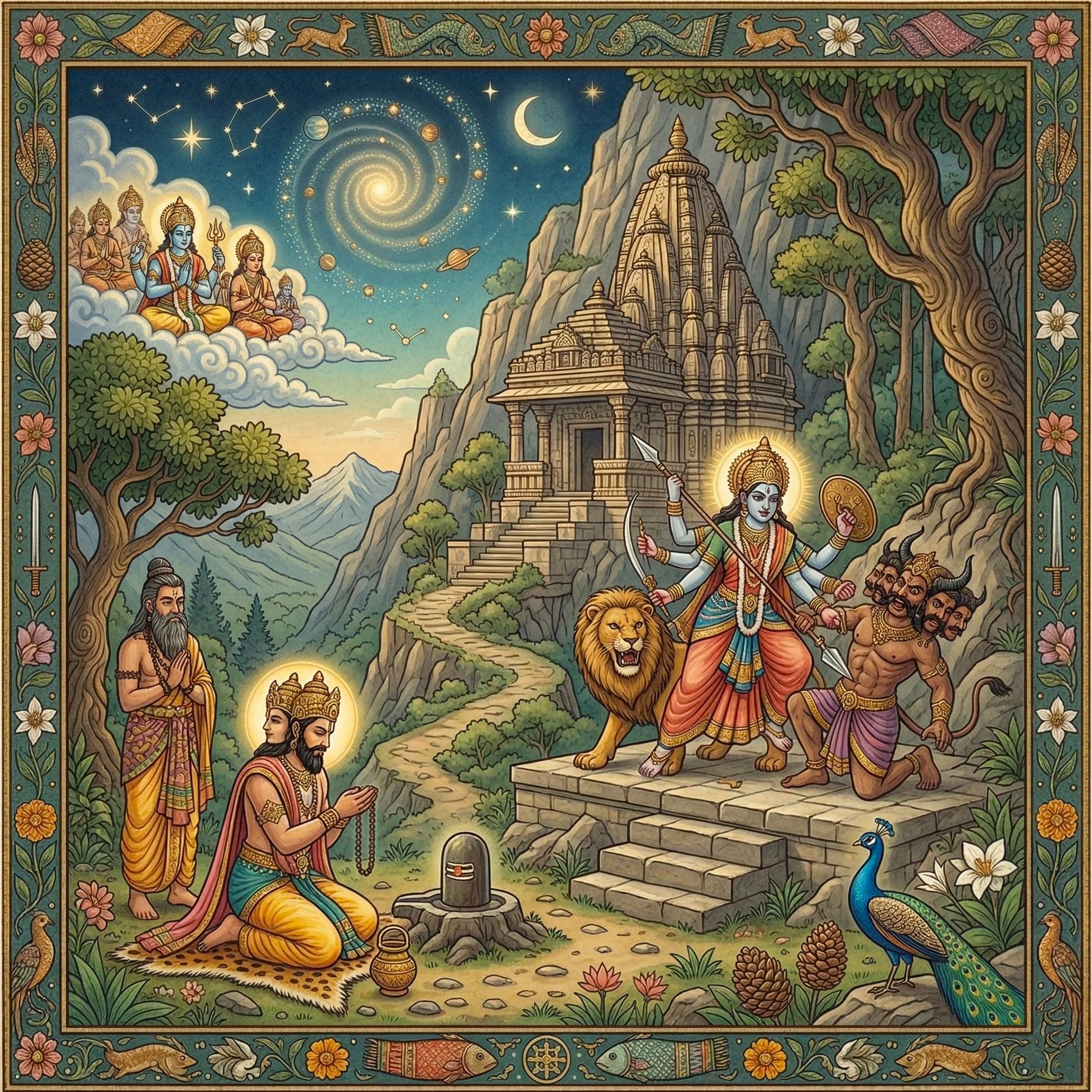
Arbuda Khanda
Arbudha Khanda
This section is centered on Arbuda (commonly identified in Purāṇic sacred geography with the Arbuda mountain region, associated with the Aravalli range and the Mount Abu area). The landscape is treated as a tīrtha-field where mountains, cavities, rivers invoked through mantra, and hermitage zones become loci of purification narratives. The text frames Arbuda as notable for sin-removal (pāpa-praṇāśana) and as being described as relatively untouched by Kali-era defects through the theological agency attributed to Vasiṣṭha’s presence and austerity.
Adhyayas in Arbudha Khanda
63 chapters to explore.
Adhyaya 1
Arbuda-Māhātmya Prastāvanā: Vasiṣṭha, Nandinī, and the Sanctification of Arbuda
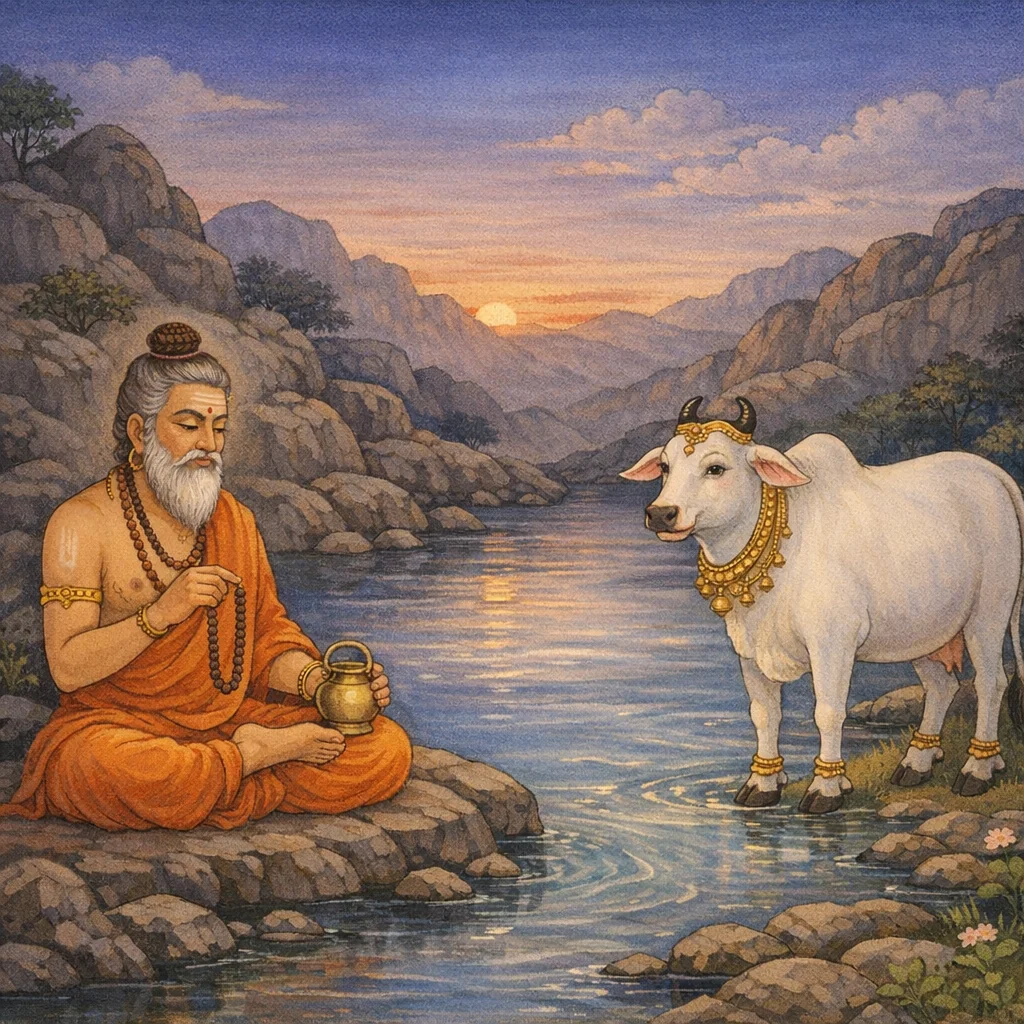
Chapter 1 begins with a maṅgala, an invocatory praise of Śiva as subtle, knowable through true knowledge, pure, and universal in form. The ṛṣis—having heard the genealogies of Soma and Sūrya, the accounts of the manvantaras, and varied creation narratives—request an excellent tīrtha-māhātmya and ask which sacred places are foremost on earth. Sūta replies that tīrthas are innumerable, traditionally counted in vast totals, and that fields, rivers, mountains, and streams attain supreme sanctity through the tapas of ṛṣis. In this sacred geography, Arbuda is singled out as a sin-removing mountain, untouched by Kali-doṣa due to Vasiṣṭha’s power; it purifies even by mere darśana, surpassing ordinary rites such as bathing and giving. The ṛṣis then ask about Arbuda’s measure and location, how its fame arises from Vasiṣṭha’s māhātmya, and which tīrthas are chief there. Sūta begins the purifying account as he heard it: Vasiṣṭha, a devarṣi of Brahmā’s lineage, performs severe austerities with regulated diet and seasonal disciplines. His renowned wish-fulfilling cow Nandinī falls into a deep, dark chasm while grazing. Anxious because she is needed for his daily homa, Vasiṣṭha searches, finds the chasm, and hears her cry; at her plea he meditatively invokes Sarasvatī, purifier of the three worlds, who appears and fills the chasm with clear water so Nandinī can escape. Seeing the chasm’s immense depth, Vasiṣṭha resolves to have it filled by bringing a mountain, and he goes to Himavān to request a suitable mountain mass; Himavān welcomes him, asks for the dimensions, and then wonders how such a vast opening came to be, leading into the next development.
Adhyaya 2
Uttanka’s Guru-sevā, the Recovery of the Kuṇḍalas, and the Takṣaka Episode (उत्तंक-गुरुसेवा-कुण्डल-प्राप्ति-तक्षक-प्रसङ्गः)
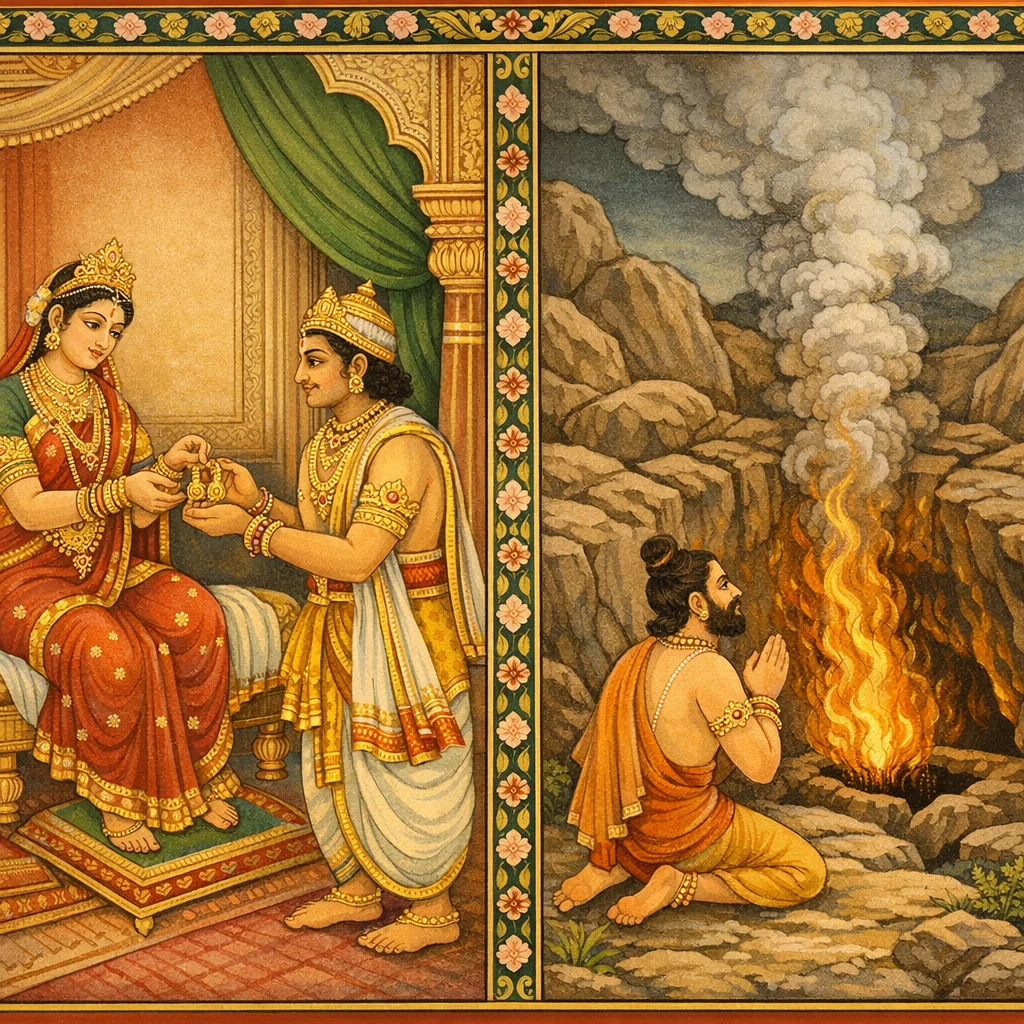
Vasiṣṭha recounts an earlier episode: the sage Gautama teaches many students, yet the devoted Uttanka remains for a long time in guru-sevā, steadfast service to his teacher. Sent on an errand, Uttanka encounters a symbolic sign of neglected household duty and is troubled about the continuity of lineage; when the matter is reported, Gautama instructs him to perform the householder rites with his wife and refuses any further fee. Still desiring a tangible guru-dakṣiṇā, Uttanka approaches Ahalyā, the guru’s wife, who commands him to obtain—within a strict deadline—the jeweled earrings (kuṇḍalas) of Madayantī from King Saudāsa. The king threatens to eat Uttanka yet permits the request; Madayantī demands a royal token as proof and then gives the earrings, warning that Takṣaka covets them. On the return journey Uttanka hears the king’s cryptic words about the consequences of pleasing or displeasing brāhmaṇas, and Saudāsa explains his former curse and its release. Takṣaka then steals the earrings; Uttanka pursues him into the subterranean realm and, aided by Indra and a divine horse bearing the Agni motif, raises smoke and fire that compel the nāgas to restore the kuṇḍalas. Uttanka delivers them to Ahalyā just in time, averting her curse; the chapter ends by saying a “vivara” (an opening) arose because of Takṣaka and Uttanka, joined to a practical injunction to fill a pit for cattle—binding moral narrative to landscape memory and duty.
Adhyaya 3
अर्बुदेन विवरप्रपूरणं तथा नागतीर्थमाहात्म्यम् (Arbuda Fills the Chasm and the Glory of Nāga Tīrtha)
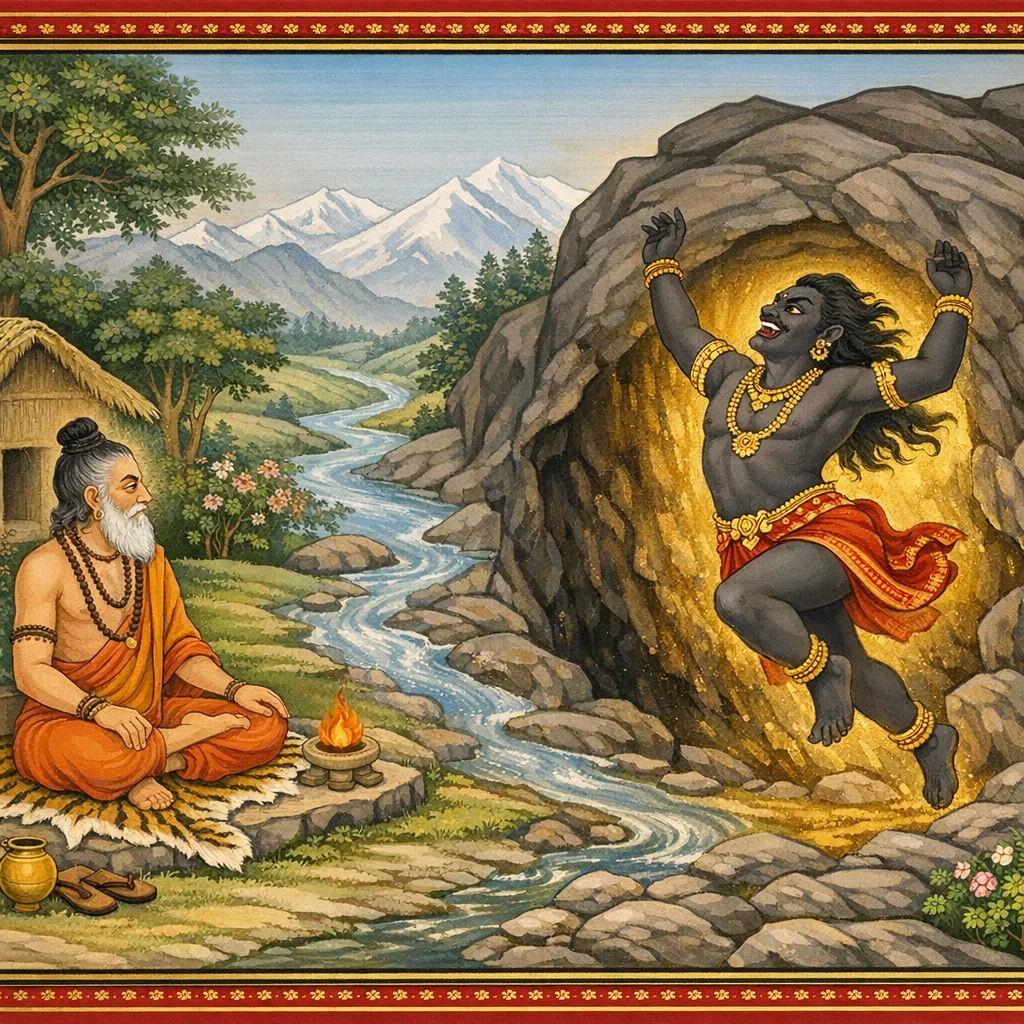
Sūta recounts a sequence of dialogues in which Himālaya asks the sage Vasiṣṭha how a dreadful chasm (vivara) might be filled. Since the mountains lost the power of flight after Indra long ago cut off their wings, a practical means is required. Vasiṣṭha proposes Nandivardhana, Himālaya’s son, together with his close companion Arbuda—a mighty nāga able to rise swiftly. Nandivardhana hesitates, calling the region harsh and socially unsafe, but Vasiṣṭha assures him that his sanctifying presence will establish rivers, tīrthas, deities, and auspicious life there, and that Maheśvara (Śiva) will also be brought. Arbuda agrees on the condition that the place become renowned by his name. Arbuda then fills/releases the chasm as instructed, pleasing Vasiṣṭha. As boons, Arbuda asks that the pure waterfall/spring on the peak be famed as Nāga Tīrtha, and that bathing there grant ascent to higher states; benefits of fertility for women are also declared. Observances are prescribed: worship on Nabhas śukla-pañcamī, Māgha bathing, sesame-gifts (tila-dāna), and pañcamī śrāddha. Vasiṣṭha grants all, establishes an āśrama, and through tapas manifests the river/stream Gomati. The chapter closes with its promised fruit: even grievous sinners attain a higher destiny by bathing, the sight of Vasiṣṭha’s face is linked with freedom from rebirth, and Arundhatī is affirmed as worthy of special veneration.
Adhyaya 4
Acaleśvara-liṅga Prādurbhāva and Vasiṣṭha’s Śiva-stotra (अचलेश्वरलिङ्गप्रादुर्भावः वसिष्ठशिवस्तोत्रम्)
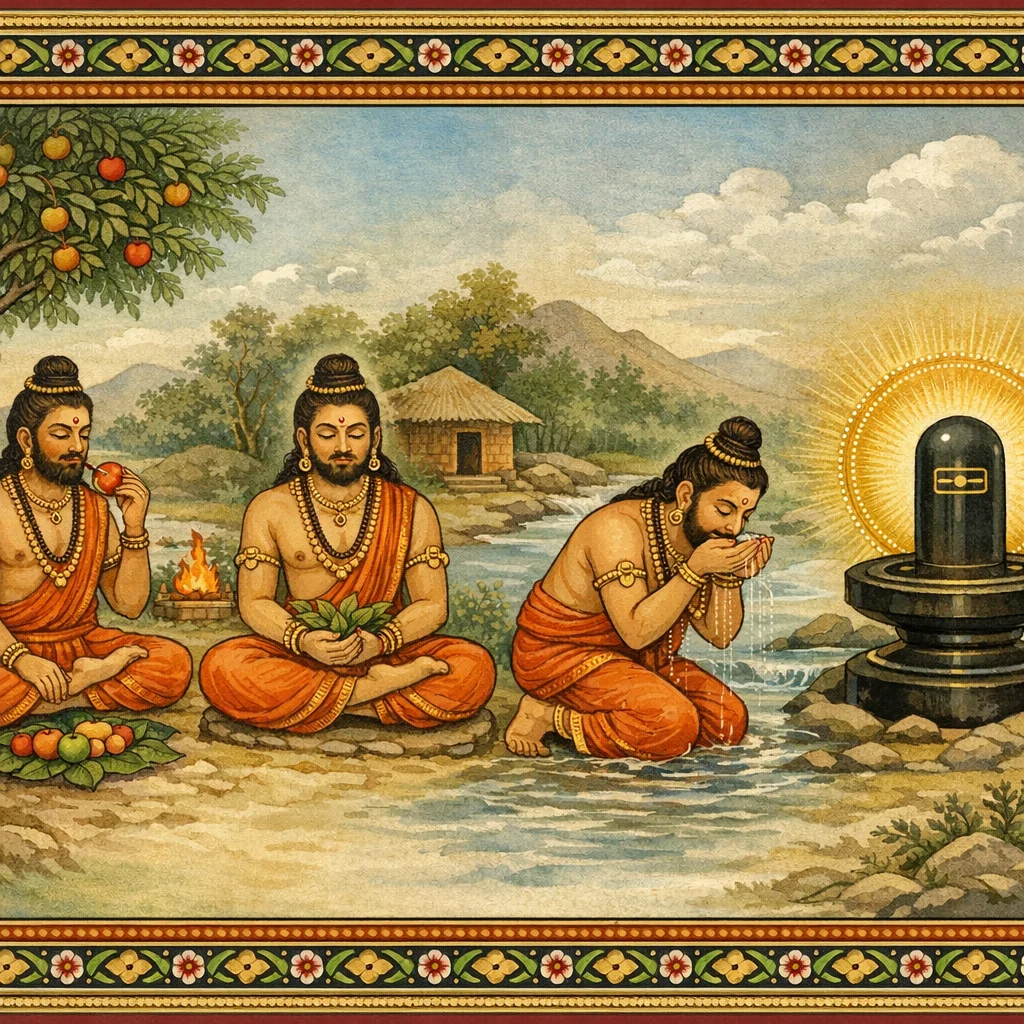
Sūta relates that Bhagavān Vasiṣṭha establishes an āśrama on Arbudācala and performs intense tapas so that Śambhu may abide there. His ascetic practice unfolds in stages—living on fruits, then leaves, then water alone, and finally on air—followed by prolonged seasonal disciplines: pañcāgni in summer, immersion practices in winter, and dwelling under the open sky during the rains. Pleased, Mahādeva manifests by splitting open the mountain, and a liṅga arises before the sage. Vasiṣṭha offers a well-ordered Śiva-stotra, praising Śiva’s purity, all-pervasiveness, triadic resonance (trimūrti), aṣṭamūrti, and knowledge-nature. A bodiless voice invites a boon; Vasiṣṭha asks for perpetual divine proximity within the liṅga, in keeping with a prior vow. Śiva grants continuous sānnidhya and declares that those who praise with this stotra—especially in a calendrically appointed observance—gain fruits akin to pilgrimage. The account further sanctifies the Mandākinī river, sent for divine purpose, and a northern kuṇḍa whose bath and liṅga-darśana lead to the highest state beyond aging and death. The liṅga is named Acaleśvara, proclaimed immovable until cosmic dissolution, after which sages and gods establish additional tīrthas and sacred abodes in the region.
Adhyaya 5
Nāga-tīrtha Māhātmya (Glory of Nāga-tīrtha at Arbuda)
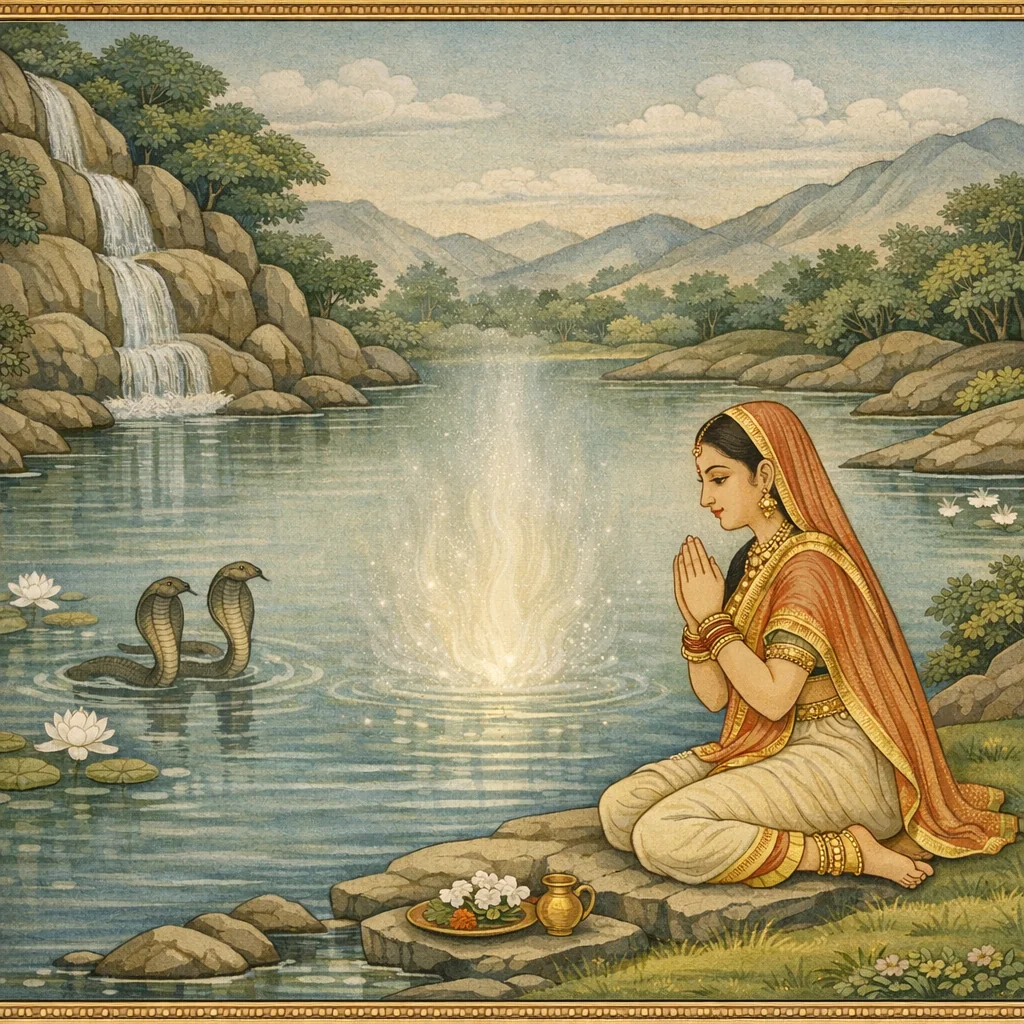
Chapter 5 unfolds as an ordered dialogue. The sages ask to hear more of Arbuda’s greatness, and Sūta recalls an earlier occasion when King Yayāti questioned the sage Pulastya about Arbuda, the proper sequence of pilgrimage, and the resulting merits. Pulastya declares Arbuda’s dharma-filled vastness and, choosing brevity, begins with Nāga-tīrtha, a sacred ford that fulfills aims and, especially for women, bestows offspring and auspicious prosperity. An origin tale follows: Gautamī, a chaste Brahmin widow devoted to pilgrimage, reaches Arbuda and bathes in Nāga-tīrtha. Seeing another woman attended by her son, she is overcome with sorrow and inwardly forms the wish for a child. On leaving the water she becomes pregnant without conjugal contact; ashamed, she intends to end her life, but an incorporeal voice forbids self-harm and explains that this is the tīrtha’s power—desires conceived while in the water are fulfilled. Gautamī remains there and gives birth to a son marked with auspicious signs. The chapter closes with phala statements: śrāddha performed there safeguards the continuity of one’s lineage; desireless bathing and śrāddha grant enduring worlds; women who offer flowers and fruits gain children and good fortune; and disciplined, reverent pilgrimage is commended.
Adhyaya 6
Vasiṣṭhāśrama–Kuṇḍa Māhātmya (वसिष्ठाश्रम-कुण्ड-माहात्म्य) — Ritual Merits of Darśana, Snāna, Śrāddha, Dīpa-dāna, and Upavāsa
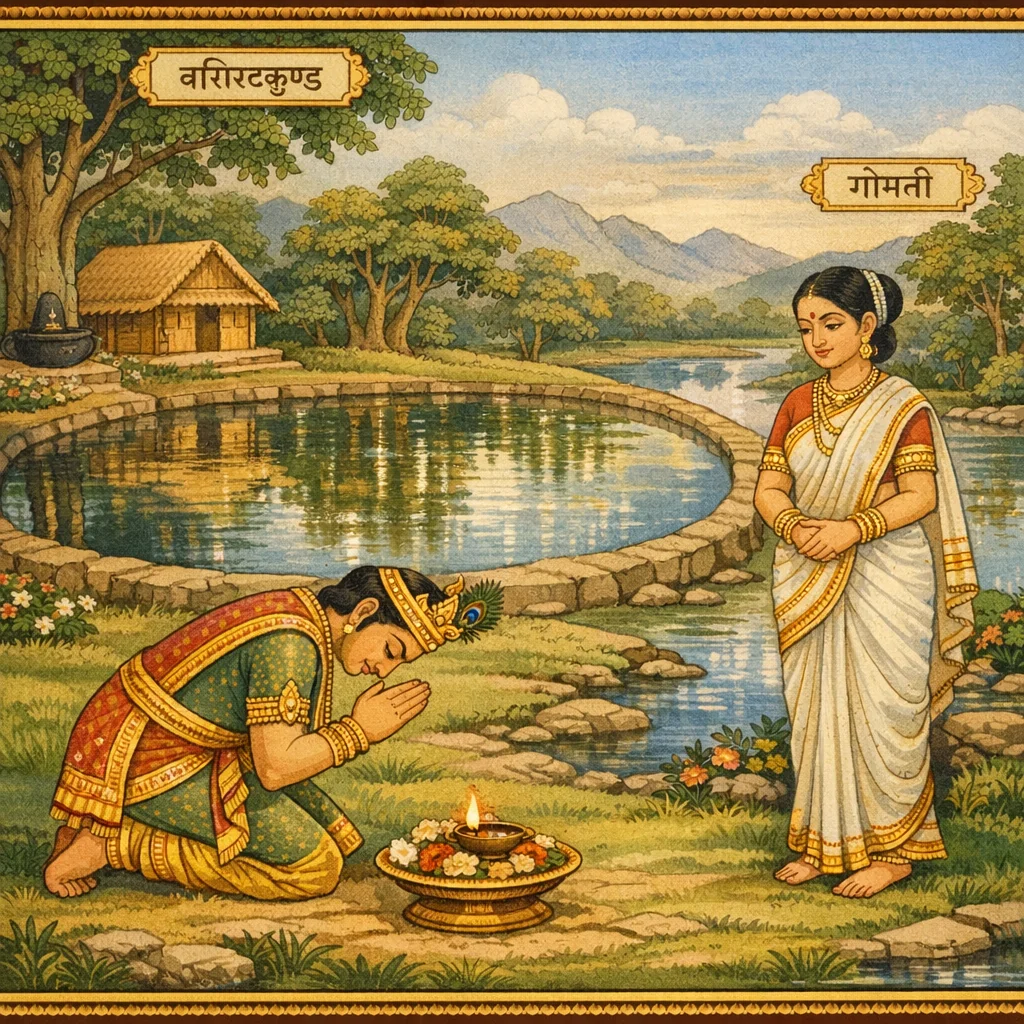
Pulastya instructs the king to go to Vasiṣṭha, praised as a treasury of tapas, whose very darśana brings fulfillment. The chapter locates special merit at a water-filled kuṇḍa that destroys demerit, linked to Vasiṣṭha and the river Gomati, said to have been drawn there by ascetic power; bathing in it frees one from pāpaka (sin). The teaching then turns to ancestral rites: śrāddha performed with ṛṣidhānya is declared to deliver all pitṛs through both fortnights, and a gāthā from the Nārada-gītā proclaims śrāddha at Vasiṣṭha’s āśrama superior to other famed śrāddha sites and even sacrifices. Arundhatī is singled out as especially worthy of worship and as granting desired aims. Graded observances and fruits are listed: offering a lamp (dīpa-dāna) before Vasiṣṭha yields prosperity and radiance; a one-night fast leads to the pure realm of the Seven Ṛṣis; three nights to Maharloka; a month-long fast to mokṣa and freedom from saṃsāra. Further injunctions include tarpaṇa to the ṛṣi on Śrāvaṇa śukla Paurṇamāsī for Brahmaloka, japa of eight hundred Gāyatrīs for immediate release from grave sins, and worship of Vāmadeva for Agniṣṭoma-like merit; the chapter closes by urging earnest darśana of the sage and pure, faithful worship of Vāmadeva.
Adhyaya 7
अचलेश्वरप्रदक्षिणामाहात्म्य (Acaleśvara Pradakṣiṇā-Māhātmya) — Chapter 7
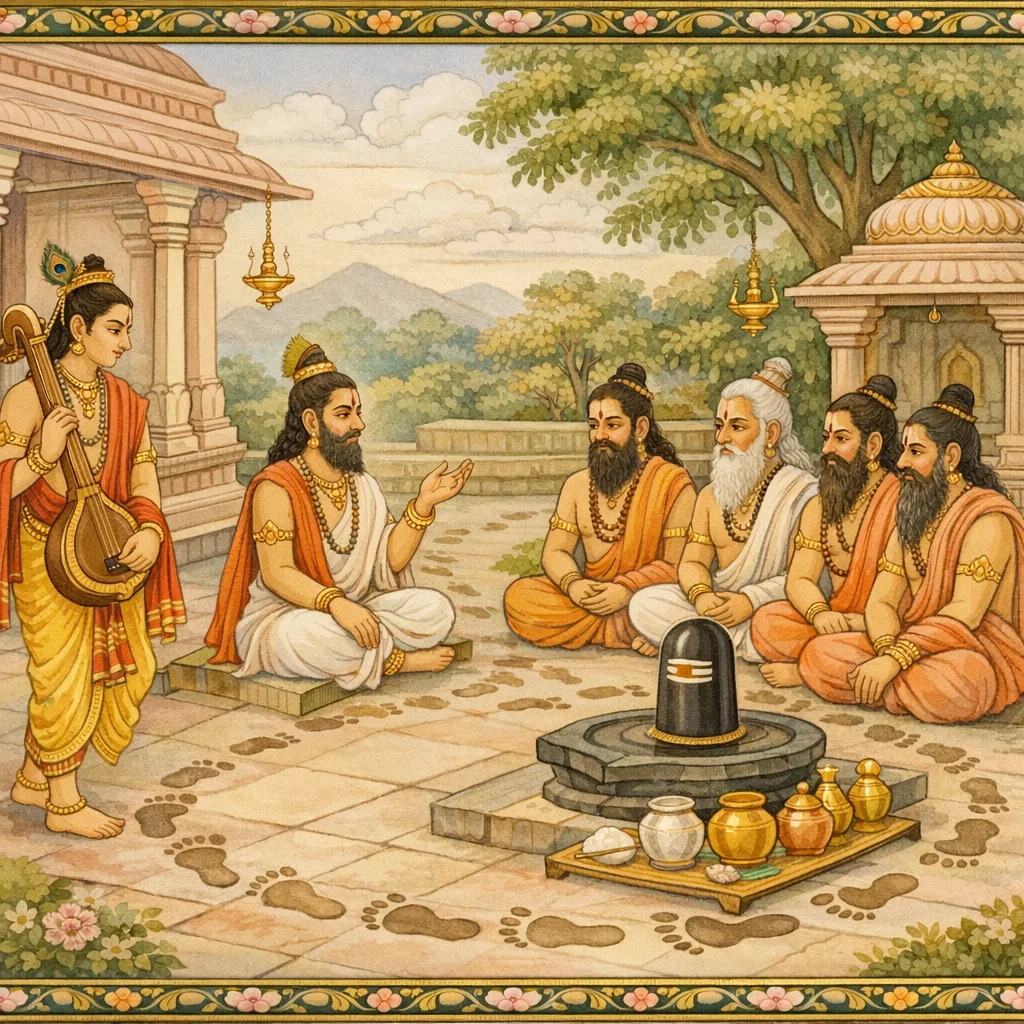
Pulastya sets forth a pilgrimage injunction to Acaleśvara, declaring that darśana performed with faith brings spiritual accomplishment. He details rites and their phala: śrāddha on Kṛṣṇa Caturdaśī (also in Āśvina/Phālguna) leads to supreme attainment; worship facing south with flowers, leaves, and fruits equals the fruit of an Aśvamedha; pañcāmṛta tarpaṇa grants divine proximity and Śiva-loka; and every step of pradakṣiṇā dissolves sin. The chapter then relates a “wonder” Pulastya heard from Nārada in a heavenly setting: a non-devotional parrot repeatedly circumambulates its nest out of routine, dies, and is reborn as King Veṇu with birth-memory. Recalling the causal power of circumambulation, Veṇu devotes himself almost entirely to pradakṣiṇā at Acaleśvara. Visiting sages (including Nārada and others) question his neglect of conventional offerings; Veṇu explains his prior-life cause and reliance on the shrine’s grace. The sages affirm the teaching, adopt pradakṣiṇā themselves, and Veṇu finally attains a rare, enduring status through Śambhu’s favor.
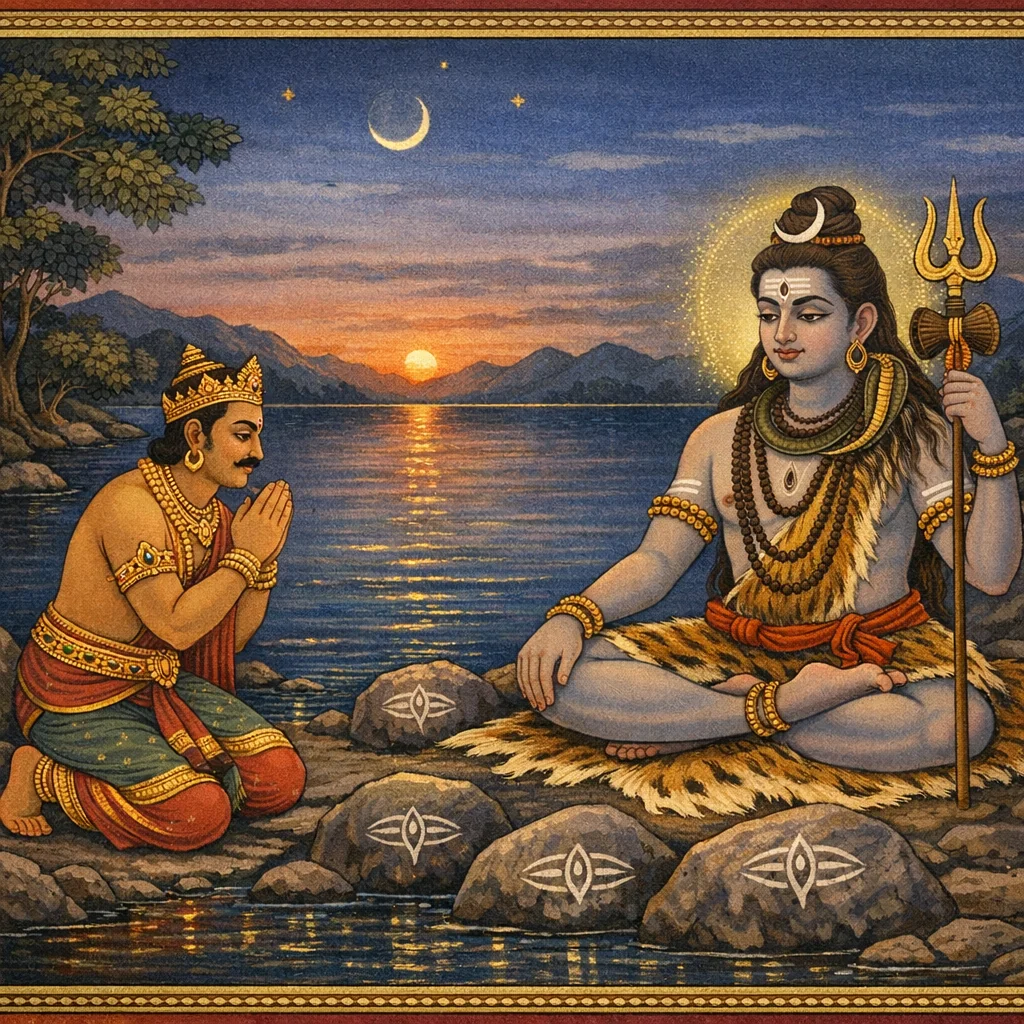
Adhyaya 8
भद्रकर्णह्रद-त्रिनेत्रलिङ्गमाहात्म्यम् (The Māhātmya of Bhadrakarṇa Lake and the Trinetra Liṅga)
Pulastya tells a king of the great sacred water-body called Bhadrakarṇa Mahāhrada, famed for many stones that appear “three-eyed” (trinetrābhā). To its west stands Śiva’s liṅga; the darśana of that liṅga is said to make the devotee “like the three-eyed one” (trinetrasadṛśa), symbolically attuned to Śiva’s vision. An origin-legend is then given: Bhadrakarṇa, a gaṇa beloved of Śiva, establishes the liṅga and fashions the lake. Later, when the gaṇa host is defeated in battle with the dānavas, the mighty dānava Namuci assaults Śiva’s front. Bhadrakarṇa confronts him and slays him decisively. Though the fallen dānava enters darkness, by recognizing Śiva and standing in truth he becomes the occasion for Śiva’s satisfaction. Śiva grants Bhadrakarṇa a boon of enduring sānnidhya at the liṅga and the lake, with special intensification on the 14th lunar day (caturdaśī) of the dark fortnight (kṛṣṇapakṣa) in the month of Māgha. The chapter concludes by prescribing that one who bathes (snāna) in Bhadrakarṇa lake and worships the Trinetra Liṅga attains Śiva’s eternal abode; therefore devotees are urged to perform snāna and pūjā there with steady effort.
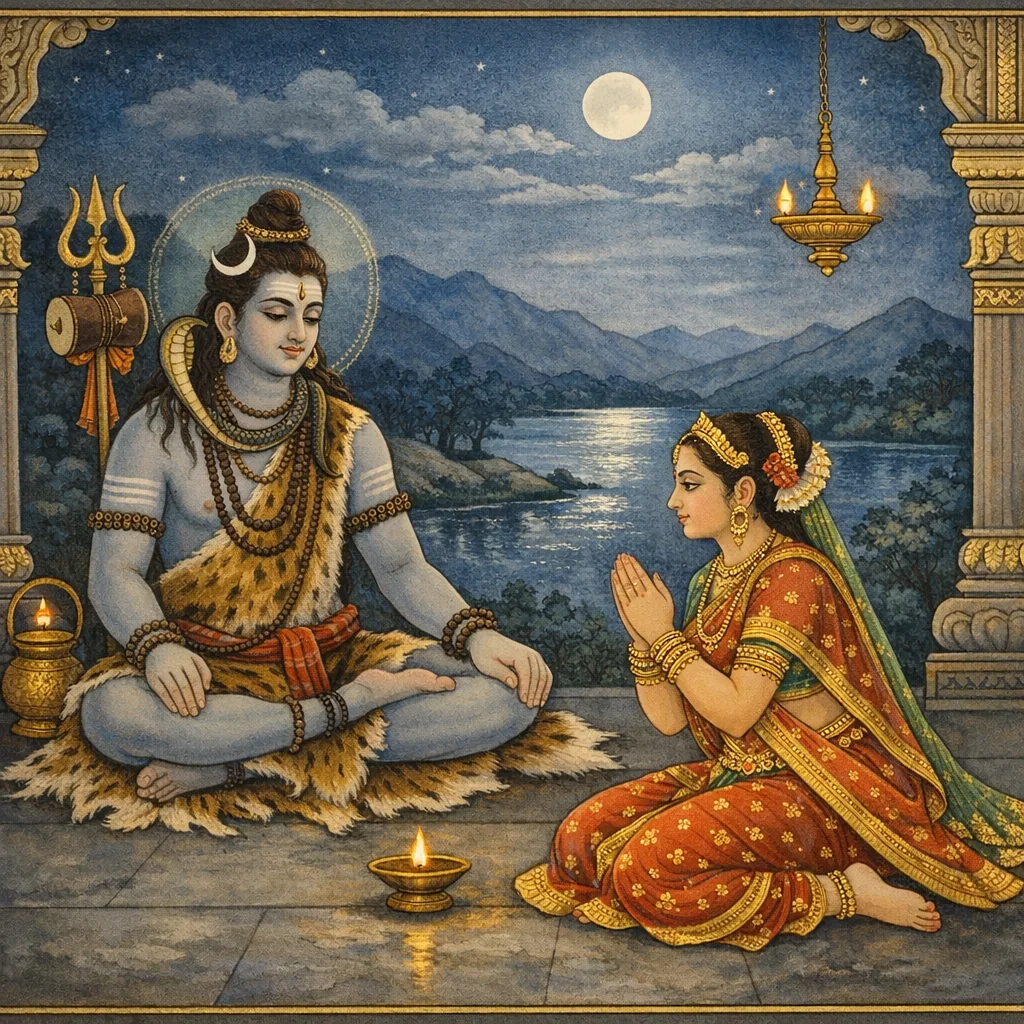
Adhyaya 9
केदारतीर्थमाहात्म्यं तथा शिवरात्रिजागरकथनम् (Kedāra Tīrtha Māhātmya and the Śivarātri Night-Vigil Narrative)
Pulastya proclaims Kedāra as a tīrtha famed in the three worlds, powerful to cleanse sin, set in a supremely purifying region where the Mandākinī is linked with Sarasvatī. Darśana, bathing, and drinking from the Kedāra-kuṇḍa are praised as bestowing great merit. An “ancient itihāsa” is then told. King Ajapāla, an ideal ruler who levies no excessive taxes and keeps his realm “thornless” (free of crime), receives the sage Vasiṣṭha during a pilgrimage occasion and asks the karmic cause of his prosperity, social welfare, and devoted wife. Vasiṣṭha explains their prior birth: the couple, of Śūdra origin and stricken by famine, wandered to a lotus-filled water spot, bathed and drank, and offered mental/ritual satisfactions to ancestors and deities. Seeking food, they carried lotuses to sell, but in the scarcity no one would buy. At day’s end they heard Vedic-Purāṇic recitation near a Śiva temple at Kedāra, where the courtesan Nāgavatī was observing Śivarātri jāgaraṇa (night vigil). Learning the vow’s merit, they chose to offer the lotuses to Śiva instead of taking payment, and with focused mind they performed worship, fasting (arising from hunger), night-vigil, and Purāṇa-hearing. After death (including the wife’s self-immolation as narrated), they were reborn into royal circumstances; Ajapāla’s present exemplary kingship is attributed to Kedāra’s grace. The chapter concludes by specifying Śivarātri as the Kṛṣṇa Caturdaśī between Māgha and Phālguna, prescribing pilgrimage, vigil, and worship at Kedāra. The phalāśruti declares that listening removes sin, and that darśana, snāna, and drinking from the Kedāra-kuṇḍa yield liberation-oriented fruits, extending benefit even to one’s ancestors.
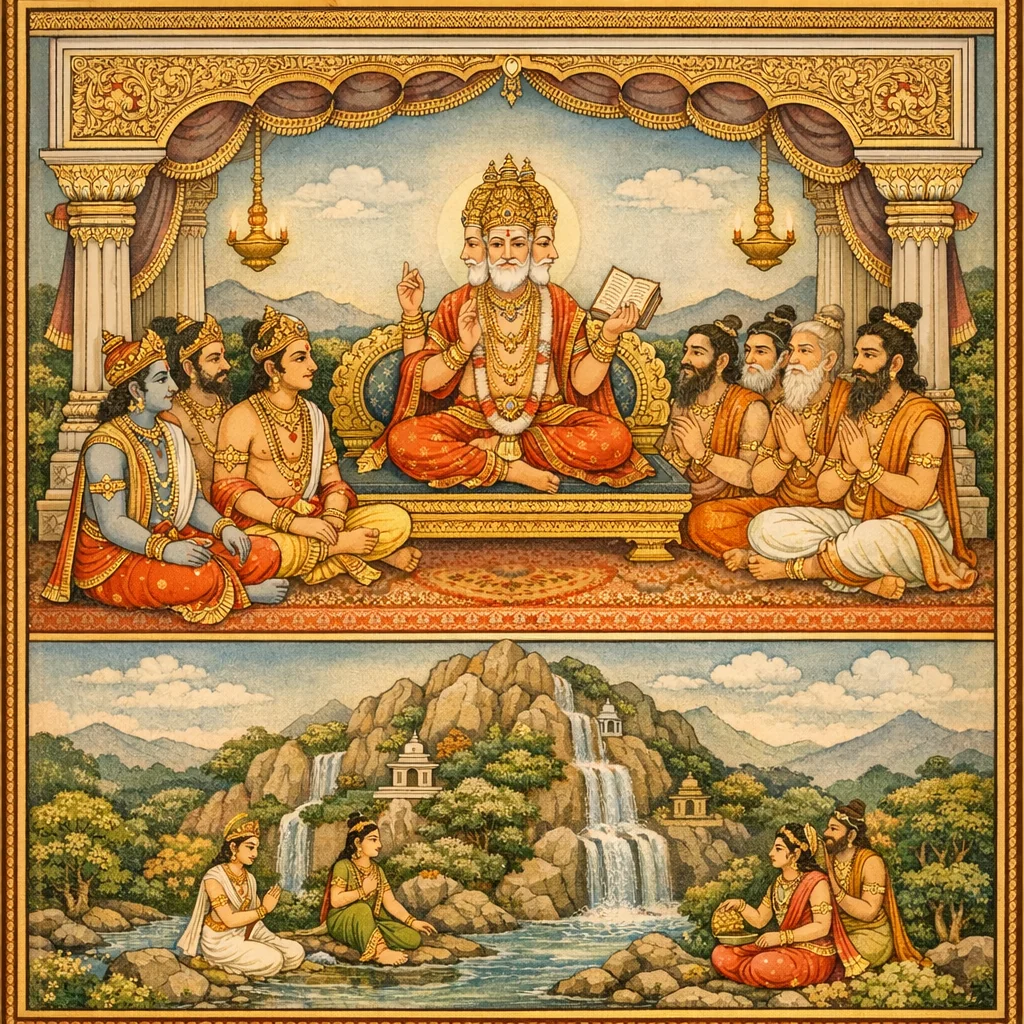
Adhyaya 10
Yuga-māna and Kali-yuga Refuge of Tīrthas at Arbuda; Maṅkaṇaka–Maheśvara Discourse (युगमान-वर्णनम्, अर्बुदे तीर्थ-निवासः, मंकणक-महेश्वर-संवादः)
Chapter 10 begins with King Yayāti asking Pulastya why Kedāra and the great rivers Gaṅgā and Sarasvatī are present in the Arbuda setting, seeking the reason for the site’s “kautuka” (a remarkable sacred anomaly). Pulastya answers through an embedded scene in which devas and ṛṣis approach Brahmā, and Indra requests a systematic account of yuga-measures and the moral character of each age. Brahmā states the durations of Kṛta, Tretā, Dvāpara, and Kali and explains dharma’s decline from four-footed to one-footed, with social and ritual decay in Kali-yuga. The tīrthas, personified, ask how they can endure in Kali; Brahmā appoints Arbuda as a mountain where Kali does not operate and directs the tīrthas to dwell there so their efficacy remains intact. The chapter then illustrates this teaching with the legend of the ascetic Maṅkaṇaka, who mistakes a bodily sign for siddhi and dances, disturbing cosmic order; Śiva intervenes, displays superior power (ash emerging from his thumb), and grants boons. Śiva proclaims the liberating, sin-purifying fruits of bathing in Sarasvatī, performing śrāddha at the Gaṅgā–Sarasvatī confluence, and giving gold according to one’s capacity. Thus the chapter weaves cosmological time, ethical diagnosis, sacred geography, and ritual instruction into a single tīrtha-māhātmya affirming Arbuda’s enduring sanctity.
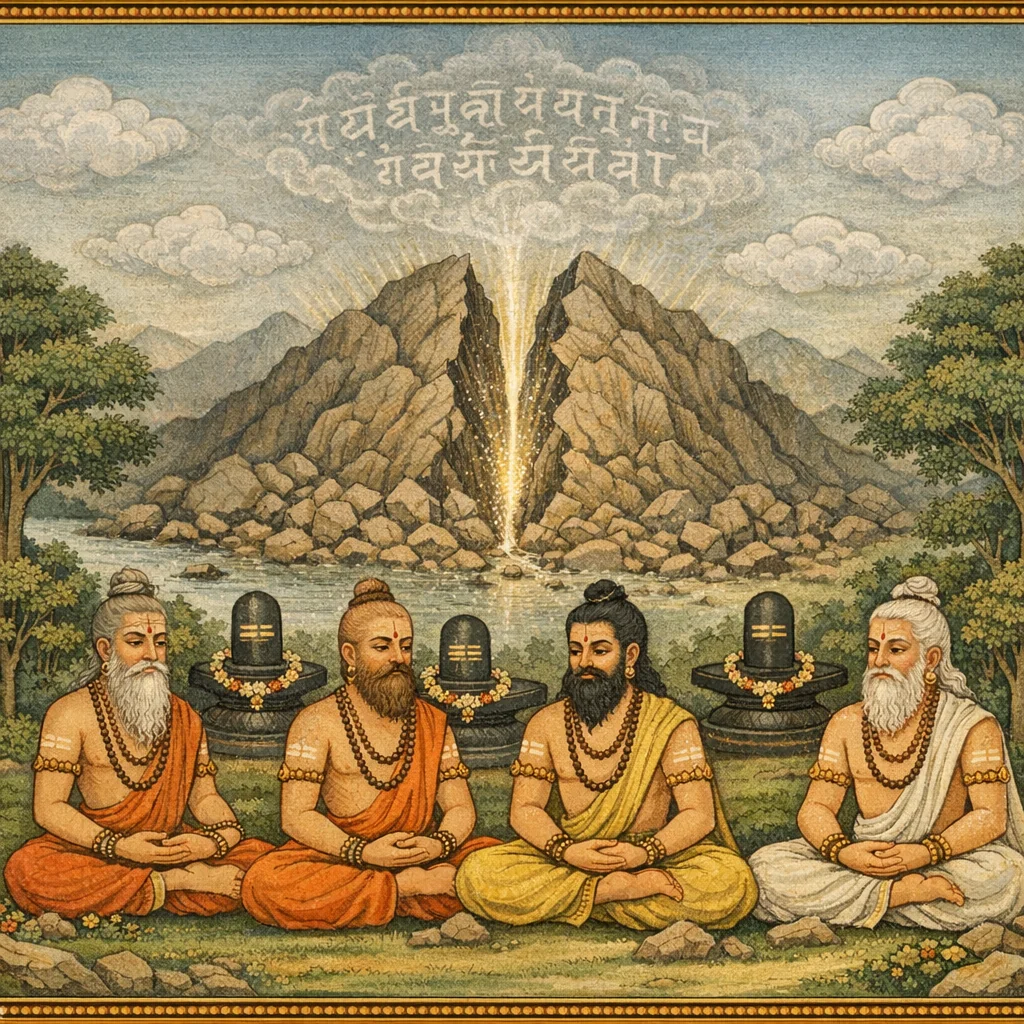
Adhyaya 11
Koṭīśvara-liṅga-prādurbhāvaḥ (Origin and Merit of Koṭīśvara)
Pulastya tells a royal listener of the manifestation and greatness of Koṭīśvara. Many sages from the South arrive at Arbuda in a spirit of rivalry, each demanding precedence in beholding Acaleśvara; a moral warning is given that a late-coming brāhmaṇa, devoid of devotion and faith, would fall into a degraded state. The sages then restrain themselves, take vows, and are recognized as peaceful ascetics learned in Vedic lore. Śiva, moved by compassion for their devotional intent, manifests at once as “a koṭi” of self-forms (ātma-liṅgas), so that each sage beholds the Deity distinctly in the very same moment. They praise Śiva with Vedic hymns, and Śiva invites them to ask for a boon. They request that this collective, simultaneous darśana yield an unsurpassed fruit, and ask for a single liṅga embodying the merit of a koṭi of liṅgas. A liṅga arises as the mountain splits; an incorporeal voice names it Koṭīśvara and ordains worship on the fourteenth lunar day (caturdaśī) of the dark fortnight in Māgha. The voice declares that worship there grants koṭi-fold reward, and that śrāddha performed there—especially by a southerner—equals the fruit of Gayā-śrāddha. The sages worship with fragrances, incense, and unguents, and attain siddhi through the liṅga’s grace.
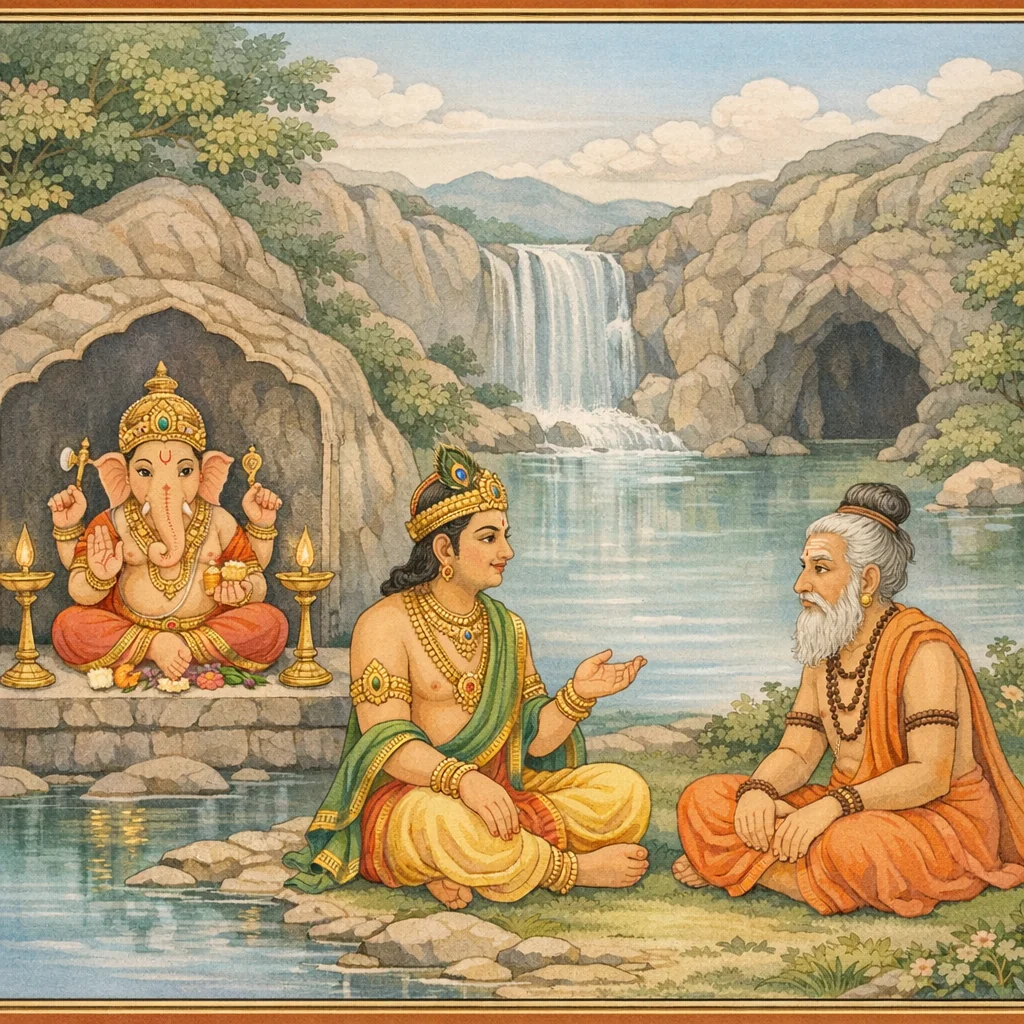
Adhyaya 12
रूपतीर्थमाहात्म्य (Glory of Rūpatīrtha)
Pulastya directs the listener to Rūpatīrtha, praised as a supreme bathing-place that destroys demerit and bestows beauty and an auspicious form. A local legend explains its power: a cowherd woman (ābhīrī), first shown as deformed, falls into a mountain cascade on Māgha-śukla-tṛtīyā and, by the tīrtha’s might, rises forth with divine beauty and auspicious marks. Indra arrives for sport, is enamored, and speaks with her; she asks that on this date any man or woman who bathes there with devotion will please all the gods and gain rare beauty. Indra grants the boon and takes her to heaven, where she becomes known as the apsaras Vapu. The chapter then catalogs nearby sacred micro-sites: an eastern cave where netherworld maidens bathe; a Gaṇeśa seat (vaināyaka-pīṭha) whose water grants siddhi and protection; a Tilaka tree whose flowers and fruits fulfill aims; and the transformative virtues of stones and water. A phalaśruti-like list promises relief from infertility, disease, astrological affliction, and harmful influences. When Yayāti asks the deeper cause, Pulastya attributes the tīrtha’s heightened sanctity to Aditi’s austerities, her concealment and care of the infant Viṣṇu (Trivikrama) in the cascade during a crisis in Indra’s sovereignty, and her nurturing of the Tilaka tree. The chapter ends by urging diligent bathing there, declaring it wish-fulfilling in this world and beyond.
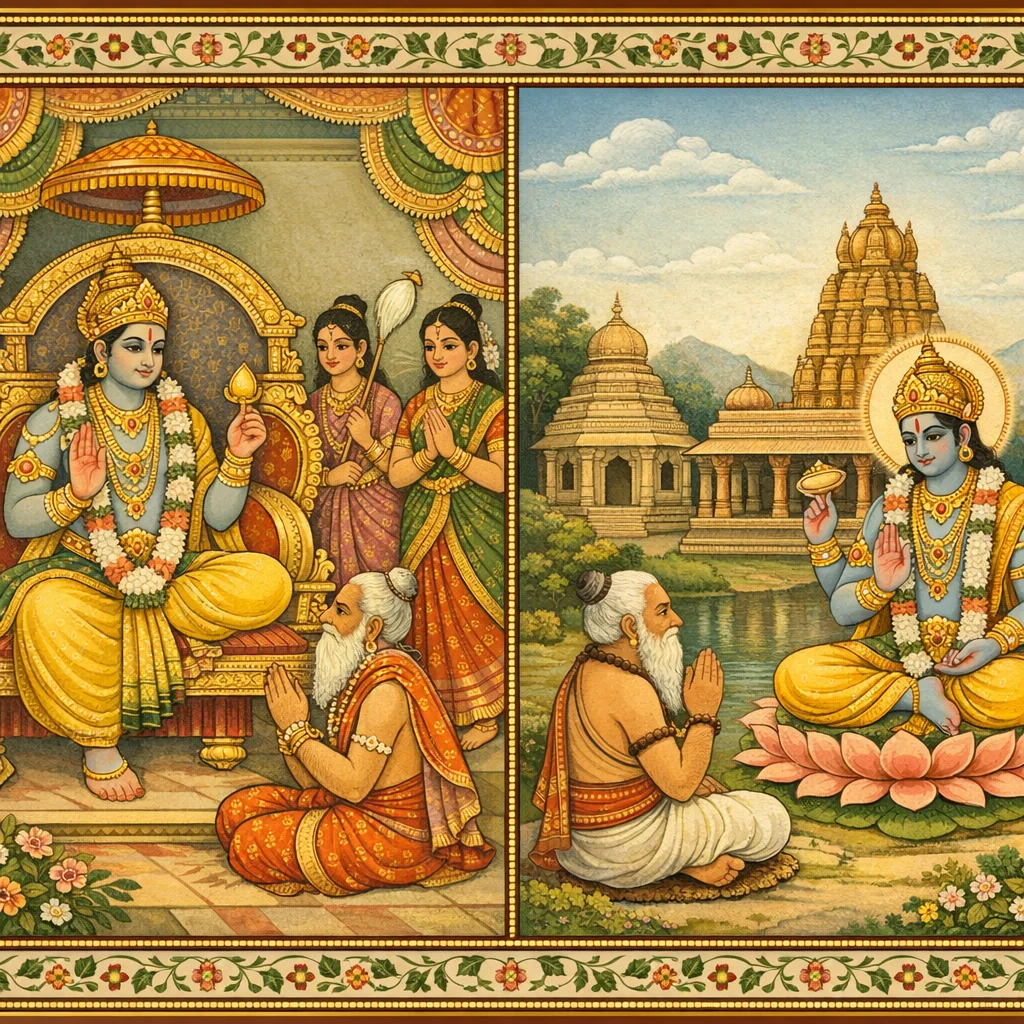
Adhyaya 13
हृषीकेश-तीर्थे अम्बरीषोपाख्यानम् | The Ambarīṣa Narrative at Hṛṣīkeśa Tīrtha
Pulastya directs the royal listener to a tri-loka-renowned tīrtha in the Īśāna quarter—Hṛṣīkeśa Tīrtha—linked with King Ambarīṣa and praised as pāpa-nāśana, the destroyer of sin. The chapter recounts Ambarīṣa’s Kṛta-yuga austerities as they intensify: regulated diet, then living on leaves and water, and finally breath-centered restraint leading into samādhi, by which Viṣṇu is pleased. Indra appears first, offering boons and asserting his lordship, but Ambarīṣa refuses worldly reward and declares that Indra cannot grant mokṣa. When Indra threatens violence, cosmic disturbances arise and Ambarīṣa remains absorbed in samādhi. Viṣṇu then manifests (with Garuḍa imagery displacing Airāvata), grants a boon, and teaches at length: jñāna-yoga for the wasting away of saṃsāra and, at the king’s request, kriyā-yoga suited to the Kali-yuga condition. Ambarīṣa asks for the Lord’s perpetual presence in his āśrama through the installation of an image; a temple is founded, and Viṣṇu is proclaimed continually present in Kali. The phalaśruti exalts Hṛṣīkeśa-darśana and the four-month cāturmāsya observance above many gifts, sacrifices, and austerities; even small acts—offering a flower, anointing, sweeping, lighting a lamp on Kārttika śukla ekādaśī, and pañcāmṛta worship—are presented as merit-giving and liberation-oriented, emphasizing disciplined devotion as an ethical-ritual path.
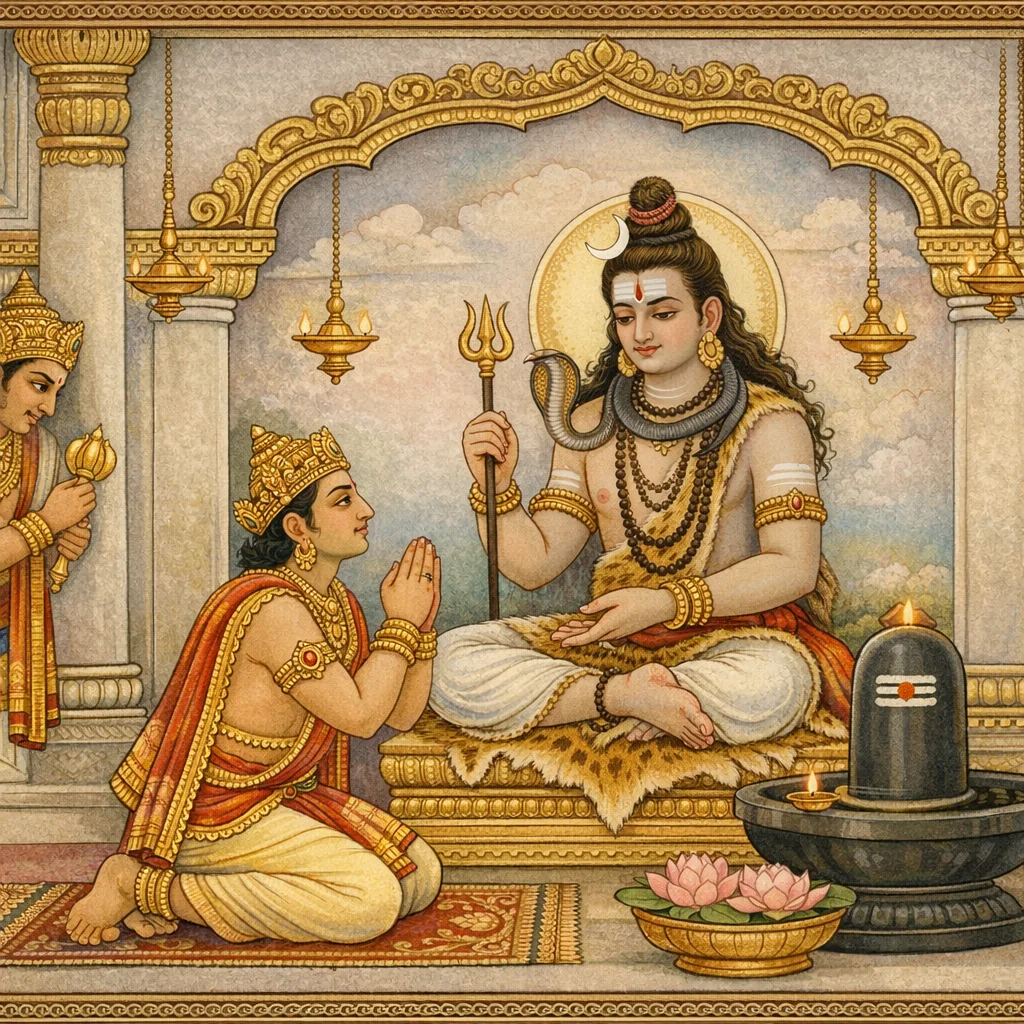
Adhyaya 14
Siddheśvara-liṅga Māhātmya (Glory of the Siddheśvara Liṅga)
Pulastya tells a royal listener of the greatness of Siddheśvara, a supreme liṅga said to have been established in ancient times by an accomplished siddha. That siddha, Viśvāvasu, performs vast austerities with steadfast bhakti, mastering anger, pride, and the senses; pleased, Śiva (Vṛṣabhadhvaja) grants him a direct vision. When Śiva offers a boon, Viśvāvasu asks that anyone who mentally contemplates this liṅga may, by Śiva’s grace, attain desired aims. Śiva assents and vanishes; many go to Siddheśvara and gain siddhi. Yet because its influence grants ends so readily, customary dharma-acts such as yajña and dāna decline, troubling the gods; Indra tries to obstruct siddhi by covering it with the vajra, but nearness to Siddheśa still brings accomplishment and diminishes sin. A calendrical rule is given: on the 14th lunar day (caturdaśī) that falls on a Monday, whether in the bright or dark fortnight, one who touches it (sparśana) becomes “siddha.” The chapter concludes by reaffirming its enduring efficacy and urging pilgrimage and reverent worship to attain sadgati, a good destination.
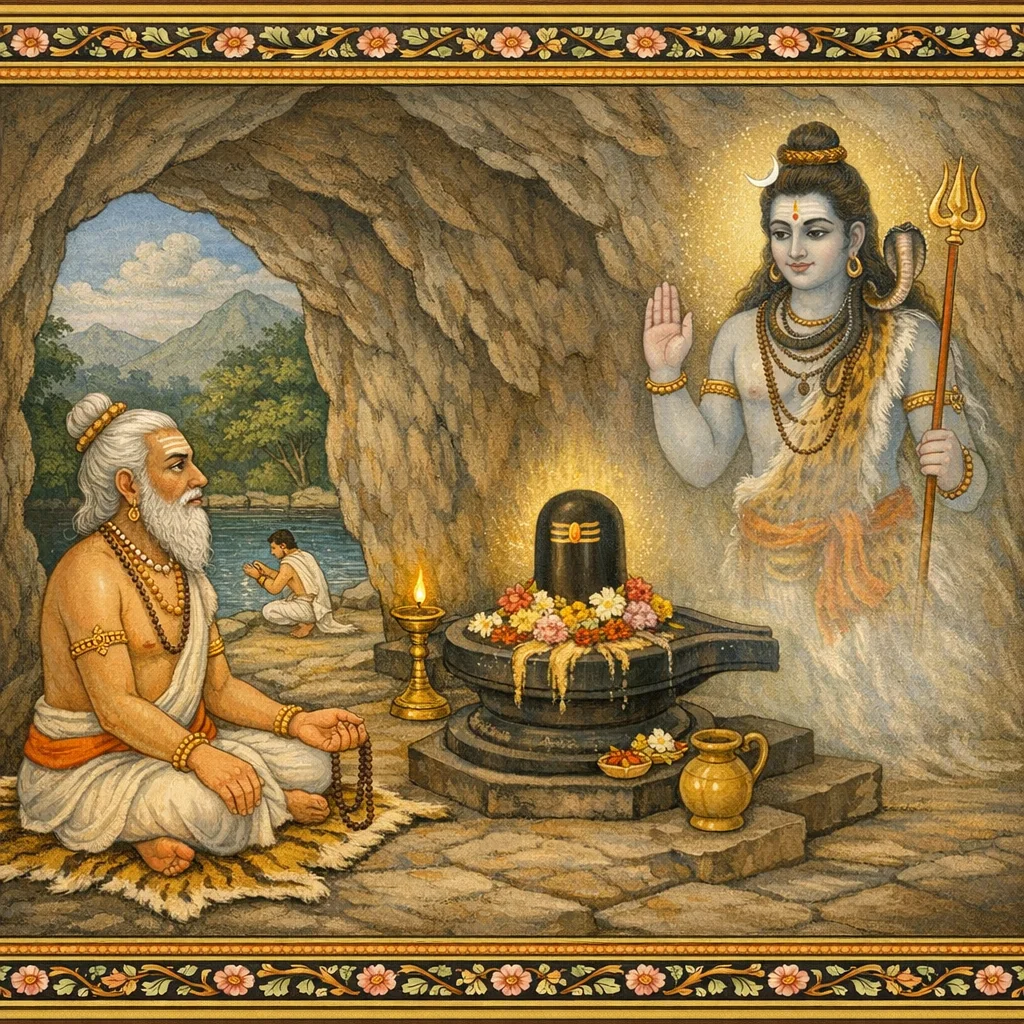
Adhyaya 15
Śukreśvara-Pratiṣṭhā and the Life-Restoring Vidyā (शुक्रेश्वरप्रतिष्ठा तथा संजीवनीविद्या)
Pulastya tells a royal listener the sacred origin of Śukreśvara, the liṅga established by Śukra (Bhārgava). Seeing the daityas defeated by the devas, Śukra reflects on how they might regain strength and resolves to attain siddhi through worship of Śaṅkara. He goes to Arbuda mountain, finds a cave-like opening, and undertakes fierce austerities, installing a Śiva-liṅga and worshipping it unceasingly with incense, fragrances, and unguents. After a thousand years Śiva appears, praises his devotion, and offers a boon. Śukra asks for the sañjīvanī-vidyā by which those who have met death may be restored to life; Śiva grants it and invites a further request. Śukra then lays down a calendrical rite: whoever, on the bright eighth day (śukla-aṣṭamī) of Kārttika, with faith touches/approaches and worships that liṅga, is freed even from the slightest fear of death and gains desired aims here and hereafter. Śiva assents and vanishes. By the granted vidyā, Śukra revives many daityas slain in battle. The account ends by pointing out a pure, sin-destroying mahākuṇḍa before the shrine: bathing there removes sins, and śrāddha performed there satisfies the ancestors; even simple water-offerings (tarpaṇa) bear fruit—therefore one should earnestly strive to bathe in that place.
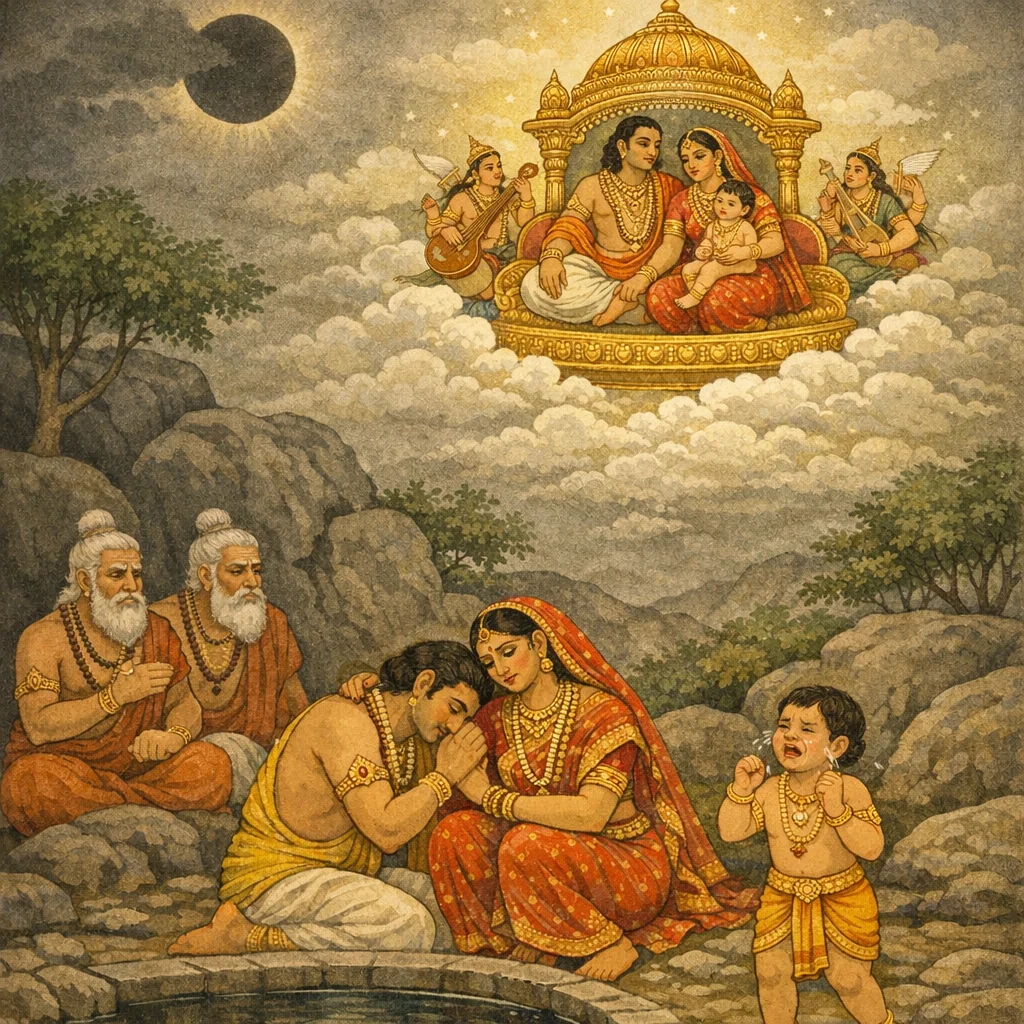
Adhyaya 16
मणिकर्णिका-तीर्थ-माहात्म्य (Maṇikarṇikā Tīrtha Māhātmya)
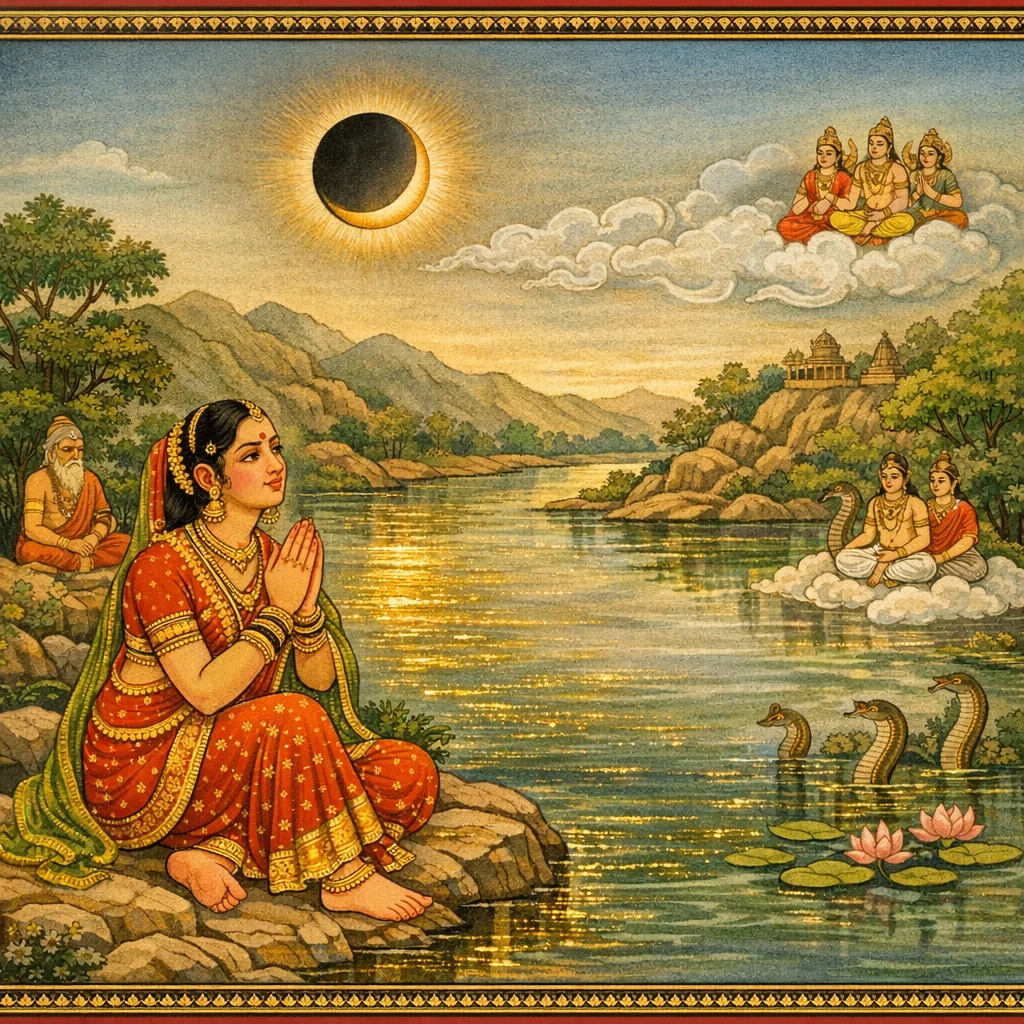
Pulastya instructs a royal listener to go to the famed, sin-destroying Maṇikarṇikā tīrtha. In a mountain recess the Vālakhilya sages have made a beautiful kuṇḍa. At midday during a solar eclipse, a Kirāta woman named Maṇikarṇikā—dark and fearsome in appearance—enters the water in thirst, and before the sages emerges transformed into a divinely radiant beauty, rare even among the gods, by the tīrtha’s power. Her husband arrives searching for her, distressed by their crying child. Urged to bathe, he enters the water with the child; but when the eclipse passes he becomes deformed again, is overcome by grief, and dies at that very waterside. Maṇikarṇikā, steadfast in pativratā-dharma, resolves to enter the funeral fire; questioned by the sages, she proclaims the ethic of exclusive spousal fidelity: for a woman, the husband is the sole refuge in the three worlds, regardless of beauty, poverty, or rank, and she entrusts the child to the sages. Moved by compassion, the sages restore the husband to life with auspicious marks and a worthy form. A celestial vehicle arrives, and the couple ascends to heaven with their son. Granted a boon, Maṇikarṇikā asks that the local mahāliṅga bear her name; the sages affirm the tīrtha’s renown as Maṇikarṇikā. The chapter ends with phala: bathing and giving at a solar eclipse yields merit equal to Kurukṣetra; concentrated bathing grants desired aims—therefore one should bathe with effort, give according to capacity, and offer to devas, ṛṣis, and ancestors.
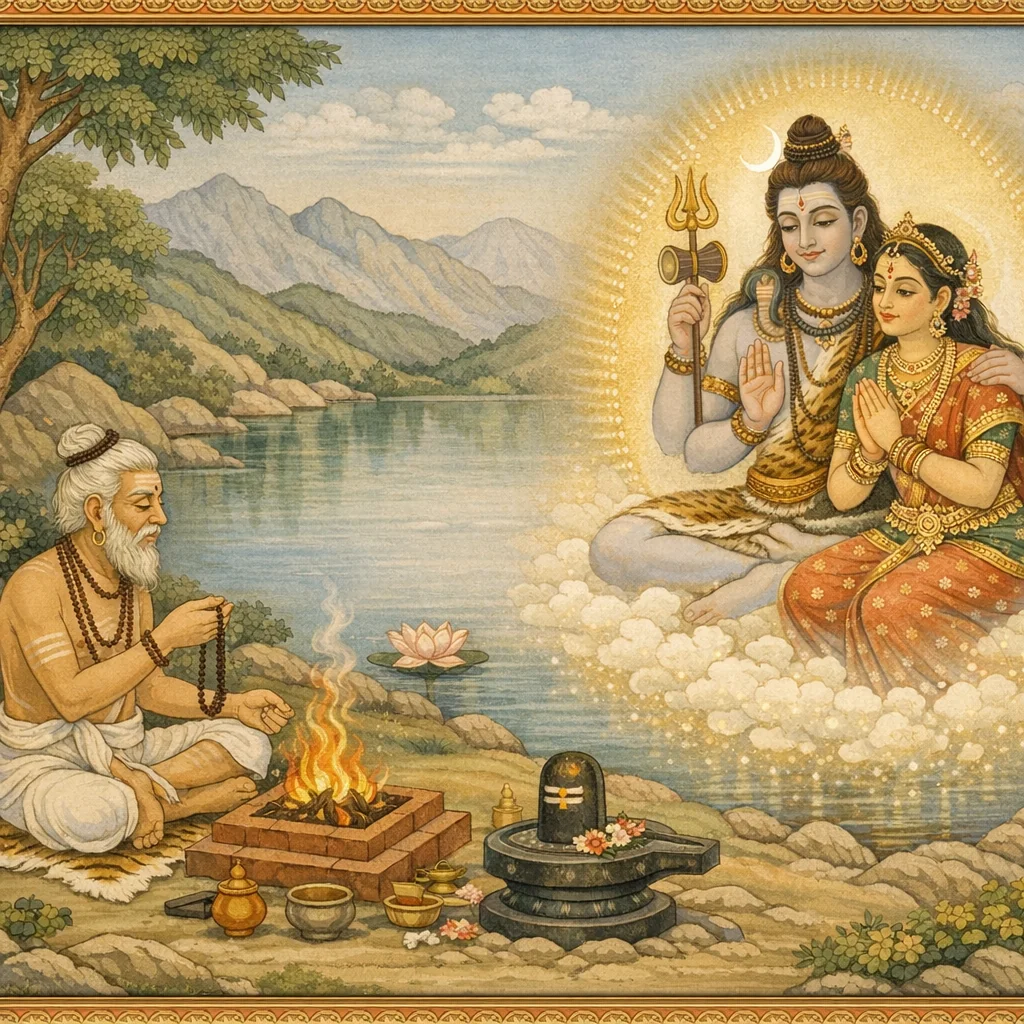
Adhyaya 17
पंगुतीर्थमाहात्म्यवर्णनम् (Pangu-tīrtha Māhātmya: The Glory of Pangu Tirtha)
This chapter, as narrated by Pulastya, proclaims the sanctifying power of Paṅgu-tīrtha, famed as the destroyer of all sins (sarva-pātaka-nāśana). It tells of a Brahmin named Paṅgu, born in the lineage of Cyavana, who is lame and unable to walk, and who suffers abandonment and sorrow when his relatives leave him behind for household duties. Reaching Arbudācala, Paṅgu finds a lake and undertakes severe tapas. He installs a liṅga and worships Śiva with disciplined faith, offering gandha (fragrance), puṣpa (flowers), and naivedya (food offerings). His devotion ripens into sustained ascetic practice—living on wind, and performing japa and homa. Pleased, Mahādeva speaks to him directly and grants a boon. Paṅgu asks that the tīrtha be renowned by his name, that his lameness be removed there by Śiva’s grace, and that Śiva, with Pārvatī, remain continually present. Īśvara grants this and declares assured presence on Caitra śukla caturdaśī. The fruit is stated plainly: by bathing alone Paṅgu attains a divine form, and pilgrims who bathe on that day are freed from lameness and gain an auspicious, transformed embodiment.
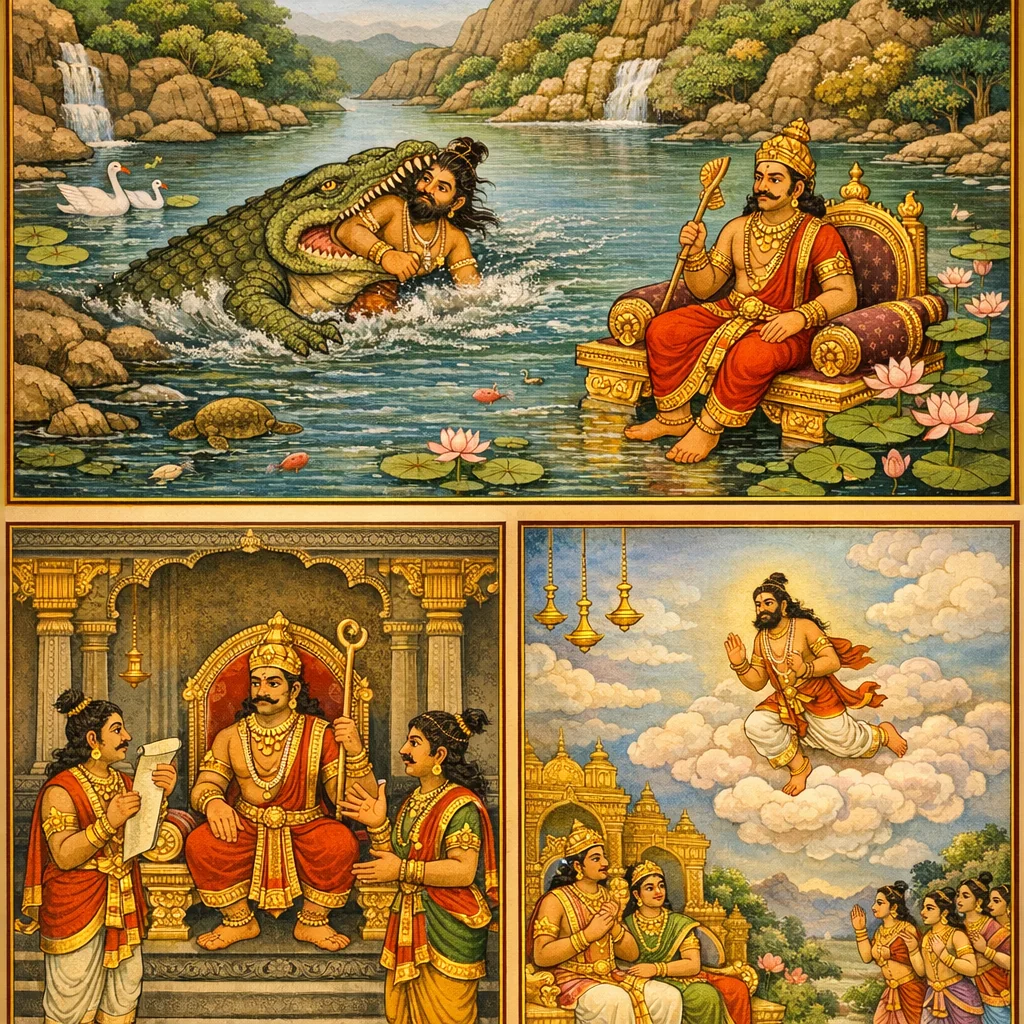
Adhyaya 18
यमतीर्थमाहात्म्यवर्णनम् / The Māhātmya of Yama-tīrtha
Pulastya instructs a king to proceed to Yama-tīrtha, an unsurpassed sacred ford that frees beings from hellish states and destroys sin, praised as a supreme purifier of karmic defilement. A paradigmatic tale follows: King Citrāṅgada, fiercely greedy and adharma—violent, oppressive to devas and brāhmaṇas, habitual in theft and adultery, devoid of truth and purity, driven by deceit and envy—goes hunting on Mount Arbuda. Parched with thirst, he enters a waterbody teeming with aquatic life and birds; a graha (crocodile) seizes him and he dies. In Yama’s realm, dreadful narakas are prepared and Yama’s messengers cast him there, yet because his death is connected with Yama’s tīrtha, the beings in those hells feel an unexpected relief. The astonished messengers report to Dharmarāja, and Yama explains that on earth there is Arbuda-acala and a beloved tīrtha where he once performed tapas; whoever dies at that sin-destroying tīrtha must be released at once. By Yama’s command the king is freed and attains heaven, attended by apsarases. The chapter then states the general rule: one who bathes there with devotion reaches the supreme state, free from aging and death. It prescribes special observance—bathing with full effort, especially on Caitra śukla trayodaśī—and recommends performing śrāddha properly at the site, granting one’s ancestors prolonged residence in heaven.
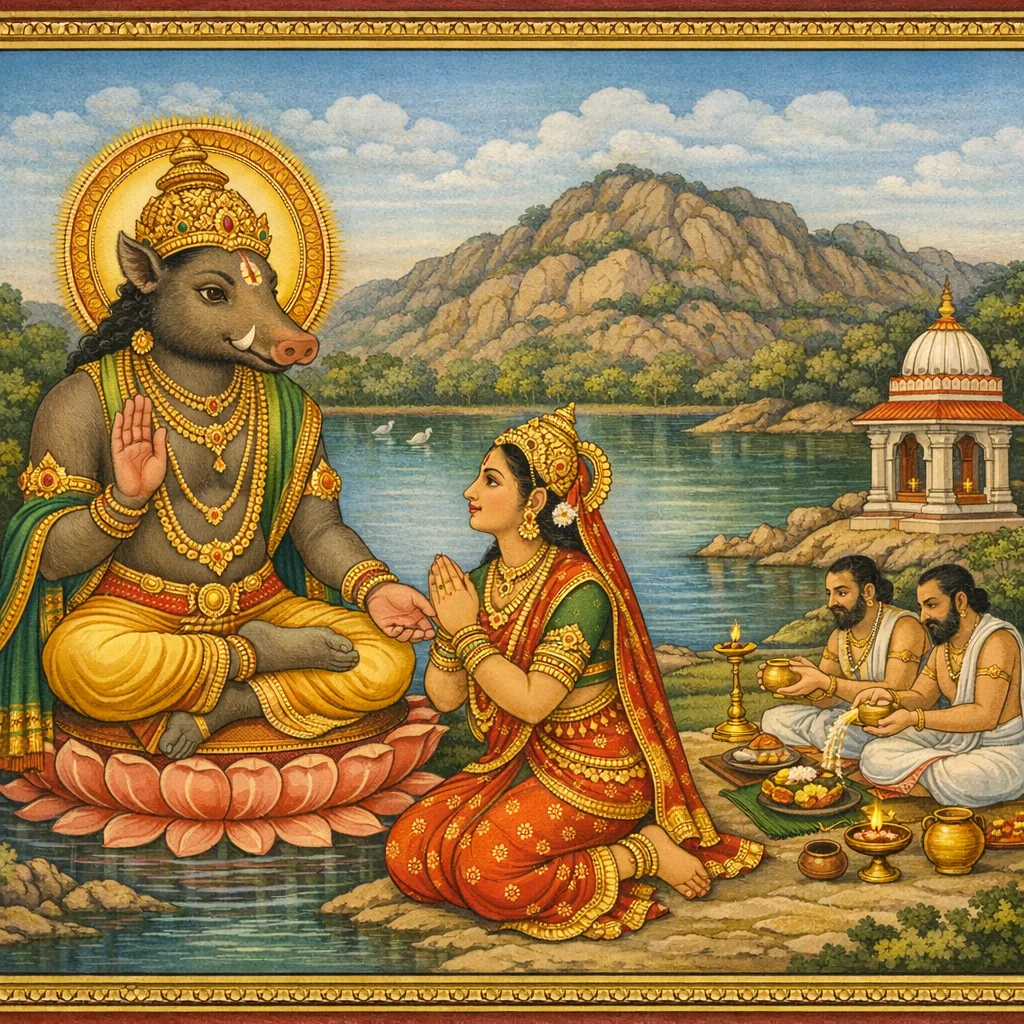
Adhyaya 19
वाराहतीर्थमाहात्म्यवर्णनम् (The Glory of Varāha Tīrtha)
Pulastya instructs a king about a sin-destroying tīrtha dear to Hari (Viṣṇu) in the Varāha setting. The account recalls the Varāha avatāra, where the Lord lifts up the Earth and reassures her, and then turns to a boon-dialogue: Earth asks that Viṣṇu remain there in that very form, and Viṣṇu agrees to abide on Arbuda mountain for the welfare of all beings. The chapter lays down ritual observance around a pure lake before the deity, highlighting devotional bathing in Māgha month, bright fortnight, on Ekādaśī as a powerful purifier—even of grave sin (said to free one from brahmahatyā). Ancestor rites are included: performing śrāddha with faith brings lasting satisfaction to one’s forebears. It culminates in the ethics of giving, especially go-dāna, praised as supreme and granting prolonged heavenly residence. The combined discipline of snāna, vrata, tarpaṇa, piṇḍa-dāna, and dāna is linked to attaining Viṣṇu-sālokya together with one’s ancestors.
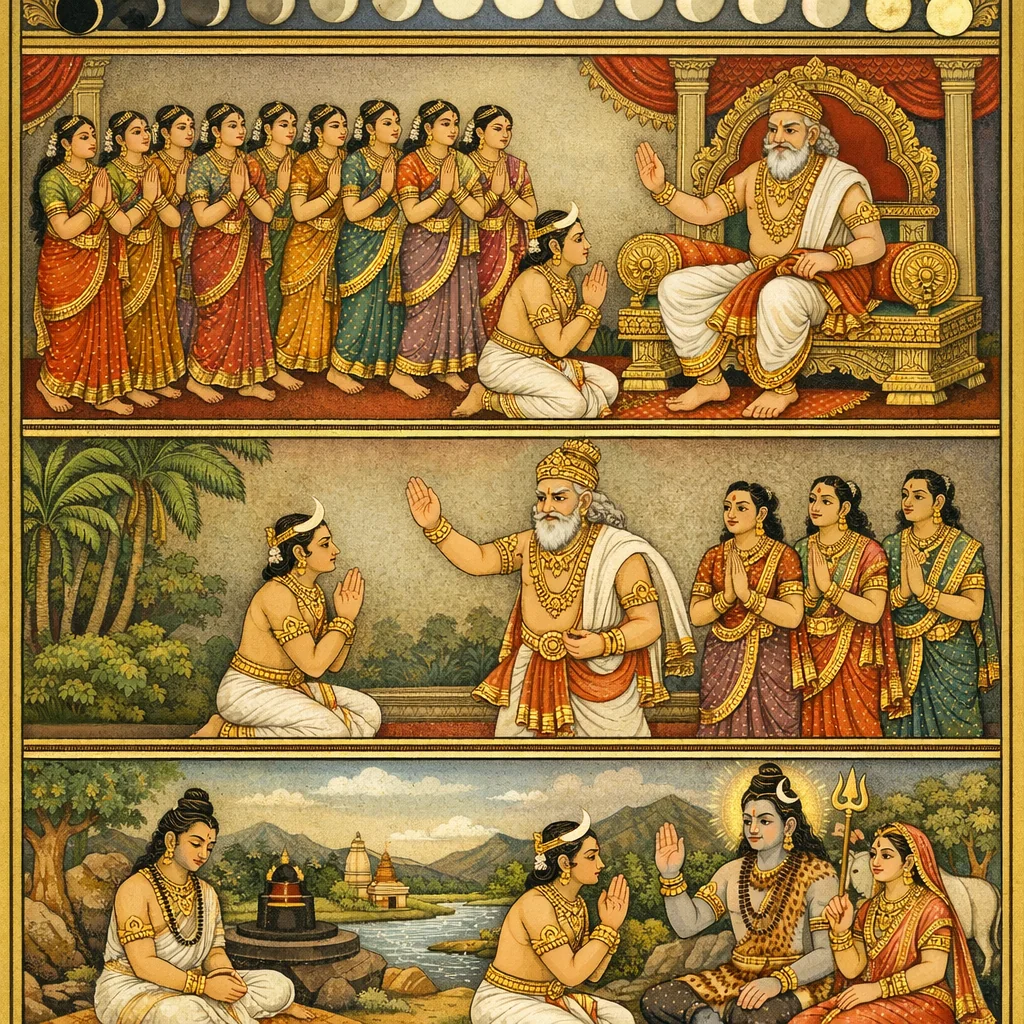
Adhyaya 20
चन्द्रक्षय-शाप-निवारणं तथा प्रभासतীर्थमाहात्म्यम् | Candra’s Curse, Remediation, and the Māhātmya of Prabhāsa Tīrtha
Pulastya recounts a theological and ethical episode explaining the Moon’s waxing and waning and the sanctity of Prabhāsa. Dakṣa gives his twenty-seven daughters—the Nakṣatras beginning with Aśvinī—in marriage to Candra, but Candra favors Rohiṇī and neglects the others. The daughters complain to their father; Dakṣa instructs Candra to be impartial. Though Candra agrees, he repeats the offense, and Dakṣa, angered, curses him to suffer kṣaya (decline) through yakṣmā. As Candra wastes away, he seeks remedy through devotion to Śiva, performing tapas at Arbuda, restraining anger, and sustaining japa and homa. Śiva grants darśana and declares that Dakṣa’s curse cannot be wholly annulled, but can be regulated: Candra must treat all his wives equally, and thus the Moon will periodically wane in the dark fortnight (kṛṣṇa pakṣa) and wax in the bright fortnight (śukla pakṣa). Candra then asks for tīrtha-fruits: devotees who bathe on Monday (Somavāra), especially when Soma is in conjunction or ascendant, attain elevated states. Śrāddha and piṇḍadāna performed here benefit the ancestors with merit likened to Gayā-śrāddha. Śiva confirms the place will be known as Prabhāsa-tīrtha, and the narrative ends with Candra resuming equitable relations with Dakṣa’s daughters.
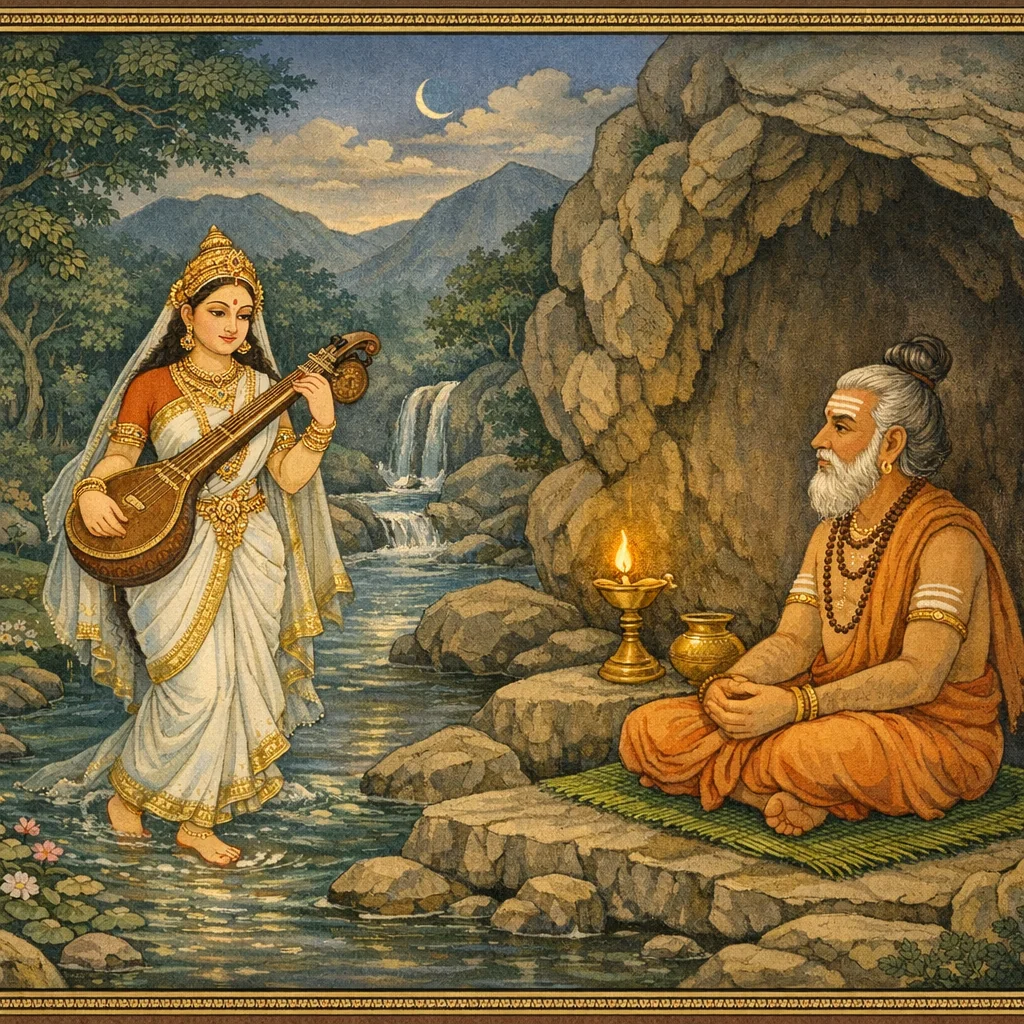
Adhyaya 21
पिण्डोदकतीर्थमाहात्म्यवर्णनम् (The Māhātmya of Piṇḍodaka Tīrtha)
Pulastya delivers a place-centered theological account proclaiming the māhātmya of Piṇḍodaka Tīrtha. A Brahmin named Piṇḍodaka, slow to learn and unable to complete his studies despite instruction, is seized by intense dispassion and withdraws to a mountain cave. Shamed before his teacher, he falls into despair and even seeks death, for speech and learning do not arise within him. In that secluded spot the goddess Sarasvatī appears and asks the cause of his sorrow. Revealing herself as dwelling on the auspicious mountain, she offers a boon and marks the time: on the thirteenth lunar day (trayodaśī) at nightfall (niśāmukha). Piṇḍodaka prays for sarvajñatva (omniscience) and that the tīrtha be famed by his name. Sarasvatī grants both, declaring that whoever bathes there at the appointed time will attain omniscience even if dull-witted, and affirming her continual presence. She vanishes; Piṇḍodaka becomes all-knowing, returns home, amazes the people, and thus spreads the renown of the tīrtha’s power.
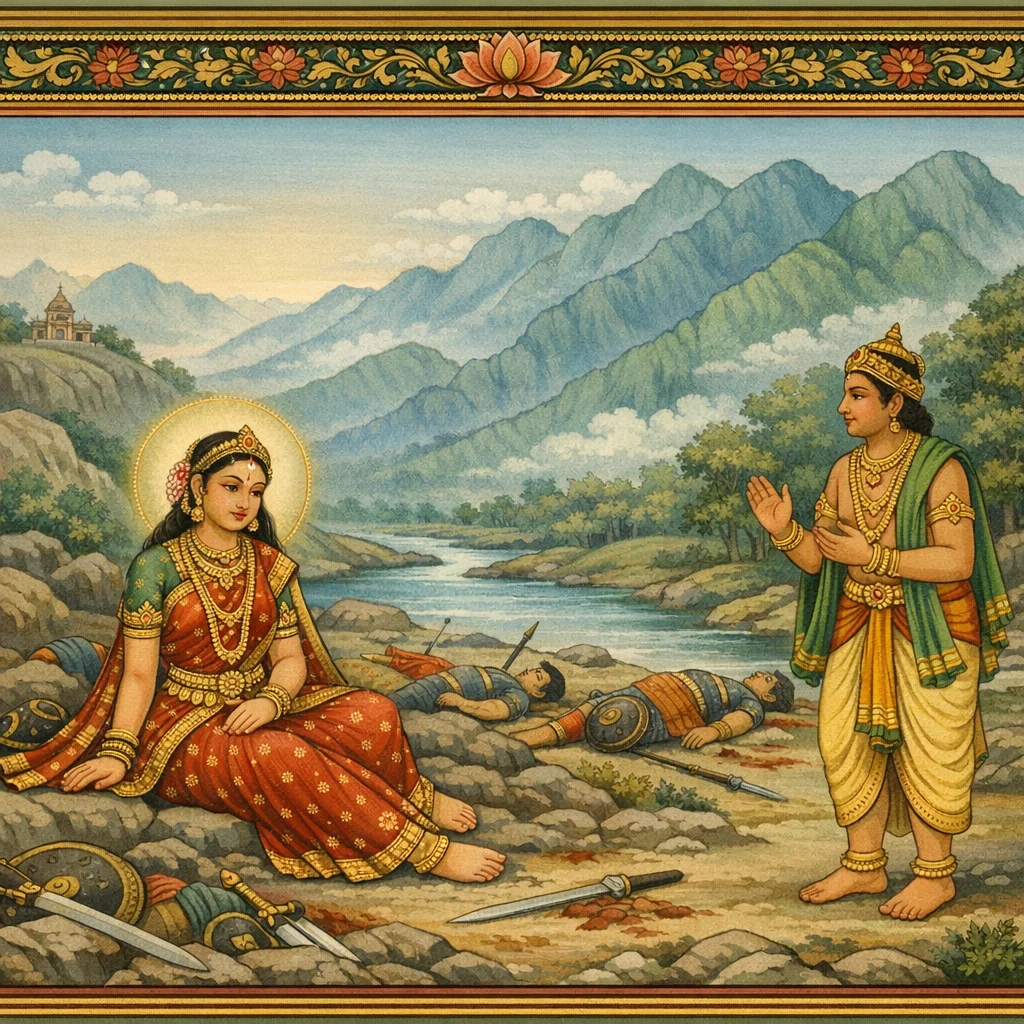
Adhyaya 22
Śrīmātā-Āvirbhāva, Deva-Stuti, and the Pādukā-Pratiṣṭhā at Arbudācala (श्रीमाता-आविर्भावः, देवस्तुतिः, पादुकाप्रतिष्ठा)
Pulastya tells Yayāti of the greatness of Śrīmātā, the supreme Śakti—all-pervading and directly abiding on Arbudācala—who grants both worldly attainments and otherworldly fulfillment. A crisis arises when the daitya-king Kalinga (later also called Bāṣkali) overpowers the three worlds, drives out the devas, and seizes the sacrificial shares. The devas withdraw to Arbuda and perform intense austerities through many vrata disciplines—varied fasts, the pañcāgni observance, japa-homa, and meditation—worshiping the supreme Goddess for the restoration of order. After a long period, the Devī manifests in successive forms, culminating in the appearance of a maiden, and receives a rich hymn of praise that identifies her with cosmic functions, the three guṇas, and great goddesses such as Lakṣmī, Pārvatī, Sāvitrī, and Gāyatrī. Though she grants boons, she declares devas and asuras alike to be her creations, and therefore intervenes with measure: a messenger commands the daitya to relinquish heaven. His arrogance swells into a coercive advance toward the Goddess; she then brings forth a fearsome army from her own presence and destroys his forces. Since the daitya is protected by a prior boon of deathlessness/immovability, she restrains him by placing her pādukās and establishing a protective ordinance, while promising to remain at Arbuda—especially on Caitra śukla caturdaśī—so that darśana and pādukā-worship yield exceptional merit, liberation-oriented benefit, and freedom from recurring bondage. The concluding phalaśruti affirms that faithful reading or praise of this account removes great sins and strengthens knowledge-rooted devotion.
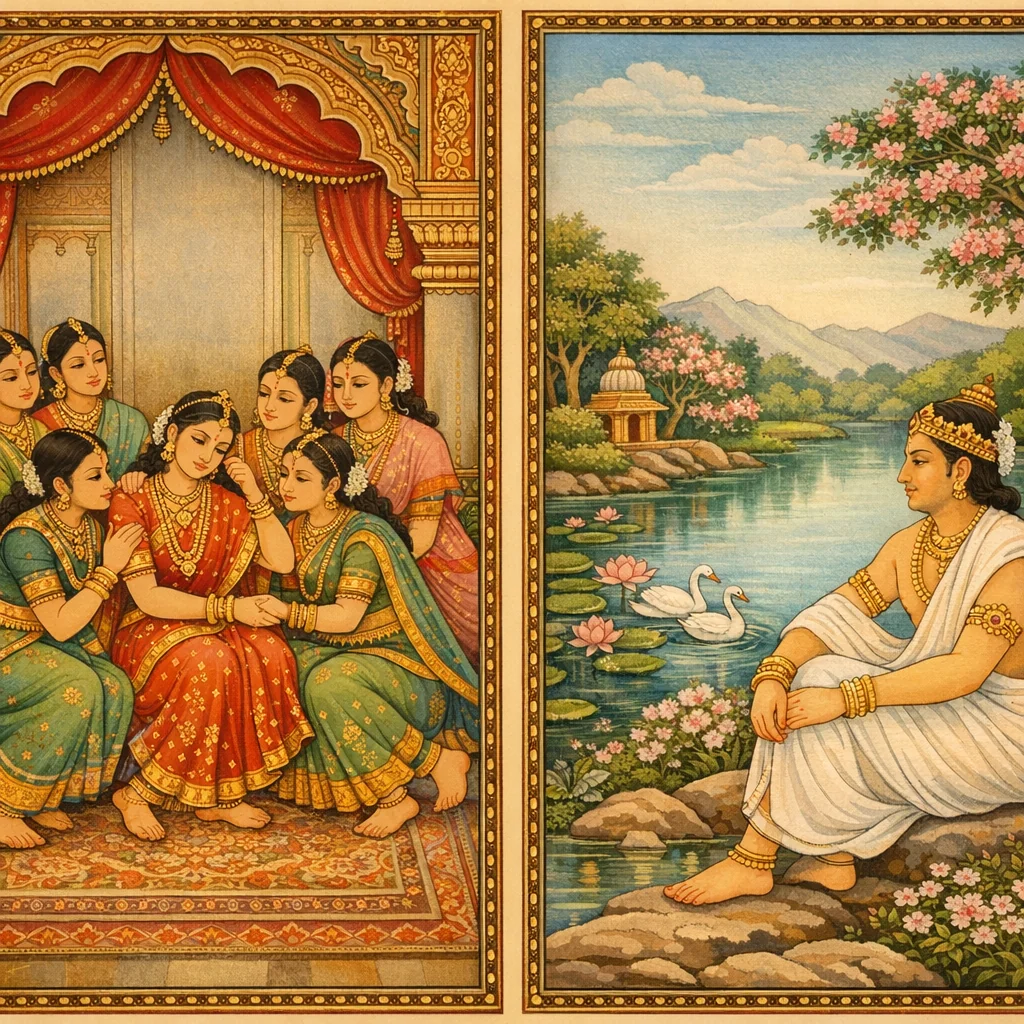
Adhyaya 23
शुक्लतीर्थमाहात्म्यवर्णनम् (The Māhātmya of Śukla Tīrtha)
Pulastya tells a king of the fame of an unsurpassed sacred place called Śukla Tīrtha. A washerman (rajaka) named Śamilākṣa is seized with fear when garments set in indigo dye are spoiled, and he considers fleeing with his family. His distressed daughter confides in a girl from the fisherman community (dāśa-kanyā). The girl offers a practical remedy: in Arbuda there is a spring (nirjhara) whose water transforms whatever is cast into it, making it “white” (śukla). Fisherfolk and her brothers know its power; if the garments are washed there, they will quickly return to bright, lustrous whiteness, removing the cause of fear. The washerman follows her instruction, sees the cloth become white and shining, and reports the marvel to the king. The king tests the spring with other dyed cloths and witnesses the same change, then bathes there and performs the rites “as enjoined.” Later he renounces kingship, undertakes austerities at that tīrtha, and attains a superior accomplishment attributed to the site’s influence. The phala statement adds that śrāddha performed there on Ekādaśī uplifts one’s family and leads to heaven, while bathing there grants immediate freedom from sin within the sacred framing of the narrative.
Adhyaya 24
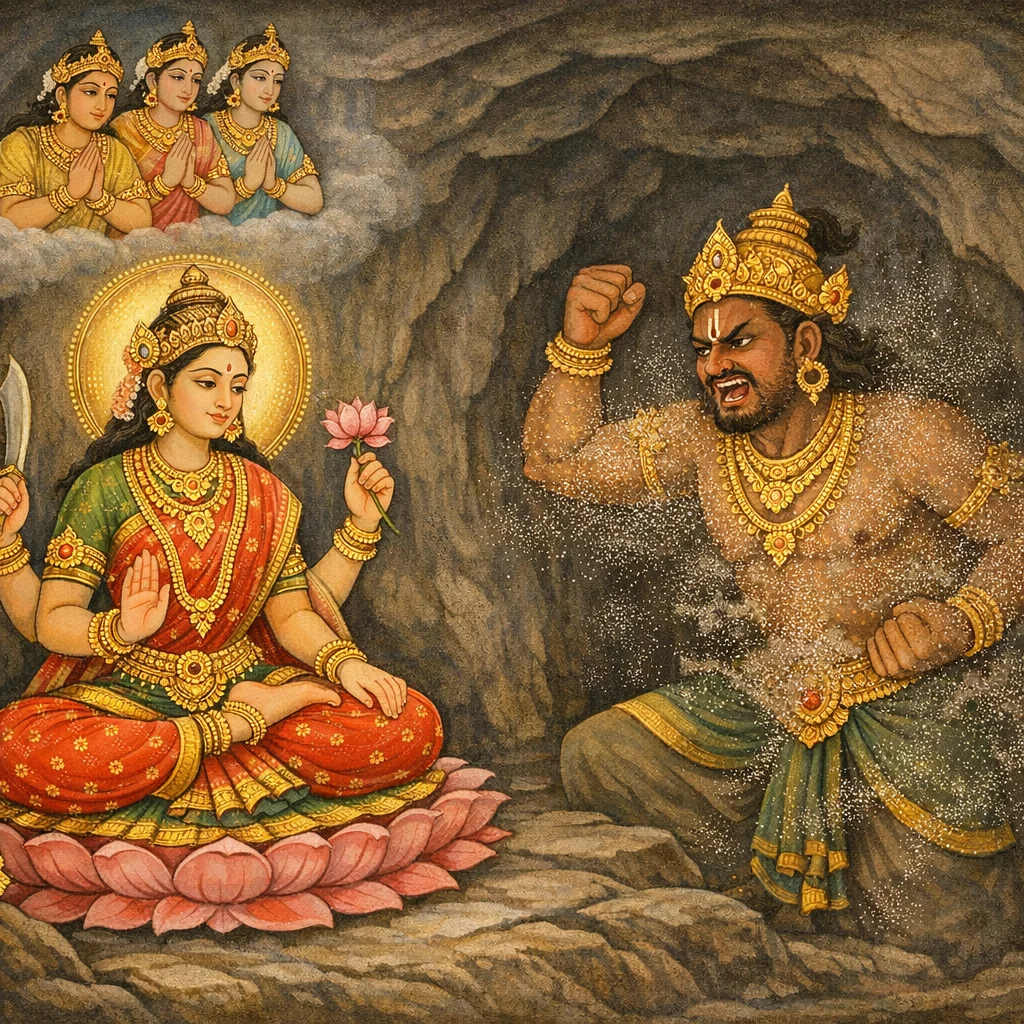
कात्यायनीमाहात्म्यवर्णनम् (Kātyāyanī Māhātmya—Account of the Goddess’s Glory at Arbuda)
Pulastya tells a king of the sacred route to a cave (guhā) on Mount Arbuda, where the Goddess Kātyāyanī abides as the slayer of Śumbha. Śumbha is introduced as a mighty demon who, by Śaṅkara’s boon, cannot be killed by any being except a woman, and thus defeats the gods and subjugates the world. The gods withdraw to Arbuda, perform austerities, and worship the Goddess in her visible form, begging her to restore cosmic order by destroying Śumbha. Learning she is a woman, Śumbha scorns her and sends demons to seize her; the Goddess reduces them to ash with a mere glance. Śumbha then comes in rage with sword in hand, but is likewise burned to ashes, and the remaining demons flee to the nether regions. The gods praise the Goddess and invite her to choose a boon; she declares she will remain on Arbuda, making it a perpetual place of divine accessibility. When concern is voiced that heaven might become too easily attained without sacrifice or gifting, a calendrical rule is set: the gods will behold her there on Śuklāṣṭamī. The chapter ends with its phala: whoever beholds her on Śuklāṣṭamī with a composed mind attains desired aims, even those difficult to achieve.
Adhyaya 25
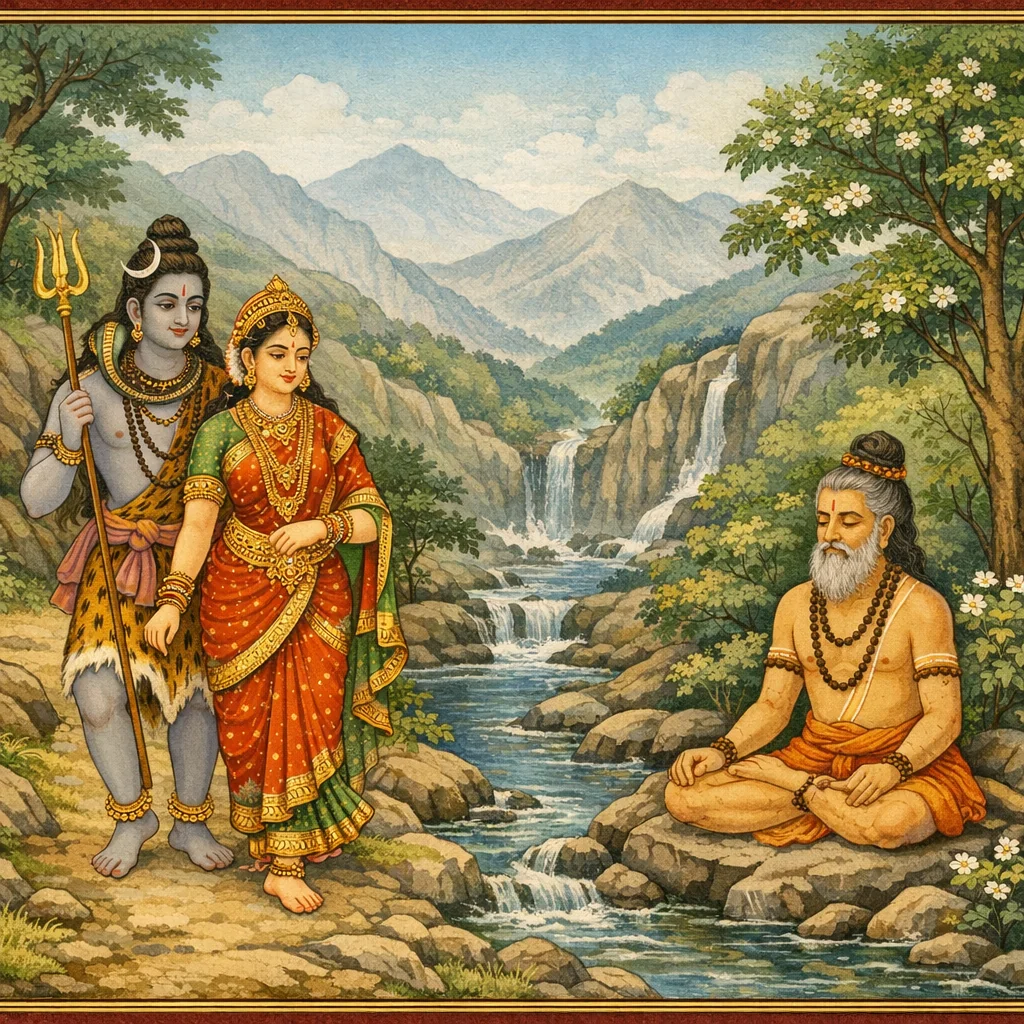
पिंडारकतीर्थमाहात्म्यवर्णनम् (The Māhātmya of Piṇḍāraka Tīrtha)
Pulastya recounts the glory of the Piṇḍāraka tīrtha, praised as pāpa-hara, the remover of sin. A brāhmaṇa named Maṅki—simple-minded and at first unskilled in brāhmaṇical duties—gains wealth while guarding a buffalo on a beautiful mountain. After great difficulty he buys a small pair of oxen, but an unforeseen mishap involving a camel leaves the oxen entangled by the neck and ruined. Struck by this reversal, Maṅki awakens to vairāgya, abandons village life, and goes to the forest, reaching a spring (nirjhara) on Arbuda. There he undertakes disciplined practice: bathing three times daily and sustained Gāyatrī-japa, by which he becomes purified and attains divya-darśana, divine sight. In the same period Śaṅkara (Śiva), accompanied by Gaurī, roams the mountain for recreation and is beheld by the ascetic. Maṅki offers reverence, and Śiva grants a boon. He asks not for worldly gain but to become Śiva’s gaṇa, and that the tīrtha be renowned by his name, Piṇḍāraka. Śiva confirms that after death the brāhmaṇa will become a gaṇa, the place will be called Piṇḍāraka, and on Mahāṣṭamī Śiva will be specially present; those who bathe on the aṣṭamī day attain the supreme abode where Śiva is ever established. The chapter closes by prescribing mantra-accompanied bathing and extolling dāna—especially gifting a buffalo on aṣṭamī—as a means to desired benefits in this world and the next.
Adhyaya 26
कनखलतीर्थमाहात्म्यवर्णनम् (The Māhātmya of Kanakhala Tīrtha)
Pulastya tells a king of the glory of Kanakhala Tīrtha, a holy place upon a sin-destroying mountain. Long ago King Sumati came to Arbuda during a solar eclipse (sūryagraha), bringing refined gold to give as dāna to brāhmaṇas; through inadvertence it fell into the water and could not be found, and he returned home in remorse. Later he came again at another eclipse to perform ritual bathing. As he remembered the loss, a disembodied voice (aśarīriṇī vāk) declared that in this place there is no “loss” in this world or the next: the gold becomes multiplied to koṭiguṇa, and his earlier regret gives rise to a saṅkhyā (a counting/measure) connected with future acts of śrāddha and gifting. Told to search, he recovered abundant, bright, multiplied gold. Knowing the tīrtha’s power, he made extensive gifts to brāhmaṇas, dedicating them to the ancestral deities (pitṛdevatā); by that gift’s efficacy he is said to become the yakṣa Dhanada, a bestower of many kinds of wealth. The chapter ends with guidance: śrāddha performed here at a solar eclipse satisfies the ancestors for an aeon-like span (ākalpa); bathing delights ṛṣis, devas, and great nāgas and destroys sin at once. Therefore one should strive to bathe there and to perform dāna and śrāddha according to one’s capacity.
Adhyaya 27
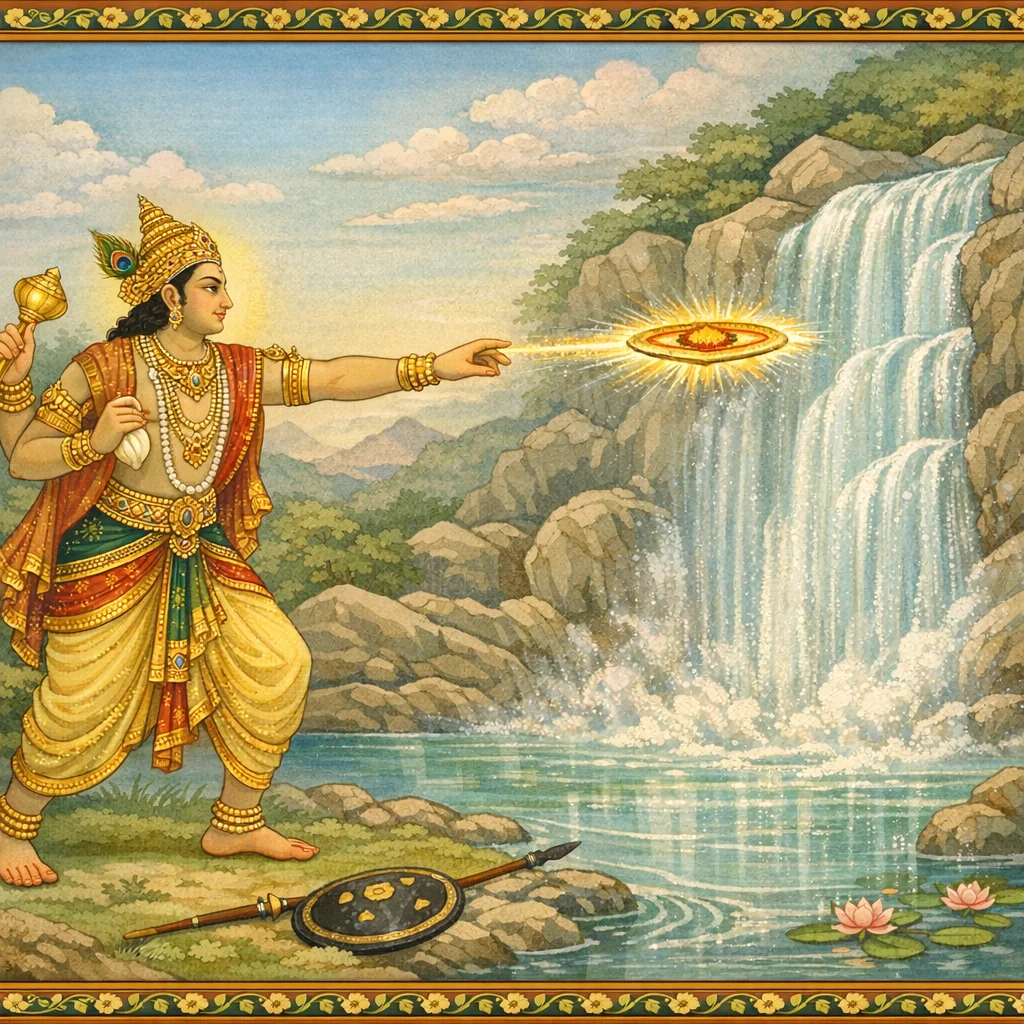
चक्रतीर्थप्रभाववर्णनम् | Description of the Efficacy of Cakra Tīrtha
Pulastya instructs the royal listener to proceed to the eminent Cakratīrtha. The chapter establishes the site’s sanctity through an origin narrative: Viṣṇu, praised as Prabhaviṣṇu, once slew the Dānavas in battle and there released his cakra. After this, Viṣṇu performs a purificatory bathing sequence at a clear cascade or spring (sunnirjhara), as though washing the very waters; the text explains that this divine contact is the cause of the tīrtha’s heightened purity (medhyatā). It then prescribes that one who performs śrāddha here on the occasions of Hari’s “sleeping” and “awakening” (śayane, bodhane) grants enduring satisfaction to the ancestors, lasting for an entire kalpa. The chapter ends with a colophon identifying it as the 27th adhyāya of the Arbuda Khaṇḍa within the Prabhāsa Khaṇḍa of the Skanda Mahāpurāṇa.
Adhyaya 28
मानुष्यतीर्थप्रभाववर्णनम् | The Glory and Efficacy of Mānuṣya-Tīrtha
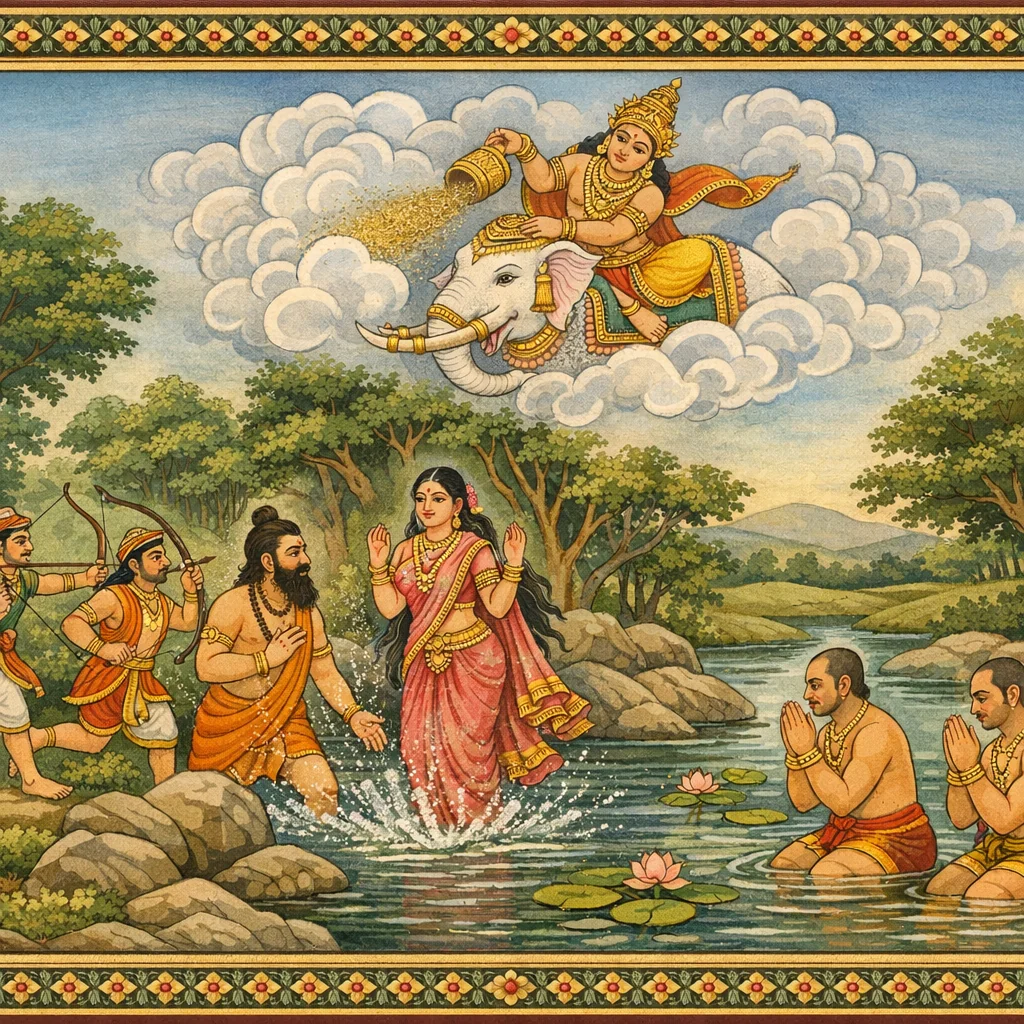
Pulastya instructs a royal listener about a supremely meritorious water-pilgrimage site at Prabhāsa called “Mānuṣya-hrada/Mānuṣya-tīrtha.” The chapter teaches that bathing there stabilizes one’s human status: even a person burdened with grave sins is said not to fall into an animal birth. To demonstrate this, a herd of deer, driven by hunters, rushes into the water; at once they become human and retain memory of their former life. The armed hunters arrive and ask where the deer went, and the newly human beings reply that the transformation occurred solely through the tīrtha’s power. The hunters then cast aside their weapons, bathe, and attain a “siddhi,” a sacred spiritual attainment. Seeing the tīrtha’s sin-destroying potency, Śakra (Indra) tries to blunt it by filling the pool with dust, yet its efficacy is upheld: those who bathe there on Budhāṣṭamī are said not to incur animality, and by performing śrāddha-dāna they gain the full fruit of pitṛ-medha for the ancestors.
Adhyaya 29
Kapilā-tīrtha Māhātmya (कपिलातीर्थमाहात्म्यम्) — The Ethics of Satya and Pilgrimage Merit
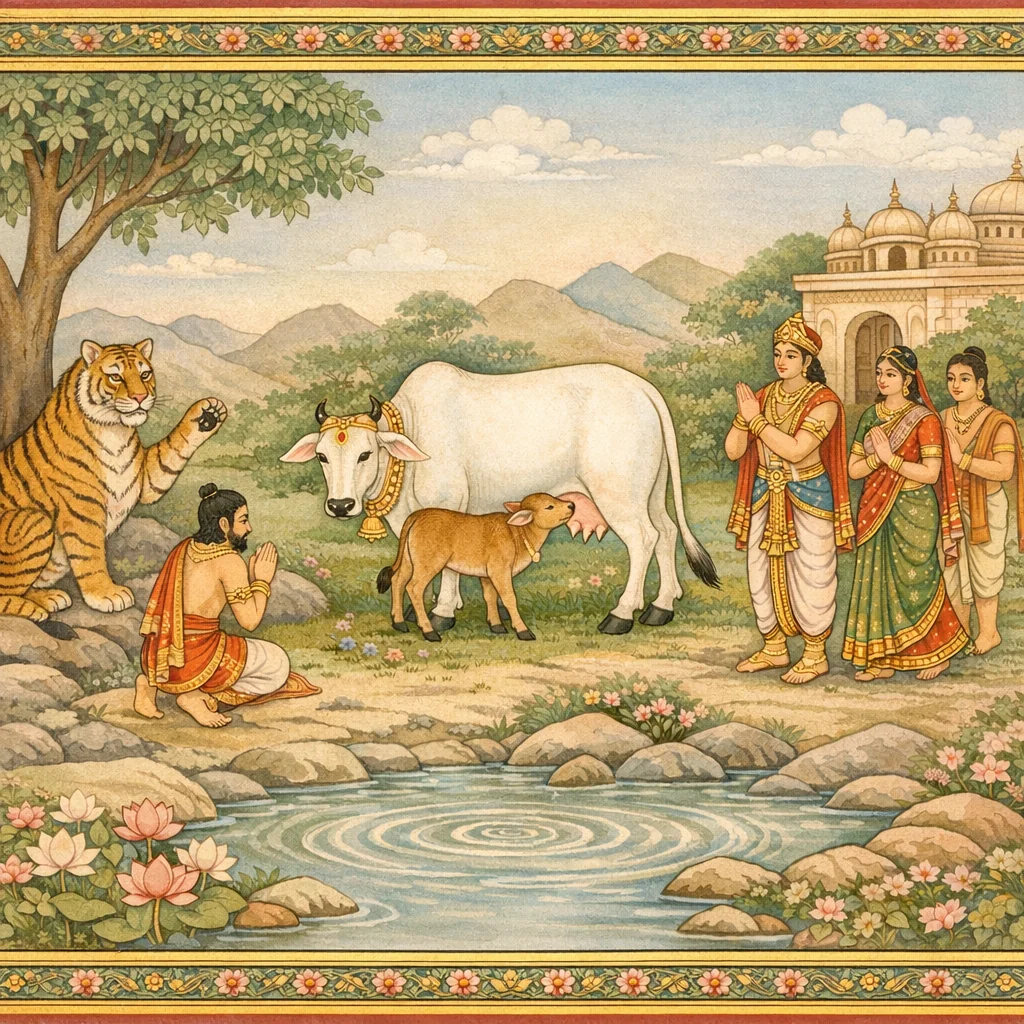
Pulastya describes the proper progression of pilgrimage to Kapilā-tīrtha, where bathing is said to cleanse accumulated faults. King Suprabha, consumed by hunting, kills a doe nursing her fawn; as she dies, the doe condemns the deed as opposed to kṣātra-dharma and curses the king to become a fierce tiger on the mountain slope, to be released only upon meeting a milch cow named Kapilā. The king becomes a tiger and later encounters Kapilā, separated from her herd. Kapilā asks leave to return to her calf and vows to come back, strengthening her promise with many self-imprecatory oaths, accepting grave demerit should she fail. Moved by her satya (truthfulness), the tiger permits her to go. Kapilā nurses her calf, teaches vigilance and freedom from greed, bids farewell to her community, and returns as promised. Satya is publicly proclaimed superior even to immense ritual performances, likened to a thousand aśvamedhas; the tiger releases her, and at that moment the cursed king regains his human form. When Kapilā asks for water, the king strikes the ground with an arrow and a pure, cool spring arises. Dharma appears, grants boons, and declares the tīrtha’s name and fruits: snāna (especially on the fourteenth lunar day), śrāddha, and dāna yield multiplied, inexhaustible merit, and even small beings benefit by contact with the water. Celestial vehicles then arrive, and Kapilā, her community, and the king attain a divine state; the chapter ends by urging bathing, śrāddha, and charity there according to one’s capacity.
Adhyaya 30
अग्नितीर्थमाहात्म्य (Agni-tīrtha Māhātmya: The Glory of Agni Tirtha)
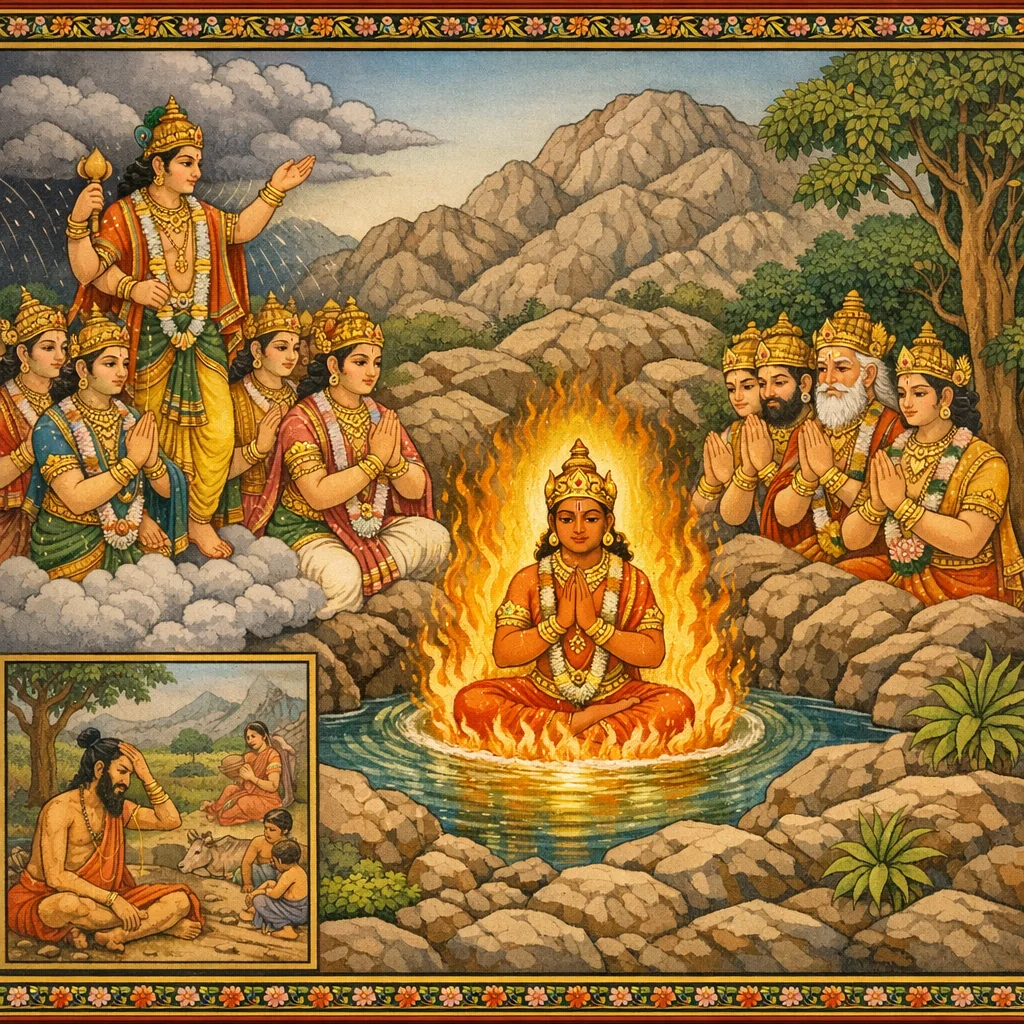
Pulastya instructs Yayāti to visit Agni-tīrtha, a supremely purifying sacred ford where Agni was once “lost” and later recovered by the Devas. The cause is told: a twelve-year drought brings famine and the breakdown of social order. Viśvāmitra, weakened by hunger, reaches a caṇḍāla settlement, finds a dead dog, cooks it, and offers it into the fire—an act condemned as abhakṣya-bhakṣaṇa, the polluting consumption of what is unfit. Agni, unwilling to be forced to receive impure offerings and blaming the drought on Indra’s governance, withdraws from the human realm; yajña rites (such as the agniṣṭoma) falter and stability declines. The Devas search for him; a śuka (parrot) points out his course, and Agni hides in a śamī/aśvattha tree and then in a water-body on Mount Arbuda, remaining unseen. A frog (dardura) reveals his presence in a mountain spring (nirjhara), and Agni curses it with vijihvatva, an affliction of the tongue. The Devas praise Agni as the sustaining “mouth” of the gods and the support of the cosmos. Agni states his grievance about impure offerings and the drought. Indra explains the political-ethical reason for withholding rain (linked to Devāpi, Pratīpa, and Śantanu’s succession narrative) and commands the clouds to restore rainfall. Pleased, Agni agrees to remain and asks that the water-body be renowned as Agni-tīrtha. The phalāśruti declares that proper bathing leads to Agni-loka, tiladāna yields the fruit of an agniṣṭoma, and reciting or hearing this māhātmya removes sins, even those gathered by day and by night.
Adhyaya 31
रक्तानुबन्धतीर्थ-माहात्म्य (Māhātmya of the Raktānubandha Tīrtha)
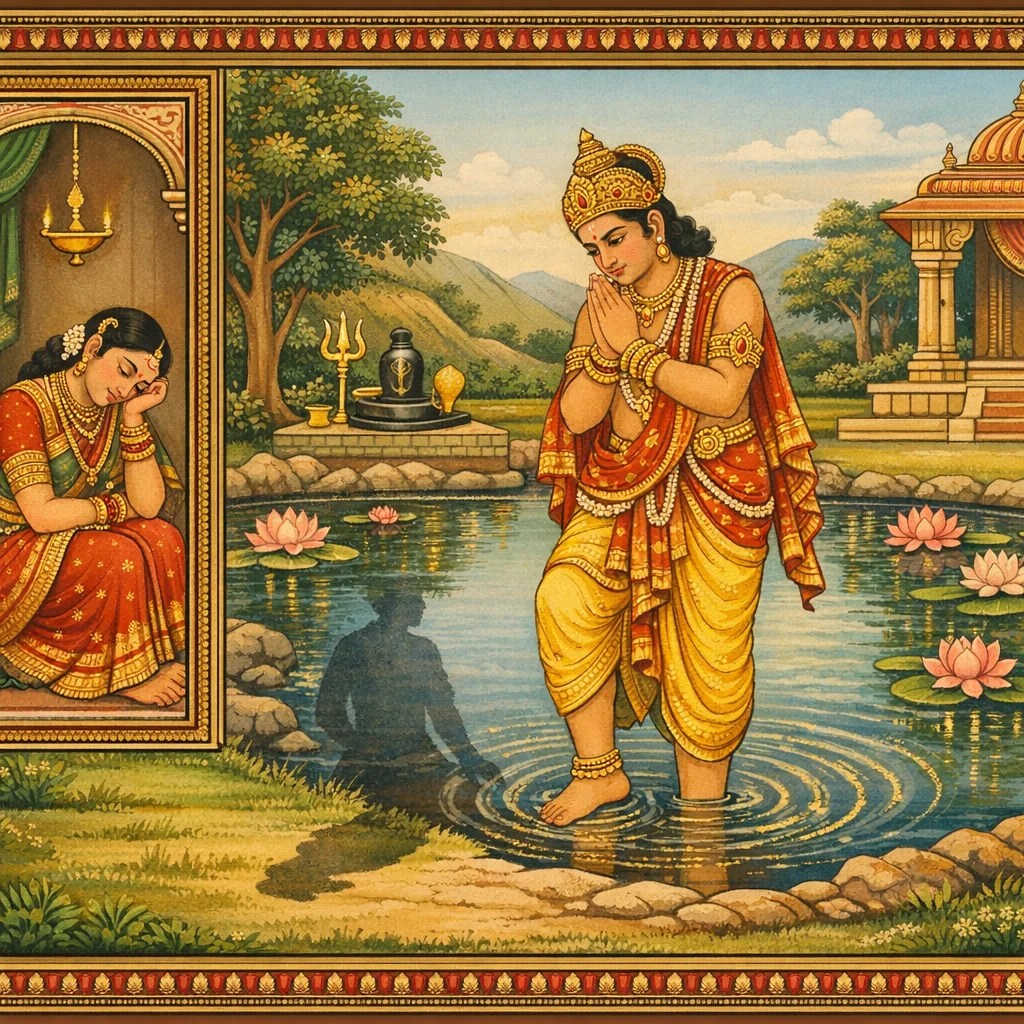
Pulastya recounts an expiatory case centered on the famed Raktānubandha tīrtha. King Indrasena, returning from war, sends a deceitful messenger to test Queen Sunandā’s pativratā fidelity by falsely reporting the king’s death; Sunandā, portrayed as patipraṇā and unwavering, dies upon hearing it. The king is then seized by the karmic consequence of strī-vadha (woman-killing): a second shadow clings to him, with heaviness, loss of tejas, and a foul odor—bodily marks of moral pollution. He performs funerary rites and undertakes wide pilgrimage to many tīrthas, including Kāśī/Varanasi and Kapālamocana, yet the affliction persists. After long wandering he reaches Arbuda mountain and bathes at Raktānubandha; the second shadow vanishes and auspicious qualities return. But when he crosses beyond the tīrtha’s boundary the taint reappears; returning at once, he is purified again, revealing the site’s bounded efficacy. Knowing the tīrtha’s supreme status, he gives dāna, builds a pyre, and enters fire as a final renunciation, ascending to Śivaloka. The concluding phala extols the tīrtha: offerings and śrāddha performed there are highly efficacious; bathing at a solar saṅkrānti is said to remove even brahmahatyā; and gifts during eclipses—especially go-dāna—are credited with liberating seven generations.
Adhyaya 32
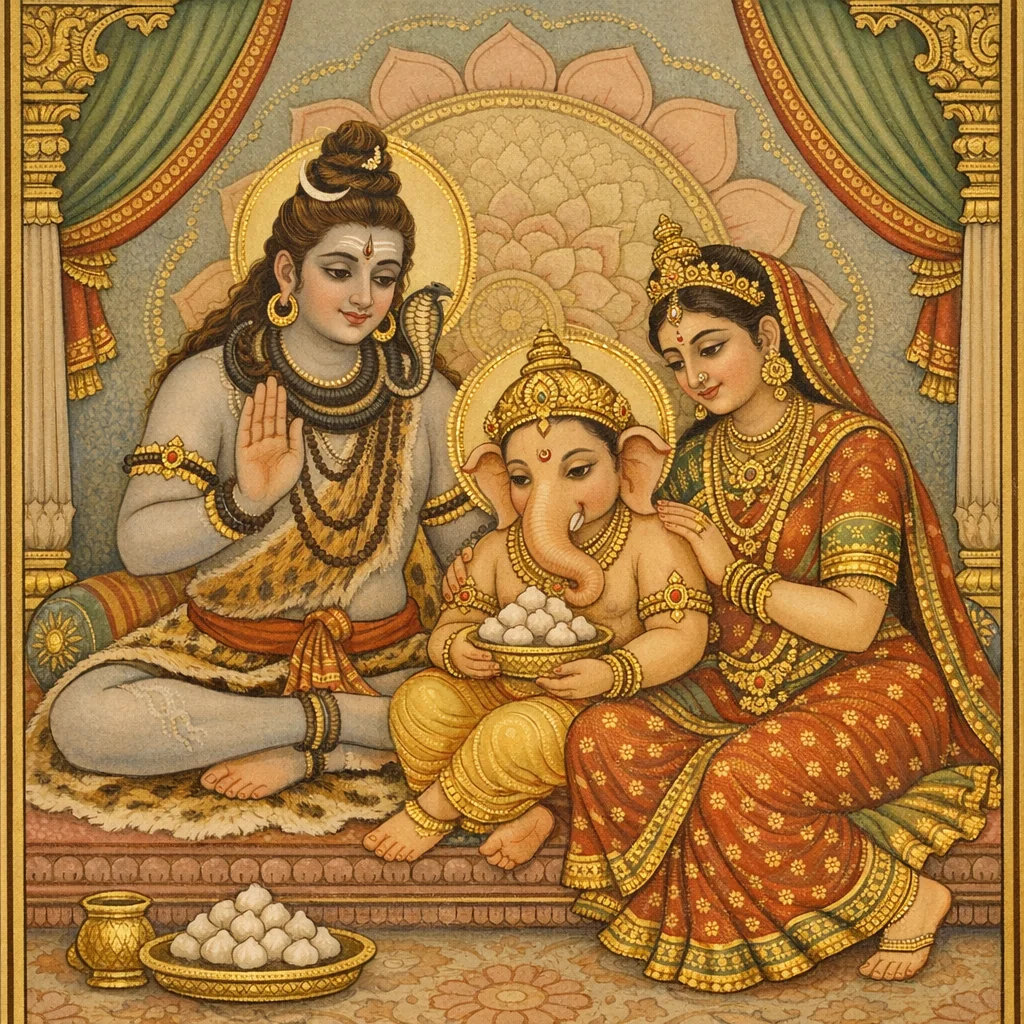
Mahāvināyaka-prādurbhāvaḥ and Mahāvināyakī-śānti (महाविनायकप्रादुर्भावः / महाविनायकीशान्तिः)
This adhyāya is framed as a technical dialogue between Pulastya and King Yayāti. Pulastya directs the king to visit Mahāvināyaka, whose darśana is said to grant immediate nirvighnatva—freedom from obstacles. Asked how Vināyaka attained such greatness, Pulastya recounts the origin: Pārvatī fashions a child from bodily lepa (unguent), but the form is first headless for want of material. Skanda is sent to bring a head, and by circumstance a mighty elephant head is obtained and fitted. The child shines with auspicious marks; Pārvatī animates him by her śakti and presents him to Śiva. Śiva establishes his status: the elephant head is declared the basis of his mahattva, he is named Mahāvināyaka, made leader of the gaṇas, and ordained to be remembered first in every undertaking so that no work is lost. Further emblems follow—Skanda gives a small axe (kuṭhāraka), Gaurī gives a bowl of modakas, and a mouse appears as his vehicle. The chapter then gives phalaśruti and observances: darśana in Māgha (bright fortnight, Caturthī) with fasting yields knowledge; bathing in a nearby clear-water kuṇḍa and worship benefit one’s descendants; and thrice circumambulation with the “Gaṇānāṃ tve” mantra averts misfortune. Finally, at Yayāti’s request, Pulastya outlines Mahāvināyakī-śānti: choose a doṣa-free day with strong lunar conditions, build a vedi and maṇḍapa with an eight-petalled lotus, invoke lokapālas and mātṛs, establish a water-filled kalaśa with offerings, perform homa (including graha-homa), recite “Gaṇānāṃ tve” in a large count, and conclude with the yajamāna’s ritual bath amid Vedic recitations (including Śrīsūkta and other hymns). The promised fruit is the pacification of obstacles, afflictions, and inauspicious portents; reading or hearing this on Caturthī ensures continual non-obstruction, and focused worship grants desired aims through Gaṇanātha’s grace.
Adhyaya 33
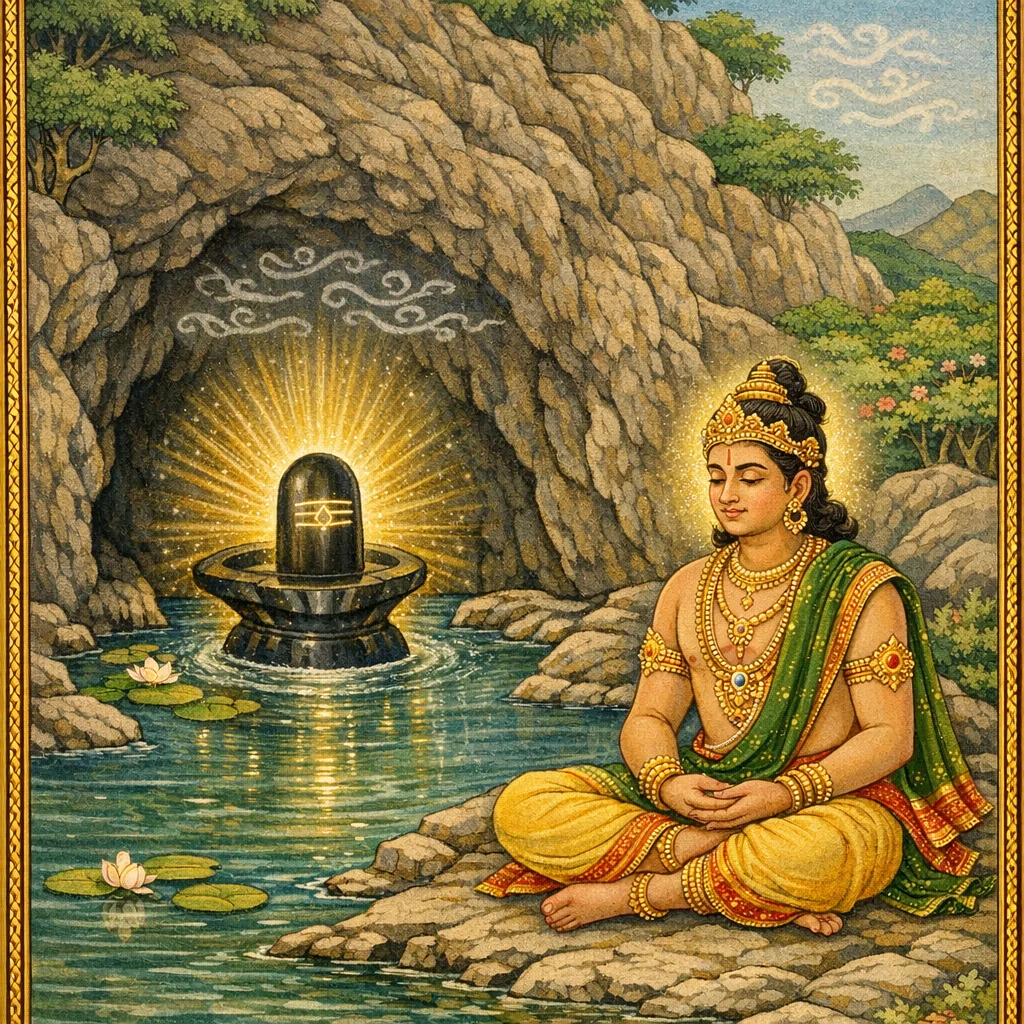
पार्थेश्वरमाहात्म्यवर्णनम् (The Māhātmya of Pārtheśvara)
Pulastya describes a pilgrimage to Pārtheśvara, praised as a sin-destroying sacred site whose darśana is said to free one from many transgressions. The chapter then introduces a chaste woman named Pārthā, beloved of Devala, who performs austerities at that very place. In a former life she had been the childless wife of a ṛṣi; having attained deep dispassion, she went to Arbuda and undertook severe ascetic practice—subsisting on air, fasting, and maintaining mental equanimity for a long span. After a thousand years a liṅga suddenly bursts forth from the earth, and an incorporeal voice instructs her to worship this supremely purifying Śiva-liṅga, manifested through her devotion. The voice declares that worship done with a specified intention grants the desired aim, and proclaims that the liṅga will be renowned as Pārtheśvara. She worships in wonder, and the narrative connects this worship with the boon of a hundred sons to carry on the lineage. The site’s fame spreads; a pure water source in a mountain cave is mentioned. Bathing there and beholding the liṅga with devotion is said to remove worldly suffering connected with progeny; on the 14th day of the bright fortnight, fasting and keeping vigil before the deity is prescribed for obtaining a son. Ancestor offerings of piṇḍa performed there are also said to bestow upon the forefathers, by that grace, a benefit akin to the status of having a son.
Adhyaya 34
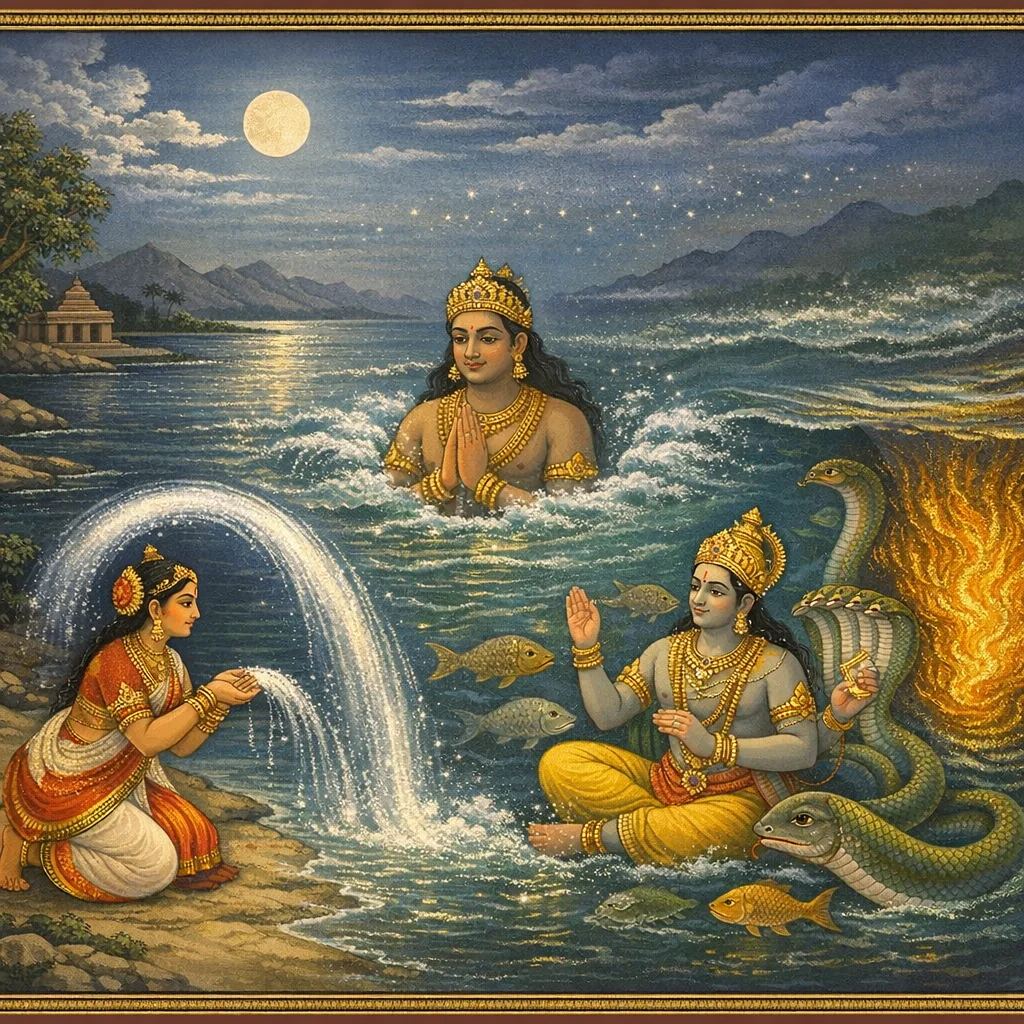
कृष्णतीर्थ-प्रादुर्भावः (Origin and Significance of Kṛṣṇa-tīrtha)
Pulastya instructs Yayāti to visit Kṛṣṇa-tīrtha, a sacred ford ever dear to Kṛṣṇa/Viṣṇu and marked by unceasing divine presence. When Yayāti asks for its origin, Pulastya recounts that in the time of pralaya Brahmā awakens after immeasurable ages and meets Govinda; their dispute over supremacy swells into a prolonged battle. A radiant, limitless liṅga then appears, and an incorporeal command orders them to seek its extremities—one upward, one downward—declaring supreme whoever reaches the end. Viṣṇu descends, encounters the form of Kālāgnirudra, and is scorched into “kṛṣṇatva” (darkened blackness), yet returns to worship the liṅga with Vedic praise. Brahmā ascends but finds no end and brings a ketakī flower as false testimony; Mahādeva curses Brahmā’s worship-status and restricts ketakī’s ritual use, while commending Viṣṇu’s truthfulness. Viṣṇu requests that the liṅga become small so creation may proceed; Mahādeva directs that it be installed in a pure place. Viṣṇu establishes the liṅga on Arbuda-parvata near a clear spring, and the spot becomes known as Kṛṣṇa-tīrtha. The phalaśruti declares that bathing and beholding the liṅga here grants the comprehensive merit of all tīrthas, the fruits of gifts, the benefits of Ekādaśī vigil and śrāddha, freedom from grievous sins, and purification even by the mere sight of Kṛṣṇa-tīrtha.
Adhyaya 35
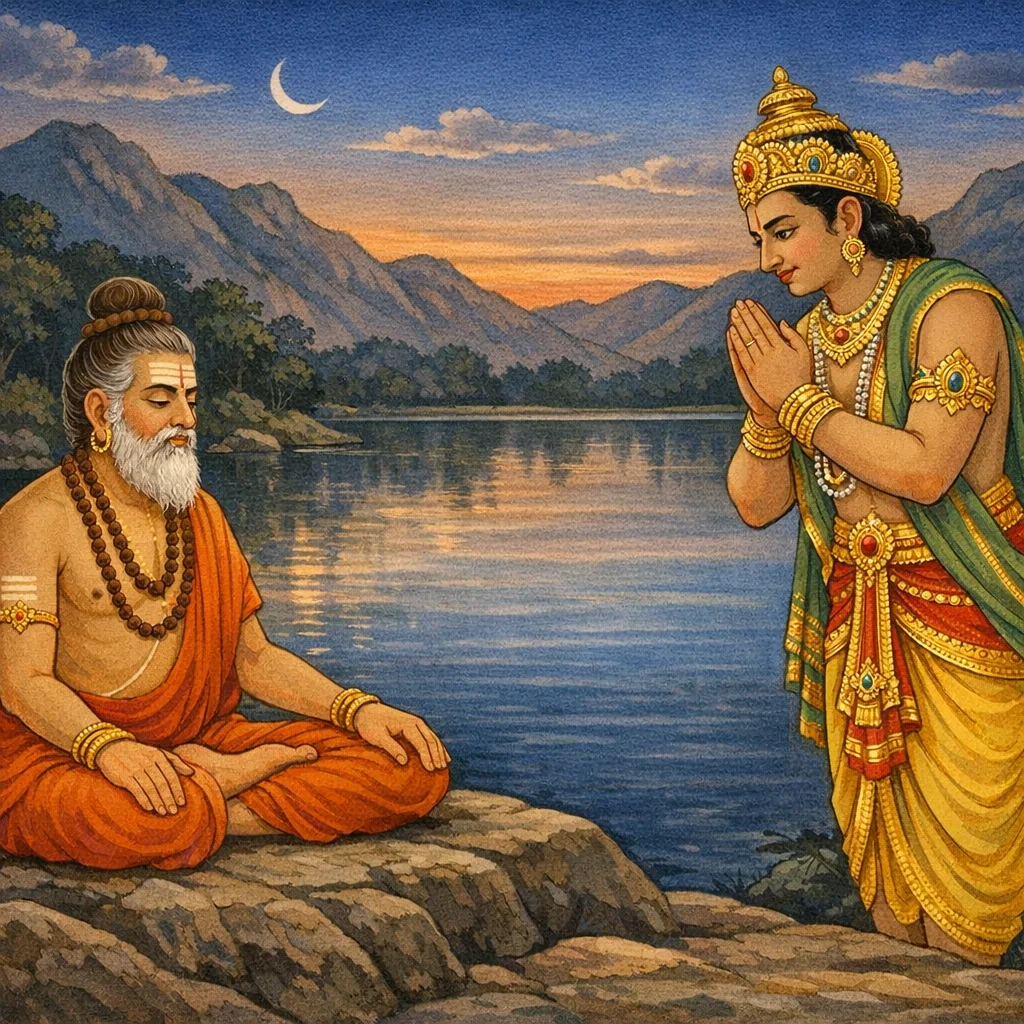
Māmūhradā Tīrtha-Māhātmya and Mudgaleśvara: Dialogue on Svarga’s Limits and the Choice of Mokṣa
Pulastya instructs King Yayāti to go to a sin-destroying tīrtha called Māmūhrada amid the mountains, explaining its ritual power: faithful bathing removes even grave sins, and the darśana of the liṅga established by the sage Mudgala—Mudgaleśvara—bestows rare spiritual excellence, especially when done in Phālguna at the prescribed lunar times. The chapter also joins ancestral rites to the place: śrāddha performed there (with proper orientation) satisfies the pitṛs until cosmic dissolution, and even simple offerings—nivāra grains and vegetable/root-based rites—are praised. When Yayāti asks how the site gained its name and requests Mudgala’s āśrama story, Pulastya recounts a model episode. A divine messenger invites Mudgala to svarga; Mudgala questions heaven’s merits and flaws and learns that svarga is a realm of enjoyment where no new merit can be produced and where fear of “falling” remains once merit is exhausted. He rejects svarga, choosing intensified tapas and devotion to Śiva. Indra tries coercion through the messenger and then comes himself, but Mudgala’s spiritual power immobilizes them, forcing Indra to negotiate and offer a boon. Mudgala asks for mokṣa and for the tīrtha to be renowned on earth as Māmūhrada. Indra grants that Phālguna full-moon bathing yields supreme attainment, that piṇḍadāna there bears fruit comparable to Gayā, and that the rewards of charity are immeasurable. The narrative ends with Mudgala attaining imperishable liberation through pure contemplation, and a traditional gāthā (ascribed to Nārada) concludes that bathing at Māmūhrada and seeing Mudgaleśvara brings both worldly fulfillment and final release.
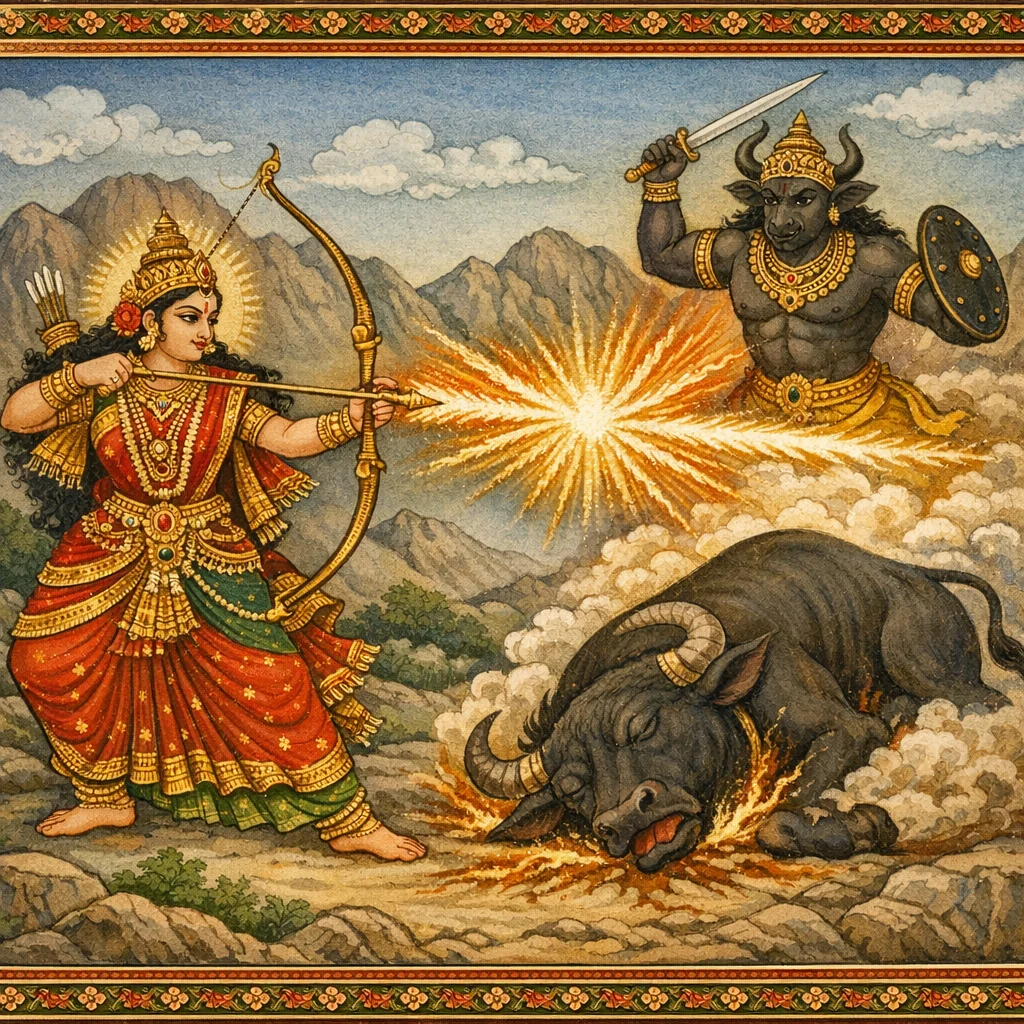
Adhyaya 36
Chandikā-Āśrama-Prādurbhāva and Mahīṣāsura-Vadha (चण्डिकाश्रमप्रादुर्भावः महिषासुरवधश्च)
The chapter begins with Yayāti asking how Chandikā’s āśrama arose on Mount Arbuda, when it occurred, and what benefit humans gain by beholding it. Pulastya relates a sin-destroying account from an earlier deva-yuga: the daitya Mahīṣa, empowered by Brahmā’s boon (invulnerable except to a certain “woman”), subdues the devas, disrupts the proper shares of yajña, and forces cosmic functionaries to serve without ritual reciprocity. The devas consult Bṛhaspati, who sends them to Arbuda to perform tapas and worship the supreme Śakti as Chandikā through mantra, nyāsa, offerings, and sustained discipline. After months of practice, the devas’ gathered tejas is ritually consolidated into a maṇḍala, from which a radiant maiden—Chandikā—manifests. She receives divine weapons and is praised with many epithets (world-pervading, Mahāmāyā, protectress, fierce). Granting the devas’ plea, she vows to slay Mahīṣa at the proper time. Nārada, having seen her, describes her incomparable beauty to Mahīṣa, stirring desire; Mahīṣa sends envoys to obtain her, but Chandikā rejects the proposal, declaring it a deliberate prelude to his destruction. A great battle follows: omens and armies are described; Chandikā neutralizes many astras, counters even the Brahmāstra with her own power, defeats Mahīṣa’s transformations, and kills him decisively—beheading the buffalo-form and dispatching the warrior-form that emerges. The devas rejoice and restore Indra’s sovereignty. Chandikā then asks for a permanent, renowned āśrama on Arbuda where she will remain; those who behold her there attain elevated spiritual states and an orientation toward brahma-jñāna. The chapter concludes with an extensive phalaśruti: snāna, piṇḍa-dāna, śrāddha, gifts to brāhmaṇas, fasting for one or three nights, and cāturmāsya residence—especially in Āśvina on kṛṣṇa-caturdaśī—yield fruits ranging from Gayā-śrāddha equivalence and freedom from fear to health, wealth, progeny, restored kingship, and liberation. A cautionary epilogue notes that as people flock to the Goddess other rites decline, so Indra deploys personified distractions (kāma, krodha, etc.) to regulate conduct; yet Arbuda-darśana remains inherently purifying, and merit extends even to those who keep the written text at home or recite it with faith.
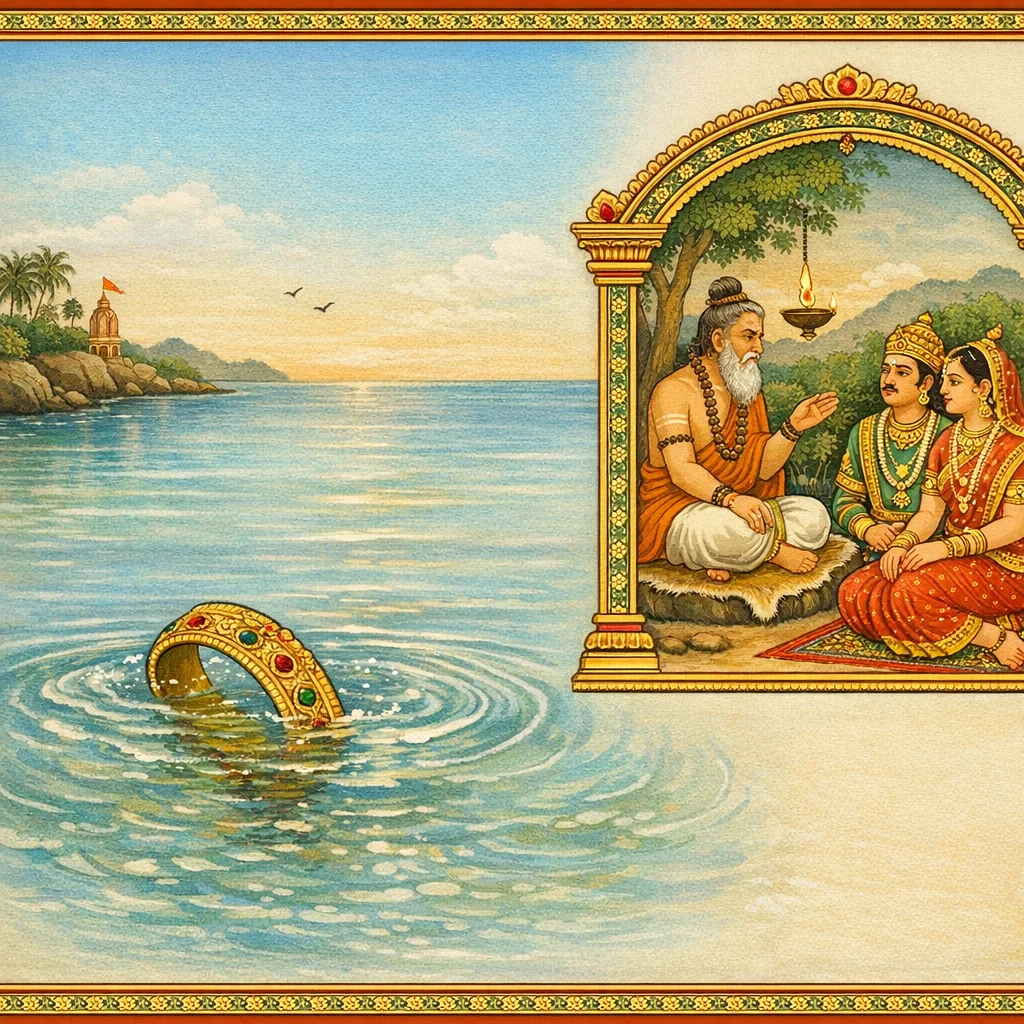
Adhyaya 37
नागह्रदतीर्थमाहात्म्यवर्णनम् | The Māhātmya of Nāgahṛda Tīrtha
This chapter is framed as Pulastya’s instruction. He first directs one to go to Nāgahṛda, a sin-destroying tīrtha, and then explains its origin: the nāgas, distressed by Kadru’s curse and fearing destruction in Parīkṣit’s sacrificial fire, approach Śeṣa for guidance. Śeṣa advises disciplined tapas on Arbuda mountain and unceasing worship of the goddess Caṇḍikā, praised as kāmarūpiṇī, declaring that her remembrance dispels calamities. Entering the mountain through a cavern path, the nāgas perform severe austerities—homa, japa, fasting, and other observances—until the Devī is pleased. Caṇḍikā grants them protection: they may remain near her without fear until the sacrifice ends, and then return to their abode. She also proclaims that since the mountain cavern was cleft by them, the place will be known on earth as Nāgahṛda tīrtha. A calendrical rule follows: in the month of Śrāvaṇa, on the fifth lunar day (pañcamī), devoted bathing removes fear of serpents, and śrāddha performed there benefits one’s ancestors. The chapter closes by reaffirming the goddess’s abiding presence on Kṛṣṇa-pañcamī in Śrāvaṇa and recommending bathing and śrāddha at Nāgahṛda for one’s welfare.
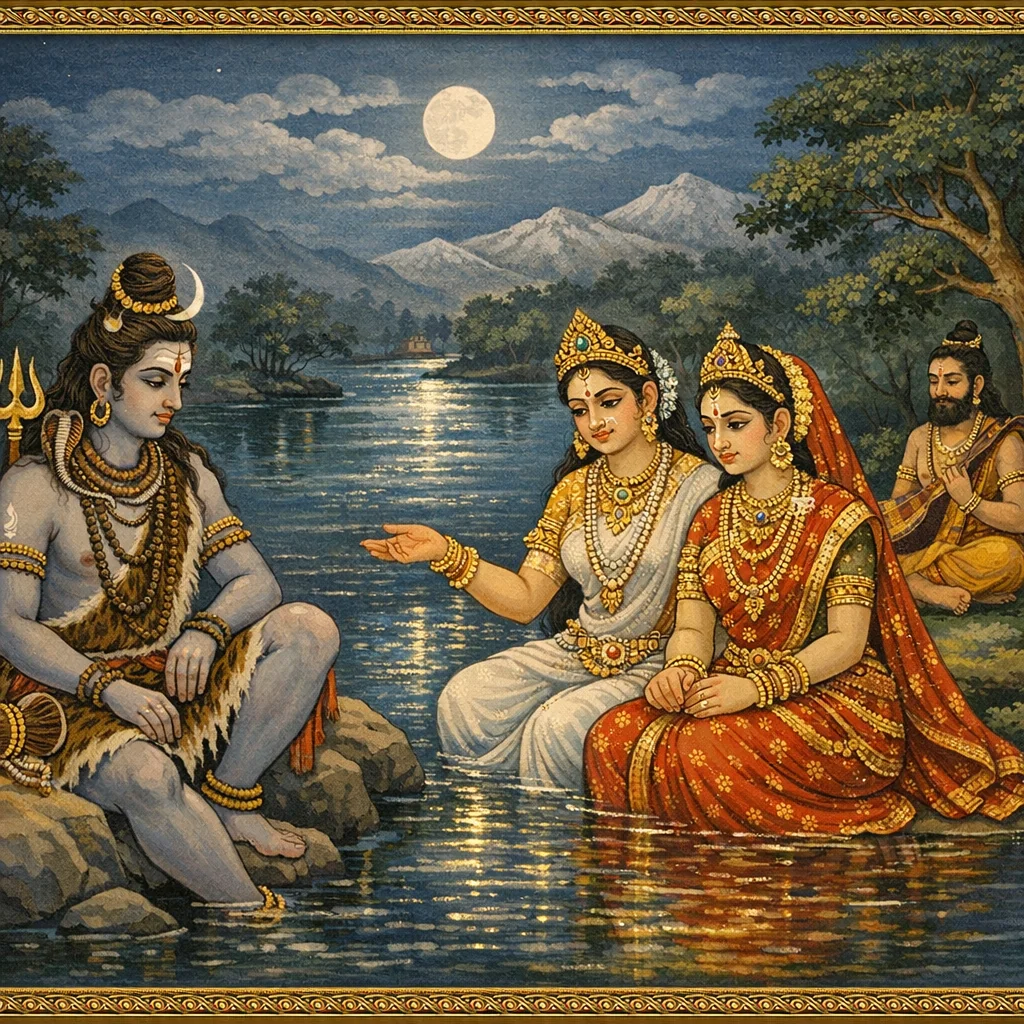
Adhyaya 38
Śiva-kuṇḍa and Śiva-Gaṅgā: The Concealed Presence of Jāhnavī at Arbuda (शिवकुण्ड-शिवगङ्गामाहात्म्यम्)
This adhyāya unfolds as a theological question-and-answer between Pulastya and King Yayāti. Pulastya points to a kuṇḍa connected with a Śiva-liṅga, where Jāhnavī (Gaṅgā) is said to remain “concealed” (guptā). Bathing there is praised as yielding the merit of all tīrthas and erasing the lifetime’s accumulated sins. The cause is then narrated: after the gods propitiate Śiva and establish Him on Mount Arbuda, Śiva longs for continual nearness to Gaṅgā while keeping discretion before Pārvatī. Gaṇas led by Nandin and Bhṛṅgin build a splendid, clear-water kuṇḍa; Śiva enters it under the pretext of a vow (vrata-vyāja) and mentally invokes Gaṅgā, who arrives at once. Nārada notices Śiva’s unusual mood, realizes the hidden attachment through meditative insight, and reports it; Pārvatī approaches in anger. Forewarned, Gaṅgā pacifies Pārvatī with respectful speech, recalls their earlier connection through Bhagiratha’s episode and her being “held” during descent, and asks for one full day of sportive association with Śiva on Caitra-śukla Trayodaśī, naming the place “Śiva-kuṇḍa / Śiva-Gaṅgā.” The chapter ends with observance: bathing on Caitra śukla Caturdaśī with focused intent destroys inauspiciousness, and a dāna is prescribed—gifting a bull to a brāhmaṇa—bearing a heavenward fruit.
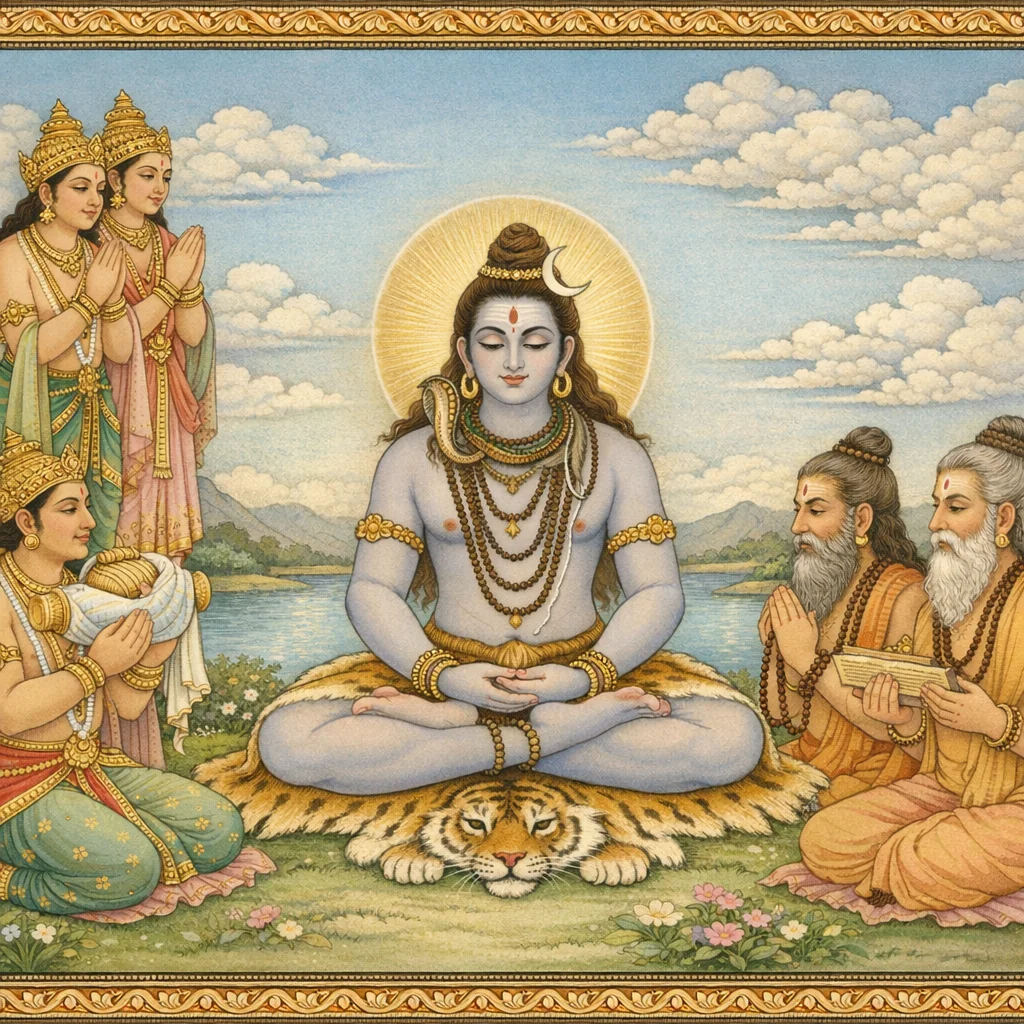
Adhyaya 39
Acalēśvara-liṅga-patana, Deva-stuti, and Saktū-dāna Māhātmya (अचलेश्वरलिङ्गपतन-देवस्तुति-सक्तुदानमाहात्म्य)
The chapter unfolds as a dialogue: King Yayāti asks Pulastya why a liṅga once established by Mahādeva became dislodged, and what merit comes from beholding that sacred spot. Pulastya relates an origin-legend: after Satī’s death and Dakṣa’s insult, a bewildered Śiva arrives at the āśrama of the Vālakhilya sages. Their wives, captivated by his splendor, approach him; the sages, failing to recognize the Lord, utter a curse, and thus the liṅga “falls.” The cosmos wavers—earthquakes and troubled seas—so the devas report the crisis to Brahmā, who discerns the cause and leads them to Arbuda. The devas then hymn Śiva in Vedic-style praise and beg for restoration. Śiva declares the fallen liṅga to be “immovable” (acala) and not to be relocated, prescribing a single remedy: worship in sequence—first Brahmā, then Viṣṇu, Indra, the other devas, and finally the Vālakhilyas with Śatarudrīya mantras—after which the ominous portents cease. A further boon is sought: that even touching the liṅga removes impurity; Indra covers it with the vajra so it is unseen by ordinary mortals, while its purifying power through proximity remains. The chapter ends with calendrical and ritual instruction: on the concluding Caturdaśī of the month of Phālguna, offering fresh barley (yava) and feeding Brahmins yields extraordinary fruit, surpassing many other rites. An exemplum follows: a diseased man’s accidental association with saktū (parched grain flour) at the site brings an auspicious rebirth; realizing its efficacy, he later performs the observance annually with fasting, night vigil, and generous saktū-dāna. The final phalaśruti promises release from day-and-night accrued faults for faithful listeners.
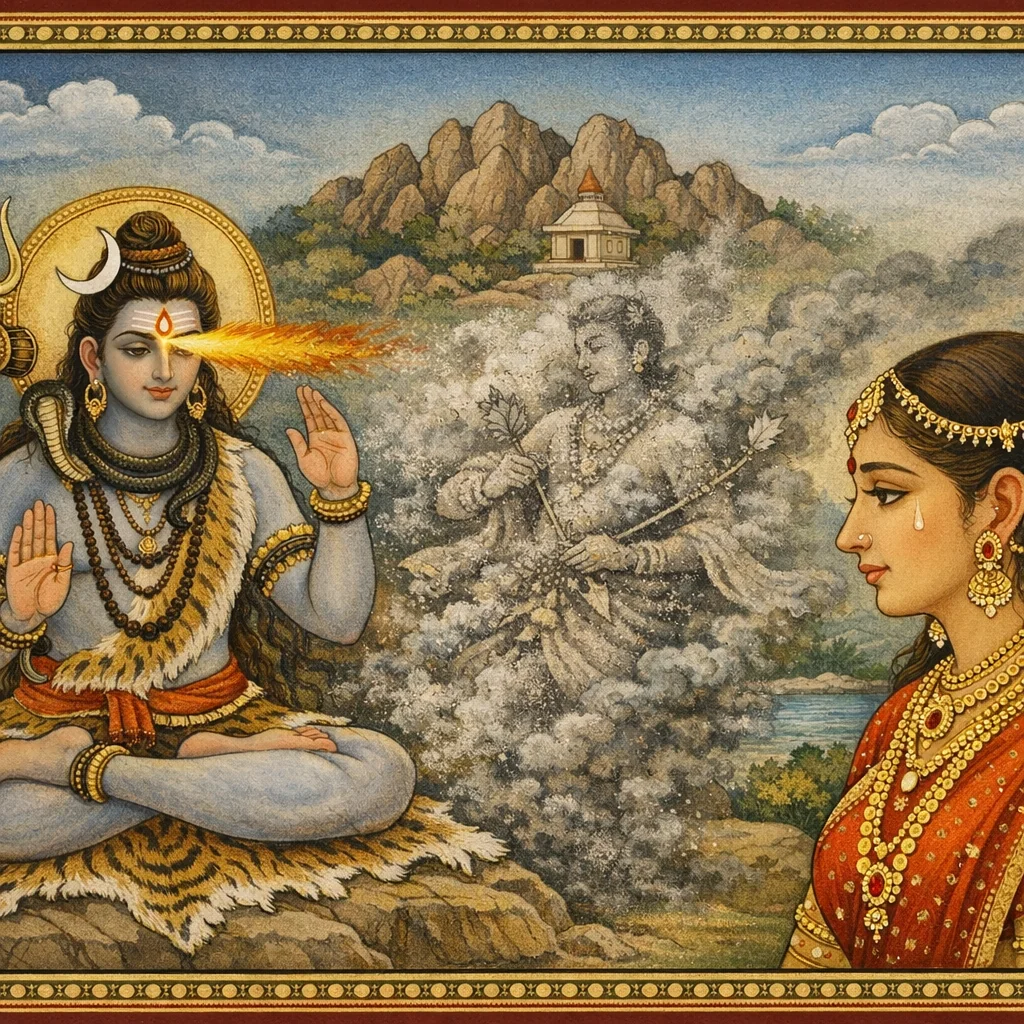
Adhyaya 40
कामेश्वरमाहात्म्यवर्णनम् (Kāmeśvara Māhātmya—Narrative of the Glory of Kāmeśvara)
This adhyāya unfolds as a dialogue between Pulastya and King Yayāti. Yayāti asks why Śiva moved through many sacred tīrthas under the perceived threat of Kāma (Manobhava), and requests a full account of Kāmeśvara’s abode. Pulastya relates that Kāma relentlessly follows Śiva, repeatedly appearing with bow and arrows at the ready. After a prolonged passage through renowned tīrthas, Śiva turns back toward Arbuda and confronts Kāma directly; from Śiva’s third eye bursts a consuming flame that reduces Kāma—along with his bow and arrows—to ashes. The narrative then turns to Rati’s lament and her attempt at self-immolation, halted by a celestial voice instructing her to undertake tapas. After a thousand years of disciplined worship—vows, gifts, japa, homa, and fasting—Śiva grants a boon: Kāma is restored as an embodied presence and resumes his function, now under Śiva’s sanction. The chapter concludes that Yayāti, grasping Śiva’s greatness, establishes Śiva on Arbuda; darśana of this deity is said to avert misfortune for seven births, proclaiming the site’s phalaśruti and ritual centrality.
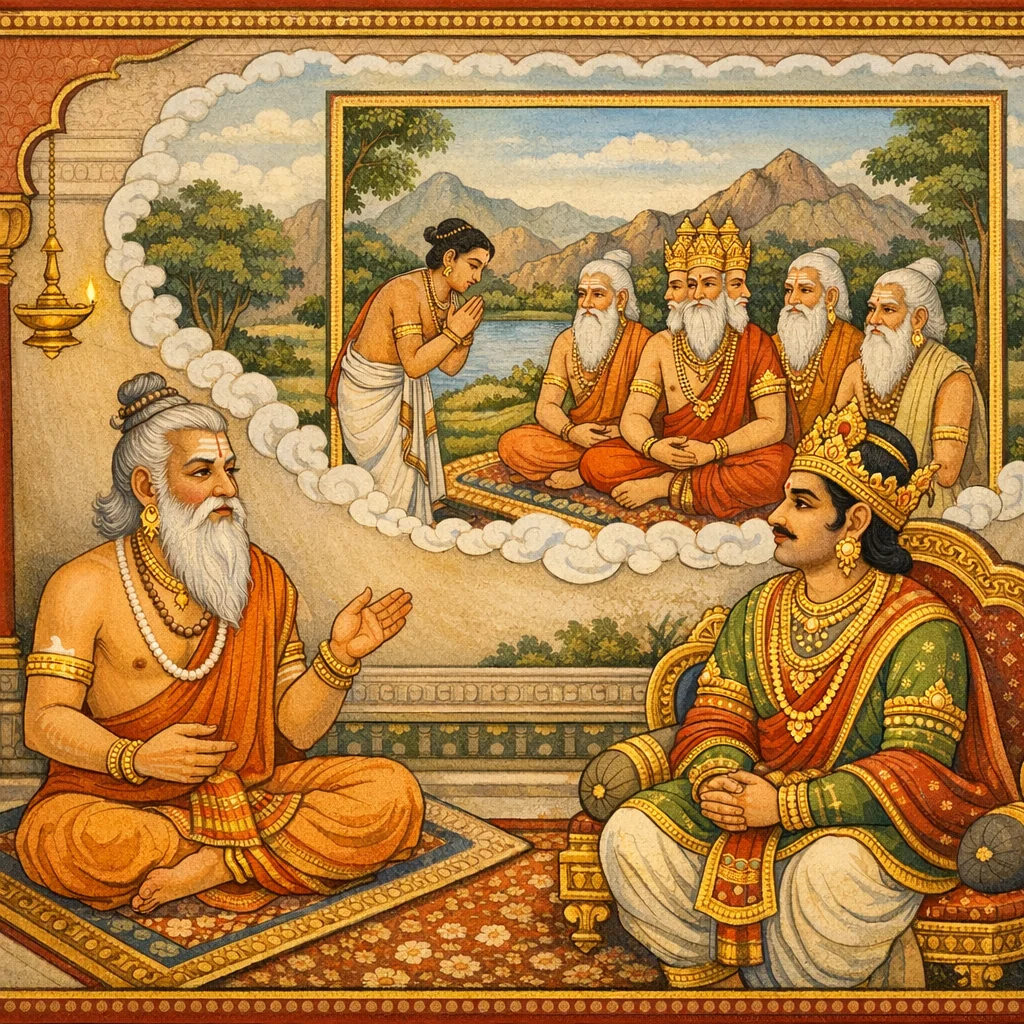
Adhyaya 41
Mārkaṇḍeya’s Longevity Boon and the Ritual Merits of Arbuda Āśrama (मार्कण्डेयदीर्घायुष्प्रसङ्गः)
Pulastya recounts to a king the story of Mṛkaṇḍu’s son: a child bearing auspicious marks, yet foretold by a learned visitor to die within six months. The father hastens the boy’s upanayana and trains him in disciplined reverence, teaching him to bow to Brahmins of every age. When the Saptarṣi arrive on pilgrimage, the child greets them with devotion and receives their blessing of long life. But Aṅgiras, with subtle insight, perceives death approaching on the fifth day and urges a remedy so their blessing may not conflict with truth. The sages carry the child to Brahmaloka, where Brahmā inquires and grants him longevity lasting for a full kalpa. Returned to his parents, the child proclaims the boon and resolves to found a beautiful āśrama on Mount Arbuda and worship Brahmā. The chapter ends with a local phalaśruti: pitṛ-tarpaṇa there on the Śrāvaṇa full-moon yields complete fruit like a pitr̥medha; tarpaṇa to eminent Brahmins through ṛṣi-yoga grants long residence in Brahmaloka; and faithful bathing there removes fear of untimely death within one’s lineage.
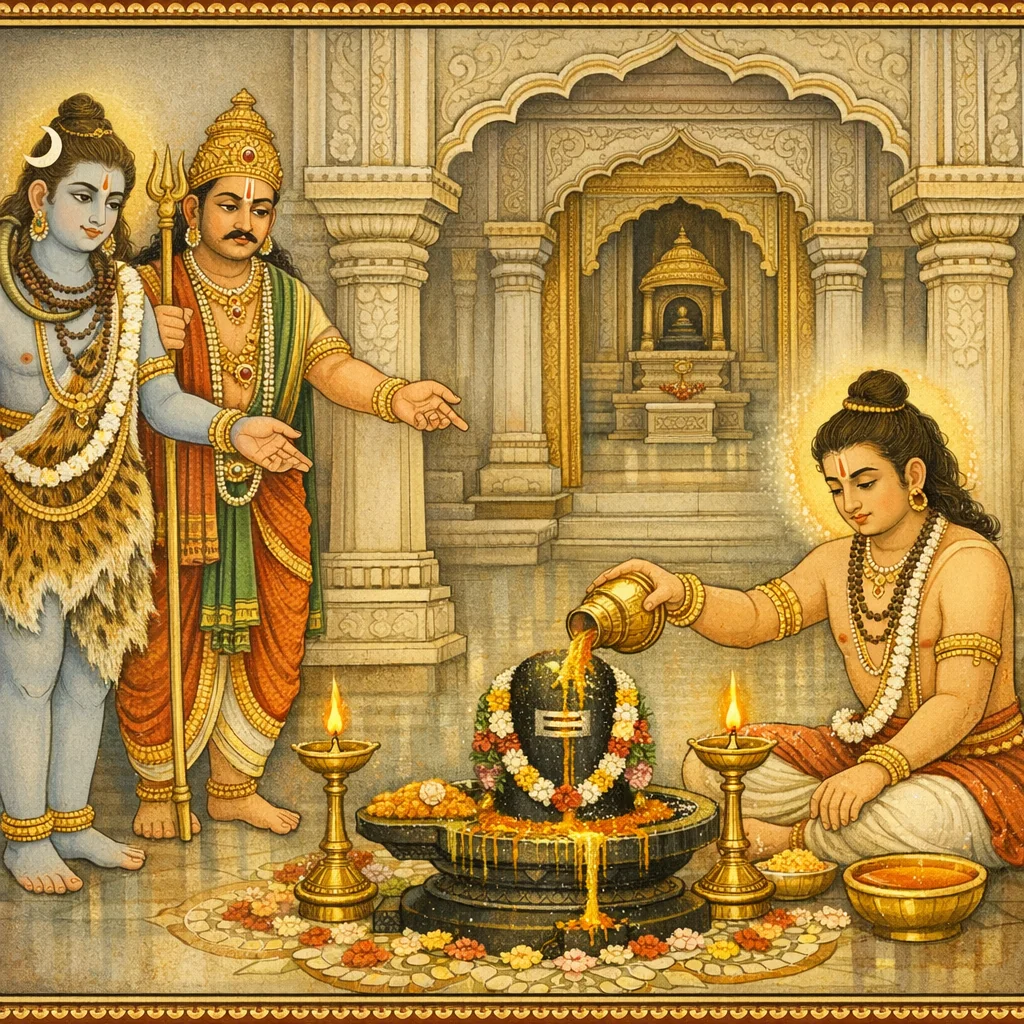
Adhyaya 42
उद्दालकेश्वरमाहात्म्यवर्णनम् (Narration of the Māhātmya of Uddālakeśvara)
This chapter is a concise instruction in which Pulastya addresses an excellent king (nṛpaśreṣṭha). He directs him to go to a supremely sin-destroying liṅga (liṅgaṃ pāpaharaṃ param), renowned in the world, established by the sage Uddālaka and known as Uddālakeśvara. The teaching is closely tied to ritual efficacy: touching (spṛṣṭa), seeing (dṛṣṭa), and especially worshipping (pūjita) that liṅga are declared fruitful. The results are promised in three ascending modes—freedom from all diseases (sarvaroga-vinirmukta), fitness to attain or sustain the householder state (gārhasthyaṃ prāpnuyāt), and complete release from sins with honor in Śiva’s realm (śivaloke mahīyate). The closing colophon places the chapter in the Prabhāsa Khaṇḍa, within the Arbuda Khaṇḍa, as Adhyāya 42.
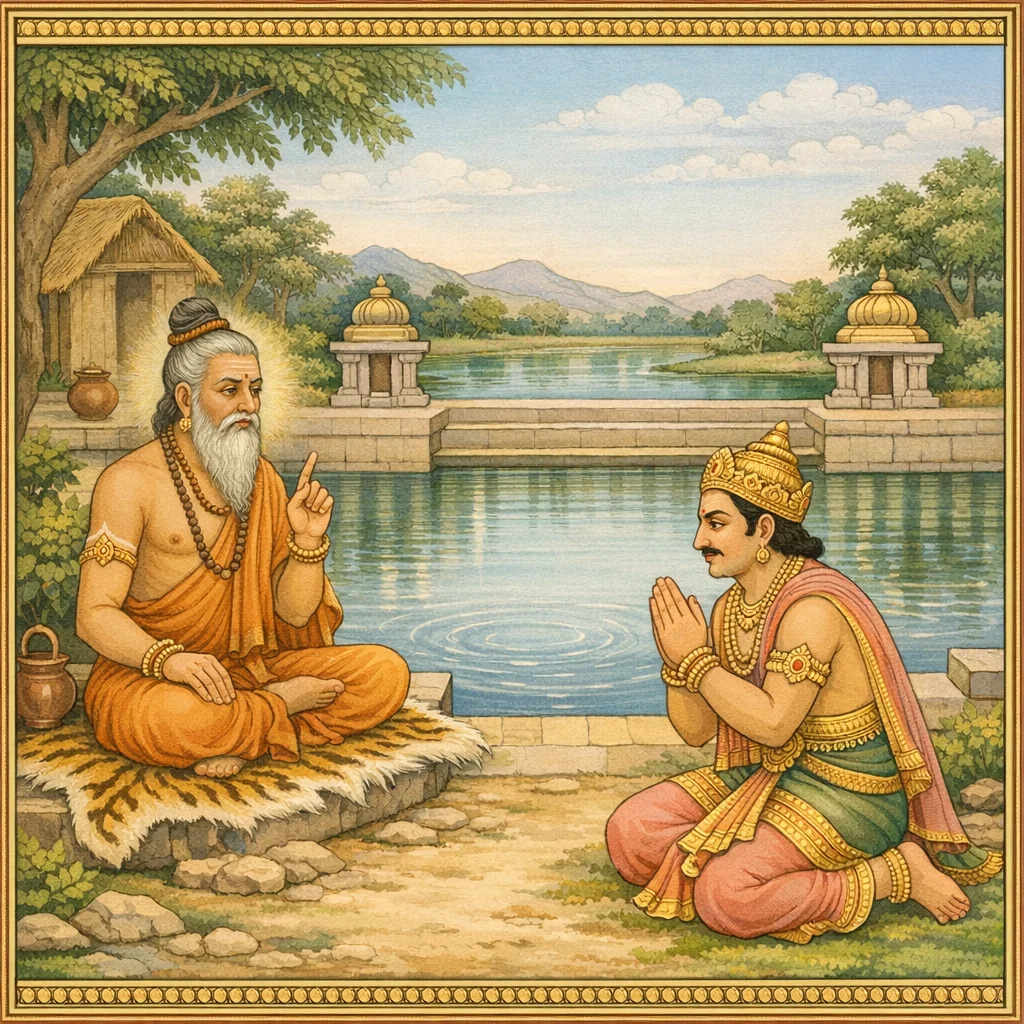
Adhyaya 43
Siddheśvara-Māhātmya (सिद्धेश्वरमहिमवर्णनम्) — The Glory of Siddheśvara
Pulastya instructs the kingly interlocutor to go to a sacred liṅga called Siddhaliṅga, praised as bestowing “good accomplishment” and as established by the siddhas. The shrine is presented as a destroyer of all pātakas, the gravest impurities and sins. The chapter then points to a nearby kuṇḍa whose water is exceptionally pure; bathing there is said to free one from the specific transgression of brahmahatyā, a paradigmatic major sin. The text further universalizes the site’s power: whatever desire one contemplates while bathing is promised to be fulfilled, and at life’s end one attains a “supreme state.” A closing colophon locates the unit within the Skanda Purāṇa’s saṃhitā structure, naming the Prabhāsa Khaṇḍa, the Arbuda Khaṇḍa subsection, and the adhyāya title, serving as an internal marker for transmission and indexing.
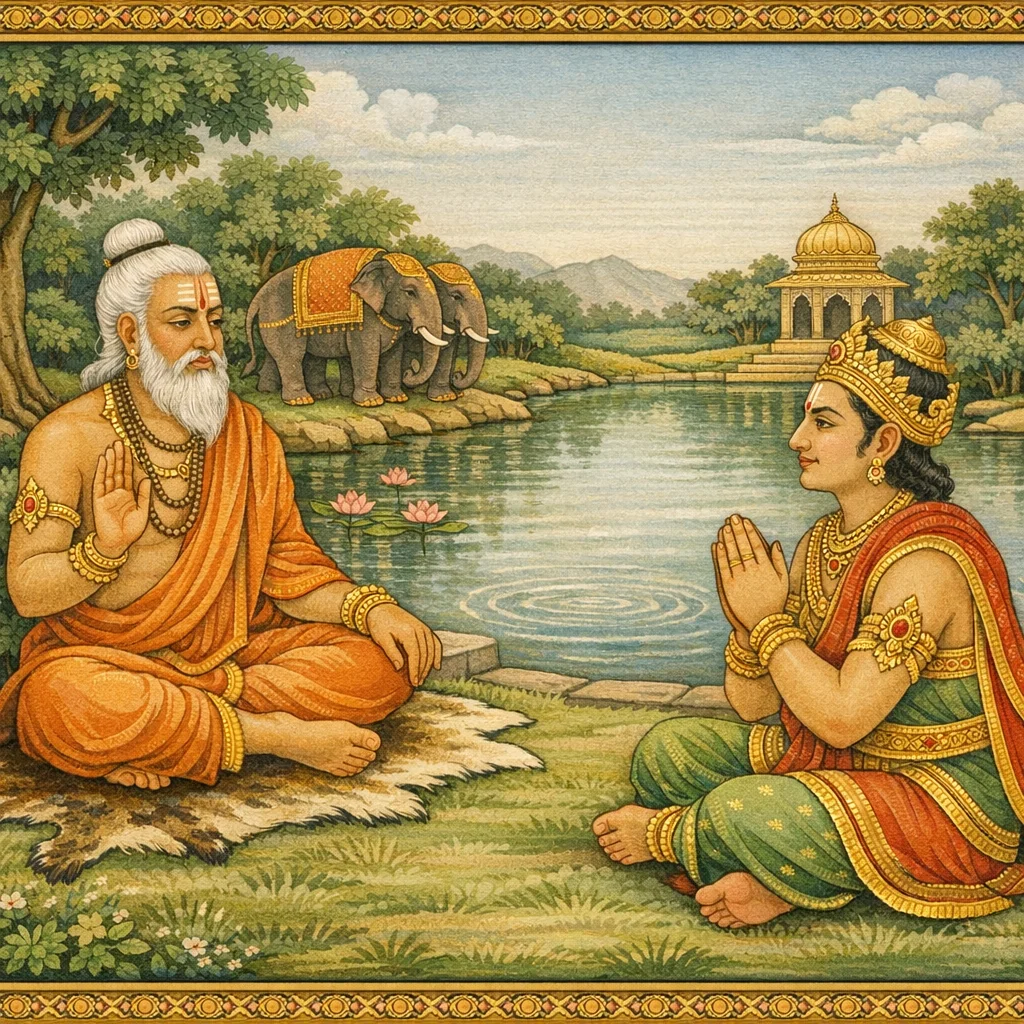
Adhyaya 44
गजतीर्थप्रभाववर्णनम् | Description of the Power and Merit of Gajatīrtha
The chapter “Gajatīrtha-prabhāva-varṇana” records Pulastya’s instruction to a king to proceed to an unsurpassed pilgrimage ford (tīrtha) known as Gajatīrtha. Its sanctity and authority are established through revered precedent from ancient times. In former ages, the directional elephants (diggaja), portrayed as disciplined and purified beings, performed tapas there, together with other world-bearing elephants led by Airāvata. The chapter’s ritual focus is proper bathing (samyaṅ-snānā) at this sacred site: one who bathes correctly is promised the merit-fruit equal to performing gaja-dāna, the auspicious donation of an elephant. Thus it joins sacred geography, exemplary ascetic history, and a precise equivalence of merit in the Purāṇic ethic of pilgrimage.
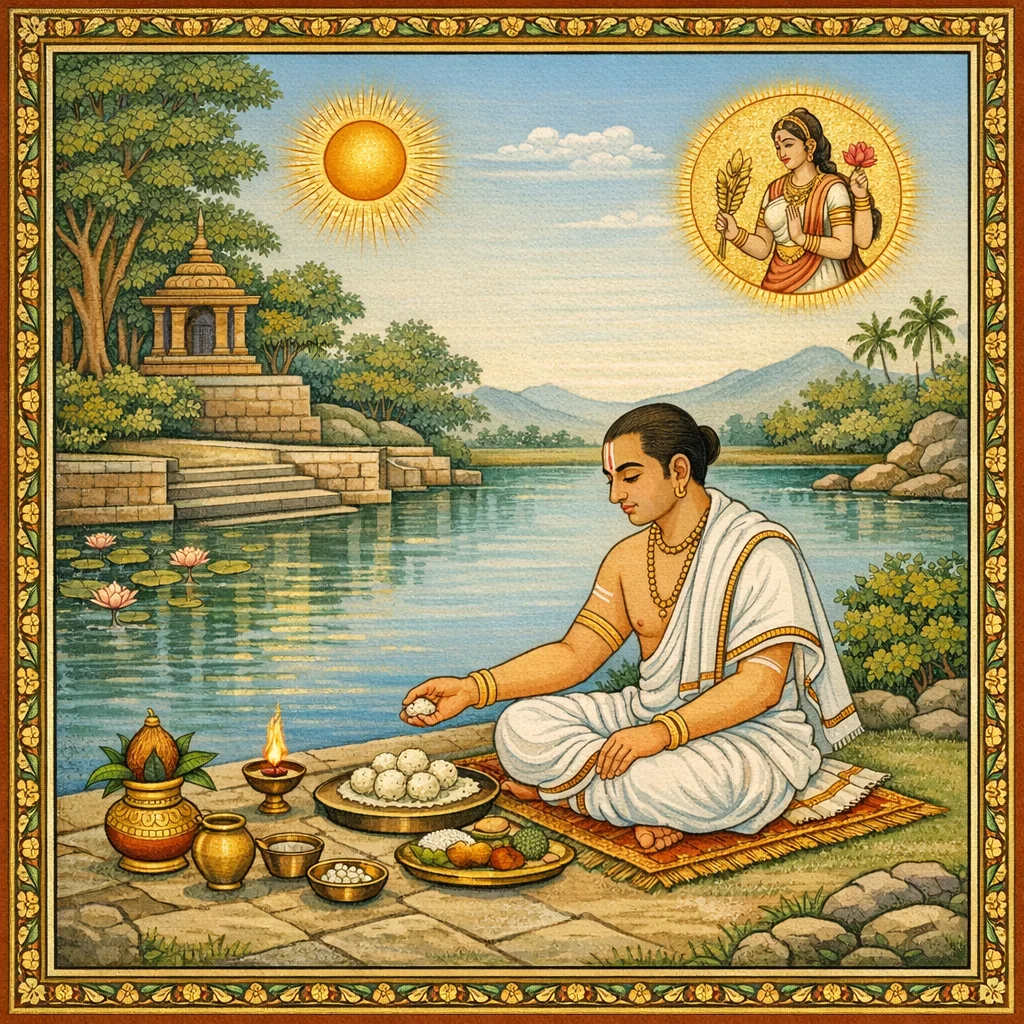
Adhyaya 45
श्रीदेवखातोत्पत्तिमाहात्म्यवर्णनम् (Devakhāta Tīrtha: Origin and Māhātmya)
This adhyāya records Pulastya’s instruction concerning Devakhāta, praised as a tīrtha of supreme merit, whose fame is said to be self-manifest and affirmed among the learned (vibudhas). It then sets forth a ritual observance: performing śrāddha at this place, with special emphasis on amāvāsyā (new-moon day), and with added auspiciousness when the sun is transiting Kanyā (Virgo). The rite is linked to a twofold fruit—an elevated posthumous state for the performer and salvific benefit for the pitṛs (ancestors), even for those believed to have fallen into difficult destinies. The chapter concludes with the customary colophon, locating the passage within the Skanda Mahāpurāṇa’s Prabhāsa Khaṇḍa and Arbuda Khaṇḍa, and naming the topic as the narrative of Devakhāta’s origin and glory (māhātmya).
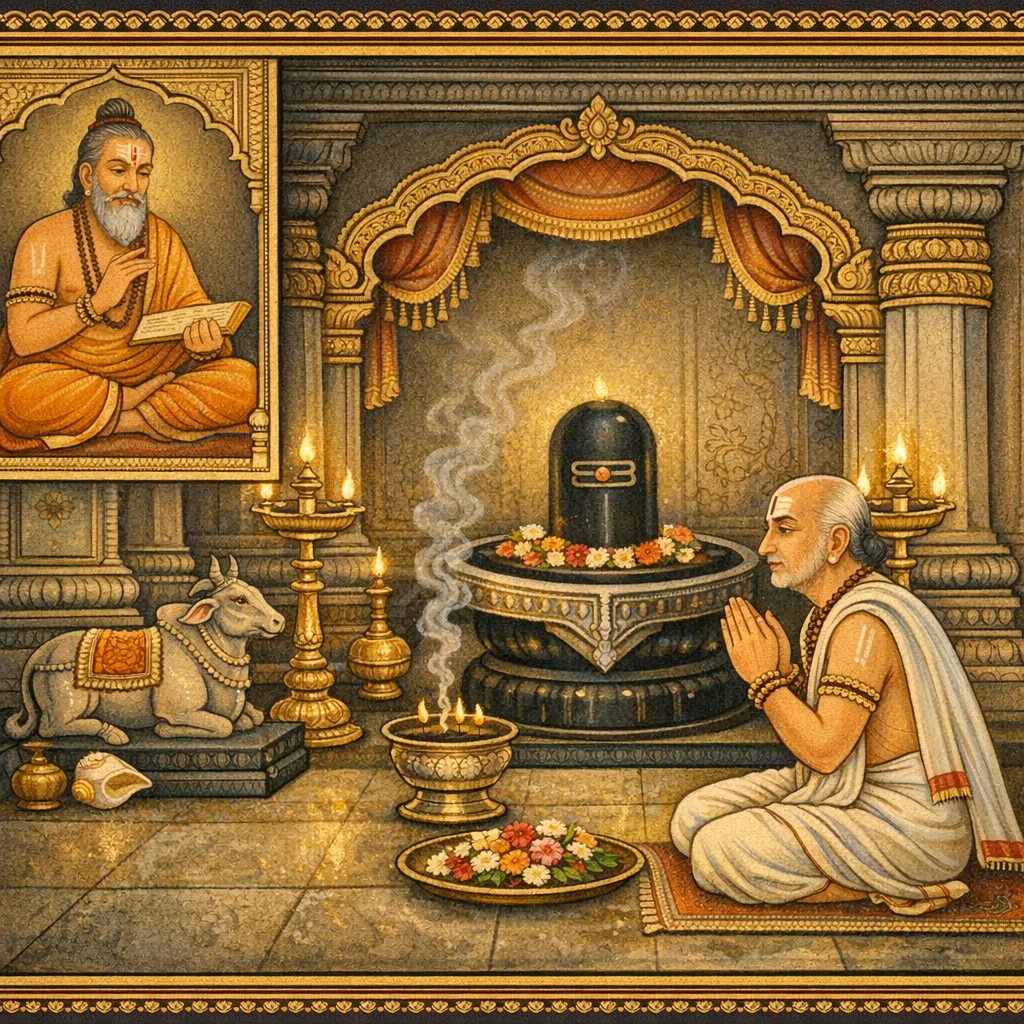
Adhyaya 46
व्यासतीर्थमाहात्म्यवर्णनम् (Description of the Glory of Vyāsa-tīrtha)
This adhyāya is cast as Pulastya’s instructive narration, guiding the listener to a definite sacred destination: Vyāseśvara, the shrine established by Vyāsa. The opening injunction—“then one should go to Vyāseśvara”—places pilgrimage as an ordered step within the wider sacred landscape of Arbuda. Its core teaching exalts darśana as transformative knowing: the very sight of the deity and holy site is said to bestow medhā (clarity of intellect), mati (discernment), and śuci (purity). The closing colophon identifies the passage as part of the 81,000-verse Skanda Mahāpurāṇa, within the seventh Prabhāsa Khaṇḍa and the third Arbuda Khaṇḍa, naming this as the forty-sixth chapter for canonical recitation, citation, and preservation.
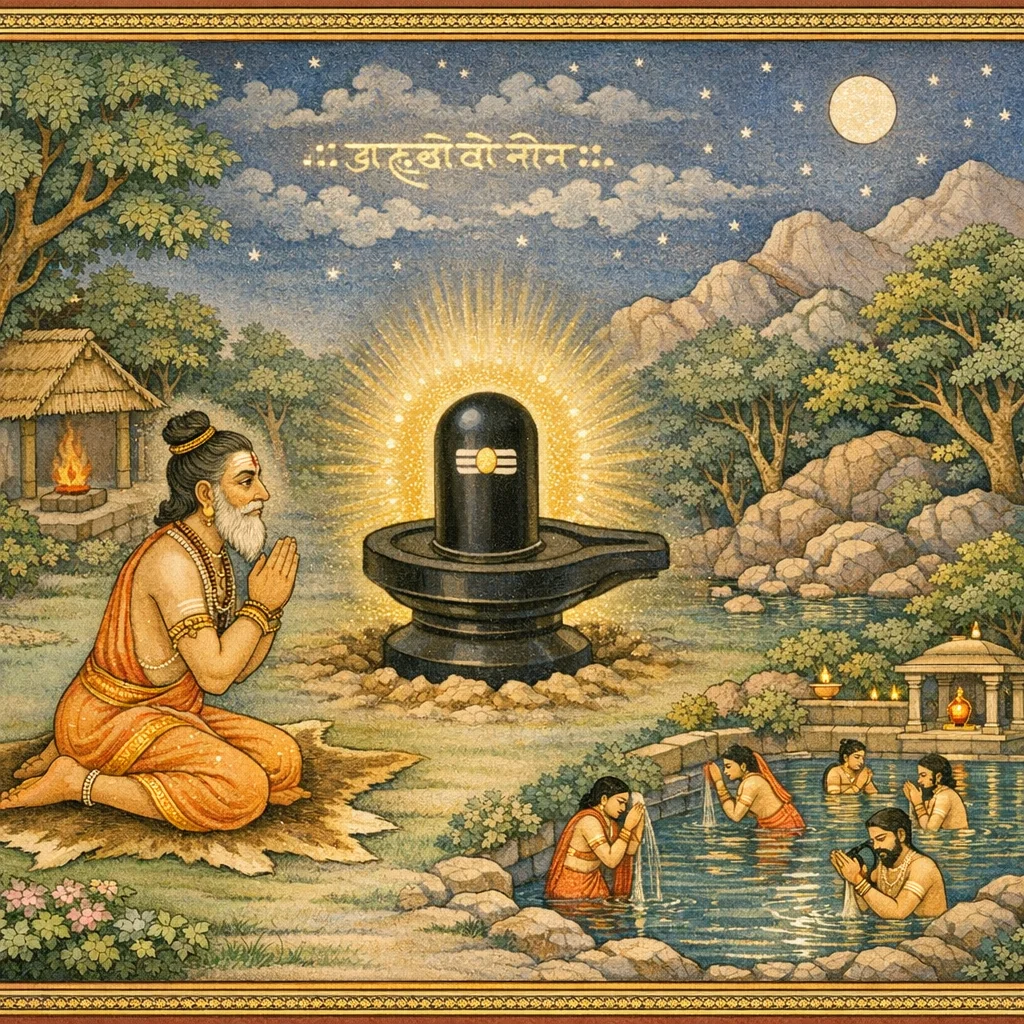
Adhyaya 47
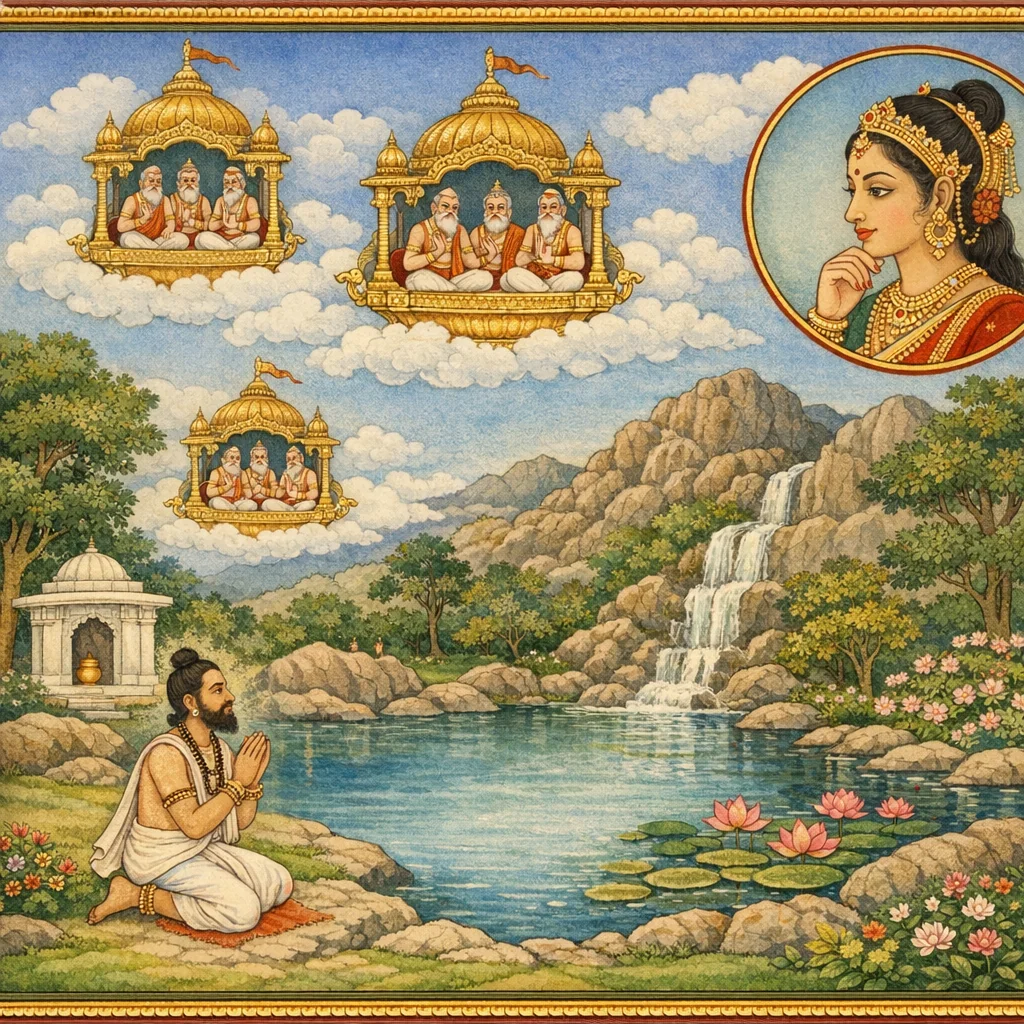
गौतमाश्रमतीर्थमाहात्म्यवर्णनम् | Gautamāśrama Tīrtha Māhātmya (Glory of Gautama’s Hermitage-Site)
Pulastya instructs the king to go to the renowned Gautama Āśrama, a sanctified hermitage where the sage Gautama once performed austerities. Gautama, a muni of exceptional righteousness, worshipped Mahādeva with devoted bhakti; in response, a mighty liṅga burst forth by piercing the earth, revealing Śiva’s localized presence there. An incorporeal heavenly voice (ākāśavāṇī) commands that the liṅga be worshipped and invites a boon. Gautama asks that Śiva remain ever near the āśrama and that devotees receive saving grace: whoever beholds Śiva there with sincere devotion is said to attain Brahmaloka. A further rule of sacred time is given—one who has darśana of the deity on the dark-fortnight caturdaśī (14th lunar day) in Māgha gains the highest goal (parā gati). The chapter then lists nearby ritual supports and their merits: a sacred water-reservoir (kuṇḍa) whose bath uplifts one’s lineage; śrāddha performed there, especially at indusaṃkṣaya (a lunar conjunction/waning moment, possibly eclipse-related), equals the merit of Gayā-śrāddha; and sesame-gifts (tila-dāna) grant prolonged heavenly residence in proportion to the number of seeds. It also compares these fruits with famed pilgrimages—such as bathing in the Godāvarī during Jupiter’s Siṃhastha—placing this tīrtha within a wider calendar and economy of sacred merit.
Adhyaya 48
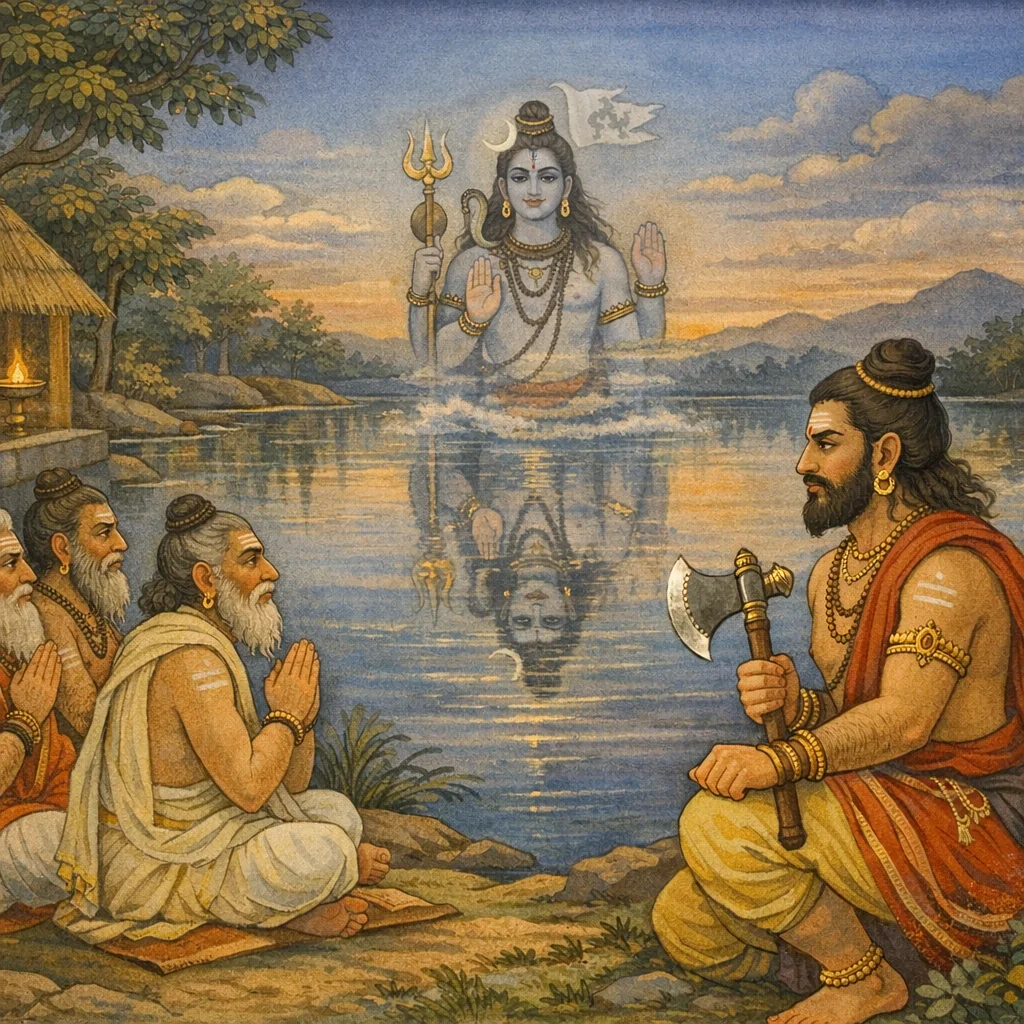
कुलसंतारणतीर्थमाहात्म्यवर्णनम् | Kulasantāraṇa Tīrtha: Māhātmya and the Ethics of Ancestral Uplift
Pulastya describes the tīrtha called Kulasantāraṇa, proclaimed an “unsurpassed” holy place where bathing in the proper manner is said to uplift an entire lineage. The chapter presents the former king Aprastuta as ethically wayward—ruling with violence, committing acquisitive wrongs, and neglecting dāna (giving), jñāna (sacred knowledge), and disciplined conduct. In old age the king receives a dream-encounter: suffering pitṛs (ancestors) explain that though they lived dharmically, they have fallen into hell because of his deeds, and they urge him toward auspicious worship and corrective rites. He confides in Queen Indumatī, who affirms that a good son elevates ancestors while a bad son harms them, and advises consulting dharma-versed brāhmaṇas. The brāhmaṇas prescribe a graded remedy—dīkṣā and bodily purification, then extensive tīrtha-pilgrimage with snāna (sacred bathing) and dāna, and only afterward eligibility for further sacrificial acts. The king undertakes the journey, reaches Arbuda’s pure waters, and bathes with focused faith; the ancestors are freed from a fierce hell and appear in divine conveyances. They declare the site will be known as Kulasantāraṇa and invite the king to ascend bodily to heaven by the tīrtha’s power. Pulastya closes by reaffirming the tīrtha’s efficacy and noting auspicious calendrical moments—such as rākā-soma and the vyatīpāta conjunction—that further amplify the merit of the bath.
Adhyaya 49
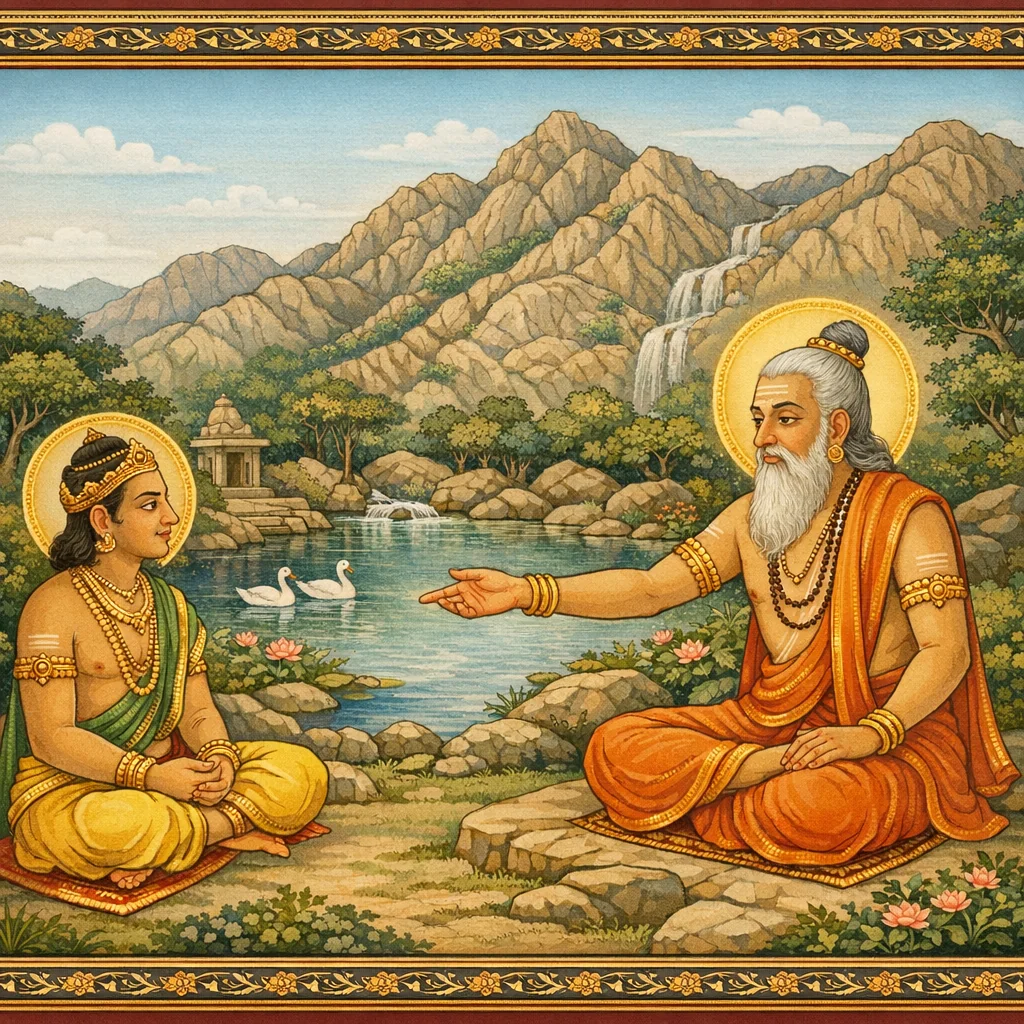
रामतीर्थमाहात्म्यवर्णनम् (Rāmatīrtha Māhātmya: The Glory of Rama’s Tīrtha)
Pulastya describes the pilgrimage toward Rāmatīrtha, a sacred site frequented by ṛṣis, where bathing is said to bring about pāpa-saṅkṣaya, the wasting away of sins. The chapter then turns back to an origin-legend: Bhārgava Rāma (Paraśurāma), warrior and ascetic, undertakes prolonged tapas to diminish his enemies. After three hundred years Mahādeva, pleased, grants a boon and bestows the supreme Pāśupata weapon, whose power is said to work even through mere remembrance, bringing “enemy-destruction.” He further declares that the connected reservoir will be famed as Rāmatīrtha throughout the three worlds by divine favor. A calendrical and ritual instruction follows: on the Kārttika full-moon (pūrṇimā), when Kṛttikā-yoga is present, focused performance of śrāddha at this place yields complete fruit for the pitṛs (ancestors), and is also linked with enemy-diminution and lasting heavenly residence. The narrative closes with Mahādeva’s disappearance and Paraśurāma’s ensuing acts—grief for Jamadagni’s death, tarpaṇa “three times seven,” and an oath that frames his conflict with the kṣatriyas—ending in the practical directive to perform śrāddha here with earnest effort, especially for kṣatriyas seeking that result.
Adhyaya 50
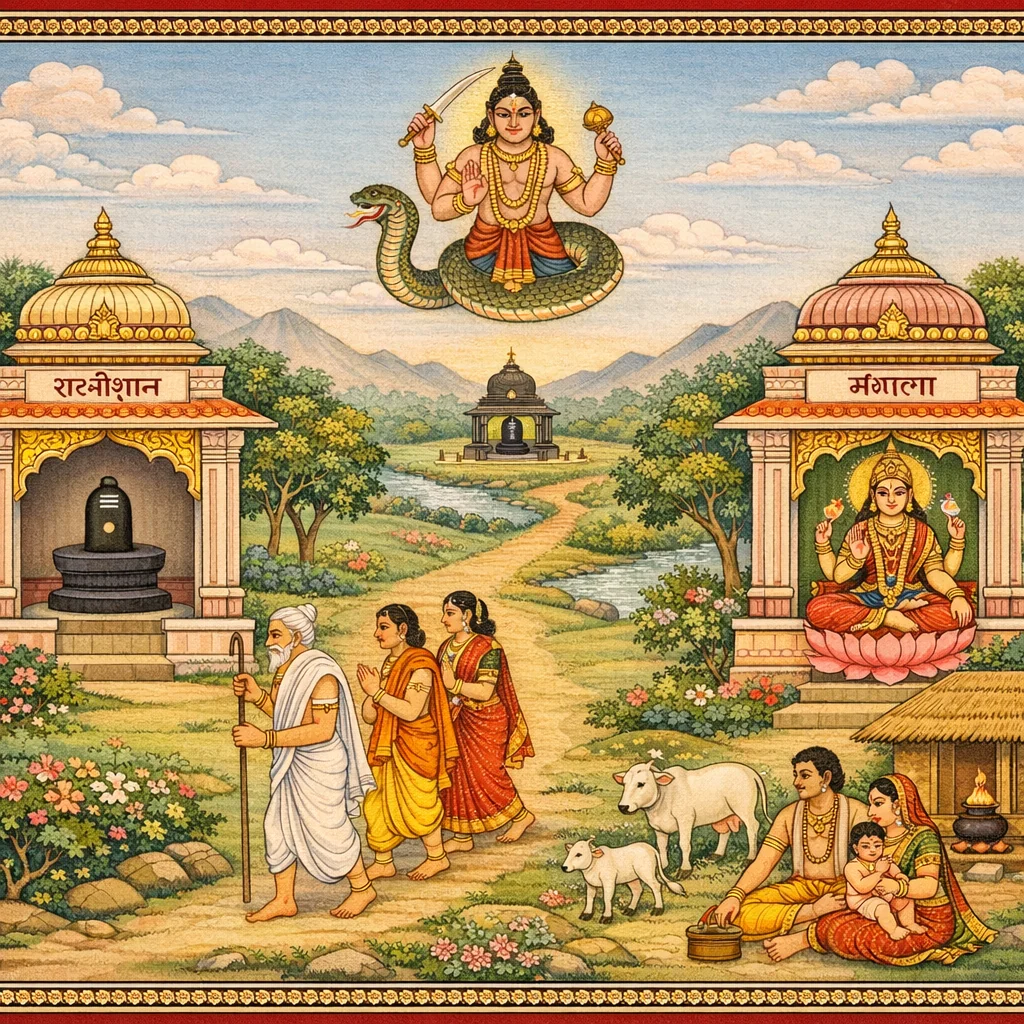
कोटितीर्थप्रभाववर्णनम् | Kotitīrtha: Description of Power and Merit
This adhyāya records Pulastya’s theological instruction to a king on Kotitīrtha, praised as a supreme purifier that destroys all sins (sarva-pātaka-nāśana). It explains why tīrtha power on the scale of a “koṭi” (crore) becomes concentrated in select sites: vast numbers of tīrthas are cited, and a “koṭi portion” is said to have taken residence on Mount Arbuda, with related concentrations at Puṣkara, Kurukṣetra, and a “half-koṭi” at Vārāṇasī, all lauded and guarded by the gods. A key theme is ritual vulnerability in Kali-yuga: as people become mleccha-bhūta and contact causes tīrtha disturbance (tīrtha-viplava), the tīrthas are described as swiftly remaining within these protected stations. The chapter then gives practical guidance—bathe with full effort, especially on the kṛṣṇa-pakṣa trayodaśī in the month of Bhādrapada (Nabhāsyā). It concludes with a phala assurance: all bathing, japa, and homa performed there become koṭi-guṇa, their merit multiplied a crore-fold by that grace.
Adhyaya 51
चन्द्रोद्भेदतीर्थमाहात्म्यवर्णनम् (Māhātmya of the Chandrodbheda Tīrtha)
This adhyāya, framed within Pulastya’s instruction to a king, proclaims an “unsurpassed” sin-destroying tīrtha connected with Candra, the Moon. It introduces the sacred site as uniquely potent for purification and auspicious welfare. The chapter then recounts the eclipse (grahaṇa) myth: Rāhu, hostile since the amṛta episode, becomes deathless by drinking nectar; Viṣṇu severs his head, yet that head endures and terrifies the devas, especially Candra during eclipses. Seeking protection, Candra goes to Arbuda, splits the mountain peak, forms a deep cavern, and performs severe tapas within it. Pleased, Maheśvara (Śiva) grants a boon. Candra asks to be freed from Rāhu’s promised “seizing” at eclipse times. Śiva acknowledges Rāhu’s power but establishes a compensatory ritual order: during a lunar eclipse, those who perform snāna (sacred bathing) and dāna (charity) at this spot gain auspicious well-being; their sukṛta becomes imperishable, and Candra’s distress is ritually neutralized. Because the peak was cleft for tapas, the place is named Chandrodbheda; bathing there during an eclipse grants release from rebirth, and bathing with darśana on Somavāra (Monday) assures residence in Candra’s realm. Śiva then disappears, and Candra returns joyfully to his station.
Adhyaya 52
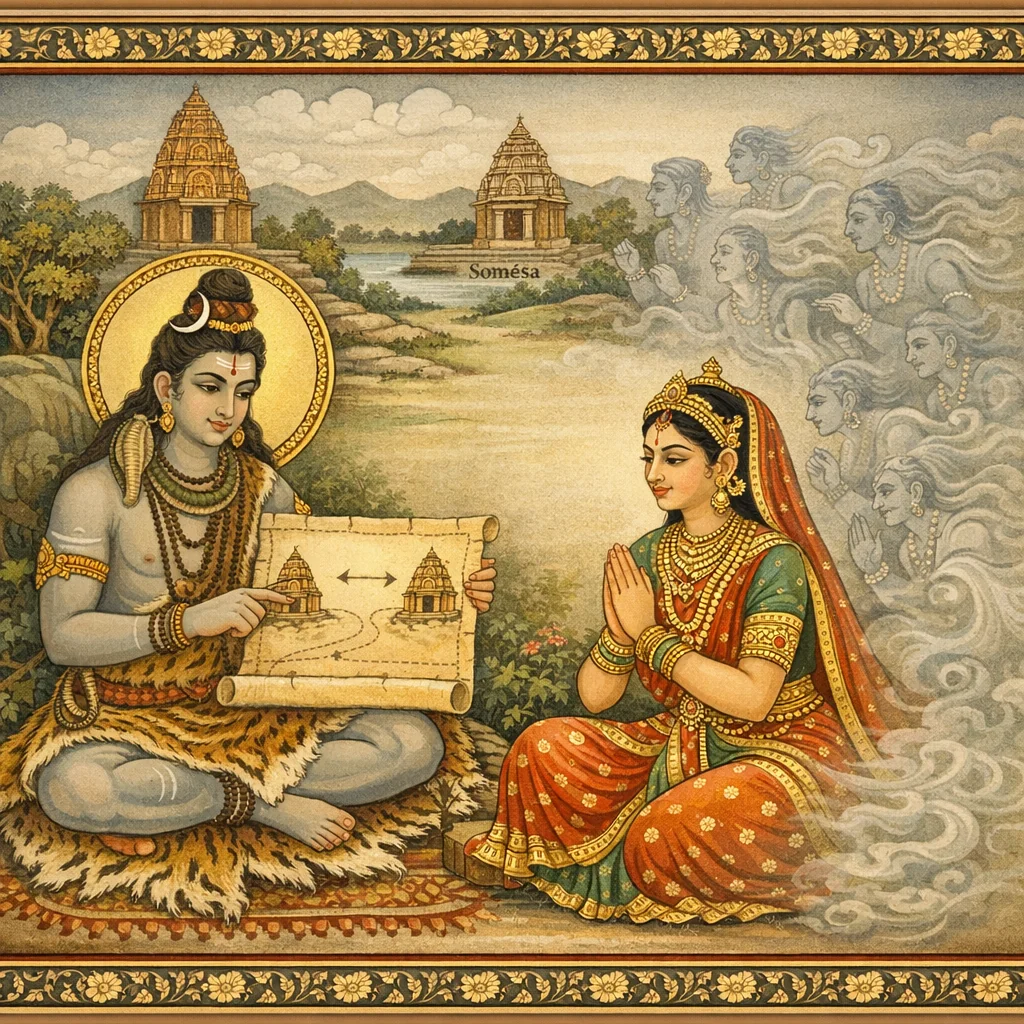
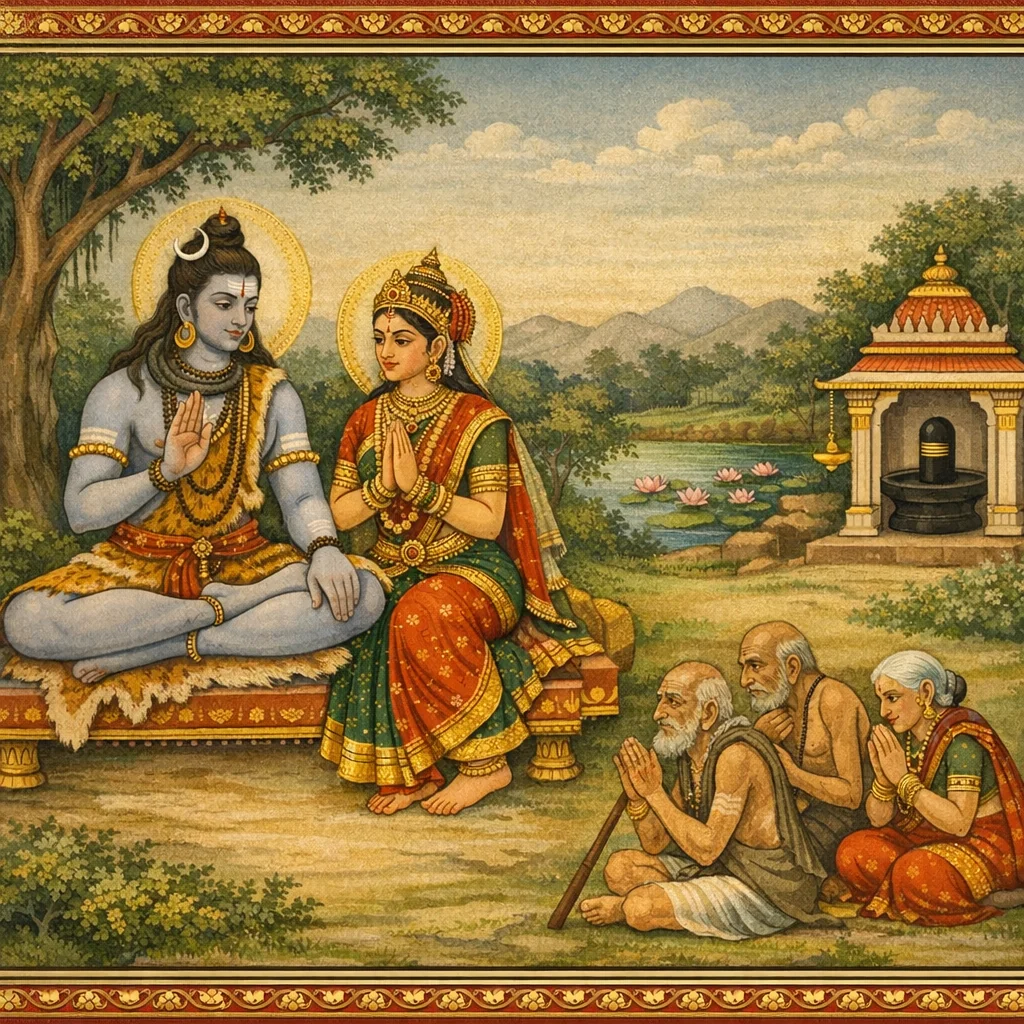
Īśānīśikhara Māhātmya (Glory of the Īśānī Peak)
Pulastya tells King Yayāti of the famed holiness of the great peak called Īśānīśikhara, declaring that mere sight of it frees one from pāpa and bestows auspiciousness through seven births. Asked when and why Devī performed austerities there, Pulastya recounts a divine episode. Fearing cosmic disorder if Śiva’s potency were to fall within Devī’s domain, the devas secretly send Vāyu to request restraint. Śiva, moved by modesty, withdraws; Devī, distressed, utters curses— the devas become deprived of progeny, and Vāyu becomes bodiless—then departs in anger to Arbuda. Indra and the devas seek reconciliation. Śiva explains he acted out of duty for the welfare of the divine world and promises Devī a son from her own body on the fourth day. Devī forms a four-armed Vināyaka from bodily unguent; Śiva animates him, and he becomes the universally worshipped leader to be honored first. The devas proclaim the peak sin-destroying by service and sight; bathing in its sacred waters leads to an immortal station, and Māgha observances (bright third) grant happiness across seven births.
Adhyaya 53
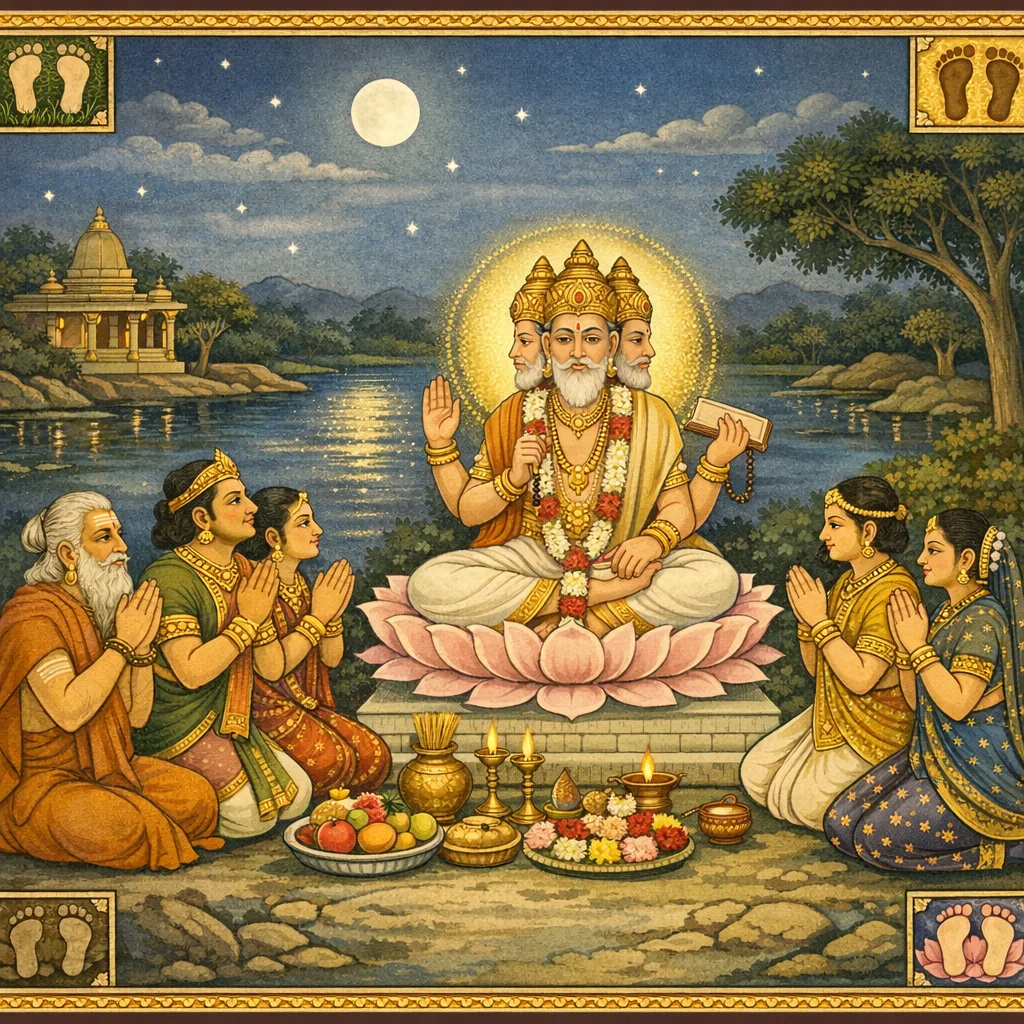
ब्रह्मपदोत्पत्तिमाहात्म्यवर्णनम् / The Māhātmya of the Origin and Power of Brahmā’s Padam (Sacred Mark)
Pulastya recounts the shift to the renowned tīrtha called Brahmapada, praised throughout the three worlds. On Mount Arbuda, during the pilgrimage observances connected with Acaleśvara, devas and purified ṛṣis assemble. Worn out by severe disciplines—rules, homa, vows, baths, fasts, difficult japa, and ritual regimens—the ṛṣis ask Brahmā for a practical upadeśa that can ferry seekers across the “ocean of saṃsāra” and clarify the means of attaining heaven. Brahmā replies with compassion, declaring his own auspicious “padam” a sin-destroying sacred locus. Mere contact with it, or faithful orientation toward it with unwavering śraddhā, leads to a good destiny even without the usual supports of snāna, dāna, vrata, homa, and japa; the one indispensable requirement is steadfast faith. He then prescribes a liturgical observance: on Kārttika Pūrṇimā, worship with water, fruits, fragrances, garlands, and unguents, and afterward feed Brahmins sweet foods according to one’s means—thereby gaining access to Brahmā’s difficult-to-attain world. The chapter closes with a wonder-account: the padam’s color and size are said to vary by yuga—uncountably white in Kṛta, red in Tretā, tawny in Dvāpara, and minute black in Kali—underscoring the site’s temporal and theological symbolism.
Adhyaya 54
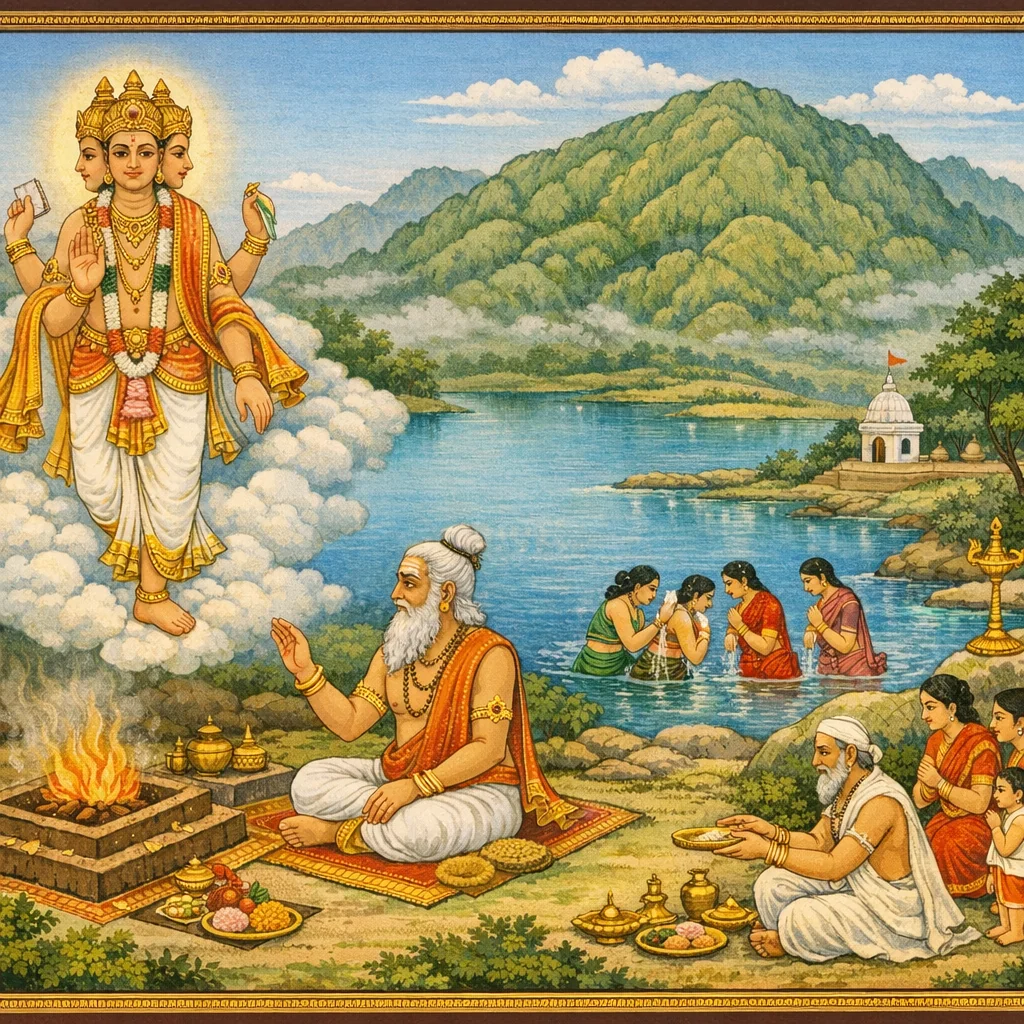
त्रिपुष्करमाहात्म्यवर्णनम् | Tripuṣkara Māhātmya (Glorification of Tripuṣkara)
The chapter recounts Pulastya’s narration of how Tripuṣkara becomes established on Mount Arbuda. Brahmā (Padmayoni) is portrayed as proceeding toward Puṣkara to perform sandhyā worship, in keeping with his vow to honor the sandhyā at Tripuṣkara for as long as he remains in the human world. As Vasiṣṭha’s sacrificial rite (yajña) continues, Vasiṣṭha intervenes, declaring that the proper karmakāla—the due time for the ritual’s fruition—has arrived, and that without Brahmā’s presence the sacrifice cannot be completed. He therefore requests Brahmā to bring Tripuṣkara to the sacrificial ground, perform sandhyā worship there, and then preside as the divine authority over the rite. After contemplation, Brahmā brings the threefold Puṣkara (jyēṣṭha–madhya–kaniṣṭha; the triad of Puṣkara tīrthas) to a highly meritorious water-reservoir on Arbuda; from that point Tripuṣkara is said to abide at Arbuda. The phalaśruti adds that one who, with composure, bathes and gives gifts on the Kārttika full-moon attains enduring worlds; and to the north lies the excellent Sāvitrī-kuṇḍa, where snāna and dāna lead to auspicious attainment.
Adhyaya 55
रुद्रह्रद-माहात्म्यवर्णनम् | Rudrahrada Māhātmya (Glory of the Lake of Rudra)
This chapter records Pulastya’s guidance to a king on going to the auspicious Rudrahrada, a sacred lake whose power is realized through devotional bathing with bhakti. It first identifies the tīrtha and proclaims its transforming promise: one who bathes there with devotion attains the exalted state called gaṇādhiśatva—association with, or even lordship among, Śiva’s gaṇas. An origin account then grounds the rite in divine precedent: after slaying the demon Andhaka, Vṛṣabhadhvaja (Śiva), accompanied by his gaṇas, bathes and establishes a lake that becomes known as Rudrahrada. Finally, the chapter states an observance: bathing on caturdaśī (the fourteenth lunar day) yields merit described as equal to the confluence of all tīrthas. It closes with the colophon naming it the 55th adhyāya of the Arbuda Khaṇḍa within the Prabhāsa Khaṇḍa.
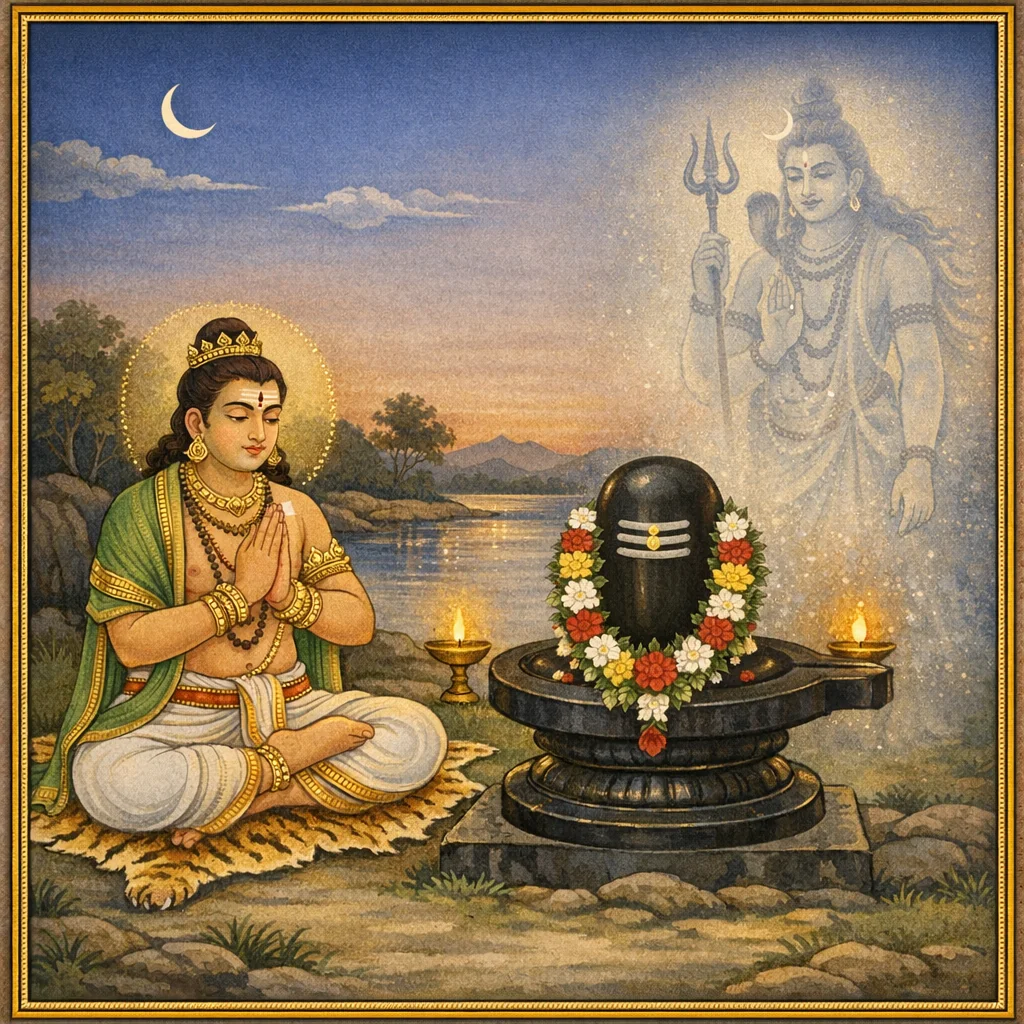
Adhyaya 56
गुहेश्वरमाहात्म्यवर्णनम् | Guhēśvara Māhātmya (Account of the Glory of Guhēśvara)
This chapter records Pulastya’s instruction to a king about the eminent shrine called Guhēśvara. It is described as a liṅga set within a cave (a liṅga in the midst of the cavern) and is authenticated by the statement that siddhas in former times worshipped there. Pulastya then explains the fruits of worship according to intention: one who approaches and venerates the Lord while holding a particular desire attains the corresponding goal, whereas worship performed without desire (niṣkāma) is said to lead toward mokṣa, liberation. The colophon places this as the 56th adhyāya of the Skanda Mahāpurāṇa, in the Prabhāsa Khaṇḍa, Arbuda Khaṇḍa.
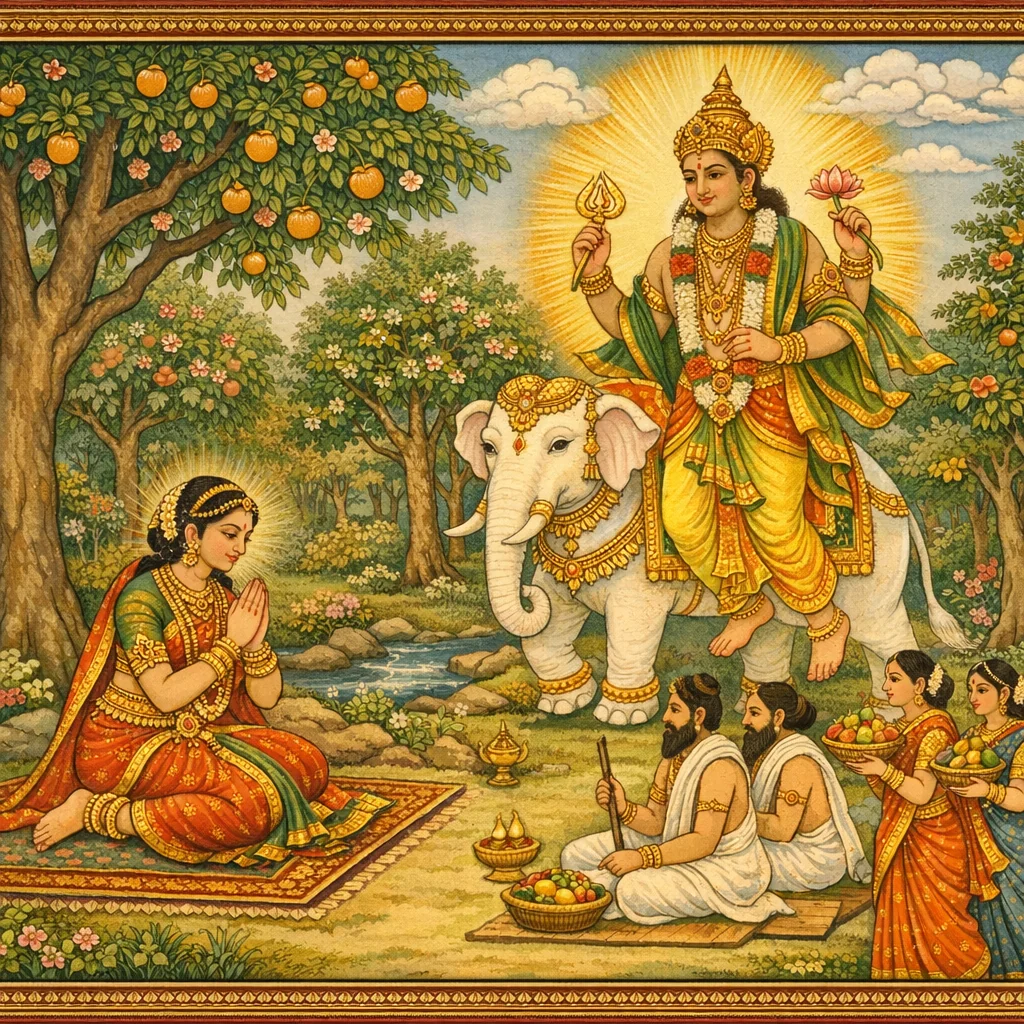
Adhyaya 57
अवियुक्तक्षेत्रमाहात्म्यवर्णनम् | The Māhātmya of the Aviyukta (Non-Separation) Kṣetra
Pulastya instructs a king about a forest called Aviyuktavana, known for a distinctive phala: whoever beholds it or dwells there does not remain separated from what is dear. This claim is supported through an origin-legend explaining the site’s power. After Nahusha seizes Indra’s sovereignty, Śacī, Indra’s consort, enters the forest in grief. By the forest’s inherent potency (tat-prabhāva), Indra (Śatakratu), who had been separated, is restored and returns, and the place becomes renowned as a kṣetra that brings reunion. Śacī then grants a boon to the forest: any man or woman separated from beloved relations who stays there for a single night will regain association (saṅga) and shared dwelling with loved ones. The chapter also praises fruit-giving or fruit-offerings (phaladāna) there, especially for women seeking progeny (vandhyā), who are said to obtain “the fruit of a son” (putra-phala). It concludes with the colophon identifying it as Chapter 57 of the Arbuda Khaṇḍa within the Prabhāsa Khaṇḍa of the Skanda Mahāpurāṇa.
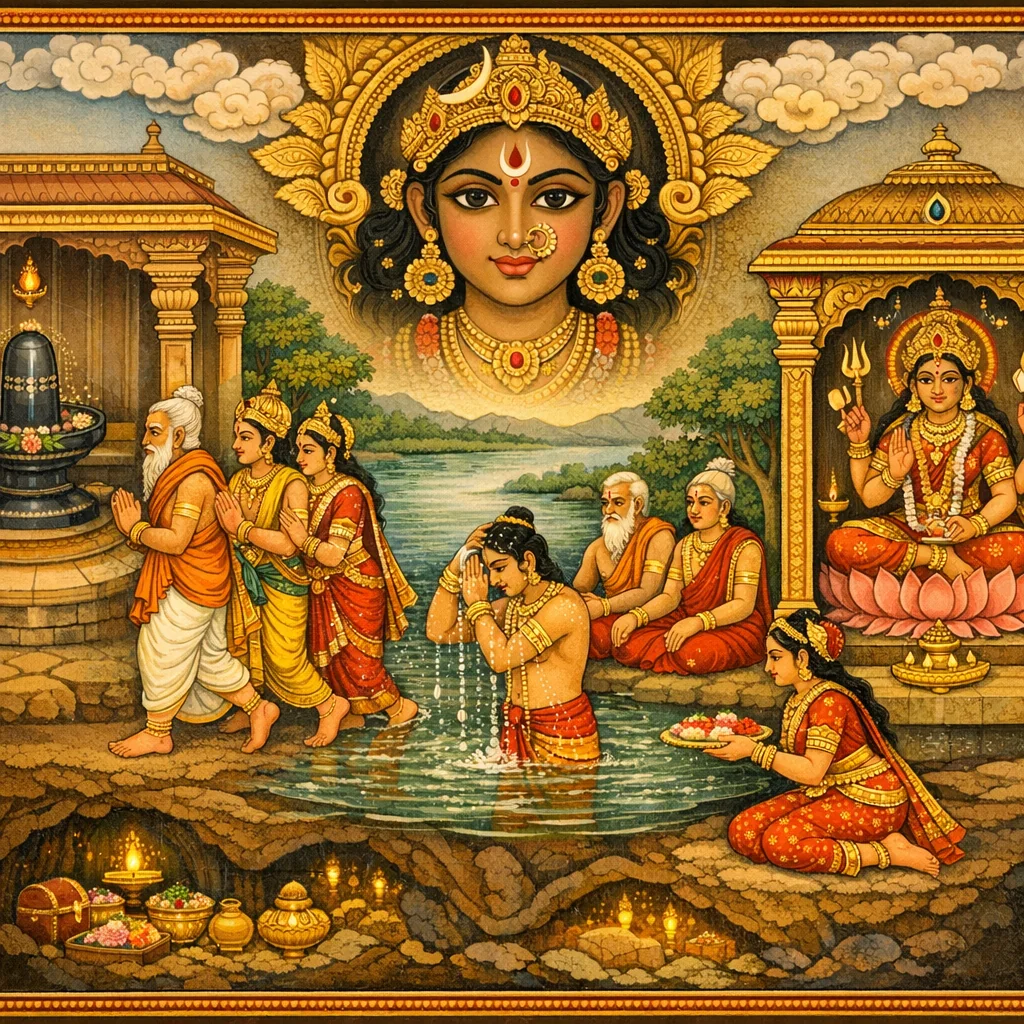
Adhyaya 58
उमामाहेश्वरतीर्थमाहात्म्यवर्णनम् (Glorification of the Umā–Maheśvara Tīrtha)
The chapter is framed as a theological instruction delivered by Pulastya to a royal listener. It points to a particular pilgrimage site, the Umā–Maheśvara Tīrtha, and praises it as supremely bestowing spiritual merit. The site’s establishment is attributed to a devotee named Dhundhumāra, highlighting how bhakti—devotional intention—sanctifies a place. The practical teaching is simple: the pilgrim should go to Umā–Maheśvara and worship the Divine Couple, Umā and Maheśvara, with heartfelt devotion. The phalāśruti promises an auspicious ethical fruit: the worshipper is said to be free from misfortune for seven successive births, linking multi-life wellbeing to disciplined reverence at this tīrtha.
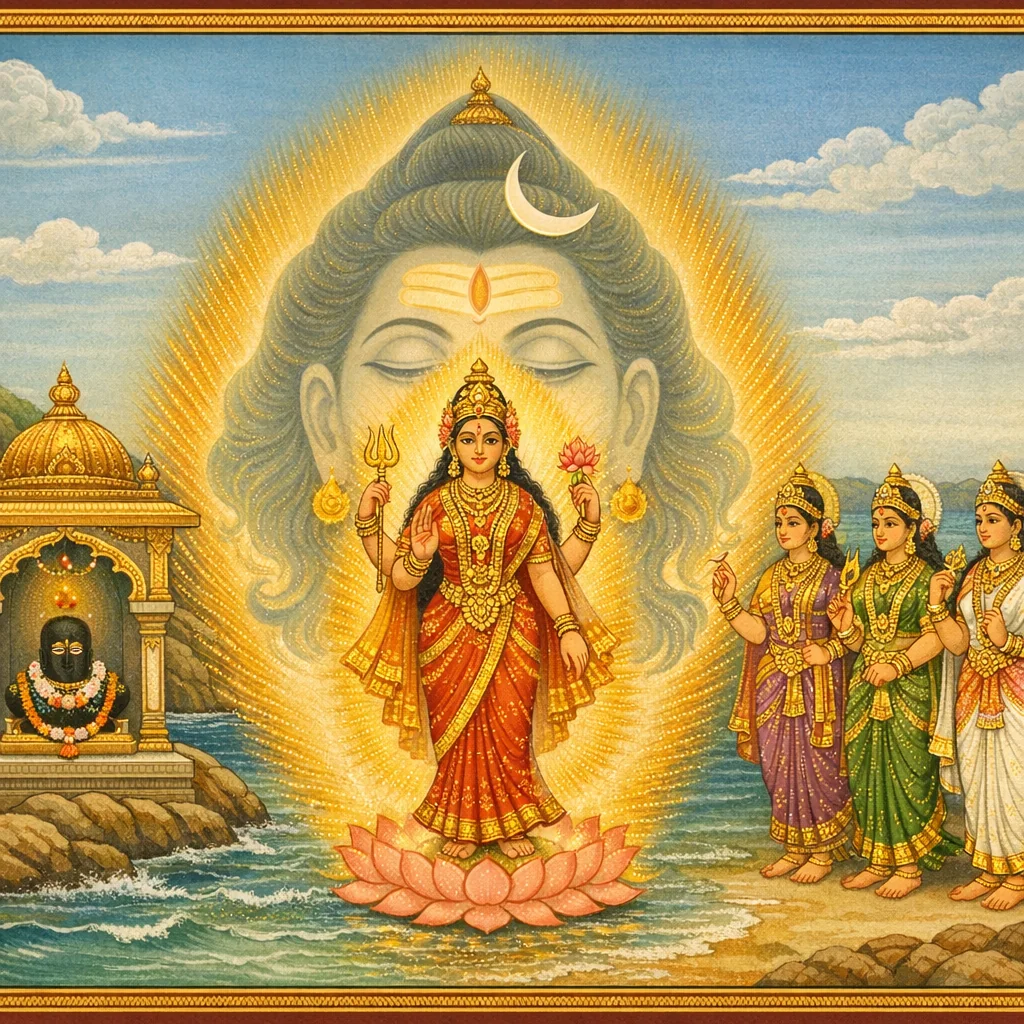
Adhyaya 59
महौजसतीर्थप्रभाववर्णनम् | The Efficacy of Mahaujasa Tīrtha
This adhyāya, narrated by Pulastya, unfolds as a tīrtha-legend. Mahaujasa is praised as a pātaka-nāśana tīrtha: by bathing there one’s tejas—radiant, auspicious potency—is restored. Indra (Śakra), suffering the consequences of brahmahatyā, is shown bereft of śrī and tejas, tainted by a foul odor, and excluded by the gods from social and ritual standing. Seeking renewal, Indra consults Bṛhaspati, who declares that tīrtha-yātrā on earth is the necessary means to regain tejas, for such increase is not attained without a tīrtha. After wandering through many sacred places, Indra reaches Arbuda, beholds a water-reservoir, bathes, and regains mahā-ojas, great vigor. Freed from the odor and welcomed again among the gods, Indra proclaims a time-bound phalaśruti: those who bathe here at Śakra’s “rise”—the end of the bright fortnight of Āśvina—attain the supreme state and are endowed with śrī across births. Thus the chapter tightly links moral injury, ritual remedy, sacred place, and calendrical observance.
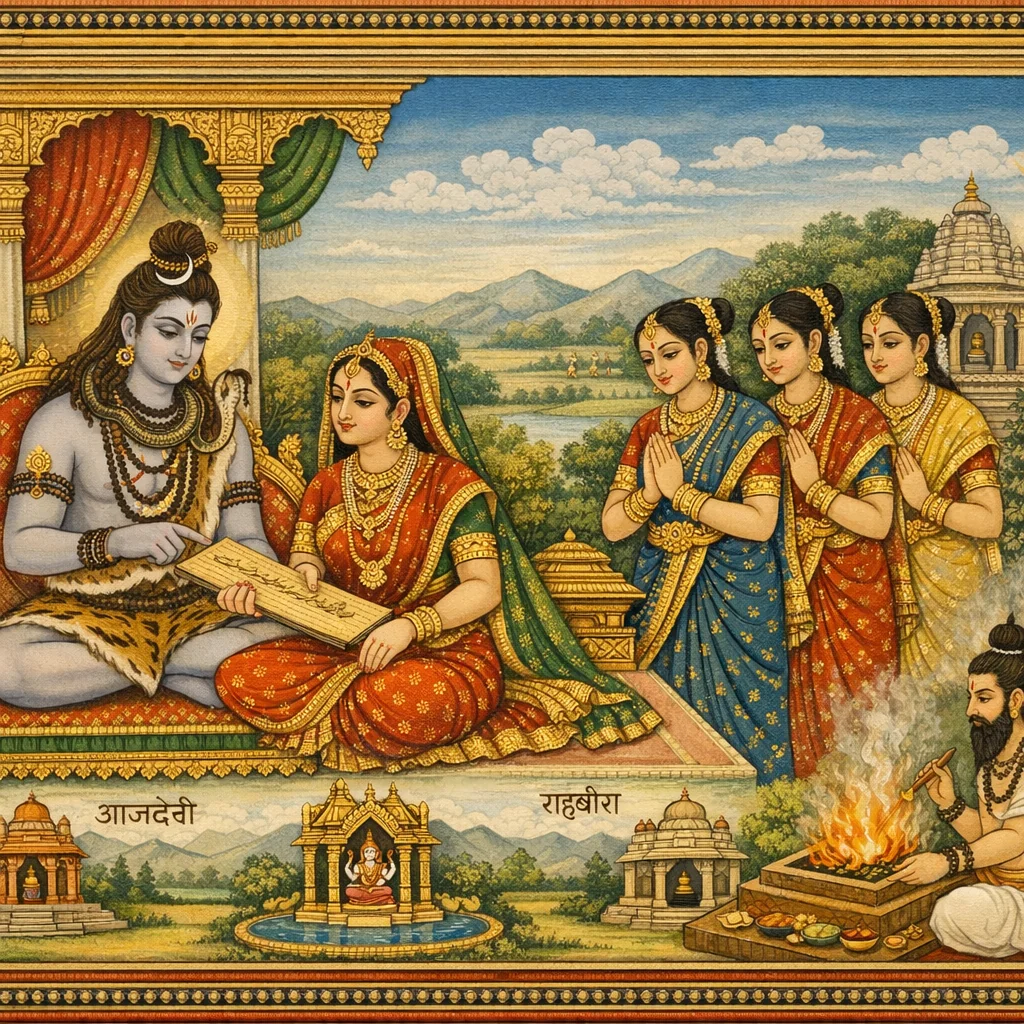
Adhyaya 60
जंबूतीर्थप्रभाववर्णनम् (Description of the Power and Merit of Jambū Tīrtha)
Pulastya instructs the listener to proceed to the unsurpassed Jambū Tīrtha, declaring that bathing there in the proper manner grants the desired fruits. The account then turns to an earlier time: King Nimi of the Sūryavaṃśa, in his old age, goes to Mount Arbuda and undertakes prāyopaveśana (a disciplined fast unto death) with a concentrated mind. Many sages arrive and hold uplifting dharma-discourses on exemplary royal sages, divine sages, and Purāṇic traditions. At the end, the sage Lomaśa recites a full tīrtha-māhātmya. Hearing it, Nimi is troubled with regret that he had not earlier performed extensive tīrtha-bathing, and he asks for a way to obtain the fruit of all tīrthas. Moved by compassion, Lomaśa promises to bring the Jambūdvīpa-origin tīrthas to that very place through mantra-power, and instructs the king to bathe in the now-unified sacred waters. Lomaśa meditates; the tīrthas arrive instantly, and a Jambū tree appears as proof. Nimi bathes in the reservoir of ‘all tīrthas’ and immediately attains heaven with his body; thus the site is remembered as Jambū Tīrtha. It is also said that when the sun is in Kanyā (Virgo), performing śrāddha there yields merit equal to that of Gayāśīrṣa.
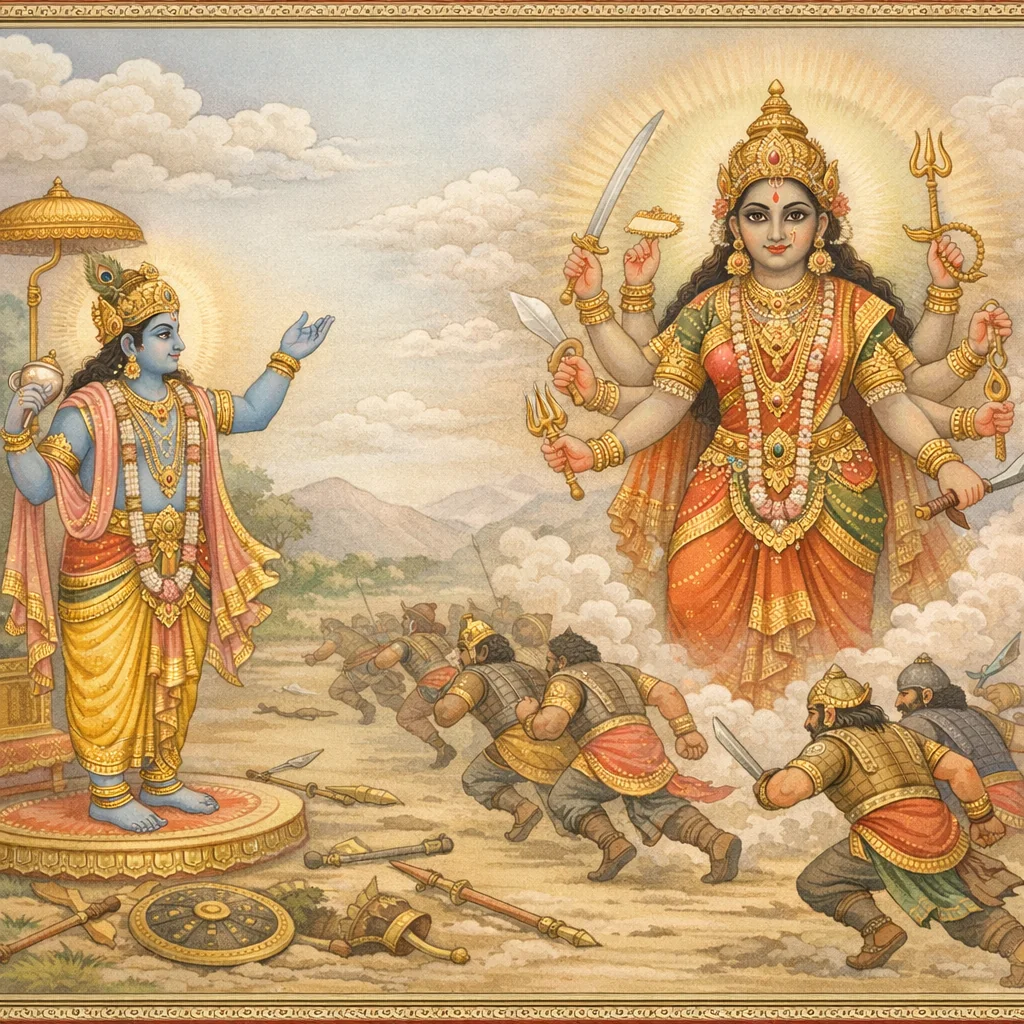
Adhyaya 61
गंगाधरतीर्थमाहात्म्य (Glory of Gaṅgādhara Tīrtha)
This adhyāya records Pulastya’s instruction to a royal listener about a supremely meritorious water-tīrtha named Gaṅgādhara, praised as supuṇya and endowed with “pure waters” (vimala-udaka). Its holiness is grounded in a Śaiva theophany: the deity (spoken of as Hari/Śiva) manifests as Acalēśvara and is lauded as the one who “held” Gaṅgā when she descended from the sky, sanctifying the place through cosmic restraint and grace. The chapter then gives a clear observance: on aṣṭamī, one should bathe (snāna) at this tīrtha with a composed, concentrated mind (samāhita). The promised fruit is exalted—attainment of a supreme state difficult even for the gods—showing how right time, sacred place, and pure intention unite to yield extraordinary spiritual merit.
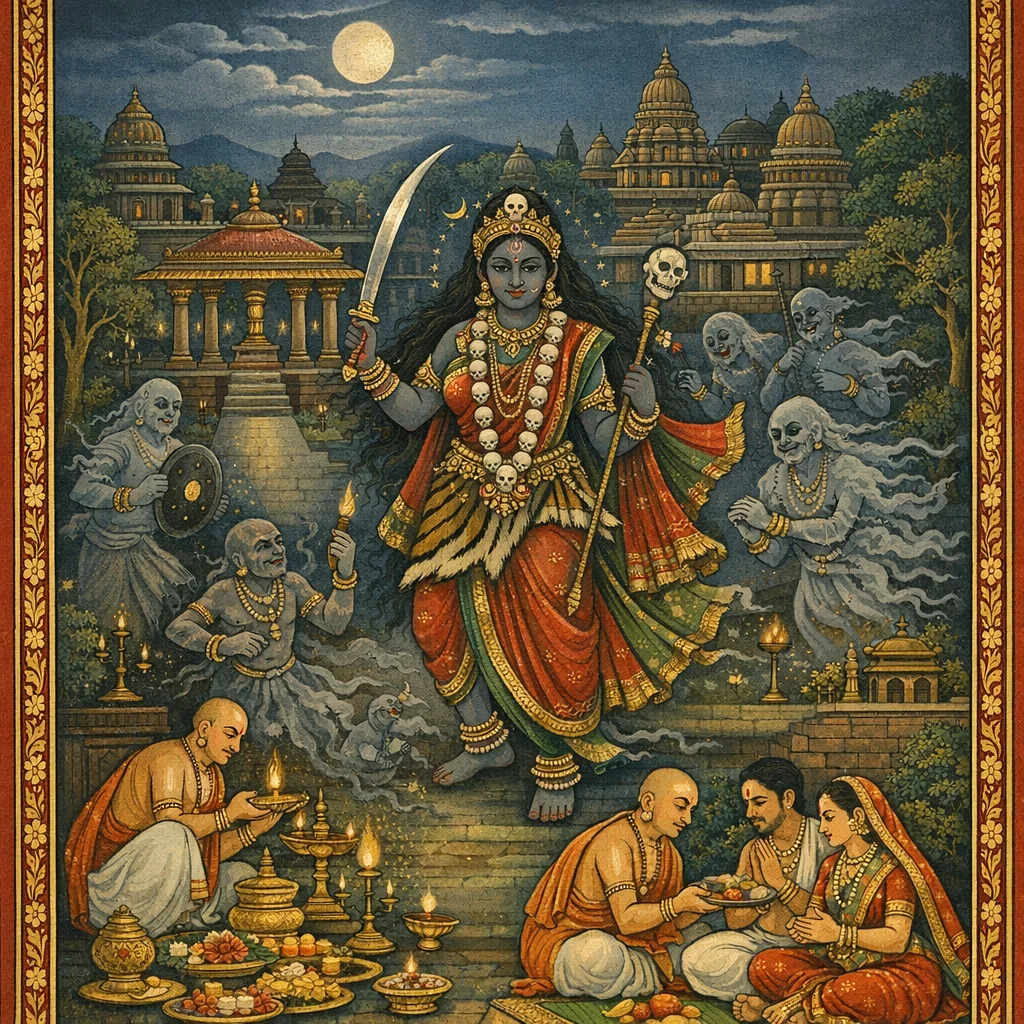
Adhyaya 62
कटेश्वर-गंगेश्वर-माहात्म्यवर्णनम् (Glory of Kāṭeśvara and Gaṅgeśvara)
Pulastya sets forth a pilgrimage sequence that leads the listener to two liṅgas: Kāṭeśvara, said to have been fashioned by Gaurī (Umā), and Gaṅgeśvara, fashioned by the river-goddess Gaṅgā. The narrative is stirred by an earlier dispute between Umā and Gaṅgā concerning saubhāgya—auspicious marital fortune and household blessedness. As Gaṅgā searches for a place to establish a liṅga, Gaurī beholds a lovely mountain formation resembling a liṅga, marked by a ring-like feature (kāṭaka), and worships there with full śraddhā. Mahādeva is pleased, grants darśana, and bestows a boon. Gaurī names the shrine Kāṭeśvara and proclaims its phalāśruti: women distressed by co-wife rivalry or separation are said to be freed from fever and affliction by merely seeing the shrine, gaining well-being and the restoration of auspiciousness in the home. Gaṅgā likewise worships, receives a boon, and establishes Gaṅgeśvara, confirming the paired logic of the holy sites: both liṅgas should be seen. Special emphasis is placed on women seeking relief from “sapatnī-doṣa” and the attainment of sukha and saubhāgya. The chapter closes by affirming these benefits as an enduring devotional incentive within the sacred geography of Arbuda.
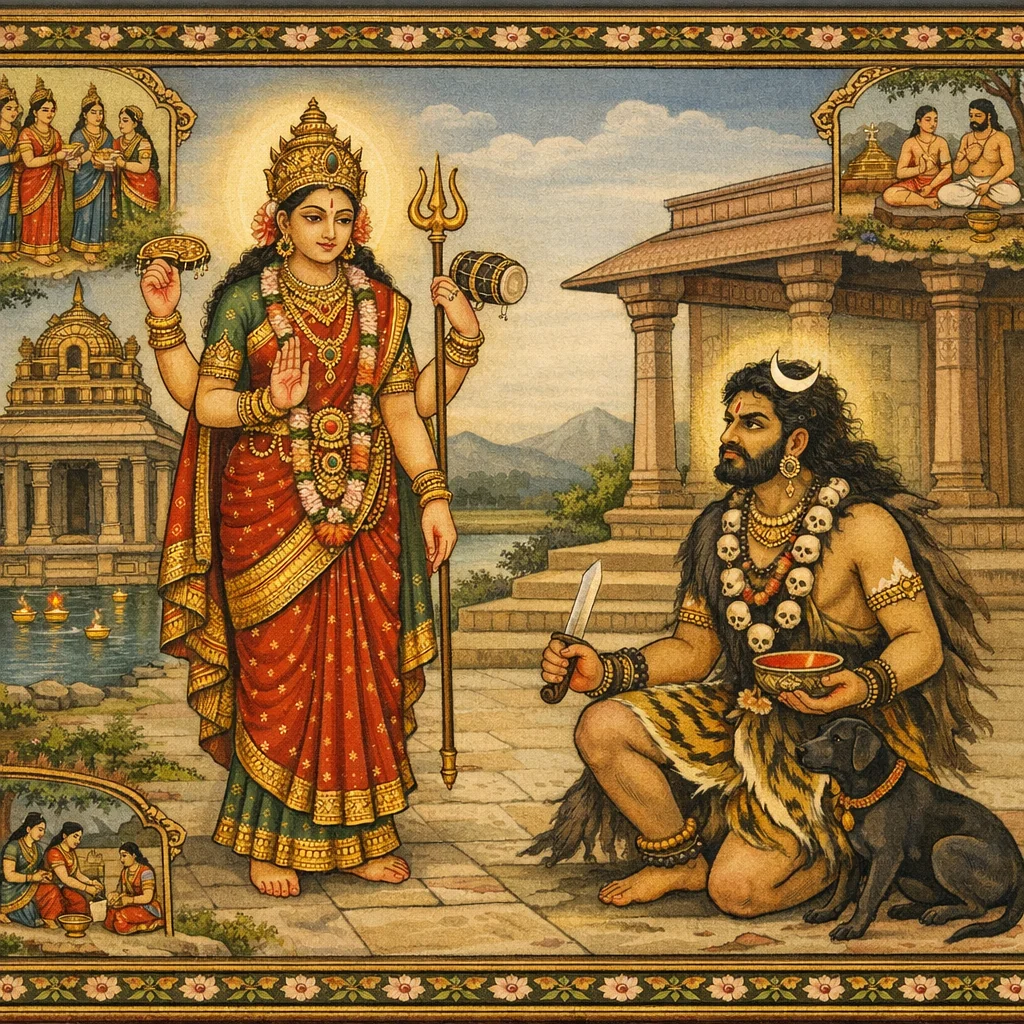
Adhyaya 63
Arbuda-khaṇḍa-māhātmya-phalaśruti-varṇanam (Glory of Arbuda: Fruits of Hearing and Pilgrimage)
Pulastya concludes a compressed account of Arbuda’s greatness, saying that a full enumeration would surpass even centuries of narration because of the innumerable tīrthas and sanctified abodes established by the ṛṣis. The chapter declares that sacrality pervades Arbuda: no tīrtha, siddhi, sacred tree, river, or divine presence is absent there. Those who dwell on the “beautiful Arbuda mountain” are portrayed as bearers of merit, while one who does not behold Arbuda “on all sides” is said to miss the practical worth of life, wealth, and austerity. The saving power is extended beyond humans to all beings—insects, animals, birds, and all creatures of the four modes of birth. Death on Arbuda—whether desireless or even with desire—is proclaimed to lead to Śiva-sāyujya, union with Śiva, free from aging and death. Finally, the phalaśruti teaches that daily, faithful hearing of this purāṇic account grants the fruit of pilgrimage; therefore one should undertake the journey to Arbuda to attain siddhi in this world and the next.
FAQs about Arbudha Khanda
Arbuda is portrayed as exceptionally purificatory—capable of removing sin even through mere sight (darśana)—and as sanctified through Vasiṣṭha’s ascetic power and presence.
Merits are framed in terms of pāpa-kṣaya (sin-diminution), tīrtha-snāna/dāna efficacy, and the heightened salvific value of approaching the mountain and its associated sacred sites with disciplined conduct.
A Vasiṣṭha-centered narrative provides the anchor: an episode involving the rescue of the wish-fulfilling cow Nandinī and the ritual-theological creation or transformation of a landscape feature through invoked sacred waters and mountain agency.