Adhyaya 21
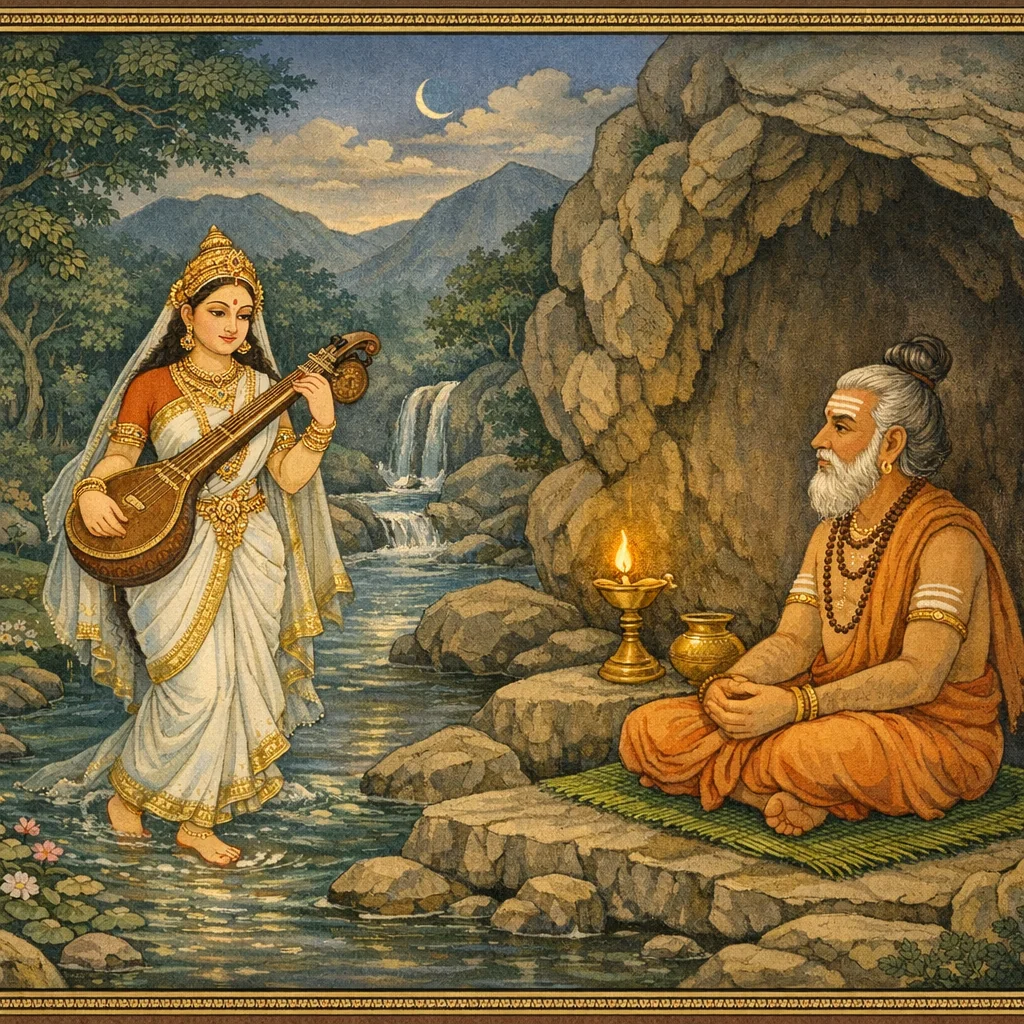
Pulastya delivers a place-centered theological account proclaiming the māhātmya of Piṇḍodaka Tīrtha. A Brahmin named Piṇḍodaka, slow to learn and unable to complete his studies despite instruction, is seized by intense dispassion and withdraws to a mountain cave. Shamed before his teacher, he falls into despair and even seeks death, for speech and learning do not arise within him. In that secluded spot the goddess Sarasvatī appears and asks the cause of his sorrow. Revealing herself as dwelling on the auspicious mountain, she offers a boon and marks the time: on the thirteenth lunar day (trayodaśī) at nightfall (niśāmukha). Piṇḍodaka prays for sarvajñatva (omniscience) and that the tīrtha be famed by his name. Sarasvatī grants both, declaring that whoever bathes there at the appointed time will attain omniscience even if dull-witted, and affirming her continual presence. She vanishes; Piṇḍodaka becomes all-knowing, returns home, amazes the people, and thus spreads the renown of the tīrtha’s power.
Shlokas
Verse 1
पुलस्त्य उवाच । ततो गच्छेन्नृपश्रेष्ठ पिण्डोदकमनुत्तमम् । तीर्थं यत्र तपस्तप्तं पिण्डोदकद्विजातिना
Pulastya said: “Then, O best of kings, one should go to the unsurpassed Piṇḍodaka (tīrtha)—the sacred place where austerity was performed by the twice-born named Piṇḍodaka.”
Verse 2
पुरा पिण्डोदकोनाम ब्राह्मणोऽभून्महामते । मन्दप्रज्ञोऽल्पमेधावी सोपाध्यायेन पाठितः
Long ago, O wise one, there lived a brāhmaṇa named Piṇḍodaka. Dull of mind and scant of intellect, he was taught his lessons by his preceptor.
Verse 3
अशक्तोऽध्ययनं कर्तुं जाड्यभावान्महीपते । स वैराग्यं परं गत्वा संप्राप्तो गिरिगह्वरे
O king, unable to pursue study because of his dullness, he attained profound dispassion (vairāgya) and came to a cave within the mountain, seeking solitude for practice.
Verse 4
एतस्मिन्नेव कालेतु तत्रैव च सरस्वती । वीणाविनोदसंयुक्ता विविक्ते तमुपस्थिता
At that very time, in that very place, the goddess Sarasvatī—delighting in the play of her vīṇā—approached him in a secluded spot.
Verse 5
तं दृष्ट्वा ब्राह्मणं खिन्नं वैराग्येण समन्वितम् । कृपाविष्टा महादेवी वाक्यमेतदुवाच ह
Seeing that brāhmaṇa dejected and filled with dispassion, the great goddess, moved by compassion, spoke these words.
Verse 6
सरस्वत्युवाच । कस्मात्त्वं खिद्यसे विप्र विरक्त इव भाससे । कस्मान्न हृष्यसि हृदा कस्मादत्र त्वमागतः । वद शीघ्रं महाभाग तवांतिके वसाम्यहम्
Sarasvatī said: “Why do you grieve, O vipra? Why do you appear as though detached from all things? Why does your heart not rejoice? Why have you come here? Speak quickly, O fortunate one—for I dwell close by you.”
Verse 7
पिण्डोदक उवाच । अहं वैराग्यमापन्न उपाध्यायतिरस्कृतः । ज्ञानहीनो महाभागे मृत्युं वांछामि सांप्रतम्
Piṇḍodaka said: “I have fallen into dispassion; I have been slighted by my teacher. Devoid of true knowledge, O great lady, I now desire death.”
Verse 9
न मे सरस्वती देवी जिह्वाग्रे परिवर्तते । कारणं नान्यदस्तीह मृत्योर्मम वरानने । दृष्टोऽकस्मात्त्वया चाहं ततो यास्यामि चान्यतः । मरणं हि मम श्रेयो मूकभावान्न जीवितम्
“For me, the goddess Sarasvatī does not move upon the tip of my tongue. There is no other cause here for my longing for death, O fair-faced one. I have been seen by you unexpectedly—therefore I shall go elsewhere. For death is better for me than living in a state of muteness.”
Verse 10
सरस्वत्युवाच । अहं सरस्वती देवी सदास्मिन्वरपर्वते । निशासुखे त्रयोदश्यां करोमि वसतिं द्विज । तस्मात्त्वं प्रार्थय वरं यदभीष्टं सुदुर्लभम्
Sarasvatī said: “I am the goddess Sarasvatī. I ever dwell upon this excellent mountain. On the thirteenth lunar day, at the pleasing onset of night, I make my abode here, O twice-born. Therefore ask of me a boon—whatever you desire, even if it is very difficult to obtain.”
Verse 11
पिण्डोदक उवाच । प्रसादात्तव वै वाणि सर्वज्ञत्वं ममेप्सितम् । एतत्तीर्थं तु मन्नाम्ना ख्यातिं यातु शुचिस्मिते
Piṇḍodaka said: “By your grace, O Vāṇī, goddess of speech, I desire omniscience. And may this sacred tīrtha become renowned by my name, O you of pure smile.”
Verse 12
सरस्वत्युवाच । अद्यप्रभृति सर्वज्ञो ह्यत्र लोके भविष्यसि । नाम्ना तव तथा तीर्थमेतत्ख्यातिं प्रयास्यति
Sarasvatī said: “From today onward you shall indeed be all-knowing in this world; and this tīrtha too shall attain renown by your name.”
Verse 13
निशामुखे त्रयोदश्यां योऽत्र स्नानं करिष्यति । भविष्यति स सर्वज्ञो यद्यपि स्यात्सुमन्दधीः
Whoever bathes here at the onset of night on the thirteenth lunar day shall become all-knowing, even if he was of very dull understanding.
Verse 14
अत्र मे सततं वासो भविष्यति द्विजोत्तम । यस्मात्तस्मात्सदा स्नानं कर्तव्यं सुसमाहितैः
“Here shall be my continual abode, O best of brāhmaṇas. Therefore, those who are well-composed and attentive should always perform bathing here.”
Verse 15
एवमुक्त्वा ततो देवी तत्रैवांतरधीयत । पिण्डोदको हि सर्वज्ञो भूत्वाथ स्वगृहं ययौ । व्यस्मापयज्जनान्सर्वांस्तत्तीर्थस्य समाश्रयात्
Having spoken thus, the Goddess vanished from that very spot. Then Piṇḍodaka, becoming all-knowing, returned to his own home; and by taking refuge in that sacred tīrtha, he caused all people to marvel at its power and glory.
Verse 21
इति श्रीस्कांदे महापुराण एकाशीति साहस्र्यां संहितायां सप्तमे प्रभासखण्डे तृतीयेऽर्बुदखण्डे पिण्डोदकतीर्थमाहात्म्यवर्णनंनामैकविंशोऽध्यायः
Thus, in the holy Skanda Mahāpurāṇa—within the Ekāśīti-sāhasrī Saṃhitā, in the seventh division called the Prabhāsa-khaṇḍa, and in the third subdivision called the Arbuda-khaṇḍa—ends the twenty-first chapter, entitled “The Description of the Glory of Piṇḍodaka-tīrtha.”