Adhyaya 49
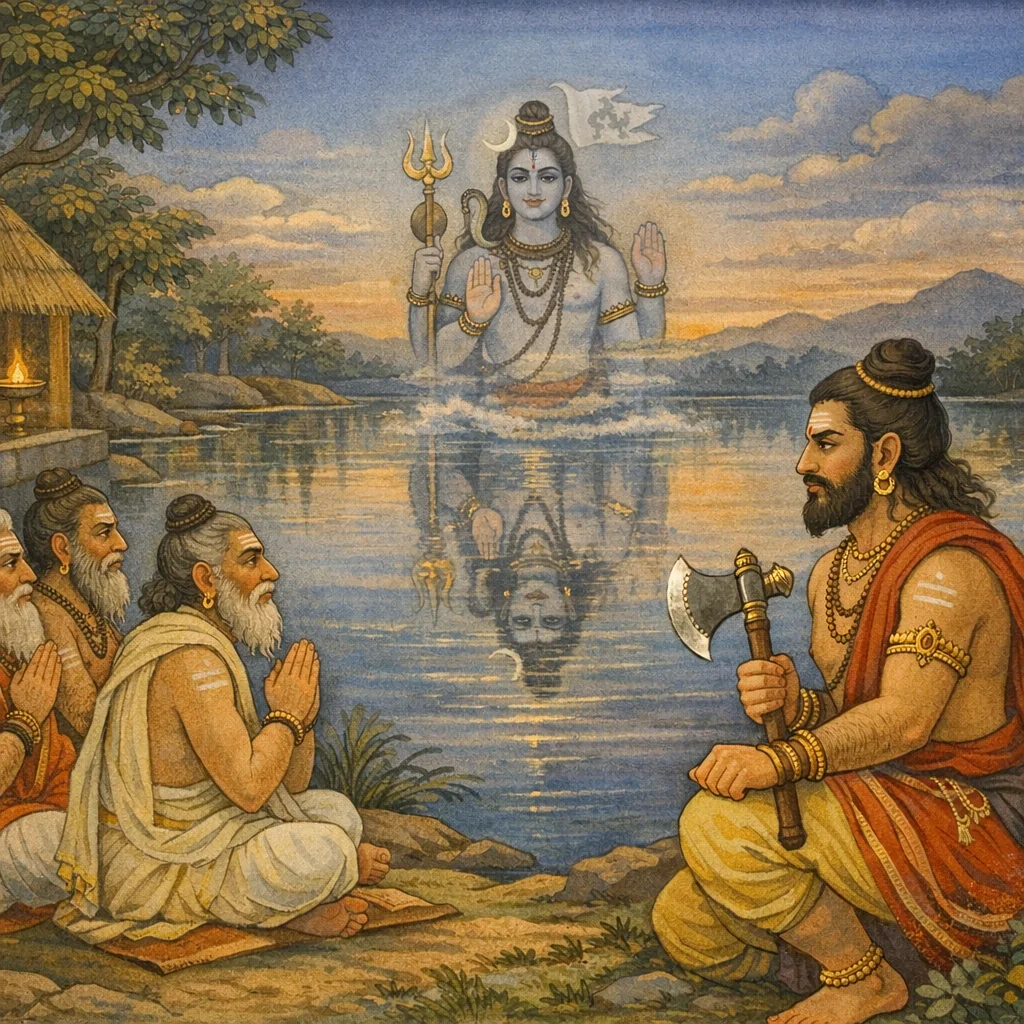
Pulastya describes the pilgrimage toward Rāmatīrtha, a sacred site frequented by ṛṣis, where bathing is said to bring about pāpa-saṅkṣaya, the wasting away of sins. The chapter then turns back to an origin-legend: Bhārgava Rāma (Paraśurāma), warrior and ascetic, undertakes prolonged tapas to diminish his enemies. After three hundred years Mahādeva, pleased, grants a boon and bestows the supreme Pāśupata weapon, whose power is said to work even through mere remembrance, bringing “enemy-destruction.” He further declares that the connected reservoir will be famed as Rāmatīrtha throughout the three worlds by divine favor. A calendrical and ritual instruction follows: on the Kārttika full-moon (pūrṇimā), when Kṛttikā-yoga is present, focused performance of śrāddha at this place yields complete fruit for the pitṛs (ancestors), and is also linked with enemy-diminution and lasting heavenly residence. The narrative closes with Mahādeva’s disappearance and Paraśurāma’s ensuing acts—grief for Jamadagni’s death, tarpaṇa “three times seven,” and an oath that frames his conflict with the kṣatriyas—ending in the practical directive to perform śrāddha here with earnest effort, especially for kṣatriyas seeking that result.
Shlokas
Verse 1
पुलस्त्य उवाच । रामतीर्थं ततो गच्छेत्पुण्यमृषिनिषेवितम् । तत्र स्नातस्य मर्त्त्यस्य जायते पापसंक्षयः
Pulastya said: Thereafter one should go to Rāma-tīrtha, a holy place frequented by the ṛṣis. For the mortal who bathes there, the destruction of sins comes to be.
Verse 2
पितॄणां च परा तुष्टिर्यावदाभूतसंप्लवम् । पुरासीद्भार्गवो रामः सर्वशस्त्रभृतां वरः
And there is supreme satisfaction for the Ancestors (Pitṛs), lasting until the end of the age. In former times there was Bhārgava Rāma, the foremost among all who bear weapons.
Verse 3
तेन पूर्वं तपस्तप्तं शत्रूणामिच्छता क्षयम् । ततः पाशुपतं नाम तस्यास्त्रं परमं ददौ
Formerly, desiring the destruction of enemies, he performed austerities. Then (Mahādeva) granted him the supreme weapon called the Pāśupata.
Verse 4
तपस्तुष्टो महादेवो गते वर्षशतत्रये । अब्रवीद्वरदोऽस्मीति स वव्रे शत्रुसंक्षयम्
Pleased by his austerities, Mahādeva—when three hundred years had passed—said, “I am the giver of boons.” And he chose the destruction of enemies.
Verse 5
ततः पाशुपतं नाम तस्यास्त्रं परमं ददौ । स्मरणेनापि शत्रूणां यस्य संजायते क्षयः
Then he granted him the supreme weapon called the Pāśupata—by the mere remembrance of which the enemies’ destruction comes to pass.
Verse 6
अब्रवीद्वचनं चापि प्रहस्य वृषभध्वजः । जामदग्न्य महाबाहो शृणु मे परमं वचः
Smiling, the Bull-bannered Lord (Śiva) spoke these words: “O mighty-armed son of Jamadagni, listen to my supreme utterance.”
Verse 7
अस्त्रेणानेन युक्तस्त्वमजेयः सर्वदेहिनाम् । भविष्यसि न संदेहो मत्प्रसादाद्भृगूद्वह
“Armed with this weapon, you will be unconquerable by all embodied beings—of this there is no doubt—through my grace, O foremost of the Bhṛgus.”
Verse 8
एतज्जलाशयं पुण्यं त्रैलोक्ये सचराचरे । रामतीर्थमिति ख्यातं मत्प्रसादाद्भविष्यति
“This sacred water-reservoir will become renowned throughout the three worlds, with all that moves and does not move, as ‘Rāmatīrtha’—by my grace.”
Verse 9
येऽत्र श्राद्धं करिष्यंति पौर्णमास्यां समाहिताः । संप्राप्ते कार्त्तिके मासि कृत्तिकायोगसंयुते
Those who, with a concentrated mind, will perform śrāddha here on the Full-moon day, when the month of Kārttika has arrived and is joined with the Kṛttikā-yoga—
Verse 10
पितृमेधफलं तेषामशेषं च भविष्यति । तथा शत्रुक्षयो राजन्वासः स्वर्गेषु चाक्षयः
For them, the full and undiminished fruit of the pitṛ-sacrificial rites will arise; likewise, O king, there will be the destruction of enemies and imperishable residence in the heavenly worlds.
Verse 11
पुलस्त्य उवाच । एवमुक्त्वा महादेवस्ततश्चादर्शनं गतः । रामोऽप्यसूदयत्क्षत्रं पितृदुःखेन दुःखितः
Pulastya said: “Having spoken thus, Mahādeva then disappeared from sight. And Rāma (Paraśurāma), afflicted by sorrow for his father, went on to destroy the kṣatriya power.”
Verse 12
त्रिःसप्त तर्पयामास पितॄंस्तत्र प्रहर्षितः । जमदग्नौ मृते तेन प्रतिज्ञातं महात्मना
There, rejoicing, he satisfied the ancestors with libations (tarpana) twenty-one times. When Jamadagni had been slain, that great-souled one had made a vow.
Verse 13
दृष्ट्वा मातुः क्षतान्यंगे त्रिःसप्त मनुजाधिप । शस्त्रजातानि विप्राणां समाजे समुपस्थिते
O lord of men, after seeing wounds upon his mother’s body, he resolved upon “three times seven”; and amid the assembly of brāhmaṇas, weapons were gathered and made ready.
Verse 14
पिता मे निहतो यस्मात्क्षत्रियैस्तापसो द्विजः । अयुध्यमान एवाथ तस्मात्कृत्वा त्रिसप्त वै
Because my father—an ascetic brāhmaṇa—was slain by kṣatriyas while he was not even fighting, therefore I shall indeed carry out the “three times seven.”
Verse 15
क्षत्त्रहीनामहं पृथ्वीं प्रदास्ये सलिलं पितुः । तत्सर्वं तस्य संजातं तीर्थमाहात्म्यतो नृप
I shall make the earth bereft of kṣatriyas and offer water (tarpana) to my father. O king, all of that became effective through the greatness of the tīrtha.
Verse 16
तस्मात्सर्वं प्रयत्नेन श्राद्धं तत्र समाचरेत् । क्षत्रियश्च विशेषेण य इच्छेच्छत्रुसंक्षयम्
Therefore, with every effort one should perform the śrāddha rites there. And especially a kṣatriya—if he desires the destruction of enemies—should undertake it at that sacred place.
Verse 49
इति श्रीस्कांदे महापुराण एकाशीतिसाहस्र्यां संहितायां सप्तमे प्रभासखंडे तृतीयेऽर्बुदखंडे रामतीर्थमाहात्म्यवर्णनंनामैकोनपंचाशत्तमोऽध्यायः
Thus, in the venerable Skanda Mahāpurāṇa—within the Saṃhitā of eighty-one thousand verses—in the seventh, the Prabhāsa Khaṇḍa, and in its third subdivision, the Arbuda Khaṇḍa, ends the forty-ninth chapter entitled “The Glorification of Rāma-tīrtha.”