Adhyaya 47
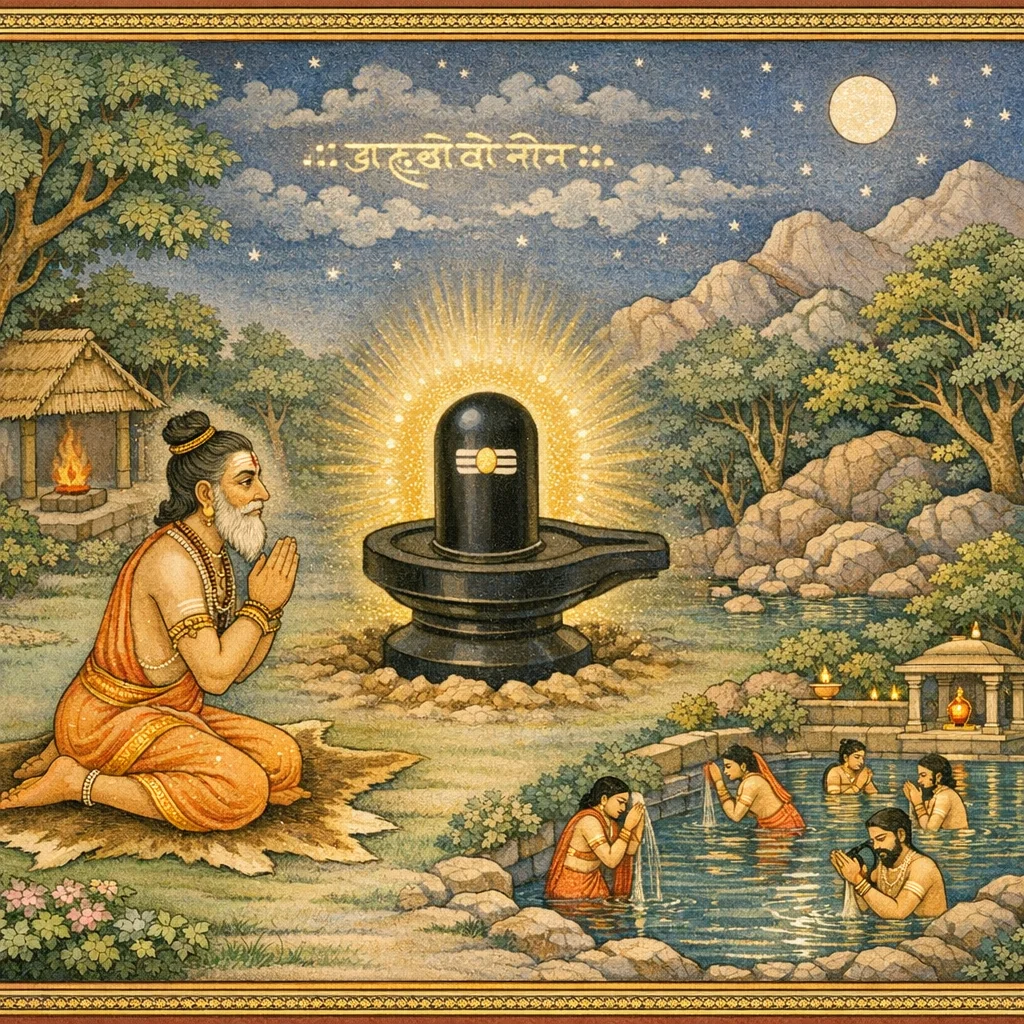
Pulastya instructs the king to go to the renowned Gautama Āśrama, a sanctified hermitage where the sage Gautama once performed austerities. Gautama, a muni of exceptional righteousness, worshipped Mahādeva with devoted bhakti; in response, a mighty liṅga burst forth by piercing the earth, revealing Śiva’s localized presence there. An incorporeal heavenly voice (ākāśavāṇī) commands that the liṅga be worshipped and invites a boon. Gautama asks that Śiva remain ever near the āśrama and that devotees receive saving grace: whoever beholds Śiva there with sincere devotion is said to attain Brahmaloka. A further rule of sacred time is given—one who has darśana of the deity on the dark-fortnight caturdaśī (14th lunar day) in Māgha gains the highest goal (parā gati). The chapter then lists nearby ritual supports and their merits: a sacred water-reservoir (kuṇḍa) whose bath uplifts one’s lineage; śrāddha performed there, especially at indusaṃkṣaya (a lunar conjunction/waning moment, possibly eclipse-related), equals the merit of Gayā-śrāddha; and sesame-gifts (tila-dāna) grant prolonged heavenly residence in proportion to the number of seeds. It also compares these fruits with famed pilgrimages—such as bathing in the Godāvarī during Jupiter’s Siṃhastha—placing this tīrtha within a wider calendar and economy of sacred merit.
Shlokas
Verse 1
पुलस्त्य उवाच । ततो गच्छेन्नृपश्रेष्ठ सुपूर्णं गौतमाश्रमम् । यत्र पूर्वं तपस्तप्तं गौतमेन महात्मना
Pulastya said: “Then, O best of kings, go to the well-endowed hermitage of Gautama—where in former times the great-souled sage Gautama performed austerities.”
Verse 2
पुराऽसीद्गौतमो नाम मुनिः परमधार्मिकः । स भक्त्याऽराधयामास देवदेवं महेश्वरम्
In ancient times there was a sage named Gautama, supremely righteous. With devotion he worshipped Maheśvara, the God of gods.
Verse 3
भक्त्याऽराधयमानस्य निर्भिद्य धरणीतलम् । समुत्तस्थौ महल्लिंगं परं माहेश्वरं नृप
As he worshipped with devotion, the surface of the earth split open, and a great Liṅga—supreme and belonging to Maheśvara—rose up, O king.
Verse 4
एतस्मिन्नेव काले तु वागुवाचाशरीरिणी । पूजयैतन्महल्लिंगं त्वद्भक्त्या समुपस्थितम् । वरं वरय भद्रं ते यत्ते मनसि वर्तते
At that very moment, an incorporeal voice spoke: “Worship this great Liṅga that has appeared through your devotion. Choose a boon—may auspiciousness be yours—whatever rests in your mind.”
Verse 5
गौतम उवाच । अत्राश्रमपदे देव त्वया शम्भो जगत्पते । सदा कार्यं हि सान्निध्यं यदि तुष्टो मम प्रभो
Gautama said: “O God—O Śambhu, Lord of the world—if you are pleased with me, then let your constant presence be established here at this hermitage-site.”
Verse 6
यस्त्वां पश्यति सद्भक्त्या ब्रह्मलोकं स गच्छतु
“Whoever beholds you with true devotion—let him attain Brahmaloka.”
Verse 7
आकाशवाण्युवाच । माघमासे चतुर्द्दश्यां योऽत्र मां वीक्षयिष्यति । कृष्णायां ब्राह्मणश्रेष्ठ स यास्यति परां गतिम्
The heavenly voice said: “In the month of Māgha, on the fourteenth lunar day of the dark fortnight, whoever beholds me here—O best of brāhmaṇas—shall attain the supreme state.”
Verse 8
एवमुक्त्वा ततो वाणी विरराम महीपते । तत्रास्ति कुण्डमपरं पवित्रं जलपूरितम् । तत्र स्नातो नरः सद्यः कुलं तारयतेऽखिलम्
Having spoken thus, the voice fell silent, O king. There too is another sacred pool, filled with pure water. A man who bathes there at once delivers his entire lineage.
Verse 9
यस्तत्र कुरुते श्राद्धं विशेषादिन्दुसंक्षये । गयाश्राद्धफलं तस्य सकलं जायते ध्रुवम्
Whoever performs śrāddha there—especially at the waning of the moon, on the amāvasyā (new-moon day)—surely attains in full the fruit of the śrāddha performed at Gayā.
Verse 10
तत्र दानं प्रशंसंति तिलानां मुनिपुंगवाः । तिलसंख्यानि वर्षाणि दानात्स्वर्गे वसेन्नृप
There the foremost sages praise the gifting of sesame seeds. By that charity, O king, one dwells in heaven for as many years as the number of sesame seeds given.
Verse 11
अर्बुदे गौतमी यात्रा सिंहस्थे च बृहस्पतौ । अमायां सोमवारेण द्विषड्गोदावरीफलम्
In Arbuda, the pilgrimage to the Gautamī (Godāvarī) when Bṛhaspati (Jupiter) is in Leo (Siṃhastha)—if undertaken on the amāvasyā (new-moon day) that falls on a Monday—yields merit equal to the fruit of bathing in the Godāvarī six times.
Verse 12
षष्टिवर्षसहस्राणि भागीरथ्यवगाहने । सकृद्गोदावरीस्नानात्सिंहस्थे च बृहस्पतौ
Immersion in the Bhāgīrathī (the Gaṅgā) for sixty thousand years—such, it is said, is the merit that arises from a single bath in the Godāvarī when Bṛhaspati (Jupiter) is in Leo (Siṃhastha).
Verse 47
इति श्रीस्कान्दे महापुराण एकाशातिसाहस्र्यां संहितायां सप्तमे प्रभासखण्डे तृतीयेऽर्बुदखण्डे गौतमाश्रमतीर्थमाहात्म्यवर्णनंनाम सप्तचत्वारिंशोऽध्यायः
Thus ends the forty-seventh chapter, called “The Description of the Greatness of the Gautamāśrama Tīrtha,” in the Arbuda Khaṇḍa—the third subdivision—within the seventh, the Prabhāsa Khaṇḍa, of the venerable Skanda Mahāpurāṇa, in the Ekāśīti-sāhasrī Saṃhitā.