Adhyaya 25
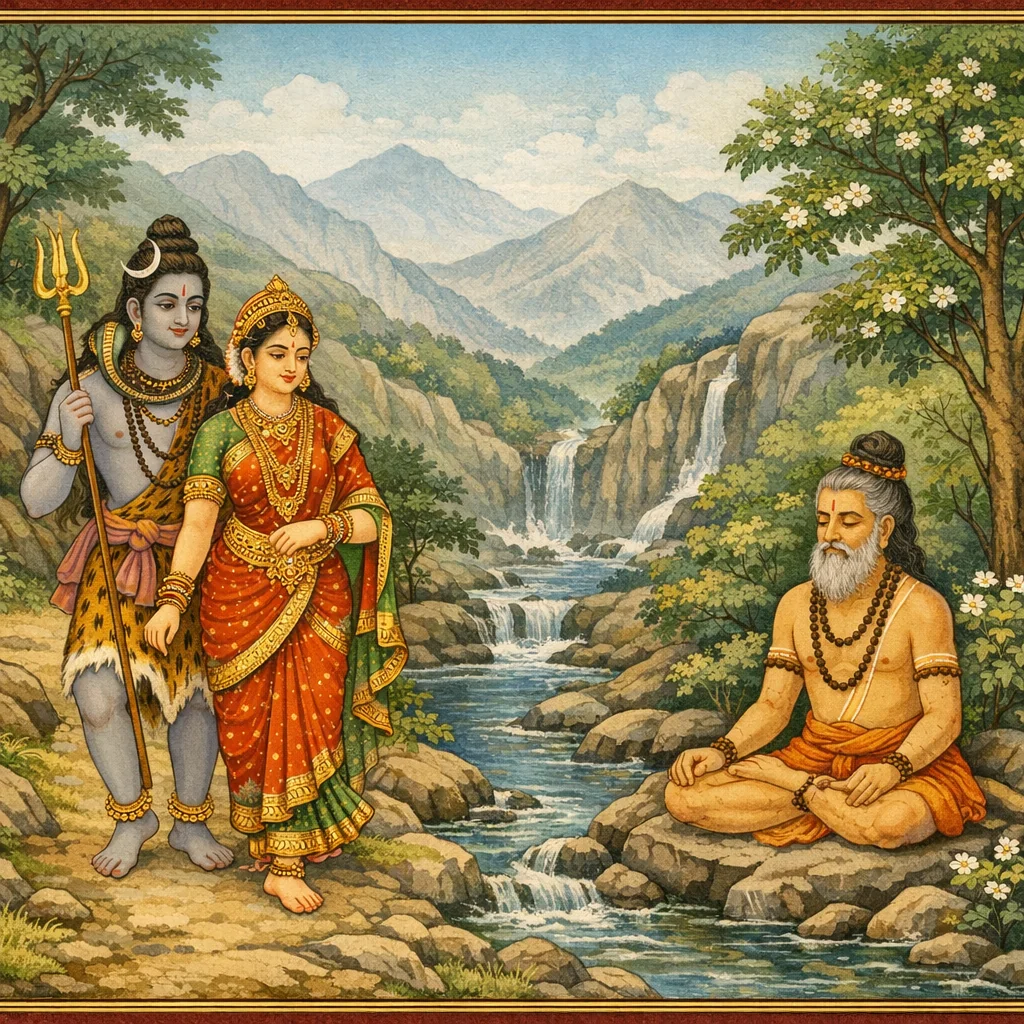
Pulastya recounts the glory of the Piṇḍāraka tīrtha, praised as pāpa-hara, the remover of sin. A brāhmaṇa named Maṅki—simple-minded and at first unskilled in brāhmaṇical duties—gains wealth while guarding a buffalo on a beautiful mountain. After great difficulty he buys a small pair of oxen, but an unforeseen mishap involving a camel leaves the oxen entangled by the neck and ruined. Struck by this reversal, Maṅki awakens to vairāgya, abandons village life, and goes to the forest, reaching a spring (nirjhara) on Arbuda. There he undertakes disciplined practice: bathing three times daily and sustained Gāyatrī-japa, by which he becomes purified and attains divya-darśana, divine sight. In the same period Śaṅkara (Śiva), accompanied by Gaurī, roams the mountain for recreation and is beheld by the ascetic. Maṅki offers reverence, and Śiva grants a boon. He asks not for worldly gain but to become Śiva’s gaṇa, and that the tīrtha be renowned by his name, Piṇḍāraka. Śiva confirms that after death the brāhmaṇa will become a gaṇa, the place will be called Piṇḍāraka, and on Mahāṣṭamī Śiva will be specially present; those who bathe on the aṣṭamī day attain the supreme abode where Śiva is ever established. The chapter closes by prescribing mantra-accompanied bathing and extolling dāna—especially gifting a buffalo on aṣṭamī—as a means to desired benefits in this world and the next.
Shlokas
Verse 1
पुलस्त्य उवाच । ततः पिंडारकं गच्छेत्तीर्थं पापहरं नृप । यत्र पूर्वं तपस्तप्तं मंकिना ब्राह्मणेन च । सिद्धिं गतस्तथा राजंस्तीर्थस्यास्य प्रभावतः
Pulastya said: “Thereafter, O king, one should go to Piṇḍāraka, a tīrtha that removes sin, where in former times the brāhmaṇa Maṅki performed tapas and, by the power of this sacred ford, attained siddhi—spiritual accomplishment.”
Verse 2
पुरा मंकिरभूद्विप्रो नाममात्रेण भूपते । मूर्खो ब्राह्मणकृत्यानामनभिज्ञः सुमन्दधीः
Formerly, O lord of the earth, there was a man named Maṅki—called a brāhmaṇa only in name—foolish, ignorant of brāhmaṇical duties, and of very dull understanding.
Verse 3
अथासौ पर्वते रम्ये लोकानां नृपसत्तम । महिषी रक्षयामास ततः पिंडारकर्मणि
O best of kings, then on that lovely mountain he protected the people; thereafter he engaged in the sacred observances connected with Piṇḍāraka.
Verse 4
कस्यचित्त्वथ कालस्य तेन वित्तमुपार्जितम् । दूरात्कृच्छ्रेण च स्तोकं जगृहे गोयुगं ततः
After some time, he earned some wealth; then, with difficulty and from far away, he acquired a small pair of cattle.
Verse 5
ततस्तद्दमयामास गोयुगं नृपसत्तम । अथ दैववशाद्राजन्दमितं तस्य गोयुगम्
Then, O best of kings, he trained that pair of cattle; but, O king, by the force of fate, that very pair came under control in an unforeseen way.
Verse 6
निबद्धमुष्ट्रमासाद्य ग्रीवादेशे बलात्स्थितम् । अथोष्ट्रस्त्वरया राजन्नुत्थितस्त्रासतत्परः
Reaching the camel that had been tied, the yoke was forced onto the camel’s neck. Then, O king, the camel sprang up swiftly, seized by fear and bent on flight.
Verse 7
गोयुगेन हि ग्रीवायां लम्बमानेन भूपते । तद्दृष्ट्वा सुमहाश्चर्यं विनाशं गोयुगस्य तु
O king, as the pair of cattle with the yoke hung from the neck, seeing that most astonishing sight and the ruin of the cattle-pair,
Verse 8
मंकिर्वैराग्यमापन्नस्त्यक्त्वा ग्रामं वनं ययौ । स गत्वा निर्झरं कञ्चिदर्बुदे नृपसत्तम
Maṅkī, having attained dispassion (vairāgya), abandoned the village and went to the forest. O best of kings, he reached a certain mountain stream on Arbuda.
Verse 9
त्रिकालं कुरुते स्नानं गायत्रीजपमुत्तमम् । तेनासौ गतपापोऽभूद्दिव्यदर्शी च भूमिप
O king, he bathed three times a day and performed the excellent japa of the Gāyatrī. By that he became free from sin and attained divine sight.
Verse 10
एतस्मिन्नेव काले तु तेन मार्गेण शंकरः । सह गौर्या विनिष्क्रांतः क्रीडार्थं रम्यपर्वते
At that very time, Śaṅkara, together with Gaurī, came forth along that path to sport upon the lovely mountain.
Verse 11
स दृष्टः सहसा तेन पिंडारेण महात्मना । प्रणाममकरोद्राजंस्ततस्तं शंकरोऽब्रवीत्
Suddenly he was seen by the great-souled Piṇḍāra; O king, he bowed in reverence, and then Śaṅkara spoke to him.
Verse 12
न वृथा दर्शनं मे स्याद्वरो मे गृह्यतां द्विज । यदभीष्टं महाराज यद्यपि स्यात्सुदुर्लभम्
“Let my appearing not be in vain. O twice-born, accept a boon from me—whatever you desire, O great king, even if it is exceedingly hard to obtain.”
Verse 13
पिंडारक उवाच । गणोऽहं तव देवेश भवानि त्रिपुरांतक । यथा तथा कुरु विभो नान्यन्मे हृदि वर्तते
Piṇḍāraka said: “O Lord of the gods, O Tripurāntaka, O Bhavānī—I am your gaṇa, your attendant. O All-powerful One, do with me as you will; nothing else dwells in my heart.”
Verse 14
एतत्पिण्डारकं तीर्थ मम नाम्ना प्रसिध्यतु
“May this sacred ford be renowned by my name as Piṇḍāraka Tīrtha.”
Verse 15
भगवानुवाच । भविष्यसि गणोऽस्माकं देहांते त्वं द्विजोत्तम । एतत्पिंडारकंनाम तीर्थमत्र भविष्यति
The Blessed Lord said: “At the end of your body (when you depart), O best of the twice-born, you shall become one of my gaṇas. And here there shall arise a holy place named Piṇḍāraka.”
Verse 16
अहमत्र महाष्टम्यां निवेक्ष्यामि महामते । ये च स्नानं करिष्यंति संप्राप्ते चाष्टमीदिने । ते यास्यंति परं स्थानं यत्राहं नित्यसंस्थितः
O great-minded one, on the great Aṣṭamī I shall be present here. Those who bathe when the Aṣṭamī day arrives will go to the supreme abode—where I ever abide.
Verse 17
पुलस्त्य उवाच । एवमुक्त्वा महादेवस्तत्रैवांतरधीयत । मंकिः पिंडारकस्तत्र तपस्तेपे दिवानिशम्
Pulastya said: “Having spoken thus, Mahādeva vanished there itself. And Maṅki—Piṇḍāraka—performed austerities there day and night.”
Verse 18
ततः कालेन महता त्यक्त्वा देहं दिवं गतः । यत्रास्ते भगवान्रुद्रो गणस्तत्र बभूव ह
Then, after a long time, he cast off his body and went to heaven; and where the Lord Rudra abides, there indeed he became a gaṇa.
Verse 19
तस्मात्सर्वप्रयत्नेन स्नानं मन्त्रेण चाचरेत्
Therefore, with every effort one should perform the bathing rite, along with mantra-recitation.
Verse 20
राजेन्द्र महिषीदानमथाष्टम्यां विशेषतः । य इच्छति सदाऽभीष्टमिह लोके परत्र च
O king of kings, especially on Aṣṭamī one should give the gift of a buffalo-cow (mahiṣī-dāna). Whoever desires cherished aims—both in this world and in the next—should do so.
Verse 25
इति श्रीस्कांदे महापुराण एकाशीतिसाहस्र्यां संहितायां सप्तमे प्रभासखण्डे तृतीयेऽर्बुदखण्डे पिंडारकतीर्थमाहात्म्यवर्णनंनाम पंचविंशोऽध्यायः
Thus ends the twenty-fifth chapter, called “The Description of the Glory of Piṇḍāraka Tīrtha,” in the third Arbuda Khaṇḍa of the seventh Prabhāsa Khaṇḍa of the Skanda Mahāpurāṇa, in the Ekāśīti-sāhasrī Saṃhitā.