Adhyaya 30
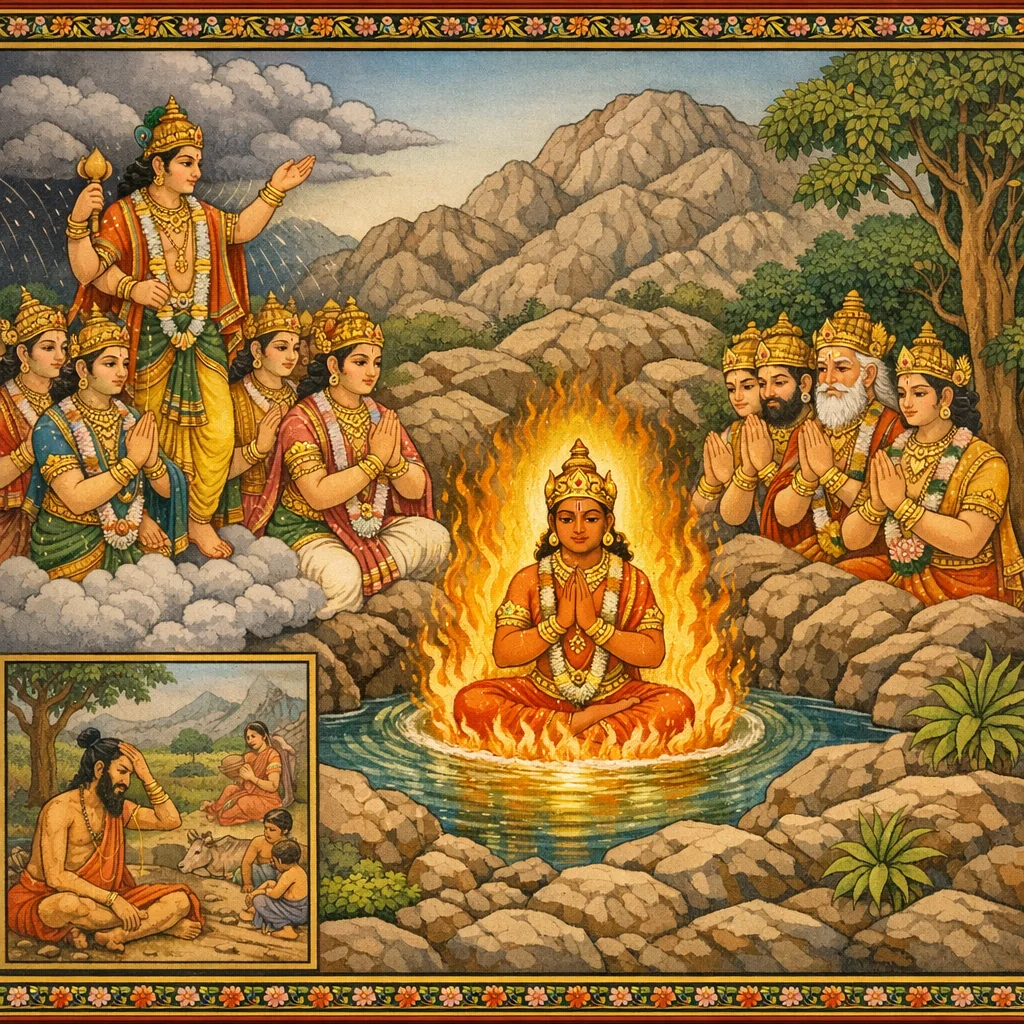
Pulastya instructs Yayāti to visit Agni-tīrtha, a supremely purifying sacred ford where Agni was once “lost” and later recovered by the Devas. The cause is told: a twelve-year drought brings famine and the breakdown of social order. Viśvāmitra, weakened by hunger, reaches a caṇḍāla settlement, finds a dead dog, cooks it, and offers it into the fire—an act condemned as abhakṣya-bhakṣaṇa, the polluting consumption of what is unfit. Agni, unwilling to be forced to receive impure offerings and blaming the drought on Indra’s governance, withdraws from the human realm; yajña rites (such as the agniṣṭoma) falter and stability declines. The Devas search for him; a śuka (parrot) points out his course, and Agni hides in a śamī/aśvattha tree and then in a water-body on Mount Arbuda, remaining unseen. A frog (dardura) reveals his presence in a mountain spring (nirjhara), and Agni curses it with vijihvatva, an affliction of the tongue. The Devas praise Agni as the sustaining “mouth” of the gods and the support of the cosmos. Agni states his grievance about impure offerings and the drought. Indra explains the political-ethical reason for withholding rain (linked to Devāpi, Pratīpa, and Śantanu’s succession narrative) and commands the clouds to restore rainfall. Pleased, Agni agrees to remain and asks that the water-body be renowned as Agni-tīrtha. The phalāśruti declares that proper bathing leads to Agni-loka, tiladāna yields the fruit of an agniṣṭoma, and reciting or hearing this māhātmya removes sins, even those gathered by day and by night.
Shlokas
Verse 1
पुलस्त्य उवाच । अग्नितीर्थं ततो गच्छेत्पावनं परमं नृणाम् । तत्र वह्निः पुरा नष्टो लब्धश्च त्रिदशैरपि
Pulastya said: Then one should go to Agni-tīrtha, the supreme purifier of men. There, in ancient times, Fire (Vahni) was lost—and there he was found again, even by the gods.
Verse 2
ययातिरुवाच । किमर्थं भगवन्वह्निः पुरा नष्टो द्विजोत्तम । कथं तत्रैव लब्धस्तु कौतुकं मे महामुने
Yayāti said: For what reason, O revered one, was Fire formerly lost, O best of twice-born? And how was he found there again? Great sage, this curiosity has arisen in me.
Verse 3
पुलस्त्य उवाच । पुरा वृष्टिनिरोधोऽभूद्यावद्द्वादशवत्सरान् । संशयं परमं प्राप्तः सर्वो लोकः क्षुधार्दितः
Pulastya said: Long ago there was a stoppage of rain for twelve years. Tormented by hunger, the entire world fell into extreme uncertainty and peril.
Verse 4
प्रायो मृतो मृतप्रायः शेषोऽभूद्धरणीतले । नष्टा अरण्यजा ग्राम्याः पशवः पक्षिणो मृगाः
Nearly all had died; those who remained on the earth were as good as dead. Creatures of the forests and villages—cattle, birds, and wild animals—perished.
Verse 5
एवं कृच्छ्रमनुप्राप्ते मर्त्यलोके नराधिपः । विश्वामित्रो मुनिवरः संदेहं परमं गतः
When such hardship had befallen the mortal world, O king, the great sage Viśvāmitra fell into profound doubt and distress.
Verse 6
अन्नौषधिरसाभावादस्थिशेषो व्यजायत । अन्यस्मिन्दिवसे प्राप्तः क्षुत्क्षामः पर्यटन्दिशः
For lack of food, herbs, and nourishing juices, he became reduced to little more than bones. Then, on another day, wasted by hunger, he wandered through the regions.
Verse 7
चंडालनिलयं प्राप्तः क्षुत्तृषापीडितो भृशम् । तत्रापश्यन्मृतं श्वानं शुष्कं पार्थिवसत्तम
Tormented intensely by hunger and thirst, he came to the dwelling of a caṇḍāla. There he saw a dead dog, dried up—O best of kings.
Verse 8
तमादाय गृहं प्राप्तः प्रक्षाल्य सलिलेन तु । क्षुत्क्षामः पाचयामास ततस्तं पावकेऽजुहोत्
Taking it, he returned home; washing it with water, and weakened by hunger, he cooked it—then offered that (meat) into the fire.
Verse 9
अभक्ष्यभक्षणं ज्ञात्वा हव्यवाहस्ततो नृप । शक्रस्योपरि मन्युं स्वं चक्रेऽतीव महीपते
Knowing that a forbidden thing had been eaten, Agni—the carrier of oblations—then became exceedingly wrathful toward Śakra, O king, O lord of the earth.
Verse 10
नष्टौषधिरसे लोके युक्तमेतद्धि सांप्रतम् । यादृगाप्तं हविस्तादृगग्निभक्षो विशिष्यते
Now, in a world where the essence of healing herbs has vanished, this indeed seems fitting: as the havis, the sacred oblation, is obtained, so too what Agni consumes becomes correspondingly distinguished.
Verse 11
नाभक्ष्यं भक्षयिष्यामि त्यजिष्ये क्षितिमंडलम् । येन शक्रादयो देवा यांति कष्टतरां दशाम्
I will not consume what must not be eaten; I shall abandon the circle of the earth—by which Śakra and the other gods would fall into an even harsher condition.
Verse 12
एवं संचिंत्य मनसा सकोपो हव्यवाहनः । प्रणष्टः सकलं हित्वा मर्त्यलोकं चराचरम्
Thinking thus in his mind, Havyavāhana (Agni), filled with anger, vanished—abandoning the entire mortal world with all its moving and unmoving beings.
Verse 13
प्रणष्टे सहसा वह्नावग्निष्टोमादिकाः क्रियाः । प्रणष्टास्तु जनाः सर्वे विशेषात्संशयं गताः
When Fire vanished suddenly, rites such as the Agniṣṭoma and the rest came to a halt; and all people, in particular, fell into deep uncertainty.
Verse 14
ततो देवगणाः सर्वे संदेहं परमं गताः । यज्ञभागविहीनत्वान्मंत्रं चक्रुस्ततो मिथः
Then all the hosts of gods fell into the utmost doubt; deprived of their portions in sacrifice, they then took counsel among themselves.
Verse 15
त्यक्तस्तु वह्निना मर्त्यस्ततो नाशं गता नराः । शेषनाशाद्वयं सर्वे विनंक्ष्यामो न संशयः
Abandoned by Fire, mortals then went to ruin. When what remains is destroyed, we too—all of us—will perish; of this there is no doubt.
Verse 16
तस्मादन्वेष्यतां वह्निर्यत्र तिष्ठति सांप्रतम् । यथा चरति मर्त्ये च तथा नीतिर्विधीयताम्
Therefore let Fire be sought—wherever he is now abiding. And according to how he is acting in the mortal realm, let an appropriate course of action be devised.
Verse 17
पुलस्त्य उवाच । एवं ते निश्चयं कृत्वा सर्वे देवाः सवासवाः । अन्वैषयंस्तथाग्निं ते समंतात्क्षितिमंडले
Pulastya said: Having thus resolved, all the gods—together with Indra—began to search for Agni everywhere, across the whole circuit of the earth.
Verse 18
ततस्ते पुरतो दृष्ट्वा शुकं श्रांता दिवौकसः । पप्रच्छुः श्रद्धया वह्निर्यदि दृष्टः प्रकथ्यताम्
Then, the weary dwellers of heaven, seeing Śuka before them, asked with reverence: “If you have seen Agni, please tell us.”
Verse 19
शुक उवाच । योऽयं वंशो महानग्रे प्रदग्धो वह्निसंगतः । प्रणष्टो हव्यवाहोत्र मया दृष्टो महाद्युतिः
Śuka said: “That great bamboo-stem which was burnt earlier upon contact with fire—there, the vanished Havyavāha (Agni), radiant with great splendor, was seen by me.”
Verse 20
शुकेनावेदितो वह्निः शप्त्वा तं मन्युना वृतः । गद्गदा भावि ते वाणी प्रोक्त्वेदं प्रस्थितो द्रुतम्
When Śuka pointed out Vahni (Agni), Agni—overcome with wrath—cursed him, saying: “Your speech shall become stammering.” Having spoken thus, he swiftly departed.
Verse 21
प्रविवेश शमीगर्भमश्वत्थं तरुसत्तमम् । तत्रस्थो द्विपराज्ञा स कथितो विबुधान्प्रति
He entered the womb of a Śamī-tree—into an Aśvattha, the finest among trees. While he remained there, the king of elephants reported this to the gods.
Verse 22
स तं प्रोवाच ते जिह्वा विपरीता भविष्यति । ततो जलाशयं गत्वा पर्वतेऽर्बुदसंज्ञके
He said to him: “Your tongue will become distorted.” Then he went to a lake upon the mountain called Arbuda,
Verse 23
प्रविष्टो भगवान्वह्निर्यथा देवैर्न लक्ष्यते । तत्रोत्थेन दर्दुरेण तेषां प्रोक्तो हुताशनः
The blessed Vahni entered in such a way that the gods could not perceive him. Yet there, a frog that rose up disclosed Hutāśana to them.
Verse 24
अत्राऽसौ तिष्ठते वह्निर्निर्झरे पर्वतस्य च । दग्धाश्च जलजाः सर्वे सुतप्तेनैव वारिणा
“Here Agni remains—within the mountain’s cascade; and all creatures born of the waters have been scorched by the water itself, made intensely hot.”
Verse 25
कृच्छ्रादहं विनिष्क्रांतस्तस्मान्मृत्युमुखात्सुराः । तच्छ्रुत्वा यत्नमास्थाय प्रविष्टो हव्यवाहनः
With great difficulty I escaped from that mouth of death, O gods. Hearing this, Havyavāhana (Agni) exerted himself and entered that place.
Verse 26
भविष्यसि विजिह्वस्त्वं शप्त्वा तं दर्दुरं नृपः
“You shall become tongueless (or your tongue shall be deformed)!”—thus spoke the king (Agni), having cursed that frog.
Verse 27
ततो देवगणाः सर्वे निष्क्रांताः सलिलाश्रयात् । संवेष्ट्य तुष्टुवुः सर्वे स्तवैर्वेदोद्भवैर्नृप
Then all the hosts of gods came forth from their watery refuge; surrounding him on every side, O King, they praised him with hymns born of the Vedas.
Verse 28
देवा ऊचुः । त्वमग्ने सर्वभूतानामंतश्चरसि पावक । त्वया हीनं जगत्सर्वं नाशं यास्यति सत्वरम्
The gods said: “O Agni, O Purifier, you move within the hearts of all beings. Deprived of you, this entire world would swiftly go to ruin.”
Verse 29
त्वं मुखं सर्वदेवानां त्वयि लोकाः प्रतिष्ठिताः । भूलोके च त्वया त्यक्ते वयं सर्वे सवासवाः । विनाशमेव यास्यामस्तस्मात्त्वं त्रातुमर्हसि
“You are the very ‘mouth’ of all the gods; upon you the worlds are established. If you abandon the earthly realm, we all—together with Indra—shall meet only destruction. Therefore you must protect us.”
Verse 30
त्वं ब्रह्मा त्वं महादेवस्त्वं विष्णुस्त्वं दिवाकरः । त्वं चंद्रस्त्वं च धनदो मरुत्त्वं च सुरेश्वरः
You are Brahmā; you are Mahādeva; you are Viṣṇu; you are the Sun. You are the Moon; you are Kubera, the giver of wealth; you are Marut; and you are the Lord of the gods.
Verse 31
इंद्राद्या विबुधाः सर्वे त्वदायत्ता हुताशन । किमर्थं भगवन्मर्त्त्यं त्यक्त्वा त्वमत्र संस्थितः । किमर्थं भगवन्नस्माननागांस्त्यक्तुमिच्छसि
O Hutāśana, all the gods beginning with Indra depend upon you. Why, O Lord, have you abandoned the world of mortals and remained here? Why, O Lord, do you wish to forsake us who are without fault?
Verse 32
पुलस्त्य उवाच । वेष्टितो भगवान्वह्निर्देवैः स्तुतिपरायणैः । तस्यैव निर्झरस्याथ तटस्थो वाक्यमब्रवीत्
Pulastya said: Surrounded by the gods devoted to praise, the blessed Fire-god stood upon the bank of that very holy waterfall and then spoke these words.
Verse 33
वह्निरुवाच । अभक्ष्यभक्षणे शक्रो मामिच्छति नियोजितुम् । तेनैव न करोत्येष वृष्टिं मर्त्त्ये सुरेश्वरः
Agni said: “Śakra wishes to employ me in consuming what ought not be consumed. For that very reason, this lord of the gods withholds rain from the realm of mortals.”
Verse 34
अतोऽहं भूतलं त्यक्त्वा प्रविष्टो निर्झरे त्विह । प्रणष्टान्नरसे लोके न चाहं स्थातुमुत्सहे
Therefore I have left the surface of the earth and entered this waterfall here. In a world where the essence of humanity and right conduct has perished, I do not have the heart to remain.
Verse 35
शक्र उवाच । शृणु यस्मान्मया रोधः कृतो वृष्टेर्हुताशन । देवापिर्नाम धर्मज्ञः क्षत्रियाणां यशस्करः
Śakra said: “Hear, O Hutāśana (Agni), the reason I held back the rains. There is a man named Devāpi—knower of dharma, a bestower of glory upon the Kṣatriyas.”
Verse 36
प्रतीपस्तत्सुतः साधुः सर्वशीलवतां वरः । देवापौ च गते स्वर्गं ज्येष्ठभ्रातरमग्रजम् । संत्यक्त्वा जगृहे राज्यं शंतनुस्तत्सुतोऽवरः
“His son was Pratīpa, a righteous man, the foremost among those of noble conduct. And when Devāpi, the eldest brother, departed to heaven, Śaṃtanu—the younger son of Pratīpa—set aside the elder and took up the kingship.”
Verse 37
एतस्मात्कारणाद्राज्ये तस्य वृष्टिर्निराकृता । तवादेशात्करिष्यामि निवर्तस्व हुताशन
“For this very reason, in his kingdom the rainfall has been withheld. At your command I shall set it right—therefore withdraw, O Hutāśana (Agni).”
Verse 38
पुलस्त्य उवाच । एवमुक्त्वा सहस्राक्षः पुष्करावर्तकान्घनान् । द्रुतमाज्ञापयामास वृष्ट्यर्थं जगतीतले
Pulastya said: “Having spoken thus, Sahasrākṣa (Indra) swiftly commanded the rain-bearing clouds called Puṣkarāvartakas to pour rain upon the surface of the earth.”
Verse 39
अथ शक्रसमादिष्टा विद्युत्वन्तो बलाहकाः । गम्भीरराविणः सर्वं भूतलं प्रचुरैर्जलैः । पूरयामासुरत्युग्रा द्युतिमन्तो महीपते
Then, commanded by Śakra (Indra), the lightning-laden clouds—deep-thundering, exceedingly fierce, and radiant—flooded the whole earth with abundant waters, O king.
Verse 40
ततोऽगमत्परां तुष्टिं भगवान्हव्यवाहनः । रोचयामास भूपृष्ठे वसतिं देवकारणात्
Thereupon the blessed Havyavāhana (Agni) attained supreme contentment, and—by the gods’ sacred purpose—approved of establishing his dwelling upon the earth’s surface.
Verse 41
देवा ऊचुः । तवाऽदेशात्कृता वृष्टिरन्यत्कार्यं हुताशन । यत्ते प्रियं तदस्माकं सुशीघ्रं हि निवेदय
The gods said: “By your command the rain has been brought forth. O Hutāśana, what other task remains? Whatever is dear to you—tell us at once.”
Verse 42
अग्निरुवाच । एतज्जलाशयं पुण्यं मन्नाम्ना तीर्थमुत्तमम् । ख्यातिं यातु धरापृष्ठे युष्माकं हि प्रसादतः
Agni said: “May this sacred reservoir become renowned upon the earth as an excellent tīrtha bearing my name—through your gracious favor.”
Verse 43
देवा ऊचुः । अग्नितीर्थमिदं लोके प्रख्यातिं संप्रयास्यति । अत्र स्नातो नरः सम्यगग्निलोकं प्रयास्यति
The gods said: “This shall indeed become famous in the world as Agnitīrtha. Whoever bathes here in the proper manner will attain the world of Agni.”
Verse 44
यस्तिलान्दास्यति नरस्तीर्थेऽस्मिन्सुसमाहितः । अग्निष्टोमस्य यज्ञस्य फलं तस्य भविष्यति
Whoever, with steady devotion, donates sesame seeds at this tīrtha shall obtain the fruit of the Agniṣṭoma sacrifice.
Verse 45
पुलस्त्य उवाच । एवमुक्त्वा सुराः सर्वे स्वस्वस्थानं ययुस्ततः । वह्निश्च भगवान्राजन्यथापूर्वमवर्तत
Pulastya said: “Having spoken thus, all the gods departed to their own abodes. And the revered Vahni (Agni), O king, remained as before.”
Verse 46
यश्चैत्पठते नित्यं प्रातरुत्थाय चोत्तमम् अग्नितीर्थस्य माहात्म्यं मुच्यते सर्वपातकैः
Whoever, rising in the morning, recites daily this excellent Māhātmya of Agnitīrtha is freed from all sins.
Verse 47
अहोरात्रकृतात्पापात्स शृण्वन्नपि मुच्यते
Even by merely listening, one is freed from the sins committed over the course of a day and a night.