Adhyaya 55
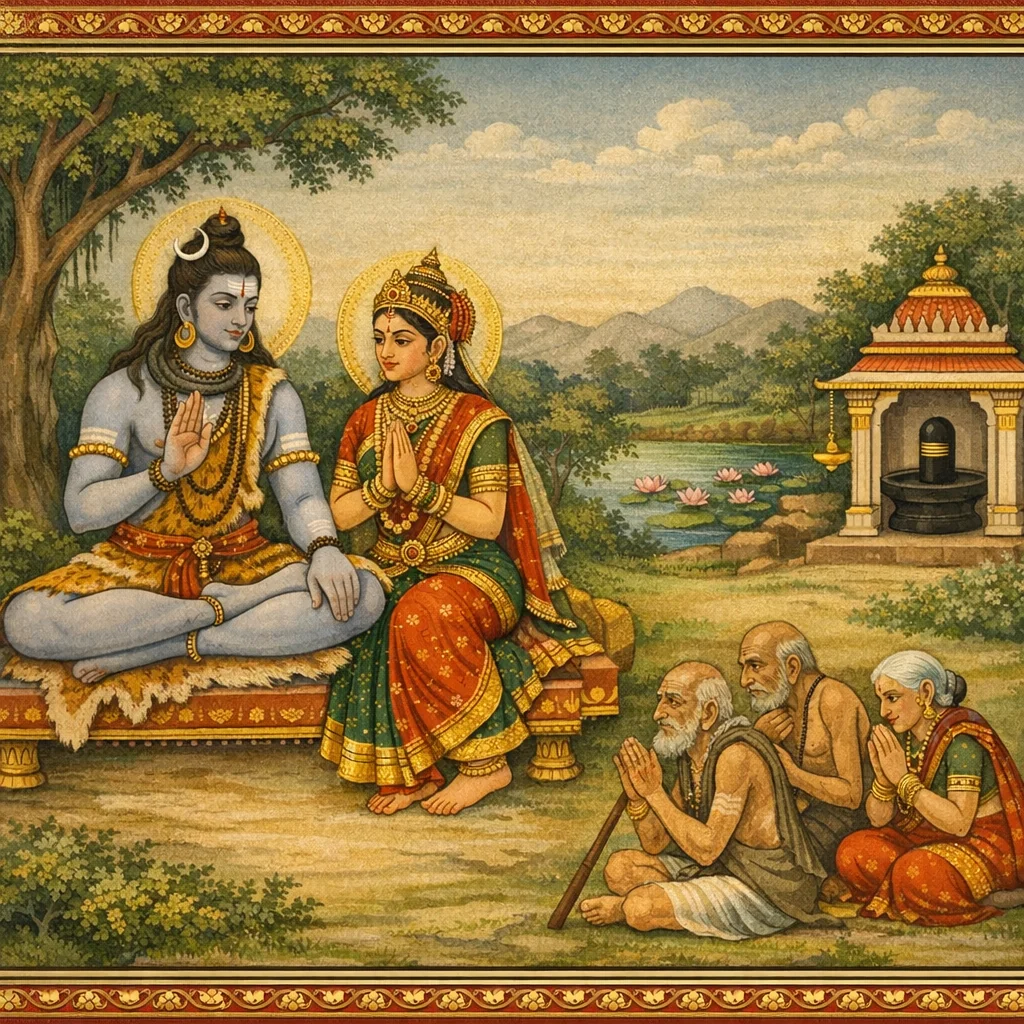
This chapter records Pulastya’s guidance to a king on going to the auspicious Rudrahrada, a sacred lake whose power is realized through devotional bathing with bhakti. It first identifies the tīrtha and proclaims its transforming promise: one who bathes there with devotion attains the exalted state called gaṇādhiśatva—association with, or even lordship among, Śiva’s gaṇas. An origin account then grounds the rite in divine precedent: after slaying the demon Andhaka, Vṛṣabhadhvaja (Śiva), accompanied by his gaṇas, bathes and establishes a lake that becomes known as Rudrahrada. Finally, the chapter states an observance: bathing on caturdaśī (the fourteenth lunar day) yields merit described as equal to the confluence of all tīrthas. It closes with the colophon naming it the 55th adhyāya of the Arbuda Khaṇḍa within the Prabhāsa Khaṇḍa.
Shlokas
Verse 1
पुलस्त्य उवाच । ततो गच्छेन्नृपश्रेष्ठ पुण्यं रुद्रह्रदं शुभम् । यत्र स्नातो नरो भक्त्या गणाधीशत्वमाप्नुयात्
Pulastya said: Then, O best of kings, one should go to the holy and auspicious Rudrahrada. Bathing there with devotion, a man may attain the status of a lord among Śiva’s gaṇas.
Verse 2
पुरा हत्वांऽधकं दैत्यं सगणो वृषभध्वजः । ततः स्नातो ह्रदं कृत्वा ततो रुद्रह्रदोऽभवत्
Long ago, after slaying the demon Andhaka, the Bull-bannered Lord (Śiva), together with his attendants, bathed there. Thus a lake was formed, and that place became renowned as Rudra-hrada, Rudra’s sacred lake.
Verse 3
चतुर्द्दश्यां महाराज यस्तत्र कुरुते नरः । स्नानं तस्य भवेत्पुण्यं सर्वतीर्थसमुद्भवम्
O great king, whoever bathes there on the fourteenth lunar day (caturdaśī), the merit of that bath becomes equal to the merit arising from all tīrthas combined.
Verse 55
इति श्रीस्कांदे महापुराण एकाशीतिसाहस्र्यां संहितायां सप्तमे प्रभासखण्डे तृतीयेऽर्बुदखण्डे रुद्रह्रदमाहात्म्यवर्णनंनाम पञ्चपञ्चाशत्तमोऽध्यायः
Thus ends the fifty-fifth chapter, entitled “The Description of the Greatness of Rudra-hrada,” in the third subdivision (Arbuda Khaṇḍa) of the seventh book (Prabhāsa Khaṇḍa) of the Śrī Skanda Mahāpurāṇa, within the eighty-one-thousand-verse compendium.