Adhyaya 20
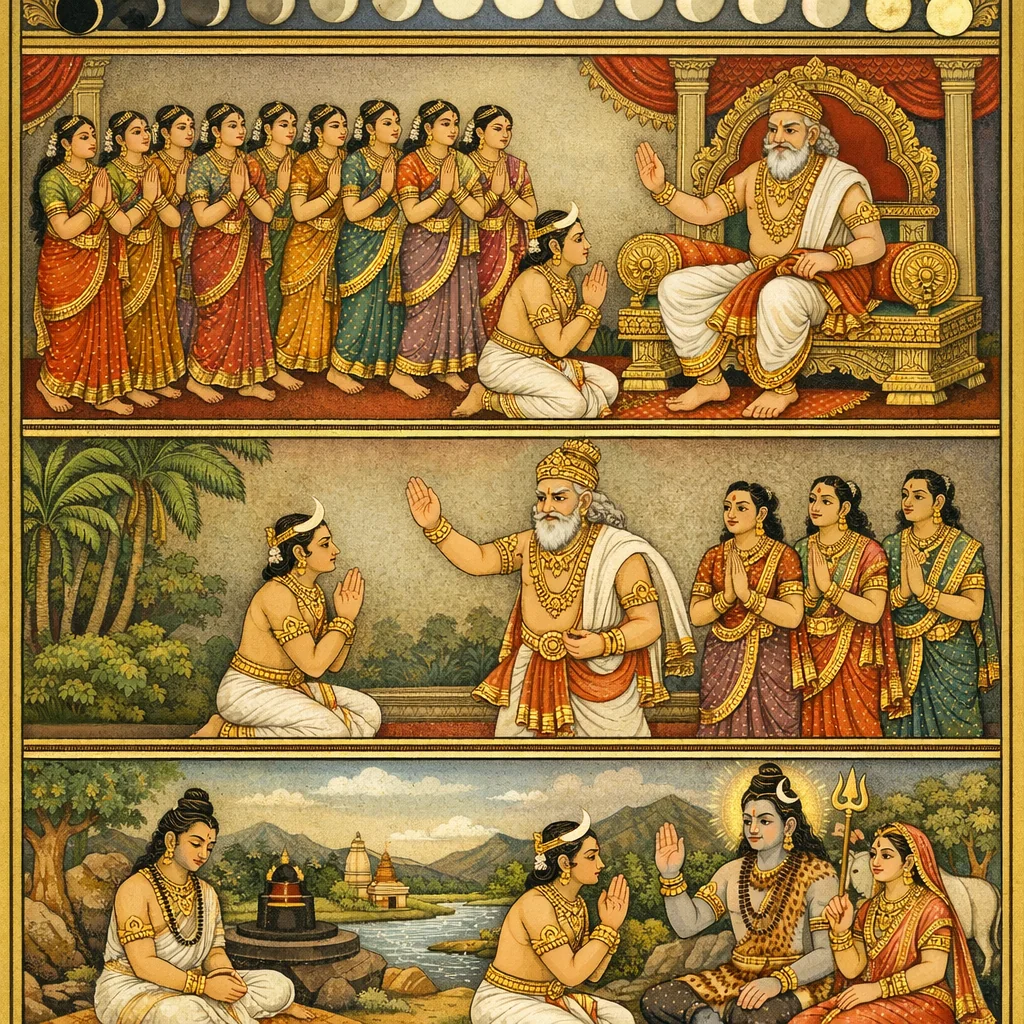
Pulastya recounts a theological and ethical episode explaining the Moon’s waxing and waning and the sanctity of Prabhāsa. Dakṣa gives his twenty-seven daughters—the Nakṣatras beginning with Aśvinī—in marriage to Candra, but Candra favors Rohiṇī and neglects the others. The daughters complain to their father; Dakṣa instructs Candra to be impartial. Though Candra agrees, he repeats the offense, and Dakṣa, angered, curses him to suffer kṣaya (decline) through yakṣmā. As Candra wastes away, he seeks remedy through devotion to Śiva, performing tapas at Arbuda, restraining anger, and sustaining japa and homa. Śiva grants darśana and declares that Dakṣa’s curse cannot be wholly annulled, but can be regulated: Candra must treat all his wives equally, and thus the Moon will periodically wane in the dark fortnight (kṛṣṇa pakṣa) and wax in the bright fortnight (śukla pakṣa). Candra then asks for tīrtha-fruits: devotees who bathe on Monday (Somavāra), especially when Soma is in conjunction or ascendant, attain elevated states. Śrāddha and piṇḍadāna performed here benefit the ancestors with merit likened to Gayā-śrāddha. Śiva confirms the place will be known as Prabhāsa-tīrtha, and the narrative ends with Candra resuming equitable relations with Dakṣa’s daughters.
Shlokas
Verse 1
पुलस्त्य उवाच । ततो गच्छेत चंद्रेशं प्रभासं नृपसत्तम । प्रभा तत्र पुरा प्राप्ता चंद्रेण सुमहात्मना
Pulastya said: “Then, O best of kings, one should go to Candreśa at Prabhāsa. For there, in ancient times, the great-souled Candra (the Moon) attained radiance (prabhā).”
Verse 2
दक्षस्य कन्यका राजन्सप्तविंशतिसंख्यया । ऊढाश्चंद्रेण ताः सर्वा अश्विनीप्रमुखाः पुरा
Pulastya said: “O King, Dakṣa had daughters numbering twenty-seven. Long ago, all of them—beginning with Aśvinī—were married to Candra (the Moon).”
Verse 3
तासां मध्ये च रोहिण्या सह रेमे स नित्यदा । त्यक्ताः सर्वाश्च चंद्रेण दक्षकन्याः सुदुःखिताः । गत्वा स्वपितरं नत्वा प्राहुरस्राविलेक्षणाः
Among them, he dwelt in constant delight with Rohiṇī. Therefore, all the other daughters of Dakṣa, abandoned by Candra and overwhelmed with sorrow, went to their father; bowing to him, they spoke with tear-filled eyes.
Verse 4
वयं त्यक्ताः प्रजानाथ निर्दोषाः पतिना ततः । शरणं त्वामनुप्राप्ता दुःखेन महतान्विताः
“O Lord of creatures, though we are without fault, we have been cast aside by our husband. Therefore we have come to you for refuge, burdened with great grief.”
Verse 5
गतिर्भव सुरश्रेष्ठ सर्वेषां त्वं हितं कुरु । अस्माकमुपदिश्यैनं चंद्रं च रोहिणीरतम्
Be our refuge, O best among the gods; do what is beneficial for all. For our sake, instruct Candra, who is devoted to Rohiṇī.
Verse 6
पुलस्त्य उवाच । स तासां वचनं श्रुत्वा गतो यत्र निशाकरः । अब्रवीच्च समं पश्य सर्वासु तनयासु मे
Pulastya said: Hearing their words, Dakṣa went to where Niśākara (the Moon) was and said, “Look equally upon all my daughters.”
Verse 7
अथ व्रीडासमायुक्तश्चंद्रस्तं प्रत्यभाषत । तव वाक्यं करिष्यामि दक्ष गच्छ नमोस्तु ते
Then Candra, filled with shame, replied to him: “O Dakṣa, I shall do as you say. Go now—salutations to you.”
Verse 8
गते दक्षे ततो भूयश्चंद्रमा रोहिणीरतः । त्यक्त्वा च कन्यकाः सर्वाः प्रजापतिसमुद्भवाः
But after Dakṣa had gone, Candra once again became devoted to Rohiṇī, abandoning all the other maidens born of Prajāpati (Dakṣa).
Verse 9
अथ गत्वा पुनः सर्वा दक्षमूचुः सुदुःखिताः । न कृतं तव वाक्यं वै चंद्रेणैव दुरात्मना
Then all of them, deeply distressed, went again to Dakṣa and said: “Indeed, your instruction has not been carried out by Candra, that wicked-minded one.”
Verse 10
दौर्भाग्यदुःखसंतप्ता मरिष्याम न संशयः । अनेन जीवितेनापि मरणं निश्चयं भवेत्
Scorched by misfortune and sorrow, we shall die—there is no doubt. Even with this life, death alone seems certain.
Verse 11
पुलस्त्य उवाच । अथ रोषसमायुक्तो दक्षो गत्वाऽब्रवीद्विधुम् । मम वाक्यं त्वया चंद्र यस्मात्पाप कृतं न हि
Pulastya said: Then Dakṣa, filled with anger, went to Vidhū (the Moon) and said: “O Candra, since you have not carried out my command—O sinful one—…”
Verse 12
क्षयमेष्यसि तस्मात्त्वं यक्ष्मणा नास्ति संशयः । एवं दत्त्वा ततः शापं गतो दक्षः स्वमालयम्
“Therefore you will waste away with yakṣmā (consumption)—of this there is no doubt.” After pronouncing this curse, Dakṣa departed to his own abode.
Verse 13
यक्ष्मणा व्यापितश्चंद्रः क्षयं याति दिनेदिने । क्षीणो द्युतिविहीनस्तु चिंतयामास चंद्रमाः
Afflicted by yakṣmā, the Moon (Candra) wasted away day by day. Diminished and bereft of radiance, Candramā fell into anxious reflection.
Verse 14
कि कर्त्तव्यं मया तत्र ह्यस्मिञ्छापे सुदारुणे । अथ किं पूजयिष्यामि सर्वकामप्रदं शिवम्
“What should I do in the face of this most dreadful curse? And by what means shall I worship Śiva, the bestower of all desired aims?”
Verse 15
स एवं निश्चयं कृत्वा गतोर्बुदमथाचलम् । तपस्तेपे जितक्रोधो जपहोमपरायणः
Thus, having made a firm resolve, he went to Mount Arbuda. There he performed austerities—conquering anger, devoted to japa and homa.
Verse 16
तस्मै तुष्टो महादेवो वर्षाणामयुते गते । अब्रवीद्वरदोऽस्मीति ततोऽस्मै दर्शनं ददौ
Pleased with him after ten thousand years had passed, Mahādeva said, “I am the giver of boons,” and then granted him His divine vision.
Verse 17
ईश्वर उवाच । वरं वरय भद्रं ते यत्ते मनसि वर्तते । तव दास्याम्यहं चंद्र यद्यपि स्यात्सुदुर्ल्लभम्
Īśvara said: “Choose a boon—may it be auspicious for you—whatever abides in your heart. O Candra, I shall grant it to you, even if it is exceedingly difficult to obtain.”
Verse 18
चंद्र उवाच । व्याधिक्षयं सुरश्रेष्ठ कुरु मे त्रिपुरांतक । यक्ष्मणा व्यापितो देहो ममायं च जगत्पते
Candra said: “O best among the gods, O Tripurāntaka, bring about the destruction of my disease. O Lord of the world, this body of mine is pervaded by yakṣmā.”
Verse 19
ईश्वर उवाच । दक्षशापेन ते चंद्र यक्ष्मा काये व्यवस्थितः । न शक्तो ह्यन्यथा कर्तुं शापस्तस्य महात्मनः
Īśvara said: “O Candra, by Dakṣa’s curse yakṣmā has taken its place in your body. The curse of that great-souled one cannot be made otherwise.”
Verse 20
तस्मात्त्वं तस्य ताः सर्वाः कन्यका मम वाक्यतः । निशाकर समं पश्य तव व्याधिर्गमिष्यति
Therefore, by My word, look upon all his daughters with equal regard, O Niśākara (Moon); then your affliction shall depart.
Verse 21
कृष्णे क्षयश्च ते चंद्र शुक्ले वृद्धिर्भविष्यति । वरं वरय भद्रं ते अन्यमिष्टं सुदुर्ल्लभम्
In the dark fortnight you shall wane, O Candra; in the bright fortnight you shall wax. Choose another boon—may it be auspicious for you—even one most difficult to obtain.
Verse 22
चंद्र उवाच । चंद्रग्रहे नरो योऽत्र सोमवारे च शंकर । भक्त्या स्नानं करोत्येव स यातु परमां गतिम्
Candra said: “O Śaṅkara, whoever bathes here with devotion on a Monday—especially at the time of a lunar eclipse—may he attain the supreme state, liberation.”
Verse 23
पिण्डदानेन देवेश स्वर्गं गच्छंतु पूर्वजाः । प्रसादात्तव देवेश तीर्थं भवतु मुक्तिदम्
O Lord of the gods, by the offering of piṇḍas may the ancestors attain heaven. And by your grace, O Lord of the gods, may this tīrtha become a giver of liberation.
Verse 24
ईश्वर उवाच । भविष्यंति नरोऽत्रैव विपाप्मानो निशाकर । यस्मात्प्रभा त्वया प्राप्ता तीर्थेऽस्मिन्विमलोदके
Īśvara said: “O Niśākara, people here shall indeed become free from sin, for you have obtained radiance in this tīrtha of pure waters.”
Verse 25
प्रभासतीर्थं विख्यातं तस्मादेतद्भविष्यति । यत्र सोमग्रहे प्राप्ते सोमवारे विशेषतः
Therefore this place shall become renowned as Prabhāsatīrtha—especially when a lunar eclipse occurs here on a Monday.
Verse 26
करिष्यंति नराः स्नानं ते यास्यंति परां गतिम् । येऽत्र श्राद्धं करिष्यंति पिंडदानं तथा नराः
Those people who will bathe here shall go to the supreme goal. And those people who will perform śrāddha here, and likewise offer piṇḍas…
Verse 27
गयाश्राद्धसमं पुण्यं तेषां चंद्र भविष्यति । तथा दानं प्रकर्तव्यं सोम लोकैर्ग्रहे तव
O Candra, the merit gained by them shall be equal to that of the famous Gayā-śrāddha. Likewise, gifts (dāna) should be duly given—especially by the people of Soma’s realm—at the time of your eclipse.
Verse 28
पुलस्त्य उवाच । एवमुक्त्वा विरूपाक्षस्तत्रैवांतरधीयत । चन्द्रोऽपि बुभुजे सर्वाः पत्नीश्च दक्षसंभवाः
Pulastya said: “Having spoken thus, Virūpākṣa (Śiva) vanished right there. And Candra too enjoyed all the wives born of Dakṣa (i.e., Dakṣa’s daughters).”