Adhyaya 7
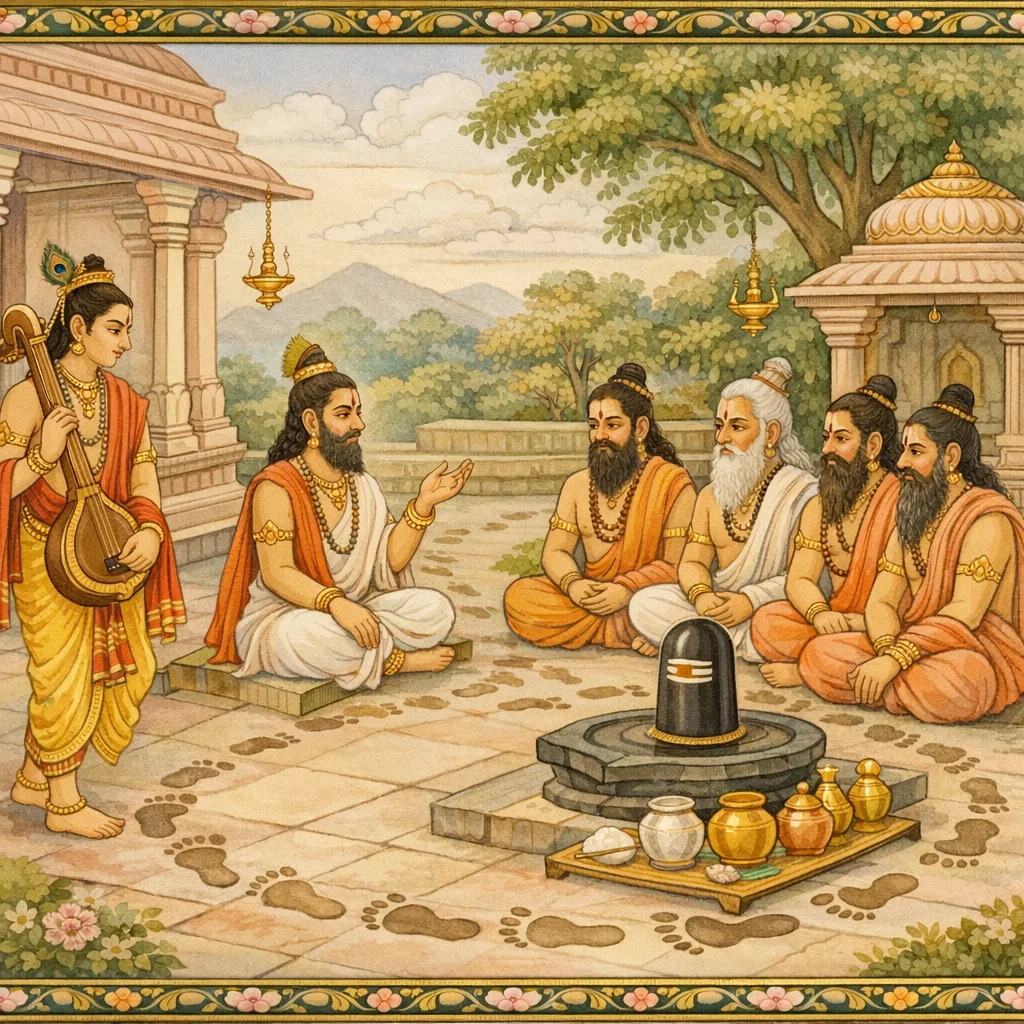
Pulastya sets forth a pilgrimage injunction to Acaleśvara, declaring that darśana performed with faith brings spiritual accomplishment. He details rites and their phala: śrāddha on Kṛṣṇa Caturdaśī (also in Āśvina/Phālguna) leads to supreme attainment; worship facing south with flowers, leaves, and fruits equals the fruit of an Aśvamedha; pañcāmṛta tarpaṇa grants divine proximity and Śiva-loka; and every step of pradakṣiṇā dissolves sin. The chapter then relates a “wonder” Pulastya heard from Nārada in a heavenly setting: a non-devotional parrot repeatedly circumambulates its nest out of routine, dies, and is reborn as King Veṇu with birth-memory. Recalling the causal power of circumambulation, Veṇu devotes himself almost entirely to pradakṣiṇā at Acaleśvara. Visiting sages (including Nārada and others) question his neglect of conventional offerings; Veṇu explains his prior-life cause and reliance on the shrine’s grace. The sages affirm the teaching, adopt pradakṣiṇā themselves, and Veṇu finally attains a rare, enduring status through Śambhu’s favor.
Shlokas
Verse 1
पुलस्त्य उवाच । ततो गच्छेन्नृपश्रेष्ठ सुपुण्यमचलेश्वरम् । यं दृष्ट्वा सिद्धिमाप्नोति नरः श्रद्धासमन्वितः
Pulastya said: Then, O best of kings, one should go to the exceedingly holy Acaleśvara. Having beheld it with śraddhā (faith), a man attains siddhi, spiritual accomplishment.
Verse 2
तत्र कृष्णचतुर्दश्यां यः श्राद्धं कुरुते नरः । आश्विने फाल्गुने वापि स याति परमां गतिम्
There, the man who performs Śrāddha on the fourteenth day of the dark fortnight (kṛṣṇa pakṣa)—whether in Āśvina or in Phālguna—attains the highest state.
Verse 3
यस्तु पूजयते भक्त्या दक्षिणां दिशमास्थितः । पुष्पैः पत्रैः फलैश्चैव सोऽश्वमेधफलं लभेत्
But he who, standing facing the southern direction, worships with bhakti—offering flowers, leaves, and fruits—obtains the merit of the Aśvamedha sacrifice.
Verse 4
पंचामृतेन यस्तत्र तर्पणं कुरु ते नरः । सोऽपि देवस्य सांनिध्यं शिवलोकमवाप्नुयात्
The man who there performs tarpaṇa using pañcāmṛta attains the Lord’s presence and reaches Śivaloka, the world of Śiva.
Verse 5
प्रदक्षिणांते यस्तस्य प्रणामं कुरुते नरः । नश्यंति सर्वपापानि प्रदक्षिणपदेपदे
The man who offers obeisance (pranāma) to Him at the completion of pradakṣiṇā—at every step of that circumambulation—all sins are destroyed.
Verse 6
तत्राश्चर्यमभूत्पूर्वं तत्त्वं शृणु महामते । मया पूर्वं श्रुतं स्वर्गे नारदाच्छक्रसन्निधौ
There, in former times, a wonder occurred—hear its true purport, O great-minded one. I once heard it in heaven from Nārada, in the presence of Śakra (Indra).
Verse 7
तत्र पूर्वं शुको नीडं वृक्षे चैवाकरोद्द्विजः । गतागतेन नीडस्य कुरुते तं प्रदक्षिणाम्
There, long ago, a parrot made its nest upon a tree. By its going and returning to the nest, it performed as it were a pradakṣiṇā, a reverent circumambulation around it.
Verse 8
न च भक्त्या महाराज पक्षियोनिसमुद्भवः । अथासौ मृत्युमापन्नः कालेन महता शुकः
And that parrot—born in the estate of birds—had not yet attained the fruit through bhakti, O great king. In the course of a long span of time, that Śuka met with death.
Verse 9
संजातः पार्थिवे वंशे राजा वेणुरिति स्मृतः । जातिस्मरो महाराज सर्वशत्रुनिकृन्तनः
He was then born in a royal lineage and became known as King Veṇu. Remembering his former birth, O great king, he was a cutter-down of all enemies.
Verse 10
स तं स्मृत्वा प्रभावं हि प्रदक्षिणासमुद्भवम् । अचलेश्वरमासाद्य प्रदक्षिणामथाकरोत्
Recalling that power born of pradakṣiṇā, he approached Acaleśvara and then performed pradakṣiṇā—devotional circumambulation.
Verse 11
नक्तं दिनं महाराज नान्यत्किंचित्करोति सः । न तथा तपसे यत्नो न नैवेद्ये कथंचन
Night and day, O great king, he did nothing else at all. He made no effort toward austerity, nor toward naivedya—offerings of food—in any manner.
Verse 12
न पुष्पे धूपदाने च प्रदक्षिणापरः सदा । केनचित्त्वथ कालेन मुनयोऽत्र समागताः
Offering neither flowers nor incense, he was always devoted solely to pradakṣiṇā, the reverent circumambulation. Then, after some time, sages arrived there.
Verse 13
नारदः शौनकश्चैव हारीतो देवलस्तथा । गालवः कपिलो नंदः सुहोत्रः कश्यपो नृपः
Nārada and Śaunaka, Hārīta and Devala; Gālava, Kapila, Nanda, Suhotra, and Kaśyapa—O king—these sages came.
Verse 14
एते चान्ये च बहवो देवव्रतपरायणाः । केचित्स्नानं कारयंति तस्य लिंगस्य भक्तितः
These and many others were devotees devoted to divine vows. Some, out of bhakti, arranged the ritual bathing (abhiṣeka) of that liṅga.
Verse 15
अन्ये च विविधां पूजां जपमन्ये समाहिताः । एके नृत्यंति राजेंद्र गायंति च तथा परे
Others performed various forms of pūjā; others, with minds composed, engaged in japa. Some danced, O lord of kings, and others likewise sang.
Verse 16
बलिमन्ये प्रयच्छंति स्तुतिं कुर्वंति चापरे । अथाश्चर्यं परं दृष्ट्वा प्रदक्षिणापरं नृपम्
Some offered bali (ritual offerings), while others recited hymns of praise. Then, beholding a great wonder—the king wholly intent upon pradakṣiṇā (devotional circumambulation)—they were astonished.
Verse 17
परं कौतुकमापन्ना वाक्यमेतदथाब्रुवन् । प्रदक्षिणासमुद्भूतं कारणं ज्ञातुमिच्छवः
Filled with keen curiosity, they then spoke these words, wishing to know the cause of what had arisen from pradakṣiṇā.
Verse 18
ऋषय ऊचुः । कस्मात्त्वं पार्थिवश्रेष्ठ प्रदक्षिणापरः सदा । देवस्यास्य विशेषेण सत्यं नो वक्तुमर्हसि
The sages said: “O best of kings, why are you ever devoted to pradakṣiṇā (circumambulation)? Tell us truthfully—especially concerning this deity—what is the reason.”
Verse 19
न ददासि जलं लिंगे प्रभूतं सुमनोहरम् । पुष्पधूपादिकं वाथ स्तोत्राणि विविधानि च
“You do not pour abundant, pleasing water upon the liṅga; nor do you offer flowers, incense, and the like, or recite various hymns.”
Verse 20
समर्थोऽसि तथान्येषां दानानां त्वं महीपते । एतन्नः कौतुकं सर्वं यथावद्वक्तुमर्हसि
“O lord of the earth, you are capable of making other kinds of gifts as well. Therefore, explain to us properly this whole matter that has stirred our curiosity.”
Verse 21
वेणुरुवाच । यदहं संप्रवक्ष्यामि श्रूयतां द्विजसत्तमाः । पूर्वदेहांतरे वृत्तं सर्वं सत्यं विशेषतः
Veṇu said: “Hear what I am about to relate, O best of the twice-born. It is all that occurred in a former embodiment, and it is wholly true—most especially.”
Verse 22
प्रासादेऽस्मिन्पुरा पक्षी शुकोऽहं स्थितवांस्तदा । कृतवांश्च तदा देवं प्रदक्षिणामहर्निशम्
“Formerly, in this very temple, I was a bird—a parrot—dwelling here. In those days I would circumambulate this deity in pradakṣiṇā, day and night.”
Verse 23
कृपयाऽस्य प्रभावाच्च जातो जातिस्मरस्त्वहम् । अधुना परया भक्त्या यत्करोमि प्रदक्षिणाम्
“By his compassion and by his power, I became a jātismara, one who remembers former births. Therefore even now, with supreme devotion, I perform pradakṣiṇā.”
Verse 24
न जाने किं फलं मेऽद्य देवस्यास्य प्रसादतः । एतस्मात्कारणाच्चाहं नान्यत्किंचित्करोमि भोः
“I do not know what fruit may be mine today through the favor of this deity. For this very reason, O revered ones, I do nothing else at all.”
Verse 25
पुलस्त्य उवाच । वेणुवाक्यं ततः श्रुत्वा मुनयः शंसितव्रताः । विस्मयोत्फुल्लनयनाः साधुसाध्विति चाब्रुवन्
Pulastya said: “Having heard Veṇu’s words, the sages—men of praised vows—opened their eyes wide in wonder and exclaimed, ‘Sādhu! Sādhu!’”
Verse 26
ततः प्रदक्षिण पराः सर्वे तत्र महर्षयः । बभूवुर्मुनयः सर्वे श्रद्धया परया युताः
Then all the great sages there devoted themselves to pradakṣiṇā, the reverent circumambulation; all the munis were filled with supreme faith.
Verse 27
सोऽपि राजा महाभागो वेणुः शंभोः प्रसादतः । शाश्वतं स्थानमापन्नो दुर्ल्लभं त्रिदशैरपि
That fortunate king Veṇu too, by Śambhu’s grace, attained an eternal abode—one difficult to obtain even for the gods.