Adhyaya 54
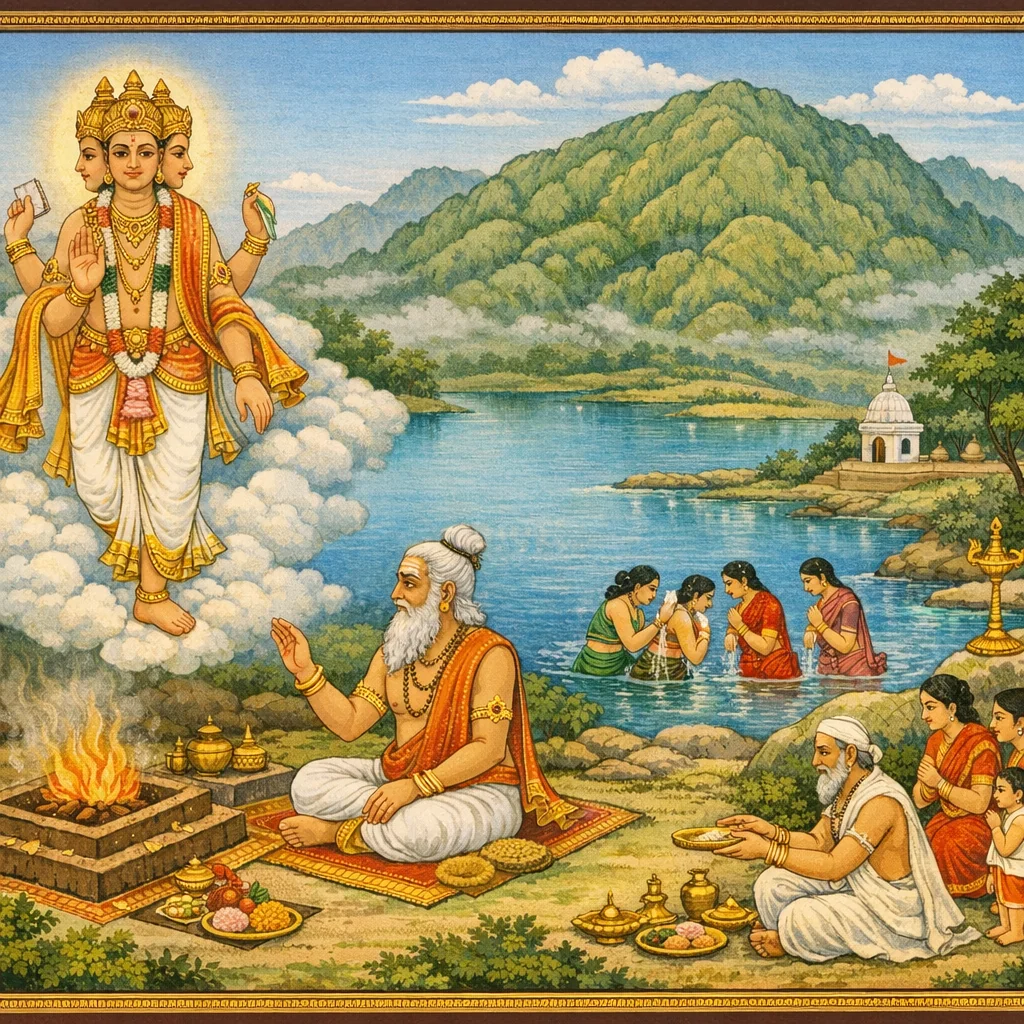
The chapter recounts Pulastya’s narration of how Tripuṣkara becomes established on Mount Arbuda. Brahmā (Padmayoni) is portrayed as proceeding toward Puṣkara to perform sandhyā worship, in keeping with his vow to honor the sandhyā at Tripuṣkara for as long as he remains in the human world. As Vasiṣṭha’s sacrificial rite (yajña) continues, Vasiṣṭha intervenes, declaring that the proper karmakāla—the due time for the ritual’s fruition—has arrived, and that without Brahmā’s presence the sacrifice cannot be completed. He therefore requests Brahmā to bring Tripuṣkara to the sacrificial ground, perform sandhyā worship there, and then preside as the divine authority over the rite. After contemplation, Brahmā brings the threefold Puṣkara (jyēṣṭha–madhya–kaniṣṭha; the triad of Puṣkara tīrthas) to a highly meritorious water-reservoir on Arbuda; from that point Tripuṣkara is said to abide at Arbuda. The phalaśruti adds that one who, with composure, bathes and gives gifts on the Kārttika full-moon attains enduring worlds; and to the north lies the excellent Sāvitrī-kuṇḍa, where snāna and dāna lead to auspicious attainment.
Shlokas
Verse 1
पुलस्त्य उवाच । ततस्त्रिपुष्करं गच्छेदभीष्टं पद्मजस्य च । ब्रह्मणा तत्समानीतं पर्वतेऽर्बुदसंज्ञके
Pulastya said: Thereafter one should go to Tripuṣkara, beloved also of the Lotus-born Brahmā. That sacred place was brought there by Brahmā to the mountain known as Arbuda.
Verse 2
वसिष्ठस्य पुरा सत्रे वर्त्तमाने नराधिप । तस्मिन्नगे समायाता ब्रह्माद्याश्च सुरोत्तमाः
O King, long ago, when Vasiṣṭha’s sacrificial session was in progress, the foremost gods—beginning with Brahmā—gathered on that mountain.
Verse 3
प्रतिज्ञातं महाराज ब्रह्मणाऽव्यक्तजन्मना । यावत्स्थास्ये नृलोकेऽस्मिंस्तावत्सन्ध्यां त्रिपुष्करे । वंदयिष्यामि संप्राप्ते संध्याकाले समाहितः
O great king, Brahmā—whose birth is unmanifest—has vowed: “So long as I remain in this human realm, at Tripuṣkara I shall reverently worship Sandhyā at the proper time, with a collected mind.”
Verse 4
एतस्मिन्नेव काले तु प्रस्थितः पुष्करं प्रति । संध्यार्थं पद्मजो यावद्वसिष्ठस्तावदब्रवीत्
Just at that time, when the Lotus-born Brahmā set out toward Puṣkara for the Sandhyā rite, Vasiṣṭha spoke to him.
Verse 5
वसिष्ठ उवाच । कर्मकालश्च सम्प्राप्तो यज्ञेऽस्मिन्सुरसत्तम । स विना न त्वया देव सिद्धिं यास्यति कर्हिचित्
Vasiṣṭha said: “O best among the gods, the appointed time for the rite in this sacrifice has arrived. Without you, O Deva, it will never attain completion.”
Verse 6
तस्मादानय चात्रैव पद्मयोने त्रिपुष्करम् । संध्योपास्तिं ततः कृत्वा तत्र भूयः सुरेश्वर । ब्रह्मत्वं कुरु देवेश सत्रे चास्मिन्दयानिधे
Therefore, O Lotus-wombed One (Padmayoni), bring Tripuṣkara here itself. Having performed the worship of Sandhyā there, return again, O Lord of the gods; assume the office of Brahmā’s priest in this sacrificial session (satra), O Lord, ocean of compassion.
Verse 7
एवमुक्तो वसिष्ठेन ब्रह्मा लोक पितामहः । ध्यात्वा तत्रानयामास ज्येष्ठमध्यकनिष्ठिकम् । पुष्करत्रितयं चागात्सुपुण्ये सलिलाशये
Thus addressed by Vasiṣṭha, Brahmā, the grandsire of the worlds (Pitāmaha), meditated and brought there the three Puṣkaras—senior, middle, and junior—and arrived at that supremely holy reservoir of waters.
Verse 8
ततःप्रभृति संजातमर्बुदेऽस्मिंस्त्रिपुष्करम्
From that time onward, Tripuṣkara came into being here in Arbuda.
Verse 9
तत्र यः कार्तिके मासि पौर्णमास्यां समाहितः । स्नानं करोति दानं च तस्य लोकाः सनातनाः
Whoever, with a steady mind, bathes there and gives charity on the full-moon day in the month of Kārttika—his worlds (attainments) are eternal.
Verse 10
तस्य चोत्तरदिग्भागे सावित्रीकुण्डमुत्तमम् । स्नानदानादिकं कुर्वन्यत्र याति शुभां गतिम्
To its northern side lies the excellent Sāvitrī-kuṇḍa. By performing bathing, charity, and related rites there, one attains an auspicious destination.
Verse 54
इति श्रीस्कांदे महापुराण एकाशीतिसाहस्र्यां संहितायां सप्तमे प्रभासखण्डे तृतीयेऽर्बुदखंडे त्रिपुष्करमाहात्म्यवर्णनंनाम चतुष्पंचाशत्तमोऽध्यायः
Thus ends the fifty-fourth chapter, entitled “The Description of the Greatness of Tripuṣkara,” in the third subdivision (Arbuda Khaṇḍa) of the seventh major division (Prabhāsa Khaṇḍa) of the Śrī Skanda Mahāpurāṇa, within the Ekāśītisāhasrī Saṃhitā.