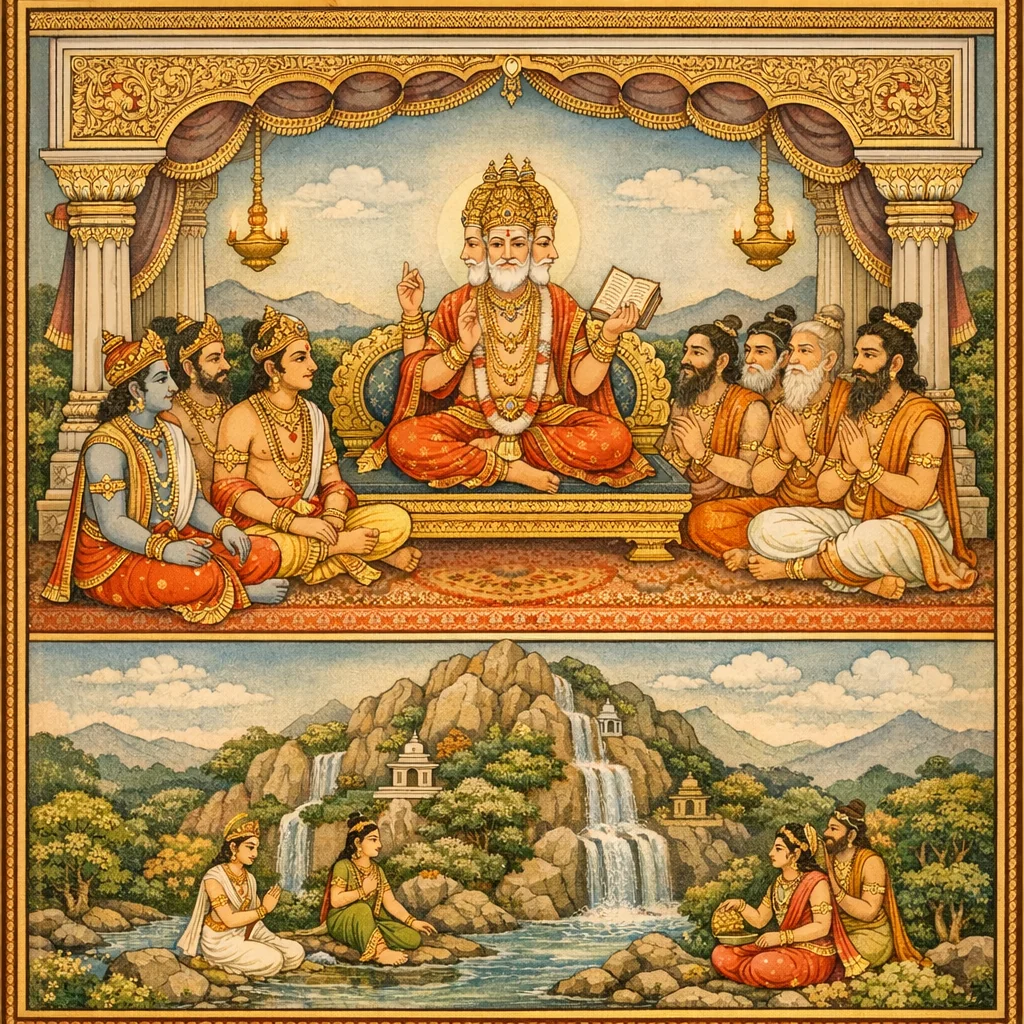
Adhyaya 10
Chapter 10 begins with King Yayāti asking Pulastya why Kedāra and the great rivers Gaṅgā and Sarasvatī are present in the Arbuda setting, seeking the reason for the site’s “kautuka” (a remarkable sacred anomaly). Pulastya answers through an embedded scene in which devas and ṛṣis approach Brahmā, and Indra requests a systematic account of yuga-measures and the moral character of each age. Brahmā states the durations of Kṛta, Tretā, Dvāpara, and Kali and explains dharma’s decline from four-footed to one-footed, with social and ritual decay in Kali-yuga. The tīrthas, personified, ask how they can endure in Kali; Brahmā appoints Arbuda as a mountain where Kali does not operate and directs the tīrthas to dwell there so their efficacy remains intact. The chapter then illustrates this teaching with the legend of the ascetic Maṅkaṇaka, who mistakes a bodily sign for siddhi and dances, disturbing cosmic order; Śiva intervenes, displays superior power (ash emerging from his thumb), and grants boons. Śiva proclaims the liberating, sin-purifying fruits of bathing in Sarasvatī, performing śrāddha at the Gaṅgā–Sarasvatī confluence, and giving gold according to one’s capacity. Thus the chapter weaves cosmological time, ethical diagnosis, sacred geography, and ritual instruction into a single tīrtha-māhātmya affirming Arbuda’s enduring sanctity.
Shlokas
Verse 1
ययातिरुवाच । केदारं श्रूयते ब्रह्मन्पर्वते च हिमाचले । गंगा तस्माद्विनिष्क्रान्ता प्रविष्टा पूर्वसागरम्
Yayāti said: “O Brāhmaṇa, Kedāra is said to be upon the Himālaya mountain. From there the Gaṅgā issued forth and entered the eastern ocean.”
Verse 2
तथा सरस्वती देवी चूतवृक्षाद्विनिर्गता । पश्चिमं सागरं प्राप्ता गृहीत्वा वडवानलम्
“Likewise, the goddess Sarasvatī emerged from the mango tree and reached the western ocean, bearing the submarine fire (Vaḍavānala).”
Verse 3
कथमत्र समायातः केदारश्चात्र कौतुकम् । सर्वं विस्तरतो ब्रूहि विचित्रं मम भूसुर
“How did Kedāra come here, and what is the wonder here? Tell me everything in detail, O venerable Brāhmaṇa, for it is marvellous to me.”
Verse 4
पुलस्त्य उवाच । सत्यमेतन्महाराज यन्नोऽत्र परिपृच्छसि । शृणुष्वावहितो भूत्वा यथा जातं श्रुतं तु वै
Pulastya said: “True indeed, O great king, is what you ask here. Listen attentively, and I shall relate it as it occurred and as it has been heard.”
Verse 5
गंगाद्यानि च तीर्थानि केदाराद्या दिवौकसः । मया सह पुरा देवाः शक्राद्या नृपसत्तमाः
“The tīrthas beginning with Gaṅgā, and the divine beings connected with places beginning with Kedāra—formerly, the gods led by Śakra were with me, O best of kings.”
Verse 6
ब्रह्माणं प्रति राजेन्द्र गताः सर्वे महर्षयः । सर्वे तत्र कथाश्चक्रुर्धर्म्या नाना पृथक्पृथक्
“O lord of kings, all the great seers went to Brahmā. There, each of them held various righteous discourses, separately and in diverse ways.”
Verse 7
समुदाये च देवानां सर्वतीर्थानि पार्थिव । क्षेत्राण्युप स्थितान्येव वनान्युपवनानि च
“O king, when the gods assembled, all sacred fords (tīrthas) were present there as well—along with the holy fields (kṣetras), forests, and sacred groves.”
Verse 8
ततः कथाप्रसंगेन इन्द्रः प्राह चतुर्मुखम् । कौतुकेन समायुक्तः पप्रच्छ नृपसत्तम
“Then, in the course of the conversation, Indra spoke to the Four-faced One (Brahmā). Filled with curiosity, he asked (him), O best of kings.”
Verse 9
इन्द्र उवाच । भगवन्पुण्यमाहात्म्यं श्रोतुमिच्छामि सांप्रतम् । प्रमाणं चैव सर्वेषां कृतादीनां पृथग्विधम्
Indra said: “O Blessed Lord, I wish to hear now the sacred greatness (māhātmya) of merit, and also the distinct measures of all the ages beginning with Kṛta.”
Verse 10
ब्रह्मोवाच । लक्षं सप्तदश प्रोक्तं युगमानं सुराधिप । अष्टाविंशतिभिः सार्द्धं सहस्रैः कृतमुच्यते
Brahmā said: O lord of the gods, the measure of a yuga is declared in lakhs. Kṛta-yuga is said to be seventeen lakhs, together with twenty-eight thousand (years).
Verse 11
लक्षद्वादशभिः प्रोक्तं युगं त्रेताभिसंज्ञितम् । षण्णवत्यधिकैश्चैव सहस्रैः परिमाणितम्
The yuga called Tretā is declared to be twelve lakhs, and it is measured further by ninety-six thousand (years) in addition.
Verse 12
लक्षाण्यष्टौ चतुःषष्टिसहस्रैः परिकीर्तितम् । ततो वै द्वापरं नाम युगं देवप्रकीर्तितम्
Next, the yuga called Dvāpara—proclaimed by the gods—is described as eight lakhs, together with sixty-four thousand (years).
Verse 13
लक्षैश्चतुर्भिर्विख्यातो द्वात्रिंशद्भिः कलिस्तथा । सहस्रैश्च सुरश्रेष्ठ युगमानमितीरितम्
O best of gods, Kali is renowned as four lakhs, together with thirty-two thousand (years); thus the measure of the yuga has been stated.
Verse 14
चतुष्पदः कृते धर्मः शुक्लवर्णो जनार्दनः । न दुर्भिक्षं न च व्याधिस्तस्मिन्भवति वै क्वचित्
In the Kṛta age, dharma stands firm on four feet, and Janārdana is of radiant white. In that time there is nowhere any famine, nor any disease at all.
Verse 15
क्रियते च तदा धर्मो नाकाले मरणं नृणाम् । लांगलेन विना सस्यं भूरिक्षीराश्च धेनवः
Then Dharma is truly practiced, and people do not die before their appointed time. Crops grow even without the plough, and cows yield milk in abundant plenty.
Verse 16
कामः क्रोधो भयं लोभो मत्सरश्चाभ्यसूयता । तस्मिन्युगे सहस्राक्ष न भवंति कदाचन
O Thousand-eyed one (Indra), in that age there never arise desire, anger, fear, greed, envy, or malice.
Verse 17
ततस्त्रेतायुगे जातस्त्रिपादो धर्म एव च । चिरायुषो नरास्तस्मिन्रक्तवर्णो जनार्दनः
Thereafter, in the Tretā-yuga, Dharma arises three-footed, established in threefold measure. In that age people are long-lived, and Janārdana (Viṣṇu) is of red hue.
Verse 18
तस्मिन्यज्ञाः प्रवर्त्तंते प्राणिनामिष्टदायिनः । न कामादिप्रवृत्तिश्च तस्मिन्संजायते नृणाम्
In that age, yajñas flourish, granting beings the fruits they desire. And among men there does not arise indulgence driven by desire and the like.
Verse 19
तपसा ब्रह्मचर्येण स्नानैर्दानैः पृथग्विधैः । तथा यज्ञैर्जपैर्होमैस्तत्र वृत्तिर्भवेन्नृणाम्
There, men’s way of life is shaped by austerity (tapas) and brahmacarya, by sacred baths and various forms of charity; likewise by yajñas, japa (recitation), and homa (fire-offerings).
Verse 20
ततस्तु द्वापरं नाम तृतीयं युग मुच्यते । द्विपदो धर्मः सञ्जातः पीतवर्णो जनार्द्दनः
Then comes the third age, called Dvāpara. Dharma stands on two feet, and Janārdana (Viṣṇu) is of yellow hue.
Verse 21
फलाकांक्षाप्रवृत्तानि जपयज्ञतपांसि च । सत्यानृतान्वितो लोको द्वापरे सुरसत्तम
In Dvāpara, japa, sacrifice, and austerity are undertaken with expectation of reward; and the world, O best of gods, is mixed with truth and untruth.
Verse 22
तत्रान्योन्यं महीपाला युयुधुर्वसुधातले । सुपूताश्च दिवं यांति यज्ञैरिष्ट्वा जनार्दनम्
There, kings fight one another upon the face of the earth; yet, well-purified, they go to heaven after worshipping Janārdana through sacrifices.
Verse 23
ततः कलियुगं घोरं चतुर्थं तु प्रव र्त्तते । एकपादो भवेद्धर्मः संत्रस्तो नित्यपूजने
Then the dreadful Kali-yuga, the fourth, begins. Dharma becomes one-footed, and people are troubled even in the matter of daily worship.
Verse 24
कृष्णवर्णो भवेद्विष्णुः पापाधिक्यं प्रवर्तते । माया च मत्सरश्चैव कामः क्रोधस्तथा भयम्
In that age, Viṣṇu is of dark hue, and the predominance of sin increases. Delusion (māyā), envy, desire, anger, and fear also prevail.
Verse 25
अर्थलुब्धास्तथा भूपा लोभमोहशतान्विताः । अल्पायुषो नरास्तत्र अल्पसस्या च मेदिनी
Rulers grow greedy for wealth, bound by hundreds of forms of greed and delusion. There, people are short-lived, and the earth yields scant harvests.
Verse 26
अल्पक्षीरास्तथा गावः सत्यहीना द्विजातयः । तत्र मायाविनो लोका जैह्व्यौपस्थ्यपरायणाः
Cows give little milk, and the twice-born are bereft of truth. People become deceitful, devoted to the cravings of the tongue and to sensual indulgence.
Verse 27
सत्यहीनास्तथा पापा भविष्यंति कलौ युगे । तत्र षोडशमे वर्षे नराः पलितकुन्तलाः
In the Kali Yuga, people will be bereft of truth and given to sin. There, even at sixteen years of age, men will have greyed hair.
Verse 28
नार्यो द्वादशमे वर्षे भविष्यंति सुगर्भिताः । भविष्यति क्रमाद्वर्णसंकरश्च सुराधिप
Women will conceive even in their twelfth year; and in due course, O lord of the gods, the mingling and confusion of social orders (varṇa-saṅkara) will arise.
Verse 29
एकाकारा भविष्यंति सर्ववर्णाश्रमाश्च वै । नाशं यास्यंति यज्ञाश्च कुलधर्मः सनातनः
All the varṇas and āśramas will become uniform and indistinct. Sacrificial rites will fall into ruin, and the ancient duties of families and lineages will perish.
Verse 30
व्यर्थानि तत्र तीर्थानि म्लेच्छस्पृष्टानि सर्वशः । भविष्यंति सुरश्रेष्ठ प्रभावरहितानि च
Then the tīrthas will become barren of fruit, defiled on every side by the mlecchas; and, O best among the gods, they will be bereft of their divine potency.
Verse 31
एतच्छ्रुत्वा ततो वाक्यं ब्रह्मणोऽव्यक्तजन्मनः । तत्र स्थितानि तीर्थानि ब्रह्माणमिदमब्रुवन्
Having heard these words of Brahmā, whose origin is unmanifest, the tīrthas present there spoke thus to Brahmā.
Verse 32
तीर्थान्यूचुः । कथं वयं भविष्यामः संप्राप्ते दारुणे कलौ । स्थानं नो ब्रूहि देवेश स्थातव्यं च सदैव हि
The tīrthas said: “How shall we endure when the dreadful Kali has arrived? O Lord of the gods, tell us a place where we may dwell—indeed, where we may remain always.”
Verse 33
ब्रह्मोवाच । अर्बुदः पर्वतश्रेष्ठः कलिस्तत्र न विद्यते । अतस्तत्र च गंतव्यं तीर्थैरायतनैः सह
Brahmā said: “Arbuda is the foremost of mountains; Kali does not exist there. Therefore you tīrthas should go there, together with your shrines and abodes.”
Verse 34
अपि कृत्वा महत्पापमर्बुदं प्रेक्षते तु यः । कलिदोषविनिर्मुक्तः स यास्यति परां गतिम्
Even if one has committed a great sin, whoever beholds Arbuda is freed from the faults of Kali and attains the supreme state.
Verse 35
पुलस्त्य उवाच । एवमुक्त्वा चतुर्वक्त्रो ब्रह्मलोकं गतो नृप । ततः सर्वाणि तीर्थानि गतानि च कलौ युगे
Pulastya said: “Having spoken thus, the four-faced Brahmā went to Brahmaloka, O king. Thereafter, in the Kali age, all the tīrthas departed to their appointed refuge.”
Verse 36
भूमावर्बुदशैलेन्द्रे संस्थितानि कलेर्भयात् । गंगा सरस्वती चैव यमुना पुष्कराणि च
Out of fear of Kali, they came to dwell on earth upon Arbuda, the lord of mountains—Gaṅgā, Sarasvatī, Yamunā, and the Puṣkaras as well.
Verse 37
कुरुक्षेत्रं प्रभासं च ब्रह्मावर्तं तथैव च । तिस्रःकोट्योऽर्द्धकोटिश्च यानि तीर्थानि भूतले
Kurukṣetra, Prabhāsa, and likewise Brahmāvarta—indeed, all the sacred tīrthas upon the earth, amounting to three crores and a half, are reckoned here.
Verse 38
तेषां वासश्च सञ्जातः पर्वतेऽर्बुदसंज्ञिके । एवं तत्र समापन्ना गंगा चैव सरस्वती
Their abode came to be upon the mountain known as Arbuda; thus, in that very place, Gaṅgā and Sarasvatī also arrived and became present.
Verse 39
तत्र शांता नराः सम्यक्परं निर्वाणमाप्नुयुः । श्राद्धं कृत्वा महाराज स्वर्गे यांति च पूर्वजाः
There, tranquil people rightly attain the supreme liberation; and, O great king, when śrāddha is performed there, the forefathers too go to heaven.
Verse 40
शृणु तत्राभवत्पूर्वं यदाश्चर्यं महामते । ऋषिर्मंकणकोनाम सरस्वत्यास्तटे स्थितः
Hear, O great-minded one, a wonder that occurred there long ago: a ṛṣi named Maṅkaṇa was dwelling on the bank of the Sarasvatī.
Verse 41
तपस्तेपे सुधर्मात्मा कामक्रोधविवर्जितः । तस्यैवं वर्तमानस्य क्षुतमासीत्कदाचन
That righteous-souled one practiced austerities, free from desire and anger; while he lived thus, hunger came upon him at a certain time.
Verse 42
पित्तं प्रपतितं तत्र तच्च रक्तमयं बभौ । तद्दृष्ट्वाऽतीव हृष्टः स मंकणर्षिर्बभूव ह
There, bile fell (from his body), and it appeared as though made of blood; seeing that, the sage Maṅkaṇa became exceedingly delighted.
Verse 43
सिद्धोऽहमिति विज्ञाय ततो नृत्यं चकार सः । तस्यैवं वर्तमानस्य जगत्स्थावरजंगमम्
Thinking, “I am accomplished (a siddha),” he then began to dance. As he went on in this manner, the whole world—moving and unmoving—was affected.
Verse 44
तत्र संक्षोभमापन्नं सागरा अपि चुक्षुभुः । गृहकृत्यानि संत्यज्य सर्वे विस्मयमा गताः
There arose a great agitation—even the oceans were churned. Abandoning their household duties, all beings came, struck with astonishment.
Verse 45
तस्यैवं नृत्यमानस्य सर्वे लोका नृपोत्तम । ननृतुः पार्थिवश्रेष्ठ प्रभावात्तस्य सन्मुनेः
As he danced in this manner, O best of kings, all the worlds danced as well—O foremost ruler—through the potency of that holy sage.
Verse 46
ततो देवगणाः सर्वे गत्वा कामनिषूदनम् । यथाऽयं नृत्यते नैव तथा कुरु महेश्वर
Then all the hosts of gods went to the Slayer of Kāma and said: “O Maheśvara, act in such a way that this one may no longer dance like this.”
Verse 47
अथ ब्राह्मणरूपेण शंभुनोक्तो द्विजोत्तमः । त्वया ब्रह्मंस्तपस्तप्तमधुना नृत्यते कथम्
Then Śambhu, having assumed the form of a brāhmaṇa, addressed that best of twice-born: “O Brahmin, you have practiced austerity—how is it that you are dancing now?”
Verse 48
मंकण उवाच । किं न पश्यसि हे ब्रह्मन्रक्तं पित्तं च मे स्थितम् । संजातं सिद्धिमापन्नो रक्तं पित्तं यतो मम
Maṃkaṇa said: “O Brahmin, do you not see that blood and bile are present in me? Since this has arisen in me, I have attained spiritual accomplishment (siddhi); therefore I dance.”
Verse 49
एतस्मात्कारणाद्धर्षाद्द्विज नृत्यं करोम्यहम् । एवमुक्तस्ततस्तेन देवदेवो महेश्वरः
“For this reason, out of exhilaration, O twice-born, I dance.” Thus spoken to by him, then the God of gods, Maheśvara (Śiva), responded.
Verse 50
तर्जन्या ताडयामास स्वांगुष्ठं नृपसत्तम । ततोंगुष्ठाद्विनिष्क्रांतं भस्म वै बिसपांडुरम्
With his forefinger he struck his own thumb, O best of kings; and from that thumb there issued ash, white as lotus-fiber.
Verse 51
ततो मंकणकं प्राह पश्य विप्र करान्मम । शुभ्रं भस्म विनिष्क्रांतं पश्य मे द्विज कौतुकम्
Then he said to Maṃkaṇa: “Look, O brāhmaṇa—see from my hand: bright white ash has emerged. Behold, O twice-born, this wondrous sign of mine.”
Verse 52
पुलस्त्य उवाच । तद्दृष्ट्वा विस्मितो विप्रो ज्ञात्वा तं वृषभध्वजम् । जानुभ्यामवनिं गत्वा वाक्यमेतदुवाच ह
Pulastya said: Seeing that, the brāhmaṇa was astonished; recognizing him as the Bull-bannered Lord (Śiva), he went down to the ground upon his knees and spoke these words.
Verse 53
मंकण उवाच । नूनं भवान्महादेवः साक्षाद्दृष्टः प्रसीद मे । निश्चितं त्वं मया ज्ञात एतन्मे हृदि वर्तते
Maṃkaṇa said: “Surely you are Mahādeva himself, seen directly—be gracious to me. I have certainly recognized you; this conviction abides in my heart.”
Verse 54
नान्यस्यायं प्रभावश्च त्वया यो मे प्रदर्शितः । मां समुद्धर देवेश कृपां कृत्वा महेश्वर
“This power that has been shown to me by you belongs to no other. Lift me up, O Lord of gods—show compassion, O Maheśvara.”
Verse 55
श्रीमहादेव उवाच । सम्यग्ज्ञातोऽस्मि विप्रेन्द्र त्वयाऽहं नात्र संशयः । वरं वरय भद्रं ते नृत्याधिक्यं यतः कृतम्
Śrī Mahādeva said: “You have rightly recognized me, O foremost of brāhmaṇas—there is no doubt. Choose a boon; blessings upon you, since such exuberant dancing has been performed.”
Verse 56
मंकण उवाच । येऽत्र स्नानं प्रकुर्वंति सरस्वत्यां समाहिताः । त्वत्प्रसादात्फलं तेषां राजसूयाश्वमेधयोः
Maṃkaṇa said: “May those who, with concentrated mind, bathe here in the Sarasvatī—by your grace—gain merit equal to that of the Rājasūya and Aśvamedha sacrifices.”
Verse 57
श्रीमहादेव उवाच । येऽत्र स्नानं करिष्यंति सरस्वत्यां समाहिताः । ते यास्यंति परं स्थानं जरामरणवर्जितम्
Śrī Mahādeva said: “Those who, with a collected mind, bathe here in the Sarasvatī shall attain the supreme abode, free from old age and death.”
Verse 58
अत्र गंगासरस्वत्योः संगमे लोकविश्रुते । श्राद्धं कुर्युर्द्विजश्रेष्ठ ते यास्यंति परां गतिम्
At this world-renowned confluence of the Gaṅgā and Sarasvatī, O best of the twice-born, those who perform śrāddha shall attain the highest goal.
Verse 59
सुवर्णं येऽत्र दास्यंति यथाशक्त्या द्विजोत्तमे । सर्व पापविनिर्मुक्तास्ते यास्यन्ति परां गतिम्
O best of the twice-born, those who give gold here according to their capacity are freed from all sins and attain the supreme state.
Verse 60
इत्युक्त्वांतर्दधे राजन्देवदेवो महेश्वरः
Having spoken thus, O King, Maheśvara—the God of gods—vanished from sight.